
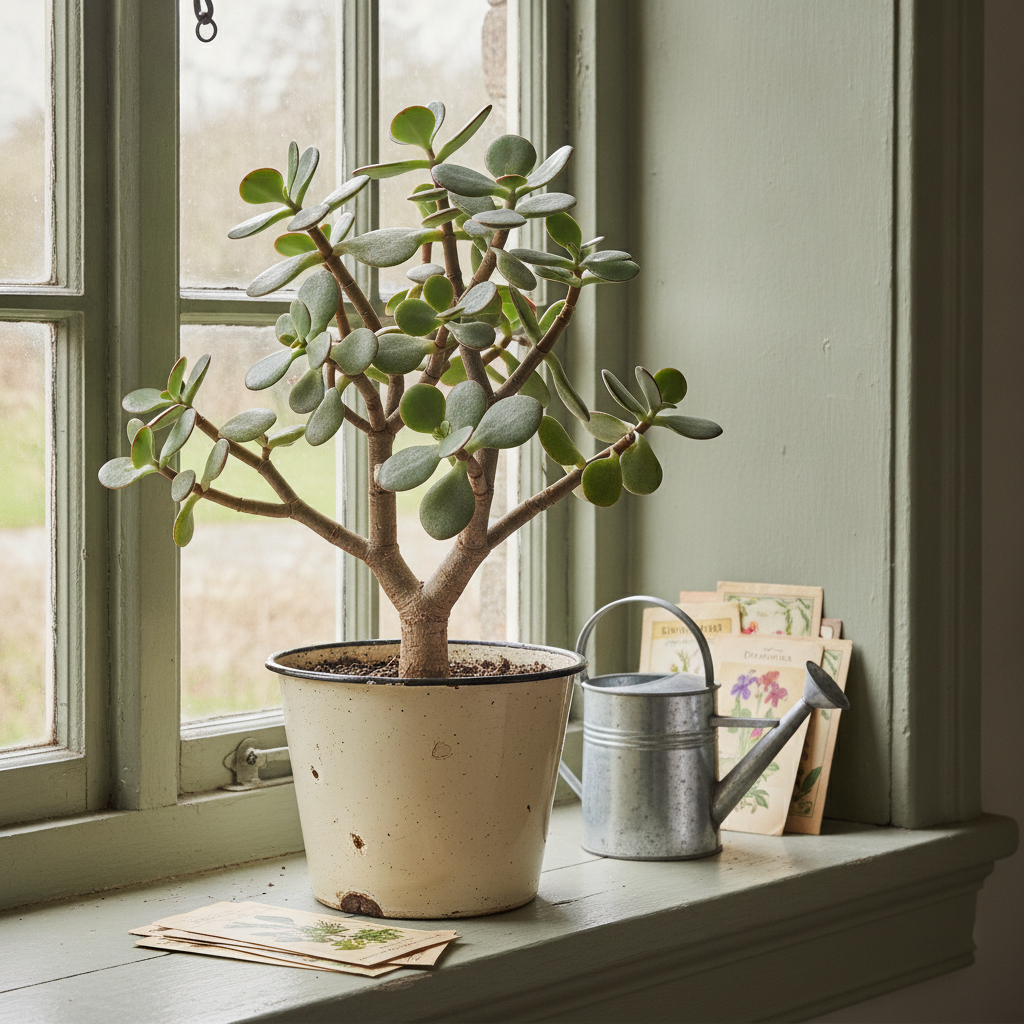
Few succulents carry their colour quite like the silver jade plant. Where the familiar green jade leans glossy and emerald, Crassula arborescens turns the other way entirely, clothing its branches in plump, almost circular leaves of dusty silver-blue, each one finished with a thin crimson rim and a scatter of fine red dots. It is sometimes sold as silver dollar jade, blue bird money plant, Chinese jade or beestebrood, and it hails from the rocky quartz slopes of South Africa’s Western Cape and the Little Karoo, where it grows into a stout, branching shrub well over a metre tall. Indoors it stays more modest, building slowly into a characterful miniature tree with a thick trunk and a rounded crown.
It has earned a reputation as one of the most forgiving of all houseplants, and for the most part that reputation is deserved. A silver jade will survive a surprising amount of neglect, shrugging off missed waterings and dry indoor air without complaint. Surviving and thriving, though, are two different things. The difference between a leggy, dull-leaved plant reaching desperately toward a window and a compact, silver-frosted specimen with red-blushed margins comes down to a handful of details, most of them about light and water. This guide walks through every one of them, from the ideal spot on your windowsill to propagating new plants from a single leaf.
Contents
- Quick Reference
- Why Silver Jade Plant Makes a Rewarding Houseplant
- Light Requirements
- Watering & Humidity
- Soil, Potting & Repotting
- Fertilising
- Propagation
- Pests & Diseases
- Popular Varieties
- Frequently Asked Questions
Quick Reference: Silver Jade Plant at a Glance
| Light | Very bright light, including several hours of direct sun; the brighter the better for colour and compact growth |
| Watering | Soak thoroughly, then let the soil dry out completely; roughly every 2 to 3 weeks in summer, monthly or less in winter |
| Temperature | 18 to 24C (64 to 75F) ideal; tolerates brief dips to about 4C (39F) but is not frost hardy |
| Humidity | Average to dry household air is perfect; no misting required |
| Fertiliser | Light feeding with a diluted low-nitrogen succulent feed two or three times across spring and summer |
| Toxicity | Mildly toxic to cats and dogs if eaten; can cause vomiting and lethargy |
Why Silver Jade Plant Makes a Rewarding Houseplant
The first thing most people notice about Crassula arborescens is the colour. The leaves are a genuine silvery blue, a shade that comes from a waxy bloom called farina coating the surface, which the plant produces to reflect harsh sun and reduce water loss. That same bloom gives the foliage a soft, powdery finish that catches light beautifully and sits in striking contrast to the warm woods and terracotta most people pot it in. Add the red leaf margins, which deepen to a rich burgundy in strong light, and you have a succulent that reads as far more ornamental than its easy reputation suggests.
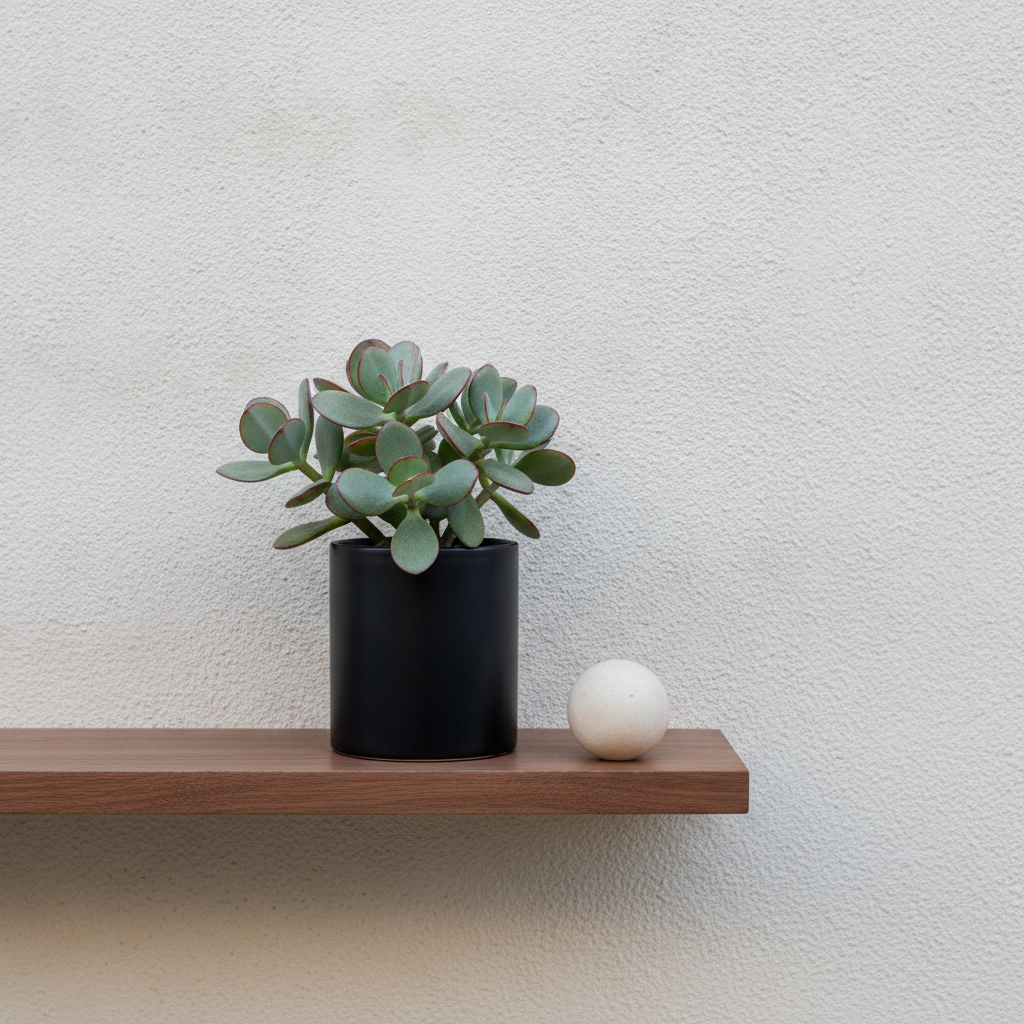
Beyond looks, this is a plant built for the realities of indoor life. As a succulent from a hot, dry, seasonally arid climate, it stores water in its thick leaves and stems, which means it positively prefers to be left alone between waterings. For anyone who travels, forgets, or simply wants a plant that does not demand daily attention, that drought tolerance is a genuine selling point. It is also long-lived, slow but steady, and develops a thickened, bark-covered trunk over the years that lends it the look of an aged bonsai with almost no intervention. Mature specimens may even produce clusters of small, star-shaped pink or white flowers in late winter when they have had a bright, cool resting period. The one real caution is toxicity, covered below, but for households without curious pets it is about as low-maintenance as a statement plant gets.
Important — Toxicity: The silver jade plant is considered mildly toxic to cats and dogs. If a pet chews the fleshy leaves it can suffer vomiting, lethargy and incoordination. Symptoms are usually mild and self-limiting, but place the plant out of reach of pets that like to nibble and contact your vet if you see a reaction.
Light Requirements
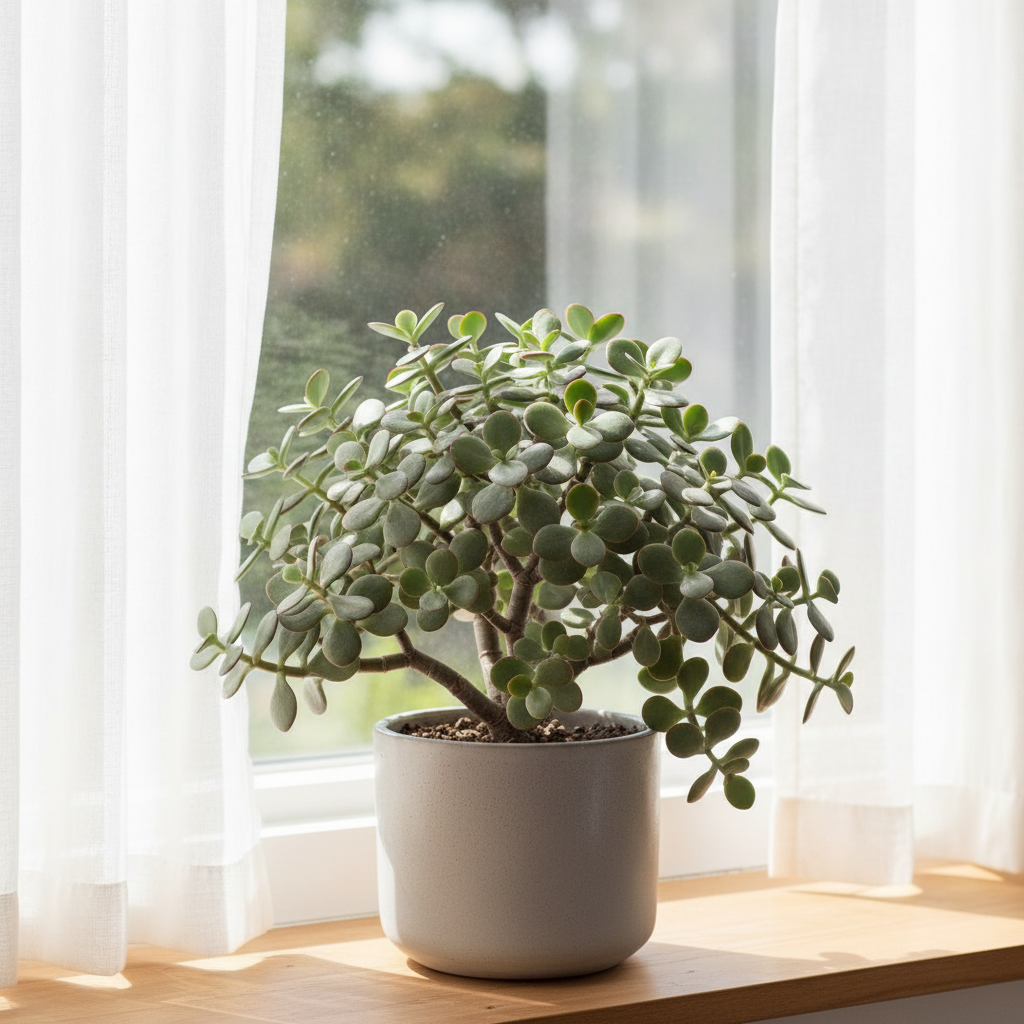
Light is the single most important factor in keeping a silver jade plant looking its best, and it is where most indoor specimens fall short. This is a full-sun plant in the wild, growing exposed on open hillsides, and it carries that need indoors. Give it the brightest position you can find and it rewards you with tight spacing between leaves, intense silver colour and red margins. Starve it of light and it stretches, the spaces between leaves lengthen, the silver fades toward a flat green and the whole plant takes on a sparse, reaching habit that no amount of later correction fully reverses.
The ideal indoor spot delivers at least four to six hours of direct sun a day, supplemented by bright indirect light for the rest of the daylight hours. A windowsill is almost always the right home for this plant. Unlike many tropical houseplants that scorch in direct sun, the silver jade is built for it, and the waxy bloom on its leaves acts as built-in sun protection. The only real risk of leaf scorch comes when a plant grown in low light is moved abruptly into fierce sun without time to adapt.
Light Levels Explained
It helps to think about indoor light in tiers, from the blazing brightness right against a sunny window down to the dim interior of a north-facing room. The table below shows roughly where the silver jade sits across that range and what to expect from each level.
| Light Category | Approx. Level | Typical Location | Outcome |
|---|---|---|---|
| Direct sun | 20,000 lux and above | On a south or west-facing windowsill | Ideal: compact growth, strong silver colour, red margins |
| Bright indirect | 10,000 to 20,000 lux | Just back from a sunny window | Good: healthy but slightly looser growth, paler colour |
| Medium | 5,000 to 10,000 lux | Middle of a bright room | Tolerated: noticeable stretching over time |
| Low | 1,000 to 5,000 lux | North-facing room, away from windows | Poor: weak, leggy growth and loss of colour |
| Very low | Under 1,000 lux | Interior corners, hallways | Decline: leaf drop and eventual death |
Window Orientation and Placement
South-facing window: In the northern hemisphere this is the best position of all, delivering the longest and strongest sun through the day. A silver jade will thrive pressed right up against the glass here year round.
West-facing window: An excellent second choice, offering several hours of strong afternoon sun. Colour and form stay good in a west window throughout the growing season.
East-facing window: Workable but on the dim side for this plant. Morning sun is gentler and shorter, so expect slightly looser growth and a paler bloom. Push the pot as close to the glass as possible.
North-facing window: Not enough light to keep a silver jade compact and colourful. The plant will survive for a while but steadily stretch and fade. If a north window is your only option, plan to supplement with a grow light.
Pro Tip — Rotate for Even Growth: Because this plant grows toward its light source, give the pot a quarter turn every week or two. Regular rotation keeps the crown balanced and stops the trunk leaning permanently toward the window.
How Light Affects Colour
The silver jade is one of those succulents that visibly tells you how happy it is through colour. In strong light the leaves develop their full silvery-blue bloom and the margins flush from pink to deep red, a mild form of stress pigmentation the plant uses to shield itself from intense sun. In weaker light those same leaves drift toward a uniform dull green, the red edges disappear and new growth comes in larger, thinner and more widely spaced. If your plant has lost its colour, the cause is almost always too little light rather than anything wrong with feeding or watering.
Warning — Direct Sunlight: While established silver jades love direct sun, a plant grown in low light has not built up its protective bloom and can scorch if moved straight into full sun. Acclimatise it over two to three weeks, increasing exposure gradually, to avoid pale or brown sunburn patches that will not recover.
Artificial Lighting
If natural light is limited, a full-spectrum LED grow light fills the gap well. Succulents like this one need fairly intense light, so position the lamp within 20 to 30cm (8 to 12in) of the crown and run it for 10 to 12 hours a day. A grow light is especially useful through the short, dim days of a northern winter, where it can prevent the seasonal stretching that otherwise spoils an otherwise healthy plant.
Seasonal Adjustments
Light changes dramatically through the year, and so should your plant’s placement. In summer a position with blazing all-day sun is fine. In winter, when the sun is weak and low, move the plant to your single brightest window and consider a grow light to maintain colour. A bright, cool, dry winter rest is also what triggers flowering in mature plants, so resist the urge to keep it warm and well watered through the cold months if you hope to see blooms.
Watering & Humidity
If light is where most silver jades fail to thrive, watering is where most of them actually die. As a true succulent, this plant stores its own water reserves and is built to endure long dry spells. The single most damaging thing you can do is keep the soil constantly moist. Master one simple rhythm, a thorough soak followed by a complete dry-out, and watering becomes the easiest part of its care.
When to Water
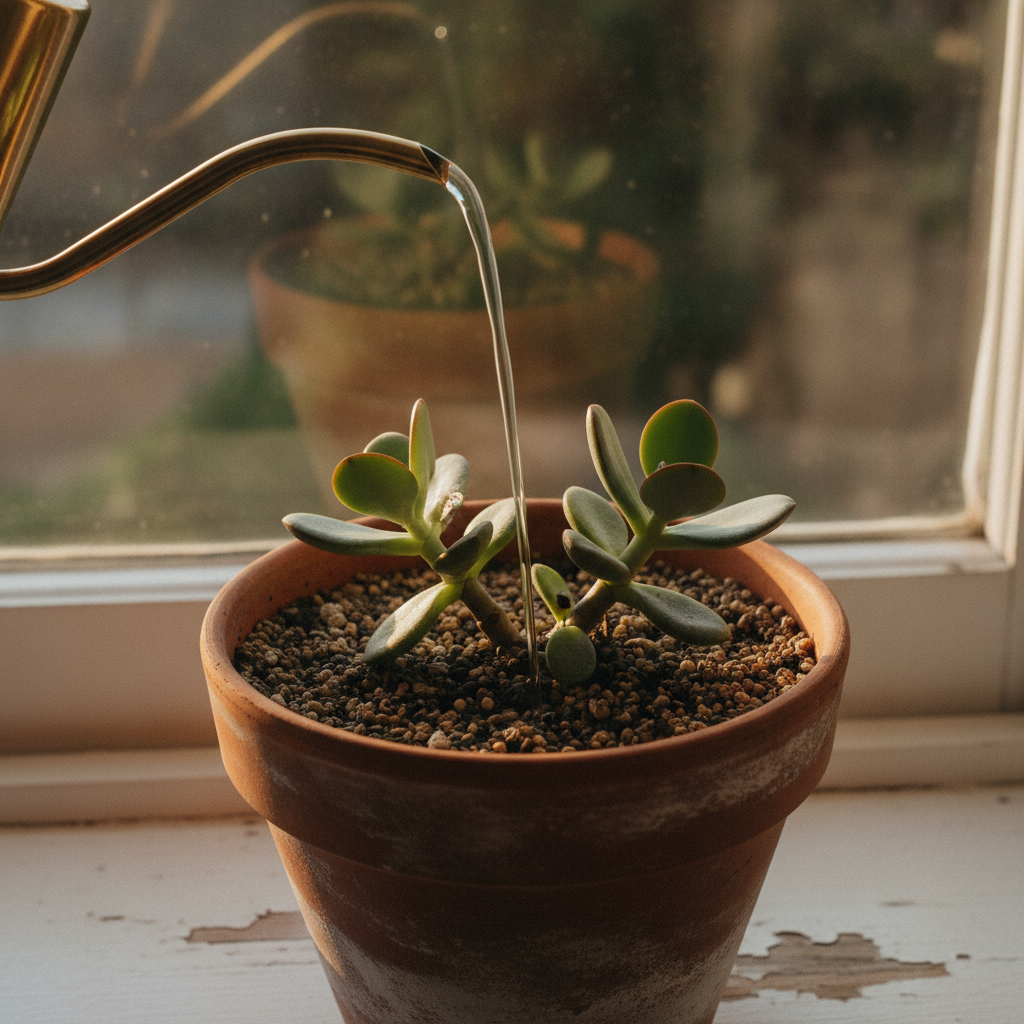
The rule is to water only when the soil has dried out entirely, top to bottom. Push a finger deep into the pot or lift it to feel the weight; a pot that feels light and a mix that is bone dry several centimetres down is your cue. In the active growing months of spring and summer this typically falls every two to three weeks, though the exact interval depends on your light, warmth and pot size rather than any fixed schedule.
In autumn and winter the plant slows right down and its water needs drop sharply. Watering once a month, or even less, is usually plenty during this resting period. The leaves themselves are a useful gauge: plump, firm leaves mean the plant is well hydrated, while leaves that look slightly soft, wrinkled or wilted are the plant drawing on its reserves and a clear sign it is genuinely ready for a drink.
Pro Tip — Read the Leaves: When in doubt, wait. A slightly wrinkled leaf rehydrates within a day of watering, but a leaf damaged by overwatering rots and cannot be saved. With this plant, underwatering is always the safer mistake.
How to Water Correctly
- Wait until the potting mix is completely dry all the way through.
- Water the soil directly at the base, avoiding the leaves and the crown where water can pool and cause rot.
- Add water slowly and steadily until it runs freely from the drainage holes, which ensures the whole root ball is wetted.
- Let the pot drain fully for a few minutes, then tip away any water left standing in the saucer or cachepot.
- Do not water again until the mix has dried out entirely, however long that takes.
Signs of Overwatering vs. Underwatering
| Symptom | Overwatering | Underwatering |
|---|---|---|
| Leaf colour | Yellowing, translucent or blackening leaves | Dull leaves that may take on stress red |
| Leaf texture | Soft, mushy, squishy to the touch | Wrinkled, thin and slightly flexible |
| Leaf drop | Sudden drop of swollen, soft leaves | Older lower leaves dry and shrivel first |
| Soil | Stays wet for days, may smell sour | Bone dry, pulling away from the pot edge |
| Stem base | Soft, brown or black, mushy trunk | Firm but the plant looks deflated overall |
Warning — Root Rot: A soft, blackened or foul-smelling stem base is root rot, the most common killer of this plant. If you catch it early, unpot the plant, cut away all mushy roots and stem tissue with a clean blade, let the cuts callus for a few days and replant the healthy top portion in fresh dry mix. A plant that is mushy through the trunk cannot usually be saved, but cuttings from firm growth often can.
Humidity Requirements
Here is where the silver jade makes life easy. Coming from a hot, dry climate, it is perfectly suited to the dry air of centrally heated and air-conditioned homes, the very conditions that trouble tropical houseplants. Average household humidity of 30 to 50 percent is ideal, and the plant has no need for the misting, pebble trays or humidifiers that ferns and calatheas demand.
In fact, high humidity works against this plant. Damp, stagnant air around the leaves raises the risk of fungal problems and rot, particularly if water settles in the crown. There is no symptom of low humidity to watch for here, because low humidity simply is not a problem for a succulent of this type.
The only humidity advice worth following is to ensure good air circulation, especially in winter and in damp rooms such as bathrooms. Gentle airflow keeps the leaves dry between waterings and discourages the fungal issues that thrive in still, moist conditions. Never mist a silver jade; it gains nothing and only invites trouble.
Water Quality
Silver jades are not fussy about water quality and ordinary tap water is fine for most homes. If your tap water is very hard you may eventually see a pale crust of mineral salts on the soil surface, which is cosmetic rather than harmful. Where water is heavily treated, letting it stand overnight or using collected rainwater avoids any build-up. Whatever you use, water at room temperature rather than cold straight from the tap.
Soil, Potting & Repotting
Everything about watering a silver jade depends on getting the soil right first. The wrong mix holds water against the roots no matter how carefully you water, while the right mix drains in seconds and dries quickly, making it almost impossible to overwater. For this plant, drainage is not a refinement, it is the foundation of good care.
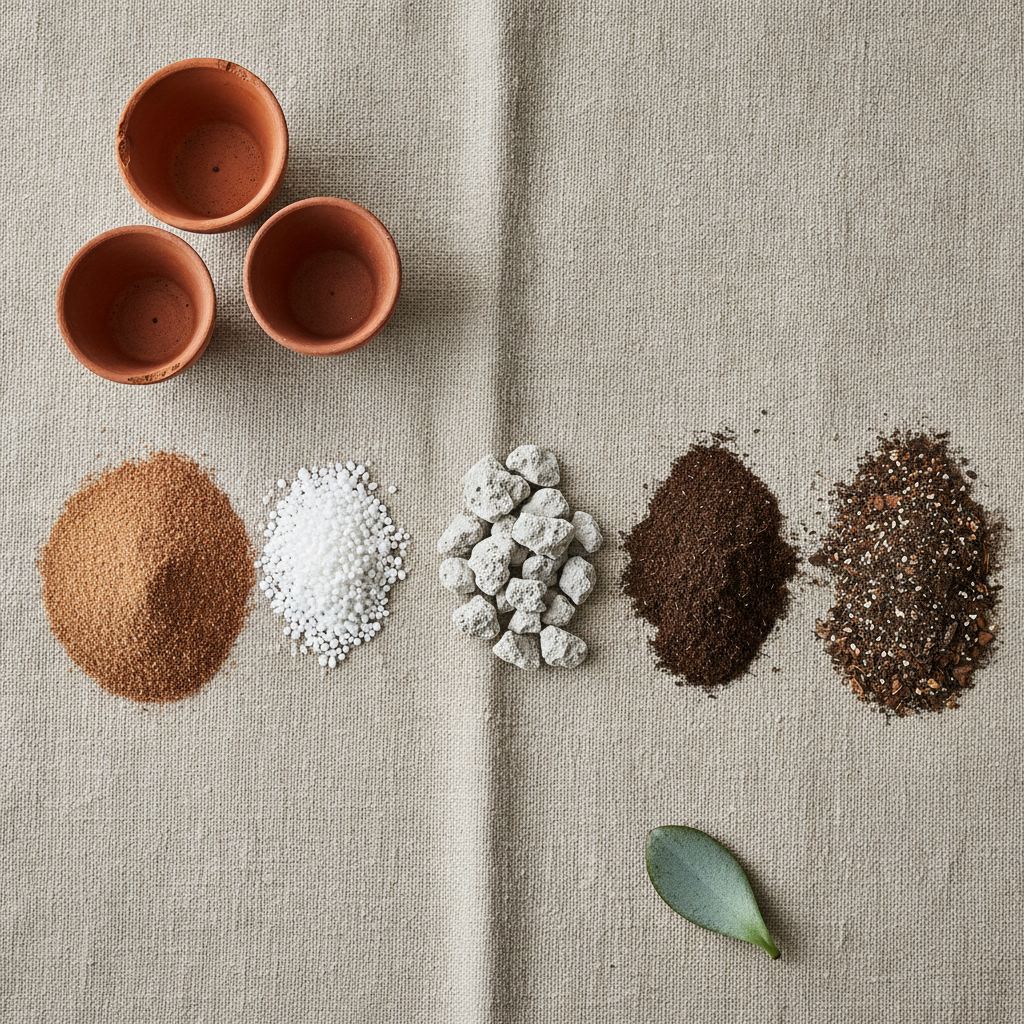
Ideal Soil Composition
A good silver jade mix is gritty, open and low in moisture-retaining material. A bagged cactus and succulent compost is the easy starting point, but most are still too rich and water-holding straight from the bag, so improve them by cutting in extra coarse grit. The aim is a substrate where water races through and air reaches the roots quickly. The table below shows a reliable blend.
| Component | Proportion | Function |
|---|---|---|
| Cactus and succulent compost | 2 parts | Base structure and modest nutrition |
| Coarse grit or pumice | 1 part | Rapid drainage and root aeration |
| Perlite | 1 part | Keeps the mix open and lightweight |
| Coarse horticultural sand | Half part | Adds weight and mineral grit |
The silver jade is unfussy about soil pH, growing happily in anything from slightly acidic to slightly alkaline, roughly 6.0 to 7.5. Far more important than chemistry is physical structure: a mix that drains fast and dries quickly matters far more than hitting any particular pH figure.
Pro Tip — Quick Mix Recipe: For a fast, foolproof blend, combine two handfuls of cactus compost with one handful of pumice and one of perlite. If water does not run straight through when you wet it, add more grit until it does.
Choosing the Right Pot
Pot choice has a direct effect on how often you can safely water and how stable the plant stays as it grows top-heavy. With this plant, a smaller, heavier pot usually beats a larger, lighter one.
Drainage holes are non-negotiable. Never plant a silver jade in a pot without drainage. Without a way for excess water to escape, even a perfect gritty mix will stay wet at the bottom and the roots will rot. If you love a decorative cachepot with no hole, keep the plant in a plain plastic nursery pot inside it and lift it out to water.
Pot material: Terracotta is ideal. The unglazed clay is porous and wicks moisture out of the soil, helping it dry faster and giving you a useful safety margin against overwatering. Its weight also anchors a top-heavy plant. Glazed ceramic and plastic both work but hold moisture longer, so water even more sparingly in them.
Pot size: Choose a pot only slightly larger than the root ball. An oversized pot holds a large reservoir of damp soil the small root system cannot use, which stays wet and invites rot. Silver jades are quite happy growing a little snug, and tight roots even help keep top growth compact.
When to Repot
This is a slow grower that dislikes disturbance, so repot infrequently, usually only every two to three years or when roots are clearly filling the pot and pushing through the drainage holes. The best time is spring or early summer at the start of active growth. Repot into a pot just one size up, and always into fresh dry mix rather than reusing tired old soil.
How to Repot: Step-by-Step
- Let the soil dry out fully before repotting, which makes the root ball easier to handle and reduces breakage.
- Ease the plant out by tipping the pot and supporting the trunk; never pull hard on the stem, as the brittle branches snap easily.
- Gently tease away the old soil from around the roots and inspect them, trimming off any that are blackened, soft or rotten with a clean blade.
- Part-fill the new pot with fresh gritty mix and set the plant at the same depth it sat before, never burying the trunk deeper.
- Fill in around the roots with more mix, firming lightly to remove air pockets without compacting it.
- Wait at least a week before watering, giving any disturbed or trimmed roots time to callus and heal first.
Warning — Transplant Shock: Watering immediately after repotting is a common cause of rot, because damaged roots cannot take up water and it simply sits around them. Always give the plant a dry settling-in period of a week or more before the first watering in its new pot.
Fertilising
Silver jades are light feeders by nature, adapted to the poor, mineral soils of their native hillsides. They will grow perfectly well with very little feeding, and overfeeding does far more harm than going without. Think of fertiliser as an occasional small boost during active growth rather than a regular requirement.
Too much fertiliser pushes soft, fast, weak growth that loses the plant’s tight, colourful character, and a build-up of fertiliser salts in the soil can scorch the roots. A modest hand here always beats a generous one.
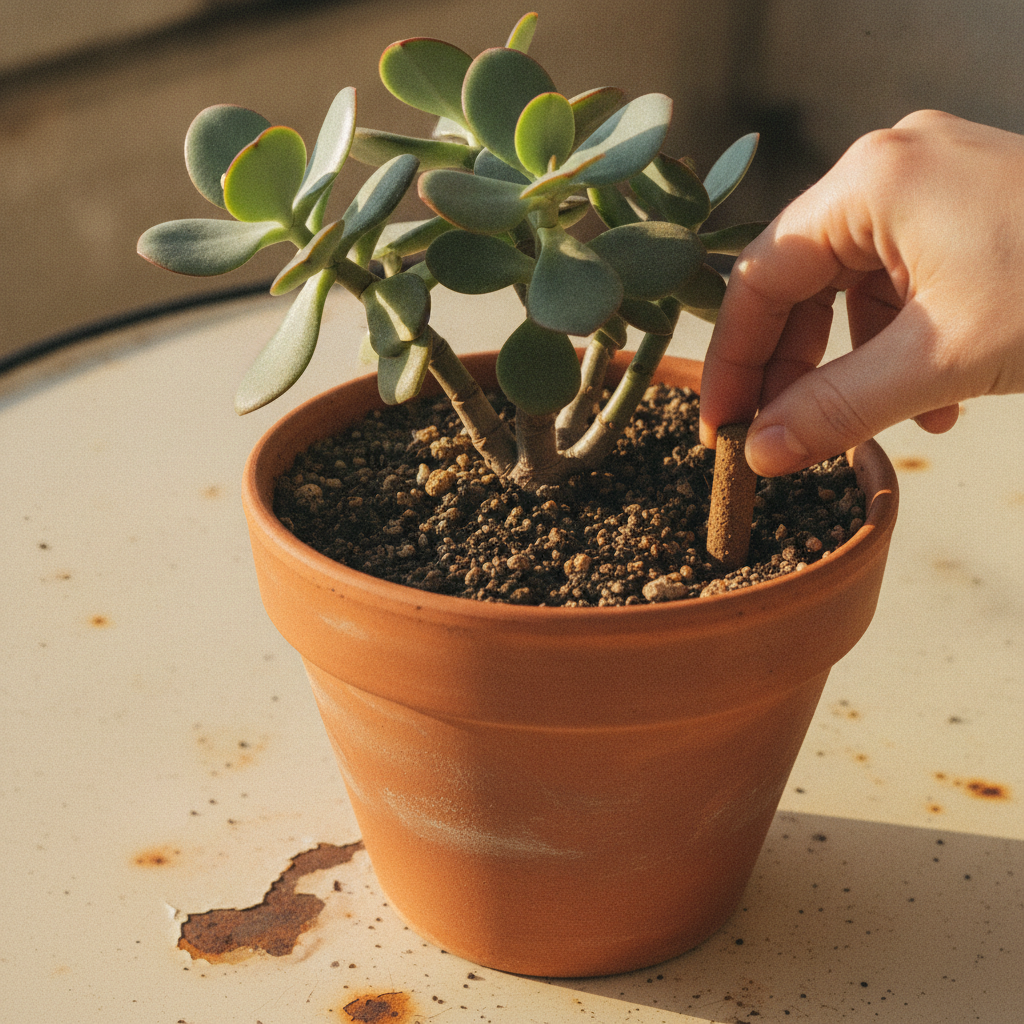
Understanding Plant Nutrients
Plant fertilisers are described by their NPK ratio, the proportions of nitrogen, phosphorus and potassium they contain, alongside smaller amounts of secondary nutrients and trace elements. For succulents like the silver jade, a balanced or low-nitrogen formula is best, because too much nitrogen drives leggy, soft growth at the expense of form and colour.
| Nutrient | Symbol | Primary Function | Deficiency Symptoms |
|---|---|---|---|
| Nitrogen | N | Leaf and stem growth | Pale, slow, stunted new growth |
| Phosphorus | P | Roots and flowering | Weak roots, poor flowering, dull leaves |
| Potassium | K | Overall vigour and stress resistance | Yellowing or browning leaf edges |
| Calcium | Ca | Cell wall strength | Distorted or weak new growth |
| Magnesium | Mg | Chlorophyll production | Yellowing between leaf veins |
| Iron | Fe | Healthy green colour | Pale yellowing of the newest leaves |
Types of Fertiliser
Liquid fertilisers: The easiest and most controllable choice. A liquid succulent or cactus feed diluted to half the recommended strength, mixed into your watering can, lets you feed lightly and stop the moment the growing season ends.
Slow-release granular: A small amount of slow-release feed worked into the soil at repotting releases nutrients gradually over months. It is low-effort, but you lose the fine control of liquid feeding, so use sparingly with a plant that needs so little.
Organic fertilisers: Gentle options such as diluted worm-casting tea release nutrients slowly and carry little risk of burning. They suit the modest needs of a silver jade well, though they offer less precision over exact nutrient levels.
Feeding Schedule
Feed only during the active growing season of spring and summer, and even then only two or three times across the whole period. Always feed at half strength or weaker, and never feed a dry plant; water first, or feed with your watering, so the dilute solution moves through moist soil rather than concentrating around dry roots. Stop feeding altogether in autumn and winter, when the dormant plant cannot use the nutrients and they simply accumulate as harmful salts.
Pro Tip — Less Is More: If you are unsure whether to feed, do not. A silver jade that is never fed will still grow happily for years, but one that is fed too much loses its compact shape and colour and risks root burn. With this plant, restraint is a feature, not a compromise.
How to Fertilise
- Dilute a succulent or balanced liquid fertiliser to half the label strength, or weaker.
- Water the plant lightly first, or apply the feed as part of a normal watering, so roots are never dosed while dry.
- Pour the diluted solution evenly over the soil until it begins to drain, avoiding the leaves.
- Tip away any run-off and do not feed again for at least four to six weeks.
Warning — Salt Build-Up: Fertiliser salts accumulate in the soil over time and can scorch roots, showing as brown, crispy leaf tips and a white crust on the soil surface. If you see this, flush the pot thoroughly with plain water several times to wash the salts out, and ease off feeding.
Propagation
Propagating a silver jade is genuinely easy and one of the most satisfying parts of growing it. Like most crassulas, it roots readily from both stem and leaf cuttings, drawing on the water and energy already stored in its fleshy tissue. A single broken branch or a leaf knocked off in handling can become a whole new plant with almost no effort.
The key principle behind all succulent propagation is the callus. A fresh cut surface must be allowed to dry and seal over before it touches soil or water, otherwise it absorbs too much moisture and rots before it can root. Patience at this one step is the difference between success and a pile of mush.
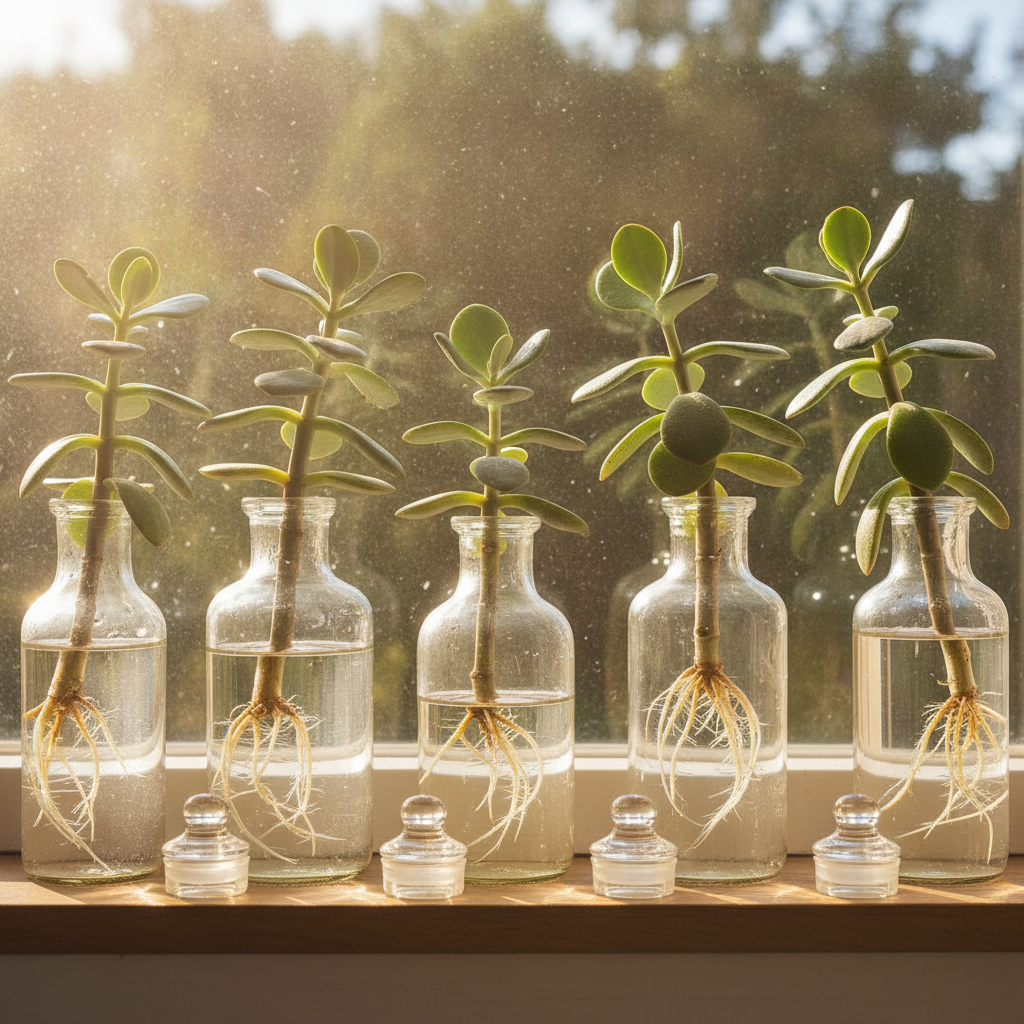
Understanding the Callus
When you take a cutting, the wound is an open door to rot-causing bacteria and fungi if it stays wet. Left in dry air for a few days, the cut surface dries into a firm, slightly shrunken callus that seals the tissue. Only once this callus has formed is the cutting ready to root, whether in soil or water. Skipping this stage is the single most common reason succulent cuttings fail.
Stem Cuttings: Step-by-Step
Stem cuttings are the fastest and most reliable method, giving you a sizeable new plant in one go. Take them in spring or summer when the plant is growing actively.
- Using a clean, sharp knife, cut a healthy stem section 8 to 12cm (3 to 5in) long, ideally with several pairs of leaves.
- Strip the lower leaves to leave a bare length of stem to insert, keeping the leaves you remove if you want to propagate those too.
- Set the cutting aside in a dry, shaded spot for three to seven days until the cut end has calloused over firmly.
- Insert the calloused end into lightly moistened gritty succulent mix, or stand it in a jar of water with the cut end just below the surface.
- Place it in bright, indirect light and keep soil cuttings barely moist; roots usually appear within two to four weeks.
- Once well rooted and showing new growth, treat the young plant as an adult and resume normal dry-and-soak watering.
Pro Tip — Free Plants from Pruning: Whenever you prune to shape the plant, do not throw the trimmings away. Healthy offcuts are ready-made cuttings, so callus and pot them up to build a collection or share with friends.
Leaf Cuttings: Step-by-Step
Leaf propagation is slower and less certain than stem cuttings but turns a single dropped leaf into a new plant, making it perfect for the leaves that inevitably come loose during handling.
- Gently twist a whole, healthy leaf cleanly from the stem so that the entire base comes away intact; a torn leaf will not root.
- Lay the leaf on a dry surface for two to three days until the base has calloused.
- Rest the calloused leaf on top of, or just barely touching, lightly moist gritty mix in a shallow tray.
- Keep it in bright, indirect light and mist the soil surface only very lightly every few days, never soaking it.
- After several weeks tiny roots and a miniature rosette form at the base; once the new plantlet is established the old leaf shrivels and can be removed.
Troubleshooting Propagation
| Problem | Likely Cause | Solution |
|---|---|---|
| Cutting turns soft and black | Inserted before calusing, or kept too wet | Allow a longer callus period and keep the mix barely moist |
| Cutting shrivels and dries up | Too little moisture, or no roots formed yet | Lightly moisten the mix and be patient; some shrinking is normal |
| No roots after many weeks | Light or temperature too low | Move to a warmer, brighter spot out of direct midday sun |
| Leaf cutting fails to sprout | Leaf base was torn rather than clean | Take a fresh leaf, twisting it off whole with the base intact |
Pests & Diseases
A healthy silver jade grown in bright light and a dry routine is remarkably resistant to pests and disease. Its biggest threats are not insects at all but the consequences of overwatering. Still, a few sap-sucking pests do occasionally find their way to it, and catching them early keeps them from becoming a problem.
Make a habit of glancing over your plant whenever you water, paying attention to the leaf joints and the undersides of leaves where pests like to hide. Early spotting makes treatment quick and simple, while an infestation left to build is far harder to clear.
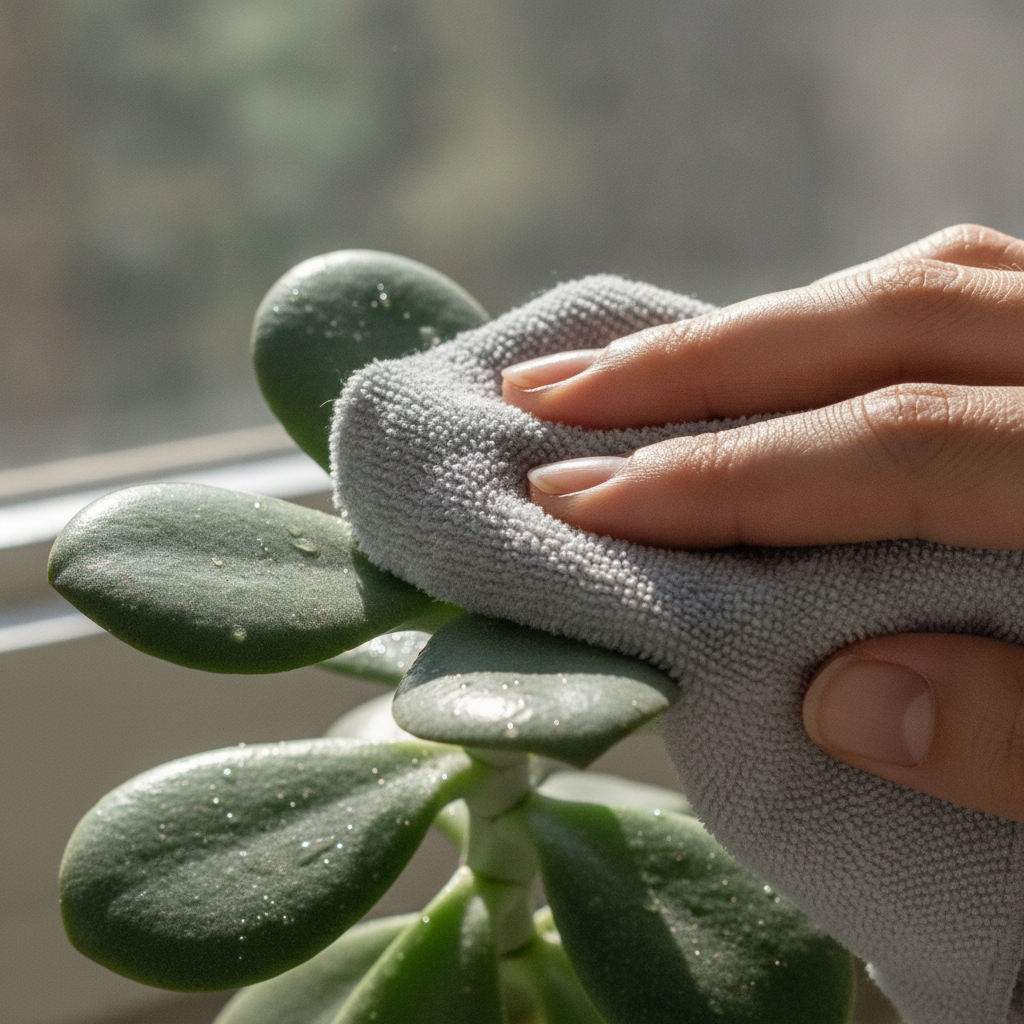
Common Pests
Mealybugs (Pseudococcidae)
Mealybugs are the number-one pest of jade plants, appearing as small, white, cottony tufts tucked into leaf joints and where leaves meet the stem. They suck sap, weakening the plant and leaving sticky honeydew that can turn to sooty mould.
Treatment: Dab each insect directly with a cotton bud dipped in isopropyl alcohol, which kills them on contact. For larger numbers, spray the whole plant with diluted insecticidal soap or neem oil and repeat every week until clear.
Spider Mites (Tetranychus urticae)
These tiny mites thrive in hot, dry conditions and are hard to see, betraying themselves through fine webbing between leaves and a faint stippling or bronzing of the foliage. They are less common on succulents than on thin-leaved plants but can still appear.
Treatment: Wipe the leaves to remove webbing and mites, then treat with neem oil or insecticidal soap. Improving air circulation around the plant helps discourage them from returning.
Scale Insects (Coccoidea)
Scale appear as small, hard, brown bumps clinging to stems and leaves. They do not move and are easily mistaken for part of the plant, but underneath they are sap-suckers that sap its vigour over time.
Treatment: Scrape or pick off individual scale, or loosen them with an alcohol-dipped cotton bud, then follow up with neem oil to catch any crawlers you missed.
Common Diseases
Root Rot (Phytophthora and Pythium species)
By far the most serious threat to a silver jade, root rot is caused by soil kept too wet for too long. It shows first as yellowing, soft, dropping leaves and a trunk that turns soft, brown or black at the base, and it can kill a plant quickly once established.
Treatment: Unpot the plant at once, cut away all soft, discoloured roots and stem tissue with a clean blade, and let the healthy remainder callus before replanting in fresh dry gritty mix. If the rot has reached the whole trunk, take cuttings from any firm growth to save the plant.
Powdery Mildew (Erysiphales)
Less common but possible in damp, stagnant conditions, powdery mildew appears as a dusty white coating on the leaves. It is encouraged by poor air movement and high humidity around the plant.
Treatment: Improve airflow, reduce humidity and remove badly affected leaves. A fungicide or a dilute solution of baking soda in water can be applied to stubborn cases.
Pest and Disease Summary
| Pest / Disease | Identification | Treatment |
|---|---|---|
| Mealybugs | White cottony tufts in leaf joints | Alcohol on a cotton bud, then neem oil |
| Spider mites | Fine webbing and stippled leaves | Wipe down, then insecticidal soap or neem |
| Scale | Hard brown bumps on stems and leaves | Scrape off, follow with neem oil |
| Root rot | Soft yellow leaves, mushy black trunk | Cut away rot, replant dry, take cuttings |
| Powdery mildew | Dusty white coating on leaves | Improve airflow, remove leaves, fungicide |
Prevention Strategies
Prevention with this plant comes down to good basic culture. A silver jade kept in bright light, watered only when fully dry and grown in a fast-draining mix is naturally resistant to almost everything that troubles it. Most problems trace back to overwatering, so getting the watering right is your strongest defence.
Beyond that, inspect new plants carefully before bringing them home and keep them apart from your collection for a couple of weeks to be sure they carry no hitchhiking pests. Good air circulation, clean tools and prompt removal of any fallen leaves around the base all help keep both pests and fungal problems at bay.
Pro Tip — Isolate and Inspect: Whenever you spot a pest, move the affected plant away from its neighbours before treating, and check the plants that sat closest to it. Pests spread easily between touching plants, and isolating early often contains an outbreak to a single pot.
Popular Varieties
Although Crassula arborescens is grown above all for its distinctive silver-blue foliage, the species includes two recognised subspecies and a handful of selected cultivars that play with leaf shape and colour intensity. They all share the same easy care, so choosing between them is purely a matter of looks.
It is worth keeping clear the difference between this silver jade and the far more common green jade, Crassula ovata. The two are close relatives and need identical care, but the silver jade’s rounder, flatter, frosted blue leaves set it firmly apart from its glossy green cousin.
| Variety | Leaf Appearance | Light Needs | Growth Rate | Availability |
|---|---|---|---|---|
| Species (subsp. arborescens) | Round, flat, silver-blue with red rims | Very bright to full sun | Slow | Common |
| ‘Blue Bird’ | Compact, intensely silver-blue, strong red margins | Very bright to full sun | Slow | Common |
| subsp. undulatifolia (Ripple Jade) | Wavy, undulating blue-grey leaves | Very bright to full sun | Slow | Fairly common |
| ‘Curly Pink’ | Twisted leaves with pink and red tones | Very bright to full sun | Slow | Less common |
| Variegated forms | Silver leaves marked with cream or yellow | Very bright to full sun | Very slow | Uncommon |
Featured Varieties
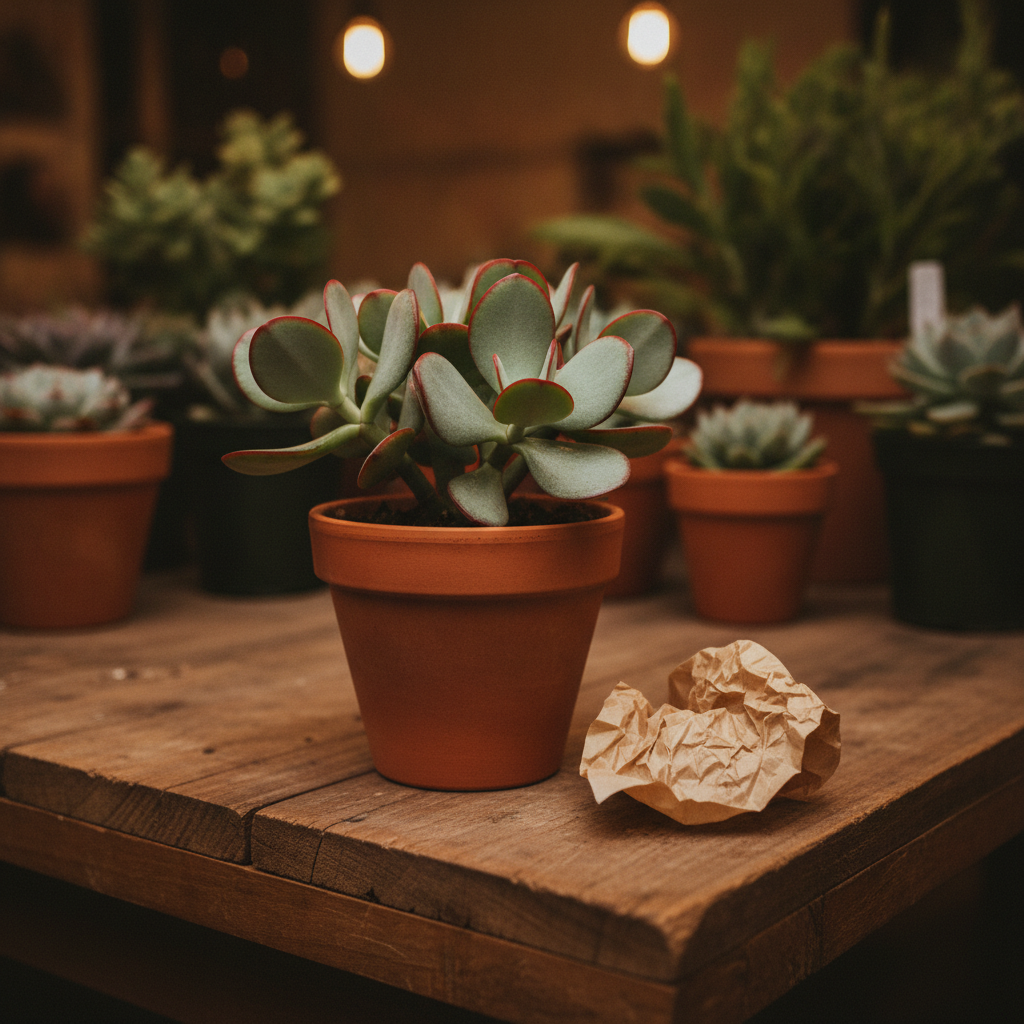
‘Blue Bird’
The most popular selected form, sometimes sold as blue bird money plant. It is more compact than the species, with especially intense silver-blue colour and pronounced red leaf margins that make it the showiest choice for a sunny windowsill.
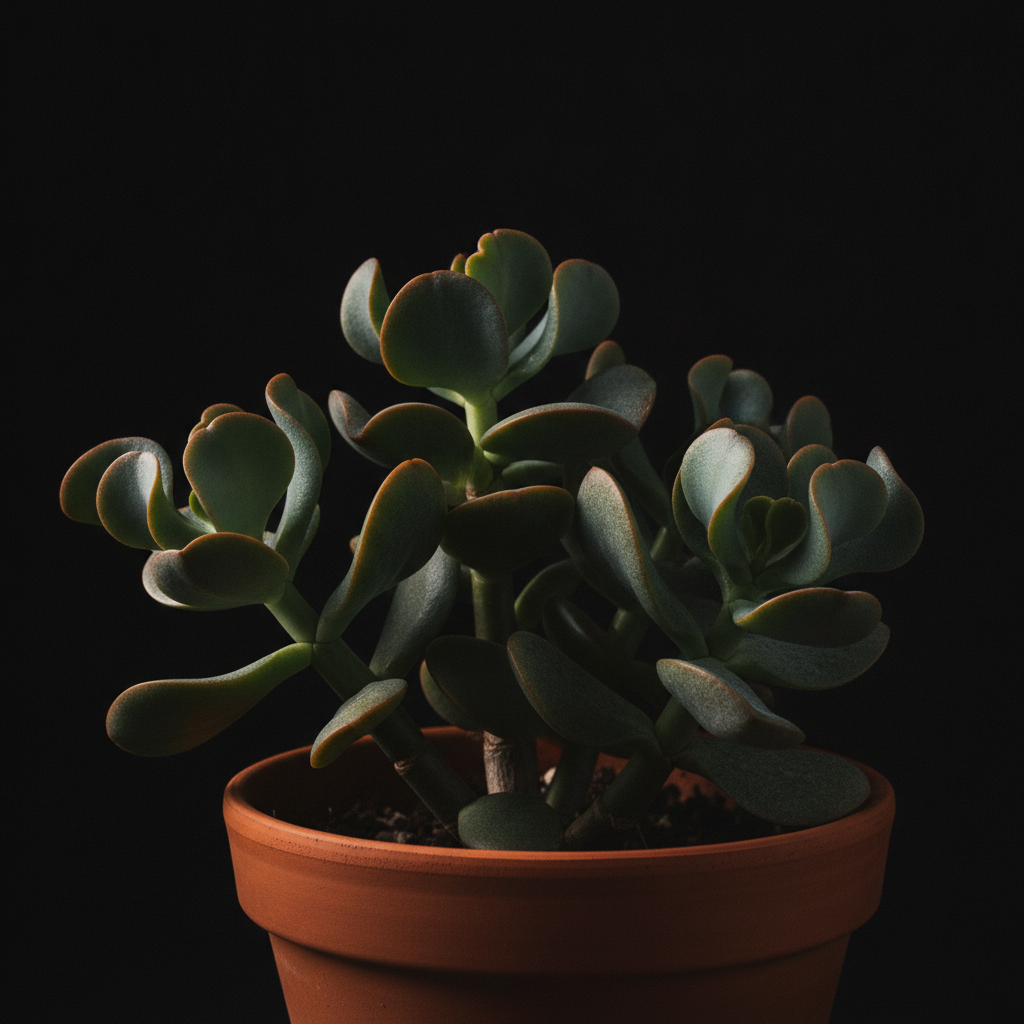
Ripple Jade (subsp. undulatifolia)
A naturally occurring subspecies prized for its wavy, undulating leaves that twist and ripple along the stem. The rippling adds sculptural interest while keeping the same frosted blue colour and undemanding care as the species.
Variety Profiles in Detail
‘Blue Bird’ (Crassula arborescens ‘Blue Bird’)
Bred for colour and compactness, ‘Blue Bird’ takes everything appealing about the species and dials it up. Its rounded leaves carry a heavier silver bloom and the red margins are bolder and more reliable, even in slightly less than perfect light. Because it stays naturally tidy it makes an outstanding specimen plant and the easiest variety to find in shops.
Ripple Jade (Crassula arborescens subsp. undulatifolia)
This subspecies trades the flat, coin-like leaves of the type for narrower leaves with a distinctive wave or curl along their length. The effect is more textural and architectural, and under strong light the wavy edges blush with the same red as the species. Care is identical, so it is simply a different look for the same reliable plant.
Choosing the Right Variety for Your Space
For most people the choice comes down to leaf shape and how much colour you want. If you are after the boldest silver-and-red display and the neatest habit, ‘Blue Bird’ is the clear pick. If you prefer texture and a more unusual form, the rippled subspecies stands out. Whichever you choose, give it the brightest spot you have, because the colour that makes these plants special only fully develops in strong light, regardless of variety.
Frequently Asked Questions
Why is my silver jade losing its silver colour and turning green?
This is almost always a sign of too little light. The silvery bloom and red margins develop in response to strong, direct sun, and in dimmer conditions the plant produces greener, larger leaves instead. Move it to your brightest window, or add a grow light, and new growth will return to its proper colour.
How often should I water my silver jade plant?
Water only when the soil has dried out completely, which is usually every two to three weeks in spring and summer and once a month or less in winter. There is no fixed schedule; let the dryness of the soil and the firmness of the leaves guide you rather than the calendar.
My silver jade’s leaves are wrinkled. Is it dying?
Wrinkled, slightly soft leaves usually just mean the plant is thirsty and drawing on its water reserves. Give it a thorough soak and the leaves should plump up within a day or two. If instead the leaves are soft and mushy rather than wrinkled, that points to overwatering, which is a more serious problem.
Is the silver jade plant toxic to cats and dogs?
Yes, it is considered mildly toxic to pets. If a cat or dog eats the leaves it may experience vomiting, lethargy and a lack of coordination. The effects are usually mild, but keep the plant out of reach of pets that like to chew and consult your vet if you notice symptoms.
Why is my silver jade plant stretching and leggy?
Leggy, stretched growth, known as etiolation, is the plant reaching for more light. The spaces between leaves lengthen and stems grow weak and pale. The only cure is more light; you can also prune back the stretched growth in spring to encourage a bushier shape, and the prunings make excellent cuttings.
Will my silver jade plant ever flower?
Mature, well-established plants can produce clusters of small star-shaped pink or white flowers in late winter. Flowering is triggered by a bright, cool and dry resting period through autumn and winter, so a plant kept warm and watered year round is much less likely to bloom than one given a proper cool rest.
How big does a silver jade plant get indoors?
In the wild it can reach well over a metre as a branching shrub, but indoors and in a pot it grows slowly and usually stays between 30 and 90cm (12 to 36in) over many years. Its slow pace and thick trunk make it a popular subject for bonsai-style training.
What is the difference between silver jade and the common jade plant?
Both belong to the genus Crassula and need the same care, but they are different species. The common jade, Crassula ovata, has glossy, deep green oval leaves, while the silver jade, Crassula arborescens, has rounder, flatter leaves with a frosted silvery-blue bloom and red margins.






