

Few small houseplants pack as much textural drama into so little space as the prayer pepper. Known to botanists as Peperomia caperata and to most growers as the emerald ripple peperomia, it is a compact, mound-forming plant from the cool, humid forests of Brazil, where its ancestors clung to mossy rocks and rotting logs rather than rooting in deep soil. The common name “prayer pepper” nods both to its membership in the pepper family, Piperaceae, and to the way its slender flower spikes rise like upheld candles above a cushion of deeply puckered, heart-shaped leaves.
Those leaves are the whole point. Heavily corrugated, almost quilted, and carried on short reddish stalks, they catch light in a way that flat-leaved plants never manage, shifting from deep forest green to a silvery or burgundy sheen depending on the cultivar and the angle of the sun. The prayer pepper has a reputation as an easy, near-indestructible desk plant, and that reputation is largely deserved. Yet there is a real difference between a prayer pepper that merely survives, sitting sullen and static for years, and one that thrives, pushing out fresh whorls of glossy foliage and throwing up its curious rat-tail blooms each summer. This guide covers everything that separates the two.
Contents
- Quick Reference
- Why Prayer Pepper Makes a Great Houseplant
- Light Requirements
- Watering & Humidity
- Soil, Potting & Repotting
- Fertilising
- Propagation
- Pests & Diseases
- Popular Varieties
- Frequently Asked Questions
Quick Reference: Prayer Pepper at a Glance
| Light | Bright indirect light; tolerates medium light well. No direct midday sun. |
| Watering | Allow the top half of the soil to dry out; semi-succulent and far happier slightly dry than soggy. |
| Temperature | 18 to 24 degrees C (64 to 75 degrees F). Keep above 10 degrees C (50 degrees F). |
| Humidity | Prefers 50 to 60 percent but tolerates average room humidity. |
| Fertiliser | Light feeder; balanced liquid feed at half strength once a month in spring and summer. |
| Toxicity | Non-toxic to cats, dogs and humans. Safe for pet households. |
Why Prayer Pepper Makes a Great Houseplant
The prayer pepper earns its place on windowsills and office desks through a combination of small size, striking texture and genuine resilience. Mature plants rarely exceed 20 to 25 cm (8 to 10 in) in height and spread, so a collection of several cultivars can sit happily along a single sill where a larger plant would crowd the glass. The semi-succulent leaves store moisture, which means the plant forgives the occasional missed watering far more readily than a fern or a calathea ever would. For anyone who travels, works long hours or is simply new to houseplants, that built-in tolerance is a powerful argument.
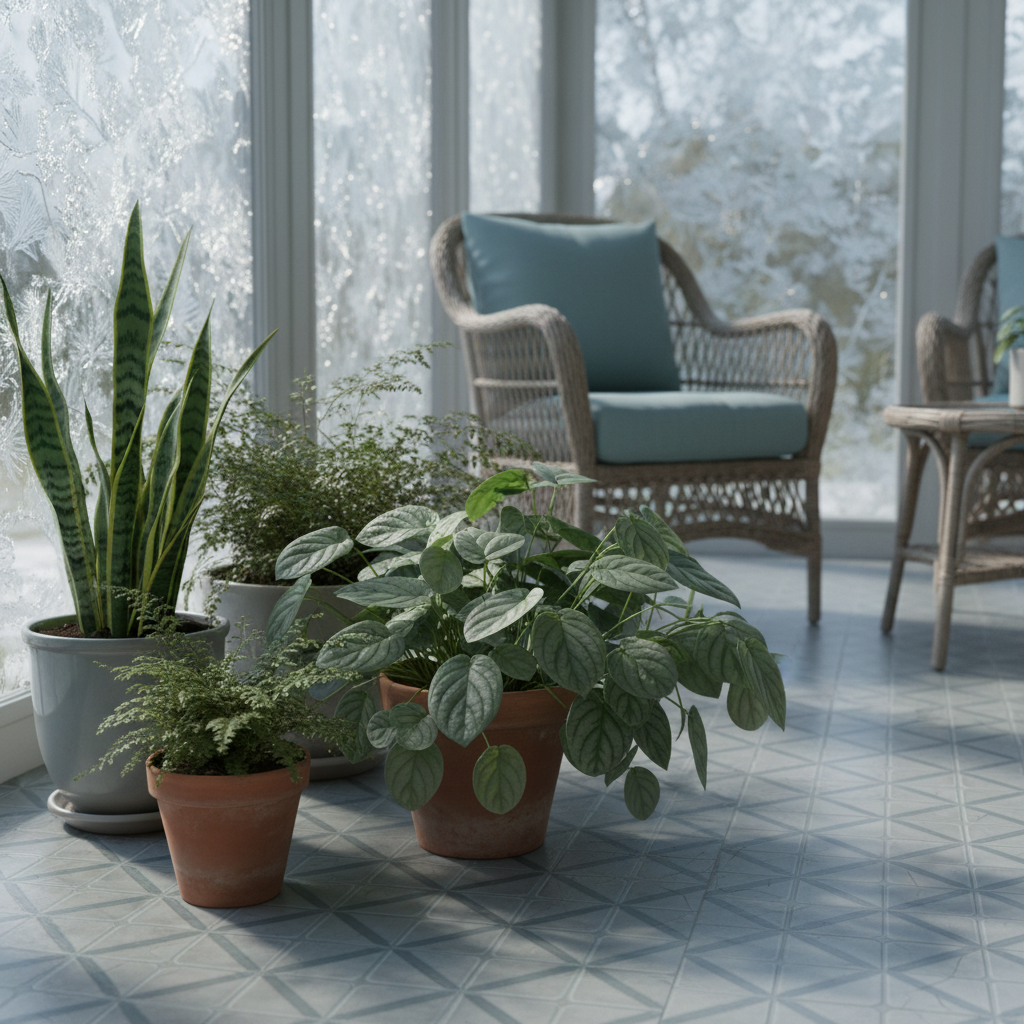
Beyond toughness, the plant offers year-round visual interest. The corrugated foliage looks good in every season, and in summer the slender greenish-white flower spikes add a quirky, sculptural note that few compact houseplants can match. Because the prayer pepper stays small and grows at a measured pace, it almost never outgrows its welcome, rarely needs repotting and is easy to propagate into gifts. It is also one of the relatively few popular foliage plants that is completely safe around pets and children, which removes a major worry for many households.
Important — Toxicity: The prayer pepper is listed as non-toxic to cats and dogs by the ASPCA, and it poses no poisoning risk to people. While no plant should be eaten and chewed leaves may cause mild stomach upset in a curious pet, you can grow this peperomia without the safety concerns that come with pothos, philodendron or dieffenbachia.
Light Requirements
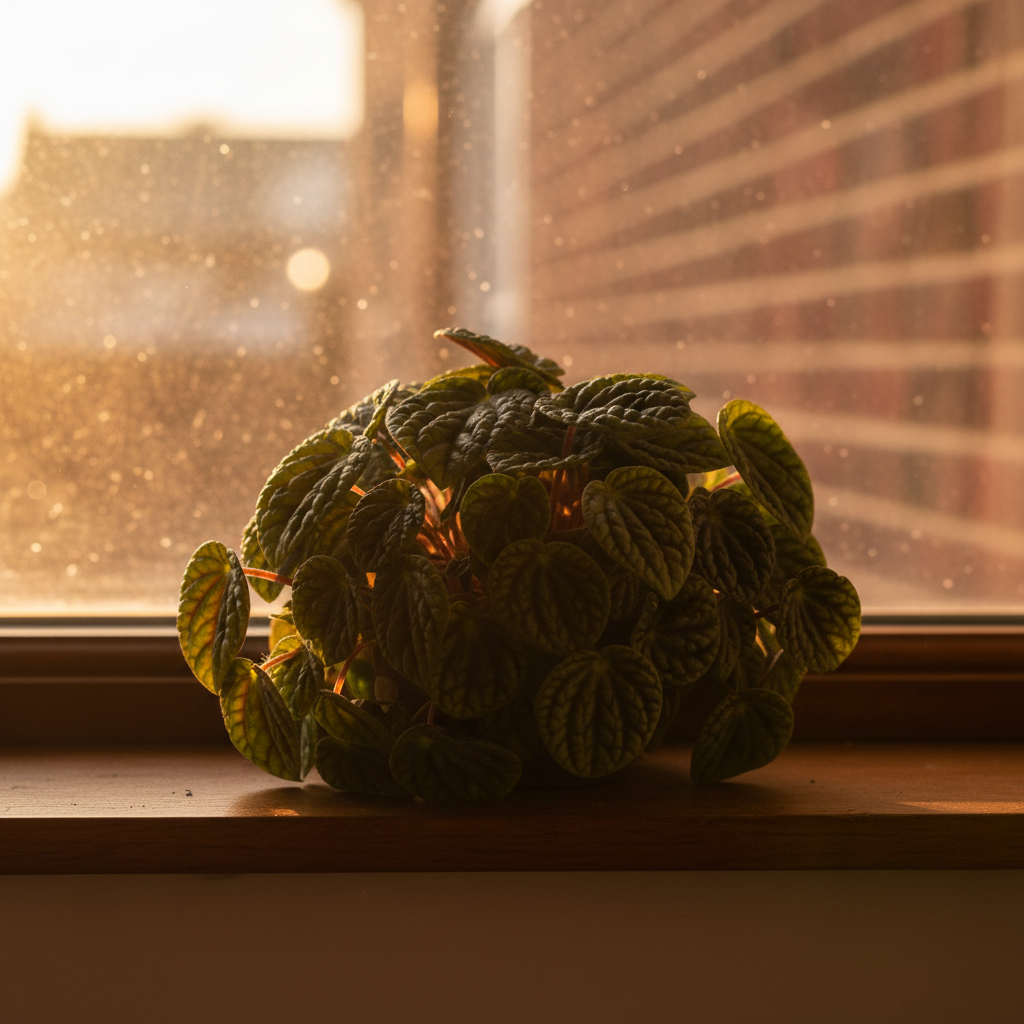
In its native Brazilian forests the prayer pepper grows on the shaded floor and on mossy rocks, beneath a canopy that filters the sun long before it reaches the leaves. That heritage shapes its needs indoors: it wants plenty of light, but light that has been softened and diffused rather than beamed directly onto the foliage. Bright indirect light produces the most compact growth and the richest leaf colour.
The ideal spot is a position that stays brightly lit through the day without the sun’s disc ever touching the plant. A few feet back from an east or west window, or directly at a north window, suits it perfectly. Unlike many trendy aroids, the prayer pepper is genuinely tolerant of medium light, so it will hold its colour and shape in spots where a fiddle leaf fig would sulk, which is exactly why it has become such a popular office and bathroom plant.
Light Levels Explained
Understanding how the prayer pepper responds across the spectrum of indoor light helps you read its behaviour and place it well. The table below summarises what to expect at each tier.
| Light Category | Approx. Level | Typical Location | Outcome |
|---|---|---|---|
| Direct sun | Over 50,000 lux | On an unshaded south sill | Leaves bleach, scorch and develop crisp brown patches |
| Bright indirect | 10,000 to 20,000 lux | Near an east or west window | Compact growth, deep colour, occasional flowering |
| Medium | 5,000 to 10,000 lux | A metre or two into a bright room | Healthy but slightly looser growth; reliable |
| Low | 1,000 to 5,000 lux | North corner, interior shelf | Slow growth, stretching, muted leaf colour |
| Very low | Under 1,000 lux | Windowless room | Decline over time; not sustainable |
Window Orientation and Placement
South-facing window: The brightest exposure and the riskiest for this plant. Set it back from the glass or filter the light through a sheer curtain so the leaves never receive direct midday rays, which scorch the delicate surface within hours.
East-facing window: An excellent choice. The gentle, low-angle light of morning gives the plant a useful energy boost before the day grows hot, and the foliage colours beautifully without any risk of burning.
West-facing window: Also very good, though the stronger afternoon sun means you should keep the plant a short distance back from the glass or behind a light curtain during summer.
North-facing window: Reliable and safe. A north sill provides the soft, even light the prayer pepper enjoys, with no danger of scorch. Growth will be a touch slower, but the plant stays healthy and well coloured.
Pro Tip — Read the Petioles: The reddish leaf stalks are an early warning system. When a prayer pepper stretches and the gaps between leaves grow long and the petioles thin, it is reaching for more light. Move it brighter before the once-tidy mound becomes a sprawl.
How Light Affects Leaf Colour
Light does more than fuel growth in the prayer pepper; it governs the depth and contrast of the foliage. In bright indirect light the green darkens, the silvery or burgundy sheen intensifies, and the corrugations cast crisp little shadows that give the leaf its quilted look. In dim conditions the same plant fades to a flat, washed-out green, the spaces between leaves lengthen, and red-leaved cultivars such as ‘Rosso’ or ‘Luna Red’ lose much of their colour. If a variety you bought for its richness has gone dull, the most likely cause is too little light rather than anything wrong with the plant.
Warning — Direct Sunlight: The thin, textured leaves of the prayer pepper have little defence against direct sun. Even an hour of harsh exposure can leave permanent bleached or papery brown patches that will not green up again. When moving a plant to a brighter position, increase the light gradually over a week or two rather than all at once.
Artificial Lighting
Because its light needs are modest, the prayer pepper is one of the easiest houseplants to grow entirely under artificial light, which makes it a natural fit for offices and windowless rooms. A standard full-spectrum LED grow light positioned 30 to 45 cm (12 to 18 in) above the plant for ten to twelve hours a day will keep it compact and well coloured. Ordinary ceiling lighting is not enough on its own, but a small desk grow lamp is more than sufficient for so undemanding a plant.
Seasonal Adjustments
As the days shorten through autumn and winter, indoor light can fall by more than half even in the same spot. Move the prayer pepper closer to its window for the darker months, and consider shifting a north-window plant to an east or west sill until spring. When the strong light of late spring returns, reverse the change so the plant is not suddenly exposed to fierce sun it has not seen for months.
Watering & Humidity
If there is one skill that separates a thriving prayer pepper from a dead one, it is restraint at the watering can. The semi-succulent leaves and stems store a reservoir of moisture, so the plant copes easily with a dry spell but rots quickly when its roots sit in saturated soil. More prayer peppers are killed by kindness, in the form of too-frequent watering, than by any pest or neglect.
When to Water
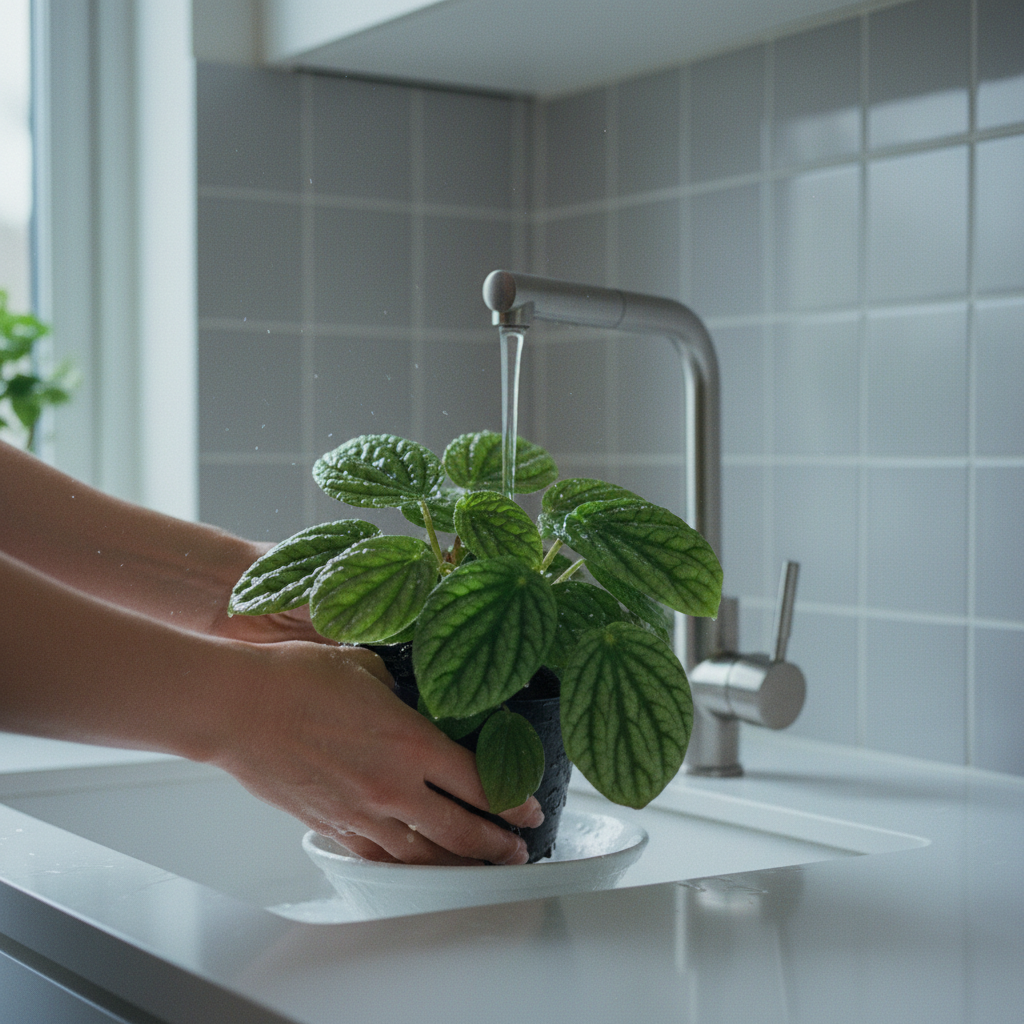
The reliable rule is to let the top half of the pot dry out before watering again. Push a finger into the soil to the second knuckle, and water only if it feels dry at that depth. In a bright spot through spring and summer this might mean watering every seven to ten days, while in winter the interval can stretch to two or even three weeks.
Resist the urge to water on a fixed schedule. The right interval depends on light, temperature, pot size and the time of year, all of which change. A plant in a warm, bright room in July will drink far more often than the same plant in a cool, dim room in January, so let the soil rather than the calendar decide. The plump, firm leaves of a well-watered prayer pepper will start to feel slightly soft and look a touch dull when the plant is genuinely thirsty, giving you a clear second signal alongside the dryness of the soil.
Pro Tip — Lift the Pot: The fastest way to judge watering need is to learn the weight of the pot. Lift it just after watering and again a week later. A pot that feels light and a soil surface that is dry to the touch together confirm it is time to water; a pot that still feels heavy means wait.
How to Water Correctly
- Check that the top half of the soil is dry before you begin.
- Water at the soil surface, taking care to keep the dense crown of leaves and stems as dry as you can, since trapped water sitting in the centre of the plant invites stem rot.
- Add water slowly until it runs freely from the drainage holes, ensuring the whole root ball is moistened.
- Let the pot drain completely for several minutes.
- Empty the saucer or cache pot so the plant never stands in collected water.
- Wait until the top half of the soil dries again before the next watering.
Signs of Overwatering vs. Underwatering
| Symptom | Overwatering | Underwatering |
|---|---|---|
| Leaf colour | Yellowing, often of lower leaves first | Dull, slightly faded green |
| Leaf texture | Soft, limp, translucent or mushy | Soft and wrinkled, recovering after watering |
| Soil | Stays wet for many days, may smell sour | Bone dry, pulling away from the pot edge |
| Roots | Brown, soft and foul-smelling | Dry but firm and pale |
| Stem base | Blackened, collapsing, mushy | Firm, simply a little shrunken |
Warning — Root and Stem Rot: The prayer pepper is exceptionally prone to rot at the base when overwatered, and a collapsed, blackened stem is often fatal once it sets in. If you catch it early, unpot the plant, cut away every soft brown root and stem, dust the cuts with cinnamon or a fungicide, and repot the firm remainder into fresh, barely-moist mix. Better still, take healthy leaf cuttings as insurance before the rot spreads.
Humidity Requirements
As a forest-floor plant from a humid climate, the prayer pepper appreciates moisture in the air and is happiest at around 50 to 60 percent relative humidity. Helpfully, though, its semi-succulent leaves make it far more tolerant of dry rooms than its rainforest origins might suggest, and it grows perfectly well in the average home without any special measures.
Problems only tend to appear when the air becomes very dry, as it can beside a radiator in winter. The signs are crisp brown leaf edges and slowed growth. If you see these, the plant is telling you the air around it has dropped too low for comfort.
To raise humidity, group the prayer pepper with other plants so they share the moisture they transpire, or stand the pot on a tray of pebbles topped up with water that sits just below the pot base. A small room humidifier is the most effective option of all in a centrally heated home. Misting is best avoided, because water settling in the dense crown of leaves encourages exactly the kind of rot this plant is prone to.
Water Quality
The prayer pepper is not especially fussy about water, but like most houseplants it does best with water at room temperature rather than straight from a cold tap. If your tap water is heavily chlorinated, leaving it to stand overnight allows the chlorine to dissipate. In hard-water areas, occasional use of filtered or rainwater helps prevent mineral build-up on the soil surface and around the roots over the long term.
Soil, Potting & Repotting
Everything about the prayer pepper’s roots points to one requirement: drainage. It is a shallow-rooted plant that in nature grows in little more than leaf litter and moss, so it needs a light, airy mix that holds a little moisture but never stays sodden. Get the soil right and most other care becomes easier, because a free-draining medium makes overwatering far harder to do.
Ideal Soil Composition
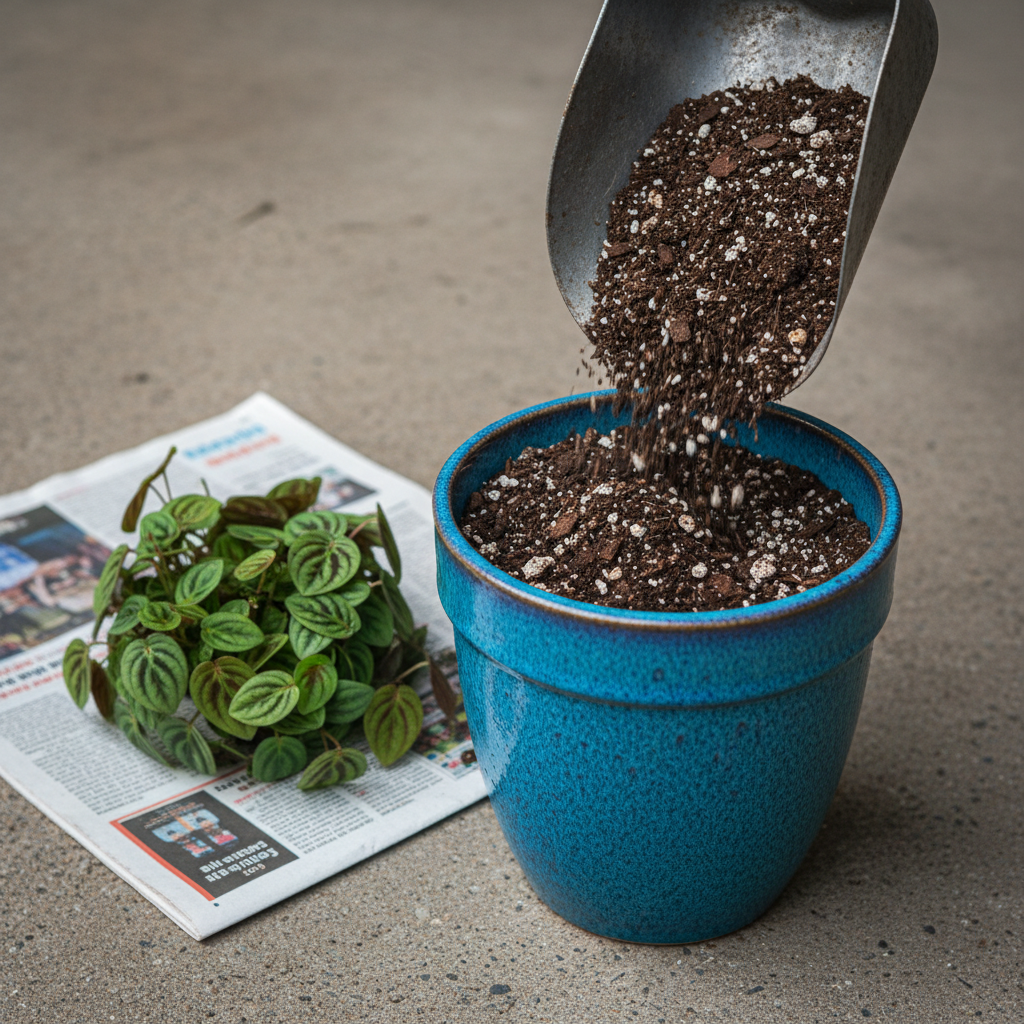
A good prayer pepper mix is open and quick-draining yet retains a little moisture and organic matter. The aim is a substrate that wets through evenly when watered but allows excess to run off in seconds rather than minutes. A blend built around coir or peat for moisture, with generous perlite for air, plus a little bark or worm castings, hits the mark.
| Component | Proportion | Function |
|---|---|---|
| Peat-free coir or quality potting compost | 50 percent | Holds moisture and provides body |
| Perlite or pumice | 30 percent | Opens the mix and keeps roots aerated |
| Fine orchid bark | 15 percent | Adds structure and prevents compaction |
| Worm castings | 5 percent | Supplies gentle, slow-release nutrition |
The prayer pepper prefers a slightly acidic to neutral root environment, somewhere around pH 5.5 to 6.5, which most peat-free and coir-based mixes provide naturally. There is no need to chase a precise figure; a good-quality houseplant compost lightened with perlite will sit comfortably in the right range.
Pro Tip — Quick Mix Recipe: If you want a simple, reliable blend, combine two parts standard houseplant compost with one part perlite and half a part orchid bark. This loose mix drains fast, resists compaction and suits not just the prayer pepper but most of the peperomia family.
Choosing the Right Pot
Because the prayer pepper has a small, shallow root system, the pot matters more than its size might suggest. A vessel that is too large holds a reservoir of wet soil the modest roots cannot use, and that lingering moisture is a direct route to rot.
Drainage holes are non-negotiable. Never plant a prayer pepper in a pot without a drainage hole. If you love a decorative cover pot, keep the plant in a plain plastic nursery pot inside it, and tip out any water that collects in the bottom after watering.
Pot material: Terracotta is an excellent choice for this rot-prone plant, because the porous clay wicks moisture from the soil and speeds drying between waterings. Plastic and glazed ceramic both work too, but with these you must be more disciplined about letting the soil dry, as they hold moisture longer.
Pot size: Choose a snug pot, only a centimetre or two wider than the root ball. The prayer pepper actively enjoys being a little pot-bound and a tight pot keeps the soil-to-root ratio sensible. When you do pot up, increase by just one size at a time.
When to Repot
The prayer pepper is a slow grower with a small root system, so it needs repotting only rarely, typically every two to three years. The signs it is ready are roots emerging from the drainage holes, water that runs straight through without wetting the soil, or a plant that has visibly stopped growing despite good care. The best time to repot is spring, as the plant enters its active growing season and can recover quickly. Often the only change needed is fresh mix in the same pot rather than a larger one.
How to Repot: Step-by-Step
- Water the plant a day or two beforehand so the root ball is moist but not wet, which reduces stress.
- Ease the plant gently from its pot, supporting the crown rather than pulling on the stems.
- Tease away the loose old soil and inspect the roots, trimming any that are brown, soft or rotten.
- Add a layer of fresh mix to the bottom of a clean pot only slightly larger than the last.
- Set the plant at the same depth it grew before, never burying the crown, and fill around it with fresh mix.
- Firm the soil lightly to remove air pockets without compacting it.
- Water sparingly, then keep the plant out of direct sun for a week while it settles.
Warning — Transplant Shock: Avoid the temptation to water heavily straight after repotting; freshly disturbed roots are vulnerable, and soggy soil at this moment is the most common cause of post-repotting rot. A light watering and a few days of patience serve the plant far better.
Fertilising
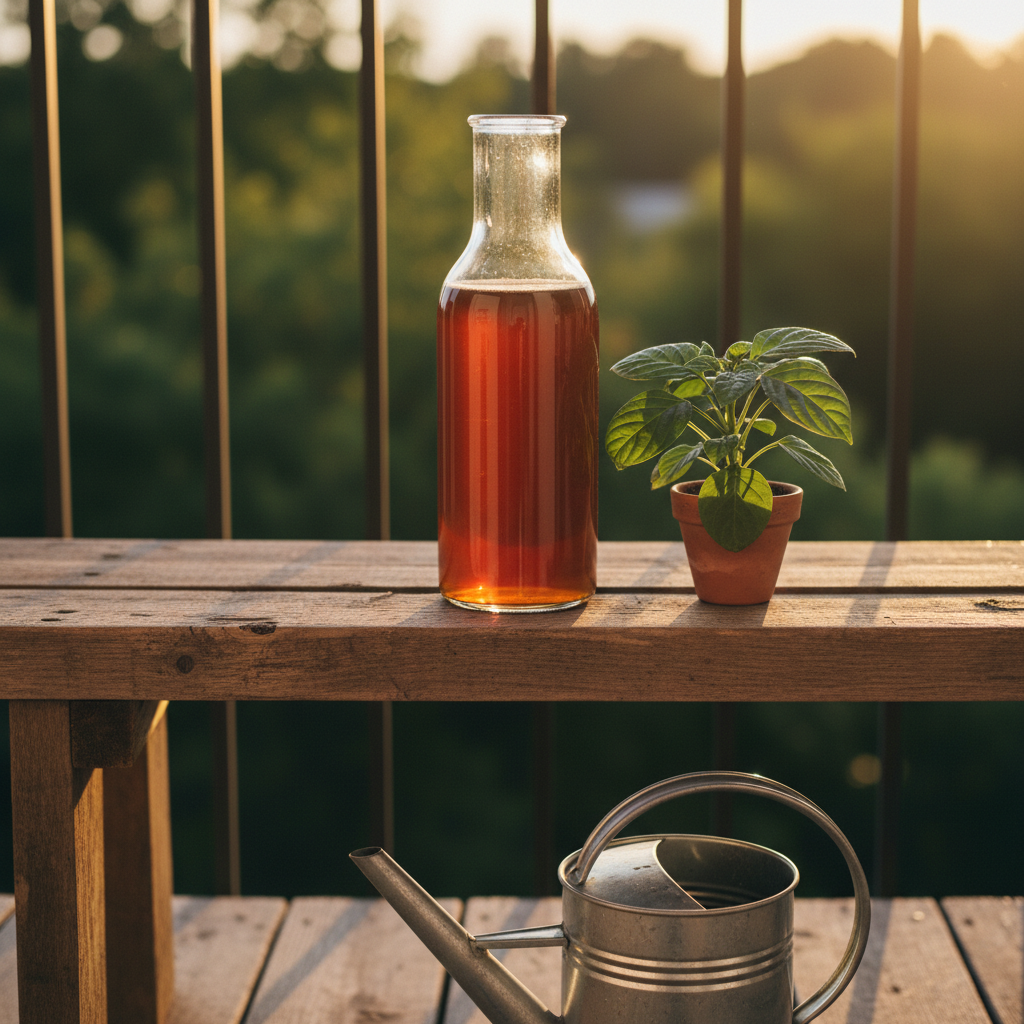
The prayer pepper is a light feeder by nature, adapted to the thin, nutrient-poor pockets of organic matter where it grows in the wild. It does not need heavy feeding, and a modest, regular dose through the growing season is far better than infrequent strong feeds.
Overfeeding is a real risk with so restrained a plant. Excess fertiliser salts accumulate in the small volume of soil and scorch the sensitive roots, showing up as brown leaf tips and a white crust on the soil surface. When in doubt, feed less.
Understanding Plant Nutrients
Most balanced houseplant fertilisers carry three headline numbers, the NPK ratio, representing nitrogen, phosphorus and potassium. For a foliage plant such as the prayer pepper, a balanced or slightly nitrogen-led feed supports healthy leaf growth, while a handful of secondary nutrients and trace elements round out its needs.
| Nutrient | Symbol | Primary Function | Deficiency Symptoms |
|---|---|---|---|
| Nitrogen | N | Leaf and stem growth, green colour | Pale, yellowing older leaves; slow growth |
| Phosphorus | P | Root development and flowering | Weak roots, dull foliage, poor blooming |
| Potassium | K | Overall vigour and water regulation | Brown leaf edges, weak stems |
| Calcium | Ca | Cell wall strength | Distorted new growth |
| Magnesium | Mg | Core of the chlorophyll molecule | Yellowing between leaf veins |
| Iron | Fe | Chlorophyll production | Pale new leaves with green veins |
Types of Fertiliser
Liquid fertilisers: The easiest and most controllable option for the prayer pepper. Diluted into the watering can, they let you feed little and often and stop instantly if the plant shows any sign of being overfed. A balanced liquid houseplant feed used at half the recommended strength is ideal.
Slow-release granular: Convenient for those who forget to feed, releasing nutrients gradually over several months. Use them at a reduced rate for this small, light-feeding plant, since a full dose can easily be too much for the modest root system.
Organic fertilisers: Worm castings, dilute seaweed extract and compost teas all suit the prayer pepper well, feeding gently and improving the soil over time. They are very hard to overdose, which makes them a forgiving choice for a plant so sensitive to excess.
Feeding Schedule
Feed the prayer pepper roughly once a month with a balanced liquid feed at half strength through the growing season, from mid spring to early autumn. Stop feeding entirely in late autumn and winter, when growth naturally slows and the plant cannot use the extra nutrients. Resuming too early in spring, before light levels recover, simply leaves unused salts in the soil.
Pro Tip — Always Feed Onto Moist Soil: Never apply fertiliser to dry roots, as concentrated nutrients hitting parched roots can burn them. Water lightly first, or feed as part of a normal watering, so the diluted solution spreads evenly through already-moist soil.
How to Fertilise
- Confirm the plant is in active growth and the soil is already slightly moist.
- Dilute a balanced liquid fertiliser to half the strength stated on the label.
- Apply the solution evenly across the soil surface until it just begins to drain.
- Avoid splashing the feed onto the leaves, where it can leave marks.
- Every couple of months, flush the pot with plain water to wash out any accumulated salts.
Warning — Salt Build-Up: A white or yellowish crust on the soil surface or around the pot rim signals a build-up of fertiliser salts. Flush the pot thoroughly with plain water several times to leach them out, and reduce how often or how strongly you feed in future.
Propagation
One of the great pleasures of the prayer pepper is how generously it propagates. Like the African violet, it can be multiplied from a single leaf, which means one healthy plant can become a windowsill full of young ones with very little effort and almost no special equipment.
The best time to propagate is spring and early summer, when warmth and lengthening days drive vigorous rooting. Propagation is also the ideal insurance policy: if a treasured plant begins to rot at the base, taking leaf cuttings from the healthy upper growth lets you save the cultivar even if the parent is lost.
Understanding Leaf and Petiole Cuttings
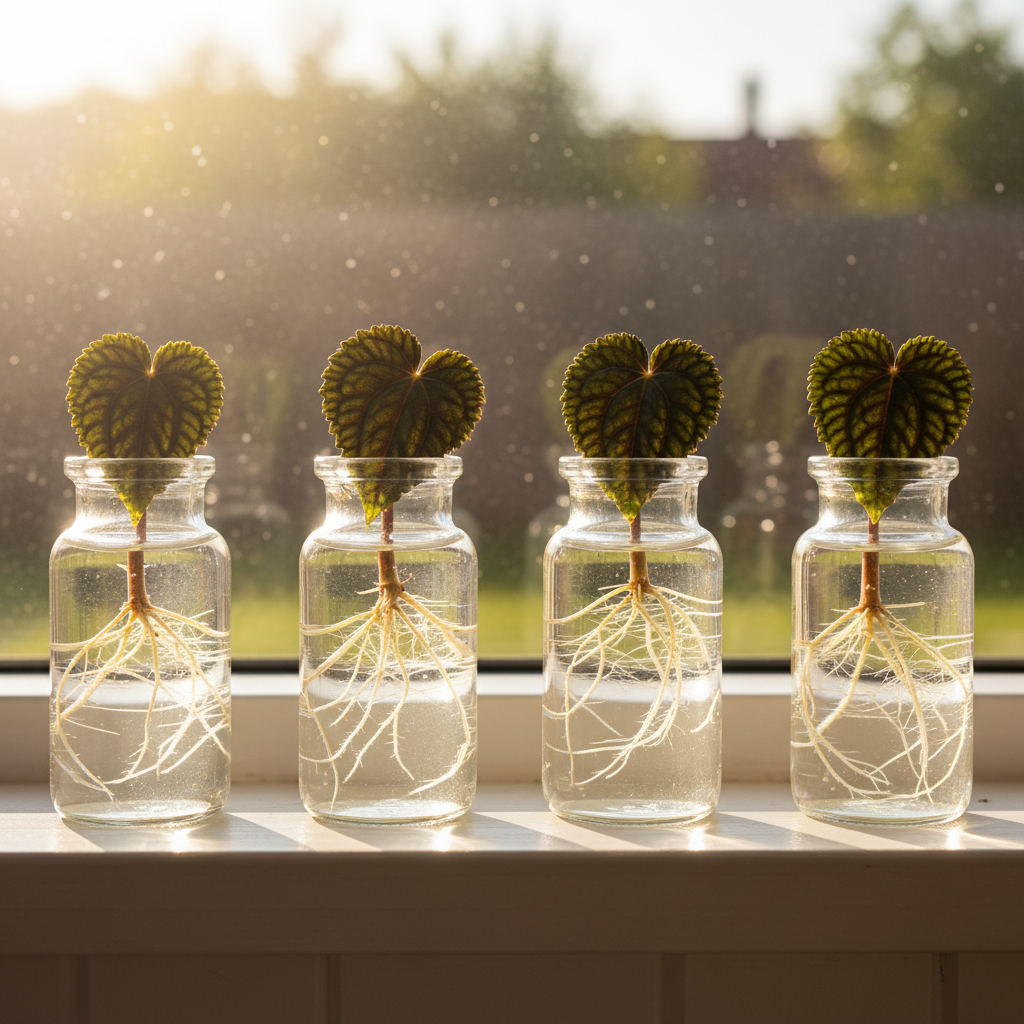
The key to propagating the prayer pepper is that new plantlets form at the base of a leaf stalk, the petiole, rather than from a stem node as in vining aroids. A leaf taken with a short length of its stalk attached carries everything it needs to generate roots and then a whole new rosette at the cut end. This is why a leaf is the unit of propagation here, and why keeping that little length of petiole intact matters so much.
Leaf Cuttings in Water: Step-by-Step
Water propagation lets you watch roots develop and is the most satisfying method for beginners.
- Choose a healthy, mature leaf and cut it off with 2 to 3 cm (around 1 in) of petiole attached, using a clean, sharp blade.
- Place the cutting in a small glass of water so that the cut end of the stalk is submerged but the leaf blade stays above the surface.
- Set the glass in bright indirect light and refresh the water every few days to keep it clear.
- Wait for fine white roots to appear from the cut end, usually within three to six weeks.
- Once a small cluster of roots and ideally a tiny new leaf has formed, pot the cutting into a small container of the standard light mix.
- Keep the soil lightly moist and humid for the first couple of weeks while the plantlet establishes.
Pro Tip — Be Patient for the Plantlet: Roots appear well before the new rosette does. Do not be discouraged by a rooted leaf that has yet to produce growth of its own; the tiny new plant emerges from the petiole base only after the roots are established, sometimes a month or more later.
Leaf Cuttings in Soil: Step-by-Step
Soil propagation skips the transplanting step and often produces sturdier plantlets, at the cost of being able to watch the roots form.
- Take a healthy leaf with a short length of petiole, as for water propagation.
- Optionally dip the cut end in rooting hormone to speed things along.
- Insert the petiole into a small pot of moist, free-draining propagation mix so the leaf sits upright just above the surface.
- Cover loosely with a clear bag or propagator lid to hold humidity, opening it briefly every few days for fresh air.
- Keep the mix barely moist and warm in bright indirect light.
- After a month or two, a gentle tug that meets resistance shows roots have formed, and a new plantlet will follow.
Troubleshooting Propagation
| Problem | Likely Cause | Solution |
|---|---|---|
| Cutting rots in water | Leaf blade submerged or water left stale | Keep only the stalk in water and change it regularly |
| No roots after many weeks | Too cold or too little light | Move somewhere warmer and brighter; be patient in winter |
| Roots form but no plantlet | Normal delay between rooting and new growth | Wait; the rosette emerges weeks after the roots |
| Leaf shrivels and dries | Air too dry around a soil cutting | Cover with a humidity dome or bag until established |
Pests & Diseases
The prayer pepper is a robust plant that suffers few problems when its basic needs are met, and most of the troubles it does encounter trace back to overwatering rather than to pests. Still, a handful of common insects and a few diseases are worth knowing, both to recognise them early and to head them off before they spread.
The single best defence is regular observation. Looking over your plant each time you water, including the undersides of the leaves and the dense crown where stems meet, catches almost every issue while it is still small and easily dealt with.
Common Pests
Mealybugs (Pseudococcus longispinus)
The most frequent pest of the prayer pepper, mealybugs appear as small white, cottony tufts tucked into the crown and the joints where leaf stalks meet the stem. They suck sap, weaken the plant and leave a sticky residue behind. The dense, sheltered centre of a peperomia is a favourite hiding place, so look there carefully.
Treatment: Dab each insect directly with a cotton bud dipped in isopropyl alcohol, which kills them on contact. For larger infestations, treat the whole plant with insecticidal soap or a diluted neem oil spray every week until clear, and isolate the plant from your collection in the meantime.
Spider Mites (Tetranychus urticae)
These tiny sap-suckers thrive in warm, dry conditions and announce themselves through fine stippling on the leaves and delicate webbing between stems. Because they are barely visible, the damage usually shows before the mites themselves do, with the foliage taking on a dull, speckled look.
Treatment: Rinse the plant under a gentle stream of water to dislodge the mites, then treat with neem oil or insecticidal soap, repeating every five to seven days for a few weeks. Raising the humidity around the plant also makes the environment less inviting to them.
Fungus Gnats (Bradysia species)
Small black flies drifting around the pot are fungus gnats, whose larvae live in persistently wet soil and feed on roots and organic matter. Their presence is almost always a symptom of overwatering, making them a useful warning sign as much as a pest in their own right.
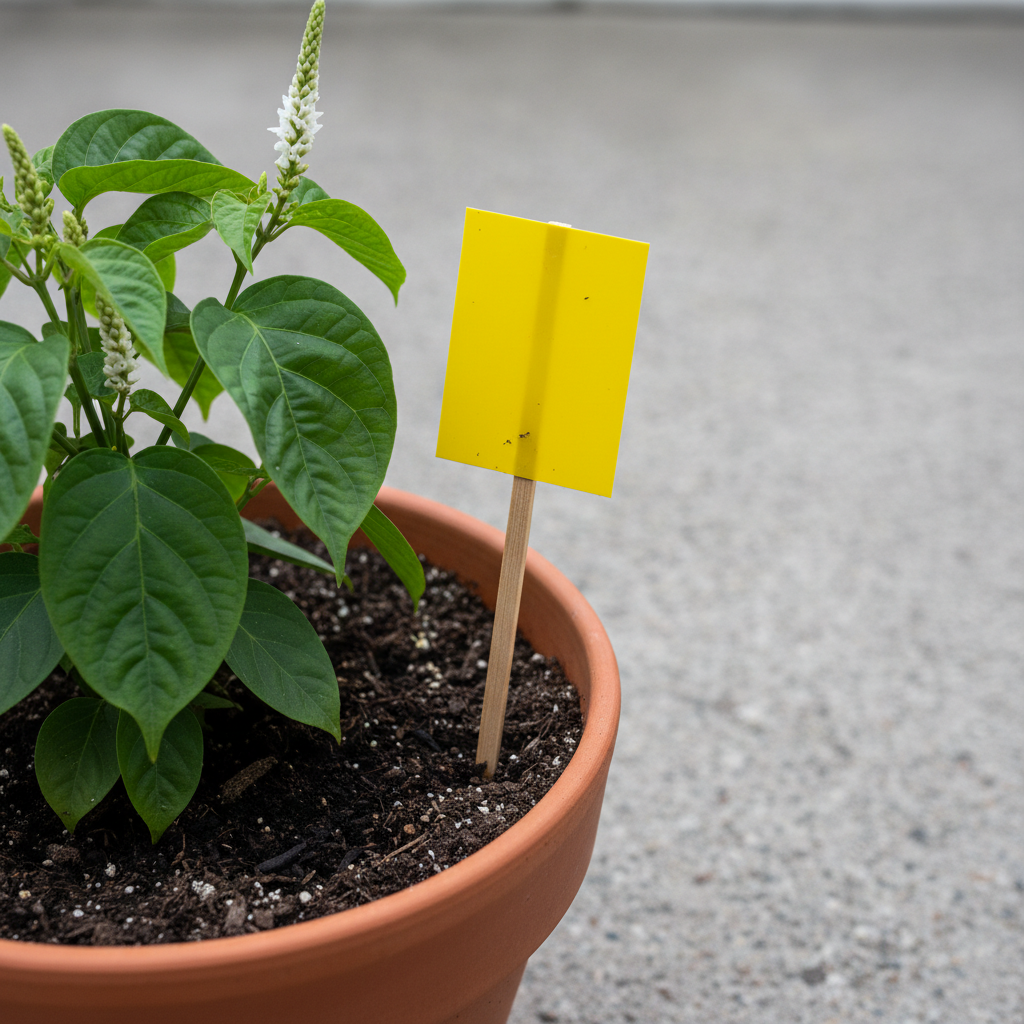
Treatment: Let the soil dry out more thoroughly between waterings to break their breeding cycle, and use yellow sticky traps to catch the adults. A layer of fine grit or sand over the soil surface deters egg-laying, and biological controls are available for stubborn cases.
Common Diseases
Root and Stem Rot (Pythium and Rhizoctonia)
By far the most serious threat to the prayer pepper, rot takes hold when the soil stays saturated and fungal pathogens attack the roots and the base of the stem. The symptoms are yellowing, mushy lower leaves, a soft and blackened stem base, and a sour smell from the soil. Left unchecked, it collapses the whole plant.
Treatment: Act quickly. Unpot the plant, cut away all soft, discoloured roots and stem tissue back to firm growth, dust the cuts with cinnamon or fungicide, and repot the survivor into fresh, barely-moist mix. Take leaf cuttings from any healthy foliage as a backup, then correct the watering habits that caused the problem.
Peperomia Ring Spot (Cucumber mosaic virus)
This viral disease produces distinctive brown, ring-shaped or arc-shaped marks on the leaves, sometimes with distorted growth. Unlike rot, it cannot be cured, and it can spread to other plants through contaminated tools or sap.
Treatment: There is no cure for a virus. Isolate the affected plant immediately and, if the symptoms are widespread, dispose of it to protect the rest of your collection. Always sterilise blades between plants, since cutting tools are a common route of transmission.
Pest and Disease Summary
| Pest / Disease | Identification | Treatment |
|---|---|---|
| Mealybugs | White cottony tufts in the crown and leaf joints | Alcohol on a cotton bud; neem or insecticidal soap |
| Spider mites | Fine stippling and webbing on the leaves | Rinse, then neem or insecticidal soap; raise humidity |
| Fungus gnats | Small black flies around damp soil | Dry the soil out; sticky traps; grit topping |
| Root and stem rot | Mushy yellow leaves, black stem base, sour smell | Cut away rot, repot in fresh mix, correct watering |
| Ring spot virus | Brown ring-shaped marks, distorted leaves | No cure; isolate or dispose; sterilise tools |
Prevention Strategies
Prevention with the prayer pepper comes down to two habits above all: watering correctly and inspecting regularly. A plant grown in free-draining soil and allowed to dry between waterings simply does not develop the rot and fungus gnat problems that plague overwatered specimens, which removes the great majority of its potential troubles at a stroke.
Quarantining every new plant for a couple of weeks before it joins your collection prevents hitchhiking pests from spreading, and keeping the foliage clean and the growing area tidy denies insects the conditions they favour. Good airflow around the plant further discourages both pests and fungal disease.
Pro Tip — Treat in the Evening: When using neem oil or insecticidal soap sprays, apply them in the evening or in a shaded spot rather than in bright light. Oil on the leaves combined with strong light can cause scorch, so giving the spray time to work overnight before the sun returns protects the very foliage you are trying to save.
Popular Varieties
The species itself is handsome, but the prayer pepper has been bred into a wonderful range of cultivars that differ in leaf colour, texture and form. Collectors prize the genus precisely because so many distinct looks share the same easy, forgiving care, making it simple to build a varied display on a single windowsill.
From the deep burgundy undersides of ‘Rosso’ to the silvery wash of ‘Frost’, the named selections below are among the most widely available and reliably attractive. Whichever you choose, the care described throughout this guide applies equally.
| Variety | Leaf Appearance | Light Needs | Growth Rate | Availability |
|---|---|---|---|---|
| ‘Emerald Ripple’ | Deeply corrugated deep green, the classic form | Bright indirect | Slow | Very common |
| ‘Rosso’ | Dark green top, vivid red underside, pointed | Bright indirect | Slow | Common |
| ‘Frost’ | Silvery frosted wash over dark green | Bright indirect | Slow | Common |
| ‘Luna Red’ | Rich burgundy throughout | Bright indirect | Slow | Fairly common |
| ‘Abricos’ | Reddish-toned ripple, warm cast | Bright indirect | Slow | Less common |
| ‘Suzanne’ | Green with silver-frosted ridges | Bright indirect | Slow | Less common |
| ‘Variegata’ | Green and cream marbled foliage | Bright indirect | Slow | Uncommon |
Featured Varieties
‘Rosso’
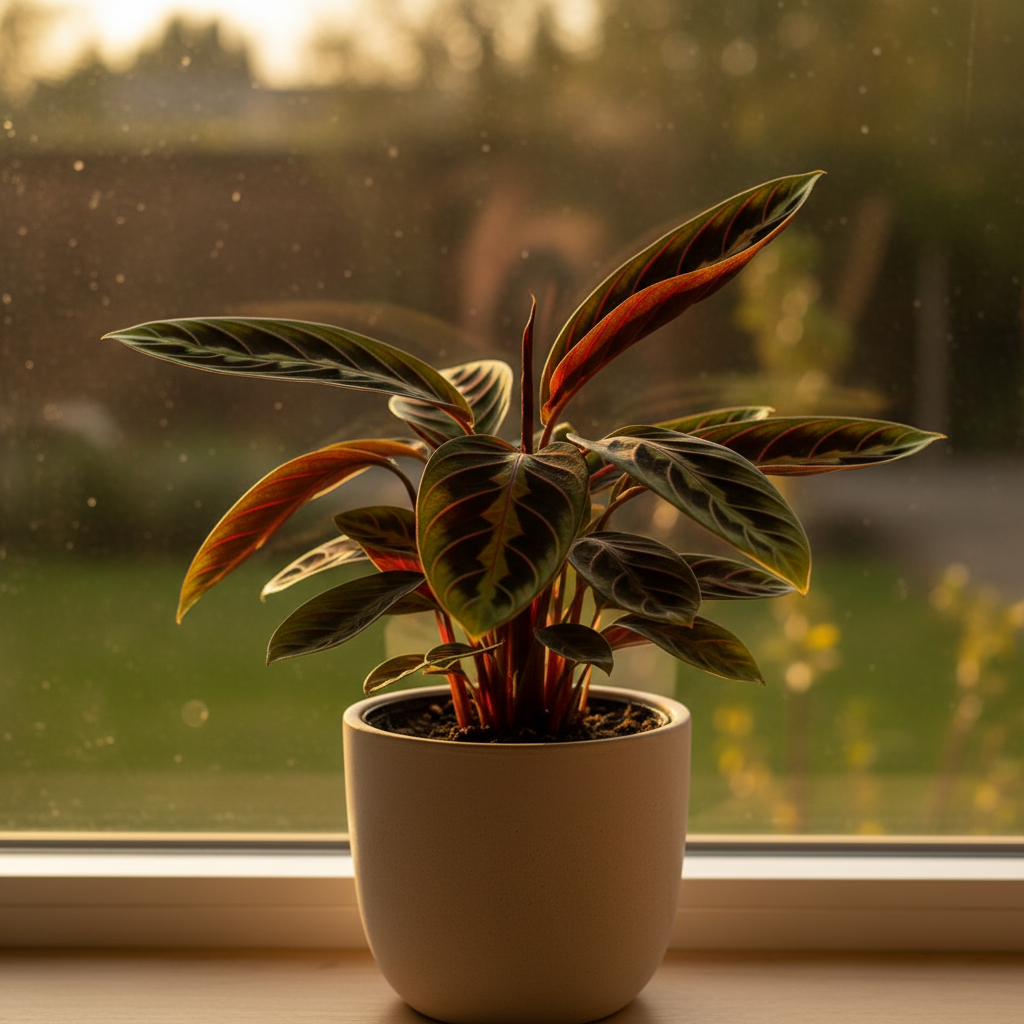
Perhaps the most dramatic of all the prayer peppers, ‘Rosso’ pairs glossy, deeply ridged dark green tops with brilliant deep-red undersides and a more elongated, pointed leaf shape. When the rosette catches the light from below, the red glows, giving the plant a jewel-like quality unmatched in the genus.
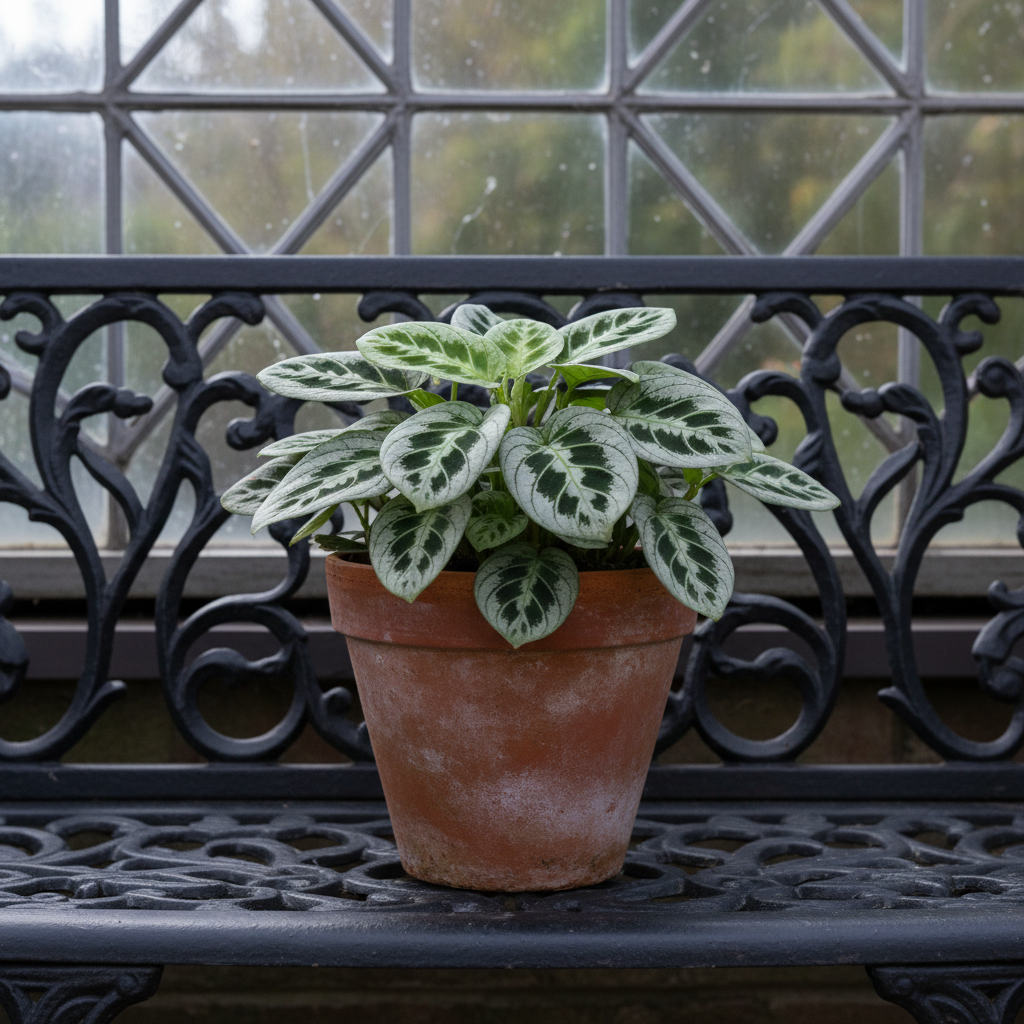
‘Frost’
A cooler, more ethereal selection, ‘Frost’ carries the same quilted heart-shaped leaves washed in a silvery, frosted sheen, with the darker green of the sunken veins showing through. The effect is almost metallic in good light, and it makes a striking contrast to the deeper, redder cultivars when the two are grown side by side.
Variety Profiles in Detail
Emerald Ripple (Peperomia caperata)
The original form and the one most often sold simply as “prayer pepper”, emerald ripple has intensely corrugated, deep green heart-shaped leaves on short reddish stalks. It is the benchmark against which the coloured cultivars are judged, and remains a favourite for its sheer toughness and the depth of its green.
Luna Red (Peperomia caperata ‘Luna Red’)
Where ‘Rosso’ reserves its red for the undersides, ‘Luna Red’ flushes the whole leaf with a rich burgundy that deepens in bright light. It is one of the most colourful peperomias available and an easy way to add a warm, dark accent to a collection of greens.
Choosing the Right Variety for Your Space
Because every prayer pepper shares the same compact size and undemanding care, choosing between them is almost entirely a matter of colour and texture. For a bright, lively look, the silvery ‘Frost’ or classic emerald ripple suits cool, minimal interiors; for warmth and drama, the reds of ‘Rosso’ and ‘Luna Red’ bring depth. Since all of them stay small, you can comfortably grow several together, and the slow growth means a thoughtfully arranged group will keep its composition for years.
Frequently Asked Questions
Is the prayer pepper safe for cats and dogs?
Yes. Peperomia caperata is listed as non-toxic to both cats and dogs by the ASPCA, and it is harmless to people too. It is one of the safest choices for a home with curious pets or young children, though as with any plant it is sensible to discourage nibbling.
Why are the leaves on my prayer pepper turning yellow and mushy?
Soft, yellowing leaves, especially lower ones, almost always point to overwatering. The plant’s semi-succulent roots rot easily in soggy soil. Let the top half of the pot dry out fully between waterings, make sure the pot drains freely, and if the stem base feels soft, take healthy leaf cuttings at once as insurance.
What are the strange spikes growing out of my plant?
Those slender, greenish-white spikes are the prayer pepper’s flowers, often described as rat-tail or mouse-tail blooms. They are completely normal and a sign of a happy, well-lit plant. They have no scent and you can leave them to enjoy or snip them off if you prefer to keep the plant’s energy in its foliage.
How often should I water a prayer pepper?
There is no fixed schedule. Water only when the top half of the soil has dried out, which typically means every seven to ten days in summer and every two to three weeks in winter. Always let the soil, rather than the calendar, tell you when to water, since light and temperature change the plant’s needs constantly.
Why has my prayer pepper become leggy and sparse?
Stretched, widely spaced leaves on thin stalks are a clear sign of insufficient light. Move the plant to a brighter position with plenty of indirect light, and the new growth will return to the tight, mounded form. You can pinch back the leggy growth and propagate the trimmings to fill the plant out again.
Do prayer peppers need a lot of humidity?
They prefer moderate humidity of around 50 to 60 percent but tolerate ordinary household air well thanks to their moisture-storing leaves. Only in very dry conditions, such as beside a radiator in winter, will you need to help, in which case a pebble tray, grouping with other plants or a small humidifier all work. Avoid misting, as water in the crown encourages rot.
Can I propagate a prayer pepper from a single leaf?
Yes, and it is the usual method. Take a healthy leaf with a short length of its stalk attached and root it in water or moist propagation mix. Roots form within a few weeks, followed later by a new plantlet from the base of the stalk. Spring and early summer give the fastest, most reliable results.
How big does a prayer pepper get?
It stays small. A mature prayer pepper typically reaches only 20 to 25 cm (8 to 10 in) in both height and spread, forming a tidy mound. Its compact size and slow growth make it ideal for windowsills, desks and shelves, and it almost never outgrows its space or needs frequent repotting.






