
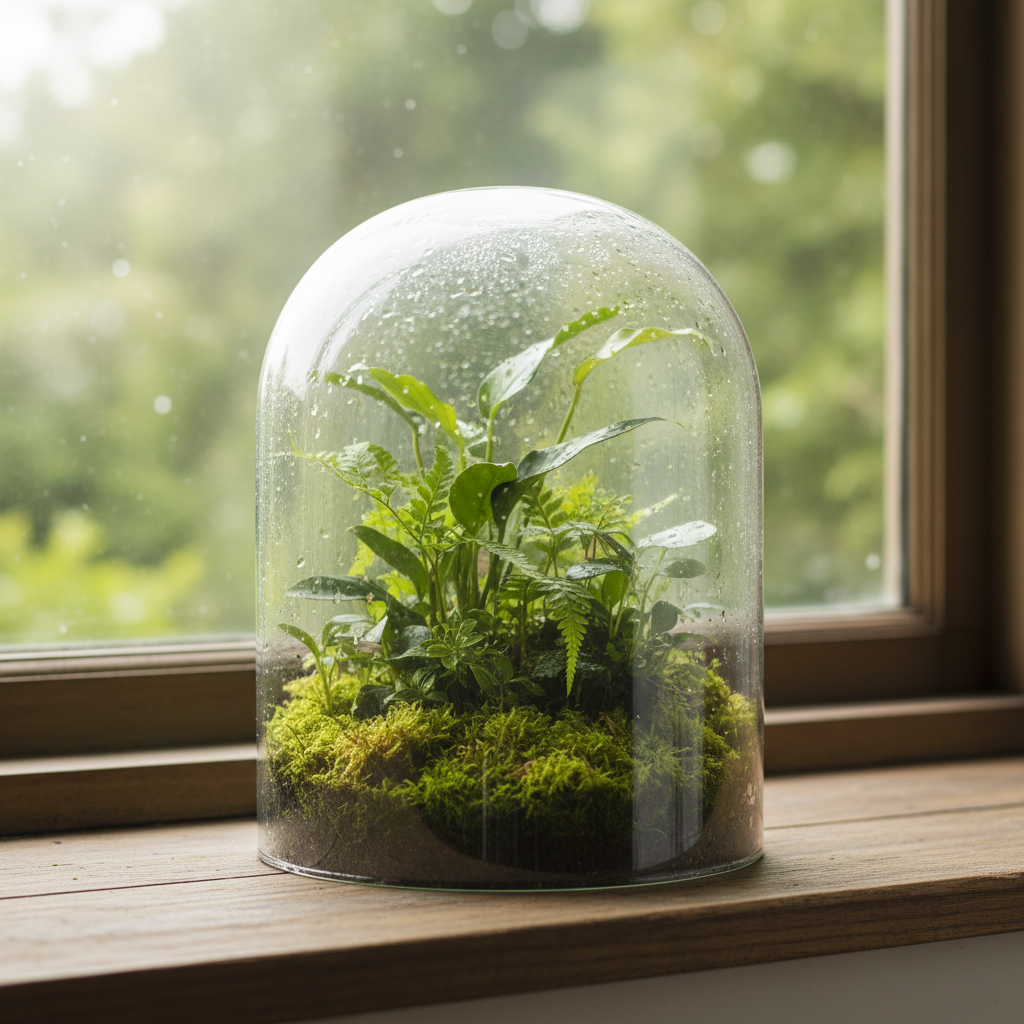
- Open, Closed or Dish Garden?
- Choose the Right Container
- Do Not Mix Plants With Opposite Needs
- Light: Bright, Indirect and Never Cooking
- Water Less Than You Think
- Fertilise Sparingly, If at All
- Common Terrarium Problems
- Frequently Asked Questions
A terrarium is a miniature indoor world in a glass container. Done well, it is charming, compact and surprisingly low-maintenance. Done badly, it becomes a foggy jar of regret. The difference is usually plant choice, moisture control and understanding whether the display is open or closed.
Iowa State University Extension explains that terrariums create a mini water cycle: water moves from soil into plants, is released through leaves, condenses on the glass and returns to the soil.[5] That cycle is why closed terrariums can go for long periods with little watering, but it is also why excess moisture can quickly become a problem.
Open, Closed or Dish Garden?
| Display type | Humidity level | Best for | Watch out for |
|---|---|---|---|
| Closed terrarium | Highest | Small tropical plants, mosses and ferns | Disease, algae and overheating. |
| Open terrarium | Moderate | Many small foliage plants | More frequent watering. |
| Dish garden | Lowest | Succulents, cacti and mixed displays | Faster drying and normal room humidity. |
University of Missouri Extension notes that closed terrariums retain the most humidity, open terrariums retain less, and dish gardens retain the least.[6] This distinction matters because a cactus and a fern do not want to live in the same glass weather system.
Choose the Right Container
Use clear glass or plastic so light can reach the plants. Penn State Extension recommends a clear container with a tight-fitting lid for closed terrariums and warns that coloured glass may block too much light.[7]
A wide opening is easier for beginners because you can actually reach the plants. Narrow-necked containers look elegant, but they require patience, tools and possibly the emotional resilience of a ship-in-a-bottle builder.
Do Not Mix Plants With Opposite Needs
The most important terrarium rule is simple: choose plants with similar light and moisture requirements. Iowa State University Extension recommends selecting plants that tolerate the same soil moisture, light levels and growing conditions because they will share the same enclosed space.[5]
Closed terrariums suit small, slow-growing plants that enjoy humidity. Iowa State lists candidates such as fittonia, ferns, peperomia, begonias, pilea, baby’s tears and creeping fig.[5] Succulents and cacti are generally better in open containers or dish gardens because moist enclosed conditions can promote rot.[6]
Light: Bright, Indirect and Never Cooking
Closed glass containers can overheat quickly in direct sun. Penn State Extension is blunt: a terrarium placed in direct sunlight “will cook.”[7] Iowa State Extension similarly recommends medium to bright indirect sunlight and warns that direct sunlight can build heat too quickly.[5]
Place terrariums near bright windows without direct hot sun, or use gentle supplemental lighting if the room is too dim. If plants stretch, fade or rot, reassess both light and moisture.
Warning — Glass Magnifies Mistakes: Direct sun plus a closed terrarium can create heat damage fast. If the container fogs heavily and sits in sun, move it immediately.
Water Less Than You Think
A closed terrarium should not need frequent watering once its cycle is established. Iowa State Extension notes many closed terrariums may need water only every three to six months, depending on soil, plants, light and other factors.[5] Penn State Extension advises watering only if condensation has stopped, plants droop or soil feels dry.[7]
Aim for light condensation, not a permanent rainforest downpour. If heavy condensation forms, open the lid until some moisture evaporates. Iowa State Extension recommends uncovering the terrarium when excessive condensation builds up.[5]
Fertilise Sparingly, If at All
In normal houseplant care, fertiliser can support growth. In a terrarium, growth is not always the goal. Iowa State Extension recommends avoiding fertiliser because it encourages growth and earlier crowding.[5] Oregon State University Extension similarly advises using very small plants and not fertilising too much because plants will eventually outgrow the space.[8]
A terrarium is not a race. Slow growth is a feature.
Common Terrarium Problems
| Problem | Likely cause | Fix |
|---|---|---|
| Heavy fog all day | Too much moisture | Open lid temporarily and reduce watering. |
| Rotting leaves | Excess moisture or poor airflow | Remove affected material and air out. |
| Stretchy growth | Too little light | Move to brighter indirect light. |
| Brown crispy leaves | Too much sun or too little water | Check heat and soil moisture. |
| Algae on glass | High moisture and light | Reduce moisture and clean glass. |
Frequently Asked Questions
| Question | Answer |
|---|---|
| Do terrariums need drainage holes? | Most terrariums do not have drainage, which is why careful watering is essential. |
| Should I put rocks at the bottom? | This is debated, but several modern sources warn that stone layers can allow water to pool rather than solve drainage. |
| Can I grow succulents in a closed terrarium? | Usually no. Succulents and cacti prefer drier, airier conditions. Use an open display instead. |
| How often should I open a closed terrarium? | Open it when condensation is excessive, plants need maintenance or airflow is needed. Very tight lids may benefit from occasional brief airing. |



