
- Quick Reference: Grooming Tasks
- Cleaning Smooth Leaves
- Cleaning Hairy or Delicate Leaves
- Leaf Shine Products: Usually Skip Them
- Pruning for Shape and Health
- Deadheading and Flower Cleanup
- Training, Staking and Rotating
- Hygiene and Pest Prevention
- Frequently Asked Questions
Good houseplant care is not only watering and light. It is also grooming: removing tired leaves, cleaning dust, pruning leggy stems and keeping plants attractive enough that they earn their space indoors. A well-groomed houseplant is not merely prettier. It often photosynthesises better, reveals pests earlier and channels energy into healthier growth.
Clemson Cooperative Extension notes that indoor plants collect dust and greasy films that dull appearance, and that clean leaves are favourable to healthy growth while also helping with insect control.[6] In ordinary living-room terms: your plant would like a bath before it becomes a small botanical lampshade.
Quick Reference: Grooming Tasks
| Task | How often | Why it matters |
|---|---|---|
| Dust leaves | Monthly, or more in dusty rooms | Improves appearance and keeps leaf surfaces clear. |
| Remove dead leaves | As needed | Reduces decay and improves airflow. |
| Prune leggy stems | Mainly spring and summer | Encourages fuller, better-shaped growth. |
| Rotate pots | Weekly to monthly | Prevents one-sided leaning. |
| Inspect for pests | Every grooming session | Finds problems before they spread. |
| Clean tools | Before and after pruning | Reduces spread of disease. |
Cleaning Smooth Leaves
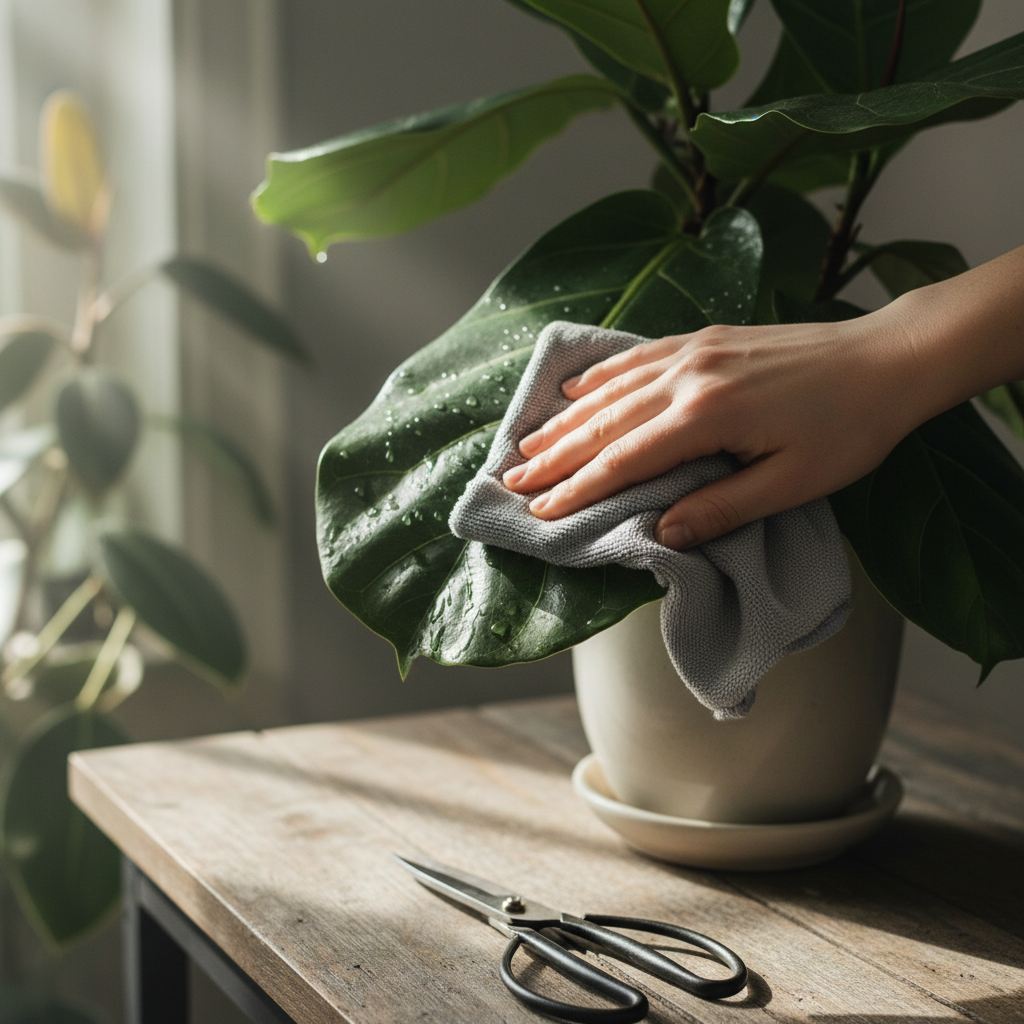
For plants with smooth leaves, use a soft damp cloth and wipe both upper and lower surfaces. Support each leaf with one hand so you do not crease the petiole. Large-leaved plants such as rubber trees, monstera, fiddle-leaf figs and peace lilies respond especially well because dust is obvious and light-blocking.
Sturdier plants can be rinsed in the shower or sink using lukewarm water. Let them drain thoroughly before returning them to decorative pots. Avoid blasting delicate plants with high pressure.
Cleaning Hairy or Delicate Leaves
Hairy leaves, such as those on African violets and some begonias, should not be scrubbed with a wet cloth. Clemson recommends cleaning hairy leaves with a soft cosmetic brush rather than wet wiping.[6] The same approach works for delicate or textured foliage that traps dust.
A small paintbrush, makeup brush or soft toothbrush can lift dust without bruising the leaf surface. Work gently and avoid leaving water sitting in crowns.
Leaf Shine Products: Usually Skip Them
Commercial leaf shine sprays can make plants look briefly showroom-ready, but Clemson generally does not recommend products that clean and shine leaves because waxy residues may interfere with air exchange; it also warns never to use them on hairy leaves.[6]
If you want shine, clean the leaf properly and let its natural surface do the work. A healthy leaf has a better finish than a sprayed one, and it does not smell like a florist fridge.
Warning — Do Not Oil the Leaves: Household oils, mayonnaise, milk and other folk-polish recipes can clog surfaces, attract dust and create a sticky mess. Plants are not antique furniture.
Pruning for Shape and Health
Pruning removes dead, damaged or badly placed growth. It can also encourage branching. On many vining plants, cutting just above a node prompts new shoots from that area. University of Minnesota Extension recommends trimming leggy stems just above a leaf node in spring to redirect energy into healthy new growth.[3]
Use clean, sharp scissors or pruning snips. Make decisive cuts rather than crushing stems. Remove yellow leaves once they are mostly yellow; they will not return to green. Remove brown crispy sections if they bother you, but remember that cosmetic trimming does not solve the underlying cause.
Deadheading and Flower Cleanup
Flowering houseplants often benefit from deadheading, which means removing spent blooms before they rot or set seed. This keeps the plant tidy and can encourage continued flowering in species that bloom repeatedly. With orchids, begonias, anthuriums and African violets, the exact method depends on the plant, but the principle is the same: remove what is finished without damaging new growth.
Dead flowers left on damp soil can invite mould and fungus gnats. A quick cleanup is easier than a tiny fly circus later.
Training, Staking and Rotating
Some houseplants need support. Climbing aroids may grow larger leaves when given a moss pole or plank. Tall stems may need discreet stakes. Trailing plants can be pruned, pinned or redirected to keep them full rather than stringy.
Rotation is the simplest grooming habit. Plants grow toward light. A quarter turn every week or two keeps many specimens symmetrical. Do not rotate plants in active bud or bloom if they are known to resent movement, but for foliage plants it is usually beneficial.
Hygiene and Pest Prevention
Every grooming session is also an inspection. Look at the undersides of leaves, new growth and stem joints. Pests prefer hiding places. Removing dead leaves and debris from the soil surface reduces shelter for pests and fungi. Cleaning leaves may also physically remove early pest stages before they become an infestation.
If you prune a diseased or pest-infested plant, clean tools before using them on another plant. For soft stems, ordinary household scissors can work if sharp and clean. For woody stems, use proper pruners.
Pro Tip — Groom Before Watering: A plant is easier to move, turn and inspect before it has been freshly watered and made heavier. Water afterwards, then let it drain.
Frequently Asked Questions
| Question | Answer |
|---|---|
| Can I cut off brown leaf tips? | Yes. Use clean scissors and follow the natural leaf shape. The cut edge may brown slightly again. |
| Will pruning make a plant bushier? | Often, if the plant can branch from nodes below the cut and is in good light. |
| Should I remove dusty aerial roots? | Usually no. Aerial roots are functional. Rinse or guide them rather than cutting unless they are dead or unwanted. |
| How much can I prune at once? | Light pruning is safest. Avoid removing more than about a quarter to a third of healthy foliage unless the plant is vigorous and actively growing. |



