
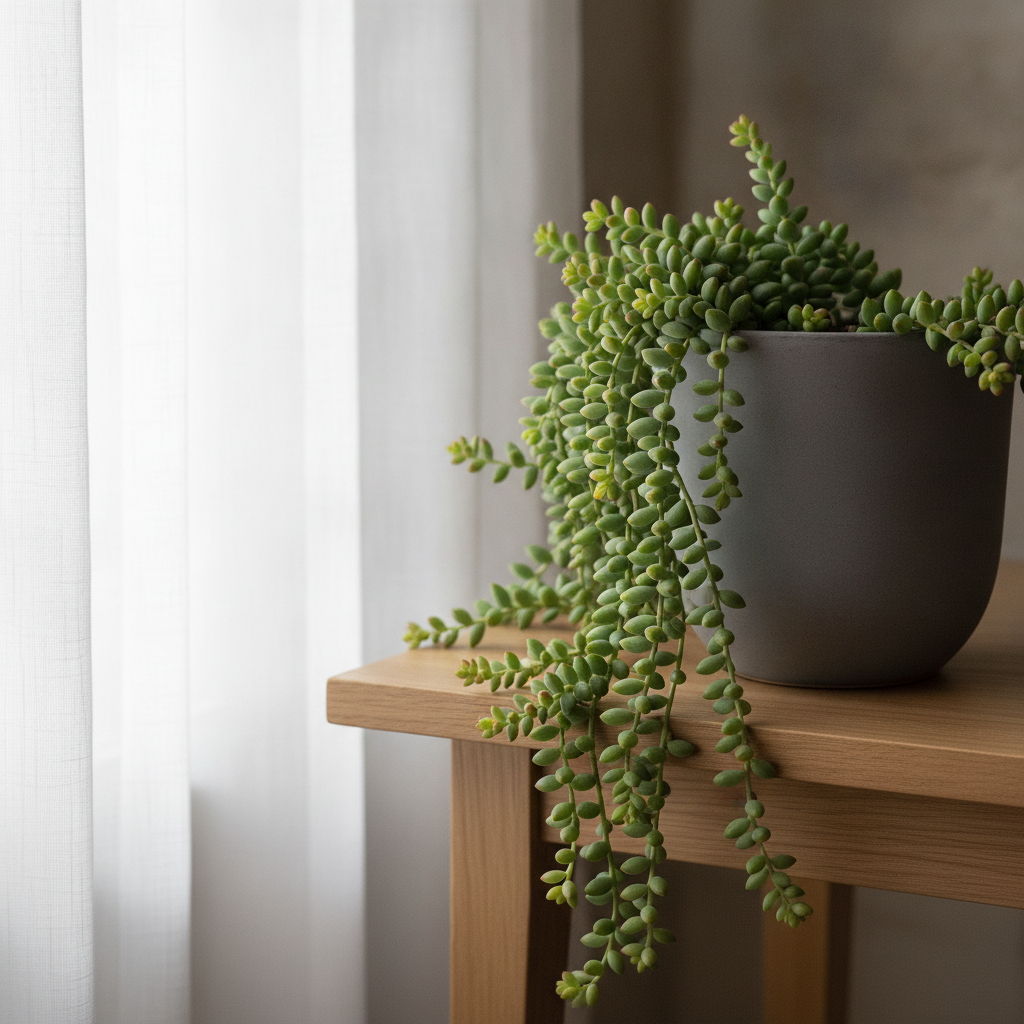
Few succulents wear their name as plainly as the necklace vine. Trailing stems are strung end to end with small, rounded leaves that clasp the stem in tightly stacked pairs, giving each strand the look of a beaded chain draped over a pot rim. Known botanically as Crassula marnieriana and sold under a handful of affectionate common names, including jade necklace and worm plant, it belongs to the same South African family as the familiar jade plant and shares that group’s forgiving, water-storing constitution.
The necklace vine has a reputation as one of the easier trailing succulents to keep alive, and that reputation is deserved. Keeping it alive and keeping it beautiful, however, are two different things. A plant left in a dim corner will survive for months as an increasingly stretched, pale strand, while the same plant given a few hours of bright light will stay compact, its leaves close-packed and flushed rose at the edges. This guide covers everything from light and watering through soil, feeding, propagation and pests, with the aim of helping you move your plant from merely surviving to genuinely thriving.
Contents
- Quick Reference
- Why Necklace Vine Makes a Rewarding Houseplant
- Light Requirements
- Watering & Humidity
- Soil, Potting & Repotting
- Fertilising
- Propagation
- Pests & Diseases
- Popular Varieties
- Frequently Asked Questions
Quick Reference: Necklace Vine at a Glance
| Light | Bright light with a few hours of direct morning sun; the brighter the position, the more compact and colourful the growth |
| Watering | Soak thoroughly, then allow the soil to dry out completely before watering again; roughly every 10 to 14 days in summer, far less in winter |
| Temperature | 18 to 24 degrees Celsius (64 to 75 Fahrenheit); keep above 10 degrees Celsius (50 Fahrenheit) and protect from frost |
| Humidity | Low; ordinary household air suits it well and high humidity is a liability |
| Fertiliser | A dilute succulent feed once a month through spring and summer only |
| Toxicity | Generally regarded as low toxicity, but the wider Crassula genus can cause upset in cats and dogs, so keep it out of reach of curious pets and children as a precaution |
Why Necklace Vine Makes a Rewarding Houseplant
The appeal of the necklace vine begins with its geometry. Each pair of leaves fuses around the stem so tightly that the strand appears segmented, like vertebrae or a row of beads, an effect that has earned it the folk names worm plant and baby’s necklace as well as jade necklace. Young stems grow upright and neat, then lengthen and tumble over the edge of a pot, so a single well-grown plant can be displayed as a tidy mound or as a cascade from a shelf or hanging planter. Because the leaves are blue-green and cool-toned, they read as calm and architectural rather than busy, which is part of why the plant photographs so well and turns up so often in styled interiors.
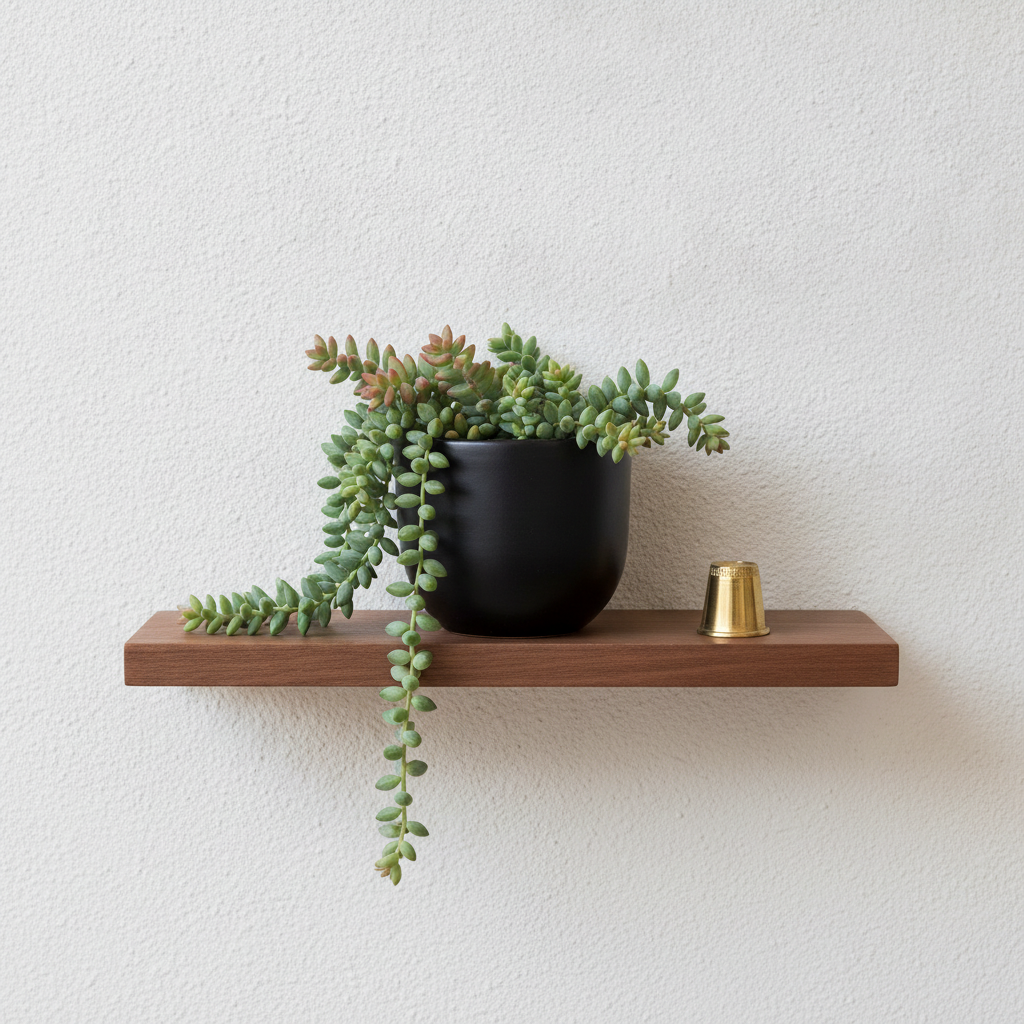
Beyond looks, the necklace vine is genuinely undemanding in ways that matter to a busy household. It is a succulent, so it stores water in its leaves and tolerates the occasional missed watering better than almost any leafy tropical. It stays small, rarely needing a large pot, and it grows slowly enough that it will not overwhelm a windowsill within a season. It also propagates with almost comic ease, meaning a single plant can quickly become gifts for friends or a fuller display for yourself. For anyone building confidence with houseplants, it offers a low-risk introduction to the rhythms of succulent care while still delivering real ornamental value.
Important — Toxicity: Reliable toxicity data for Crassula marnieriana specifically is limited, and it is often described as non-toxic. However, its close relative the jade plant (Crassula ovata) is listed as toxic to cats and dogs, capable of causing vomiting and lethargy if eaten. Given that uncertainty, the sensible course is to treat the necklace vine as potentially irritating and keep it somewhere pets and small children cannot nibble it.
Light Requirements
Light is the single factor that most separates a handsome necklace vine from a disappointing one. In its native South African habitat the plant grows in exposed, sun-drenched rocky ground, and it carries that expectation indoors. Given plenty of bright light, it holds its leaves tight against the stem, keeps its compact beaded profile, and develops the rosy blush along the leaf margins that makes the plant so striking. Starved of light, it does the opposite, stretching between leaf pairs into a thin, pale, floppy strand that never recovers its former density.
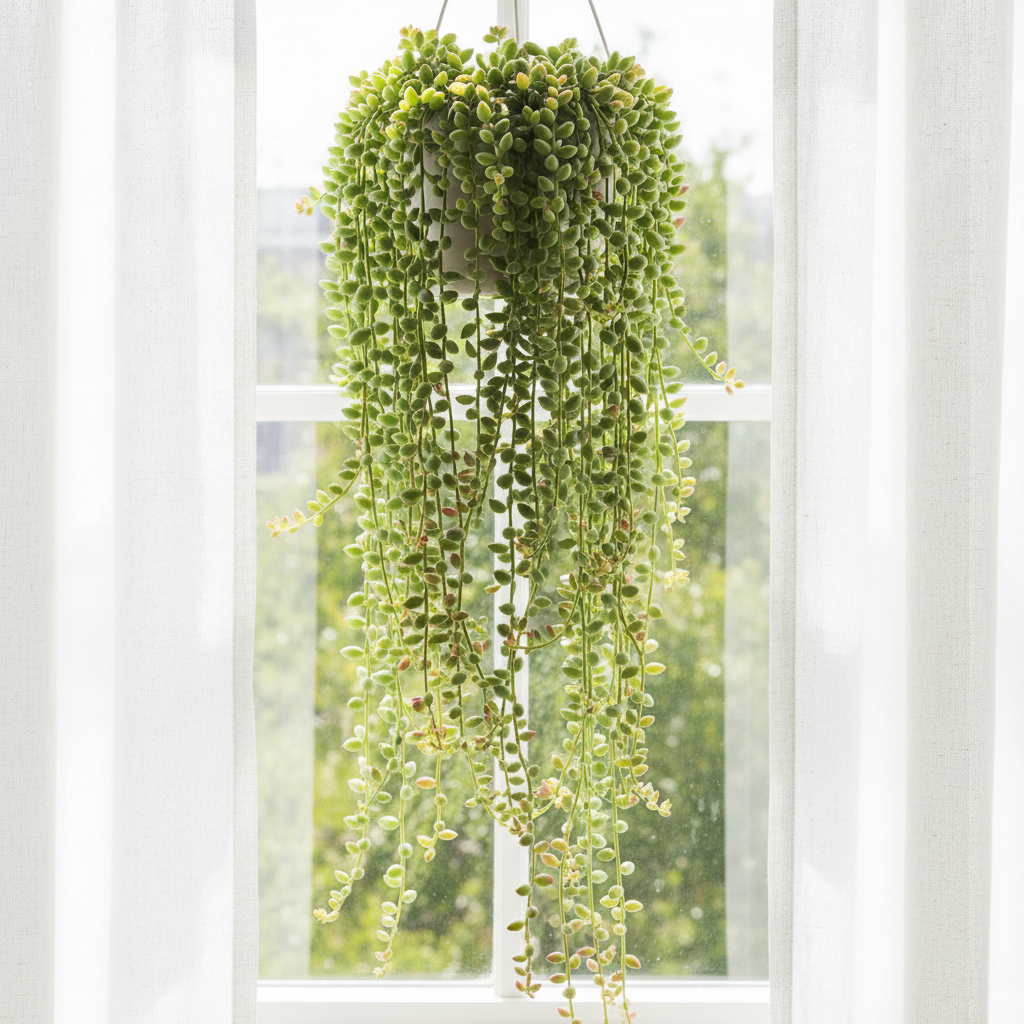
The ideal indoor position is a spot that receives several hours of direct sun each day, tempered so that the fierce heat of midsummer afternoons does not scorch the leaves. An east-facing windowsill that catches gentle morning sun, or a lightly shaded south-facing window, tends to hit the sweet spot. If your only bright window faces full afternoon sun, a sheer curtain or a short setback from the glass will take the edge off without robbing the plant of the intensity it craves.
Light Levels Explained
Houseplant light is often described in vague terms, so the table below translates the common categories into approximate brightness and a realistic outcome for a necklace vine. The plant sits firmly at the bright end of the scale, and knowing where a given spot falls helps you predict whether your plant will stay tight or begin to stretch.
| Light Category | Approx. Level | Typical Location | Outcome |
|---|---|---|---|
| Direct sun | Over 50,000 lux | On a south or west sill against the glass | Excellent colour and compactness; watch for scorch in peak summer |
| Bright indirect | 10,000 to 25,000 lux | Beside an east window or just back from a south one | The ideal balance of tight growth and safety |
| Medium | 5,000 to 10,000 lux | A metre or two inside a bright room | Survives but slowly loosens and pales |
| Low | 1,000 to 5,000 lux | A north window or a dim interior wall | Rapid stretching, weak stems, no blush |
| Very low | Under 1,000 lux | A windowless room or deep corner | Unsustainable; steady decline |
Window Orientation and Placement
South-facing window: In the northern hemisphere this is the brightest exposure and generally the best for a necklace vine, provided you soften the harshest summer afternoons with a sheer curtain or a small gap from the glass. Colour and compactness are usually excellent here.
East-facing window: Often the most trouble-free position. The plant receives direct but cool morning sun, then bright ambient light for the rest of the day, which keeps it tight without any real risk of scorch.
West-facing window: Workable, but the direct light arrives in the afternoon when it is hottest, so keep an eye out for bleaching or soft spots on leaves facing the glass and pull the plant back slightly if you see them.
North-facing window: The weakest exposure and the hardest to succeed with. A necklace vine here will stretch and fade over time. If a north window is all you have, plan to supplement with a grow light to make up the shortfall.
Pro Tip — Rotate for Even Growth: Succulents lean hard toward their light source. Give the pot a quarter turn every week or two so that every side of the plant receives its share, keeping the mound symmetrical rather than lopsided toward the window.
How Light Affects Leaf Colour
The rosy-red edging that makes the necklace vine so photogenic is a stress response, produced when the plant makes protective pigments in bright light and cool conditions. In a strongly lit spot the leaf margins deepen to pink or red while the centres stay blue-green, giving each bead a two-tone finish. Move the same plant into shade and those pigments fade, leaving a uniform, slightly dull green. Cooler autumn and winter temperatures, combined with good light, tend to intensify the colour, which is why many growers report their best colouring in the darker half of the year rather than in high summer.
Warning — Direct Sunlight: A plant grown in shade and then moved abruptly into full summer sun can scorch, developing pale, papery burn marks that never heal. Acclimatise it over a week or two by increasing exposure gradually rather than relocating it in one step.
Artificial Lighting
Where natural light falls short, a full-spectrum LED grow light does the job well. Position it 15 to 30 centimetres (6 to 12 inches) above the plant and run it for 10 to 12 hours a day to mimic a bright growing season. Because the necklace vine is small, even a modest desk-style grow lamp is usually enough to keep a single plant compact and coloured through a dark winter, and it is the most reliable way to grow one in a room with poor windows.
Seasonal Adjustments
Light levels indoors fall sharply between summer and winter, so a position that was ideal in July may be too dim by December. As the days shorten, move the plant to your brightest available window, clean any dust from the glass, and consider adding supplementary light if you notice new growth beginning to stretch. In summer, the reverse applies: watch for scorch on south and west sills and be ready to add light diffusion during the most intense weeks.
Watering & Humidity
If light is what makes a necklace vine beautiful, watering is what most often kills it. Like all leaf succulents it stores its own reserves and expects long dry spells between drinks, so the most common cause of decline by a wide margin is too much water rather than too little. The guiding principle is simple: water thoroughly, then wait until the soil is bone dry before watering again.
When to Water
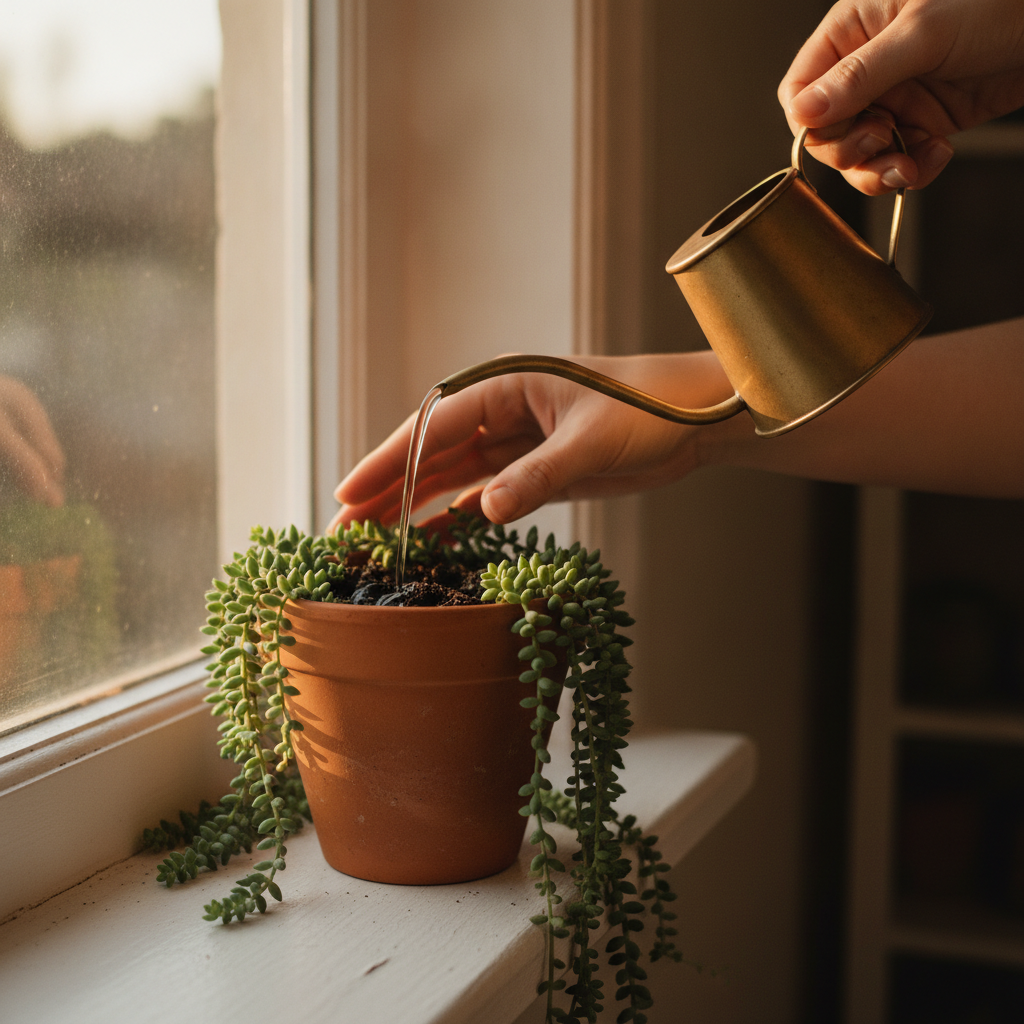
Rather than watering to a fixed calendar, judge each watering by the soil. Push a finger or a wooden skewer down into the mix; if it comes out with damp grains clinging to it, wait longer. Only when the pot is dry all the way through should you water again. In a warm, bright room during the growing season this typically works out to roughly once every 10 to 14 days, but the interval depends heavily on pot size, light and temperature, so the soil test always beats the calendar.
Seasonality matters enormously. Through the active months of spring and summer the plant drinks steadily, but in the cooler, darker months its growth slows and its water use drops to a trickle. In winter you may water only once every three or four weeks, and a plant kept cool and dim needs even less. The leaves themselves are a useful gauge: plump, firm beads mean the plant is well hydrated, while slightly soft or wrinkled leaves signal it is ready for a drink.
Pro Tip — Read the Leaves: A necklace vine tells you when it is thirsty. Firm, rounded beads mean no water is needed; when the lowest leaves start to look faintly soft or creased, that is the plant drawing on its reserves and your cue to soak it. This living gauge is more reliable than any schedule.
How to Water Correctly
- Check that the soil is completely dry by testing to the bottom of the pot with a skewer or finger.
- Water at the soil surface, avoiding the tightly packed leaves where trapped moisture can invite rot.
- Add water slowly until it runs freely from the drainage holes, ensuring the whole root ball is soaked.
- Let the pot drain fully, then tip away any water left standing in the saucer or cachepot.
- Return the plant to its bright spot and do not water again until the mix has dried right through.
Signs of Overwatering vs. Underwatering
| Symptom | Overwatering | Underwatering |
|---|---|---|
| Leaf colour | Yellowing, translucent or blackened leaves | Dull green, sometimes with a reddish stress tint |
| Leaf texture | Soft, mushy, squashy to the touch | Wrinkled, shrivelled but still firm |
| Soil | Stays wet for days, may smell sour | Bone dry throughout, pulling from the pot sides |
| Roots | Brown, soft and foul-smelling | Dry and intact, simply thirsty |
| Stem base | Blackening or collapsing at soil level | Firm, though growth may pause |
Warning — Root Rot: Soft, translucent leaves and a blackening stem base are signs of rot, and by the time they appear the roots are usually already damaged. Act fast: unpot the plant, cut away any mushy tissue, take healthy cuttings from the firm upper stems as insurance, and let everything dry before replanting in fresh, dry, gritty mix.
Humidity Requirements
Unlike the tropical foliage plants that crave moist air, the necklace vine prefers things on the dry side. Ordinary household humidity of 30 to 50 percent suits it perfectly, and it has no need of misting, pebble trays or humidifiers.
In fact, high humidity works against it. Stagnant, damp air lingering among the closely stacked leaves encourages fungal problems and rot, so good airflow is far more valuable to this plant than added moisture. If anything, err toward a drier, better-ventilated spot rather than a humid one.
There is nothing you need to do to raise humidity for a necklace vine, and plenty to avoid. Keep it away from steamy bathrooms and kitchens where damp air collects, and make sure the leaves are not left wet after watering. A gently moving, dry atmosphere is exactly what it wants.
Water Quality
The necklace vine is not fussy about water quality, and ordinary tap water is fine for most growers. If your supply is very hard, you may in time see pale mineral deposits on the soil surface, which are harmless but can be avoided by using filtered or collected rainwater. Whatever you use, water at room temperature rather than straight from a cold tap, as a sudden chill does the roots no favours.
Soil, Potting & Repotting
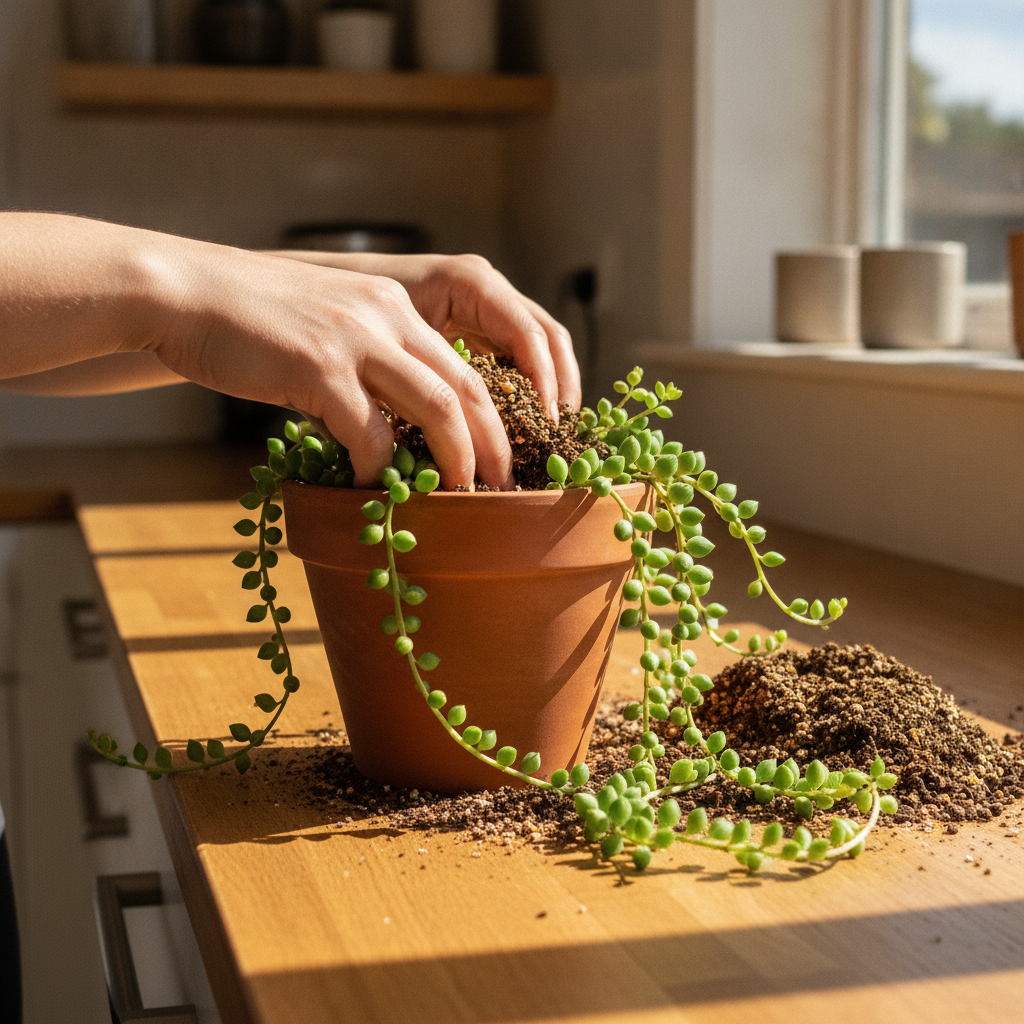
Everything about watering a necklace vine well depends on the soil beneath it. The right mix drains in seconds and dries quickly, letting the roots breathe between waterings; the wrong one holds moisture around the roots and undoes even careful watering. Getting the substrate right is therefore the foundation of the whole plant’s health.
Ideal Soil Composition
A good necklace vine mix is mostly grit and only partly organic matter. The aim is a substrate that holds just enough moisture to sustain the plant briefly before drying out, with plenty of coarse mineral material to keep the structure open and airy. A ready-made cactus and succulent compost is a fine starting point, but most are still a little too moisture-retentive out of the bag and benefit from extra grit.
| Component | Proportion | Function |
|---|---|---|
| Cactus and succulent compost | Half | Provides a base of light organic matter and a little moisture retention |
| Coarse grit or pumice | One quarter | Opens the structure and speeds drainage |
| Perlite | One quarter | Keeps the mix airy and prevents compaction around the roots |
The necklace vine is not particular about pH and does well in the slightly acidic to neutral range of roughly 6.0 to 7.0 that most commercial mixes fall within. There is no need to test or adjust it; a free-draining, mineral-rich mix will keep the roots healthy regardless of small pH variations.
Pro Tip — Quick Mix Recipe: For a reliable blend, combine two parts cactus compost with one part coarse grit or pumice and one part perlite. If you can pour water through a handful and watch it run straight out, the mix is right for a necklace vine.
Choosing the Right Pot
Pot choice has a direct bearing on how easy the plant is to keep. Because the necklace vine trails, a slightly raised or hanging pot shows it off best, but the practical qualities of drainage, material and size matter far more to its health than the style.
Drainage holes are non-negotiable. A pot without holes traps water at the bottom where you cannot see it, and for a succulent that is a death sentence. Always use a container with at least one generous drainage hole, and if you love a decorative pot that has none, treat it as a cachepot and keep the plant in a plain draining nursery pot that lifts out for watering.
Pot material: Terracotta is an excellent match for this plant. Its porous walls wick moisture out of the soil and let it evaporate, helping the mix dry quickly and forgiving the occasional heavy hand with the watering can. Glazed ceramic and plastic hold moisture longer, which is workable if you are disciplined about letting the soil dry but less forgiving of mistakes.
Pot size: Choose a snug pot rather than a large one. An oversized container holds a reservoir of damp soil that the small root system cannot use, and that lingering moisture is a rot risk. A pot only a little wider than the current root ball keeps the balance of soil and roots healthy.
When to Repot
The necklace vine is slow-growing and quite happy to be a little crowded, so it needs repotting only every two or three years, or when you see roots emerging from the drainage holes and the plant drying out unusually fast. The best time is early spring, at the start of the growing season, when the plant can recover quickly. Repotting is also the ideal moment to refresh tired soil and to check the roots for any early signs of rot.
How to Repot: Step-by-Step
- Water lightly a day or two beforehand so the root ball holds together, then let it drain; do not repot into wet soil.
- Ease the plant out of its pot, supporting the trailing stems, and gently tease away the old mix from around the roots.
- Inspect the roots and trim off any that are brown, soft or dead, using clean scissors.
- Settle the plant into a pot only slightly larger, part-filled with fresh gritty mix, at the same depth it grew before.
- Fill in around the roots with more mix, firming gently so there are no large air pockets.
- Wait a week before watering, giving any disturbed or trimmed roots time to callus and reducing the risk of rot.
Warning — Transplant Shock: Resist the urge to water a freshly repotted succulent straight away. Damaged roots sitting in wet soil are the classic route to rot. Keep the plant dry and out of harsh sun for the first week, then resume normal watering once it has settled.
Fertilising
The necklace vine is adapted to lean, mineral soils and asks for very little feeding. In the wild it grows in ground that offers scant nutrition, and indoors it grows slowly, so heavy fertilising does more harm than good. A light touch, applied only during the growing season, is all it needs.
That said, a small amount of feed does help a potted plant, because the limited soil in a container is gradually exhausted and refreshed only at repotting. The goal is to top up nutrients gently rather than to push growth, keeping the plant healthy without encouraging the soft, stretched shoots that over-feeding produces.
Understanding Plant Nutrients
Plant fertilisers are built around three main nutrients, shown on the label as the N-P-K ratio for nitrogen, phosphorus and potassium, alongside smaller amounts of secondary and trace elements. For a succulent like the necklace vine, a balanced or slightly low-nitrogen formula is ideal, since too much nitrogen drives soft, weak growth at the expense of the compact form you want.
| Nutrient | Symbol | Primary Function | Deficiency Symptoms |
|---|---|---|---|
| Nitrogen | N | Drives leaf and stem growth | Pale, slow, stunted growth |
| Phosphorus | P | Supports roots and flowering | Weak roots, poor blooming |
| Potassium | K | Overall vigour and stress resistance | Yellow leaf edges, weak stems |
| Calcium | Ca | Builds strong cell walls | Distorted or dying new growth |
| Magnesium | Mg | Central to chlorophyll | Yellowing between leaf veins |
| Iron | Fe | Aids chlorophyll production | Pale new leaves with green veins |
Types of Fertiliser
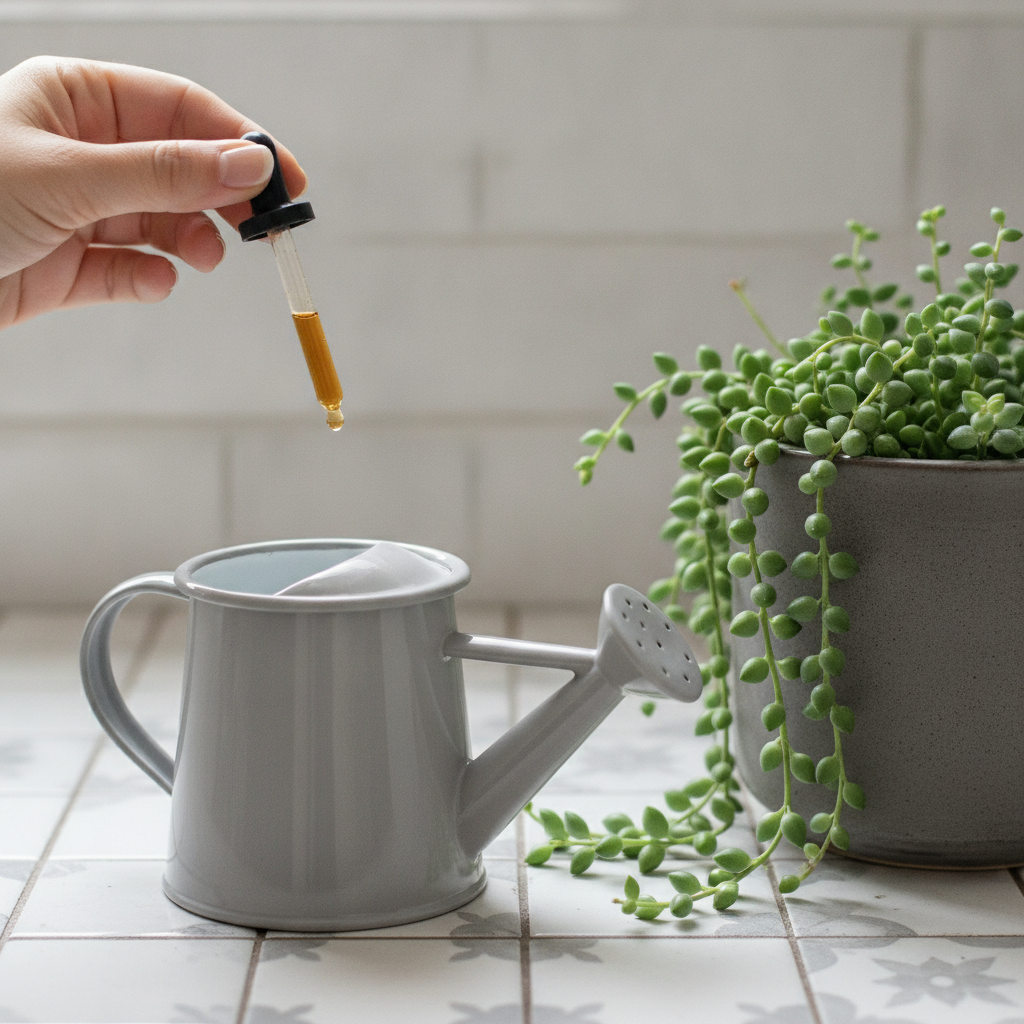
Liquid fertilisers: The easiest choice for a necklace vine. A liquid succulent or cactus feed, diluted to half the recommended strength, can be added to the watering can during the growing season and gives you precise control over how much the plant receives.
Slow-release granular: A few granules of a slow-release feed mixed into the soil at repotting will drip-feed nutrients over several months. This is convenient but offers less control, so use a light hand and choose a formula suited to succulents.
Organic fertilisers: Gentle options such as a dilute worm-casting tea release nutrients slowly and are hard to overdo. They suit growers who prefer an organic approach, though they act more slowly than synthetic liquids.
Feeding Schedule
Feed only during the active growing months of spring and summer, roughly once a month, and always with a diluted solution. Stop entirely in autumn and winter, when the plant is resting and cannot use the nutrients; feeding a dormant succulent simply lets unused salts build up in the soil. A plant repotted into fresh mix each couple of years needs even less supplementary feeding than one left long in the same pot.
Pro Tip — Less Is More: When in doubt, under-feed. A necklace vine will sail through a season on little or no fertiliser, whereas too much produces leggy, pale growth and a build-up of salts. Half-strength, once a month, in summer only, is plenty.
How to Fertilise
- Mix a succulent fertiliser to half its recommended strength in your watering can.
- Water the plant with plain water first if the soil is completely dry, to avoid feeding parched roots.
- Apply the diluted feed to the soil, not the leaves, until it drains from the bottom.
- Let the pot drain fully and tip away any run-off, then return the plant to its spot.
Warning — Salt Build-Up: Over time, fertiliser salts can accumulate in the soil and scorch the roots, showing as brown, crisp leaf tips. Every few months, flush the pot with a generous volume of plain water to rinse the salts out through the drainage holes.
Propagation
One of the great pleasures of the necklace vine is how readily it multiplies. Its trailing stems root with almost no encouragement, so a single plant can furnish a whole shelf of new ones, or fill out its own pot into a denser cascade. For most growers, stem cuttings are the method of choice, with division a useful second option for a large, clumping plant.
The best time to propagate is spring or summer, when the plant is growing actively and cuttings root fastest. Take the opportunity whenever you prune or tidy a leggy plant, since the pieces you remove are exactly the material you need to start new ones.
Understanding Stem Nodes
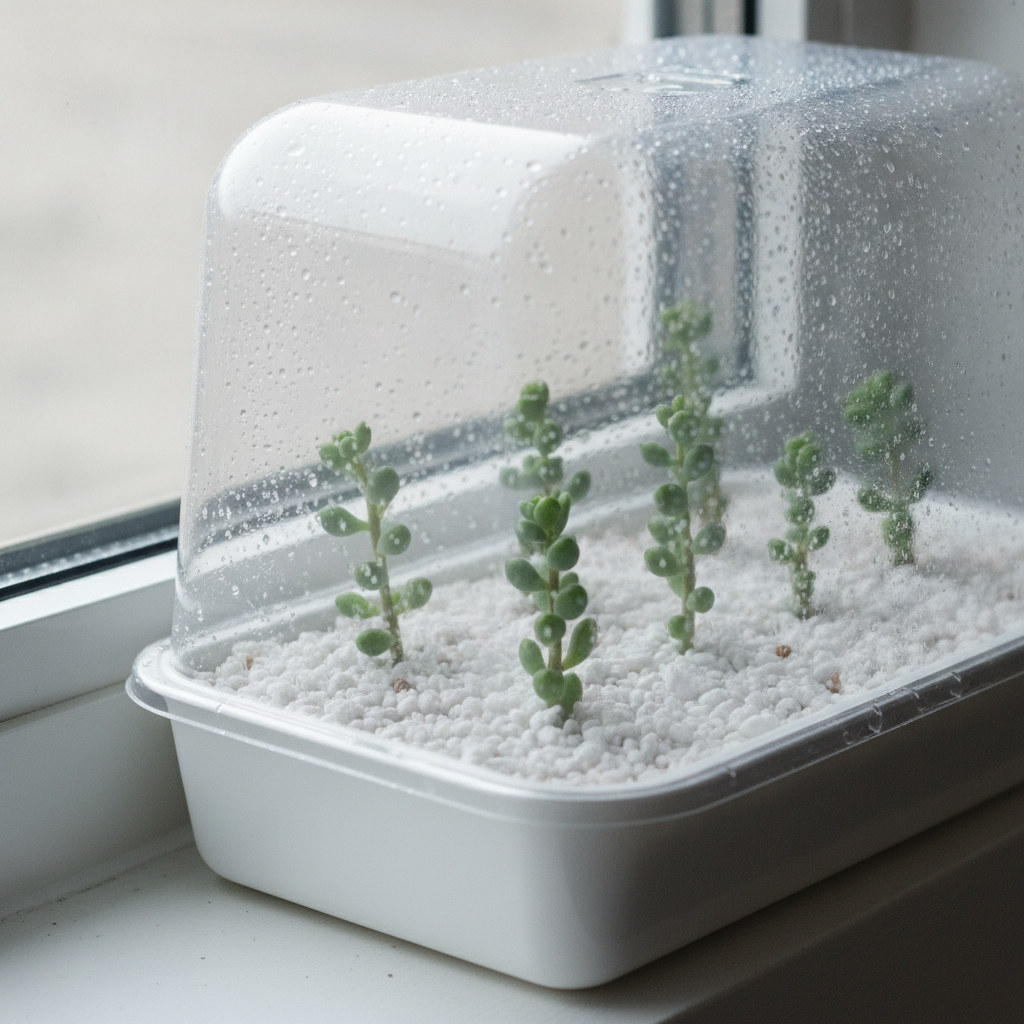
The key to rooting a necklace vine lies in its nodes, the points along the stem where each pair of leaves joins. These nodes contain the dormant cells that produce new roots, so a cutting will root most reliably from a node placed in contact with the growing medium. When you take a cutting, remove the lowest pair or two of leaves to expose a bare node, and it is from there that the fresh roots will emerge.
Stem Cuttings: Step-by-Step
This is the simplest and most productive way to propagate the plant, and it doubles as a way to rejuvenate a stretched specimen.
- Using clean scissors, cut a healthy length of stem 5 to 10 centimetres (2 to 4 inches) long, ideally just below a node.
- Strip the leaves from the lowest one or two nodes to leave a bare section of stem.
- Set the cutting aside in a dry, shaded spot for two to three days so the cut end calluses over.
- Insert the bare node into a pot of dry, gritty succulent mix or damp perlite.
- Keep the medium barely moist and the pot in bright, indirect light until roots form, usually within two to four weeks.
- Once you feel resistance to a gentle tug, roots have taken and you can begin normal, sparing watering.
Pro Tip — Let It Callus: The single most important step in succulent propagation is allowing the cut to dry and seal before planting. A callused cutting resists rot; a fresh, wet cut pushed straight into moist soil is the most common reason cuttings fail.
Division: Step-by-Step
A mature necklace vine often grows as a cluster of stems sharing a root mass, and this can be split into separate plants when you repot.
- Slide the whole plant from its pot and brush the loose soil away from the roots.
- Find natural divisions where clumps of stems have their own section of roots.
- Gently pull the clumps apart, or cut through the root mass with a clean blade if needed, keeping roots attached to each piece.
- Pot each division into its own container of fresh gritty mix at its original depth.
- Hold off watering for several days, then resume the normal soak-and-dry routine.
Troubleshooting Propagation
| Problem | Likely Cause | Solution |
|---|---|---|
| Cutting rots before rooting | Planted without callusing, or kept too wet | Let cuts dry for a few days and keep the medium barely moist |
| No roots after many weeks | Too cold, too dark, or taken in winter | Move to a warm, bright spot and propagate in the growing season |
| Cutting shrivels completely | Medium too dry with no roots to draw water | Lightly moisten the medium and be patient as roots form |
| New growth is thin and pale | Insufficient light for the young plant | Increase brightness gradually once rooted |
Pests & Diseases
A healthy necklace vine grown in bright light and dry conditions is largely trouble-free, and most problems that do arise trace back to overwatering rather than to any pest. Still, a few opportunistic insects find succulents to their liking, and knowing what to look for makes it easy to catch an infestation early.
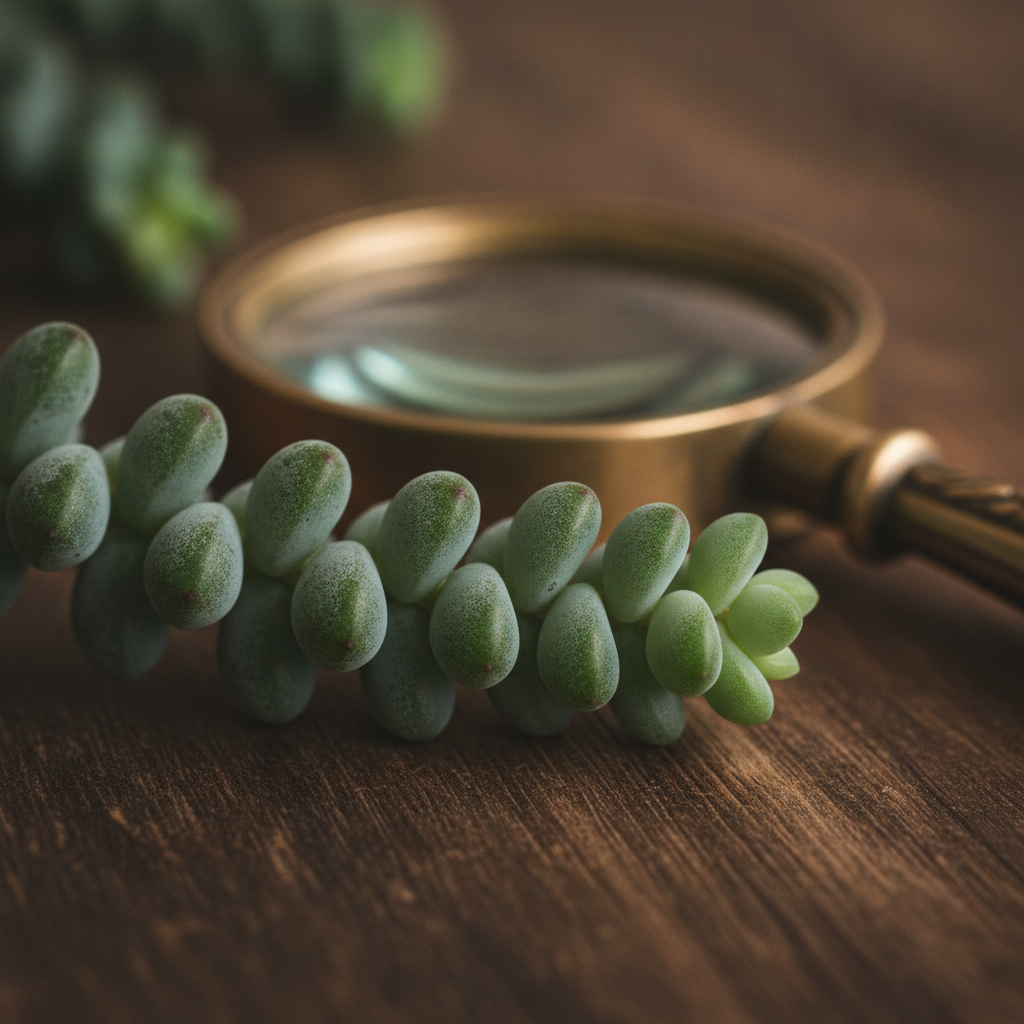
The plant’s densely packed leaves, while beautiful, do create sheltered nooks where pests can hide, so it pays to inspect the stems and leaf joints now and then. The good news is that the same treatments work across the common culprits, and early action almost always resolves the issue.
Common Pests
Mealybugs (Pseudococcus species)
By far the most common pest of the necklace vine, mealybugs appear as small, white, cottony tufts tucked into the leaf joints and along the stems. They suck sap, weakening the plant and leaving behind sticky honeydew that can turn sooty and black.
Treatment: Dab each insect directly with a cotton bud soaked in isopropyl alcohol, which kills them on contact. For a wider outbreak, follow up with a succulent-safe insecticidal soap or neem oil, repeating every week until no new bugs appear.
Spider Mites (Tetranychus urticae)
These tiny mites thrive in hot, dry conditions and are almost too small to see, betrayed instead by fine webbing between leaves and a faint stippling or dullness on the foliage. They can multiply quickly if unnoticed.
Treatment: Wipe the plant down to remove mites and webbing, then treat with neem oil or a miticide. Improving airflow and isolating the plant while you treat it helps prevent them spreading to neighbours.
Fungus Gnats (Bradysia species)
Small black flies drifting around the pot are fungus gnats, whose larvae live in the top layer of damp soil. They are more a symptom than a serious threat, since they appear only when the soil is kept too wet for a succulent.
Treatment: Let the soil dry out fully, which alone usually ends the problem, and use yellow sticky traps to catch the adults. Reviewing your watering habits is the real fix.
Common Diseases
Root Rot (Pythium and Phytophthora species)
The most serious threat to a necklace vine, root rot sets in when the roots sit in wet soil for too long. It shows as soft, yellowing or blackened leaves, a mushy stem base and a sour smell from the soil, and if ignored it can kill the whole plant.
Treatment: Unpot the plant immediately, cut away all soft, brown roots and tissue, and take healthy cuttings from the top as insurance. Let everything dry, then replant in fresh, dry, gritty mix and water only sparingly thereafter.
Fungal Leaf Spot (various fungi)
Damp, stagnant air among the crowded leaves can occasionally lead to dark, sunken spots on the foliage. It is uncommon in a well-ventilated position but more likely where humidity is high and airflow poor.
Treatment: Remove affected leaves, improve air circulation, and keep water off the foliage. In persistent cases a fungicide can help, but better ventilation is usually enough.
Pest and Disease Summary
| Pest / Disease | Identification | Treatment |
|---|---|---|
| Mealybugs | White cottony tufts in leaf joints | Alcohol on a cotton bud, then neem or soap |
| Spider mites | Fine webbing and stippled leaves | Wipe down and treat with neem or a miticide |
| Fungus gnats | Small flies over damp soil | Dry the soil out and use sticky traps |
| Root rot | Mushy stems, blackened leaves, sour soil | Cut away rot, take cuttings, repot dry |
| Fungal leaf spot | Dark sunken spots on leaves | Remove leaves and improve airflow |
Prevention Strategies
Prevention with a necklace vine comes down to good basic culture. Bright light, a gritty free-draining mix, careful watering and decent airflow between them head off almost every problem before it starts, because a plant grown dry and bright simply does not offer pests and fungi the damp, sheltered conditions they need.
It also helps to quarantine any new plant for a couple of weeks before letting it join your collection, and to inspect your necklace vine each time you water. Catching a few mealybugs early is a two-minute job; catching them late can mean losing the plant. A quick, regular look is the cheapest insurance there is.
Pro Tip — Isolate and Inspect: Keep a small bottle of isopropyl alcohol and a few cotton buds near your plants. Spotting and dabbing a single mealybug the moment it appears is far easier than tackling a colony hidden deep in the leaf joints weeks later.
Popular Varieties
The necklace vine belongs to a small group of closely related trailing crassulas that are often sold under overlapping names, and telling them apart is part of the fun of collecting them. All share the same beaded, stacked-leaf habit, differing mainly in leaf size, spacing and how strongly they colour.
Because these plants hybridise and are labelled inconsistently in the trade, you may find the same plant sold under two names or two plants under one. The profiles below cover the forms you are most likely to encounter and what distinguishes each.
| Variety | Leaf Appearance | Light Needs | Growth Rate | Availability |
|---|---|---|---|---|
| Jade Necklace | Tightly stacked, near-round blue-green beads | Bright | Slow | Common |
| Baby’s Necklace | Smaller beads with strong red margins | Bright | Slow | Common |
| Crassula rupestris | Larger, more spaced blue leaves, red-edged | Bright | Moderate | Common |
| String of Buttons | Flat, triangular leaves spiralling up the stem | Bright | Moderate | Common |
| Tom Thumb | Very small, tightly packed pointed leaves | Bright | Slow | Occasional |
| Crassula ‘Hottentot’ | Dense, fine-beaded trailing stems | Bright | Slow | Occasional |
Featured Varieties
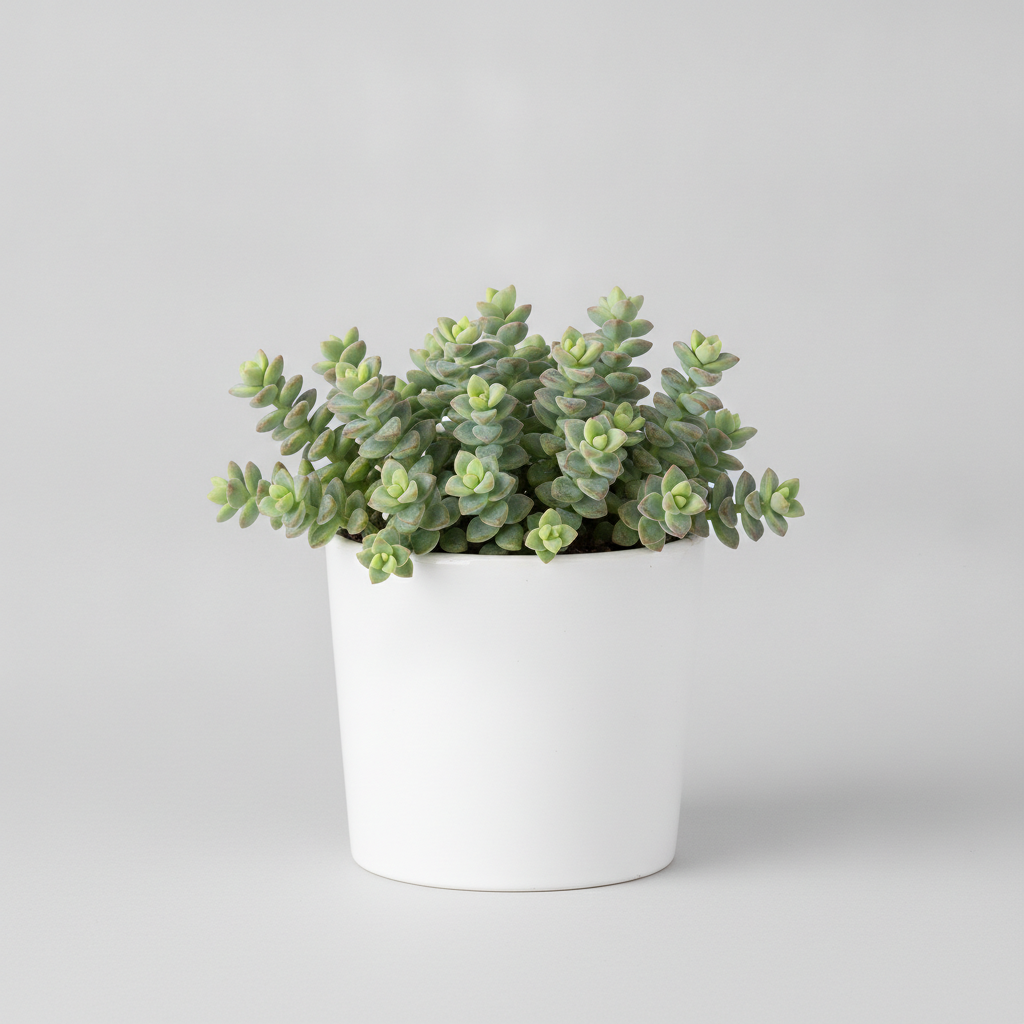
Jade Necklace
The classic form, with tightly packed, near-spherical blue-green leaves stacked like a beaded chain. It stays compact and neat in bright light, its edges tinting pink under stronger sun.
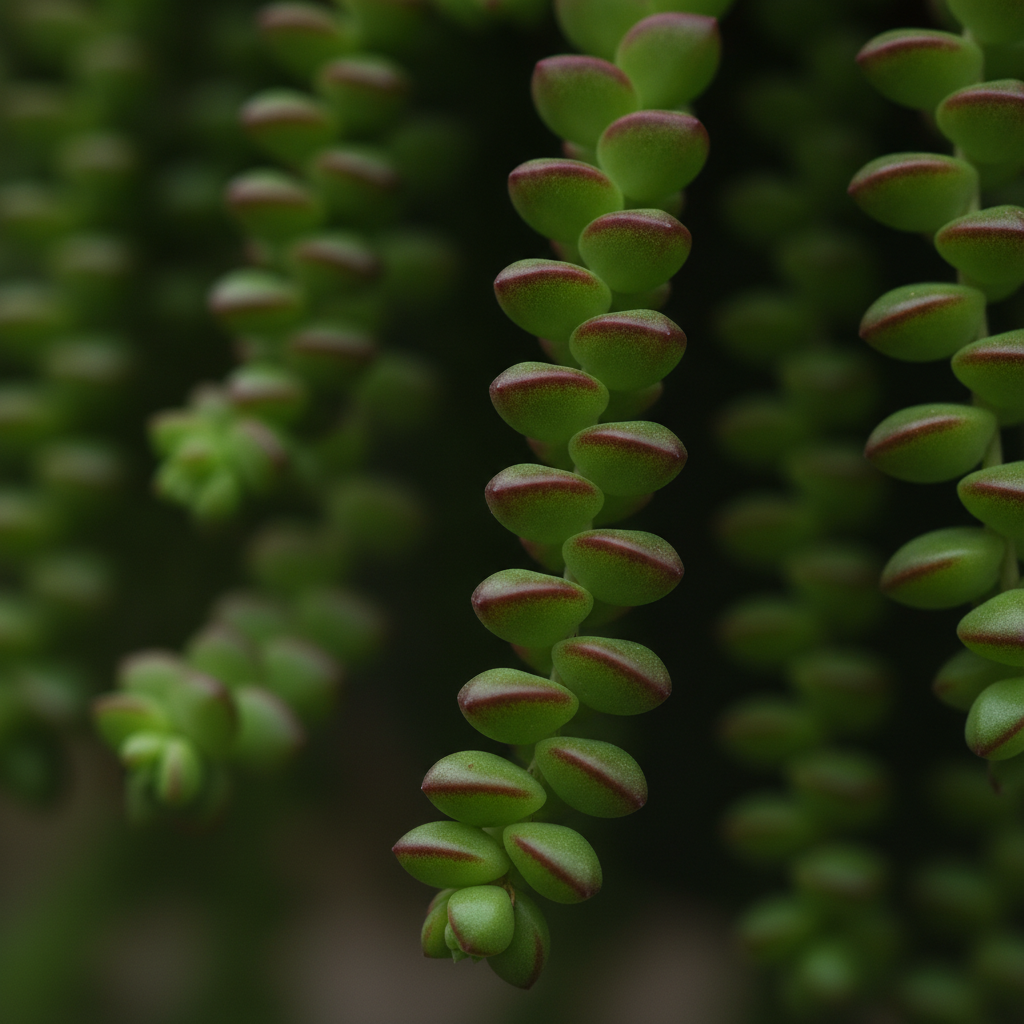
Baby’s Necklace
A daintier hybrid with smaller beads and more pronounced red margins along slender cascading stems. The heightened colour makes it a favourite for bright windowsills and hanging displays.
Variety Profiles in Detail
Jade Necklace (Crassula marnieriana)
The plant most often sold simply as necklace vine, this is the reference form: short, tightly stacked, rounded blue-green leaves clasping the stem in dense beaded strands. It is slow, compact and forgiving, and it colours reliably at the leaf margins given a bright position, making it the natural starting point for anyone new to the group.
Baby’s Necklace (Crassula ‘Baby’s Necklace’)
Widely regarded as a hybrid between Crassula marnieriana and Crassula rupestris, this form carries smaller, more numerous beads and shows stronger red edging. It trails a little more freely than the classic jade necklace and rewards bright light with vivid colour, which has made it one of the most sought-after members of the group.
String of Buttons (Crassula perforata)
A close relative rather than a true variety, string of buttons carries flat, triangular leaves that appear threaded onto the stem and spiral gently as they climb. It grows a touch faster and taller than the necklace vine but wants exactly the same bright light and lean, gritty conditions, and it makes a handsome companion on the same windowsill.
Choosing the Right Variety for Your Space
All of these crassulas ask for the same care, so the choice comes down to look and habit. For a tidy, compact plant on a bright sill, the classic jade necklace is ideal; for stronger colour and a more cascading form, baby’s necklace has the edge; and if you want a little more height and a different leaf shape alongside them, string of buttons rounds out a small collection. Whichever you pick, a bright spot and a gritty, fast-draining mix will keep it at its best.
Frequently Asked Questions
Why is my necklace vine stretching out and losing its beaded look?
Stretching, known as etiolation, is almost always caused by too little light. The plant lengthens the gaps between its leaf pairs as it reaches for a brighter source, and that growth will not tighten up again. Move it to a much brighter spot, and prune the leggy stems back to use as cuttings for a fuller, more compact plant.
How often should I water a necklace vine?
Water only when the soil has dried out completely, which in a warm, bright room usually means roughly every 10 to 14 days in summer and far less, perhaps once every three or four weeks, in winter. Always judge by testing the soil rather than by a fixed schedule, as conditions change the interval considerably.
Why are the leaves turning red or pink?
Reddish leaf margins are a natural and desirable response to bright light and cooler temperatures, not a sign of trouble. The plant produces protective pigments under those conditions, and many growers deliberately give it strong light to bring out the colour. As long as the leaves stay firm, it is a healthy blush rather than stress damage.
Is the necklace vine safe around cats and dogs?
Specific toxicity data for Crassula marnieriana is limited, and it is often described as non-toxic. However, its relative the jade plant is known to be toxic to cats and dogs, so the cautious approach is to keep the necklace vine out of reach of pets and children and to discourage any nibbling.
My necklace vine’s leaves are soft and mushy. What went wrong?
Soft, translucent or mushy leaves are the classic sign of overwatering and probable root rot. Stop watering at once, unpot the plant to check the roots, cut away anything brown and soft, and take healthy cuttings from the top as a safeguard. Replant in fresh, dry, gritty mix and water only sparingly from then on.
Does the necklace vine flower?
Yes. In late winter or early spring a mature, well-grown plant can produce small clusters of pale, star-shaped flowers along the stems. The blooms are modest rather than showy, and the plant is grown mainly for its foliage, but flowering is a good sign that its light and seasonal conditions suit it.
How do I make my necklace vine bushier and fuller?
Bright light is the first step, since it keeps growth compact. Beyond that, pinching or pruning the stem tips encourages branching, and you can plant the cuttings you remove straight back into the same pot to thicken it up. Over a season or two of good light and occasional pruning, a sparse plant fills into a dense, cascading mound.
Can I grow a necklace vine in a hanging pot?
It is one of the best ways to display it. The trailing stems spill attractively over the edge of a hanging planter, showing off the beaded strands to full effect. Just make sure the hanging pot still has proper drainage and hangs in a bright position, since suspended plants often end up in dimmer spots than they need.
Why hasn’t my plant grown much in months?
The necklace vine is naturally slow-growing, and it also rests during the cooler, darker months, so long pauses in growth are normal. Expect the most visible growth in spring and summer under bright light, and treat a winter lull as the plant conserving its energy rather than as a problem to fix.






