
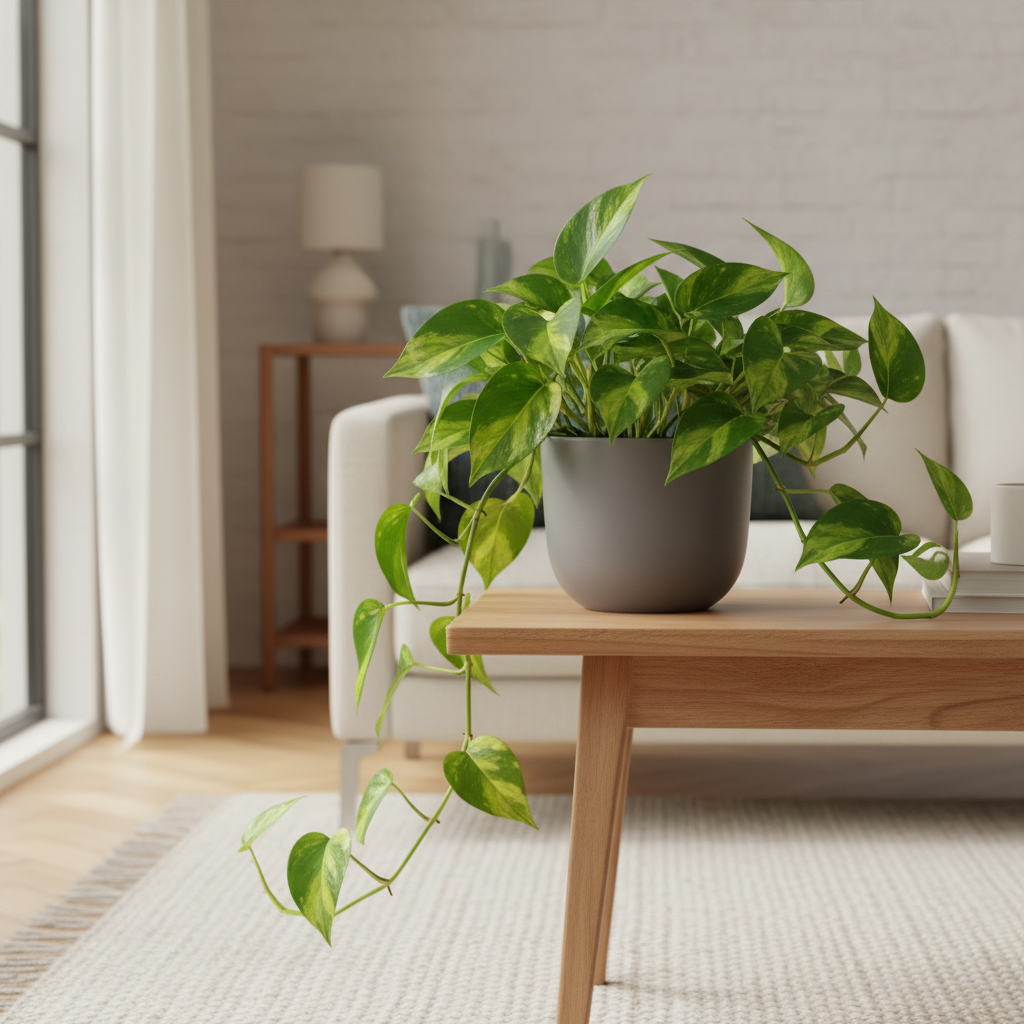
The pothos, known botanically as Epipremnum aureum, is a trailing tropical vine native to the Solomon Islands and parts of South-East Asia. It has earned a long list of common names over the decades, including Devil’s Ivy, Golden Pothos, money plant, and hunter’s robe, all of which point to the same vigorous, heart-leaved climber. In its native habitat it scrambles up the trunks of rainforest trees, but in the home it is most often grown as a hanging or shelf-trailing plant whose vines may eventually drape several metres downwards if left undisturbed.
Few houseplants have a reputation for being as forgiving as pothos. It tolerates low light, irregular watering, dry indoor air, and the kind of neglect that would kill a fussier species in a fortnight. That reputation is well earned, but there is a meaningful difference between a pothos that simply survives in a corner and one that thrives, pushing out broad glossy leaves and steadily lengthening vines. This guide focuses on the conditions, routines, and small adjustments that turn an ordinary pothos into a luxuriant indoor specimen.
Contents
- Quick Reference
- Why Pothos Makes an Outstanding Houseplant
- Light Requirements
- Watering & Humidity
- Soil, Potting & Repotting
- Fertilising
- Propagation
- Pests & Diseases
- Popular Varieties
- Frequently Asked Questions
Quick Reference: Pothos at a Glance
| Light | Bright indirect light preferred; tolerates medium and low light, though variegation fades. |
| Watering | Water when the top 3 to 5 cm (1 to 2 in) of soil feels dry; roughly every 7 to 14 days indoors. |
| Temperature | 18 to 29 °C (65 to 85 °F); avoid drops below 10 °C (50 °F). |
| Humidity | Average household 40 to 60% is fine; growth improves above 50%. |
| Fertiliser | Balanced liquid fertiliser at half strength every 4 to 6 weeks in spring and summer. |
| Toxicity | Toxic to cats, dogs, and humans if ingested due to calcium oxalate crystals. |
Why Pothos Makes an Outstanding Houseplant
Pothos is the houseplant most often recommended to beginners, and the reasoning behind that recommendation goes well beyond simple tolerance. It is one of the few tropical vines that grows steadily in average household light, holds its leaves through brief lapses in watering, and recovers gracefully when conditions improve. The result is a plant that rewards consistent care without punishing the occasional missed week, which makes it equally well suited to a busy home, a quiet office, or a north-facing room where many other tropicals would gradually decline.
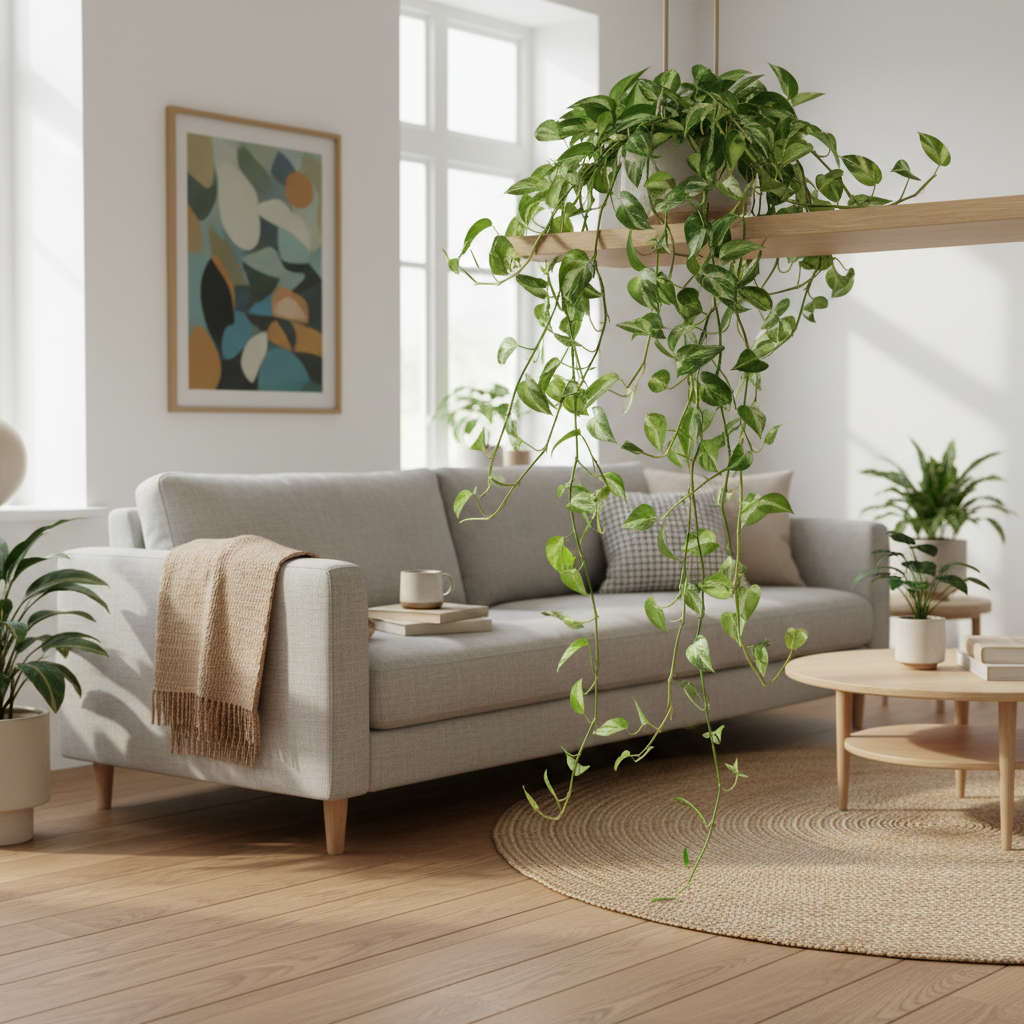
The plant is also remarkably versatile in form. Trained upward against a moss pole, pothos produces larger, more deeply lobed mature leaves and develops the climbing habit of its rainforest origins. Allowed to trail from a hanging basket or shelf, it stays in its juvenile form: long supple stems, smaller heart-shaped leaves, and a draping silhouette that suits modern interiors. Pothos is therefore as useful for filling a tall corner as it is for softening the edge of a bookshelf, and both growth habits can be encouraged from a single plant by changing how it is supported.
Important — Toxicity: All parts of Epipremnum aureum contain insoluble calcium oxalate crystals that cause oral irritation, drooling, vomiting, and difficulty swallowing if chewed. Keep vines out of reach of cats, dogs, and young children, and wash your hands after pruning, as the sap can irritate sensitive skin.
Light Requirements
Pothos is famously adaptable to a wide range of light levels, but the difference between the conditions it tolerates and the conditions it prefers is enormous. In a dim hallway, a pothos may live for years while producing only the occasional small, slightly washed-out leaf. In bright indirect light, the same plant will push out a new leaf every week or two during the growing season, and its variegation, where present, will be richer and more clearly defined.
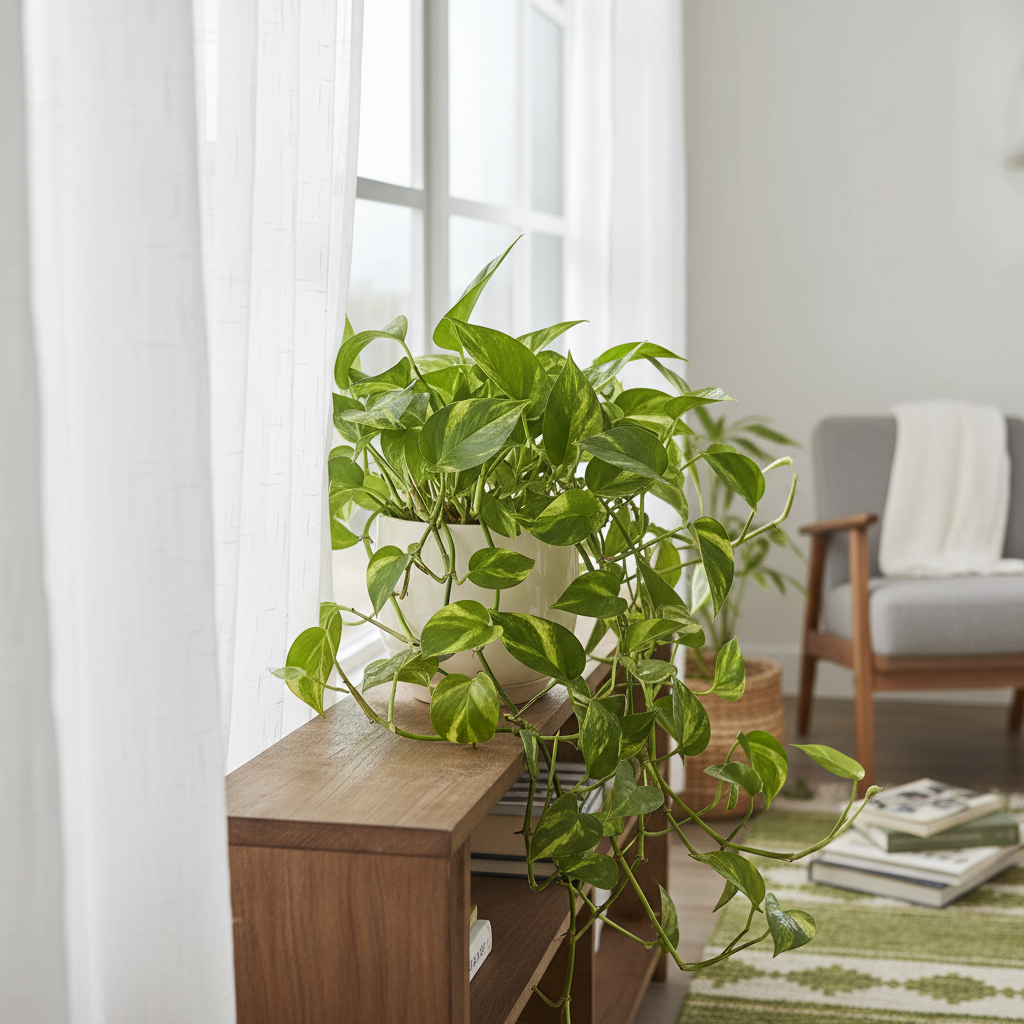
The ideal exposure is several hours of bright, filtered light per day. A position near an east or west window, set back slightly so that direct sun does not strike the leaves, will produce the fullest and most colourful growth. South-facing windows can work well if a sheer curtain softens the midday rays. North windows are workable, especially for solid green forms, but variegated cultivars will gradually revert to green if the light is too dim.
Light Levels Explained
Light terminology for houseplants can be confusing. The table below maps the most common descriptions to approximate measured values and to typical locations in a home, which makes it easier to assess where your pothos is actually living.
| Light Category | Approx. Level | Typical Location | Outcome for Pothos |
|---|---|---|---|
| Direct sun | 10,000 to 50,000 lux | On a south or west sill, no curtain | Scorched, faded leaves; only tolerated briefly |
| Bright indirect | 2,500 to 10,000 lux | Within a metre of an east window | Fast growth, strong variegation |
| Medium | 800 to 2,500 lux | Across the room from a bright window | Steady growth, slightly muted variegation |
| Low | 200 to 800 lux | Interior corner, north window | Survives but slow growth, smaller leaves |
| Very low | Below 200 lux | Windowless hallway or closet | Decline over time, leaves drop |
Window Orientation and Placement
South-facing window: The brightest exposure in the northern hemisphere. Pothos placed directly on the sill is likely to suffer leaf scorch in summer, so set it back at least one to two metres or filter the light with a sheer curtain. In winter, when the sun sits lower, the same window becomes ideal.
East-facing window: Generally considered the best orientation. Pothos receives several hours of gentle morning sun and bright indirect light for the rest of the day, which gives the fullest growth and the cleanest variegation.
West-facing window: Provides strong afternoon light. Pothos thrives here when set back from the glass, although the warmer afternoon rays may require slightly more frequent watering in summer.
North-facing window: The dimmest exposure. Plain-green pothos varieties such as Epipremnum aureum ‘Jade’ tolerate this position well; variegated cultivars often slowly lose their pattern. Consider supplementing with a small grow light if a north window is the only option.
Pro Tip — Rotate Regularly: Turn the pot a quarter-turn every week or two. Pothos vines tend to grow strongly towards the brightest light, and rotation keeps the plant balanced rather than lopsided.
How Light Affects Variegation
Variegated leaves contain less chlorophyll than solid green ones, so cultivars such as Marble Queen and N’Joy depend on extra light to compensate. In bright indirect light, the white or cream sections remain crisp and well defined. In dim conditions, the plant compensates by producing leaves with more green tissue, gradually reducing the proportion of variegation across new growth. The change is not always reversible from existing leaves, but moving the plant brighter usually restores the pattern on subsequent growth.
Warning — Direct Sunlight: Even though pothos can adapt to a wide range of conditions, prolonged midday sun in summer will bleach and burn leaves within days. Brown crispy patches, pale yellow blotches, and a generally washed-out appearance are the classic signs of sun scald.
Artificial Lighting
Pothos responds well to standard LED grow lights and even to ordinary household fluorescents and bright LED room lighting. A full-spectrum bulb at 20 to 40 watts, positioned 30 to 60 cm (12 to 24 in) above the plant for 10 to 12 hours a day, is more than sufficient to maintain healthy growth in a windowless office. Even an overhead office light running on a normal workday schedule will keep a pothos alive indefinitely, which is one reason it has become the unofficial mascot of office plant collections.
Seasonal Adjustments
Light intensity changes substantially between summer and winter, especially in temperate climates. A spot that gave bright indirect light in June may become a low-light position by December. Move pothos slightly closer to windows in autumn and winter, and back away again in late spring. Plants near south-facing windows can usually move directly onto the sill in winter without scorching, since the angle of the sun is shallower and the light less intense.
Watering & Humidity
Watering is the single most common cause of pothos problems, and almost all of those problems trace back to overwatering rather than underwatering. The plant’s epiphytic ancestry means it expects fast-draining conditions and brief dry spells between soakings. A pothos that is allowed to dry out slightly between waterings will produce stronger roots and more resilient growth than one kept perpetually moist.
When to Water
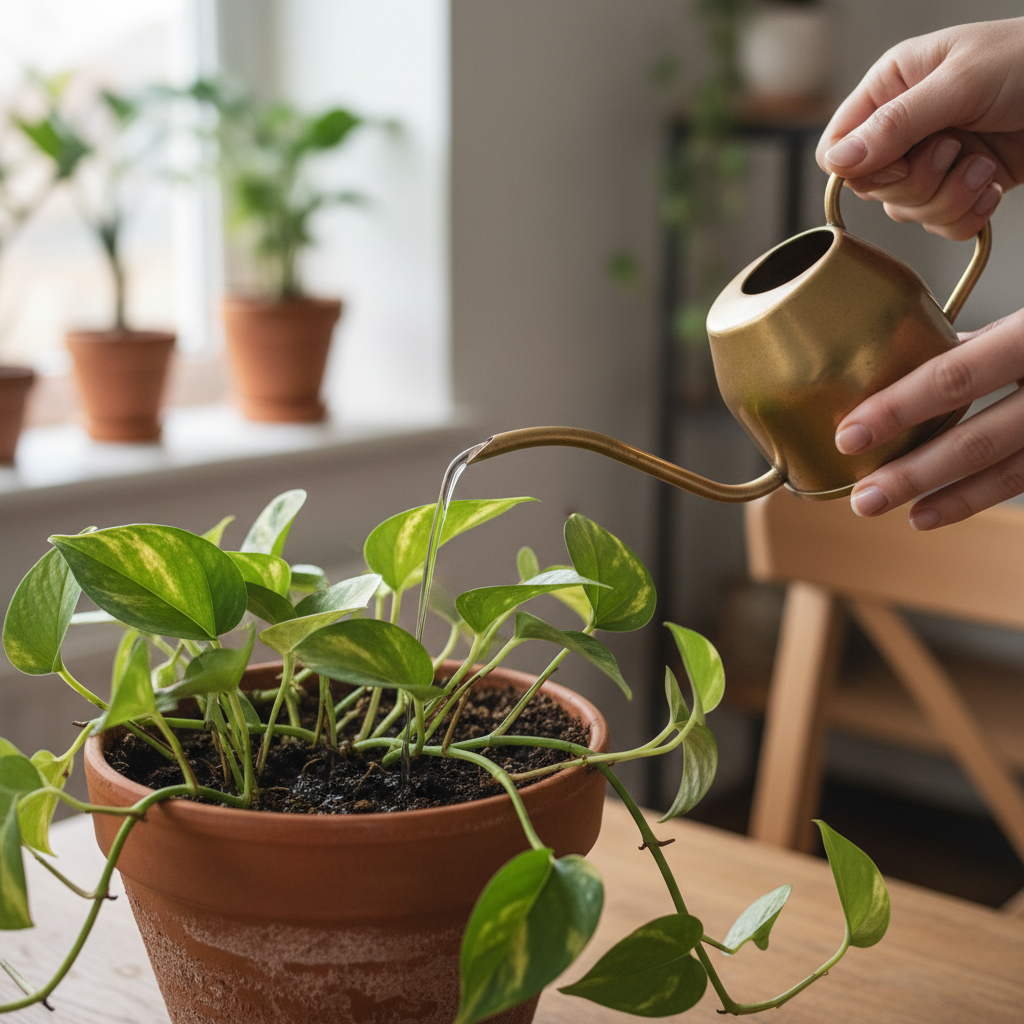
The most reliable test is a finger inserted into the top of the soil to about the second knuckle, roughly 3 to 5 cm (1 to 2 in) deep. Water only when this layer feels dry to the touch. In typical indoor conditions, this works out to once every 7 to 14 days, but the interval varies with pot size, temperature, light, and the season. A pothos in a small pot near a sunny window may dry out in five days; the same plant in a large pot in a cool room may take three weeks.
Pothos also gives clear visual cues. Healthy leaves are firm and held upright at the petiole. When the plant is genuinely thirsty, the leaves become slightly soft and droop on their stems, recovering visibly within hours of a thorough watering. This wilt-and-recover cycle, used occasionally, does no harm and is often easier to read than soil moisture alone.
Pro Tip — Lift the Pot: Pick up the pot before watering and again immediately after. With a little practice, the weight difference becomes the most reliable indicator of how dry the rootball actually is, more reliable than any moisture meter.
How to Water Correctly
- Move the pot to a sink or bath where excess water can drain freely.
- Pour room-temperature water slowly over the entire soil surface, avoiding the crown of the plant where the stems meet the soil.
- Continue until water flows steadily from the drainage holes at the base of the pot.
- Allow the pot to drain for at least 10 to 15 minutes so that no standing water remains in the saucer or cover pot.
- Return the plant to its usual position and wait until the top few centimetres of soil are dry again before the next watering.
Signs of Overwatering vs. Underwatering
| Symptom | Overwatering | Underwatering |
|---|---|---|
| Leaf colour | Yellowing leaves spread across the plant, often starting with older leaves | Browning leaf tips and edges, lower leaves first |
| Leaf texture | Soft, limp, sometimes translucent | Crispy, papery, curled at the edges |
| Soil | Constantly wet, sometimes with a musty smell | Pulls away from the pot edges, very light when lifted |
| Roots | Brown, mushy, breaking apart easily | Dry, brittle, but still firm and pale |
| Stem base | Soft, blackened, sometimes collapsing | Firm, possibly slightly shrivelled |
Warning — Root Rot: A pothos sitting in waterlogged soil for several weeks may develop root rot. If yellowing spreads rapidly and the stem base feels soft, unpot the plant immediately, trim away any dark, mushy roots with sterilised scissors, and repot into fresh, dry, well-draining mix. Withhold water for several days afterwards.
Humidity Requirements
Pothos comes from humid rainforests but is unusually tolerant of dry indoor air. Anything from 40 to 60% relative humidity, which describes most heated homes, is perfectly acceptable. The plant will not visibly suffer in winter when central heating drops humidity into the 20s, although growth slows and leaf tips occasionally turn brown.
Common signs that humidity is too low include crispy brown leaf tips, slow new growth, and an increase in pest activity, particularly spider mites. None of these problems is catastrophic, but they signal that the plant would benefit from a slightly more humid spot.
Practical ways to raise humidity around a pothos include grouping it with other plants, placing it near a kitchen or bathroom, setting the pot on a tray of pebbles and water (with the pot itself above the waterline), or running a small room humidifier during the dry winter months. Misting offers only very brief humidity gains and tends to wet the foliage in ways that can encourage fungal spots, so it is best avoided as a primary strategy.
Water Quality
Pothos is moderately sensitive to chlorine, chloramine, and fluoride present in some tap water supplies. Brown leaf tips and edges, particularly when humidity is otherwise reasonable, often point to a buildup of these compounds. Allowing tap water to sit uncovered for 24 hours drives off most chlorine; filtered, rainwater, or distilled water solves the problem completely and is worth using if you notice persistent leaf-tip damage.
Soil, Potting & Repotting
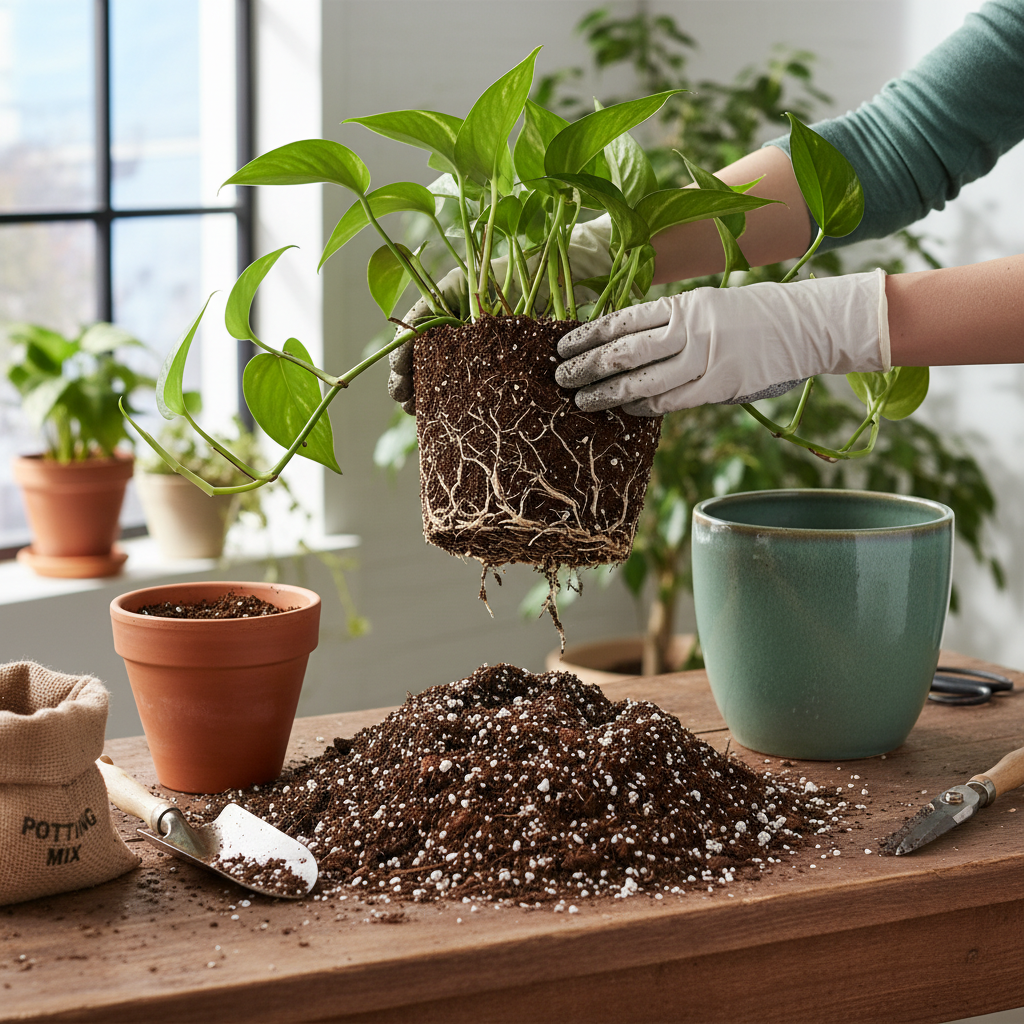
Because pothos is naturally an epiphytic climber, its roots are adapted to grip bark and absorb water briefly before draining. Dense, water-retentive soils that are perfect for many other houseplants smother those roots and quickly lead to rot. The ideal substrate is light, airy, and free-draining, with enough organic matter to hold a useful amount of moisture between waterings.
Ideal Soil Composition
A good pothos mix is built from three or four components that balance moisture retention, drainage, and structure. Off-the-shelf indoor potting compost is acceptable on its own, but most plants respond noticeably to a chunkier, more aerated blend.
| Component | Proportion | Function |
|---|---|---|
| Peat-free houseplant compost or coir | 50% | Holds moisture and provides nutrients |
| Perlite or pumice | 30% | Creates large air pockets and improves drainage |
| Orchid bark | 15% | Adds structure and mimics epiphytic growing conditions |
| Horticultural charcoal | 5% | Discourages anaerobic bacteria and absorbs impurities |
The ideal soil pH for pothos is mildly acidic to neutral, between 6.0 and 7.0. Most commercial houseplant mixes fall comfortably within this range, so adjustments are rarely necessary unless you are mixing from raw ingredients.
Pro Tip — Quick Mix Recipe: For a fast home blend, combine two parts ordinary peat-free houseplant compost with one part perlite and a handful of orchid bark. The texture should crumble in your hand and let water pass through within seconds when poured.
Choosing the Right Pot
Pot choice affects watering frequency, root health, and how the plant displays. The right pot is almost as important as the right soil, and even the best compost cannot compensate for a pot that traps water or constricts the roots.
Drainage holes are non-negotiable. A pot without drainage will eventually waterlog the roots, no matter how carefully you measure each watering. Decorative cachepots without holes can still be used, but the pothos should sit in an inner pot with drainage that can be lifted out for watering and returned only after excess water has run away.
Pot material: Terracotta breathes through its walls and dries the soil faster, which is excellent insurance against overwatering but means more frequent watering in summer. Plastic and glazed ceramic hold moisture longer, which suits drier homes and travellers. Hanging baskets in coco-fibre liners drain very rapidly and may require watering twice as often as a closed pot.
Pot size: Pothos prefers to be slightly snug at the roots. Choose a pot only 2 to 4 cm (1 to 2 in) wider than the rootball. Oversized pots hold large reserves of damp soil that the roots cannot reach, encouraging rot. Move up in single sizes as the plant outgrows each container.
When to Repot
A healthy pothos typically needs repotting every two to three years. Signs that it is time include roots circling the drainage holes, water running straight through the pot without soaking in, slowed growth despite favourable conditions, and a soil surface that has compacted or sunk noticeably. The best time to repot is in spring or early summer, when active growth helps the plant recover quickly from any root disturbance.
How to Repot: Step-by-Step
- Water the pothos thoroughly a day before repotting so that the rootball slides out cleanly.
- Gently squeeze the sides of the pot and tip the plant out, supporting the stem base with one hand.
- Tease apart the outer roots with your fingers and trim any that are dark, soft, or hollow with sterilised scissors.
- Add a layer of fresh mix to the bottom of the new pot, enough that the top of the rootball will sit 2 to 3 cm (about 1 in) below the rim.
- Position the plant centrally, then backfill with fresh mix, tapping the pot gently to settle the soil around the roots.
- Water until liquid runs from the drainage holes, then allow to drain fully.
- Return the plant to its usual spot and resume normal care, but hold off on fertilising for four to six weeks.
Warning — Transplant Shock: A pothos may droop or lose a leaf or two in the days following repotting. This is normal and usually self-corrects within a week or two. Resist the urge to water more frequently or move the plant to brighter light, as this generally makes recovery slower rather than faster.
Fertilising
Pothos is a light feeder by houseplant standards. In its native habitat, it grows in low-nutrient leaf litter and on bark, drawing what it needs in small, steady amounts. Indoors, where compost reserves run down over time, occasional fertilising makes a noticeable difference to leaf size and vine length. Overfeeding, however, is a more common problem than underfeeding and produces salt-burned roots and crispy leaf edges.
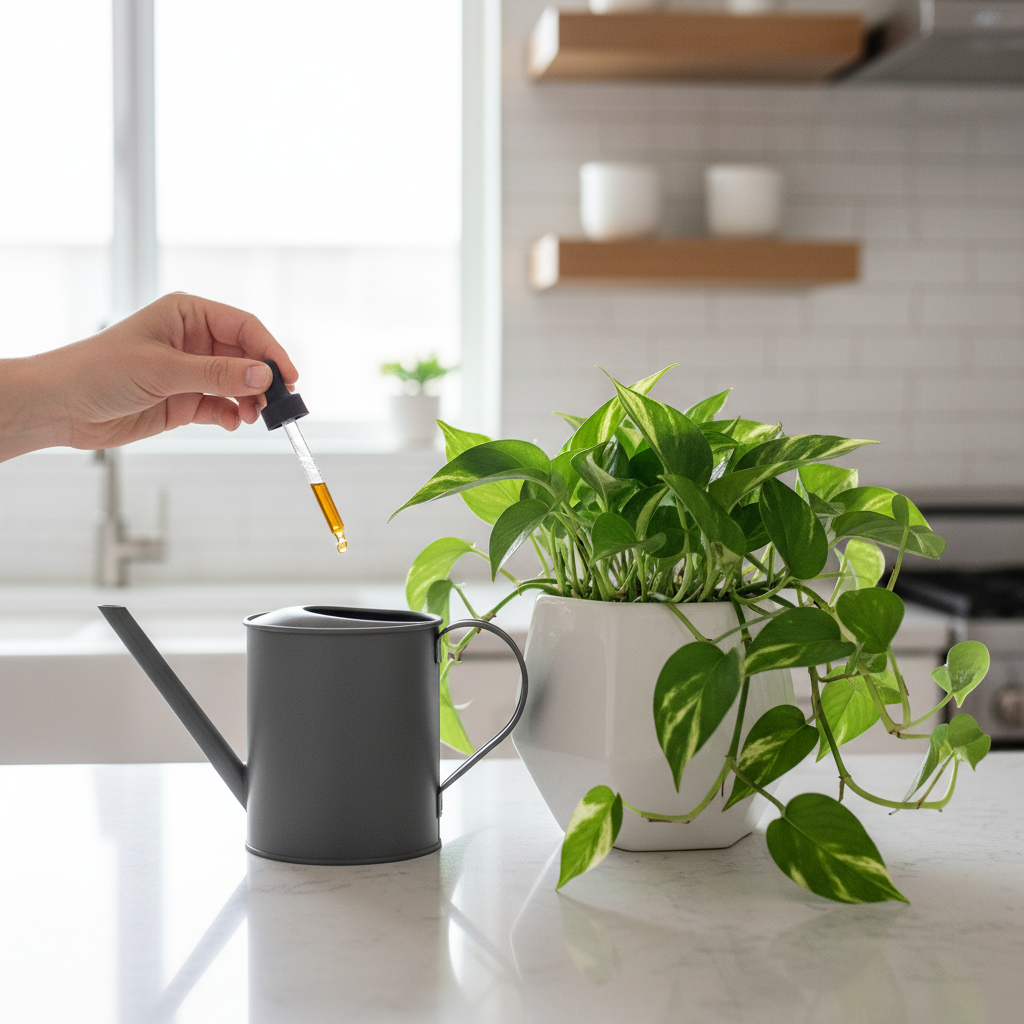
The simplest schedule is a balanced liquid fertiliser at half the manufacturer’s recommended strength, applied every four to six weeks during spring and summer, and stopped entirely from late autumn through winter. Plants in low light should be fed less often, since they use nutrients more slowly.
Understanding Plant Nutrients
Houseplant fertilisers are labelled with three numbers, the NPK ratio, indicating the percentages of nitrogen, phosphorus, and potassium. A general-purpose balanced fertiliser such as 10-10-10 or 20-20-20 is ideal for pothos. Higher-nitrogen formulas (such as 30-10-10) can be used briefly in spring to push lush foliage, but balanced ratios suit ongoing feeding.
| Nutrient | Symbol | Primary Function | Deficiency Symptoms |
|---|---|---|---|
| Nitrogen | N | Builds leaves and overall green growth | Pale, yellowing older leaves |
| Phosphorus | P | Supports root development and overall energy transfer | Slow growth, dull leaves, weak roots |
| Potassium | K | Regulates water balance and disease resistance | Brown leaf edges, weak stems |
| Calcium | Ca | Strengthens cell walls and supports new growth | Distorted new leaves, blackened tips |
| Magnesium | Mg | Central atom in chlorophyll | Yellowing between leaf veins on older leaves |
| Iron | Fe | Chlorophyll production in new leaves | Yellowing between veins on the youngest leaves |
Types of Fertiliser
Liquid fertilisers: The most controllable option. They are mixed into watering and absorbed quickly. Diluting to half strength is the safest approach for pothos and gives consistent results throughout the season.
Slow-release granular: Pellets or prills mixed into the top layer of soil release nutrients gradually over three to six months. Convenient, but harder to scale back if the plant slows in winter, so use a lower dose than the label suggests.
Organic fertilisers: Worm castings, seaweed extract, and fish emulsion are gentle and improve soil biology. They release nutrients slowly and are very hard to overdo, although fish-based products can have a noticeable smell indoors.
Feeding Schedule
From early spring to late summer, feed every four to six weeks with a balanced liquid fertiliser at half strength. In autumn, taper to every two months and reduce strength further. Stop feeding entirely from late autumn through winter, when the plant rests and any unused nutrients accumulate in the soil. Resume in spring once you see new leaves emerging.
Pro Tip — Half Strength, Half the Worry: Pothos almost never suffers from underfeeding, but it is easy to harm with too much fertiliser. Always halve the dose printed on the bottle and watch the plant’s response over the next month before adjusting.
How to Fertilise
- Water the pothos with plain water first; never apply fertiliser to bone-dry soil, as it can burn the roots.
- Mix the fertiliser at half the labelled strength in a watering can.
- Apply the solution evenly across the soil surface until it begins to drain from the bottom of the pot.
- Allow the pot to drain fully and discard any liquid that collects in the saucer or cover pot.
- Note the date and skip the next regular watering with plain water to avoid waterlogging the freshly fed plant.
Warning — Salt Build-Up: Even at moderate doses, fertiliser salts accumulate in the soil over time. A white crust on the soil surface or on the pot rim is the telltale sign. Flush the pot with three to four times its volume of plain water every six months to wash away the buildup.
Propagation
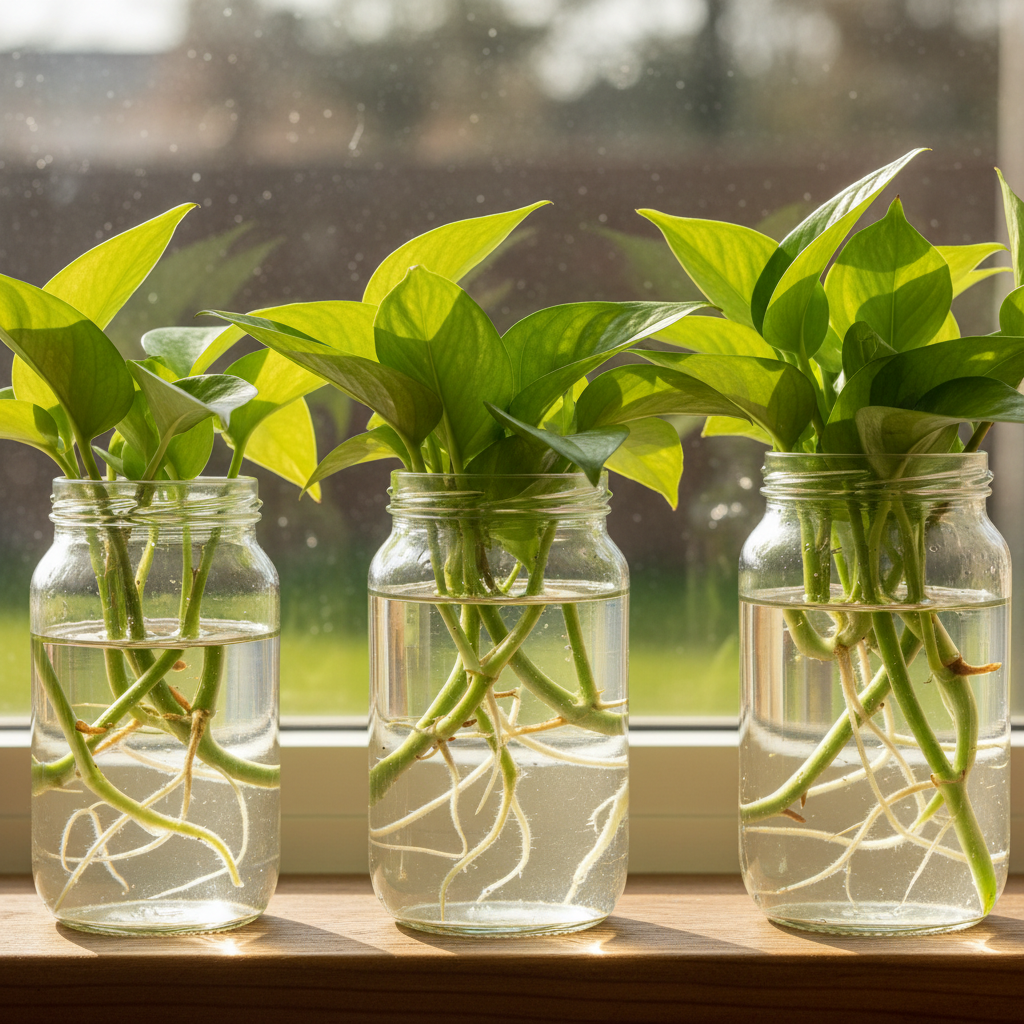
Pothos is one of the easiest houseplants to propagate, and the process is among the most satisfying for new growers. A single mature vine can be turned into a dozen new plants in a single afternoon, all rooting reliably in a glass of water on a windowsill within two to four weeks. The plant’s natural climbing biology, with adventitious roots forming readily at each node, makes both water and soil propagation almost foolproof.
Propagation is also the standard way to refresh an old plant. Pothos that has grown leggy, with long bare vines and sparse leaves, can be cut back hard, with the cuttings rooted and replanted into the original pot to restore a full, bushy shape. This single technique turns one tired plant into a fresh, lush specimen using nothing more than a pair of scissors and a jar of water.
Understanding Nodes
A node is the slight thickening on a pothos vine where a leaf joins the stem. Each node already contains the cells that will become new roots, often visible as small brown bumps along the underside of the stem. A successful pothos cutting must include at least one node submerged in water or soil; a cutting taken between nodes will not root, no matter how long it sits in water.
Water Propagation: Step-by-Step
Water propagation is the most popular method because it allows you to watch roots develop in real time and is almost entirely free of equipment. The cuttings can later be moved into soil or grown on indefinitely in water if topped up regularly.
- Choose a healthy vine with several leaves and locate a node by following the stem until you find a leaf joint.
- Cut the vine about 1 cm (half an inch) below a node using clean, sharp scissors. Each cutting should have one or two nodes and at least one leaf.
- Remove the leaf nearest the cut end so that no foliage sits below the waterline.
- Place the cutting in a clear glass jar of room-temperature water, with at least one node submerged and the leaves above the surface.
- Set the jar in bright indirect light and refresh the water every five to seven days to keep it clear and oxygenated.
- Wait for white roots to appear at the nodes, usually within two to three weeks.
- Once roots reach 5 to 8 cm (2 to 3 in) long, pot the cutting into a small container of fresh houseplant mix.
Pro Tip — Multi-Cutting Pots: For a full, bushy new plant, root five or six cuttings together and pot them into a single small container. The result fills out much faster than a single cutting and gives a more shop-bought look from day one.
Soil Propagation: Step-by-Step
Soil propagation skips the water-to-soil transition, which means the cutting develops roots that are already adapted to substrate. Results are usually slightly slower to show but produce stronger plants over the long term.
- Take cuttings as above, each with at least one node and one leaf.
- Fill a small pot with moist, free-draining houseplant mix.
- Use a pencil or chopstick to make a hole 3 to 4 cm (1 to 2 in) deep, and insert the cutting so the node sits beneath the soil surface.
- Firm the soil gently around the cutting and water lightly to settle.
- Place the pot in bright indirect light, keeping the soil just barely moist for the first three to four weeks.
- Test for rooting by gently tugging the cutting after about four weeks; resistance indicates that roots have established.
Troubleshooting Propagation
| Problem | Likely Cause | Solution |
|---|---|---|
| Cutting turns black at the cut end | Bacterial rot from stagnant water or contaminated scissors | Recut the stem above the rot, sterilise tools, change water more often |
| Roots fail to appear after a month | Cut taken between nodes, or insufficient warmth or light | Confirm cutting has a node submerged; move to a warmer, brighter spot |
| Leaves yellow during rooting | Cutting is sustaining itself from leaf reserves while it roots | Normal in moderation; remove badly yellowed leaves and continue |
| Roots develop but plant wilts after potting | Water roots and soil roots differ; transition shock | Pot earlier, when roots are shorter, or keep soil more evenly moist for the first two weeks |
Pests & Diseases
Healthy pothos are not particularly attractive to pests, but a stressed plant, especially one in a dry, dusty position, can become a target for sap-sucking insects and the occasional fungal disease. Most issues are easy to spot during routine watering and respond well to simple, mechanical treatments if caught early.
The single most effective preventative measure is a regular inspection. Every week or two, glance over the undersides of a few leaves, check the leaf joints, and look at the stem base. Pests caught at the first colony are quick to eliminate; pests that have spread across an entire trailing vine are not.

Common Pests
Spider Mites (Tetranychus urticae)
Spider mites are tiny arachnids, often smaller than a grain of salt, that thrive in warm, dry conditions. Early signs are fine pale stippling on the upper leaf surface and a slightly dusty appearance; in advanced infestations, fine silken webbing collects between leaves and stems. They reproduce explosively when indoor humidity is very low.
Treatment: Wipe leaves and stems with a damp cloth, then spray thoroughly with an insecticidal soap or 1% neem oil solution, repeating every seven days for three applications. Increase ambient humidity afterwards to discourage a return.
Mealybugs (Pseudococcus longispinus)
Mealybugs are small, soft-bodied insects covered in a white cottony wax that makes them look like flecks of fluff in leaf joints. They feed on plant sap and excrete a sticky honeydew that can lead to sooty mould. Pothos mealybug infestations are most common on plants that have spent summer outdoors.
Treatment: Dab visible mealybugs with a cotton bud soaked in 70% isopropyl alcohol to dissolve their wax coating, then follow with weekly sprays of insecticidal soap or neem oil for three weeks.
Scale Insects (Coccus hesperidum)
Scale insects look like small brown or tan bumps on stems and along leaf midribs. The adults are largely immobile and protected by a hard shell, which makes them resistant to many sprays. They are slow-moving but persistent and can build up quietly over months.
Treatment: Scrape adults off with a fingernail or soft toothbrush, then treat the plant with horticultural oil or neem oil weekly for at least four weeks to catch newly hatched crawlers.
Fungus Gnats (Bradysia spp.)
Fungus gnats are small dark flies that hover around the soil surface and breed in consistently moist compost. Adults are mostly a nuisance; the real damage comes from larvae feeding on fine roots in the soil. They are a classic symptom of overwatering.
Treatment: Let the top 5 cm (2 in) of soil dry between waterings, set yellow sticky traps to catch adults, and water with a BTI (Bacillus thuringiensis israelensis) drench to kill larvae.
Common Diseases
Root Rot (Pythium and Phytophthora spp.)
Root rot is the most common pothos disease and is almost always a consequence of poor drainage or chronic overwatering. The visible symptoms (yellowing leaves, sudden wilting, a soft black stem base) reflect a collapsed root system already well advanced. The smell of damp, sour soil is often the giveaway.
Treatment: Unpot the plant, wash the rootball clean, and trim away every dark or mushy root. Repot into fresh, dry, well-draining mix and a clean pot, then water sparingly for several weeks while the plant rebuilds its root system.
Bacterial Leaf Spot (Pseudomonas cichorii)
This disease appears as water-soaked, yellow-edged dark spots, often starting near leaf edges or wherever water sits on the leaf surface. It spreads readily on damp foliage and through contaminated tools.
Treatment: Remove affected leaves with sterilised scissors, water at soil level rather than overhead, and improve airflow around the plant. Severely affected plants can be cut back hard and allowed to regrow from healthy stems.
Pest and Disease Summary
| Pest / Disease | Identification | Treatment |
|---|---|---|
| Spider mites | Fine stippling, webbing in leaf joints | Insecticidal soap or neem oil, raise humidity |
| Mealybugs | White cottony fluff in nodes | Isopropyl alcohol on a cotton bud, neem oil sprays |
| Scale | Hard brown bumps on stems | Scrape adults off, follow with horticultural oil |
| Fungus gnats | Small flies around soil, larvae in compost | Let soil dry, sticky traps, BTI drench |
| Root rot | Yellowing, soft stem base, sour soil | Repot in fresh dry mix, trim rotted roots |
| Bacterial leaf spot | Water-soaked dark spots with yellow halo | Remove affected leaves, water at soil level |
Prevention Strategies
Prevention is far easier than treatment and rests on a few simple habits: water only when the topsoil is dry, keep humidity reasonable, dust leaves with a damp cloth every month or two, and inspect new arrivals carefully before bringing them home. Quarantining new houseplants for two to three weeks in a separate room is an excellent way to avoid importing pests into an established collection.
Pruning also plays a preventative role. Removing yellowing leaves and any vines that have grown unusually leggy improves air circulation and removes likely sites for fungal infection. A clean, well-spaced plant in healthy soil rarely suffers more than a passing pest visit.
Pro Tip — Neem Oil Routine: A monthly preventative spray of 1% neem oil during the growing season keeps a wide range of soft-bodied pests at bay without resorting to harsher chemicals. Apply in the evening so the leaves are not exposed to bright sun while wet.
Popular Varieties
The pothos sold in shops covers a surprising range of leaf patterns and growth habits, all within a small number of distinct cultivars of Epipremnum aureum and its close relatives. Most are easy to grow under similar conditions, but variegation, leaf shape, and growth speed vary considerably between them.
Choosing among them is largely a matter of light availability and preferred colour palette. Heavily variegated forms need more light to look their best, while plain-green or near-plain cultivars cope with darker corners and are noticeably more vigorous.
| Variety | Leaf Appearance | Light Needs | Growth Rate | Availability |
|---|---|---|---|---|
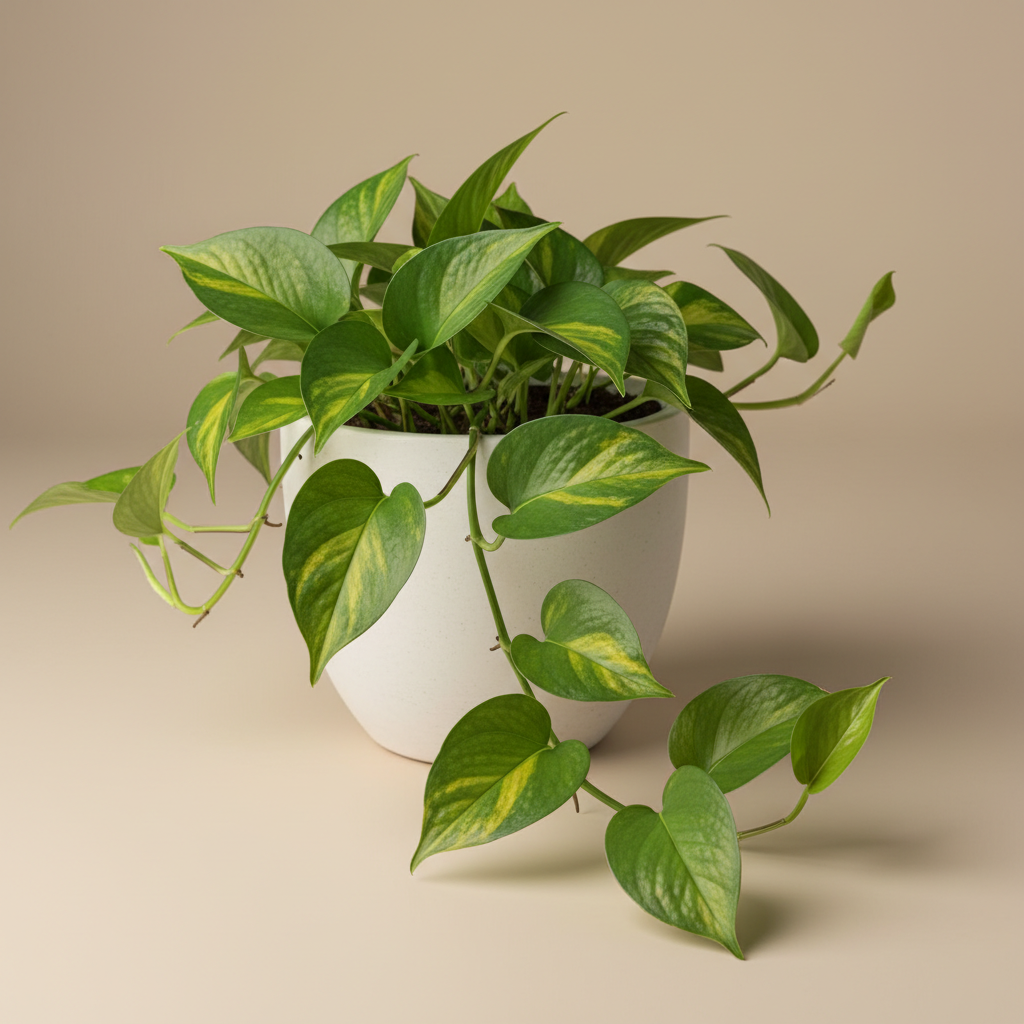
| Golden Pothos | Heart-shaped green with bright golden-yellow streaks | Bright indirect | Fast | Very common |
| Marble Queen | Heavy creamy-white marbling on deep green | Bright indirect | Moderate | Common |
| Neon | Solid bright chartreuse green | Medium to bright | Fast | Common |
| Jade | Plain glossy deep green | Low to medium | Fast | Common |
| N’Joy | Small leaves with sharp white margins | Bright indirect | Slow to moderate | Moderate |
| Pearls and Jade | Small leaves with speckled white and silver edges | Bright indirect | Slow | Moderate |
| Manjula | Wavy leaves with cream, white, green, and silver swirls | Bright indirect | Slow | Less common |
| Cebu Blue | Narrow blue-green leaves with metallic sheen (Epipremnum pinnatum) | Bright indirect | Fast | Less common |
Featured Varieties
Golden Pothos
The original and still most widely sold form. Vivid yellow streaks scatter across heart-shaped green leaves, intensifying with bright indirect light. Fast-growing, forgiving, and well suited to a hanging basket or a tall shelf.
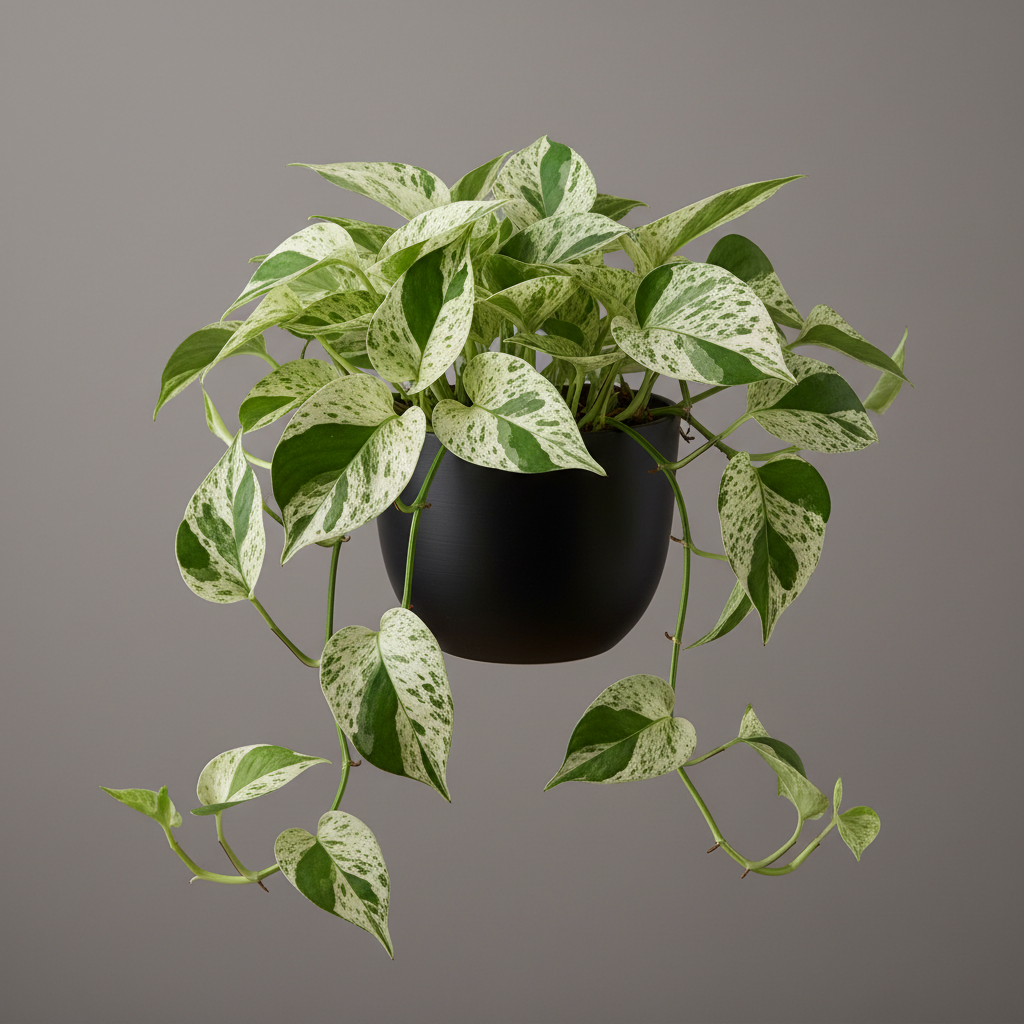
Marble Queen Pothos
A heavily variegated cultivar in which creamy white tissue can cover more than half of each leaf. Slower-growing than Golden Pothos and dependent on good light, but spectacular when grown well.
Variety Profiles in Detail
Neon Pothos (Epipremnum aureum ‘Neon’)
Neon is unique among popular pothos for its solid, electric chartreuse foliage. The colour is most vibrant on new leaves and slightly deepens as they mature. Despite its bright appearance, it tolerates medium light surprisingly well, though the colour pales in dim corners.
Jade Pothos (Epipremnum aureum ‘Jade’)
The most forgiving of all the cultivars. Jade has solid green, slightly glossy leaves and tolerates the lowest light of any pothos. It is the natural choice for a north-facing office or a darker hallway and grows as fast as Golden Pothos in better conditions.
N’Joy Pothos (Epipremnum aureum ‘N’Joy’)
Compact, slower-growing, and instantly recognisable for its small leaves with sharp, almost cleanly drawn white margins. N’Joy is more compact than other pothos and works well as a desk or shelf plant rather than a long-trailing specimen.
Manjula Pothos (Epipremnum aureum ‘Manjula’)
A relatively new patented cultivar with wavy-edged leaves splashed in green, silver, cream, and white. Every leaf looks different. Slow-growing and dependent on bright indirect light, but considered one of the most ornamental pothos available.
Cebu Blue Pothos (Epipremnum pinnatum ‘Cebu Blue’)
Technically a different species, Cebu Blue is sold alongside true pothos and grown in much the same way. Its narrow, lance-shaped leaves have a blue-green tint and a faint metallic sheen, and on a moss pole mature plants develop large, deeply fenestrated leaves resembling those of mature Monstera.
Choosing the Right Variety for Your Space
For a dim corner or a hallway with limited natural light, Jade or Neon pothos give the strongest results. For a bright kitchen or a window-lit living room, Golden Pothos or Marble Queen produce the most striking display. If space is limited, N’Joy and Pearls and Jade stay compact for years. For collectors looking for something less common, Manjula and Cebu Blue offer striking foliage that rewards a brighter, more attentive position.
Frequently Asked Questions
Why are my pothos leaves turning yellow?
The most common cause is overwatering and the soggy, oxygen-starved roots that follow. Let the top 3 to 5 cm (1 to 2 in) of soil dry between waterings, and check that the pot drains freely. Occasional yellowing of the oldest leaf is normal as the plant ages and redirects energy elsewhere, but rapid or widespread yellowing always points to a watering or root problem.
How fast does pothos grow?
A healthy pothos in bright indirect light can grow 30 to 45 cm (12 to 18 in) per month during the growing season. Growth is slower for heavily variegated cultivars and slower still in low light or during winter. With time, vines reach 3 to 5 m (10 to 16 ft) indoors and considerably longer in their native habitat.
Can pothos live in just water?
Yes. Cuttings rooted in water can be grown on indefinitely in a clean jar, refreshed weekly and supplemented with a few drops of dilute hydroponic fertiliser every month. Growth is slower than in soil and leaves are usually smaller, but the plant survives well and gives an attractive, low-effort display.
Is pothos safe for pets?
No. Epipremnum aureum contains insoluble calcium oxalate crystals that cause oral pain, drooling, vomiting, and difficulty swallowing in cats and dogs. Symptoms are unpleasant rather than usually fatal, but the plant should be kept well out of reach, ideally on a high shelf or in a hanging basket where curious pets cannot chew the trailing vines.
Why are my pothos leaves losing variegation?
Insufficient light is by far the most common cause. Variegated tissue contains less chlorophyll, so the plant gradually produces greener leaves to compensate in dim conditions. Move the plant to a brighter spot near an east or filtered south window, and pinch back vines that have reverted entirely to green; new growth should return with more pattern.
Should I prune my pothos?
Pruning is optional but encouraged. Pinching the tip of each vine above a leaf node prompts the plant to branch, producing a fuller silhouette. Long bare vines can be cut back hard and propagated to refresh the original plant. The best time to prune is in spring, when active growth quickly fills in the gaps.
Will pothos flower indoors?
Almost never. Pothos flowers only as a mature climbing plant, a stage that takes many years and requires the plant to grow up a substantial support in warm, humid conditions. The houseplant form remains in its juvenile vegetative state indefinitely and produces no flowers in typical indoor conditions.
Can pothos grow up a moss pole?
Yes, and the results can be striking. Trained up a moist moss pole, pothos vines climb steadily and produce noticeably larger leaves over time. Mature climbing pothos in nature develop deeply lobed, almost Monstera-like foliage; indoors, you can sometimes coax leaves twice the size of the juvenile form by providing a long, well-watered support.
How often should I dust the leaves?
Every four to six weeks is usually enough. Wipe each leaf gently with a damp cloth to remove dust, which can otherwise block light and reduce photosynthesis. A periodic lukewarm shower in the bath, with the soil covered to prevent saturation, achieves the same effect in less time on a large trailing specimen.
Why are my pothos vines leggy with few leaves?
Legginess almost always points to insufficient light. As the plant stretches towards a brighter spot, the spacing between leaves increases and older leaves drop, leaving long bare runners. Move the plant to a brighter position, cut the legginess back to a node, and propagate the trimmings to fill in the pot for a denser look.






