

Few houseplants have captured popular imagination quite like the sweetheart hoya. Sold by the thousand around Valentine’s Day as a single thick, glossy, heart-shaped leaf rooted upright in a tiny pot, Hoya kerrii has become a kind of shorthand for living affection — a plant you give rather than buy for yourself. It is native to the warm forests of Southeast Asia, found wild across Thailand, Vietnam, Laos, Cambodia and parts of southern China, where it scrambles along tree trunks and dapples into the canopy as a slow-creeping, semi-succulent epiphyte. Outside its homeland it is most often called sweetheart hoya, sweetheart plant, lucky-heart plant, valentine hoya or simply the wax heart, and its botanical name honours the Irish botanist Arthur Francis George Kerr, who collected the species in Thailand in the early twentieth century.
What gets people through the door is the single-leaf novelty. What keeps them coming back is everything that happens afterward, if they are patient enough to let it. A solitary leaf without a node will sit on a shelf for a decade and never grow another thing, an oddly satisfying low-maintenance ornament. A cutting with a node, by contrast, will eventually push out long wiry vines studded with paired hearts, climb a trellis, and after several years reward its keeper with clusters of intensely fragrant, parachute-shaped flowers in white, cream and dusty pink. This guide covers both ends of that spectrum — the bare-minimum care that keeps a Valentine’s Day leaf alive on a bookshelf, and the deeper conditions that turn a small cutting into a full, flowering vine. The difference between surviving and thriving with this plant is mostly about light, restraint with the watering can, and the willingness to wait.
Contents
- Quick Reference
- Why Hoya Kerrii Makes a Charming Houseplant
- Light Requirements
- Watering & Humidity
- Soil, Potting & Repotting
- Fertilising
- Propagation
- Pests & Diseases
- Popular Varieties
- Frequently Asked Questions
Quick Reference: Hoya Kerrii at a Glance
| Light | Bright indirect light; tolerates a few hours of gentle direct sun in the morning or late afternoon |
| Watering | Allow the substrate to dry out almost completely between waterings; roughly every 14 to 21 days in summer, every 4 to 6 weeks in winter |
| Temperature | 18 to 29°C (65 to 85°F); avoid anything below 13°C (55°F) |
| Humidity | Average household humidity (40 to 60 percent) is fine; tolerates lower without complaint |
| Fertiliser | Balanced liquid feed at quarter to half strength every 4 to 6 weeks during active growth; nothing in winter |
| Toxicity | Non-toxic to cats, dogs and humans according to the ASPCA; safe around pets and curious children |
Why Hoya Kerrii Makes a Charming Houseplant
The sweetheart hoya rewards an unusual combination of qualities. The leaves are thick and water-storing in the way of a succulent, so the plant forgives a forgetful owner who skips a watering or two. The growth habit is slow and predictable, so it never outgrows the spot you place it in over a single season. The vines are flexible and willing to climb a trellis, drape from a hanging pot, or stay tidily upright in a small specimen container, so the same plant suits a tiny rented flat or a dedicated sunroom equally well. And the flowers, when they eventually arrive, are among the most extraordinary in cultivation: tight umbels of five-pointed waxy stars in cream, pink and burgundy, each one shaped as if it were carved from a single block of soft porcelain, releasing a heavy chocolate-and-honey fragrance after dark.
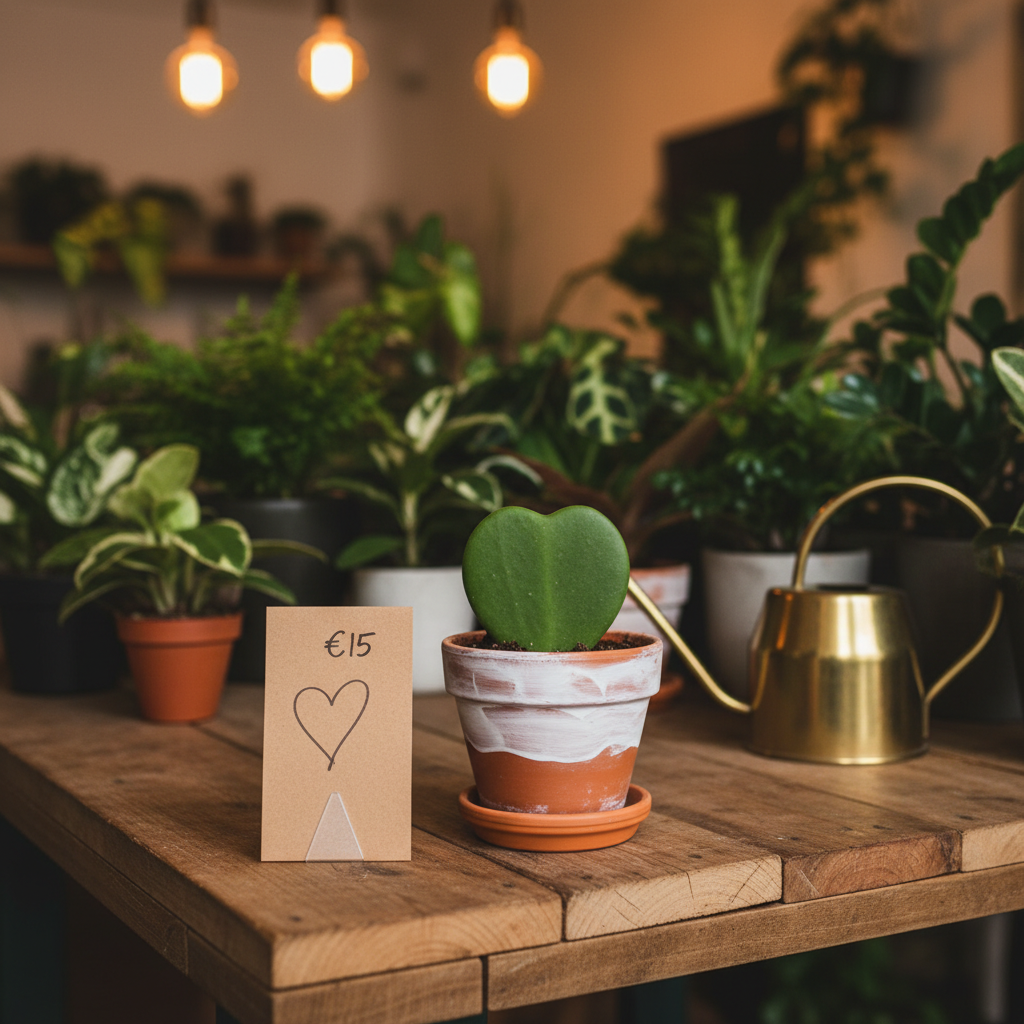
That said, expectations need calibrating from the start. A single-leaf cutting is sold as a gift item, not as a juvenile plant; without a node it will almost never produce a stem, and many people who buy one are quietly disappointed years later that nothing has changed. A rooted cutting with at least one node behaves quite differently and will eventually grow, but on a timescale better measured in years than months. A fully mature hoya kerrii that flowers reliably indoors is genuinely uncommon and tends to belong to growers who have given the plant a stable spot near a sunny window, fed it lightly, and left it alone for half a decade. Once the gift-plant phase passes, the real reward of this species is its longevity: a well-treated specimen can outlive most other houseplants by a wide margin.
Important — Toxicity: Hoya kerrii is listed as non-toxic by the ASPCA, and there are no significant reports of poisoning in cats, dogs or humans from leaf or sap contact. The milky sap can still irritate sensitive skin and should not be rubbed into the eyes, so wash hands after pruning. The plant is one of the safer choices for households with pets and small children.
Light Requirements
Light is the single most important factor in whether a hoya kerrii stays alive, whether it grows, and whether it eventually flowers. The species evolved as an epiphyte clinging to the trunks and lower branches of tropical trees, where it receives bright dappled light filtered through a higher canopy. Indoors, the closest equivalent is a position close to a window that is shielded from the harshest part of the day but never gloomy. The plant is far more forgiving of brightness than most aroids and most tropical foliage plants, and in the right spot the leaves will keep their thick, glossy quality rather than thinning out and stretching.
The ideal placement is within a metre of a bright east-facing or west-facing window, or set slightly back from a south-facing one. A hoya kerrii will tolerate direct morning or late-afternoon sunlight surprisingly well, especially if it has been gradually introduced to it, and a few hours of gentle direct light each day actually encourages tighter growth and eventual flowering. The plant struggles in genuinely low light: it will not die quickly, thanks to those water-storing leaves, but it will refuse to grow, and over a year or two the leaves can develop a slightly limp, pale quality that no amount of fertiliser will fix.
Light Levels Explained
Plant care articles throw around terms like “bright indirect light” with very little precision. The table below maps the rough light tiers in lux to the kinds of indoor spots most people actually have, and describes what each one means for a hoya kerrii over the course of a year.
| Light Category | Approx. Level | Typical Location | Outcome |
|---|---|---|---|
| Direct sun | 40,000 to 100,000 lux | Right on a south-facing windowsill in summer | Tolerated only if acclimated; risk of pale or scorched leaves in afternoon sun |
| Bright indirect | 10,000 to 25,000 lux | Within a metre of an east or west window, set back from a south one | Best growth, tightest internodes, best chance of flowering |
| Medium | 2,000 to 10,000 lux | Several metres back from a bright window, or beside a north window | Survives well, slow growth, no flowering |
| Low | 500 to 2,000 lux | Interior corner of a room, hallway with no direct sky view | Hangs on for months but slowly declines; not recommended long-term |
| Very low | Under 500 lux | Bathroom with no window, deep interior | Will not grow; eventually dies back |
Window Orientation and Placement
South-facing window: excellent in autumn, winter and spring, when sun angles are lower and the light is filtered through the atmosphere. In high summer the plant should be moved a metre back from the glass or shielded by a sheer curtain, otherwise the leaves can pale and develop dry patches.
East-facing window: probably the best year-round spot in most homes. The plant receives several hours of mild morning sun, then bright indirect light for the rest of the day, with no risk of overheating.
West-facing window: also very good, though the afternoon sun is stronger than the morning. Set the plant slightly back from the glass or use a sheer curtain during peak summer.
North-facing window: usable but not ideal. A hoya kerrii placed directly against a bright north window will survive and even put on a little growth, but flowering is unlikely and the plant will be considerably slower than in a brighter orientation.
Pro Tip — The Hand Shadow Test: hold your hand about 30 centimetres above the plant and look at the shadow it casts on the leaves. A crisp, dark shadow with clear edges means real bright light; a soft, blurry shadow means moderate light; no visible shadow at all means the plant is in low light and unlikely to thrive.
How Light Affects Leaf Colour and Flowering
Light is what triggers a hoya kerrii to flower, far more than fertiliser or repotting. The species blooms on short woody spurs called peduncles that emerge from mature stems and can flower repeatedly over many years from the same spur, so it pays not to prune them off. Plants kept in bright conditions for several consecutive months are the ones that develop these spurs and eventually cycle into bloom. In dim light, the spurs may form but never push out flowers, and the plant tends to focus on slow vine extension instead. Variegated and splash forms also depend on light to keep their colour: too little, and the cream margins reduce or the silvery flecks fade; too much, and the white tissue can scorch first because it lacks chlorophyll for self-protection.
Warning — Direct Sunlight: a sudden move from a shady room to a sun-drenched windowsill will scorch the leaves within hours, leaving pale dry patches that never recover. If you want a hoya kerrii in a brighter spot, increase the light gradually over two to three weeks, starting with an hour of direct sun and working up.
Artificial Lighting
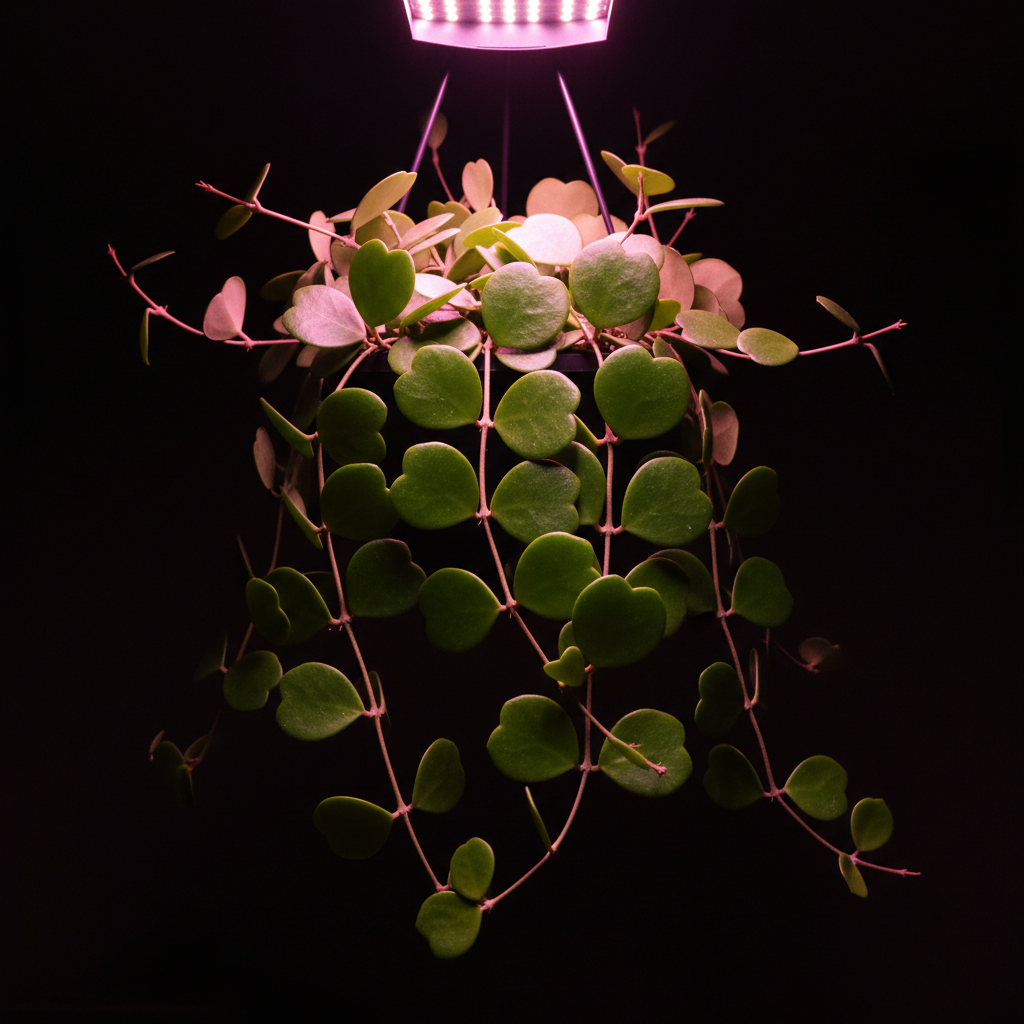
Hoya kerrii responds well to grow lights, which makes it a good candidate for darker flats or for keeping growth going through a long northern winter. A full-spectrum LED panel positioned 30 to 45 centimetres above the canopy and run for 12 to 14 hours a day will hold a plant in active growth and can even induce flowering in a basement or windowless room. Cheap clip-on USB lights are not bright enough for blooming, but they will keep a single-leaf cutting healthy on a bookshelf far from any window.
Seasonal Adjustments
In temperate climates the light reaching an indoor plant in midwinter can be a tenth of what it receives in midsummer. A hoya kerrii that thrived a metre back from a window in June will often need to be moved right up against the glass by December. Conversely, a plant that was happy on a south-facing sill all winter may need to step back into the room as the sun strengthens in late spring. Watching for any sign of leaf paling, etiolated stretching, or aborted flower buds is the simplest cue that the light has shifted and the plant needs repositioning.
Watering & Humidity
Watering is where most hoya kerrii die, and almost always from too much rather than too little. Those thick succulent leaves store significant amounts of water and act as a buffer against drought, so the plant is built to dry out and recover, not to sit constantly damp. The roots are fine and easily rotted, and once rot sets in on a slow-growing species like this one the plant has very little capacity to recover before it collapses entirely. The single most useful watering rule for hoya kerrii is to let the substrate dry out almost completely before watering again, and then to water thoroughly until liquid runs from the drainage holes.
How Often to Water
A useful starting frequency is every two to three weeks during the warm growing months from late spring through early autumn, and every four to six weeks during winter. Those numbers should be adjusted to the conditions in your home: a small plant in a bright sunny window dries out in a fraction of the time a large plant in a north-facing corner does. Rather than committing to a calendar, test the substrate with a finger or a wooden skewer pushed to the bottom of the pot. The substrate should feel barely cool and almost dry before the next watering. If it still feels even slightly damp, wait another few days.
How to Water
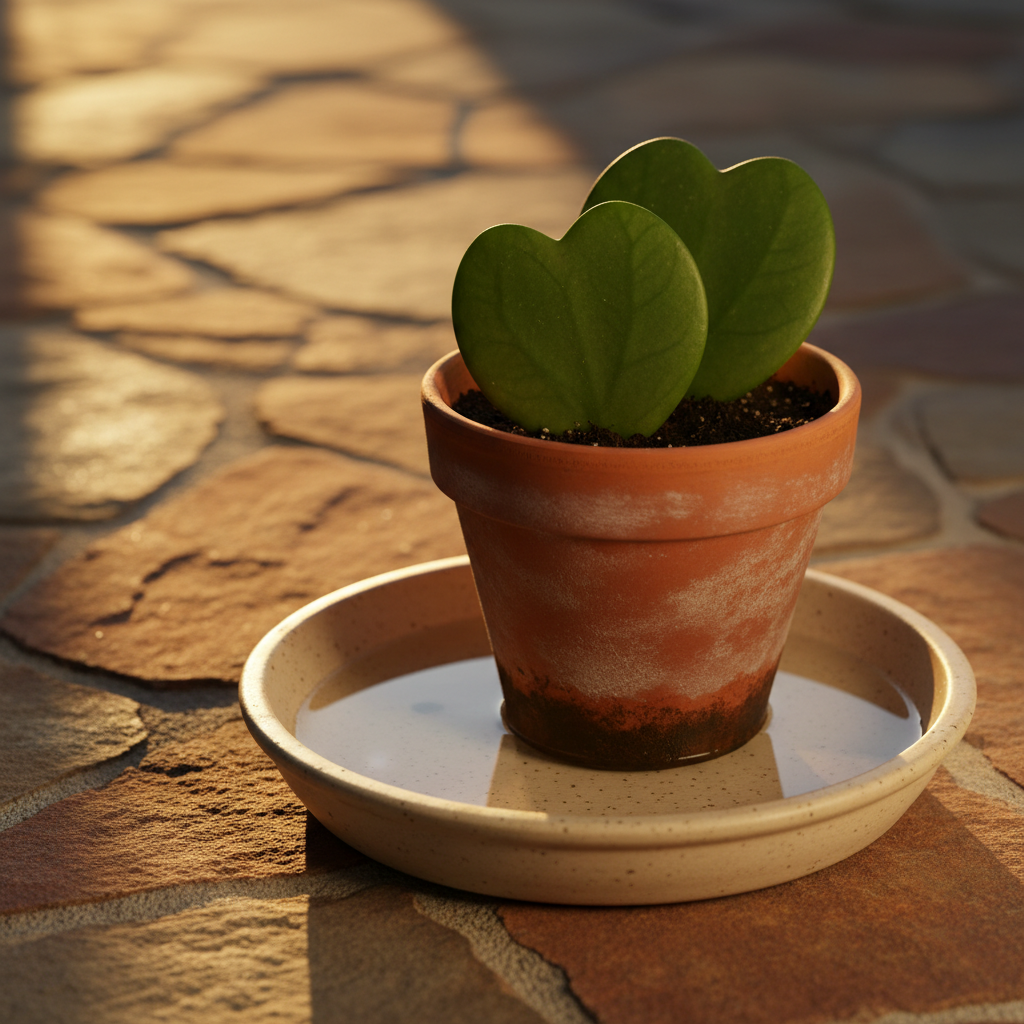
When the time comes, water generously. Soak the substrate all the way through, either from above with room-temperature water poured slowly around the base, or by bottom watering in a shallow tray for ten to fifteen minutes. The aim is to wet every part of the root system and then allow excess to drain away. Always empty any saucer or cover-pot afterwards, because hoya kerrii roots will not tolerate sitting in water for more than a few hours.
- Check the substrate by feel or with a moisture meter; only water if it is nearly dry to the bottom of the pot.
- Use room-temperature water, ideally rain or filtered water if your tap is very hard.
- Water the substrate, not the leaves; wet hoya foliage in low light invites fungal spotting.
- Allow water to drain freely for several minutes; tip out anything that pools in the saucer.
- Note the date and check again in roughly two weeks rather than working on autopilot.
Signs of Over- and Underwatering
Overwatered hoya kerrii leaves often look subtly swollen, then turn yellow from the base of the leaf outward, and finally drop with a soft mushy stalk. The lower stem may darken or feel spongy when pressed. Underwatered leaves, by contrast, become slightly wrinkled or develop a soft puckered indentation on the underside; the plant looks deflated rather than discoloured. The recovery from a single underwatering is fast and complete after a thorough drink. Recovery from overwatering is far less certain and usually requires unpotting, inspecting the roots, cutting away anything mushy, and repotting into a much drier mix.
Pro Tip — The Pinch Test: gently pinch one of the thicker leaves between thumb and forefinger. A well-hydrated hoya kerrii leaf feels firm, almost like a piece of latex; a thirsty one yields slightly and feels softer. With a few weeks of attention, you can learn to read your plant’s water status without even touching the soil.
Water Quality
Tap water is usually fine for hoya kerrii. In areas with very hard water, mineral build-up can show up over time as crusty white deposits on the soil surface and around the pot rim, and it can contribute to slow root decline. Filtering, using rainwater, or occasionally flushing the pot through with several pot volumes of distilled water clears the salts. Avoid water that has been through a softener, because the sodium it adds is harmful to roots.
Humidity
For a tropical plant, hoya kerrii is remarkably tolerant of dry indoor air. The thick waxy leaf surface limits transpiration, and the plant will sit happily through the dry winter months in centrally heated homes where calatheas and ferns are crisping at the edges. A relative humidity of 40 to 60 percent is plenty, and the species shows no obvious advantage above that. If you keep it in a very dry environment of 20 to 30 percent humidity, the leaves remain fine but flowering can be inhibited and any developing buds may dry up. A small humidifier or a tray of pebbles and water near the plant in winter is a sensible insurance policy if blooms matter to you.
Soil, Potting & Repotting
The right substrate for hoya kerrii is one that drains fast, holds very little water for very long, and offers plenty of air around the roots. The roots evolved to cling loosely to tree bark with brief flushes of moisture from rain, not to be packed into dense peat that stays wet for a week. A bag of generic indoor plant compost straight from a garden centre is usually too retentive on its own. With a little amendment, however, it becomes an excellent base.
A Reliable Mix Recipe
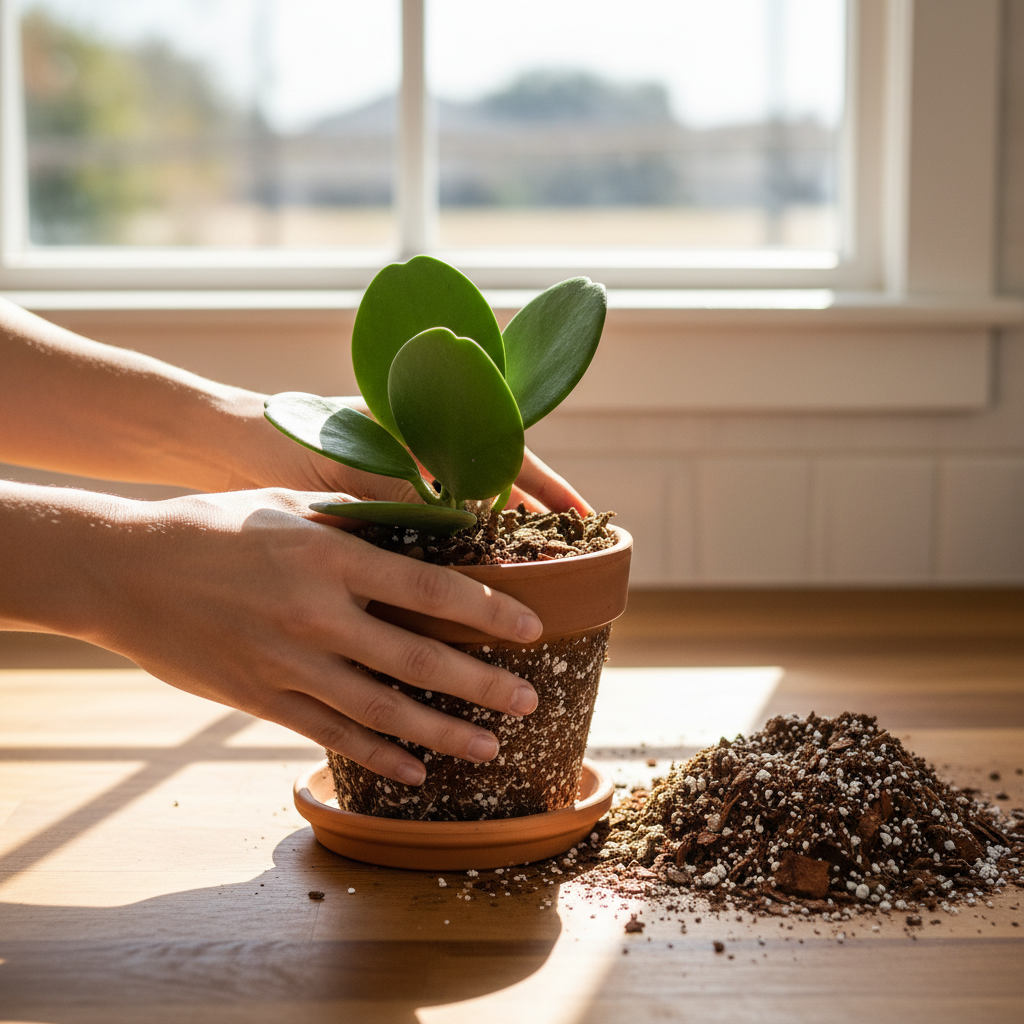
A simple and reliable mix can be assembled from ingredients sold in any garden centre. Three parts peat-free houseplant compost or coco coir form the base, one part medium-grade orchid bark adds chunky texture and air pockets, one part perlite or pumice keeps the mix permanently open, and a small handful of horticultural charcoal sweetens the medium and absorbs minor toxins. The resulting substrate looks coarse, almost rough, and is impossible to compact firmly with your fingers. That is precisely the texture you want for any hoya.
| Ingredient | Approximate Ratio | Purpose |
|---|---|---|
| Peat-free houseplant compost or coco coir | 3 parts | Holds gentle moisture and provides organic content |
| Medium-grade orchid bark | 1 part | Creates air pockets and mimics epiphytic substrate |
| Perlite or pumice | 1 part | Improves drainage and prevents compaction |
| Horticultural charcoal | Small handful | Sweetens the mix and absorbs minor toxins |
A commercial cactus and succulent mix amended with extra perlite and a generous addition of orchid bark works almost as well, and saves the trouble of buying multiple bags. Avoid anything advertised as a moisture-retentive houseplant blend, because those substrates are designed for thirsty foliage plants and will keep hoya roots wetter than they want to be.
Pot Choice
Hoya kerrii prefers to be slightly root-bound and grows perfectly well in a pot that looks too small for it. Unglazed terracotta is the conservative choice: it wicks moisture from the substrate, dries faster than plastic, and gives a clear visual cue when the outside of the pot darkens after watering. Glazed ceramic and plastic both work too, but they hold water longer, so watering frequency needs to drop. Whatever the material, the pot must have a drainage hole. Cover pots with no drainage are a guaranteed way to drown a hoya over a season or two, no matter how careful you are with the watering can.
When to Repot
Repotting hoya kerrii is something you do every two or three years at most, and many growers go four or five years between repots without trouble. The plant flowers more readily when slightly cramped, and the major risk of repotting is breaking the brittle roots and stems in the process. Look for signs that it is time to repot: roots visibly emerging from the drainage hole, water running straight through the pot without soaking, or the substrate breaking down into a fine dust that no longer holds structure. Spring or early summer is the best moment to repot, when the plant has the longest growing season ahead in which to recover.
How to Repot
- Water lightly the day before to make the rootball easier to slide out without shattering.
- Choose a new pot only one size up (about 2 to 3 centimetres wider in diameter); never jump several sizes.
- Add a layer of fresh mix in the base, place the rootball at the same depth as before, and fill in around the sides.
- Press the new mix gently rather than firmly; you want it loose enough to breathe.
- Wait a week before the first watering, so any small root injuries can callous over and resist rot.
Pro Tip — Keep the Peduncles: when repotting, take care not to break off the leafless woody spurs that may emerge from mature stems. These are the peduncles, and they flower repeatedly from the same spot for many years. Removing them resets the plant’s flowering clock, and a single mistake here can cost you blooms for several seasons.
Fertilising
Hoya kerrii is not a heavy feeder. In its native habitat, the plant lives on the slow trickle of nutrients washed down a tree trunk in rainwater and the gradual decay of leaf litter caught in bark crevices. Indoors, the equivalent is a light hand with fertiliser and a long pause through winter. Over-fertilising is the classic cause of leaf-tip burn on this species, and chronically excessive feeding can build salts in the substrate that damage the fine roots.
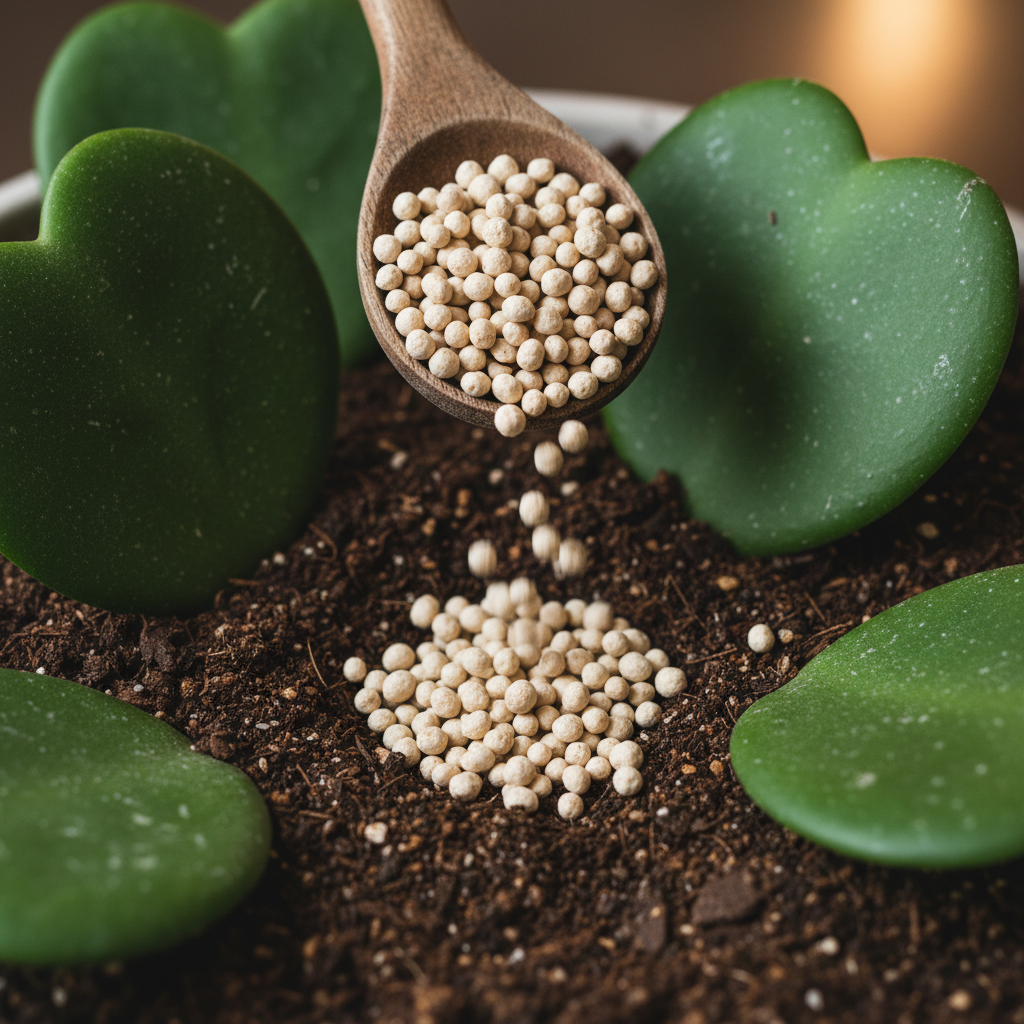
A Sensible Feeding Schedule
A balanced liquid feed labelled for indoor plants or for orchids, diluted to a quarter or half of the recommended strength, applied every four to six weeks from late spring to early autumn, is more than enough. Skip fertiliser entirely from late autumn to early spring, when the plant slows its growth in response to lower light. A slow-release prill mixed lightly into the surface of the substrate in spring is an alternative that takes the decision out of your hands for a whole season, and many growers find that the most consistent approach.
Choosing a Fertiliser
The exact ratio of nitrogen, phosphorus and potassium matters less than the dilution. A balanced 10-10-10 or 20-20-20 will work fine. Some hoya growers prefer a bloom-booster formula with a higher middle number (something like 7-9-5 or 5-10-10) during the warmer half of the year, on the basis that it nudges mature plants toward flowering. There is real but modest truth to that claim; on a young plant that is not yet old enough to bloom, the formulation makes little difference. Organic options like worm-casting tea or seaweed extract are gentle, slow-releasing, and almost impossible to overdose.
Recognising Over- and Under-Feeding
Crispy brown leaf tips on otherwise healthy foliage usually signal a build-up of salts from over-fertilising rather than a humidity problem. Flush the pot through with several volumes of clean water, skip the next feed, and the new growth that follows should come in clean. Under-fed plants, by contrast, look pale and undersized: leaves may be smaller than expected, slightly washed out in colour, and growth is slow even in bright light. A return to a regular dilute feed turns this around within a couple of months.
Warning — Salt Build-Up: if you fertilise with synthetic feeds regularly, flush the pot with several pot volumes of plain water every three to four months. This prevents the gradual accumulation of mineral salts in the substrate that can quietly damage roots before any symptom appears on the leaves.
Propagation
Propagation of hoya kerrii is where the famous single-leaf myth originates, and it is worth being precise about what does and does not work. A single thick heart-shaped leaf, cut from the plant and rooted upright in soil, will produce a small set of roots but cannot grow into a new plant. Without a node — the small bump on the stem from which leaves and roots originate — there is no meristematic tissue capable of generating new shoots. The leaf remains a charming, long-lived novelty and that is all. To make a full plant, the cutting must include at least one node, and ideally two or three.
Taking a Suitable Cutting
Use clean, sharp secateurs or a craft knife to take a stem cutting from a healthy parent plant in spring or early summer. The cutting should be between 10 and 20 centimetres long and include at least two nodes — usually a pair of leaves at the upper end and one or two leafless nodes lower down where roots will form. Allow the cut surface to callous over for a few hours in a shaded spot before planting; this reduces the chance of rot at the point of insertion.
Rooting Methods
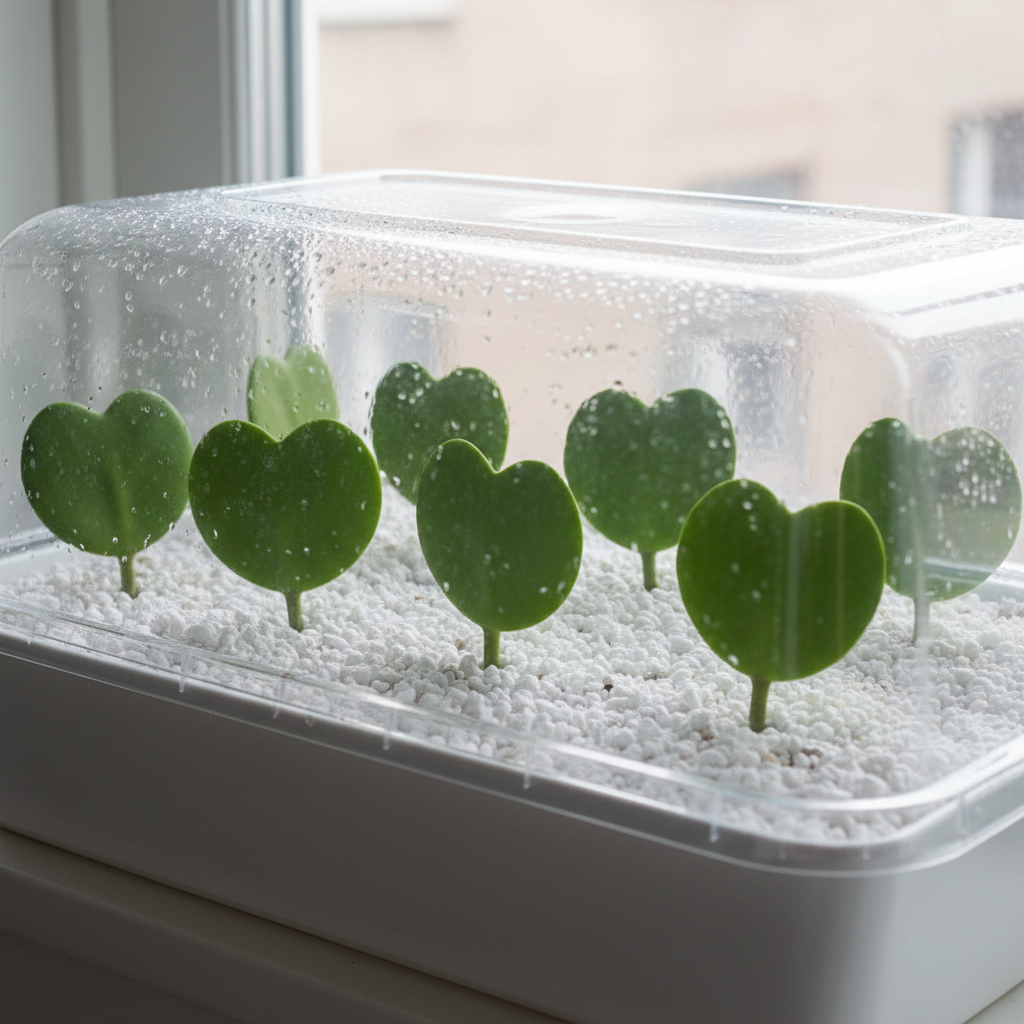
Three rooting methods all work for hoya kerrii: water, perlite under a humidity dome, and sphagnum moss in a closed container. Water rooting is the most visually rewarding because you can watch the roots emerge from the node, but the transition to soil can be a small shock and some leaves may yellow. Perlite or sphagnum rooting takes a little longer at first, but the resulting roots are better suited to substrate from the start, and the move into a final pot is seamless. Bottom heat from a propagation mat between 22 and 26°C noticeably speeds up rooting in all three methods.
- Take a stem cutting with at least two nodes and let the cut callous for a few hours.
- Strip the lowest leaf so that one bare node can be buried in the rooting medium.
- Insert the cutting into damp perlite, sphagnum moss, or a small jar of water, with at least one node submerged or buried.
- Cover with a clear humidity dome or place inside a closed clear container; keep in bright indirect light.
- Check moisture every few days and wait four to eight weeks for the first roots to appear.
- Pot up into a regular hoya mix once roots are around 2 to 3 centimetres long.
Pro Tip — Patience with New Cuttings: a freshly rooted hoya kerrii often does almost nothing visible above the soil for the first six to twelve months. The plant is building its root system and consolidating before it pushes out new vines. Resist the urge to overwater or overfeed during this stage; let the cutting earn its growth slowly.
The Single-Leaf Question
The endless rows of single-leaf hoya kerrii sold around Valentine’s Day are not a scam exactly, but they are sold without full disclosure. A single leaf, with no fragment of stem and no node attached, will live for many years on its small reserve of stored water, develop roots, and refuse to grow further. A leaf cut with a tiny sliver of stem that includes a node — sometimes called a “leaf-with-node” cutting in the trade — is a completely different proposition and will eventually behave like a normal stem cutting, producing a shoot from the node. If you want a single-leaf gift to ever become a real plant, check the base of the leaf for a small woody bump where it joins the stem. If it is genuinely there, you may be in luck. If the leaf rises straight from the soil with nothing else attached, manage your expectations.
Pests & Diseases
Hoya kerrii is generally robust and resists most pests reasonably well, helped by its tough waxy leaf surface. The pests that do find it tend to lodge in the leaf axils and along the stems, where the cuticle is thinner. Catching trouble early is the difference between a quick treatment and a full quarantine; a brief inspection at every watering is the most useful pest-prevention habit you can build.
Common Pests
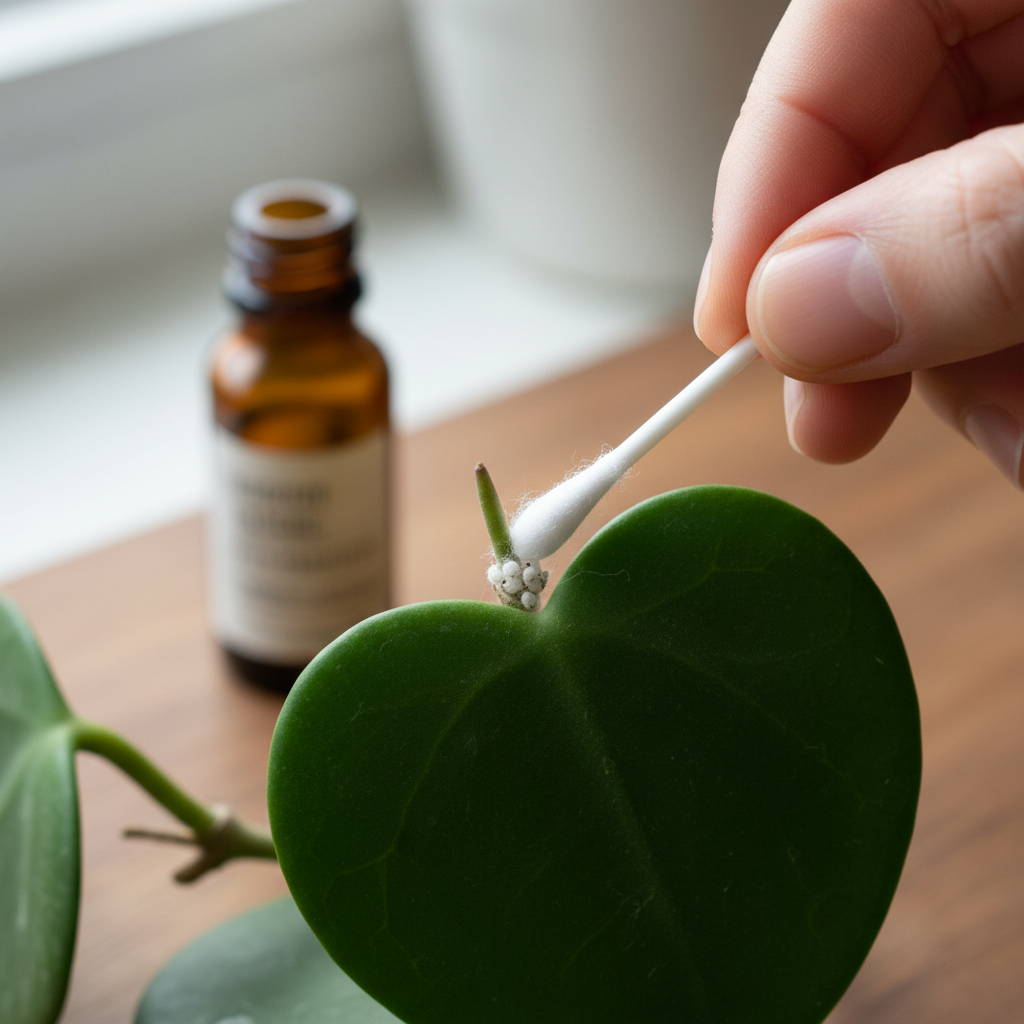
Mealybugs are the single most common pest on hoyas. They look like small tufts of white cotton wool tucked into the leaf axils, along stems, and on the underside of leaves near the midrib. They suck sap, weaken growth, and excrete a sticky honeydew that encourages sooty mould. Treat by dabbing each insect with a cotton bud dipped in 70 percent isopropyl alcohol, repeating every five to seven days for at least three weeks to catch newly hatched crawlers. A horticultural soap or neem oil spray is a useful follow-up for heavy infestations.
Scale insects appear as small flat or domed brown shells along stems and the underside of mature leaves, often along the midrib. The adults are protected by their waxy shell and are slow to respond to sprays, so the practical approach is to scrape them off by hand with a fingernail or an old toothbrush and follow with a spray of neem oil or horticultural soap to catch the mobile crawlers. As with mealybugs, repeated treatment over several weeks is necessary.
Spider mites are less common but show up on plants in very dry, warm conditions. Fine pale stippling on the upper surface of the leaves and tiny webs in the leaf axils are the giveaway signs. Increase humidity, rinse the plant down under a gentle shower of lukewarm water, and treat with a miticidal spray or neem oil at weekly intervals until the population is gone.
Aphids sometimes turn up on flower buds and tender new growth, particularly outdoors in summer. They are easy to wipe off, rinse off with water, or treat with insecticidal soap, and rarely become a chronic problem indoors.
Common Diseases
Root rot is the dominant disease of hoya kerrii and is almost always linked to overwatering or a substrate that holds too much moisture. Symptoms include soft yellow lower leaves, a soft mushy base of the stem, and a sour smell from the rootball. Unpot the plant immediately, wash the roots clean, cut away every blackened or mushy root with sterilised scissors, dust the cuts with cinnamon or sulphur powder, and repot into a much drier, chunkier mix. Sometimes the plant survives; sometimes it does not. Prevention is far easier than rescue.
Fungal leaf spots appear as small brown or black circles on leaves, sometimes with a yellow halo. They usually follow prolonged wet conditions or splashed water sitting on leaves in low light. Remove affected leaves, water at the soil level rather than overhead, and improve air circulation around the plant.
Prevention
Most pest and disease problems are easier prevented than cured. Quarantine every new plant for two to three weeks before placing it near existing collection. Inspect the leaf axils and undersides of leaves at every watering, especially the protected spots where pests hide. Keep the leaves dust-free by wiping with a soft damp cloth every month or two, which removes early-stage pests along with the dust. Allow the substrate to dry properly between waterings to deny fungal pathogens the constant moisture they need to spread.
Popular Varieties
The straight green species is by far the most common form of hoya kerrii in cultivation, but several variegated and patterned cultivars have become widely available in recent years. Most are slower-growing than the green form, demand a little more light to keep their colour, and carry a noticeable price premium. Two of the most popular are highlighted below.
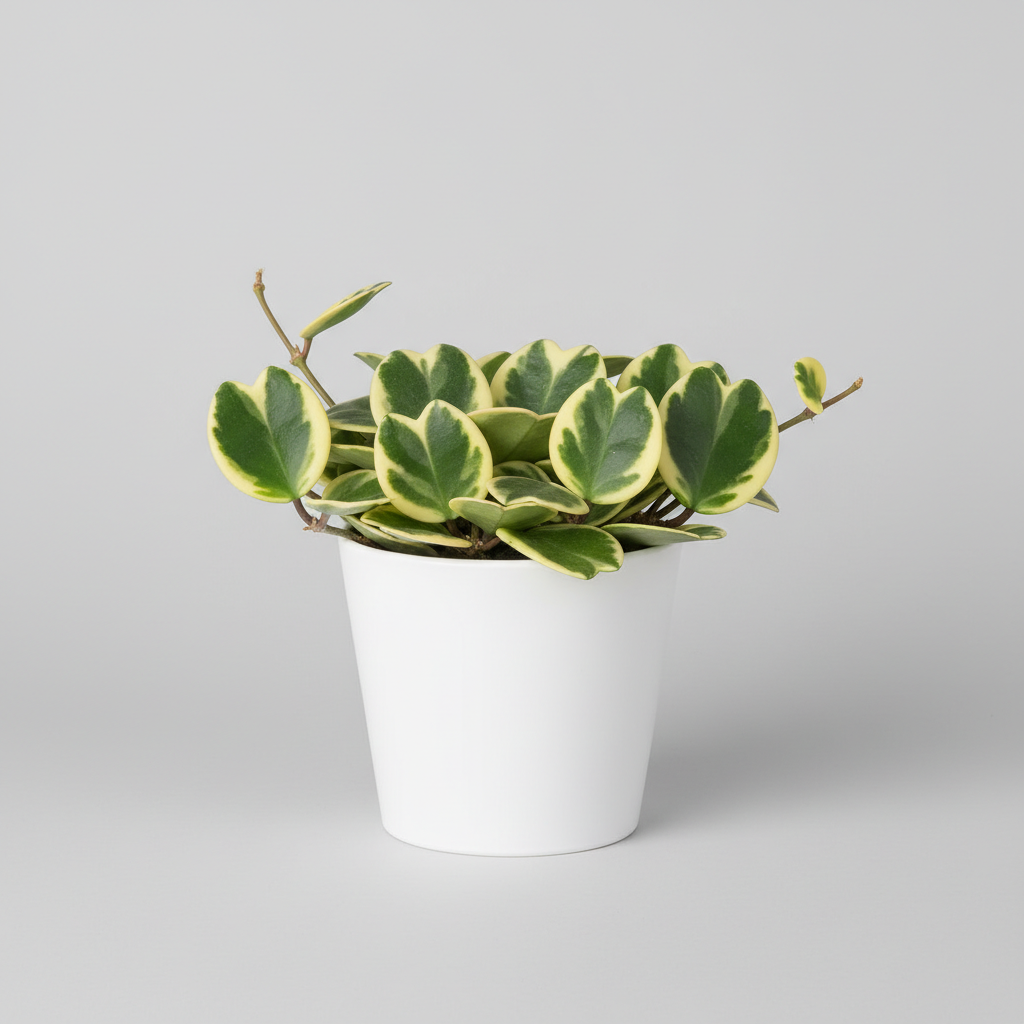
Variegated Hoya Kerrii
The classic variegated cultivar, sometimes labelled ‘Variegata’ or ‘Albomarginata’ in the trade, carries bold creamy yellow margins around a deep green leaf centre. The colour intensifies in bright light and fades in dim conditions, so a position close to a sunny window keeps the contrast crisp. The variegated form is markedly slower than the green species and tends to keep smaller, more rounded leaves. A reverse-variegated version with a cream centre and green margins also exists and is among the most sought-after collector forms.
Splash Hoya Kerrii
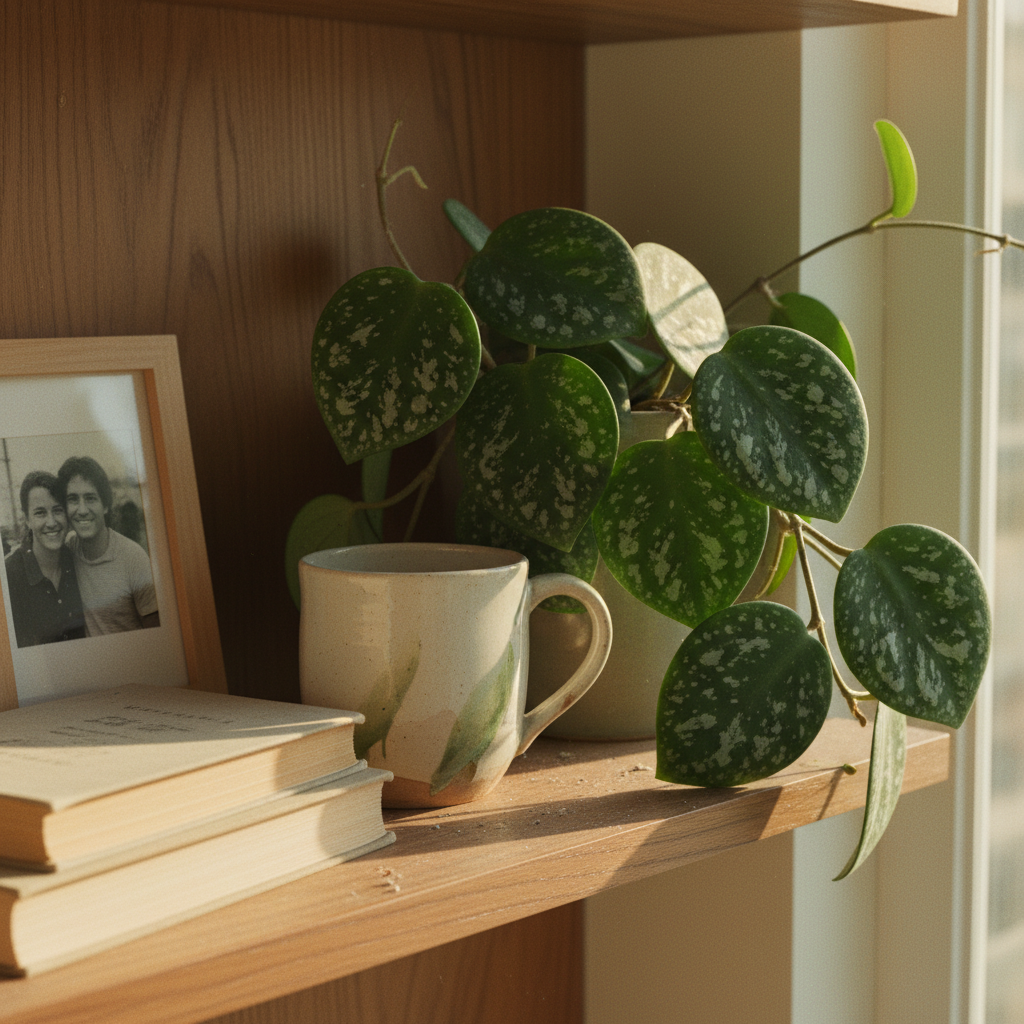
The splash form, sometimes simply called Hoya kerrii ‘Splash’, scatters silvery pewter flecks across the deep green surface of each thick heart-shaped leaf, the speckling concentrated near the centre and fading toward the edges. The silvery pattern is reportedly a layer of air pockets just beneath the leaf cuticle that reflects light, similar to the splash patterns on Scindapsus pictus and some philodendrons. It grows at a pace closer to the green species than the variegated form, and the pattern is reasonably stable under typical indoor light.
Beyond these two, collectors trade in a number of named forms with smaller, longer or more sharply pointed leaves, including the long-leaf form sometimes called Hoya kerrii ‘Long Leaf’ and various seed-grown selections from Thai growers. These are mainly of interest to specialist collectors and rarely show up in mainstream garden centres.
Frequently Asked Questions
Will a single hoya kerrii leaf ever grow into a full plant?
Almost never, unless a fragment of stem with a node is attached to the base of the leaf. A truly isolated leaf has no meristematic tissue and will live for years as a charming ornament without producing further growth. If the leaf does have a node, behaviour shifts to that of a normal stem cutting and a shoot will eventually emerge, often only after one or two years of apparent dormancy.
How long does it take for a hoya kerrii to flower?
A young plant rarely flowers in its first two or three years. Most mature specimens begin blooming after about five to seven years in cultivation, and only when given consistently bright light, a slightly root-bound pot, and a moderate dry rest in winter. Once a plant starts blooming it tends to flower repeatedly from the same peduncles, often more than once a year in ideal conditions.
Is hoya kerrii safe for cats and dogs?
Yes, the species is listed as non-toxic to cats, dogs and humans by the ASPCA. The milky sap can mildly irritate sensitive skin, but the plant is among the safer choices for households with pets and curious children.
Why are my hoya kerrii leaves wrinkled?
Wrinkled or slightly puckered leaves usually signal underwatering or, less obviously, severe root damage that prevents the plant from absorbing water even when the substrate is wet. Check the substrate first. If it is dry, water thoroughly and the leaves should plump up over a few days. If the substrate is wet but the leaves still look deflated, root rot is the more likely cause and the plant needs to be unpotted and inspected.
Should I cut off the flower spurs after blooming?
No. The leafless woody peduncles that produced the flowers will flower again from the same spot for many years and should be left untouched. Cutting them off is one of the most common mistakes new hoya growers make, and it resets the flowering clock back to square one.
How big does a hoya kerrii get?
Given enough time and a suitable trellis, a hoya kerrii can climb to 3 or 4 metres (10 to 13 feet) in length. In typical indoor cultivation, however, growth is so slow that most plants stay under a metre for many years. The species is generally trained as a compact climber on a small wire hoop or moss pole rather than allowed to sprawl.
Why isn’t my single-leaf hoya growing?
Because there is no node attached to it. The leaf is technically alive and rooted, but has no tissue capable of generating a new shoot. This is normal, expected, and the reason single-leaf hoyas should be sold as decorative novelties rather than future plants. If a full vining plant is the goal, obtain a stem cutting with at least one node and start over from there.
Can hoya kerrii live outdoors?
In warm-temperate and tropical climates, hoya kerrii can spend the warmer months outside in dappled shade, where the brighter light often accelerates growth and triggers flowering. It must be brought back indoors before night temperatures drop below about 13°C (55°F). In cold-winter climates, it is strictly a houseplant.






