
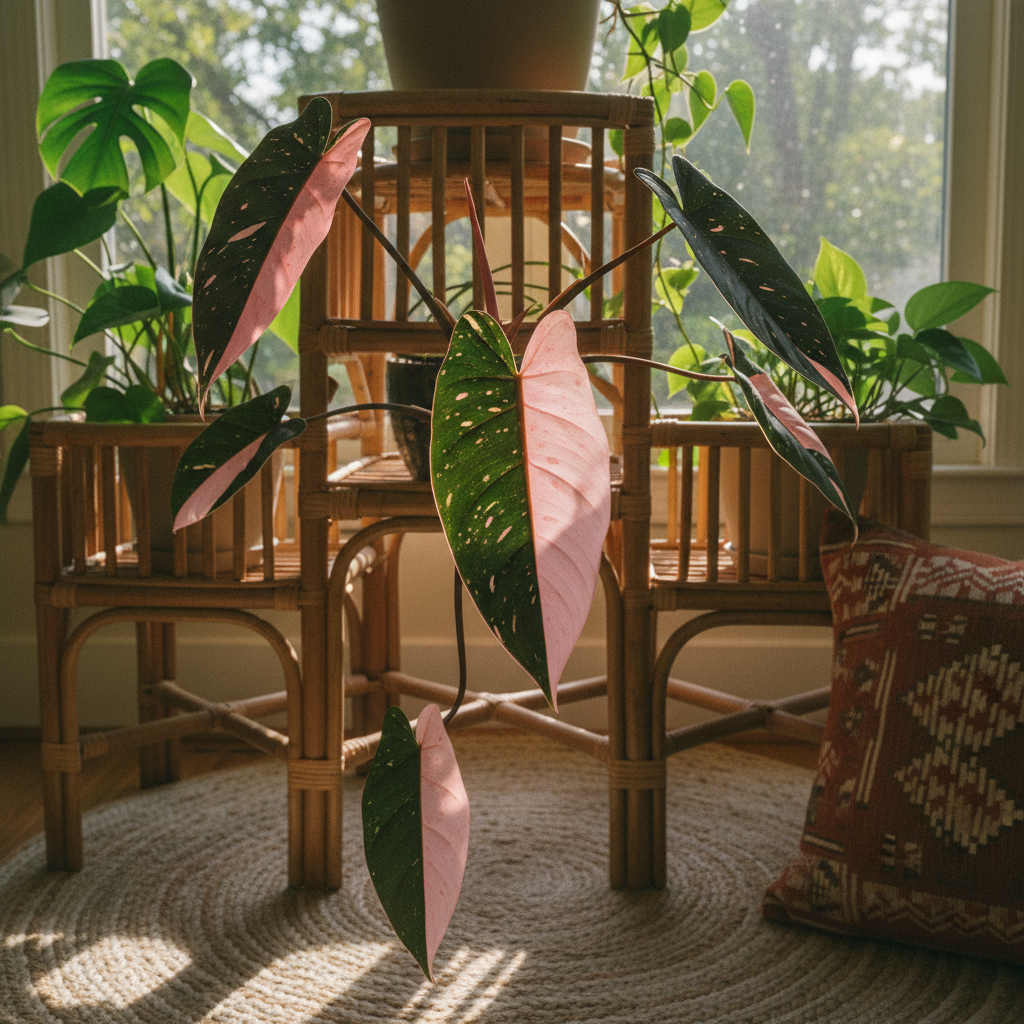
Few houseplants have caused as much social-media frenzy as the pink princess philodendron, a chimeric cultivar of Philodendron erubescens whose deep, almost-black leaves are punctuated by patches of bright bubble-gum pink. Native parentage traces to the tropical understorey of Colombia, where the species form climbs the trunks of canopy trees on slender aerial roots, but the pink variegation seen in cultivation is the result of a spontaneous genetic mutation isolated and stabilised by tropical-foliage nurseries in the mid-twentieth century. The plant remained an obscure collector’s curiosity for decades, only to detonate into mainstream popularity from around 2018 onwards when its instantly recognisable colouring became a fixture of houseplant-influencer feeds.
That reputation has earned it both a steep price tag and a slightly intimidating mystique, but the plant itself is not difficult, only opinionated. Treated like a regular climbing philodendron, a pink princess will survive happily; treated with attention to its variegated foliage, the right light intensity, and a chunky aroid mix that mimics its native epiphytic root zone, it will thrive, push out leaf after pink-splashed leaf, and reward you with the colour that made it famous. This guide covers the full picture, from the science behind the chimera to the daily routine that keeps the pink coming, and walks through where most growers go wrong.
Contents
- Quick Reference
- Why the Pink Princess Philodendron Makes a Rewarding Houseplant
- Light Requirements
- Watering and Humidity
- Soil, Potting and Repotting
- Fertilising
- Propagation
- Pests and Diseases
- Popular Varieties
- Frequently Asked Questions
Quick Reference: Pink Princess Philodendron at a Glance
| Botanical name | Philodendron erubescens ‘Pink Princess’ |
| Family | Araceae (aroid family) |
| Native range | Tropical Colombia (species form); cultivar developed in cultivation |
| Light | Bright indirect light, 200 to 400 micromoles per square metre per second, or roughly 10,000 to 20,000 lux. Tolerates lower light but loses variegation |
| Watering | Water thoroughly when the top 2 to 3 cm (1 inch) of soil feels dry. Roughly every 7 to 10 days in summer, 14 to 21 days in winter |
| Temperature | 18 to 27 degrees Celsius (65 to 80 degrees Fahrenheit). Avoid temperatures below 13 degrees Celsius (55 degrees Fahrenheit) |
| Humidity | Prefers 60 to 70 percent, but tolerates 40 to 50 percent indoors |
| Soil | Chunky, free-draining aroid mix with bark, perlite and coco coir. Slightly acidic (pH 5.5 to 6.5) |
| Fertiliser | Balanced liquid feed at half strength every 3 to 4 weeks during the growing season |
| Growth rate | Slow to moderate. Around 10 to 15 cm (4 to 6 inches) of new growth per year indoors |
| Mature size | Up to 1.2 metres (4 feet) climbing indoors; longer with a tall moss pole |
| Toxicity | Toxic to humans, cats and dogs if ingested (calcium oxalate crystals) |
| Difficulty | Moderate. Variegation management is the main challenge |
Why the Pink Princess Philodendron Makes a Rewarding Houseplant
The pink princess is one of the most genuinely striking foliage plants available in the houseplant trade. Mature leaves can reach 15 to 22 centimetres (6 to 9 inches) long, with a glossy texture that holds the deep blackish-green ground colour beautifully against blocks, splashes or speckles of soft pink. The variegation is unstable in the most interesting way: every new leaf is a small surprise, ranging from nearly solid green through gentle pink freckling to fully half-moon leaves where one whole side of the blade is pink. That unpredictability is part of the plant’s appeal and the reason that growers tend to develop a strong attachment to individual specimens, photographing each new leaf as it unfurls.
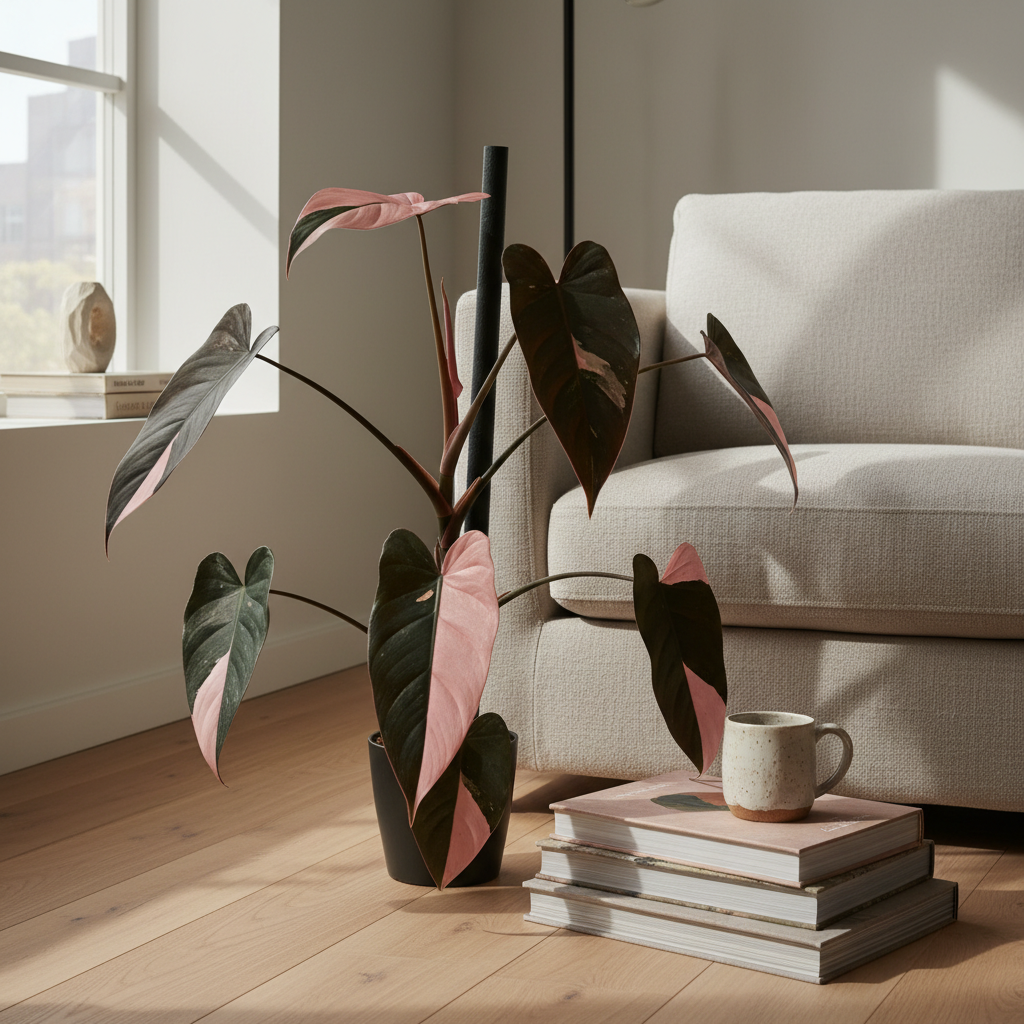
Beyond the looks, the pink princess is forgiving in ways that high-status plants often are not. As an aroid evolved to live as a hemi-epiphyte, scrambling up tree trunks with its roots part-soil, part-air, it tolerates short periods of dryness, occasional missed feedings and the dry, climate-controlled air of most flats. It is happy to be trained up a moss pole, allowed to drape from a tall shelf or kept compact through regular pruning. Mature plants release several aerial roots along their stem, which can be tucked back into the soil or directed onto a support to encourage larger leaves. None of this care is exotic; what makes the plant rewarding is the dialogue between attentive care and visible response — the pinker the new growth, the more confident you can be that the light, feed and watering balance is right.
Important — Toxicity: Like most aroids, the pink princess contains insoluble calcium oxalate crystals throughout its tissue. Chewing the leaves or stems can cause oral irritation, burning, drooling and swelling in humans, cats and dogs, and occasionally vomiting. Keep the plant out of reach of curious pets and small children, and wash your hands after pruning or taking cuttings, as the sap can irritate sensitive skin.
Light Requirements
Light is the single most important factor in growing a pink princess well, and it is the lever that controls the colour you actually bought the plant for. The variegation on a pink princess comes from chimeric tissue: certain cells lack chlorophyll altogether and instead express anthocyanin pigments, producing the pink colour. Cells without chlorophyll cannot photosynthesise, so the green parts of the plant must do all the work of feeding both themselves and the pink sections. The plant needs enough light to keep that work easy. Give it too little, and it will gradually revert to producing all-green leaves, the most economical option for a plant struggling for energy. Give it too much, and the variegated sections, with no chlorophyll to protect them, will scorch and crisp before the green tissue does.
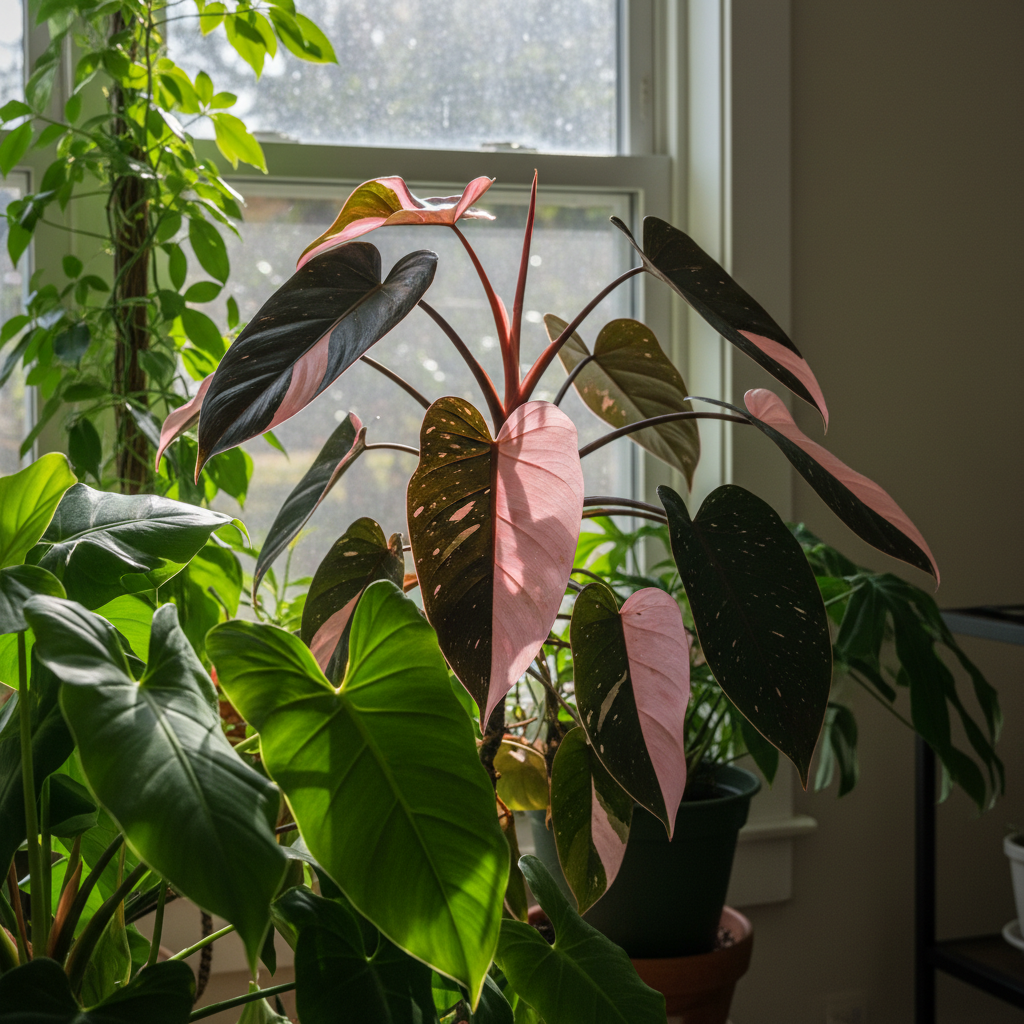
The sweet spot is bright, filtered, indirect light for many hours a day. In photometric terms, that means around 200 to 400 micromoles per square metre per second of photosynthetically active radiation, or roughly 10,000 to 20,000 lux on a smartphone meter, sustained for 10 to 12 hours. In practical terms, that is the kind of light you find a metre or so back from a south or west-facing window with a sheer curtain, or directly in front of an east or bright north-facing window. The deeper the green of a new leaf, and the brighter and crisper the pink, the closer you are to ideal.
Light Levels Explained
Understanding the different categories of indoor light is useful when deciding where to place a pink princess in your home. The five tiers below describe the conditions a typical houseplant will encounter, and how the pink princess responds to each.
| Light Category | Approx. Level | Typical Location | Outcome |
|---|---|---|---|
| Direct sun | 50,000 to 100,000 lux | On the glass of a south-facing window with no curtain | Pink sections scorch and brown within days. Avoid |
| Bright indirect | 10,000 to 20,000 lux | One metre back from a south window with sheer curtain; in front of an east or bright north window | Optimal. Strong pink in new leaves, compact internodes |
| Medium | 2,500 to 10,000 lux | Two to three metres into a bright room, or directly in front of a dimmer north window | Acceptable. Growth slows, pink reduces but plant remains healthy |
| Low | 500 to 2,500 lux | Hallways, interior corners, far from any window | Plant survives but reverts to all-green. Internodes stretch |
| Very low | Below 500 lux | Windowless rooms | Plant declines steadily and will eventually die. Not viable |
Window Orientation and Placement
South-facing window: The brightest exposure in the Northern Hemisphere. Excellent for pink princess provided the plant sits at least 1 to 1.5 metres back, or behind a sheer curtain. Direct contact with afternoon sun will scorch the pink areas. East and west-facing rooms are usually safer in summer; in winter the lower sun angle means a south window becomes the best year-round option.
East-facing window: Often the ideal placement for a pink princess. Morning sun is soft and warm, the rest of the day delivers bright indirect light, and there is almost no risk of scorch. Plants here tend to produce the most consistent variegation.
West-facing window: Also good, with a similar light budget to an east window but delivered as warmer, more intense late-afternoon sun. Watch for leaf scorch in summer; pull the plant back a few centimetres or use a sheer curtain during the hottest months.
North-facing window: The dimmest of the four orientations. A bright, unobstructed north window can still grow a pink princess respectably, but expect slower growth and slightly less pink. In flats with limited light, a supplemental grow-light is the most reliable solution.
Pro Tip — Read the New Leaves: The plant tells you whether the light is right. Newly unfurled leaves that are deep green with crisp pink patches indicate ideal conditions. Pale, washed-out leaves with stretched stems mean the plant is reaching for more light. Brown, papery patches on pink areas signal too much direct sun.
How Light Affects Variegation
Variegation in the pink princess is fundamentally a balancing act. Because the pink cells cannot photosynthesise, every pink leaf is an energetic luxury that the plant pays for from its green cells. When light is abundant, the plant can afford to keep producing variegated leaves. When light is scarce, evolution kicks in, and the meristem (the growing tip) increasingly produces all-green cells that can pull their own weight. This is what growers call “reversion”, and it is reversible only at the growth tip. A leaf that opens green will stay green for life. The remedy is not to wait, but to act early: brighten the light, prune back to a node where variegated tissue is still present, and force the plant to produce a new growth point from that node.
The opposite problem, all-pink leaves, also matters. A leaf that emerges completely pink looks spectacular for a few weeks but cannot feed itself. It will yellow, brown and drop within months, and its presence drains the rest of the plant. Many growers cut “white sheet” or “moonstone” pink-only leaves off at the petiole to preserve the energy of the parent stem. The plant you want produces leaves that are between 20 percent and 50 percent pink: dramatic enough to enjoy, green enough to sustain themselves.
Warning — Direct Sunlight: Pink princess leaves can scorch in as little as 30 minutes of direct summer sun. The damage shows up first on the pink sections as bleached white or brown papery patches that never recover. If the plant sits on a windowsill that gets even a brief patch of direct light in summer, fit a sheer curtain or move the plant back a metre.
Artificial Lighting
In flats without strong natural light, full-spectrum LED grow-lights are a reliable supplement and can be the primary light source. Look for a fixture rated at around 30 to 50 watts of actual draw, with a colour temperature in the 4000 to 6500 K range. Position the lamp 30 to 50 centimetres above the plant and run it for 10 to 12 hours per day on a timer. Modern white LEDs (rather than the older blurple panels) are pleasant enough to use in a living room without dominating the room’s lighting. Pink princesses grown entirely under good LED light can produce variegation as strong as window-grown specimens.
Seasonal Adjustments
In temperate climates, indoor light intensity drops by 50 percent or more between June and December. A spot that works perfectly in summer can become marginal in winter, so most growers move plants closer to the window during the shorter months and either pull back or add a sheer in summer. Spring and autumn are the moments to reassess: watch for stretching, paler new leaves, or decreased pink, and respond before the plant has lost three or four leaves to suboptimal conditions.
Watering and Humidity
Watering a pink princess correctly is less about following a calendar than reading the plant and the substrate. As a hemi-epiphyte, its roots evolved to grow into a chunky mat of bark, moss and leaf litter clinging to tree trunks: a substrate that briefly soaks in tropical rain and then drains and aerates fast. Recreating that rhythm indoors, where pots dry out far more slowly than a tree trunk in the wind, is the central challenge. The good news is that the plant is forgiving on the dry side and unforgiving on the wet side, so when in doubt, wait.
When to Water
The most reliable rule is to water thoroughly when the top 2 to 3 centimetres (about 1 inch) of substrate has dried out. Push a finger into the soil to feel for moisture, or use a wooden chopstick or bamboo skewer pushed to the bottom of the pot: pull it out, and if it comes out clean and dry, water. If soil clings to the stick or it feels cool and damp, wait. Moisture metres are convenient but cheap probes are notoriously unreliable in chunky aroid mixes; the chopstick method is more accurate and free.
In a typical centrally-heated home, this works out to roughly once every 7 to 10 days during the growing season (spring and summer), and every 14 to 21 days in winter when growth slows and the substrate dries more slowly. Frequency depends heavily on pot size, pot material, light level and indoor humidity. Plants in terracotta dry out faster than the same plant in plastic. Plants in bright light and warm rooms drink more than plants in dim corners. Use the soil, not the diary, to decide.
Pro Tip — Lift the Pot: Once you know roughly how heavy the pot feels when fully watered versus when dry, lifting becomes the fastest way to assess moisture. A pot that feels suspiciously light is dry; a pot that feels reassuringly heavy still has water in it.
How to Water Correctly
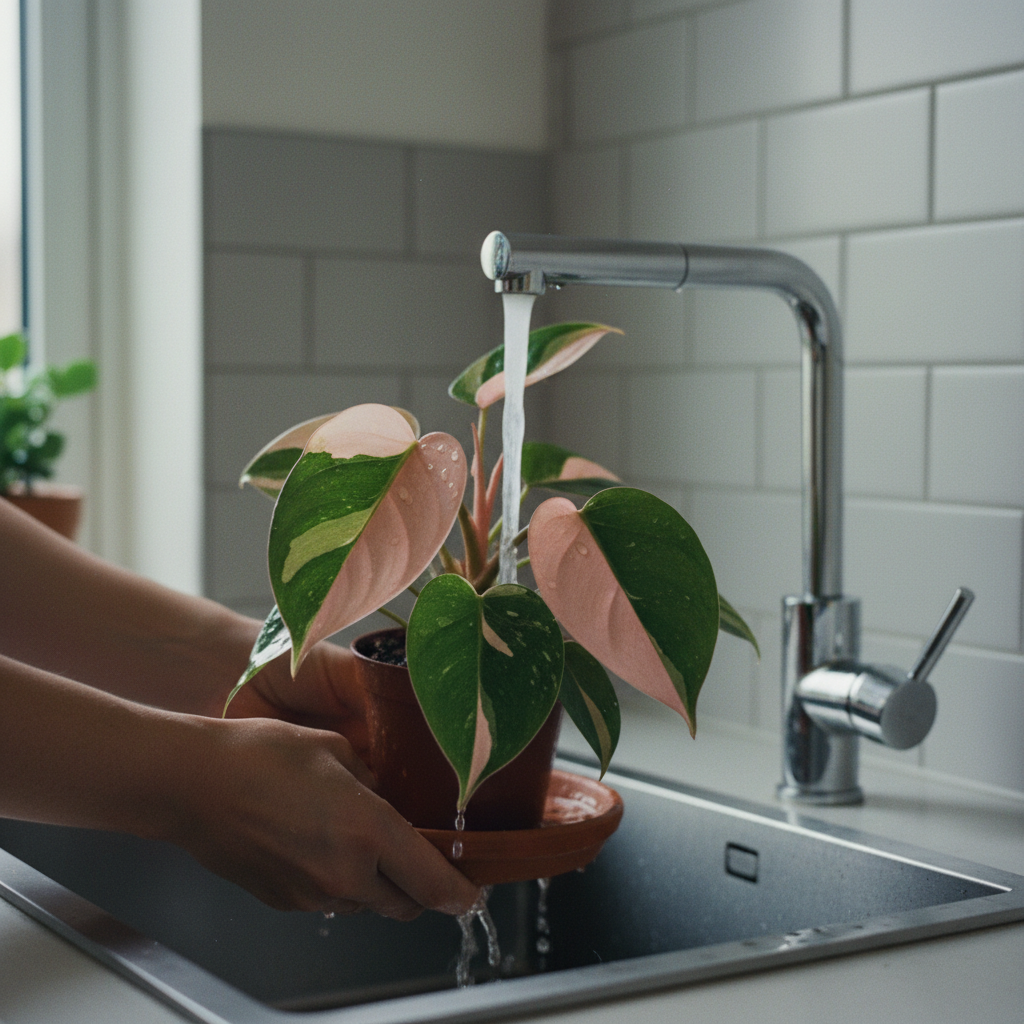
- Move the plant to a sink, shower tray or large saucer where it can drain freely.
- Pour water slowly and steadily across the entire surface of the substrate, working from the edges inward, until water flows freely from the drainage holes for a full 10 to 15 seconds.
- Stop, wait one minute for the substrate to absorb water, then water again until it flows from the drainage holes once more. This second pass ensures the entire root ball is wetted, not just channels through dry soil.
- Allow the pot to drain completely for at least 15 to 30 minutes. Tip out any water that collects in a saucer or cachepot.
- Return the plant to its growing position only once the pot has stopped dripping. Never let the plant sit in standing water.
Signs of Overwatering vs Underwatering
| Symptom | Overwatering | Underwatering |
|---|---|---|
| Leaf colour | Yellowing of older lower leaves, sometimes with brown spots | Pale, dull green, edges browning and crisping |
| Leaf texture | Soft, limp, sometimes mushy at the base | Thin, papery, curling inward along the midrib |
| Soil | Damp for over a week, sour smell, sometimes fungus gnats | Pulled away from the pot edge, dusty and pale |
| Roots | Brown, black, soft, slipping out of their outer sheath | Dry, brittle, white inside when broken |
| Stem base | Soft, black, sometimes weepy or bad-smelling | Firm but slightly shrunken, no discolouration |
Warning — Root Rot: Pink princesses are killed by overwatering far more often than by drought. A plant left sitting in a saucer of water for even two or three days can develop anaerobic conditions in the root ball that allow opportunistic pathogens such as Pythium and Phytophthora to take hold. If the stem base feels soft or smells sour, unpot immediately, trim away all blackened roots back to firm white tissue, dust the cuts with cinnamon or sulphur, and repot into fresh dry aroid mix.
Humidity Requirements
In its native Colombian forest, the pink princess grows in ambient humidity of 70 to 90 percent. Indoors, that level is neither realistic nor necessary, but the plant does appreciate above-average humidity. Aim for 60 to 70 percent if you can, and accept that 40 to 50 percent (typical of a centrally-heated room in winter) is the practical floor at which the plant will still grow without obvious stress.
Symptoms of low humidity show up first on the newest leaves: brown, crispy edges, leaves that fail to fully unfurl, or leaves that emerge smaller than expected. These signs are sometimes confused with underwatering, but humidity-related damage is concentrated on the edges and tips of new growth rather than older leaves, and the soil is usually still moist when it appears.
The most effective way to raise humidity is a small electric humidifier running on a timer near the plant. Aim for 4 to 8 hours of run-time per day during winter. Pebble trays raise humidity only minimally and are largely cosmetic. Grouping plants together creates a marginally more humid microclimate. Misting the leaves wets the foliage temporarily but raises ambient humidity by only a few percentage points and risks fungal spots if water sits on the leaves overnight. Pinning the plant inside a glass cabinet or terrarium is the most extreme but reliable solution for chronically dry homes.
Water Quality
Tap water in most regions is fine for a pink princess, but very hard or heavily chlorinated water can cause brown leaf-tip burn over time as salts and minerals accumulate in the substrate. If your tap water leaves a heavy white scale on kettles, consider letting it sit out for 24 hours so chlorine off-gasses, or use rainwater, filtered water or diluted distilled water for half of your waterings. Once or twice a year, flush the substrate thoroughly by pouring water through the pot for several minutes to wash accumulated salts out through the drainage holes.
Soil, Potting and Repotting
If light is the most important factor in pink princess care, substrate is the second. The plant evolved to grow in a chunky, airy mat clinging to bark, where roots breathe almost as much as they drink. Standard supermarket potting compost is the opposite of that: dense, water-retentive, slow to dry, with very little oxygen at depth. Plant a pink princess into ordinary compost and you set yourself up for root rot. The remedy is to assemble or buy a proper aroid mix.
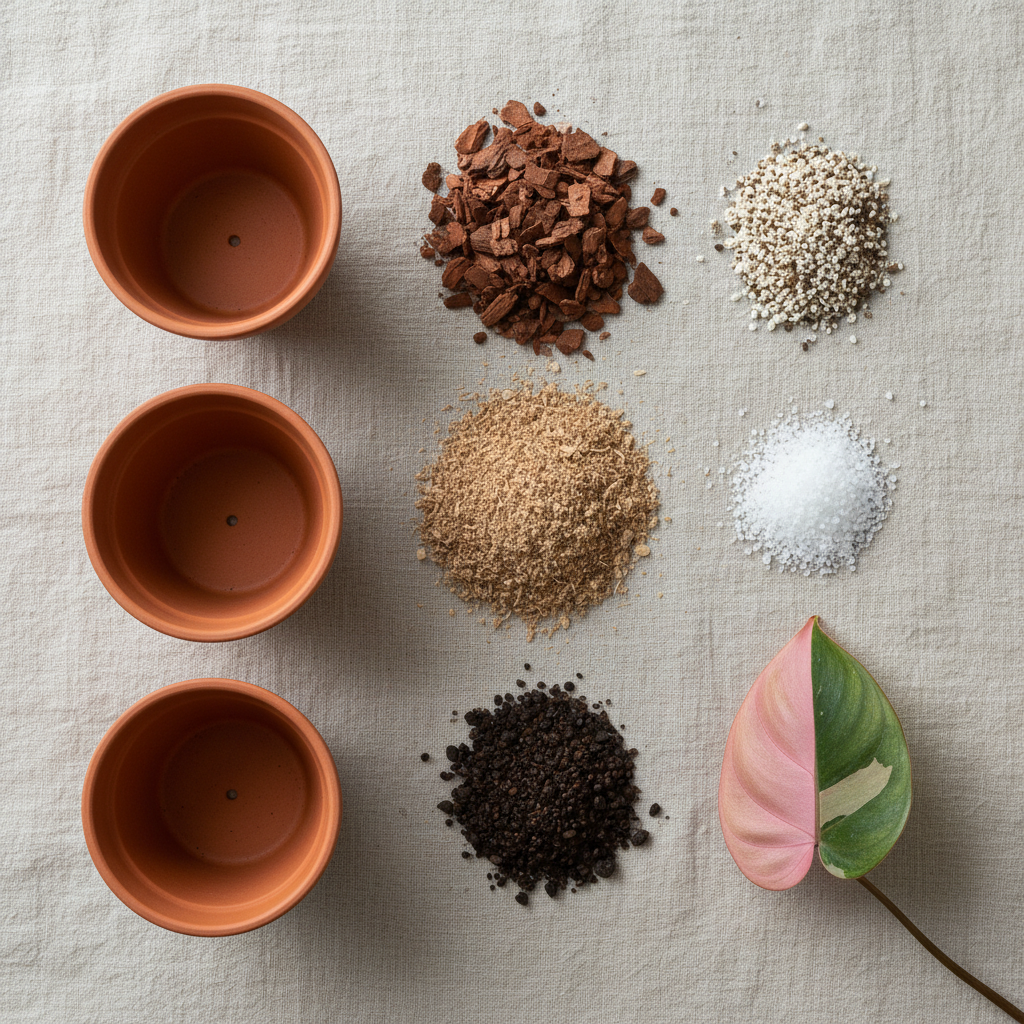
Ideal Soil Composition
A good aroid mix is built around the principle of large air pockets. Roots should be in contact with damp substrate but never sitting in a slick of water. Most mixes blend a soft moisture-retentive base with chunkier components that create permanent gaps, plus a small amount of organic fertility. The table below shows the typical proportions for a pink princess mix that drains in seconds yet stays evenly damp for several days.
| Component | Proportion | Function |
|---|---|---|
| Coco coir or peat-free potting compost | 40 percent | Holds moisture, supplies fine structure, anchors roots |
| Orchid bark, medium grade | 30 percent | Creates large air pockets, mimics native bark substrate |
| Perlite or pumice | 20 percent | Improves drainage and aeration, prevents compaction |
| Worm castings or composted bark fines | 5 percent | Slow-release nutrients, beneficial microbes |
| Horticultural charcoal | 5 percent | Absorbs impurities, helps prevent anaerobic pockets |
Aim for a slightly acidic pH between 5.5 and 6.5, which is the natural range of decomposing forest litter. Most pre-mixed potting composts already fall in this range, and the orchid bark and coco coir together tend to keep the mix gently acidic without intervention. If you suspect your tap water is heavily alkaline, occasional flushing with rainwater helps prevent the pH from creeping upward over time.
Pro Tip — Quick Mix Recipe: If you don’t want to weigh ingredients, a fast and reliable shortcut is two parts peat-free potting compost, two parts orchid bark, one part perlite and a generous handful of worm castings per 5 litres of mix. This gets you 95 percent of the way to a properly tuned aroid substrate.
Choosing the Right Pot
The pot is part of the watering equation. A wide, shallow pot dries faster than a tall narrow one of the same volume; an unglazed terracotta pot breathes through its walls and dries faster than a plastic or glazed ceramic pot. Match the pot to your watering tendencies: if you tend to overwater, pick terracotta; if you tend to forget, pick glazed ceramic or plastic.
Drainage holes are non-negotiable. A pink princess cannot live long-term in a pot without holes. Decorative cachepots without drainage can be used as outer covers, but the actual growing pot must have at least one and preferably several drainage holes. After watering, lift the inner pot out, let it drain fully, and tip out any water collected in the cachepot before returning it.
Pot material: Plastic nursery pots are practical, lightweight, retain moisture longer and are easy to squeeze for slip-out repotting. Terracotta breathes, dries faster and is forgiving of overwatering, but can wick moisture away too aggressively in very dry rooms. Glazed ceramic looks beautiful but behaves much like plastic in terms of drying time. Self-watering planters with a wick reservoir work surprisingly well for pink princess if the substrate is chunky enough; otherwise they encourage root rot.
Pot size: Pink princesses prefer to be slightly snug. Choose a pot only 2 to 4 centimetres (1 inch) wider than the current root ball. Oversizing the pot is one of the most common causes of stagnation: surplus damp substrate without roots in it stays wet for too long, and the plant sulks.
When to Repot
A pink princess typically needs repotting every 18 to 24 months. The telltale signs are roots circling the bottom of the pot, roots protruding from drainage holes, water running straight through without being absorbed, or visible compaction and shrinkage of the substrate over time. Spring and early summer are the best months to repot, because the plant is in active growth and recovers quickly. Avoid repotting a plant that is stressed, root-rotting, or just out of transit.
How to Repot: Step-by-Step
- Water the plant lightly the day before repotting so the root ball holds together without crumbling.
- Prepare fresh aroid mix and a clean pot one size up. Run boiling water over the pot if it has been used before.
- Tip the plant out by inverting the pot and supporting the stem at the base. Squeeze plastic pots gently if it resists.
- Loosen the outer edge of the root ball with your fingers and tease away any tightly circling roots. Trim any black, mushy or hollow roots back to firm white tissue with sterilised scissors.
- Place a thin layer of fresh mix in the bottom of the new pot, set the plant in at the same depth as before, and backfill around the sides, tapping the pot occasionally to settle the substrate.
- Press the surface gently to firm the plant in place, leaving 1 to 2 centimetres of space at the rim for watering.
- Water thoroughly until water runs from the drainage holes, then return the plant to its usual spot and avoid feeding for four to six weeks while new roots establish.
Warning — Transplant Shock: Even healthy plants can drop one or two older leaves in the weeks after repotting as they redirect energy into root regrowth. Resist the urge to overwater “to help” the plant recover. Repotting shock is a root issue, not a thirst issue, and extra water at this stage will encourage rot rather than recovery.
Fertilising
Pink princesses are moderate feeders. In their native habitat, nutrients arrive in trickles: from decomposing leaf litter, the occasional smear of bird droppings, the slow weathering of bark. They are not heavy gross feeders like tomatoes or tropical fruit, and they respond badly to over-fertilisation, which causes leaf-tip burn and accelerated salt build-up in the substrate.
Nonetheless, the plant does need a steady supply of nutrients to produce its variegated leaves and to maintain healthy roots. A balanced liquid feed at half strength every three to four weeks during the growing season is enough for most specimens. Reduce feeding to once every six to eight weeks during winter, or stop entirely if the plant is dormant in a cool dark room.
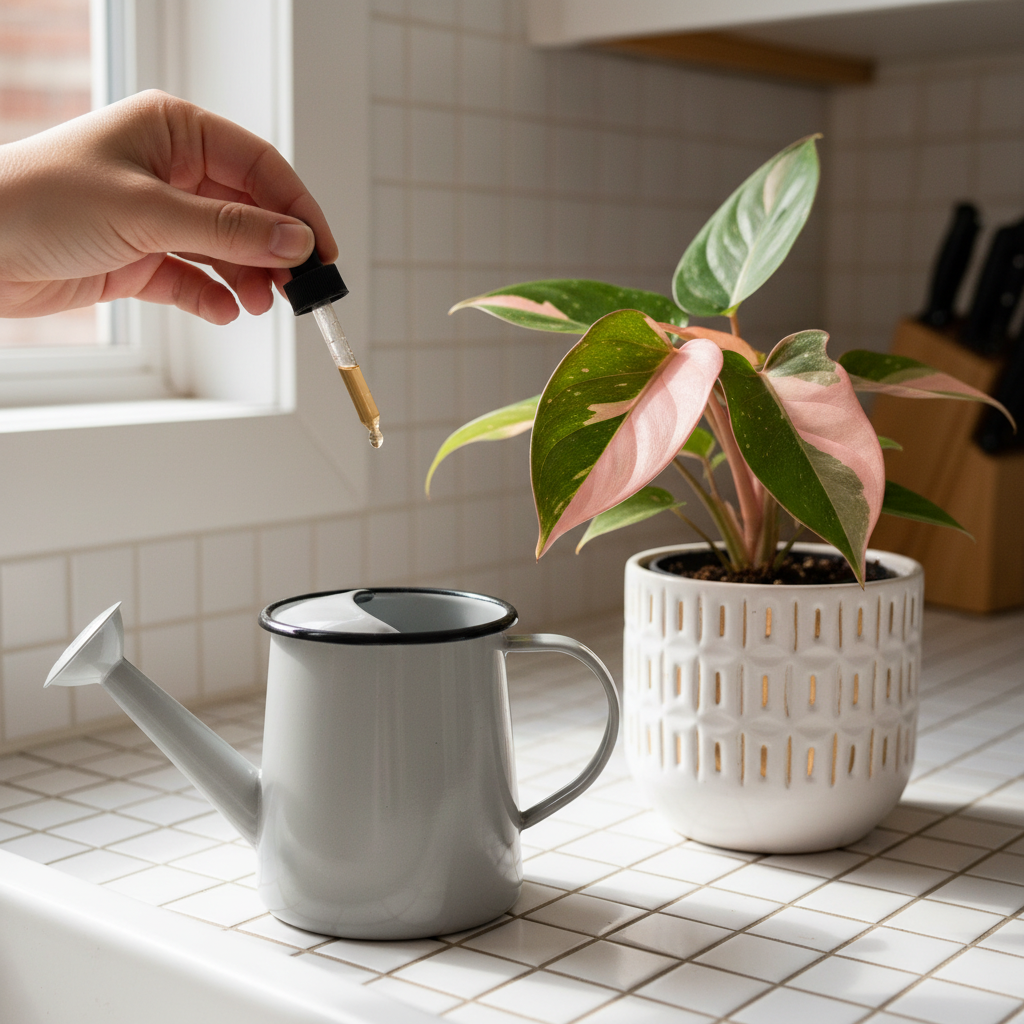
Understanding Plant Nutrients
All plant fertilisers are labelled with an NPK ratio — three numbers showing the percentage of nitrogen (N), phosphorus (P) and potassium (K) by weight. For foliage-focused houseplants like the pink princess, a balanced or slightly nitrogen-leaning formula such as 5-5-5, 7-3-3 or 10-10-10 is appropriate. Plants on the verge of flowering benefit from more phosphorus, but pink princess rarely flowers indoors, so a foliage formulation is fine year-round. Micronutrients matter as much as the headline three, and most reputable indoor-plant feeds include calcium, magnesium, iron and trace elements in suitable balance.
| Nutrient | Symbol | Primary Function | Deficiency Symptoms |
|---|---|---|---|
| Nitrogen | N | Drives leaf growth, builds chlorophyll | Older leaves yellow uniformly; growth slows |
| Phosphorus | P | Supports root development and energy transfer | Stunted growth; older leaves dull purplish |
| Potassium | K | Regulates water balance, strengthens cell walls | Brown leaf edges, weak stems, leaves drop early |
| Calcium | Ca | Cell wall integrity, new leaf structure | Distorted new leaves, brown tips on emerging foliage |
| Magnesium | Mg | Central atom of chlorophyll molecule | Interveinal yellowing on older leaves, green veins remain |
| Iron | Fe | Chlorophyll synthesis | Interveinal yellowing on new leaves, green veins remain |
Types of Fertiliser
Liquid fertilisers: The most flexible option for pink princess. They allow precise control over dilution and frequency, dissolve evenly through the substrate, and can be flushed out if you over-apply. Dilute to half the label strength unless the bottle is explicitly formulated for houseplants at full strength.
Slow-release granular: Convenient and effective if you struggle to remember a regular feeding schedule. Sprinkle a small amount of coated prills on the soil surface in spring; they release nutrients gradually over three to six months. The downside is reduced control, so use a brand specifically formulated for houseplants rather than garden-strength versions.
Organic fertilisers: Worm castings, seaweed extract and diluted compost tea provide gentle, balanced nutrition with low risk of burn. Top-dress a tablespoon of worm castings every three months for a slow trickle of nitrogen and micronutrients, and use seaweed or fish emulsion as an occasional foliar feed during the active growing season.
Feeding Schedule
A simple year-round schedule works for most pink princesses: from March to October, apply a balanced liquid feed diluted to half strength once every three weeks. From November to February, reduce to once every six to eight weeks, or stop altogether if the plant is in a cool, dim room and is clearly not growing. Always water the plant lightly before applying fertiliser to a dry root ball — feeding into bone-dry substrate can scorch fine root tips.
Pro Tip — Half Strength Is the Right Strength: Houseplant fertiliser labels are written for fast-growing tropical specimens in optimal conditions. The pink princess sitting on a windowsill in a flat is in slower, lower-light conditions and needs proportionally less. Halving the label rate is almost always safer than following the bottle.
How to Fertilise
- Measure the fertiliser carefully and dilute with clean room-temperature water in a watering can or jug.
- Lightly pre-water the plant if the substrate is bone dry, then wait 30 minutes.
- Apply the diluted feed slowly and evenly across the surface of the substrate until a small amount runs from the drainage holes.
- Tip out any excess that collects in the saucer or cachepot, and return the plant to its growing spot.
- Every third or fourth feed, flush the pot with plain water instead to wash out accumulated salts.
Warning — Salt Build-Up: Over months, fertiliser salts accumulate in the substrate as a fine white crust on the soil surface or at the rim of the pot. Persistent salt build-up causes root tip damage and brown leaf edges. If you see a crust forming, flush the pot with plain water through the drainage holes until two or three times the pot volume has passed through, and reduce feeding frequency until growth resumes.
Propagation
Pink princess is propagated almost exclusively from stem cuttings, and propagation is the standard way both to multiply the plant and to manage its variegation. Because variegation is carried in particular cell lines within the stem, taking a cutting from a section with strong pink expression gives the new plant a much higher chance of producing pink leaves itself. Cuttings from sections that have reverted to all green will produce all-green plants. This makes propagation a strategic, not just sentimental, exercise: every cut is also a choice about what kind of plant you want to grow.
The good news is that pink princess roots readily. Healthy cuttings with at least one node and one leaf will root in water, sphagnum moss or perlite within three to six weeks, and most growers see no real difference in success rate between the methods. What matters is starting with a clean cut just below a node, keeping the cutting warm (around 22 to 25 degrees Celsius, or 72 to 77 degrees Fahrenheit) and humid, and resisting the urge to disturb it.
Understanding Nodes and Aerial Roots
A node is the swollen junction along the stem where a leaf meets the main vine. Each node carries a dormant axillary bud capable of producing roots and, eventually, a new growing tip. Many nodes on a healthy pink princess already show a small brown nub or stub: this is an aerial root, ready to extend the moment it touches damp substrate. Any cutting must include at least one node — a leafless segment of stem alone will never root, and a cutting that is all leaf with no node will simply rot. Cuttings with an obvious aerial root nub root faster and more reliably than those without.
Perlite or Sphagnum Propagation: Step-by-Step
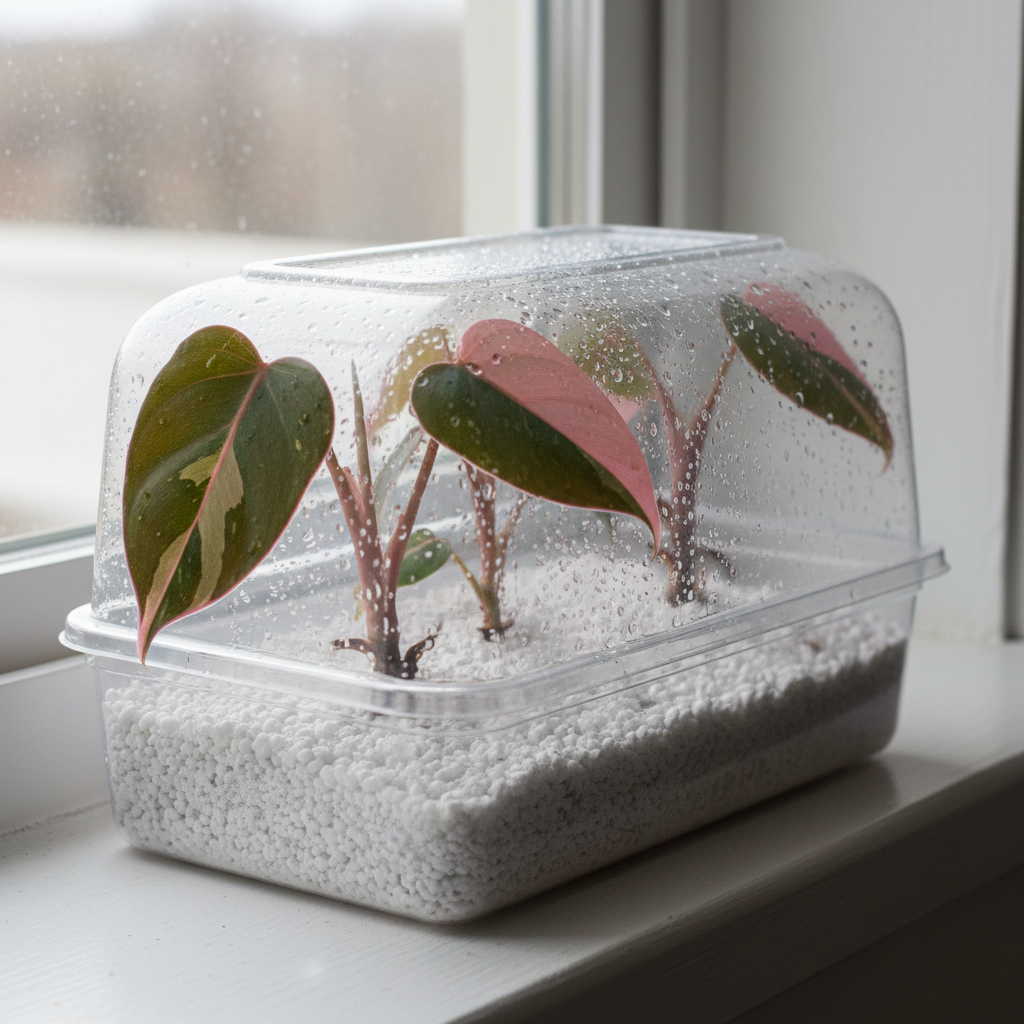
Rooting in damp perlite or sphagnum moss under a humidity dome is the most reliable method, and the one most professional growers use. It avoids the “water-root to soil-root” transition shock that often delays growth after water propagation, and provides a stable, humid micro-climate around the cutting.
- Choose a healthy section of stem with at least one node, one leaf, and visible pink variegation on the section just above the chosen node. Two or three nodes per cutting is ideal.
- Using sterilised scissors or a clean blade, cut the stem cleanly 1 to 2 centimetres below the node. A second cut above the top node leaves the cutting compact.
- Let the cut surface air-dry for 30 to 60 minutes to allow a callus to form. This reduces the risk of bacterial infection.
- Fill a clear plastic tub or shallow tray with horticultural perlite or damp pre-soaked sphagnum moss. The substrate should feel like a wrung-out sponge, never sopping.
- Insert the cutting upright into the substrate, burying the node and leaving at least one leaf above the surface. Press the substrate gently around the stem.
- Cover with a clear lid or loose plastic bag to maintain high humidity around the cutting. Place in bright indirect light, away from direct sun.
- Open the dome briefly every two to three days to refresh air and check moisture. Mist the substrate lightly only if it looks pale and dry.
- After three to six weeks, check for resistance when the cutting is tugged gently. Once roots are 3 to 5 centimetres long, pot the cutting up into a small pot of aroid mix and gradually reduce humidity by leaving the dome open longer each day.
Pro Tip — Read the Top Node: The colour of the section just above the node you cut is a strong predictor of the future plant’s variegation. Pink princess variegation is preserved by the meristematic cells at growing tips, so the most variegated cuttings come from sections where the most recently produced leaf is well variegated. Choose your cut accordingly.
Water Propagation: Step-by-Step
Rooting cuttings in water is the simplest and most visible method. You can watch roots emerge in real time, and the only equipment needed is a clean glass and a sunny windowsill. The disadvantage is that water roots are structurally different from soil roots; transferring a heavily water-rooted cutting to substrate often causes a stall while the plant grows a new set of substrate-adapted roots.
- Prepare cuttings as above, with one to three nodes and at least one leaf each.
- Place each cutting in a clean glass jar or vase of tepid room-temperature water, with the nodes submerged and the leaves above the waterline.
- Place in bright indirect light. East or filtered south windowsills work well.
- Change the water completely every five to seven days to keep oxygen levels up and prevent bacterial film.
- Once roots are 3 to 5 centimetres long and have started to develop fine secondary roots, transfer the cutting to a small pot of damp aroid mix.
- Keep the new pot in higher humidity than usual for the first two weeks and water more frequently than for an established plant while the cutting adapts.
Troubleshooting Propagation
| Problem | Likely Cause | Solution |
|---|---|---|
| Cutting turns black and mushy at the cut end | Bacterial rot from a damp, contaminated cut | Re-cut above the rot back to clean tissue, dust with cinnamon, restart in fresh substrate |
| No roots after six weeks | Temperature too cool, or node never made contact with substrate | Move to a warmer spot (22 to 25 degrees Celsius), reseat the cutting so the node is firmly in the substrate |
| New leaf opens all green | Cutting was taken from an already-reverted section of stem | Prune back to a variegated section and let a new growing point develop from a more pink-bearing node |
| Cutting yellows and drops its leaf | Too dark, or top growth losing energy faster than roots can replace it | Move to brighter indirect light; trim the leaf in half to reduce evaporation while roots establish |
Pests and Diseases
Pink princesses are not unusually pest-prone, but their thick, glossy leaves provide good landing pads for several common houseplant invaders. The thicker tissue means infestations build up slowly enough to be caught and dealt with if you inspect the plant regularly. A weekly look at the leaf undersides, especially around the leaf axils where the petiole meets the stem, is the most useful single habit a pink princess owner can develop.
Disease is a smaller risk than pests for pink princess, with the major exception of root rot from overwatering and the occasional fungal leaf spot if water is left to sit on the leaves overnight in a poorly ventilated room. Most disease issues trace back to a substrate or watering problem, so prevention starts with the soil mix and the watering can rather than with a fungicide bottle.
Common Pests
Spider Mites (Tetranychus urticae)
The most common pest on pink princess in dry, warm rooms. Mites are barely visible to the naked eye but produce fine silken webbing in the leaf axils and on the undersides of leaves. Affected leaves develop a stippled, dusty look with tiny pale dots that gradually merge into yellow patches. Heavy infestations cause leaves to dry up and drop.
Treatment: Shower the plant thoroughly in lukewarm water, paying special attention to leaf undersides. Follow up with a thorough application of insecticidal soap or 1 percent neem oil emulsion, applied to all leaf surfaces and the stem. Repeat every five to seven days for three weeks to break the egg-hatching cycle. Raising ambient humidity discourages new infestations.
Mealybugs (Pseudococcus longispinus)
White cottony clusters that hide deep in leaf axils, along the underside of midribs and at the base of petioles. Mealybugs feed on plant sap, weakening the plant and excreting sticky honeydew that attracts sooty mould. Their waxy coating makes them resistant to plain water sprays.
Treatment: Dab individual mealybugs with a cotton bud dipped in 70 percent isopropyl alcohol, which dissolves the waxy coat and kills them on contact. For heavier infestations, follow with a systemic insecticide such as imidacloprid or a horticultural soap spray every seven days for three to four weeks. Check newly purchased plants carefully before bringing them into a room with other houseplants.
Thrips (Thrips tabaci)
Tiny slender insects, around 1 to 2 millimetres long, that rasp leaf surfaces and suck out the contents of damaged cells. Affected leaves develop silvery streaks, distorted new growth and small black flecks of frass on the surface. Thrips are notoriously hard to spot but quick to multiply.
Treatment: Isolate the plant immediately, as thrips spread rapidly. Use yellow or blue sticky traps to monitor and reduce adult numbers. Spray weekly with spinosad or systemic insecticide, alternating active ingredients to prevent resistance. Remove and bin badly damaged leaves rather than composting them, which can spread infestation.
Fungus Gnats (Bradysia spp.)
Small black flies, around 2 to 3 millimetres long, that flit out of the soil when disturbed. Adults are harmless, but their larvae feed on fine root hairs and decaying organic matter in damp substrate. Heavy populations indicate consistently wet, poorly draining soil.
Treatment: The primary remedy is letting the top 2 to 3 centimetres of substrate dry out fully between waterings, which kills the larvae. A top layer of horticultural sand or pumice physically blocks egg-laying. For persistent infestations, drench with a Bti (Bacillus thuringiensis israelensis) solution, which is harmless to plants and people but lethal to gnat larvae.
Common Diseases
Root Rot (Pythium and Phytophthora spp.)
The single biggest killer of pink princess. Opportunistic soil-borne pathogens take hold when roots sit in waterlogged, oxygen-starved substrate. Above ground, the plant looks limp, leaves yellow from the base upward, and the stem at soil level becomes soft and discoloured. Roots, when unpotted, are blackened, mushy and slip out of their outer sheath.
Treatment: Unpot the plant immediately, wash all soil off the roots, and trim away every soft or discoloured root back to firm white tissue. Dust the cuts with cinnamon, sulphur or a copper-based fungicide. Repot into fresh, dry chunky mix in a clean pot only slightly larger than the remaining root ball. Water sparingly until new white root tips are visible at the drainage holes.
Bacterial Leaf Spot (Erwinia spp.)
Appears as small water-soaked patches on the leaves that gradually turn brown or black, often ringed by a yellow halo. The patches enlarge if leaves stay wet, especially in poorly ventilated rooms. Heavy infections can spread to petioles and stems.
Treatment: Remove all affected leaves and bin them. Move the plant to a better-ventilated spot and avoid wetting the leaves when watering. In severe cases, apply a copper-based bactericide and reduce humidity temporarily. Sterilise scissors between cuts to avoid spreading the infection.
Pest and Disease Summary
| Pest / Disease | Identification | Treatment |
|---|---|---|
| Spider mites | Fine webbing, stippled yellow leaves | Shower, neem or insecticidal soap weekly for 3 weeks |
| Mealybugs | White cottony clusters in leaf axils | 70 percent alcohol on cotton bud, then systemic insecticide |
| Thrips | Silvery streaks, black frass dots on leaves | Spinosad spray weekly, sticky traps, isolate plant |
| Fungus gnats | Small black flies around the soil surface | Let top soil dry, Bti drench, sand top dressing |
| Root rot | Limp leaves, soft stem base, black roots | Unpot, trim rot, repot in dry chunky mix |
| Bacterial leaf spot | Water-soaked patches with yellow halos | Remove affected leaves, copper fungicide, improve airflow |
Prevention Strategies
Most pink princess pest issues are preventable rather than curable. Quarantine new plants in a separate room for two to three weeks before introducing them to your existing collection, since most infestations arrive on a recently bought plant. Inspect the leaf undersides and axils weekly with a magnifying glass or smartphone camera zoom, particularly through autumn and winter when central heating dries the air and creates ideal conditions for spider mites.
Cultural prevention matters as much as chemistry. Keep humidity in the 50 to 70 percent range to discourage mites, avoid wetting leaves at night, ensure good airflow around the plant, and prune any damaged or yellowing leaves promptly so they don’t become entry points for pathogens. A clean, healthy plant in good light is the strongest pest deterrent there is.
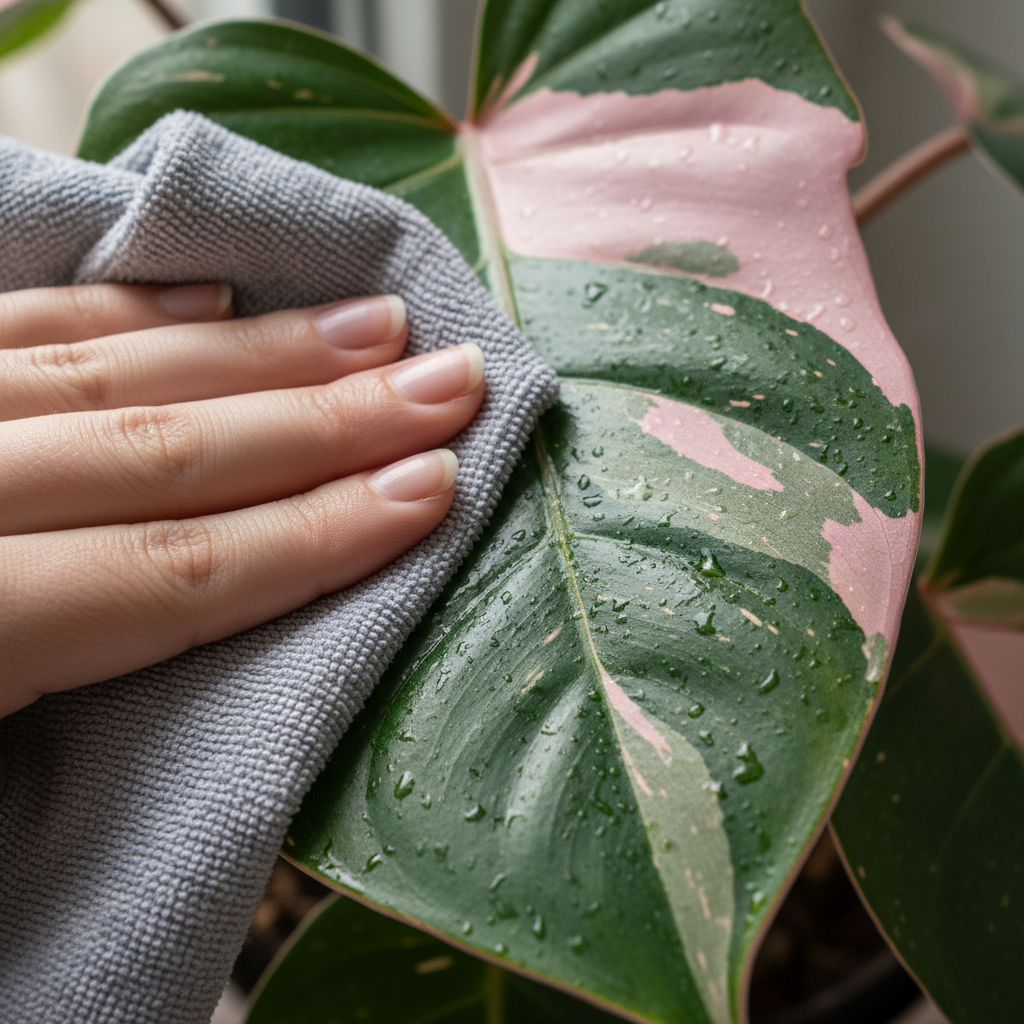
Pro Tip — The Weekly Wipe: Get into the habit of wiping every leaf, top and bottom, with a damp microfibre cloth once a week. It removes dust that blocks photosynthesis, dislodges pest eggs before they hatch, and forces you to look closely at every part of the plant. Most growers who do this catch problems weeks earlier than those who don’t.
Popular Varieties
The pink princess is itself a cultivar of Philodendron erubescens, a species that has produced an unusually rich set of named selections over the last fifty years. Most of these cultivars are climbing aroids with elongated heart-shaped leaves and similar care needs to the standard pink princess; what varies is the colour, intensity and pattern of variegation, and the size and posture of mature foliage. Collectors trade in specific forms — half-moon, marble, “Pink Princess Black Cherry” — but those distinctions are descriptive rather than officially registered.
Below is an overview of the most widely grown cultivars and how they compare. Several were briefly very fashionable at peak houseplant prices in 2020 to 2022 before settling into ordinary availability today. A few, such as the white-variegated White Princess and White Knight, remain genuinely scarce and command higher prices.
| Variety | Leaf Appearance | Light Needs | Growth Rate | Availability |
|---|---|---|---|---|
| ‘Pink Princess’ (standard) | Dark green with pink splashes, patches and speckles | Bright indirect | Moderate | Widely available |
| ‘Pink Princess Marble’ | Heavy marbled pink and green, often more than 50 percent pink | Bright indirect | Slow | Less common, premium price |
| ‘Pink Princess Half-Moon’ | One whole half of each leaf creamy pink, the other deep green | Bright indirect | Slow | Rare, collector form |
| ‘Pink Princess Black Cherry’ | Almost-black foliage with deep wine-red rather than pink markings | Bright indirect | Moderate | Less common |
| ‘White Princess’ | Dark green with crisp white variegation, pink-tinged stems | Bright indirect | Slow | Less common, premium price |
| ‘White Knight’ | White variegation on green, with deep burgundy stems | Bright indirect | Slow | Rare, premium price |
| ‘Burle Marx Fantasy’ | Light silvery-green variegation in a feathered pattern | Medium to bright indirect | Moderate | Specialist nurseries |
| ‘Red Emerald’ | Solid deep green leaves with red stems and petioles | Bright indirect | Fast | Widely available |
Featured Varieties
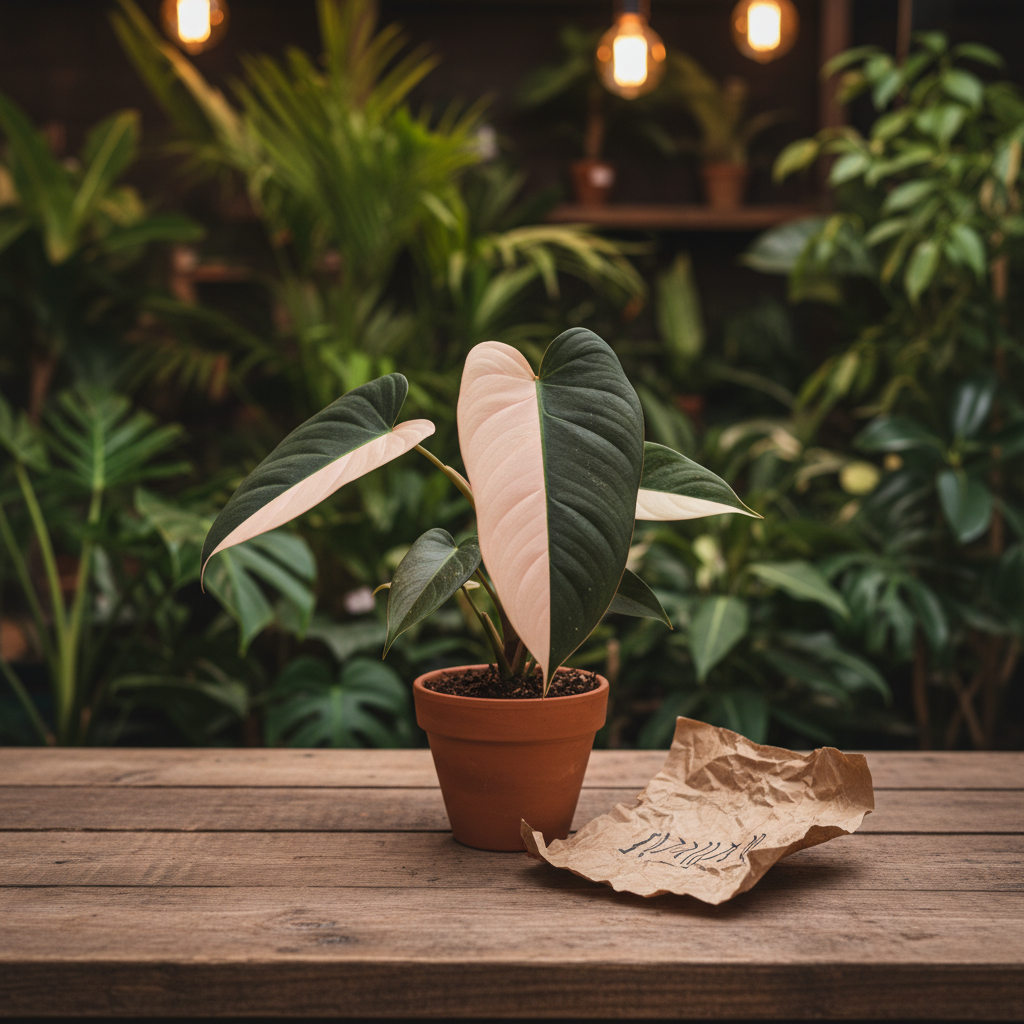
Half-Moon Pink Princess
The grail form for collectors. Each new leaf splits cleanly down the central midrib, with one full side rendered in creamy bubble-gum pink and the other in deep blackish-green. Slow-growing and sensitive to light fluctuations, but spectacular when stable.
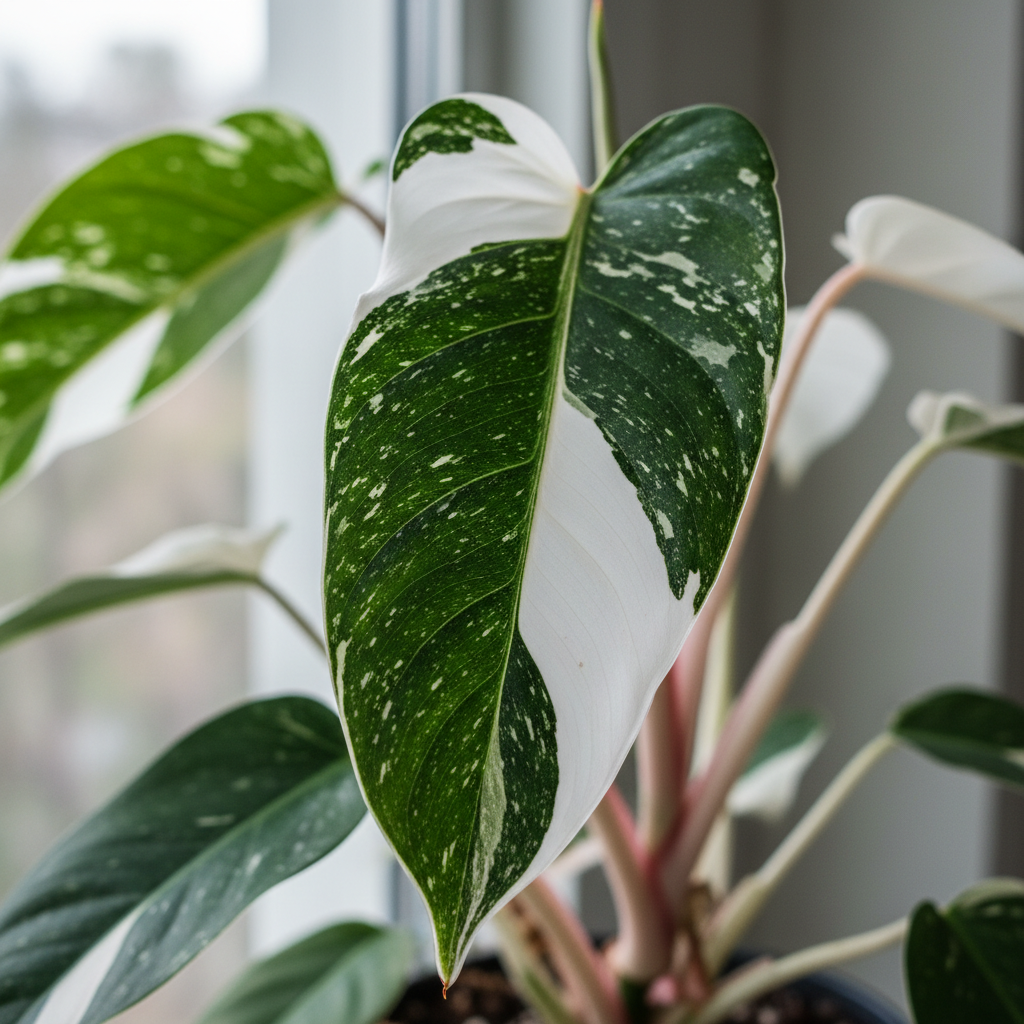
White Princess
A closely related Philodendron erubescens cultivar with crisp white variegation on dark green and a pink-tinged stem. Care is essentially identical to the pink princess, but white variegation is even less photosynthetic than pink, so the plant grows slower and needs even more careful light management.
Variety Profiles in Detail
Standard Pink Princess (Philodendron erubescens ‘Pink Princess’)
The original and still the most widely available form. Leaves emerge bronzed-red, mature to deep blackish-green, and develop random patches, splashes or speckles of pink in unpredictable distribution. Excellent climber on a moss pole. Most affordable of the named pink forms and a sensible starting point.
Pink Princess Marble (Philodendron erubescens ‘Pink Princess Marble’)
A more heavily variegated form, often with leaves more than half pink. Grows more slowly than the standard because the larger pink area produces less of its own energy. Worth seeking out for the visual impact, but plan for a slower-growing plant.
Pink Princess Black Cherry (Philodendron erubescens ‘Black Cherry’)
A darker variant where the foliage approaches true black and the variegation appears in deeper wine-red rather than pink. Stunning under warm directional lighting. Care needs are identical to the standard, but the darker leaves benefit from slightly brighter indirect light to keep contrast crisp.
Burle Marx Fantasy (Philodendron ‘Burle Marx Fantasy’)
A closely related but distinct climbing philodendron with feathered silvery-green variegation across smaller, lance-shaped leaves. Compact and well suited to terrariums or smaller plant cabinets. Identical aroid-mix and humidity preferences make it a good companion plant for a pink princess.
Choosing the Right Variety for Your Space
For a first Philodendron erubescens, the standard pink princess is the best balance of price, availability and visual reward. Growers with bright stable light and patience for slower growth might enjoy the marble or half-moon forms, while collectors looking to expand laterally rather than just chase pinker leaves often add a Red Emerald, a White Princess or a Burle Marx Fantasy. Whatever you choose, prioritise a healthy plant from a reputable seller with at least three leaves and visible aerial roots; a cheap import with thin pale leaves and no visible variegation may struggle to recover regardless of care.
Frequently Asked Questions
Why is my pink princess losing its pink variegation?
Almost always insufficient light. The plant’s growing tip will gradually produce more all-green tissue when energy is scarce. Move it to a brighter spot with bright indirect light for at least 10 hours a day. If the most recent few leaves are all green, prune back to a node where variegated tissue is still visible to force a new growth point from a more variegated section.
Can I make my pink princess more pink?
You cannot increase the variegation in a leaf that has already formed, but you can encourage future leaves to emerge more variegated by giving the plant strong, stable indirect light, by avoiding overwatering and by pruning strategically just above well-variegated nodes. Chemical-induced “more pink” treatments are unreliable and often kill the plant. The original Pink Congo cultivar, sold at peak hype, used such treatments and the variegation faded back to green within months.
My pink princess has a fully pink leaf. Should I cut it off?
Generally yes, especially if the leaf is more than 90 percent pink. A fully pink leaf cannot photosynthesise, so it draws energy from the rest of the plant for the few months it survives. Cutting it back at the petiole redirects energy into healthier leaves and reduces the risk of the next leaf also opening too pink. Keep half-moon leaves with one pink and one green side; those are the prize result.
Does a pink princess need a moss pole?
It does not need one, but it benefits enormously from one. As a climbing aroid, the pink princess produces larger leaves and stronger growth when its aerial roots can attach to a damp vertical support. Moss poles or coir poles, kept damp, encourage roots to anchor and pull moisture, mimicking the tree-trunk relationship the plant evolved with. Plants left to trail will produce smaller, less impressive leaves over time.
Why are the leaves on my pink princess so small?
Leaf size correlates strongly with the size and structure of the support. Free-trailing plants and plants on thin stakes tend to produce small leaves. Plants on substantial moss poles, with a steady supply of light, water and nutrients, can grow leaves twice the size of stake-grown specimens. Adequate humidity and consistent fertilising also feed leaf expansion. If your plant has recently been moved, repotted or stressed, expect the next one to two leaves to be smaller than usual.
Is the pink princess safe around cats and dogs?
No. All parts of the plant contain insoluble calcium oxalate crystals that cause oral irritation, drooling, vomiting and difficulty swallowing if chewed by cats or dogs. Severe cases can cause swelling of the tongue and throat. Keep the plant well out of reach, or restrict it to a room your pets cannot access. If ingestion is suspected, contact a veterinarian.
How fast does the pink princess grow?
Slow to moderate compared with other philodendrons. Expect around 10 to 15 centimetres of stem extension per year indoors and one new leaf every four to six weeks during the growing season. Heavily variegated plants grow more slowly than less variegated ones, because the green tissue carries a larger metabolic load.
Should I prune my pink princess?
Strategic pruning is one of the most useful tools available to a pink princess owner. Prune to encourage branching from a more variegated section, to remove all-green reverted leaves, or to take cuttings for propagation. Always cut just above a node, sterilise scissors between cuts, and prune in spring or summer when the plant has the energy to push new growth from the cut site.
My pink princess looks leggy. What should I do?
Legginess — long internodes and small leaves — is almost always a light problem. Move the plant to a brighter location, or supplement with a grow-light. Once the plant has adapted to better light, you can prune off the worst legged sections back to a healthier node and use the cuttings to propagate a denser replacement. Tying the existing stem to a moss pole also encourages tighter, larger growth in subsequent leaves.
Are the famous “Pink Congo” plants the same as Pink Princess?
No, and the distinction matters. Pink Congo plants sold around 2018 to 2020 had their leaves chemically treated with ethylene to suppress chlorophyll temporarily, producing dramatic pink colour that reverted to all green within six to twelve months. True pink princess plants have stable, genetic, chimeric variegation that persists for life when given enough light. If a “pink” philodendron loses all its pink in under a year regardless of care, it was almost certainly a Pink Congo rather than a Pink Princess.






