
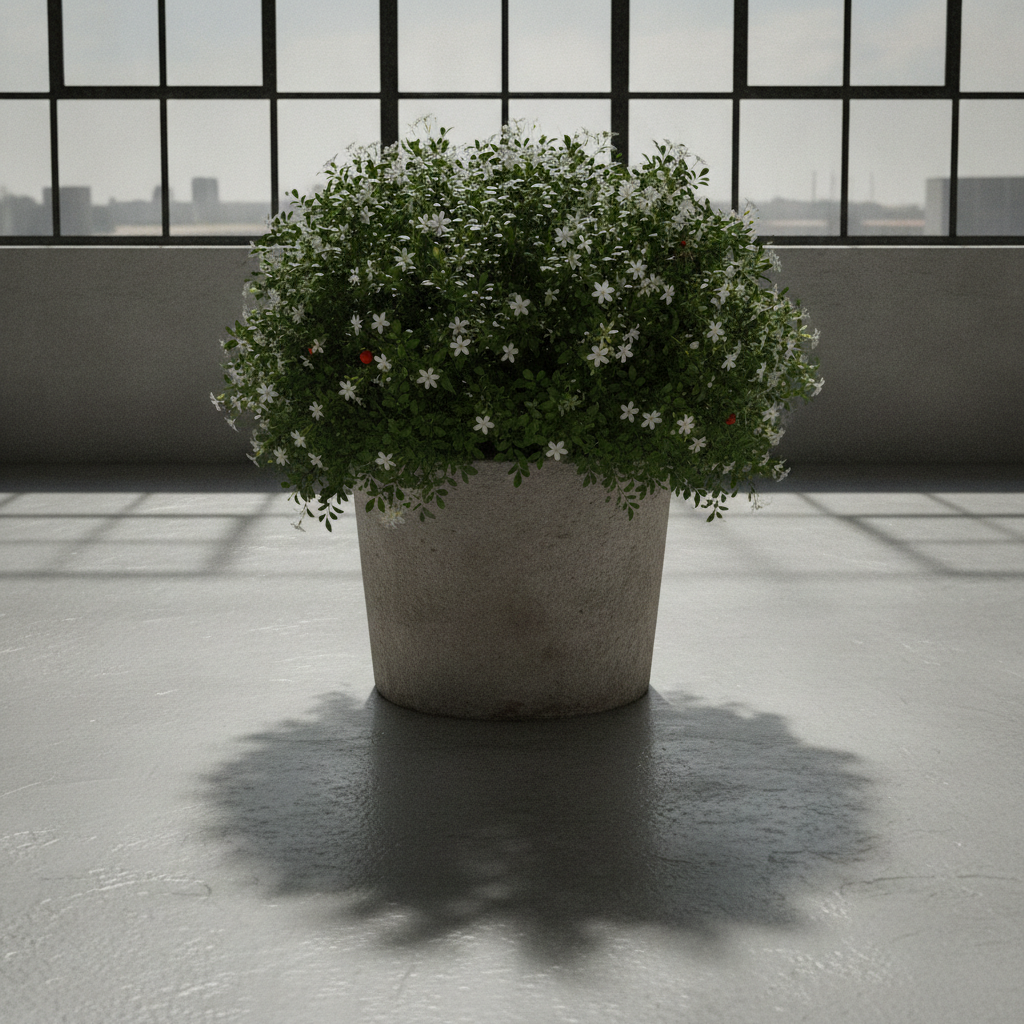
Few indoor shrubs announce themselves by scent before sight the way orange jasmine does. Murraya paniculata is an evergreen member of the citrus family, Rutaceae, and its flushes of small white flowers carry a perfume almost indistinguishable from orange blossom, drifting across a room on a warm afternoon. Known variously as mock orange, orange jessamine, satinwood and Chinese box, the plant is native to a broad sweep of South and Southeast Asia, southern China and northern Australasia, where it grows as a dense shrub or small tree. Its glossy, dark green pinnate leaves and pale, papery bark have made it a mainstay of tropical gardens, clipped hedges and, increasingly, the windowsills and bonsai benches of growers far outside its native range.
Orange jasmine has a reputation as a rewarding but slightly demanding houseplant, and both halves of that description are fair. Give it light, warmth and steady moisture and it will reward you with lush foliage and repeated waves of scented bloom; neglect its need for bright conditions or let it sit cold and wet and it sulks, drops leaves and refuses to flower. This guide covers everything needed to move from merely keeping an orange jasmine alive to helping it genuinely thrive indoors, from reading its light requirements and watering rhythm to feeding, repotting, propagation and the pests that most often trouble it.
Contents
- Quick Reference
- Why Orange Jasmine Makes a Rewarding Houseplant
- Light Requirements
- Watering & Humidity
- Soil, Potting & Repotting
- Fertilising
- Propagation
- Pests & Diseases
- Popular Varieties
- Frequently Asked Questions
Quick Reference: Orange Jasmine at a Glance
| Light | Bright light, ideally 4 to 6 hours of direct sun; tolerates bright indirect but flowers far less |
| Watering | Keep evenly moist; let the top 2 to 3 cm (1 in) of soil dry before watering again |
| Temperature | 18 to 30 degrees C (64 to 86 degrees F); protect from anything below 5 degrees C (41 degrees F) |
| Humidity | Moderate to high, ideally above 50 per cent |
| Fertiliser | Balanced or citrus feed every 2 to 4 weeks in spring and summer, with added iron and magnesium |
| Toxicity | Generally regarded as non-toxic to cats and dogs; berries are best kept away from small children |
Why Orange Jasmine Makes a Rewarding Houseplant
The strongest argument for growing orange jasmine indoors is sensory. When a mature plant comes into bloom it produces clusters of small, five-petalled white flowers whose fragrance fills a room, and because the plant flowers in repeated flushes rather than one brief season, that perfume returns again and again through the warmer months. Between blooms the plant is far from dull: its dense, rounded canopy of glossy compound leaves holds colour and structure all year, and small orange to scarlet berries often follow the flowers, giving the shrub a second season of interest.
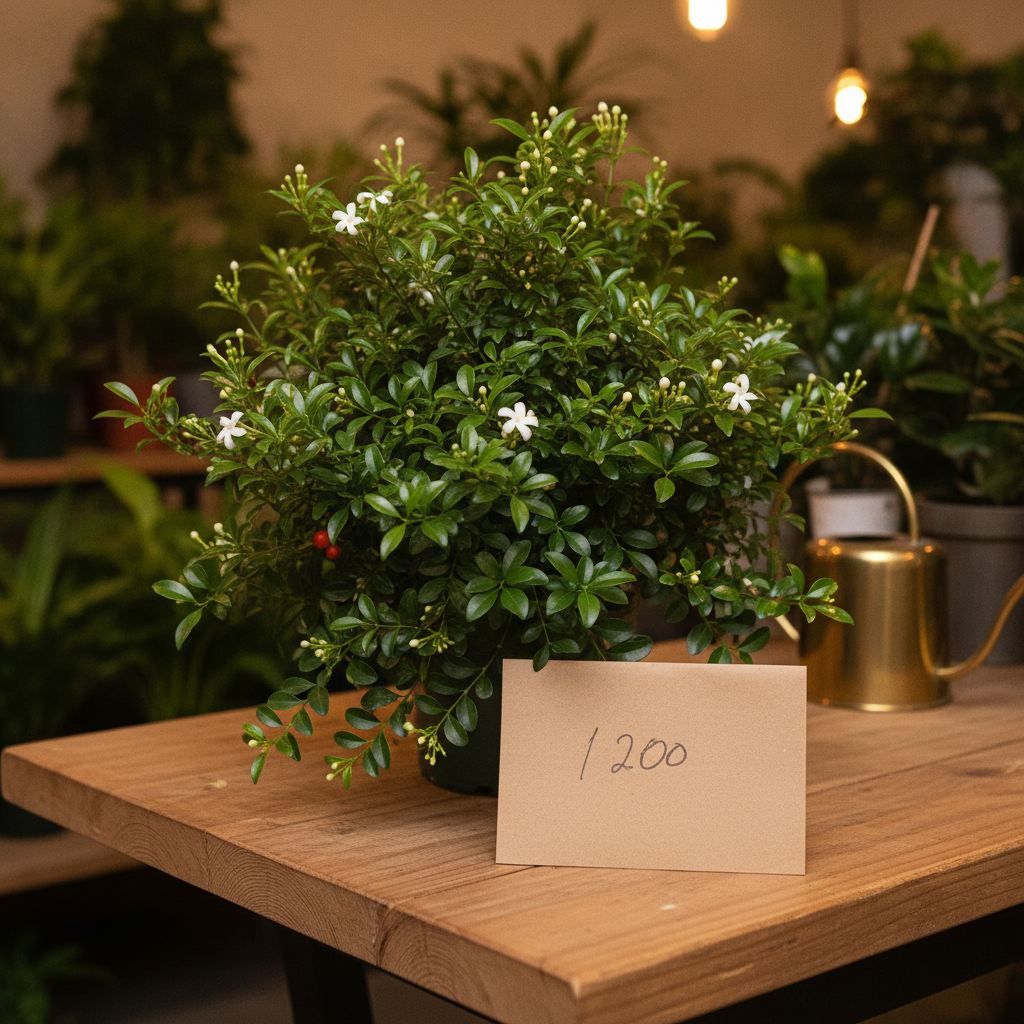
Beyond its charm, orange jasmine is genuinely versatile. It responds well to pruning, which makes it equally suited to life as a compact bushy houseplant, a formal clipped standard or one of the most popular subjects in indoor bonsai, where its small leaves, willingness to back-bud and pale, characterful bark are prized. It is also long-lived, and a plant kept in good conditions can remain a fixture of a room for many years, gradually thickening into a small specimen tree. The trade-off is that it is not a plant for a dim corner or a forgetful waterer: it wants light and attention, and it will tell you clearly when it is not getting them.
Important — Toxicity: Orange jasmine is not listed among the plants known to be toxic to cats and dogs, and it is generally regarded as safe around pets. The small berries are edible in the botanical sense but bland and best not eaten in quantity, so it is sensible to keep fallen fruit out of reach of very young children and curious animals. If a pet consumes a large amount of any plant material and shows signs of distress, contact a veterinarian.
Light Requirements
Light is the single most important factor in growing orange jasmine well, and it is where most disappointing plants go wrong. In its native habitat this is a plant of open woodland edges and sunny clearings, accustomed to strong light for much of the day. Indoors it needs the brightest position you can offer, and while it will survive in bright indirect light, it will only flower reliably where it receives several hours of direct sun.
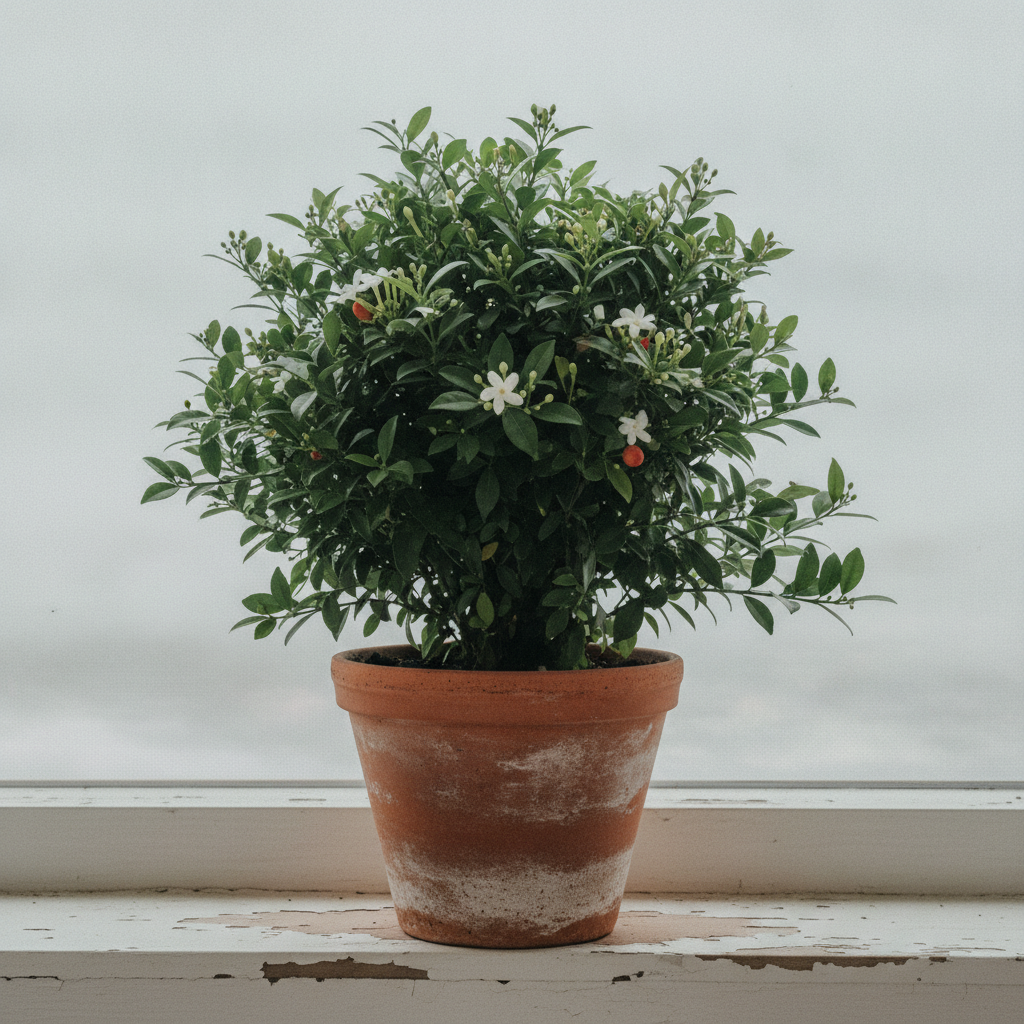
The ideal indoor situation gives an orange jasmine four to six hours of direct sunlight daily, supplemented by bright ambient light for the rest of the day. A spot directly in or beside a large, sunny window is far better than a shaded interior corner. A plant that is not flowering, growing leggy with widely spaced leaves, or leaning hard toward the glass is almost always asking for more light rather than any other change in care.
Light Levels Explained
Indoor light is easy to overestimate because the human eye adapts so readily. The table below translates the usual descriptive terms into approximate illuminance and typical placements, and shows what to expect from an orange jasmine in each.
| Light Category | Approx. Level | Typical Location | Outcome |
|---|---|---|---|
| Direct sun | Over 50,000 lux | Right at a south or west window | Strong growth and best flowering |
| Bright indirect | 10,000 to 20,000 lux | Near a bright window, out of direct beams | Healthy foliage, sparse or no bloom |
| Medium | 5,000 to 10,000 lux | A metre or two back from a window | Slow growth, leggy habit, no flowers |
| Low | 1,000 to 2,500 lux | Interior wall, north-facing room | Decline, leaf drop over time |
| Very low | Under 1,000 lux | Hallway, corner far from light | Unsuitable; plant will fail |
Window Orientation and Placement
South-facing window: In the northern hemisphere this is usually the best position for an orange jasmine, offering the long hours of direct sun the plant needs to flower. In high summer, very intense midday sun through glass can occasionally scorch soft new growth, so watch for pale bleached patches and, if they appear, move the plant back slightly or filter the harshest hours.
East-facing window: A good option that supplies several hours of gentler morning sun. Growth will be healthy, though flowering may be a little less prolific than in a south window unless ambient light for the rest of the day is strong.
West-facing window: Also suitable, delivering strong afternoon sun. The main caution is heat build-up on hot days, since west light arrives when the room is already warm, so keep an eye on soil moisture in summer.
North-facing window: The most difficult orientation. A north window rarely supplies enough light for good flowering and often not enough for vigorous growth. An orange jasmine can be kept here for a time but will tend toward a thin, drawn-out habit and is much better moved to a brighter aspect or supplemented with a grow light.
Pro Tip — Rotate for an Even Canopy: Orange jasmine grows strongly toward its light source, and a plant left facing one way will thicken on the window side and thin on the other. Give the pot a quarter turn every week or two so the whole canopy receives light and the shrub develops an even, well-balanced shape.
How Light Affects Flowering
The clearest signal of whether an orange jasmine is receiving enough light is whether it blooms. Foliage will hold up in moderate conditions, but flower buds form only where light energy is abundant, so a plant that produces plenty of leaves yet never flowers is almost always under-lit rather than under-fed or under-watered. Moving such a plant into direct sun, or adding supplementary lighting, is usually the change that finally brings on the scented flushes growers keep the plant for in the first place.
Warning — Direct Sunlight: While orange jasmine loves sun, a plant that has been kept in low light should be moved into bright conditions gradually over a week or two. Sudden relocation from a dim interior to intense direct sun can scorch leaves that are not acclimatised, leaving bleached or brown patches that will not recover.
Artificial Lighting
Where natural light is limited, orange jasmine responds well to a full-spectrum LED grow light. To support both growth and flowering, aim for a strong fixture positioned 20 to 40 cm (8 to 16 in) above the canopy and run it for roughly 12 to 14 hours a day. Supplementary light is particularly valuable through the short days of winter in temperate climates, when even a bright window may not deliver enough energy to keep the plant actively growing.
Seasonal Adjustments
Light intensity indoors falls sharply between summer and winter, and the sun also tracks lower in the sky. Move the plant to your brightest available window as autumn arrives, clean the glass and the leaves so nothing needlessly dims the light, and be ready to reduce watering to match the slower growth that shorter days bring. As spring returns and light strengthens, growth resumes and the plant can be moved back or gradually reacclimatised to stronger sun.
Watering & Humidity
Orange jasmine likes to be kept consistently moist but never waterlogged, a balance that sits between the drought tolerance of a succulent and the constant sogginess a fern will accept. The aim is soil that stays lightly damp through the root zone while the very top layer dries between waterings, giving the roots both the moisture and the oxygen they need.
When to Water
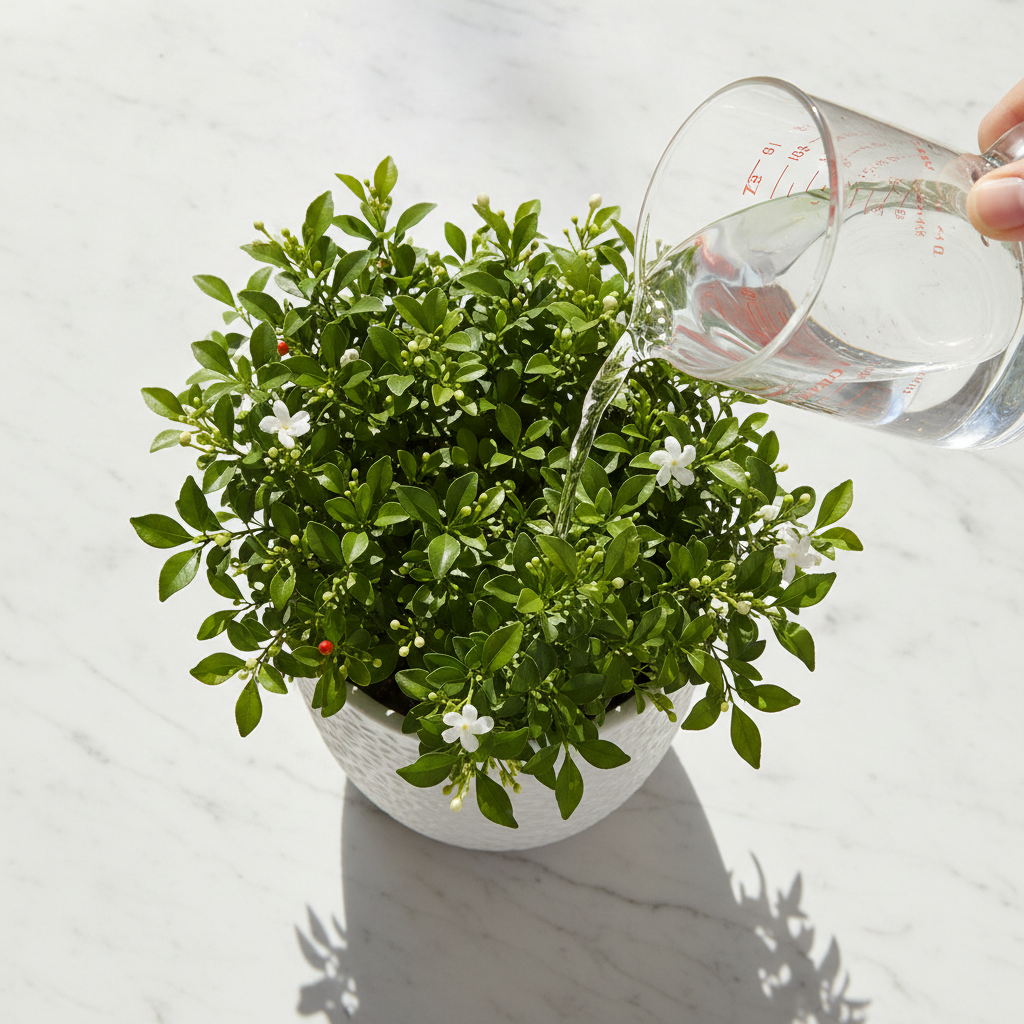
Rather than watering on a fixed calendar, check the soil with a finger. When the top 2 to 3 cm (about an inch) feels dry, it is time to water; while it still feels damp, wait. In a bright, warm spot through spring and summer this often means watering two or three times a week, but the interval stretches considerably in winter when growth slows and evaporation drops.
Pay attention to the factors that speed drying, because they matter more than the day of the week. A plant in strong sun, in a small or terracotta pot, or in a heated room will dry out faster and need water more often; a plant in a cool room, a large plastic pot or lower light will hold moisture much longer. A cheap moisture meter or simply lifting the pot to feel its weight both help build an accurate sense of the plant’s rhythm.
Pro Tip — Do Not Let It Bone-Dry: Unlike many tough houseplants, orange jasmine dislikes drying out completely. A pot that goes fully dry, especially while flowering, will often respond by dropping buds and yellowing leaves. Keeping the soil lightly and evenly moist is one of the surest ways to keep the plant flowering and settled.
How to Water Correctly
- Check that the top 2 to 3 cm of soil has dried before watering.
- Water slowly and evenly across the whole surface, not just one spot, until moisture reaches all of the root ball.
- Continue until water runs freely from the drainage holes, which ensures the entire root zone is wetted.
- Let the pot drain completely for a few minutes.
- Empty the saucer or cache-pot so the plant never sits in standing water.
Signs of Overwatering vs. Underwatering
| Symptom | Overwatering | Underwatering |
|---|---|---|
| Leaf colour | Yellowing, often across many leaves at once | Yellowing at edges, older leaves first |
| Leaf texture | Soft, limp, sometimes translucent | Dry, crisp, curling at the margins |
| Soil | Constantly wet, sour smell possible | Dry, pulling away from the pot sides |
| Roots | Brown, mushy, foul-smelling | Dry and brittle but generally firm |
| Buds and flowers | Buds blacken and drop | Buds shrivel and fall unopened |
Warning — Root Rot: The most serious risk to an indoor orange jasmine is root rot from waterlogged soil. Once roots turn brown and mushy the plant declines quickly. If you suspect rot, unpot the plant, trim away all soft dark roots with clean scissors, and repot into fresh, free-draining mix in a pot with ample drainage. Prevention through good drainage and disciplined watering is far easier than a cure.
Humidity Requirements
As a plant of humid subtropical and tropical regions, orange jasmine appreciates moderate to high humidity and is happiest above about 50 per cent. It will tolerate average household air, but very dry conditions, particularly the parched air of a room heated through winter, can leave it stressed and more susceptible to pests such as spider mites.
Signs that the air is too dry include crisping leaf tips and margins, a dull look to the foliage and an uptick in mite activity. These symptoms are easy to confuse with underwatering, so check the soil first before assuming humidity is to blame.
Raising humidity is straightforward. Grouping plants together, standing the pot on a tray of damp pebbles kept topped up with water, or running a small humidifier through the driest months all help. A humidifier gives the steadiest results; misting offers only a fleeting lift and, done heavily on a plant prone to fungal problems, can do more harm than good.
Water Quality
Orange jasmine is not especially fussy about water, but as a citrus relative it can show sensitivity to a build-up of salts and to very hard, alkaline water over time, which contributes to the iron chlorosis the plant is prone to. If your tap water is very hard or heavily chlorinated, using filtered water, collected rainwater or tap water left to stand overnight can help keep the foliage a rich green. Room-temperature water is always kinder to the roots than cold water straight from the tap.
Soil, Potting & Repotting
The right soil for orange jasmine holds moisture without ever becoming boggy, and drains freely enough that air reaches the roots between waterings. A dense, water-retentive potting soil used straight from the bag is a common cause of trouble, so most growers improve a standard mix with materials that open up its structure.
Ideal Soil Composition
A good working mix combines a quality peat-free or loam-based potting compost as the moisture-holding base with generous additions of drainage material and some bark for structure. The goal is a medium that feels open and crumbly, not one that packs down into a solid mass when wet.
| Component | Proportion | Function |
|---|---|---|
| Loam-based or quality potting compost | Around 60 per cent | Holds moisture and nutrients, provides body |
| Perlite or coarse grit | Around 20 per cent | Improves drainage and aeration |
| Composted bark or coco chips | Around 20 per cent | Adds structure and stops compaction |
Orange jasmine prefers a soil that is slightly acidic to neutral, roughly pH 6.0 to 7.0. In consistently alkaline conditions the plant struggles to take up iron and manganese, which shows as yellowing between the leaf veins. A little acidity in the mix, and the occasional use of an ericaceous or citrus feed, helps keep the foliage a healthy deep green.
Pro Tip — Quick Mix Recipe: For a reliable blend, combine three parts good potting compost, one part perlite and one part fine composted bark, with a handful of worm castings stirred through for slow, gentle nutrition. This holds moisture well while draining freely and suits orange jasmine grown as a houseplant or as bonsai.
Choosing the Right Pot
Pot choice affects watering rhythm, root health and how the plant sits in a room, so it is worth a little thought rather than simply reaching for whatever is to hand.
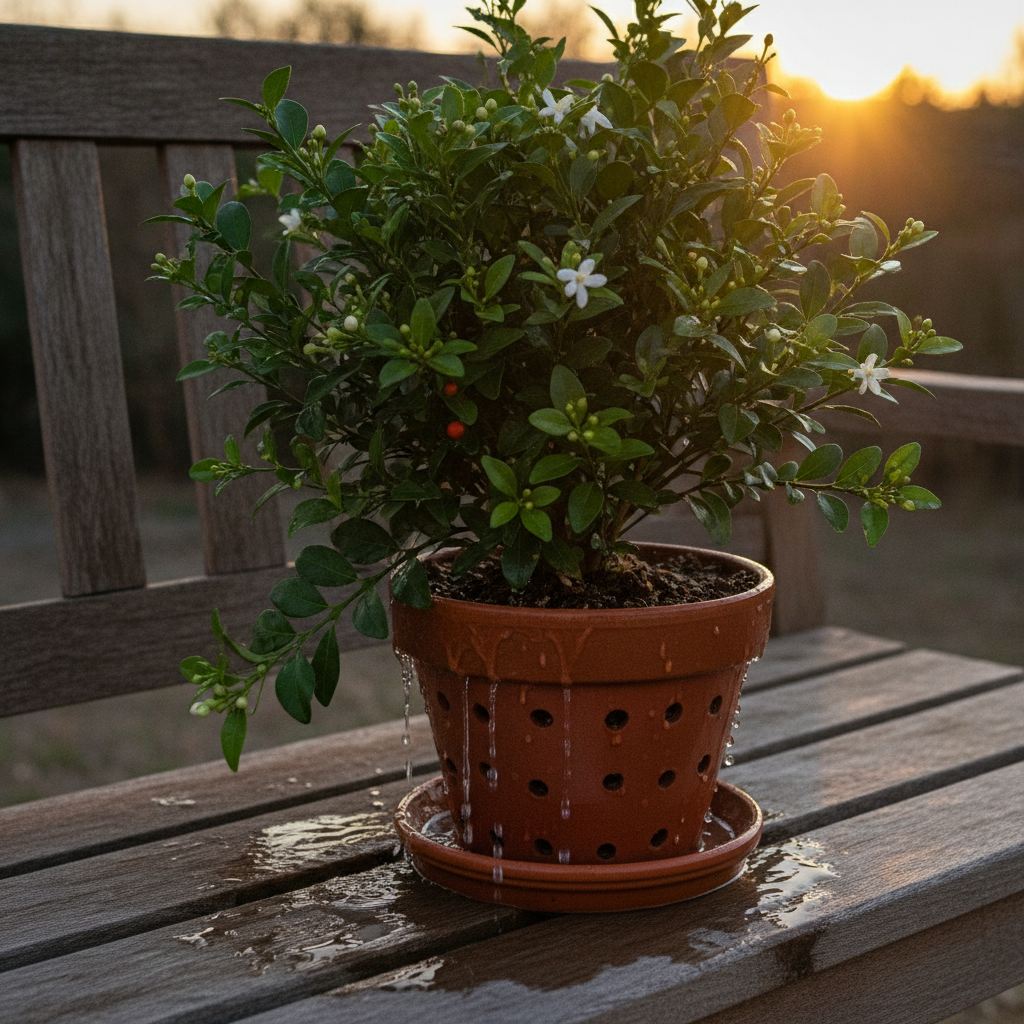
Drainage holes are non-negotiable. Orange jasmine will not tolerate sitting in water, so any pot it lives in must have drainage holes. A decorative cache-pot without holes is fine as an outer cover, but only if you lift the inner pot to empty excess water after each watering.
Pot material: Terracotta is an excellent choice because its porous walls let the root ball breathe and dry more evenly, which suits a plant that dislikes staying sodden. Glazed ceramic and plastic hold moisture longer, meaning less frequent watering but a greater need for care not to overwater. For bonsai, a shallow training pot changes the watering picture entirely and demands closer attention.
Pot size: Choose a pot only a size larger than the current root ball. Orange jasmine actually flowers more freely when its roots are a little restricted, and an oversized pot holds a large volume of wet soil around a small root system, inviting rot. Pot up gradually rather than in big jumps.
When to Repot
Most orange jasmines need repotting every two to three years, or when roots begin to circle the pot or emerge from the drainage holes, water runs straight through without wetting the soil, or growth slows noticeably despite good care. The best time is spring, as the plant enters its active growing season and can recover quickly. Because the species flowers better when slightly pot-bound, there is no rush to move a healthy plant into a larger container before it genuinely needs it.
How to Repot: Step-by-Step
- Water the plant a day beforehand so the root ball is moist and holds together.
- Slide the plant out gently, supporting the base of the stem and easing rather than pulling.
- Tease out any tightly circling roots and trim away any that are brown, soft or dead.
- Add fresh, free-draining mix to the base of the new pot so the plant will sit at its previous depth.
- Position the plant centrally and fill around the root ball with fresh mix, firming gently to remove air pockets.
- Water thoroughly to settle the soil, then top up any mix that sinks.
- Return the plant to bright light and hold off feeding for a few weeks while new roots establish.
Warning — Transplant Shock: Orange jasmine can sulk after repotting, sometimes dropping a few leaves or pausing growth. Avoid the temptation to fertilise immediately or to overwater a freshly potted plant, as its reduced root system cannot use the extra water or nutrients and both raise the risk of rot. Steady warmth, bright light and even moisture will see it through.
Fertilising
Orange jasmine is a comparatively hungry plant for its size, especially when it is flowering, and regular feeding through the growing season makes a visible difference to both foliage colour and bloom. As a citrus relative it has a particular appetite for the trace elements iron and magnesium, and a feeding regime that ignores these often leads to the yellowing foliage that puzzles many growers.
The plant feeds actively from spring through to early autumn, and should be fed little and often during this window. In winter, when growth slows or stops, feeding should be reduced sharply or paused entirely so that unused fertiliser salts do not accumulate in the soil.
Understanding Plant Nutrients
Fertilisers are labelled with an NPK ratio describing their proportions of nitrogen, phosphorus and potassium, the three nutrients plants use in the largest amounts. For orange jasmine a balanced feed works well for general growth, while a formulation with adequate potassium and the key micronutrients supports flowering and keeps the foliage green.
| Nutrient | Symbol | Primary Function | Deficiency Symptoms |
|---|---|---|---|
| Nitrogen | N | Leaf and stem growth, green colour | Pale, uniformly yellowing older leaves |
| Phosphorus | P | Root development and flowering | Poor growth, dull or purplish tint |
| Potassium | K | Overall vigour, flowering, stress resistance | Yellow or scorched leaf margins |
| Magnesium | Mg | Core of the chlorophyll molecule | Yellowing between veins on older leaves |
| Iron | Fe | Chlorophyll production | Yellowing between veins on new leaves |
Types of Fertiliser
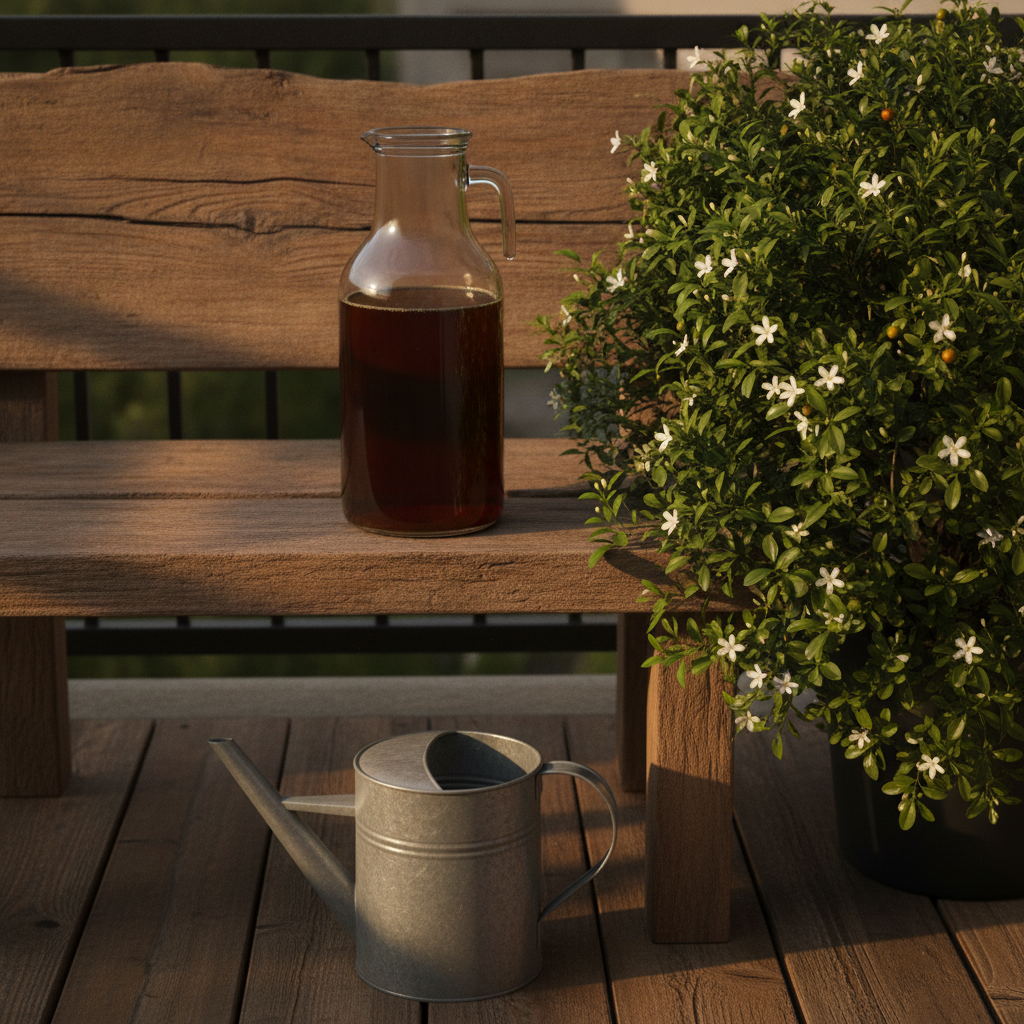
Liquid fertilisers: Diluted liquid feeds are the easiest way to feed an orange jasmine because they act quickly and let you match feeding precisely to the growing season. A balanced houseplant feed or a dedicated citrus feed applied every two to four weeks in spring and summer suits the plant well.
Slow-release granular: Controlled-release granules or prills mixed into the soil release nutrients steadily over several months, a low-effort approach that reduces the risk of over-feeding. They are convenient but give less control than liquid feeding if the plant shows a specific deficiency.
Organic fertilisers: Worm castings, compost tea and seaweed feeds provide gentle, well-rounded nutrition and help sustain healthy soil life. They are forgiving and hard to overdo, though their nutrient content is lower and slower to act than synthetic feeds.
Feeding Schedule
Through spring and summer, feed every two to four weeks with a balanced or citrus fertiliser at the recommended strength, adding a supplement of iron and magnesium if the newer leaves start to pale between the veins. As growth slows in autumn, stretch the interval, and through the depths of winter stop feeding altogether unless the plant is kept warm and actively growing under lights.
Pro Tip — Treat the Yellowing: Interveinal yellowing on the newest leaves almost always signals iron shortage, common in this citrus relative. A chelated iron supplement or a citrus feed containing trace elements usually greens the plant back up within a few weeks, and correcting soil that is too alkaline stops the problem returning.
How to Fertilise
- Dilute liquid fertiliser to the strength recommended on the label, erring on the weaker side.
- Water the plant lightly first if the soil is very dry, so the feed does not burn dry roots.
- Apply the diluted feed evenly across the soil surface until it moistens the root zone.
- Feed only during the active growing season, and never a plant that is stressed, sick or bone dry.
Warning — Salt Build-Up: Over time, fertiliser salts accumulate in the soil and can show as a white crust on the surface or pot rim, along with scorched leaf edges. Every couple of months, flush the pot by running plenty of plain water through it until it drains freely, which washes out the excess and protects the roots.
Propagation
Orange jasmine can be propagated at home, though it asks for a little patience compared with fast-rooting vines. The two most reliable methods for the home grower are semi-hardwood stem cuttings and air layering, while seed is possible where fresh berries are available but is slow and less predictable.
The best time to propagate is late spring or early summer, when the plant is growing actively and warmth encourages roots to form. Warmth is the single biggest factor in success, so a propagator or a consistently warm, bright spot pays off handsomely.
Understanding Semi-Hardwood Growth
Success with cuttings depends on choosing the right kind of wood. Fully soft, whippy new growth tends to rot before it roots, while old, hard, woody stems are reluctant to produce roots at all. The sweet spot is semi-hardwood: growth from the current season that has begun to firm and mature but still has some flexibility, snapping rather than bending limply. Selecting stems at this stage is the foundation of reliable propagation.
Semi-Hardwood Cuttings: Step-by-Step
Stem cuttings are the most common approach and, with warmth and patience, give good results even though rooting can take several weeks.
- Select a healthy semi-hardwood shoot around 10 to 15 cm (4 to 6 in) long and cut just below a leaf node with clean, sharp secateurs.
- Remove the leaves from the lower half of the cutting, leaving a few at the tip.
- Dip the cut end in rooting hormone, which noticeably improves success with this species.
- Insert the cutting into a moist, free-draining mix of equal parts perlite and compost.
- Cover with a clear bag or place in a propagator to hold humidity, keeping it warm and in bright indirect light.
- Keep the medium lightly moist and be patient; roots typically form over four to eight weeks.
Pro Tip — Bottom Heat: Orange jasmine cuttings root far more readily with gentle warmth at the base. A heat mat set to around 22 to 25 degrees C (72 to 77 degrees F) under the propagation tray can be the difference between a tray of rotted stems and one of well-rooted young plants.
Air Layering: Step-by-Step
Air layering is more involved but highly reliable, and it produces a sizeable, already-rooted plant while the new growth stays attached to and nourished by the parent until roots have formed. It is an excellent option for a stem that is a little too woody to strike easily as a cutting.
- Choose a healthy stem and make a shallow upward cut or remove a thin ring of bark just below a node.
- Dust the wound with rooting hormone to encourage roots to form.
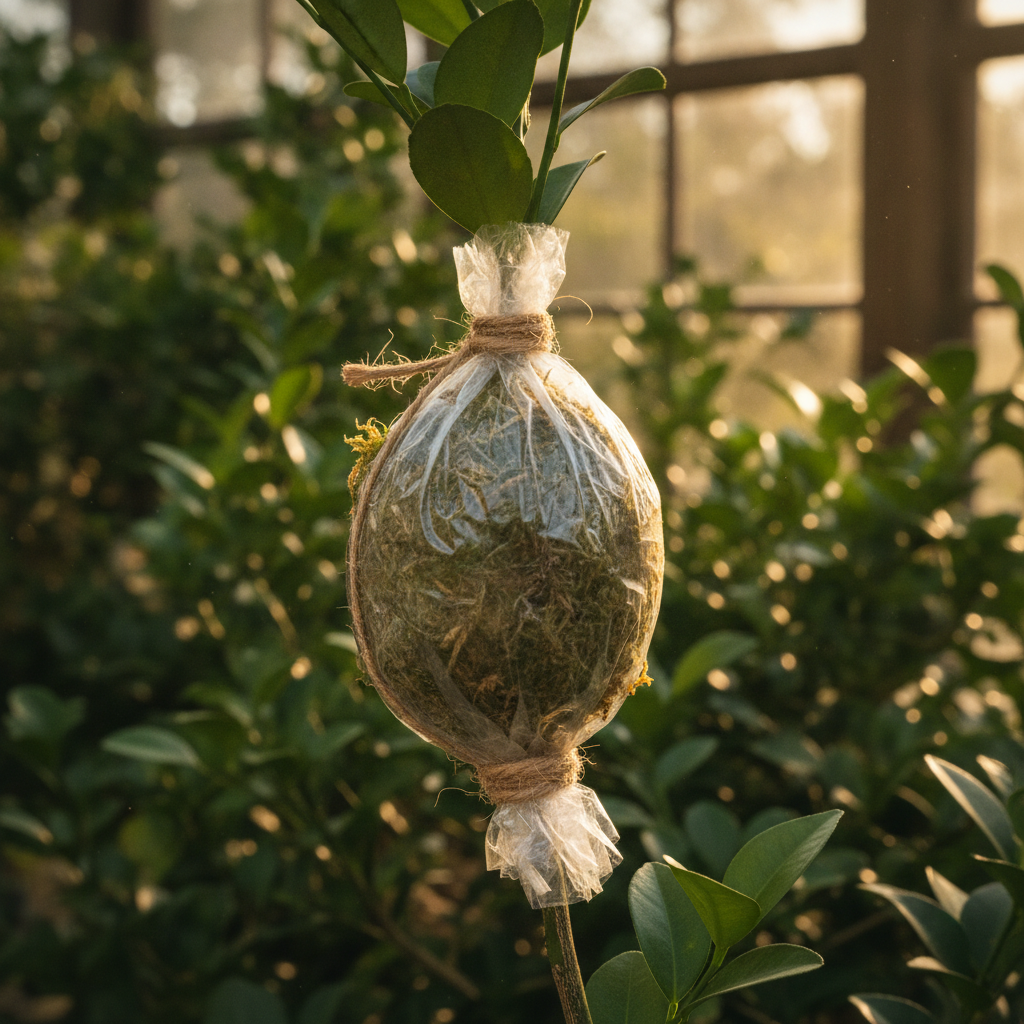
- Wrap the area in a generous handful of moist sphagnum moss.
- Enclose the moss in clear plastic film and secure both ends with twine, keeping the moss damp inside.
- Wait until a good network of roots is visible through the film, usually after several weeks to a couple of months.
- Cut the stem off just below the new roots and pot it up into a free-draining mix.
Troubleshooting Propagation
| Problem | Likely Cause | Solution |
|---|---|---|
| Cutting rots at the base | Medium too wet or wood too soft | Use firmer semi-hardwood and a more open, barely moist mix |
| Cutting dries and shrivels | Humidity too low | Cover to retain moisture and keep out of direct sun |
| No roots after many weeks | Too cold | Provide bottom heat and a warmer, brighter position |
| Air layer moss stays sodden and blackens | Over-wet moss, poor airflow | Wring the moss out first so it is damp, not dripping |
Pests & Diseases
A healthy, well-grown orange jasmine is reasonably resilient, but it is not immune to the usual indoor pests, and its dense canopy of glossy leaves can hide an infestation until it is well established. Regular, close inspection, especially of the leaf undersides and the new growth where pests gather, is the best defence.
Many pest problems on this plant are linked to stress. A specimen kept too dry, too dark or in stagnant air is far more likely to attract trouble than one grown in the bright, warm, buoyant conditions it prefers, so good culture is itself a form of pest control.

Common Pests
Sap-Sucking Scale (Coccidae and allies)
Scale insects appear as small brown or tan bumps clinging to stems and the undersides of leaves, where they suck sap and excrete sticky honeydew. Orange jasmine is a particular favourite of scale, and a heavy infestation weakens the plant and encourages sooty mould.
Treatment: Scrape off small numbers by hand or dab them with a cotton bud dipped in isopropyl alcohol. For larger infestations, treat with horticultural oil or insecticidal soap, repeating every week or two until clear, and isolate the plant while treating.
Mealybugs (Pseudococcidae)
Mealybugs look like small tufts of white cotton wool tucked into leaf axils and along stems. Like scale, they drain sap and leave honeydew behind, and they breed quickly in warm indoor conditions.
Treatment: Touch each insect with an alcohol-dipped cotton bud to kill it on contact, then follow up with insecticidal soap or neem oil. Check new growth and hidden crevices carefully, as survivors quickly rebuild the colony.
Spider Mites (Tetranychus urticae)
Spider mites thrive in hot, dry air and are most troublesome on a plant kept in a heated room over winter. They cause fine pale stippling on the leaves and, in bad cases, delicate webbing between stems and foliage.
Treatment: Rinse the foliage, including the undersides, with a firm spray of water, raise the humidity around the plant, and treat with insecticidal soap or a miticide. Repeated treatment is usually needed to break the fast breeding cycle.
Whitefly (Aleyrodidae)
Tiny white winged insects that rise in a cloud when the plant is disturbed, whitefly cluster on leaf undersides and, again, produce honeydew. Orange jasmine is a known host, and infestations can build rapidly in warm conditions.
Treatment: Hang yellow sticky traps to catch the adults, spray the undersides of leaves with insecticidal soap or neem oil, and repeat regularly until the population collapses.
Common Diseases
Root Rot (Phytophthora and Pythium)
The most damaging disease of indoor orange jasmine, root rot follows waterlogged soil and poor drainage. Affected plants yellow, wilt despite wet soil, and their roots turn brown and mushy.
Treatment: Unpot the plant, cut away all rotten roots with clean tools, and repot into fresh free-draining mix. Improve drainage and watering discipline to prevent a recurrence, and remove any badly affected growth.
Sooty Mould (Capnodium species)
Sooty mould is a black, soot-like film that grows on the honeydew left by sap-sucking pests. It does not attack the plant directly but coats the leaves, blocking light and dulling the foliage.
Treatment: Deal with the underlying pest first, then wipe the mould off with a soft, damp cloth. Once the honeydew source is gone the mould will not return.
Pest and Disease Summary
| Pest / Disease | Identification | Treatment |
|---|---|---|
| Scale | Brown bumps on stems and leaf undersides, sticky honeydew | Alcohol swab, horticultural oil, insecticidal soap |
| Mealybugs | White cottony tufts in leaf axils | Alcohol swab, neem oil, insecticidal soap |
| Spider mites | Fine stippling and webbing, worse in dry air | Rinse, raise humidity, insecticidal soap or miticide |
| Whitefly | Clouds of tiny white flies from leaf undersides | Sticky traps, neem oil, insecticidal soap |
| Root rot | Wilting in wet soil, brown mushy roots | Trim roots, repot in fresh mix, improve drainage |
| Sooty mould | Black film over honeydew-coated leaves | Control pests, wipe leaves clean |
Prevention Strategies
Prevention rests on good routine. Inspect the plant regularly, paying attention to leaf undersides and fresh growth, and quarantine any newly acquired plant for a couple of weeks before letting it join the collection. Keep the foliage clean and free of dust, maintain good airflow, and avoid the twin stresses of drought and stagnant, over-dry air that make an orange jasmine an easy target.
Because so many of this plant’s pests are sap-suckers that produce honeydew, catching them early also heads off the secondary problem of sooty mould. A weekly glance while watering is usually all it takes to spot trouble before it spreads through the dense canopy.
Pro Tip — Neem as Routine: A light monthly spray of diluted neem oil over the foliage, including the undersides, acts as a gentle preventative that discourages scale, mealybugs and whitefly before they establish. Apply in the evening or out of direct sun to avoid leaf scorch, and never on a wilting, thirsty plant.
Popular Varieties
Orange jasmine is grown less for a wide range of showy cultivars than for the species itself, but a handful of named forms are widely available and differ usefully in size and leaf character. The main division is between the vigorous standard form and compact dwarf selections bred for tighter growth.
Choosing between them comes down mostly to the scale you want. The standard forms make substantial shrubs and small indoor trees, while the dwarfs suit smaller pots, low hedging outdoors in mild climates, and bonsai, where their fine foliage is a distinct advantage.
| Variety | Leaf Appearance | Light Needs | Growth Rate | Availability |
|---|---|---|---|---|
| Species (Murraya paniculata) | Glossy mid-green pinnate leaves | Bright, some direct sun | Moderate to vigorous | Common |
| ‘Lakeview’ | Larger, deep green glossy leaflets | Bright, some direct sun | Vigorous | Common |
| ‘Min-a-Min’ | Small, fine, densely packed leaflets | Bright, some direct sun | Compact, slow | Common |
| ‘Sweet Privet’ (dwarf) | Neat small leaves, tidy habit | Bright, some direct sun | Compact | Regional |
| Variegated forms | Green leaves marbled with cream | Bright light for best variegation | Slower | Uncommon |
Featured Varieties
‘Lakeview’
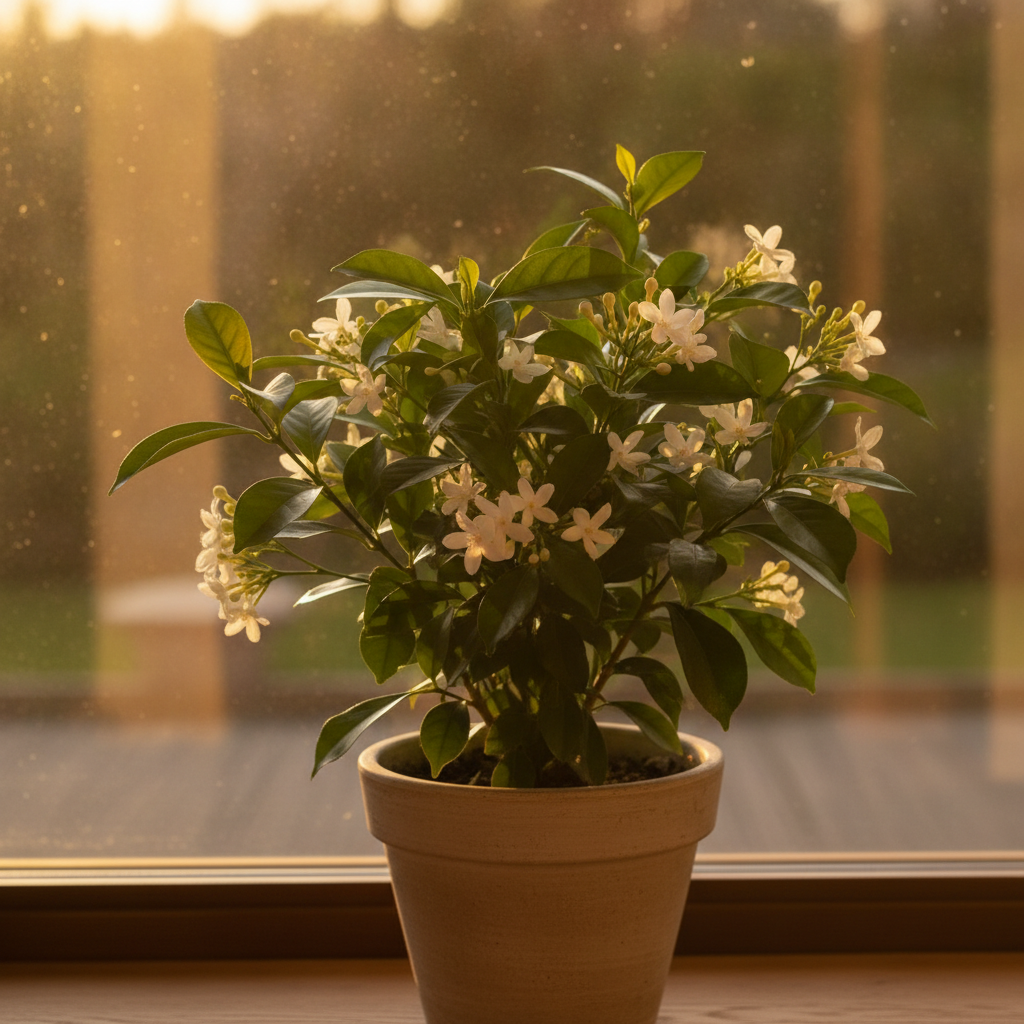
The classic vigorous form, with larger glossy leaves and generous flushes of fragrant white flowers. Ideal where you want a substantial, free-flowering shrub or a small indoor tree.
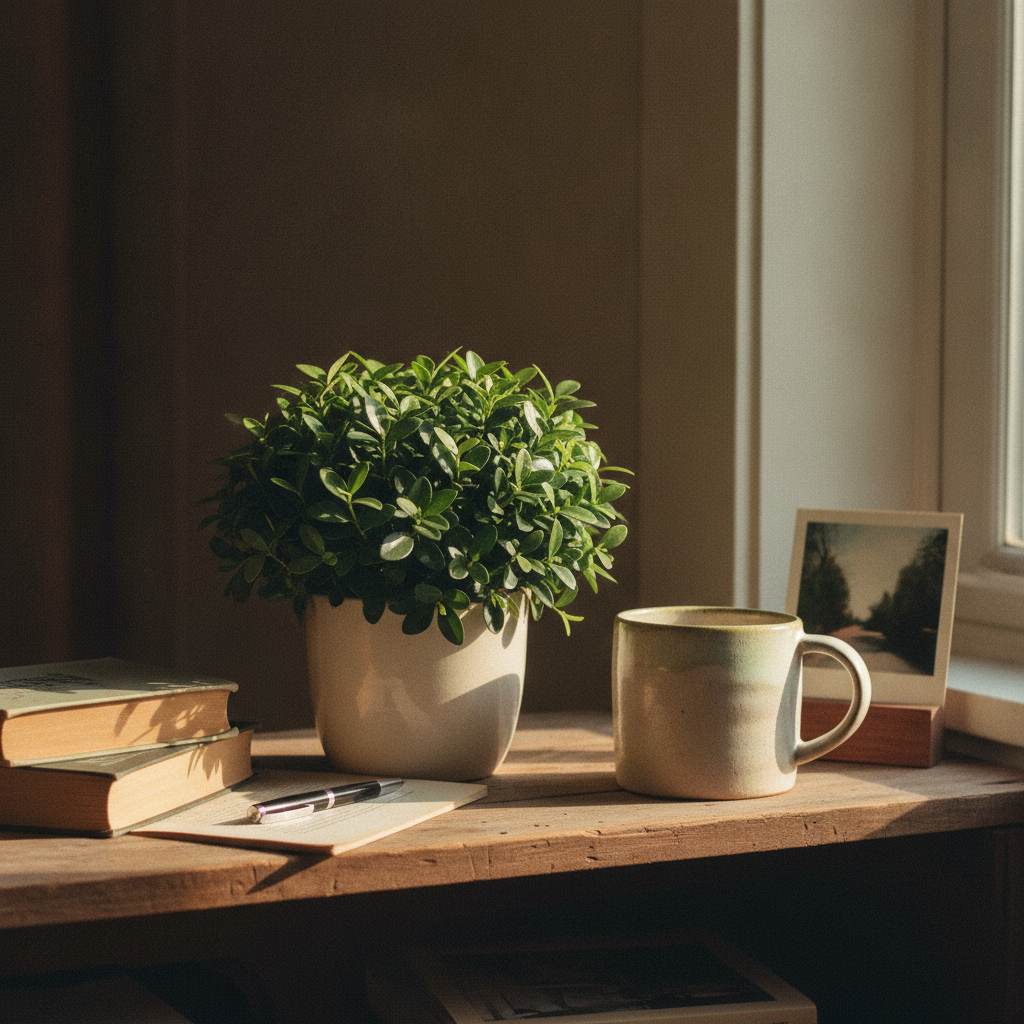
‘Min-a-Min’
A compact dwarf with fine, densely packed foliage and a naturally tidy, rounded habit. Its small leaves and slow growth make it a favourite for small pots, low hedging and bonsai.
Variety Profiles in Detail
‘Lakeview’ (Murraya paniculata ‘Lakeview’)
Often sold simply as the standard orange jasmine, ‘Lakeview’ is the form most people picture: an upright, vigorous shrub carrying larger, deep green leaflets and reliable waves of intensely scented bloom. Given room and light it will grow into a small tree, and it responds well to pruning into a clipped standard or hedge in frost-free climates.
‘Min-a-Min’ (Murraya paniculata ‘Min-a-Min’)
A dwarf selection prized for its compact, dense growth and much finer foliage. It stays naturally small and neat, needing far less pruning to keep in shape, which makes it the go-to choice for tight spaces, formal low hedging and indoor bonsai, where its small leaves look properly in scale with a miniature tree.
Choosing the Right Variety for Your Space
If you have the room and want the full impact of scent and flower, a standard form such as ‘Lakeview’ is the obvious pick. For a windowsill, a small pot, or a first attempt at bonsai, a dwarf like ‘Min-a-Min’ gives all the fragrance in a far more manageable, self-contained package. Whichever you choose, the care is essentially identical: bright light, even moisture, regular feeding and warmth are what turn any orange jasmine from a survivor into a plant that flowers and fills a room with scent.
Frequently Asked Questions
Why is my orange jasmine not flowering?
Almost always the cause is too little light. Orange jasmine needs several hours of direct sun to form flower buds, so a plant with healthy leaves but no blooms should be moved to your brightest window or given supplementary lighting. Inadequate feeding, particularly a shortage of potassium and trace elements, and a pot that is far too large can also suppress flowering.
Why are the leaves turning yellow?
Yellowing has several possible causes. Uniform yellowing of many leaves at once often points to overwatering, while yellowing between the veins of the newest leaves signals iron deficiency, common in this citrus relative and linked to alkaline soil or water. Yellowing of the oldest leaves alone can simply be natural ageing. Check watering and soil pH first, then feed with a citrus or iron-containing fertiliser if the new growth is affected.
Is orange jasmine safe for cats and dogs?
Orange jasmine is not listed among the plants known to be toxic to cats and dogs and is generally considered safe around pets. As with any plant, it is wise to discourage pets from chewing on it and to keep fallen berries out of reach, and to consult a veterinarian if an animal eats a large amount and becomes unwell.
Can I grow orange jasmine as a bonsai?
Yes, and it is one of the most popular subjects for indoor bonsai. Its small leaves, willingness to back-bud after pruning, pale attractive bark and fragrant flowers all suit the art well. The dwarf ‘Min-a-Min’ is especially well scaled for smaller bonsai. Grown this way it needs the same bright light and even moisture as a potted specimen, with more frequent watering because of the shallow training pot.
How big will an indoor orange jasmine get?
Outdoors in the tropics the plant can reach three to seven metres (10 to 23 ft), but in a pot indoors it is easily kept to one to two metres (3 to 6 ft) and can be maintained much smaller with pruning. Regular trimming after each flush of flowers keeps it dense and bushy and controls its size, and dwarf forms stay naturally compact.
When and how should I prune it?
Prune after a flush of flowering to shape the plant and encourage bushy new growth. Orange jasmine tolerates hard pruning well and readily produces new shoots from old wood, so you can cut back fairly firmly to control size or rejuvenate a leggy plant. Use clean, sharp secateurs and remove any dead or crossing stems at the same time.
Why is my orange jasmine dropping leaves?
Leaf drop usually reflects a stress or a sudden change. Common triggers are the soil drying out completely, a cold draught or a drop below the plant’s comfort range, a big change in light after moving the plant, and overwatering leading to root problems. Identify which condition has changed, correct it, and give the plant steady warmth, bright light and even moisture to recover.
What temperature does it need?
Orange jasmine is happiest in normal warm room temperatures of roughly 18 to 30 degrees C (64 to 86 degrees F). It is not frost hardy and should be protected from anything below about 5 degrees C (41 degrees F), as well as from cold draughts and the drying blast of heating vents. In mild climates it can spend summer outdoors but must be brought in before the first cold nights of autumn.






