
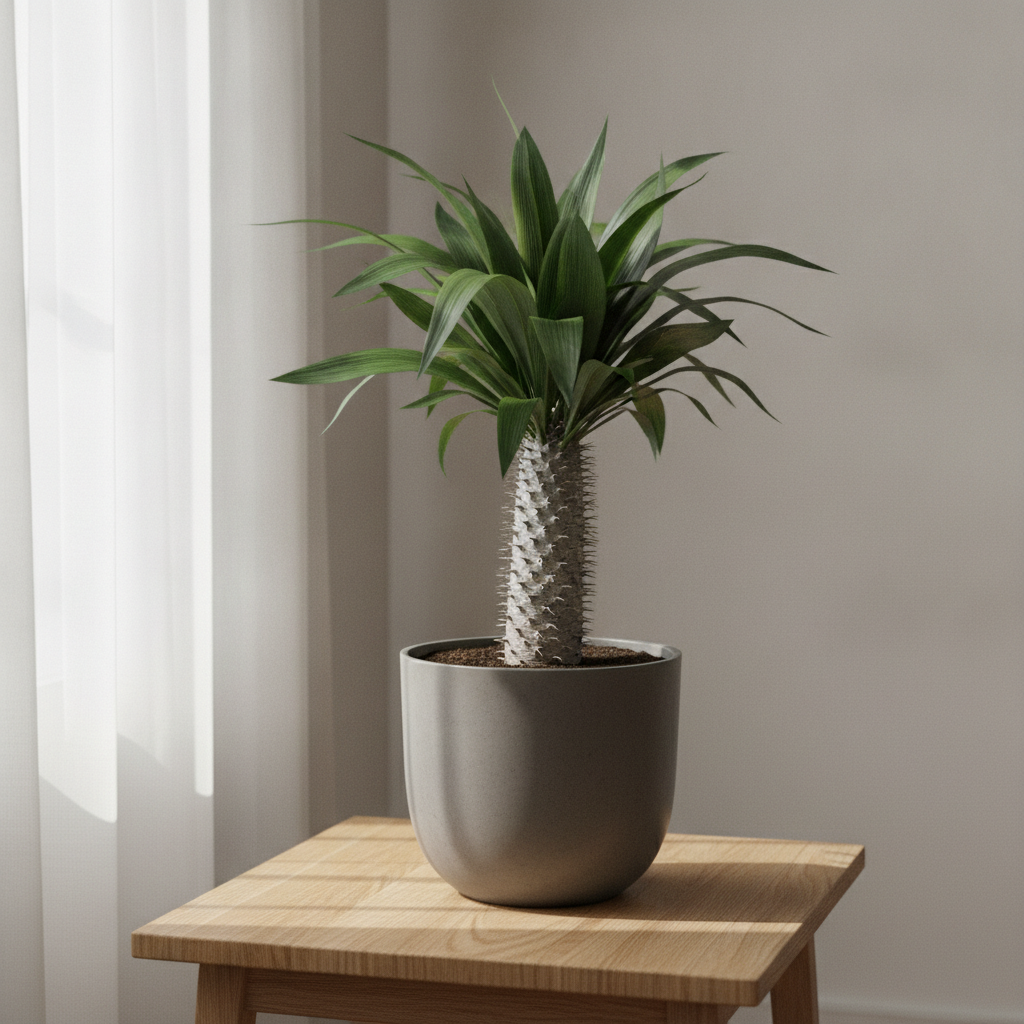
Few houseplants provoke a double-take quite like the Madagascar palm. With a thick, silver-grey trunk armoured in stiff spines and a topknot of long, glossy green leaves, it reads at a glance like a miniature palm crossed with a cactus. In truth it is neither. Pachypodium lamerei is a succulent shrub or small tree from the arid south and southwest of Madagascar, a member of the dogbane family (Apocynaceae) that counts oleander and the desert rose among its close relatives. The common name simply describes its silhouette, not its botany, and understanding that distinction is the single most useful thing a new owner can learn.
The Madagascar palm has a reputation as an easy, almost indestructible plant, and for the most part that reputation is deserved. It asks for very little: strong light, sparing water, and a pot that drains freely. Yet the gap between a Madagascar palm that merely survives and one that genuinely thrives, pushing out fresh flushes of leaves each spring and slowly fattening its water-storing trunk, comes down to a handful of details that this guide walks through in full. Get the light and the watering rhythm right and you will have a striking architectural specimen that can outlive most of the other plants in your home.
Contents
- Quick Reference
- Why the Madagascar Palm Makes a Rewarding Houseplant
- Light Requirements
- Watering & Humidity
- Soil, Potting & Repotting
- Fertilising
- Propagation
- Pests & Diseases
- Popular Varieties
- Frequently Asked Questions
Quick Reference: Madagascar Palm at a Glance
| Light | As much bright, direct sun as you can give it; a south-facing window is ideal |
| Watering | Only when the soil is completely dry; very sparing in winter, when it may go dormant |
| Temperature | 18 to 30 degrees Celsius (64 to 86 Fahrenheit); keep above 10 degrees Celsius (50 Fahrenheit) |
| Humidity | Low to average; thrives in dry indoor air |
| Fertiliser | Dilute cactus feed once a month in spring and summer only |
| Toxicity | Sharp spines are the main hazard; the milky sap is an irritant, so keep away from pets and children |
Why the Madagascar Palm Makes a Rewarding Houseplant
The appeal of the Madagascar palm begins with its sculptural form. The trunk, technically a water-storing caudex, is pale silver-grey and studded with clusters of stiff spines arranged in groups of two or three at each node. From the crown springs a rosette of narrow, strap-shaped leaves up to 30 centimetres (12 inches) long, deep glossy green with a paler midrib. In its native Madagascar the plant can reach four to six metres (13 to 20 feet) tall, and very old specimens occasionally branch into a candelabra. Indoors it is far more restrained, typically climbing to somewhere between one and two metres (3 to 6 feet) over many years, which makes it a manageable floor plant for a bright corner.
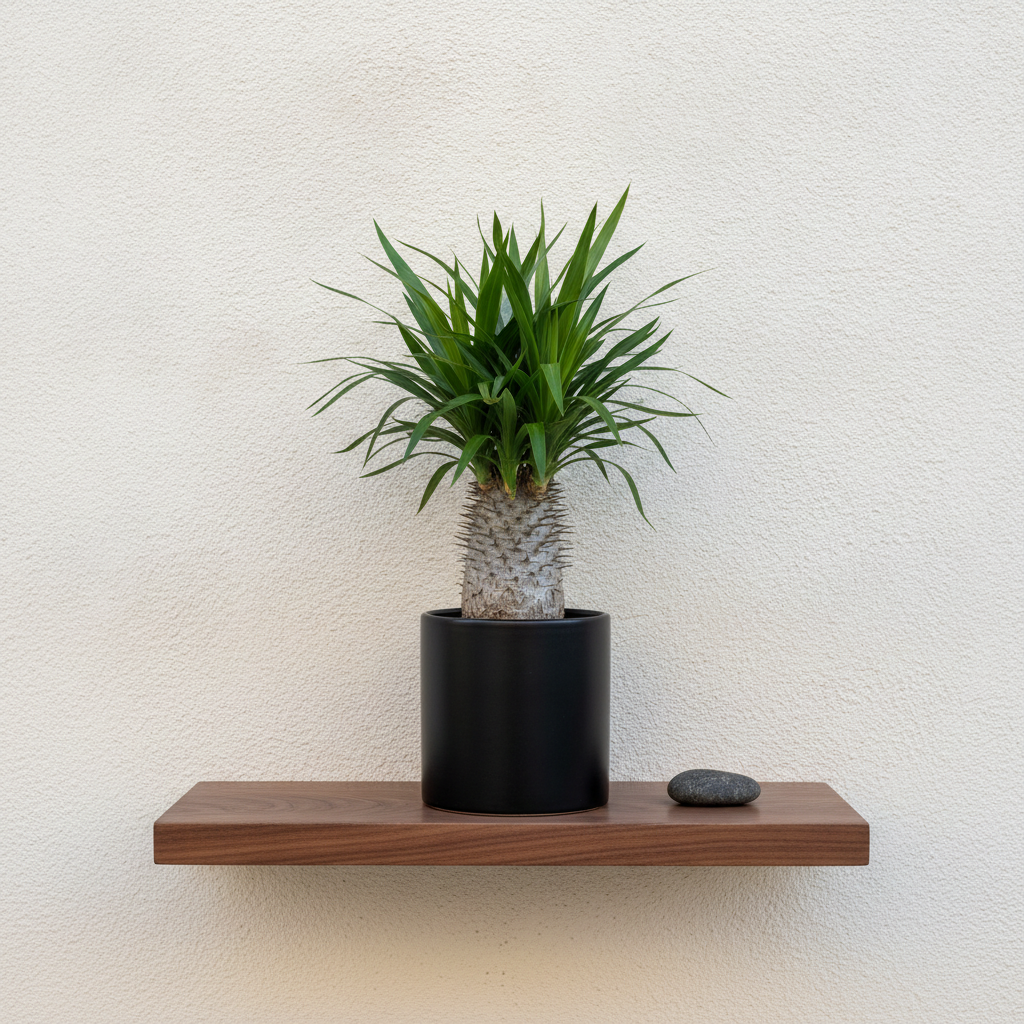
Beyond its looks, the Madagascar palm earns its place through sheer resilience. As a succulent adapted to a hot, seasonally dry climate, it stores water in its swollen trunk and tolerates the kind of neglect that would finish off a fern or a calathea. Forget to water it for a fortnight and it barely notices. It also adapts well to the low humidity of centrally heated rooms, a common stumbling block for tropical foliage plants. For anyone who wants dramatic structure without a demanding maintenance routine, few plants deliver more for less. The main thing it will not forgive is soggy soil, which is why almost everything in this guide circles back to drainage and restraint.
Important — Toxicity: The most immediate danger with a Madagascar palm is physical: its spines are sharp and can deliver a nasty jab, so site it away from walkways and handle it with thick gloves. The plant also exudes a milky latex when cut, which can irritate skin and mucous membranes. As a relative of oleander in the dogbane family, it is safest to treat the sap as potentially toxic if swallowed and to keep the plant out of reach of curious pets and young children.
Light Requirements
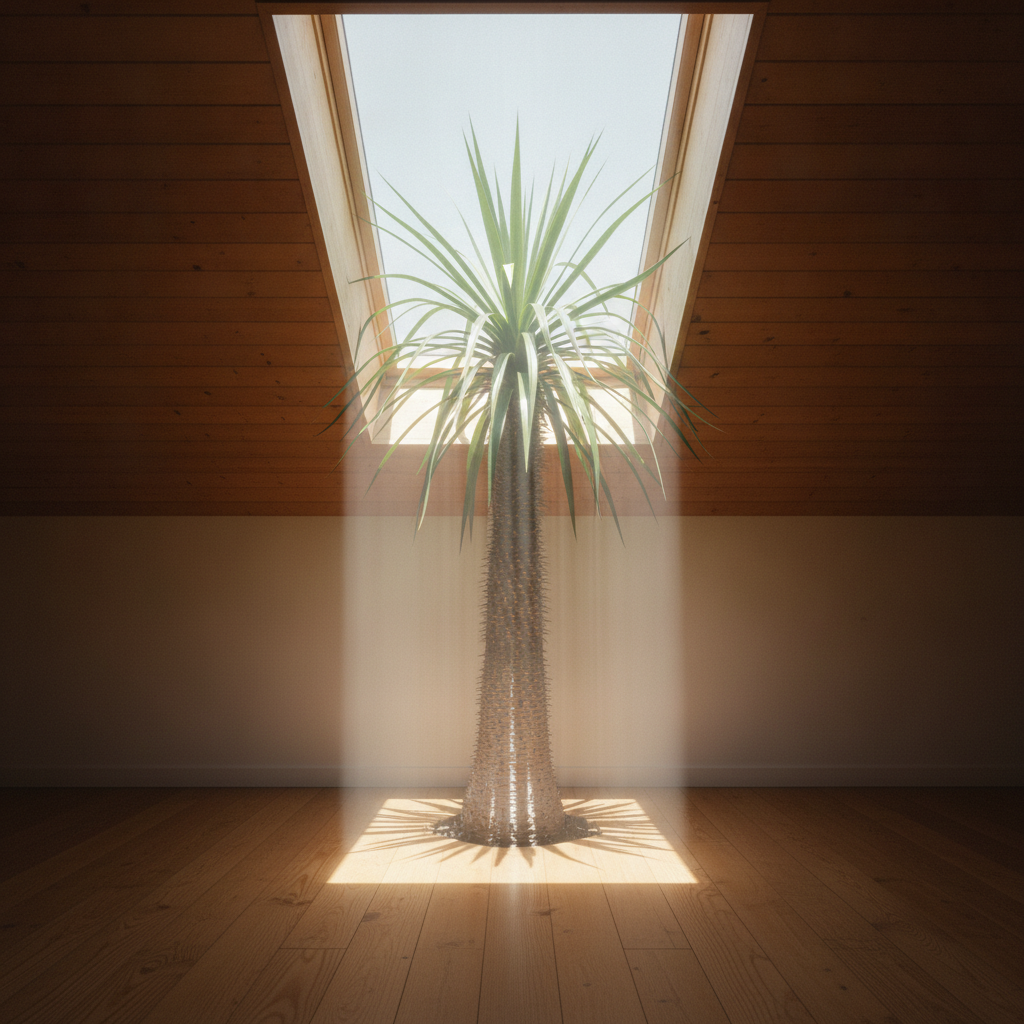
If there is one non-negotiable in Madagascar palm care, it is light. This is a full-sun desert plant, and indoors it wants every bit of brightness you can offer. In its habitat it grows exposed on rocky slopes under fierce tropical sun, so the dim corners that suit a pothos or a peace lily will slowly starve it. Insufficient light is the second most common reason these plants decline, behind overwatering, and the two often go hand in hand because a plant in low light uses water slowly and is far more prone to rot.
The ideal position is directly in front of an unobstructed south-facing window where the plant receives several hours of direct sun each day. A conservatory, a sunroom or a bright balcony in the warmer months is even better. Given enough light, growth is compact and sturdy, the leaves stay a rich green, and the trunk thickens steadily. Deprived of it, the plant stretches, the leaf crown thins, and the whole specimen takes on a weak, drawn-out look that no amount of feeding will correct.
Light Levels Explained
Houseplant light is often described in vague terms, so the table below translates the usual categories into approximate brightness and typical positions, along with what you can expect from a Madagascar palm in each.
| Light Category | Approx. Level | Typical Location | Outcome |
|---|---|---|---|
| Direct sun | 20,000 to 100,000 lux | On a south-facing sill | Ideal; strong, compact growth |
| Bright indirect | 10,000 to 20,000 lux | Just back from a bright window | Acceptable; slower but healthy |
| Medium | 5,000 to 10,000 lux | A few metres from a window | Poor; leggy, sparse crown |
| Low | 1,000 to 5,000 lux | Interior wall, north room | Decline; leaf drop, rot risk |
| Very low | Below 1,000 lux | Hallway, windowless space | Unsuitable; will not survive long |
Window Orientation and Placement
South-facing window: The best choice by a wide margin. Place the plant as close to the glass as possible for maximum exposure. This is where a Madagascar palm looks its best.
East-facing window: Workable, offering gentler morning sun. Growth will be a little slower and you may need to rotate the plant to keep it symmetrical.
West-facing window: Also good, with strong afternoon light. Watch for heat build-up against the glass on very hot days, though this plant handles heat well.
North-facing window: The weakest option and generally not enough on its own. A Madagascar palm here will gradually etiolate, and you should either move it or add a grow light.
Pro Tip — Rotate for Symmetry: The leaf crown leans towards the light source over time. Give the pot a quarter turn every week or two so the plant grows straight and keeps its balanced, upright form rather than tilting permanently towards the window.
How Light Affects Trunk and Leaf Growth
Light does more than keep the leaves green; it governs the plant’s entire architecture. In strong sun the internodes stay short, so leaves cluster tightly at the crown and the trunk broadens in proportion to its height, giving that stout, well-anchored look. In weak light the plant invests its energy in reaching upward, producing a thin, elongated stem with widely spaced leaf scars and a sparse tuft of foliage on top. This stretching is not reversible, so the trunk that forms in poor light stays permanently spindly even if you later move the plant to a brighter spot.
Warning — Sudden Sun Exposure: Although the Madagascar palm loves direct sun, a plant that has been indoors or in shade can scorch if moved abruptly into intense light. Acclimatise it over a week or two, increasing exposure gradually, especially when moving it outdoors for summer, to avoid pale bleached patches on the leaves.
Artificial Lighting
Where natural light falls short, a full-spectrum LED grow light is an effective supplement. Because this is such a high-light plant, choose a reasonably powerful fixture and position it 20 to 30 centimetres (8 to 12 inches) above the crown, running it for 12 to 14 hours a day. Grow lights are particularly useful through the darker winter months in northern latitudes, though many growers simply accept a winter rest instead. A cheap, low-output desk lamp will not make a meaningful difference to a plant with these requirements.
Seasonal Adjustments
Light intensity indoors drops sharply between summer and winter, and the sun sits lower in the sky. Move the plant to your brightest available window as the days shorten, and do not be alarmed if it slows down or sheds some or all of its leaves as winter approaches. This dormancy is a natural response to shorter days and cooler temperatures, not a sign of ill health. Fresh growth resumes from the crown when light and warmth return in spring.
Watering & Humidity
Watering is where most Madagascar palms are won or lost. The swollen trunk is a reservoir, and the plant is built to endure long dry spells and then drink deeply when rain finally arrives. Your job is to imitate that rhythm: a thorough soak, followed by a genuine dry-out, then repeat. The single most damaging mistake is keeping the soil constantly moist, which suffocates the roots and invites the rot that quickly kills these plants from the base upward.
When to Water
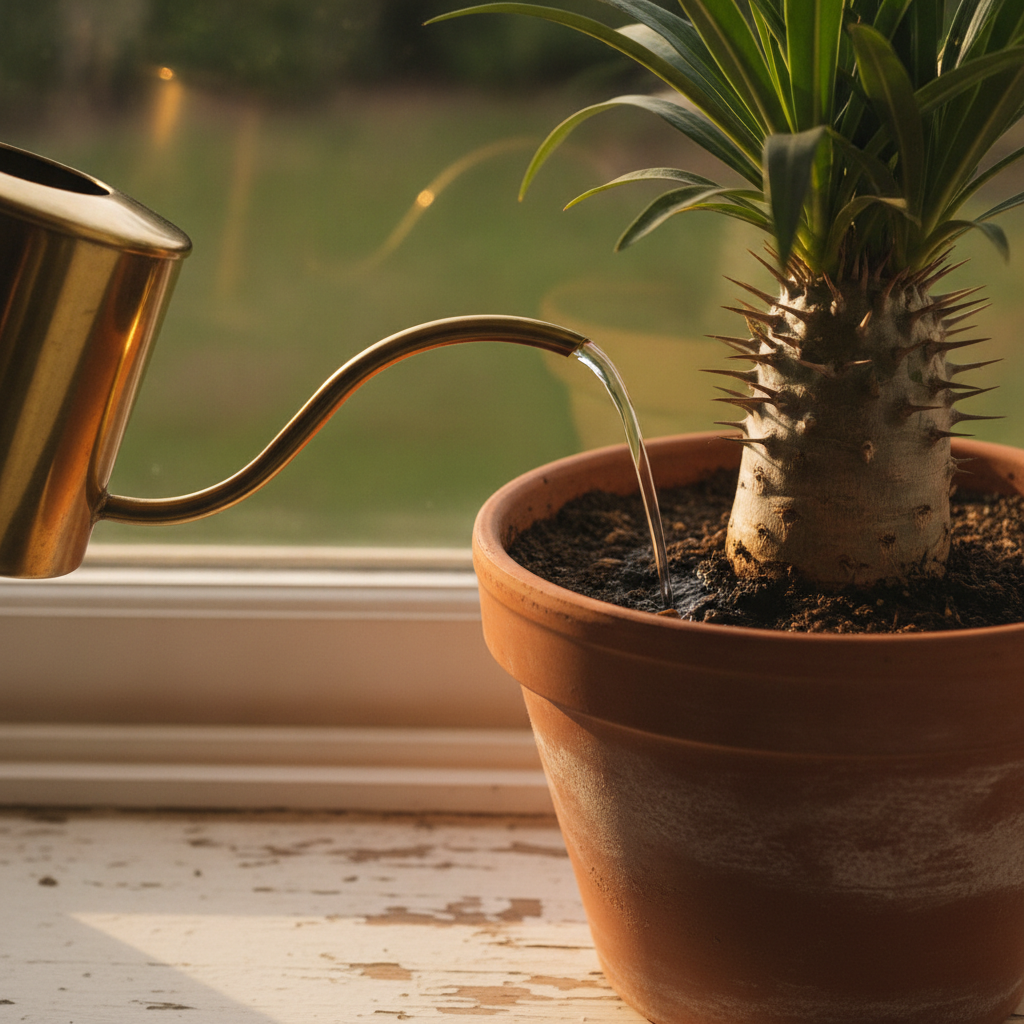
During the active growing season, from spring through early autumn, water only when the potting mix has dried out completely. Push a finger several centimetres into the soil, or lift the pot to feel its weight; a dry pot is noticeably light. For most indoor plants this works out to roughly once every one to two weeks in summer, but treat that as a rough guide rather than a schedule, because pot size, light and temperature all change the pace at which the mix dries.
In winter the picture changes entirely. If the plant has entered dormancy and dropped its leaves, it needs almost no water at all, perhaps a small drink once every four to six weeks simply to stop the trunk shrivelling. A cool, dry winter rest is exactly what this plant would experience in habitat, and withholding water at this time is not neglect but correct care. Resume normal watering only when new leaves appear in spring.
Pro Tip — When in Doubt, Wait: A Madagascar palm recovers easily from being too dry but rarely from being too wet. If you are unsure whether it needs water, wait a few more days. Underwatering shows as a slightly soft or wrinkled trunk that firms up again after a drink, while overwatering shows as a soft, discoloured base that cannot be undone.
How to Water Correctly
- Check that the soil is fully dry from the last watering before you begin.
- Water slowly at the soil surface, avoiding the trunk and crown, until liquid runs freely from the drainage holes.
- Let the pot drain completely for several minutes so no water pools at the base.
- Empty the saucer or cachepot; never let the plant stand in collected water.
- Return the plant to its bright spot and do not water again until the mix has dried right through.
Signs of Overwatering vs. Underwatering
| Symptom | Overwatering | Underwatering |
|---|---|---|
| Leaf colour | Yellowing, often sudden and widespread | Slow yellowing of the oldest lower leaves only |
| Leaf texture | Soft, limp, translucent | Thin, curled or crisp at the edges |
| Soil | Stays wet for many days, may smell sour | Bone dry, pulling away from the pot sides |
| Trunk base | Soft, mushy, sometimes darkened | Firm but slightly wrinkled or shrunken |
| Overall | Collapse from the base, hard to reverse | Droop that recovers quickly after watering |
Warning — Root and Stem Rot: A soft, brown or blackened patch at the base of the trunk is the classic sign of rot from overwatering, and it can travel upward with alarming speed. If you catch it early, cut away all affected tissue with a clean blade back to firm green flesh, dust the wound with sulphur or cinnamon, and keep the plant dry and warm while it heals. Once rot reaches the core, the plant usually cannot be saved.
Humidity Requirements
Here the Madagascar palm is refreshingly undemanding. Coming from a dry climate, it is perfectly content in the low humidity of a heated or air-conditioned home and needs no misting, pebble trays or humidifiers. Average household humidity of 30 to 50 percent suits it well, and it will happily tolerate drier air still.
Because it copes so easily with dry air, humidity-related problems are rare. If leaf tips brown, the cause is far more likely to be a watering issue, mineral build-up or fertiliser salts than a lack of moisture in the air. There is no need to chase up the humidity for this plant, and doing so around a sun-loving succulent can even encourage fungal problems if air movement is poor.
Should you ever grow one in an unusually dry setting alongside more tropical plants, simple grouping is enough to lift the local humidity without any special equipment. Good airflow remains more valuable to this plant than high humidity, as moving air helps the soil surface dry and keeps rot and pests at bay.
Water Quality
The Madagascar palm is not fussy about water quality and generally accepts ordinary tap water. In hard-water areas, mineral deposits can gradually accumulate in the soil over years, so an occasional heavy flush that runs plenty of water through the pot helps rinse them away. If you happen to collect rainwater it is a fine choice, but there is no need to go out of your way; this is not a plant that sulks over chlorine or fluoride the way some sensitive tropicals do.
Soil, Potting & Repotting
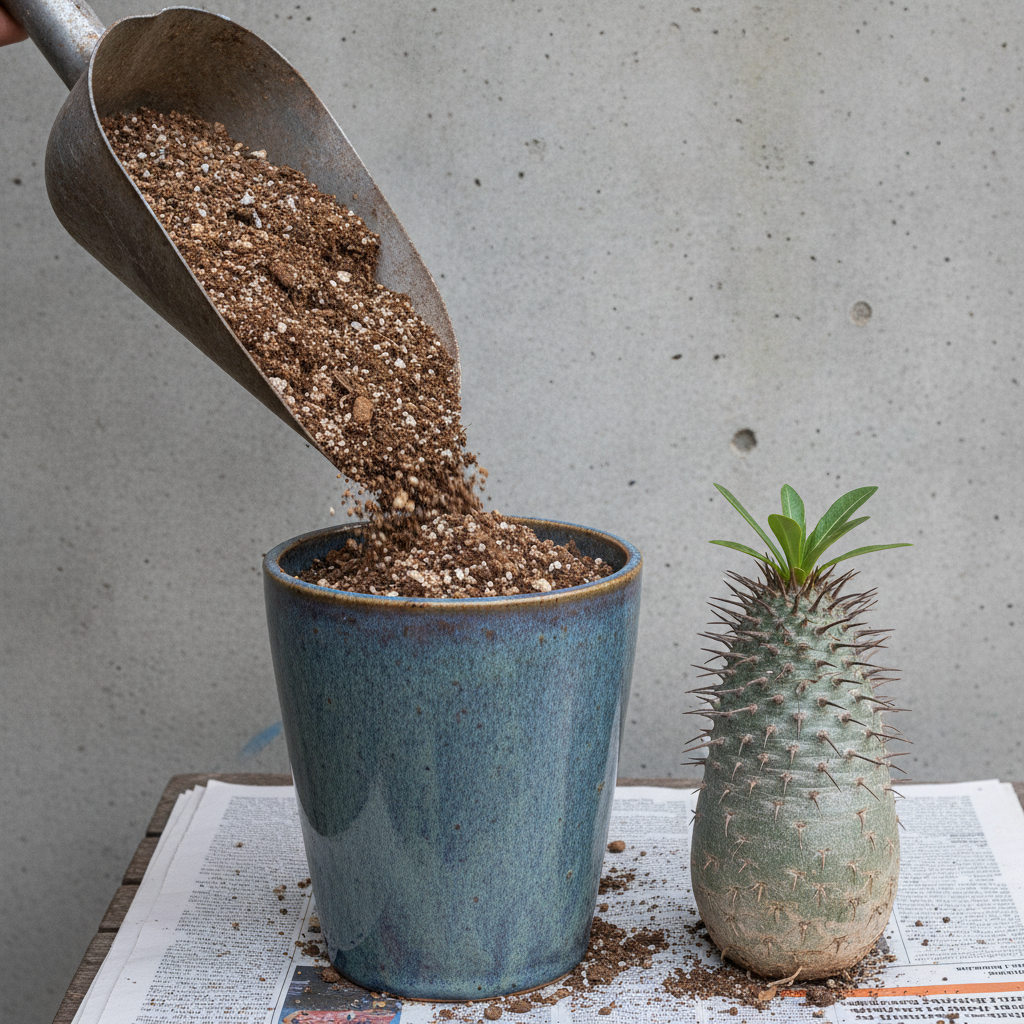
Everything about watering a Madagascar palm depends on the soil beneath it. Because the plant demands fast drainage and hates sitting wet, the growing medium has to shed water quickly and admit plenty of air to the roots. An open, gritty mix is the foundation of a healthy plant, and no amount of careful watering can rescue a Madagascar palm rooted in dense, moisture-retentive compost.
Ideal Soil Composition
Start with a quality cactus and succulent compost and open it up further with coarse mineral grit. The aim is a mix that feels chunky and loose in the hand, with visible particles rather than a uniform fine texture. Roughly half mineral matter to half organic material is a good target, erring towards more grit in cooler or less bright conditions where the soil dries more slowly.
| Component | Proportion | Function |
|---|---|---|
| Cactus and succulent compost | 50 percent | Base structure and modest nutrients |
| Pumice or coarse perlite | 30 percent | Drainage and aeration |
| Coarse horticultural grit or sand | 20 percent | Weight, sharp drainage, mimics native soil |
The plant is happy in a slightly acidic to neutral soil, somewhere around pH 6.0 to 7.0, which most commercial cactus mixes fall within naturally. Precise pH management is not something owners need to worry about; getting the physical structure right matters far more than fine-tuning acidity.
Pro Tip — Quick Mix Recipe: If you cannot find pumice, a reliable blend is two parts cactus compost, one part perlite and one part coarse grit or aquarium gravel. Mix it dry, and if you can squeeze a damp handful into a ball that immediately crumbles apart, the drainage is about right.
Choosing the Right Pot
The container matters almost as much as the mix, because it controls how quickly the soil dries and how stable a top-heavy plant remains.
Drainage holes are non-negotiable. Never plant a Madagascar palm in a pot without them. A decorative cachepot is fine as an outer cover, but the plant itself must sit in a container that lets excess water escape freely, and that outer pot must be emptied after every watering.
Pot material: Terracotta is the classic choice for this plant because its porous walls wick moisture from the soil and speed drying, exactly what a rot-prone succulent wants. Glazed ceramic and plastic hold moisture longer, so if you use them, lean even harder on a gritty mix and water more cautiously.
Pot size: Choose a pot only slightly larger than the root ball. An oversized container holds a reservoir of damp soil the roots cannot reach, which stays wet and invites rot. A heavy pot also helps counterbalance the plant, since a tall Madagascar palm can become distinctly top-heavy.
When to Repot
Madagascar palms are slow growers and dislike disturbance, so they need repotting only every two to three years, or when roots begin to emerge from the drainage holes and the plant becomes unstable in its pot. The best time is early spring, at the start of the growing season, when the plant can recover quickly. Because of the spines, repotting a large specimen is a two-person job and calls for thick gloves, a folded towel or several layers of newspaper wrapped around the trunk to protect your hands.
How to Repot: Step-by-Step
- Let the soil dry out for a few days first, as a dry root ball slides out more cleanly and is less prone to breakage.
- Protect your hands with thick gloves and wrap the spiny trunk in folded towel or newspaper to give yourself a safe hold.
- Ease the plant out of its pot, supporting the base, and gently tease away the old soil from the roots.
- Inspect the roots, trimming any that are black, soft or rotten with a clean blade, and let cut surfaces dry briefly.
- Set the plant in a pot one size up over a layer of fresh gritty mix, keeping it at the same depth as before.
- Fill around the roots with mix, firming lightly to remove air pockets without compacting the soil.
- Wait a week before watering so any damaged roots can callus, then resume normal care.
Warning — Transplant Shock: Do not water immediately after repotting. Freshly disturbed roots and any small tears need time to seal, and watering straight away pushes moisture into those wounds and greatly raises the risk of rot. A week of dry rest after repotting is one of the simplest ways to keep this plant healthy.
Fertilising
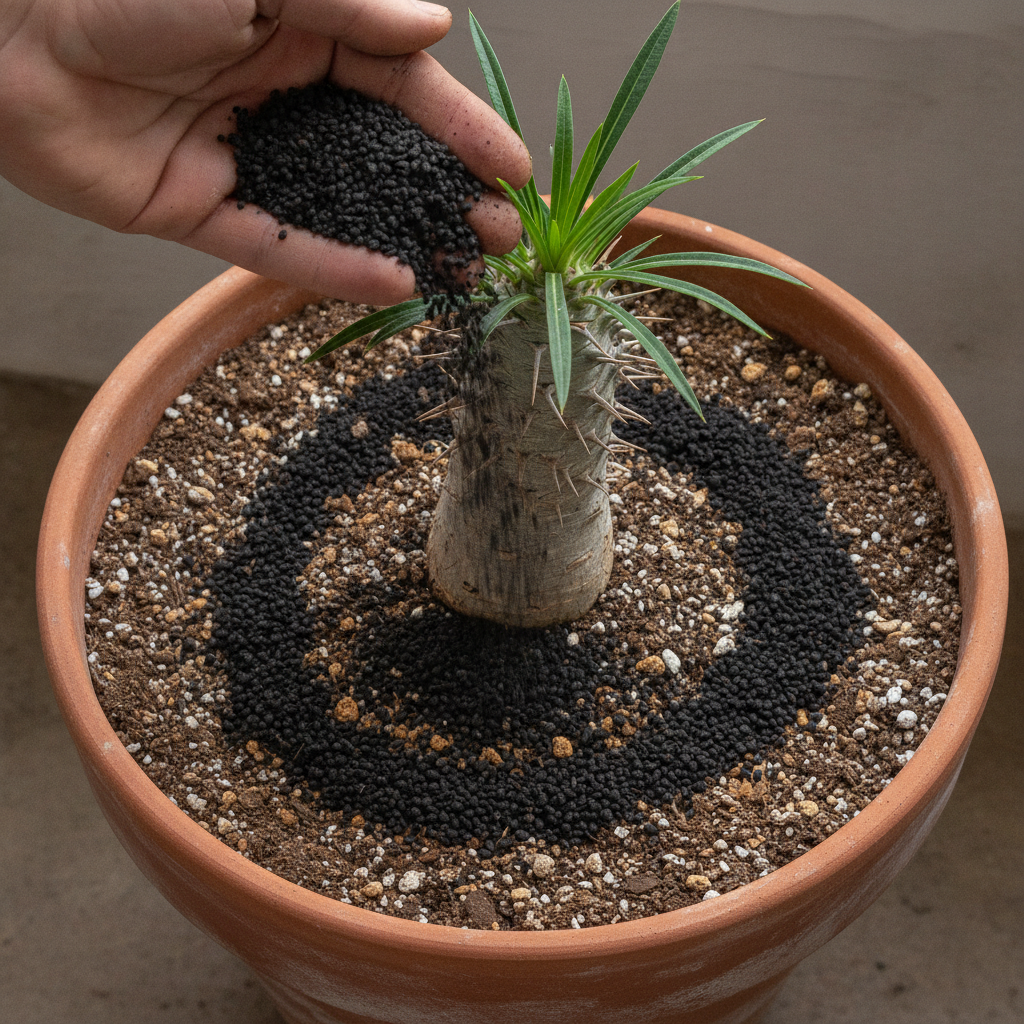
Adapted to poor, stony ground, the Madagascar palm is a light feeder that needs far less fertiliser than most leafy houseplants. A modest, well-timed feeding routine supports steady growth and helps the plant build reserves, but overfeeding does real harm, scorching roots and leaving salt deposits in the soil. When it comes to this plant, restraint pays.
Feeding should track the plant’s natural rhythm, concentrated entirely in the active season and stopped altogether during the winter rest. A dormant, leafless plant cannot use nutrients, and fertilising one only risks a build-up of unused salts around the roots.
Understanding Plant Nutrients
Fertiliser labels carry three numbers, the ratio of nitrogen, phosphorus and potassium, the three nutrients plants use in the greatest quantity. For a succulent like the Madagascar palm, a formula that is not too heavy in nitrogen is ideal, since excess nitrogen drives soft, weak growth prone to rot. The table below outlines the key nutrients and how a deficiency of each tends to show.
| Nutrient | Symbol | Primary Function | Deficiency Symptoms |
|---|---|---|---|
| Nitrogen | N | Leaf and stem growth | Pale, yellowing older leaves; stalled growth |
| Phosphorus | P | Root development and energy | Weak roots, dull leaves, poor vigour |
| Potassium | K | Overall hardiness and water regulation | Browning leaf edges, weak stems |
| Calcium | Ca | Cell wall strength | Distorted or stunted new growth |
| Magnesium | Mg | Core of the chlorophyll molecule | Yellowing between the veins of leaves |
| Iron | Fe | Chlorophyll production | Yellow new leaves with green veins |
Types of Fertiliser
Liquid fertilisers: The easiest option to control, mixed into water and applied during the growing season. A cactus or succulent feed, or a balanced houseplant feed at half the recommended strength, works well and lets you stop the moment the plant slows down.
Slow-release granular: A few granules worked into the topsoil in spring release nutrients gradually over months. Convenient, though you have less control over timing, so use a light hand with a plant that wants so little.
Organic fertilisers: A thin top-dressing of worm castings or a diluted organic feed gently enriches the soil without the sharp spike of synthetic salts. It is a forgiving choice for anyone nervous about overfeeding.
Feeding Schedule
Feed once a month from spring through to the end of summer, using a dilute cactus fertiliser. That is genuinely all this plant needs. As growth slows in autumn, taper off, and give nothing at all through winter. Four or five light feeds across the warm months keep a Madagascar palm in good condition without any risk of overdoing it.
Pro Tip — Half Strength, Never Dry: Always dilute to half the label strength for succulents, and never apply fertiliser to bone-dry soil. Water lightly first, or feed as part of a normal watering, so the nutrients disperse evenly and do not burn roots sitting in dry, concentrated solution.
How to Fertilise
- Confirm the plant is in active growth, with leaves present and the season warm.
- Dilute a cactus or balanced feed to half the recommended strength in your watering can.
- Moisten the soil first if it is completely dry, then apply the feed evenly to the surface.
- Avoid splashing fertiliser onto the trunk or into the leaf crown.
- Flush the pot with plain water every couple of months to rinse away any salt build-up.
Warning — Salt Build-Up: A white crust on the soil surface or around the pot rim signals accumulated fertiliser salts, which can burn roots and brown leaf tips. Correct it by flushing the pot thoroughly with plain water until it runs clear from the drainage holes, and cut back on feeding.
Propagation
Propagating a Madagascar palm calls for patience, as it is neither as quick nor as reliable as taking cuttings from a trailing vine. The two practical routes for the home grower are separating basal offsets, when the plant produces them, and growing from seed. Leaf propagation, common with many succulents, does not work here; a detached leaf will simply wither.
Whichever method you choose, the key is to let any cut or wounded surface dry and callus before it touches soil, and then to keep everything on the dry side. As with the parent plant, excess moisture during propagation is the surest way to lose your new plants to rot.
Understanding Offsets and Seed
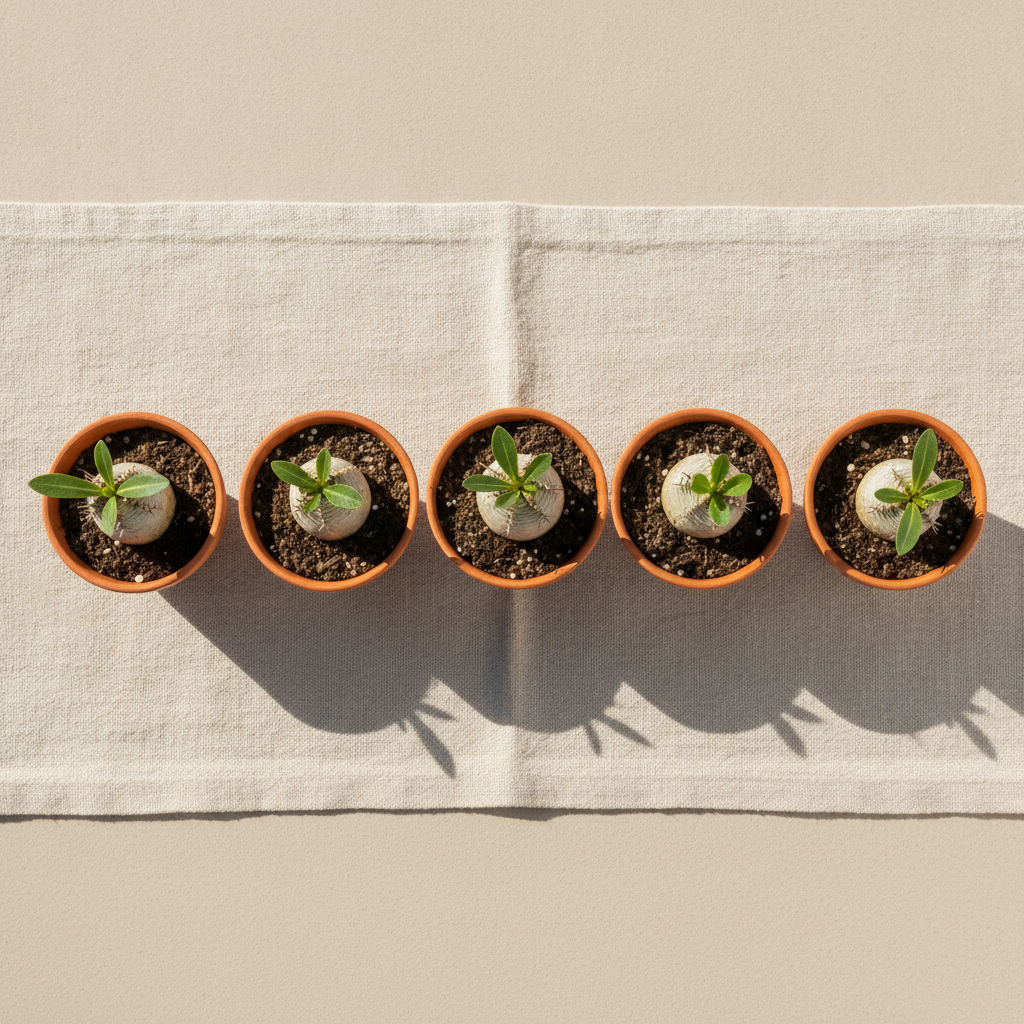
Mature Madagascar palms sometimes produce offsets, small pups that emerge from the base of the trunk. These are clones of the parent and, because they often form their own roots while still attached, they give the highest success rate for home propagation. Seed, by contrast, is how the plant reproduces in the wild and remains the main commercial method, but it demands fresh seed, warmth and a good deal of time before you have anything resembling a recognisable plant.
Separating Offsets: Step-by-Step
If your plant has produced pups at its base, separating them is the most dependable way to propagate. Do it in spring, choosing offsets that are a reasonable size and ideally already showing a few roots of their own.
- Water the parent lightly a day ahead so it is neither bone dry nor saturated.
- Wearing gloves, ease the plant from its pot to expose the base and the offsets.
- Cut a chosen pup cleanly away from the trunk with a sterilised blade, keeping any roots intact.
- Set the offset aside in a warm, dry, shaded spot for several days so the cut surface calluses over.
- Pot the callused pup into a small container of gritty cactus mix, barely burying the base.
- Wait about a week, then water sparingly and keep the young plant warm and brightly lit while it establishes.
Pro Tip — Let It Callus: Never pot an offset or cutting straight after cutting. Allowing the wound to dry and form a firm callus over several days, longer for a thick cut, is the difference between a pup that roots and one that rots. Rushing this step is the most common cause of failure.
Growing From Seed: Step-by-Step
Seed is a slower but rewarding route, and the only practical way to raise many plants at once. Freshness matters enormously, as Madagascar palm seed loses viability quickly, so sow as soon after obtaining it as you can.
- Soak fresh seed in warm water for 24 hours to soften the coat and encourage germination.
- Sow onto the surface of a moist, gritty, well-draining seed mix, barely covering the seed.
- Keep the tray warm, ideally around 24 to 30 degrees Celsius (75 to 86 Fahrenheit), and bright but out of harsh direct sun.
- Maintain light moisture until germination, which can take anywhere from a week to a couple of months.
- Once seedlings show their first true leaves, ease off watering and grow them on in strong light.
- Pot up individually once they are sturdy enough to handle, treating them as small adults thereafter.
Troubleshooting Propagation
| Problem | Likely Cause | Solution |
|---|---|---|
| Offset rots after potting | Potted before callusing, or kept too wet | Allow a longer dry callus period; water very sparingly |
| Seed fails to germinate | Old, non-viable seed or too cold | Use fresh seed and provide steady bottom heat |
| Seedlings damp off and collapse | Excess moisture and poor airflow | Improve ventilation, reduce watering, use a sterile mix |
| Offset sits without rooting | Too cool, too dark or the season is wrong | Provide more warmth and light; propagate in spring |
Pests & Diseases
A healthy Madagascar palm in good light is a tough plant that shrugs off most problems, and pests are relatively uncommon compared with softer, leafier houseplants. When trouble does appear, it is usually either a sap-sucking insect taking advantage of a stressed plant or, far more often, rot brought on by overwatering. Regular inspection, especially of the leaf crown and undersides, catches issues while they are still easy to manage.
By far the most serious threat to this plant is not an insect at all but water-related disease. Keeping the plant in strong light with a gritty mix and a disciplined watering routine prevents the overwhelming majority of problems before they start.
Common Pests
Mealybugs (Pseudococcus species)
Mealybugs are the most likely pest, appearing as small, white, cottony tufts nestled in the leaf crown, along the leaf bases and around the spines. They suck sap, weaken the plant and leave a sticky residue that can lead to sooty mould.
Treatment: Dab each insect directly with a cotton bud soaked in rubbing alcohol, then follow up with a spray of insecticidal soap or diluted neem oil. Repeat every week until no new bugs appear, checking the tight crevices where they hide.
Scale Insects (Coccidae family)
Scale shows up as small, hard, brown bumps clinging to the trunk and leaf undersides. Immobile once settled, they are easy to overlook until their numbers grow and the plant begins to look tired.
Treatment: Scrape off what you can with a fingernail or blunt blade, then treat with neem oil or insecticidal soap. Persistent infestations may need several rounds, and horticultural oil helps smother any survivors.
Spider Mites (Tetranychus urticae)
Spider mites thrive in hot, dry conditions and can find the warm spot this plant enjoys. Look for fine stippling on the leaves and delicate webbing between the crown and spines, most visible when the plant is under stress.
Treatment: Rinse the foliage to knock back the population, then apply neem oil or a specific miticide. Improving airflow and keeping the plant vigorous makes a recurrence far less likely.
Common Diseases
Root and Stem Rot (Pythium and Phytophthora)
This is the defining disease of the Madagascar palm and the cause of most losses. Overwatering and poor drainage let soil-borne pathogens attack the roots and trunk base, which turn soft, brown and mushy, often with a foul smell as the tissue collapses.
Treatment: Act fast. Unpot the plant, cut away every trace of affected tissue back to firm, healthy flesh with a sterile blade, dust the wounds with sulphur or cinnamon, and repot into fresh dry gritty mix. Withhold water for a week or more and keep the plant warm and bright while it recovers.
Fungal Leaf Spot (various fungi)
Less common, leaf spot appears as brown or black blotches on the foliage, usually where water sits on the leaves in still, humid air with poor light. It is more a cosmetic nuisance than a serious threat but signals that conditions are too damp.
Treatment: Remove affected leaves, improve air circulation, avoid wetting the foliage, and move the plant into brighter, drier conditions. A fungicide is rarely needed once the environment is corrected.
Pest and Disease Summary
| Pest / Disease | Identification | Treatment |
|---|---|---|
| Mealybugs | White cottony tufts in the crown and leaf bases | Alcohol swab, then insecticidal soap or neem |
| Scale | Hard brown bumps on trunk and leaf undersides | Scrape off, treat with neem or horticultural oil |
| Spider mites | Fine stippling and webbing, worse when dry | Rinse foliage, apply neem or a miticide |
| Root and stem rot | Soft, brown, foul-smelling trunk base | Cut out rot, dry out, repot in fresh gritty mix |
| Fungal leaf spot | Brown or black blotches on leaves | Remove leaves, improve airflow and light |
Prevention Strategies
Prevention with this plant is almost entirely about the growing environment. Strong light, a fast-draining mix, a pot with good drainage and a disciplined dry-then-soak watering rhythm together head off both rot and most pests. A vigorous, well-lit plant simply has the resources to resist trouble that would overwhelm a weak, shaded one.
Beyond that, inspect the crown and leaf undersides regularly so you catch any insects early, and quarantine new plants for a few weeks before letting them join your collection. Wiping the leaves occasionally keeps them clean and gives you a natural chance to check for the first signs of a problem.
Pro Tip — Neem as Routine: A light monthly spray of diluted neem oil during the growing season works as a gentle preventative, deterring mealybugs, scale and mites before they establish. Apply it in the evening or out of direct sun to avoid marking the leaves, and never on a heat-stressed plant.
Popular Varieties
The name Madagascar palm is applied loosely across several species and forms within the genus Pachypodium, all sharing the same basic recipe of a fat, spiny, water-storing trunk topped with leaves. For the houseplant grower, Pachypodium lamerei is by far the most widely sold, but a handful of close relatives and forms turn up in specialist nurseries and are worth knowing.
These plants differ mainly in their eventual size, the shape and colouring of their leaves, and how readily they branch. Care is broadly identical across the group, so choosing between them is largely a matter of the look you want and what you can find for sale.
| Variety | Leaf Appearance | Light Needs | Growth Rate | Availability |
|---|---|---|---|---|
| Pachypodium lamerei | Long glossy strap-shaped green leaves | Full sun | Slow to moderate | Common |
| P. lamerei var. ramosum | As species but on a branching trunk | Full sun | Slow | Occasional |
| Pachypodium geayi | Narrow grey-green leaves, red midrib | Full sun | Slow | Occasional |
| Pachypodium rutenbergianum | Broader leaves, tall tree form | Full sun | Moderate | Rare |
| Pachypodium saundersii | Small leaves, swollen squat caudex | Full sun | Slow | Rare |
| Pachypodium brevicaule | Tiny leaves on a low, flattened body | Full sun | Very slow | Collector |
Featured Varieties
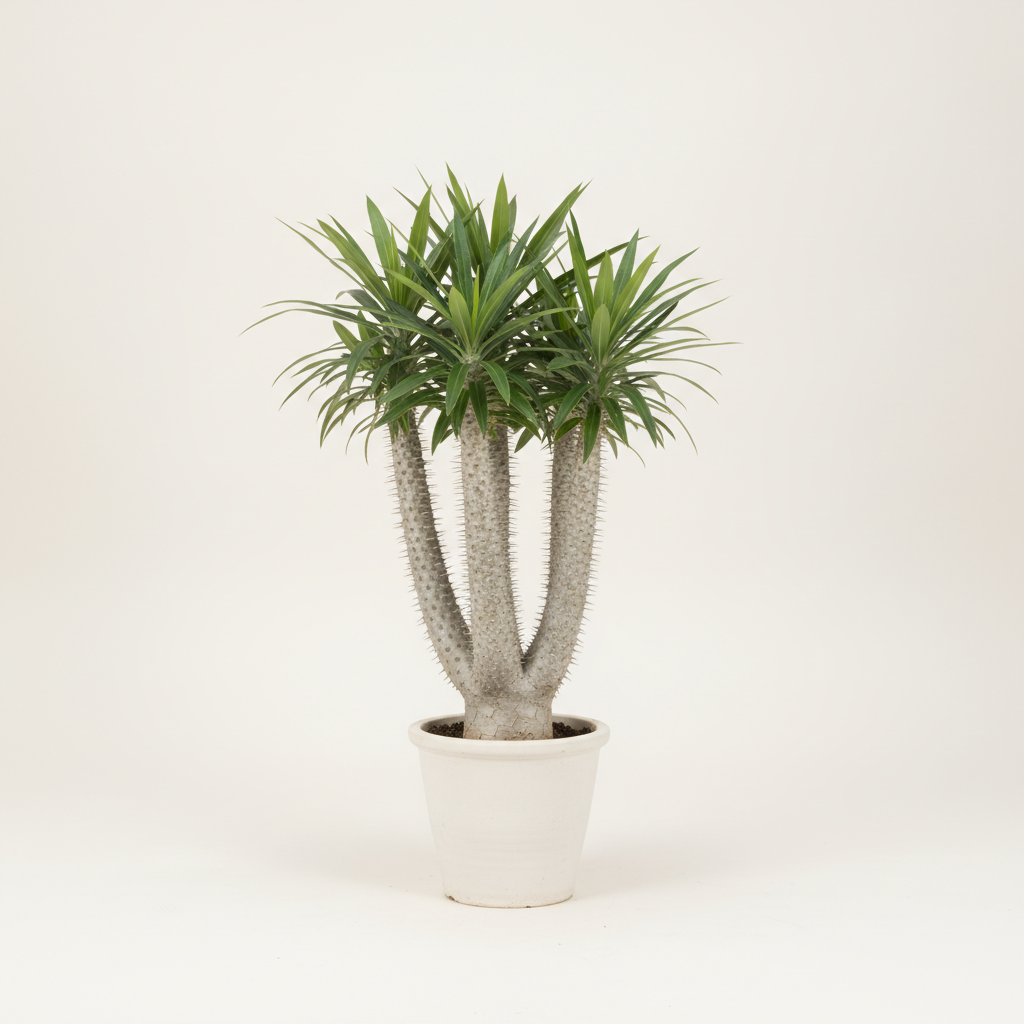
Branching Ramosum
The var. ramosum form develops several spiny stems from the trunk, each crowned with its own tuft of leaves, giving a candelabra effect that a single-stemmed plant only achieves after decades.
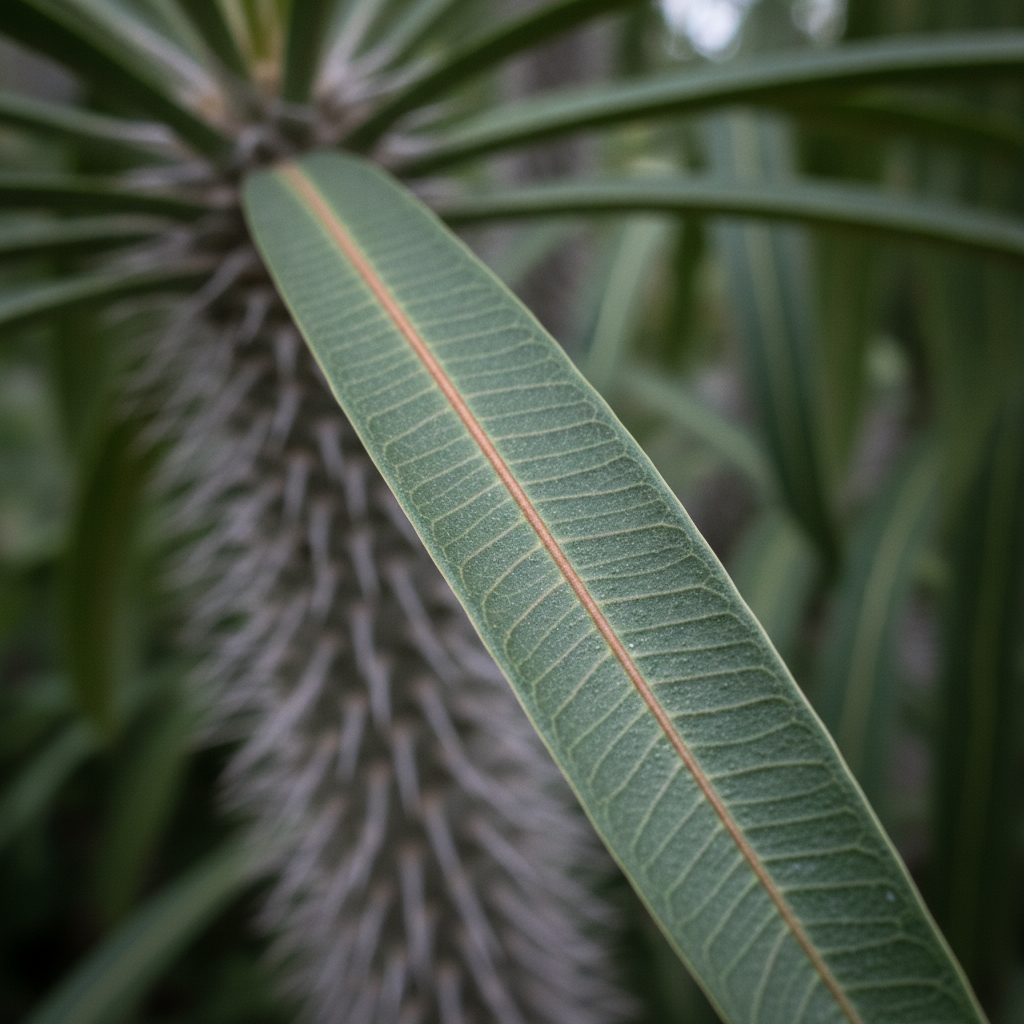
Pachypodium geayi
A tall, slender relative with narrower, greyer leaves marked by a fine reddish midrib and a densely spined silver trunk, prized for its more refined, silvery appearance.
Variety Profiles in Detail
Madagascar Palm (Pachypodium lamerei)
The standard-bearer of the genus and the plant most people mean by the name. It forms a stout, cylindrical silver trunk clothed in spines, topped by a rosette of long, glossy green leaves, and in maturity can produce fragrant white flowers with a yellow throat, though flowering is uncommon indoors. Reliable, widely available and forgiving, it is the ideal starting point.
Branching Madagascar Palm (Pachypodium lamerei var. ramosum)
Botanically almost identical to the species, this form is distinguished by its tendency to branch, producing multiple leafy heads. It makes a fuller, more shrub-like specimen and is sought after by growers who want the candelabra look without waiting a lifetime for a single trunk to divide.
Pachypodium geayi (Pachypodium geayi)
Often sold alongside P. lamerei and easily confused with it, P. geayi is taller and more slender with narrower, more silvery leaves that carry a distinctive reddish central vein. Its densely spined trunk and greyer foliage give it a slightly more austere, desert-plant character.
Choosing the Right Variety for Your Space
For a first Madagascar palm, the standard Pachypodium lamerei is the obvious choice: widely sold, affordable and tolerant of a beginner’s learning curve. If you want a fuller, more sculptural plant sooner, seek out the branching ramosum form, while P. geayi appeals to those drawn to its cooler, silvery look. Whatever you choose, the deciding factor should be the amount of direct sun you can provide, since every plant in this group has the same non-negotiable appetite for light, and none will look its best in a dim room.
Frequently Asked Questions
Is the Madagascar palm actually a palm?
No. Despite the name and the palm-like silhouette, Pachypodium lamerei is a succulent in the dogbane family, Apocynaceae, related to oleander and the desert rose. The common name refers only to its appearance, not its botany, which is why it is cared for like a succulent rather than a true palm.
Why is my Madagascar palm dropping all its leaves?
Leaf drop in autumn and winter is usually normal dormancy triggered by shorter days and cooler temperatures, and fresh leaves return in spring. Leaf loss during the growing season is more concerning and points to overwatering, a sudden cold draught or a big drop in light. Check that the base is firm and the soil is drying properly between waterings.
How often should I water it?
Only when the soil has dried out completely, which in summer tends to mean every one to two weeks, and in winter as little as once a month or not at all during dormancy. Frequency depends on light, warmth and pot size, so always check the soil rather than following a fixed calendar.
Why is the trunk going soft or mushy?
A soft, mushy trunk, especially near the base, is the hallmark of rot from overwatering and is a serious emergency. Cut away all affected tissue back to firm flesh with a sterile blade, dust the wounds with sulphur or cinnamon, repot into dry gritty mix and keep the plant dry and warm. A firm but slightly wrinkled trunk, by contrast, simply means the plant is thirsty.
Does the Madagascar palm flower indoors?
It can, but only rarely and usually only on large, mature, well-established plants given a great deal of sun. The flowers are fragrant, white and yellow-throated, and appear at the crown. Most indoor specimens are grown purely for their striking form and never bloom, so treat any flowering as a bonus rather than an expectation.
Are the spines or sap dangerous?
The rigid spines can give a painful jab, so position the plant away from walkways and handle it with gloves. The milky sap is an irritant to skin and mucous membranes, and given its oleander relatives it is wise to treat it as potentially toxic if swallowed. Keep the plant out of reach of pets and children, and wash your hands after handling cut surfaces.
How big will it get and how fast?
Indoors a Madagascar palm grows slowly, typically adding a modest amount of height each year and reaching one to two metres (3 to 6 feet) over many years. In its native habitat it can top four to six metres (13 to 20 feet), but container growing and indoor light keep it far smaller. Patience is part of owning one.
Can I move my Madagascar palm outside in summer?
Yes, and it often benefits from a summer outdoors in full sun once nights are reliably warm, above about 10 degrees Celsius (50 Fahrenheit). Acclimatise it gradually to stronger light over a week or two to prevent scorch, and bring it back inside well before the first cold nights of autumn, as it has no tolerance for frost.
Why are the leaf tips or edges turning brown?
Brown tips usually stem from a build-up of fertiliser salts or mineral deposits in the soil, or from inconsistent watering, rather than from low humidity. Flush the pot thoroughly with plain water to rinse away salts, ease off feeding, and keep to a steady dry-then-soak watering rhythm to prevent it recurring.
Can I propagate it from a leaf or a cutting?
Not from a leaf, which will simply shrivel. The reliable home methods are separating basal offsets when the plant produces them and growing from fresh seed. Branch cuttings from a branching plant can sometimes be rooted, but they must be callused thoroughly and kept dry, and success is far less certain than with offsets.






