
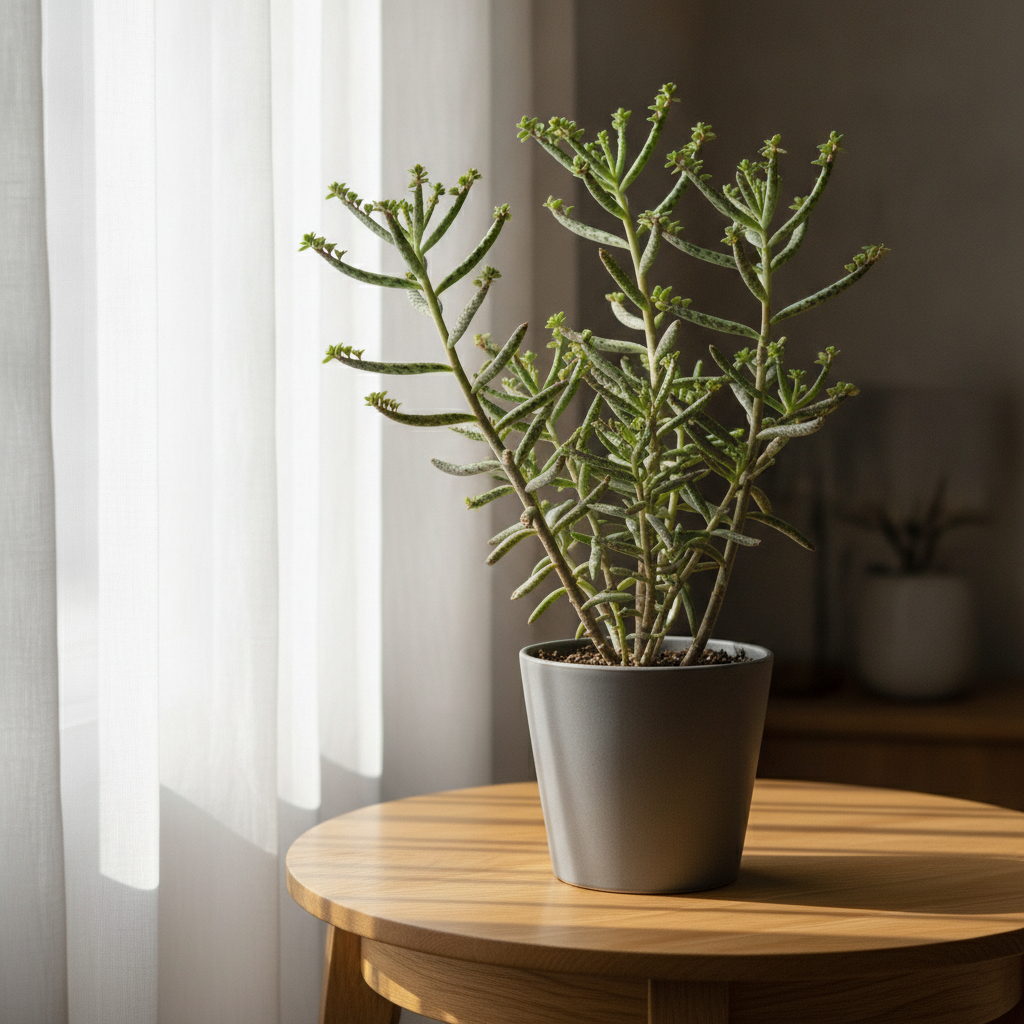
Few houseplants earn their common name as literally as the mother of millions. A single plant of Kalanchoe delagoensis lines the tip of every slender, tube-shaped leaf with rows of miniature plantlets, each one a fully formed baby ready to drop, root and grow the moment it touches soil. Native to the dry, rocky country of southern Madagascar, this upright succulent has turned that reproductive trick into one of the most efficient colonising strategies in the plant world, which is exactly why it can fill a windowsill collection from one parent in a single season.
That same vigour makes it almost impossible to kill, and it has a reputation as a plant you can neglect for weeks and still find thriving. The gap between merely surviving and genuinely thriving, though, is wider than most people expect. A mother of millions left in a dim corner becomes a stretched, floppy stick that topples under its own weight, while one given the bright light and lean, fast-draining conditions it evolved for stays compact, silver-green and, in winter, crowned with a chandelier of coral flowers. This guide covers everything from light and watering to propagation, pests and the toxicity you absolutely need to understand before bringing one home.
Contents
- Quick Reference
- Why Mother of Millions Makes a Resilient Houseplant
- Light Requirements
- Watering & Humidity
- Soil, Potting & Repotting
- Fertilising
- Propagation
- Pests & Diseases
- Popular Varieties
- Frequently Asked Questions
Quick Reference: Mother of Millions at a Glance
| Light | Bright direct to bright indirect light; at least 4 to 6 hours of sun keeps it compact |
| Watering | Soak thoroughly, then let the soil dry out completely; roughly every 2 to 3 weeks in summer, monthly or less in winter |
| Temperature | 18 to 27 degrees Celsius (64 to 81 Fahrenheit); protect from anything below 5 degrees Celsius (41 Fahrenheit) |
| Humidity | Average to low household humidity; thrives in dry air, dislikes damp stagnant conditions |
| Fertiliser | Dilute succulent feed once or twice across spring and summer; none in winter |
| Toxicity | Highly toxic to cats, dogs, livestock and humans if eaten; contains cardiac glycosides |
Why Mother of Millions Makes a Resilient Houseplant
The appeal of Kalanchoe delagoensis starts with how little it asks of you. It stores water in its thick, cylindrical leaves and woody stems, so it shrugs off the missed waterings and erratic schedules that finish off thirstier plants. It tolerates a wide range of light, copes with dry indoor air that would crisp a fern, and rarely succumbs to pests. For anyone who has killed a string of houseplants and concluded they have a black thumb, this is the species that tends to break the losing streak.
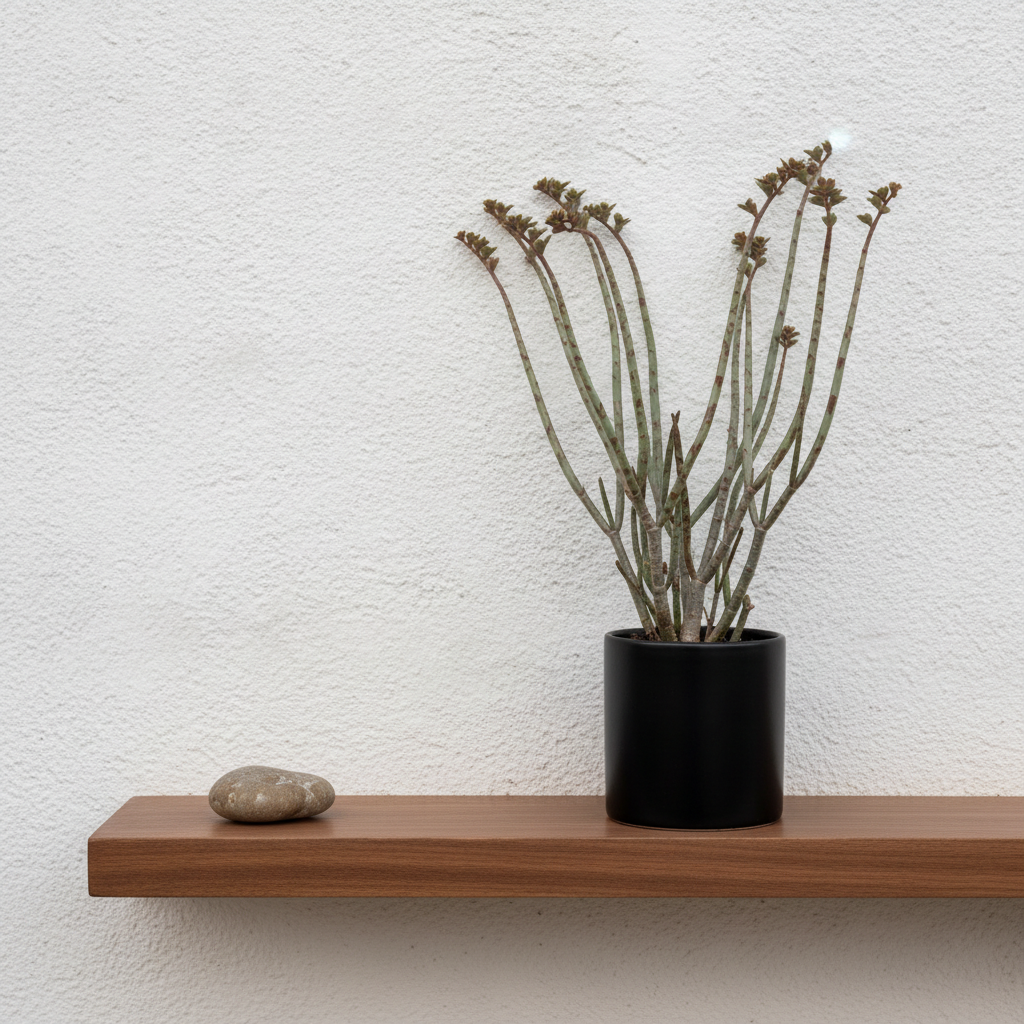
Beyond toughness, it is simply a striking plant. The narrow blue-grey leaves, freckled with purple-brown mottling, give it an architectural, almost otherworldly look that suits modern and minimalist interiors. The plantlet-fringed tips are a living curiosity that few visitors can resist examining, and a mature specimen rewards good care with a winter flush of pendant, tubular flowers in shades of coral, salmon and orange. It is a conversation piece that happens to be one of the most forgiving plants you can own.
Important — Toxicity: Every part of mother of millions is highly toxic. The leaves and plantlets contain bufadienolide cardiac glycosides that can cause vomiting, drooling, irregular heartbeat and, in serious cases involving livestock or pets, death. Keep it well away from cats, dogs and curious children, and be aware that the tiny plantlets it scatters can be swallowed accidentally. If you have free-roaming animals, this may not be the right plant for your home.
Light Requirements
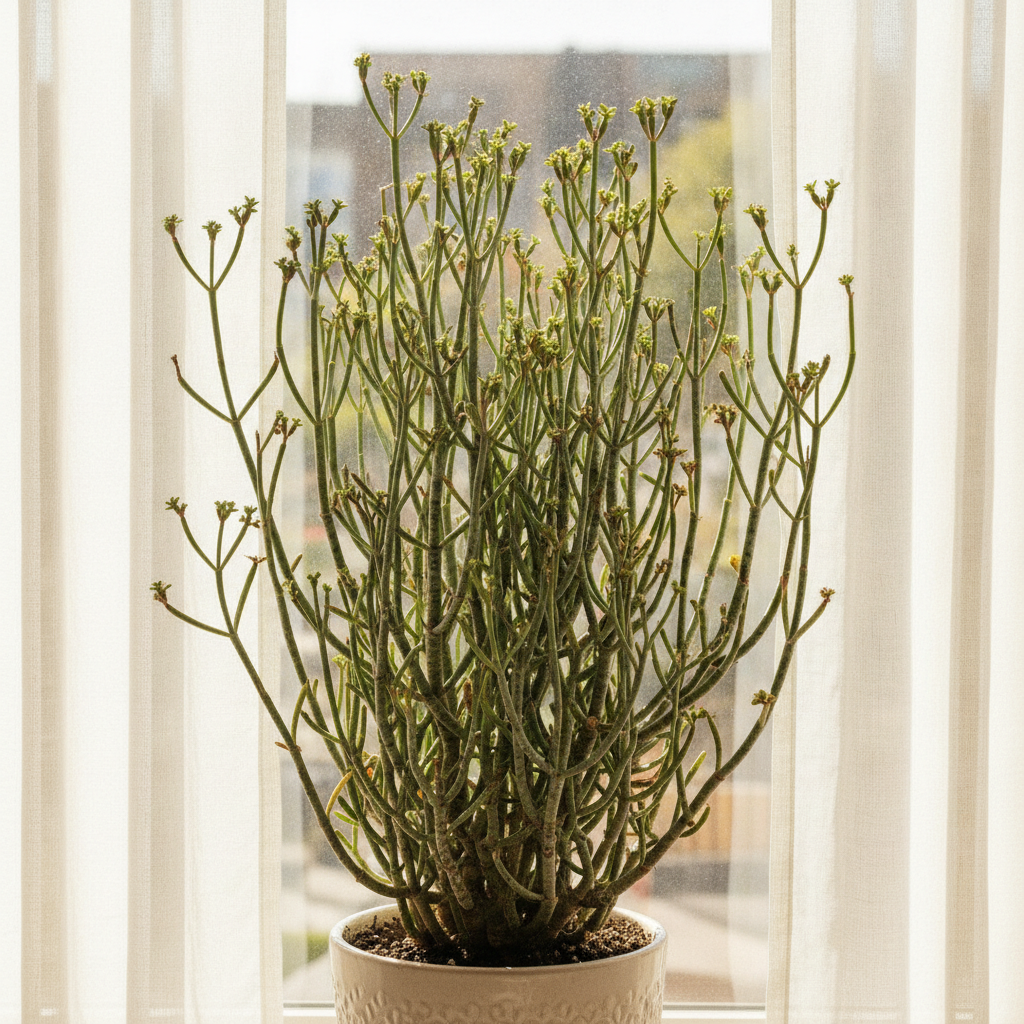
Light is the single biggest factor separating a handsome mother of millions from a sad one. In its native Madagascar it grows in open, sun-baked terrain, and it carries that appetite for brightness indoors. Given generous light, the stems stay short and sturdy, the leaves keep their compact spacing and silvery colour, and the purple mottling deepens. Starved of light, the plant stretches desperately toward the nearest window, producing long, pale, weak growth that flops over and never recovers its shape.
The ideal spot is directly in or right beside a bright window where the plant receives at least four to six hours of sun each day. Unlike many tender houseplants, mother of millions actively wants some direct sun on its leaves, so a position that would scorch a calathea is exactly what this succulent is looking for.
Light Levels Explained
The table below translates the usual light categories into what they mean for this particular succulent, so you can match a spot in your home to the result you can expect.
| Light Category | Approx. Level | Typical Location | Outcome |
|---|---|---|---|
| Direct sun | 20,000 lux and above | On a south or west windowsill | Ideal; compact, colourful, may flower |
| Bright indirect | 10,000 to 20,000 lux | Just back from a sunny window | Good; healthy but slightly looser growth |
| Medium | 5,000 to 10,000 lux | A few metres from a bright window | Tolerated; slow, somewhat stretched |
| Low | 1,000 to 5,000 lux | A north room or shaded corner | Poor; etiolated, weak, leggy stems |
| Very low | Below 1,000 lux | Interior wall, far from any window | Decline; will not sustain healthy growth |
Window Orientation and Placement
South-facing window: In the northern hemisphere this is the best position you can offer. The strong, long-lasting light keeps the plant compact and brings out the best leaf colour. Acclimatise a plant moved from lower light gradually so it does not scorch.
East-facing window: Gentle morning sun followed by bright light for the rest of the day suits mother of millions well. Growth stays reasonably tight, though it may lean slightly toward the glass over time, so rotate the pot occasionally.
West-facing window: The hot afternoon sun of a west window is well within this plant’s tolerance and produces sturdy, well-coloured growth. It is one of the easiest exposures to grow it in successfully.
North-facing window: The weakest exposure and the hardest to keep this plant happy in. Expect stretching and pale growth unless you supplement with a grow light. If a north window is all you have, place the plant as close to the glass as possible.
Pro Tip — Read the Stretch: The plant tells you when it needs more light. Widely spaced leaves, a pale washed-out colour and stems that bend toward the window all mean it is reaching for brightness. Move it closer to the glass or add supplemental lighting before the growth becomes permanently floppy.
How Light Affects Colour and Form
Light does more than control height. In strong light the leaves take on their characteristic silvery blue-green tone and the purple-brown freckling intensifies, sometimes flushing reddish at the tips under sustained sun. In weak light the plant reverts to a plain, flat green and loses much of its distinctive patterning. Strong light is also a precondition for flowering, as the plant needs to build enough energy reserves through the growing season to push out its winter blooms.
Warning — Direct Sunlight: Although mother of millions loves sun, a plant grown in low light and then moved abruptly into intense direct sun can scald. Sunscald shows as bleached white or brown patches on the leaves that never green up again. Always increase exposure over a week or two rather than all at once.
Artificial Lighting
If your home lacks a bright enough window, mother of millions responds well to a full-spectrum LED grow light. Position the light 20 to 30 centimetres (8 to 12 inches) above the plant and run it for 10 to 12 hours a day to mimic the long, bright days it prefers. Supplemental light is especially useful through the dark winter months in higher latitudes, where natural light alone often leaves the plant stretching.
Seasonal Adjustments
As daylight shortens in autumn and winter, move the plant to your brightest available window to compensate for the weaker, briefer sun. In spring and summer, when light is abundant, you may need to acclimatise it to the increasing intensity to avoid scorch. A plant that flowered over winter often looks tired afterward, so the brighter spring light helps it recover and push fresh growth.
Watering & Humidity
If light is where people most often go wrong with mother of millions, watering is a close second, and the mistake is almost always too much rather than too little. As a succulent built to survive long dry spells, it is far happier slightly thirsty than sitting in damp soil. The guiding principle is simple: water thoroughly, then leave it completely alone until the soil has dried out from top to bottom.
When to Water
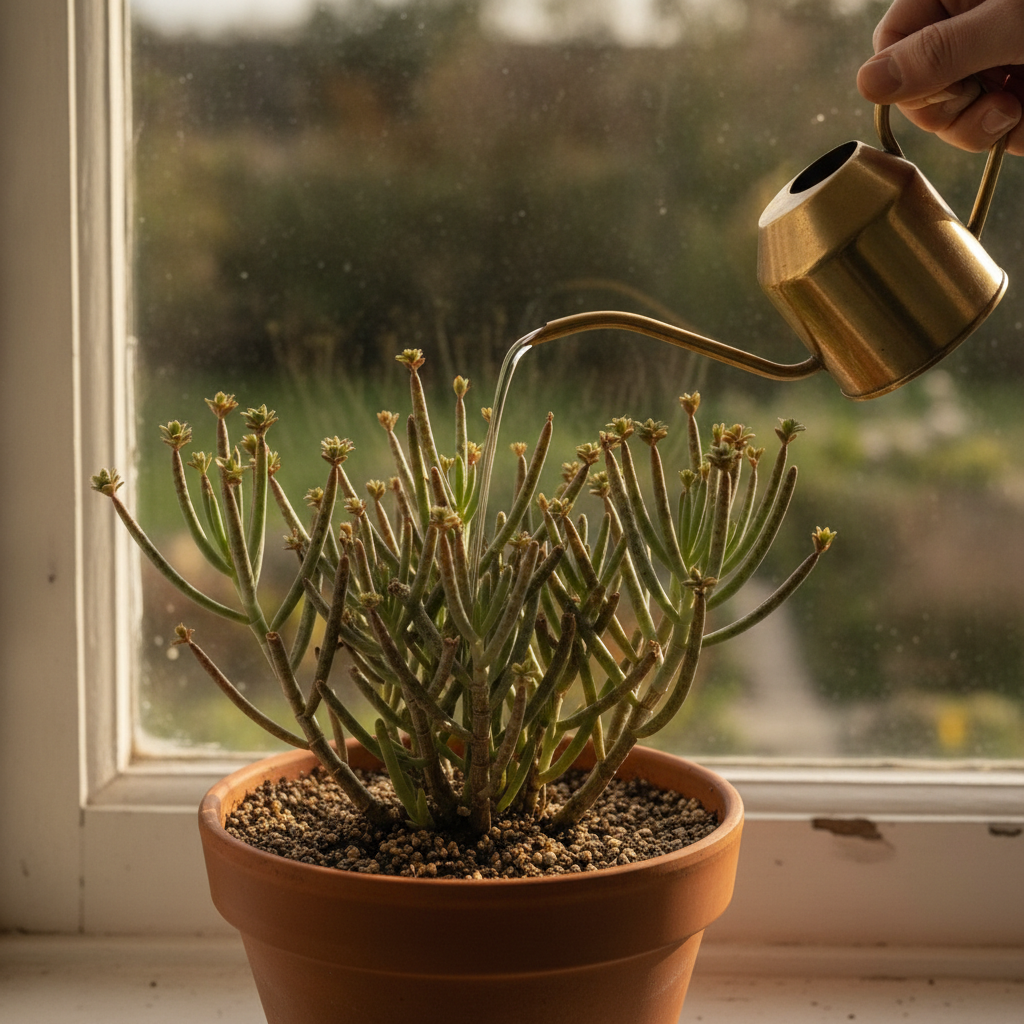
Forget any fixed weekly schedule and let the soil be your guide. Push a finger several centimetres into the mix, or lift the pot to feel its weight; water only when the soil is bone dry all the way through and the pot feels light. In a bright spot through spring and summer this usually works out to roughly once every two to three weeks, but the interval depends entirely on your light, pot and temperature.
In autumn and winter the plant’s growth slows and its water needs drop sharply. Stretch the interval to once a month or even less, giving only enough to keep the leaves from shrivelling. Cool, damp winter soil is the single most common cause of death in this otherwise unkillable plant, so when in doubt during the cold months, wait longer.
Pro Tip — The Weight Test: Lift the pot right after a thorough watering and commit that heavy feel to memory, then lift it again a couple of weeks later. A pot that feels noticeably light has dried out and is ready for water. This quick check is more reliable than any calendar and works through every season.
How to Water Correctly
- Check that the soil is completely dry throughout before you begin.
- Water at the soil surface, directing the stream around the base of the stems rather than over the leaves.
- Add water slowly and steadily until it runs freely from the drainage holes.
- Let the pot drain fully for several minutes so no water is trapped at the bottom.
- Empty the saucer or cache pot completely; never leave the plant standing in collected water.
- Wait until the soil has dried out entirely before watering again.
Signs of Overwatering vs. Underwatering
| Symptom | Overwatering | Underwatering |
|---|---|---|
| Leaf colour | Yellowing, translucent, often from the base up | Dull, faded, sometimes reddish from stress |
| Leaf texture | Soft, mushy, water-soaked and swollen | Wrinkled, shrivelled, flattened along their length |
| Soil | Stays wet for days, may smell sour | Bone dry, pulling away from the pot edge |
| Roots | Brown, black, soft and foul-smelling | Dry but firm and pale, intact |
| Stem base | Blackening, soft and collapsing | Firm but thin, possibly slightly woody |
Warning — Root Rot: Soft, blackening stems and a sour smell from the soil mean root rot has set in, usually from overwatering or poor drainage. Act fast: unpot the plant, cut away every soft or discoloured root and stem section with a sterile blade, let the cuts callus for a day or two, and replant the firm remainder in dry, gritty mix. Healthy plantlets and leaves can also be rooted as insurance.
Humidity Requirements
Humidity is refreshingly uncomplicated with this plant. Mother of millions is adapted to dry, arid air and is perfectly content in the low humidity of a centrally heated or air-conditioned home. It needs no misting, no pebble trays and no humidifier, and in fact prefers good airflow and dry conditions that discourage rot and fungal problems.
Problems linked to moisture in the air are almost always about too much rather than too little. In a stagnant, very humid spot such as a closed bathroom, the plant becomes more prone to soft rot and fungal spotting, particularly if the soil is also staying damp. If you notice mushy patches or mould on the surface, improve ventilation and move the plant somewhere drier and brighter.
There is essentially never a need to raise humidity for this species. If you grow it alongside tropical plants that demand high humidity, simply keep the mother of millions at the drier edge of the group, with the best air movement, rather than in the most humid pocket.
Water Quality
Mother of millions is not fussy about water quality and tolerates ordinary tap water without complaint. Because it is watered so infrequently, mineral build-up is rarely an issue. If your tap water is very hard and you notice a white crust forming on the soil surface or pot, flush the pot thoroughly once in a while or switch to filtered or rainwater. Room-temperature water is gentler on the roots than very cold water straight from the tap.
Soil, Potting & Repotting
Getting the soil right is the foundation of growing mother of millions well, because the right mix does much of the watering work for you. This plant needs a substrate that drains almost instantly and holds very little moisture, recreating the gritty, fast-draining ground of its rocky homeland. Ordinary houseplant compost, which stays wet for too long, is a recipe for root rot.
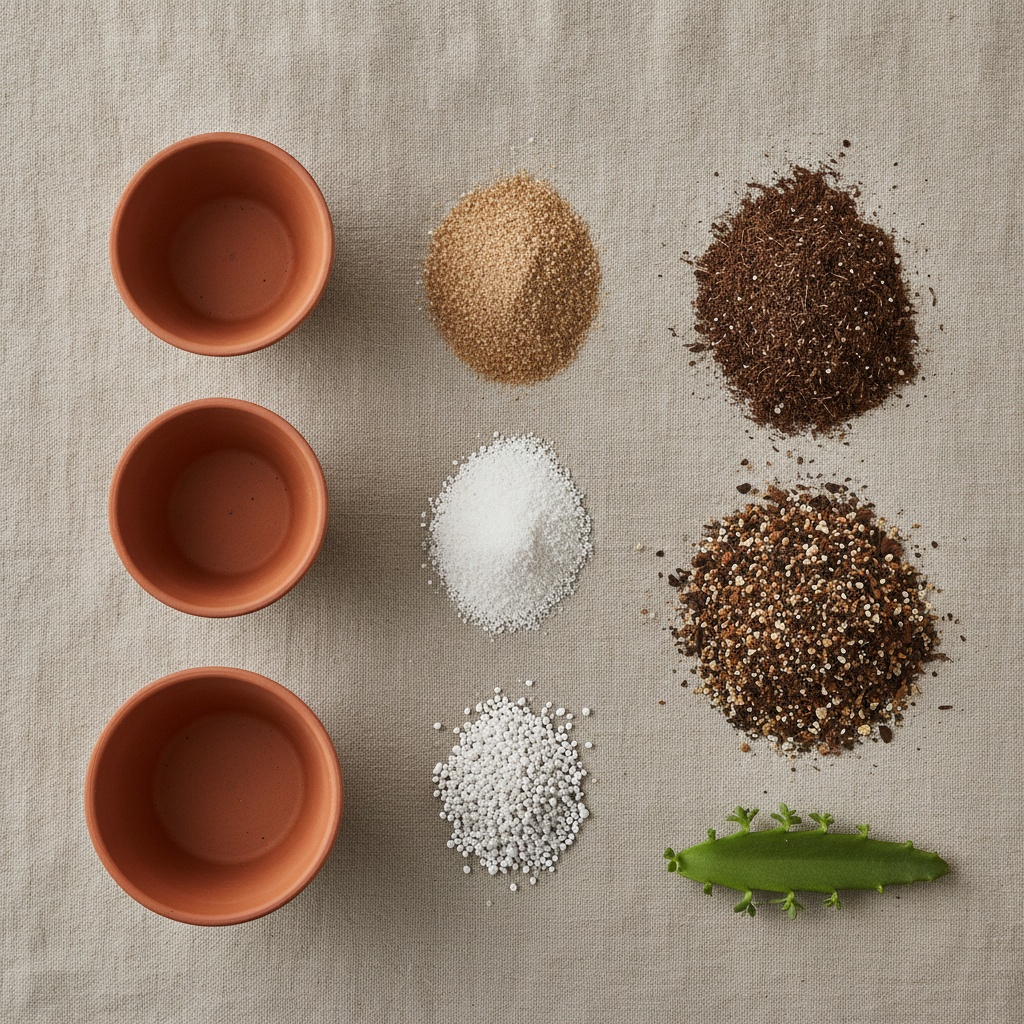
Ideal Soil Composition
The aim is a lean, mineral-heavy mix that lets air to the roots and dries quickly after watering. A good blend combines a base of cactus or succulent compost with a generous amount of coarse mineral grit to open it up. Roughly half organic matter and half grit is a sensible starting point, leaning grittier if your home is humid or your watering hand is heavy.
| Component | Proportion | Function |
|---|---|---|
| Cactus or succulent compost | 50 percent | Provides structure and modest nutrition |
| Pumice or perlite | 25 percent | Creates air pockets and speeds drainage |
| Coarse horticultural sand or grit | 20 percent | Adds weight and sharpens drainage |
| Fine bark or coir | 5 percent | Holds a little moisture without compacting |
Mother of millions is relaxed about soil pH, growing happily anywhere from slightly acidic to slightly alkaline, in the rough range of 6.0 to 7.5. There is no need to test or adjust pH for a healthy plant; getting the drainage right matters far more than fine-tuning chemistry.
Pro Tip — Quick Mix Recipe: For a fast, reliable blend, mix two parts bagged cactus compost with one part pumice and one part coarse grit or sharp sand. Squeezed in a damp handful it should crumble apart rather than hold together in a ball, which tells you it will drain freely.
Choosing the Right Pot
The container is just as important as what goes in it. Because this plant grows tall and somewhat top-heavy while keeping a relatively modest root system, a heavier, stable pot helps prevent it tipping over as it gains height.
Drainage holes are non-negotiable. Never plant mother of millions in a container without drainage. Without a way for excess water to escape, even the grittiest mix will eventually waterlog and rot the roots. If you love a decorative pot with no hole, use it as a cache pot with the plant in a plain draining nursery pot inside.
Pot material: Unglazed terracotta is the ideal choice because its porous walls wick moisture out of the soil and help it dry quickly, which is exactly what this plant wants. Terracotta also adds useful weight and stability. Glazed ceramic and plastic both work but hold moisture longer, so be even more conservative with watering when you use them.
Pot size: Choose a pot only slightly larger than the root ball. An oversized pot holds a large volume of soil that stays wet long after the roots have had their fill, inviting rot. Snug pots that dry out quickly suit this succulent far better than roomy ones.
When to Repot
Mother of millions is slow to need repotting and is happy to be a little root-bound. Plan on moving it up a pot size every two to three years, or when you see roots emerging from the drainage holes, the plant drying out unusually fast, or the whole arrangement becoming unstable and top-heavy. Spring, at the start of the active growing season, is the best time to repot so the plant can recover quickly.
How to Repot: Step-by-Step
- Let the soil dry out for a few days first, as dry root balls slide out more cleanly and resist damage.
- Gently ease the plant from its pot, supporting the base of the stems rather than pulling on the foliage.
- Tease away the old spent soil and inspect the roots, trimming any that are soft, brown or dead.
- Add a layer of fresh gritty mix to the base of the new pot and set the plant at its previous depth.
- Fill around the root ball with mix, firming lightly to remove air pockets and steady the plant.
- Brush off any plantlets that have dropped into the pot if you want to avoid a crowd of seedlings.
- Wait about a week before watering, then resume your normal soak-and-dry routine.
Warning — Transplant Shock: Resist the urge to water a freshly repotted plant straight away. Repotting always nicks a few roots, and watering immediately lets moisture into those open wounds, which is a fast route to rot. Waiting roughly a week gives the cuts time to seal before the roots meet damp soil again.
Fertilising
Mother of millions is a lean feeder that evolved in poor, rocky soils, so it needs very little fertiliser to thrive. In fact, overfeeding is more likely to cause problems than underfeeding, pushing soft, weak growth that stretches and flops. A light touch through the growing season is all this plant asks for.
Think of feeding as an occasional supplement rather than a routine. One or two doses of a dilute fertiliser spread across spring and summer keep the plant in good condition, and many growers find their plants do perfectly well with even less. When in doubt, feed less.
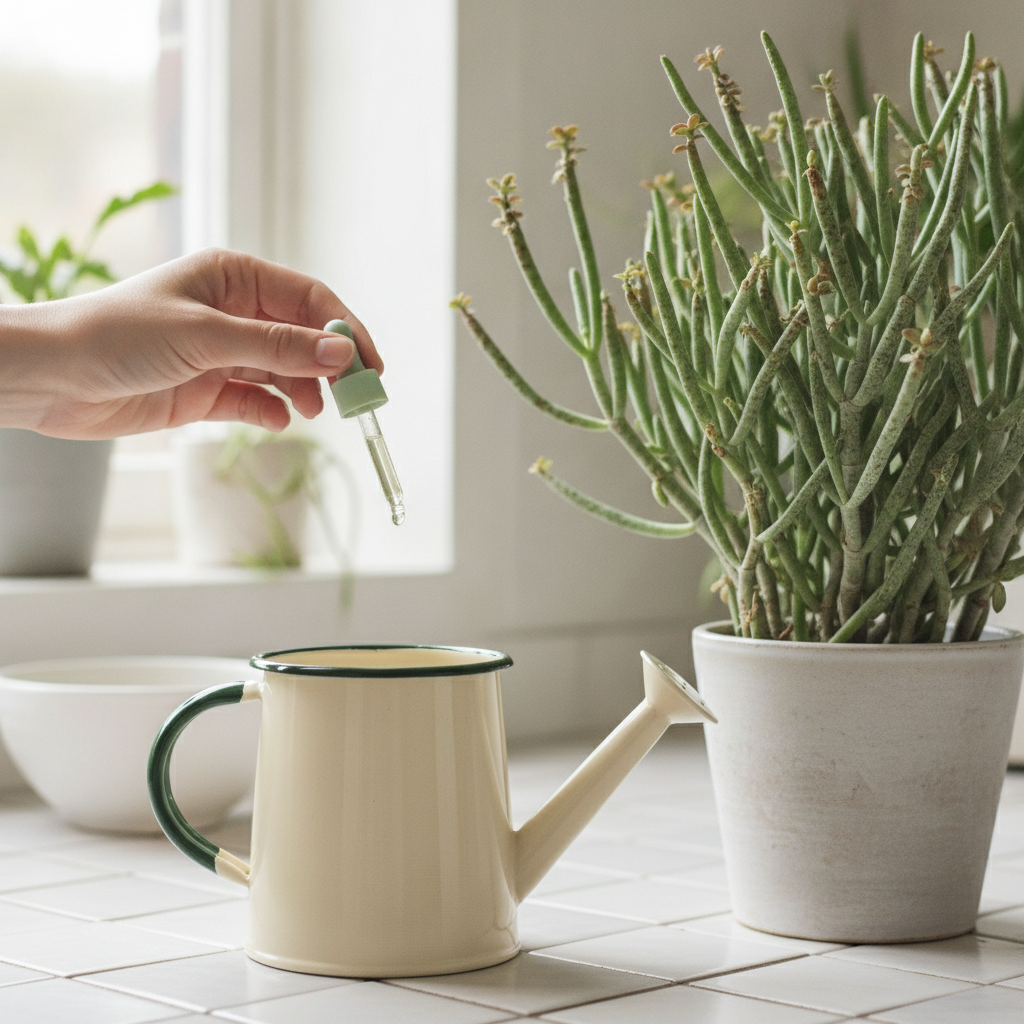
Understanding Plant Nutrients
Fertilisers are labelled with an NPK ratio standing for nitrogen, phosphorus and potassium, the three nutrients plants use in the largest quantities. For a succulent like this, a balanced or slightly phosphorus-leaning formula is ideal, since too much nitrogen encourages the soft, leggy growth you want to avoid. A handful of secondary nutrients and trace elements round out a complete feed.
| Nutrient | Symbol | Primary Function | Deficiency Symptoms |
|---|---|---|---|
| Nitrogen | N | Leaf and stem growth | Pale, slow, stunted growth |
| Phosphorus | P | Root development and flowering | Poor rooting, few or no flowers |
| Potassium | K | Overall vigour and stress resistance | Yellow or browning leaf edges |
| Calcium | Ca | Cell wall structure | Distorted, weak new growth |
| Magnesium | Mg | Core of the chlorophyll molecule | Yellowing between leaf veins |
| Iron | Fe | Chlorophyll production | Pale young leaves with green veins |
Types of Fertiliser
Liquid fertilisers: A liquid succulent or cactus feed diluted in water is the easiest option and gives you full control over dose and timing. Always mix it well below the recommended strength, to roughly a quarter or half, and apply it to already-moist soil to protect the roots.
Slow-release granular: A small amount of slow-release granules worked into the soil in spring feeds the plant gently over several months. Use a light hand and the lowest dose on the packet, since these succulents need so little.
Organic fertilisers: Gentle organic options such as dilute worm-casting tea release nutrients slowly and are very hard to overdo. They are a forgiving choice for anyone nervous about overfeeding, though they provide only a modest nutrient boost.
Feeding Schedule
Feed only during the active growing season of spring and summer, when the plant can actually use the nutrients. A dilute dose every four to six weeks during this window is plenty, and one or two feeds across the whole season is enough for many plants. Stop feeding entirely in autumn and winter, when growth slows and fertiliser would simply accumulate as unused salts in the soil.
Pro Tip — Less Is More: When you are unsure whether to feed, do not. A mother of millions that is never fertilised still grows perfectly well, whereas an overfed one becomes soft, stretched and far more prone to rot and pests. Treat fertiliser as a rare treat rather than a regular meal.
How to Fertilise
- Dilute a succulent fertiliser to a quarter or half of the label strength.
- Water the plant lightly first if the soil is bone dry, so the feed never hits parched roots.
- Apply the diluted solution evenly to the soil, avoiding the leaves and stems.
- Let any excess drain away and empty the saucer so no fertiliser sits at the roots.
- Flush the pot with plain water every few months to wash out accumulated salts.
Warning — Salt Build-Up: A white or yellowish crust on the soil surface or pot rim signals a build-up of fertiliser salts, which can scorch the roots and brown the leaf tips. Flush the pot by running plenty of plain water through it until it drains clear, and ease off on feeding.
Propagation
No plant makes propagation easier than mother of millions, which essentially propagates itself whether you ask it to or not. The name refers to the countless plantlets that form along every leaf margin and tip, each a tiny, complete baby plant with its own pair of leaves and the first hint of roots, simply waiting to fall and grow.
For the gardener this is a gift, since you can fill pots, share with friends or replace an ageing parent with almost no effort. For everyone else it can be a nuisance, because dropped plantlets root in neighbouring pots and need weeding out. Either way, understanding how it reproduces lets you control the process rather than be overrun by it.
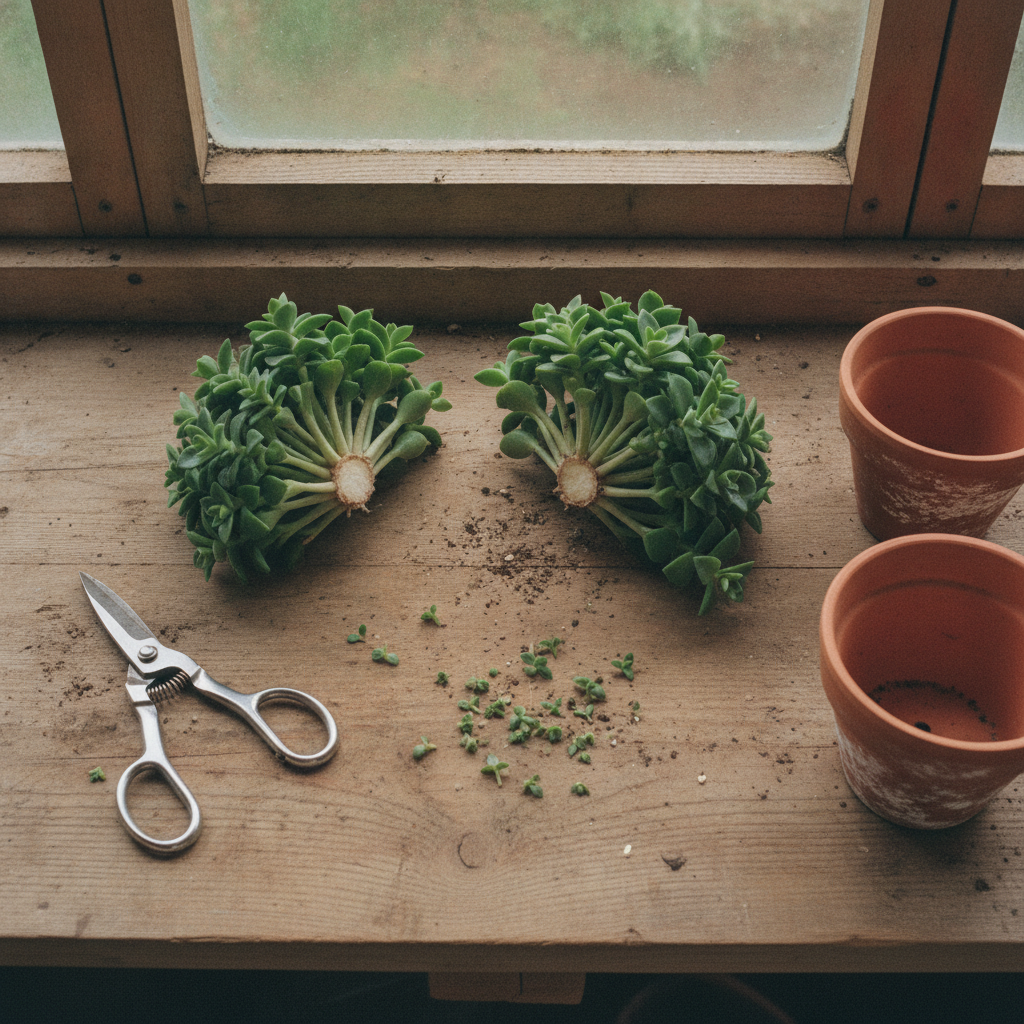
Understanding Plantlets
The plantlets, sometimes called bulbils, are produced asexually along the leaves, which means each is a genetic clone of the parent. They develop their own miniature roots while still attached, so by the time they drop they are ready to establish almost instantly on any suitable surface. This is why a single plant can carpet the ground beneath it with seedlings, and why the species is classed as a serious invasive weed in warm regions such as parts of Australia and the southern United States. Indoors the same trait simply makes it the most generous propagator on your shelf.
Plantlet Propagation: Step-by-Step
This is the simplest method and the one the plant prefers. You are really just giving nature a gentle nudge and a pot to land in.
- Brush a few mature plantlets off a leaf edge, or collect ones that have already dropped.
- Fill a shallow tray or pot with gritty, free-draining succulent mix and level the surface.
- Scatter the plantlets across the top, pressing them very lightly into contact with the soil.
- Place the tray in bright, indirect light and mist the surface just enough to keep it barely moist.
- Within one to two weeks the plantlets root and begin to grow; reduce moisture once they are established.
- Pot the strongest young plants on individually once they are a few centimetres tall.
Pro Tip — Contain the Spread: Because plantlets root so readily, they easily colonise other pots nearby. If you want to keep your collection tidy, stand the mother plant on its own saucer away from other containers and sweep up dropped plantlets regularly before they take hold where you do not want them.
Stem Cuttings and Division: Step-by-Step
If you want to reshape a leggy plant or produce a larger specimen quickly, stem cuttings and division are both reliable. These methods make use of the parts of the plant beyond the plantlets.
- Use a clean, sharp blade to cut a healthy stem section 8 to 12 centimetres (3 to 5 inches) long, or lift and split a multi-stemmed clump into separate crowns.
- Set cuttings aside in a dry, shaded spot for two to three days so the cut ends callus over.
- Insert the callused cuttings or replant each division into dry, gritty succulent mix.
- Keep the soil dry for the first week, then begin watering very lightly to encourage rooting.
- Move to bright light once new growth shows that roots have taken hold, usually within a few weeks.
Troubleshooting Propagation
| Problem | Likely Cause | Solution |
|---|---|---|
| Plantlets rot before rooting | Soil kept too wet or air too humid | Mist less, improve airflow, use grittier mix |
| Cuttings shrivel and fail | Cut ends not callused before planting | Let cuts dry two to three days first |
| Slow or no rooting | Too cold or too dark | Move to warmth and brighter light |
| Leggy, weak young plants | Insufficient light after rooting | Grow on in a bright spot or under a grow light |
Pests & Diseases
Mother of millions is remarkably resistant to pests and diseases, and most trouble it runs into is self-inflicted through overwatering rather than caused by invading insects. Still, a stressed or overcrowded plant can attract the usual succulent pests, so it pays to know what to look for.
The best defence is the same good culture that keeps the plant looking its best: bright light, careful watering and decent airflow. A healthy plant in the right conditions rarely has a serious problem, and quick action at the first sign of trouble keeps minor issues from spreading.
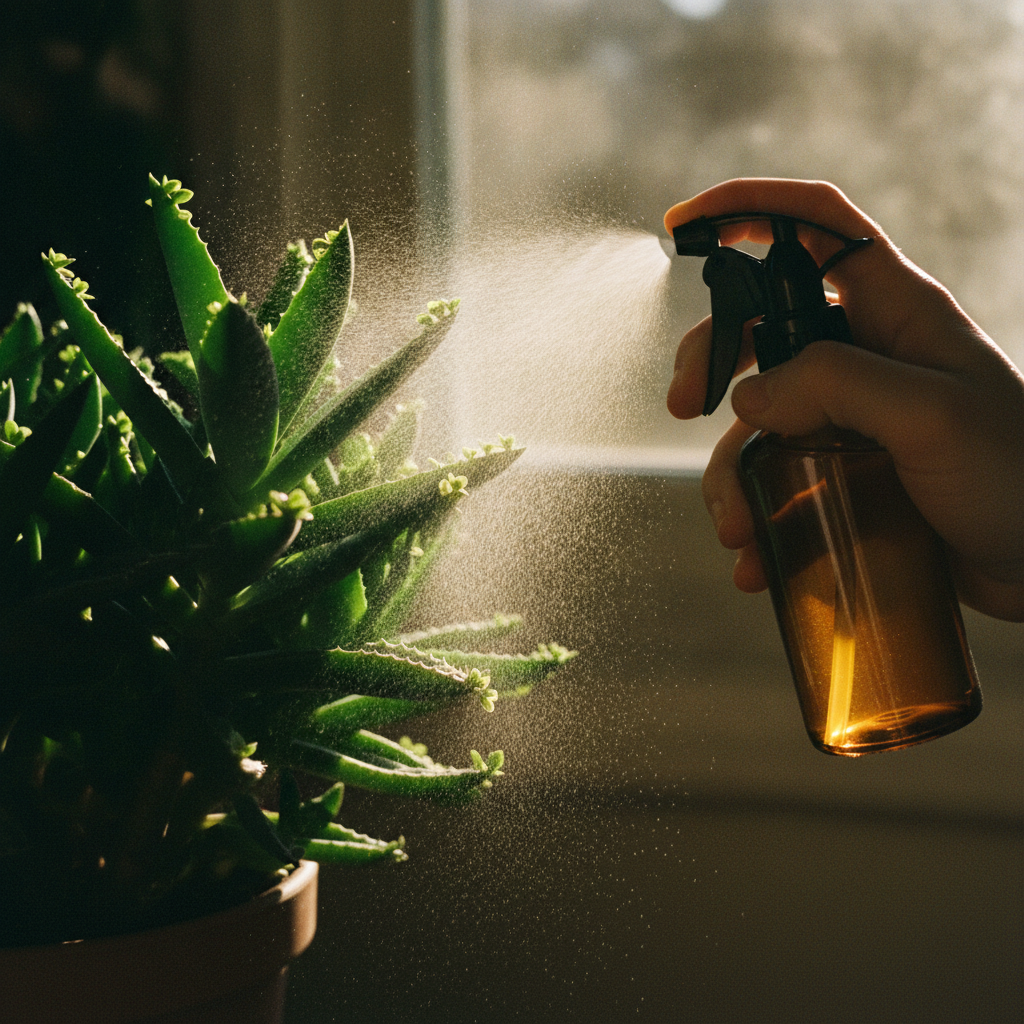
Common Pests
Mealybugs (Pseudococcus species)
Mealybugs are the most likely pest, appearing as small white cottony tufts tucked into the leaf joints and along the stems. They suck sap, weakening the plant and leaving sticky honeydew that can attract sooty mould. A bad infestation slows growth and distorts new leaves.
Treatment: Dab each insect with a cotton bud dipped in isopropyl alcohol, then follow up with neem oil or an insecticidal soap spray every week until they are gone. Isolate the plant from your other succulents while you treat it.
Aphids (Aphidoidea)
Aphids are small green, black or pink insects that cluster on soft new growth and flower stalks, especially when the plant is blooming. They distort tender shoots and, like mealybugs, leave sticky honeydew behind.
Treatment: Rinse them off with a firm jet of water, then spray with insecticidal soap or neem oil. Repeat every few days until the population is under control, paying attention to the growing tips and flower buds.
Scale Insects (Coccoidea)
Scale appear as small, immobile brown or tan bumps stuck to stems and the undersides of leaves. They are easy to overlook because they barely move, but they steadily drain sap and leave the plant looking tired and sticky.
Treatment: Scrape off the visible scale with a fingernail or an alcohol-dipped cotton bud, then treat with neem oil to catch the mobile young crawlers. Several rounds over a few weeks are usually needed.
Common Diseases
Root and Stem Rot (Pythium and Phytophthora species)
By far the most common and most serious problem, rot is driven by soggy soil and poor drainage. It shows as soft, blackening stems at the base, yellowing mushy leaves and a sour smell from the soil, and it can collapse a plant quickly if ignored.
Treatment: Unpot the plant immediately, cut away all soft and discoloured tissue with a sterile blade, and let the healthy remainder dry and callus before replanting in fresh, dry, gritty mix. Take plantlet or stem cuttings from any firm growth as a backup, and correct the watering that caused it.
Leaf Spot and Powdery Mildew (various fungi)
In damp, stagnant conditions the plant can develop dark fungal leaf spots or a dusty white powdery mildew on its foliage. These are far less common than rot and usually point to too much humidity or too little air movement.
Treatment: Remove affected leaves, improve ventilation and move the plant somewhere brighter and drier. A fungicide is rarely needed if you fix the underlying conditions.
Pest and Disease Summary
| Pest / Disease | Identification | Treatment |
|---|---|---|
| Mealybugs | White cottony tufts in leaf joints | Alcohol swabs and neem oil |
| Aphids | Clusters on new growth and flowers | Water jet and insecticidal soap |
| Scale | Brown immobile bumps on stems | Scrape off and treat with neem oil |
| Root and stem rot | Soft black base, sour soil | Cut away rot, dry out, replant in gritty mix |
| Leaf spot and mildew | Dark spots or white powder on leaves | Remove leaves, improve airflow, reduce humidity |
Prevention Strategies
Prevention with this plant is overwhelmingly about water and air. Keeping the soil gritty and letting it dry out fully between waterings removes the conditions that almost every disease and many pests rely on. Good light and decent airflow do the rest, keeping growth firm and unappealing to soft-bodied insects.
Inspect new plants before adding them to your collection and keep any newcomer isolated for a couple of weeks to be sure it is pest-free. A quick weekly glance over your mother of millions, paying attention to leaf joints and stems, catches the occasional problem long before it becomes serious.
Pro Tip — Neem as Routine: A light neem oil spray every few weeks during the growing season works as a gentle preventative, deterring mealybugs and aphids before they settle in. Apply it in the evening or out of direct sun so the oil does not magnify the light and mark the leaves.
Popular Varieties
The name mother of millions is applied loosely to several closely related Madagascan kalanchoes that all share the plantlet-bearing habit, which can make labelling confusing. The true mother of millions is Kalanchoe delagoensis, with its slender, near-cylindrical leaves, but it is often grouped and sold alongside its broad-leaved cousins and a handful of cultivated hybrids.
The selections below are the ones you are most likely to encounter, ranging from the wild species to ornamental hybrids bred for showier plantlets. Care is essentially identical across all of them, so you can mix and match by appearance alone.
| Variety | Leaf Appearance | Light Needs | Growth Rate | Availability |
|---|---|---|---|---|
| Kalanchoe delagoensis | Narrow grey-green tubes, brown-mottled | Bright to full sun | Fast | Common |
| ‘Pink Butterflies’ | Tubular leaves edged with vivid pink plantlets | Bright to full sun | Moderate | Specialist growers |
| Mother of Thousands (Kalanchoe daigremontiana) | Broad triangular leaves, plantlets on margins | Bright indirect to full sun | Fast | Common |
| Kalanchoe x houghtonii | Hybrid; mid-width leaves, very prolific plantlets | Bright to full sun | Very fast | Common |
| Chandelier Plant (flowering delagoensis) | Species in bloom with hanging coral flowers | Full sun to flower well | Fast | Common |
Featured Varieties
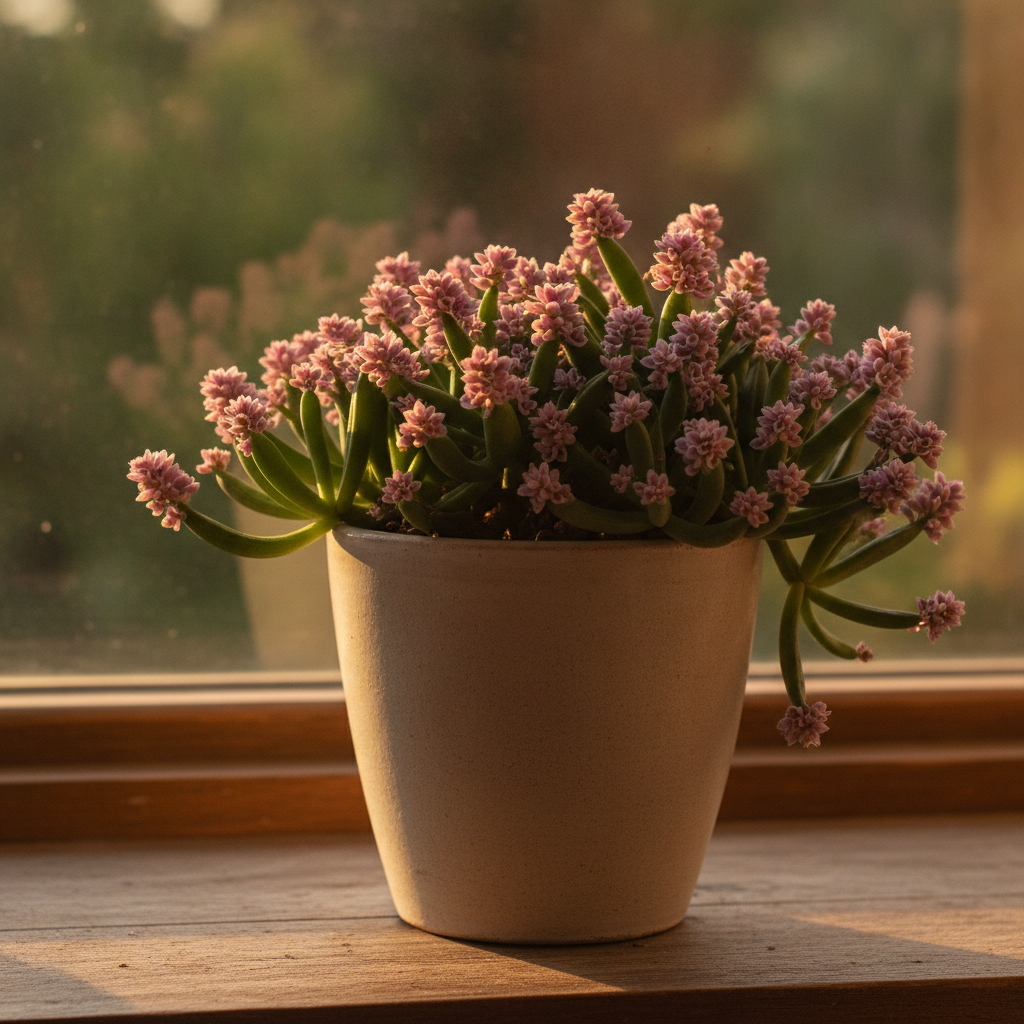
‘Pink Butterflies’
A prized ornamental hybrid whose plantlets emerge a vivid pink to lavender rather than green. Because these pink bulbils lack chlorophyll they cannot survive on their own, which makes this cultivar far less invasive and a more responsible choice for warm climates.
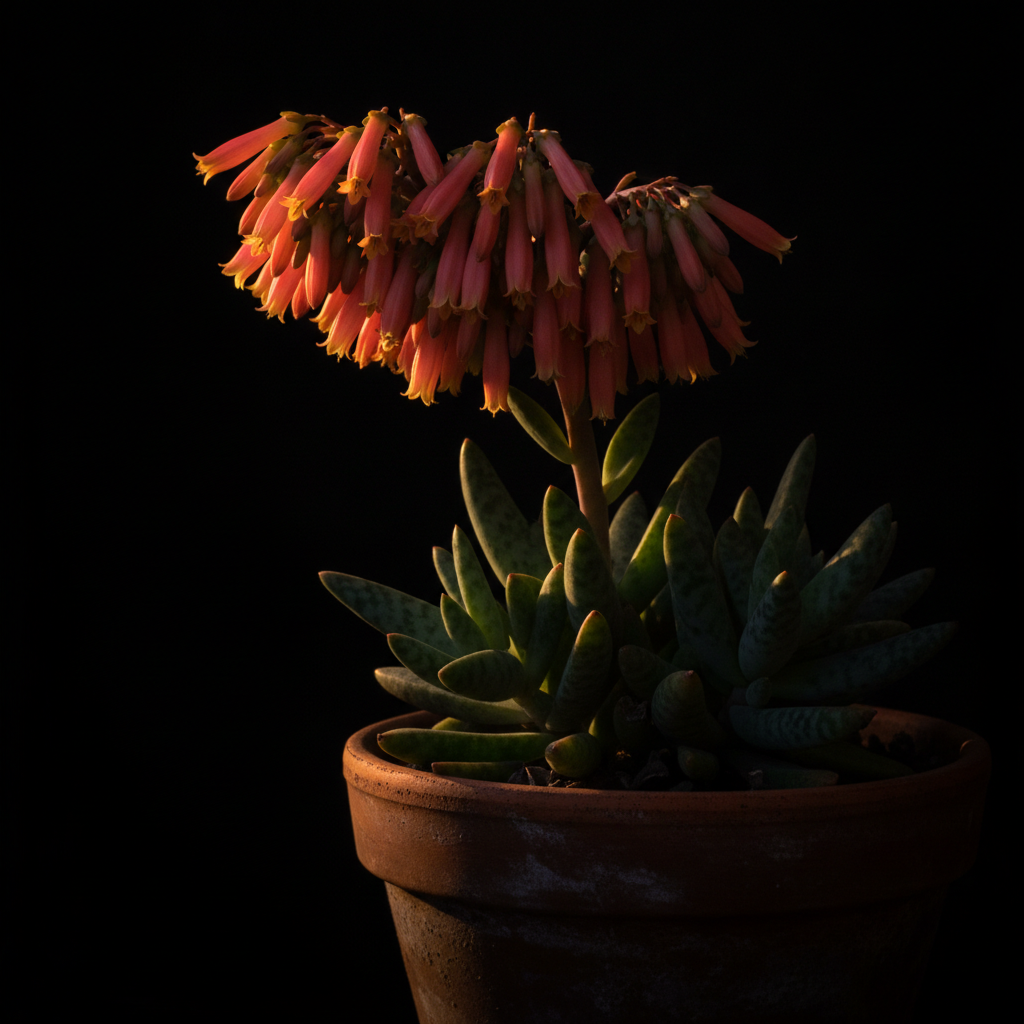
Chandelier Plant
The same species in its winter glory, topped with a hanging cluster of tubular coral to salmon-orange flowers that give it the chandelier nickname. Reaching this flowering stage takes a mature plant, a full season of strong light and a cool, dry winter rest.
Variety Profiles in Detail
Mother of Thousands (Kalanchoe daigremontiana)
The broad-leaved counterpart and the plant most often confused with the true mother of millions. Instead of narrow tubes it has wide, blue-green triangular leaves lined with neat rows of plantlets along their scalloped edges. It tends to grow as a single upright stem and is just as easy, and just as toxic and invasive, as its slender cousin.
Kalanchoe x houghtonii (Kalanchoe x houghtonii)
A naturally occurring hybrid between the two species above, combining their traits into a vigorous, mid-width-leaved plant that produces plantlets with extraordinary enthusiasm. It is the form most likely to escape and naturalise outdoors, so it deserves extra care in warm regions, but indoors it is a fast and rewarding grower.
Choosing the Right Variety for Your Space
For a sculptural, architectural look choose the true Kalanchoe delagoensis with its slim, upright stems, while the broad-leaved mother of thousands gives a bolder, more graphic silhouette. If you live in a warm climate and worry about the plant spreading outdoors, the sterile-plantlet ‘Pink Butterflies’ is the most responsible and arguably the prettiest choice. Whichever you pick, the care is the same, so let appearance and your conscience about invasiveness guide the decision.
Frequently Asked Questions
Is mother of millions poisonous to cats and dogs?
Yes, and seriously so. Every part of the plant contains bufadienolide cardiac glycosides that can cause vomiting, drooling, lethargy and dangerous heart rhythm changes in cats and dogs, with the risk highest for grazing animals. Keep it well out of reach, sweep up dropped plantlets, and contact a vet immediately if you suspect your pet has eaten any.
Why is my mother of millions tall and floppy?
This is etiolation, caused by too little light. The plant stretches and produces weak, widely spaced growth as it reaches for a brighter source. Move it to your sunniest window or add a grow light. The existing stretched growth will not tighten up, but you can cut the plant back and let it regrow compactly in better light, or root the cuttings.
How often should I water it?
Only when the soil has dried out completely, which in good light usually means every two to three weeks in summer and once a month or less in winter. Always judge by the dryness and weight of the pot rather than the calendar, and err on the side of underwatering since this succulent handles drought far better than soggy soil.
Why does it produce so many plantlets?
The plantlets are the plant’s primary reproductive strategy, a form of asexual cloning that lets it colonise ground rapidly. Each forms along the leaf edge with its own leaves and root buds, ready to grow the instant it drops. It is entirely normal and a sign of a healthy plant, though you may want to remove plantlets to keep the plant tidy and prevent them sprouting in other pots.
Will it flower indoors?
It can, given the right conditions. A mature plant grown in strong light through the year, then given a cool, dry rest over winter, may reward you with a cluster of pendant tubular flowers in coral and orange shades, usually in late winter. Young or low-light plants rarely bloom, so patience and good light are the keys.
Is mother of millions the same as mother of thousands?
They are different but closely related species often confused with one another. Mother of millions (Kalanchoe delagoensis) has narrow, cylindrical leaves, while mother of thousands (Kalanchoe daigremontiana) has broad, flat triangular leaves. Both bear plantlets along their leaves, both are toxic, and both need identical care, so the difference is mainly one of appearance.
My plant is rotting at the base. Can I save it?
Often, yes, if you act quickly. Cut away all the soft, blackened tissue with a sterile blade until you reach firm, healthy growth, let the cuttings dry and callus for a day or two, then replant the firm sections in dry, gritty mix. Take a few plantlets as insurance, and review your watering, since base rot almost always comes from soil that stayed too wet.
Can I grow mother of millions outdoors?
In a frost-free, warm climate it grows outdoors with ease, but that is exactly the problem. The plant is a declared invasive weed in many warm regions because its plantlets spread so aggressively and it is toxic to livestock. In cooler climates it can spend summer outside in a pot and come in before frost, but never plant it in open ground where it could escape into the wider environment.






