
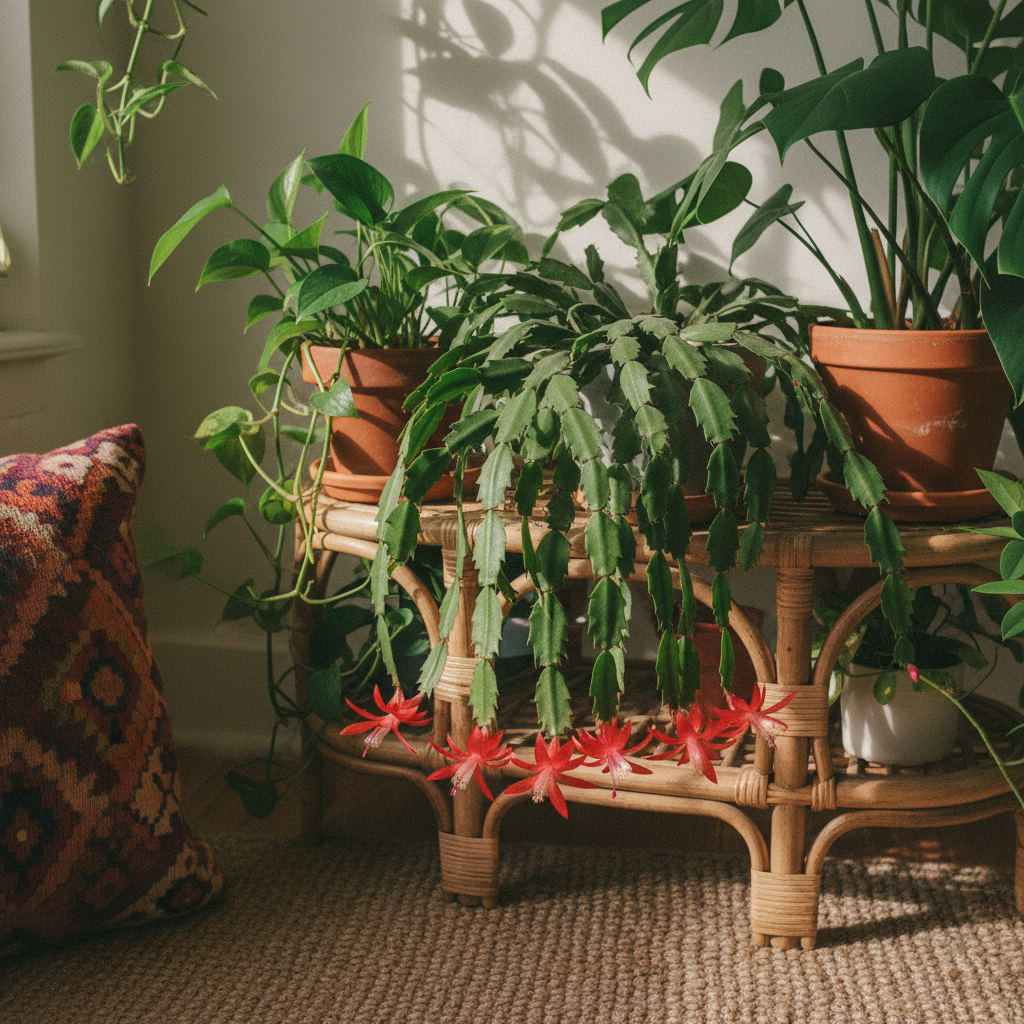
The Easter cactus is a strikingly different creature from the desert cacti most people picture when they hear the word. Known botanically as Hatiora gaertneri and often sold under its older name Rhipsalidopsis gaertneri, it is an epiphytic forest cactus from the misty Atlantic rainforests of southeastern Brazil, where it clings to mossy tree branches rather than rooting in sand. Sometimes labelled the spring cactus or Whitsun cactus, it produces an astonishing flush of five-pointed, star-shaped scarlet flowers each spring, traditionally timed to open around Easter in the northern hemisphere. Outside of that brief but spectacular flowering window it sits quietly as a softly cascading collection of segmented, scalloped green stems that look at home on any bright shelf.
Among the holiday cacti, Easter cactus has a reputation for being the trickiest, mostly because its bloom cycle is more demanding than that of its Christmas and Thanksgiving cousins. The truth is that surviving an Easter cactus is easy — keep it out of direct sun, water with restraint, and it will live happily for decades. Thriving, with annual cascades of flowers, asks for a little more attention to temperature, light and rest. This guide walks through everything from quick-reference numbers to the seasonal rhythm that makes the plant bloom reliably, the cultivars worth seeking out, and the small handful of problems that can knock it off course.
Contents
- Quick Reference
- Why Easter Cactus Makes a Rewarding Houseplant
- Light Requirements
- Watering & Humidity
- Soil, Potting & Repotting
- Fertilising
- Propagation
- Pests & Diseases
- Popular Varieties
- Frequently Asked Questions
Quick Reference: Easter Cactus at a Glance
| Botanical name | Hatiora gaertneri (syn. Rhipsalidopsis gaertneri) |
| Light | Bright indirect light; no direct midday sun |
| Watering | Water thoroughly when the top 2 to 3 cm (1 inch) of mix is dry; reduce sharply in autumn rest |
| Temperature | 16 to 24 degrees C (61 to 75 F) growing; 8 to 12 degrees C (46 to 54 F) cool rest in autumn |
| Humidity | 40 to 60 percent; tolerates average rooms |
| Fertiliser | Balanced or low-nitrogen feed at quarter strength, monthly in growth |
| Soil | Loose, slightly acidic, very free-draining; aroid or orchid mix works well |
| Pot size | Slightly under-potted; flowers best when modestly root-bound |
| Mature size | Around 30 cm tall by 45 cm wide (12 by 18 inches) with mature pendulous habit |
| Bloom time | March to May, around Easter in the northern hemisphere |
| Lifespan | 20 plus years with reasonable care; can become a family heirloom |
| Toxicity | Non-toxic to cats, dogs and humans per ASPCA records |
| Origin | Atlantic rainforest of southeastern Brazil, epiphytic in cool montane forest |
Why Easter Cactus Makes a Rewarding Houseplant
Easter cactus rewards patience like very few other houseplants. For most of the year it sits as a quiet, structural plant with arching jointed stems that drape elegantly over the edge of a pot or shelf. Then, in the weeks leading into spring, fat bullet-shaped buds begin to swell at the tips of the youngest segments, and within a fortnight the entire plant erupts into vivid five-pointed flowers. A mature specimen in full bloom can carry more than a hundred flowers at once, and because the blooms last several days each, the show stretches across several weeks rather than vanishing overnight.
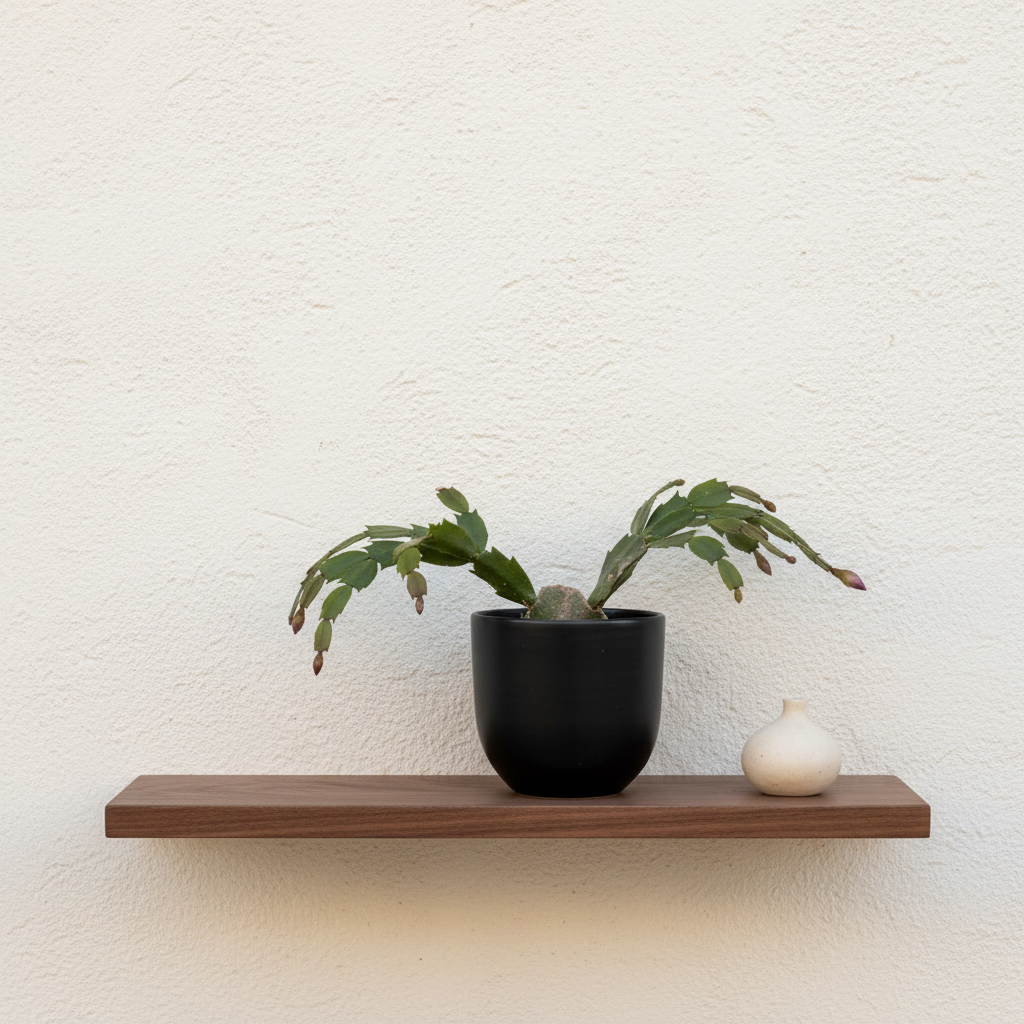
It is also an unusually long-lived houseplant. Specimens passed down through three generations are not unusual, and a well-tended Easter cactus will outlive most ferns, calatheas and prayer plants by decades. Because the segmented stems detach cleanly at the joints, any plant that becomes too large can be propagated into a dozen new ones with no specialist equipment. That makes Easter cactus one of the easiest plants to share with friends and family — and, for many growers, the holiday cactus that ties together childhood memory and adult home.
The plant is also genuinely safe around pets and children. Unlike many of the popular houseplants that share shelf space with it — peace lilies, pothos, dieffenbachia, philodendrons — Easter cactus contains no calcium oxalate raphides and is listed by the ASPCA as non-toxic to cats and dogs. Curious teeth on a stem segment will not harm a pet, although the plant itself will not appreciate the editing.
Important — Toxicity: Easter cactus is non-toxic to humans, cats and dogs. Ingestion of the fleshy stem segments may cause mild stomach upset simply because of the volume of fibre and sap, but no toxic compounds are involved. It is one of the safest flowering houseplants to keep in a home with pets.
Light Requirements
In the wild, Hatiora gaertneri grows as an understorey epiphyte in cool, humid montane forests, perched on the mossy branches of taller trees and shaded by an overhead canopy. That ecology dictates almost everything about its light preferences indoors. The plant evolved under bright but heavily filtered light, with the sun reaching it only as dappled patches through leaves, never as a direct shaft. Indoors, the closest match is a position with bright indirect light all day, and no more than a few minutes of weak early-morning or late-afternoon direct sun.
The ideal spot for most growers is about a metre back from an unobstructed east-facing window, or close to a north-facing window in the brighter months. South and west aspects can also work, provided a sheer curtain, blind or larger plant filters the direct midday and afternoon sun. If you can hold a hand a few centimetres above the plant at noon and feel no warmth on your skin, the light level is right.
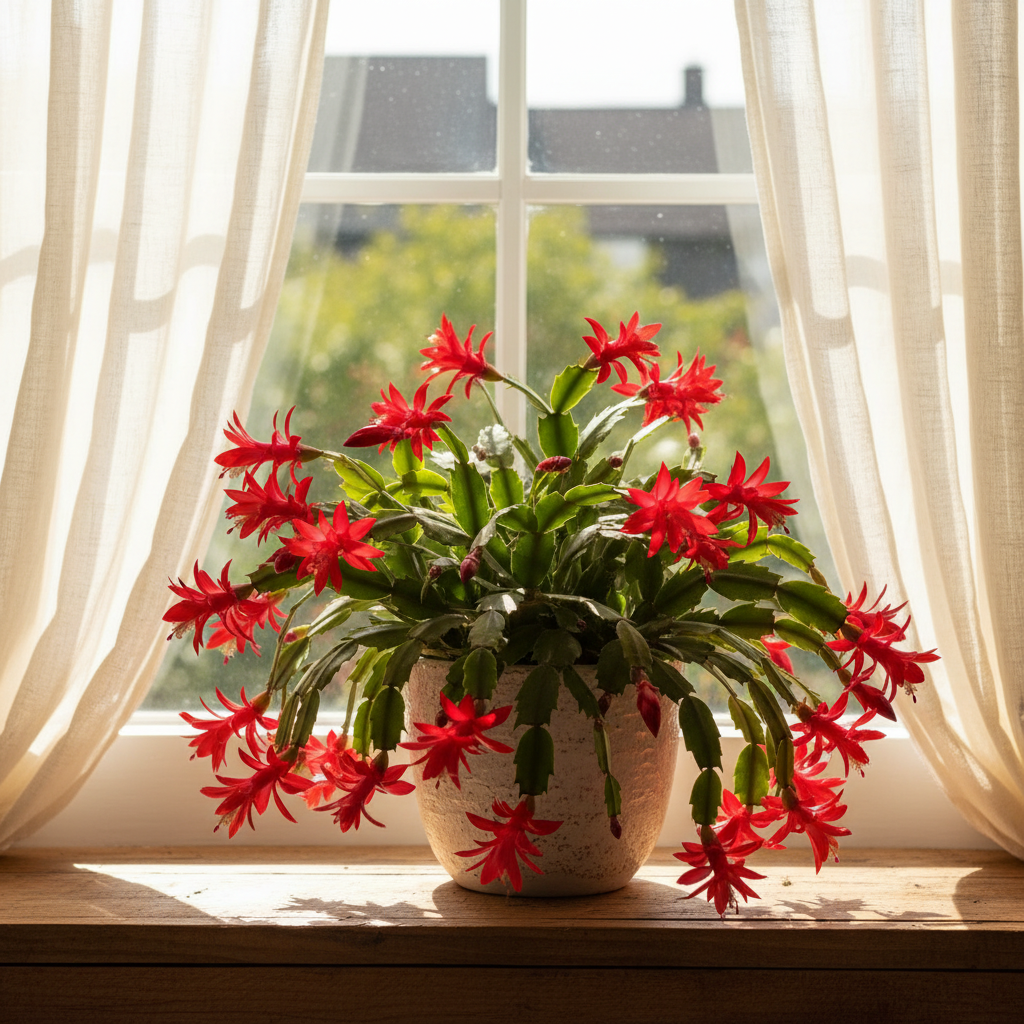
Light Levels Explained
Different categories of indoor light have specific consequences for the appearance and bloom performance of an Easter cactus. The table below maps the general light tiers to typical indoor locations and the outcome you should expect from each.
| Light Category | Approx. Level | Typical Location | Outcome |
|---|---|---|---|
| Direct sun | 20,000 lux and above | Touching a south or west window in summer | Stems redden, then bleach to yellow or papery white; sunscald in days |
| Bright indirect | 10,000 to 20,000 lux | One metre back from an east window, or behind a sheer at a brighter window | Ideal: dense growth, plump segments, abundant spring bloom |
| Medium indirect | 5,000 to 10,000 lux | Two to three metres into a sunlit room | Healthy plant, slower growth, reduced bloom count |
| Low | 1,000 to 5,000 lux | North-facing window in winter, or back of a bright room | Survives; bloom becomes erratic; segments thin and elongate |
| Very low | Below 1,000 lux | Interior corridor or windowless room | Will decline over months; rarely or never flowers |
Window Orientation and Placement
South-facing window: Bright enough to bleach the stems if the plant is placed directly on the sill, especially between April and September. Pull the plant back at least a metre, or filter the light with a sheer curtain, frosted film or larger leafy plant in front. South light during the short days of midwinter is usually fine without filtering.
East-facing window: The single best aspect for Easter cactus in most homes. Morning sun is weak enough to be tolerated directly for an hour or two, and bright indirect light fills the rest of the day. Placement right on the sill is usually fine year-round in temperate climates.
West-facing window: Workable, with caveats. Afternoon sun in summer is hotter than morning sun and arrives at a low angle, so it can be more damaging than south sun. Use a sheer curtain or move the plant a metre back from the window between May and August.
North-facing window: A safe position for the summer half of the year, when even north windows deliver useful light intensity. In winter, north light alone may drop below the threshold for healthy growth and bud initiation, so consider supplementing with a grow light or moving the plant temporarily to a brighter aspect.
Pro Tip — Read the Stems: The colour of the youngest stem segments is a reliable real-time light meter. Bright fresh green means the light is right. A reddish or purplish flush at the segment edges indicates the plant is receiving more sun than it would like and should be moved a little further from the window. Pale, elongated, almost translucent new growth signals the opposite — not enough light, and the plant is stretching to find more.
How Light Affects Bloom Set
Easter cactus is a long-night plant, meaning bud initiation is triggered by a period of long uninterrupted darkness combined with cool temperatures in autumn. From late September through about mid November, the plant needs at least twelve to fourteen hours of total darkness each night to set the next spring’s flower buds. A lamp left on in the same room, or even strong street lighting through an uncurtained window, can be enough to interrupt the dark period and suppress bud set entirely. If a previously reliable plant has skipped a year of flowering with no obvious cause, light contamination at night is almost always the explanation.
Warning — Direct Sunlight: Stems exposed to direct sun for more than an hour or two a day in the warmer months will redden, then yellow, then develop papery brown sunscald patches that never recover. The damage is permanent on the affected segments, although the plant itself will usually grow out of it with time. Move the plant before stems bleach to white.
Artificial Lighting
In homes with poor natural light, a modest full-spectrum LED grow light positioned 30 to 45 cm (12 to 18 inches) above the plant for ten to twelve hours a day during the growing season is more than enough to keep an Easter cactus healthy. The light requirement is lower than for most flowering houseplants. Critically, however, the grow light needs to be on a timer that switches off well before evening from late September onward, so the autumn dark-period requirement is preserved. A timer set for 8 am to 4 pm in autumn approximates the natural day length the plant is looking for.
Seasonal Adjustments
From spring through early autumn, position the plant for steady bright indirect light. From late September to mid November, both the duration of darkness and the temperature matter more than the absolute light intensity by day — see the section on bloom triggering for the full protocol. After flowering finishes in May, the plant can be moved outdoors to a shaded porch or balcony for the summer, where the natural fluctuation in temperature and light tends to produce particularly robust growth and a heavier bloom the following spring.
Watering & Humidity
The single biggest source of failure with Easter cactus is misunderstanding its watering needs. Because the plant is called a cactus, many growers treat it the way they would treat a desert species and let it bone-dry for weeks between waterings. That is a disaster. The forest epiphytes of the genus Hatiora evolved in a perpetually humid environment where their roots received frequent light moisture from rain, fog and tree drip, and the substrate around them was always damp but never waterlogged. Indoors, the goal is to mimic that pattern: water generously when the substrate has started to dry, but never allow it to desiccate completely outside of the deliberate autumn rest.
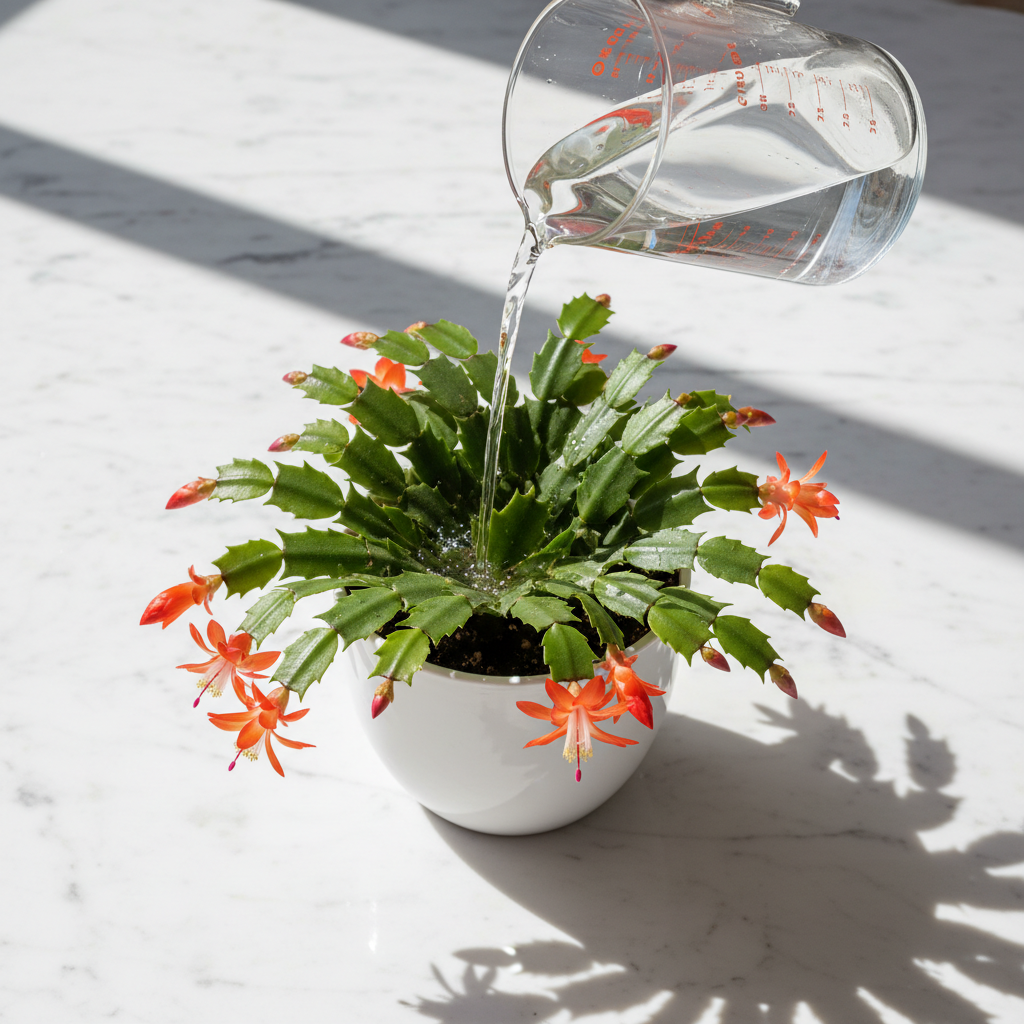
How to Water
Use room-temperature water and pour slowly and evenly across the surface of the substrate until water begins to run from the drainage holes at the base of the pot. Let the pot drain freely for several minutes, then pour off any water that has collected in the saucer or cover pot. Standing water at the base of the pot kills more Easter cacti than any pest or disease, because it suffocates the fine roots and creates ideal conditions for the soil fungi that cause root rot.
Check moisture by pressing a finger into the top 2 to 3 cm (1 inch) of substrate. When that layer feels just dry to the touch, water again. Avoid relying purely on a calendar schedule — the actual interval will range from four days in a warm summer position with airflow to two weeks or more in a cool winter spot.
The Seasonal Watering Rhythm
Easter cactus has four distinct watering phases through the year, tied directly to the bloom cycle. Getting the rhythm right is the difference between a plant that survives and one that genuinely thrives.
| Phase | Period | Approach |
|---|---|---|
| Active growth | June to mid September | Water thoroughly whenever the top 2 to 3 cm of mix is dry. Substrate stays consistently lightly moist below the surface. |
| Autumn rest | Late September to mid November | Reduce watering sharply. Allow the top 5 cm to dry between waterings, and time waterings to coincide with cooler temperatures. |
| Bud development | Late November to February | Resume normal watering at a moderate level. Keep the substrate evenly moist as buds swell. Never let buds dehydrate while developing or they will abort. |
| Bloom and recovery | March to May | Water consistently and a little more generously through flowering. After the last flower fades, ease off slightly for two weeks before the next active growth phase begins. |
Water Quality
Easter cactus is moderately sensitive to hard tap water. Heavy mineral content will accumulate as a white crust on the surface of the substrate and along the pot rim over time, and very salty water can scorch the fine root tips. If your tap water is very hard, fill a watering can the evening before and let it stand uncovered overnight so dissolved chlorine can dissipate, then water in the morning. Rainwater, distilled water or filtered water is preferred where available, although it is not strictly necessary. Avoid softened water, which trades calcium for sodium and is genuinely damaging to the roots.
Humidity
As a forest epiphyte, Easter cactus prefers ambient humidity in the 40 to 60 percent range, which is comfortably within the range of most occupied homes. Very dry winter air, common in centrally heated apartments, can cause the youngest segments to wrinkle slightly and may reduce bloom count, but it is rarely catastrophic. A small ultrasonic humidifier running in the same room, or grouping the plant alongside other foliage, is enough to raise local humidity by ten to fifteen percent. Light misting of the stems on hot summer mornings is harmless and welcomed, although misting is not a substitute for a properly regulated room.
Common Watering Problems
Limp, soft stems near the base: Almost always root rot from overwatering or poor drainage. Check the roots immediately; healthy roots are firm and pale, while rotting roots are brown, mushy and may slip out of their tissue when pinched.
Wrinkled segments and soft tips: Counter-intuitively, this can mean either chronic underwatering or root damage from overwatering that has left the plant unable to take up moisture. Inspect the roots before deciding which way to correct.
Bud drop just before flowering: Usually caused by a sudden change in moisture level — either drying out completely or being soaked after a long dry spell. Keep the substrate evenly moist once buds appear.
Pro Tip — Lift the Pot: The fastest way to learn the right watering interval for any single Easter cactus is to weigh the pot in your hand immediately after a thorough watering, and again a week later. The dry weight you arrive at over time becomes a far more reliable cue than any finger test. Lift, compare, and water when the pot feels markedly lighter than its just-watered weight.
Soil, Potting & Repotting
Substrate is the second most important variable after watering, and the two interact closely. Because Easter cactus grows on tree branches in the wild rather than in mineral soil, it has a strong preference for a loose, airy, slightly acidic medium that holds some moisture but drains very freely. A standard houseplant compost is too dense and stays wet for too long; a sharp desert-cactus mix dries out too quickly and starves the fine roots of nutrients. The sweet spot is an aroid-style mix with significant bark content, or an orchid mix amended with a moisture-retentive component.
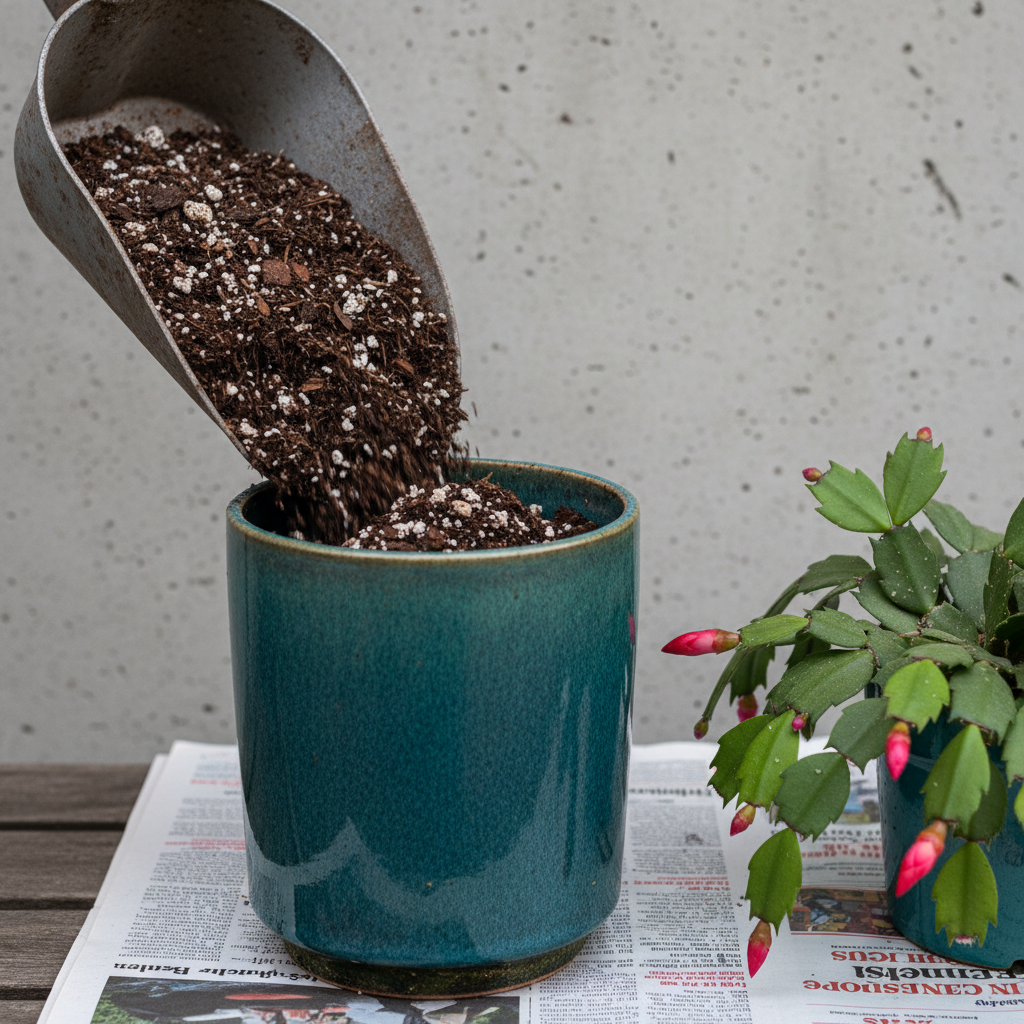
A Recipe That Works
The following blend has been used reliably across many specimens. Mix by volume, not by weight, and combine thoroughly so the components are evenly distributed:
- Two parts good-quality peat-free houseplant compost, or coco coir mixed with worm castings at a ten to one ratio.
- One part fine to medium orchid bark.
- One part perlite or pumice.
- A small handful of horticultural charcoal per litre of finished mix, to keep the medium sweet and to absorb stray salts.
The finished mix should feel light and chunky in the hand and should pour through your fingers without compacting. If you squeeze a handful and it stays in a tight clump, add more bark and perlite until it falls apart cleanly. A slightly acidic pH in the range of 5.5 to 6.5 is ideal, although the plant tolerates a wider window than that.
Choosing a Pot
Pot choice matters more for Easter cactus than for most houseplants because the plant flowers best when slightly root-bound. Choose a pot that is only marginally larger than the current root mass — 2 to 3 cm (1 inch) of fresh substrate around the rootball at most. A pot that is too generous holds excess moisture and tips the plant toward root rot, and the loose root environment encourages leafy stem growth at the expense of buds.
Terracotta is excellent because it breathes and helps the substrate dry evenly. Glazed ceramic and plastic both work, provided the pot has at least one generous drainage hole. Hanging baskets are an outstanding match for the plant’s pendulous habit but tend to dry faster, so substrate moisture deserves more attention. Decorative cover pots without drainage holes should only be used as outer sleeves around a properly drained inner pot.
When to Repot
Easter cactus does not need frequent repotting. Plan to repot once every three to four years, or whenever the substrate has broken down into a dense water-retentive mass, the roots are visibly circling the bottom of the pot, or the plant lifts the substrate out as a single rootbound disc. The best time to repot is in late spring, immediately after flowering has finished and before the active growth phase begins. Repotting during bud development or bloom will almost always trigger bud drop and should be avoided.
How to Repot
- Water the plant lightly the evening before repotting, so the roots are hydrated but not saturated.
- Tip the plant gently on its side and ease the rootball out of the existing pot. Avoid yanking by the stems, which detach easily at the segment joints.
- Tease away loose substrate from the outside of the rootball with your fingers. Do not bare-root the plant; leave the inner core undisturbed.
- Inspect the roots and trim any soft, brown or rotting sections with sterilised scissors. Healthy roots are pale, firm and slightly translucent.
- Place a 2 cm layer of fresh substrate at the bottom of the new pot, position the plant at the same depth as before, and fill in around the rootball. Tap the pot gently on the bench to settle the mix; do not compact it hard.
- Water lightly to settle the substrate, then withhold further water for three to five days while any disturbed roots heal.
Pro Tip — Keep the Pot Snug: An Easter cactus that has been growing happily in the same pot for three or four years and is flowering well may not need a new pot at all — only fresh substrate. Lift the plant, remove as much old mix as possible without damaging the roots, and replant in the same pot with new mix. This refreshes the medium without disturbing the snug root environment that triggers flowering.
Fertilising
Easter cactus is a light feeder. In the wild, its roots scavenge a thin trickle of nutrients from decomposing leaf litter, bark and mosses around it, never a concentrated nutrient pulse. Indoors, that translates to small regular feeds during the growing season and total rest during autumn. Overfeeding produces lush soft growth that flowers poorly and rots more easily; under-feeding shows up as pale, stalled, slightly chlorotic stems with reluctant bud set.
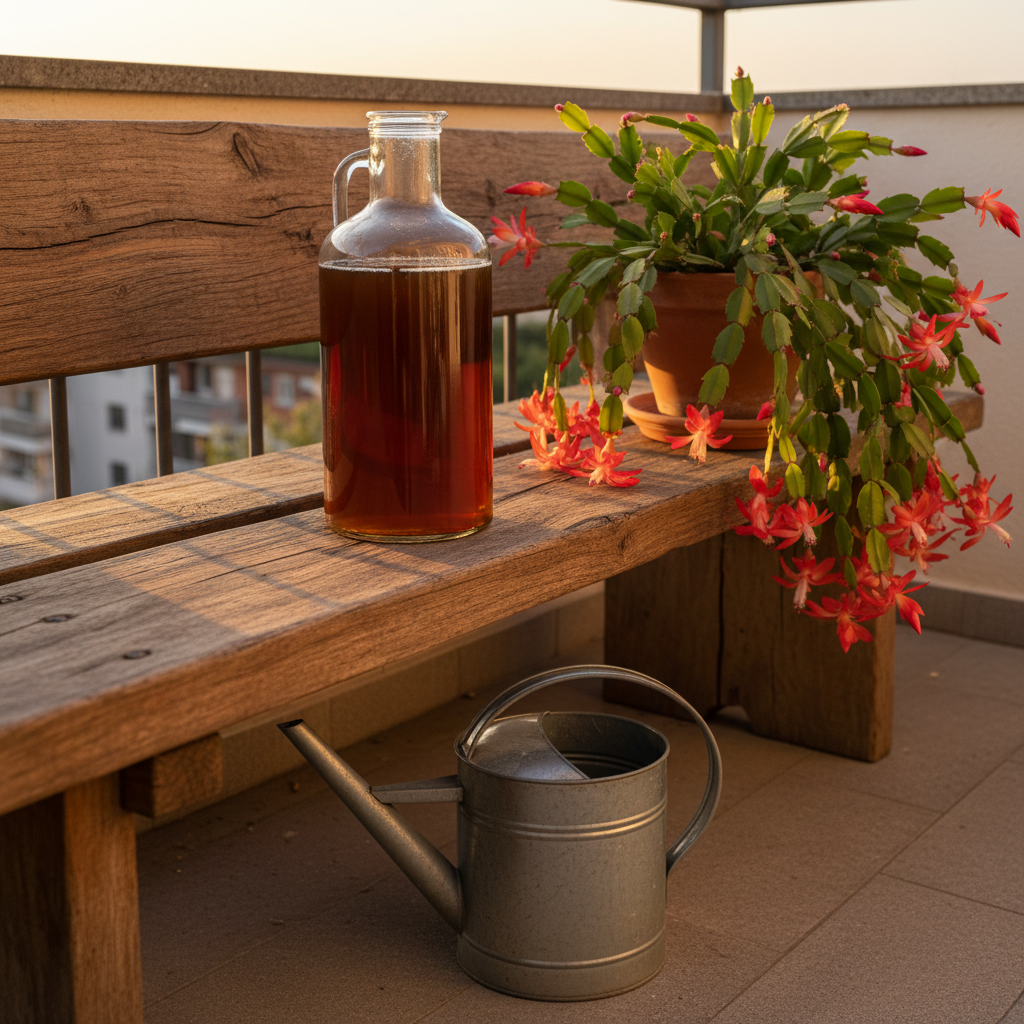
What to Feed
A balanced liquid houseplant fertiliser at quarter strength, or a dedicated cactus-and-succulent feed at half the manufacturer’s recommended rate, works well throughout the active growth season. Look for an NPK around 5-5-5 or 7-7-7. From late winter as buds begin to form, switching to a low-nitrogen, higher-phosphorus and potassium formula (something like 2-7-7 or 0-10-10) supports better flower development. Worm castings or compost tea make excellent organic alternatives and are particularly forgiving — the slow nutrient release is closer to what the plant evolved with.
When to Feed
| Period | Feed | Frequency |
|---|---|---|
| June to mid September | Balanced liquid feed at quarter strength | Every fortnight |
| Mid September to late November | None — autumn rest | Stop feeding entirely |
| December to February | Low-nitrogen bloom feed at quarter strength | Once a month |
| March to May (in bloom) | Low-nitrogen bloom feed at quarter strength | Once a month, lighter touch |
| After bloom, mid May | Light balanced feed to recover | Once or twice across the month |
Signs of a Feeding Problem
Pale, yellowing segments across the whole plant: Long-term under-feeding, especially nitrogen deficiency. Resume regular feeds at quarter strength for several months and watch for new green growth at the tips.
Brown crusty tips and edges on the segments: Fertiliser burn from over-application or build-up of mineral salts. Flush the substrate thoroughly with three pot volumes of plain water and reduce the feed concentration by half going forward.
Soft floppy growth that flowers poorly: Too much nitrogen. Switch immediately to a low-nitrogen formula and re-pot in fresh substrate at the next opportunity.
Warning — Salt Build-Up: Over months and years, dissolved salts from fertiliser and tap water accumulate in the substrate and can damage the fine roots. Flush the pot with plain water — at least three times the pot’s volume — every three to four months. If you see a white crust forming on the substrate surface or on the inside of a terracotta pot, the plant is overdue a flush.
Propagation
Easter cactus is one of the most generous houseplants to propagate. The segmented structure of the stems means a new plant can be started by simply detaching a piece at one of the natural joints; no specialist cut, hormone or equipment is required. A single mature specimen will provide enough material for two dozen new plants without any visible impact on the parent. The trick is to give the cuttings a few days of dry callusing time, and to keep them slightly under-watered as they root, mimicking the relatively dry tree-branch microclimate they would have rooted into in the wild.
When to Propagate
The best window is from late May through July, immediately after the plant has finished flowering and is moving into active summer growth. Cuttings taken in this window root quickly and establish well before the autumn rest. Cuttings taken in autumn or winter will still root eventually, but progress is slow and losses to rot are higher. Avoid taking material during bud development, as that pulls reserves away from flower formation.
Stem-Segment Cuttings (the Standard Method)
- Choose a healthy mature stem and twist or pinch it gently at a joint to detach a piece of two to three segments. The natural joint snaps cleanly with little effort; no scissors required.
- Lay the cuttings on a piece of kitchen paper out of direct sun and leave them to callus for two to four days. The cut surface should look dry, slightly puckered and pale before the next step. Skipping this step is the single most common cause of rot during propagation.
- Fill a small pot (8 to 10 cm diameter) with fresh propagation mix — half perlite, half coco coir or fine bark works very well. Moisten the mix lightly so it is damp but not soaking.
- Push the callused end of each cutting about 1 cm into the substrate. Several cuttings can share a pot, spaced 3 to 4 cm apart, which actually speeds rooting because they create a humid microclimate together.
- Place the pot in bright indirect light, well away from any direct sun, at room temperature.
- Wait two weeks before watering for the first time. After that, water lightly when the surface of the mix is dry; the cuttings need very little water until roots are established.
- By six to eight weeks the cuttings should be firmly rooted. Gentle resistance when you tug very lightly on a segment is the sign roots have taken hold.
- Pot up into a regular Easter cactus substrate and treat as a mature plant from that point. A young plant rooted in summer will often produce its first flowers in spring two years later.
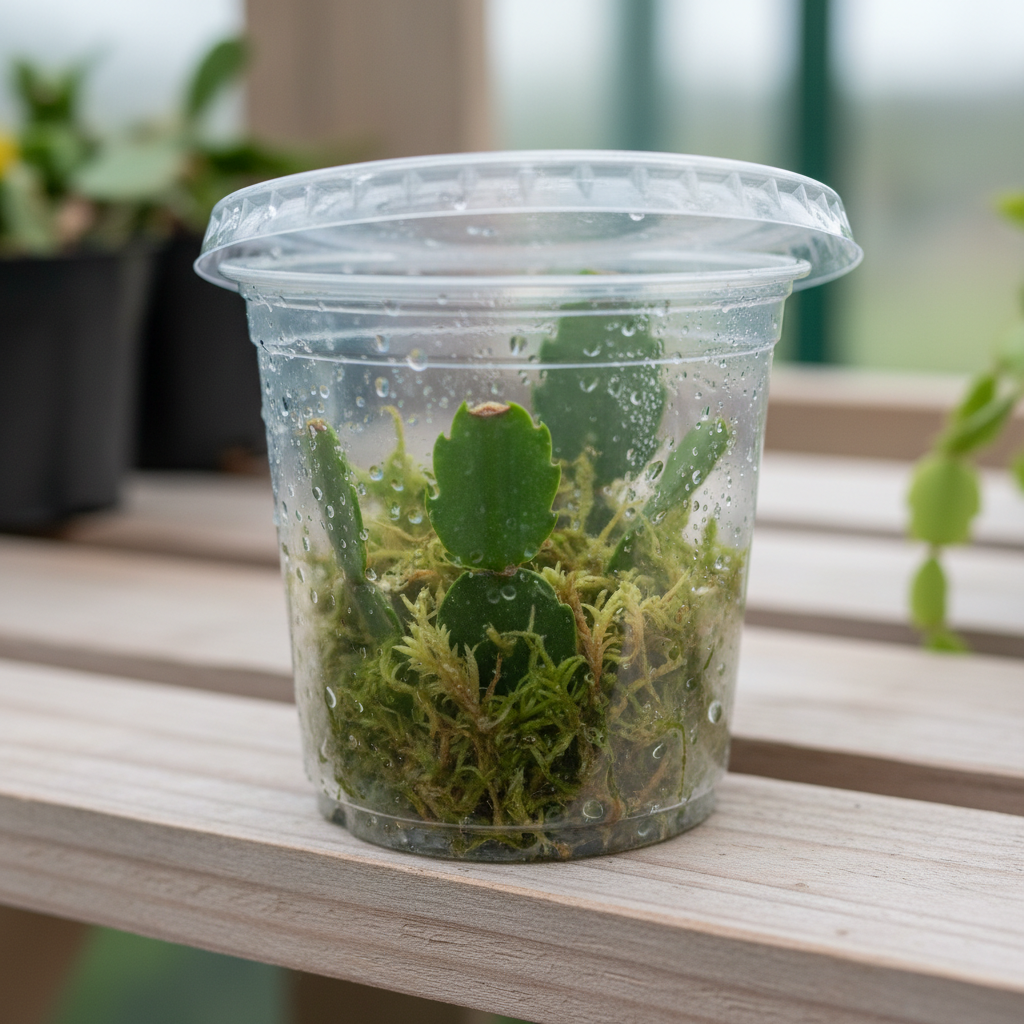
Sphagnum Moss in a Deli Cup
An alternative method, popular among growers who want maximum rooting reliability, is to nestle the callused cuttings into damp sphagnum moss inside a clear plastic deli cup with the lid slightly ajar. The high humidity and clean medium produce strong root systems within four to six weeks, and the transparent walls let you watch the roots develop. Once roots reach a couple of centimetres long, transplant carefully into a standard substrate, keeping the moss attached to the new roots to minimise transplant shock.
Water Rooting (Not Recommended)
Easter cactus can technically be rooted in water, like many other forest cacti, but it is the least reliable method for this species. The roots that form in pure water are structurally different from soil-grown roots, and the cuttings often struggle to transition into substrate afterwards. If you do try it, change the water every three days, keep the cuttings out of direct sun, and move them into substrate as soon as the first roots reach 1 cm — do not wait for a long root system to develop in the water.
Pro Tip — Twist, Do Not Cut: The segments are designed to detach at their joints, and a clean twist breaks them at exactly the natural abscission point with very little exposed tissue. A scalpel or scissors cut across a segment creates a much larger wound that takes longer to callus and is more vulnerable to rot. Pinch with two fingers and twist a quarter turn; the segments separate without resistance.
Pests & Diseases
Easter cactus is relatively pest-resistant. The waxy, smooth surface of the segments offers little purchase for the soft-bodied insects that plague tropical foliage plants, and the firm tissue is unattractive to most chewing pests. When problems do appear, the usual culprits are mealybugs hiding in the segment joints, fungus gnats in chronically wet substrate, and scale on older specimens. The bigger threat tends to be fungal rot from overwatering, which can take down an otherwise healthy plant in days.

Common Pests
Mealybugs: The most common Easter cactus pest. They appear as small white cottony lumps in the joints between segments, where they are well protected from casual inspection. Heavy infestations produce sticky honeydew on the lower segments and a slight yellowing of affected tissue. Treat by dabbing each individual mealybug with a cotton bud dipped in 70 percent isopropyl alcohol, then follow up with a weekly insecticidal soap spray for three weeks to catch any newly hatched crawlers. Inspect new acquisitions carefully before placing them near established plants.
Fungus gnats: Small dark flies that breed in chronically moist substrate. The adults are harmless to the plant but signal that the medium is staying wet for too long. The larvae can graze on fine root hairs and cause slow decline in seedlings or cuttings. Let the top layer of substrate dry out fully between waterings, top-dress with a 1 cm layer of horticultural grit, and use yellow sticky traps to break the breeding cycle. Bacillus thuringiensis israelensis (Bti) applied as a substrate drench kills the larvae without harming the plant.
Scale insects: Less common but harder to dislodge once established. They appear as flat brown or tan oval bumps along the lower stems and segment edges, often near old leaf scars. Scrape off visible individuals with a soft-bristled toothbrush, treat the plant with horticultural oil sprayed thoroughly across all surfaces, and repeat at fortnightly intervals for at least three applications.
Spider mites: Rare on Easter cactus but possible in very dry warm air. Fine webbing across the segment joints and a stippled, dusty appearance to the stems are the giveaways. Raise humidity, rinse the plant thoroughly under tepid water and apply insecticidal soap if needed.
Diseases
Root rot: By far the most serious problem. Caused by chronically wet substrate, poor drainage, or overpotting. Symptoms include limp soft segments near the base, blackened slimy roots, and a sour smell from the substrate. If caught early, unpot the plant immediately, cut away all soft black roots with sterilised scissors, dust the cut surfaces with cinnamon powder or a sulphur-based powder, and repot in fresh dry substrate. Withhold water for at least a week. In advanced cases, the only realistic option is to cut healthy segments from the upper plant and propagate them as cuttings; the rootball is unsalvageable.
Stem rot (Erwinia or Fusarium): Soft mushy patches that spread along the stem, often starting at a damaged joint. Excise the affected segments well below the rotting tissue with sterilised scissors, treat the cut with cinnamon or a copper-based fungicide, and improve airflow around the plant. Avoid misting until the plant has recovered.
Botrytis (grey mould) on flowers: Fluffy grey-brown patches on developing buds and faded flowers in cool damp conditions. Remove affected flowers immediately, improve airflow around the plant, and avoid wetting the flowers when watering.
Common Cultural Problems
Buds dropping just before opening: Sudden movement of the plant, a sharp temperature swing, a change in light direction, or drying out at the wrong moment. Once buds form, keep the plant in one place, in stable conditions, until flowering finishes.
Failure to flower: Almost always means the autumn dark and cool period was not respected. Light contamination at night, indoor temperatures above 18 degrees C through October, or both, will suppress bud initiation. See the FAQ for the full bloom-triggering protocol.
Reddish or purplish stems: Light stress from too much direct sun. Move the plant a metre back from the window or behind a sheer curtain. The colour will fade and new growth will return to bright green within a few weeks.
Pale, stretched, thin new growth: Not enough light. The plant is elongating in search of a brighter position. Move closer to a window or add a modest grow light.
Pro Tip — Quarantine New Plants: The single most effective pest-control measure for any houseplant collection is a strict two-week quarantine for any new arrival. Keep new plants in a separate room, inspect every few days for mealybugs in the joints and fungus gnats above the substrate, and only move them in with the rest of the collection once they have passed two clean weeks.
Popular Varieties
Selective breeding of Hatiora gaertneri has produced a small but interesting palette of named cultivars, mostly differentiated by flower colour rather than by foliage. The classic wild type carries the recognisable scarlet five-pointed flower, but pink, white, salmon and coral forms are widely available in spring at independent garden centres and specialist nurseries. The two cultivars below are perhaps the most reliably available and offer the clearest contrast to the standard plant.
‘Sirius’
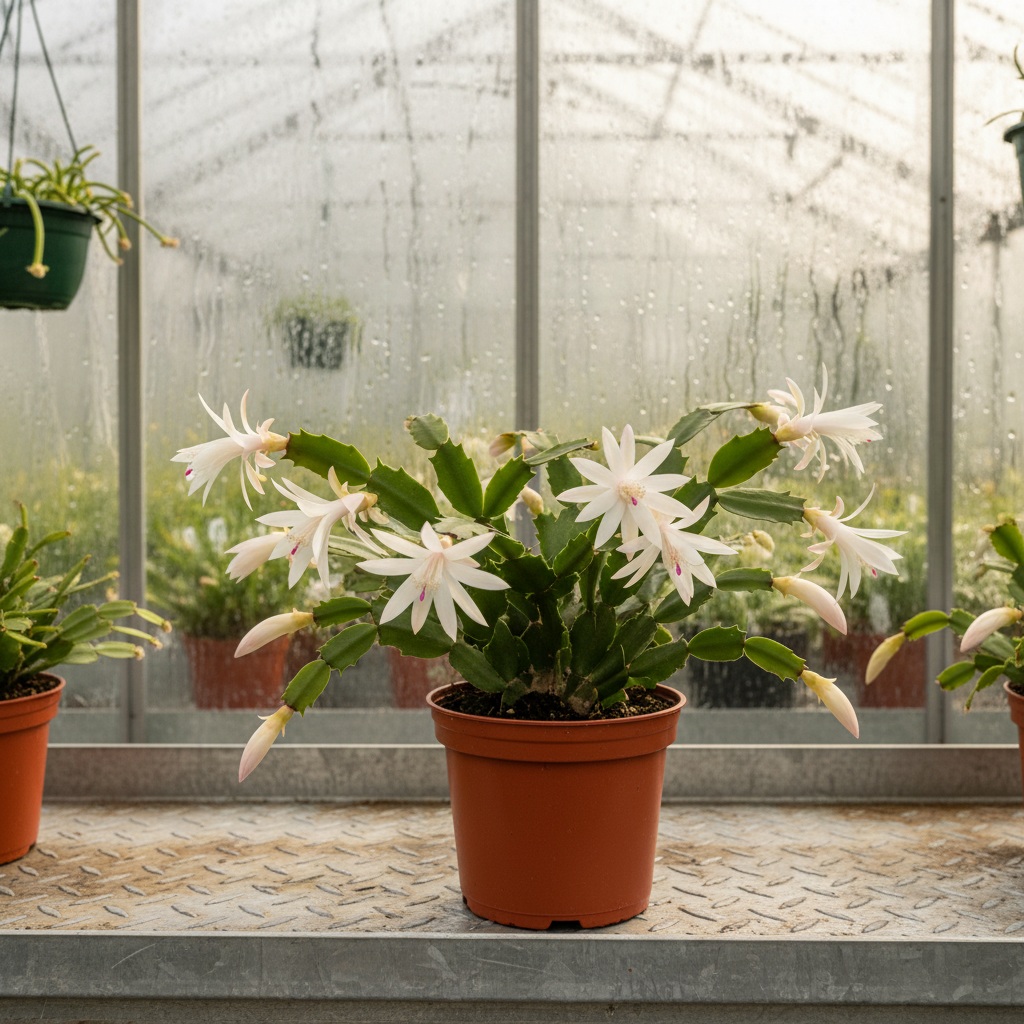
A refined cultivar with creamy ivory-white star-shaped flowers, softened by a faint blush of pink at the petal tips. The stems are a slightly softer mid-green than the species type. ‘Sirius’ is favoured by growers who want the unmistakable Easter cactus silhouette without the high-saturation red bloom. Its quieter colour palette also makes it an excellent partner to other plants on a styled shelf, where the scarlet wild type can overwhelm everything around it.
‘Andromeda’
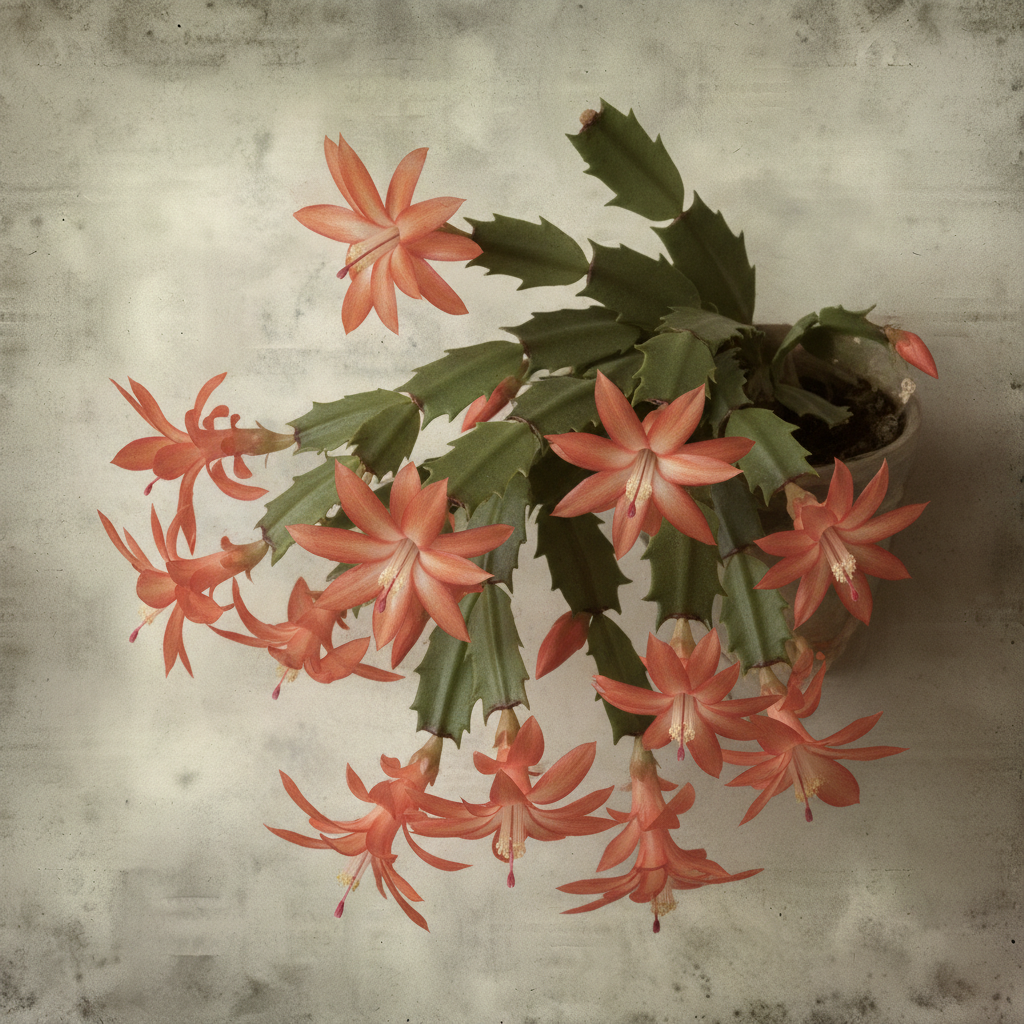
One of the most striking cultivars in commerce, ‘Andromeda’ produces vivid coral-orange flowers with elongated pointed petals that catch the light differently than the wild type. Against deep green segmented stems, the contrast is electric. It tends to flower slightly later than the species type, often extending the season by a week or two, and is reliably heavy-flowering once mature. Plants are sometimes labelled simply as the orange-flowered Easter cactus at garden centres, but the cultivar holds true when propagated from cuttings.
Other Cultivars Worth Knowing
‘Vulkan’: Deep velvety red, slightly larger flowers than the species type. A classic European cultivar widely sold across the Nordic and Dutch markets.
‘Polaris’: Soft pink with a slightly creamy throat. Gentle and unusual.
‘Phoenix’: Bright orange-red, free-flowering and vigorous, with a slightly more upright habit than the species type.
x graeseri hybrids: Crosses between Hatiora gaertneri and Hatiora rosea that produce an unusually wide range of pinks, salmons and bicolour flowers. Often sold simply as Easter cactus without further identification, but the genetic mix tends to be slightly more vigorous than either parent.
Frequently Asked Questions
How is Easter cactus different from Christmas and Thanksgiving cactus?
The three holiday cacti are botanically distinct. Christmas and Thanksgiving cacti belong to the genus Schlumbergera, while Easter cactus is Hatiora gaertneri in a separate genus altogether. The easiest way to tell them apart is by the stem segments and flowers. Easter cactus has rounded segments with shallow scalloped edges and produces radial-symmetric, five-pointed star-shaped flowers. Thanksgiving cactus has sharply pointed claw-like segments and zygomorphic (one-sided, swept-back) flowers. Christmas cactus has more rounded segments without claws and similar zygomorphic flowers, blooming earlier than Thanksgiving despite the name (its modern cultivars typically bloom in late November). Bloom timing also differs: Thanksgiving around late October to early December, Christmas in late November and December, Easter from March to May.
How do I get my Easter cactus to bloom?
Two factors trigger bud set: a long dark period each night and cool temperatures, both running for about six to eight weeks in autumn. From the last week of September through mid November, move the plant to a cool position (8 to 14 degrees C / 46 to 57 F) and ensure it receives at least twelve to fourteen hours of total uninterrupted darkness each night. An unheated spare room, an enclosed porch or a cool conservatory works well. Reduce watering during this period so the substrate dries between waterings, and stop fertilising entirely. By mid November, small buds should be visible at the segment tips. At that point, move the plant back to its normal warm bright position, resume regular watering, and wait for the show. A plant that skipped flowering last year almost certainly missed one of these inputs.
Why are the segments turning red?
A reddish, purplish or bronze flush along the edges and tips of the segments is a stress response, almost always to too much direct sunlight. The plant is producing anthocyanin pigments as a kind of natural sunscreen. It is not dangerous in the short term and the colour will fade once the plant is moved to brighter indirect light rather than direct sun. Prolonged exposure, however, leads to bleaching, sunscald and permanent damage, so do not ignore the warning.
Is Easter cactus safe for cats and dogs?
Yes. Easter cactus is listed as non-toxic to cats, dogs and horses by the ASPCA. Ingestion of stem segments may produce mild gastrointestinal upset because of the volume of fibrous tissue, but no toxic compounds are involved. It is one of the safer flowering houseplants for pet households.
My Easter cactus is dropping buds. What’s wrong?
Bud drop in Easter cactus is almost always caused by a sudden change while buds are developing. The four most common culprits, in order, are: a sharp temperature swing (especially a draught or a heating vent kicking on), the plant being rotated or moved to a new spot, the substrate drying out completely between waterings, and an abrupt change in light direction. Once buds form, treat the plant as if it were on rails — same position, same watering rhythm, same exposure, until flowering finishes. Even rotating the pot to even out growth can be enough to trigger drop.
Can I grow Easter cactus outdoors?
Yes, in the right climate. The plant tolerates outdoor conditions in the shade of a porch, balcony or large tree from late spring through early autumn, provided night temperatures stay above 8 degrees C (46 F) and the plant is protected from direct sun and heavy rain. A summer outside often produces noticeably stronger growth and heavier bloom the following spring. Bring the plant back indoors before night temperatures dip below the threshold, or use the cold outdoor nights from late September into November to provide the cool autumn period that triggers bud set — just do not let it freeze, and watch the daily forecast carefully.
How long does an Easter cactus live?
With reasonable care, Easter cactus lives for decades. Twenty to thirty years is unremarkable, and well-tended specimens passed through families can comfortably reach fifty. The plant continues to flower reliably across its whole life, with the bloom display typically increasing in scale as the plant matures and the cascading habit develops fully.
When should I repot, and into what size pot?
Repot in late May, immediately after flowering finishes and before active growth begins. Move up by only one pot size — typically 2 to 3 cm (1 inch) larger in diameter — and use a fresh batch of loose chunky substrate. Easter cactus actually flowers better when slightly root-bound, so resist the temptation to size up generously. Many growers can leave a happy plant in the same pot for three or four years before any repot is necessary, just refreshing the top layer of substrate annually.
My plant flowered once and never again. What did I do wrong?
Probably nothing dramatic. Commercial Easter cacti are usually sold in heavy bloom because growers force the autumn dark and cool period in production greenhouses. In a normal home, the autumn cue is often missed: temperatures stay too warm because of central heating, and the dark period is broken by lamps and screens in the evening. Once you replicate the cool, dark autumn for six to eight weeks deliberately, the plant resumes annual flowering and can do so for the rest of its very long life.
Should I deadhead spent flowers?
Removing faded flowers is not essential, but it is helpful. Spent blooms eventually drop on their own, but they can stick on for several days and occasionally rot in place, which can spread to nearby healthy tissue in humid weather. A gentle pinch at the base of each finished flower keeps the plant tidy and reduces the risk of grey mould forming. Do not strip the small fleshy bud-bearing tips from the segment ends — they may carry further flowers in subsequent seasons.
Why is the older name Rhipsalidopsis still on labels?
Botanical reclassification moves slowly through the retail trade. Hatiora gaertneri was formerly placed in the genus Rhipsalidopsis, and many older books, plant labels and online sources still use that name. Recent taxonomic work has merged Rhipsalidopsis into Hatiora, but a few authorities still keep them separate, so both names remain in circulation. They refer to the same plant and the same care applies under either label.






