
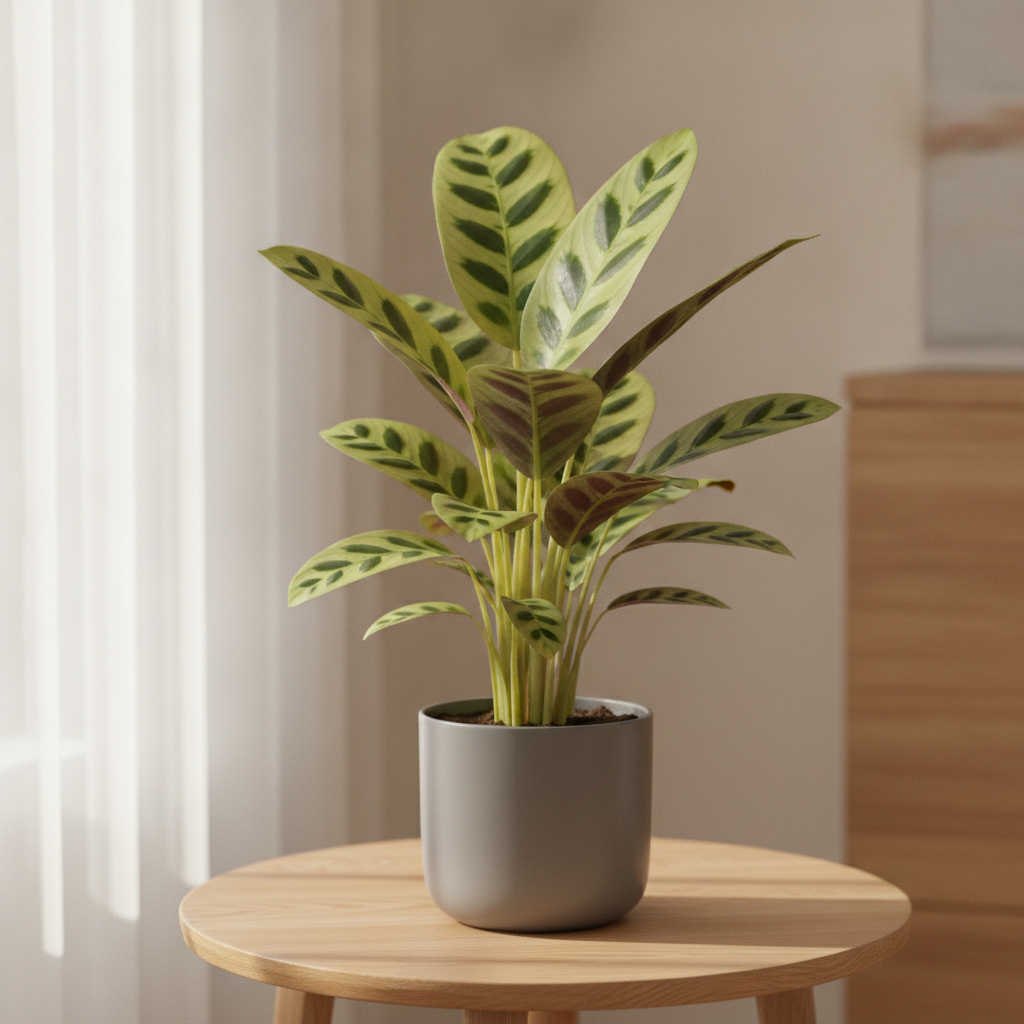
Few prayer plants wear their name as plainly as the leopardina calathea. Each upright leaf is painted with paired dark-green brushstrokes that scatter across a paler background like the rosettes on a big cat, and by evening the whole plant lifts those leaves skyward in the slow, deliberate movement that gives the marantas and calatheas their common name. Known botanically as Goeppertia leopardina (and still sold almost everywhere under its older label, Calathea leopardina), this Brazilian native has earned a reputation as one of the more forgiving members of a famously fussy group. It rewards attention without demanding perfection, and once you understand the handful of things it genuinely cares about, it settles into a steady, glossy rhythm of new growth.
Quick Reference
- Why It Makes a Rewarding Houseplant
- Light
- Watering and Humidity
- Soil and Potting
- Fertilising
- Propagation
- Pests and Problems
- Varieties and Lookalikes
- Frequently Asked Questions
| Common name | Leopardina calathea, leopard prayer plant |
| Botanical name | Goeppertia leopardina (syn. Calathea leopardina) |
| Family | Marantaceae |
| Origin | Tropical Brazil |
| Mature size | 40 to 60 cm (16 to 24 in) tall and wide indoors |
| Light | Bright indirect light, no direct sun |
| Water | Keep evenly moist, never soggy or bone dry |
| Humidity | High, ideally 60 per cent or above |
| Temperature | 18 to 27 degrees C (64 to 81 degrees F) |
| Soil | Light, airy, moisture-retentive but free-draining |
| Fertiliser | Dilute balanced feed monthly in spring and summer |
| Propagation | Division only |
| Toxicity | Non-toxic to cats, dogs and humans |
Why It Makes a Rewarding Houseplant
The leopardina calathea belongs to the Marantaceae, the prayer plant family, a group prized less for flowers than for foliage that behaves almost like a living thing you can watch. Its leaves are lance-shaped and held on slim upright petioles, pale to mid green above and flushed with soft maroon-purple beneath. The signature is the marking: bold dark-green feathering that runs in matched pairs from the central vein toward the leaf edge, an effect so evenly spotted that the plant reads as camouflaged. In lower light the contrast deepens, while very bright conditions can wash the pattern toward a flatter uniform green, so the plant effectively tells you how it is being treated.
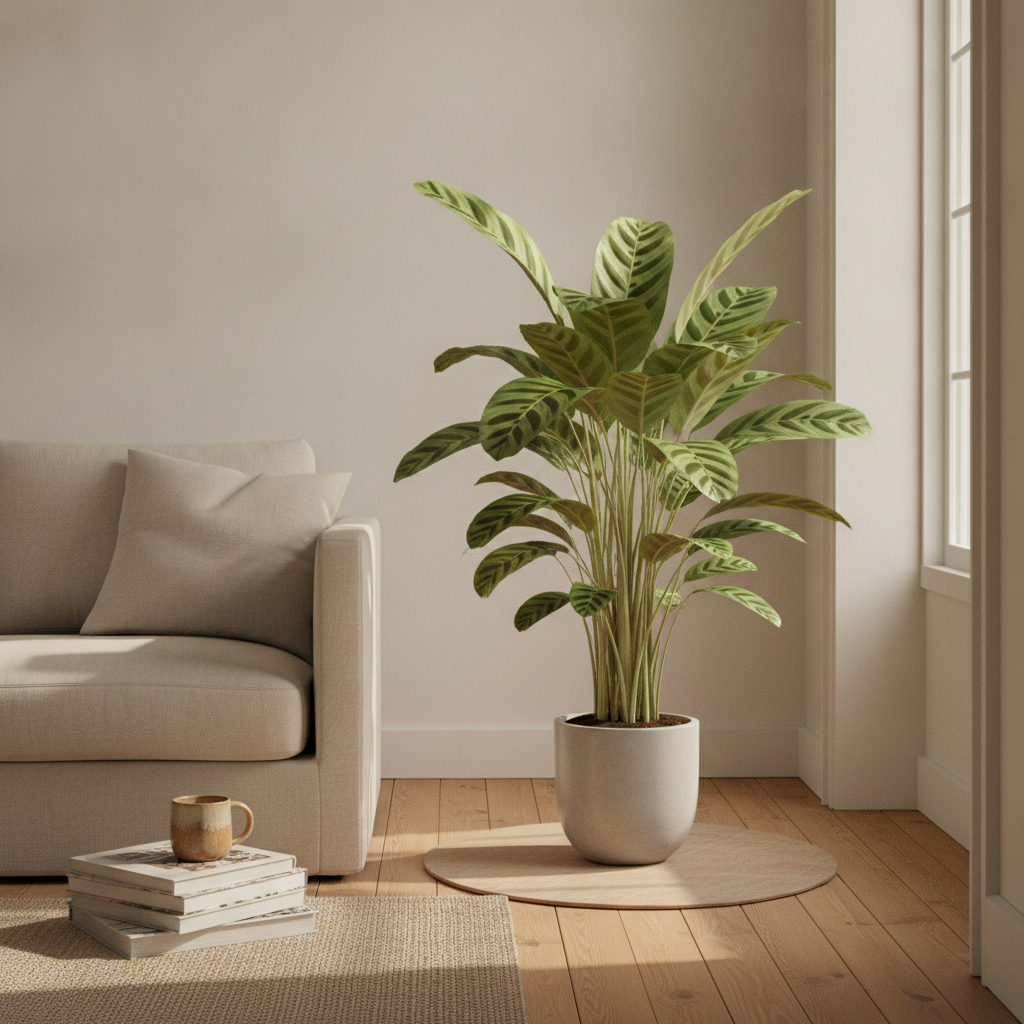
Like its relatives, this species performs nyctinasty, the daily rising and lowering of leaves in response to the light cycle. Come nightfall the foliage folds upward with a faint rustle, exposing those purple undersides, and by mid-morning it relaxes flat again. That movement is not a symptom of stress but a healthy circadian rhythm, and it is one of the quiet pleasures of living alongside a prayer plant. Because the leopardina stays compact and clumping rather than trailing or climbing, it fits neatly on a desk, a plant shelf or a side table without a support, and it never outgrows a room the way a monstera or a rubber plant eventually will.
Its most practical virtue is safety. Everything in the calathea and maranta group is non-toxic to cats, dogs and humans, so the leopardina is a sound choice for a home with curious pets or small children. Where it asks for effort is in consistency: it wants humidity, clean water and steady moisture, and it dislikes neglect and extremes in equal measure. The good news is that leopardina is widely considered one of the toughest and most tolerant prayer plants, forgiving the occasional missed watering far better than the diva-ish white fusion or the temperamental medallion. For anyone wanting the look of a calathea without the steepest part of the learning curve, it is an excellent place to begin.
Light
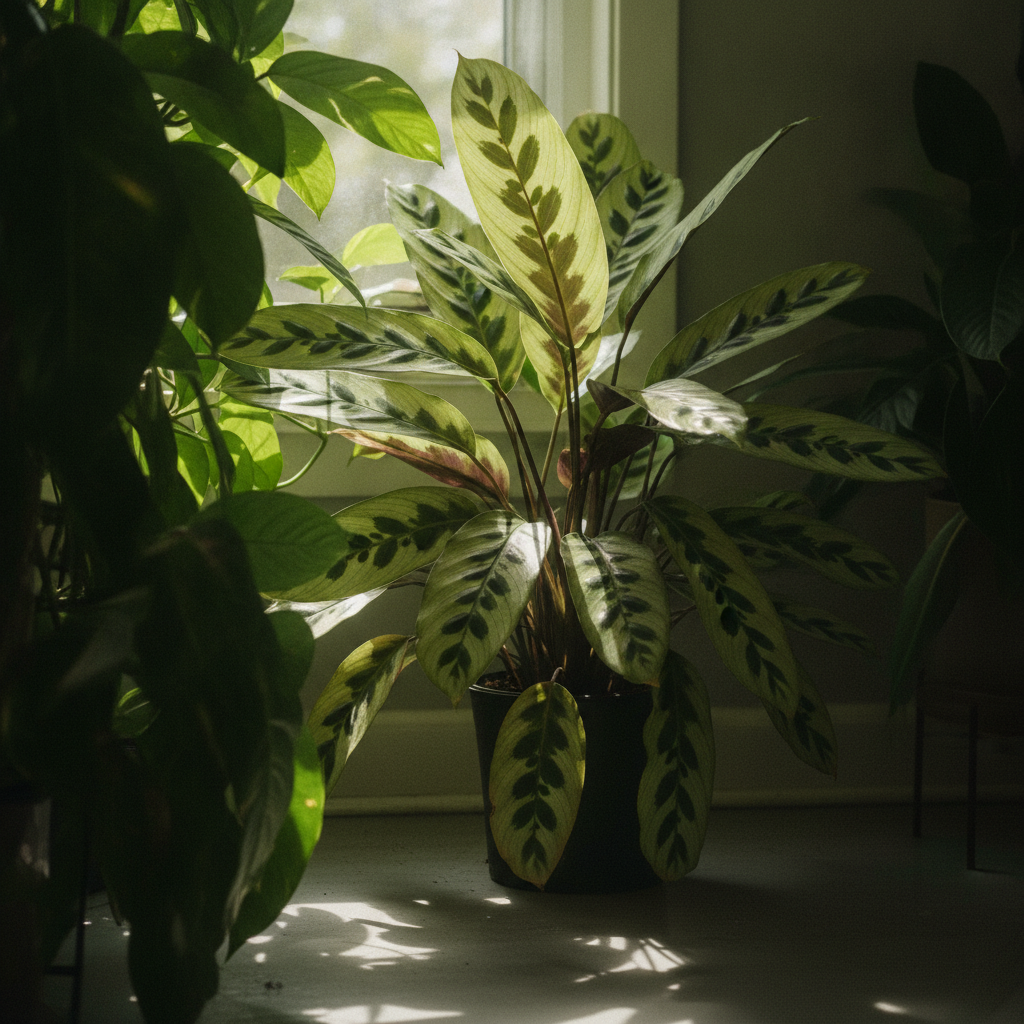
On the floor of the Brazilian forest the leopardina grows beneath a canopy that scatters and softens the sun before it ever reaches the leaves, and that is precisely the quality of light to recreate indoors. The plant will survive in a fairly dim corner, but to thrive and keep its patterning sharp it wants bright, indirect light for most of the day. An east-facing window that delivers gentle morning sun is close to ideal, as is a position a metre or so back from a brighter south or west window where the harshest rays are diffused by a sheer curtain or filtered through other plants.
Direct sun is the one form of light to avoid outright. A few hours of unfiltered midday sun will scorch the thin leaves, bleaching the dark markings to a dull, flat green and, in bad cases, leaving crisp pale patches that never recover. If you notice the contrast fading across the whole plant, it is usually a sign of too much light rather than too little, and moving it further from the glass will often restore the depth of colour over the following weeks. Conversely, a leopardina kept too dark will grow slowly, stretch its petioles toward the window and produce smaller, more widely spaced leaves.
Pro Tip – Even Growth: Rotate the pot a quarter turn each time you water. Prayer plants lean noticeably toward their light source, and a regular turn keeps the clump upright and symmetrical rather than one-sided.
If your home simply lacks a bright, sun-free spot, the leopardina takes very happily to a full-spectrum LED grow light. Run it for around ten to twelve hours a day, positioned far enough above the foliage that the leaves feel no warmth, and the plant will not know the difference between that and a good window. Grow lights are especially useful through the short days of winter, when even a well-placed calathea can lose vigour for want of hours rather than intensity.
Watering and Humidity
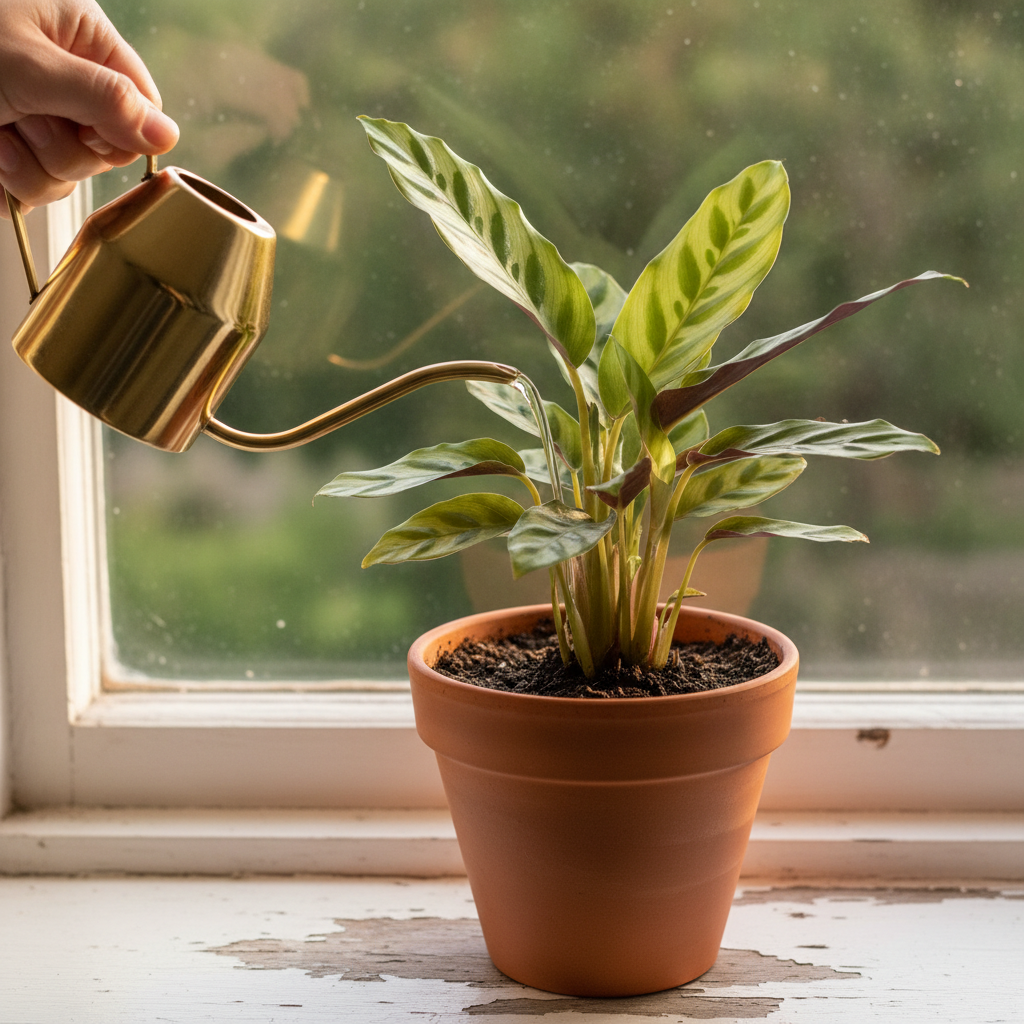
Water is where most people meet the leopardina on its own terms. The plant wants its soil kept consistently, evenly moist, never left to dry out completely and never allowed to sit in a swamp. In practice that usually means watering when the top two to three centimetres of the mix feel dry to the touch, then adding water slowly until it runs freely from the drainage holes. Empty the saucer once it has drained so the roots are not left standing, because sustained sogginess is the fastest route to root rot in this species.
The frequency will shift with the seasons. Through the warm, bright months of active growth the plant may want watering once or twice a week, while in the cooler, darker part of the year that can stretch to every ten days or more. Rather than fixing a rigid schedule, check the soil with a finger, and let the plant and its conditions set the pace. Underwatering announces itself through curling leaves and crisp brown edges, while overwatering shows up as yellowing lower leaves and a soft, sour smell at the soil surface.
Water quality matters more here than for most houseplants. Prayer plants are sensitive to the fluoride, chlorine and dissolved salts common in tap water, which accumulate at the leaf margins and cause the browning that so often plagues calatheas. Where you can, use rainwater, distilled water or filtered water at room temperature. If only tap water is available, leaving it to stand uncovered overnight allows some chlorine to dissipate, though it does nothing for fluoride, so filtered or collected water remains the better long-term habit.
Warning – Crispy Edges: Persistent brown, crunchy leaf margins are the classic calathea complaint. They are almost always caused by a combination of low humidity and mineral-heavy tap water. Switch to filtered or rainwater and raise the humidity before assuming anything more serious is wrong.
Humidity is the other half of the equation, and it is non-negotiable for lush growth. The leopardina wants moisture in the air at around 60 per cent or higher, well above the level of a typical centrally heated or air-conditioned room. The most reliable way to provide it is a small room humidifier running near the plant, which raises ambient moisture without wetting the foliage. Grouping plants together, standing the pot on a wide tray of pebbles topped up with water, or moving the plant to a naturally humid room such as a bright bathroom all help too. Misting offers only a brief lift and, if the leaves stay wet overnight, can encourage fungal spotting, so it is the least dependable option of the lot.
Keep the plant away from cold draughts, radiators and heating or cooling vents, all of which dry the air locally and stress the foliage. A steady warmth of 18 to 27 degrees C (64 to 81 degrees F) suits it best, and it should never be exposed to temperatures below about 15 degrees C (59 degrees F), which will check its growth and can damage the leaves.
Soil and Potting
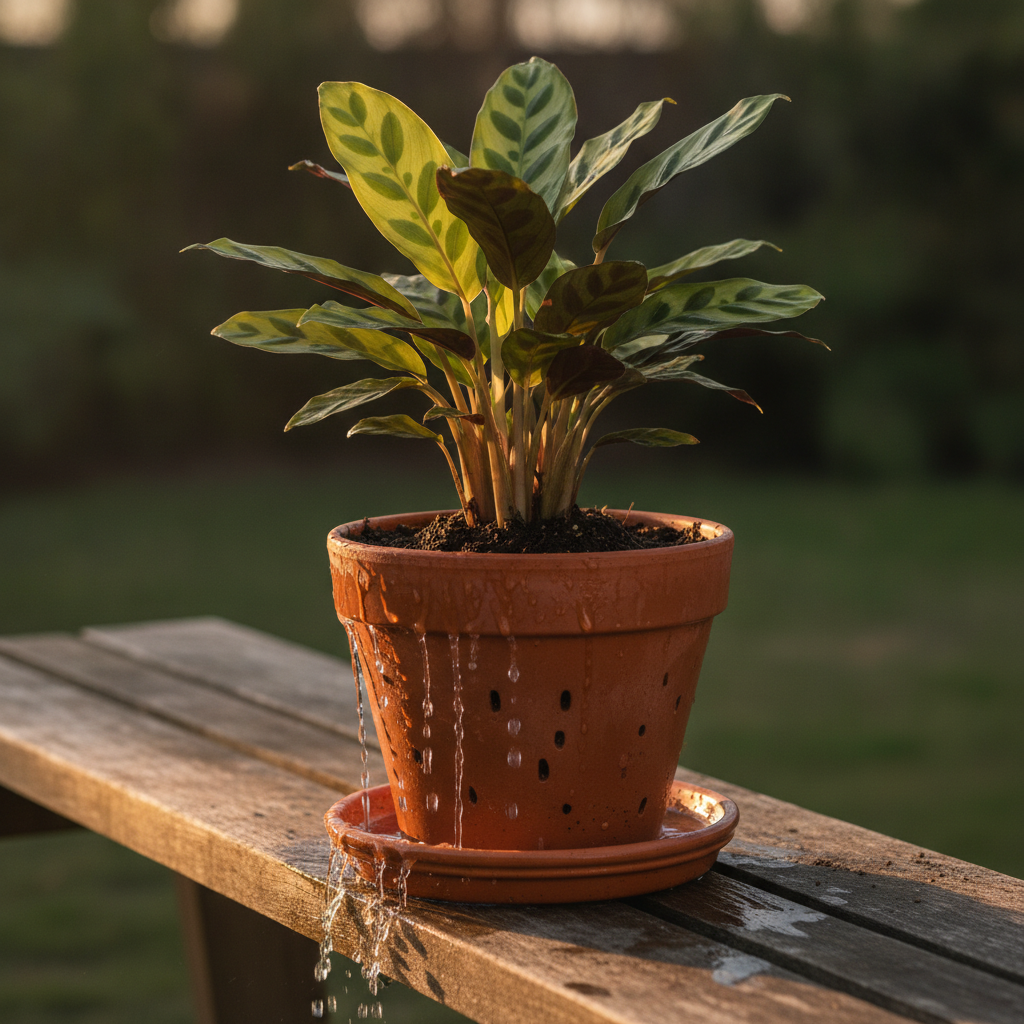
The ideal potting medium for a leopardina resolves an apparent contradiction: it must hold moisture, because the plant hates drying out, yet it must drain and breathe freely, because the roots rot in stagnant wet. The answer is a light, open mix built from moisture-retentive and airy ingredients in balance. A reliable recipe is roughly two parts of a peat-free coir or peat base for water retention, one part perlite or pumice for drainage and aeration, and one part fine orchid bark to keep the structure loose and open. A small handful of worm castings adds gentle nutrition without the risk of chemical burn.
If mixing your own is not practical, a quality peat-free houseplant compost lightened with a generous scoop of perlite will serve well. Avoid heavy, dense soils and standard garden earth, both of which compact around the fine roots and hold too much water for too long. Whatever the mix, the pot itself must have drainage holes. A decorative cover pot without holes is fine as an outer sleeve, but only if you lift the inner nursery pot out to water and let it drain fully before returning it.
The leopardina is not a fast grower and is content to be a little snug in its pot, so it needs repotting only every two years or so, or when roots begin to escape the drainage holes or circle the surface. Spring, at the start of the growing season, is the best time. Move up just one pot size, no more than two to three centimetres wider in diameter, since an oversized pot holds a reservoir of wet soil the roots cannot use and invites rot. Repotting is also the natural moment to divide a mature, crowded clump, which is covered in the next section.
Pro Tip – Settling In: A freshly repotted calathea often sulks for a week or two, drooping while its roots re-establish. Keep it warm, humid and out of direct sun, resist the urge to overwater, and it will usually perk back up on its own.
Fertilising
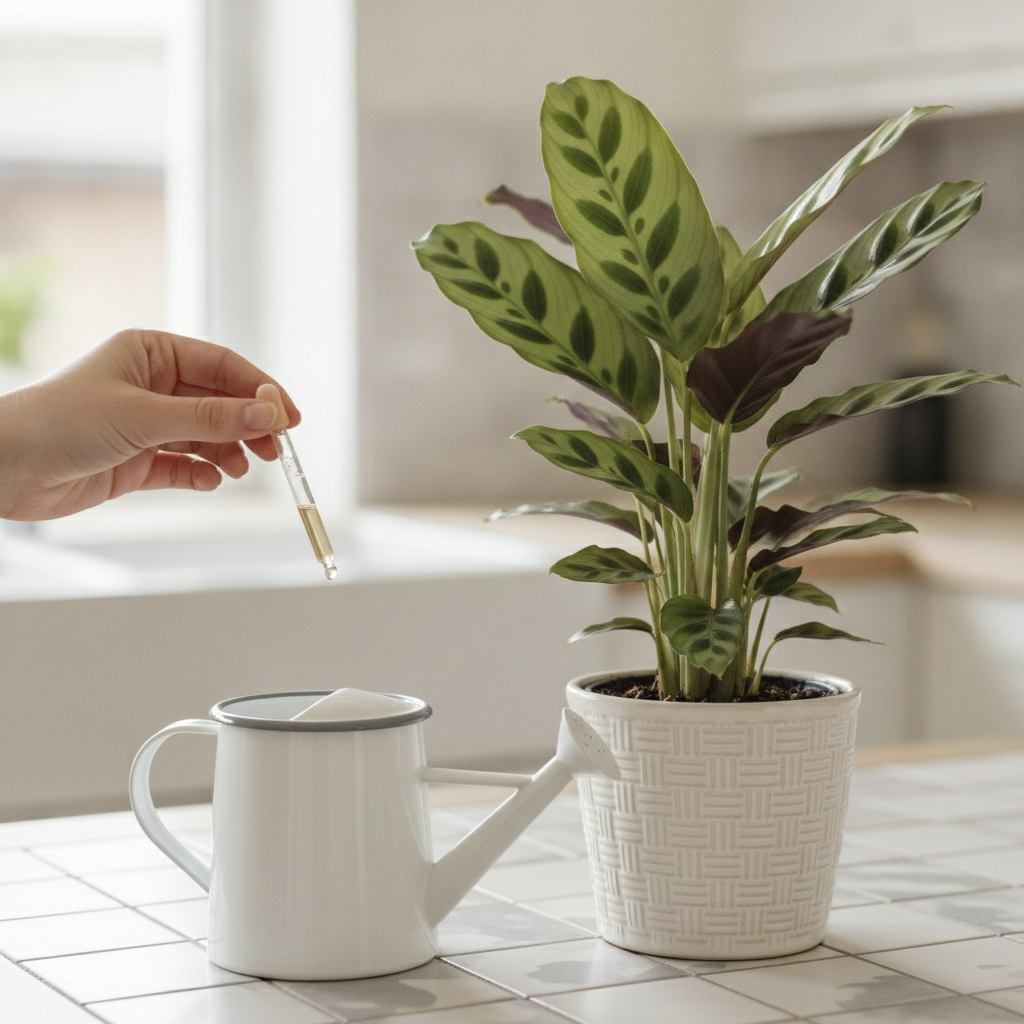
The leopardina is a modest feeder, and restraint pays off. During the active growing months of spring and summer, a balanced liquid houseplant fertiliser diluted to half the recommended strength, applied roughly once a month, supplies everything the plant needs to push out fresh, well-marked leaves. There is no advantage in feeding more often or more strongly. Prayer plants are notably sensitive to a build-up of mineral salts, and over-feeding shows up quickly as scorched brown leaf tips and edges, the same symptom caused by hard water.
Always apply fertiliser to already-moist soil rather than a dry root ball, since feeding into dry soil concentrates the salts against the roots and increases the risk of burn. Watering the plant first, then following with the diluted feed, spreads the nutrients gently and safely. Every few months it is worth flushing the pot with a generous volume of plain water, letting it run right through the drainage holes several times, to wash out any accumulated salts before they reach damaging levels.
As light levels fall in autumn and the plant’s growth naturally slows, stop feeding altogether through the winter. The leopardina is not dormant in the strict sense, but it takes up far less in the dark months, and fertiliser it cannot use simply accumulates in the soil as harmful salt. Resume the monthly half-strength routine only when you see new growth resuming in spring.
Propagation
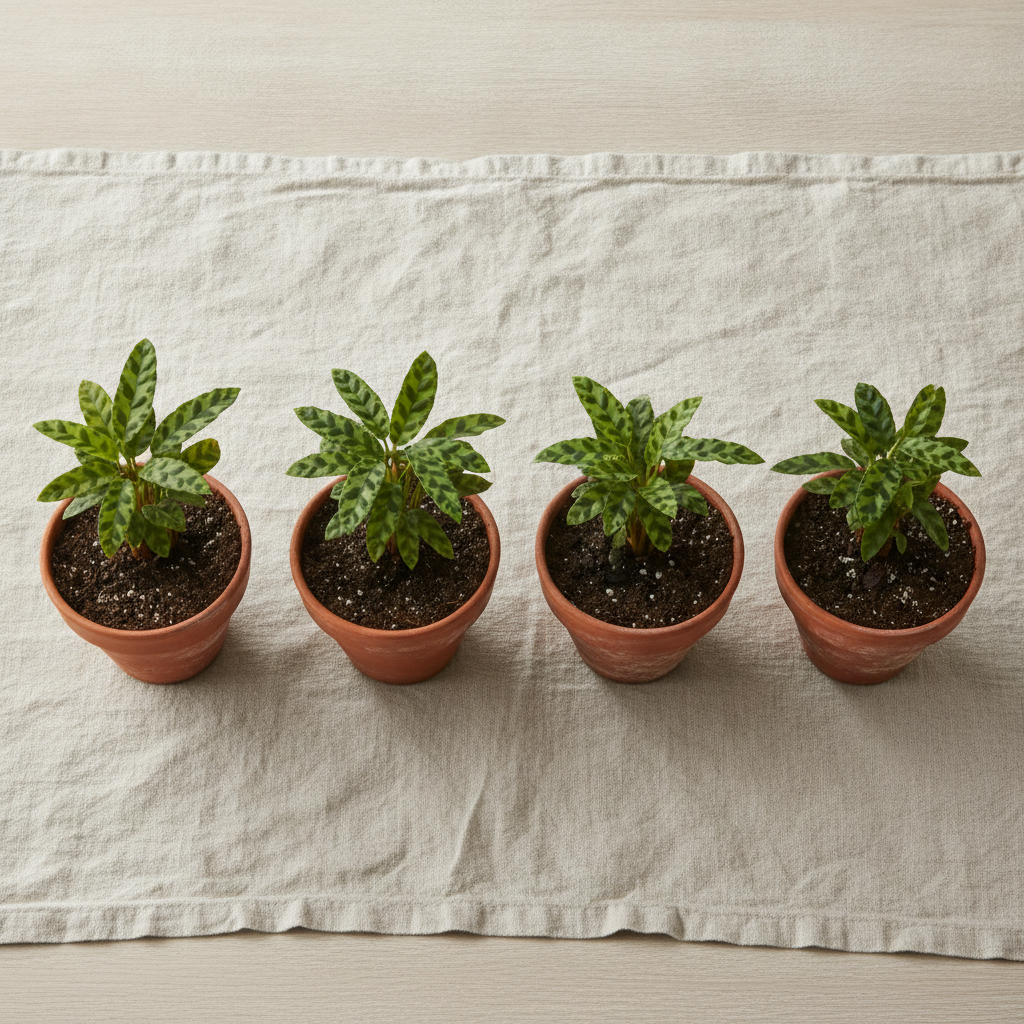
Unlike the pothos and philodendrons that root from a single cut stem in a jar of water, the leopardina cannot be propagated from leaf or stem cuttings. It grows as a clump from a spreading underground rhizome, and the only reliable way to make more plants is division, separating that clump into smaller pieces that each carry their own roots and growing points. The best time to do this is in spring, ideally combined with a scheduled repotting so the parent plant is disturbed only once.
Begin by watering the plant a day ahead so the roots are hydrated and less brittle. Slide the whole plant out of its pot and gently tease away enough soil to see how the clump is structured, looking for natural divisions where separate crowns of stems rise from the rhizome. Work the sections apart with your fingers where you can, using a clean, sharp knife only where the rhizome will not pull cleanly, and make sure every division keeps a healthy portion of both roots and at least two or three leaves. Very small pieces with few roots rarely survive on their own.
- Water the parent plant thoroughly the day before dividing.
- Ease the plant from its pot and shake or rinse away loose soil to expose the rhizome.
- Identify natural clumps, each with its own roots and several leaves.
- Separate the sections by hand, cutting only where necessary with a sterilised blade.
- Pot each division into its own small container of fresh, airy calathea mix.
- Water lightly, then keep warm, humid and out of direct sun while roots re-establish.
Newly divided plants are understandably sulky for the first few weeks and may droop or pause while they recover from the disturbance. A humid, warm spot out of direct light gives them the best chance, and covering each pot loosely with a clear bag or propagation dome for a week or two raises the local humidity and eases the transition. Resist feeding until you see fresh growth, the signal that the roots have taken hold and the division has succeeded.
Pests and Problems
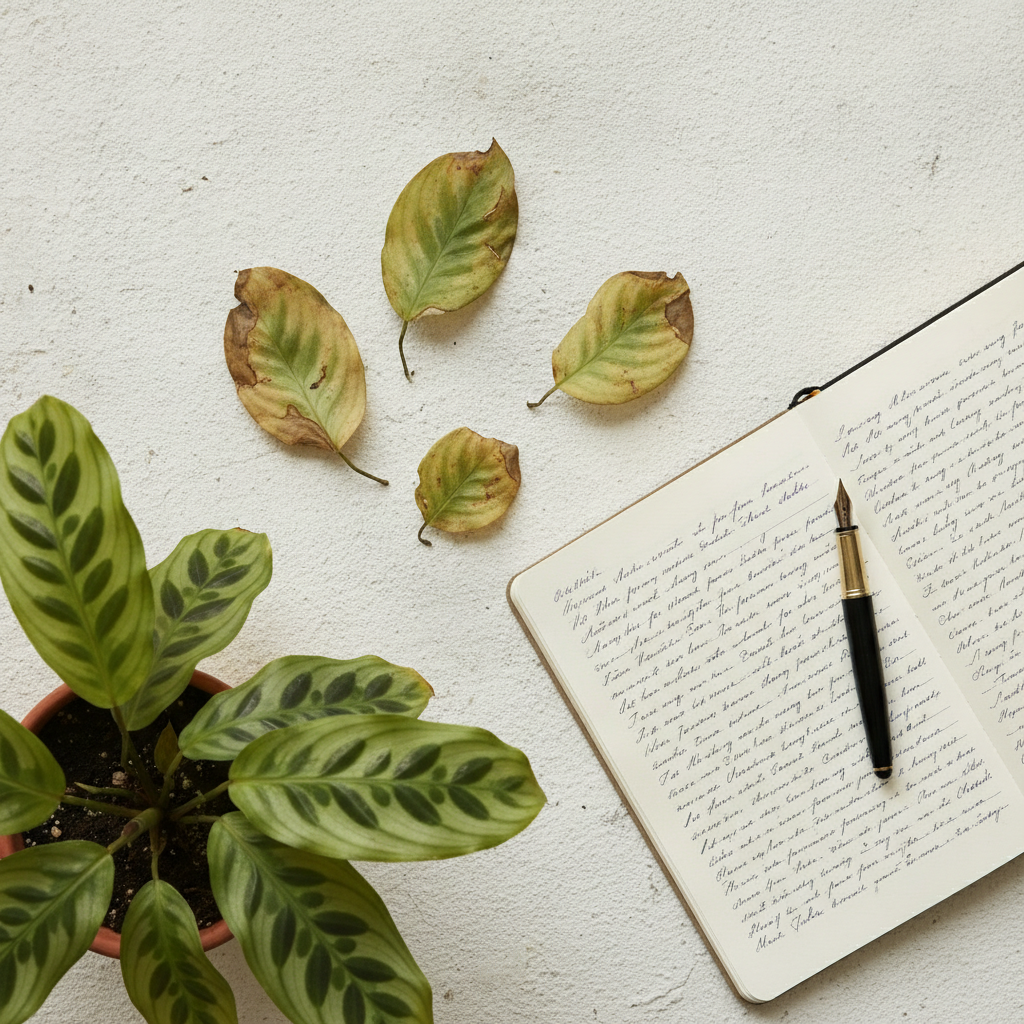
The majority of leopardina complaints are cultural rather than pest-driven, and the leaves are unusually good at reporting what is wrong. Crispy brown edges point to low humidity or mineral-laden water; curling leaves usually signal thirst or dry air; yellowing lower leaves indicate overwatering; and a fading, washed-out pattern means the plant is getting too much direct light. Because the symptoms overlap, it helps to review the whole set of conditions rather than reacting to a single leaf, adjusting humidity, water quality and light in turn and giving the plant a few weeks to respond.
When pests do appear, spider mites are the most likely culprit, and they are drawn precisely by the dry air the leopardina dislikes. They are tiny, favour the leaf undersides and betray themselves with fine speckled stippling and, in heavy infestations, faint webbing. Keeping humidity up is the best prevention, and at the first sign you should isolate the plant, wipe both sides of every leaf, and treat with insecticidal soap or a neem oil solution, repeating every few days until the mites are gone. Fungus gnats are the other common visitor, their larvae thriving in soil kept too wet; letting the top layer dry a little more between waterings and using yellow sticky traps to catch the adults usually breaks the cycle. Mealybugs, seen as small white cottony tufts in the leaf joints, are less frequent but respond to spot treatment with a cotton bud dipped in diluted alcohol.
Warning – Sudden Collapse: A leopardina that yellows, softens and wilts despite moist soil is likely suffering root rot from overwatering. Unpot it, trim away any dark, mushy roots, and repot into fresh airy mix, then water more sparingly while it recovers.
It is worth remembering that some leaf loss is entirely normal. Older outer leaves naturally yellow and die back over time as the plant invests in new growth from the centre, and an occasional faded leaf at the base is nothing to worry about. Trim tired leaves and crispy tips with clean scissors, following the natural shape of the leaf when tidying brown edges, and the plant will keep looking fresh.
Varieties and Lookalikes
The leopardina is a distinct species rather than a plant with a long list of named cultivars, but it sits within a tight cluster of small, upright prayer plants that are easily confused in the trade and are often sold under overlapping labels. Understanding its closest relatives makes it easier to identify what you actually have and to care for it correctly, since the whole group shares near-identical needs.
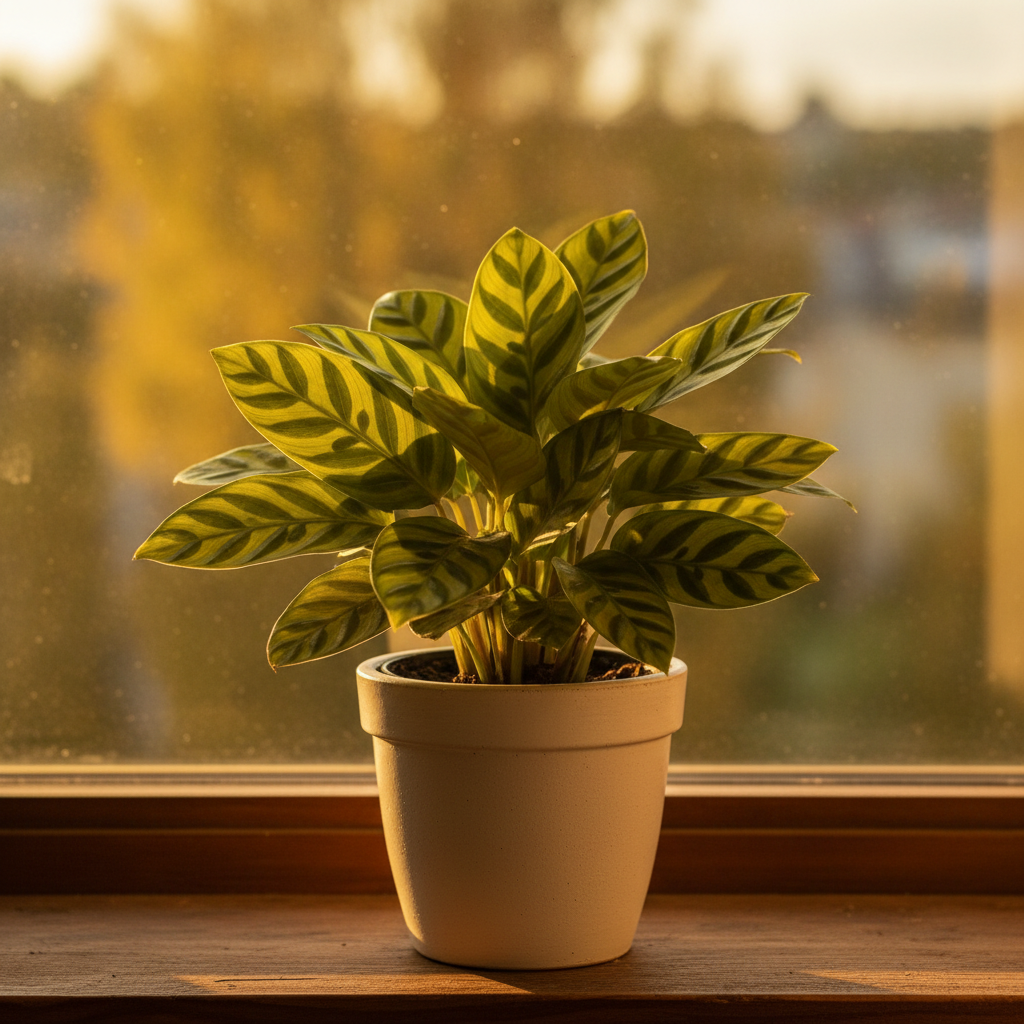
Standard Leopardina. The species as usually sold, forming a compact clumping rosette of upright, pointed leaves in pale to mid green, each patterned with matched dark-green feather markings either side of the midrib and flushed maroon beneath. It is the most robust and beginner-friendly of the group.
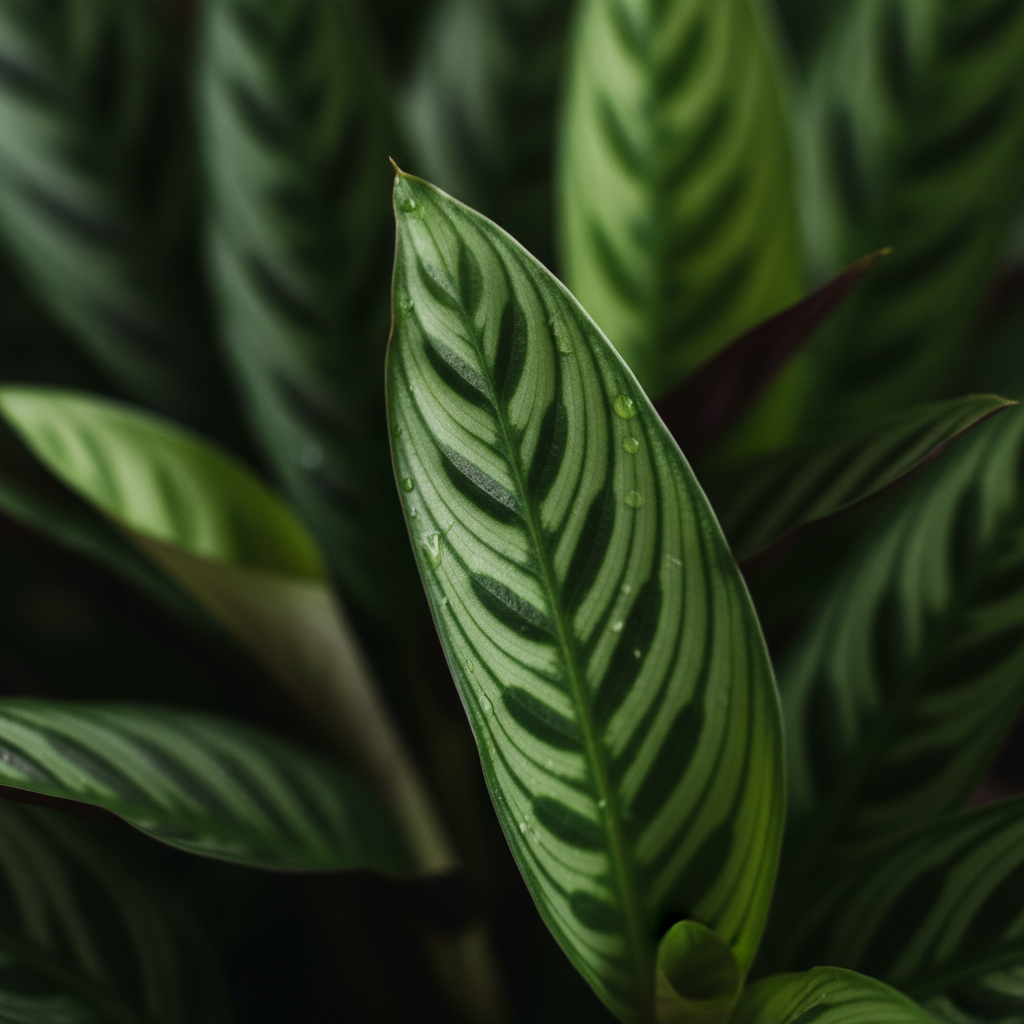
Freddie (Goeppertia concinna). A near cousin frequently mistaken for the leopardina, with lighter apple-green, more slender leaves carrying finer, more delicate dark striping and a faster, bushier habit. Care is effectively identical, so a mislabelled plant is rarely a problem in practice.
Beyond these two, the leopardina is sometimes shelved alongside other tidy prayer plants such as the rattlesnake calathea (Goeppertia insignis), with its long wavy leaves, and the network calathea (Goeppertia musaica), prized for its fine mosaic veining. All belong to the same family and want the same bright indirect light, steady moisture, clean water and high humidity, so once you have the knack of one, the rest of the group holds few surprises.
Frequently Asked Questions
Is the leopardina calathea safe for cats and dogs?
Yes. Like all members of the calathea and maranta group, Goeppertia leopardina is non-toxic to cats, dogs and humans, which makes it a reassuring choice for homes with pets or young children.
Why are the edges of my leopardina turning brown and crispy?
Brown, crunchy leaf margins are the most common calathea complaint and are almost always down to low humidity combined with the minerals in tap water. Raise the humidity to 60 per cent or more, switch to filtered water, rainwater or distilled water, and keep the soil evenly moist to prevent it recurring on new growth.
Why do the leaves fold up at night?
This is nyctinasty, the natural daily movement that gives prayer plants their name. The leaves rise in the evening and lower again by morning in response to the light cycle. It is a sign of a healthy plant, not a problem, though leaves that stay folded and curled during the day usually mean the plant is thirsty or the air is too dry.
Can I propagate a leopardina from a leaf or stem cutting?
No. This species will not root from leaf or stem cuttings. It can only be propagated by dividing a mature clump into sections that each keep their own roots and leaves, ideally in spring when you repot.
How often should I water it?
Water when the top two to three centimetres of soil feel dry, keeping the mix evenly moist but never soggy. In warm, bright months that often means once or twice a week; in winter it may be every ten days or more. Check the soil rather than following a fixed calendar.
Why has the leopard pattern faded?
A washed-out, flattened pattern usually means too much light, often direct sun. Move the plant to a spot with bright but indirect light and the contrast will typically deepen again over a few weeks as new leaves emerge.
Give the leopardina calathea the humidity, clean water and steady moisture it asks for, keep it out of direct sun, and it will reward you with one of the most striking and pet-safe patterns in the houseplant world, folding its leopard-spotted leaves skyward each evening like clockwork.






