
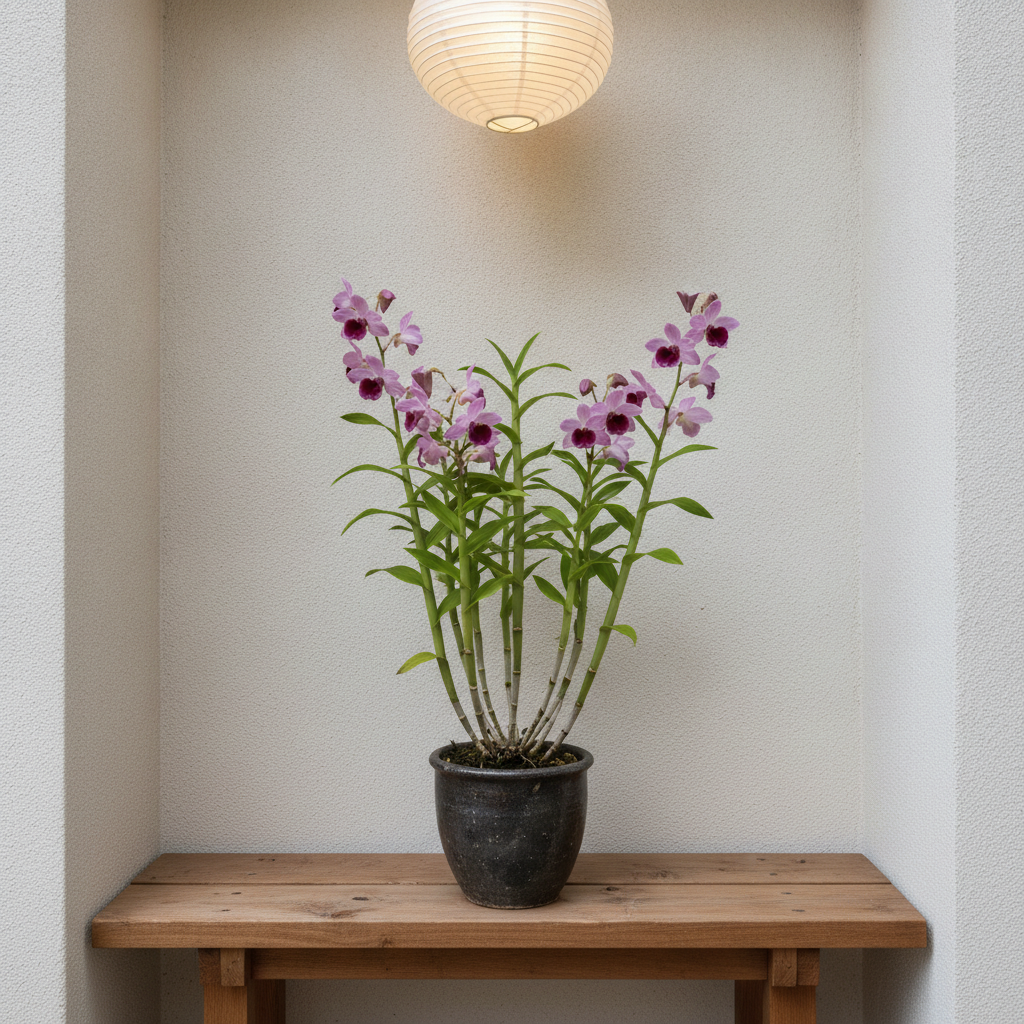
Few orchids reward a little seasonal discipline as generously as the bamboo orchid, the upright, cane-forming species known to botanists as Dendrobium nobile and to growers as the noble dendrobium. Its slender, jointed pseudobulbs stand like stalks of green bamboo, and in late winter they erupt along almost every node into clusters of waxy, sweetly scented flowers in rose, lilac and cream, each marked with a velvety maroon eye. Native to the cool, misty foothills of the Himalayas and stretching east through southern China, northern India and into the highlands of Southeast Asia, it grows in the wild as an epiphyte, clinging to mossy tree branches where light is bright and air moves freely. That mountain heritage is the single most important thing to understand about it.
The bamboo orchid has a slightly unfair reputation for being temperamental, when in truth it is simply honest about its needs. Keep it warm, watered and shaded all year and it will survive as a tidy green plant that stubbornly refuses to bloom. Give it the cool, dry winter rest its biology expects and it transforms into one of the most floriferous orchids you can grow on a windowsill. This guide covers everything that separates a surviving bamboo orchid from a thriving one: how much light it really wants, the watering rhythm that swings from generous to almost nothing across the year, the bark-based mix its roots depend on, when and how to feed, two reliable ways to make more plants, and the handful of pests worth watching for.
Contents
- Quick Reference
- Why the Bamboo Orchid Makes a Rewarding Houseplant
- Light Requirements
- Watering & Humidity
- Soil, Potting & Repotting
- Fertilising
- Propagation
- Pests & Diseases
- Popular Varieties
- Frequently Asked Questions
Quick Reference: Bamboo Orchid at a Glance
| Light | Bright light with a few hours of gentle direct morning sun; the brightest orchid windowsill you have |
| Watering | Generous and frequent in spring and summer, allowing bark to approach dryness between; drastically reduced through the winter rest |
| Temperature | 18 to 30°C (64 to 86°F) in growth; a cool rest of 10 to 15°C (50 to 59°F) at night through autumn and winter |
| Humidity | 50 to 70 per cent, with good air movement |
| Fertiliser | Balanced orchid feed at half strength every one to two weeks in growth; none during winter rest |
| Toxicity | Non-toxic to cats, dogs and people; safe in a household with curious pets |
Why the Bamboo Orchid Makes a Rewarding Houseplant
The appeal of Dendrobium nobile begins with its architecture. Unlike the flat, strappy leaves of a moth orchid, this plant builds vertical canes, technically pseudobulbs, that thicken and lengthen through the growing season and carry pairs of glossy, lance-shaped leaves along their length. A mature, well-grown specimen forms a dense cluster of these canes, and when it flowers the effect is striking: blooms appear not at the tip but all the way up the stem, wrapping each cane in a column of colour. A single happy plant can carry fifty or more flowers at once, and they last for weeks, often filling a room with a soft, honeyed fragrance.
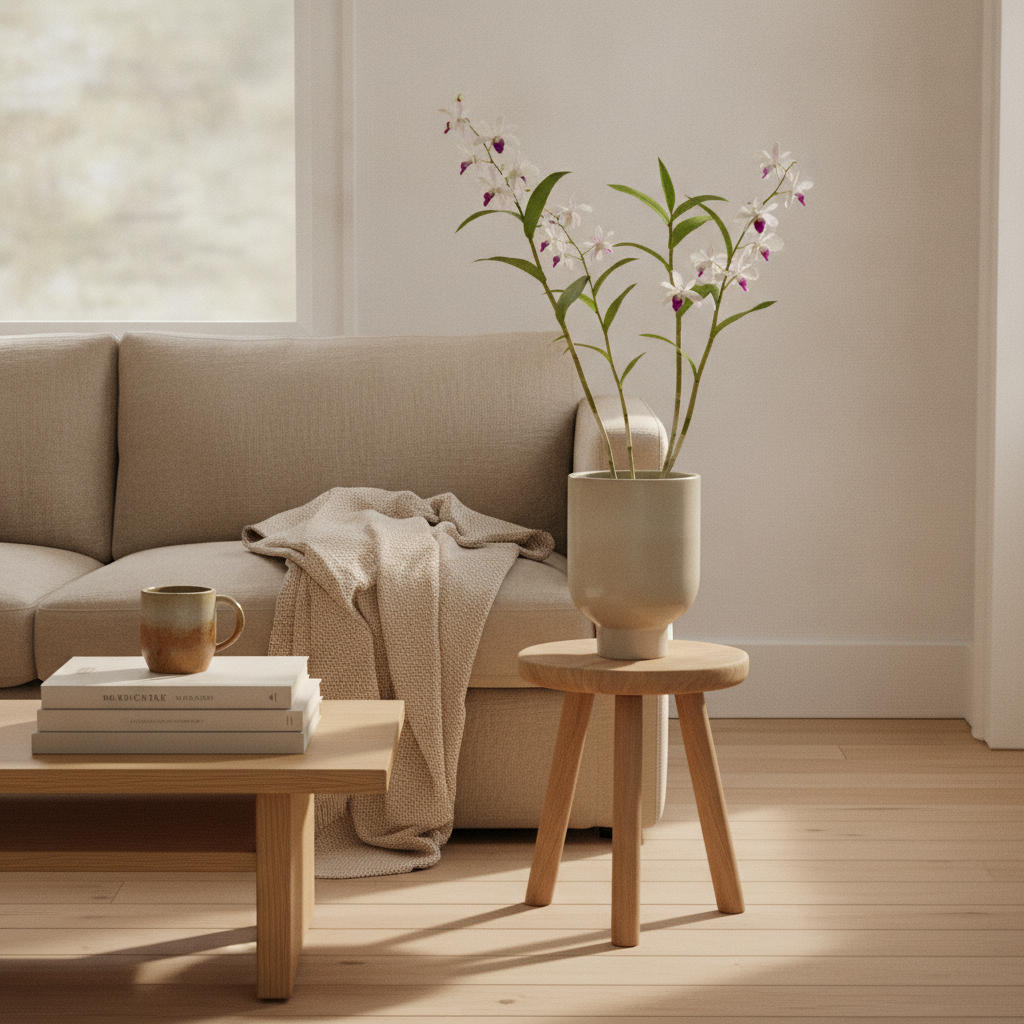
It is also a genuinely long-lived plant. Treated well, a bamboo orchid will grow with you for many years, adding fresh canes each season while the older ones continue to store energy and, eventually, sprout new plantlets. There is a learning curve, and it sits almost entirely in the winter, when the plant wants to be cooler and drier than instinct suggests. Master that one rhythm and the rest of its care is forgiving. The reward is an orchid that flowers reliably on its own schedule rather than one bought in bloom and discarded when the show ends, which is what makes the noble dendrobium such a satisfying long-term companion.
Important — Toxicity: The bamboo orchid is not known to be toxic to cats, dogs or humans, and orchids in general are listed as non-toxic by animal-poison authorities. Even so, a cat that chews foliage may suffer mild stomach upset, and the bark mix and any added fertiliser are not meant to be eaten, so it is still sensible to keep the plant out of reach of determined nibblers.
Light Requirements
Light is the engine that builds the canes that later carry the flowers, and the bamboo orchid wants more of it than most popular houseplant orchids. In the wild it grows high in the forest canopy where it catches bright, filtered sun for much of the day, so a dim corner will keep it alive but never lead to a satisfying bloom. Think of it as one of the more sun-loving orchids: it appreciates the kind of brightness that would scorch a moth orchid, provided the strongest midday rays are softened.
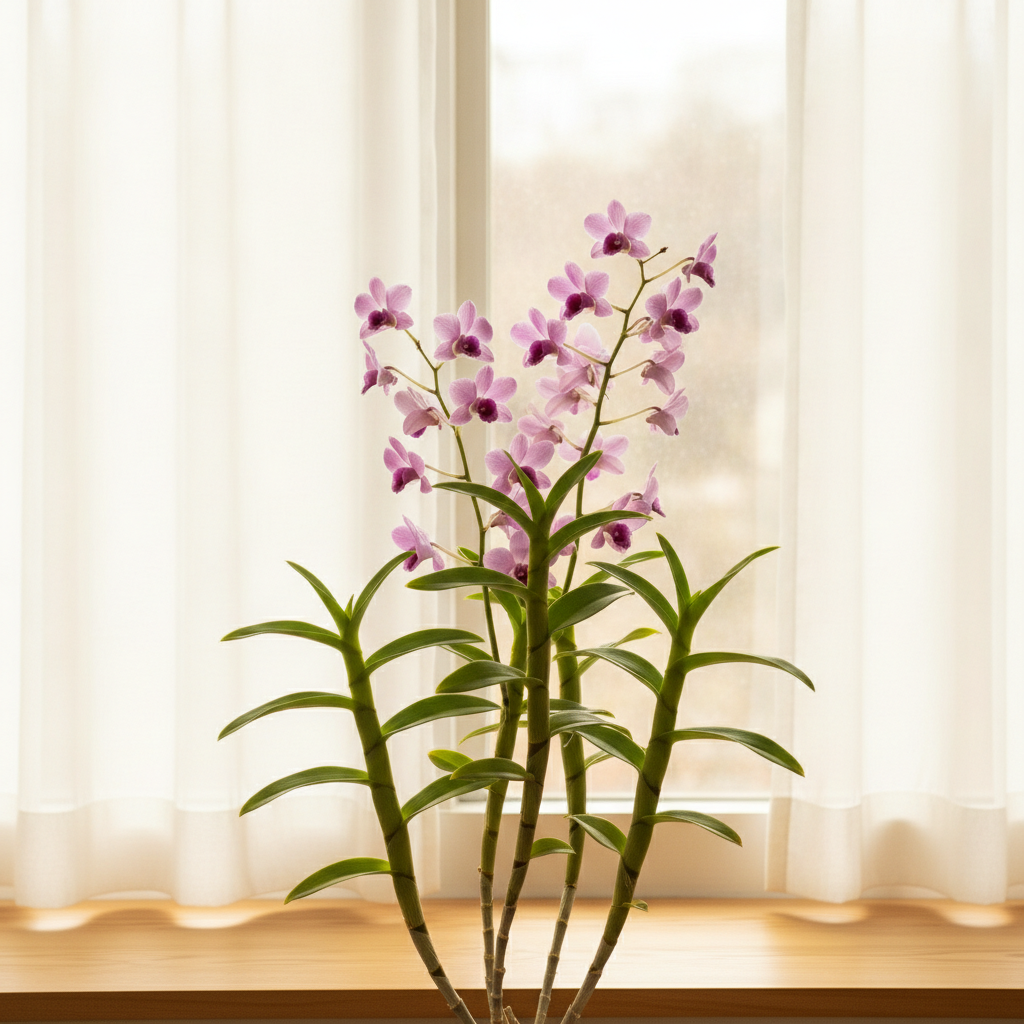
The ideal spot offers bright, indirect light for most of the day plus two or three hours of gentle direct sun, the sort delivered by an east-facing window at sunrise or a south-facing window screened by a sheer curtain. Healthy growth shows in the colour of the foliage. Leaves should be a fresh, light to mid green; very dark, lush green leaves are a sign of too little light and almost always coincide with a plant that grows but will not flower.
Light Levels Explained
Indoor light is far dimmer than it appears to the eye, which is forgiving and adjusts automatically. The table below translates loose descriptions into rough illuminance figures and the outcome each level produces for a bamboo orchid, so you can judge a position before committing the plant to it.
| Light Category | Approx. Level | Typical Location | Outcome |
|---|---|---|---|
| Gentle direct sun | 20,000 to 50,000 lux | Early-morning east window, or south window behind a sheer | Ideal in moderation; builds strong canes and triggers flowering |
| Bright indirect | 10,000 to 20,000 lux | Just back from a bright south or west window | Excellent for steady growth; the safest all-round position |
| Medium | 5,000 to 10,000 lux | A metre from an east window | Plant survives and grows slowly; flowering becomes unreliable |
| Low | 1,000 to 5,000 lux | Interior of a room, north window | Weak, dark, soft growth; rarely blooms |
| Very low | Below 1,000 lux | Hallway, far from any window | Slow decline; not suitable |
Window Orientation and Placement
South-facing window: The most productive position in most homes, but only with the midday sun diffused by a voile curtain or by setting the plant slightly to one side. Unfiltered summer sun directly on the canes will scorch them.
East-facing window: Arguably the perfect orchid window. Cool, gentle morning sun followed by bright indirect light for the rest of the day gives the bamboo orchid almost exactly what it wants, with little risk of burning.
West-facing window: Good, with a caveat. Afternoon sun is hotter and more intense than morning sun, so on a west sill in summer a light screen is wise, while in winter the extra warmth and brightness is welcome.
North-facing window: Usually too dim to flower a bamboo orchid, though it may keep one ticking over. If a north window is all you have, plan to supplement with a grow light during the main growing months.
Pro Tip — Read the Canes: The plant tells you whether the light is right. Tall, thin, dark canes that flop under their own weight are reaching for light they cannot find. Short, plump, upright canes with pale green leaves are a sign of a well-lit, well-fed plant that is likely to flower.
How Light Affects Flowering
For the bamboo orchid, light and flowering are inseparable. The canes that form in spring and summer are the ones that bloom the following winter, so a season of insufficient light produces weak canes and, inevitably, a disappointing display months later. Bright conditions during the growing season also help the plant lay down the energy reserves it draws on during its dormant rest. If you only fix one thing about an orchid that grows but will not flower, give it more light through the summer.
Warning — Direct Sunlight: Although this orchid loves brightness, a plant moved abruptly from a shaded spot into full summer sun will sunburn within a day or two, showing bleached white or scorched brown patches that never recover. Increase light gradually over two to three weeks to let the foliage acclimatise.
Artificial Lighting
The bamboo orchid responds well to supplementary lighting, which is the simplest fix for a home short on natural brightness. A full-spectrum LED grow light positioned 20 to 30 centimetres (8 to 12 inches) above the canes, run for 12 to 14 hours a day during spring and summer, will drive strong growth. During the autumn and winter rest you can ease the day length back to match the shorter natural daylight, which helps reinforce the seasonal cue the plant relies on to set buds.
Seasonal Adjustments
Move the plant closer to the glass as autumn light weakens, and consider its brightest available window through winter, when maximising what little sun there is helps the developing buds. In high summer, watch for the angle of the sun shifting and the risk of scorch rising, and add or adjust shading accordingly. The goal across the year is consistently bright light, dialled up in the dark months and gently tempered at the height of summer.
Watering & Humidity
Watering a bamboo orchid is not a fixed routine but a rhythm that swings dramatically with the seasons, and learning that swing is the heart of growing it well. As an epiphyte its roots are adapted to a soak-then-dry cycle: drenched by rain, then exposed to moving air that dries them quickly. They rot if kept constantly wet, especially in cool conditions, so the bark mix it lives in should be allowed to approach dryness between thorough waterings rather than held permanently damp.
When to Water
Through the active growing season, from spring until early autumn, the plant is thirsty and should be watered freely, often once or twice a week, whenever the bark has dried to the point of being just barely damp deep in the pot. This is when the new canes are swelling and the plant is photosynthesising hard, and underwatering now produces thin, stunted growth. Lift the pot to judge weight, or push a finger or a wooden skewer into the mix to check moisture below the surface before reaching for the watering can.
From mid-autumn the rhythm reverses completely. As the canes finish maturing the plant enters its rest, and watering should drop to the bare minimum needed to stop the canes shrivelling, perhaps a light drink every two or three weeks. This winter drought, combined with cooler nights, is the primary signal that tells the plant to switch from making leaves to making flower buds. Resume normal generous watering only once buds or new growth appear in late winter.
Pro Tip — Dry Is the Goal in Winter: The instinct to rescue a plant that looks slightly thirsty is exactly what stops a bamboo orchid flowering. Some light wrinkling of the canes over winter is normal and harmless. Hold your nerve, keep it cool and nearly dry, and the buds will follow.
How to Water Correctly
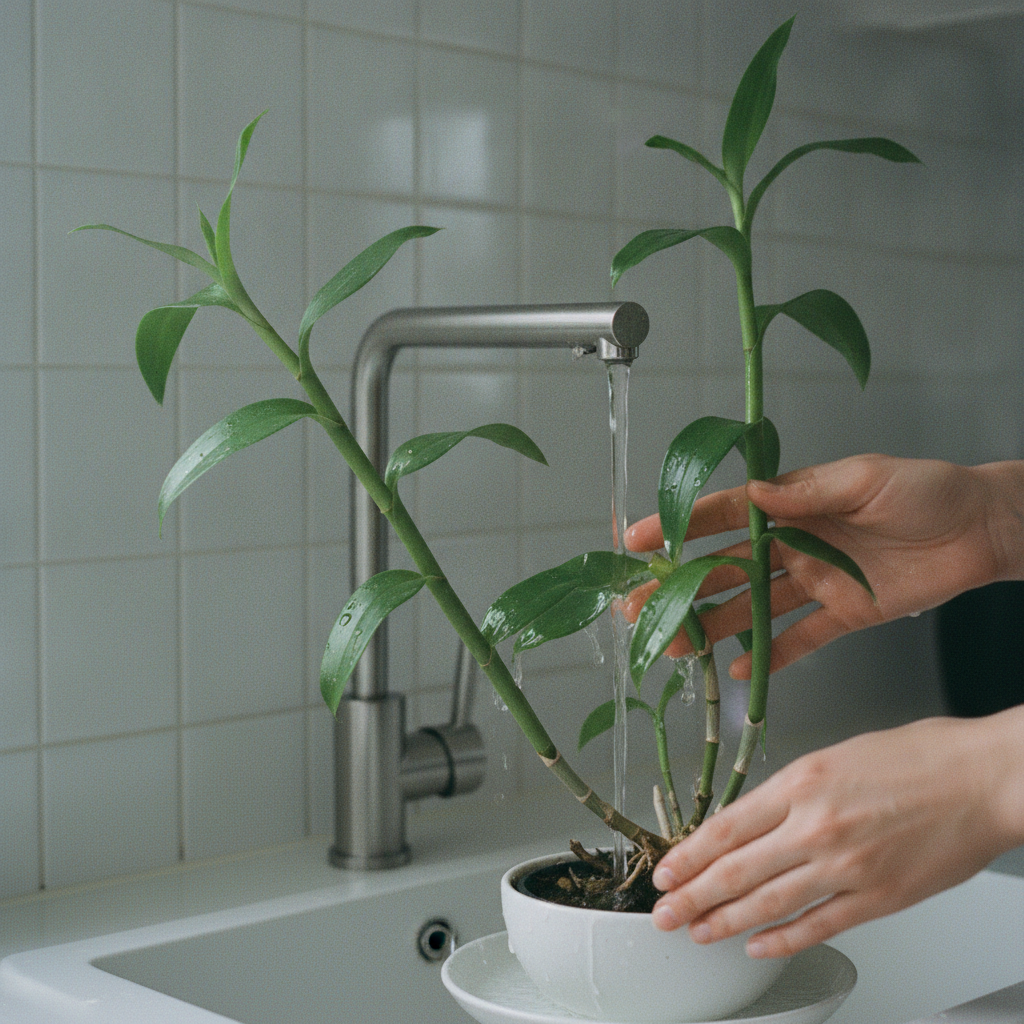
- Take the plant to a sink so excess water can drain freely rather than collecting in a saucer.
- Run tepid water through the bark for 20 to 30 seconds, letting it flood the whole pot and flow out of the drainage holes, which fully wets the mix and flushes away accumulated salts.
- Let the pot sit and drain for several minutes until water stops dripping.
- Tip away anything that collects in the outer cover pot or saucer; the roots must never stand in water.
- Return the plant to its spot and do not water again until the bark has dried appropriately for the season.
Signs of Overwatering vs. Underwatering
| Symptom | Overwatering | Underwatering |
|---|---|---|
| Leaf colour | Yellowing of lower leaves, often soft and translucent | Dull green fading to yellow, dry to the touch |
| Cane texture | Soft, mushy, sometimes blackened at the base | Wrinkled, shrunken but still firm |
| Mix condition | Constantly soggy, sour-smelling, slow to dry | Bone dry throughout, water runs straight through |
| Roots | Brown, hollow, mushy, pull apart easily | Dry, papery, silvered and brittle |
| Cane base | Dark, soft rot creeping up from the mix | Firm but the whole cane looks deflated |
Warning — Root Rot: Cool, wet roots are the most common way to kill a bamboo orchid. If canes blacken and soften at the base, unpot immediately, cut away every brown, hollow root with sterilised scissors, and repot into fresh dry bark, holding back on water for a week while the wounds seal.
Humidity Requirements
Coming from humid mountain forests, the bamboo orchid is happiest at 50 to 70 per cent relative humidity, comfortably above the dry air of a centrally heated room in winter. It is more tolerant of average household humidity than many tropical orchids, but very dry air slows growth and can cause flower buds to shrivel before they open, a frustrating problem known as bud blast.
Signs that the air is too dry include buds that yellow and drop, leaf tips that brown, and canes that struggle to plump up despite adequate watering. These symptoms often appear in midwinter when heating is at its peak and humidity at its lowest, precisely when the plant is setting buds, so a little attention to moisture in the air at that time pays off in flowers.
To raise humidity, group the plant with other plants so they share the moisture they transpire, stand the pot on a tray of damp pebbles with the pot base clear of the water, or run a small humidifier nearby during the driest months. Crucially, pair any humidity boost with good air movement, because still, damp, stagnant air invites the fungal problems this orchid is prone to.
Water Quality
Bamboo orchids are sensitive to the mineral salts and chlorine in hard tap water, which accumulate in the bark and on the roots over time. Rainwater, distilled water or filtered water is ideal. If you must use tap water, let it stand overnight so chlorine can dissipate, and flush the pot generously every few weeks to wash away built-up salts. Always water with tepid rather than cold water, as a shock of cold on the roots can check growth.
Soil, Potting & Repotting
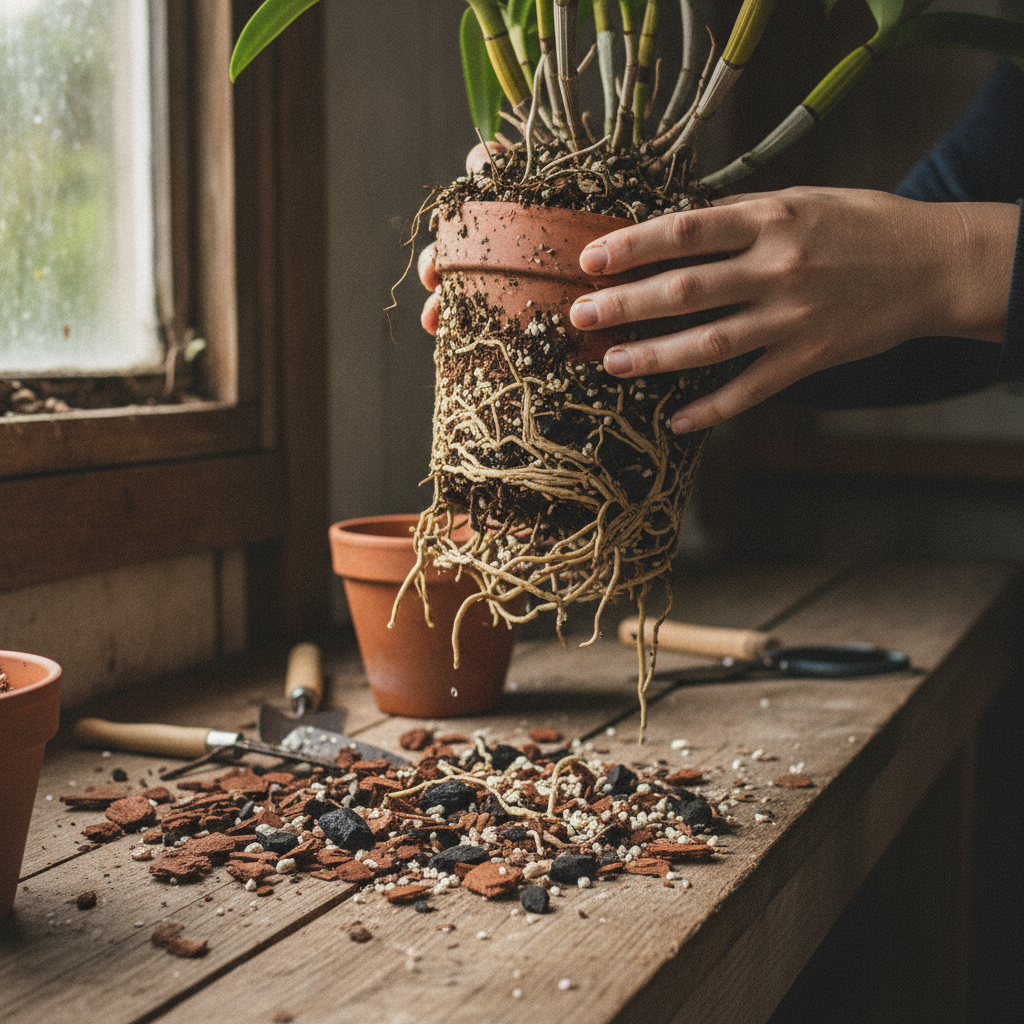
An epiphyte like the bamboo orchid never grows in ordinary potting soil, which would suffocate and rot its air-adapted roots within weeks. Instead it needs a coarse, open, fast-draining medium that holds a little moisture while letting air circulate freely around every root. Get the medium right and most other problems become far easier to manage, because the roots stay healthy and able to take up water and nutrients.
Ideal Soil Composition
The foundation is medium-grade bark, supplemented with materials that improve drainage, hold a touch of moisture and resist breaking down too quickly. A blend rather than bark alone gives the roots the balance of air and moisture they prefer, and the proportions below make a reliable starting point that you can lean drier or more moisture-retentive to suit your home.
| Component | Proportion | Function |
|---|---|---|
| Medium-grade fir or pine bark | 60% | Core structure; holds air and a little moisture, mimics tree bark |
| Perlite or pumice | 15% | Keeps the mix open and improves drainage |
| Horticultural charcoal | 15% | Absorbs impurities and keeps the medium sweet |
| Chopped sphagnum moss | 10% | Holds a reserve of moisture around the roots without waterlogging |
The bamboo orchid prefers a slightly acidic root environment, broadly in the range of 5.5 to 6.5 on the pH scale, which a fresh bark-based mix supplies naturally as it breaks down. There is no need to test or adjust pH actively; repotting into fresh mix before the old bark decomposes into a fine, acidic, water-holding sludge is all the management it requires.
Pro Tip — Quick Mix Recipe: No time to blend? A bag of ready-made medium-grade orchid bark mix from a garden centre works perfectly well on its own. Stir through a handful of perlite for extra drainage and you have a sound medium in a couple of minutes.
Choosing the Right Pot
Bamboo orchids flower best when their roots are a little crowded, so resist the urge to give them a roomy pot. A snug container that the cluster of canes just fills, with the rootball comfortable but not swimming in space, is exactly right.
Drainage holes are non-negotiable. Any pot must have generous drainage so water rushes straight through. Many growers favour pots with extra slots or holes in the sides, and clear plastic orchid pots have the bonus of letting you watch root health and moisture at a glance.
Pot material: Plastic holds moisture longer and suits drier homes or growers who tend to underwater. Terracotta breathes and dries faster, which suits those inclined to overwater or homes with cool, damp air. Either works; just match your watering habits to the pot you choose.
Pot size: Choose a pot only slightly larger than the rootball, allowing room for one or two seasons of new canes. An oversized pot holds a reservoir of damp bark the roots cannot reach, and that lingering moisture is a direct route to rot.
When to Repot
Repot every two years or so, or when the bark has broken down into fine, dark, soggy crumbs that no longer drain, or when the plant has clearly outgrown its pot with canes spilling over the rim. The ideal time is in spring, just as new growth begins, when the plant is entering its active phase and will root quickly into fresh medium. Avoid repotting a plant in bud or in full flower, which often causes it to drop the display.
How to Repot: Step-by-Step
- Water the plant a day before so the roots are supple and less likely to snap.
- Ease the plant from its pot and gently tease away the old, spent bark from around the roots.
- Inspect the roots and trim away any that are brown, hollow or mushy with sterilised scissors, keeping the firm, pale, healthy ones.
- Position the plant in its new pot so the oldest canes sit against one edge, leaving room on the opposite side for new growth to spread into.
- Work fresh mix in around the roots, tapping the pot to settle it, until the plant is held firmly and the base of the canes sits at the surface.
- Stake the canes if needed for stability, then wait roughly a week before watering to let any damaged roots seal.
Warning — Transplant Shock: A freshly repotted bamboo orchid may sulk for a few weeks as it settles. Keep it in stable, bright but not scorching light, hold off on fertiliser until you see new root or cane growth, and do not be alarmed by a short pause; resist the temptation to overwater it back into life.
Fertilising
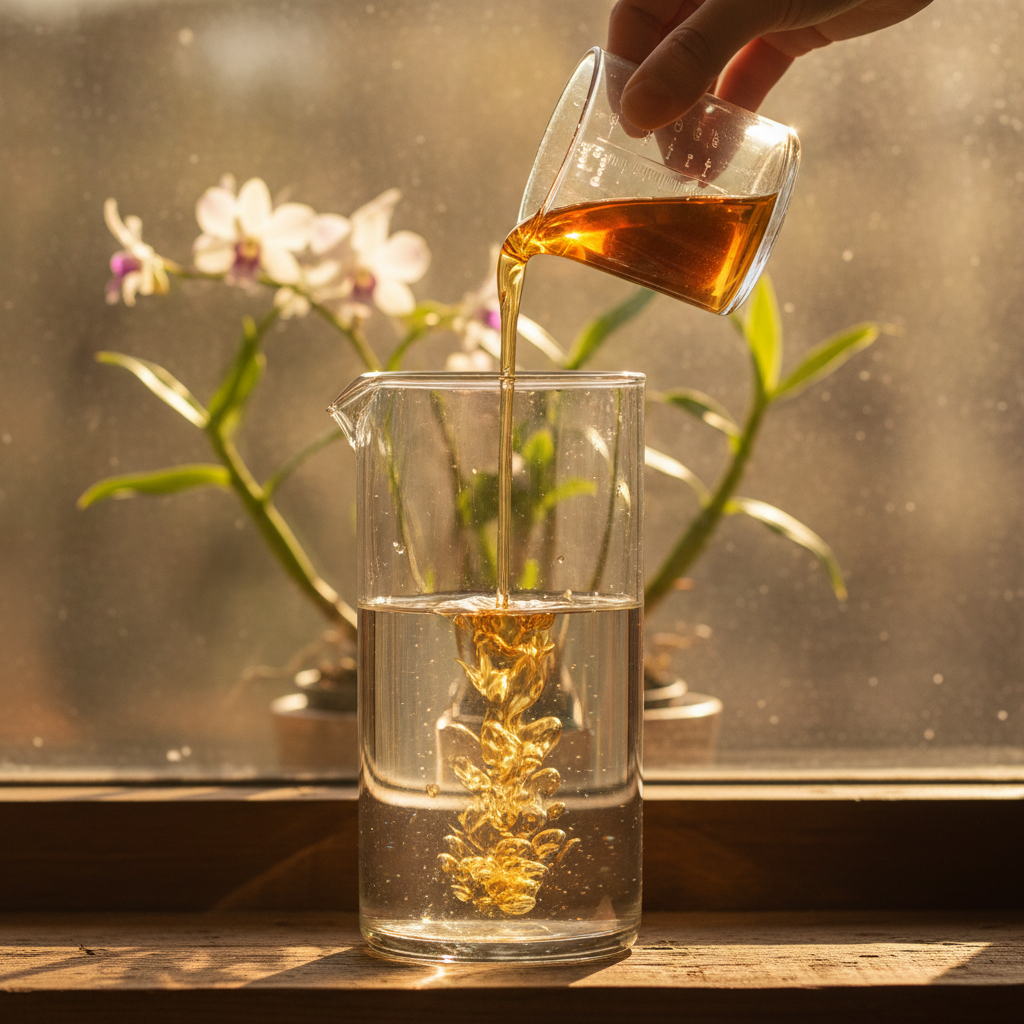
Because bark holds few nutrients of its own, a potted bamboo orchid depends on you for its feeding, and a sensible regime makes a real difference to the size and number of next season’s flowers. The plant is a relatively hungry orchid during its growth spurt, but its needs vanish almost entirely once it enters the winter rest, so feeding is as seasonal as watering.
The single most important principle is to feed in time with growth and to stop when growth stops. Pushing fertiliser at a resting plant in autumn and winter does not help and can actively discourage flowering by keeping the plant in a vegetative frame of mind, as well as risking a damaging build-up of salts in the bark.
Understanding Plant Nutrients
Fertiliser labels carry three numbers, the N-P-K ratio, showing the percentages of nitrogen, phosphorus and potassium, the three nutrients plants use in the greatest quantity. Alongside these, several secondary nutrients and trace elements keep an orchid in good health, and a deficiency in any of them shows up in predictable ways across the foliage and canes.
| Nutrient | Symbol | Primary Function | Deficiency Symptoms |
|---|---|---|---|
| Nitrogen | N | Drives leaf and cane growth | Pale, yellowing older leaves; weak, stunted canes |
| Phosphorus | P | Supports roots and flower formation | Poor rooting, reluctance to bloom, dull foliage |
| Potassium | K | Regulates water use and flower quality | Browning leaf edges, weak flower stems |
| Calcium | Ca | Builds strong cell walls and new growth | Distorted, dying new cane tips |
| Magnesium | Mg | Core of the chlorophyll molecule | Yellowing between leaf veins on older leaves |
| Iron | Fe | Enables chlorophyll production | Yellowing between veins on the newest leaves |
Types of Fertiliser
Liquid fertilisers: The easiest and most controllable choice for orchids. A balanced liquid orchid feed diluted in water lets you adjust strength and frequency precisely, and feed and water in a single step during the growing season.
Slow-release granular: Coated prills that release nutrients over months are convenient but blunt instruments for a plant with such a sharp seasonal cycle, since they keep feeding into the rest period when you want feeding to stop. If used at all, place them sparingly and only in spring.
Organic fertilisers: Gentle options such as dilute seaweed or fish emulsion supply trace elements and rarely scorch roots, though they act more slowly and can smell. They pair well with a regular balanced feed rather than replacing it.
Feeding Schedule
From spring to late summer, while new canes are actively growing, feed with a balanced orchid fertiliser at half the recommended strength every one to two weeks. Some growers shift to a higher-potassium bloom feed in late summer to help the maturing canes prepare to flower. As autumn arrives and growth halts, stop feeding entirely and keep the plant unfed through its cool, dry winter rest, resuming only when new growth appears the following spring.
Pro Tip — Weakly, Weekly: Orchids respond far better to a little feed often than to occasional strong doses. Diluting to half or even quarter strength and feeding more frequently keeps nutrient levels steady and greatly reduces the risk of root-burning salt build-up.
How to Fertilise
- Water the plant lightly first so fertiliser never lands on bone-dry roots, which can scorch them.
- Dilute the orchid feed in tepid water to half the strength stated on the label.
- Pour the solution evenly through the bark until it runs from the drainage holes, wetting all the roots.
- Once a month, water with plain water only to flush out accumulated salts before they reach harmful levels.
Warning — Salt Build-Up: A white crust on the bark or pot rim, or blackened root tips, signals fertiliser salts accumulating to toxic levels. Flush the pot thoroughly with plenty of plain water several times, and review whether you are feeding too strongly or too often.
Propagation
One of the quiet pleasures of the bamboo orchid is how readily it makes more of itself. A mature, multi-caned clump can be divided into separate plants, and the species also has an endearing habit of sprouting baby plantlets, called keikis, directly along its older canes. Both methods produce plants identical to the parent, so a treasured form can be multiplied with confidence.
Patience is the main requirement. Divisions and keikis take a season or two to establish and reach flowering size, but the process itself is straightforward and far more reliable than trying to raise orchids from dust-fine seed, which is essentially impossible in the home. The two practical home methods are division of an established clump and the potting up of keikis.
Understanding Canes and Keikis
Each upright cane is a storehouse of water and energy, and even an old, leafless cane is far from useless; it both feeds the plant and serves as the launch point for new growth. Keikis are clones that form at the nodes along these canes, complete with their own little leaves and, eventually, roots. They tend to appear when a plant has not had a sufficiently cool, dry rest, almost as if the orchid hedges its bets by making offspring instead of flowers, but they are a welcome free source of new plants whatever their cause.
Division: Step-by-Step
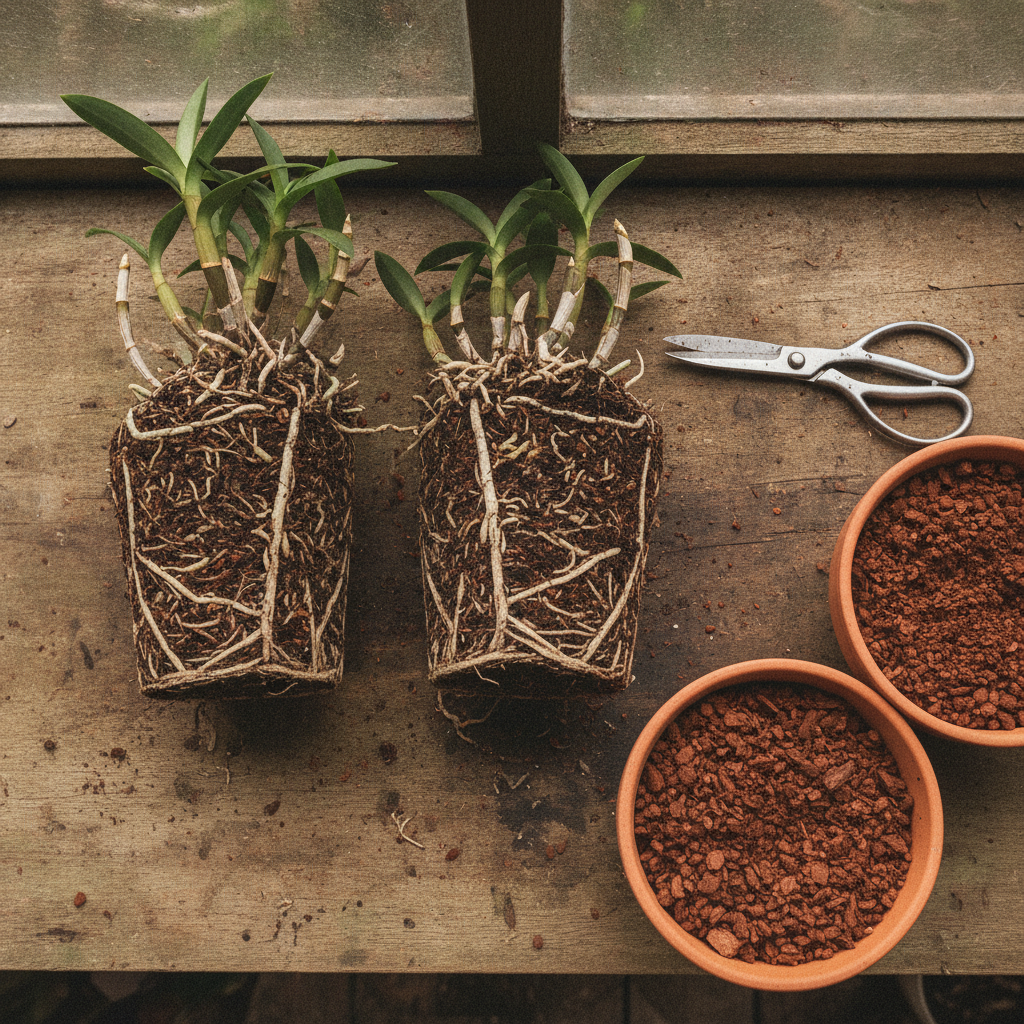
Division suits a large, crowded plant of at least six to eight canes and is best done in spring at repotting time, so the divisions can root away into the growing season ahead.
- Slide the whole plant from its pot and clear the old bark from the roots so you can see the structure clearly.
- Identify natural divisions, ensuring each piece will keep at least three or four canes, a mix of older canes and newer growth, plus a healthy share of roots.
- Cut cleanly through the rhizome between the chosen groups with a sterilised knife or secateurs.
- Dust the cut surfaces with cinnamon or a little sulphur powder to guard against infection.
- Pot each division into a snug container of fresh bark mix, settling the roots in firmly.
- Keep the new plants warm, bright and humid, and water sparingly until fresh roots take hold.
Pro Tip — Keep Clumps Generous: The temptation is to split a plant into as many pieces as possible, but small divisions of one or two canes sulk and rarely flower for years. Divisions of three or four canes establish faster and bloom much sooner, so divide less and wait less.
Potting Up Keikis: Step-by-Step
When a keiki appears on a cane, the trick is patience: let it grow its own roots to a usable length before separating it from the parent.
- Leave the keiki attached until its roots are at least four to five centimetres (1.5 to 2 inches) long.
- Cut it from the parent cane with a small section of the cane attached, using sterilised blades.
- Dust the cut with cinnamon, then pot the keiki into a tiny container of fine bark mix.
- Keep it warm, humid and out of direct sun while it establishes, misting lightly rather than soaking.
- Once new growth shows the keiki has rooted in, begin a normal, gentle watering and feeding routine.
Troubleshooting Propagation
| Problem | Likely Cause | Solution |
|---|---|---|
| Division rots after potting | Overwatering damaged roots before they sealed | Water sparingly after division; let cut roots callus first |
| Keiki produces no roots | Air too dry, or removed from cane too soon | Raise humidity and leave the keiki on the parent longer |
| Divisions refuse to flower | Pieces too small, or no winter rest given | Use larger divisions and provide a cool, dry winter |
| Lots of keikis, few flowers | Plant kept too warm and wet in winter | Enforce a genuine cool, dry rest to switch it to blooming |
Pests & Diseases
A well-grown bamboo orchid in bright, airy conditions is reasonably resistant to trouble, but no houseplant is immune. Most problems are either sap-sucking insects that hitch a ride from other plants or fungal and bacterial rots that follow from overwatering and stagnant air. Catching them early, when an infestation is a few insects rather than a colony, makes all the difference.
Make a habit of inspecting the plant whenever you water, paying attention to the leaf undersides, the joints where leaves meet the canes, and the papery sheaths along the canes, all favourite hiding places. A quick weekly look is the cheapest pest control there is.
Common Pests
Mealybugs (Pseudococcus spp.)
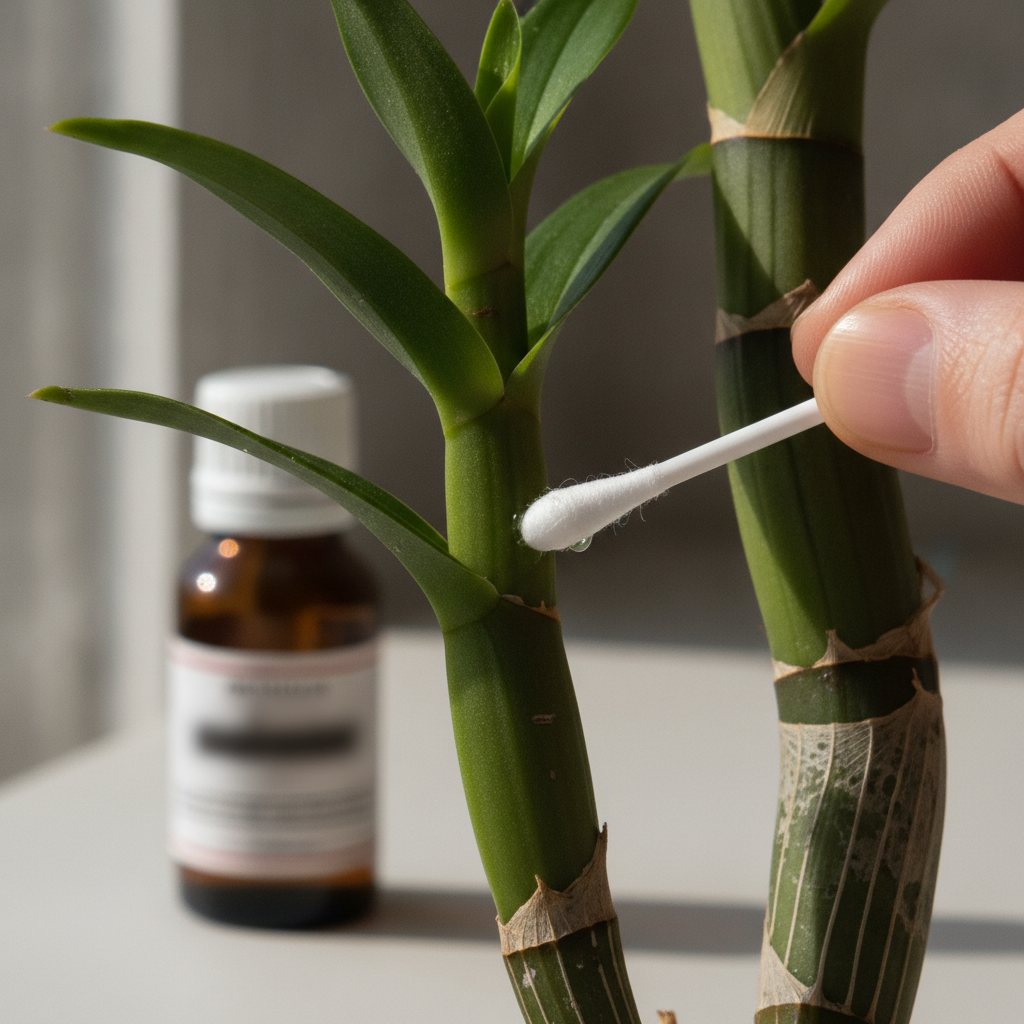
These soft, white insects look like tiny tufts of cotton wool and gather in the sheltered leaf joints and along the canes, draining sap and weakening the plant while excreting sticky honeydew that attracts sooty mould.
Treatment: Dab each insect directly with a cotton bud dipped in diluted isopropyl alcohol, then treat the whole plant with a horticultural soap or neem oil spray, repeating weekly until they are gone.
Scale Insects (Coccoidea)
Scale appear as small, immobile brown bumps clamped onto canes and the undersides of leaves, protected by a waxy shell that makes them easy to mistake for part of the plant until they are numerous.
Treatment: Scrape them off gently with a fingernail or soft brush, wipe the area with alcohol, and follow up with neem oil or a systemic insecticide for persistent populations sheltering in the sheaths.
Spider Mites (Tetranychus urticae)
Thriving in hot, dry air, these almost invisible mites stipple the leaves with fine pale speckles and spin delicate webbing in the leaf axils, gradually bronzing and weakening the foliage.
Treatment: Raise the humidity, which they hate, rinse the plant thoroughly, and apply neem oil or a miticide to the leaf undersides over several weeks to break their fast breeding cycle.
Aphids (Aphidoidea)
Soft green, black or pink insects that cluster on tender new growth and especially on developing flower buds, distorting them and coating them in sticky honeydew.
Treatment: Rinse them off with a firm jet of water, then treat with insecticidal soap, taking care around delicate buds, and check for ants that may be farming them.
Common Diseases
Root and Crown Rot (Pythium and Phytophthora spp.)
The most serious threat to a bamboo orchid, caused by waterlogged, airless conditions. Roots turn brown and mushy and the rot can creep up into the canes, blackening and softening them from the base.
Treatment: Unpot at once, cut away every affected root and cane back to firm, healthy tissue with sterilised tools, dust the wounds with cinnamon, and repot into fresh dry bark with much more restrained watering thereafter.
Bacterial Leaf Spot (Erwinia spp.)
Soft, water-soaked, often foul-smelling dark patches that appear on leaves and spread quickly in warm, wet, stagnant conditions, sometimes overrunning a leaf within a day or two.
Treatment: Cut out the infected tissue well into healthy leaf with a sterile blade, treat with a copper-based fungicide, improve air movement and keep water off the foliage, especially overnight.
Pest and Disease Summary
| Pest / Disease | Identification | Treatment |
|---|---|---|
| Mealybugs | White cottony tufts in leaf joints | Alcohol on a cotton bud, then neem or soap spray |
| Scale | Brown immobile bumps on canes and leaves | Scrape off, wipe with alcohol, follow with neem |
| Spider mites | Fine pale speckling and webbing | Raise humidity, rinse, apply neem or miticide |
| Aphids | Clusters on new growth and buds | Rinse off, treat with insecticidal soap |
| Root and crown rot | Brown mushy roots, blackening cane bases | Cut to healthy tissue, repot dry, water less |
| Bacterial leaf spot | Soft, smelly, water-soaked dark patches | Excise tissue, copper fungicide, improve airflow |
Prevention Strategies
Prevention costs almost nothing and saves a great deal. Quarantine any new plant for a couple of weeks before letting it join your collection, keep the growing area clean of fallen leaves and debris, and ensure steady air movement so foliage dries quickly and fungal spores struggle to settle.
Above all, a plant grown correctly, with bright light, the right watering rhythm and good airflow, is far less appealing to pests and far better able to shrug off disease than a stressed one. Most pest outbreaks on orchids begin on a weakened plant, so good general care is itself the best protection.
Pro Tip — Neem as Routine: A monthly preventive spray of diluted neem oil over the foliage and canes, applied in the evening out of direct sun, deters most sap-sucking pests before they establish and is gentle enough for regular use on orchids.
Popular Varieties
The wild species is beautiful in its own right, but a century of breeding has given Dendrobium nobile an enormous range of named hybrids and colour forms, many of them grouped under the popular Yamamoto line developed in Japan for compact growth and free flowering. Between them they cover almost the full spectrum from pure white through every shade of pink, lilac and magenta to deep purple, with endless variations in the contrasting throat.
For a houseplant grower the differences that matter most are flower colour and the reliability of bloom, since care is essentially identical across all of them. The selection below highlights some of the most widely available and rewarding forms to look out for.
| Variety | Flower Appearance | Light Needs | Growth Rate | Availability |
|---|---|---|---|---|
| Yamamoto hybrids | Compact canes packed with pink to lavender blooms, maroon eye | Bright | Moderate | Common |
| ‘Apollon’ | Pure white with a soft primrose throat | Bright | Moderate | Common |
| ‘Star Class’ | Large, full, rounded flowers in rich pink | Bright | Moderate | Frequent |
| ‘Spring Dream’ | Soft pastel pinks and whites, very free flowering | Bright | Moderate | Frequent |
| ‘Oriental Smile’ | Warm apricot to peach tones | Bright | Moderate | Occasional |
| Deep purple forms | Intense magenta to violet with a dark eye | Bright | Moderate | Frequent |
Featured Varieties
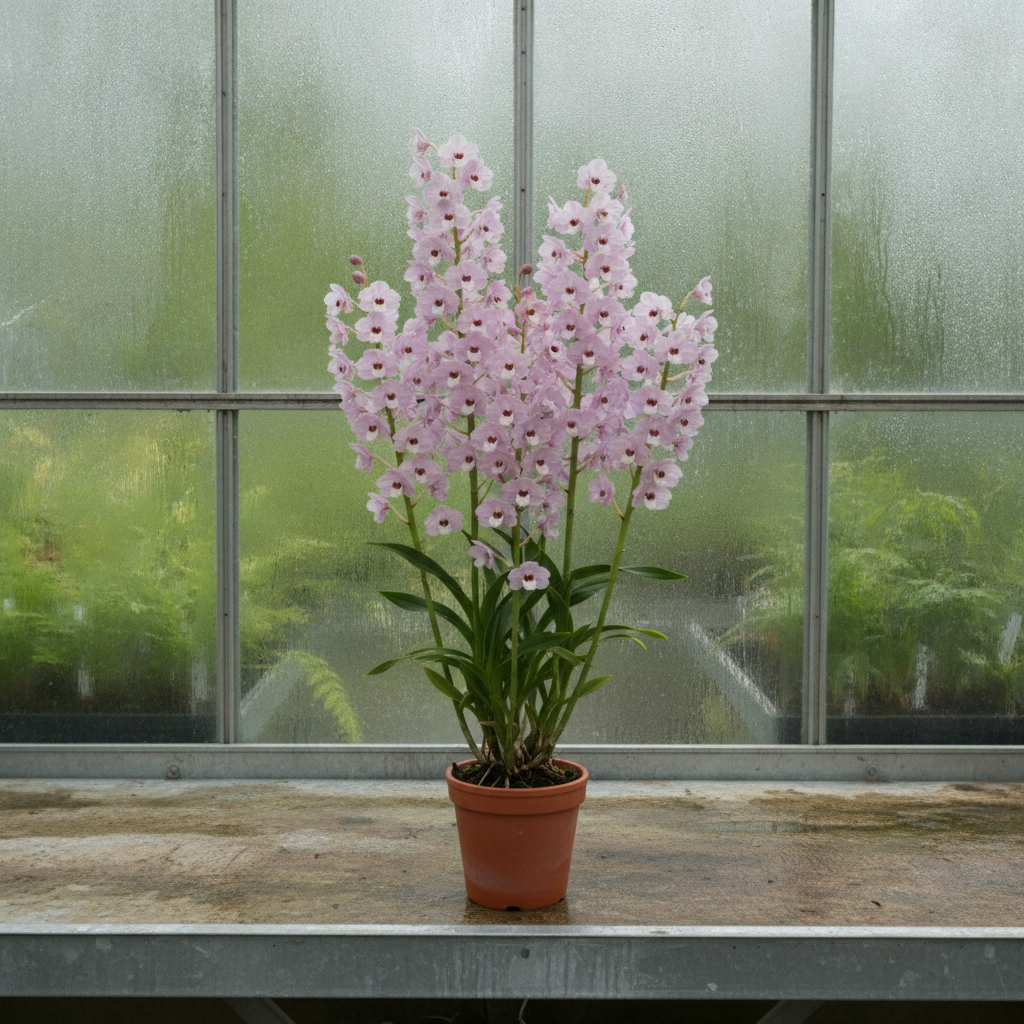
Yamamoto Hybrids
The benchmark for indoor growers. Bred for compact, upright canes that crowd themselves with rounded flowers in soft pink and lavender, each with a creamy centre and a deep maroon eye. Free flowering and forgiving, they are the easiest way into the noble dendrobiums.
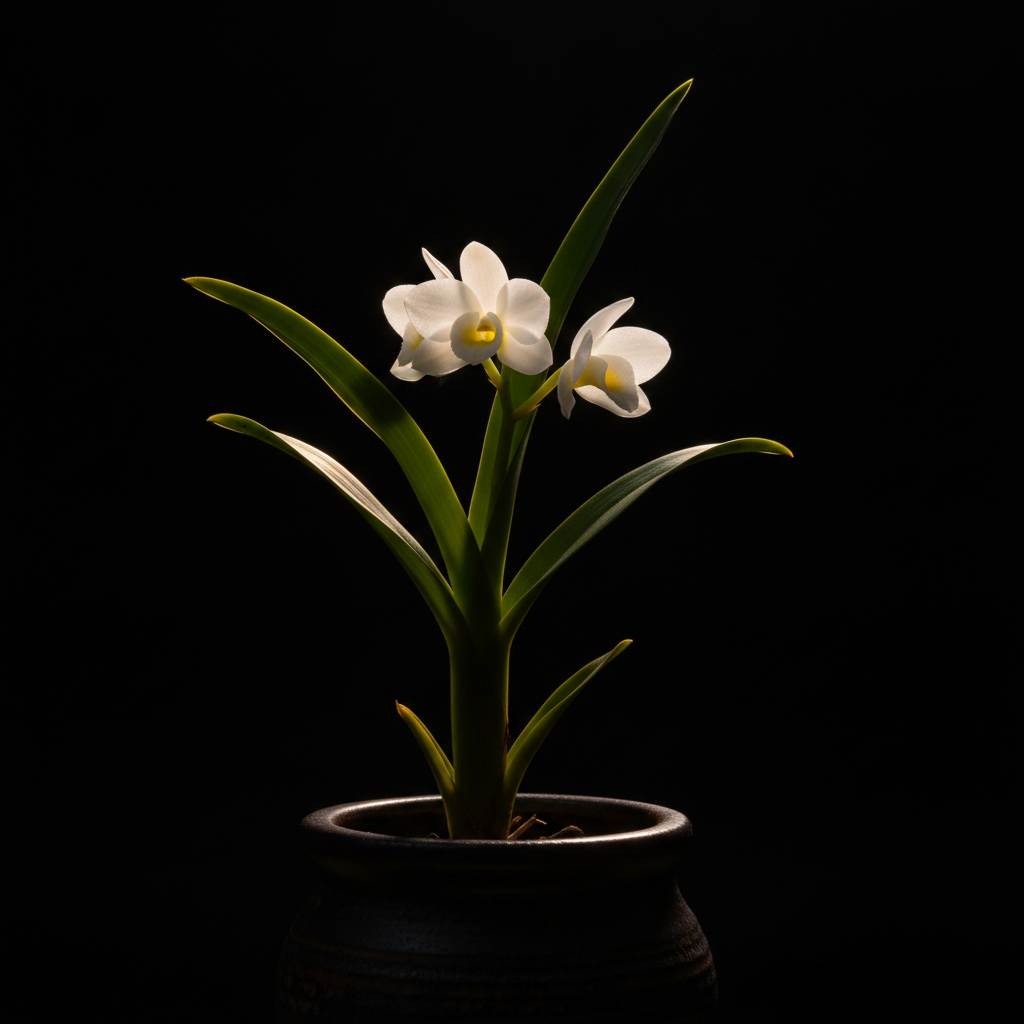
‘Apollon’
A classic white form prized for its broad-petalled, pure white flowers set off by a gentle primrose-yellow throat, borne in pairs along green canes. Its clean colouring makes a serene contrast to the bolder pinks and is a favourite for bright, minimal interiors.
Variety Profiles in Detail
Yamamoto Hybrids (Dendrobium nobile hybrids)
Developed over decades by the Yamamoto nursery in Japan, this vast group was selected specifically for the windowsill grower: shorter, sturdier canes than the wild species, a strong tendency to flower along the whole length of every cane, and a colour range spanning white, pink, red, lilac and bicolours. If you buy a bamboo orchid from a garden centre, it is most likely a Yamamoto hybrid, and they remain the most dependable choice for a first plant.
‘Apollon’ (Dendrobium nobile ‘Apollon’)
One of the best-loved white selections, ‘Apollon’ carries full, rounded, almost waxy white flowers with only the faintest blush of yellow at the centre. It tends to flower generously once given a proper rest, and the absence of strong markings makes its blooms read as crisp and architectural, which is why it endures as a collector favourite.
Choosing the Right Variety for Your Space
Because every Dendrobium nobile form shares the same care, the choice comes down to colour and what suits your room. White forms such as ‘Apollon’ bring calm to a bright, pared-back interior, while the saturated pinks and purples make a vivid focal point in winter when little else is in bloom. Whatever you pick, look for a plant with several plump, healthy canes and firm roots, since a well-established specimen will reward you far sooner and far more reliably than a struggling bargain.
Frequently Asked Questions
Why won’t my bamboo orchid flower?
Almost always because it has not had a cool, dry winter rest. To set buds, Dendrobium nobile needs several weeks of cooler nights, around 10 to 15°C (50 to 59°F), with much reduced watering and no fertiliser through autumn and winter. A plant kept warm and watered all year stays green and may sprout keikis instead of flowers. Insufficient light in the previous summer is the other common cause.
What are the little plantlets growing on the canes?
Those are keikis, baby plants that are clones of the parent. They often appear when the plant did not receive a cold enough rest to flower. You can leave them to grow and, once they have roots a few centimetres long, detach and pot them up as new plants, as described in the propagation section.
Should I cut off the old canes after flowering?
No. Even old, leafless canes store water and energy and can produce keikis or fresh growth, so leave them in place as long as they are firm and green. Only remove a cane once it has gone genuinely brown, shrivelled and dead, cutting it away cleanly at the base with sterilised tools.
The canes look wrinkled in winter. Is something wrong?
Usually not. Some light wrinkling is normal during the dry winter rest and is part of the process that triggers flowering. As long as the canes stay firm rather than soft, hold to the sparse watering schedule. If they become deeply shrivelled and the roots are dry and dead, however, the plant may have lost its roots to earlier overwatering and need repotting.
Is the bamboo orchid safe around cats and dogs?
Yes. Orchids, including Dendrobium nobile, are not listed as toxic to cats or dogs, so it is a sound choice for a home with pets. A pet that chews the leaves might get a mild upset stomach, and the bark and fertiliser are not meant to be eaten, so it is still best kept out of reach.
How often should I repot it?
Every two years or so, or sooner if the bark has broken down into a soggy, airless crumb or the plant has clearly outgrown its pot. Repot in spring as new growth begins, into a pot only a little larger than the rootball, since bamboo orchids flower best when somewhat pot-bound.
Can I grow a bamboo orchid outdoors?
In a warm, frost-free climate it can spend spring and summer outside in bright, dappled shade, which often improves flowering by giving it naturally cooler autumn nights. It is not frost hardy, though, so bring it in well before temperatures approach freezing, and use the outdoor chill of early autumn as part of its rest rather than exposing it to a true cold snap.
How long do the flowers last?
The display is generous and long-lived, typically lasting four to six weeks, sometimes longer in cool, stable conditions out of direct sun and away from draughts and ripening fruit. With its blooms appearing in late winter and early spring, the bamboo orchid brings colour exactly when most homes need it most.






