
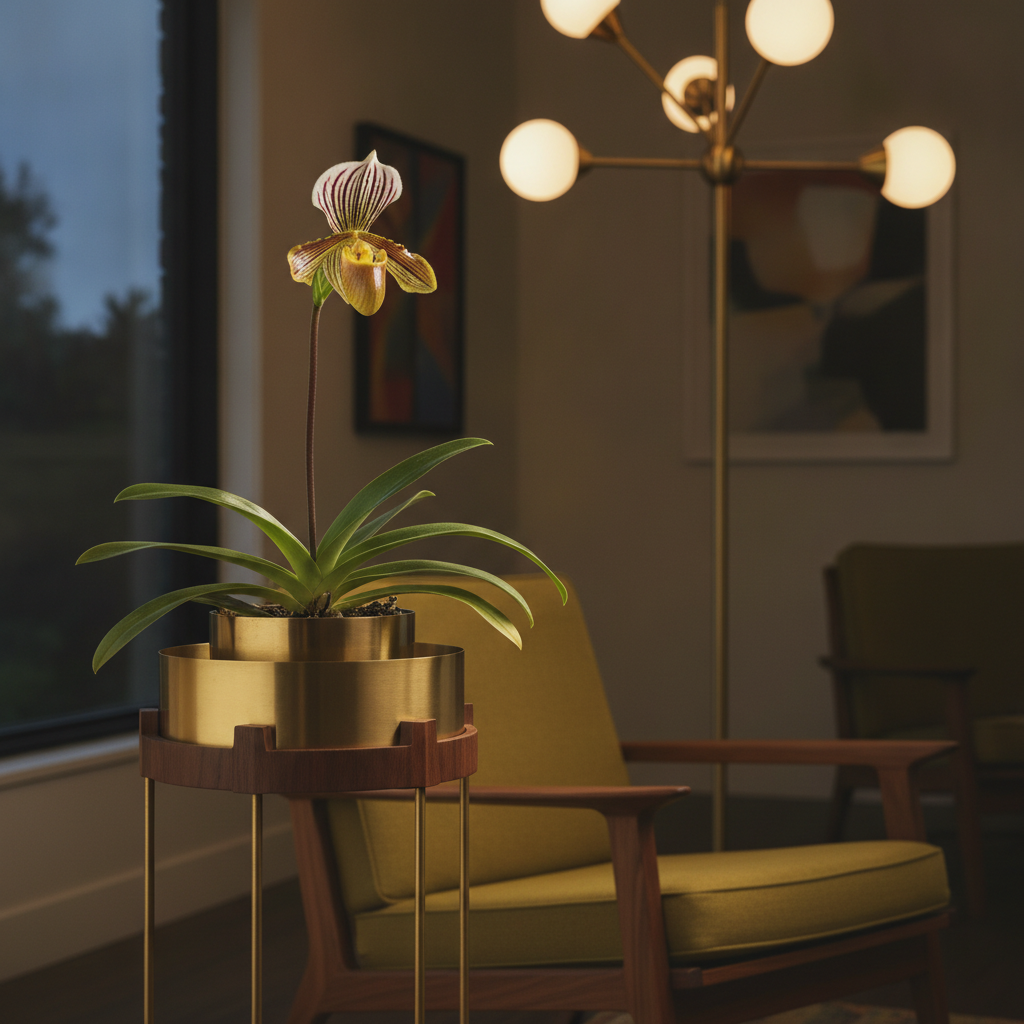
Few orchids look quite as deliberate as the lady slipper. Where a moth orchid flares open and a cattleya ruffles, the lady slipper orchid (Paphiopedilum insigne) presents a single, glossy, slipper-shaped flower built like a piece of polished lacquerware, its waxy pouch held below a tall striped dorsal sepal that catches the light. Native to the cool, humid foothills of the eastern Himalayas, across north-east India and Nepal, it grows on and among limestone outcrops rather than perched high in trees, which sets it apart from most of the orchids sold as houseplants. The common name covers the whole genus Paphiopedilum, but insigne is the classic, forgiving species that introduced generations of growers to slipper orchids and remains one of the easiest to flower on a windowsill.
The lady slipper has a reputation for being fussy, and that reputation is largely undeserved. It is not difficult so much as different. It has no pseudobulbs and no water-storing organs, so it neither wants to dry out completely nor to sit in stagnant wet, and it flowers best after a spell of cool nights that most centrally heated homes can supply with a little thought. This guide walks through everything that separates a slipper orchid that merely survives, holding on with a fan or two of leaves and no flowers, from one that thrives and throws up a long-lasting bloom every winter: light, watering and humidity, the right potting mix, feeding, how to divide it, the pests and rots to watch for, and the related varieties worth knowing.
Contents
- Quick Reference
- Why the Lady Slipper Orchid Makes a Rewarding Houseplant
- Light Requirements
- Watering & Humidity
- Soil, Potting & Repotting
- Fertilising
- Propagation
- Pests & Diseases
- Popular Varieties
- Frequently Asked Questions
Quick Reference: Lady Slipper Orchid at a Glance
| Light | Bright indirect light, no direct midday sun. East or shaded north window is ideal. |
| Watering | Keep the mix evenly moist at all times; water when the surface just begins to dry. Never bone dry, never waterlogged. |
| Temperature | 18 to 24°C (64 to 75°F) by day, dropping to 10 to 15°C (50 to 59°F) at night. A cool plant. |
| Humidity | 50 to 70 per cent. Tolerates household levels around 40 per cent with steady watering. |
| Fertiliser | Weak orchid feed at quarter to half strength every second or third watering during active growth. |
| Toxicity | Not considered toxic to cats, dogs or people if eaten. The foliage can cause mild skin irritation in sensitive growers. |
Why the Lady Slipper Orchid Makes a Rewarding Houseplant
The lady slipper earns its place on a windowsill for two reasons: the flower lasts an extraordinarily long time, and the plant itself is compact and tidy year round. A single bloom commonly holds in good condition for eight to twelve weeks, far longer than most flowering houseplants manage, and because the flower is so heavily textured it looks almost artificial, drawing comment from anyone who sees it. Between blooms, the low fan of strap-shaped leaves stays neat and evergreen, never dying back to a bare bulb, so the plant always looks like something rather than a pot of waiting roots.
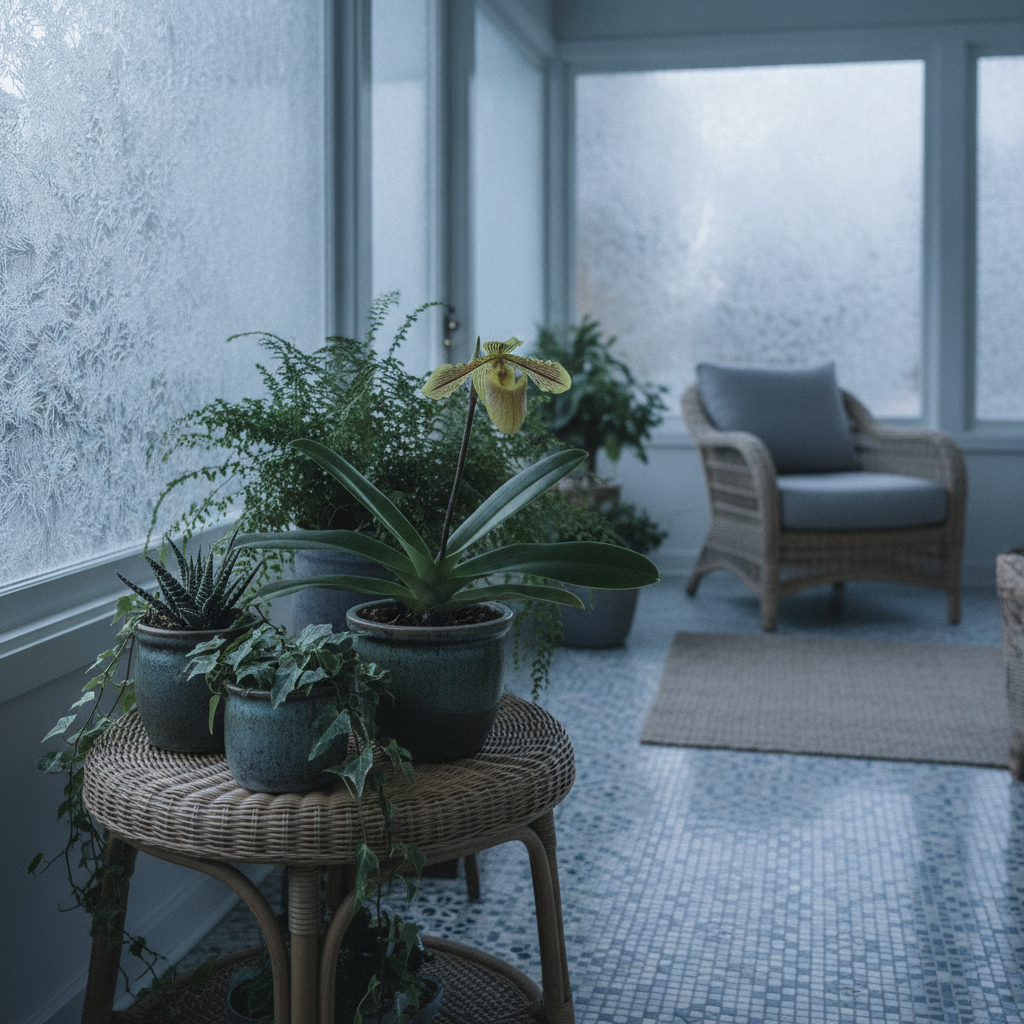
It also suits the way many homes are actually heated. Unlike the warmth-loving orchids that sulk in a cool room, Paphiopedilum insigne comes from a climate of mild days and genuinely cold nights, so a hallway, a spare bedroom or a bright porch that the central heating does not quite reach is an advantage rather than a problem. That same cool tolerance makes it forgiving of the dry, draughty spots near windows in winter, exactly the time it chooses to flower. For a grower who wants an orchid that is present and interesting in the depths of the year, with none of the bare-stem awkwardness of a deciduous plant, the lady slipper is hard to better.
Important — Toxicity: Lady slipper orchids are not listed as toxic to cats, dogs or humans, and a curious pet that nibbles a leaf is unlikely to come to harm. The main caution is for the grower: the fine hairs on the leaves and flower stem can trigger mild contact dermatitis in sensitive people, so handle freely cut surfaces with care and wash your hands after repotting.
Light Requirements
Light is the single most common thing growers get wrong with slipper orchids, usually by giving too much. In the wild, Paphiopedilum insigne grows in leaf litter and on shaded limestone where it receives bright, filtered light but is screened from harsh direct sun by surrounding vegetation and cloud. It is, in plant terms, a low-to-medium-light orchid, sitting somewhere between a moth orchid and a fern in its tolerance, and it will scorch in the same window that a cactus would enjoy.
The ideal is bright, indirect light for most of the day, with perhaps an hour of gentle early or late sun that has lost its sting. A position a metre or so back from a bright window, or right against a window shaded by a sheer curtain or an outside tree, gives the plant what it needs without the risk of burn. Leaves that are a healthy mid-green, neither dark and floppy nor bleached and yellowish, tell you the level is about right.
Light Levels Explained
Plant light is measured in lux, and slipper orchids occupy a fairly narrow, forgiving band. The table below sets out the broad categories so you can place the plant by eye and by location rather than reaching for a meter, though a cheap lux app on a phone is a useful sanity check.
| Light Category | Approx. Level | Typical Location | Outcome |
|---|---|---|---|
| Direct sun | 50,000 lux and up | Unshaded south window in summer | Leaf scorch, bleaching, possible death |
| Bright indirect | 15,000 to 25,000 lux | East window, or shaded south window | Ideal: strong growth and reliable flowering |
| Medium | 10,000 to 15,000 lux | A metre back from a bright window | Good growth, dependable flowering |
| Low | 5,000 to 10,000 lux | North window, or deeper in a room | Survives, leaves darken, flowering may stall |
| Very low | Below 5,000 lux | Interior wall, dim corner | Slow decline, no flowers |
Window Orientation and Placement
South-facing window: Usable but risky. The unobstructed midday sun of a south window is too strong and will scorch the leaves, so pull the plant back from the glass or hang a sheer curtain to filter the light. In the depths of winter, a south window often becomes ideal as the sun sits low and weak.
East-facing window: The best choice for most homes. Soft morning sun followed by bright shade for the rest of the day matches the plant’s needs almost exactly, with little risk of burn.
West-facing window: Workable, but the strong afternoon sun can be fierce in summer. Treat it like a south window and provide some filtering, or set the plant a little back from the glass.
North-facing window: A safe, gentle option that suits the plant’s low-light tolerance. Flowering may be slightly less reliable than in an east window, especially over a dark winter, in which case a grow light makes up the difference.
Pro Tip — Read the Leaves: The plant tells you whether the light is right. Yellowish, reddish or stiff, upright leaves mean too much light; dark, soft, lax leaves that flop over the pot rim mean too little. Aim for firm, mid-green leaves held at a gentle angle, and adjust the position until you see them.
How Light Affects Flowering
Light drives flowering more than any feed or trick. A lady slipper kept too dark will grow on perfectly happily, producing fan after fan of green leaves, and simply never bloom, which frustrates growers who assume the plant is unhappy when in fact it is merely under-lit. Lifting a shy plant from a low spot to a brighter, indirect one, and pairing that with the cool autumn nights described below, is usually all it takes to coax out a flower spike from the centre of a mature growth.
Warning — Direct Sunlight: A few hours of unfiltered summer sun can scorch a slipper orchid in a single afternoon, leaving sunken yellow or brown patches that never recover. If you move the plant outdoors or to a brighter window for the warmer months, increase the exposure gradually over a week or two and keep it out of direct midday rays.
Artificial Lighting
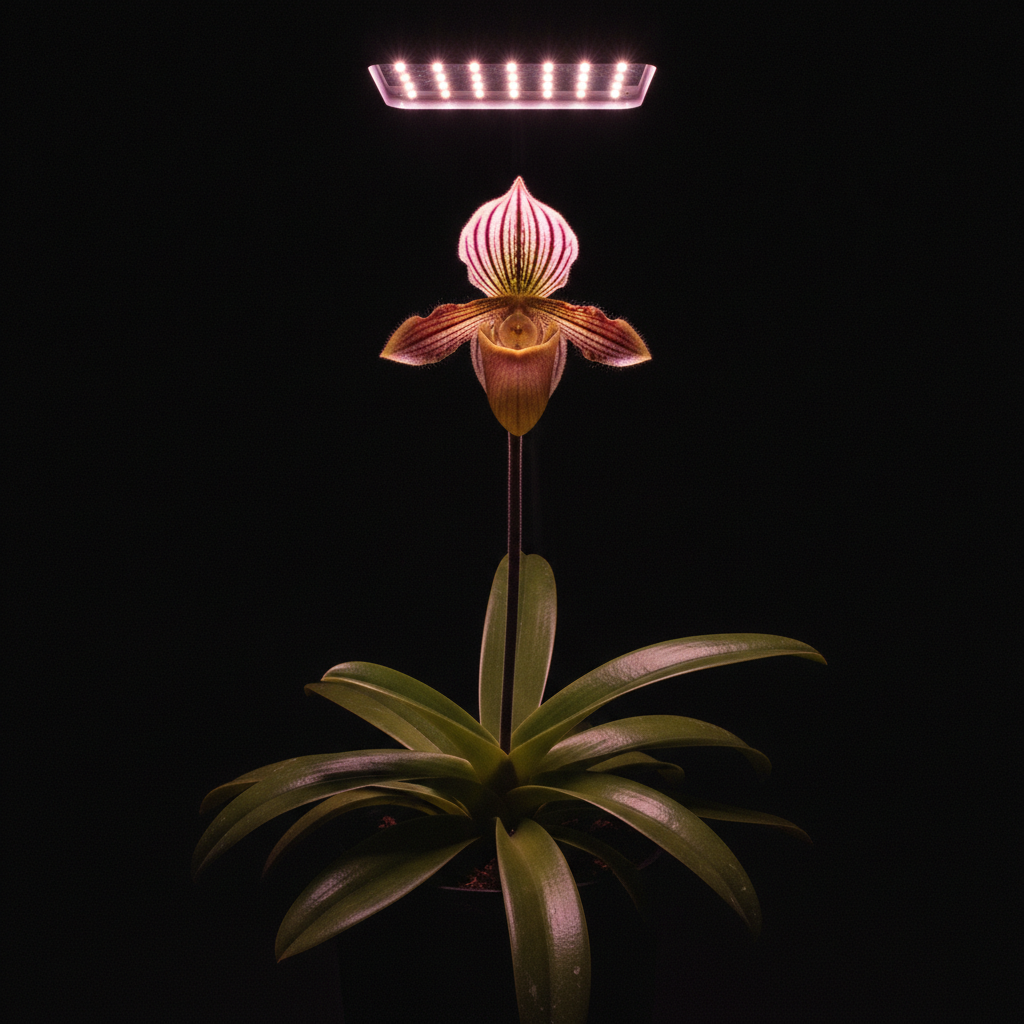
Slipper orchids grow beautifully under artificial light, and because their requirement is modest, a single full-spectrum LED grow light set 30 to 45 centimetres (12 to 18 inches) above the foliage and run for 12 to 14 hours a day is ample. This is the simplest fix for a flat with poor natural light, and it has the bonus of letting you control the day length precisely, which can help nudge a reluctant plant into bloom. Ordinary warm-white room lighting is far too weak to count, so a dedicated horticultural lamp is needed.
Seasonal Adjustments
As the days shorten through autumn, move the plant closer to the brightest available window to compensate for the weaker, shorter light, then ease it back again in spring when the sun strengthens. This seasonal shuffle matters more for the lady slipper than for many houseplants, because its natural flowering trigger is the combination of cooler nights and changing light that arrives in autumn, and a plant kept in unchanging conditions year round can lose the cue to bloom.
Watering & Humidity
Watering is where the lady slipper differs most sharply from the orchids people are used to. It has no pseudobulbs and no thick, water-storing roots, so it cannot draw on a reserve when the mix dries out, and it cannot shrug off a soaking the way an epiphyte perched in bark can. The plant wants to stay evenly, lightly moist at all times: never dust dry, never sitting in a swamp. Get this balance right and most other problems disappear.
When to Water
Check the plant every few days by pushing a finger a centimetre or so into the mix. Water when the surface and the very top of the mix have just begun to dry but the bulk below is still cool and damp. In practice this often means watering roughly twice a week in summer and once a week in winter, but treat those numbers as a starting point rather than a rule, because pot size, mix, light and room temperature all change the pace.
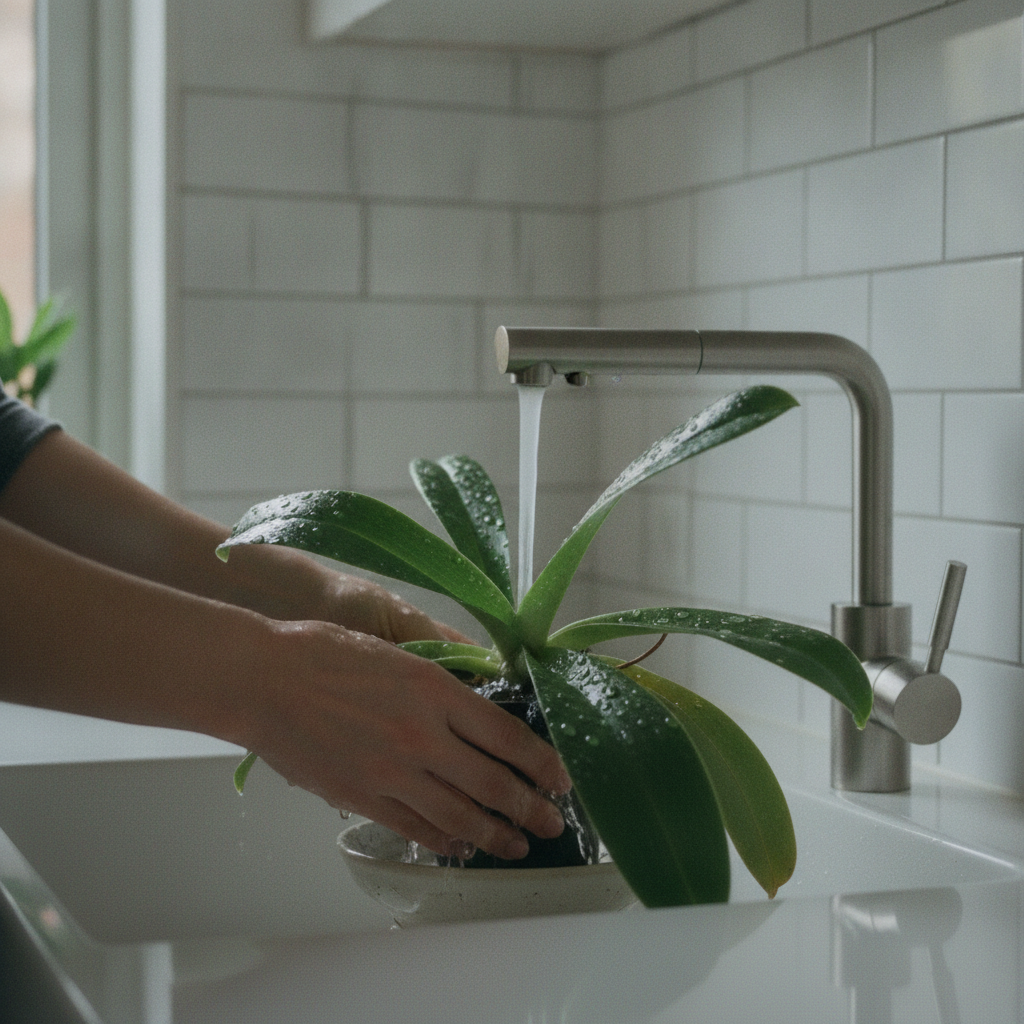
The safest method is to take the plant to the sink and flush it thoroughly, letting tepid water run through the pot for a good fifteen or twenty seconds so the entire mix is wetted and any built-up salts are washed away, then allowing it to drain completely before it goes back. Avoid the common houseplant habit of giving a small splash every day, which wets only the surface and leaves the core either permanently soggy or chronically dry.
Pro Tip — Water Down the Side: Try to keep water out of the central crown where the leaves meet, especially in the evening. Water pooling and sitting in that growing point overnight is the classic cause of crown rot, which can kill a fan within days. Water at the edge of the pot, or tip the plant slightly so any splash runs off the leaves.
How to Water Correctly
- Use tepid water, never cold straight from the tap, as cold water shocks the roots of this warmth-rooted plant.
- Take the pot to the sink and run water through the mix at the edge of the pot, avoiding the central crown.
- Let the water flow for fifteen to twenty seconds so the whole mix is soaked and salts are flushed out.
- Allow the pot to drain fully for several minutes until no more water drips from the base.
- Tip out any water that collects in the saucer or cover pot, so the plant never stands in it.
- Return the plant to its spot and check again in a few days rather than on a fixed calendar day.
Signs of Overwatering vs. Underwatering
| Symptom | Overwatering | Underwatering |
|---|---|---|
| Leaf colour | Yellowing from the base, often whole leaves at once | Dull, greyish-green, sometimes reddened tips |
| Leaf texture | Soft, limp, water-soaked patches | Thin, papery, leaf tips browning and crisp |
| Mix | Sour smell, constantly wet, breaking down to mush | Pulls away from the pot, dusty and slow to rewet |
| Roots | Brown, hollow, mushy, slipping their outer layer | Pale, dry, shrivelled and brittle |
| Crown | Blackening, soft, foul-smelling at the centre | Generally unaffected; damage shows in the leaves first |
Warning — Root Rot: Because the lady slipper has fine roots and no water store, it is unusually quick to rot in a soggy, broken-down mix. If you tip the plant out and find brown, hollow, foul-smelling roots, cut away every dead one with sterile scissors, rinse the survivors, and repot into fresh open mix. A plant caught early with even a few healthy white roots can recover; one left in sour wet mix rarely does.
Humidity Requirements
Coming from misty hill forests, the lady slipper prefers humidity in the range of 50 to 70 per cent, noticeably higher than the 30 to 40 per cent of a typical heated room. It is more tolerant than many orchids and will manage at household levels provided its mix stays reliably moist, but raising the humidity around it improves leaf quality and helps flower buds develop without drying and dropping.
The signs that the air is too dry are subtle at first: leaf tips that brown and crisp, flower buds that yellow and fall before opening, and a general lack of vigour despite correct watering. These often appear in winter, when central heating strips moisture from the air at exactly the time the plant is trying to bloom, so a little extra humidity through the colder months pays off.
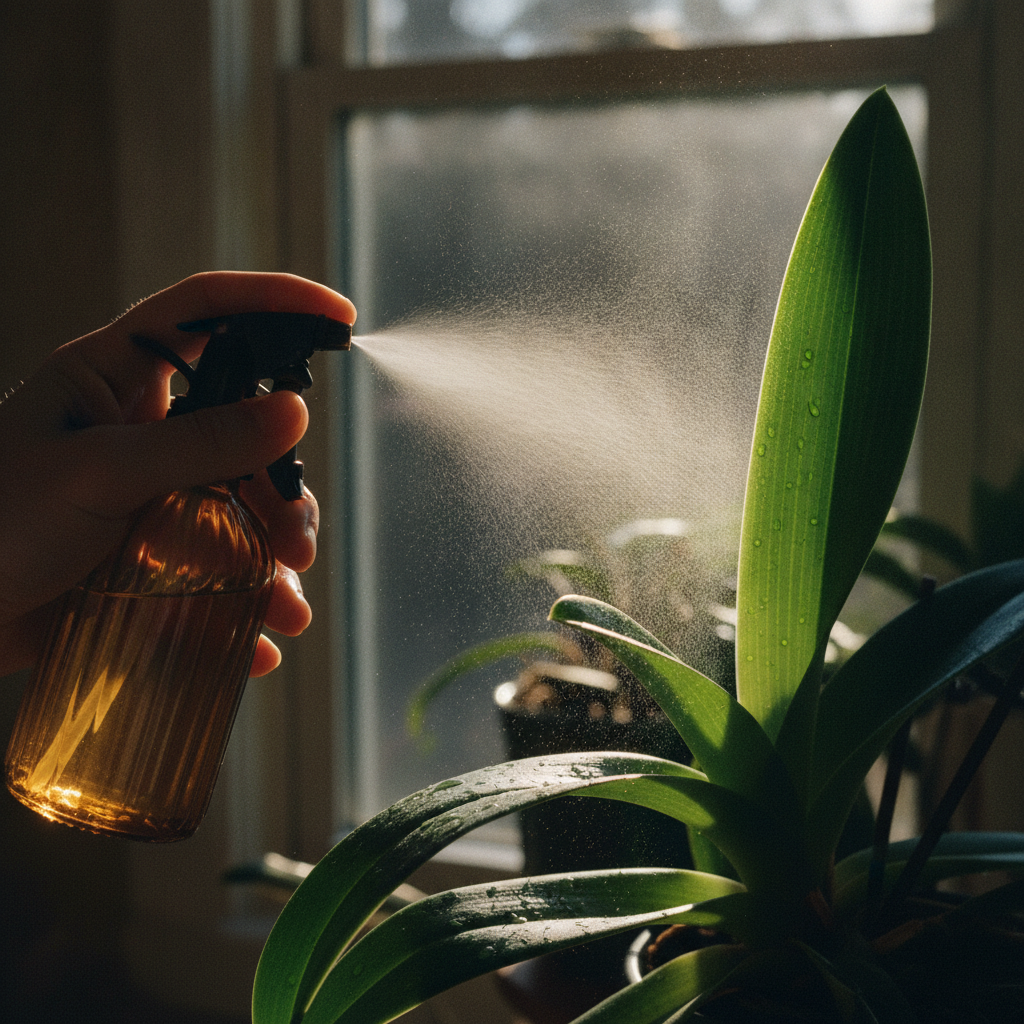
The most reliable way to raise local humidity is to stand the pot on a wide tray of damp gravel or clay pebbles, keeping the water level just below the base of the pot so the plant draws on the moist air without standing in water. Grouping plants together raises humidity in their shared microclimate, and a small room humidifier is the surest fix of all in a very dry home. Misting does little and, by wetting the crown, can do more harm than good, so it is best avoided.
Water Quality
Lady slipper orchids are sensitive to the salts and minerals that build up from hard tap water and over-feeding, which scorch the fine root tips and brown the leaf edges. Rainwater, filtered water or cooled boiled water is gentler, and if you can only use tap water, let it stand overnight and flush the pot generously each time to keep salts moving through rather than accumulating. Many of the limestone-dwelling slippers actually appreciate a trace of dissolved calcium, so moderately hard water is not the enemy here that it would be for a soft-water orchid; it is concentrated salt build-up, not calcium itself, that causes trouble.
Soil, Potting & Repotting
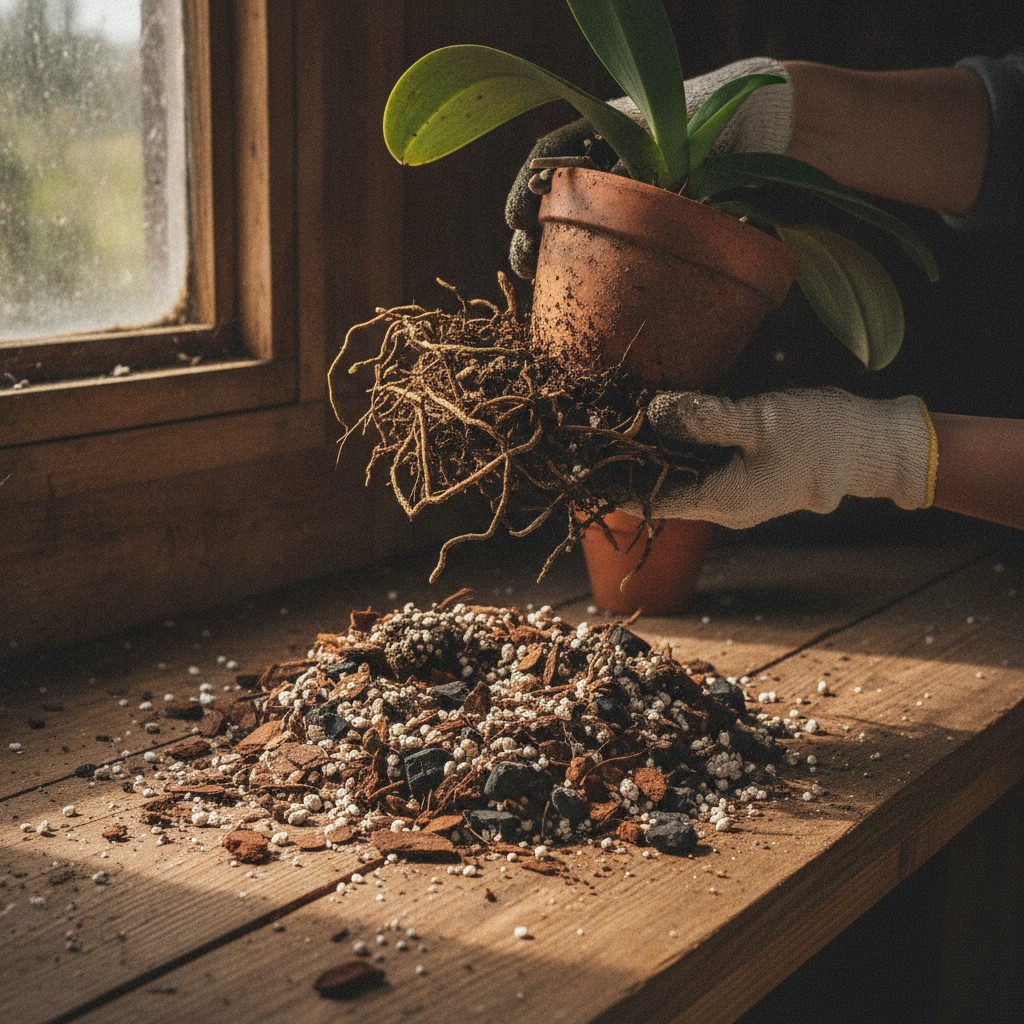
The lady slipper is sometimes called a terrestrial orchid, but it does not grow in soil in any ordinary sense. In the wild its roots run through loose leaf litter, moss and crumbling limestone, an environment that is open and airy yet stays evenly damp. The job of the potting mix is to recreate that: free-draining enough that water never stagnates around the roots, but moisture-retentive enough that the plant never dries to dust. Ordinary houseplant compost is fatal, smothering the roots and holding far too much water.
Ideal Soil Composition
A good slipper mix is based on fine-to-medium grade orchid bark, opened up with perlite and charcoal for drainage and air, and given a little water-holding body with chopped sphagnum moss. The aim is a blend that drains freely the moment you pour water through it yet stays cool and damp to the touch for days afterwards. A handful of crushed oyster shell or fine limestone chips suits this lime-loving species and helps buffer the mix.
| Component | Proportion | Function |
|---|---|---|
| Fine to medium orchid bark | Around half | Open structure, air to the roots, slow to break down |
| Perlite | About a fifth | Drainage and lasting aeration |
| Chopped sphagnum moss | About a fifth | Holds even moisture without going sour |
| Horticultural charcoal | A small handful | Keeps the mix sweet, absorbs impurities |
| Crushed oyster shell or limestone | A pinch | Supplies calcium this lime-dwelling orchid favours |
Lady slippers prefer a near-neutral to slightly alkaline root environment, which is unusual among orchids and reflects their limestone origins. This is why the pinch of oyster shell or limestone is worth adding, and why moderately hard water does the plant no harm. There is no need to chase a precise pH; simply avoid the strongly acidic peat-based composts sold for general houseplants.
Pro Tip — Quick Mix Recipe: If you would rather not blend your own, take a bag of fine-grade bark-based orchid mix and stir through one part perlite and one part chopped sphagnum to every three parts of the mix, plus a small handful of charcoal. That single adjustment turns a standard orchid mix into something far better suited to a moisture-loving slipper.
Choosing the Right Pot
Slipper orchids have a relatively small, fine root system and resent being swamped in too large a container, where the surplus mix stays wet and turns sour. Choose a pot that holds the roots comfortably with only a little room to grow, typically just one size up at repotting time.
Drainage holes are non-negotiable. The pot must have generous drainage so water flows straight through. A decorative cover pot is fine for looks, but the plant should sit in a pot that drains freely, and it must never be left standing in collected water.
Pot material: Plastic is the usual choice and the most forgiving, because it holds moisture steadily and lets you judge watering by weight. Terracotta breathes and dries faster, which can suit a heavy-handed waterer but means you must water more often. Unlike many orchids the lady slipper does not need a clear pot, as its roots do not photosynthesise.
Pot size: Err on the small side. A snug pot that the roots fill is far healthier than a generous one half full of wet, unused mix. As a rough guide, the pot should be just wide enough to take the root mass with a centimetre or two to spare.
When to Repot
Repot every one to two years, driven less by the plant outgrowing its pot than by the mix breaking down. As bark decomposes it packs together, loses its air and holds water like a sponge, which is exactly the condition that rots slipper roots, so fresh open mix on a regular cycle is the single best preventive against root loss. The ideal time is just after flowering, in spring, when the plant is moving into active growth and will re-establish quickly. Avoid repotting a plant in spike or full bloom unless an emergency such as rot forces your hand.
How to Repot: Step-by-Step
- Water the plant lightly the day before so the roots are supple and less likely to snap.
- Ease the plant out of its pot and gently tease away all the old, broken-down mix from the roots.
- Inspect the roots and trim away any that are brown, hollow or mushy with sterilised scissors, keeping the firm pale ones.
- Settle the plant into a clean pot of barely larger size, holding it so the base of the growths sits at the surface.
- Trickle fresh mix around the roots, tapping the pot to work it into the gaps, and firm it gently without compacting.
- Water sparingly at first and keep humidity up while the plant settles, returning to normal watering once you see new root or leaf growth.
Warning — Transplant Shock: A freshly repotted slipper orchid may sulk for a few weeks, and it is tempting to water heavily to revive it. Resist this. Overwatering a disturbed root system is the fastest route to rot. Keep the mix only lightly moist and the humidity high, and let new growth tell you the plant has re-rooted before you resume a full watering routine.
Fertilising
Lady slipper orchids are light feeders, and far more are harmed by too much fertiliser than too little. In the wild they make do with the thin nourishment of leaf litter and rainwater trickling over rock, so their roots are easily burned by the concentrated salts in a strong feed. The guiding principle is weak and frequent rather than strong and occasional.
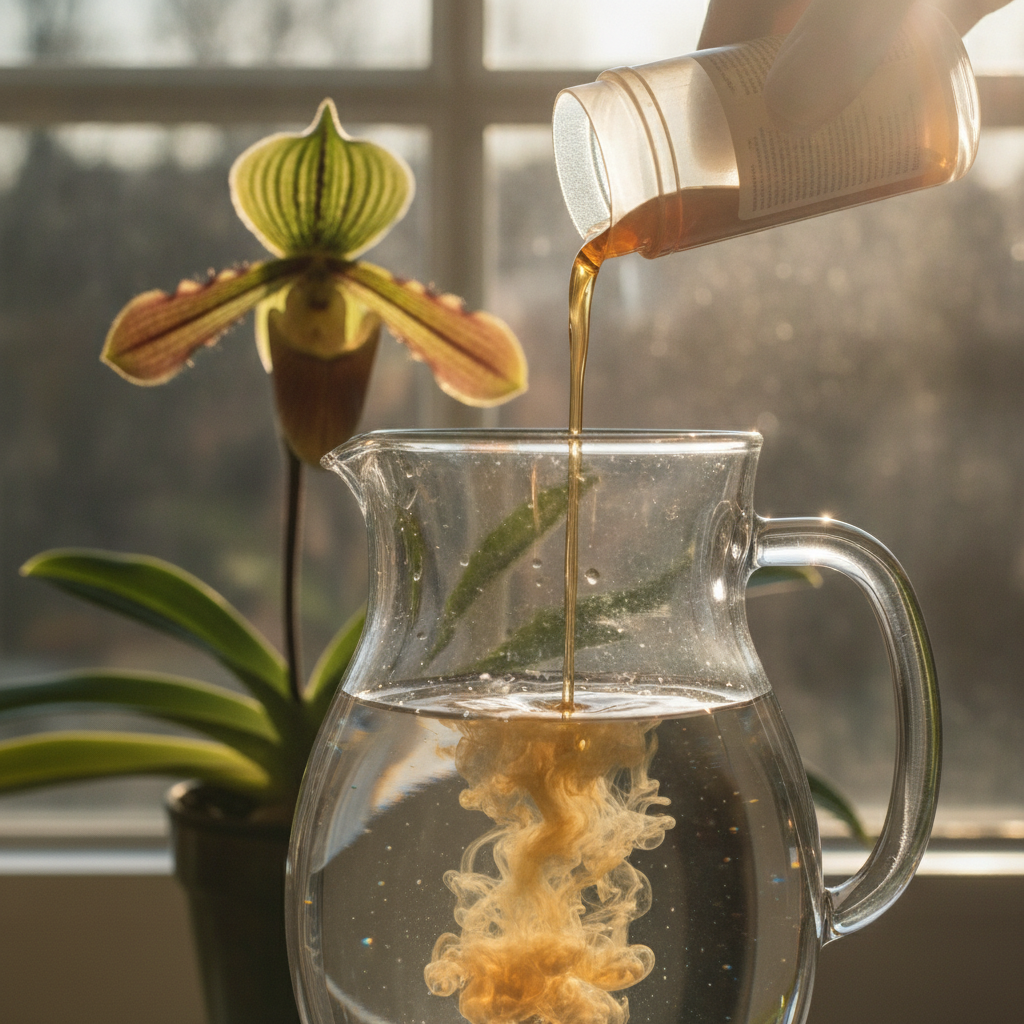
A balanced orchid fertiliser diluted to a quarter or at most half the label strength, applied every second or third watering through the active growing season, supplies everything the plant needs. Always feed onto a pot that is already damp, never onto dry roots, and flush the mix with plain water every few weeks to wash out any salts the feeding leaves behind.
Understanding Plant Nutrients
Fertiliser labels carry three numbers, the N-P-K ratio, giving the percentages of nitrogen, phosphorus and potassium. Nitrogen drives leaf and root growth, phosphorus supports flowering and root development, and potassium underpins general health and bloom quality. A balanced feed with roughly equal numbers suits the lady slipper for most of the year, and the secondary nutrients below matter too, particularly the calcium this limestone plant appreciates.
| Nutrient | Symbol | Primary Function | Deficiency Symptoms |
|---|---|---|---|
| Nitrogen | N | Leaf and root growth, green colour | Pale, slow, undersized new leaves |
| Phosphorus | P | Flowering and root development | Poor flowering, weak roots |
| Potassium | K | Overall vigour and bloom quality | Yellowing leaf margins, weak flowers |
| Calcium | Ca | Cell walls; valued by this lime-dwelling species | Deformed new growth, crown problems |
| Magnesium | Mg | Core of the chlorophyll molecule | Yellowing between the veins of older leaves |
| Iron | Fe | Chlorophyll production | Yellowing of the youngest leaves with green veins |
Types of Fertiliser
Liquid fertilisers: The easiest and most controllable option, mixed fresh into the watering can at each feed so you can dial the strength down precisely. A balanced liquid orchid feed at quarter strength is the standard choice for slippers.
Slow-release granular: Convenient but harder to control, as the prills release a fixed dose regardless of the plant’s needs and can concentrate salts in a small pot. If used at all, choose a low-strength orchid formulation and apply at half the suggested rate.
Organic fertilisers: Gentle options such as dilute seaweed extract are well suited to a salt-sensitive plant, supplying trace elements and a mild boost without the burn risk of a strong synthetic feed. They make a good alternating partner to a light balanced fertiliser.
Feeding Schedule
Feed actively from spring through to early autumn, when the plant is putting out new growth, at every second or third watering. Ease off through late autumn and winter, when growth slows and the plant turns its energy to flowering, dropping to a very occasional weak feed or none at all. Resume the regular rhythm as new leaves appear in spring.
Pro Tip — Weakly, Weekly: The old orchid-grower’s mantra applies perfectly here: feed weakly, weekly. A very dilute feed given often, with regular plain-water flushes in between, keeps a steady trickle of nutrients moving to the roots without ever letting salts spike to a level that scorches them.
How to Fertilise
- Water the plant first, or feed onto a pot that is already damp, never onto dry roots.
- Mix a balanced orchid fertiliser to a quarter or half the label strength in tepid water.
- Pour the solution through the mix at the edge of the pot until it runs from the drainage holes.
- Let the pot drain fully and tip away any feed that collects in the saucer.
- Every third or fourth feed, water through with plain water only to flush accumulated salts.
Warning — Salt Build-Up: A white or rusty crust on the pot rim or mix surface, or browning, dying leaf tips, signals salt build-up from over-feeding or hard water. Stop feeding, flush the pot heavily with plain water several times over a fortnight, and resume only at a weaker dilution. Left unchecked, salt damage kills the fine root tips and stalls the plant.
Propagation
Propagating a lady slipper is a patient business, because there is only one reliable home method: division. Unlike orchids that throw out keikis or root readily from cuttings, Paphiopedilum insigne increases by slowly building up a clump of growths, each one a fan of leaves with its own roots, and the only way to make more plants is to split a mature clump into pieces. There are no leaf cuttings, no stem sections and no water-rooting shortcuts to be had.
This makes division both simple and slow. Simple, because there is no rooting hormone, humidity tent or specialist kit involved, just a clean cut and two pots. Slow, because a plant needs years to grow large enough to divide without setting it back, and each division then takes a season or two to settle and flower again.
Understanding Growths and Fans
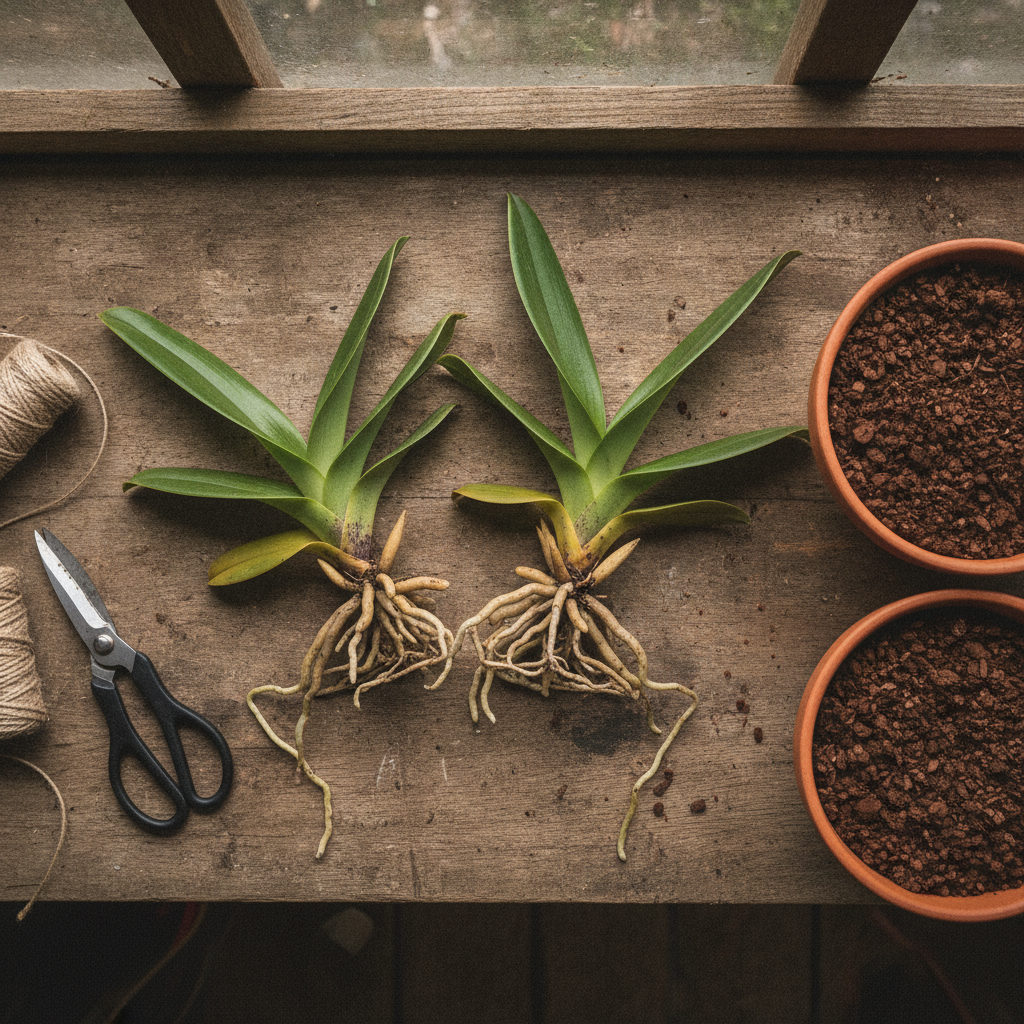
Each fan of leaves on a lady slipper is a single growth, and only a mature growth flowers, once, before the plant pushes a new growth from its base to carry on. Over time these growths multiply into a clump. The key to successful division is to keep at least three healthy growths together in each piece, because a division of one or two fans is slow to establish and may not flower for years, whereas a clump of three or more carries enough reserves to recover quickly and bloom on schedule.
Division: Step-by-Step
The best moment to divide is at repotting time in spring, just after flowering, when the plant is about to enter active growth. Work gently, keep your tools sterile, and resist the urge to split the clump into too many small pieces.
- Slide the whole plant out of its pot and carefully wash or tease the old mix away to expose the roots and the points where the growths join.
- Study the clump and find a natural division line where you can separate it leaving at least three growths on each side.
- Cut cleanly through the rhizome between the growths with a sterilised blade, trying to keep each piece’s roots intact.
- Trim away any dead or rotten roots, and dust large cut surfaces with cinnamon or sulphur to guard against infection.
- Pot each division into a snug container of fresh slipper mix, settling it at the same depth it grew before.
- Water lightly, stand the divisions somewhere warm, humid and shaded, and keep them just moist until new growth shows they have re-rooted.
Pro Tip — Don’t Over-Divide: The temptation is always to make as many plants as possible from one prized clump, but a slipper orchid grows and flowers far better as a substantial multi-growth specimen than as a row of weak singletons. Divide only when a plant is genuinely large, and keep the pieces generous. A bigger plant simply gives a better show.
Aftercare: Step-by-Step
The weeks after division decide whether the new plants thrive or stall. Treat each division as a convalescent: warm, humid and only lightly watered until its roots take hold.
- Keep the divisions out of direct sun in bright shade while they recover, as strong light stresses a plant with reduced roots.
- Maintain high humidity around them with a pebble tray or a loose, vented cover to slow water loss from the leaves.
- Water sparingly, keeping the mix barely moist, since a disturbed root system rots easily if kept wet.
- Hold off all feeding until you see clear new root or leaf growth, then resume a very weak feed.
Troubleshooting Propagation
| Problem | Likely Cause | Solution |
|---|---|---|
| Division wilts and shrivels | Too few roots left on the piece, or air too dry | Raise humidity, shade well, keep barely moist until rooted |
| Cut surface rots | Infection entering the wound, mix kept too wet | Use sterile tools, dust cuts with cinnamon, ease back on water |
| No new growth for months | Normal slow recovery, or division too small | Be patient; keep conditions stable and avoid disturbing the plant |
| Division never flowers | Piece too small, carrying only one or two growths | Grow it on undivided until it builds a clump of three or more growths |
Pests & Diseases
A healthy lady slipper in good conditions is not especially prone to trouble, but its evergreen leaves and the snug, moist crannies between its growths give a few pests places to hide, and its dislike of a wet crown makes it vulnerable to certain rots. Most problems are caught early by simply looking the plant over each time you water, paying attention to the leaf axils and undersides where pests gather.
Prevention is far easier than cure. Good airflow, careful watering that keeps the crown dry, and a quick inspection at watering time will head off the great majority of issues before they take hold. Any new plant brought into the home should be kept apart from the others for a few weeks until you are sure it is clean.
Common Pests
Mealybugs (Pseudococcus species)
The most frequent pest of slipper orchids, mealybugs look like small tufts of white cotton wool tucked into the leaf axils and the folds at the base of the growths, exactly where they are hard to spot. They suck sap, weaken the plant and leave a sticky residue that grows sooty mould.
Treatment: Dab each insect with a cotton bud dipped in diluted isopropyl alcohol, then follow up with neem oil or an insecticidal soap over the whole plant. Repeat weekly for several weeks to catch newly hatched young, and check the crown carefully each time.
Scale (Coccoidea species)
Scale appears as small, flat or domed brown discs stuck fast to the leaves, particularly along the midrib and undersides. Like mealybugs they feed on sap and excrete sticky honeydew, and their hard shells make them stubborn to shift.
Treatment: Scrape or rub the scales off gently with a fingernail or soft cloth, then treat with neem oil or a horticultural oil that smothers the survivors. Several rounds a week apart are usually needed to clear an infestation fully.
Spider mites (Tetranychus urticae)
Spider mites thrive in dry air and show up as fine pale stippling on the leaves, sometimes with delicate webbing on the undersides. They are tiny and easily missed until the leaves take on a dull, mottled look. Raising humidity makes the plant far less hospitable to them.
Treatment: Wipe the leaves, raise the humidity, and treat with neem oil or a miticide, repeating to break the rapid breeding cycle. Improving airflow and moisture in the air usually prevents their return.
Common Diseases
Crown and root rot (Pythium and Phytophthora species)
The classic killer of slipper orchids, crown rot sets in when water sits in the central growing point or the mix stays waterlogged, turning the base of a fan soft, black and foul-smelling. It can take down a growth in days. Root rot is the same story below the surface, with roots going brown and hollow.
Treatment: Act fast. Cut away all soft, blackened tissue back to firm clean growth, dust the wounds with cinnamon or a fungicide, and repot into fresh open mix. Water at the edge of the pot from now on, keep the crown dry, and improve airflow to stop it recurring.
Bacterial brown spot (Erwinia species)
This shows as soft, water-soaked patches on the leaves that spread quickly, turn brown and can smell unpleasant, often after water has been left sitting on the foliage in warm, still air. It spreads fast and can reach the crown if ignored.
Treatment: Cut out the affected tissue well into healthy leaf with a sterile blade, dust the cut with cinnamon, and move the plant somewhere with better air movement and lower leaf wetness. A copper-based bactericide can help check a stubborn case.
Pest and Disease Summary
| Pest / Disease | Identification | Treatment |
|---|---|---|
| Mealybugs | White cottony tufts in leaf axils and crown | Alcohol swab, then neem oil weekly |
| Scale | Brown discs fixed to leaves and midribs | Scrape off, then horticultural oil |
| Spider mites | Pale stippling and fine webbing, worse in dry air | Raise humidity, wipe leaves, apply miticide |
| Crown and root rot | Blackened, soft, smelly crown or hollow brown roots | Cut out rot, dust, repot, keep crown dry |
| Bacterial brown spot | Spreading water-soaked brown patches on leaves | Cut out into healthy tissue, improve airflow |
Prevention Strategies
The healthiest slipper orchids are the ones grown in steady, sensible conditions, because a plant under no stress shrugs off the odd invading pest far better than a struggling one. Keep the air moving, water in the morning so any stray drops dry before nightfall, and never let water pool in the crown. Inspect the plant each time you water, turning back the leaves to look into the axils where mealybugs and scale begin.
Quarantine is the other half of prevention. Most infestations arrive on a new plant, so keep any newcomer well away from your other orchids for a few weeks and watch it closely before letting it join the collection. A clean growing area, sterile tools at repotting and division, and prompt removal of any dead leaves all reduce the openings that pests and rots exploit.
Pro Tip — Neem as Routine: A light neem oil spray over the leaves and into the axils once a month, done in the evening out of direct sun, works as a gentle preventive that keeps soft-bodied pests from gaining a foothold in the first place. It is far easier to keep a clean plant clean than to clear a heavy infestation.
Popular Varieties
The name lady slipper covers the whole genus Paphiopedilum, well over sixty species and thousands of registered hybrids, so once the basic care is mastered there is a deep field to explore. The species differ in one practical way that matters more than flower colour: plain-leaved kinds such as insigne tend to be cool-growers, while the mottled-leaved kinds generally prefer warmer conditions, so it pays to know which camp a new plant belongs to.
For a first slipper orchid, the species and the complex hybrids are the most forgiving. The table below gathers some of the most widely grown forms, and the featured pair beneath it are the two you are most likely to meet for sale as a beginner-friendly, free-flowering lady slipper.
| Variety | Leaf Appearance | Light Needs | Growth Rate | Availability |
|---|---|---|---|---|
| Paphiopedilum insigne | Plain mid-green strap leaves | Low to medium | Moderate | Common |
| Paphiopedilum Maudiae | Mottled silver and dark green | Medium | Moderate | Common |
| Maudiae ‘Vinicolor’ | Mottled, with wine-red flowers | Medium | Moderate | Common |
| Paphiopedilum callosum | Boldly tessellated leaves | Medium | Moderate | Fairly common |
| Paphiopedilum spicerianum | Plain green, white-topped flower | Low to medium | Moderate | Specialist |
| Paphiopedilum delenatii | Mottled, pink flowers | Medium | Slow | Specialist |
| Complex (bulldog) hybrids | Plain green | Low to medium | Moderate | Common |
Featured Varieties
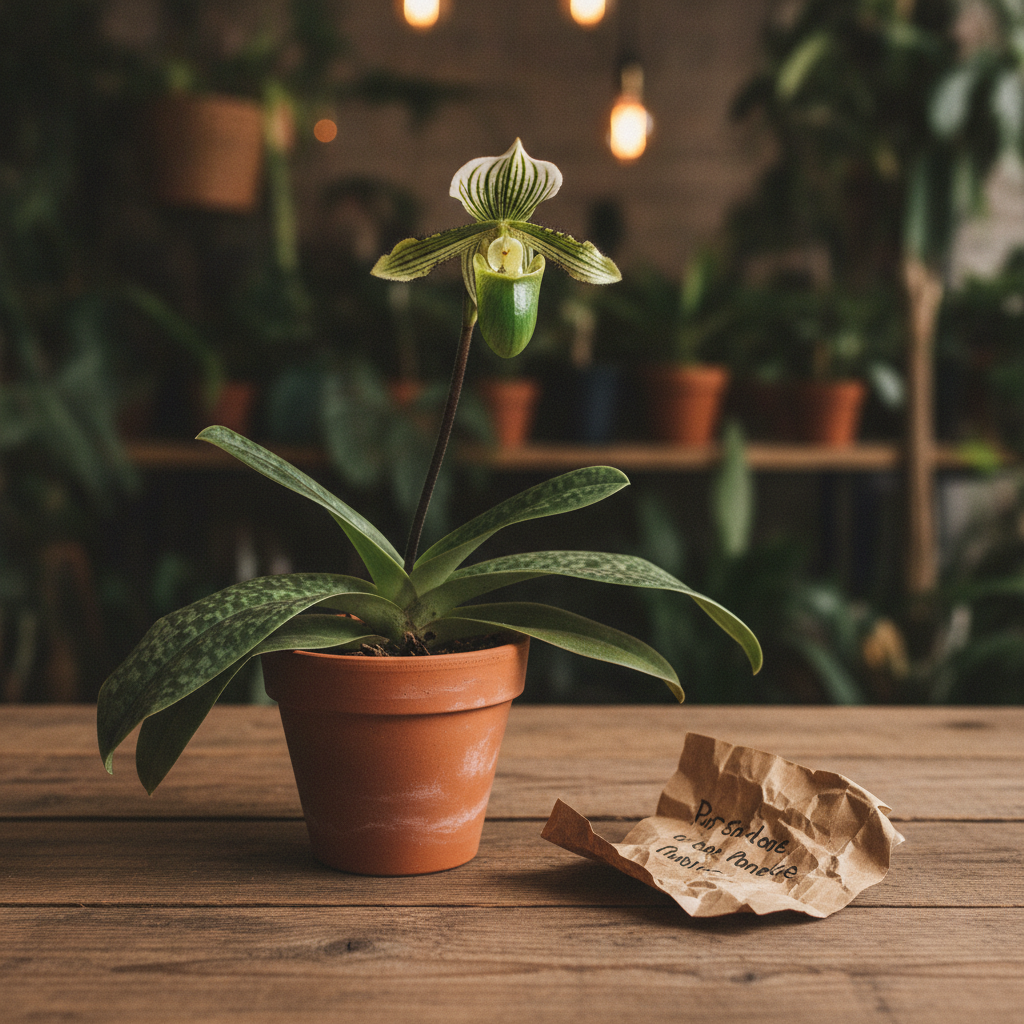
Paphiopedilum Maudiae
The classic mottled-leaf hybrid, Maudiae pairs beautifully tessellated silver-and-green foliage with a crisp green-and-white candy-striped flower over a glossy green pouch. It is compact, free-flowering and tolerant, making it one of the best slippers for a beginner who wants attractive leaves all year as well as a bloom.
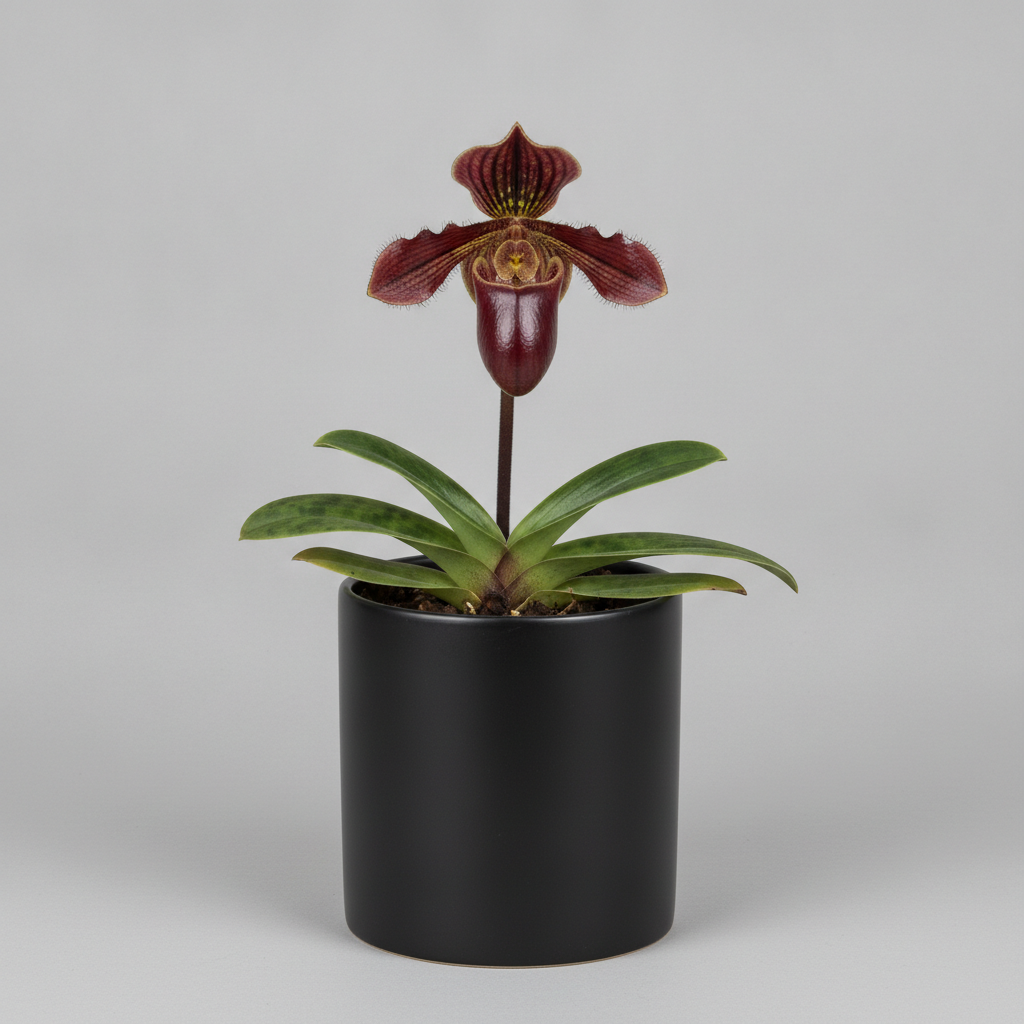
Paphiopedilum Maudiae ‘Vinicolor’
The dark form of Maudiae, ‘Vinicolor’ carries the same mottled foliage but trades the green-and-white flower for a deep, glossy wine-red bloom that looks almost lacquered. Its care is identical to the green Maudiae, and the dramatic colouring makes it a favourite for growers wanting something more striking than the species.
Variety Profiles in Detail
Paphiopedilum insigne (Paphiopedilum insigne)
The original windowsill lady slipper, insigne is a plain-leaved, cool-growing species from the eastern Himalayas with a glossy yellow-green and bronze flower marked in maroon, carried on a tall stem above a low fan of leaves. It is the most tolerant of cool rooms and neglect, flowers reliably in winter, and is the species behind a great many of the classic complex hybrids.
Complex or ‘bulldog’ hybrids (Paphiopedilum hybrids)
Bred over generations from insigne and its relatives, the complex hybrids carry large, round, heavily textured flowers in mahogany, gold, green and spotted combinations. They are plain-leaved cool-growers like their ancestor, share the same easy care, and are the showiest slippers for a grower who wants a big, glossy bloom rather than a botanical species flower.
Choosing the Right Variety for Your Space
Match the plant to your conditions rather than the other way round. If your home runs cool, particularly at night, a plain-leaved kind such as insigne or a complex hybrid will reward you with reliable winter flowers, whereas a consistently warm flat suits the mottled-leaved Maudiae types far better. For a first slipper, choose a green Maudiae or a complex hybrid: both are widely sold, forgiving of ordinary household care, and quick to flower, which builds the confidence to branch out into the more particular species later.
Frequently Asked Questions
Why won’t my lady slipper orchid flower?
The two usual culprits are too little light and the lack of a cool autumn rest. A plant kept dim will grow leaves happily but never bloom, so move it somewhere brighter but still out of direct sun. Equally important is a spell of cool nights in autumn, around 10 to 15°C (50 to 59°F), which many of these species need as a trigger. Give both and a mature growth should send up a spike.
How often should I water a lady slipper orchid?
Often enough that the mix never dries out completely, which usually means roughly twice a week in summer and about once a week in winter. Rather than counting days, check the mix and water when the surface just begins to dry while the core stays damp. This plant has no water store, so it must not go bone dry, but it must never sit soggy either.
Are lady slipper orchids safe around cats and dogs?
Yes, broadly. Paphiopedilum orchids are not listed as toxic to cats or dogs, and a nibbled leaf is unlikely to cause more than mild stomach upset. The bigger caution is for the grower, as the fine leaf hairs can irritate sensitive skin, so wash your hands after handling cut surfaces.
My orchid finished flowering. Do I cut the stem?
Once the bloom has faded and the stem begins to yellow and dry, cut it back to the base with sterile scissors. Unlike a moth orchid, a slipper flower stem does not rebloom, and each growth flowers only once before the plant pushes a new growth to carry on. Removing the spent stem tidies the plant and lets it put its energy into the next growth.
Why are the leaf tips turning brown?
Browning leaf tips usually point to salt build-up from hard water or over-feeding, or to air that is too dry. Flush the pot with plain water several times to wash out salts, ease back on fertiliser, and raise the humidity around the plant. A small amount of tip browning is cosmetic, but spreading brown tips signal one of these conditions needs correcting.
What temperature does a lady slipper orchid need?
The plain-leaved kinds like insigne are cool-growers, happiest at 18 to 24°C (64 to 75°F) by day and dropping to 10 to 15°C (50 to 59°F) at night. That night-time drop is not just tolerated but wanted, as it helps trigger flowering. A cool spare room or bright porch often suits them better than a warm living room.
Can I grow a lady slipper orchid in normal potting soil?
No. Ordinary potting compost holds far too much water and smothers the fine roots, which rot quickly as a result. Use an open, free-draining mix based on fine orchid bark with perlite, charcoal and a little sphagnum moss, plus a pinch of crushed oyster shell to suit this lime-loving plant. The mix should drain freely yet stay evenly damp.
How long do lady slipper orchid flowers last?
Remarkably long. A single slipper bloom commonly stays in good condition for eight to twelve weeks, and some hold even longer in cool, stable conditions. This longevity is a large part of the plant’s appeal, as one flower carries the display through much of the winter.
When and how do I divide a lady slipper orchid?
Divide in spring, just after flowering, and only once the plant has built a clump of several growths. Wash the roots, find a natural split that leaves at least three growths on each piece, cut cleanly with a sterile blade, dust the wounds, and pot each division snugly in fresh mix. Keep the divisions warm, humid and only lightly watered until new growth shows they have re-rooted.
Should I mist my lady slipper orchid?
It is better not to. Misting does little to raise humidity in any lasting way, and water sitting in the crown or leaf axils invites the crown rot and bacterial spot that are the plant’s main killers. To raise humidity, use a pebble tray, group plants together or run a small humidifier instead, and keep the foliage and crown dry.






