
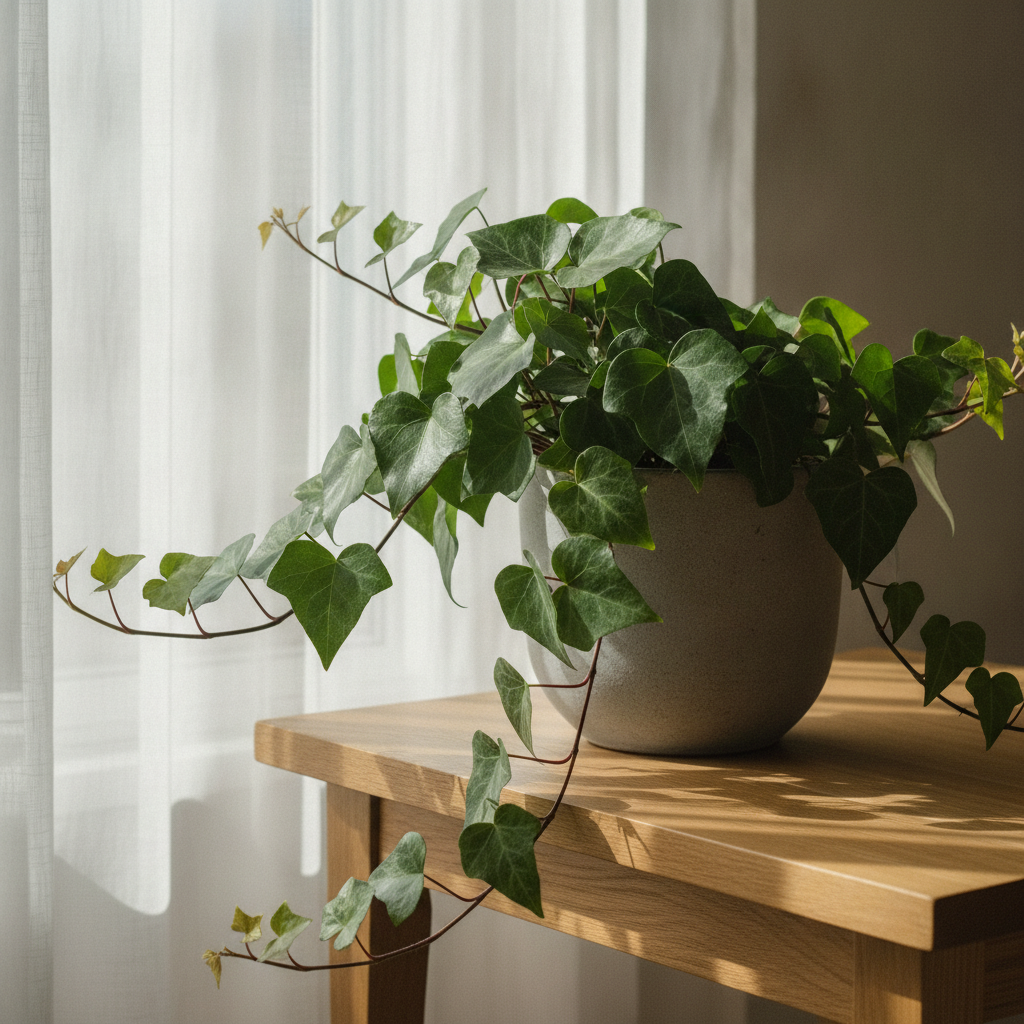
Few climbing plants carry themselves with quite the relaxed confidence of Algerian ivy. Where its better-known cousin the English ivy reads as fine and busy, Hedera canariensis is broad-shouldered and glossy, throwing out hand-sized leaves on stems the colour of red wine. It is a plant that drapes a bookshelf, softens a bare wall or fills an awkward cool corner with very little fuss, and it forgives the kind of neglect that would finish off fussier foliage plants.
Native to the Atlantic fringe of the Canary Islands, Madeira and the coast of North Africa, this evergreen has spent millennia learning to thrive in mild, humid, frost-light conditions, which is precisely why it settles so readily into the average home. This guide walks through everything that separates an ivy that merely survives from one that genuinely thrives, from reading its light needs to rooting new plants for free.
Quick Reference
- Quick Reference
- Why Grow Algerian Ivy as a Houseplant
- Light
- Watering
- Soil and Potting
- Fertilising
- Propagation
- Pests, Problems and Troubleshooting
- Varieties
- Frequently Asked Questions
| Botanical name | Hedera canariensis |
| Common names | Algerian ivy, Canary Island ivy, Canary ivy, Madeira ivy |
| Family | Araliaceae |
| Origin | Canary Islands, Madeira, North-west Africa, Atlantic Iberia |
| Light | Bright indirect light; variegated forms need more, plain green tolerate less |
| Water | Keep evenly moist; let the top 2 to 3 cm (1 inch) dry between waterings |
| Humidity | Moderate to high; dislikes hot, dry air |
| Temperature | 10 to 21 degrees C (50 to 70 degrees F); tolerates cool rooms well |
| Soil | Free-draining, loam or peat-based mix with added perlite |
| Feeding | Balanced feed monthly in spring and summer; none in winter |
| Growth habit | Vigorous trailing and climbing vine, 2 to 3 m (6 to 10 ft) indoors |
| Toxicity | Toxic to cats, dogs and people if eaten; sap can irritate skin |
| Difficulty | Easy |
Why Grow Algerian Ivy as a Houseplant
The first thing most people notice about Hedera canariensis is scale. A single mature leaf can span 15 to 20 cm (6 to 8 inches), carried on a glossy, leathery blade with three to seven shallow lobes and a softly rounded outline. Set against the burgundy-red of the young stems and leaf stalks, the deep green reads as lush rather than cluttered, giving the plant a presence that smaller-leaved ivies cannot match. Trailing from a high shelf or trained up a moss pole, it brings the kind of generous, jungly volume that usually demands a far more temperamental tropical.
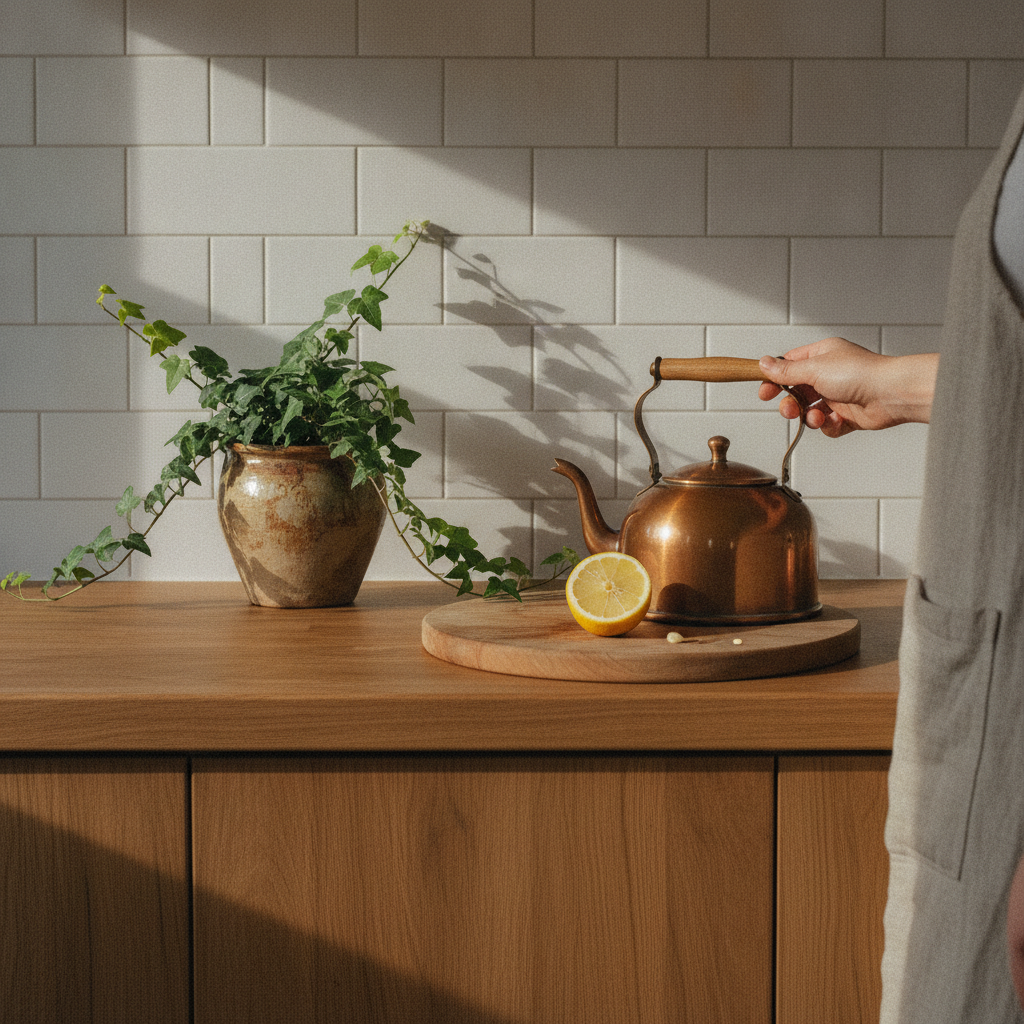
Beyond looks, this is an unusually adaptable plant. It belongs to a small group of climbers genuinely happy in cool, low-light corners that defeat most houseplants, which makes it ideal for north-facing rooms, draughty hallways and the kind of unheated stairwell where a fiddle leaf fig would sulk and drop leaves. It is equally at home as a trailing plant, a climber on a support, or a groundcover spilling over the rim of a wide pot, so a single plant can be styled in several different ways as it grows.
Algerian ivy is also famously forgiving of inconsistent watering and irregular feeding, recovering from a missed week or two far more gracefully than the average calathea or maranta. Like other ivies it is often credited with helping to filter common indoor air pollutants, and while no houseplant will transform the air in a real room, the dense evergreen foliage certainly does no harm. The one genuine caution is toxicity: every part of the plant is poisonous if eaten, and the sap can irritate sensitive skin, so it is best kept out of reach of pets and small children. For households without those concerns, few plants offer so much greenery for so little effort.
Light
Algerian ivy occupies an unusually wide band on the light spectrum, which is a large part of its appeal. In its ideal position it receives bright, indirect light for most of the day: think a spot a metre or two back from an east or west window, or close to a north-facing window where the light is gentle but constant. In these conditions growth is dense and vigorous, the leaves stay large and well coloured, and the burgundy stems develop their full depth of tone.
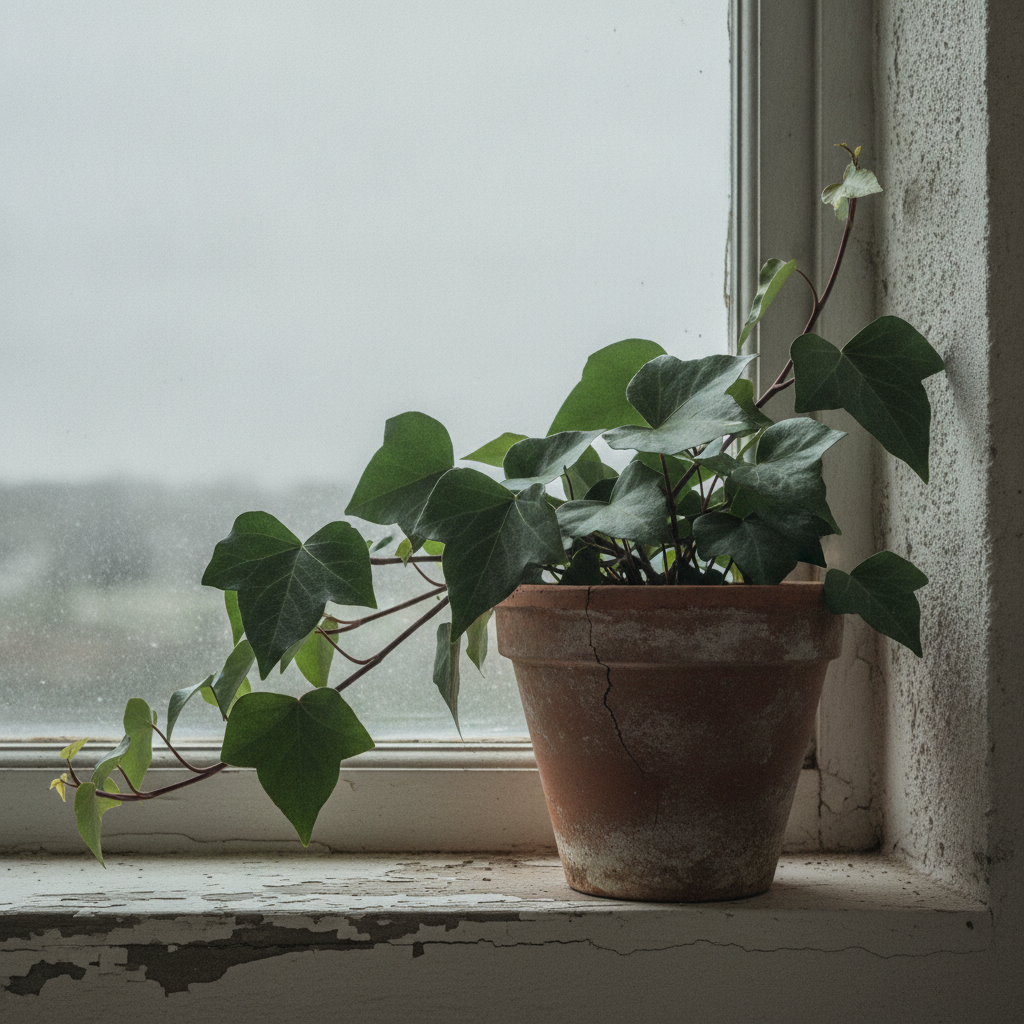
The crucial distinction is between the plain green forms and the variegated cultivars. All-green Algerian ivy is the more shade-tolerant of the two and will keep growing, if more slowly, in genuinely low light where many plants would decline. Variegated selections such as Gloire de Marengo, by contrast, rely on their green tissue to feed the whole plant, and in dim conditions they compensate by producing greener leaves and losing the creamy markings that make them worth growing. Give a variegated ivy the brightest indirect spot you can offer, short of harsh midday sun, and it will hold its pattern far better.
Direct sun is the one thing to watch. A few hours of soft early-morning light does no harm, but strong midday and afternoon sun through glass will scorch the leaves, bleaching them to a tired yellow-green and leaving crisp brown patches that never recover. If you notice long bare stretches of stem with leaves spaced far apart, a condition gardeners call legginess, the plant is reaching for more light and should be moved somewhere brighter, then pinched back to encourage it to bush out again.
Pro Tip — Even growth: Algerian ivy grows towards its light source, so the side facing the window fills out while the back thins. Give the pot a quarter turn each time you water and the plant will develop an even, all-round shape rather than leaning permanently towards the glass.
Watering
Watering is where most Algerian ivy problems begin, almost always on the side of too much rather than too little. This is a plant that likes its compost evenly moist but never sodden, mirroring the damp but free-draining soils of its native coastal woodlands. The reliable method is to water thoroughly when the top 2 to 3 cm (about an inch) of the mix has dried out, letting water run freely from the drainage holes, then emptying the saucer so the roots are not left standing in the excess.
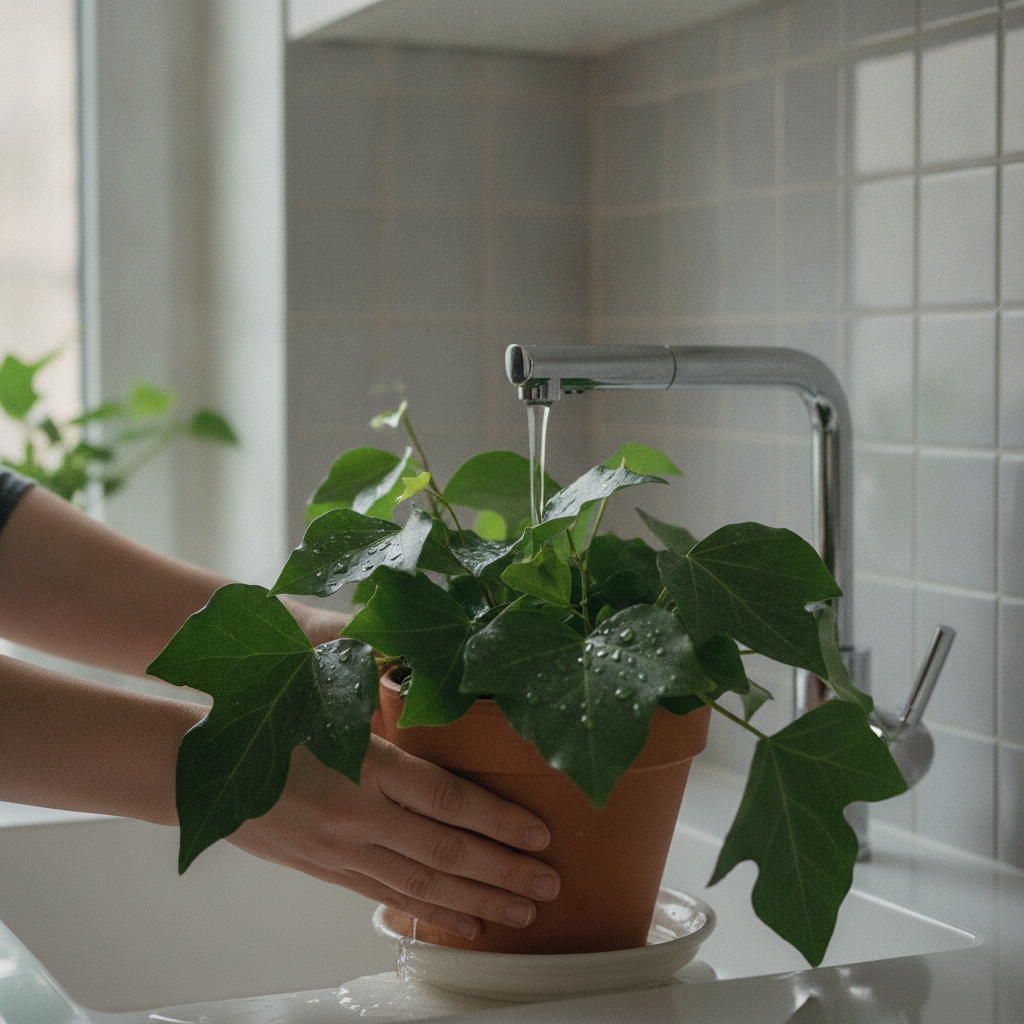
How often this works out to depends heavily on conditions. In a warm, brightly lit room in summer an ivy may need watering twice a week, while the same plant in a cool, dim corner in midwinter might go ten days or more between drinks. Rather than watering to a fixed schedule, check the compost with a finger and let the plant tell you when it is ready. Erring slightly on the dry side is far safer than keeping the mix permanently wet, because Hedera canariensis roots are quick to rot in airless, waterlogged soil.
The leaves give clear feedback. Crisp, brown, papery tips and edges usually signal underwatering or air that is too dry, especially in winter when central heating bakes the atmosphere. Soft, yellowing leaves that drop easily, often accompanied by a sour smell from the pot, point the other way to overwatering and the early stages of root rot. Because both extremes can produce leaf drop, always check the soil before deciding which problem you are dealing with.
Humidity is the close partner of watering for this plant. Algerian ivy comes from mild, moist Atlantic islands and dislikes the hot, dry air of a heated living room, which both stresses the foliage and rolls out the welcome mat for spider mites. Standing the pot on a tray of damp pebbles, grouping it with other plants, or running a humidifier nearby all help. A cool bathroom or kitchen, where humidity naturally runs higher, is often the happiest home of all.
Warning — Root rot: An ivy left sitting in a saucer of water will rot from the roots up, and by the time the leaves yellow and collapse the damage is often advanced. Always tip away standing water within half an hour of watering, and never let a decorative cover pot become a hidden reservoir.
Soil and Potting
Algerian ivy is not fussy about the exact recipe of its compost, but it does insist on good drainage. The aim is a mix that holds enough moisture to stay lightly damp between waterings while still letting excess water flow straight through, so the roots never sit in stagnant wet. A quality general-purpose houseplant compost, whether loam-based or peat-free, works well on its own, and adding roughly a quarter to a third by volume of perlite, grit or coarse bark opens it up further and all but eliminates the risk of waterlogging.
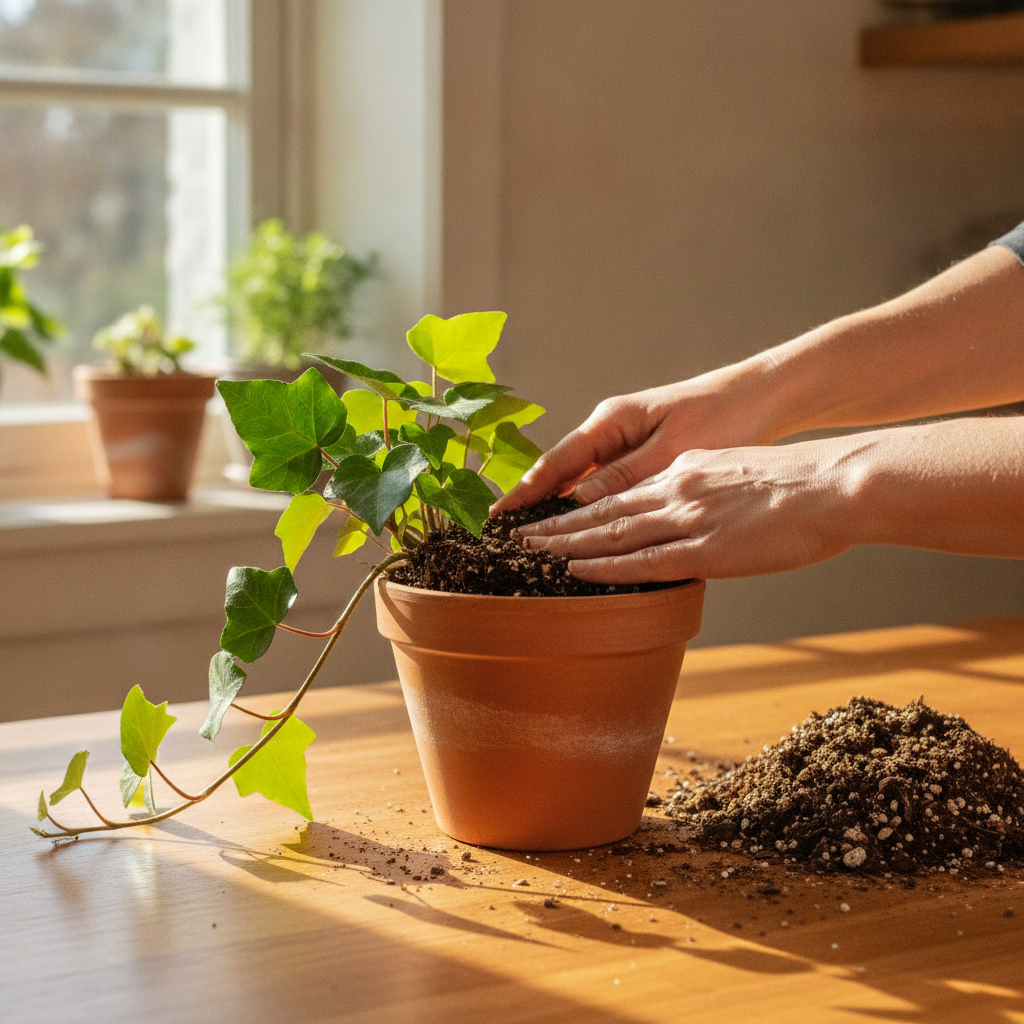
The plant prefers a soil that sits between slightly acidic and neutral on the pH scale, which most commercial composts provide without any adjustment. Whatever container you choose, a drainage hole is non-negotiable. Terracotta has the advantage of breathing and wicking away surplus moisture, which suits a plant prone to overwatering, though it does dry out faster and so needs a closer eye in summer. Plastic and glazed ceramic hold water longer, which can be an asset in a warm room but a liability in a cool one.
Repotting is best tackled in spring, as growth picks up. Algerian ivy is a vigorous grower and will fill a pot with roots within a season or two, but it flowers and performs perfectly well when slightly snug, so there is no need to rush it into an oversized container. Move it up by a single pot size, around 2 to 4 cm (1 to 2 inches) wider, only when roots are circling the bottom or creeping out of the drainage holes. A pot that is too large simply holds a reservoir of wet, unused compost around the roots and raises the risk of rot. In years when you choose not to repot, refreshing the top few centimetres of compost gives the plant a gentle boost.
Fertilising
As a fast grower, Algerian ivy appreciates regular feeding through its active season, but it is easily overdone. During spring and summer, a balanced liquid houseplant fertiliser diluted to the strength recommended on the bottle and applied roughly once a month keeps the foliage large, dense and well coloured. A balanced formula, where the three main nutrients are present in similar proportions, suits a foliage plant like this better than anything heavily weighted towards flowering.
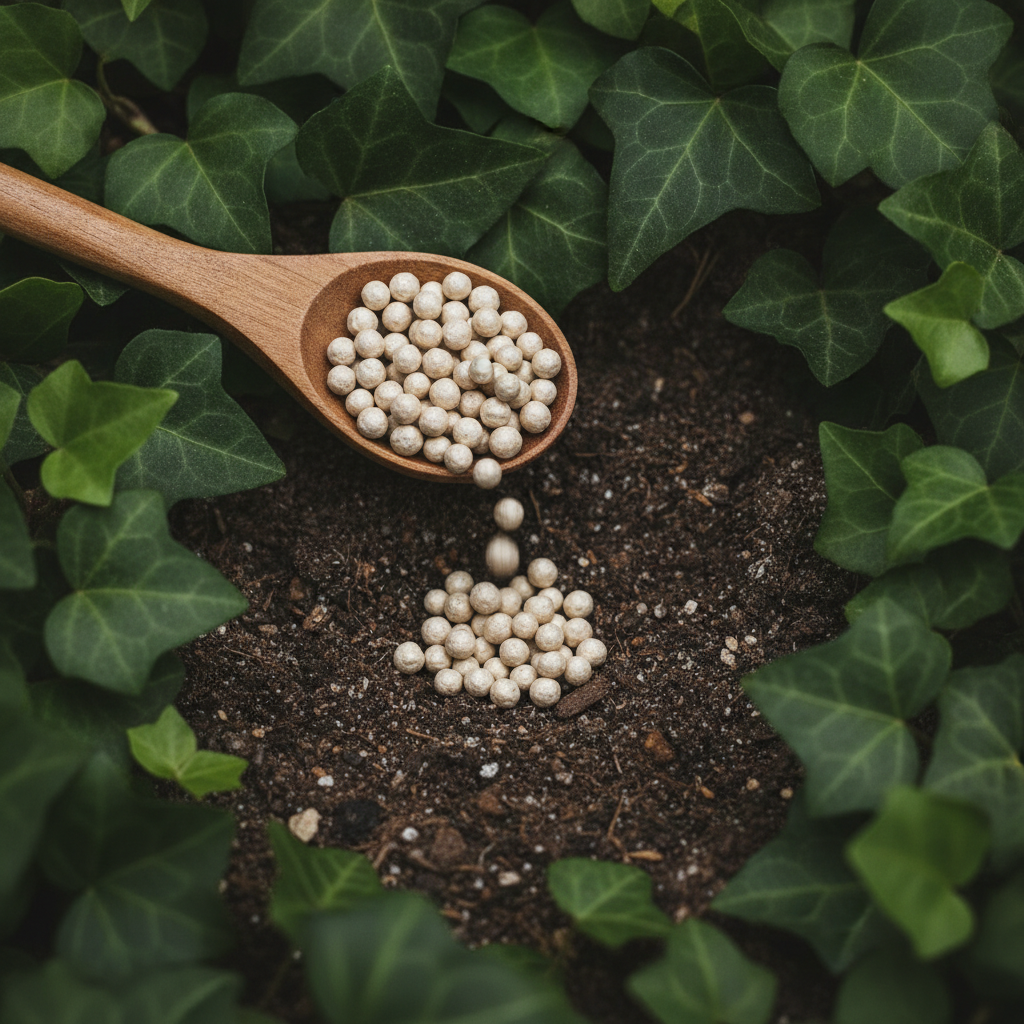
The single most common feeding mistake is carrying on through the winter. As light levels fall and growth slows to a near halt, the plant simply cannot use the nutrients on offer, and the unused mineral salts build up in the compost where they scorch the roots and brown the leaf edges. Stop feeding entirely from around mid-autumn to early spring and resume only when you see fresh new growth appearing at the stem tips.
If a once-a-month routine is hard to remember, a slow-release fertiliser offers a low-effort alternative: mixed into the compost or scattered on the surface in spring, it doles out a little nutrition with each watering across the whole season. Whichever route you take, restraint is the watchword. A lightly underfed ivy stays compact and healthy, whereas an overfed one produces soft, sappy, weak growth that is far more attractive to pests, and a visible crust of white salts on the soil or pot rim is a clear sign to flush the compost through with plenty of plain water and ease off.
Propagation
Algerian ivy is among the easiest of all houseplants to propagate, which is part of the reason it has spread so widely across windowsills and gardens. The most reliable method by far is the humble stem cutting, and spring or early summer, when the plant is growing strongly, is the ideal time to take them. Each cutting needs to include at least one node, the slightly swollen point where a leaf joins the stem, because this is where new roots emerge. Stems that already carry small brown aerial rootlets along their length root especially quickly.
To root cuttings in water, follow these steps:
- Using clean scissors or secateurs, cut a healthy stem tip 10 to 15 cm (4 to 6 inches) long, snipping just below a node.
- Strip the leaves from the lower third of the cutting so that at least one or two bare nodes will sit beneath the water.
- Stand the cutting in a glass of clean, room-temperature water in a bright spot out of direct sun, and refresh the water every few days to keep it clear and oxygenated.
- Watch for white roots emerging from the submerged nodes, usually within two to four weeks.
- Once the roots are 3 to 5 cm (1 to 2 inches) long, pot the cutting into a small container of free-draining compost and keep it slightly more moist than usual while it settles.
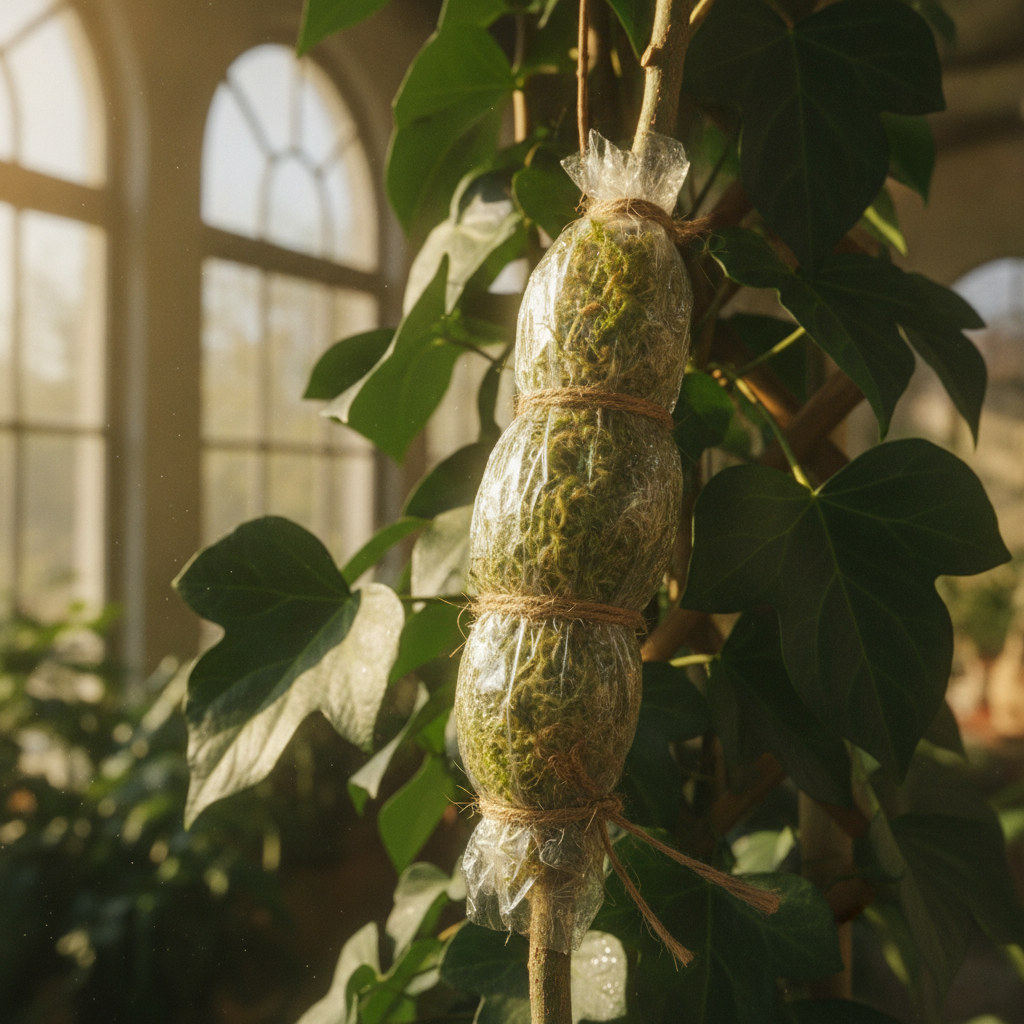
Cuttings can just as easily be rooted straight into compost, skipping the water stage: insert the prepared stem into a small pot of damp, gritty mix, firm it gently, and keep it warm and humid, covering it loosely with a clear bag if the air is dry. For a faster, fuller result, several cuttings can be rooted together in one pot. Thicker, more established stems respond well to air layering, where a node is wrapped in damp sphagnum moss and clear film and left to root in place before being severed, giving you a sizeable new plant from the outset. Whatever the method, success rates with Algerian ivy are high, and a single healthy plant can quickly become several.
Pests, Problems and Troubleshooting
A healthy, well-watered Algerian ivy is reasonably resilient, but it has one persistent enemy: the spider mite. These almost invisible sap-suckers thrive in exactly the warm, dry indoor air that the plant itself dislikes, and they are by far the most common reason an indoor ivy declines. The early signs are subtle, a faint speckling or stippling of pale dots across the leaf surface, sometimes with fine silken webbing strung between the stems and leaf stalks, and by the time you spot heavy webbing the infestation is already well established.
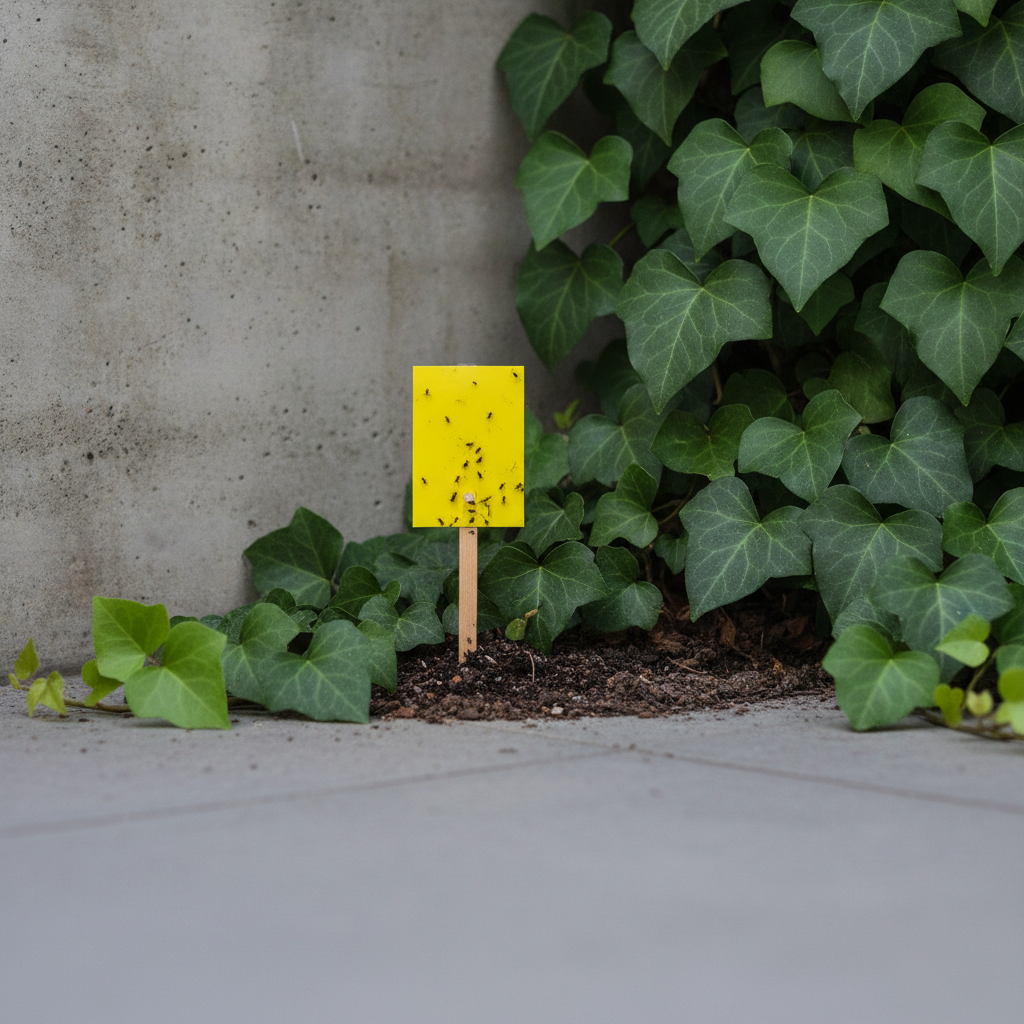
Prevention is far easier than cure. Raising the humidity around the plant, keeping it out of the hot draught of a radiator, and rinsing or wiping the foliage every few weeks all make life difficult for mites. If they do take hold, isolate the plant at once, rinse it thoroughly in the shower to dislodge as many as possible, and treat it with insecticidal soap or a horticultural oil such as neem, repeating every week or so until no new damage appears. Aphids, scale and mealybugs occasionally trouble Algerian ivy too, and respond to the same combination of physical removal and repeat treatment. The table below summarises the most common issues and their likely causes.
| Symptom | Likely cause | Remedy |
| Pale speckling and fine webbing | Spider mites in dry air | Rinse, raise humidity, treat with neem or insecticidal soap |
| Crisp brown leaf tips and edges | Dry air or underwatering | Increase humidity, check watering routine |
| Soft yellow leaves dropping | Overwatering, early root rot | Let soil dry, improve drainage, repot if roots are mushy |
| Variegated leaves turning all green | Too little light | Move to a brighter indirect spot |
| Long bare stems, small spaced leaves | Insufficient light (legginess) | Brighten position and pinch back to encourage bushiness |
| Sticky residue or white cottony tufts | Aphids, scale or mealybugs | Remove by hand, treat with soap or oil, repeat weekly |
Most other complaints trace back to watering and light rather than disease. Yellowing lower leaves in moderation are a normal part of an evergreen shedding its oldest growth, but widespread yellowing means it is time to check the roots and review your routine. A leggy, sparse plant is rarely sick, merely under-lit, and responds quickly to a brighter spot and a firm pinching back, which prompts a flush of dense new shoots from lower down the stems.
Warning — Toxicity: Every part of Algerian ivy is poisonous if eaten, causing mouth irritation, drooling and stomach upset in cats, dogs and people, and the sap can trigger a skin rash in sensitive gardeners. Wear gloves when pruning a large plant, and keep it well clear of curious pets and children.
Varieties
While the plain green species is handsome in its own right, Algerian ivy is most often grown in one of its named cultivars, and two in particular dominate. The variegated Gloire de Marengo is the showpiece of the group, prized for its painterly foliage, while the robust all-green Montgomery is the choice where vigour and a uniform wall of glossy leaves are wanted.
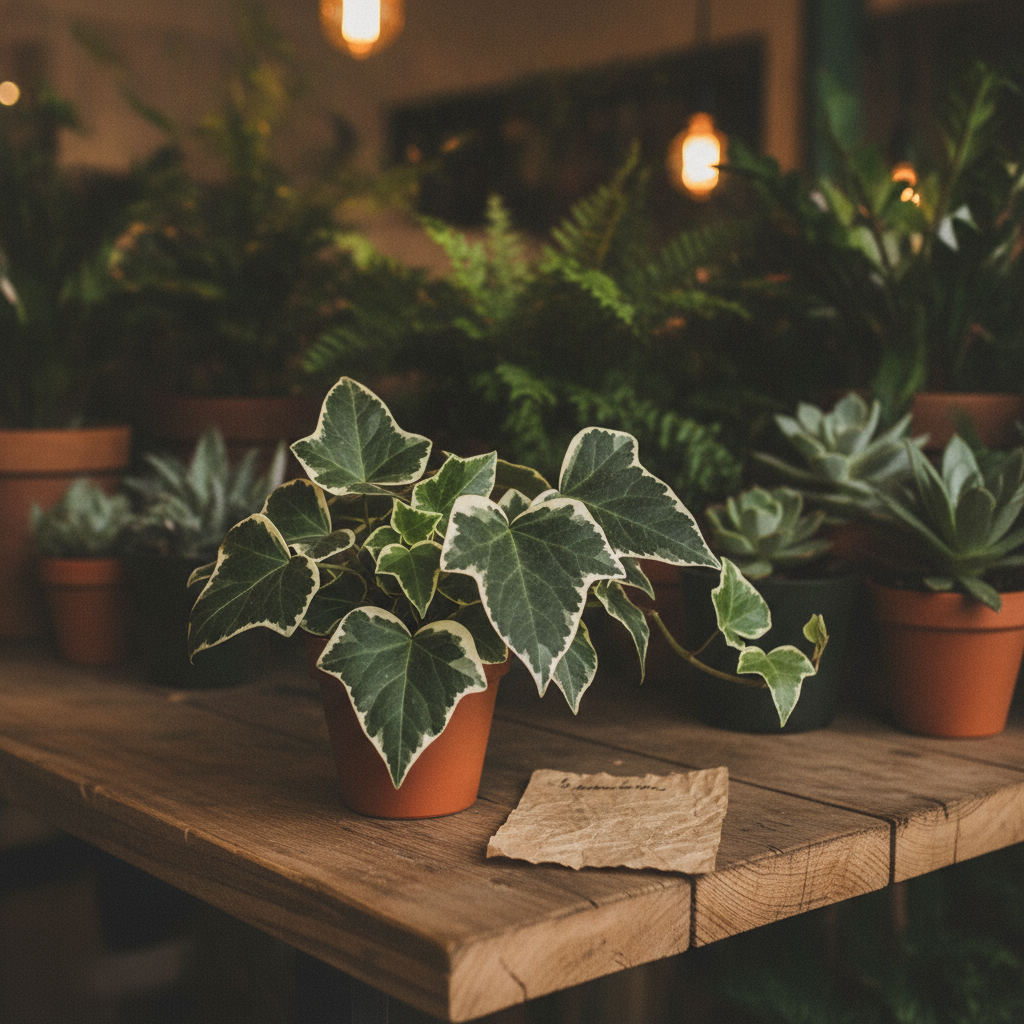
Gloire de Marengo: By far the best-known form, this cultivar carries broad glossy leaves whose deep green centres dissolve through soft silvery grey-green into irregular creamy-white margins, so that no two leaves look quite alike. It is a holder of the Royal Horticultural Society Award of Garden Merit and brings real brightness to a room, but the variegation comes at a price: it needs noticeably more light than the green forms to keep its markings and can revert to plain green in dim corners.
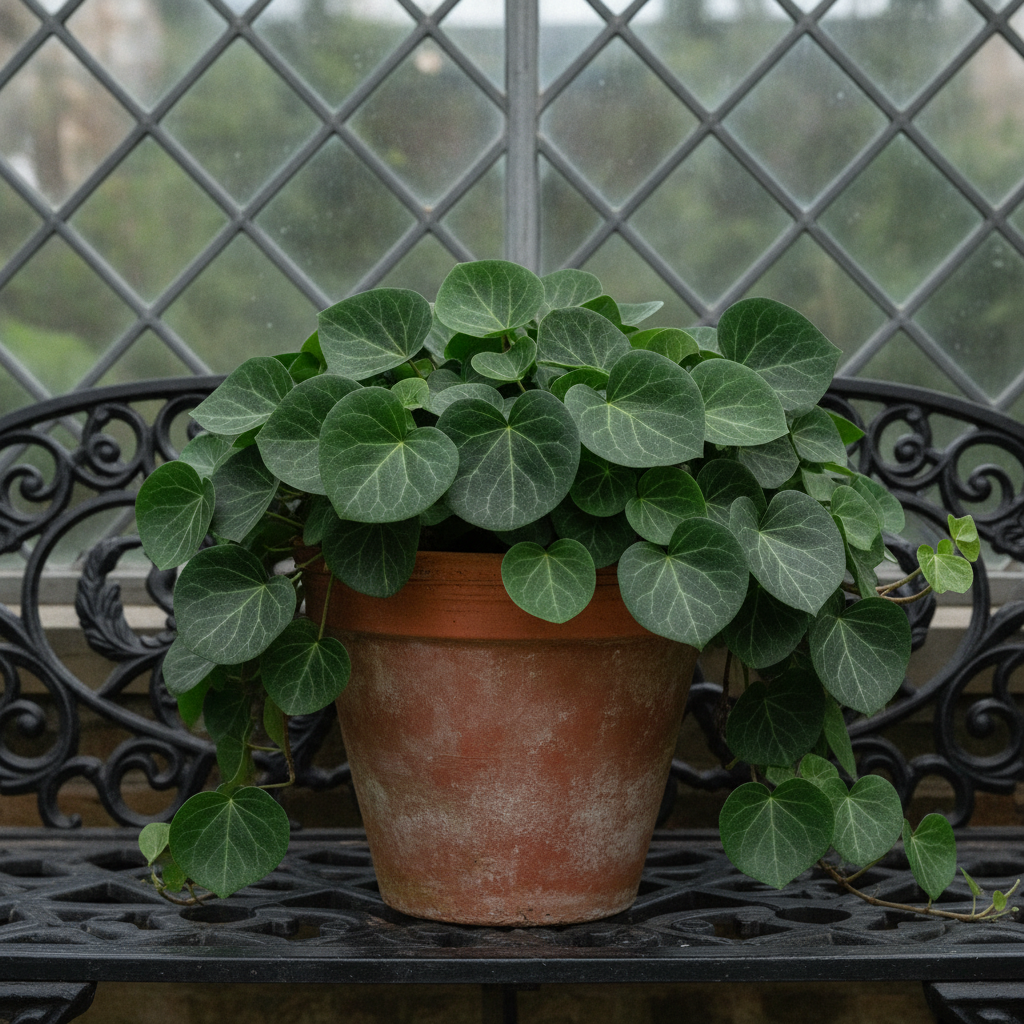
Montgomery: A bold, unvariegated selection grown for its large, leathery, uniformly deep-green leaves marked with prominent pale veins. Without variegation to maintain, it is the more shade-tolerant and the more vigorous of the two, quickly clothing a moss pole or trailing in a long, dense curtain. It is the obvious pick for a cooler, lower-light position or for anyone who simply wants the maximum of glossy green foliage with the minimum of fuss.
Other selections appear from time to time, including Striata, with paler central markings, and the bold green Ravensholst, but Gloire de Marengo and Montgomery between them cover the two reasons most people grow this plant: striking variegation on the one hand, and easy, vigorous greenery on the other.
Frequently Asked Questions
Is Algerian ivy toxic to cats and dogs?
Yes. Like all true ivies, Hedera canariensis contains compounds that are toxic if eaten, and chewing the leaves can cause drooling, mouth irritation, vomiting and stomach upset in cats and dogs. The sap may also irritate the skin on contact. It is not usually life-threatening in small amounts, but it is best kept well out of reach of pets and children, and gloves are sensible when pruning.
Why is my variegated Algerian ivy turning all green?
This is almost always a light problem. Variegated cultivars like Gloire de Marengo produce more green, chlorophyll-rich tissue to make up for low light, gradually losing their creamy markings in the process. Move the plant to a brighter spot with plenty of indirect light and new growth should come through better marked. Pruning out any fully green stems also helps prevent the plain growth from taking over.
How often should I water Algerian ivy?
Rather than a fixed schedule, water when the top 2 to 3 cm (about an inch) of compost has dried out. In practice that often means once or twice a week in warm, bright conditions and considerably less in a cool or dim room, especially in winter. Always let excess water drain away and never leave the pot standing in water, as soggy roots are the quickest way to kill this plant.
Can Algerian ivy grow in low light?
The plain green forms tolerate low light better than almost any other climber, which makes them a good choice for north-facing rooms and shaded corners, though growth will be slower. Variegated forms need brighter indirect light to keep their patterning and tend to disappoint in genuinely dim spots. No Algerian ivy enjoys direct midday sun through glass, which scorches the leaves.
How do I make my ivy bushier instead of leggy?
Legginess, where stems grow long and bare with widely spaced leaves, is a sign of too little light combined with a lack of pruning. Move the plant somewhere brighter and pinch or cut back the longest stems just above a leaf node. This prompts the plant to branch and send out fresh shoots lower down, filling in the gaps. The trimmings root easily, so nothing need go to waste.
What is the difference between Algerian ivy and English ivy?
Both belong to the genus Hedera, but Algerian ivy (Hedera canariensis) has much larger, glossier leaves with shallower lobes and distinctive wine-red stems, and it is a little less cold-hardy than English ivy (Hedera helix), which has smaller, more sharply lobed leaves. Indoors their care is broadly similar, but the bolder foliage of the Algerian species makes a stronger visual statement in a pot.






