
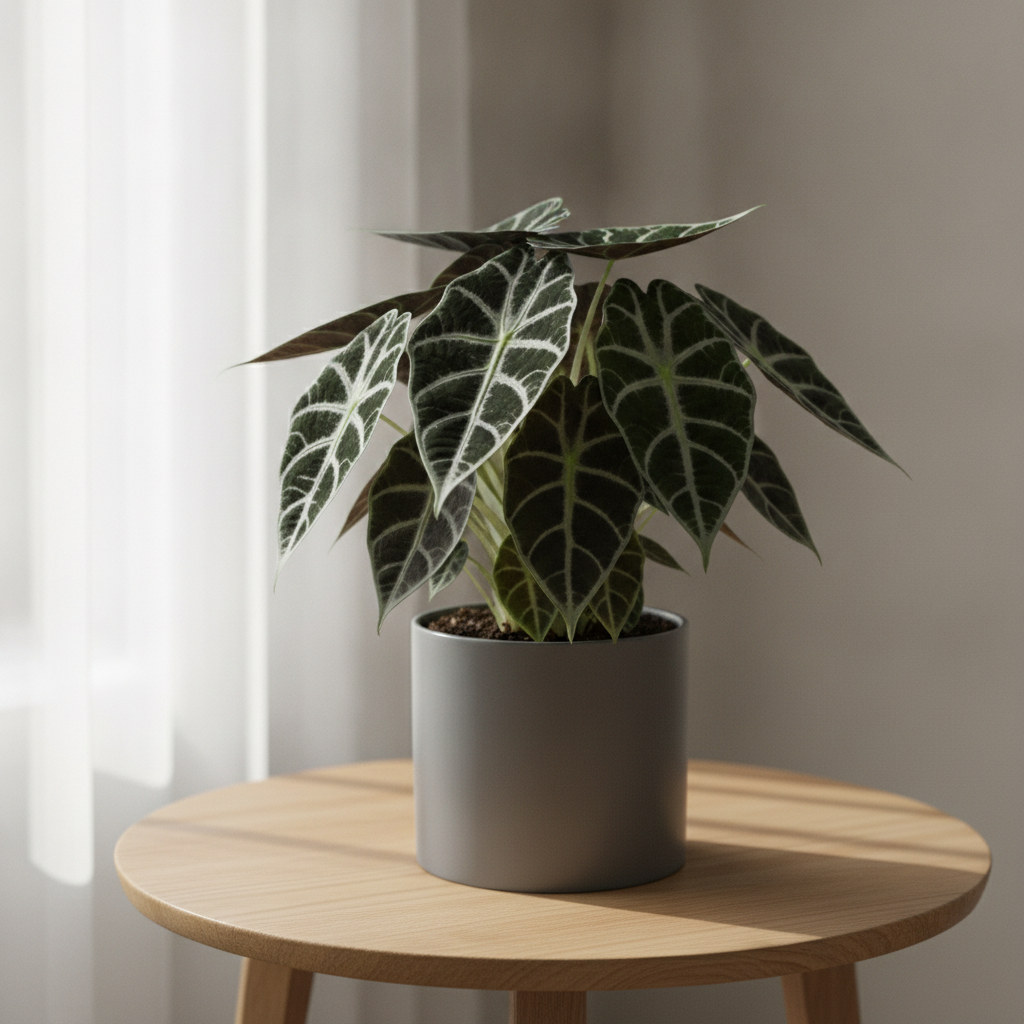
Few houseplants stop a room the way the Black Velvet Alocasia does. Its leaves are small, thick and almost succulent to the touch, finished in a matte blackish-green so deep it reads as charcoal, then crossed by bright silvery-white veins that look hand-drawn. Known botanically as Alocasia reginula, a name that translates loosely as “little queen”, this is one of the most compact members of a genus better known for its dramatic, oversized foliage. Where many alocasias sprawl, the Black Velvet stays neat and jewel-like, rarely exceeding 30 to 45 centimetres (12 to 18 inches) in height.
That compact beauty comes with a reputation. The Black Velvet is widely considered a fussy plant, and the honest version of the story is that it is not difficult so much as specific. It will survive a surprising amount of benign neglect, but it will only thrive when a handful of conditions are met consistently: bright but filtered light, an airy soil that never stays sodden, steady warmth and humidity, and a grower who understands that this plant takes a seasonal rest. Learn those rhythms and the little queen rewards you with some of the most striking foliage available to indoor gardeners.
Quick Reference
The table below summarises the conditions an Alocasia reginula needs to do more than merely tick over. Treat it as a snapshot; the sections that follow explain the reasoning behind each figure so you can adapt to your own home rather than following numbers blindly.
| Common name | Black Velvet Alocasia, Little Queen, Black Velvet Elephant Ear |
| Botanical name | Alocasia reginula |
| Family | Araceae (the aroids) |
| Native range | Tropical forest floor of Borneo, Southeast Asia |
| Mature size | 30 to 45 cm (12 to 18 in) tall; leaves 10 to 15 cm (4 to 6 in) long |
| Light | Bright, indirect light; no direct midday sun |
| Watering | When the top 2 to 3 cm (1 in) of mix dries; keep lightly moist, never soggy |
| Humidity | High, ideally 60 per cent or more |
| Temperature | 18 to 27 degrees C (65 to 80 degrees F); never below 15 degrees C (59 degrees F) |
| Soil | Chunky, fast-draining aroid mix |
| Fertiliser | Dilute balanced feed monthly in spring and summer; none in winter |
| Toxicity | Toxic to people and pets; contains calcium oxalate crystals |
| Difficulty | Intermediate to advanced |
- Why grow a Black Velvet Alocasia as a houseplant
- Light
- Watering
- Soil and potting
- Fertilising
- Propagation
- Pests and problems
- Varieties
- Frequently asked questions
Why grow a Black Velvet Alocasia as a houseplant
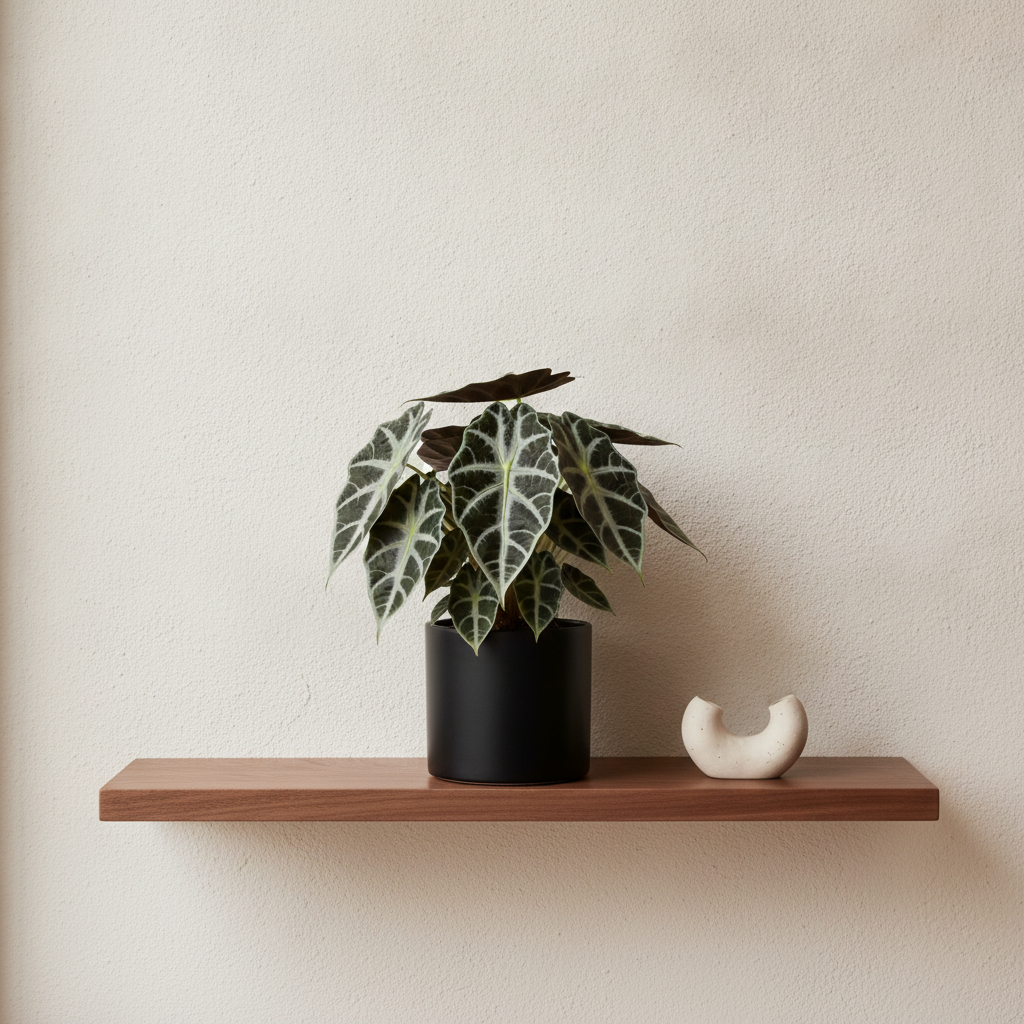
The case for the Black Velvet rests almost entirely on its leaves. Each one is a thick, rounded heart shape, held on a short petiole, with a surface that genuinely behaves like velvet. The dark pigment absorbs light rather than reflecting it, which is why photographs rarely do the plant justice; in person the contrast between the matte black-green blade and the network of pale veins is far sharper. The leaves are also unusually substantial for such a small plant, giving it a sculptural, almost artificial quality that draws comment.
Alocasia reginula originates on the forest floor of Borneo, where it grows in the dim, humid understorey among leaf litter and rock. That habitat explains almost everything about its care. A plant adapted to dappled understorey light resents direct sun. A plant rooted in loose, fast-draining forest debris resents heavy, water-retentive compost. And a plant from the consistently warm, humid tropics struggles in the dry, fluctuating air of a centrally heated home. None of this makes the Black Velvet a bad houseplant; it simply makes it a plant that asks you to recreate a specific corner of the world rather than tolerate whatever conditions it is given.
Its size is its other great virtue. Because it stays small, it fits where a larger aroid cannot, and it can be grown successfully in a terrarium, a glass cabinet or under a grow light, all of which make the humidity and warmth it craves far easier to provide. For collectors short on space, the Black Velvet offers maximum visual impact for minimum footprint.
Warning – Toxic to pets and people: Like all aroids, Alocasia reginula contains insoluble calcium oxalate crystals throughout its tissues. Chewing or swallowing any part can cause intense burning of the mouth and throat, drooling, swelling and vomiting in cats, dogs and humans. Keep it out of reach of curious pets and children, and wash your hands after handling cut tissue.
Light
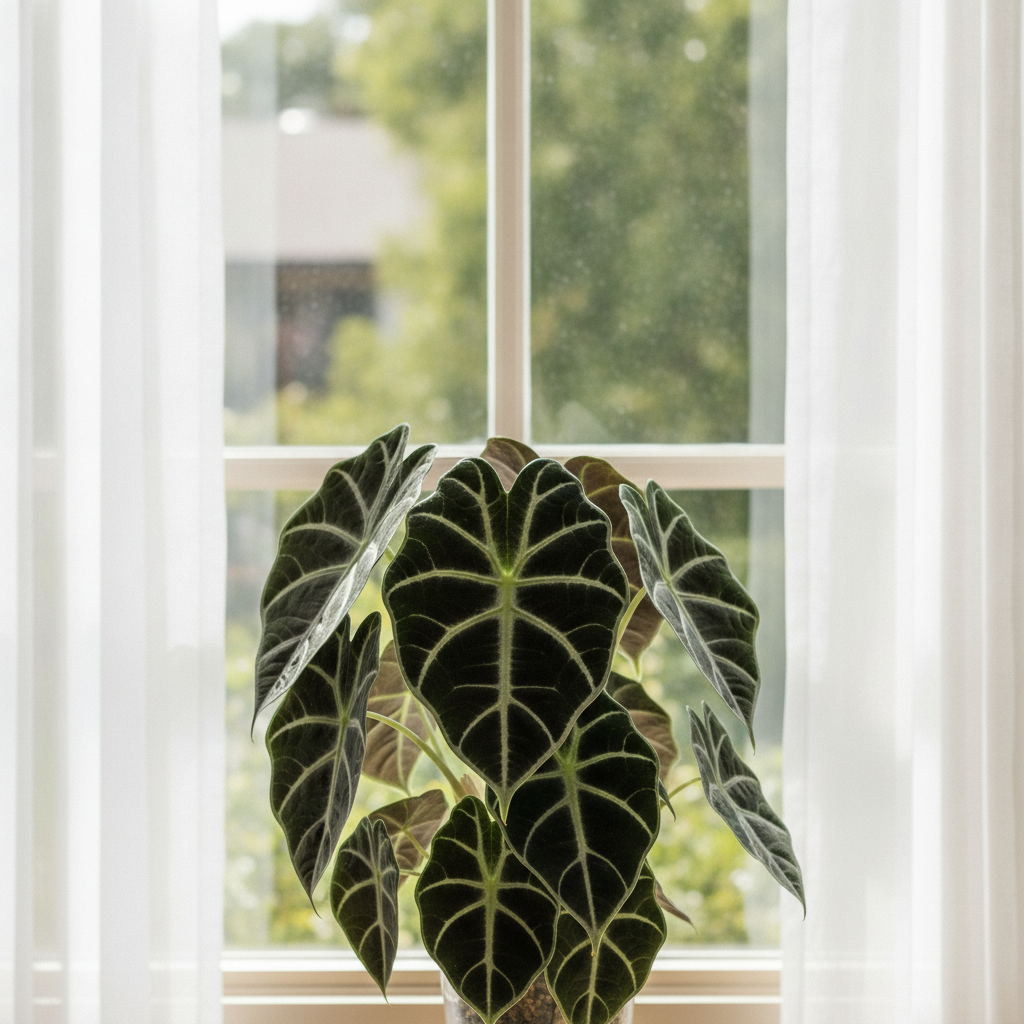
Light is where most people misjudge this plant in both directions. The Black Velvet wants bright, indirect light: enough to drive steady growth and keep the silver veining crisp, but never the unfiltered sun that would scorch its dark, light-absorbing leaves. An east-facing window where it catches gentle morning sun, or a position a metre or so back from a brighter south or west window, suits it well. Behind a sheer curtain in almost any bright room is close to ideal.
The difference between surviving and thriving is stark here. In a dim corner the plant will cling on for months, but its new leaves will emerge smaller, the petioles will stretch and lean toward the light, and the velvet sheen will dull. Give it generous indirect light and you see the opposite: compact growth, full-sized leaves and the deep, almost three-dimensional colour the species is prized for. Because the leaves are so dark, they need more light than their colour might suggest simply to photosynthesise efficiently.
Direct sun is the one thing to avoid outright. An hour or two of soft early-morning sun is tolerated, but harsh midday or afternoon sun will bleach and crisp the foliage within days, leaving pale, papery patches that never recover. If you grow under artificial light, a full-spectrum LED running for ten to twelve hours a day keeps the plant happy through dark winters and is one of the most reliable ways to maintain quality growth indoors.
Pro Tip – Rotate for symmetry: Alocasias orient their leaves firmly toward the light source. Give the pot a quarter turn each week so the plant grows evenly rather than leaning, and you will keep that neat, rounded habit instead of a one-sided plant.
Watering
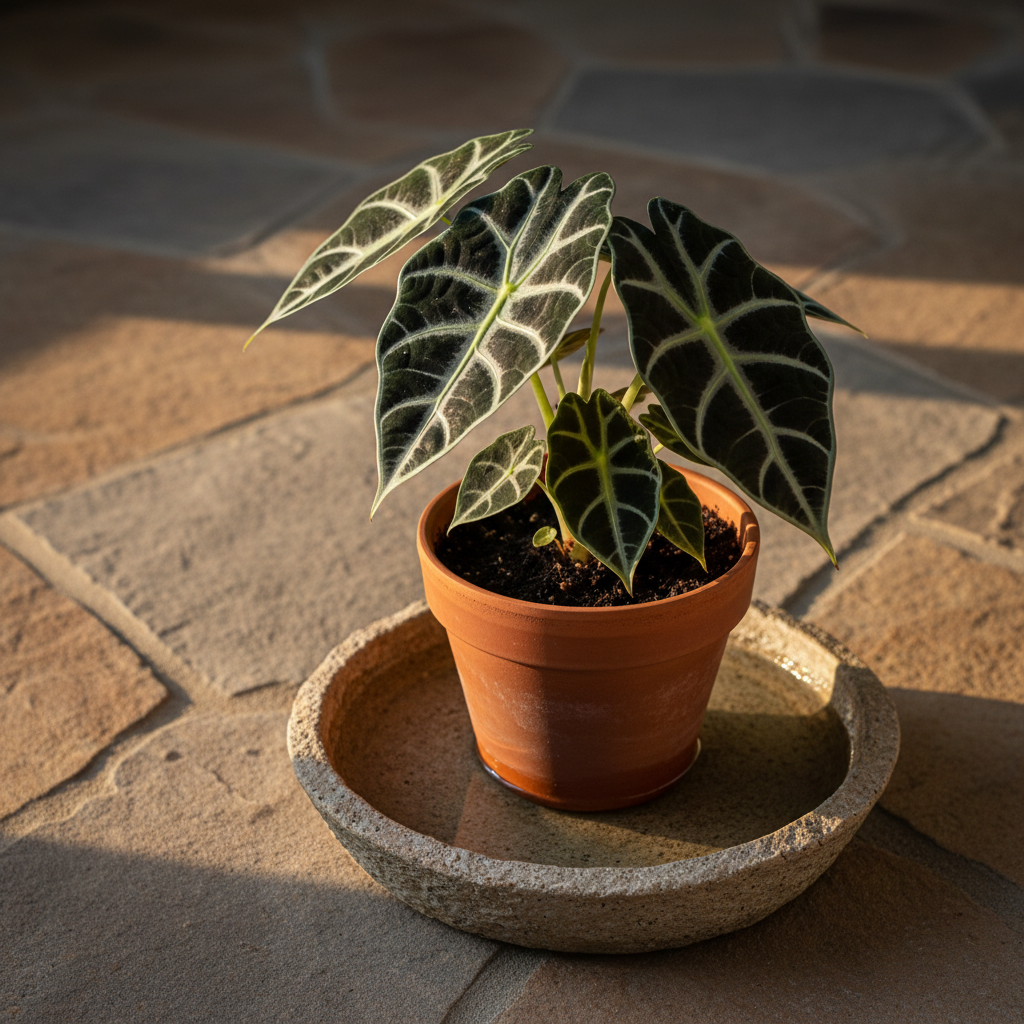
Watering is the single most common cause of a Black Velvet’s decline, and almost always the fault is too much rather than too little. This is a plant with a tuberous, rhizomatous base that rots quickly when it sits in cold, airless, waterlogged soil. The goal is to keep the mix lightly and evenly moist during active growth, allowing the top two to three centimetres (about an inch) to dry before watering again, and to err on the dry side whenever you are unsure.
Because the right amount depends so heavily on your light, pot and mix, judge by feel rather than by calendar. Push a finger into the soil; if the top inch is dry but the layer beneath is still cool and slightly damp, it is time to water. When you do, water thoroughly until it runs from the drainage holes, then let the pot drain completely and never leave it standing in a saucer of water. In the chunky, fast-draining mix this plant prefers, you will often water more frequently than you would a plant in dense compost, but each watering passes through quickly and the roots get the oxygen they need.
Water quality matters more than for most houseplants. Alocasias are sensitive to the salts, chlorine and fluoride in hard tap water, which can accumulate and brown the leaf edges over time. Where possible, use rainwater, filtered water or tap water that has stood uncovered overnight, and aim to water with tepid rather than cold water, since a cold soak can shock the warmth-loving roots.
One behaviour that unsettles new owners is the plant’s habit of “guttation”, weeping droplets of sap from the leaf tips. This is normal, and usually a sign that the soil holds plenty of moisture, sometimes a hint that you are watering a little generously. It is harmless, though the droplets can leave small mineral marks on furniture.
Warning – Winter is not summer: A Black Velvet’s water needs collapse in the cooler, darker months as it slows down or goes dormant. Continuing a summer watering schedule into winter is the fastest route to root rot. Cut back sharply and let the mix approach dryness between waterings once growth stalls.
Soil and potting
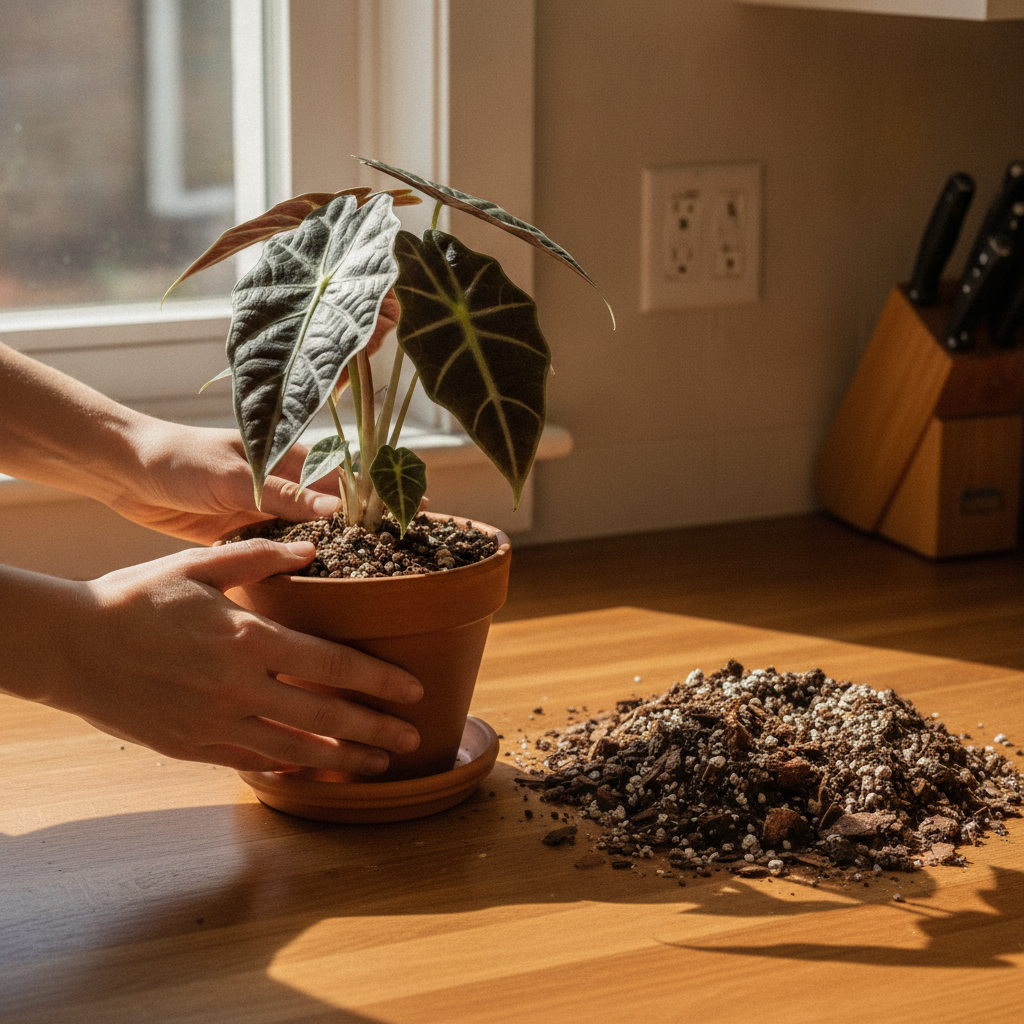
If watering is the most common way to kill a Black Velvet, the wrong soil is the reason watering goes wrong. Standard bagged houseplant compost holds far too much water around these oxygen-hungry roots. What the plant wants instead is a loose, chunky, fast-draining aroid mix that stays airy even when moist, so that water passes through and drains while leaving the roots damp rather than drowned.
A reliable recipe combines roughly equal parts orchid bark, perlite or pumice, and coco coir, with a generous handful of worm castings folded in for gentle nutrition. The bark and perlite create air pockets and sharp drainage, the coir holds just enough moisture to keep the roots from drying out completely, and the castings feed the plant slowly without the salt load of synthetic fertiliser. The finished mix should feel light and open in the hand, not dense or muddy.
Pot choice is part of the same equation. The Black Velvet prefers to be slightly snug in its container, and a pot only a little larger than the root ball reduces the volume of soil that can stay wet around the roots. Drainage holes are non-negotiable. Terracotta is an excellent choice because it breathes and wicks away excess moisture, buying you a margin of safety against overwatering, though plastic or glazed pots work well too if you adjust your watering accordingly.
Repot only every couple of years, or when roots clearly fill the pot, and do it in spring as growth resumes. These plants dislike root disturbance and may sulk for a few weeks afterwards, so resist the urge to repot more often than necessary. When you do, it is the ideal moment to inspect the rhizome, remove any soft or rotten sections, and separate offsets, as described in the propagation section below.
Pro Tip – Refresh, do not always upsize: Because this plant likes a snug pot, you often do not need a bigger container at all. Simply refreshing the old, broken-down mix for fresh chunky substrate in the same pot restores drainage and air without forcing the plant into an oversized, water-holding home.
Fertilising
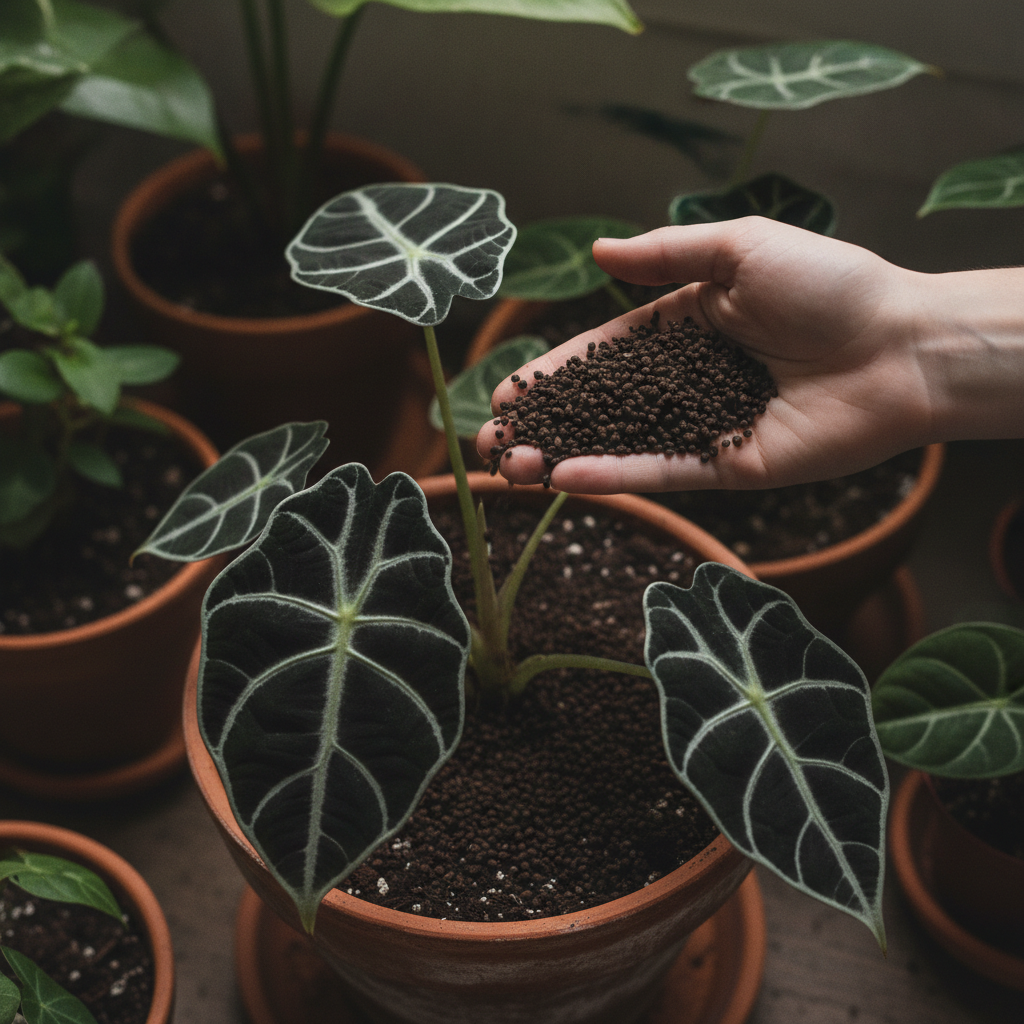
The Black Velvet is not a heavy feeder, and its modest size means it needs far less fertiliser than a vigorous climbing aroid. During the active growing season of spring and summer, a balanced liquid houseplant fertiliser diluted to roughly half the recommended strength, applied about once a month, is plenty. This steady, gentle feeding supports the production of new leaves without overwhelming the plant’s sensitive roots.
The risk with this species is not under-feeding but over-feeding. Concentrated fertiliser, or feeding too frequently, allows mineral salts to build up in the mix, which scorches root tips and browns leaf margins. The symptoms look alarmingly like other problems, which is why a cautious, diluted approach pays off. Many experienced growers lean on slow-release organic inputs such as worm castings worked into the soil or applied as an occasional top-dressing, which release nutrients gradually and almost eliminate the danger of burning.
Timing matters as much as dose. As light fades and temperatures fall in autumn, the plant slows down and often enters dormancy, and a dormant plant cannot use the nutrients you give it. Feeding through this rest period simply leaves unused salts in the soil. Stop fertilising entirely from autumn until you see fresh growth resume in spring. If you ever suspect salt build-up, flushing the pot thoroughly with plain water several times will leach the excess away.
Propagation
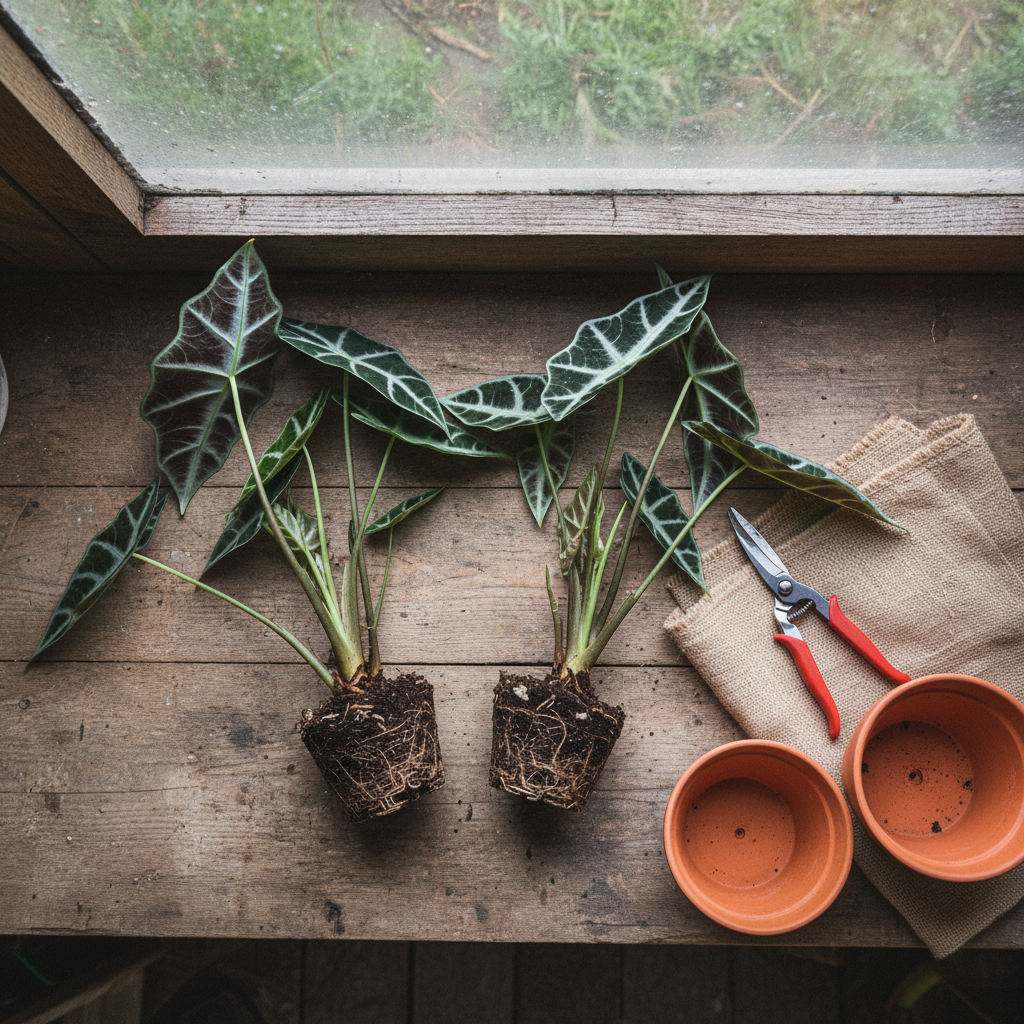
Unlike the trailing aroids that root readily from stem cuttings in a jar of water, Alocasia reginula does not propagate from leaf or stem cuttings at all. It multiplies instead by producing offsets, small clumps and corms from its underground rhizome. The most dependable method for the home grower is simple division, carried out in spring when the plant is repotted and actively growing.
To divide a mature plant, slide it from its pot and gently tease the chunky mix away from the roots until you can see the structure of the rhizome and any attached offsets. Each viable division needs its own portion of healthy root and at least one growing point. Where natural separations exist, you can often pull the clumps apart by hand; where they do not, use a clean, sharp blade and cut decisively, then allow the cut surfaces to air for an hour before potting.
- Water the plant a day before so it is well hydrated, then unpot it and clear the mix from the roots to expose the rhizome and offsets.
- Identify natural clumps, each with its own roots and at least one shoot or growing point.
- Separate them by hand, or cut cleanly with a sterilised blade, and let any cut surfaces dry for an hour.
- Pot each division into a small container of the same chunky aroid mix, sized snugly to the roots.
- Water lightly, then place in warm, bright, indirect light with high humidity and keep the mix barely moist while new roots establish.
The other route is to grow on the small corms, the round nodules found among the roots, which can be potted up or started on damp sphagnum moss inside a covered container. Corms are slow and test your patience, often taking weeks to sprout and many months to make a presentable plant, but they are a way to bulk up a collection from a single specimen at no cost.
Whichever method you use, warmth and humidity are decisive. Freshly divided alocasias have a reduced root system and are vulnerable to both rot and drying out, so high humidity, gentle warmth and a light hand with watering give them the best chance. Expect a settling-in period before new growth appears; patience is the most important tool in alocasia propagation.
Pests and problems
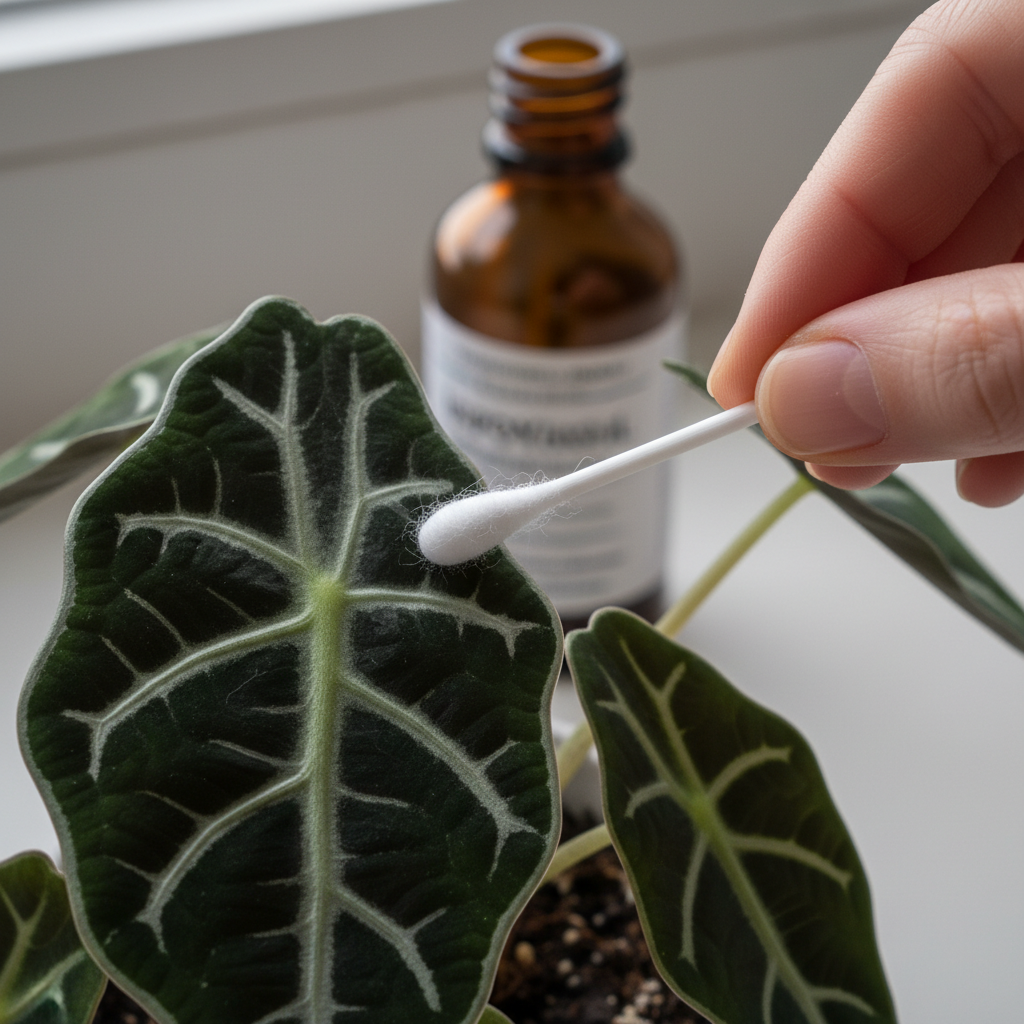
The Black Velvet’s love of warm, sometimes still air, combined with the dry conditions of heated homes, makes it a magnet for sap-sucking pests. Spider mites are the great enemy: these tiny arachnids thrive in dry air, hide on the undersides of leaves, and announce themselves with fine stippling, faint webbing and a general loss of vigour. Because dark velvety leaves make early damage hard to spot, inspect the undersides regularly, especially in winter when indoor air is driest.
Mealybugs, which appear as small white cottony tufts in leaf axils, along with thrips, aphids and scale, can also take hold. At the first sign, isolate the plant from your collection to stop the spread, then treat thoroughly. For small outbreaks, wiping the leaves and dabbing the pests directly with a cotton bud dipped in diluted isopropyl alcohol is effective. For anything more established, a thorough application of insecticidal soap or neem oil, repeated every week or so until the population is gone, brings most infestations under control. Raising the humidity around the plant is itself a strong deterrent to spider mites.
Beyond pests, most of the troubles owners report come down to watering, air and the seasons. The table below maps the most common symptoms to their usual causes and fixes.
| Symptom | Likely cause | What to do |
| Yellowing leaves, often lower ones first | Overwatering or soggy, airless soil | Let the mix dry further, check drainage, and repot into a chunkier mix if it stays wet |
| Crispy, brown leaf edges | Low humidity or mineral build-up from hard water | Raise humidity and switch to filtered or rainwater |
| Drooping leaves | Either too dry or too wet at the roots | Check the soil; water if dry, improve drainage if wet |
| Pale, bleached or scorched patches | Direct sun | Move to bright but filtered light |
| Stretched, leggy growth | Too little light | Move closer to a bright window or add a grow light |
| Sudden leaf loss in autumn or winter | Natural dormancy | Reduce water, keep warm, and wait for spring |
The last of these deserves emphasis, because it frightens more owners than any pest. As days shorten, a Black Velvet may drop most or even all of its leaves and appear to die. In most cases it has simply gone dormant. If the rhizome remains firm, keep the plant warm, cut watering right back to prevent rot, and be patient; fresh leaves usually push up again when light and warmth return in spring.
Pro Tip – Do not bin a dormant plant: Before discarding a leafless Black Velvet, gently feel the base. A firm, plump rhizome means a living plant in rest, not a dead one. Many a perfectly healthy alocasia has been thrown away in midwinter by an owner who did not know it sleeps.
Varieties
Alocasia reginula is itself a relatively recent introduction to the houseplant trade, and the velvety, silver-veined form most people know simply as “Black Velvet” is the standard species form. A handful of variations exist, most notably a rare variegated form, and the plant is often confused with other small jewel alocasias that share its understorey origins. The two below are the forms you are most likely to encounter under the Black Velvet name.
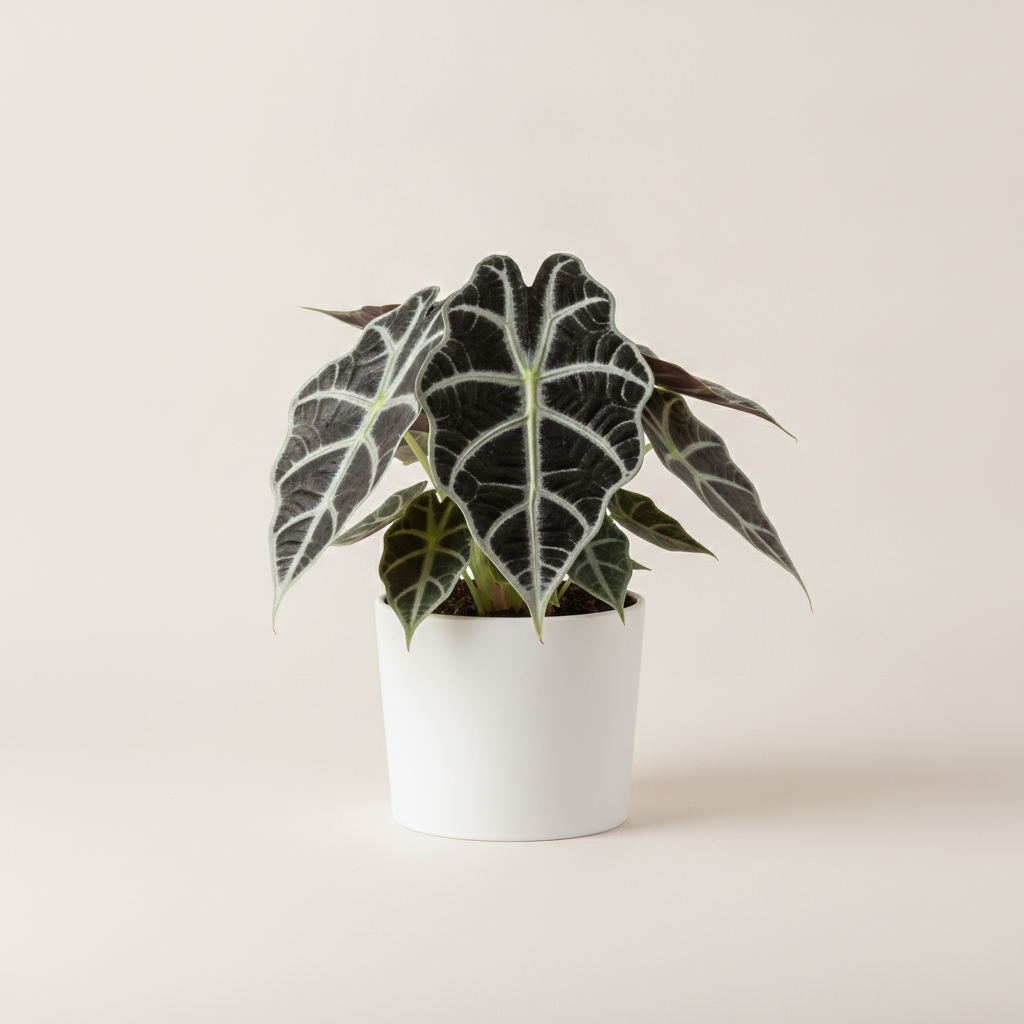
‘Black Velvet’ (standard form)
The classic and by far the most common form, with thick, rounded heart-shaped leaves in a deep blackish-green velvet, crossed by crisp silvery-white veins and backed by pale undersides. Compact and slow-growing, it is the benchmark against which the others are judged and the form described throughout this guide.
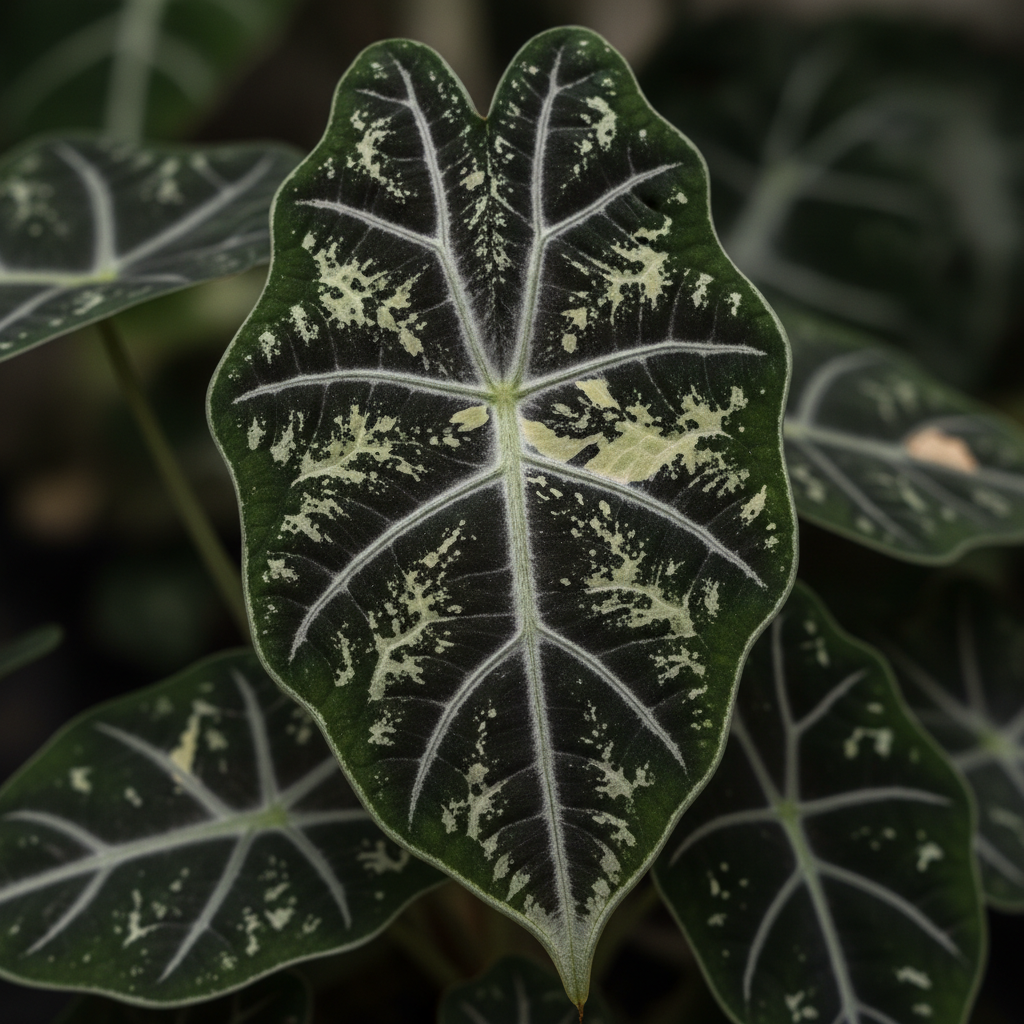
Variegated ‘Black Velvet’
A scarce and highly sought collector’s form in which patches of the dark blade are replaced by cream or pale-green variegation, set against the same silver veining. The reduced chlorophyll makes it slower and more demanding than the standard plant, needing bright indirect light to hold its pattern, and it commands a premium price wherever it appears.
It is worth noting that the Black Velvet is frequently sold alongside, and sometimes mislabelled as, other small jewel alocasias such as the silver-leaved Alocasia baginda ‘Silver Dragon’ or the dark, glossy Alocasia ‘Dragon Scale’. These share its compact habit and similar care needs but differ in leaf colour and texture, so check the silvery veining and true velvet finish if you want the genuine reginula.
Frequently asked questions
Why is my Black Velvet Alocasia dropping all its leaves?
The most common reason in autumn and winter is dormancy, a natural rest the plant takes as light and warmth decline. If the rhizome at the base is still firm, the plant is alive; keep it warm, water very sparingly and wait for spring. Out of season, sudden leaf loss usually points to root rot from overwatering, so check the roots and the drainage of your mix.
Is the Black Velvet Alocasia hard to care for?
It has a reputation as a fussy plant, which is fair but overstated. It is not difficult so much as specific: it needs bright indirect light, a fast-draining airy mix, careful watering, warmth and high humidity. Meet those conditions consistently and it is no harder than many popular houseplants. The trouble usually starts when it is treated like an ordinary plant in ordinary compost.
How much humidity does it really need?
It is genuinely humidity-loving and does best at 60 per cent or higher. In drier air the leaf edges crisp and spider mites become far more likely. A humidifier is the most reliable solution; grouping it with other plants, standing it on a pebble tray, or growing it in a terrarium or glass cabinet also helps. Misting offers only brief, marginal benefit.
Is it safe around cats and dogs?
No. Every part of the plant contains calcium oxalate crystals that are toxic if chewed or swallowed, causing painful burning, drooling, swelling and vomiting in pets and people alike. It is not usually fatal, but it is very unpleasant, so keep it well out of reach of animals and small children.
Can I propagate it from a leaf cutting?
No. Unlike trailing aroids, Alocasia reginula will not root from a leaf or a piece of stem. It propagates only by division of its rhizome and offsets, or by growing on the small corms that form among its roots. The simplest method is to divide a healthy clump at repotting time in spring.
Why are the edges of the leaves turning brown and crispy?
Crispy brown edges almost always mean the air is too dry, the water too hard, or fertiliser salts have built up in the soil. Raise the humidity, switch to filtered or rainwater, and flush the pot with plain water if you suspect salt accumulation. Brown edges that have already formed will not turn green again, but new growth should emerge clean once the cause is fixed.






