
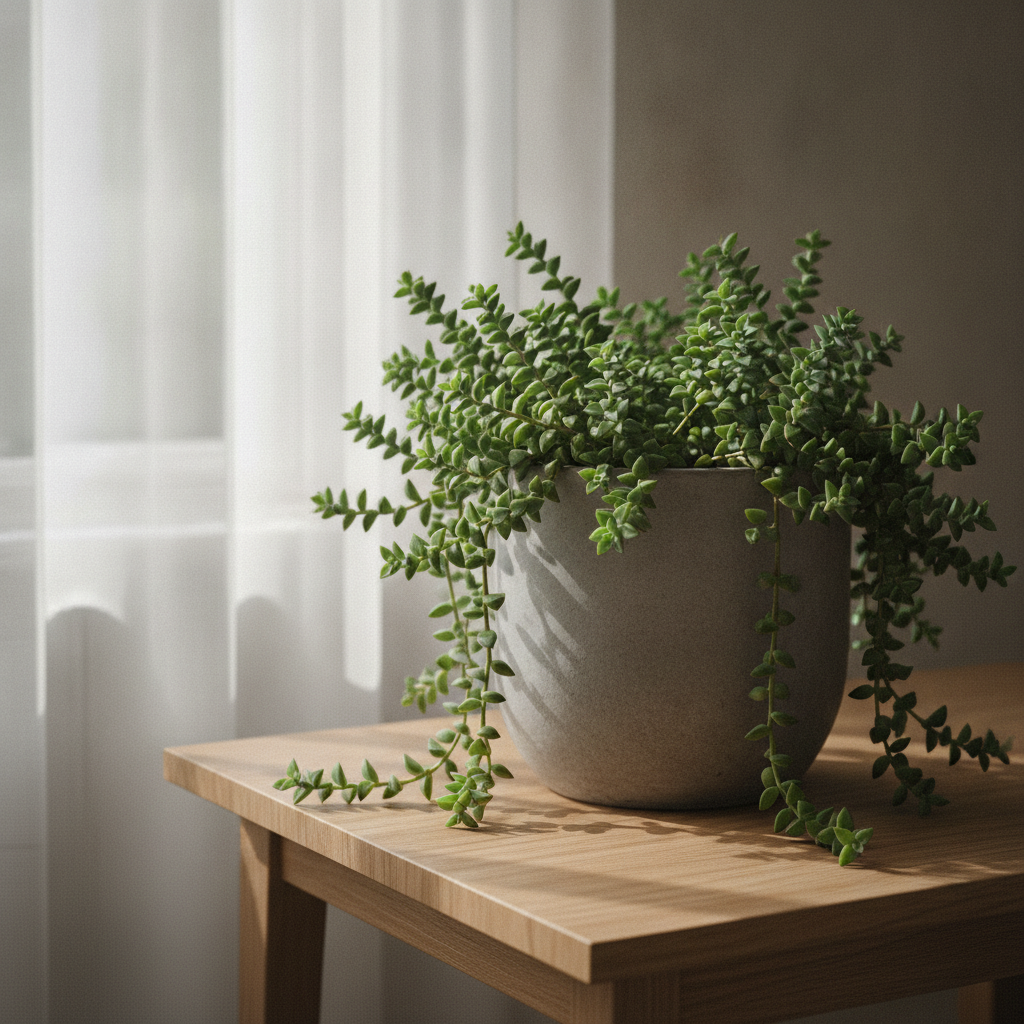
Few succulents wear their common name quite so literally as the baby necklace. Run a finger along one of its slender stems and you feel a string of tightly stacked, fleshy triangles, each pair clasped around the stalk like a bead threaded onto a cord. This is Crassula rupestris, a compact shrublet from the sun-baked rock ledges of South Africa, and it has become a windowsill favourite precisely because it asks for so little while offering so much architectural charm. The species name rupestris means “of rocks”, a clue to everything that follows: this is a plant built for lean soil, fierce light and long dry spells, not for the rich compost and frequent watering that suit a tropical foliage plant.
Getting a baby necklace to merely survive is genuinely easy, which is part of why it sells so well to beginners. Getting it to truly thrive, to stay compact, to blush red at the leaf edges and to throw out clusters of tiny starry flowers in spring, takes a little more understanding of where it comes from and what triggers its best growth. This guide walks through every part of its care, from the quality of light it craves to the gritty mix it needs underfoot, so you can move your plant from simply alive to genuinely flourishing.
In this guide
- Quick reference
- Why the baby necklace makes a good houseplant
- Light
- Watering
- Soil and potting
- Fertilising
- Propagation
- Pests and problems
- Varieties to look for
- Frequently asked questions
Quick reference
| Botanical name | Crassula rupestris |
| Common names | Baby necklace, rosary plant, bead vine, buttons on a string |
| Family | Crassulaceae |
| Origin | Rocky slopes of the Western, Eastern and Northern Cape, South Africa |
| Type | Evergreen succulent shrublet |
| Mature size | Stems 15 to 45 cm (6 to 18 in) long, sprawling or trailing |
| Light | Bright light with several hours of direct sun |
| Water | Soak when the soil is fully dry, far less in winter |
| Soil | Free-draining gritty cactus and succulent mix |
| Temperature | 18 to 24 degrees C (64 to 75 degrees F), keep above 5 degrees C (41 degrees F) |
| Humidity | Low to average, dislikes stagnant damp air |
| Feeding | Weak succulent feed once or twice in the growing season |
| Toxicity | Best treated as mildly toxic to cats and dogs, keep out of reach |
| Difficulty | Easy, very forgiving of neglect |
Why the baby necklace makes a good houseplant
The appeal of Crassula rupestris starts with its structure. Where most succulents present as rosettes or clumps of plump paddles, this one builds in neat vertical sequence, every pair of leaves rotated slightly from the pair below so the stem twists upward in a gentle spiral. The leaves are small, rarely more than a centimetre or two across, and they are perfoliate, meaning the bases of each pair fuse around the stem so the stalk appears to pass straight through them. The effect, repeated dozens of times along a stem, really does look like a beaded necklace laid out on a table, which is exactly how it earned its name.
Colour is the second draw. In modest light the plant is a calm blue-green to grey-green, dusted with a fine waxy bloom that softens its surface. Give it strong light, though, and the leaf margins flush a deep rose to burgundy red, and the whole plant takes on a sun-stressed glow that growers prize. This colour shift is not a sign of damage; it is the plant producing protective pigments in response to bright conditions, and it is one of the clearest signals that your baby necklace is getting the light it wants.
Then there is the sheer ease of it. This is a plant adapted to cracks in rock faces where soil is thin and rain is seasonal, so it stores water in its leaves and stems and simply waits out drought. For a busy household that means a houseplant which forgives the forgotten watering, tolerates a south-facing windowsill that would scorch a fern, and grows slowly enough that it rarely needs repotting. In spring, established plants reward steady care with dense flat clusters of tiny star-shaped flowers in cream, pale yellow or soft pink, sweetly scented and surprisingly showy for so small a plant. Few succulents pack this much interest into a pot you can hold in one hand.
Light
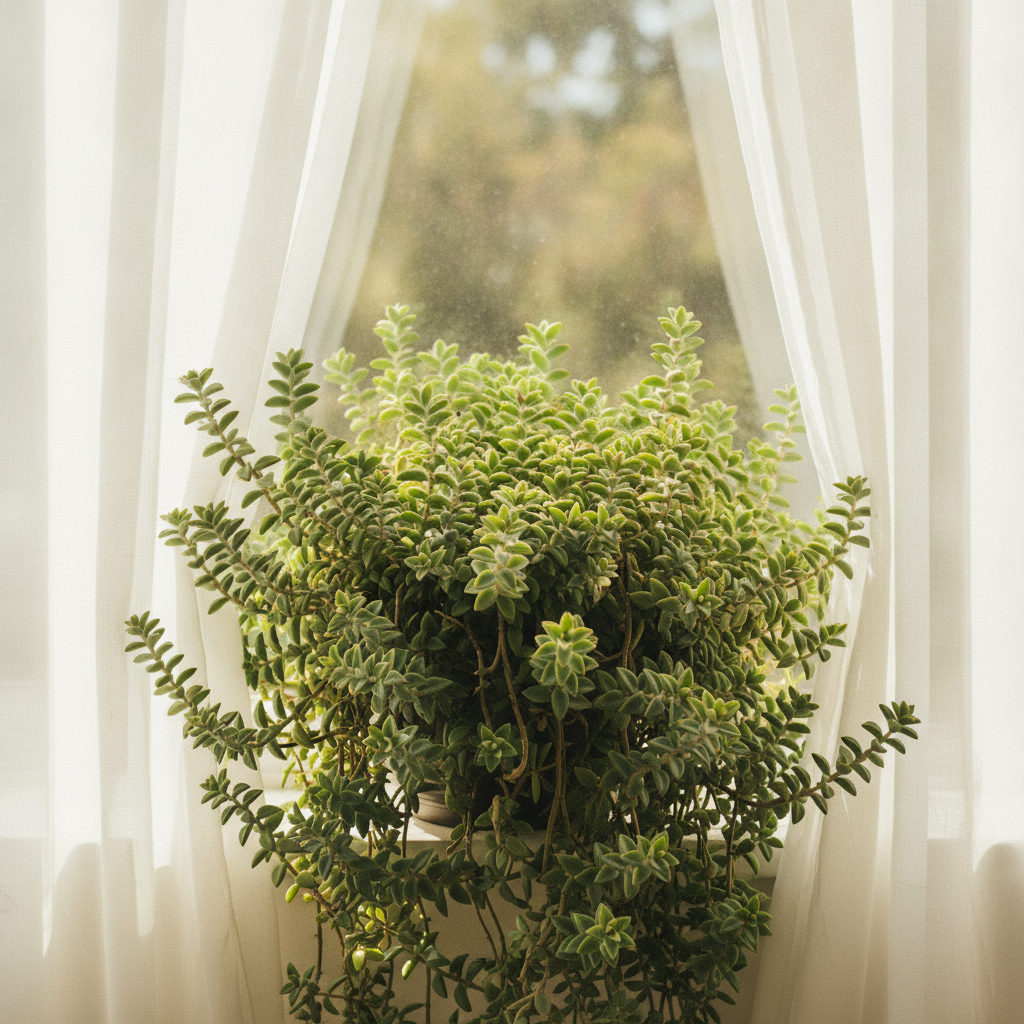
Light is the single most important factor in keeping a baby necklace looking the way it should. On its native rock ledges the plant grows fully exposed to the South African sun, so it has a high tolerance for direct light and a real need for it indoors. The brightest window you can offer is usually the right one. A south-facing sill in the northern hemisphere, or a north-facing sill in the southern hemisphere, gives the several hours of direct sun the plant uses to stay tight, colourful and healthy. An east or west window with strong morning or afternoon sun is the next best thing.
The clearest sign of too little light is stretching, known botanically as etiolation. Starved of sun, the plant lengthens the gaps between its leaf pairs in a search for brighter conditions, and the tidy beaded look gives way to a loose, sparse, pale stem that flops rather than stands. Colour fades to a flat green and the red margins disappear. Etiolated growth cannot be reversed on a stem that has already stretched, so the cure is to move the plant brighter and, if it has grown leggy, to take cuttings and start fresh in better light.
There is a sensible caveat for plants that have been kept in low light or freshly bought from a shaded shop display. Moving them straight into intense direct summer sun can scorch the leaves, leaving brown or whitish patches that do not recover. Introduce strong light over a week or two, starting with morning sun or filtered light and gradually increasing exposure, so the plant can build up its protective pigments without burning. Once acclimatised, a healthy baby necklace handles full sun on a windowsill with ease.
Pro Tip — Read the colour: Use the leaf colour as a light meter. Blue-green with no red edges and widening gaps means move it brighter. A compact stem with rosy margins means the light is just right. Bleached or papery patches mean ease off the harshest midday sun.
Watering
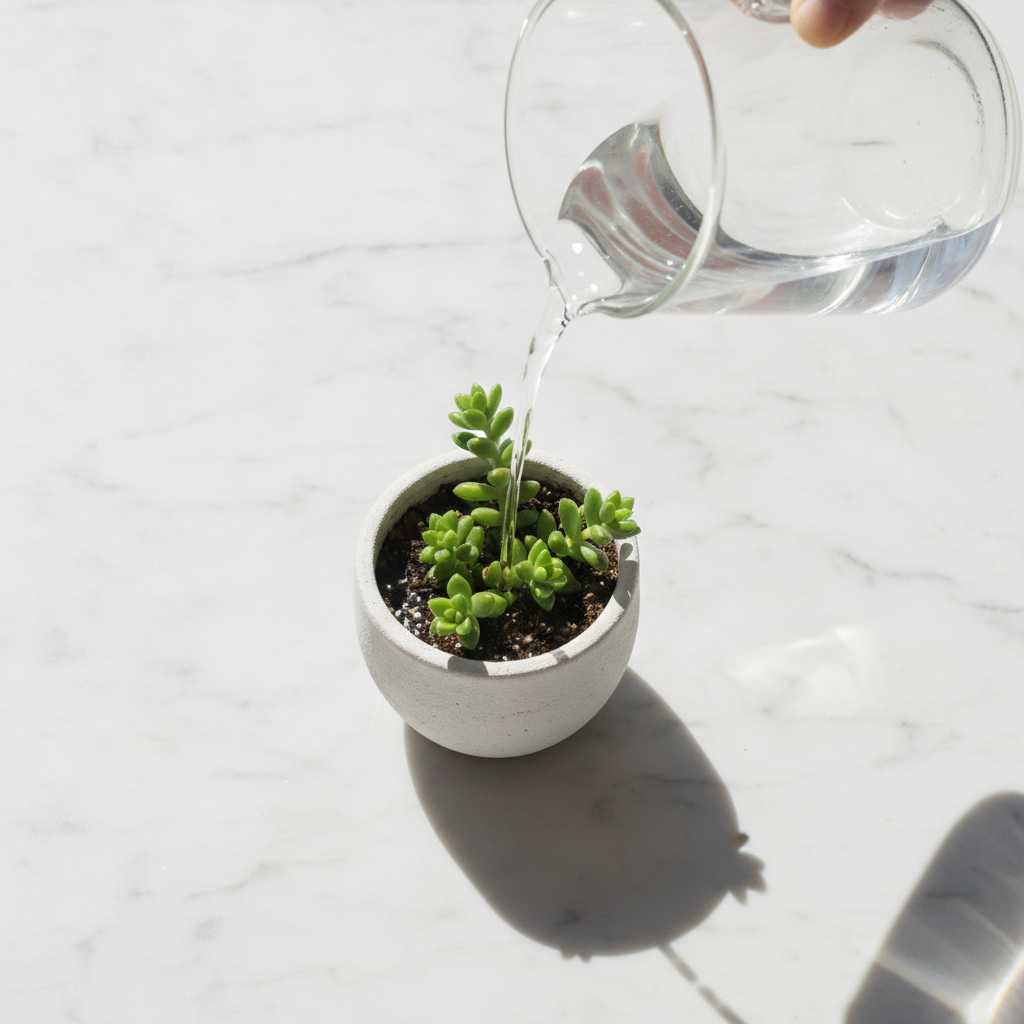
If light is what makes a baby necklace beautiful, watering is what most often kills it. The species stores its own water reserves in fleshy leaves and stems and is built to endure drought, which means the danger almost always lies in giving too much rather than too little. The guiding principle is the soak and dry approach: water generously so the whole root ball is wetted and excess runs from the drainage holes, then do not water again until the mix has dried out completely, top to bottom.
How long that takes depends on the season, the pot and your home. Through the warm, bright months of active growth a plant in a small pot on a sunny sill might want water every week to ten days. In the low light and cooler temperatures of winter the plant slows almost to a halt and its water use drops sharply, so the gap can stretch to every three or four weeks, sometimes longer. Rather than watering on a fixed schedule, check the soil. Push a finger into the mix or lift the pot to feel its weight; a dry pot is noticeably light. Only water when you are confident the mix is dry through.
Overwatering shows first as leaves that turn soft, translucent and yellow, then mushy, often starting at the base of the plant where moisture lingers. Left unchecked, the rot travels into the stem and roots and the plant collapses. Underwatering, by contrast, shows as leaves that wrinkle, soften slightly and lose their plumpness, and it is far easier to fix: a thorough soak usually sees the plant recover within a day or two. When in doubt, wait. A thirsty baby necklace is a minor inconvenience, while a waterlogged one is frequently a lost cause.
Warning — Crown and base rot: Avoid letting water sit in the tightly packed leaf joints or pooling around the base of the stems, especially in cool or dim conditions. Water the soil directly rather than over the foliage, and never leave the pot standing in a saucer of water.
Soil and potting
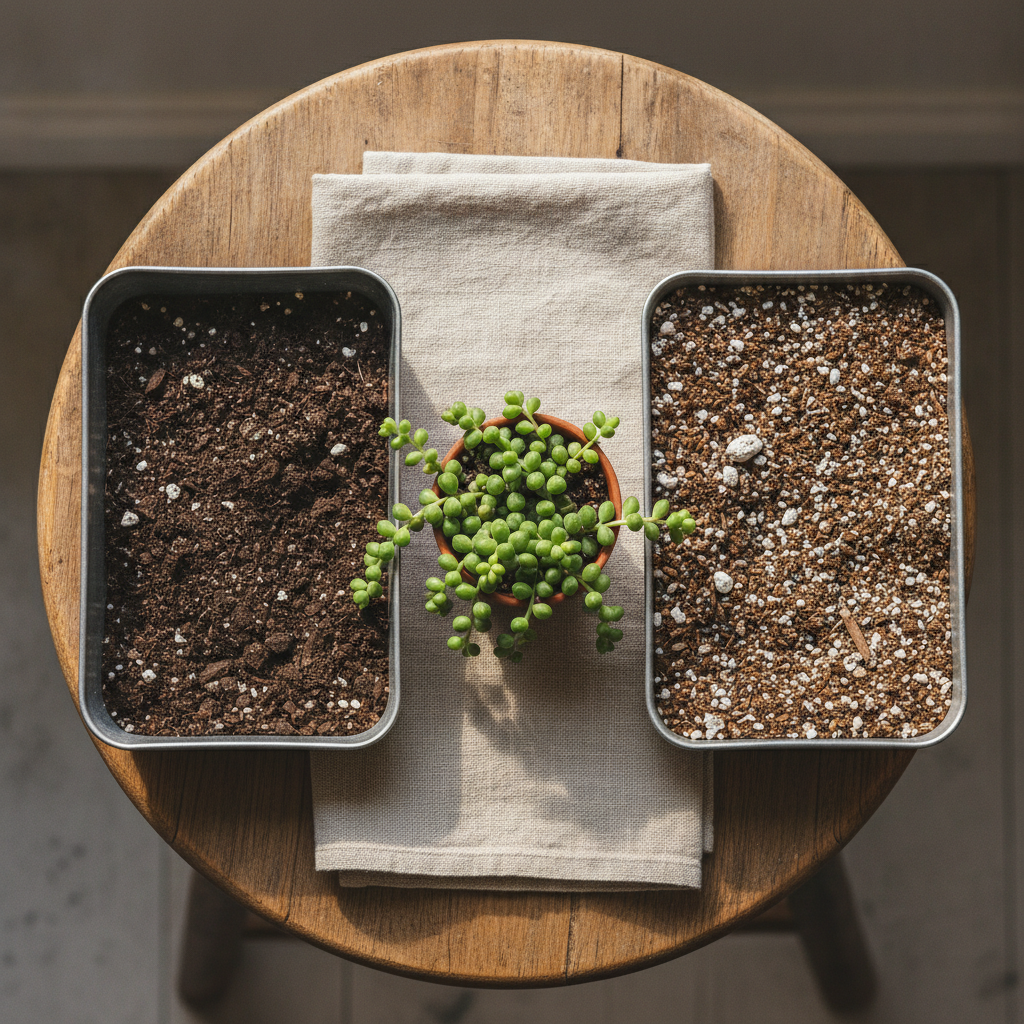
Drainage is everything for a plant that grows wild in rock crevices. The soil a baby necklace sits in should hold just enough moisture to wet the roots after watering and then release it quickly, never staying soggy. Ordinary houseplant compost on its own is far too water-retentive and is the most common reason a healthy plant slowly rots from the roots up. The solution is a gritty, open mix.
A reliable recipe is roughly one part standard cactus and succulent compost to one part coarse mineral grit such as perlite, pumice or fine horticultural grit. Aim for a mix that feels chunky and loose in the hand and that water pours straight through. Many growers push the ratio further, to half or even more mineral matter, particularly in cooler or less sunny homes where the soil dries slowly. The more grit you add, the more forgiving the plant becomes of an over-enthusiastic watering can.
The pot matters too. Choose one with drainage holes, without exception. Terracotta is an excellent choice because the porous clay wicks moisture from the soil and breathes, helping the mix dry evenly between waterings, though any pot with good drainage will work if your watering is disciplined. Keep the pot snug rather than oversized; a large volume of damp soil around a small root system stays wet too long. Repotting is rarely needed more than every two or three years, and the best time is spring at the start of active growth. After repotting, wait several days before the first watering so any roots damaged in the process can callus over rather than rot.
Fertilising
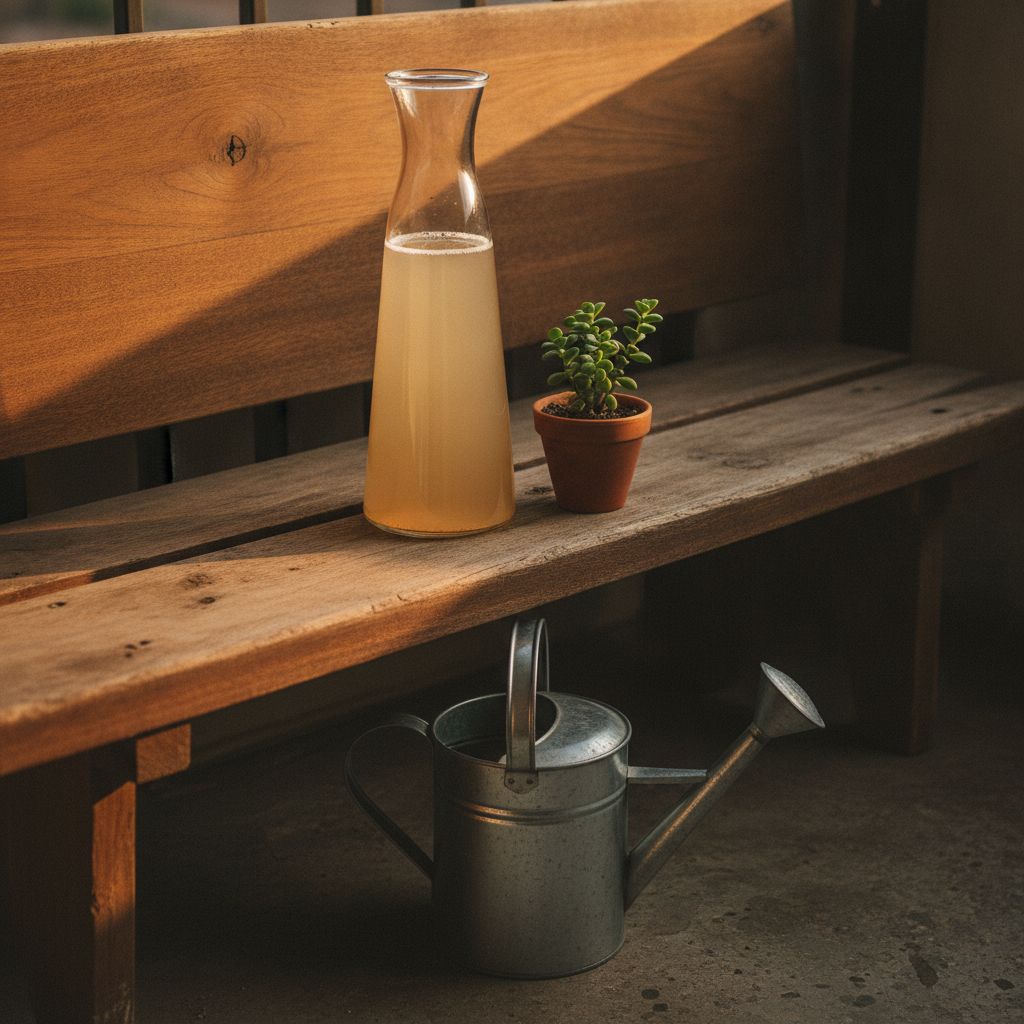
The baby necklace is a light feeder, in keeping with the nutrient-poor rock habitats it calls home. It does not need rich feeding and reacts badly to too much of it, so restraint is the rule. A single feed in late spring and perhaps one more in summer is plenty for most plants, and many growers who repot every couple of years into fresh mix skip feeding altogether without any ill effect.
When you do feed, use a fertiliser formulated for cacti and succulents, which is lower in nitrogen than general houseplant feed, and dilute it to half the strength stated on the label. High-nitrogen feeds push soft, fast, weak growth that stretches and loses the compact beaded form the plant is grown for, so a balanced or low-nitrogen product is the better match. Always apply feed to already-moist soil rather than dry mix, to avoid scorching the roots, and never feed in autumn or winter when the plant is resting. A dormant succulent cannot use the nutrients, and the salts simply build up in the soil.
Propagation
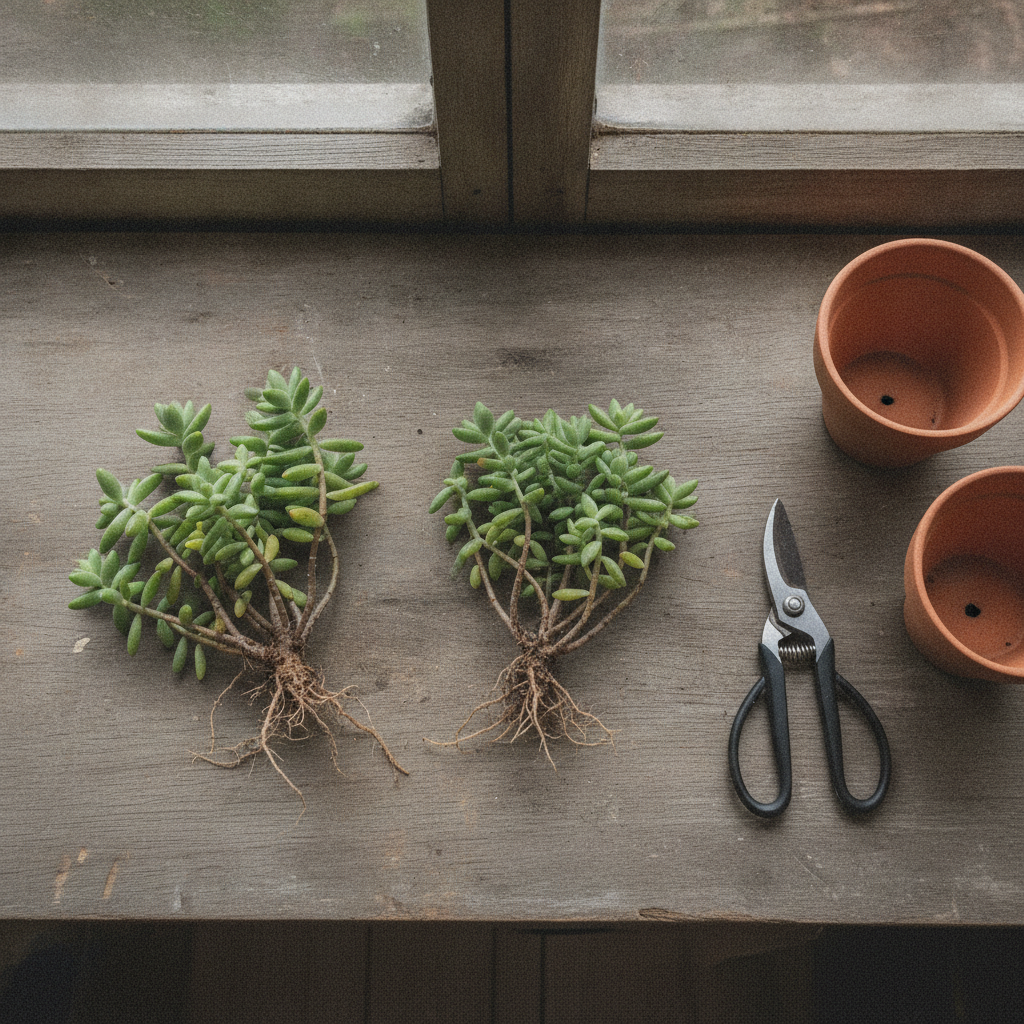
One of the quiet joys of the baby necklace is how readily it multiplies. The most dependable method is the stem cutting, which takes advantage of the plant’s natural tendency to root wherever a stem touches soil. Division of an established clump works well too, and any leaves or stem pieces that drop off during handling will often root on their own given the chance. Spring and early summer, when the plant is in active growth, give the fastest and most reliable results.
To take a stem cutting, follow these steps:
- Using clean, sharp scissors or a knife, cut a healthy length of stem around 5 to 8 cm (2 to 3 in) long, ideally with several pairs of leaves along it.
- Gently remove the lowest one or two pairs of leaves to expose a short length of bare stem that will sit in the soil.
- Set the cutting aside in a dry, shaded spot for two to four days so the cut end calluses over. This dry, sealed surface greatly reduces the risk of rot once planted.
- Insert the callused end into a small pot of barely moist gritty succulent mix, firming the soil just enough to hold the cutting upright.
- Place the pot in bright, indirect light and resist watering for the first week. After that, mist lightly or water sparingly only when the mix is dry.
- Roots usually form within two to three weeks. A gentle tug that meets resistance tells you the cutting has anchored, after which you can treat it as a normal plant.
Division is even simpler for a mature, clumping plant. Slide the whole plant from its pot, tease the root mass apart into two or more sections each with its own roots and stems, and pot each piece up separately in fresh gritty mix. As with cuttings, wait a few days before watering so any torn roots can seal. Fallen leaves can be laid on top of dry mix and left to root from the base, though leaf propagation is slower and less certain than stem cuttings for this species.
Pro Tip — Patience over moisture: The most common cause of failed succulent cuttings is watering too soon and too often. Let the cut callus, keep the mix on the dry side, and let the plant’s own water reserves carry it until roots form.
Pests and problems
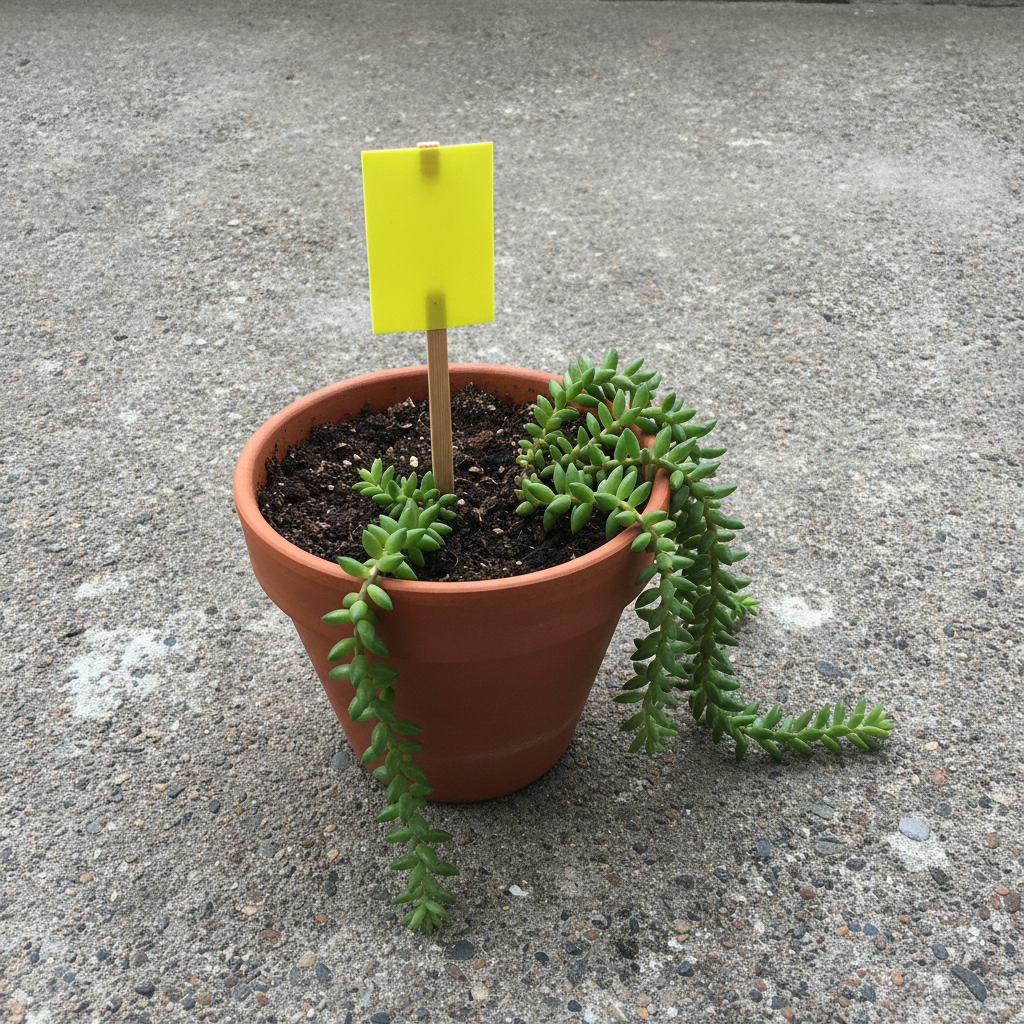
A healthy, well-grown baby necklace is largely untroubled by pests, but a few are worth watching for. Mealybugs are the most common, appearing as small white cottony tufts tucked into the leaf joints and along the stems where the densely stacked foliage gives them cover. Because the plant’s beaded structure offers so many hiding places, catching an infestation early matters. Dab the insects directly with a cotton bud dipped in rubbing alcohol, and for larger outbreaks treat the whole plant with a horticultural soap or neem-based spray, repeating every week or so until they are gone.
Aphids occasionally cluster on fresh growth and developing flower stalks, and spider mites can appear in hot, dry conditions, betrayed by fine webbing and a stippled, dull look to the leaves. Both respond to the same soap or neem treatments. Fungus gnats, the small flies that hover around the soil, are less a pest in themselves than a warning sign: they breed in persistently moist mix, so their presence usually means you are watering too often or the soil is holding too much water. Letting the mix dry out fully, and adding more grit, generally solves the problem at its source.
The most serious threat, though, is not an insect at all. Root and stem rot from overwatering accounts for more dead baby necklaces than every pest combined. The early signs are leaves turning soft, yellow and translucent, particularly low on the plant, and a stem base that feels squishy or looks darkened. If you catch it early, stop watering at once, and if the rot has set in, cut well above the affected area, let the healthy top callus and re-root it as a cutting. Treat the lost lower portion as a lesson in drainage, and revisit your mix and watering habits before the replacement goes back on the sill.
Varieties to look for
Crassula rupestris is a variable species with several named subspecies and a handful of popular cultivars, all sharing the same stacked, beaded habit but differing in leaf shape, size and colour. Two are especially common in cultivation and worth seeking out.
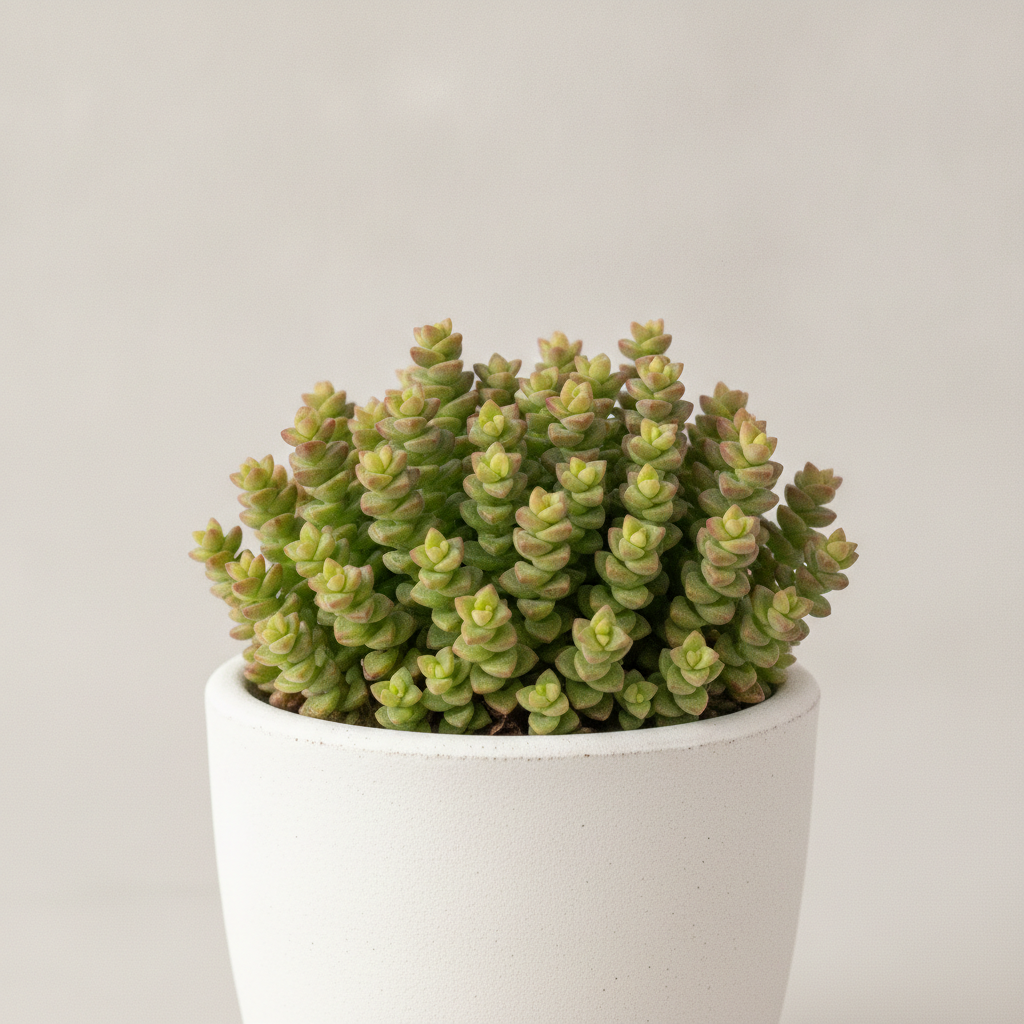
‘Tom Thumb’
The most sought-after form, ‘Tom Thumb’ is exceptionally compact, with tiny triangular jade-green leaves packed so tightly the stems look like miniature stacked towers. In good light the edges blush a vivid red, and the dense, neat growth makes it a favourite for small pots and dish gardens. It stays smaller than the wild species, rewarding bright light with intense colour.
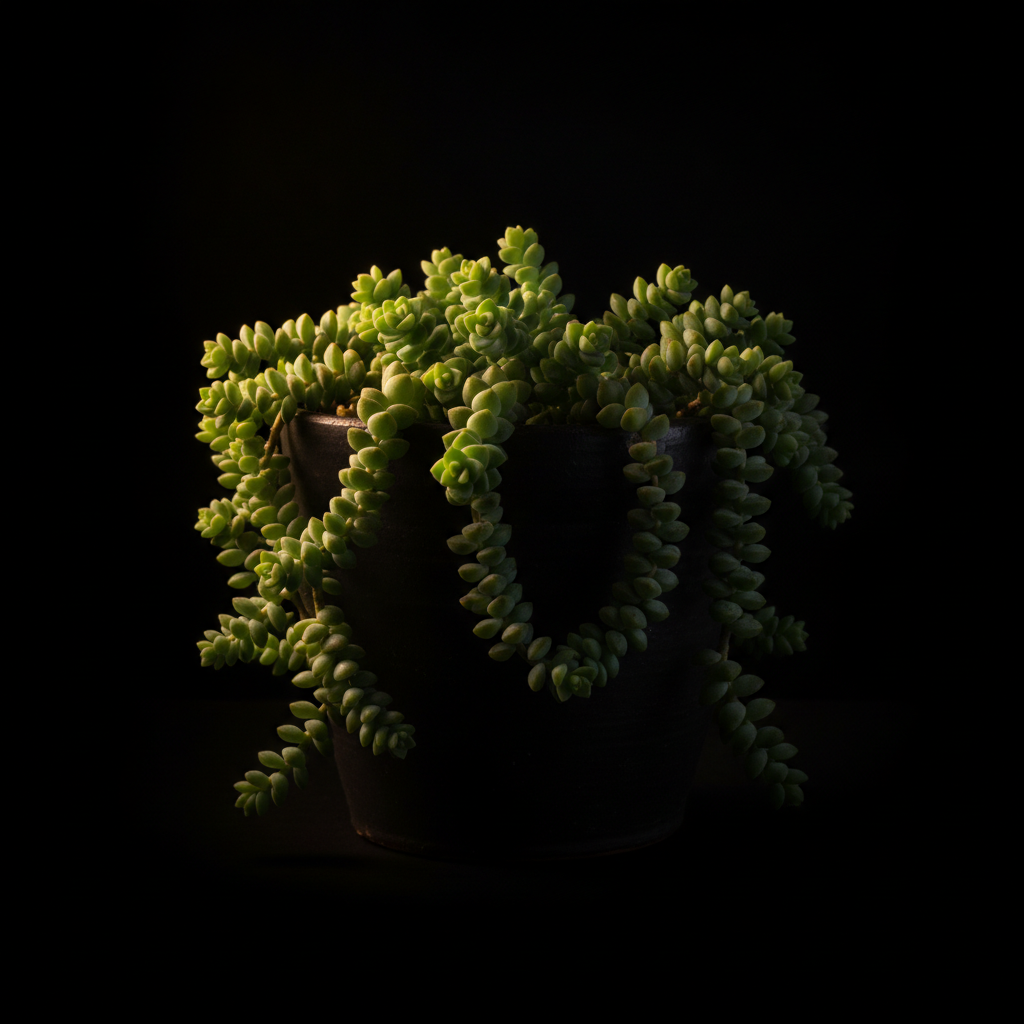
subsp. marnieriana
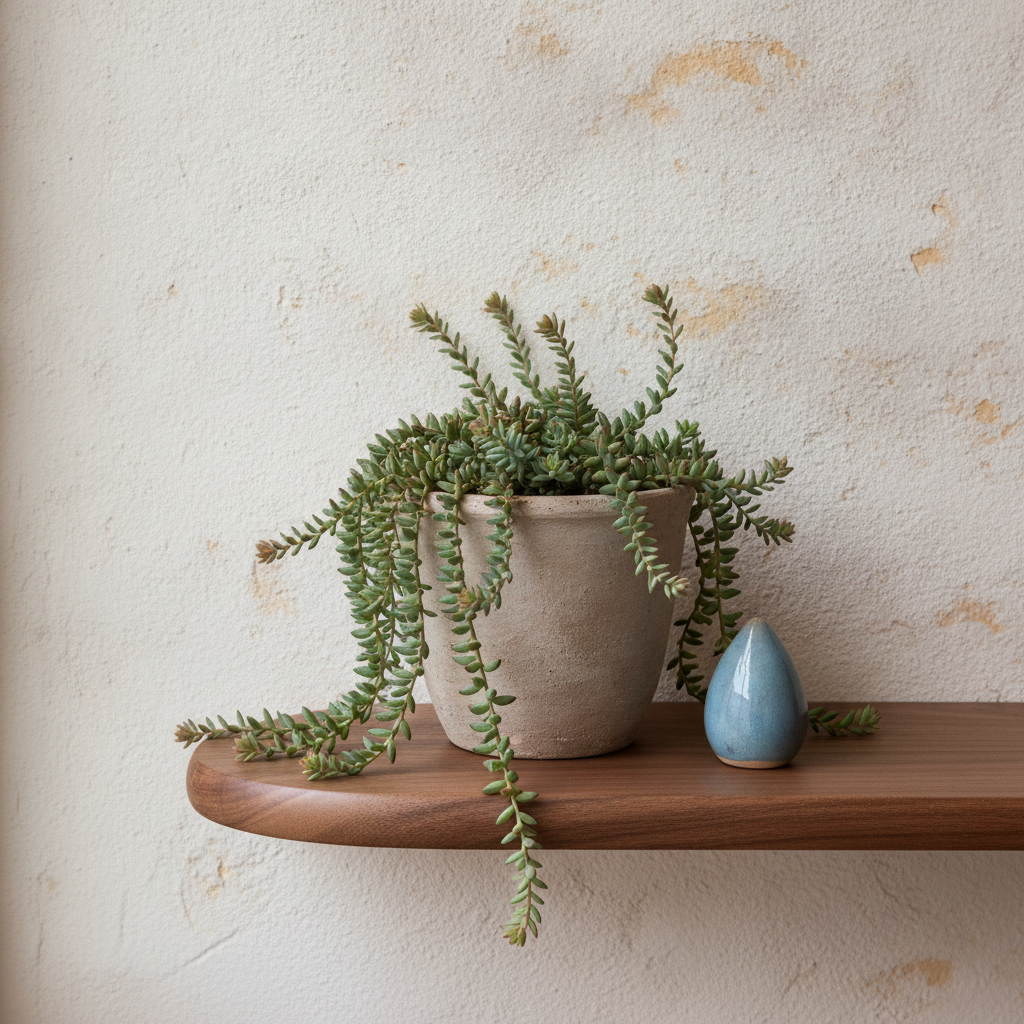
Often sold as the worm plant or jade necklace, this subspecies carries rounder, fuller blue-green leaves stacked along softer, trailing stems that resemble strings of jade beads. The margins flush pink to red in strong sun, and its looser, cascading habit makes it a striking choice for a small hanging pot or the front edge of a shelf where the stems can spill over.
Frequently asked questions
Why is my baby necklace stretching out and losing its stacked shape?
This is etiolation, and it is almost always caused by insufficient light. When the plant cannot get the sun it needs, it lengthens the gaps between leaf pairs and grows pale and floppy as it reaches for brighter conditions. Move it to your sunniest window. Stems that have already stretched will not tighten back up, but you can cut them into cuttings and grow compact new plants in better light.
How often should I water it?
There is no fixed schedule. Water thoroughly only when the soil has dried out completely, which might mean every week or so in warm, bright weather and only every three or four weeks in winter. Always check the soil first rather than watering by the calendar, and when in doubt, wait. This plant tolerates drought far better than soggy roots.
Is the baby necklace safe around pets?
Members of the Crassula genus are generally regarded as mildly toxic to cats and dogs, and can cause stomach upset or lethargy if eaten. It is safest to treat the baby necklace as a plant to keep out of reach of curious pets and small children, and to contact a vet if you suspect an animal has chewed on it.
Why are the lower leaves turning soft and yellow?
Soft, yellow, translucent leaves, especially near the base, are the classic sign of overwatering and the beginnings of rot. Stop watering immediately and let the soil dry out fully. Check that your pot drains freely and that your mix is gritty enough. If the stem base has gone mushy, cut above the damage and re-root the healthy top as a cutting.
Will it flower indoors?
Yes, given enough light. Established, well-grown plants produce flat clusters of small star-shaped flowers in cream, pale yellow or soft pink, usually in spring, and they are lightly scented. A bright position and a cool, dry winter rest both help encourage blooming, mimicking the seasonal rhythm of the plant’s native climate.
How big does a baby necklace get?
It stays small. Individual stems reach roughly 15 to 45 cm (6 to 18 in) long and tend to sprawl or trail rather than stand tall, so the plant spreads into a low mound or spills gently over the pot rim rather than growing into anything large. This compact habit is a big part of its appeal for windowsills and small spaces.






