
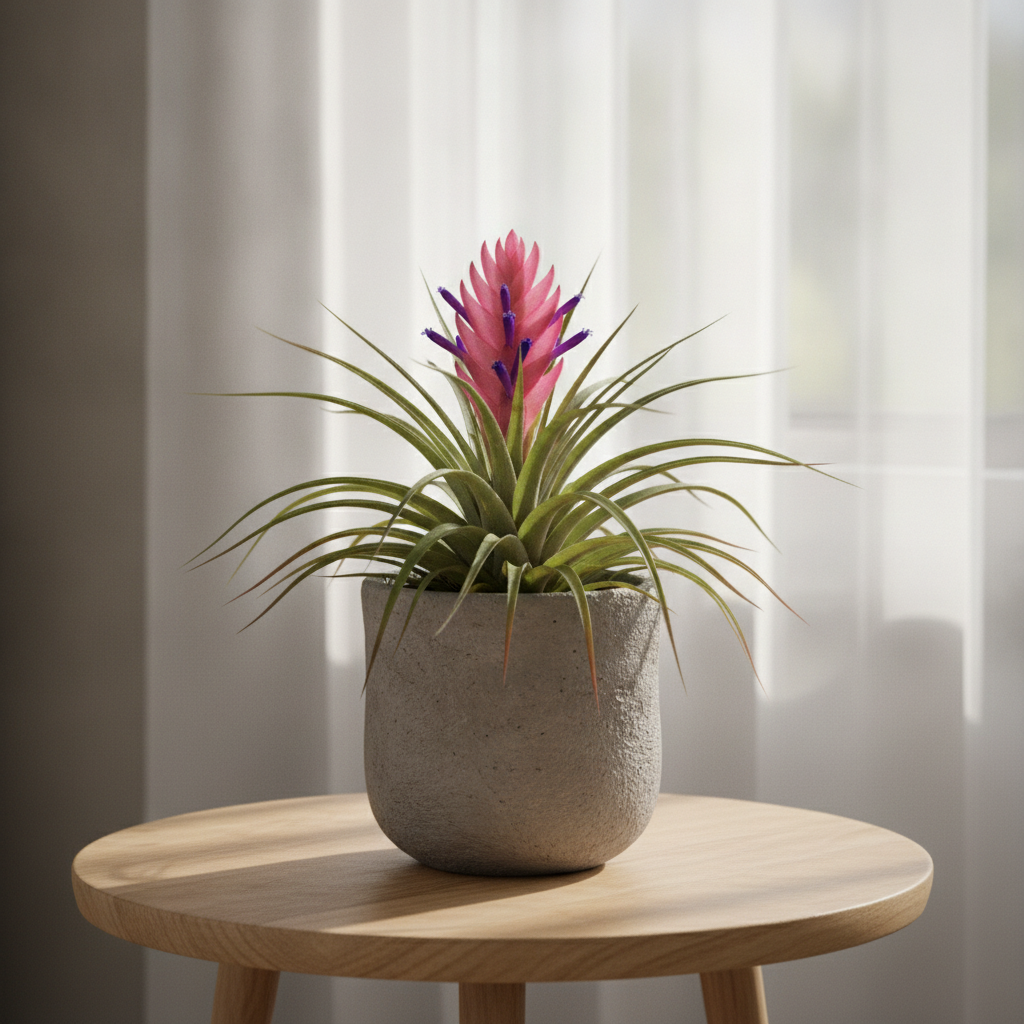
Few houseplants announce themselves quite like the pink quill plant. From a fountain of slim, arching leaves rises a flat, paddle-shaped flower spike in a vivid rose-pink, and from the edges of that spike emerge fleeting violet-blue flowers that open one or two at a time. Botanically it is Tillandsia cyanea, a member of the bromeliad family native to the humid rainforests of Ecuador, where it grows as an epiphyte clinging to tree branches rather than rooting in the ground. That wild lifestyle explains almost everything about how it behaves on a windowsill.
The pink quill has a reputation as a slightly temperamental novelty, the kind of plant bought in flower and discarded once the colour fades. That reputation is undeserved. It is genuinely easy to keep alive once you understand that it is half air plant and half potted plant, and that the showy quill is a once-in-a-lifetime event for each rosette. This guide covers the full picture, from the light and water that keep the foliage healthy to the feeding and propagation that turn a single short-lived bloom into a self-renewing colony. The difference between a plant that merely survives its first season and one that thrives and multiplies for years comes down to a handful of details, and they are all here.
Contents
- Quick Reference
- Why the Pink Quill Plant Makes a Rewarding Houseplant
- Light Requirements
- Watering & Humidity
- Soil, Potting & Repotting
- Fertilising
- Propagation
- Pests & Diseases
- Popular Varieties
- Frequently Asked Questions
Quick Reference: Pink Quill Plant at a Glance
| Light | Bright, indirect light; tolerates gentle morning sun |
| Watering | Keep the airy mix lightly moist; mist often and water with care |
| Temperature | 16 to 27 degrees C (61 to 81 degrees F) |
| Humidity | Moderate to high, ideally 50 to 70 per cent |
| Fertiliser | Dilute bromeliad or orchid feed monthly in the growing season |
| Toxicity | Non-toxic to cats, dogs and people |
Why the Pink Quill Plant Makes a Rewarding Houseplant
The pink quill occupies an unusual middle ground in the houseplant world. Most of the tillandsias sold in shops are the so-called atmospheric air plants, silvery rootless things that live glued to driftwood or perched in glass globes. Tillandsia cyanea is different. It keeps a small, functional root system and is happiest grown in a pot of loose, fast-draining material, which makes it far more forgiving and far easier to display on a shelf than its bare-rooted relatives. You get the exotic, sculptural quality of a bromeliad with the low bulk of a compact tabletop plant.
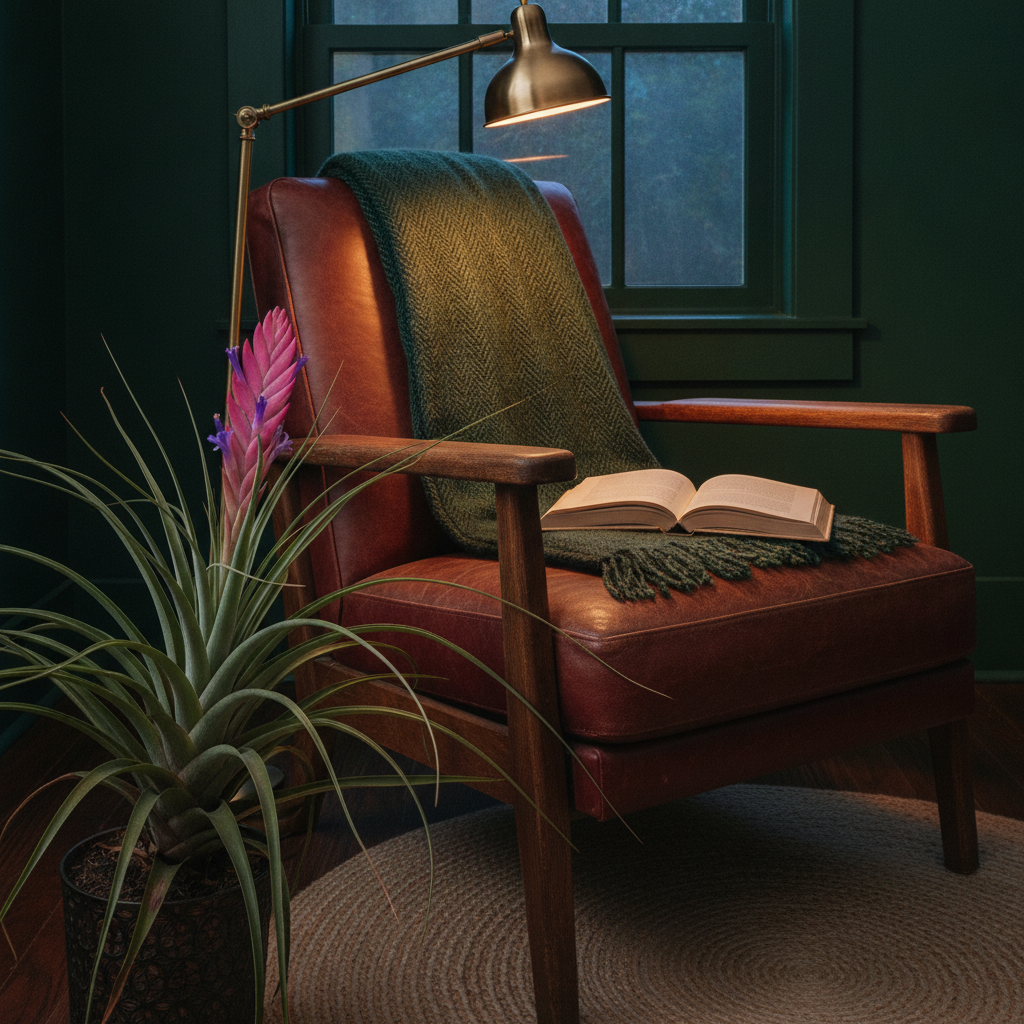
Its biggest selling point is also the source of most of the confusion around it. That brilliant pink fan is not a flower but a modified leaf structure called a bract, and it can hold its colour for two to three months. The true flowers are the small, three-petalled violet-blue blooms that push out from between the overlapping scales of the quill, each lasting only a few days. Because the colour show is so long-lasting and so unlike anything else, the pink quill is a genuine conversation piece, and it stays attractive even when not in bloom thanks to its tidy, grassy rosette of foliage.
Important — Toxicity: The pink quill plant is non-toxic and is considered safe around cats, dogs and children. Bromeliads in general are not listed as poisonous, so a curious nibble will not cause the kind of mouth irritation that aroids such as philodendrons can. The slim leaves can have slightly rough edges, so it is still sensible to keep it out of reach of pets that like to chew.
Light Requirements
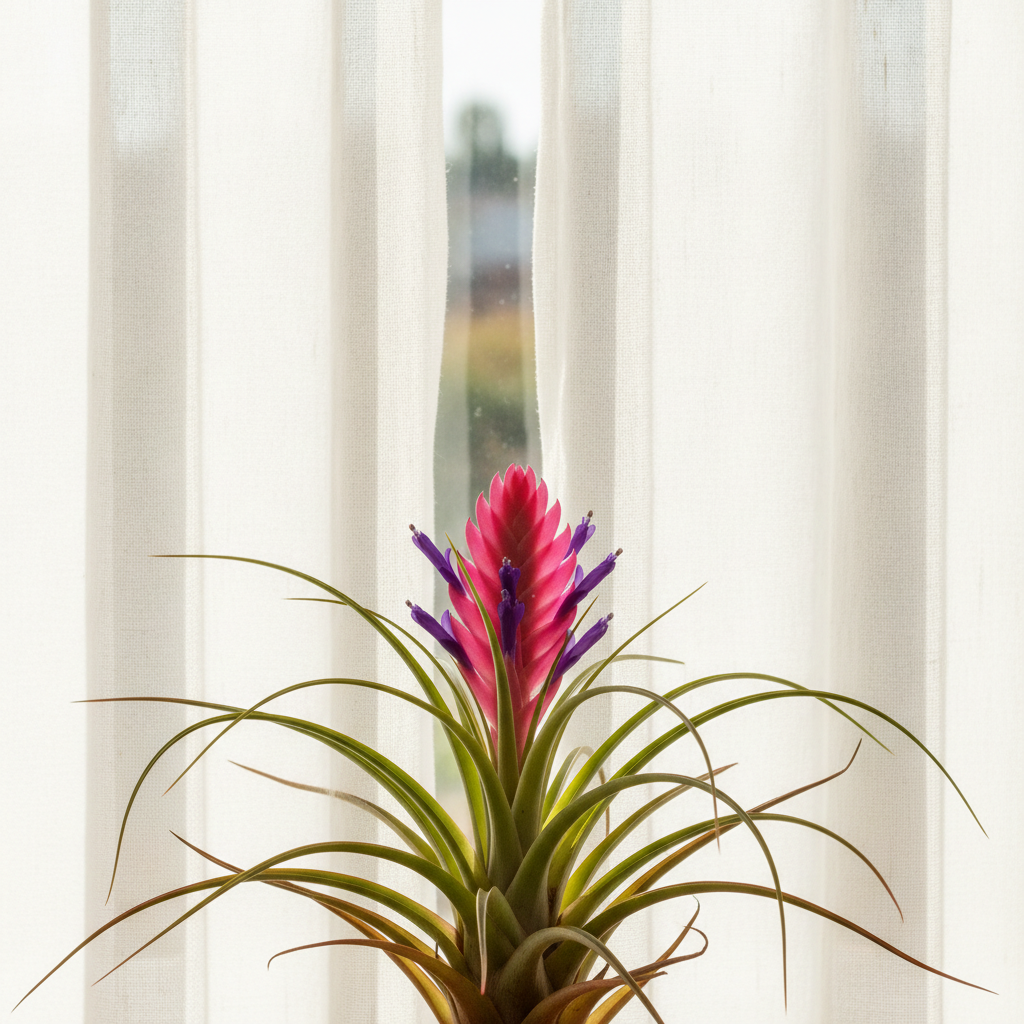
Light is the single biggest factor in whether a pink quill rebloors through its pups and keeps its leaves a deep, healthy green. In its native Ecuadorian forests it grows attached to branches in the dappled canopy, bathed in bright light that is filtered through layers of leaves above. The indoor equivalent is bright, indirect light for most of the day, the sort of position a metre or so back from a sunny window, or directly in front of a window screened by a sheer curtain.
Aim for somewhere the plant casts a soft-edged shadow rather than a hard, crisp one. In that kind of light the foliage stays compact and the plant builds up the energy reserves it needs to produce a quill. Too little light and the leaves stretch, lose their slight rosy tint at the base and the plant simply refuses to flower; too much direct sun and the leaf tips scorch to a papery brown.
Light Levels Explained
Houseplant light is easier to judge once you translate vague descriptions into rough lux values and the places in a real home where they occur. The table below shows where the pink quill sits across the common categories, and what to expect at each level.
| Light Category | Approx. Level | Typical Location | Outcome |
|---|---|---|---|
| Direct sun | Over 50,000 lux | On an unscreened south sill | Risk of bleached, scorched leaf tips |
| Bright indirect | 15,000 to 40,000 lux | Near an east window or behind a sheer curtain | Ideal; compact growth and reblooming pups |
| Medium | 8,000 to 15,000 lux | A metre or two inside a bright room | Healthy foliage but slower to flower |
| Low | 2,000 to 8,000 lux | A dim corner or north room | Leaves stretch and thin; rarely blooms |
| Very low | Under 2,000 lux | Interior wall, far from any window | Slow decline over time |
Window Orientation and Placement
South-facing window: The brightest aspect in the northern hemisphere. A pink quill will be happy here only if it is set back from the glass or shielded by a voile curtain, otherwise the midday sun will burn the slender leaves.
East-facing window: Often the sweet spot. Gentle morning sun followed by bright, indirect light for the rest of the day suits the plant perfectly and rarely causes scorching.
West-facing window: Workable, but the strong afternoon sun can be fierce in summer, so a light curtain or a position just off to the side keeps things safe.
North-facing window: Usable for keeping an established plant ticking over, but the light is generally too weak to trigger flowering or keep an offset growing strongly.
Pro Tip — Read the Leaves: The plant tells you when the light is right. Leaves that stay short, arching and faintly bronze-tinged at the base are getting enough. Leaves that turn floppy, pale and elongated are reaching for a brighter spot, so move the pot closer to the window before the rosette loses its shape.
How Light Affects Flowering and Leaf Colour
Unlike variegated foliage plants, the pink quill does not depend on light to maintain a leaf pattern, but light does control the two things people most want from it: the depth of green in the foliage and the chance of that spectacular quill appearing. A mature rosette in good light gradually builds the reserves to flower, a process that can be nudged along once the plant is large enough. In poor light it stays permanently vegetative, producing leaves but never the pink display.
Warning — Direct Sunlight: The thin leaves of Tillandsia cyanea have little protection against intense, unfiltered sun. A few hours of harsh midday light through glass can leave permanent brown, crispy patches that will not recover. Always diffuse strong sun with a curtain or distance.
Artificial Lighting
The pink quill responds well to supplementary lighting, which makes it a good candidate for rooms that lack a bright window. A full-spectrum LED grow light positioned 30 to 45 centimetres (12 to 18 inches) above the plant for ten to twelve hours a day provides plenty of energy. Because the plant is compact, even a modest desk-style grow light is enough, and the steady, predictable light through winter can actually improve its chances of flowering compared with a dim natural spot.
Seasonal Adjustments
Light intensity indoors drops sharply between autumn and early spring. A pink quill that was perfectly placed in summer may need to move closer to the window, or onto a brighter sill, to keep receiving the same effective light through the darker months. In high summer the reverse applies, and a plant on a south or west sill may need extra shading it did not require in spring. Turning the pot a quarter every week or two keeps the rosette growing evenly rather than leaning toward the glass.
Watering & Humidity
Watering the pink quill is where its split personality matters most. Because it is an epiphyte, it absorbs a great deal of moisture and nutrients through its leaves rather than relying solely on roots, yet because it is grown in a pot it can also suffer the classic potted-plant problem of soggy, airless roots. The goal is therefore a steady supply of moisture to the foliage combined with a growing medium that is lightly damp but never waterlogged.
When to Water
Water the potting medium when the top two to three centimetres (about an inch) have dried but the layer below still feels barely moist. In a warm, bright room in summer this usually means a thorough watering once or twice a week, dropping to once every week or two in winter when growth slows and the medium stays damp longer. The plant prefers to ride a little on the dry side rather than the wet side, so when in doubt, wait a day.
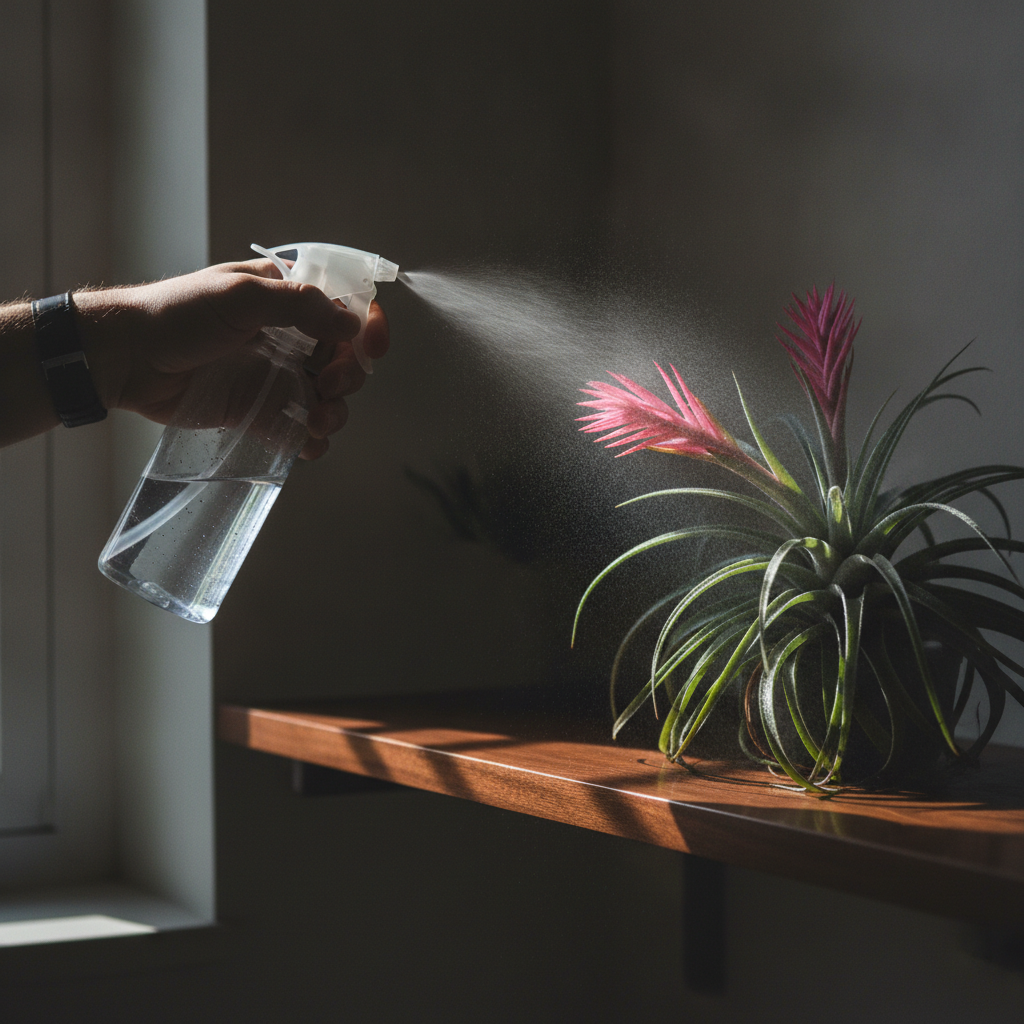
Alongside watering the medium, mist the leaves several times a week, or as often as daily in very dry indoor air. Some growers go further and periodically take the plant to the sink, run it under tepid water until the foliage is soaked and the medium is flushed, then let it drain completely before returning it to its spot. This mimics a rainforest downpour and keeps both leaves and roots refreshed.
Pro Tip — Drain Thoroughly: The fastest way to kill a pink quill is to let it stand in trapped water. After every watering or soak, tip the pot to let excess drain right out, and never leave water pooling in a decorative cover pot or saucer. Wet foliage is fine; a wet, stagnant base is not.
How to Water Correctly
- Use room-temperature water; cold water straight from the tap can shock the roots and mark the leaves.
- Water over a sink, pouring slowly around the base until it runs freely from the drainage holes.
- Mist the foliage at the same time so the leaves take up moisture directly.
- Let the pot drain completely for several minutes before it goes back on display.
- Tip away any water that collects in the cover pot or saucer.
- Between waterings, mist the leaves whenever the air feels dry to keep humidity up.
Signs of Overwatering vs. Underwatering
| Symptom | Overwatering | Underwatering |
|---|---|---|
| Leaf colour | Base yellowing, browning from the centre out | Tips drying to a pale, crispy brown |
| Leaf texture | Soft, mushy, translucent at the base | Curled, rolled inward, papery |
| Medium | Constantly wet, sour-smelling | Bone dry and pulling from the pot edge |
| Roots | Brown, slimy, breaking apart | Dry and brittle but intact |
| Plant base | Loose in the pot, the rosette pulls away easily | Firm but the whole plant looks shrunken |
Warning — Root Rot: A pink quill whose base has gone soft and whose rosette lifts away from the medium with no resistance is almost certainly suffering crown or root rot from sitting wet. Caught early, you can sometimes save healthy offsets by detaching them and starting again, but a collapsed central rosette cannot be revived.
Humidity Requirements
As a rainforest epiphyte, the pink quill is happiest in moderate to high humidity, ideally between 50 and 70 per cent. It will tolerate average household air, but the drier the room the more attention its leaves need, because in low humidity the fine leaf tips are the first thing to brown and the plant draws less of its moisture from the air.
Signs that the air is too dry include browning, crisping leaf tips, a generally dull and slightly shrivelled look to the foliage, and quicker drying of the medium between waterings. These symptoms often appear in winter when central heating strips moisture from indoor air, and they tend to show up alongside, not instead of, the plant’s normal watering needs.
Raising humidity is straightforward. Grouping the pink quill with other plants creates a moister pocket of air, a pebble tray topped with water beneath the pot lifts local humidity as it evaporates, and a small room humidifier is the most reliable fix of all. Bright bathrooms and kitchens, with their naturally damp air, also suit it well as long as the light is good enough.
Water Quality
Like most bromeliads, the pink quill is sensitive to the minerals and chemicals in hard tap water, which can build up on the leaves and in the medium and cause brown spotting over time. Rainwater is ideal, and filtered or distilled water is an excellent substitute. If you only have access to tap water, letting it stand uncovered overnight allows some of the chlorine to dissipate before you use it, and is far better than nothing.
Soil, Potting & Repotting
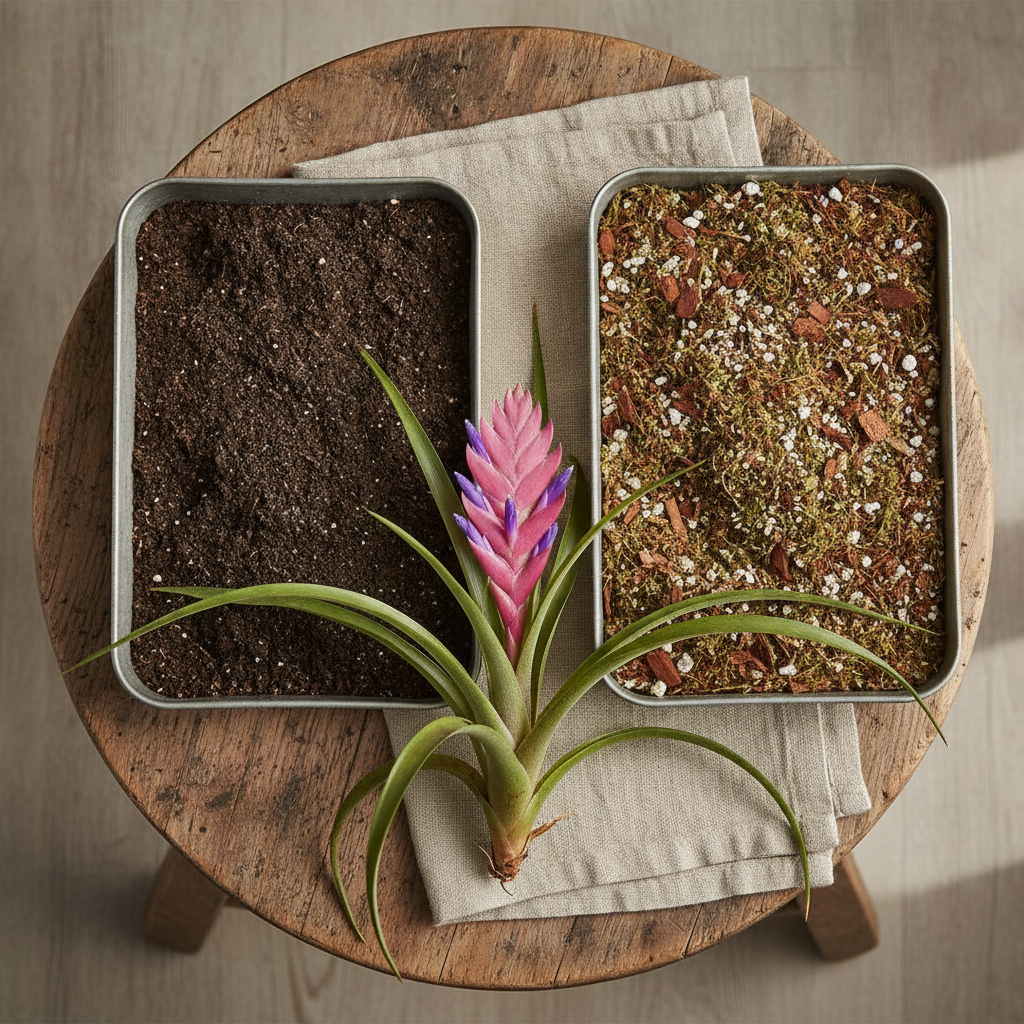
Forget ordinary potting compost for this plant. An epiphyte that naturally grows on bark needs its roots surrounded by air as much as moisture, so the medium has to be coarse, open and fast-draining. Packed into dense, water-retentive soil, the pink quill’s modest roots quickly suffocate and rot, which is the most common reason shop-bought plants fail.
Ideal Soil Composition
The best medium behaves more like an orchid mix than a houseplant compost. A blend built around bark, with generous amounts of perlite and a little sphagnum moss to hold a touch of moisture, gives the right balance of air and dampness. Many growers simply use a good-quality orchid bark mix straight from the bag, sometimes loosened further with extra perlite.
| Component | Proportion | Function |
|---|---|---|
| Orchid bark | 50 per cent | Provides structure and large air pockets |
| Perlite | 25 per cent | Keeps the mix light and sharply drained |
| Sphagnum moss | 15 per cent | Holds a little moisture around the roots |
| Coco coir or leaf mould | 10 per cent | Adds a small reserve of water and nutrients |
The pink quill prefers a slightly acidic root environment, roughly pH 5.5 to 6.5, which a bark and coir based mix naturally provides. There is no need to test or adjust pH for a single houseplant; choosing the right ingredients takes care of it automatically.
Pro Tip — Quick Mix Recipe: If you want a simple, reliable blend, combine two handfuls of fine orchid bark with one handful of perlite and a small handful of pre-soaked sphagnum moss. It drains in seconds yet stays cool and lightly damp, which is exactly what these roots want.
Choosing the Right Pot
Because the root system stays small, the pink quill never needs a large or deep container. A snug pot that just holds the rootball is ideal, both for the plant’s health and for stability, since the top growth can be top-heavy when the quill is in full display.
Drainage holes are non-negotiable. Whatever pot you choose must let water escape freely. If you love a particular decorative cover pot without holes, keep the plant in a plain plastic nursery pot and lift it out to water, returning it only once it has fully drained.
Pot material: Terracotta is an excellent choice because its porous walls wick away excess moisture and let air reach the roots, which suits an epiphyte well. Glazed ceramic and plastic both work too, but with these you must be more disciplined about not overwatering, since they hold moisture for longer.
Pot size: Move up only one size at a time, and only when roots genuinely fill the current pot. An oversized container holds a reservoir of damp medium the small roots cannot use, and that lingering moisture is an open invitation to rot.
When to Repot
The pink quill rarely needs repotting for the sake of its roots, since they grow slowly and stay compact. The main reasons to repot are to replace a tired, broken-down medium every couple of years, or to separate and pot up offsets after the mother rosette has finished flowering and begun to decline. Avoid repotting a plant that is in full bloom, as disturbing it then can cut the display short. The best time is spring or early summer, when the plant is actively growing and recovers quickly.
How to Repot: Step-by-Step
- Water lightly a day ahead so the rootball holds together without being soggy.
- Ease the plant out of its pot, supporting the base of the rosette rather than pulling on the leaves.
- Gently tease away the old medium from the roots and check for any soft, brown or rotten sections.
- Trim away dead or damaged roots with clean, sharp scissors.
- Settle the plant into fresh bark mix in a pot only slightly larger than before, keeping it at the same depth.
- Fill around the roots with mix and firm it just enough to hold the plant upright without compacting it.
- Water through once, let it drain fully, and keep it out of direct sun for a week while it settles.
Warning — Transplant Shock: A newly repotted pink quill may look a little limp for a few days. Resist the urge to compensate with extra water, which only stresses the disturbed roots further. Keep the medium just barely moist, maintain humidity with misting, and let the plant find its feet in its own time.
Fertilising
The pink quill is a light feeder, in keeping with its epiphytic habit of scavenging dilute nutrients from rain, dust and debris washing over its leaves. It does not need rich feeding and is easily harmed by too much, so the guiding principle here is little and weak rather than frequent and strong.
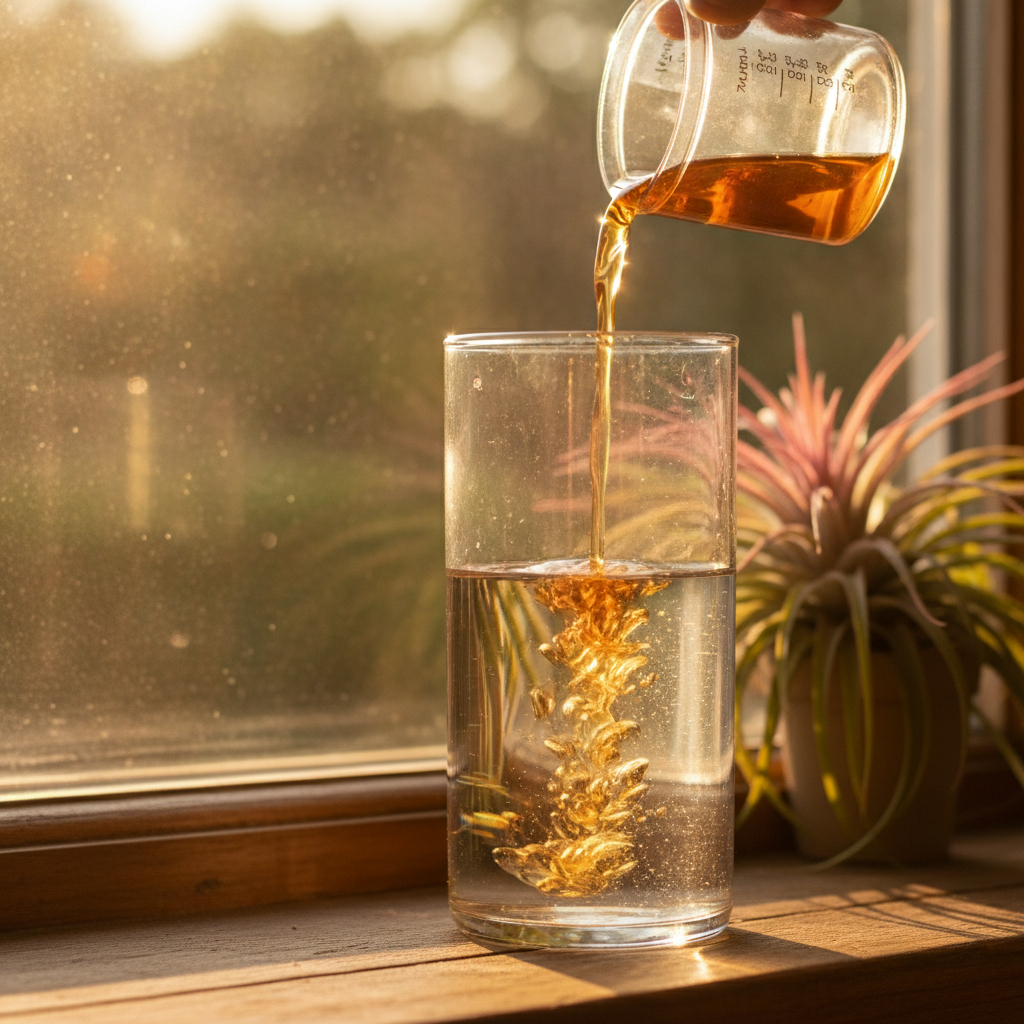
Because so much of its uptake happens through the foliage, fertiliser can be applied either to the medium when you water or, very effectively, as a dilute spray over the leaves. Either way, the feed should be heavily watered down compared with the doses used for ordinary houseplants.
Understanding Plant Nutrients
Fertilisers are labelled with three numbers, the NPK ratio, standing for nitrogen, phosphorus and potassium. Nitrogen drives leafy growth, phosphorus supports roots and flowering, and potassium underpins overall vigour and resilience. A balanced or slightly low-nitrogen feed suits the pink quill, and a specialist bromeliad or orchid formula is ideal because these are designed for exactly this kind of plant.
| Nutrient | Symbol | Primary Function | Deficiency Symptoms |
|---|---|---|---|
| Nitrogen | N | Leaf and stem growth | Pale, slow, undersized foliage |
| Phosphorus | P | Roots and flower formation | Weak growth, reluctance to bloom |
| Potassium | K | Overall vigour and stress tolerance | Yellowing leaf margins, weak plant |
| Calcium | Ca | Cell wall strength | Distorted new leaves |
| Magnesium | Mg | Core of the chlorophyll molecule | Yellowing between leaf veins |
| Iron | Fe | Chlorophyll production | Pale young leaves with green veins |
Types of Fertiliser
Liquid fertilisers: The most practical choice for the pink quill, because they are easy to dilute precisely and can be misted onto the foliage. A balanced houseplant feed at a quarter to half the recommended strength, or a purpose-made bromeliad feed, works well.
Slow-release granular: Generally too concentrated and too sustained for such a light feeder. If used at all, a tiny pinch of a low-strength formula is plenty, but most growers skip granular feeds entirely for this plant.
Organic fertilisers: Very dilute organic options such as a weak seaweed or kelp solution are gentle and well suited to misting. They release nutrients mildly and are difficult to overdo, which makes them a forgiving choice.
Feeding Schedule
Feed only during the active growing season, from spring through to early autumn, and roughly once a month at that. Through late autumn and winter, when growth all but stops, withhold fertiliser completely. A single offset coming into growth needs even less than an established plant, so err on the side of underfeeding whenever you are unsure.
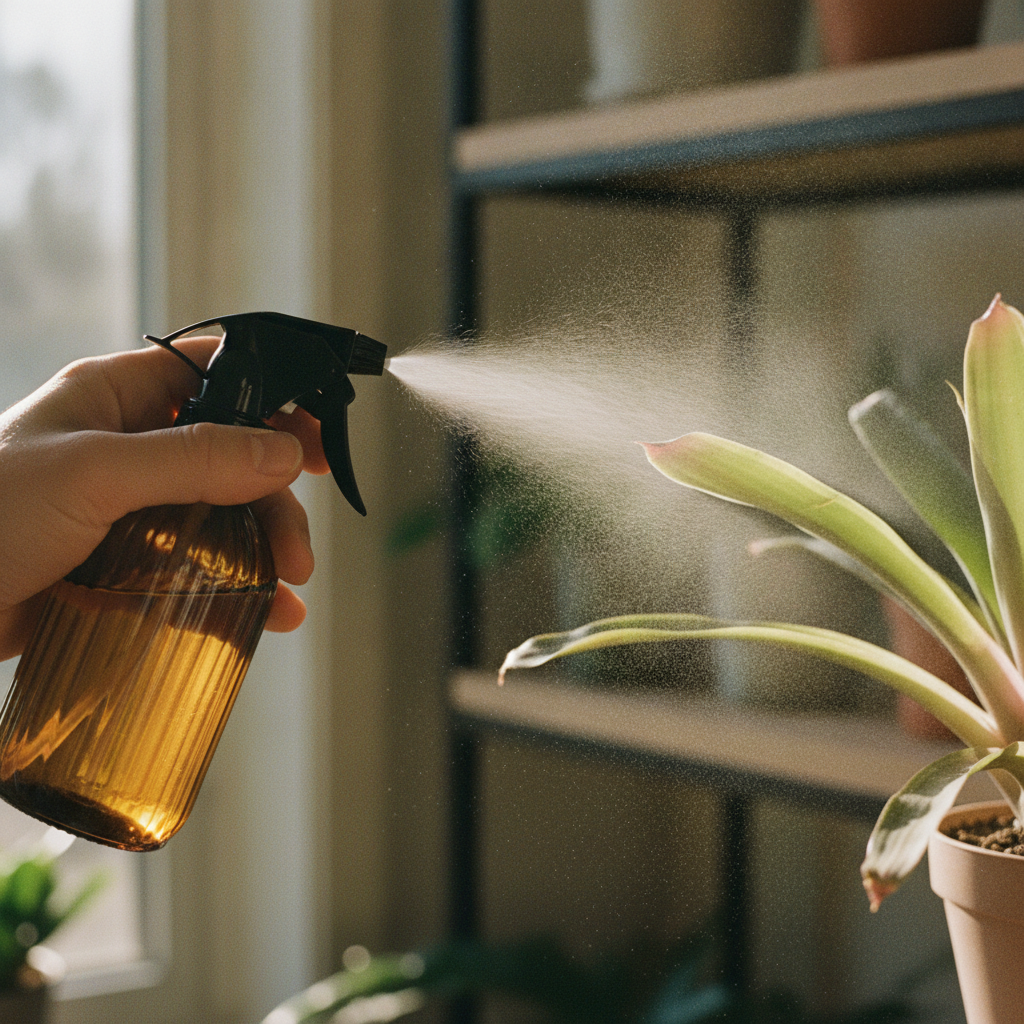
Pro Tip — Feed Through the Leaves: Add your dilute feed to the misting bottle and spray it lightly over the foliage on feeding day. This mirrors how the plant gathers nutrients in the wild and avoids any build-up of salts in the small volume of medium around the roots.
How to Fertilise
- Dilute a balanced or bromeliad-specific feed to a quarter or half the label strength.
- Apply it either when watering the medium or as a fine mist over the leaves.
- Feed only once a month, and only in the growing season.
- Every few months, water with plain water alone to flush out any accumulated salts.
Warning — Salt Build-Up: Over-feeding leaves a crust of mineral salts on the medium and scorches the sensitive roots and leaf tips, showing up as brown, burnt margins. If you see a pale residue forming, stop feeding and flush the pot thoroughly with several rounds of plain water.
Propagation
Propagating the pink quill is not just possible, it is essential to keeping it long term, because each rosette flowers only once in its life. After the quill fades, the mother plant slowly winds down, but before it does it produces offsets, known as pups, around its base. Raising these pups is how a single plant becomes a long-lived succession of bloomers.
This is the natural rhythm of most bromeliads and nothing to be alarmed by. The parent does not die suddenly; it gradually declines over many months while its pups grow, and your job is simply to let the offsets bulk up before separating them.
Understanding Offsets (Pups)
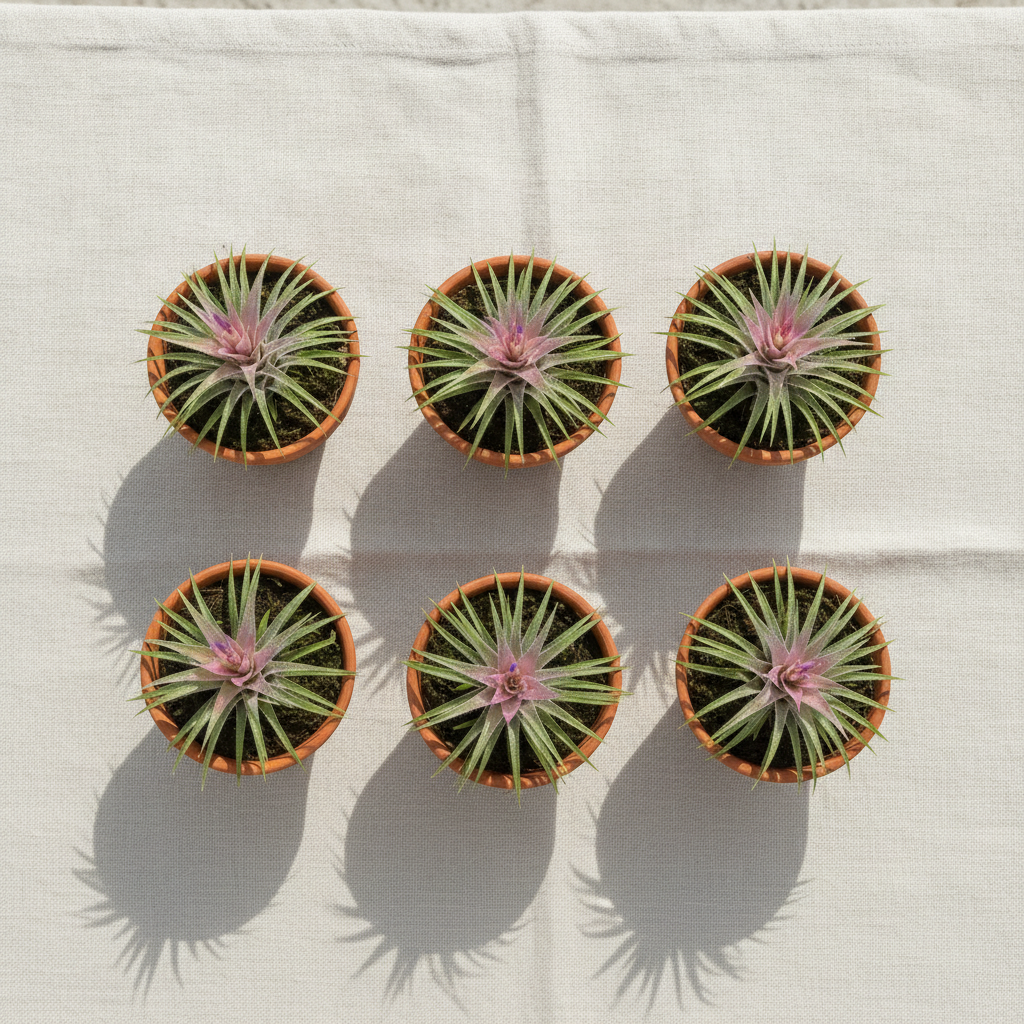
Pups are miniature versions of the parent that emerge from the base of the rosette, usually after flowering. At first they are small and depend on the mother plant for water and nutrients through a shared base. As they grow they develop their own leaves and, eventually, their own roots. Once a pup reaches around a third to a half of the parent’s size and has begun forming roots of its own, it is ready to be separated and grown on independently.
Dividing Offsets: Step-by-Step
Separating a well-grown pup from its parent is the most reliable way to propagate the pink quill. Patience is the key; a pup removed too early, before it has roots and size on its side, struggles to establish.
- Wait until the pup is at least a third the size of the mother and shows signs of its own roots.
- Ease the whole plant out of its pot so you can see where the pup joins the parent.
- With a clean, sharp knife, cut the pup away cleanly, keeping as many of its own roots as possible.
- Let the cut surfaces air-dry for an hour or two to reduce the risk of rot.
- Pot the pup into a small container of the same airy bark mix the parent grows in.
- Mist well, keep the medium just barely moist, and place it in bright, indirect light to establish.
Pro Tip — Leave Them Attached: If you are not fussed about quick numbers, you can simply leave the pups in place and let the clump grow on as a multi-rosette display. Remove the spent mother once it has fully browned, and the pups will mature and flower in their own time without ever being cut.
Growing From Seed: Step-by-Step
Seed propagation is possible but slow, and is really the preserve of dedicated enthusiasts, since a seed-grown pink quill can take several years to reach flowering size. It is worth understanding even if you never attempt it.
- Collect the fine, fluffy seed from a pollinated quill once the seed capsules ripen and split.
- Scatter the seed onto a pad of damp sphagnum moss or a sheet of fine mesh, without burying it.
- Keep it under bright, indirect light in a humid, well-ventilated enclosure.
- Mist regularly so the seed never dries out, and be prepared to wait weeks for germination.
- Grow the tiny seedlings on with great patience, potting them up only once they are large enough to handle.
Troubleshooting Propagation
| Problem | Likely Cause | Solution |
|---|---|---|
| Pup rots after separation | Removed too early or potted too wet | Wait for roots, let cuts dry, keep medium barely moist |
| Pup fails to grow | Too little light or warmth | Move to bright, indirect light in a warm room |
| No pups appearing | Mother has not yet flowered or is stressed | Be patient; ensure good light and steady care |
| Parent declining with no offsets | Poor light or low vigour before flowering | Improve conditions; healthy plants pup readily |
Pests & Diseases
The pink quill is not especially prone to pests, but like any houseplant it can be targeted, particularly when stressed or grown in dry, stagnant air. Most problems are easy to deal with if caught early, which is the best argument for giving the plant a quick look-over every time you water.
Diseases are almost always linked to excess moisture rather than infection arriving from outside, so getting the watering right is also the single most effective form of disease prevention.
Common Pests
Mealybugs (Pseudococcidae)
The most likely pest on a pink quill, mealybugs appear as small, white, cottony tufts tucked into the leaf bases and crevices where the foliage overlaps. They feed on sap and weaken the plant, leaving sticky residue behind.
Treatment: Dab each insect with a cotton bud dipped in diluted isopropyl alcohol, then follow up with a neem oil spray every week until they are gone. Check the hidden crevices carefully, as these are their favourite hiding spots.
Scale (Coccidae)
Scale insects show up as small, brown, immobile bumps along the leaves, protected by a waxy shell that makes them resistant to sprays. They too feed on sap and can slowly sap a plant’s vigour.
Treatment: Scrape or wipe them off gently with a cloth or an alcohol-dipped cotton bud, then treat with neem or horticultural oil to catch any newly hatched crawlers over the following weeks.
Spider Mites (Tetranychus urticae)
Spider mites thrive in hot, dry air, which makes a pink quill in an under-humidified winter room a possible target. They are tiny and hard to see, but the fine webbing they spin between leaves and the faint, speckled stippling on the foliage give them away.
Treatment: Raise the humidity, rinse the foliage thoroughly under tepid water, and apply neem oil or an insecticidal soap. Better humidity alone often discourages them from returning.
Common Diseases
Crown and Root Rot (Pythium and Phytophthora)
By far the most serious threat to the pink quill, rot sets in when the base of the rosette or the roots stay wet for too long. The first signs are a softening, browning centre and a rosette that loosens in the pot.
Treatment: There is no cure once the central rosette has collapsed, so prevention through careful watering and a free-draining mix is everything. If rot is just beginning, remove the plant, cut away all soft tissue, and try to salvage any firm, healthy pups.
Leaf Spot (various fungi)
Fungal leaf spot appears as brown or black blotches, sometimes with a yellow halo, and is encouraged by water sitting on the foliage in cool, still, overly damp conditions.
Treatment: Remove affected leaves, improve air circulation, and avoid leaving the foliage wet overnight. Misting earlier in the day so the leaves dry by evening prevents most cases.
Pest and Disease Summary
| Pest / Disease | Identification | Treatment |
|---|---|---|
| Mealybugs | White cottony tufts in leaf crevices | Alcohol dab plus weekly neem oil |
| Scale | Brown immobile bumps on leaves | Wipe off and treat with horticultural oil |
| Spider mites | Fine webbing and speckled leaves | Raise humidity, rinse, apply neem or soap |
| Crown and root rot | Soft, browning base; loose rosette | Prevent by careful watering; salvage pups |
| Leaf spot | Brown or black blotches on leaves | Remove leaves, improve airflow, mist early |
Prevention Strategies
Healthy, well-grown plants shrug off most problems, so the foundations of prevention are the same as the foundations of good care: bright indirect light, careful watering into a free-draining mix, decent humidity and good air movement around the plant. A pink quill kept in these conditions rarely runs into trouble.
Beyond that, quarantine any new plant for a couple of weeks before it joins your collection, inspect the leaf crevices whenever you water, and wipe or rinse the foliage occasionally to remove dust and dislodge any early pests. Catching an infestation when it is a handful of insects rather than a colony makes all the difference.
Pro Tip — Water Early, Dry by Night: Mist and water in the morning so the foliage and the crown have all day to dry. Going into the cool night with dry leaves is the simplest, cheapest defence against both rot and fungal leaf spot.
Popular Varieties
The pink quill is sold both as the true species and as a small number of closely related plants and hybrids that share its flattened, colourful flower spike. For the casual buyer the differences are subtle, but knowing what you are looking at helps when comparing plants in a shop.
All of them want the same care, so you can mix and match freely. The choice comes down to the size of the rosette, the shape and shade of the quill, and how easy each is to track down.
| Variety | Leaf Appearance | Light Needs | Growth Rate | Availability |
|---|---|---|---|---|
| Species form | Fine green leaves, bronze base, broad pink quill | Bright indirect | Slow | Common |
| Tillandsia ‘Anita’ | Compact rosette, rounded pink quill, blue flowers | Bright indirect | Slow | Very common |
| Tillandsia lindenii | Larger rosette, longer-stemmed quill | Bright indirect | Slow | Occasional |
| ‘Variegata’ | Green leaves striped with cream | Bright indirect | Slow | Rare |
Featured Varieties
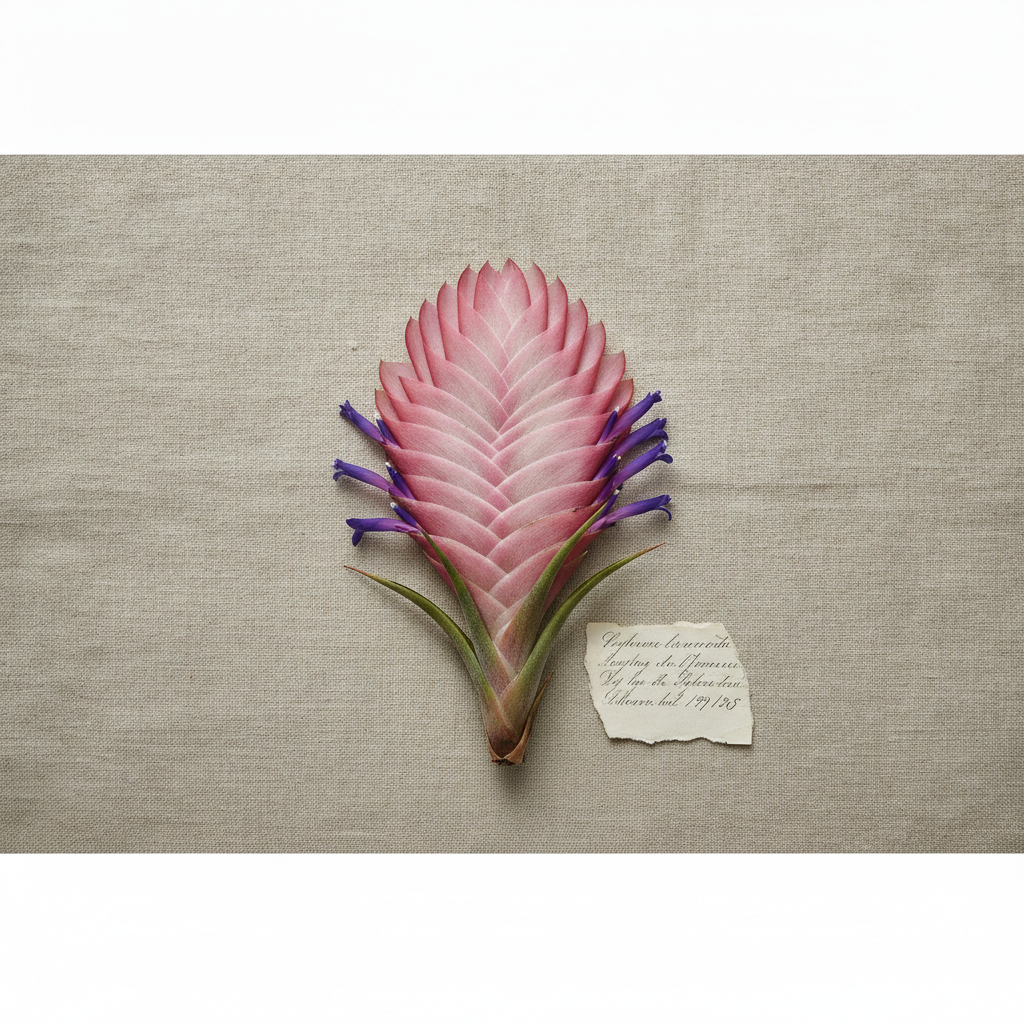
Species Form
The classic Tillandsia cyanea, with a single broad, flattened fan of vivid rose-pink bracts and short-lived deep violet flowers emerging along its edges. This is the original from which the trade plants descend.
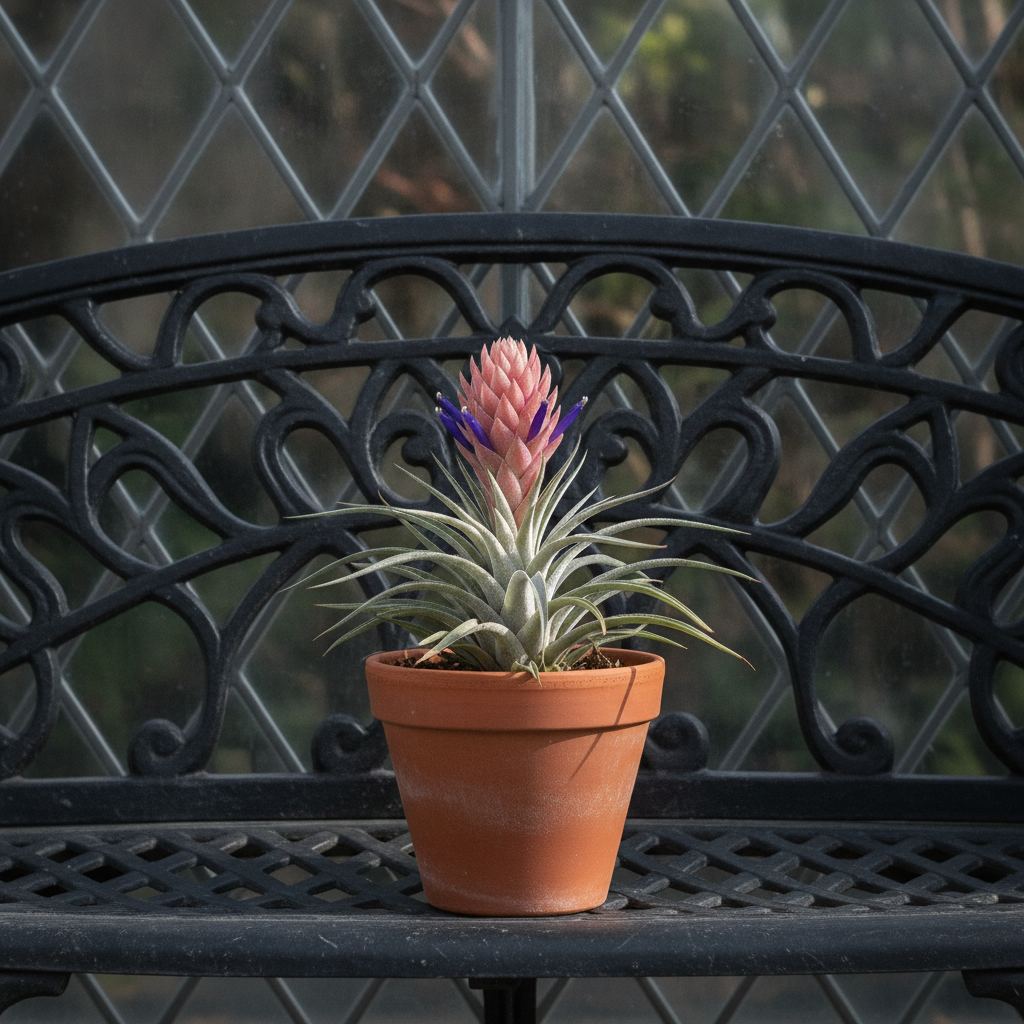
Tillandsia ‘Anita’
A popular, compact hybrid with a slightly rounder pink quill and clear blue-purple flowers. By far the most commonly sold form, ‘Anita’ is robust, free-flowering and the plant most people picture when they think of a pink quill.
Variety Profiles in Detail
Species Form (Tillandsia cyanea)
The wild species is a modest plant, forming a rosette of arching, grassy leaves perhaps 25 centimetres (10 inches) across, from which a single flat quill rises. Its appeal lies in the contrast between the simple green foliage and the saturated pink of the bract, and it remains the benchmark against which the hybrids are judged.
Tillandsia ‘Anita’ (Tillandsia cyanea hybrid)
Bred for the houseplant trade, ‘Anita’ is a cross involving Tillandsia cyanea and its relative Tillandsia lindenii. It is more compact and more reliably free-flowering than the pure species, which is exactly why it dominates the shelves. If you buy a pink quill from a supermarket or garden centre, it is almost certainly ‘Anita’.
Tillandsia lindenii (Tillandsia lindenii)
A close cousin rather than a variety, Tillandsia lindenii is larger overall and carries its quill on a longer stem, with flowers that lean more toward blue. It is grown the same way as the pink quill and turns up occasionally in specialist collections.
Choosing the Right Variety for Your Space
For most homes, the readily available ‘Anita’ is the obvious starting point: compact, dependable and easy to find in bloom. If you want the purest expression of the plant, seek out the true species, and if you have room and a taste for something a little larger, the related Tillandsia lindenii is worth hunting down. Whichever you pick, the care is identical, so let availability and the size of your shelf guide the decision.
Frequently Asked Questions
Is the pink quill plant an air plant?
It is a member of the air plant genus Tillandsia, but unlike the rootless atmospheric types, the pink quill keeps functional roots and is grown in a pot of airy, bark-based mix. Think of it as a halfway house between a true air plant and a conventional potted bromeliad.
Why is my pink quill turning brown after flowering?
This is completely normal. Each rosette flowers only once and then slowly declines over many months, putting its energy into producing pups at the base. Keep caring for the plant as usual, let the offsets grow on, and remove the spent mother only once it has fully browned.
How long does the pink flower last?
The pink quill, which is a bract rather than a true flower, holds its colour for two to three months. The actual violet-blue flowers that emerge from it are short-lived, each lasting only a few days, but they open in succession over several weeks.
Can I make my pink quill flower again?
The original rosette will not rebloom, but its pups will once they reach maturity, usually a year or two of good growth later. Some growers encourage a mature pup to flower by enclosing it briefly with a ripe apple, whose ethylene gas can trigger blooming, though strong light and patience achieve the same result naturally.
Is the pink quill plant safe for pets?
Yes. Bromeliads, including the pink quill, are not listed as toxic to cats or dogs, so it is a sensible choice for a home with curious animals. The leaves can be a little rough, so it is still best not to let pets chew on it.
Why are the leaf tips turning brown?
Brown, crispy leaf tips usually point to air that is too dry or to mineral build-up from hard tap water. Raise the humidity with misting or a pebble tray, and switch to rainwater or filtered water if your tap water is hard.
How often should I water it?
Water the medium once the top few centimetres have dried, which often means once or twice a week in summer and far less in winter, and mist the leaves several times a week year round. Always let the pot drain fully and never leave it standing in water.
What soil should I use for a pink quill?
Never use ordinary potting compost. A coarse, fast-draining epiphyte mix based on orchid bark with added perlite and a little sphagnum moss is ideal, giving the roots the air they need while holding just enough moisture.






