
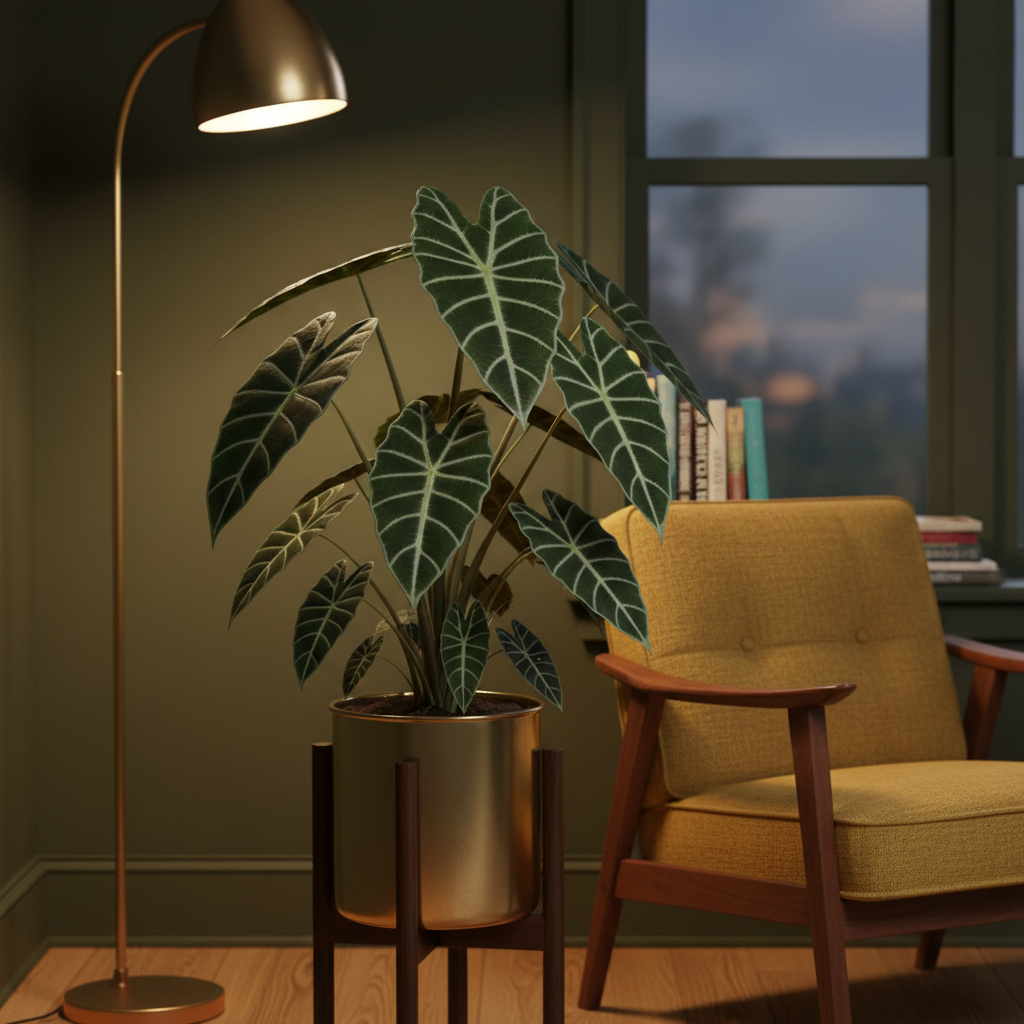
Few houseplants announce themselves the way the African mask plant does. Carried on slender dark stems, each leaf reads like a piece of cut metalwork: arrow-shaped, deeply scalloped at the margins, lacquered to a near-black gloss, and crossed by bright silver-white veins that catch the light from across a room. Despite the name, this plant is not from Africa at all. It is a horticultural hybrid, Alocasia × amazonica, almost certainly created in the 1950s in a Florida nursery from Southeast Asian parentage, and the “African mask” label refers only to the resemblance the leaves bear to carved ceremonial masks.
African mask plants have a reputation for being demanding, and that reputation is not entirely undeserved. They are sensitive to dry air, cold draughts, soggy roots and inconsistent care, and they communicate their displeasure quickly with drooping leaves or sudden yellowing. The good news is that the plant’s needs are not mysterious: warm, humid, bright but indirect, and never waterlogged. This guide walks through every part of that picture, from the light intensity it actually wants to the substrate that keeps its delicate roots happy, and it draws a clear line between simply keeping the plant alive and getting it to push out new leaves month after month.
Contents
- Quick reference
- Why grow an African mask plant
- Light
- Watering
- Soil and potting
- Fertilising
- Propagation
- Pests and problems
- Varieties to know
- Frequently asked questions
Quick reference
The table below summarises the conditions an African mask plant needs to thrive indoors. Use it as a quick lookup before placing the plant, but read the sections that follow before committing, because most “easy” plant problems with this species come from interpreting these values too loosely.
| Botanical name | Alocasia × amazonica |
| Common names | African mask plant, Kris plant, Amazonian elephant ear |
| Family | Araceae (aroids) |
| Origin | Nursery hybrid (Southeast Asian parentage) |
| Mature size | 40 to 90 cm (16 to 36 in) indoors |
| Light | Bright, indirect light; tolerates moderate light |
| Water | When top 2 to 3 cm of soil is dry; never sitting in water |
| Humidity | 60 percent or higher |
| Temperature | 18 to 27 °C (65 to 80 °F); avoid below 15 °C (59 °F) |
| Soil | Chunky, fast-draining aroid mix |
| Fertiliser | Balanced liquid feed, half strength, monthly in growth |
| Propagation | Rhizome division and offset separation |
| Toxicity | Toxic to people and pets (calcium oxalate crystals) |
Why grow an African mask plant
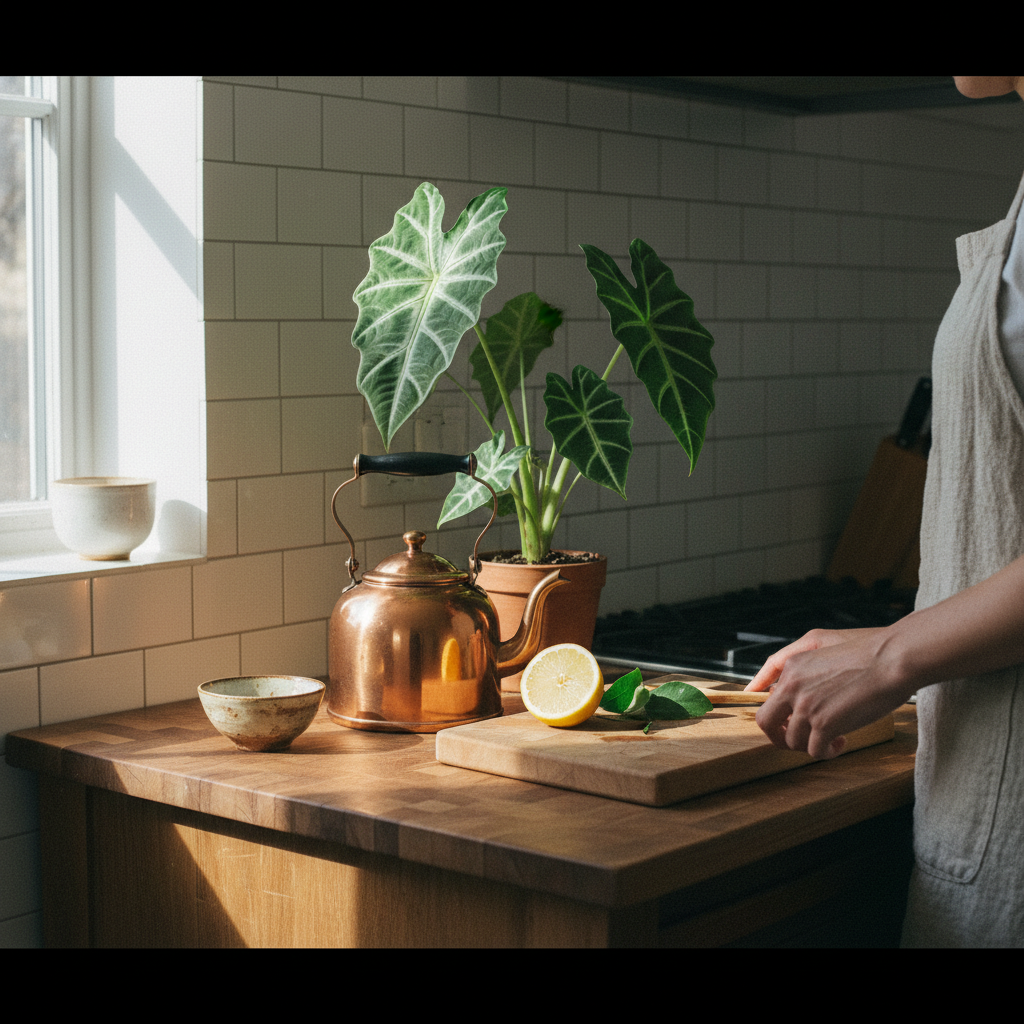
Most foliage plants offer either form or pattern. The African mask plant offers both at the same time. The leaf is an elongated heart or arrow, often 20 to 35 cm long on a mature specimen, with a pronounced scalloped edge that catches and disperses light. The leaf surface is so dark in some lights that it reads almost black, while the central rib, primary veins and lateral veins are washed in silver-white, producing a graphic, almost engraved appearance. Held on its dark, faintly speckled petioles, each leaf points slightly outward and upward, so a mature plant has a clear architectural silhouette rather than a soft mound.
That silhouette is the second reason this plant is popular. Alocasia × amazonica stays compact: a typical specimen tops out at around 60 cm tall and roughly as wide, so it works on a side table, on a shelf or as a small feature in a low planter, rather than crowding a corner like a fiddle leaf fig or monstera. It pairs well with both modern, hard-edged interiors and with denser, leafier compositions, because the graphic veining gives the eye somewhere to rest among softer foliage.
The third reason, and the one that separates beginners from experienced indoor growers, is that an African mask plant rewards attention. When its conditions are right it pushes out a new leaf roughly every two to four weeks during the growing season, each one slightly larger than the last, slowly building up a stately clump. When conditions are wrong it goes dormant, drops most of its leaves, and sulks for months as a bare corm, only to push back when you correct the issue. Few houseplants give such precise feedback on whether you have got the basics right.
Pro Tip — Read dormancy as a pause, not a death: If your African mask plant drops every leaf in winter, do not throw the pot away. Reduce watering to barely moist, keep it warm, and wait. The underground corm almost always pushes new growth in spring once conditions improve.
Light
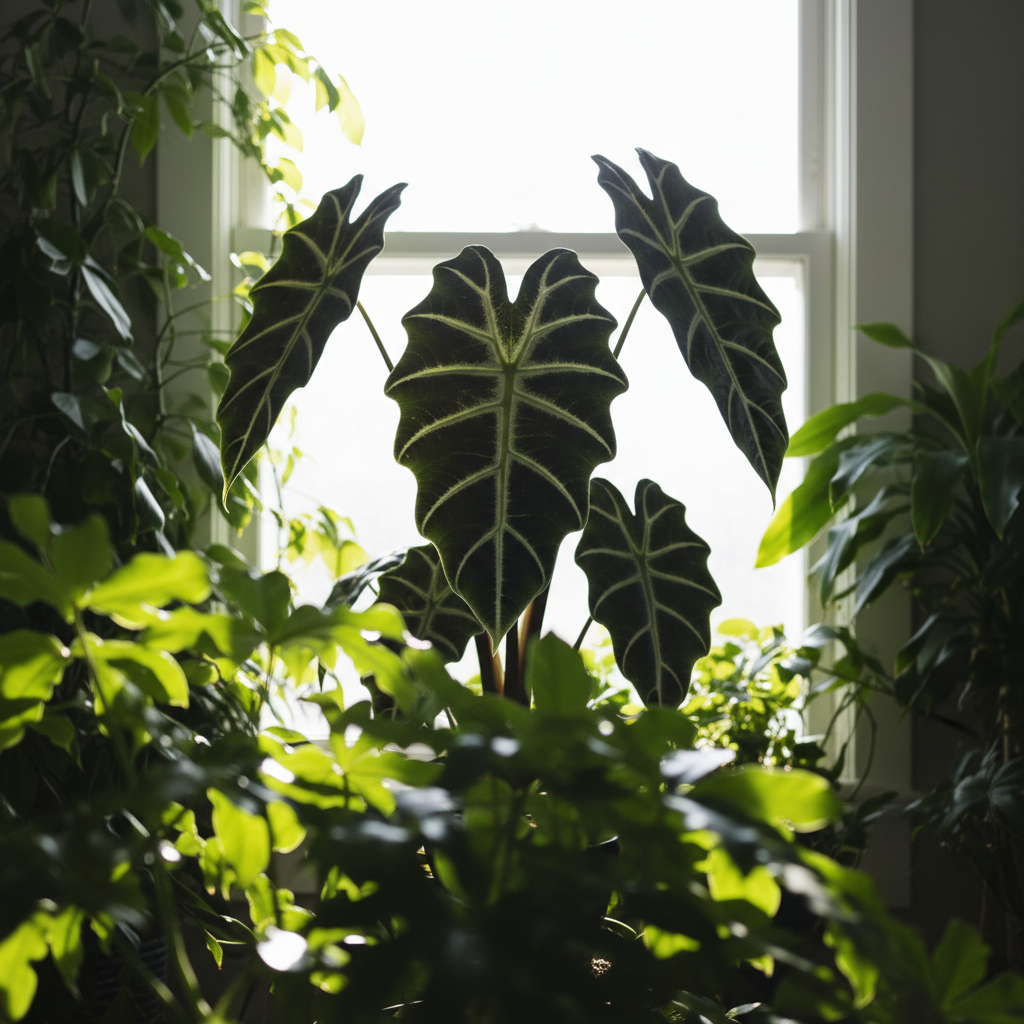
Bright, indirect light is the single phrase that does most of the work for this plant. In their natural habitat, the parent species of Alocasia × amazonica grow as understorey plants on the floor of tropical rainforest, where the canopy filters the sun before it reaches the leaves. Indoors, recreate that with a position that is bright enough to read a book in without artificial light all day, but where the leaves never sit in a direct sunbeam.
An east-facing window with the plant set on or next to the sill works well, because the morning sun is gentle and the rest of the day delivers ambient brightness. A south or west-facing window can also work if you set the plant a metre or two back from the glass, or if you diffuse the light with a sheer curtain. North-facing windows are tolerable but often borderline, particularly in winter at higher latitudes, and you may see slower growth and longer internodes as a result.
The signs of incorrect light are unmistakable. Too much direct sun produces pale, bleached patches on the upper surface of the leaf, often turning brown and crisp at the centre of the patch within a few days. Too little light, on the other hand, causes the plant to stretch toward the window with longer petioles, the leaves angled steeply upward, and any new growth emerging smaller, paler and with less contrast in the venation. If you see these symptoms, move the plant before correcting watering or fertiliser, because almost every other care variable depends on the plant having enough light to drive growth in the first place.
If your space is genuinely dim, a small full-spectrum LED grow light positioned 30 to 60 cm above the plant for 10 to 12 hours a day is an effective stand-in. Use a timer to keep the rhythm consistent, because Alocasia × amazonica responds badly to erratic light cycles, treating short days as a cue for dormancy.
Watering
More African mask plants are lost to bad watering than to any other cause. The roots are fine, fleshy and intolerant of standing water; the corm beneath the soil rots quickly when oxygen is excluded. At the same time, the plant suffers visibly when the substrate dries out completely, dropping leaves within a day or two and entering an unintended dormancy. The aim is a rhythm of thorough soakings followed by partial, never total, drying.
In practice, water when the top 2 to 3 cm of the substrate feels dry to the touch but the deeper soil is still slightly moist. Push a finger into the pot to check, or lift the pot: a freshly watered pot in chunky aroid mix feels surprisingly heavy, and the same pot a week later feels noticeably lighter. When you do water, water generously, letting the excess drain freely from the bottom of the pot before returning the plant to its saucer. Empty any standing water from the saucer within 30 minutes.
Frequency varies with conditions, but a healthy plant in a warm, bright room typically wants water every 5 to 9 days during the growing season and every 10 to 14 days in winter. Do not rely on a fixed schedule. Cool weather, low light, or a recent repot can all reduce demand dramatically, and watering on autopilot in those situations is what causes root rot. Equally, a heatwave or a windy day with the windows open can dry the pot in 48 hours.
Water quality matters. Alocasia × amazonica is sensitive to fluoride and chlorine in tap water, both of which can show up as brown leaf edges and yellow vein margins over time. Use rainwater, filtered water or tap water that has stood uncovered for 24 hours so the volatile chlorine can dissipate. Aim for water at room temperature, never cold straight from the tap, because cold water on warm soil chills the roots and slows growth.
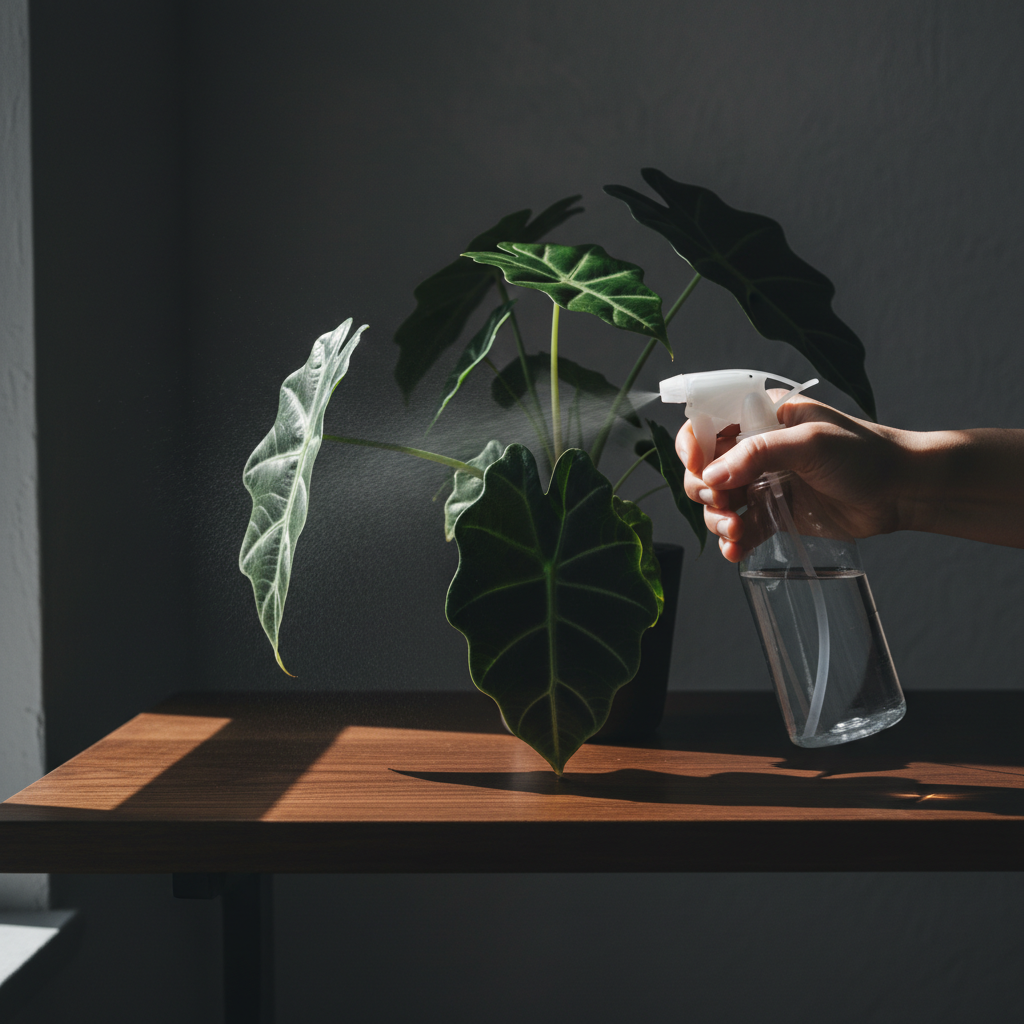
Humidity is the second half of the watering equation. African mask plants want 60 percent relative humidity or higher, well above the 30 to 40 percent that most heated and air-conditioned interiors sit at. The most effective measures are a small ultrasonic humidifier nearby, grouping the plant with other plants to share transpiration, or placing the pot on a pebble tray kept topped up with water. Misting helps a little for short periods but evaporates too quickly to maintain the levels the plant actually needs.
Warning — Crisped leaf edges: Persistent brown, papery edges on otherwise healthy leaves are almost always a humidity problem, not a watering or fertiliser problem. Increase ambient humidity before reaching for a fertiliser bottle or watering more often, both of which can make the real cause worse.
Soil and potting
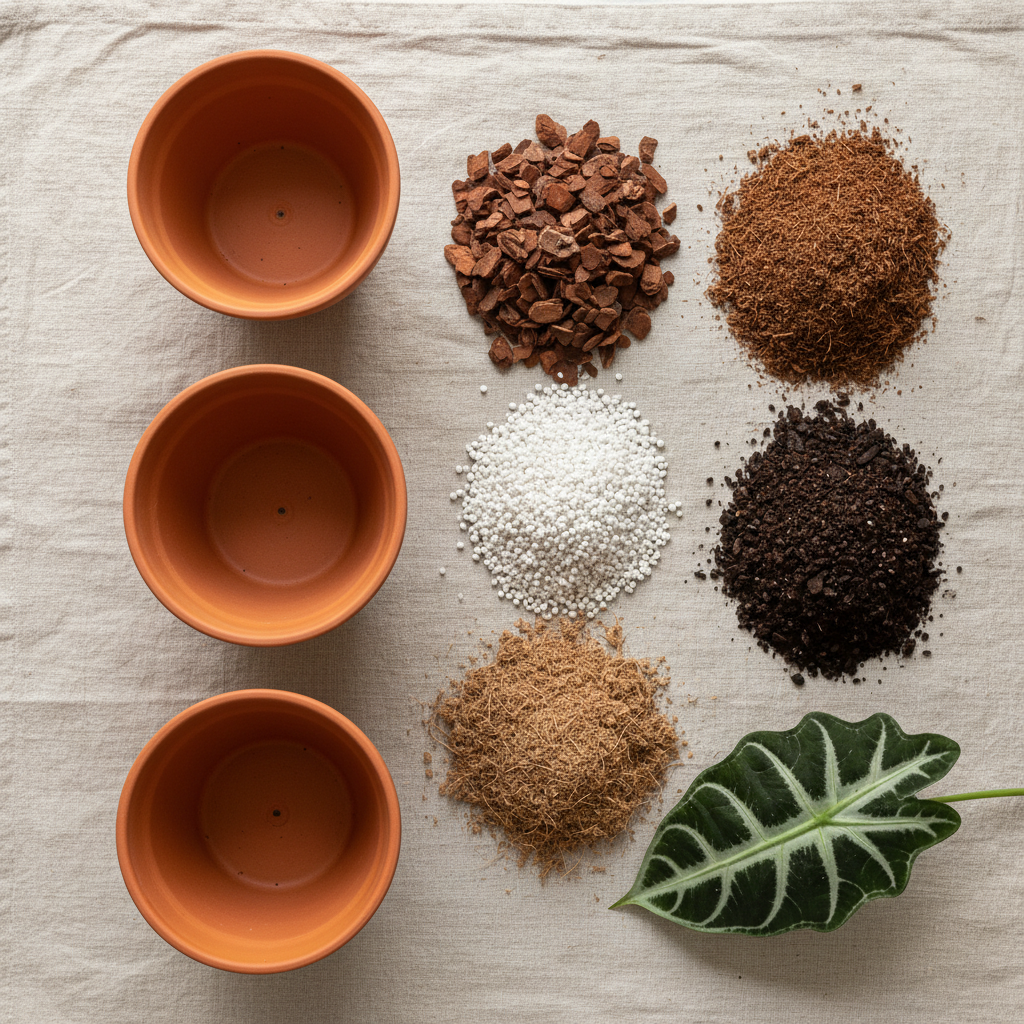
The substrate is where most of the watering problem is actually solved. A dense, peat-heavy bagged houseplant compost stays wet for too long around the corm, and is the single most reliable way to rot an African mask plant. Use a chunky, free-draining aroid mix instead, which holds enough moisture for the fine surface roots while allowing air to reach the corm even when the pot has just been watered.
A workable recipe by volume is roughly four parts orchid bark, two parts coco coir or peat-free compost, two parts perlite or pumice, and one part worm castings. The bark provides structure and airspaces; the coir holds moisture; the perlite or pumice keeps the mix from compacting; the worm castings supply a slow base of nutrients. Many growers also add a handful of activated charcoal to suppress anaerobic decomposition near the corm. If you prefer a ready-made bag, look for products labelled “aroid mix” or “monstera mix” and check that you can see the bark chunks through the bag, not just dark crumb compost.
Pot choice is the other half of the equation. Choose a pot only slightly larger than the rootball, with generous drainage holes. African mask plants prefer to be a little snug, and over-potting traps moisture in unoccupied soil. Terracotta is forgiving, because the porous walls help excess moisture evaporate, but glazed ceramic and plastic also work as long as the substrate is right and you respect the watering rhythm. Avoid decorative cachepots without drainage unless you remove the inner nursery pot to water and let it drain fully before replacing it.
Repotting is best done every 12 to 24 months in spring, just as the plant starts pushing new growth. Lift the plant carefully; the corm is brittle and the roots break easily. Tease away as much of the old mix as you reasonably can without tearing fine roots, inspect the corm for any soft, dark patches (these should be cut back to firm, white tissue with a sterilised blade), and settle the plant into fresh mix at the same depth as before. Resist the urge to water immediately; wait 24 to 48 hours to let any cut surfaces callus over.
Fertilising
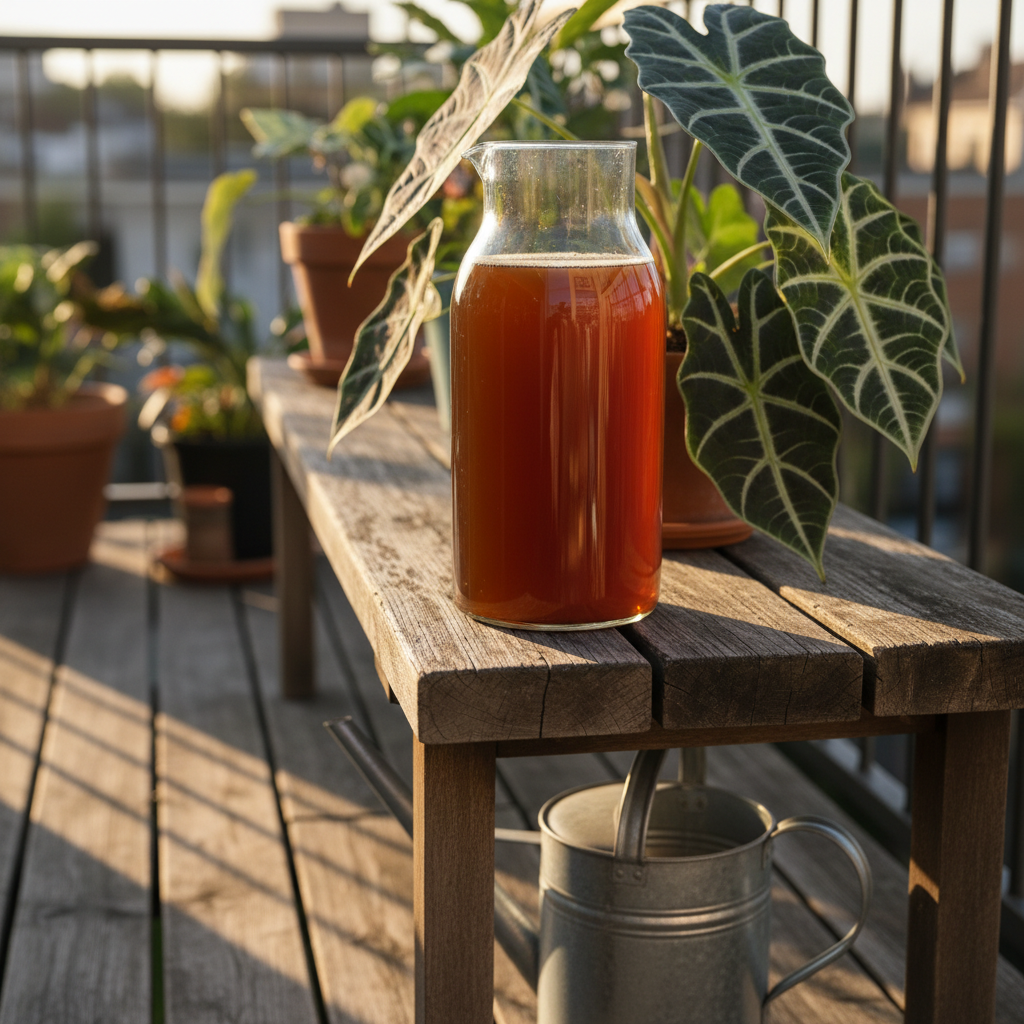
African mask plants are not heavy feeders by aroid standards, and they react badly to over-feeding. Salt build-up at the root zone shows up as crisped, blackened leaf edges, often interpreted as dryness and met with more watering, which compounds the problem. Feed lightly and consistently during the growing season, and not at all during dormancy.
A balanced liquid fertiliser with an N-P-K ratio close to 3-1-2 or 5-2-3 works well, applied at half the strength stated on the bottle and watered into pre-moistened soil once every four to six weeks from spring through early autumn. Pre-moistening is important: a dilute feed applied to dry substrate concentrates around the roots as the soil rehydrates and burns them. Skip a month if the plant looks stressed, has just been repotted, or is sitting in low light.
Slow-release prills sprinkled lightly on top of the mix in spring are a low-effort alternative for growers who would rather not measure out liquid feed every few weeks. Aim for half the manufacturer’s stated dose, because most products are calibrated for hungrier plants such as tomatoes or geraniums. Organic options such as worm castings as a top dressing or diluted compost tea are also well tolerated, with the bonus that they encourage soil microbial life. Whichever route you take, flush the pot thoroughly with plain water every three to four months to clear accumulated salts. A “flush” simply means watering until the equivalent of two or three pot volumes have passed through and out of the drainage holes.
During the cooler half of the year, when the plant slows or goes dormant, stop fertilising entirely. Continuing to feed a dormant plant accumulates salts in soil that the roots are not taking up, and is a common cause of leaf decline that growers blame on light or watering. Resume only when you see the first new leaf cone emerging from the corm in spring.
Propagation
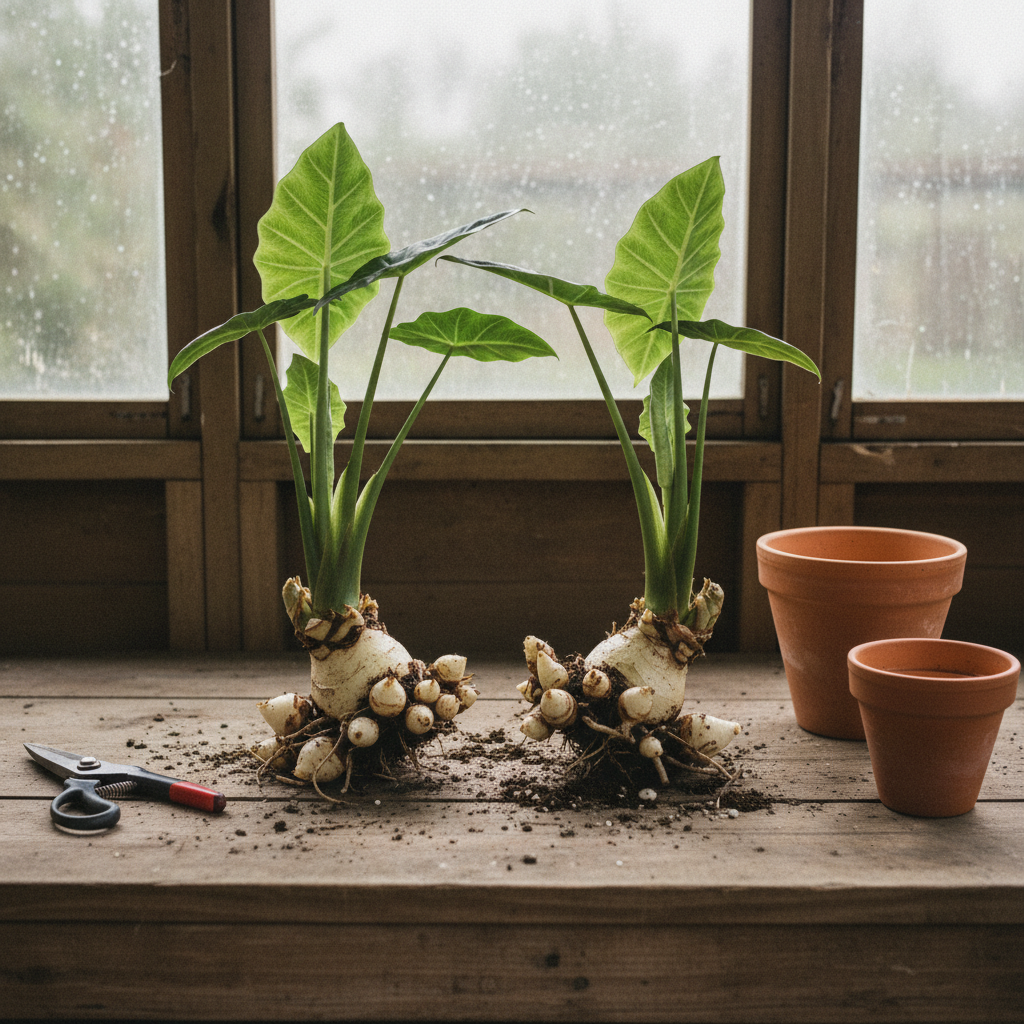
Unlike philodendrons and pothos, Alocasia × amazonica cannot be propagated from stem or leaf cuttings. Every new plant ultimately comes from the underground corm. Fortunately, a healthy adult will produce small offset corms and pups around the base of the main plant over time, and those offsets are the basis for almost all home propagation of this species.
The most reliable approach is to combine propagation with a routine repot in spring. After lifting the plant and washing soil from the roots, look at the base of the main corm: separate, marble-sized to walnut-sized cormlets that detach with a gentle twist are ready to pot up on their own. If a smaller crown comes with its own roots already attached, treat it as a true division and pot it into fresh aroid mix at the same depth it was growing.
For loose cormlets without roots, two routes work well:
- Pot them shallowly in damp, chunky aroid mix in a small clear pot, with the growing tip just above the surface. Cover loosely with a clear plastic bag or place in a propagation box to maintain 80 to 90 percent humidity, and keep warm at 22 to 26 °C (72 to 79 °F). Roots and a first leaf usually appear within four to eight weeks.
- Place the cormlets on damp sphagnum moss in a clear plastic deli cup with the lid slightly ajar. The cormlets remain visible while they root, which makes problems easy to spot, and transplanting to mix is straightforward once roots are 2 to 3 cm long.
Whichever route you take, patience matters more than technique. Cormlets often sit dormant for several weeks before any visible growth, especially if they are propagated outside the warm half of the year. Resist the urge to dig them up to check progress, because each disturbance resets the rooting process. As long as the corm is still firm to the touch and free of soft brown patches, it is doing its work underground.
Pro Tip — Save the corm: Even if a mature plant collapses entirely, do not discard the soil before checking. A still-firm corm can be cleaned, repotted in fresh mix, and very often regrows a full plant from scratch within a season.
Pests and problems
The most common pest on Alocasia × amazonica is the spider mite, which thrives in exactly the warm, dry indoor air that this plant struggles in. Look on the undersides of the leaves for fine pale stippling and thin webbing in the leaf axils. Address infestations early by wiping each leaf with a damp cloth, increasing humidity, and treating with insecticidal soap or a 1 percent neem oil solution every five to seven days for three weeks to interrupt the egg-laying cycle. Isolating the plant from your other houseplants during treatment is worth the effort.
Mealybugs and scale appear less often but are harder to dislodge. White cottony tufts in the leaf axils indicate mealybugs; immobile brown bumps along the stems indicate scale. Touch each pest with a cotton bud dipped in 70 percent isopropyl alcohol, which dissolves their protective coating and kills them on contact, then follow up with a neem spray.
Beyond pests, most “problems” with this plant are physiological. The table below sorts the symptoms most growers see, with their usual causes and fixes.
| Symptom | Likely cause | Fix |
| Yellow lower leaves, slow decline | Overwatering or compacted soil | Repot into chunky mix, water less often, check corm |
| Crisped brown leaf edges | Low humidity or salt build-up | Raise humidity to 60 percent or above; flush pot with plain water |
| Pale, bleached patches on upper surface | Direct sun scorch | Move out of direct sunbeam; restore indirect light |
| Long petioles, leaves angled steeply upward | Insufficient light | Move closer to a bright window or add a grow light |
| Sudden total leaf drop in autumn | Dormancy triggered by cool or short days | Reduce watering, keep warm, wait for spring regrowth |
| New leaves emerging deformed or pale | Cold draught or temperature stress | Move away from cold windows and air vents |
| Fine pale stippling, webbing | Spider mites | Wipe leaves, raise humidity, neem oil weekly for 3 weeks |
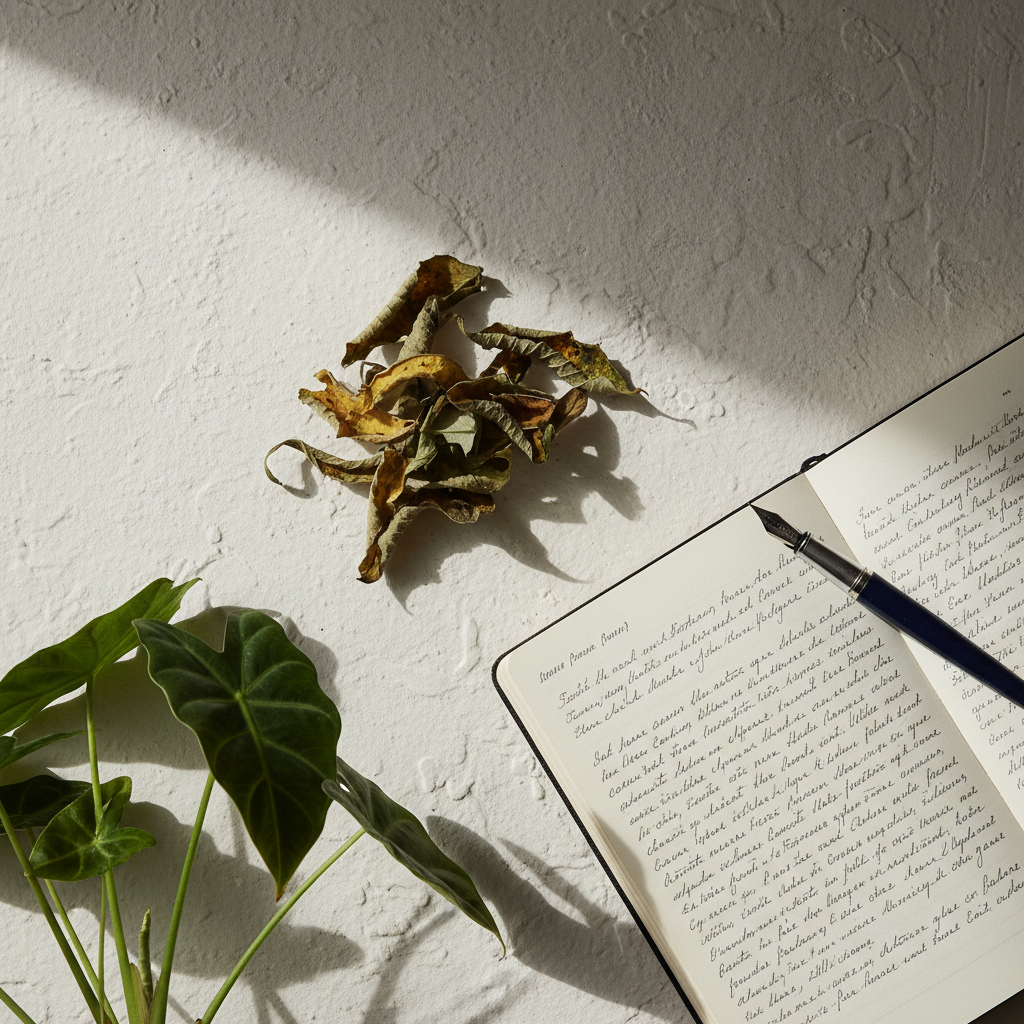
A useful diagnostic habit is to inspect both sides of every leaf at watering time. Most issues are visible at least a week before they become serious, and catching them at the stippling or yellow-edge stage is far easier than rescuing a fully infested or rotting plant. Keep a small notebook near the plant if you find it helpful; recording when each new leaf opened, when you fed and watered, and any sign of damage builds a private record that quickly outperforms generic advice.
Varieties to know
Strictly speaking, “Alocasia amazonica” itself is the name commonly used for the hybrid sold in most garden centres, but a number of selected cultivars and closely related forms circulate under similar names. The two most widely available are the compact ‘Polly’ and the miniature ‘Bambino’, and they are worth knowing because they are easier to fit into a typical interior than the standard hybrid.
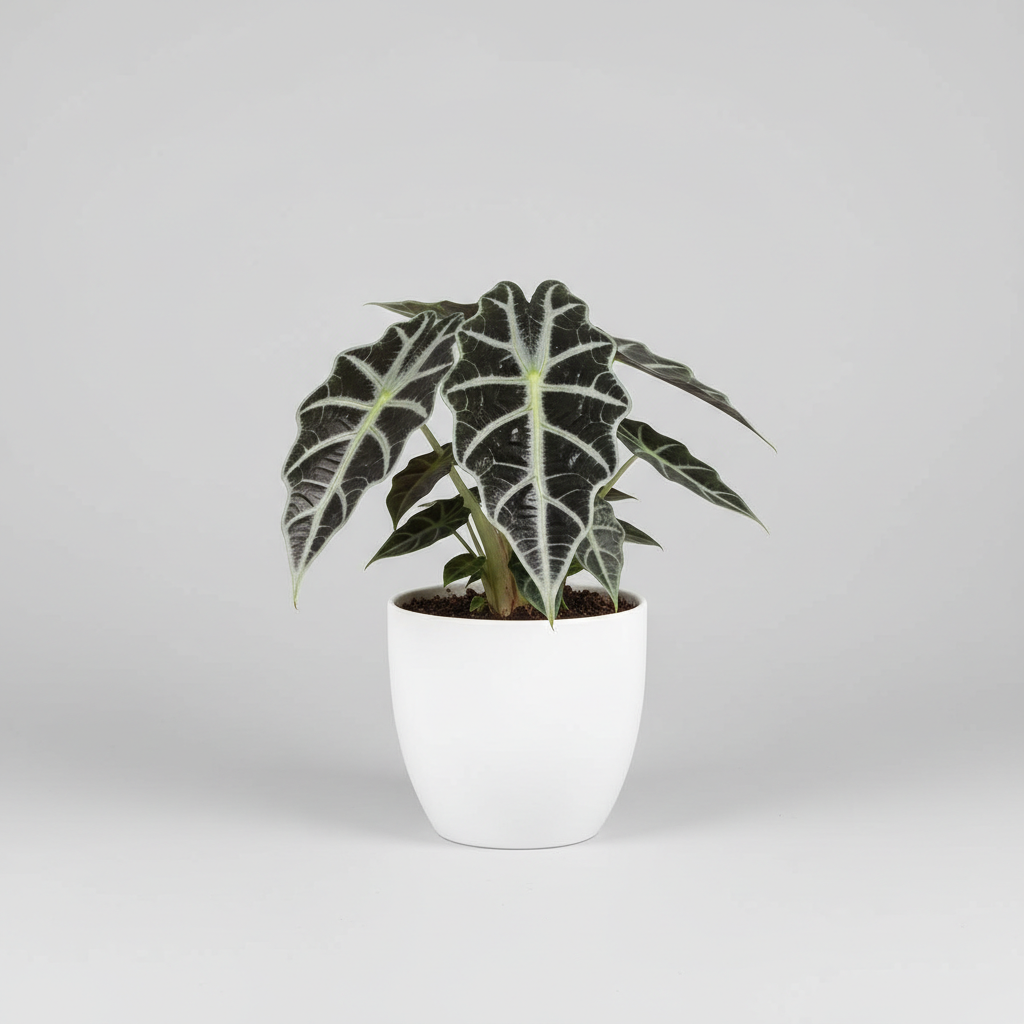
‘Polly’ is the cultivar most often sold simply as “African mask plant” in commercial trade. It is a compact form, typically 30 to 50 cm tall at maturity, with strongly scalloped, almost black leaves and brilliant silver-white venation. Care is identical to the standard hybrid, but the smaller size makes it easier to keep warm and humid in a typical home.
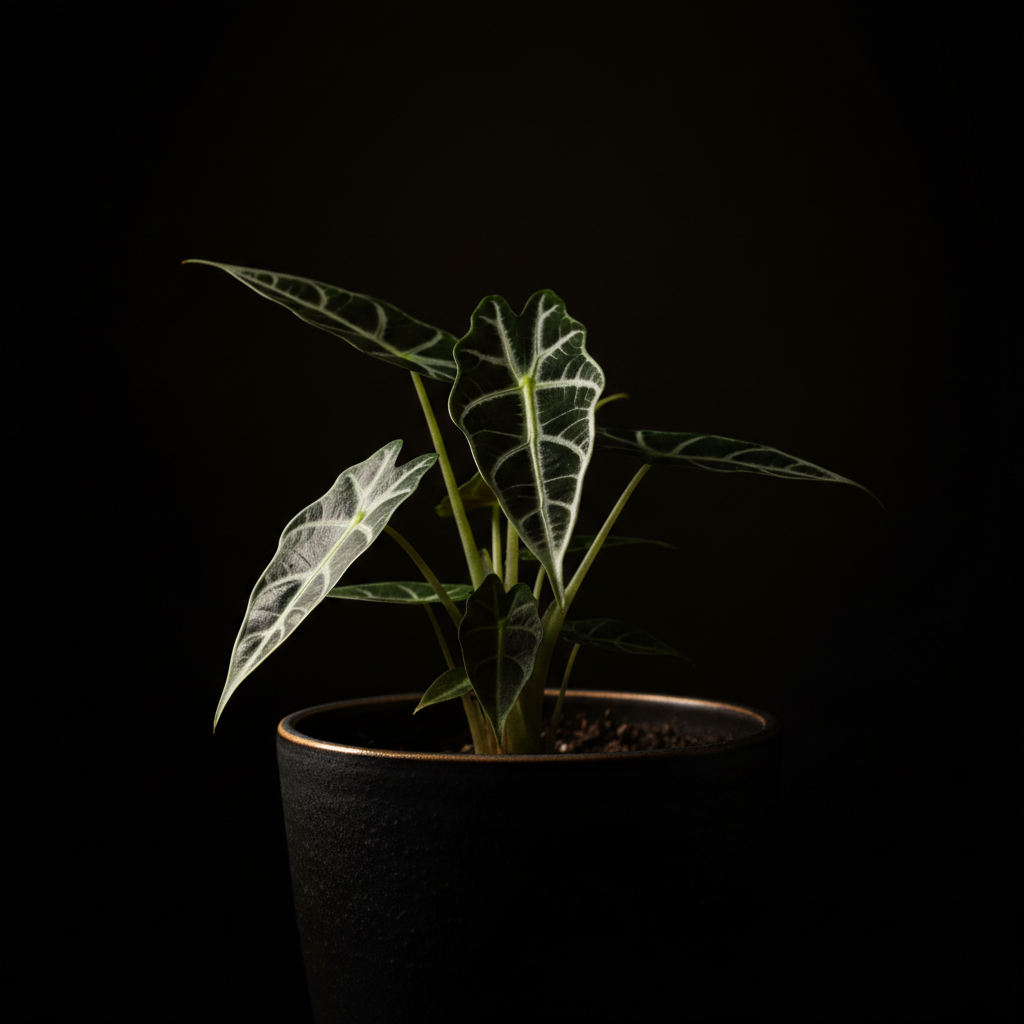
‘Bambino’ is a miniature, narrow-leaved selection that rarely exceeds 25 to 30 cm tall. Its leaves are longer and more lance-shaped than ‘Polly’, with the same dark surface and bright veins but a finer, more elegant silhouette. It is the most fragile of the three to grow successfully in dry indoor air, so a humidifier or terrarium is almost essential.
Other names you may encounter include Alocasia ‘Ivory Coast’, with a pink-purple petiole and slightly silvered leaf surface, and Alocasia ‘Frydek’, a closely related species (Alocasia micholitziana) with velvety green leaves and chalk-white veins. None are difficult to integrate alongside the ‘Polly’ and ‘Bambino’ types if their humidity and light requirements are met. As always, check the petiole colour and leaf shape carefully before purchase, because mislabelling is common, particularly between ‘Polly’ and ‘Bambino’ at smaller nursery sizes.
Frequently asked questions
Is the African mask plant safe around pets and children?
No. Like all Alocasia species, the leaves and stems contain insoluble calcium oxalate crystals which cause intense burning, swelling and irritation of the mouth and throat if chewed, and skin irritation on prolonged contact with the sap. Keep the plant out of reach of curious pets and small children, and wear gloves when repotting or dividing if your skin is sensitive.
Why is my African mask plant losing all its leaves?
If the leaf drop is gradual and the plant is otherwise healthy, especially in autumn or winter, you are almost certainly seeing natural dormancy. Reduce watering, keep the corm warm and lightly moist, and wait for spring regrowth. If the drop is sudden and accompanied by mushy stems or a sour smell from the soil, this is root rot from overwatering, and you will need to unpot the plant, cut away any soft tissue, and repot the firm corm into fresh, drier aroid mix.
Can I grow African mask plant outdoors?
In USDA hardiness zones 10 and 11, or anywhere with consistent night temperatures above 15 °C (59 °F), it can grow outdoors in a shaded, humid spot for the warm season. In any cooler climate, treat it as an indoor plant or move it back inside well before night temperatures begin to drop in autumn. A single cold night below 10 °C (50 °F) is often enough to cause leaf collapse, even if the plant is brought back into warmth the next day.
How fast does an African mask plant grow?
A healthy plant in good conditions produces a new leaf roughly every two to four weeks during the growing season, with each new leaf often slightly larger than the last. A young ‘Polly’ bought as a small starter plant typically reaches full mature size in 18 to 30 months. Plants that pause or stretch leaves out to one every six to eight weeks are usually short on light, humidity, warmth, or some combination of the three.
Why are the new leaves smaller than the old ones?
A new leaf that is conspicuously smaller than its predecessor is the plant’s clearest signal that conditions have changed for the worse. The most common causes are insufficient light, a dry winter air pattern, or accumulated salts in the soil. Address light first, then humidity, then flush the pot with plain water to clear any salt build-up. Improvements show in the next leaf, not immediately, so judge by the size of subsequent emerging cones rather than by changes to existing foliage.
Should I cut off yellow leaves?
Yes, once they are clearly more yellow than green. The plant is recovering nutrients from a declining leaf as long as it is still partly green, so wait until the leaf is fully yellow and lax, then snip the petiole at its base with a sterilised blade. Pulling rather than cutting risks tearing the corm. Removing fully yellow leaves promptly also removes a likely site for fungal infection.
Does it need to be misted?
Misting does little on its own to maintain the humidity this plant needs. A passing mist evaporates within minutes and barely shifts the relative humidity around the leaf for any length of time. For lasting improvement, use a humidifier, a pebble tray or group plants together. Misting is fine as a supplement, particularly to dampen leaves before wiping off dust, but is not a substitute for ambient humidity.
Cared for thoughtfully, an African mask plant is one of the most rewarding small foliage plants you can grow indoors. The combination of architectural form and graphic venation gives it a presence well beyond its modest footprint, and the way it responds quickly to good conditions, sending up a new leaf every few weeks during the growing season, makes the care feel like a small ongoing conversation rather than a chore. Get the light, humidity and substrate right, treat watering as a rhythm rather than a routine, and the plant will hold its place in a room for years.






