
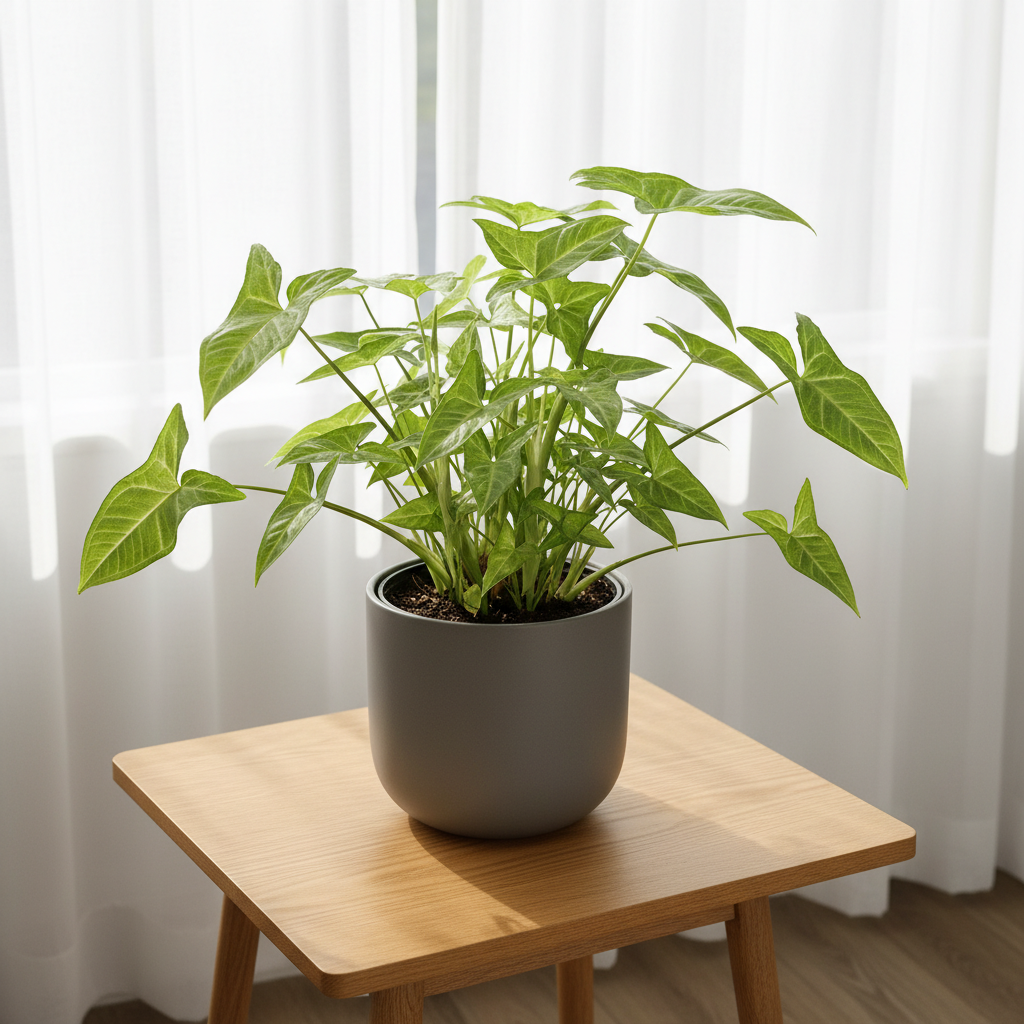
The arrowhead plant is one of those rare houseplants that quietly changes shape under your care. Botanically known as Syngonium podophyllum and native to the warm, humid understorey of tropical Central and South America, it begins life as a tidy clump of pale arrow-shaped leaves on short upright stems and slowly transforms, over a few seasons, into a generous trailing or climbing vine with deeply lobed mature foliage. Long-time enthusiasts know it under many names, including arrowhead vine, goosefoot plant, American evergreen and the older nursery label nephthytis. Whatever it is sold under, it is a member of the aroid family Araceae, the same group that contains pothos, philodendron and monstera, and it shares that family’s easy-going, forgiving temperament.
Because it is so adaptable, the arrowhead plant has a reputation as a beginner-proof houseplant, and that reputation is well earned. It will limp along in indifferent light, accept the occasional missed watering and rebound after a hard prune as if nothing happened. The gap between an arrowhead that survives and an arrowhead that genuinely thrives, however, is wider than most people realise. With the right light, a free-draining soil, a sensible feeding rhythm and a little attention to humidity, the plant pushes out larger, more colourful foliage, holds its variegation, and rewards you with the kind of luxuriant, jungle-bright growth that makes the species so collectable in the first place. This guide is written to close that gap.
Contents
- Quick Reference
- Why the Arrowhead Plant Makes a Forgiving Houseplant
- Light Requirements
- Watering and Humidity
- Soil, Potting and Repotting
- Fertilising
- Propagation
- Pests and Diseases
- Popular Varieties
- Frequently Asked Questions
Quick Reference: Arrowhead Plant at a Glance
| Light | Bright, indirect light. Tolerates medium light. Variegated forms need more light to hold colour. Avoid direct midday sun. |
| Watering | Water thoroughly when the top 2 to 3 cm (about an inch) of mix is dry. Reduce in winter. Never allow the rootball to sit in water. |
| Temperature | 18 to 27 degrees Celsius (65 to 80 degrees Fahrenheit). Avoid temperatures below 15 degrees Celsius (59 degrees Fahrenheit) and cold draughts. |
| Humidity | Average household humidity is fine, but the plant thrives at 50 to 60 percent or higher. Crisp leaf edges are usually a humidity complaint. |
| Fertiliser | Balanced liquid feed at half strength every four to six weeks during spring and summer. Pause from late autumn until growth resumes. |
| Toxicity | Toxic to cats, dogs and humans if chewed or ingested, due to insoluble calcium oxalate crystals. Keep out of reach of pets and small children. |
Why the Arrowhead Plant Makes a Forgiving Houseplant
Few houseplants offer as much visual transformation for as little fuss as Syngonium podophyllum. A juvenile plant on a shop bench looks compact and almost prim, with each new leaf emerging as a tight rolled spear and unfurling into a clean sagittate shape, the lobes neat and the basal sinus deep. Give it eighteen months on a bright shelf and you will hardly recognise the same specimen: stems lengthen, internodes stretch, aerial roots appear, and the leaves themselves morph into elaborately lobed paddles that fan outward. That single-plant arc, from upright juvenile to vining adult, is part of the species’ charm. You are not buying a static decoration. You are buying a slow performance.

The second reason the species is so popular is sheer breadth of cultivar choice. Breeders have selected for almost every variegation pattern imaginable, from the silver-frosted leaves of the original ‘White Butterfly’ to the candy-pink wash of ‘Pink Allusion’, the inky bronze of ‘Black Velvet’ and the punchy lime of ‘Neon Robusta’. Whatever shelf, corner or trailing hook you are trying to fill, there is a Syngonium cultivar that will read the way you want. Many cultivars stay compact for years and look at home in a small pot on a bedside table; others vine vigorously and can be trained up a moss pole, allowed to cascade from a hanging basket, or wound across a wire frame.
Finally, the plant is genuinely tolerant of imperfect conditions, which is what beginners need. A pothos or a snake plant might be slightly tougher, but neither offers the chromatic range of an arrowhead, and neither responds quite so eagerly to better care. Treat it well and within a few weeks of consistent watering and proper light you will see the response in the very next leaf, which is what makes the species so satisfying to grow.
Pro Tip, Reading the Plant’s Mood: Arrowhead plants telegraph their needs through new growth. A leaf that emerges smaller, paler and less variegated than its predecessors is almost always asking for more light. A leaf with crispy brown edges is almost always asking for more humidity or more consistent watering. Pay more attention to fresh leaves than to old ones when diagnosing problems.
Light Requirements
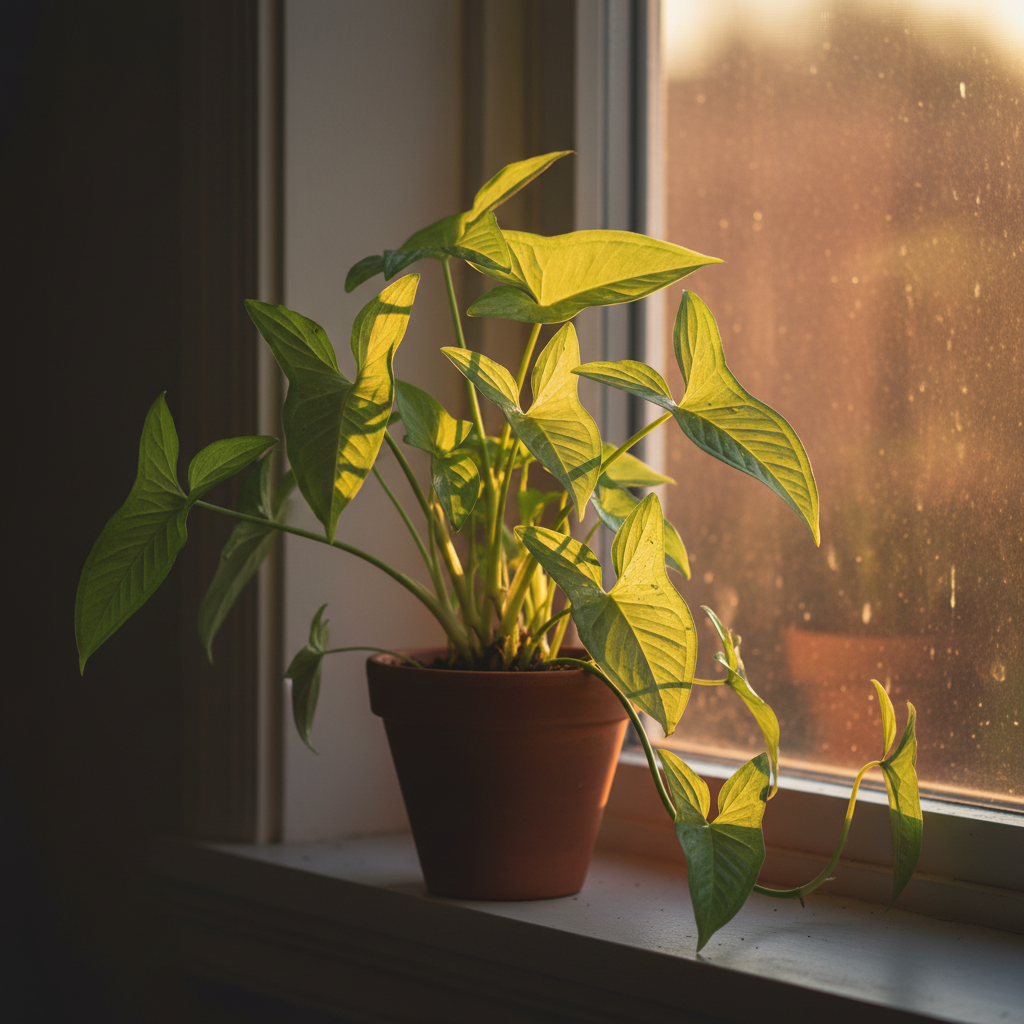
In its native range, Syngonium podophyllum climbs the trunks of larger forest trees, working its way upward through dappled shade until it reaches the brighter edges of the canopy. That ecology is the single most useful thing to remember when you place the plant indoors. Arrowhead plants are not shade plants in the strict sense, even though they will tolerate fairly dim corners. They are bright, indirect-light plants that have learned, in the wild, to deal with whatever light makes it through the leaves above them. Indoors, the equivalent is a spot within a metre or so of a window covered by a sheer curtain, or anywhere in a bright room where the sky is visible but direct sun beams do not strike the foliage for more than an hour or two a day.
By Window Orientation
An east-facing window is close to ideal. Morning sun is gentle, the colour temperature is warm, and the few hours of direct light a plant receives at sunrise are well within what an arrowhead can take without scorching. A north-facing window is also workable, though variegated cultivars will hold their patterning less well in the cooler, lower-intensity light that a north exposure provides, and growth will be slower overall. A west-facing window can be excellent if afternoon sun is filtered by a curtain or set back by a metre. Unfiltered direct sun from late afternoon onward, particularly during summer, can bleach foliage and scorch leaf tips. A south-facing window almost always needs a sheer curtain or a setback of a metre or more, but once buffered, it produces the most vigorous, most colourful growth of any indoor placement.
Reading Leaf Cues
An arrowhead that is not getting enough light tells you so quickly. The internodes between leaves stretch, so the plant looks “leggy” and reaches toward the brightest part of the room. New leaves emerge smaller, thinner and less patterned, and on variegated cultivars the white, cream or pink sectors fade to plain green over a few cycles as the plant prioritises chlorophyll production. On the other end of the spectrum, an arrowhead in too much direct sun develops pale, bleached patches on the leaf surface that look almost translucent, and the leaf tips and margins eventually scorch to crisp tan or brown. Sun-stress damage is permanent on the affected leaves, so move the plant before more new growth is harmed.
Supplemental Lighting
Modern full-spectrum LED grow lights work well for Syngonium. A small panel rated 20 to 30 watts, hung 30 to 45 cm (12 to 18 inches) above the plant and run for about 10 to 12 hours a day, easily replaces a moderate window. This is particularly useful through the dark winter months at high latitudes, where even a south-facing window may only push the equivalent of weak indirect summer light into the room. Variegated cultivars in particular benefit from supplemental lighting through the darker half of the year.
Watering and Humidity
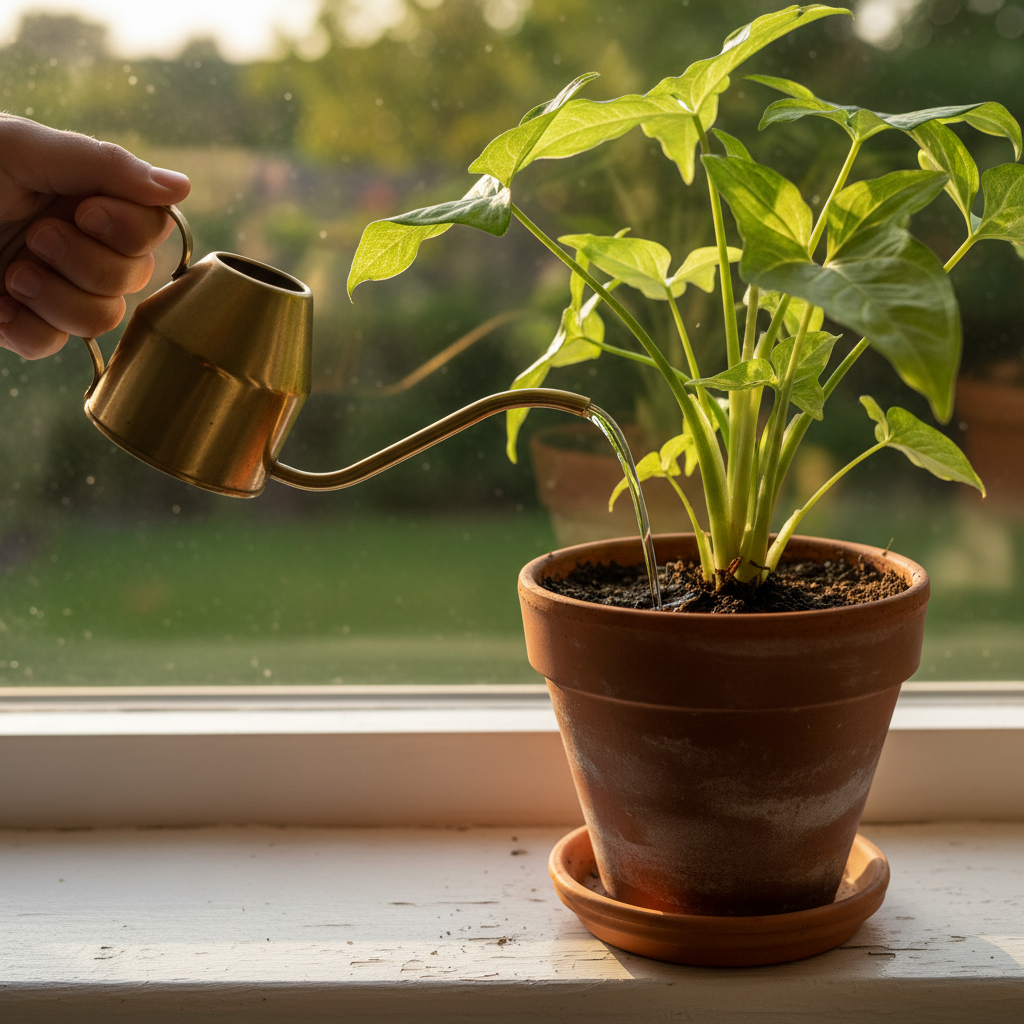
Watering an arrowhead plant correctly is mostly an exercise in restraint. The species’ fleshy stems and thick roots store a meaningful amount of water, so the plant prefers a cycle of clear wet-to-dry rather than constant moisture. The simplest reliable rule is to wait until the top 2 to 3 cm (roughly an inch) of the mix has dried, then water thoroughly, until water runs freely from the drainage holes, and then let the pot drain completely before returning it to its saucer. Empty the saucer of any standing water within half an hour. Roots that sit submerged in cool water for hours are far more likely to develop the soft, mushy texture of rot than roots that briefly experience a saturated mix.
Seasonal Adjustment
An arrowhead plant in active spring or summer growth, in bright light, can need watering every five to seven days in a typical terracotta or plastic pot. The same plant in winter, with shorter days and cooler indoor temperatures, may go ten to fourteen days between waterings. The mistake to avoid is keeping the same calendar across the year. Always feel the surface of the mix with a finger, or use a wooden skewer pushed into the rootball, before reaching for the can. If the top centimetre or two is still cool and damp, wait. If it pulls out dry and clean, water.
Water Quality
Arrowhead plants are moderately sensitive to chemical residues in tap water. In regions with very hard water, or where chloramine is used in the municipal supply, brown leaf tips and crispy margins are common even on otherwise well-cared-for plants. Filtered water, rainwater, or tap water that has been left out overnight in an open vessel to off-gas chlorine all work well. Whatever source you use, bring it to room temperature before watering. Cold water shocks tropical roots and slows growth.
Humidity
Average household humidity, somewhere between 35 and 50 percent, will sustain an arrowhead plant without obvious distress. It will not, however, make the plant look its best. At 50 to 60 percent or higher, leaves are larger, edges stay smooth, and the plant produces aerial roots more readily and propagates faster from cuttings. The simplest way to nudge humidity upward is to group the plant with other tropicals on a pebble tray or beside a small ultrasonic humidifier. Misting offers a brief humidity bump but evaporates within minutes and, if leaves are still wet at nightfall, can encourage fungal spotting. If you must mist, do it in the morning.
Warning, Yellowing Leaves: Older lower leaves yellowing one at a time, over a period of weeks, is normal senescence and nothing to worry about. Several leaves yellowing at once, especially newer ones near the growing tip, almost always means overwatering or poor drainage. Check the rootball before you change anything else.
Soil, Potting and Repotting
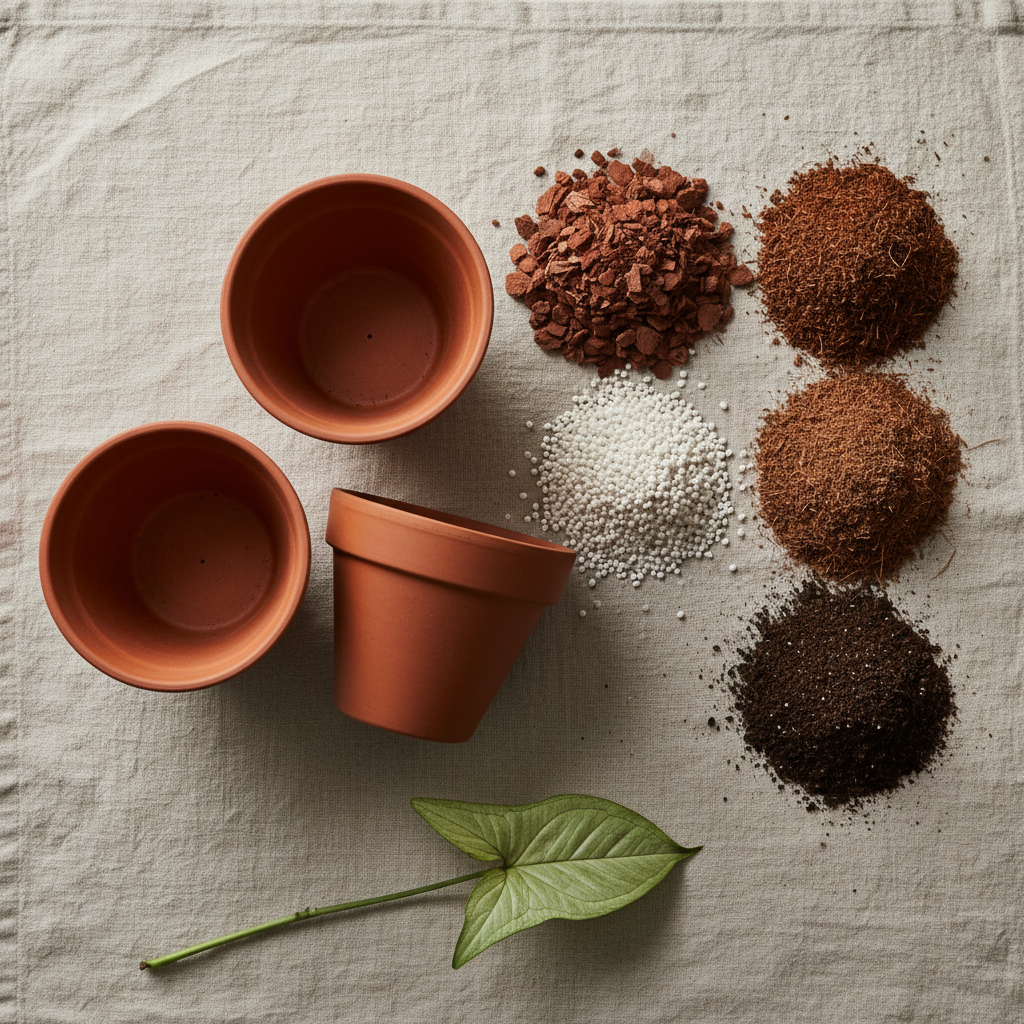
An arrowhead plant needs a substrate that holds enough moisture to keep its roots steadily supplied, but drains freely enough that the air pockets between particles refill within a few hours of watering. A plain peat-based houseplant compost, straight from the bag, tends to be too dense and water-retentive on its own; mixed about three parts to one with a chunky aerator such as perlite, pumice or fine orchid bark, it becomes nearly perfect. Many growers prefer a slightly looser aroid-style mix that runs closer to half compost and half a blend of orchid bark, perlite and coco coir, which mimics the porous, root-friendly debris that builds up in the forks of forest trees where Syngonium naturally grows.
A Reliable Mix Recipe
If you would rather not buy a premixed aroid blend, the following recipe works well for arrowhead plants and most other vining aroids. Combine the ingredients in a clean tub, moisten lightly with warm water until the mixture holds together when squeezed but breaks apart easily when poked, and store any excess in a sealed container.
- Two parts standard peat-based or coco-coir-based houseplant compost.
- One part medium-grade orchid bark for chunky structure and air channels.
- One part perlite or pumice for drainage and long-term aeration.
- A generous handful of worm castings per litre of mix, for slow-release nutrients and beneficial microbes.
Pot Choice and Drainage
Whatever pot you choose, it must have at least one drainage hole. Terracotta pots breathe through their walls and dry the mix more rapidly than glazed ceramic or plastic; this can be useful if you tend to overwater, but it does mean the plant will demand water more often. Glazed and plastic pots hold moisture for longer and forgive less frequent watering, but they are also less forgiving of overwatering because the substrate stays wet for longer. Choose the combination of pot, mix and watering style that matches your own habits, not someone else’s. Pot size should be about 2 to 3 cm (an inch) wider in diameter than the current rootball at each upgrade; a pot that is dramatically too large stays wet too long after watering and slows growth rather than encouraging it.
When and How to Repot
Most arrowhead plants benefit from being repotted every 12 to 18 months. The signs that the time has come are clear: roots circling tightly at the base of the rootball, water that runs straight through the pot without soaking in, a noticeable slowing of new growth even though light and feeding have not changed, or, for plants in clear nursery pots, a visible jungle of roots pressed against the inner wall. The best time to repot is early spring, just as the days lengthen and the plant is preparing to push fresh growth.
- Water the plant lightly the day before repotting. Slightly damp mix slides out of the old pot more cleanly than bone-dry mix.
- Lift the plant out by the base, supporting the rootball with one hand. Tease away any compacted, exhausted mix from the outer roots, but do not strip the rootball bare.
- Snip away any roots that are mushy, dark or hollow with clean scissors. Healthy roots are firm and pale.
- Place a small mound of fresh mix in the new pot, position the plant so the top of the rootball sits a centimetre or so below the rim, and backfill with mix, tamping gently so there are no large air pockets.
- Water thoroughly, let the pot drain, and return the plant to bright indirect light. Skip the next scheduled fertiliser application; freshly disturbed roots prefer to recover without a feeding push.
Fertilising
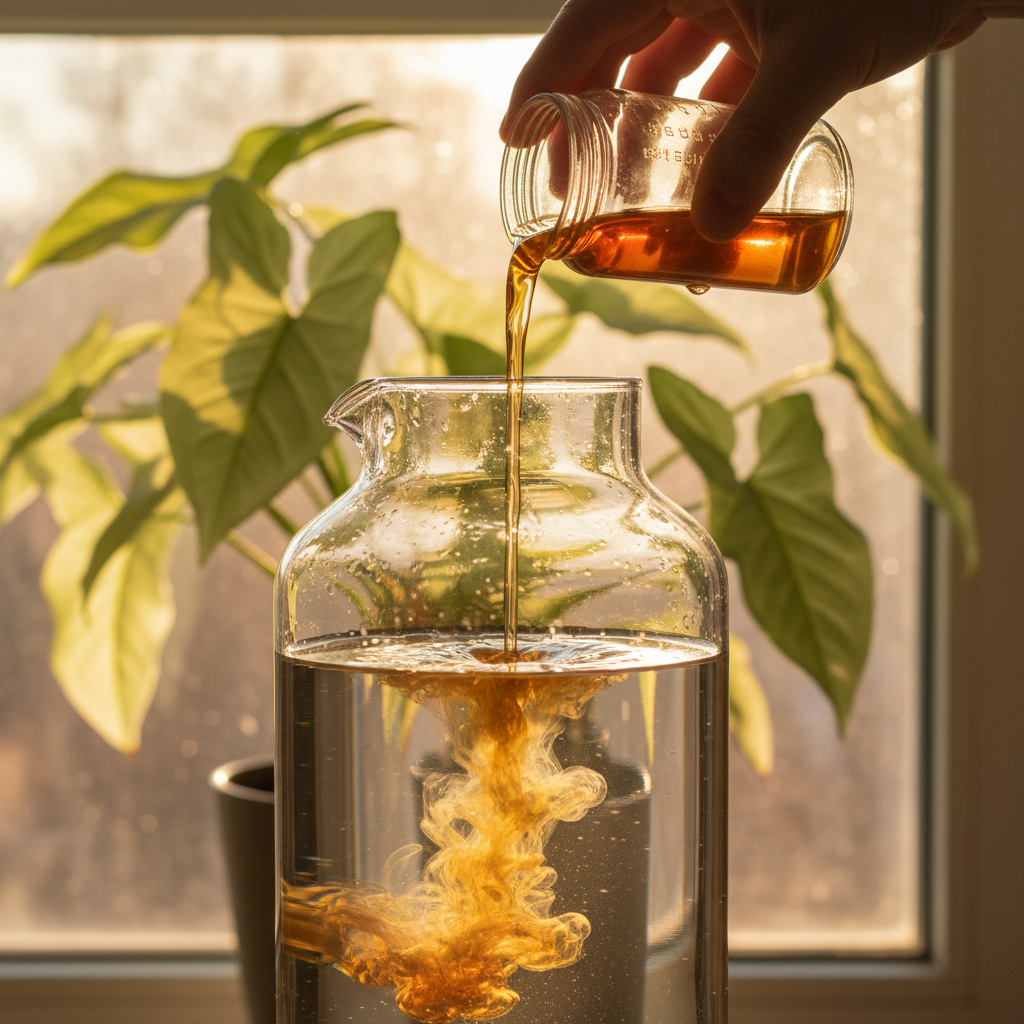
Compared with hungry tropicals like banana or hibiscus, an arrowhead plant is a light feeder. In the wild it makes do with whatever nutrients leach through the loose forest litter wrapped around its roots, and indoors it responds best to the same philosophy: a little, often, and never to excess. A balanced liquid houseplant fertiliser, applied at half the dose printed on the bottle and watered into already-moist soil every four to six weeks through spring and summer, covers everything most plants need. Stop feeding from late autumn until growth visibly resumes in early spring, because the plant cannot use the nutrients during its quieter winter weeks, and unused fertiliser salts accumulate in the substrate where they can scorch fine root tips.
Choosing a Fertiliser
A balanced NPK ratio close to 20-20-20, or any general indoor plant feed marketed for foliage houseplants, suits Syngonium well. Higher-nitrogen formulas push faster, larger leaf growth but can also wash out the variegation on cultivars like ‘White Butterfly’ or ‘Pink Allusion’, because the plant produces more chlorophyll per leaf in response to abundant nitrogen. If you are growing for variegation, stay with a balanced feed at half strength rather than a nitrogen-heavy one at full strength. Organic options work equally well: a fortnightly dilute solution of worm-casting tea, or a small top-dressing of solid worm castings every couple of months, feeds the plant steadily without ever risking root burn.
Symptoms of Over- and Under-feeding
An under-fed arrowhead grows slowly and produces pale new leaves with diffuse yellowing across the lamina rather than on the margins. An over-fed arrowhead develops crisp brown leaf tips, a white crusty layer of mineral salt at the soil surface or on the pot rim, and sometimes a sudden collapse of the youngest leaves as feeder roots are damaged. If you suspect salt build-up, flush the pot with three to four pot-volumes of plain water in a sink or shower, let it drain completely, and return to a half-strength regimen.
Pro Tip, Feeding Newly Potted Plants: A freshly repotted arrowhead plant in good potting mix already has six to eight weeks’ worth of nutrients available in the substrate itself. Wait at least that long after repotting before resuming any fertiliser, and start at quarter strength when you do begin again.
Propagation
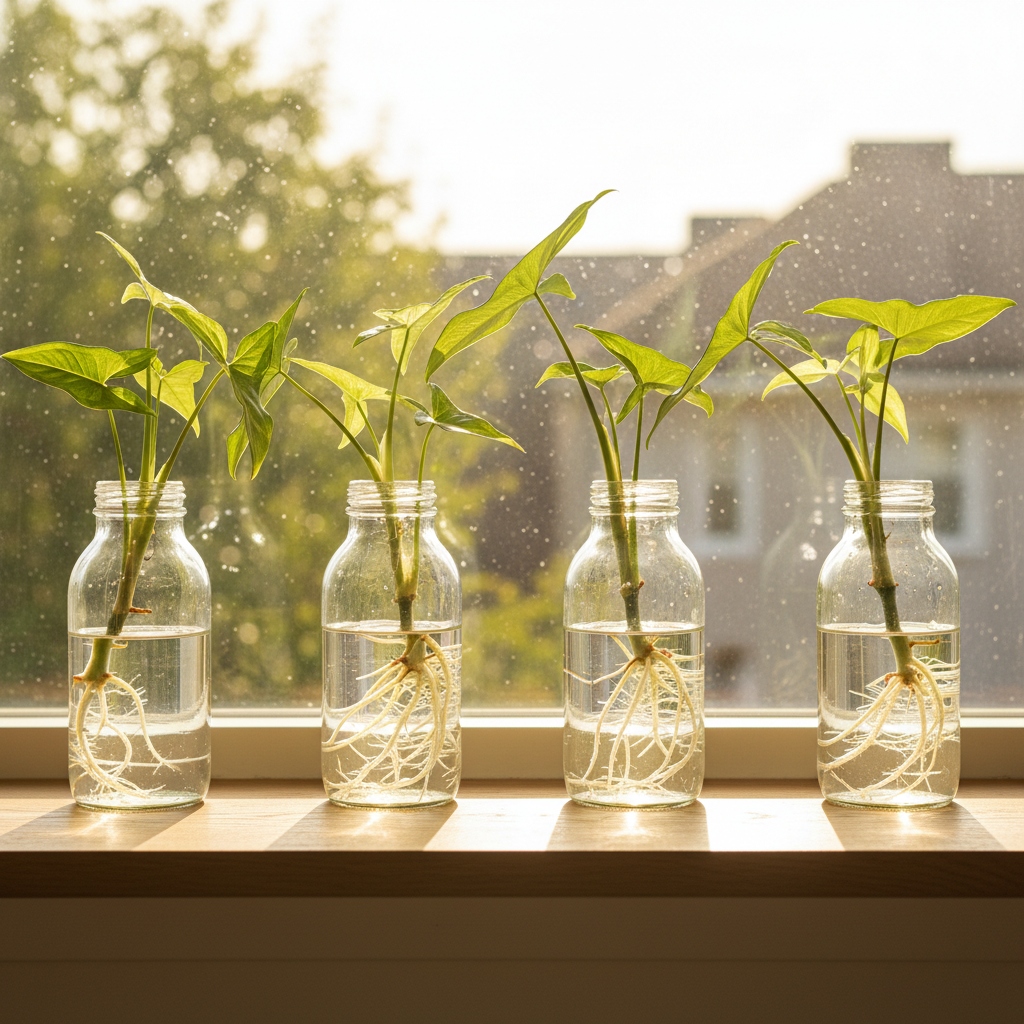
One of the great pleasures of growing an arrowhead plant is how unreservedly it propagates. Like its aroid relatives, Syngonium roots quickly and reliably from stem cuttings taken at the right point on the vine, and a single mature plant can produce more than a dozen healthy young plants in a single growing season without missing a beat. The single most important detail is the node. Every Syngonium cutting must contain at least one node, the small swollen point along the stem where a leaf emerges and where, on older growth, you will often see a stubby aerial root forming. Without a node, even a perfectly fresh-looking cutting cannot root, because it has no meristematic tissue from which new roots can emerge.
Water Propagation Step by Step
- Choose a healthy, vining stem with at least three or four mature leaves. With clean sharp scissors or a small pair of secateurs, cut 1 to 2 cm below a node, leaving at least one node on the cutting and ideally one or two leaves above it.
- If the cutting is long and bears many leaves, remove the lower one or two so that no leaves will sit submerged in water once the cutting is placed in the jar.
- Fill a clean glass jar or vase with room-temperature filtered water or rainwater, deep enough to cover the node but not the remaining leaves. Place the cutting in the jar so the node rests below the surface.
- Set the jar on a bright windowsill out of direct sun. Top up the water as it evaporates and refresh it completely every five to seven days to keep dissolved oxygen levels high.
- Roots typically emerge within ten to fourteen days. Once the new roots are 3 to 5 cm long, the cutting is ready for soil. Move it into a small pot of damp aroid mix, water in lightly, and keep the new pot slightly more humid than usual for the first two weeks while soil roots establish.
Direct-to-Soil Propagation
Some growers prefer to skip the water stage and root cuttings directly in soil. Use the same node-bearing cutting, dust the cut end with a little rooting hormone if you have it, and push the cutting gently into a pot of moist propagation mix made from equal parts perlite and peat or coco coir. Enclose the pot loosely in a clear plastic bag or place a humidity dome over it to maintain near-saturated air for the first ten to fourteen days. Direct-to-soil rooting tends to produce slightly tougher young plants, because the new roots are already adapted to a substrate, but you cannot watch progress as easily as you can in a jar of water.
Division of Mature Clumps
Older, multi-stemmed plants can also be divided at repotting time. Slide the rootball out of its pot, tease the soil away to reveal the natural clumps of stems, and separate two or three sturdy crowns with a clean sharp blade, ensuring each division retains its own portion of roots and at least two healthy stems. Pot each division into fresh aroid mix at the same depth it grew before, water in gently, and keep them out of direct sun for the first week while they recover from the disturbance.
Pests and Diseases
Healthy arrowhead plants resist most common houseplant pests, but a stressed plant, especially one in too little light or sitting in damp soil, can attract its share of trouble. The four pests worth knowing about are spider mites, mealybugs, scale insects and fungus gnats, in roughly that order of frequency. Of the four, only fungus gnats are mainly a sign of a watering problem rather than a true pest issue; the others can establish themselves quietly and grow into a serious infestation in a few weeks if not caught early. Get into the habit of turning a leaf or two over each time you water. Most pests gather on the undersides of leaves and at the leaf axils, and a thirty-second inspection is enough to spot the early stages.
Spider Mites
Spider mites thrive in warm, dry indoor air, and an arrowhead plant suffering from chronically low humidity is one of their preferred hosts. The early signs are tiny pale stippling marks on the upper leaf surface, where the mites have pierced individual cells, and fine silken webbing in the leaf axils on heavier infestations. Treat by rinsing the entire plant under a lukewarm shower for several minutes, paying particular attention to the undersides of leaves, then dry the foliage carefully and follow up with a weekly application of a horticultural soap or neem-oil spray for three weeks. Raising humidity around the plant also helps, because mites struggle to reproduce in damper air.
Mealybugs and Scale
Mealybugs appear as small, soft, cotton-wool-like clusters wedged into leaf axils and along stems. Scale insects look like flat brown or tan discs glued to the stem or the undersides of leaves. Both feed on plant sap, both excrete sticky honeydew that attracts sooty mould, and both can be controlled with a cotton bud dipped in isopropyl alcohol applied directly to each insect, followed by a thorough wipe-down of all leaves and stems. For heavier infestations, alternate alcohol treatment with weekly applications of horticultural soap, and isolate the plant from your other houseplants until at least three weeks have passed since the last sighting.
Fungus Gnats
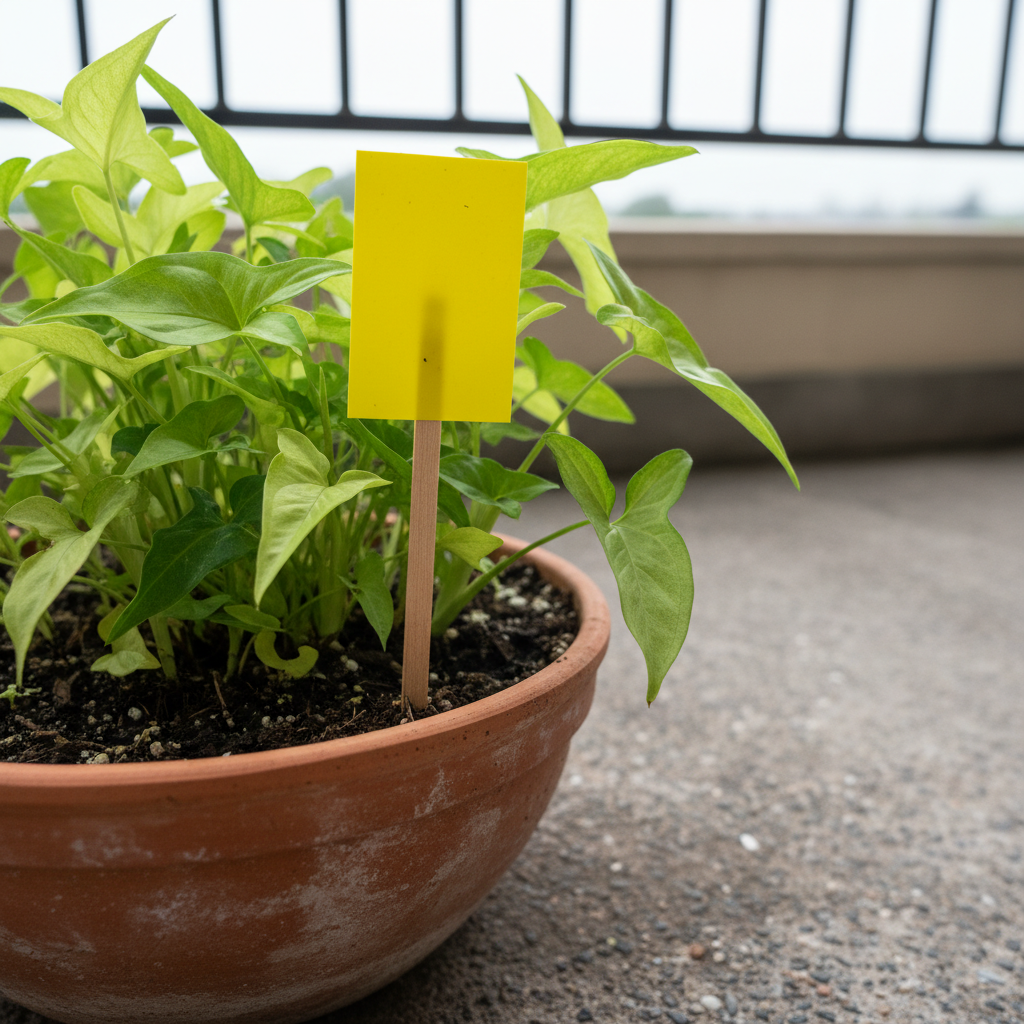
Tiny dark flies hopping around the pot are fungus gnats, and they are almost always a sign of soil that stays too wet for too long. Adults are an irritation rather than a real threat; their larvae, however, feed on fine feeder roots and can damage young plants. Let the soil dry out a centimetre or two deeper than usual between waterings, place a yellow sticky trap horizontally over the pot to catch egg-laying adults, and consider top-dressing the soil with a thin layer of horticultural grit or sand to break the moist top layer where eggs are typically laid. A weekly drench with a Bti-based larvicide handles persistent infestations.
Root Rot
Root rot is the single most common cause of arrowhead plant death, and it is virtually always caused by overwatering or poor drainage rather than by a primary infection. The classic symptoms are yellowing or wilting leaves on a plant whose soil feels permanently damp, a sour odour rising from the pot, and a rootball that, when lifted, reveals soft, dark, hollow roots instead of firm pale ones. Salvage what you can by unpotting the plant, washing the roots clean under a gentle stream of lukewarm water, snipping away every soft or discoloured root with sterilised scissors, and repotting the surviving healthy crown into fresh dry aroid mix in a smaller pot than before. Water sparingly until you see signs of new growth, which usually means a wait of two to four weeks.
Popular Varieties
The arrowhead plant has been in cultivation long enough, and is easy enough to breed and select, that the number of named cultivars on the market runs into the dozens. Two stand out as the most reliably available and the most beginner-friendly: ‘White Butterfly’ and ‘Pink Allusion’. Both belong to Syngonium podophyllum, both grow at the same rate as the species, and both respond to the same care described above. They differ mostly in colour and in the patience they demand: ‘White Butterfly’ is essentially as forgiving as the wild species, while ‘Pink Allusion’ rewards a little more light and humidity with significantly more vivid colour.
‘White Butterfly’
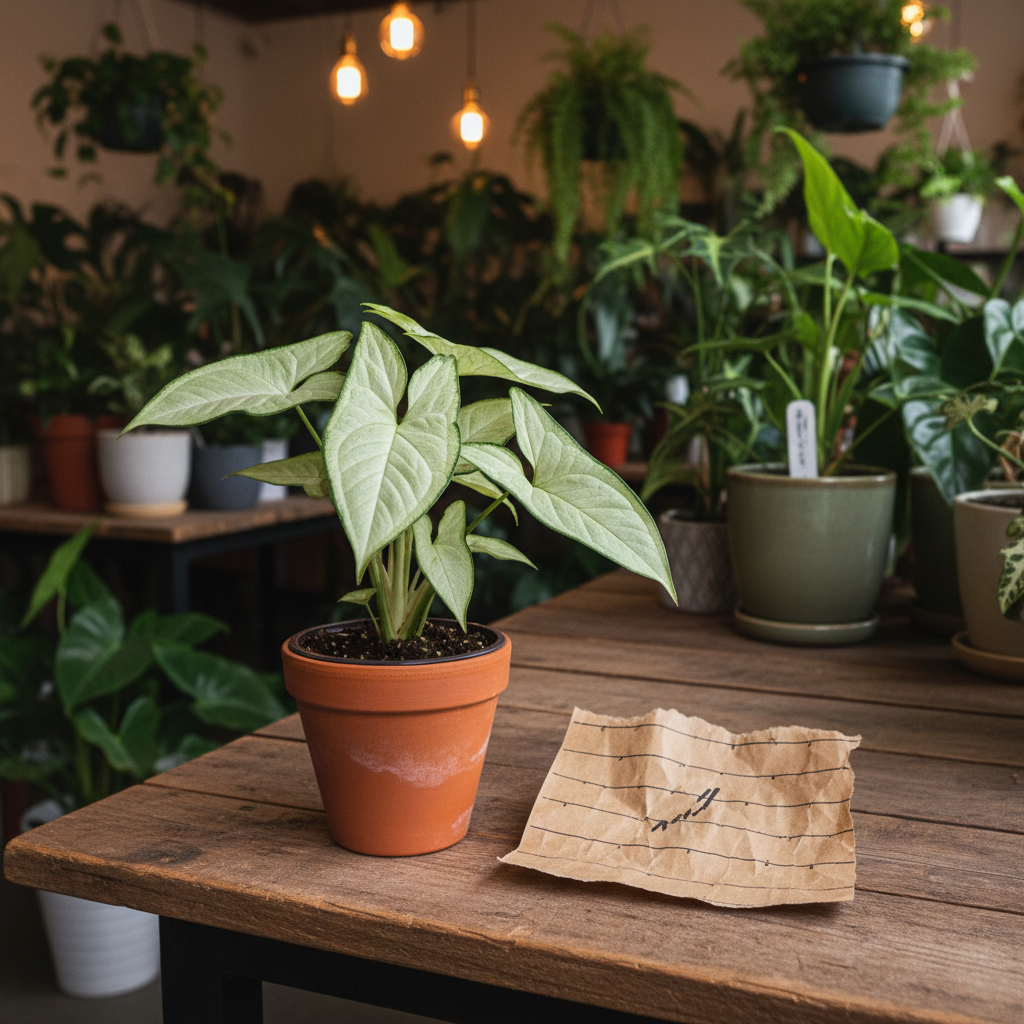
Almost certainly the cultivar you have already seen, whether or not you knew its name. ‘White Butterfly’ carries pale silvery-green leaves with creamy-white centres and clean dark-green margins that read like a watercolour wash. It tolerates lower light than most variegated Syngoniums, holds its colouring even in a north-facing position, and grows quickly enough that a single 12 cm nursery pot will fill out a hanging basket within a single growing season. The cultivar’s only quirk is a tendency to revert to plainer green leaves if grown in extreme low light for many months, so move it brighter at the first sign of fading.

‘Pink Allusion’
‘Pink Allusion’ is the cultivar that introduced many growers to the idea that a Syngonium could be pink at all. Soft pale-green leaves carry a rosy blush across the surface and a tracery of bright pink along the major veins; the effect is most pronounced on younger, well-lit leaves and softens as foliage ages. Of the well-known cultivars, ‘Pink Allusion’ is the one most rewarded by extra light: in a bright east window, the pink intensifies; in a darker corner, the colour fades toward muted cream. Otherwise it shares the easy temperament of the rest of the species.
Other Cultivars Worth Knowing
Beyond the two flagships, a handful of cultivars deserve a mention. ‘Neon Robusta’ carries luminous lime-pink leaves on a compact upright plant and lights up a shelf in moderate light. ‘Strawberry Cream’ is similar in form to ‘Pink Allusion’ but produces an unmistakable strawberry-milk tint on new foliage. ‘Maria’ and the related ‘Maria Allusion’ stay smaller and more compact, with a warmer bronze-pink cast. ‘Black Velvet’ turns the species on its head with deep blackish-green leaves veined in silver, a striking specimen for a shaded but bright corner. And ‘Confetti Tricolor’, sometimes labelled ‘Milk Confetti’, scatters pink, cream and green flecks across the leaf surface in unpredictable patterns, a slightly more demanding plant best kept in steadier humidity than most of its cousins.
Frequently Asked Questions
Is the arrowhead plant toxic to pets?
Yes. All parts of Syngonium podophyllum contain insoluble calcium oxalate crystals, which cause oral irritation, drooling, vomiting and sometimes difficulty swallowing if chewed or ingested by cats, dogs or humans. The sap can also cause mild skin irritation in sensitive people. Keep the plant on a high shelf or in a hanging basket out of reach of curious pets and small children, and wash your hands after pruning or repotting.
Why is my arrowhead plant turning yellow?
The most common cause of widespread yellowing, especially on newer leaves, is overwatering or poor drainage. Check the rootball: if it is soggy and the roots are soft, repot into fresh dry mix and water less often. Occasional yellowing of the oldest, lowest leaves is normal, particularly after a flush of new growth. Yellowing that is patchy and accompanied by stippling is more likely to be a spider mite issue.
Why are the leaves on my arrowhead plant curling?
Curling leaves most often signal underwatering or low humidity. The leaf curls inward to conserve moisture as a stress response. Check the soil: if the top several centimetres are dry, water thoroughly. If the soil is moist but the air is dry, group the plant with other tropicals or add a small humidifier nearby. Curling that persists after correcting moisture levels may indicate root damage and warrants a closer inspection.
How fast does an arrowhead plant grow?
Under good conditions, expect a new leaf every two to three weeks during the spring and summer growing season. A young 12 cm nursery plant typically fills out a hanging basket within twelve months, and a mature plant can produce 30 cm or more of vining growth in a single year. Growth slows or pauses through winter, particularly at higher latitudes. If your plant produces fewer than one new leaf a month during the growing season, the limiting factor is almost always light.
Can I train my arrowhead plant up a moss pole?
Yes, and the plant responds dramatically to the support. As the vines mature and aerial roots develop, they grip onto a damp moss or coco-coir pole and the leaves growing along the supported portion of the stem become noticeably larger and more deeply lobed than those on freely trailing growth. Keep the pole misted or watered through so it stays consistently damp, and tie the first lengths of stem to the pole loosely with garden twine until the aerial roots take hold of their own accord.
Should I prune my arrowhead plant?
Pruning is optional but encouraged. Trimming back leggy vines just above a node prompts the plant to push two or three new shoots from below the cut, producing a bushier overall form. The cuttings you remove can be rooted in water and turned into new plants. Routine pruning of any dead or yellowing leaves keeps the plant looking tidy and reduces the chance of fungal issues. Use clean sharp scissors and prune in spring or early summer when the plant can replace lost growth quickly.
Why are the leaves on my variegated arrowhead turning plain green?
Variegated cultivars revert when light levels are too low for the plant to support the reduced chlorophyll in their patterned leaves. The plant compensates by producing leaves with more chlorophyll, which appear plain green. Move the plant to a brighter position, ideally within a metre of a bright window with a sheer curtain, and prune away the reverted growth back to the most recent variegated leaf so the new shoots emerge from a variegated section of stem.






