
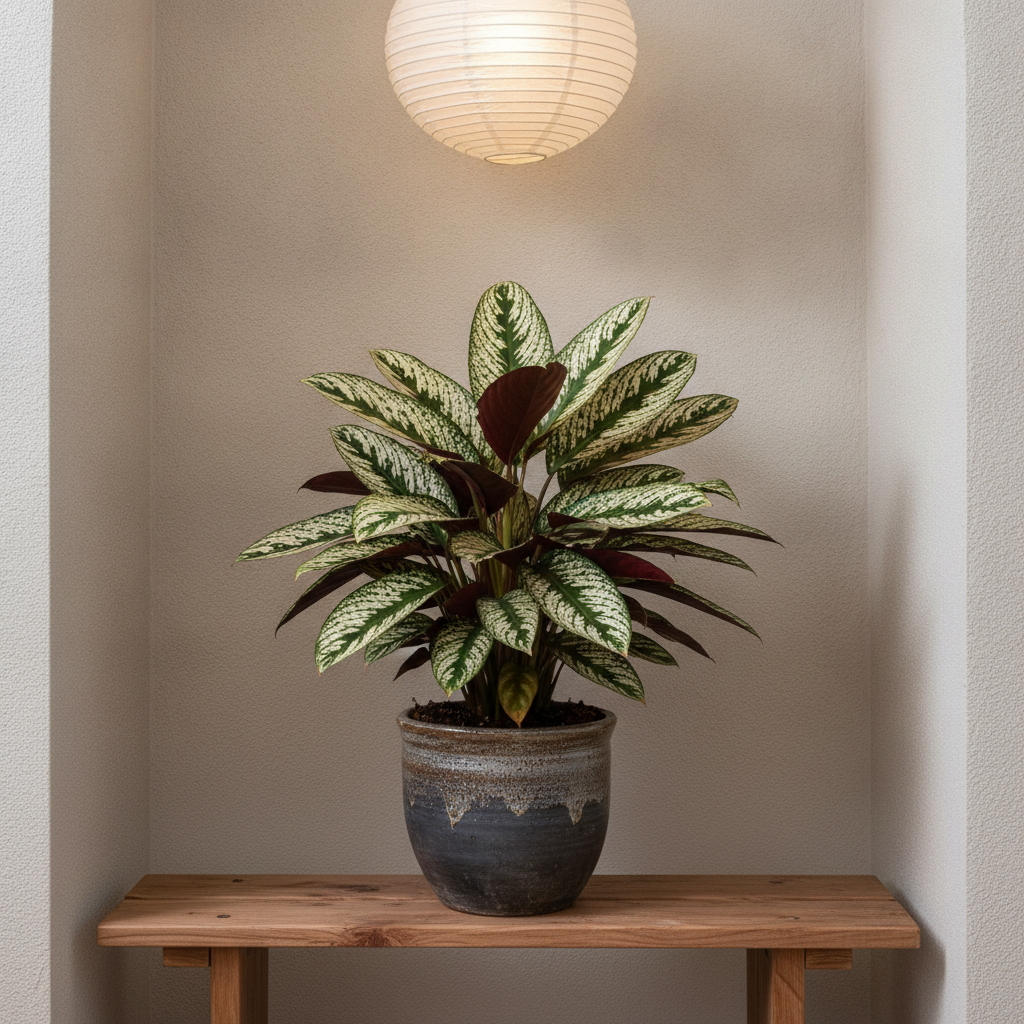
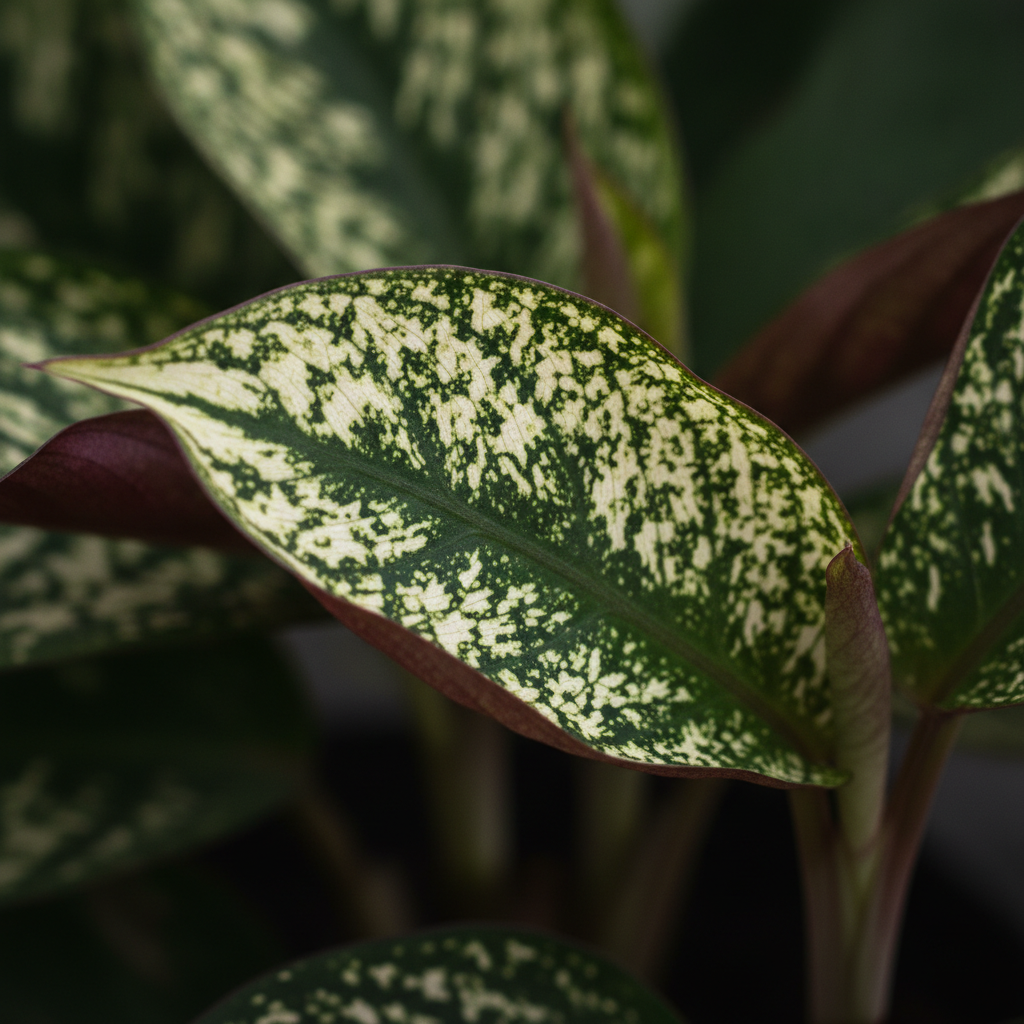
Few houseplants announce themselves quite so theatrically as the White Star Stromanthe. Each glossy, lance-shaped leaf is painted with irregular brushstrokes of cream and white over deep forest green, and every one is backed with a startling wine-red underside that glows when light passes through it. Botanically it is Stromanthe sanguinea ‘White Star’, a variegated cultivar of a species that grows on the shaded floor of the Brazilian rainforest, where it belongs to the prayer plant family, Marantaceae. Like its relatives, it performs a slow nightly ritual known as nyctinasty, folding its leaves upward at dusk to flash those crimson undersides before lowering them again at dawn.
The plant has a reputation for being demanding, and that reputation is not entirely unearned. It is fussier than a pothos and more expressive than a snake plant, quick to register a dry room or a splash of harsh sun with browning edges and curling leaves. Yet almost every complaint traces back to the same handful of conditions: humidity, water quality, light and warmth. Get those right and the White Star Stromanthe is neither temperamental nor short-lived. This guide walks through the difference between a plant that merely survives, holding on with tattered foliage, and one that genuinely thrives, pushing out fresh pink-tinged growth season after season.
Contents
- Quick Reference
- Why White Star Stromanthe Makes a Rewarding Houseplant
- Light Requirements
- Watering & Humidity
- Soil, Potting & Repotting
- Fertilising
- Propagation
- Pests & Diseases
- Popular Varieties
- Frequently Asked Questions
Quick Reference: White Star Stromanthe at a Glance
| Light | Bright, indirect light. No direct midday sun, which scorches leaves and bleaches the variegation. |
| Watering | Keep soil evenly moist but never waterlogged. Water when the top 2 to 3 cm (about 1 inch) feels dry. |
| Temperature | 18 to 27 degrees Celsius (65 to 80 Fahrenheit). Avoid anything below 15 degrees Celsius (59 Fahrenheit) and cold draughts. |
| Humidity | High. 60 percent or more is ideal; below 50 percent leaf edges brown. |
| Fertiliser | Balanced liquid feed at half strength every 3 to 4 weeks in spring and summer. |
| Toxicity | Non-toxic to cats, dogs and humans. Safe around pets and children. |
Why White Star Stromanthe Makes a Rewarding Houseplant
The obvious appeal is colour. Where many variegated plants offer a tidy stripe or a scattering of flecks, the White Star throws paint at its foliage, and no two leaves repeat the same pattern. New growth often emerges flushed with soft pink before settling into cream and green, and the underside of every mature leaf is a deep, saturated magenta-red that turns the whole plant into a two-toned display as the leaves shift through their daily cycle. Placed where afternoon light can catch it from behind, the effect is genuinely luminous.
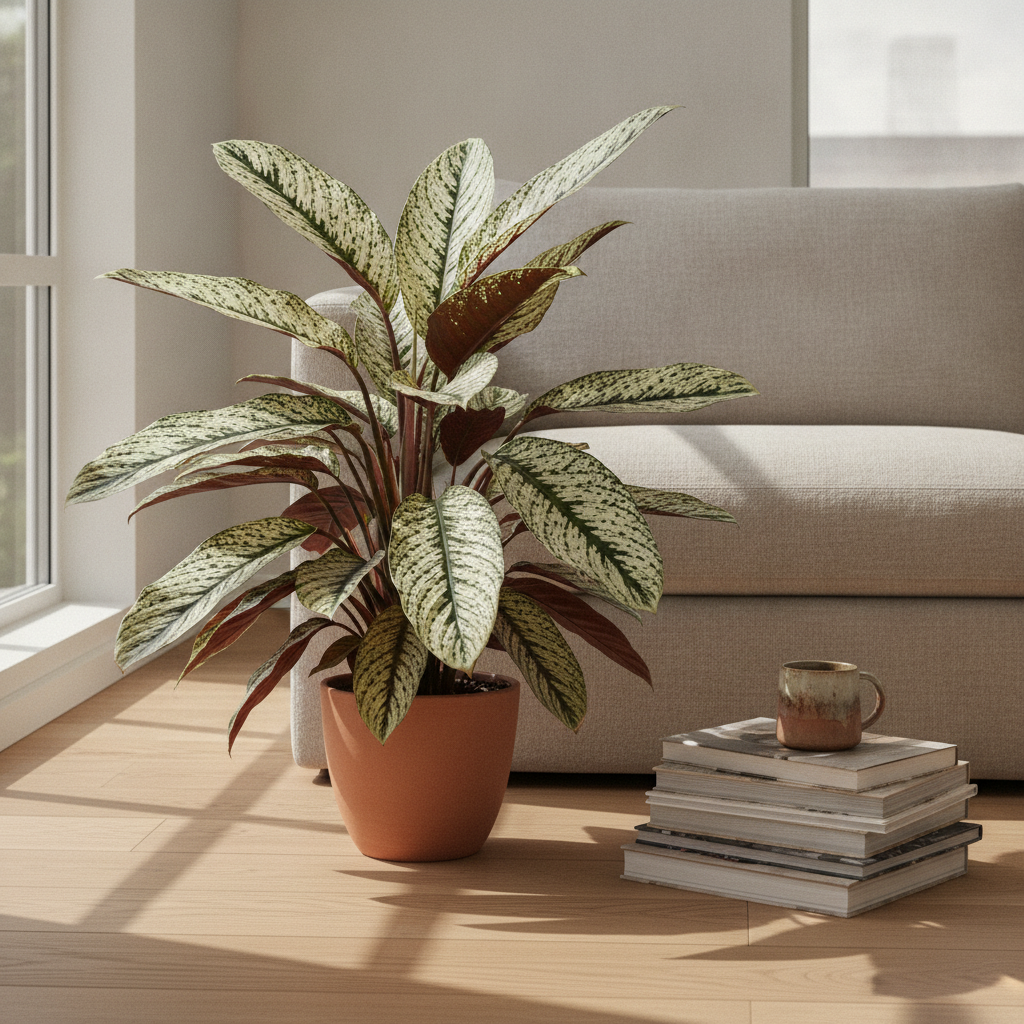
Beyond looks, there are practical reasons to welcome one into a collection. It stays compact, typically reaching 30 to 60 cm (12 to 24 inches) tall indoors and spreading gently outward as its rhizome produces new shoots, so it suits a shelf, a plant stand or a grouped humidity-loving arrangement without ever threatening to take over a room. It grows in a full, clumping rosette rather than trailing or climbing, which makes it an easy plant to place. Perhaps most reassuring for households with animals, it belongs to a family that is entirely non-toxic, so a curious cat or an inquisitive toddler is in no danger from a nibbled leaf.
Important — Toxicity: The White Star Stromanthe is non-toxic to cats, dogs and people, and appears on the ASPCA list of pet-safe plants. That said, no plant is meant to be eaten, and a pet that chews foliage may still experience mild stomach upset simply from the fibre, so it is sensible to discourage the habit.
Light Requirements
Light is the single factor most likely to make or break a White Star Stromanthe, and it sits in a narrow band. In the wild the plant grows beneath the rainforest canopy, receiving bright but heavily filtered light that reaches it dappled and diffused. Indoors it wants the brightest position you can offer that keeps direct sun off the leaves. Too little light and the striking variegation fades toward plain green as the plant conserves its limited chlorophyll; too much and the pale, pigment-poor sections of each leaf scorch into papery brown patches.
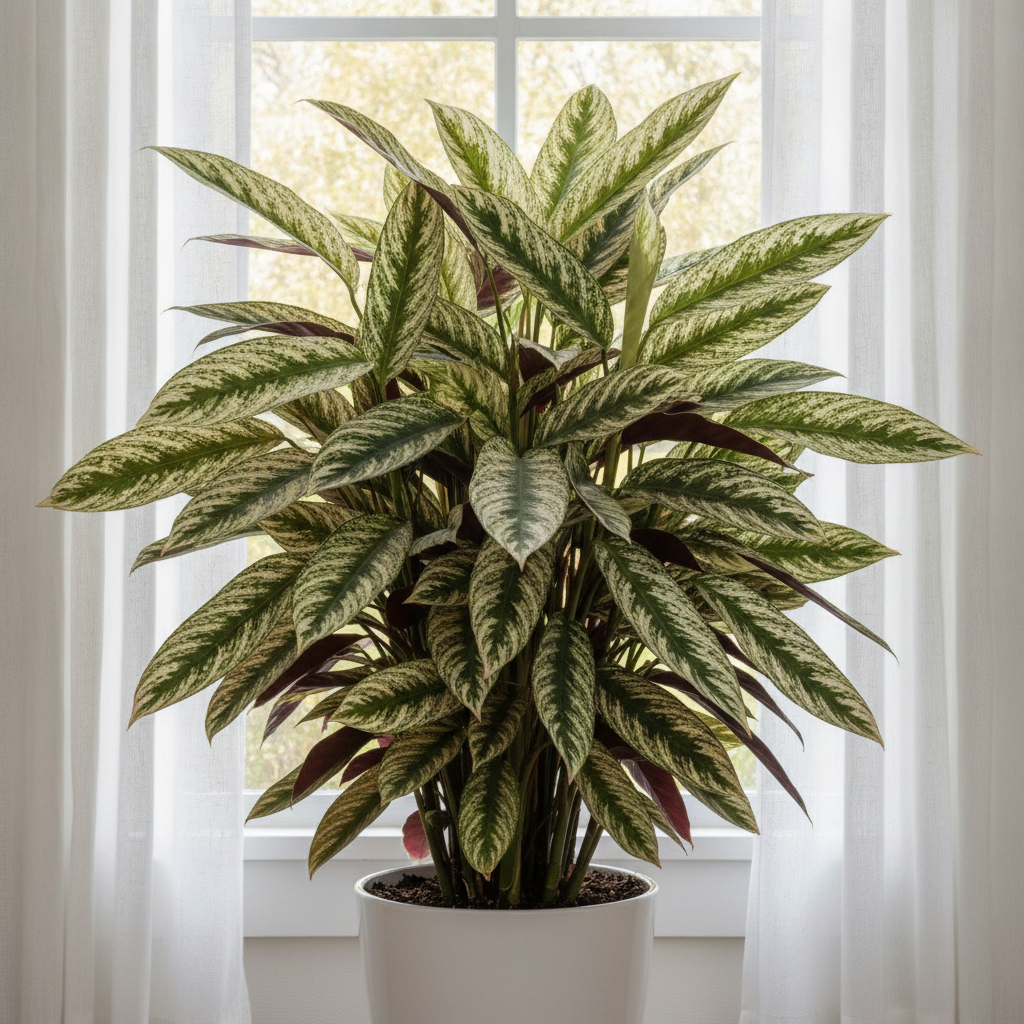
The ideal is a spot a metre or two back from a bright window, or directly beside a window screened with a sheer curtain. In that position the leaves stay saturated, the cream and white markings hold their contrast, and new growth continues to come through boldly patterned rather than washed out. Because this is a variegated plant, it needs noticeably more light than an all-green prayer plant to sustain those white sections, which contribute nothing to photosynthesis.
Light Levels Explained
Understanding where your chosen spot falls on the spectrum of household light makes it far easier to place this plant correctly. The categories below describe the practical outcome for a White Star Stromanthe in each.
| Light Category | Approx. Level | Typical Location | Outcome |
|---|---|---|---|
| Direct sun | Over 50,000 lux | On a south or west sill, unshaded | Leaf scorch, bleached variegation, crisping |
| Bright indirect | 15,000 to 40,000 lux | Near a curtained bright window | Ideal; strong variegation and steady growth |
| Medium | 8,000 to 15,000 lux | A metre or two into a bright room | Acceptable; slower growth, colour holds |
| Low | 2,000 to 8,000 lux | A dim corner or north room interior | Variegation fades, leggy, weak growth |
| Very low | Under 2,000 lux | Away from any window | Decline; drop leaves, will not sustain |
Window Orientation and Placement
South-facing window: The brightest exposure and potentially the best, but only when the plant is set back or the glass is diffused with a sheer curtain. Placed directly on a south sill it will burn within days.
East-facing window: Often the sweet spot. Gentle direct sun in the early morning is soft enough to be tolerated, and the light stays bright but indirect for the rest of the day. Many growers find this the easiest exposure for the plant.
West-facing window: Workable with a light curtain. The strong afternoon sun a west window delivers is too harsh unmediated, so filter it or place the plant a short distance away from the glass.
North-facing window: Usually too dim to keep the variegation crisp through the darker months. It can work in high summer or when supplemented with a grow light, but expect the pattern to soften and growth to slow in a north room.
Pro Tip — Rotate for Even Growth: Stromanthe leans firmly toward its light source. Give the pot a quarter turn each time you water so every side receives equal exposure, and the plant will keep a balanced, rounded shape instead of growing lopsided.
How Light Affects Variegation
The white and cream areas of each leaf contain little or no chlorophyll, so they cannot manufacture energy for the plant. In dim conditions the White Star responds by producing new leaves with more green and less white, effectively trading away its beauty for survival. In good light it has the energy surplus to keep generating heavily variegated foliage. If you notice new growth emerging plainer than the older leaves, the plant is telling you it needs a brighter position, not a darker one.
Warning — Direct Sunlight: The cream and white sections of the leaf have no pigment to protect them and burn far faster than green tissue. Once a variegated leaf scorches, the damage is permanent; that leaf will not recover its markings, so prevention through filtered light is the only real safeguard.
Artificial Lighting
The White Star responds well to supplemental lighting, which is often the simplest fix for a home that lacks a bright enough natural spot. A full-spectrum LED grow light positioned 30 to 45 cm (12 to 18 inches) above the plant and run for 10 to 12 hours a day will comfortably sustain strong variegation through winter. Because the plant is compact, a single modest fixture is usually all that is required, making it an easy candidate for a shelf setup far from any window.
Seasonal Adjustments
Light intensity indoors can fall by more than half between summer and midwinter as the sun sits lower and days shorten. A position that was perfect in July may leave the plant straining in January, so it pays to move it closer to the window or add a grow light through the darkest months, then ease it back as spring returns. Watch the new growth: pale, stretched leaves signal too little light, while crisping tips on the side facing the glass signal too much.
Watering & Humidity
If light is the factor most likely to fade the White Star Stromanthe, water is the factor most likely to damage it outright, in both directions. This is a plant that wants consistent, even moisture, never bone dry and never sitting in a swamp. It also happens to be unusually sensitive to what is dissolved in that water, which is why so many otherwise healthy specimens develop crisp brown leaf edges that their owners struggle to explain.
When to Water
Aim to water once the top 2 to 3 cm (about 1 inch) of the mix has dried, while the deeper soil remains lightly moist. In practice, in a warm bright home through the growing season, this tends to mean watering every four to seven days, though the only reliable guide is your finger rather than the calendar. The plant should never be allowed to dry out completely, as full drought triggers the same brown, curling edges that overwatering and poor water quality do.
In autumn and winter, when growth slows and light weakens, the soil stays wet for longer and the watering interval stretches accordingly. Resist the urge to keep to a fixed schedule through the colder months; check the soil and water only when the surface layer has dried, or root rot becomes a real risk in the cool, slow conditions.
Pro Tip — Use the Right Water: Stromanthe is sensitive to the fluoride, chlorine and mineral salts in hard tap water, which accumulate in the leaf margins and burn them brown. Water with rainwater, distilled water or tap water left to stand uncovered for 24 hours, and much of the mysterious edge-crisping simply disappears.
How to Water Correctly
- Check the top 2 to 3 cm (1 inch) of soil with a finger; water only if it feels dry to the touch.
- Use room-temperature water that is low in minerals, such as rainwater, distilled or dechlorinated tap water. Cold water can shock the roots.
- Pour slowly and evenly across the whole surface until water flows freely from the drainage holes.
- Let the pot drain completely for several minutes so no excess remains in the base.
- Empty the saucer or cache-pot; never leave the plant standing in collected water.
- Tip the pot gently to confirm it feels evenly moist rather than heavy and saturated.
Signs of Overwatering vs. Underwatering
Because both extremes can produce browning and drooping, it helps to read the whole plant rather than a single symptom. The table below separates the two patterns.
| Symptom | Overwatering | Underwatering |
|---|---|---|
| Leaf colour | Yellowing, often on lower leaves first | Browning, starting at the edges and tips |
| Leaf texture | Soft, limp, sometimes translucent | Dry, crisp, curling inward |
| Soil | Stays wet for days, may smell sour | Pulls away from the pot sides, dusty dry |
| Roots | Brown, mushy, foul-smelling | Firm but dry, sometimes shrivelled |
| Overall habit | Wilting despite wet soil | Wilting with dry soil, perks up after watering |
Warning — Root Rot: Soggy, airless soil is the fastest way to kill this plant. If leaves yellow and wilt while the soil stays wet and the base smells musty, unpot immediately, cut away any brown mushy roots with sterilised scissors, and repot into fresh, free-draining mix.
Humidity Requirements
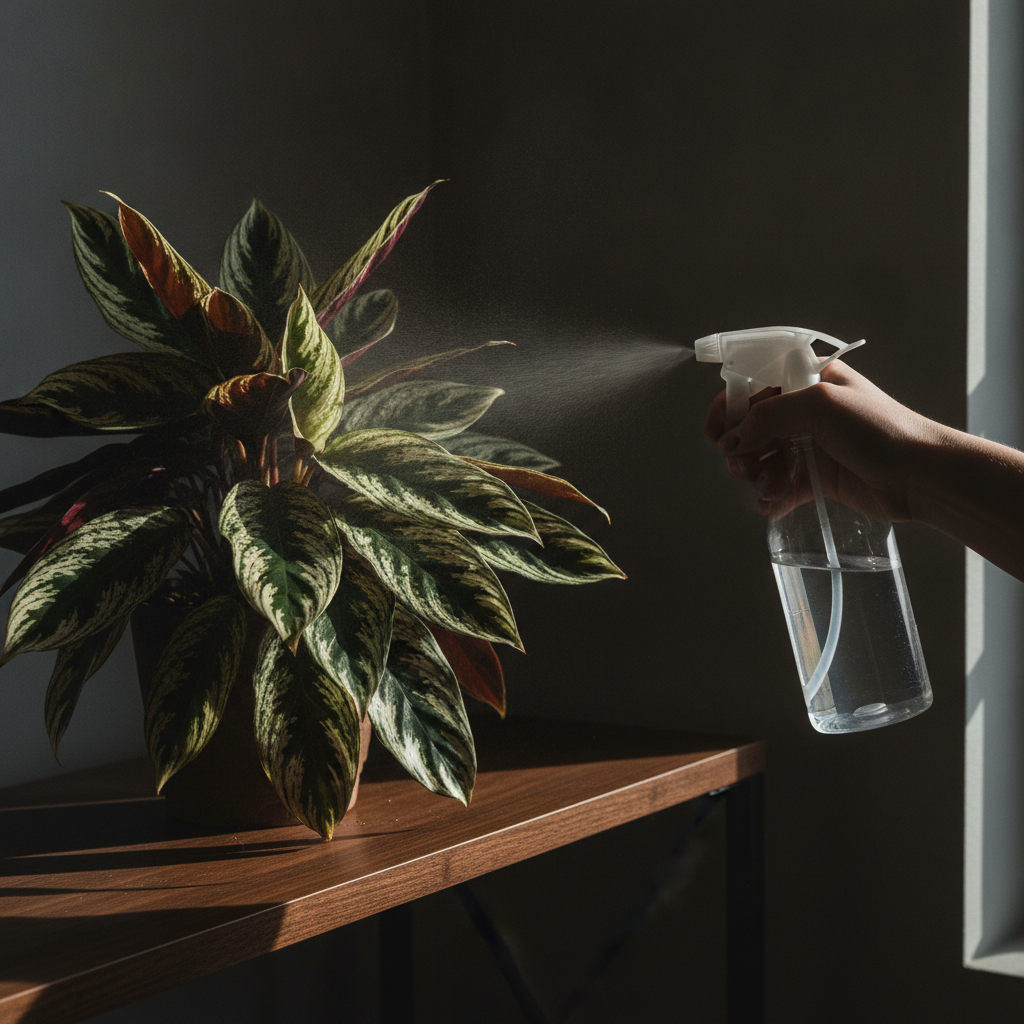
Humidity is not optional for a White Star Stromanthe; it is central to keeping the foliage intact. As a rainforest understorey plant it evolved in air that rarely drops below 60 percent relative humidity, and the dry air of a centrally heated home, often 30 percent or lower in winter, is precisely what causes the brown, papery edges that owners find so frustrating. Aim for 60 percent or more wherever you can.
The earliest sign that the air is too dry is browning along the leaf margins and tips, followed by edges that curl and feel brittle. Because these symptoms overlap with those of poor water quality and underwatering, it is worth addressing all three together rather than assuming a single cause; a plant given filtered water, steady soil moisture and humid air rarely shows edge damage at all.
Raising humidity is straightforward. A small room humidifier is by far the most effective option and the one most likely to solve persistent edge-browning. Grouping the Stromanthe with other plants raises the local humidity through their combined transpiration, and standing the pot on a wide tray of pebbles topped up with water, with the pot resting on the stones above the waterline, adds useful moisture to the air immediately around the leaves. A steamy bathroom with enough light also suits it well.
Water Quality
It is worth repeating because it is so often the hidden culprit: the White Star Stromanthe is more sensitive to water chemistry than most houseplants. Fluoride, chlorine, chloramine and the calcium and magnesium salts of hard water all build up in the sensitive leaf tissue and burn the margins. Rainwater is ideal and free; distilled or reverse-osmosis water works just as well; and ordinary tap water left uncovered overnight will lose most of its chlorine, though not its fluoride or hardness. If your tap water is very hard, switching to rainwater alone can transform a chronically crispy plant.
Soil, Potting & Repotting
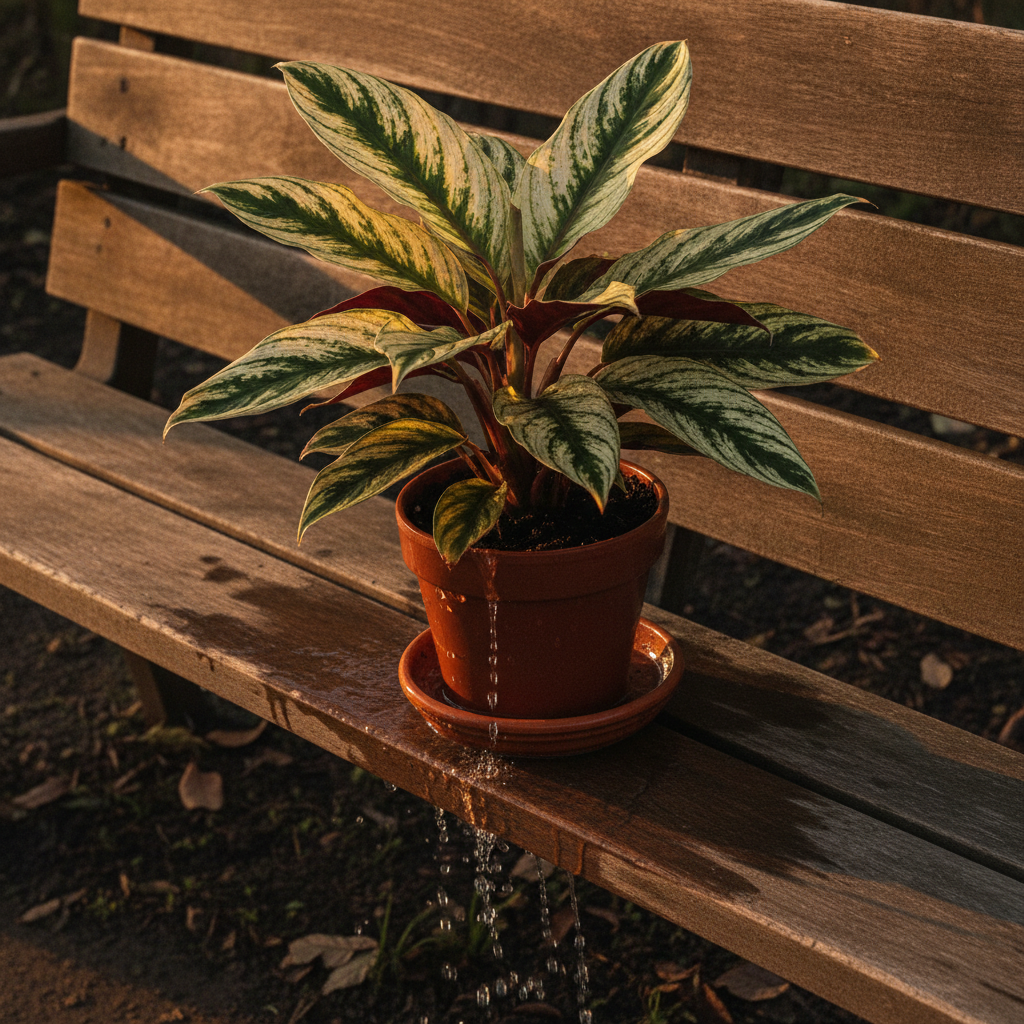
The right growing medium reconciles the plant’s two seemingly contradictory demands: it wants to stay evenly moist, yet it will rot if the roots sit in stagnant water. The answer is a mix that holds moisture in its organic content while draining freely and staying airy, so that water passes through and oxygen reaches the roots between waterings.
Ideal Soil Composition
A quality peat-free houseplant compost forms the base, lightened with materials that open up the structure and hold moisture without turning claggy. Coco coir retains water while resisting compaction, perlite creates the air pockets that keep roots healthy, and a little fine bark or worm castings adds structure and slow nutrition. The finished mix should feel light and springy, not dense.
| Component | Proportion | Function |
|---|---|---|
| Peat-free houseplant compost | 50 percent | Base medium, holds moisture and nutrients |
| Coco coir | 20 percent | Retains moisture, resists compaction |
| Perlite | 20 percent | Aeration and drainage |
| Fine bark or worm castings | 10 percent | Structure and gentle slow-release feeding |
The White Star prefers a slightly acidic to neutral soil, roughly pH 6.0 to 6.5, which a peat-free compost base naturally provides. There is rarely any need to adjust pH manually; simply avoid alkaline additives such as garden lime, which this rainforest plant does not appreciate.
Pro Tip — Quick Mix Recipe: For a fast, reliable blend, combine two handfuls of peat-free houseplant compost with one handful of perlite and one handful of coco coir. It holds moisture like the plant wants while draining fast enough to keep the roots safe.
Choosing the Right Pot
The container matters as much as what fills it, because it governs how quickly the soil dries and whether excess water can escape.
Drainage holes are non-negotiable. Whatever pot you choose, it must have holes in the base. A decorative pot with no drainage traps water at the roots and all but guarantees rot; if you love the look of a particular cache-pot, plant into a plastic nursery pot that drains and slip it inside.
Pot material: Plastic and glazed ceramic hold moisture longer, which suits this moisture-loving plant well, especially in drier homes. Unglazed terracotta breathes and dries fast, so while it protects against overwatering it may leave the Stromanthe too dry unless you water more often.
Pot size: Choose a pot only 2 to 4 cm (1 to 2 inches) wider than the current root ball. An oversized pot holds a large volume of soil that stays wet far longer than the roots can use, which invites rot. This plant is happier slightly snug than swimming in excess compost.
When to Repot
The White Star Stromanthe grows at a moderate pace and only needs repotting every one to two years, ideally in spring as the growing season begins. Tell-tale signs that it is ready include roots emerging from the drainage holes, water running straight through without wetting the soil, a plant that dries out unusually fast, or a clump that has visibly filled its pot with new shoots. If none of these apply, refreshing the top few centimetres of compost each spring is enough to keep it fed and healthy without the disturbance of a full repot.
How to Repot: Step-by-Step
- Water the plant a day beforehand so the root ball is hydrated and holds together when handled.
- Ease the plant out by tipping the pot and supporting the base of the clump; avoid pulling on the leaves.
- Gently tease apart the outer roots and brush away a little of the old, spent soil from around the edges.
- Inspect the roots and trim away any that are brown, soft or rotten with sterilised scissors.
- Add fresh mix to the base of a pot one size larger, then set the plant so its crown sits at the same depth as before.
- Fill around the sides with fresh mix, firming gently to remove air pockets without compacting the soil.
- Water thoroughly with low-mineral water and return the plant to its usual bright, indirect spot.
Warning — Transplant Shock: Expect a little sulking after repotting, with some curling or drooping for a week or two. Keep humidity high, hold off on fertiliser until fresh growth appears, and do not be tempted to overwater a plant that is simply adjusting to its new home.
Fertilising
The White Star Stromanthe is a light feeder, and its needs are modest. A steady trickle of dilute nutrition through the growing season supports the constant production of new, well-coloured leaves, while heavy feeding does more harm than good on a plant this sensitive to salts.
The guiding principle is little and often, at reduced strength. Because the same mineral salts that damage the leaves through hard water can also accumulate from over-fertilising, restraint is genuinely the safer approach here, and a hungry plant is far easier to correct than a chemically burnt one.
Understanding Plant Nutrients
A balanced fertiliser supplies the three macronutrients plants use in the largest amounts, nitrogen, phosphorus and potassium, alongside secondary nutrients and trace elements. For a foliage plant like the Stromanthe, nitrogen for leaf growth matters most, but a balanced formula covers every base and prevents the deficiencies that show up as discoloured or distorted leaves.
| Nutrient | Symbol | Primary Function | Deficiency Symptoms |
|---|---|---|---|
| Nitrogen | N | Leaf and stem growth, green pigment | Pale, yellowing older leaves; stunted growth |
| Phosphorus | P | Root development and energy transfer | Weak roots, dull leaves, slow growth |
| Potassium | K | Overall vigour and water regulation | Brown leaf edges, weak stems |
| Calcium | Ca | Cell wall structure | Distorted new growth, weak tissue |
| Magnesium | Mg | Core of the chlorophyll molecule | Yellowing between leaf veins |
| Iron | Fe | Chlorophyll production | Yellow new leaves with green veins |
Types of Fertiliser
Liquid fertilisers: The easiest option to control, diluted into the watering can and applied during the growing season. Their great advantage is precision: you can halve or quarter the recommended dose, which is exactly what this salt-sensitive plant wants.
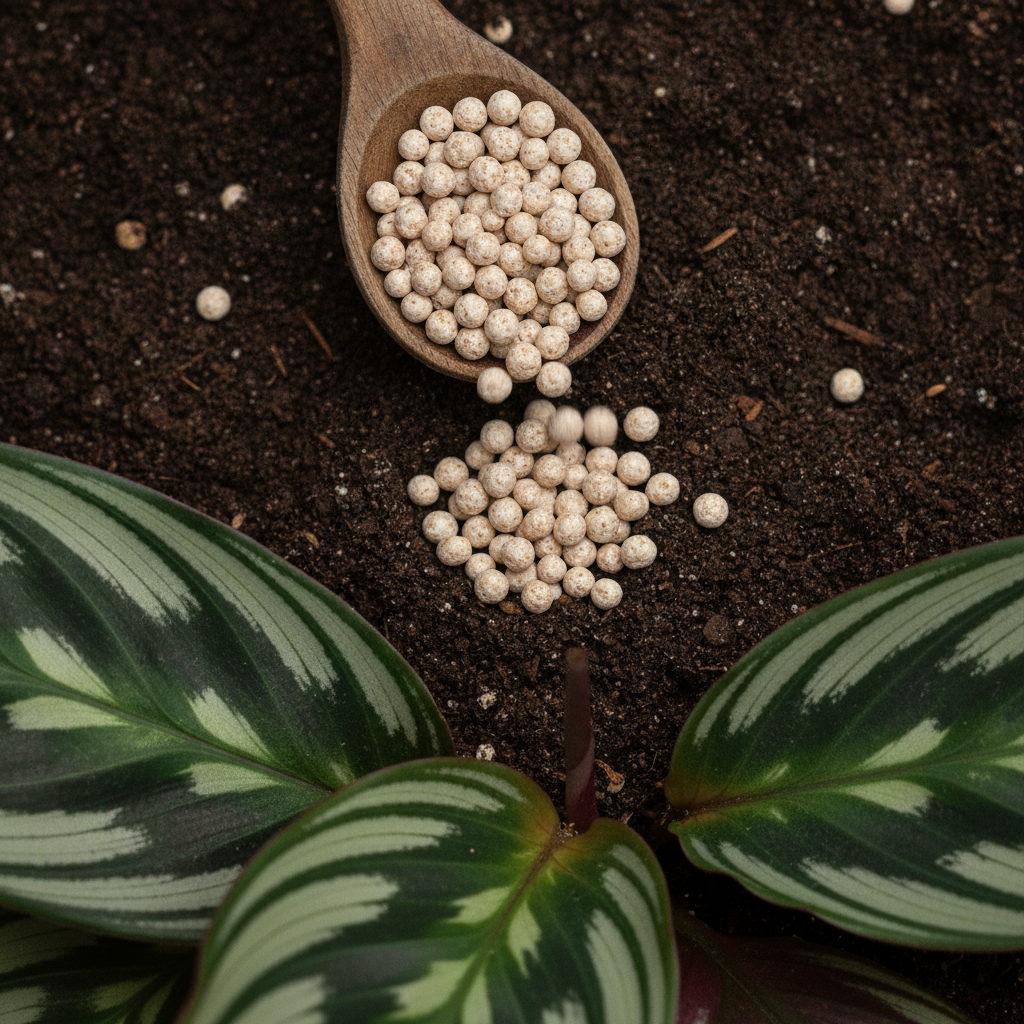
Slow-release granular: Small prills mixed into the soil surface that release nutrients gradually over months. Convenient and low-effort, though they surrender fine control over dosage, so use them at the lower end of the recommended rate.
Organic fertilisers: Worm castings, diluted seaweed extract and similar gentle feeds suit the Stromanthe well. They release nutrients slowly and are very difficult to over-apply, making them a forgiving choice for a sensitive plant.
Feeding Schedule
Feed every three to four weeks from spring through to the end of summer with a balanced liquid fertiliser diluted to half the recommended strength. As growth slows in autumn, taper off, and stop feeding entirely through winter when the plant is resting; fertilising a dormant plant simply leaves unused salts in the soil to burn the roots.
Pro Tip — Half Strength Always: When in doubt, dilute further. The White Star Stromanthe responds better to a weak feed given regularly than to a strong one given occasionally, and under-feeding is trivial to reverse while fertiliser burn takes months to grow out.
How to Fertilise
- Water the plant lightly first, so fertiliser is never applied to bone-dry soil where it can scorch the roots.
- Dilute a balanced liquid feed to half the label strength in low-mineral water.
- Apply evenly across the soil surface until it is moist but not flooded.
- Let any excess drain away and empty the saucer; never leave fertiliser-laden water standing.
- Every few months, flush the pot with plenty of plain water to wash out accumulated salts.
Warning — Salt Build-Up: A white crust on the soil surface or around the pot rim, combined with worsening brown leaf edges, signals accumulated fertiliser and mineral salts. Flush the soil thoroughly with several potfuls of low-mineral water to leach them out, and cut back on feeding.
Propagation
Propagating a White Star Stromanthe is one of the more satisfying jobs in its care calendar, but it comes with an important caveat: this plant cannot be grown from leaf or stem cuttings the way a pothos or a philodendron can. It has no aerial nodes to root, so the only reliable method is division of the clump, separating the rhizome into sections that each carry their own roots and shoots.
The best time to divide is in spring, ideally when you are already repotting, so the plant is disturbed only once. A healthy, established clump that has filled its pot and is pushing up several distinct growing points is the ideal candidate; a young or sparse plant is better left to bulk up for another season.
Understanding the Rhizome
The White Star spreads by means of a rhizome, a horizontal underground stem that produces new shoots and roots as it creeps outward. This is why a healthy plant slowly widens into a fuller clump over time, and it is exactly what makes division possible: each section of rhizome with attached roots and at least one growing shoot is effectively a complete young plant, ready to be potted on its own.
Division: Step-by-Step
Division is straightforward provided you are gentle and keep each section well supplied with roots. Work quickly so the exposed roots do not dry out.
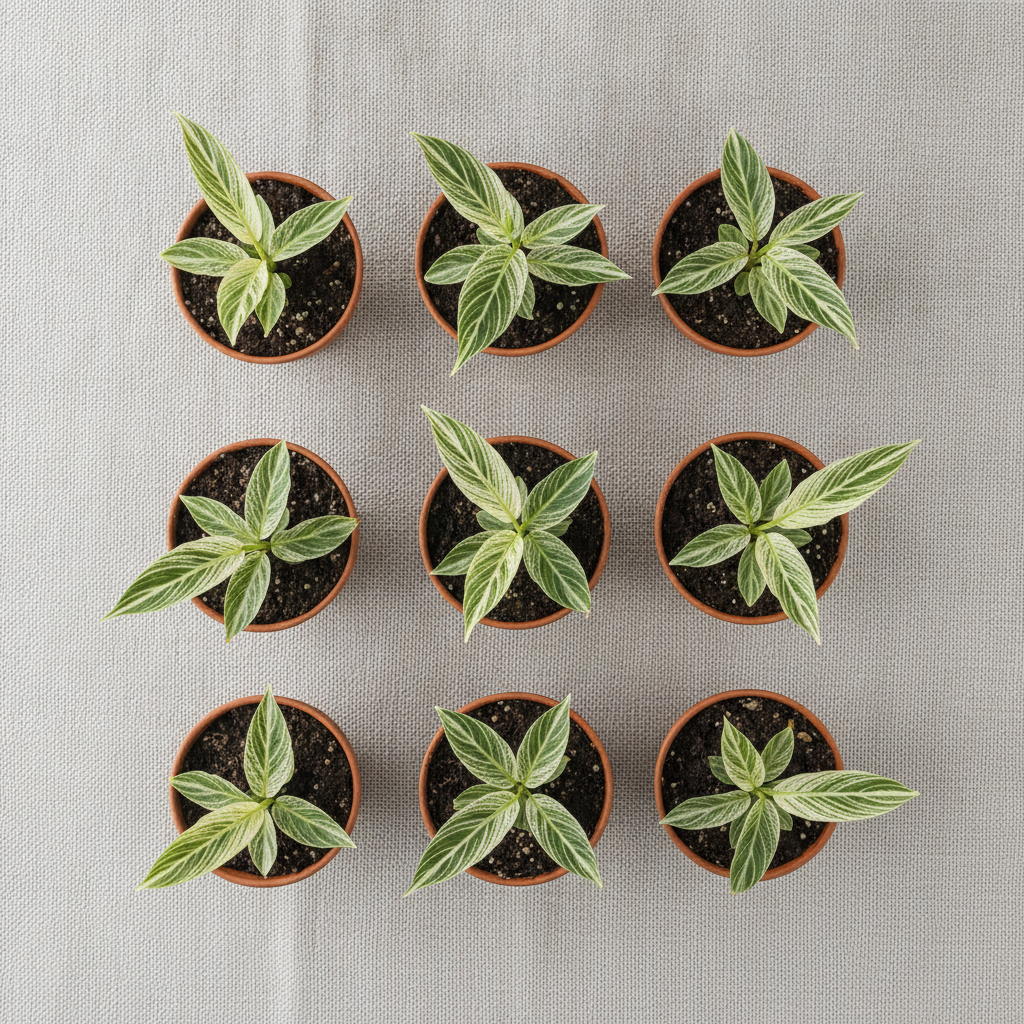
- Water the plant the day before and gather sterilised scissors, fresh mix and small pots.
- Slide the whole plant out of its pot and gently brush away enough soil to see the rhizome and root structure.
- Identify natural divisions where the clump separates into sections, each with its own roots and one or more shoots.
- Ease the sections apart by hand where you can; use sterilised scissors only where roots must be cut.
- Pot each division into its own small container of fresh, free-draining mix at its original depth.
- Water in with low-mineral water and place the new plants somewhere warm, bright and indirect.
Pro Tip — Cover for Humidity: Newly divided sections lose water faster than their reduced roots can replace it. Enclosing each pot loosely in a clear plastic bag or propagator for the first week or two keeps humidity high and dramatically improves establishment.
Aftercare: Step-by-Step
The first few weeks after division decide whether the new plants establish or stall, so consistency matters more than anything else during this period.
- Keep the soil lightly and evenly moist, never soggy, while new roots develop.
- Maintain high humidity around the divisions with a cover, humidifier or pebble tray.
- Provide bright but indirect light; direct sun stresses an already weakened plant.
- Hold off on fertiliser for four to six weeks until you see signs of fresh growth.
- Expect some drooping at first, and be patient; new shoots signal successful establishment.
Troubleshooting Propagation
| Problem | Likely Cause | Solution |
|---|---|---|
| Divisions wilt and collapse | Too few roots per section, or low humidity | Divide into fewer, larger sections; cover to raise humidity |
| No new growth for weeks | Normal establishment lag, or cold conditions | Keep warm and patient; growth resumes once roots settle |
| Rot at the base | Soil kept too wet after division | Reduce watering; ensure free-draining mix and drainage holes |
| Brown, crisping leaves | Dry air or exposed, drying roots | Increase humidity; work faster next time to protect roots |
Pests & Diseases
A well-kept White Star Stromanthe is reasonably resistant to pests, but the dry air that so easily damages its leaves also creates the conditions certain pests love. The single most common problem is spider mites, which thrive precisely when humidity is low, so the same care that keeps the foliage crisp also keeps the plant largely trouble-free.
Vigilance is the best defence. Inspect the undersides of the leaves regularly, since that is where most infestations begin, and treat any problem early while it is still confined to a leaf or two. Isolating a newly bought plant for a couple of weeks before it joins your collection prevents most outbreaks from ever taking hold.

Common Pests
Spider Mites (Tetranychus urticae)
By far the most likely pest on this plant, and a direct consequence of dry air. Look for fine pale stippling across the leaves, a faint dusty look, and delicate webbing in the leaf axils. In bad cases the foliage yellows and dries out. They are tiny, so damage usually shows before the mites themselves.
Treatment: Rinse the plant thoroughly, including leaf undersides, then treat with insecticidal soap or neem oil every five to seven days until clear. Crucially, raise the humidity, as mites cannot establish in the moist conditions the Stromanthe prefers anyway.
Mealybugs (Pseudococcus longispinus)
Small, soft-bodied insects that look like tufts of white cotton wool tucked into leaf joints and along stems. They feed on sap, weakening the plant and leaving behind sticky honeydew that can attract sooty mould.
Treatment: Dab each insect directly with a cotton bud dipped in isopropyl alcohol, then follow up with neem oil or insecticidal soap. Check regularly, as mealybugs hide well and often reappear from a missed cluster.
Fungus Gnats (Bradysia species)
Small black flies that hover around the soil surface, encouraged by the consistently moist compost this plant enjoys. The adults are merely a nuisance, but their larvae feed on organic matter and fine roots in the top layer of soil.
Treatment: Let the top layer of soil dry a little more between waterings, use yellow sticky traps to catch adults, and top-dress with a thin layer of horticultural grit or apply a biological control containing beneficial nematodes.
Common Diseases
Root Rot (Pythium and Phytophthora)
The most serious threat to a White Star Stromanthe, caused by waterlogged, airless soil in which fungal pathogens flourish. Above ground it shows as yellowing, wilting leaves on a plant whose soil is wet, often with a sour smell from the pot.
Treatment: Unpot the plant, cut away all brown, mushy roots with sterilised scissors, and repot into fresh, free-draining mix in a clean pot. Water more sparingly afterwards and always ensure drainage holes are clear.
Leaf Spot (various fungal and bacterial pathogens)
Brown or yellow spots, sometimes ringed with a paler halo, that appear when leaves stay wet for too long in still, humid air. It spreads through water splashing from leaf to leaf.
Treatment: Remove affected leaves, avoid wetting the foliage when watering, and improve air circulation around the plant. In persistent cases a copper-based fungicide can help bring it under control.
Pest and Disease Summary
| Pest / Disease | Identification | Treatment |
|---|---|---|
| Spider mites | Fine stippling, webbing, dusty leaves | Rinse, neem or insecticidal soap, raise humidity |
| Mealybugs | White cottony tufts in leaf joints | Alcohol on a cotton bud, then neem oil |
| Fungus gnats | Small flies over moist soil | Dry topsoil, sticky traps, nematodes |
| Root rot | Yellowing, wilting, wet sour soil | Trim rotten roots, repot, water less |
| Leaf spot | Brown or yellow ringed spots | Remove leaves, keep foliage dry, improve airflow |
Prevention Strategies
Prevention rests on the same conditions that keep the plant beautiful. Maintaining high humidity denies spider mites their opening, watering carefully into free-draining soil forestalls both root rot and fungus gnats, and good airflow keeps fungal leaf spot at bay. A plant kept in its preferred conditions is a plant that rarely troubles you.
Routine matters too. Wipe or rinse the leaves every few weeks to remove dust and dislodge any pests before they settle, inspect new arrivals in isolation, and check the undersides of leaves whenever you water. Catching a problem in its first week is the difference between a five-minute wipe-down and a month-long campaign.
Pro Tip — Neem as Maintenance: A light monthly spray of diluted neem oil across the leaves, especially the undersides, works as a gentle preventative that keeps spider mites and mealybugs from ever gaining a foothold. Apply it out of direct sun to avoid marking the leaves.
Popular Varieties
The White Star belongs to a small but striking group of Stromanthe sanguinea cultivars, all sharing the family trait of red-backed, nyctinastic leaves but differing markedly in how their variegation is arranged. Knowing the alternatives helps in choosing the look that suits you and in recognising what you actually have, since several are sold under overlapping names.
All of these relatives share the same care requirements, so anyone comfortable with the White Star can grow the rest with confidence. The differences are purely aesthetic, a matter of how boldly and in what pattern the cream, pink and green are distributed across the foliage.
| Variety | Leaf Appearance | Light Needs | Growth Rate | Availability |
|---|---|---|---|---|
| White Star | Heavy cream and white streaking, red underside | Bright indirect | Moderate | Uncommon |
| Triostar (Tricolor) | Cream, rose-pink and green, deep red reverse | Bright indirect | Moderate | Common |
| Magic Star | Dense white and green speckling, maroon reverse | Bright indirect | Moderate | Uncommon |
| Multicolor | Bold pink and cream patches, red underside | Bright indirect | Moderate | Rare |
| Species sanguinea | Plain glossy green, vivid red reverse | Medium to bright indirect | Moderate | Occasional |
Featured Varieties
Triostar
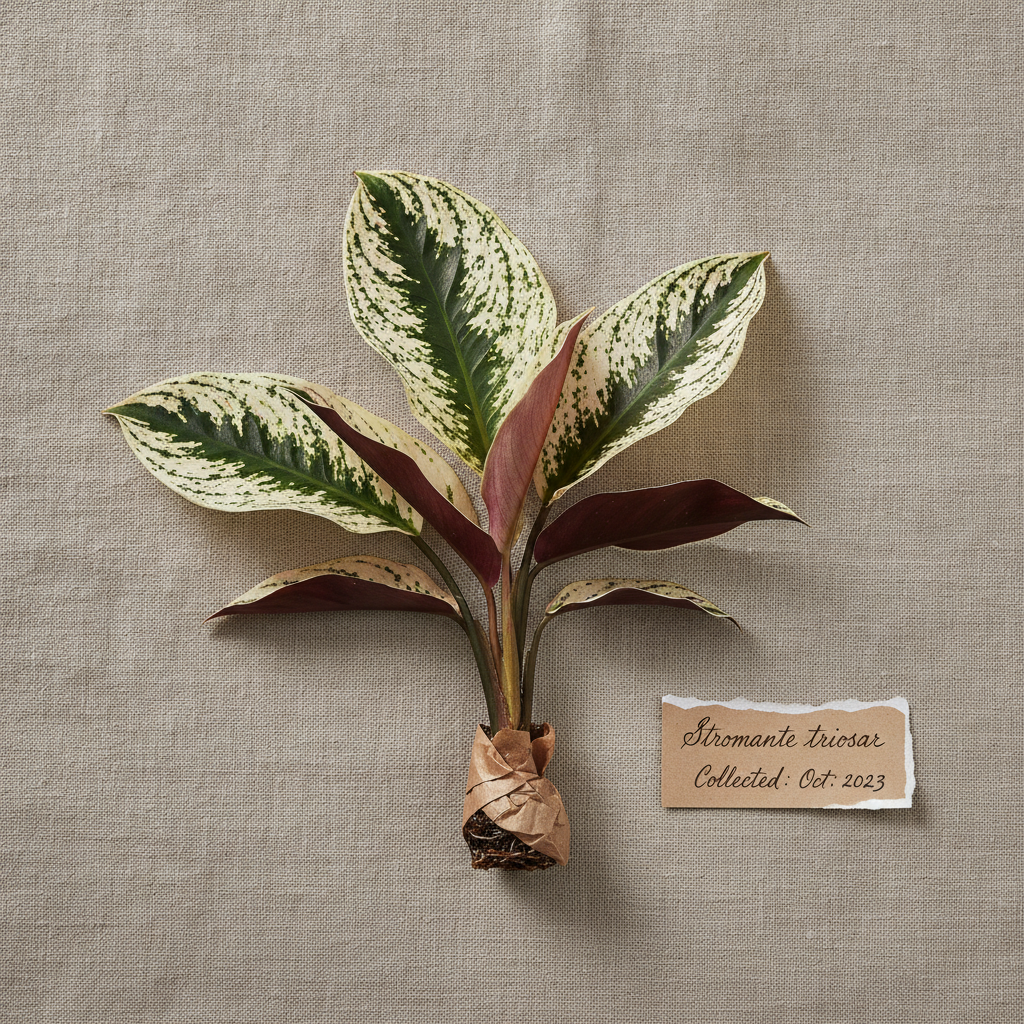
The most widely grown Stromanthe by far, prized for the rose-pink flush that layers over its cream and green variegation. Its broad, paddle-shaped leaves and vivid burgundy undersides make it the showiest member of the group.
Magic Star
A more finely detailed variegation, with leaves densely freckled and speckled in white and pale green rather than boldly splashed. It keeps the characteristic maroon reverse and forms a slightly more compact, textured clump.
Variety Profiles in Detail
Triostar (Stromanthe sanguinea ‘Triostar’)
Often sold simply as ‘Tricolor’, Triostar is the plant most people picture when they hear the name Stromanthe. Its variegation is bolder and pinker than the White Star’s, with wide bands of cream and rose sweeping across each green leaf, and it tends to be the easiest of the group to find in garden centres.
Magic Star (Stromanthe sanguinea ‘Magic Star’)
Where the White Star and Triostar paint in broad strokes, Magic Star works in fine detail, scattering white and pale green flecks densely across the leaf for an almost pointillist effect. It is less common in the trade but increasingly sought after by collectors who prize its subtlety.
Choosing the Right Variety for Your Space
For maximum impact and the easiest sourcing, Triostar is the natural choice, its pink-and-cream boldness reading clearly from across a room. The White Star offers a cooler, crisper palette of pure cream and white for those who prefer their variegation without the pink, while Magic Star rewards close viewing with its intricate speckling. Since every cultivar wants the same bright indirect light, high humidity and careful watering, the decision comes down entirely to which pattern you find most beautiful.
Frequently Asked Questions
Why are the edges of my White Star Stromanthe turning brown and crispy?
Brown, crispy edges are the plant’s most common complaint and almost always trace to one of three causes: low humidity, poor water quality, or inconsistent watering. Raise the humidity to 60 percent or more, switch to rainwater or distilled water to avoid fluoride and mineral salts, and keep the soil evenly moist. Addressing all three together usually resolves it.
Why does my Stromanthe fold its leaves up at night?
This nightly folding, called nyctinasty, is completely normal and a sign of a healthy plant. Like all members of the prayer plant family, the White Star raises its leaves at dusk, revealing their red undersides, and lowers them again at dawn. The movement is driven by changes in light and follows the plant’s internal clock.
Is the White Star Stromanthe safe for cats and dogs?
Yes. The White Star Stromanthe is non-toxic to cats, dogs and humans, and belongs to a plant family recognised as pet-safe. A pet that chews the leaves may still get a mild stomach upset from the fibre, so it is worth discouraging, but there is no risk of poisoning.
Why is my plant losing its white variegation?
Fading variegation, with new leaves emerging greener than the old ones, is a signal that the plant is not receiving enough light. The white sections cannot photosynthesise, so in dim conditions the plant produces greener foliage to survive. Move it to a brighter spot with strong indirect light, or add a grow light, and the bold patterning should return on new growth.
Can I propagate a White Star Stromanthe from a cutting?
No, this plant cannot be grown from a leaf or stem cutting the way many houseplants can, because it has no rooting nodes along its stems. The only reliable method is division, separating a mature clump into sections that each carry their own roots and shoots, ideally in spring while repotting.
How often should I water it?
Water when the top 2 to 3 cm (about 1 inch) of soil feels dry, keeping the deeper soil lightly moist. In a warm, bright home during the growing season this often works out to every four to seven days, but always check the soil rather than following a fixed schedule, and water less in winter when growth slows.
Why is my Stromanthe drooping?
Drooping can mean either thirst or excess water, so check the soil first. Dry soil with a wilting plant that perks up after watering means it was simply thirsty; wet soil with a drooping plant points to overwatering or root rot. Sudden temperature drops, cold draughts and recent repotting can also cause a temporary sulk.
What temperature does it need?
Keep it between 18 and 27 degrees Celsius (65 to 80 Fahrenheit), the warm, stable range of its rainforest home. Avoid temperatures below 15 degrees Celsius (59 Fahrenheit), and keep it well away from cold draughts, air-conditioning vents and radiators, all of which stress the plant and dry the leaves.






