
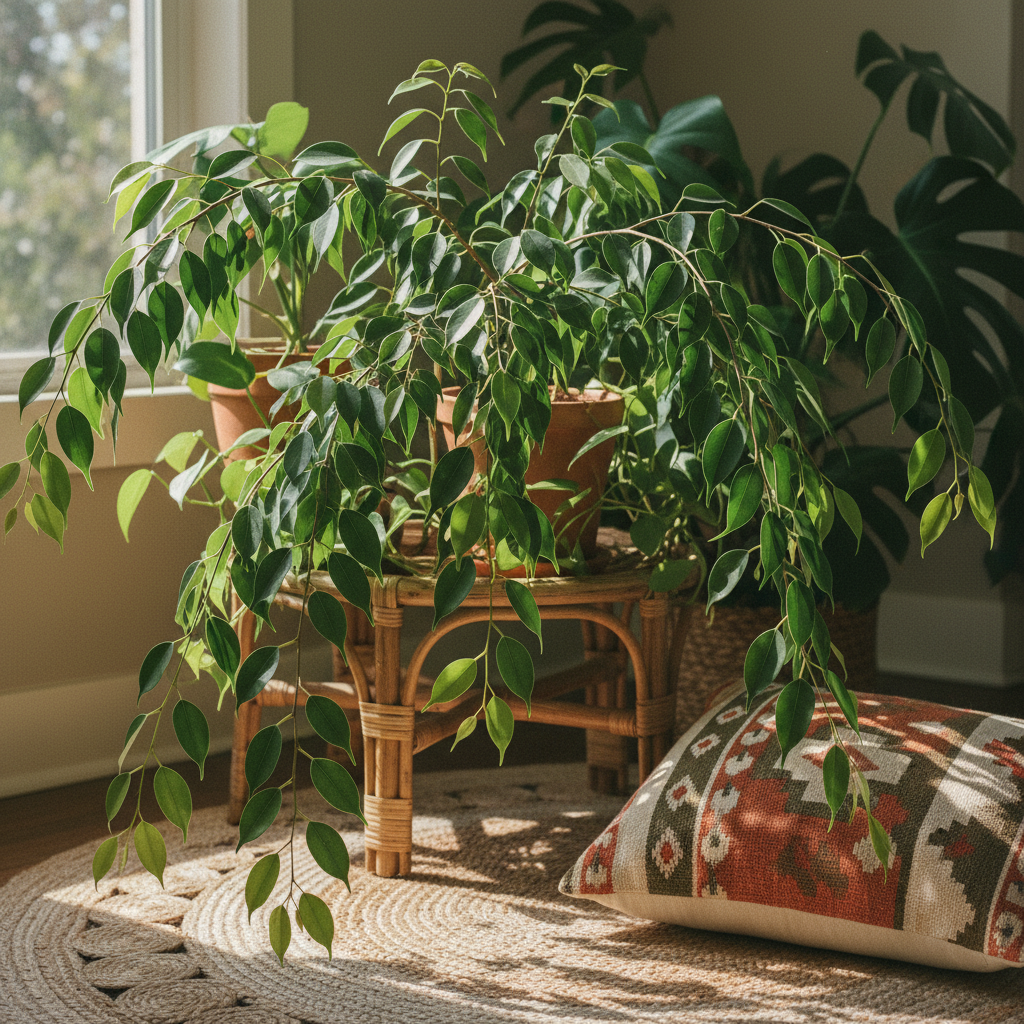
Few houseplants carry the architectural presence of a mature weeping fig. With its slender grey trunk, gracefully arching branches and dense canopy of small glossy leaves, Ficus benjamina reads less as a potted plant and more as a small indoor tree. Native to the warm humid forests of South and Southeast Asia, northern Australia and the southwest Pacific, it has been grown ornamentally for over a century and remains one of the most widely sold indoor trees in Europe and North America. Its cascading silhouette has graced hotel lobbies, office atriums and bright living rooms in roughly equal measure.
The weeping fig has a slightly contradictory reputation. On one hand it is undeniably beautiful, fast-growing and capable of living for decades indoors with minimal fuss. On the other it has earned a name as a dramatic plant that drops its leaves in a sudden shower at the merest hint of change: a new room, a draughty window, a missed watering. This guide aims to dissolve that mystery. The difference between a weeping fig that merely survives and one that thrives is not luck but consistency, and once you understand what the plant is actually responding to, you can give it a long stable life in your home.
Contents
- Quick Reference
- Why Weeping Fig Makes a Striking Houseplant
- Light Requirements
- Watering and Humidity
- Soil, Potting and Repotting
- Fertilising
- Propagation
- Pests and Diseases
- Popular Varieties
- Frequently Asked Questions
Quick Reference: Weeping Fig at a Glance
| Botanical name | Ficus benjamina |
| Family | Moraceae (mulberry family) |
| Native range | South and Southeast Asia, northern Australia, southwest Pacific |
| Mature indoor size | 1.5 to 3 metres (5 to 10 feet) tall, occasionally taller in atria |
| Light | Bright indirect light, tolerates a few hours of soft morning sun |
| Watering | Water thoroughly when the top 2 to 3 cm (1 inch) of soil is dry; reduce in winter |
| Temperature | 18 to 24 °C (65 to 75 °F); avoid drops below 13 °C (55 °F) and cold draughts |
| Humidity | 50 percent or higher; tolerates 40 percent if airflow is gentle |
| Fertiliser | Balanced liquid feed at half strength every two to four weeks in spring and summer |
| Soil | Free-draining loam-based mix with bark and perlite, slightly acidic (pH 6.0 to 6.5) |
| Propagation | Stem cuttings in water or soil; air layering for thicker stems |
| Toxicity | Mildly toxic to cats, dogs and humans; latex sap can cause skin and eye irritation |
Why Weeping Fig Makes a Striking Houseplant
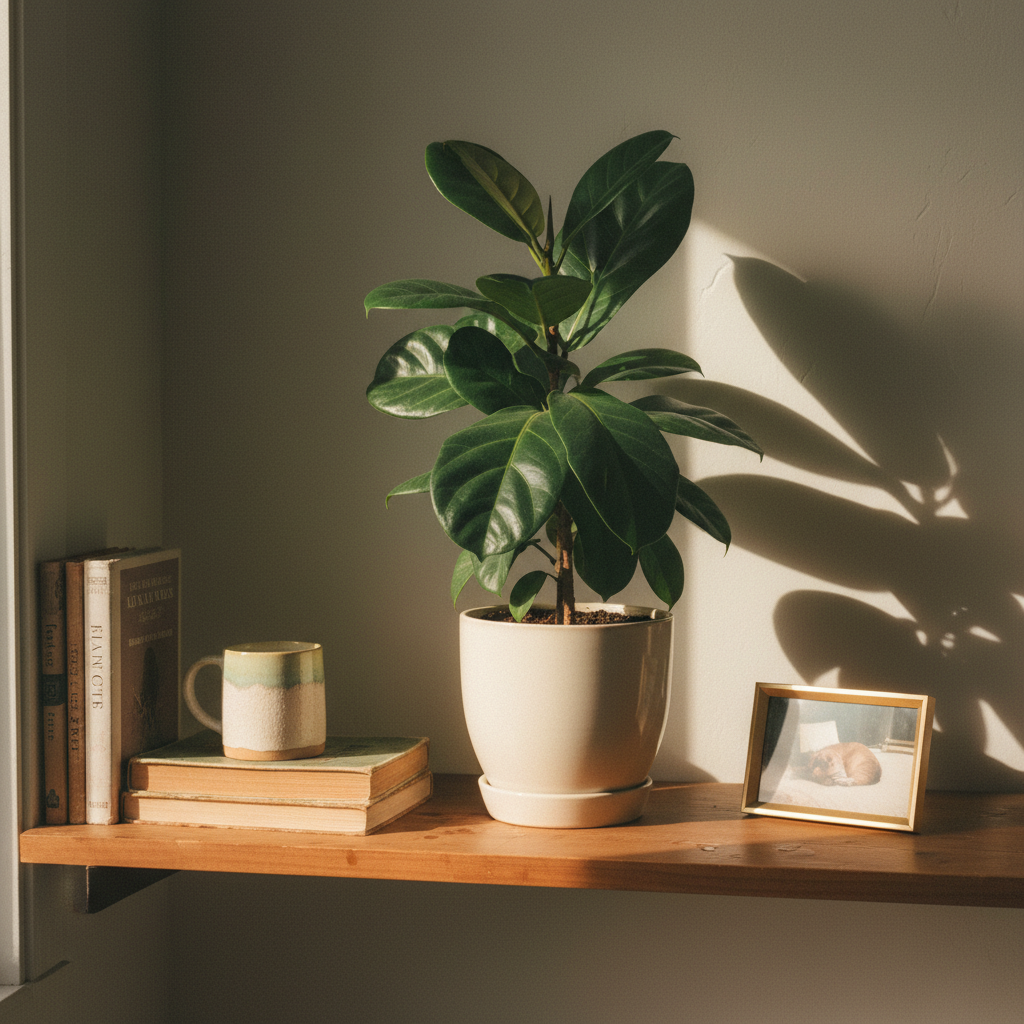
The weeping fig earns its place as a houseplant in three distinct ways: scale, texture and longevity. Few easily obtainable plants give you a true tree silhouette indoors, and fewer still combine that scale with the fine, almost lace-like texture of the canopy. A well-grown specimen casts beautiful dappled shadows across a wall, softens hard architectural lines and brings vertical interest to rooms that other houseplants simply cannot fill. Many specimens in private collections are over thirty years old, and a fig given the right conditions will easily outlive the furniture around it.
The second reason for its enduring popularity is botanical. The weeping fig belongs to the same genus as the common edible fig and the famous strangler figs of tropical forests. In the wild it grows as a large evergreen tree reaching twenty to thirty metres, often beginning life as an epiphyte high in another tree before sending aerial roots down to the forest floor. Indoors it cannot reach anything like that scale, but it retains the genus’s characteristic vigour: leaves replenish constantly, branches respond enthusiastically to pruning and the plant has an almost architectural will to fill the space available to it. With training and patience a weeping fig can be braided, espaliered or shaped into bonsai. It is, in other words, a houseplant that rewards being styled rather than simply placed.
Where the weeping fig’s reputation suffers is in its sensitivity to change. Move a fig from a south window to a north one and within a fortnight you may see a carpet of yellow leaves around the pot. This is not the plant dying. It is the fig recalibrating its leaf budget to match the new light level, dropping older leaves it can no longer afford to maintain and growing new ones suited to current conditions. Understanding this behaviour, rather than panicking at it, is the single biggest mental shift required to grow this plant well.
Important — Toxicity: All parts of Ficus benjamina contain a milky latex sap that is mildly toxic to cats, dogs and humans, and a recognised contact allergen. The sap can cause skin rash, eye irritation and, in sensitive individuals, respiratory symptoms from airborne particles of dried latex. Wash hands and tools after pruning, keep cuttings out of reach of pets and small children, and avoid the plant if anyone in the household has a latex allergy.
Light Requirements
Light is by far the most important variable in keeping a weeping fig happy. In its native forests the plant grows in bright dappled positions at the canopy edge, receiving filtered sun for much of the day. The closer you can recreate that indoors, the more comfortable the plant will be. The phrase “bright indirect light” gets used so often in houseplant writing that it loses meaning, so it helps to be specific: the ideal spot for a weeping fig is one where you could comfortably read a book at midday without artificial light, with a window visible from the plant’s position.
A weeping fig in too little light does not die quickly. It thins. The interior canopy yellows and drops first, the new growth at the tips becomes paler and more spaced out along the stems, and within a season the plant takes on an etiolated, leggy look. Move that same plant to a bright window and it will recover, but it will do so by dropping yet more leaves before pushing fresh ones suited to the new light level. This is why moving figs around the house is generally a bad idea: each change costs the plant a round of leaves and a recovery period of several weeks.

Light Levels Explained
Most houseplant writing reduces light to a vague adjective: bright, medium, low. In practice it is more useful to think in approximate lux, the standard photographic measure of light intensity that any modern phone camera app can estimate within a reasonable margin. The table below maps the categories used in this guide to the lux ranges and the household locations that typically supply them, along with what to expect from a weeping fig in each.
| Light Category | Approx. Level | Typical Location | Outcome for Weeping Fig |
|---|---|---|---|
| Direct sun | 30,000 lux and above | Directly in an unshaded south or west window in summer | Risk of leaf scorch, especially on variegated cultivars; leaves can curl and crisp |
| Bright indirect | 10,000 to 20,000 lux | One to two metres back from a south window, or directly at an east window | Ideal: lush dense canopy, steady new growth, strong stem development |
| Medium indirect | 2,500 to 10,000 lux | Several metres back from a bright window, or directly at a north window in summer | Survives well; slower growth, slightly thinner canopy, less variegation contrast |
| Low | 500 to 2,500 lux | Interior wall well away from any window | Gradual leaf drop, leggy growth; the plant lingers rather than thrives |
| Very low | Under 500 lux | Dim hallway or windowless room | Steady decline; weeping fig is not a true low-light plant despite frequent claims |
Window Orientation and Placement
South-facing window: An excellent location in winter and in temperate climates year-round, provided the plant sits one to two metres back from the glass or behind a sheer curtain. Pressed directly against a south window in summer, the leaves of even the species form can burn, and variegated cultivars such as ‘Starlight’ will scorch within days. The intense radiant heat is also drying and stresses the plant in ways that are easy to mistake for underwatering.
East-facing window: Arguably the perfect position. The plant receives a few hours of gentle morning sun that is rarely strong enough to scorch, followed by bright indirect light through the rest of the day. East-facing rooms tend to be cooler in the afternoon, which the plant appreciates, and the consistent quality of light promotes dense even canopy growth.
West-facing window: Workable but more demanding. Late afternoon sun in summer can be punishing, particularly through modern double glazing that traps heat. A sheer curtain or a position one to two metres back makes a west window comfortable, and the warm light tends to bring out the best colour in golden-green cultivars.
North-facing window: Marginal. In summer, when daylight is long and overcast skies still deliver enough diffused light, a north window can keep a fig stable. Through winter, however, light levels at a north window fall well into the low category and the plant will respond with leaf drop. If a north window is your only option, supplementing with a grow lamp from October to March makes a significant difference.
Pro Tip — Mark the Pot: Once you have found the position where your fig is happy, mark the front of the pot with a small piece of tape and always replace it with the same side facing the window after watering or dusting. Figs respond to even small rotations by adjusting leaf orientation, and that adjustment costs energy. Keeping the orientation constant cuts down on unnecessary leaf turnover.
How Light Affects Canopy Density and Variegation
Two visible features of the weeping fig respond directly to light: the density of the canopy and, in variegated cultivars, the contrast between the cream and green portions of each leaf. In bright indirect conditions, internodes stay short, new leaves emerge close to existing ones and the canopy fills in. In dimmer light the plant stretches: stems elongate between leaves, leaving visible bare wood and producing the leggy thinning look that gardeners describe as a fig that has “given up”. Variegated cultivars also produce more chlorophyll under low light, gradually losing the cream margins that make them desirable. A ‘Starlight’ kept in a dim corner for a year often looks like an entirely different plant by the end of it.
Warning — Direct Sunlight: Pressing a weeping fig directly against a south or west window through a summer afternoon, especially in a closed sunroom or behind glass that amplifies heat, can cause leaf scorch within a single day. Scorched leaves develop pale bleached patches that quickly turn brown and crisp, and they do not recover. Always introduce a fig to brighter conditions gradually, over two to three weeks, particularly when bringing it home from a shaded nursery setting.
Artificial Lighting
Weeping fig responds well to supplementary lighting and can be grown almost entirely under full-spectrum LED panels if necessary. A panel rated at around 30 to 50 watts of actual draw, positioned 60 to 90 cm above the canopy and run for twelve to fourteen hours a day, comfortably substitutes for a bright indirect window. In rooms where natural light is borderline, even running a small supplementary lamp for four to six hours in the evening can be enough to prevent winter leaf drop. Modern horticultural LEDs no longer have to look magenta: warm-white-balanced panels are widely available and look acceptable as part of normal interior lighting.
Seasonal Adjustments
Light levels in temperate latitudes drop dramatically from October to March, often by a factor of three or four even at the same window. Many weeping figs that look perfectly content through the summer begin shedding leaves in late autumn for no reason that the owner can identify, and the reason is almost always seasonal light decline. Anticipating this by moving the plant closer to its window for the winter, or adding a grow lamp before symptoms appear, prevents the cycle. If a plant must be moved seasonally, do it gradually over a fortnight rather than overnight, and accept that even a careful transition may cost the plant some leaves.
Watering and Humidity
Watering is the second great variable in weeping fig care and, like light, it rewards consistency above all else. The plant prefers an evenly moist root zone that never quite dries out completely and never sits saturated. Both extremes provoke leaf drop, and chronic alternation between them is the single most common cause of an unhappy fig. The aim is a steady rhythm: water thoroughly, allow the upper soil to dry by a couple of centimetres, water again. Skip the cycle for too long and the plant defoliates from drought; tighten the cycle to keep the soil constantly wet and the roots begin to fail.
When to Water
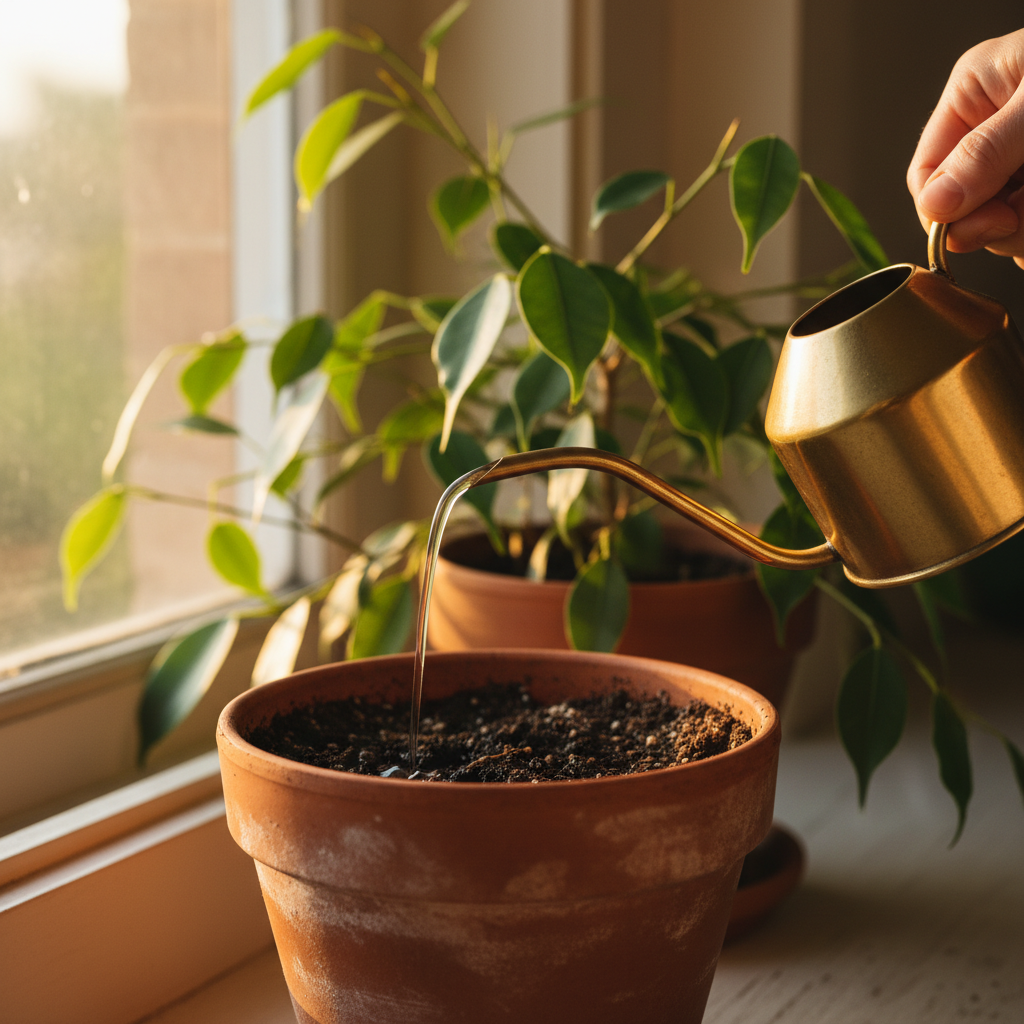
The simplest reliable test is the finger test: push a finger into the soil up to the second knuckle. If the top 2 to 3 cm (about an inch) feels dry and the soil deeper down feels barely cool and slightly damp, it is time to water. If the surface still feels moist, wait one to two days and test again. A wooden chopstick or a moisture meter can do the same job for larger pots where a finger does not reach far enough to be useful. The lift test is even more reliable for experienced growers: a freshly watered pot is heavy, a pot ready for water is noticeably lighter.
How often this translates to in days depends entirely on conditions. A weeping fig in a bright warm room in midsummer might want water every five to seven days. The same plant in a cool dim winter room might want water every two to three weeks. Watering on a fixed schedule, regardless of how the soil actually feels, is the most common watering mistake, and it is the reason figs decline in winter when their owners continue a summer routine that is now far too frequent.
Pro Tip — Tepid Water Only: Cold water straight from the tap, especially in winter, briefly chills the root zone and provokes the plant to shed leaves in protest. A jug of water left to stand for a few hours, or warm water tempered with a splash of hot, both reach room temperature and avoid the shock. The same jug also gives chlorine from municipal supplies a chance to dissipate, which the plant appreciates over time.
How to Water Correctly
- Check the soil with finger, chopstick or moisture meter to confirm the top 2 to 3 cm is dry.
- Move the plant to a sink or bath if portable, or place a deep saucer under it if not.
- Pour tepid water slowly around the rim of the pot, working in a circle so the entire surface receives water rather than channelling down one side.
- Continue until water runs freely from the drainage holes; this confirms the whole rootball has been wetted, not just the top.
- Allow the pot to drain for ten to fifteen minutes before returning it to its decorative cachepot or saucer.
- Empty any standing water from the saucer or cachepot within thirty minutes; figs strongly dislike sitting in water.
Signs of Overwatering vs. Underwatering
One of the difficulties with weeping fig is that overwatering and underwatering can produce surprisingly similar symptoms: yellow leaves, leaf drop and a generally unhappy plant. The table below isolates the differences that matter for diagnosis, so you can tell which problem you actually have before adjusting your routine.
| Symptom Category | Overwatering | Underwatering |
|---|---|---|
| Leaf colour | Yellowing begins at the lower interior canopy, often uniform across each leaf | Yellowing tends to start at leaf margins and tips, sometimes with brown crisping |
| Leaf texture | Soft, limp leaves that fall easily at the slightest touch | Crisp, dry, slightly curled leaves that hold on the plant before dropping |
| Soil | Stays wet for a week or more after watering, may smell sour | Pulls away from the sides of the pot, water runs straight through without absorbing |
| Roots (if visible) | Brown, mushy, sometimes black; healthy roots are pale tan and firm | Dry, brittle, often broken; rootball may be visibly shrunken |
| Stem base | Soft or spongy at soil level, sometimes with mould | Firm and woody; the plant looks shrivelled rather than rotten |
Warning — Root Rot: Once a weeping fig develops root rot, the plant cannot recover without intervention. Symptoms include sudden wholesale leaf drop, a sour smell at the soil surface, dark stains seeping from the drainage holes and a soft trunk base. Unpot immediately, wash the roots clean, cut away every brown or black root with sterilised scissors, and repot into entirely fresh free-draining mix in a clean pot. Withhold water for a few days, then resume with extreme moderation. Expect significant further leaf drop as the plant rebalances, and accept that some specimens are too far gone to save.
Humidity Requirements
Weeping fig comes from humid tropical and subtropical forests where ambient humidity rarely falls below 60 percent. Indoors it copes well with average household humidity of around 40 to 50 percent, but it visibly prefers anything higher. Modern homes, particularly in winter when central heating runs continuously, can dip as low as 20 to 30 percent humidity, and at those levels the plant suffers. The leaves remain functional but margin browning, leaf drop and a heightened susceptibility to spider mites all increase.
The classic signs of humidity stress are brown crisp leaf tips, dust-like webbing in the leaf axils (indicating spider mites taking advantage), and a general dullness to the foliage that no amount of leaf-cleaning seems to restore. None of these are individually conclusive — they overlap with watering issues and underfeeding — but in combination they point firmly at dry air. A small hygrometer is a worthwhile investment for any home where indoor plants live; many cost less than a single replacement fig.
Raising humidity around a fig need not be elaborate. Grouping plants together creates a microclimate measurably more humid than the surrounding room. Standing the pot on a tray of pebbles topped up with water allows continuous slow evaporation around the base of the plant. For homes that run very dry, an ultrasonic cool-mist humidifier on a timer is the most effective option, and a single small unit is usually enough for a corner with two or three plants. Misting the leaves directly is satisfying but short-lived; the humidity boost lasts minutes rather than hours, and on cool damp leaves it can encourage fungal spotting if airflow is poor.
Water Quality
Weeping fig is moderately sensitive to water chemistry, less so than calatheas or carnivorous plants but more than the average aroid. Heavily chlorinated tap water can cause leaf-tip browning over time, and very hard water leaves visible mineral spots on the leaves and a chalky crust at the soil surface. Rainwater is ideal where it can be collected cleanly. Filtered water, or tap water left to stand uncovered overnight so that volatile chlorine dissipates, works well as a default. Distilled water and reverse-osmosis water are unnecessary for this plant unless your tap supply is genuinely problematic; both lack the trace minerals that figs use, and exclusive use can lead to slow nutrient imbalances without compensatory feeding.
Soil, Potting and Repotting
The soil a weeping fig grows in shapes almost every other aspect of its care. A dense water-retentive mix forces you to water more cautiously and increases the risk of root rot. A free-draining, airy mix forgives the occasional overwatering and lets the roots breathe. Because figs are usually grown for years in the same pot before repotting, choosing the right substrate at planting time has consequences that play out across the entire life of the plant in your home.
Ideal Soil Composition
The textbook description of a weeping fig substrate is a loam-based mix amended with bark and a coarse aerator. In practice this means starting with a quality houseplant or container potting compost and adding enough chunky material to lift the structure and prevent compaction. The plant tolerates a fairly wide range of mixes provided two conditions are met: water passes through without pooling, and the substrate does not collapse into a dense block after a year of use.
| Component | Proportion | Function |
|---|---|---|
| Quality houseplant potting compost | 60 percent | Provides body, water retention and the bulk of nutrient holding capacity |
| Fine orchid bark or composted bark | 20 percent | Creates lasting air pockets, prevents compaction, mimics forest floor |
| Perlite or pumice | 15 percent | Drainage and aeration; pumice is preferable in larger pots for weight |
| Worm castings or composted bark fines | 5 percent | Slow-release nutrition, beneficial microbes, gentle structure |
Weeping fig prefers a mildly acidic to neutral soil, ideally between pH 6.0 and 6.5. Most commercial peat-based composts sit naturally in this range, as do peat-free coir-based mixes. Hard water over time pushes the soil pH upward, which can lock out iron and lead to characteristic interveinal yellowing on new leaves; an occasional flush with rainwater or filtered water helps reset that drift.
Pro Tip — Quick Mix Recipe: If you want a simple repeatable formula, combine three large scoops of a peat-free houseplant compost, one scoop of fine orchid bark, one scoop of perlite or pumice, and a generous handful of worm castings per ten litres of finished mix. Stir thoroughly in a tub, moisten lightly with tepid water until it just holds together when squeezed, and use immediately. This same mix works equally well for most ficus species, scheffleras and small indoor trees.
Choosing the Right Pot
The pot you choose for a weeping fig has structural, practical and aesthetic consequences. Larger specimens are top-heavy and benefit from a substantial weighty pot for stability; a tall thin pot may look elegant but will tip the first time the cat decides to investigate. Heavy ceramic, terracotta and concrete all work well for figs over a metre tall. Plastic nursery pots are perfectly adequate for younger plants and have the advantage of being easy to slip inside a more decorative cachepot.
Drainage holes are non-negotiable. A weeping fig planted directly into a pot with no drainage holes will eventually succumb to root rot regardless of how carefully you water. If you fall in love with a decorative pot that lacks drainage, use it as a cachepot: keep the plant in a smaller nursery pot inside it and lift the inner pot out for watering. The same principle applies to terracotta with the drainage hole sealed by a flat saucer underneath; always elevate the pot slightly on small feet or stones to keep the drainage hole clear.
Pot material: Terracotta is breathable and dries the substrate from the sides as well as the top, which suits growers prone to overwatering but requires more frequent attention in summer. Glazed ceramic and plastic both hold moisture longer, which suits growers in warm dry rooms or those who travel often. Whatever the material, avoid extremely tall narrow pots; figs root broadly and prefer a wider footprint to a deeper one.
Pot size: Move up in modest steps when repotting. A new pot 2 to 4 cm wider in diameter than the previous one is usually right. Jumping from a small pot to one twice the size leaves a large volume of soggy unrooted substrate around the plant, and this is one of the most reliable ways to drown a fig that was otherwise doing well.
When to Repot
Weeping fig prefers to be slightly snug in its pot rather than swimming in fresh substrate, and most specimens are happy to be repotted only every two to three years. The clearest sign that repotting is overdue is roots circling the surface of the soil or escaping through the drainage holes. Other indicators include water running straight through the pot without soaking in (because the rootball has displaced most of the soil), and the plant drying out alarmingly quickly between waterings. Plan repotting for spring, when the plant is moving into active growth and best able to recover from the disturbance.
How to Repot: Step-by-Step
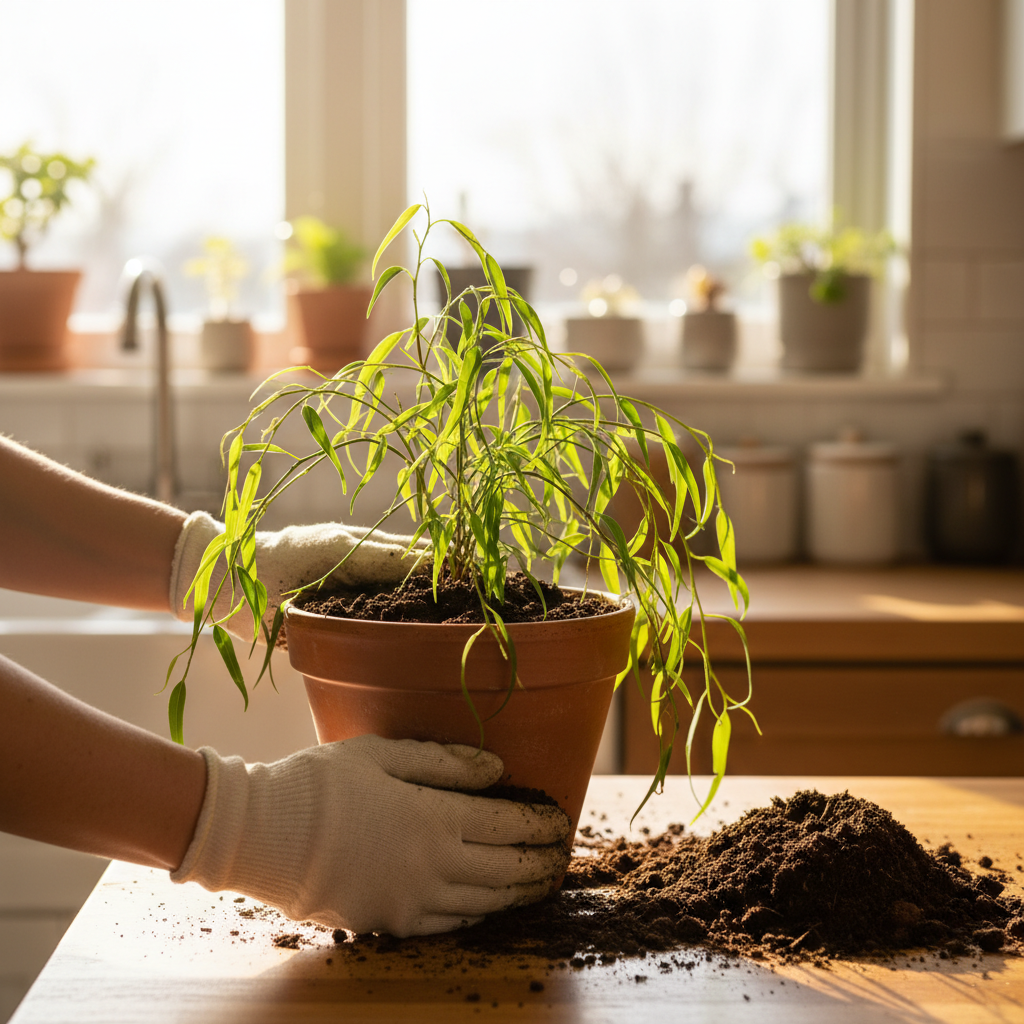
- Water the plant lightly the day before; a slightly damp rootball slides out of the pot more cleanly than a bone-dry one.
- Prepare the new pot by laying a small piece of mesh or broken crock over each drainage hole and adding a shallow layer of fresh mix to the base.
- Lay the plant on its side and ease the rootball out of the old pot, supporting the trunk near soil level rather than pulling on the canopy.
- Tease loose the outer 1 to 2 cm of roots with your fingers; trim any blackened or mushy sections cleanly with sterilised scissors.
- Position the plant in the new pot at the same depth as before, then backfill with fresh mix around the sides, gently firming as you go.
- Leave a clear 2 to 3 cm gap between the soil surface and the rim of the pot, so water has room to pool and soak in rather than overflowing.
- Water thoroughly with tepid water, allow to drain, and return the plant to its usual position. Withhold fertiliser for four to six weeks.
Warning — Transplant Shock: Weeping fig is famously prone to shedding leaves after repotting, even when the process has been done flawlessly. Some leaf drop in the two to four weeks following a repot is normal and not a sign that you have done anything wrong. Resist the urge to compensate by watering more or feeding heavily; both will make the situation worse. Hold the plant at its usual light level, water only when the top of the soil is dry, and let it settle. New growth typically resumes within six to eight weeks.
Fertilising
Weeping fig is a moderate to heavy feeder by houseplant standards, simply because it grows continuously through the spring and summer and produces a great deal of leaf tissue in the process. Underfed figs do not usually die, but they thin out, lose colour and stop putting on visible new growth, all while continuing to drop older leaves at a normal pace. The net effect is a slow shrinking plant, and the cause is almost always nutritional rather than dramatic.
At the same time, weeping fig is sensitive to fertiliser burn, and a heavy hand with a strong feed can scorch root tips within a single watering. The reliable approach is little and often, at concentrations well below what the bottle recommends, and a hard stop on feeding through the dark months when growth pauses. With those two principles in place, fertilising figs is straightforward.
Understanding Plant Nutrients
Plant fertilisers are typically labelled with three numbers, the N-P-K ratio, indicating the percentage by weight of nitrogen, phosphorus and potassium. For weeping fig and most foliage houseplants, a balanced ratio close to equal in all three (such as 10-10-10 or 7-7-7) works well, with a slight tilt toward nitrogen during active leaf production. The trace nutrients listed in fine print on the bottle, particularly iron, magnesium and calcium, also matter for figs and tend to be the first things to run short under certain water conditions.
| Nutrient | Symbol | Primary Function | Deficiency Symptoms in Weeping Fig |
|---|---|---|---|
| Nitrogen | N | Leaf and stem growth, chlorophyll production | Uniform pale yellowing of older leaves, slow new growth |
| Phosphorus | P | Root development, energy transfer, stem strength | Stunted root system, dull dark-green leaves with purplish tinge |
| Potassium | K | Overall vigour, disease resistance, water regulation | Brown crisp leaf margins, weak floppy new stems |
| Calcium | Ca | Cell wall structure, new leaf integrity | Distorted or cupped new growth, blackened leaf tips |
| Magnesium | Mg | Central component of the chlorophyll molecule | Yellowing between leaf veins on older leaves, veins stay green |
| Iron | Fe | Chlorophyll synthesis in new growth | Yellowing between veins on newest leaves, often after hard-water use |
Types of Fertiliser
Liquid fertilisers: The most flexible option for weeping fig. A balanced liquid feed diluted to half the recommended strength and applied with every second or third watering through spring and summer matches the plant’s appetite without overwhelming it. Liquid feeds are easy to dial up or down as the plant’s response indicates, and easy to flush from the soil if you apply too much.
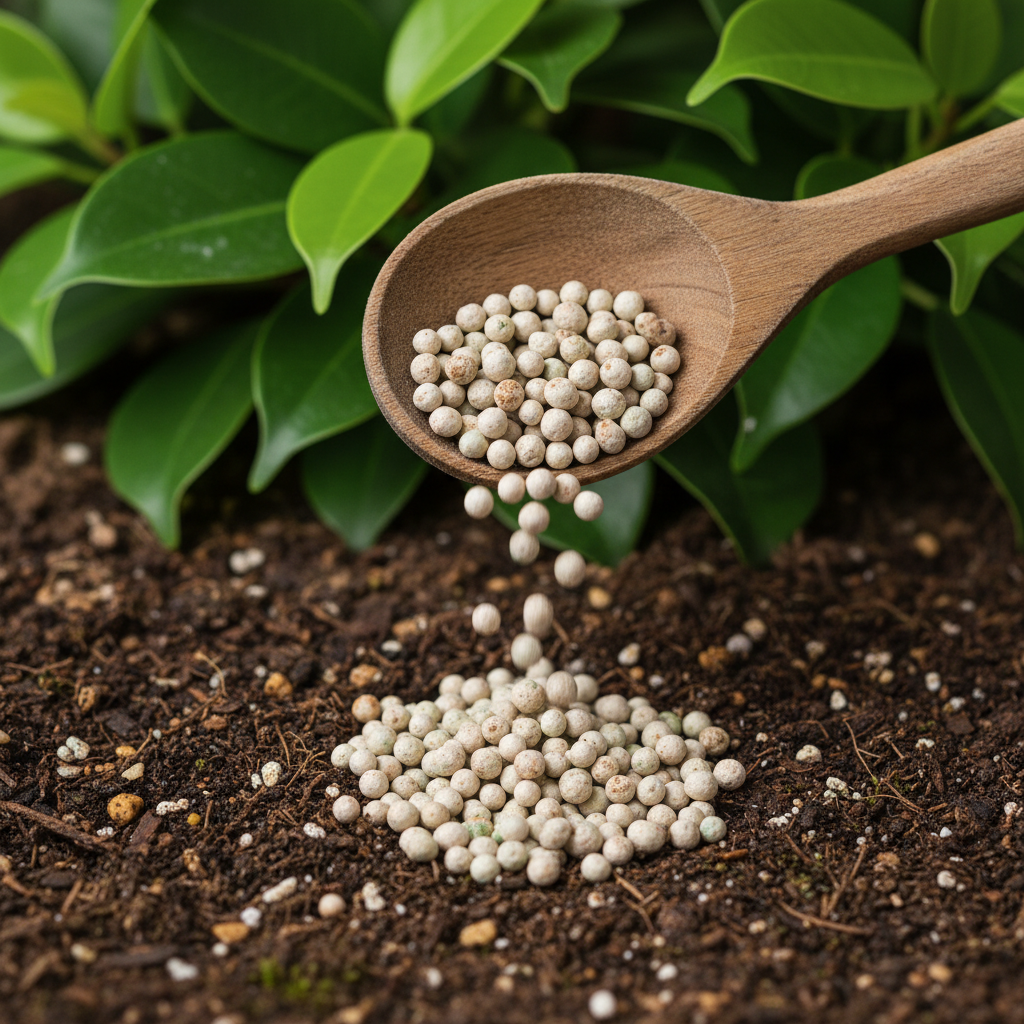
Slow-release granular: A coated-prill slow-release fertiliser scattered onto the soil surface in early spring releases nutrients gradually with each watering for three to six months, depending on the brand. This suits growers who travel often or simply prefer not to think about feeding week to week. The trade-off is less control; once the prills are down, you cannot easily reverse a heavy application, and the steady release continues into autumn whether the plant wants the food or not.
Organic fertilisers: Worm castings, compost tea and seaweed-based feeds are gentle, slow and rich in trace elements. They suit figs particularly well because the release rate is so gradual that fertiliser burn is essentially impossible. The downside is that they work slowly and may not provide enough nitrogen for a fig in a real growth flush; combining a base layer of worm castings with periodic dilute liquid feed is a reliable hybrid approach.
Feeding Schedule
A workable default schedule for weeping fig is as follows. From early March through early September, feed with a balanced liquid fertiliser at half the recommended strength every two to four weeks, applied to already-moist soil rather than dry. From mid-September through late February, stop feeding entirely; the plant’s growth slows in step with falling light, and continuing to push fertiliser onto roots that are not actively taking it up causes salt build-up in the substrate. Resume gradually in spring as you see fresh growth emerging.
Pro Tip — Less Is Almost Always More: A weeping fig fed at one-quarter strength every week will almost always outperform the same plant fed at full strength once a month. The lower concentration delivers steady gentle nutrition and avoids osmotic spikes around the roots. If in doubt about strength, err on the dilute side; you can always feed again sooner, but you cannot easily undo a heavy dose.
How to Fertilise
- Always water the plant first, or apply the feed to soil that is already lightly moist. Liquid fertiliser on dry soil can burn the fine feeder roots near the surface.
- Mix the liquid feed in a watering can according to the strength you have chosen, typically half the manufacturer’s recommended concentration.
- Pour evenly around the soil surface, avoiding splashing onto the leaves; rinse any droplets that land on foliage to prevent leaf spotting.
- Allow excess to drain freely from the pot and discard any that collects in the saucer rather than letting the plant reabsorb it.
- Every three or four months, water with plain water alone to flush accumulated salts through the substrate and out of the drainage holes.
Warning — Salt Build-Up: A white or yellow crust on the soil surface or around the pot rim, combined with browning leaf tips that creep inward over time, is the classic sign of accumulated fertiliser salts. The remedy is to flush the soil thoroughly: take the pot to the sink, run tepid water slowly through it for several minutes until the volume that has passed through is roughly four to five times the pot’s volume, then allow to drain. Repeat once a year as preventative maintenance for plants on a regular feeding schedule.
Propagation
Weeping fig is one of the more rewarding houseplants to propagate, partly because it strikes readily from cuttings and partly because the resulting baby plants grow visibly faster than many other indoor trees. A successful propagation gives you a backup of a favourite specimen, a way to bulk up a thin canopy by replanting rooted cuttings into the parent’s own pot, or simply a plant to gift to someone else without spending the price of a nursery specimen.
The two reliable methods are stem cuttings, suitable for almost any specimen with new growth to spare, and air layering, which is the method of choice when you want to produce a thicker more mature-looking plant without waiting years. Both methods produce genetically identical clones of the parent, which matters particularly with variegated cultivars: there is no other practical way to reproduce ‘Starlight’ or ‘Anastasia’ true to type.
Understanding Nodes and Latex
Two features of weeping fig anatomy matter for propagation. The first is the node, the slight thickening on a stem where a leaf attaches; nodes contain the meristematic tissue that produces both new shoots and new roots. Every cutting and every air layer must include at least one node, and ideally two, to have any chance of rooting. The second feature is the latex sap that flows freely from any cut, leaving sticky white droplets at the wound. This sap is the plant’s defence mechanism and a mild contact irritant. It also seals the cut quickly if you let it dry for ten or fifteen minutes before sticking the cutting into water or substrate, which slightly improves the success rate and reduces the chance of rot.
Stem Cuttings in Water or Soil: Step-by-Step
The simplest method, and the one to try first if you are new to propagating figs. Spring and early summer give the highest success rates because the plant is in active growth, but cuttings will root at any time of year if conditions are favourable.
- Choose a healthy stem tip 10 to 15 cm long with at least three nodes and three or four leaves. Avoid stems that are old and woody at the cutting point; semi-ripe wood with a slight green flush roots best.
- Cut just below a node with sterilised secateurs or a sharp knife. Wear gloves; the latex sap is sticky and a mild skin irritant.
- Remove the lowest one or two leaves so that the bottom node is bare; this is where roots will form. Keep the upper leaves intact for photosynthesis.
- Allow the cut end to air-dry for ten to fifteen minutes until the latex stops weeping and forms a thin seal.
- Either place the cutting in a small jar of tepid water, keeping the leaves above the waterline, or dip the end in rooting hormone and push it 3 to 4 cm into a small pot of moist propagation mix (half perlite, half fine bark or peat-free seed compost).
- Cover the pot with a clear plastic bag or place in a propagator to maintain humidity; for water rooting, simply keep the jar in bright indirect light.
- Change the water every three to four days for water rooting; for soil rooting, keep the substrate evenly moist but not waterlogged.
- Roots should appear within four to six weeks. Once water-rooted cuttings have roots 3 to 5 cm long, pot them up in normal weeping fig mix; soil-rooted cuttings can stay where they are until the pot fills with roots.
Pro Tip — Bottom Heat Doubles Speed: A heat mat set to around 22 to 25 °C (72 to 77 °F) under the cuttings can roughly halve rooting time and lift success rates substantially. A simple seed-tray heat mat is inexpensive and pays for itself the first time you successfully strike a row of cuttings of a variegated cultivar. Bottom heat is especially useful for propagation attempts during autumn and winter, when ambient warmth is harder to maintain.
Air Layering: Step-by-Step
Air layering produces a new plant with a substantial trunk in a single season, rather than the slim sapling that a cutting becomes. It is the method commercial growers use when they want to multiply an old well-shaped specimen, and it works particularly well on figs because the plant roots so readily from nodes. Choose a stem at least pencil-thick that you can spare from the parent.
- Identify a healthy section of stem 30 to 60 cm down from a growing tip, ideally below a node and above any visible aerial root nub.
- Using a sharp sterilised knife, make a shallow upward-slanting cut about a third of the way through the stem, or alternatively remove a 1 cm wide ring of bark all the way around the stem. The latter is more reliable but more committal.
- Dust the exposed wound lightly with rooting hormone if available.
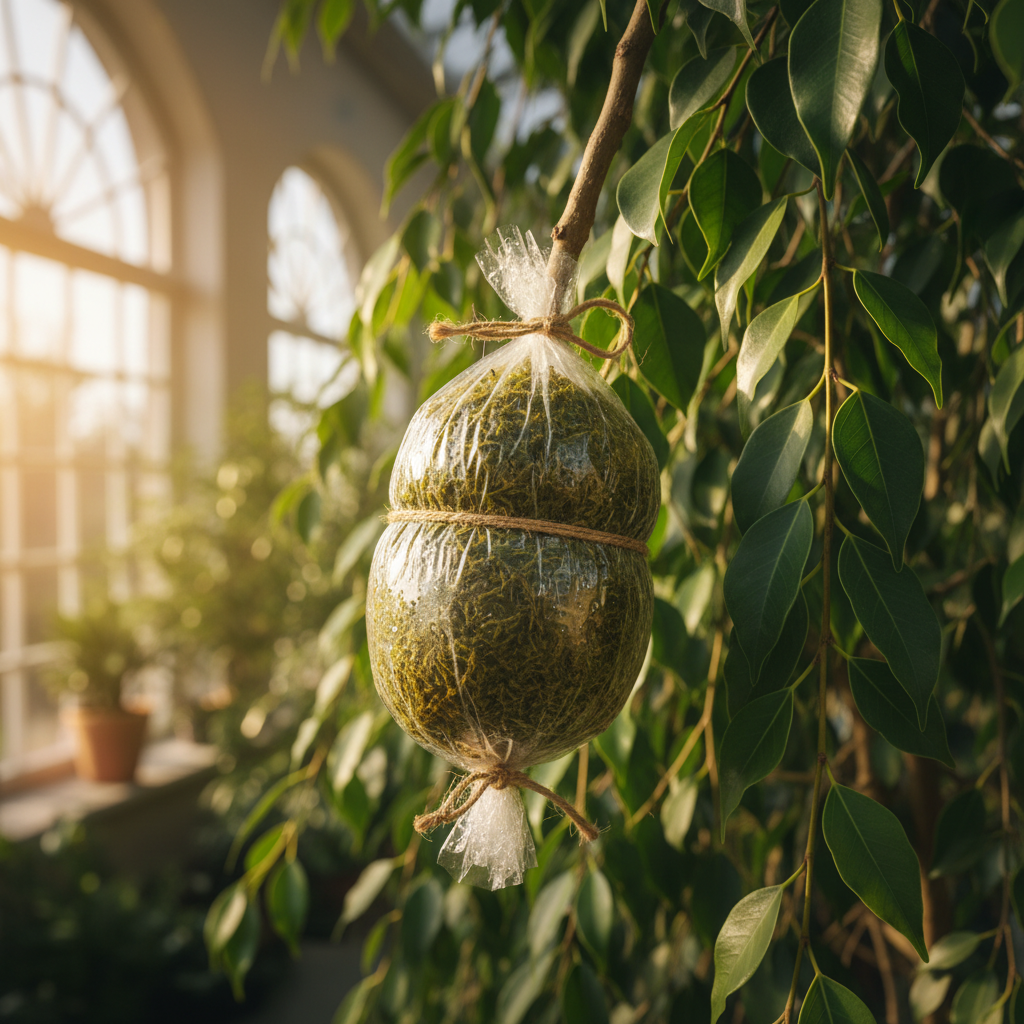
- Wrap a generous handful of pre-soaked sphagnum moss around the wound, forming a ball about the size of an orange around the stem.
- Wrap the moss ball tightly in clear plastic film or a cut piece of polythene, securing top and bottom with twine, soft wire or twist ties. The film keeps the moss humid and lets you see roots when they form.
- Check the moss every couple of weeks and re-moisten with a syringe of water through the top tie if it begins to dry out.
- Roots typically become visible inside the plastic within two to four months. Once a healthy mat of roots has filled the moss ball, cut the stem just below the wrap with sharp secateurs.
- Remove the plastic carefully, pot the new plant up in fresh weeping fig mix with the moss ball intact, water in well and keep in a humid spot for a few weeks while it establishes.
Troubleshooting Propagation
| Problem | Likely Cause | Solution |
|---|---|---|
| Cutting rots at the base in water | Water not changed often enough, or cut not allowed to seal before submersion | Change water every three days, let new cuttings air-dry for fifteen minutes before submerging |
| Cutting wilts and drops leaves within days | Humidity around the foliage is too low while the cutting has no roots to support it | Cover with a clear plastic bag or place in a propagator; reduce leaf count by half if needed |
| No root development after eight weeks | Cutting was too woody, ambient temperature too cool, or rooting hormone is old and inactive | Take a fresh semi-ripe cutting, add bottom heat, use a current bottle of rooting hormone |
| Air layer moss dries out repeatedly | Plastic film not sealed tightly enough at the top, or room is exceptionally dry | Re-wrap with tighter top seal, syringe water in weekly, mist the outside of the wrap occasionally |
Pests and Diseases
A healthy weeping fig in good light, with stable humidity and a sensible watering routine, is not a particularly pest-prone plant. The dense canopy can hide problems for longer than on a more open plant, however, and once an infestation takes hold the sheer leaf count gives pests a great deal of surface area to multiply across. Quick visual inspections every couple of weeks, particularly of the leaf undersides and the leaf axils where the petiole meets the stem, catch most problems while they are still trivial to deal with.
Most fig problems are environmental rather than infectious. Leaf drop, brown tips and yellowing nearly always trace back to inconsistent water, sudden environmental change or seasonal light decline rather than to a pathogen. When you do find an actual pest, the same low-toxicity treatments work well across the major species, and a single integrated approach to prevention covers most of what you need to know.
Common Pests
Scale Insects (Coccus hesperidum and others)
Scale are the classic weeping fig pest. Adult soft brown scale appear as small flat oval bumps roughly 2 to 5 mm long, clamped to the underside of leaves along the midrib, on petioles and in leaf axils. They are easy to mistake for a natural part of the plant until you notice that the bumps wipe off with a fingernail. A heavy infestation leaves shiny sticky honeydew on the leaves and on whatever furniture sits beneath the plant, and that honeydew often develops a layer of black sooty mould.
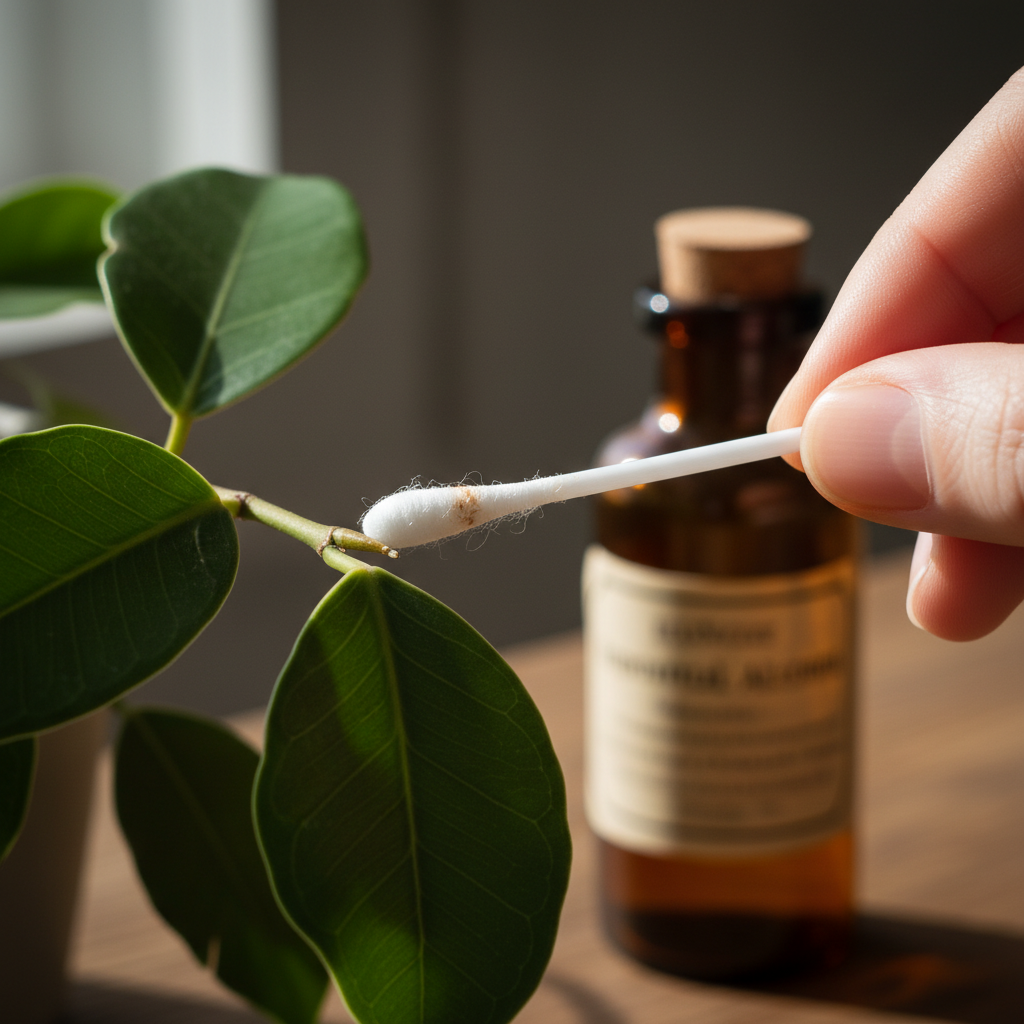
Treatment: For small infestations, dab each scale individually with a cotton bud dipped in 70 percent isopropyl alcohol; the alcohol dissolves the waxy coating and kills the insect underneath. Wipe the residue off with a damp cloth a few minutes later. For larger infestations, spray the whole plant thoroughly with insecticidal soap or neem oil at the recommended dilution, repeat at seven-day intervals for three applications, and isolate the plant from other houseplants during treatment.
Spider Mites (Tetranychus urticae)
Spider mites are encouraged by dry air, and a weeping fig in a heated winter room is a prime target. The mites themselves are barely visible to the naked eye, but their effects are not: leaves develop a faint stippled appearance from the underside upward, looking pale and slightly dusty, and in severe cases fine webbing appears in the leaf axils and along the petioles. The plant looks generally dull and sad before any obvious individual insect comes into view.
Treatment: Begin by sluicing the entire canopy under a tepid shower for several minutes, paying special attention to the undersides of leaves and the leaf axils; this dislodges most of the active population. Follow with a thorough spray of neem oil or insecticidal soap at the recommended dilution, repeated weekly for three weeks to catch successive hatches. Raise the ambient humidity for a few weeks to make the environment less hospitable.
Mealybugs (Pseudococcus spp.)
Mealybugs appear as small soft cottony white tufts clustered in leaf axils, along stems and occasionally on the soil surface. They feed on plant sap and, like scale, secrete sticky honeydew. They are slower to spread than spider mites but harder to eradicate once established, because the waxy coating that gives them their characteristic appearance also resists contact insecticides.
Treatment: Dab visible mealybugs with cotton buds soaked in isopropyl alcohol, then spray the whole plant with neem oil to catch the juveniles. Check every few days for at least a month after the visible infestation appears to have cleared, as eggs can hatch into new generations from cracks in the bark.
Thrips (Thrips tabaci)
Thrips are slender winged insects under 2 mm long that rasp leaf surfaces, leaving silvery streaks and tiny dark specks of frass. On weeping fig they typically attack newer softer leaves, distorting them as they expand. Adult thrips fly readily, so they often arrive on a new plant brought into the home.
Treatment: Hang a yellow or blue sticky trap above the canopy to monitor and catch flying adults, and spray the plant with a botanical insecticide such as neem oil or pyrethrin. Repeat treatments at weekly intervals until no further damage appears on new growth.
Common Diseases
Root Rot (Phytophthora and Pythium spp.)
Root rot is the single most common disease of weeping fig and almost always traces back to chronic overwatering or a substrate that drains poorly. Symptoms include sudden mass leaf drop, dark brown or black mushy roots that come away in your hand when the plant is unpotted, a sour smell from the soil and dark stains seeping from the drainage holes. The trunk base may feel soft.
Treatment: Unpot the plant, rinse the rootball under tepid water to expose the damaged roots, cut away all blackened mushy tissue with sterilised scissors, and repot into entirely fresh free-draining mix in a clean pot. Withhold water for several days to let the wounds callus, then resume with conservative watering. Recovery is uncertain; mild cases pull through, severe cases do not.
Anthracnose (Glomerella cingulata)
Anthracnose is a fungal leaf-spot disease producing tan or brown spots, often with a yellow halo, that begin at the leaf tip and progress inward. The spots can merge into larger blotches, and in humid stagnant conditions the disease can defoliate parts of the canopy. It thrives where airflow is poor and leaves stay wet for extended periods, particularly after misting.
Treatment: Remove and dispose of affected leaves in household waste rather than compost. Improve airflow around the plant, stop misting and water at the soil surface only. For persistent cases, a copper-based fungicide applied according to label directions can halt the spread.
Pest and Disease Summary
| Pest or Disease | Identification | Treatment |
|---|---|---|
| Scale insects | Brown flat bumps on stems and leaf undersides, sticky honeydew below the plant | Alcohol on cotton bud, then neem oil or insecticidal soap weekly for three weeks |
| Spider mites | Stippled pale leaves, fine webbing in axils, plant looks dusty | Tepid shower rinse, then neem oil spray weekly for three weeks, raise humidity |
| Mealybugs | Cottony white tufts in leaf axils and along stems | Alcohol on cotton bud, then neem oil weekly until clear, monitor for a month after |
| Thrips | Silvery streaks and tiny dark specks on new leaves, distorted growth | Yellow sticky traps, neem oil or pyrethrin sprays weekly until new growth is clean |
| Root rot | Sudden leaf drop, soft trunk base, mushy black roots, sour-smelling soil | Unpot, trim rot, repot in fresh dry mix, withhold water for days, hope and wait |
| Anthracnose | Tan or brown leaf spots with yellow halos, often starting at leaf tips | Remove infected leaves, improve airflow, copper fungicide for persistent cases |
Prevention Strategies
Prevention is largely about consistency. A fig held in stable conditions, watered to a regular rhythm and inspected every couple of weeks rarely develops a serious pest problem. Wipe the leaves clean periodically with a damp cloth; this both removes dust that suppresses photosynthesis and reveals early-stage pest activity that would otherwise hide for weeks. Quarantine any new plant in the home for two to three weeks before placing it near established specimens, and inspect the leaf undersides of every plant in the household at the same time you treat one for an infestation.
Environmental hygiene matters too. Standing water in saucers, decaying fallen leaves left on the soil surface and chronically over-wet substrate all encourage fungal pathogens. Remove dropped leaves promptly, empty saucers within thirty minutes of watering and keep the soil surface free of debris. If the room is cool and damp, a small clip-on fan running on the lowest setting near the plant for a few hours a day discourages both fungal disease and the still-air conditions in which spider mites thrive.
Pro Tip — Neem Oil as a Preventative: A monthly preventative spray of neem oil diluted to the recommended strength, applied as a fine mist over the entire canopy (especially leaf undersides), keeps most common houseplant pests at bay before they become a problem. Apply in the evening, away from direct sun, and avoid spraying flowers or buds. Many growers report that adding a single drop of mild dish soap per litre of spray solution helps the oil emulsify and coat the leaves more evenly.
Popular Varieties
The wild species Ficus benjamina has been in horticultural cultivation for well over a century, and decades of selection and sport hunting have produced a substantial range of cultivars. They differ in leaf colour, leaf shape, branching habit, mature size and indoor toughness. For practical purposes, the choices break down into three families: the dark-leaved selections developed for indoor durability, the variegated cultivars prized for visual interest, and the unusual leaf-shape sports kept by collectors. All share the same essential care requirements as the species, although the variegated forms need slightly more light and are slightly less tolerant of dry air.
What follows is a curated selection of the most widely available and most distinctive cultivars on the market. Availability varies by region and season; specialist nurseries usually carry the rarer forms, while large garden centres tend to stock the unnamed species and one or two of the most common variegated selections.
| Variety | Leaf Appearance | Light Needs | Growth Rate | Availability |
|---|---|---|---|---|
| Species (unnamed) | Mid-green glossy ovate leaves with pointed tips | Bright indirect | Moderate to fast | Common |
| ‘Starlight’ | Bold creamy-white margins with smaller green centres | Bright indirect, no direct sun | Slow to moderate | Common |
| ‘Danielle’ | Dark glossy deep green, broader and slightly larger than species | Bright indirect to medium | Moderate | Common |
| ‘Midnight’ | Very dark almost black-green, twisted slightly at the tip | Bright indirect | Moderate | Less common |
| ‘Natasja’ | Small dark green leaves on a naturally compact bushy plant | Bright indirect to medium | Slow | Less common |
| ‘Curly Locks’ | Twisted curling leaves splashed with cream | Bright indirect | Slow | Specialist |
| ‘Anastasia’ | Green centres bordered by chartreuse to lime-yellow margins | Bright indirect, no direct sun | Moderate | Less common |
| ‘Too Little’ | Tiny dark green leaves on a dwarf bonsai-suited form | Bright indirect | Very slow | Specialist |
Featured Varieties
‘Starlight’
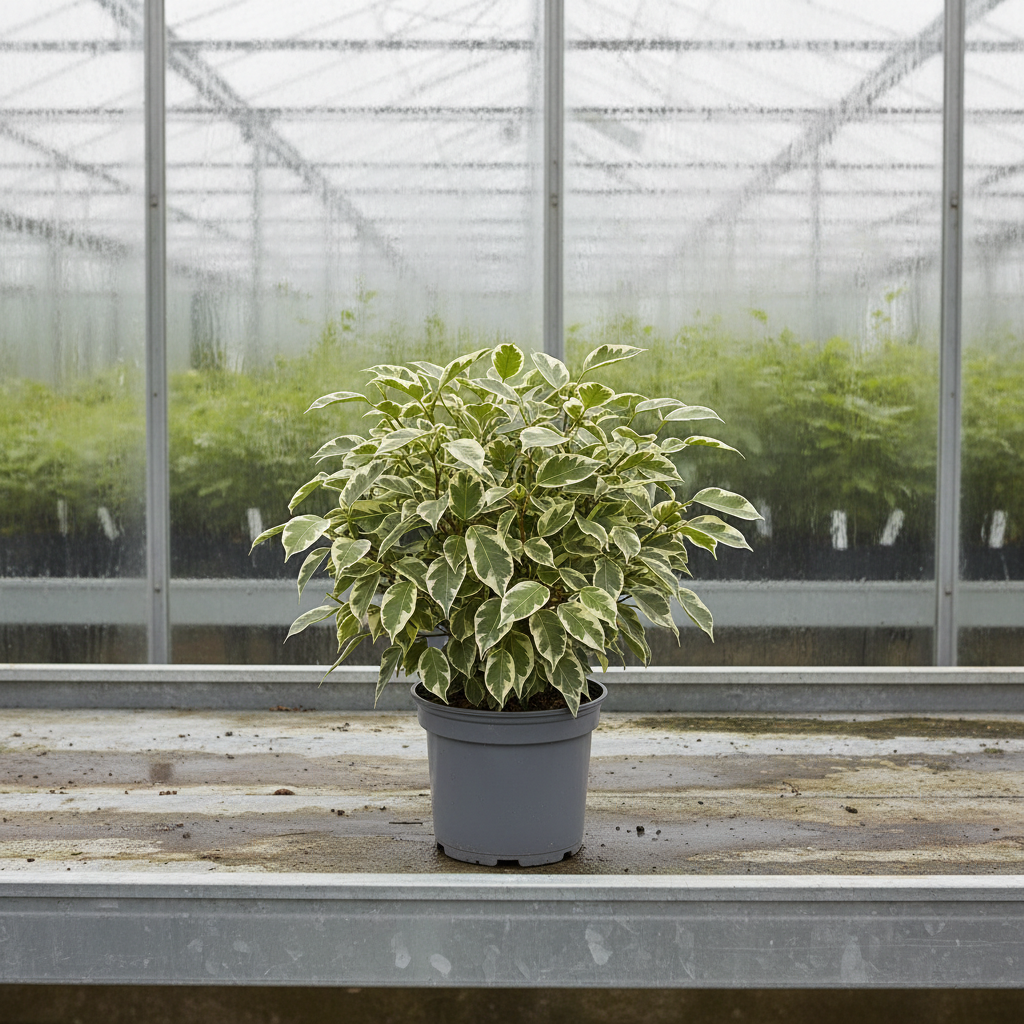
The most striking of the variegated weeping figs. ‘Starlight’ carries bold creamy-white margins that often dominate the leaf, leaving only a small green centre, and from a distance a mature plant can look almost frosted with light. It needs brighter conditions than the species to maintain that variegation and is noticeably slower-growing, but the visual reward justifies the extra attention.
‘Danielle’
The cultivar most often recommended for first-time fig owners. ‘Danielle’ has dark glossy deep green leaves, larger and broader than the species, held on a notably upright branching habit that needs less pruning to look tidy. It is also noticeably more tolerant of lower light and less prone to dramatic leaf drop after relocation than the wild type.
Variety Profiles in Detail
‘Midnight’ (Ficus benjamina ‘Midnight’)
A darker more dramatic version of ‘Danielle’, ‘Midnight’ carries very deep almost black-green leaves with a slight twist at the tip that catches light beautifully against pale walls. It is moderately vigorous, tolerates a wider range of light than the variegated cultivars and looks particularly good in modern interiors with strong contrast between dark plant and pale background.
‘Natasja’ (Ficus benjamina ‘Natasja’)
A naturally compact cultivar with small dark green leaves on a bushy multi-stemmed habit. ‘Natasja’ is sold as a tabletop plant rather than a floor-standing tree and tops out at around 60 to 90 cm even after years of growth. Its slow vigour and forgiving nature make it a good choice for shelves, mantelpieces and brightly lit office desks.
‘Anastasia’ (Ficus benjamina ‘Anastasia’)
A bright cheerful variegated cultivar with green centres bordered by chartreuse to lime-yellow margins, brightest under generous light. The yellow tones tend to mature toward cream as the leaves age, giving a layered effect across the canopy. Like other variegated forms, ‘Anastasia’ grows more slowly than the species and slightly less tolerant of low light.
‘Too Little’ (Ficus benjamina ‘Too Little’)
A genuine dwarf cultivar selected for bonsai, ‘Too Little’ produces tiny leaves rarely larger than a thumbnail on a dense slow-growing plant. It is the cultivar most often shaped into formal indoor bonsai with thickened trunks and refined branching, and well-trained specimens are highly prized. As with all dwarf bonsai material, it asks for closer attention to watering than larger figs because its tiny rootball dries out quickly.
Choosing the Right Variety for Your Space
For a first weeping fig in a typical home, the species or ‘Danielle’ is the safest choice; both are forgiving, widely available and look unmistakably like the iconic weeping fig of the gardening books. For a brighter more eye-catching specimen and a space with strong consistent natural light, ‘Starlight’ or ‘Anastasia’ bring real personality. For a small footprint where a full-sized tree is impractical, ‘Natasja’ delivers the look at one-third the scale, and ‘Too Little’ is the obvious choice for anyone interested in beginning indoor bonsai. Match the cultivar to the brightest reliable spot you can offer, rather than buying based on appearance alone; a variegated fig in a dim corner will be a disappointment within a year, while the same cultivar by an east window will look like a different plant entirely.
Frequently Asked Questions
Why is my weeping fig dropping leaves?
Leaf drop is the weeping fig’s universal response to environmental change. The most common triggers are moving the plant to a new spot, a sudden change in light (such as the seasonal decline in autumn), a cold draught from a door or window, inconsistent watering or recent repotting. A modest amount of leaf drop after any change is normal and not a sign that the plant is dying; the fig is simply rebalancing its leaf budget to match the new conditions. Hold the plant in stable conditions, water sensibly, and new growth will resume within a few weeks.
How fast does a weeping fig grow indoors?
Under good conditions, a young weeping fig can put on 30 to 60 cm (12 to 24 inches) of vertical growth in a single year. As the plant matures and approaches its mature indoor size, growth slows and shifts more toward canopy thickening and branching than vertical extension. Variegated cultivars grow more slowly than the species, often half as fast or less.
Can I prune my weeping fig, and when is the best time?
Yes, and figs respond very well to pruning. The best time is early spring, just as the plant is moving into active growth, although light shaping can be done at any time of year. Use sharp sterilised secateurs, wear gloves to protect from the latex sap and make cuts just above an outward-facing node to encourage growth in the direction you want. Do not remove more than about a third of the canopy in any one session; figs can take more, but recovery is slower and the chance of stress-induced leaf drop is higher.
Is weeping fig safe for cats and dogs?
No. All parts of the plant contain a milky latex sap that is toxic to cats, dogs, rabbits and other pets if chewed or ingested, and the sap is a recognised contact allergen for humans. Symptoms in pets include drooling, vomiting, mouth and stomach irritation, and skin rash where the sap contacts the body. Place the plant out of reach of curious animals, or choose a more pet-friendly species such as a parlour palm or spider plant if your household includes determined chewers.
Why are the new leaves on my weeping fig smaller than the old ones?
Smaller new leaves usually indicate that the plant is producing growth suited to current conditions and those conditions are less generous than they used to be. Reduced light is the most common cause, followed by underfeeding and pot-bound roots. Move the plant closer to a bright window, resume regular feeding if you have lapsed, and consider whether it is due for repotting. Within a few months of conditions improving, leaf size should return to normal on the newest growth.
Can I keep a weeping fig outdoors in summer?
Yes, and many growers find that a summer holiday outdoors gives the plant a noticeable boost. Place it in a bright sheltered spot in dappled shade, never in full midday sun, and bring it back indoors well before night-time temperatures fall below 13 °C (55 °F). Expect the inevitable round of leaf drop when you move it out and again when you move it back in; weeping figs always shed in response to relocation, but the burst of outdoor growth usually outweighs the temporary thinning. Inspect carefully for hitchhiking pests before bringing the plant back inside.
Why is my weeping fig sticky?
Sticky leaves or droplets of clear sap on the foliage and surfaces below the plant almost always indicate honeydew secreted by sap-sucking pests, usually scale insects on weeping fig. Inspect the leaf undersides, leaf axils and stems for the small brown bumps of soft scale and treat as described in the pests section. If no pests are visible, occasional weeping of clear sap from healthy plants is also possible in conditions of high humidity and active growth (a phenomenon called guttation), but this is far less common than pest-related stickiness.
My weeping fig has aerial roots, should I cut them off?
Aerial roots are normal for figs and indicate that the plant is healthy and humid. In the wild they grow into substantial supports, but indoors they rarely reach the soil and tend to dry into thin woody strands. You can leave them alone for a natural look, tuck them back into the pot where they will root into the substrate and thicken the trunk over time, or trim them off cleanly at the stem if you find them visually distracting. Pruning aerial roots does not harm the plant.
Can a weeping fig be trained as a bonsai?
Yes, and weeping fig is one of the more popular species for indoor bonsai because it tolerates pruning, wires well and produces a thickening trunk over a few years. The dwarf cultivar ‘Too Little’ is particularly well suited to small bonsai compositions, while the species can be styled at larger scales. Begin with a young pliable plant, learn the basics of root pruning and branch wiring, and accept that good bonsai is a long slow practice rather than a single project.
How long does a weeping fig live indoors?
With good care, a weeping fig can easily live for several decades indoors. Specimens of fifty years or more are not uncommon in long-term private collections and public conservatories, and the plant shows few signs of true senescence as it ages. The trunk thickens over time, the bark develops character and the canopy can be reshaped repeatedly through pruning. A weeping fig bought as a young plant in your twenties is genuinely capable of outliving you, given a stable home and continued attention.






