

Few houseplants pull off a party trick as effortlessly as the watermelon peperomia (Peperomia argyreia). The oval, slightly cupped leaves carry alternating bands of deep emerald and shimmering silver that look as though someone has sliced a tiny watermelon rind and propped it upright on a stem. Native to the shaded understorey of South American rainforests, particularly in Brazil, Bolivia, Ecuador and northern parts of Venezuela, the species grows in leaf litter and on mossy boulders where dappled light filters through the canopy. That origin story explains almost everything about how it behaves on a windowsill thousands of kilometres from home: it wants gentle, bright but indirect light, breathable soil, and water that comes and goes rather than lingering.
This guide treats the watermelon peperomia as a long-term companion rather than a seasonal centrepiece. The plant has a reputation for being easy, which is half true; it is forgiving of beginners who keep things broadly sensible, but it will quietly decline if its semi-succulent stems are left waterlogged for weeks at a time. The difference between a plant that survives and a plant that thrives shows up in the small details: the depth of colour on a freshly unfurled leaf, the firmness of the petioles, the steady production of new growth from the centre of the rosette. What follows is a section-by-section walk through every variable that influences those details, from light intensity and water chemistry through to repotting cadence, propagation by leaf cutting, and the handful of pests and diseases worth knowing about.
Contents
- Quick Reference
- Why Watermelon Peperomia Makes a Wonderful Houseplant
- Light Requirements
- Watering and Humidity
- Soil, Potting and Repotting
- Fertilising
- Propagation
- Pests and Diseases
- Popular Varieties
- Frequently Asked Questions
Quick Reference: Watermelon Peperomia at a Glance
| Light | Bright, indirect light; tolerates medium light; protect from harsh direct sun. |
| Watering | Water thoroughly when the top 2 to 3 cm (about 1 inch) of soil feels dry; allow excess to drain fully. |
| Temperature | 18 to 26 degrees Celsius (65 to 79 degrees Fahrenheit); avoid drops below 12 degrees Celsius (54 degrees Fahrenheit). |
| Humidity | Average household humidity of 40 to 60 percent is fine; appreciates 50 percent or above. |
| Fertiliser | Balanced liquid feed diluted to half strength, monthly during spring and summer; pause in winter. |
| Toxicity | Considered non-toxic to cats, dogs and humans according to the ASPCA database. |
Why Watermelon Peperomia Makes a Wonderful Houseplant
The watermelon peperomia earns its place in the modern plant collection on aesthetic merit alone. The leaves are roughly oval to teardrop-shaped, three to ten centimetres long when mature, and emerge from a central rosette on slender petioles that often blush a soft pink to deep wine red. Each leaf carries roughly seven to eleven raised veins running from base to tip, with broad silver bands between them that catch and scatter ambient light. Move the plant a few degrees on a shelf and the pattern shifts as the silver picks up reflections from nearby surfaces. It is one of very few houseplants whose leaves look slightly different at every hour of the day.

Beyond looks, the plant has practical virtues for indoor life. It stays small, rarely exceeding 25 to 30 centimetres in height and roughly 30 centimetres in spread even at maturity, which makes it suitable for a desk, bookshelf or grouped display where a larger aroid would dominate. The leaves are semi-succulent, holding moisture in their tissue, so the plant copes with the occasional missed watering far better than ferns or calatheas. It does not flower spectacularly, but it does produce slim, pale green inflorescence spikes in late spring and summer that look a little like miniature mouse tails and add textural interest without demanding any particular care of their own. And because the plant prefers warm, gently humid conditions rather than wet ones, it slots neatly into the same care routine as philodendrons, anthuriums and other modern collection staples.
Important — Toxicity: The watermelon peperomia is listed as non-toxic to cats and dogs by the ASPCA and is not known to cause harm to humans. This makes it one of the safer choices for households with curious pets or young children, though it is still wise to discourage chewing on any houseplant because of physical irritation from leaf sap.
Light Requirements
In the wild, Peperomia argyreia grows on the rainforest floor or perched on shaded rocks where direct sun rarely reaches the leaves. Light arrives indirectly, filtered through the canopy and bounced off pale leaf surfaces above. Replicating that quality of light indoors is the single most influential thing a grower can do for the plant. Get it right and the leaves stay compact, the silver banding remains crisp, and the petioles hold their characteristic upright posture. Get it wrong in either direction and the plant tells you quickly: pale, stretched stems and undersized leaves point to too little light, while bleached patches, brown crisp edges and dulled silver point to too much.
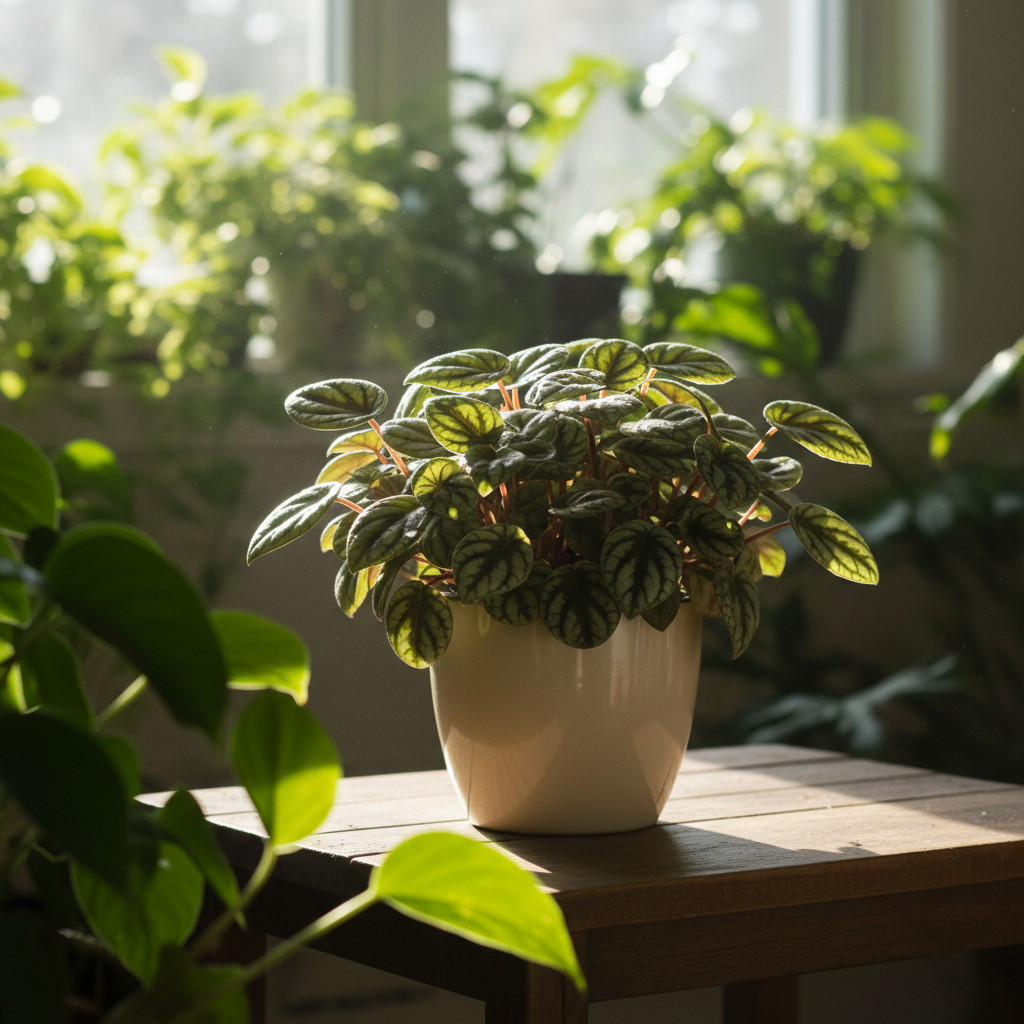
The ideal placement is bright, indirect light for at least six to eight hours a day. Think of a position one to two metres back from a south or west-facing window protected by a sheer curtain, or directly on the sill of an east-facing window where morning sun is gentle and brief. The plant should be able to see plenty of sky, but the sky should not be able to see it through any uninterrupted shaft of summer sunshine.
Light Levels Explained
Lux is the most useful unit for indoor growers because it measures how much visible light is actually arriving at the plant rather than how much is being emitted from a source. A handheld lux meter or a smartphone app can give a reasonable approximation. For the watermelon peperomia, the sweet spot sits between 10,000 and 25,000 lux during the day. The table below puts those numbers into the context of typical indoor positions.
| Light Category | Approx. Level | Typical Location | Outcome |
|---|---|---|---|
| Direct sun | 30,000 lux and above | Pressed against a south window in summer | Bleached patches, crisp edges, faded silver banding |
| Bright indirect | 10,000 to 25,000 lux | Within 1 to 2 m of a bright window, sheer curtain filtered | Compact growth, vivid silver, regular new leaves |
| Medium | 2,500 to 10,000 lux | Mid-room with side windows, north-facing sill | Steady but slower growth, slightly larger leaves |
| Low | 500 to 2,500 lux | Hallways, interior corners far from windows | Stretched stems, dulled colour, leaf drop over months |
| Very low | Below 500 lux | Windowless rooms, dim cupboards | Decline, eventual collapse without grow-light supplementation |
Window Orientation and Placement
South-facing window: South windows in the northern hemisphere provide the most intense and longest-duration light of any orientation. The watermelon peperomia will not enjoy sitting directly on a south sill in summer, but the position is excellent if the light is filtered with a sheer curtain or the plant is set back a metre or two. In winter, when the sun is lower and weaker, a south sill becomes acceptable for direct contact.
East-facing window: East windows are arguably the perfect orientation for this plant. The sun rises into the window for two or three hours, delivering a warm, low-angle dose of direct light that the leaves handle comfortably, and the rest of the day brings bright but indirect illumination. New growth is usually quickest and most vibrant in this position.
West-facing window: West windows offer hot, intense afternoon sun that can scorch the leaves in summer if the plant is pressed against the glass. Treat west exposure like south: filter with a curtain or move the plant 60 to 100 centimetres back into the room.
North-facing window: North windows give cool, even light all day with no direct sun. The watermelon peperomia tolerates a north sill perfectly well, though growth slows and the silver banding may look slightly less crisp than in brighter positions. A bare north window in midwinter at high latitudes may dip below the comfortable threshold and require supplementation.
Pro Tip — Quarter Turn Weekly: Give the pot a quarter turn every time you water. The plant grows towards its light source, and a steady rotation keeps the rosette symmetrical rather than leaning. This single habit will probably do more for the long-term shape of your plant than any other intervention.
How Light Affects Leaf Pattern and Colour
The famous silver stripes are not pigment at all but an optical effect. The epidermal cells above the silver bands contain large air spaces that scatter light, producing the gleaming pewter appearance. The same cells also reflect away some of the photosynthetically active radiation that would otherwise reach the chlorophyll-rich tissue below. In bright but indirect conditions, the contrast between the deep green veins and the silver bands is at its sharpest. In low light, the plant compensates by reducing the silver and increasing the chlorophyll-rich green to capture more of the available light, so the pattern fades. In overly intense light, the silver becomes washed out and the green parts can bleach to a yellow-grey. The colour you see is in effect a real-time report on the light environment.
Warning — Direct Sunlight: A few hours of unfiltered summer sun, particularly through south or west glass, can scorch the watermelon peperomia in a single afternoon. The damage shows up as bleached, papery patches on the upper leaf surface that do not recover, even after the plant is moved. Once a leaf is scorched, the only remedy is to wait for it to be replaced by new growth.
Artificial Lighting
For growers with limited natural light, the watermelon peperomia responds well to full-spectrum LED grow-lights. A modest fixture rated at roughly 15 to 25 watts, suspended 30 to 40 centimetres above the plant and run for 10 to 12 hours a day on a timer, will easily replace a missing window. Aim for a photosynthetic photon flux density of around 100 to 200 micromoles per square metre per second at leaf level, which is well within the range of any modern hobbyist grow-light. The plant does not require the intense output some aroids appreciate, so cooler, gentler fixtures work fine and avoid heat stress on the fleshy leaves.
Seasonal Adjustments
Light availability shifts noticeably with the seasons, particularly at higher latitudes where winter days can be short and overcast. A plant that thrives a metre back from a south window in July may need to move forward to the sill in December to maintain the same lux level. Conversely, a plant that lives happily on an east sill in winter may need a sheer curtain or a half-metre setback once the sun climbs higher in late spring. A useful habit is to check the colour and growth of the central new leaves every fortnight and shift the plant by 30 to 50 centimetres in either direction whenever the foliage starts to drift away from its ideal appearance.
Watering and Humidity
Watering is where most watermelon peperomias quietly die, and almost always from too much rather than too little. The fleshy leaves and short, shallow root system add up to a plant that stores its own water reserves and resents sitting in saturated soil. The basic rhythm to internalise is thorough drenching followed by a meaningful drying interval; the plant does not want a steady drip-feed of damp.
When to Water
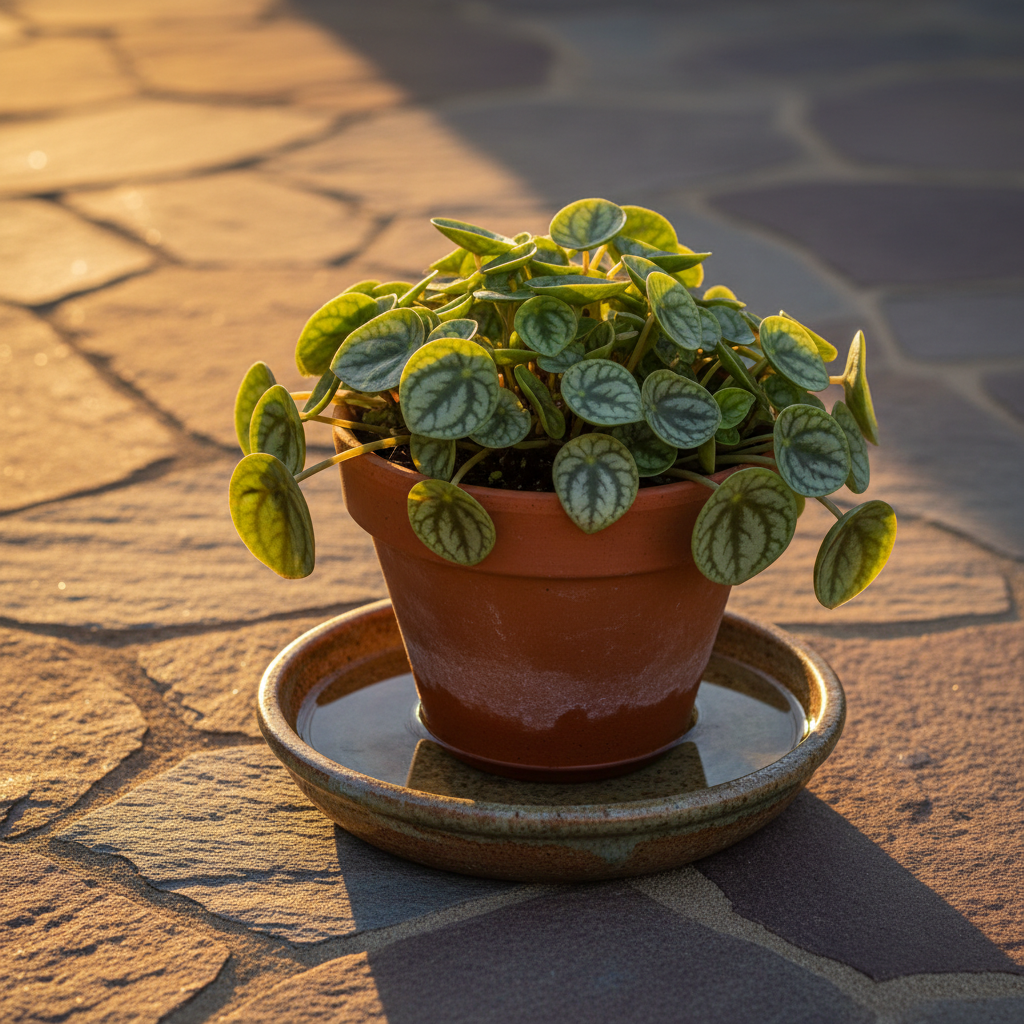
The reliable cue is to water when the top 2 to 3 centimetres of the potting mix have dried out completely. Push a clean finger into the surface, or use a chopstick that you withdraw and inspect: if it comes out with damp particles clinging to it, wait another day or two; if it pulls out clean and dusty, it is time. In a warm, bright spring or summer that interval typically falls in the seven to ten day range for a 12 to 14 centimetre pot. In winter, with cooler temperatures and shorter days, the same pot may need water only every 14 to 21 days.
Schedule-based watering, in which a person commits to a fixed weekly day no matter the conditions, is the single most common path to root rot in this species. Air temperature, humidity, pot size, soil composition and even the time of year all change how quickly the substrate dries, and the plant cannot tell you “not yet” except by suffering. A two-minute check with a finger is always a better guide than a calendar entry.
Pro Tip — Lift the Pot: Once you know what a freshly watered pot of the right size feels like, lifting the pot becomes a reliable test. A noticeably lighter weight than after watering means the soil has dried significantly. This is faster than any moisture meter and works through ceramic, terracotta and plastic alike.
How to Water Correctly
- Take the plant to the sink or bath rather than watering in place, so excess can drain away without pooling.
- Pour room-temperature water slowly around the soil surface, avoiding the central crown where rot tends to start.
- Continue until water runs freely from the drainage holes for at least 10 to 15 seconds.
- Allow the pot to drain fully for 10 to 15 minutes; do not skip this step.
- Empty any water that has collected in the saucer or cachepot before returning the plant to its position.
- Wait until the top 2 to 3 centimetres of soil are dry again before the next watering, regardless of what day of the week it is.
Signs of Overwatering vs. Underwatering
| Symptom | Overwatering | Underwatering |
|---|---|---|
| Leaf colour | Yellowing of multiple leaves at once, often starting with older outer ones | Loss of glossy sheen, gradual fading rather than sudden yellowing |
| Leaf texture | Soft, limp, sometimes translucent and water-soaked at the base | Curled, slightly puckered or wrinkled, leaves feel thinner and lighter |
| Petioles and stems | Mushy or blackened near the soil line, leaves dropping when touched | Stems remain firm but may bend or droop from loss of turgor |
| Soil | Stays dark and wet for many days, may smell sour or earthy | Pulls away from the pot edge, dusty and hydrophobic on the surface |
| Roots | Brown or black, soft, slipping out of their outer sheath when pulled | Pale to creamy white, intact but dry, plant lifts easily from the pot |
Warning — Root Rot: Once root rot takes hold in a watermelon peperomia, the decline can be remarkably fast because the root system is small and the rotting tissue spreads quickly to the crown. If you spot mushy black stems at soil level, remove the plant from its pot immediately, rinse the roots clean, cut away every soft or discoloured section with sterilised scissors, and repot into fresh dry mix. Even with prompt intervention, the safer bet is often to take a few healthy leaf cuttings and start over.
Humidity Requirements
Humidity is less critical for this plant than for many of its rainforest cousins. The fleshy, semi-succulent leaves are reasonably resistant to dry air, and the watermelon peperomia copes well with average indoor humidity of 40 to 50 percent. That makes it a sensible choice for centrally heated homes in winter, where calatheas and ferns would already be suffering. The plant still appreciates a slight lift, however, and consistently maintaining 50 to 60 percent humidity will give noticeably plumper leaves and quicker production of new growth from the centre of the rosette.
When humidity falls persistently below 30 percent, which can happen in heated rooms during cold snaps, the leaf edges may take on a faintly papery feel and new growth can emerge slightly distorted. These symptoms are reversible by improving the local environment, but they are useful early warnings that the plant would prefer slightly more atmospheric moisture.
Practical ways to raise local humidity include grouping the watermelon peperomia with other plants so transpiration creates a moister microclimate, placing the pot on a tray of moist pebbles where the pot itself sits above the waterline, or running a small room humidifier. Misting is mostly a placebo for this species; the moisture evaporates within minutes and risks leaving mineral deposits on the silver-banded leaves that dull their appearance.
Water Quality
Most tap water is perfectly acceptable for the watermelon peperomia, provided it is allowed to come to room temperature before use. Cold water straight from the tap can shock the warm tropical roots and trigger leaf drop. In areas with very hard water or heavily chlorinated supplies, occasional flushing with rainwater, distilled water or filtered water helps avoid the gradual build-up of mineral residues at the soil surface. If you notice a pale crust forming on the top of the substrate or at the pot rim, that is a visible sign that flushing is overdue. Pour several pot volumes of clean low-mineral water through the soil to wash the accumulated salts out of the drainage holes.
Soil, Potting and Repotting
The watermelon peperomia has a small, shallow, fibrous root system that resents both compacted soil and oversized pots. The substrate it sits in matters more than the pot it sits in, because mix that retains too much water for too long will undo every other element of good care. The ideal soil is light, airy, slightly acidic to neutral, and drains within seconds of being watered.
Ideal Soil Composition
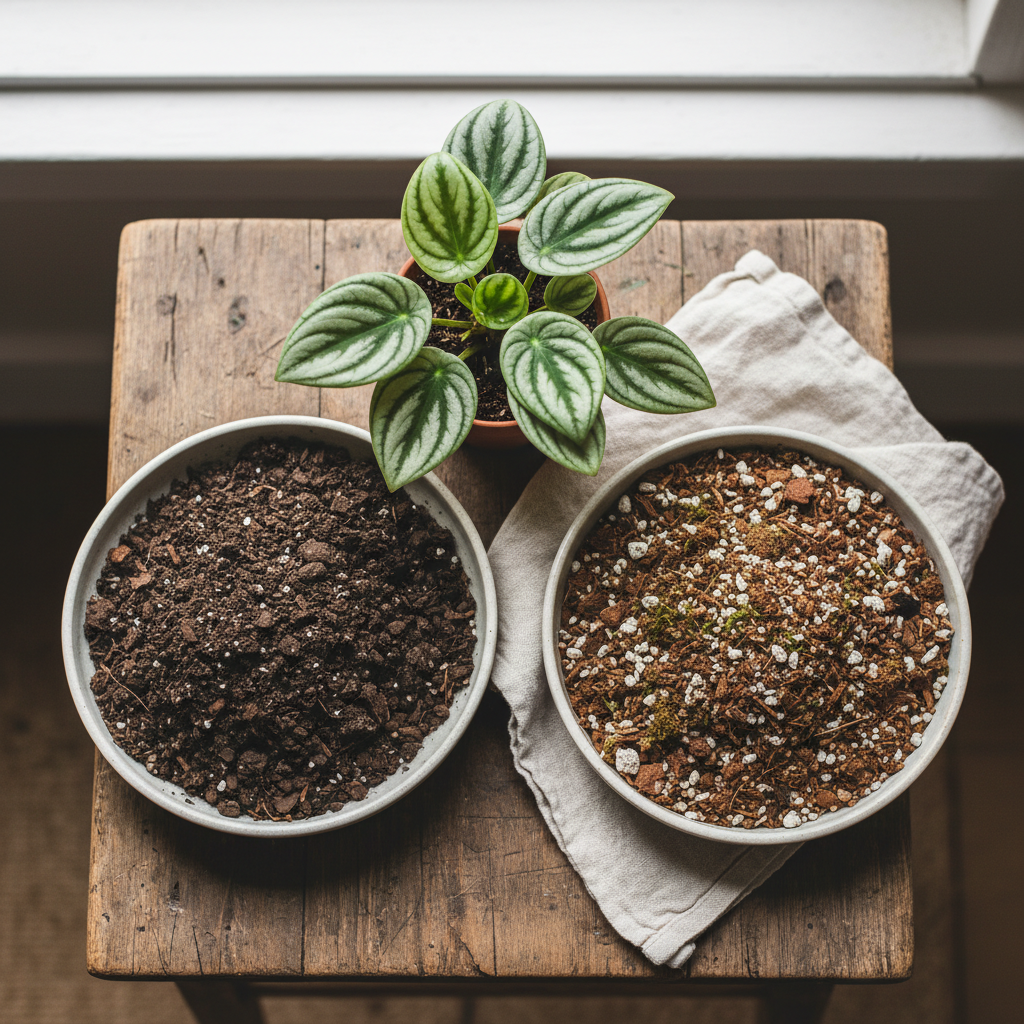
A high-quality general houseplant compost can serve as the base of a watermelon peperomia mix, but it should always be amended with extra drainage and aeration. Bagged compost on its own tends to compact over time as the organic matter breaks down, and once compacted it stays wet for much longer than the species tolerates. Adding chunky inorganic components creates pockets of air around the roots and shortens the time the substrate spends saturated.
| Component | Proportion | Function |
|---|---|---|
| Quality peat-free houseplant compost | 50 percent | Provides organic matter, water retention and a baseline of nutrients |
| Perlite | 25 percent | Adds permanent air pockets, lightens the mix, improves drainage |
| Orchid bark, fine grade | 15 percent | Creates chunky structure and prevents compaction over time |
| Coco coir or fine bark fines | 10 percent | Holds moisture without becoming waterlogged, buffers pH |
The watermelon peperomia prefers a slightly acidic to neutral substrate, with a pH in the range of 6.0 to 7.0. Most commercial houseplant composts fall comfortably inside that window, and the addition of bark fines tends to pull the mix a touch on the acidic side, which is no bad thing. There is no need to test pH actively in a domestic setting unless something appears persistently wrong with otherwise well-cared-for plants.
Pro Tip — Quick Mix Recipe: If you already keep a chunky aroid or hoya mix on hand for your other plants, blend it 1:1 with a good peat-free houseplant compost and the result will suit the watermelon peperomia perfectly. The hoya mix supplies the bark and perlite chunkiness, the houseplant compost supplies the finer organic matter, and you save yourself the trouble of measuring four separate ingredients.
Choosing the Right Pot
The temptation when buying a new houseplant is to give it a generous pot to grow into. With watermelon peperomia, this instinct is almost always wrong. A pot that is too large holds far more wet soil than the small root system can use, and that excess moisture invites rot. The plant is happiest in a snug pot, only just larger than its rootball, with reliable drainage.
Drainage holes are non-negotiable. A pot without drainage holes cannot be safely used for this species, no matter how well measured the watering. Decorative cachepots without holes are fine as outer covers, provided the inner growing pot has drainage and is lifted out for watering or any water that pools in the cachepot is emptied promptly. Standing water at the base of the root system is the most reliable way to kill a watermelon peperomia.
Pot material: Terracotta is an excellent choice because the porous clay wicks moisture away from the soil and helps the substrate dry between waterings. Glazed ceramic and plastic both work fine, but the grower must watch their schedule more carefully because evaporation through the walls is essentially nil. Self-watering pots with a reservoir at the base are not recommended for this species; the constant moisture they supply runs against the plant’s preferred wet-and-dry cycle.
Pot size: A mature watermelon peperomia is usually content in a pot 12 to 14 centimetres in diameter. When stepping up at repotting time, increase by no more than 2 to 3 centimetres in diameter. A jump from a 10 centimetre to a 15 centimetre pot is the kind of upgrade the plant will quietly resent.
When to Repot
This is a slow-growing species, so repotting is needed less often than most growers assume. Every 18 to 24 months is plenty for a healthy specimen, and even then the change is usually about freshening the substrate rather than upgrading the pot. Telltale signs that a repot is overdue include roots circling visibly at the surface or pushing out of the drainage holes, water running straight through the pot without being absorbed, a noticeable slowdown in new leaf production despite otherwise good conditions, and the soil pulling distinctly away from the pot wall after watering. The best time to repot is early spring, just as the plant resumes active growth after its winter slowdown.
How to Repot: Step-by-Step
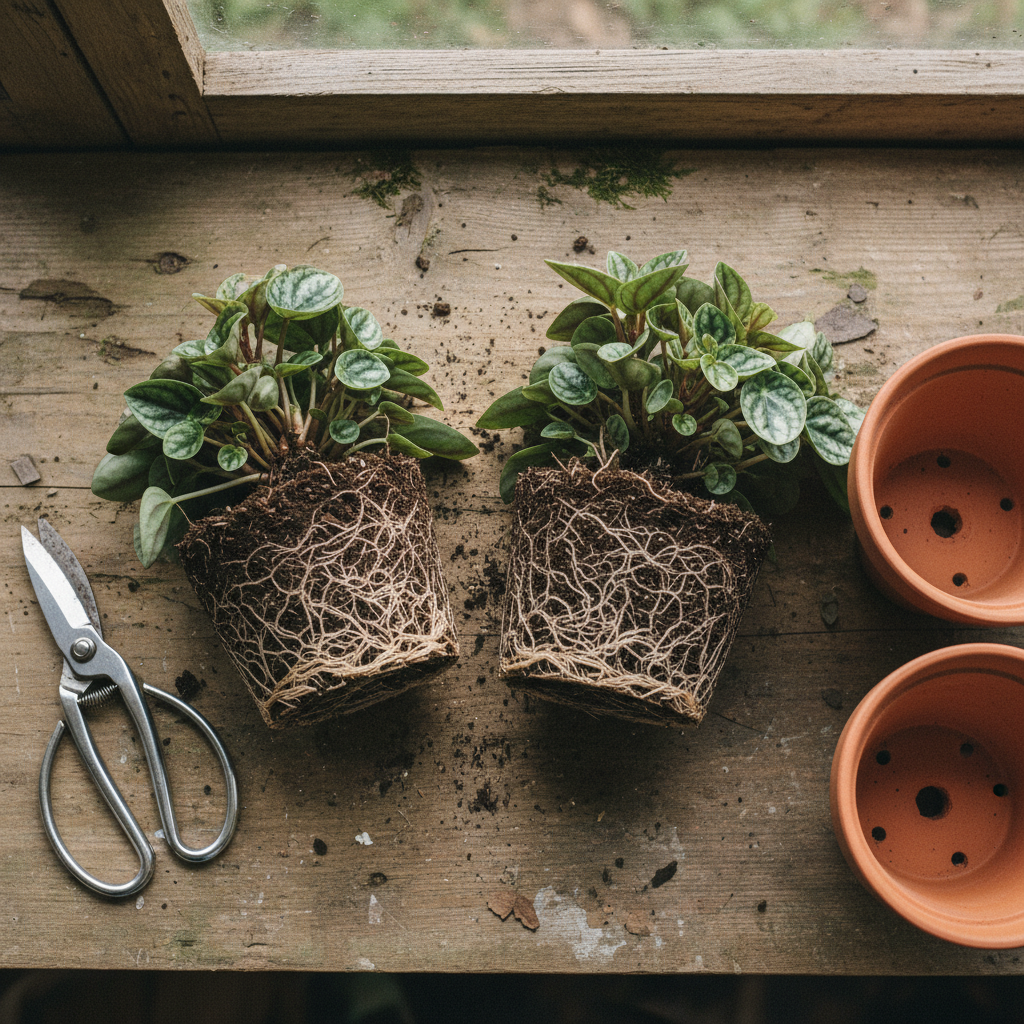
- Water the plant a day or two before repotting; moist soil holds together better than bone-dry mix and reduces the risk of root damage.
- Prepare the new pot by checking the drainage holes are clear and adding a thin layer of fresh mix to the base.
- Gently squeeze the sides of the old pot and slide the plant out, supporting the rosette from below with your fingers.
- Inspect the rootball; tease away any dead or rotten roots with sterilised scissors, and gently loosen the outer roots if they have begun to circle.
- Position the plant in the new pot at the same depth as before, with the crown sitting just above the soil surface rather than buried.
- Backfill around the roots with fresh mix, tapping the pot gently to settle the substrate without compacting it.
- Water lightly to settle the mix, then return the plant to its usual position and resume the normal watering rhythm.
Warning — Transplant Shock: The watermelon peperomia can sulk for two or three weeks after repotting, sometimes dropping a leaf or two even with a careful transplant. Resist the urge to over-water during this period to “help” the plant recover. The roots need time to settle and excess moisture at this stage often turns a brief sulk into a fatal rot.
Fertilising
As a slow-growing understorey plant, the watermelon peperomia has modest fertiliser requirements compared with the heavy feeders many growers are used to. A light, regular feed during the active growing season is enough to support steady new leaf production and maintain the colour of mature foliage. Heavier feeding rarely produces faster growth and frequently produces leaf burn, distorted new growth or visible salt deposits on the soil surface.
The general principle is “little and often, dilute rather than concentrated, and not at all in winter”. Stick to that and the plant will reward you with consistent vigour; deviate towards heavy or frequent feeding and you will probably create problems rather than solve them.
Understanding Plant Nutrients
Fertilisers are usually described by their N-P-K ratio, three numbers showing the percentage by weight of nitrogen, phosphorus and potassium in the formulation. For watermelon peperomia, a balanced ratio such as 10-10-10, 20-20-20 or any roughly equal blend works well. There is no benefit in using a high-nitrogen feed designed to push leaf growth, since this species naturally grows slowly and over-feeding nitrogen tends to produce soft, weak foliage that is more prone to pests and rot.
| Nutrient | Symbol | Primary Function | Deficiency Symptoms |
|---|---|---|---|
| Nitrogen | N | Drives leaf production and overall green colour | Pale, washed-out older leaves and slow new growth |
| Phosphorus | P | Supports root development and energy transfer | Stunted growth, dull leaf surface, weak root system |
| Potassium | K | Regulates water balance and disease resistance | Yellowing or browning at leaf edges, weak stems |
| Calcium | Ca | Builds strong cell walls and supports new growth | Distorted or crumpled emerging leaves, tip dieback |
| Magnesium | Mg | Central component of chlorophyll for photosynthesis | Yellowing between the veins of older leaves |
| Iron | Fe | Supports chlorophyll production in new growth | Pale new leaves with darker veins, the classic chlorosis pattern |
Types of Fertiliser
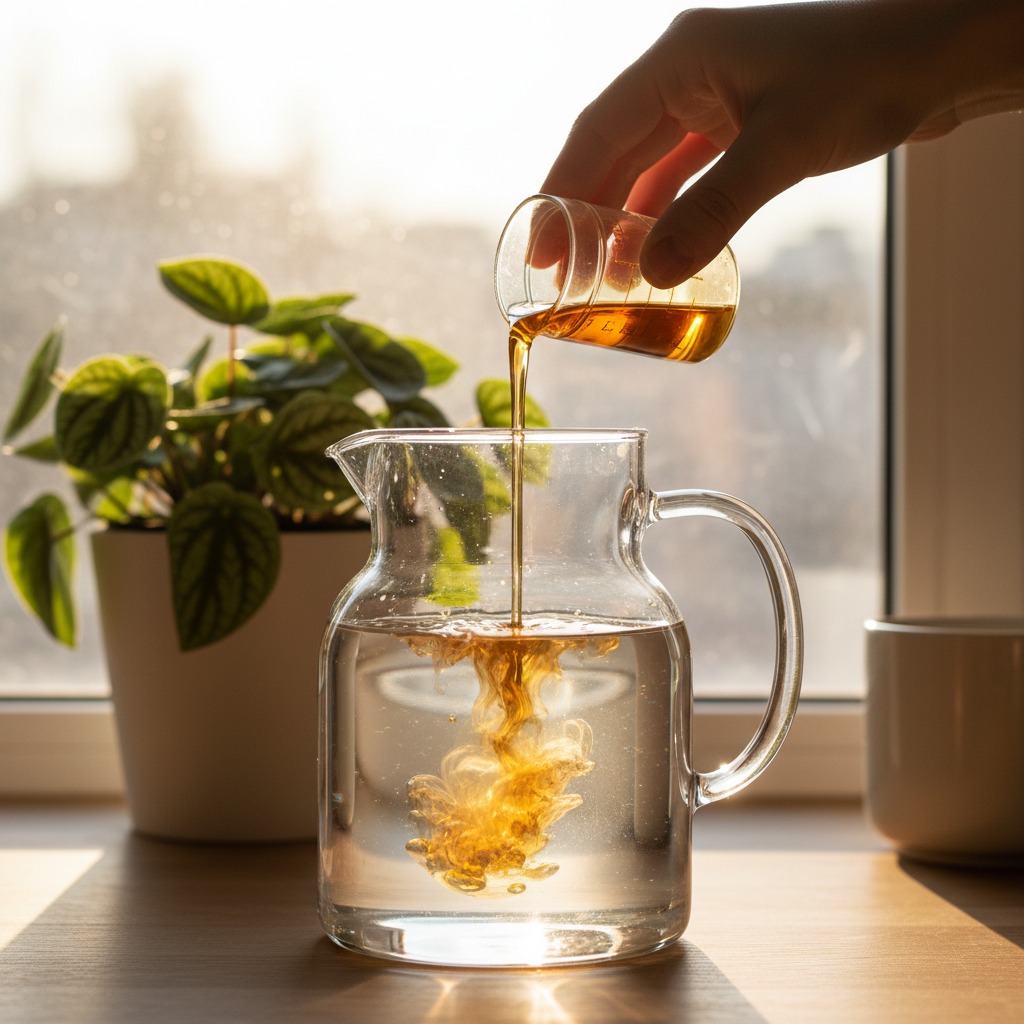
Liquid fertilisers: These are the most flexible option for watermelon peperomia. A balanced liquid feed diluted to half the manufacturer’s recommended strength, applied roughly once a month from early spring through to early autumn, suits the plant perfectly. The advantage of liquids is that the dose can be tuned to the season and the plant’s apparent vigour, and excess can be flushed out with a clean watering if mistakes are made.
Slow-release granular: Coated prills that release nutrients gradually over several months are convenient for low-maintenance setups. A light scatter of granular feed at the start of the growing season, lightly raked into the surface, can carry the plant through to autumn without further intervention. The risk is that release rates vary with temperature and moisture, so a hot summer can deliver a higher dose than intended.
Organic fertilisers: Worm castings, well-rotted compost top-dressings and dilute compost tea all work well and tend to release nutrients slowly and gently. They also feed the soil microbiology, which in the long term improves substrate health. The trade-off is variability in nutrient concentration and a more noticeable smell, which some growers prefer to avoid indoors.
Feeding Schedule
Active growth begins as light levels rise in late winter or early spring and continues through to early autumn. During this period, feed roughly once a month with a balanced liquid fertiliser at half strength. By late autumn, as days shorten and growth slows, stop feeding entirely. Resume in late February or March, depending on latitude, once the plant is visibly pushing new leaves from the centre of the rosette. Newly repotted plants in fresh substrate do not need feeding for the first 6 to 8 weeks, because the new mix contains enough residual nutrients to support normal growth in that period.
Pro Tip — Half Strength Always: If in doubt, dilute further rather than less. The watermelon peperomia responds better to a half-strength feed every month than to a full-strength feed every two months, because consistent low-level nutrition matches the gentle pace of its growth. Following the bottle’s instructions to the letter will usually deliver too much.
How to Fertilise
- Water the plant lightly first if the soil is fully dry, so the fertiliser does not contact dehydrated roots directly.
- Mix a balanced liquid feed at half the recommended strength in a clean watering can of room-temperature water.
- Apply slowly and evenly over the soil surface until the mix is moistened throughout, but stop short of letting fertiliser water gush out of the drainage holes.
- Empty any water that collects in the saucer or cachepot to prevent dissolved salts from being drawn back into the root zone.
- Every third or fourth feed, replace the fertiliser solution with a clean flushing watering to wash any accumulated mineral residues out of the substrate.
Warning — Salt Build-Up: Visible white or yellowish crust on the soil surface or around the pot rim is the sign of fertiliser salts accumulating beyond what the plant can use. Left unchecked, this build-up burns the fine feeder roots and stunts new growth. The remedy is a thorough flushing with several pot volumes of clean water in a single session, allowing the excess to drain away completely before the plant returns to its normal position.
Propagation
The watermelon peperomia is one of the most rewarding houseplants to propagate. Tiny new plantlets can be raised from individual leaves, which means a single mature specimen can yield enough material to give away to friends, refresh a tired parent plant, or insure against accidental loss with a backup generation on the windowsill. The two reliable methods are leaf cuttings and division of mature multi-crown specimens.
Both methods work best in spring and early summer, when warmth and longer day-length give the cuttings the energy to root and produce their first new leaves before the slower part of the year arrives. Late autumn and winter propagation is possible but markedly slower, and the strike rate is lower because the cuttings sit in cool, low-light conditions for weeks before showing any progress.
Understanding the Petiole
Successful leaf propagation in this species hinges on the petiole, the slender stalk that connects each leaf blade to the central crown. New roots and new plantlets emerge from the base of the petiole rather than from the leaf blade itself, so every cutting must include at least a centimetre or two of intact petiole below the leaf. A leaf taken without its petiole, or with the petiole cut too short, may form callus tissue at the wound but will rarely produce a new plant. Take a clean cut as close as possible to where the petiole meets the central stem, with sterilised scissors or a sharp blade.
Method 1 — Leaf Cuttings in Water: Step-by-Step
Water rooting is the quickest way to see results, because progress is visible through the glass and the cuttings are easy to monitor. Roots typically appear in two to three weeks, and the first tiny new leaves emerge from the base of the petiole within six to ten weeks of starting.
- Choose three to five healthy, fully mature leaves from the outer ring of the rosette, avoiding very young or very old foliage.
- Cut each leaf cleanly at the base of the petiole with sterilised scissors, leaving 2 to 3 centimetres of stalk attached.
- Let the cuts air-dry on a clean surface for an hour or two to form a thin protective callus over the wound.
- Insert the petioles into a small jar of room-temperature water so the cut end is submerged but the leaf blade stays well clear of the water surface.
- Place the jar in bright indirect light at room temperature, ideally somewhere between 20 and 24 degrees Celsius (68 to 75 degrees Fahrenheit).
- Change the water every five to seven days, or sooner if it becomes cloudy, to keep dissolved oxygen levels high.
- When roots are at least 2 to 3 centimetres long and one or two miniature leaves are visible at the base, pot up gently into a small container of the standard mix described earlier.
Pro Tip — Half-Leaf Cuttings: A single watermelon peperomia leaf can be cut horizontally across the blade into two or three sections, each of which can produce a new plant when its cut edge is inserted into damp substrate. This trick multiplies your yield dramatically from a single donor leaf, and works particularly well in a humidity dome or covered propagation tray.
Method 2 — Division of Mature Plants: Step-by-Step
Older watermelon peperomias often develop two or more crowns from a single rootball, and these can be separated cleanly at repotting time to yield instant new specimens that look mature from day one. Division works only when the plant has more than one obvious growing point, so inspect the base of the rosette before deciding.
- Water the parent plant lightly a day before division so the rootball holds together but is not waterlogged.
- Slide the plant out of its pot and gently shake or rinse away enough soil to see the structure of the crowns clearly.
- Identify the natural seams between separate crowns, where the rosettes are joined only by a small section of shared root or stem tissue.
- Tease the crowns apart with your fingers if possible, or use sterilised scissors to make clean cuts through any tissue that resists gentle pulling.
- Pot each division immediately into its own snug container of fresh standard mix, settled around the roots without compacting.
- Water lightly to settle the substrate and place the divisions in bright indirect light, keeping the soil just barely moist for the first three to four weeks while new roots establish.
Troubleshooting Propagation
| Problem | Likely Cause | Solution |
|---|---|---|
| Petiole turning mushy or black in water | Bacterial rot from stale water or unclean cutting tools | Change water more often, sterilise scissors with alcohol between cuts |
| Roots form but no new leaves appear | Conditions are too cool or too dim for active growth | Move to a warmer, brighter spot or add a grow-light above the cuttings |
| Leaf curls or yellows before rooting | Excessive light or low humidity drying the cutting | Move out of direct sun and cover loosely with a clear bag for a week |
| Division wilts dramatically after potting | Too much root damage at separation, transplant shock | Keep humidity high, light bright but indirect, allow up to three weeks to settle |
Pests and Diseases
The watermelon peperomia is not especially attractive to pests, and a well-cared-for plant in an established collection rarely suffers serious infestations. The most common problems come either from imported pests on new plants entering the collection, or from environmental stress that weakens the plant enough for opportunistic invaders to gain a foothold. Most issues are easy to manage when caught early.
Inspection is the single most powerful tool. A weekly habit of turning a few leaves over to check the undersides, looking into the central crown and along the petiole bases, will catch almost any problem in its first or second generation, when treatment is straightforward. By the time a pest population is large enough to be obvious at first glance, it has usually been multiplying unnoticed for several weeks.
Common Pests
Mealybugs (Pseudococcus longispinus and related species)
Mealybugs appear as small, soft-bodied insects covered in a fluffy white waxy coating that looks a little like tiny tufts of cotton wool. They favour leaf axils, the undersides of leaves and the junctions between petioles and the main stem, where they are partially hidden from view. A persistent infestation produces sticky honeydew, sooty mould and a gradual decline in leaf colour and vigour. Watermelon peperomia is moderately susceptible, especially in collections where mealybugs are already present on other plants.
Treatment: Dab individual mealybugs with a cotton bud dipped in 70 percent isopropyl alcohol to dissolve their protective wax and kill them on contact. For larger populations, spray the plant thoroughly with insecticidal soap or a 1:10 solution of neem oil and water, paying particular attention to leaf axils and undersides, then repeat every seven days for three to four weeks to catch successive generations. Isolate affected plants from the rest of the collection until two clean inspections in a row confirm the problem is gone.
Spider mites (Tetranychus urticae)
Spider mites are almost invisible to the naked eye, but their damage is distinctive: fine yellow stippling across the upper leaf surface, eventually progressing to a dusty, bronzed appearance, and very fine webbing in the leaf axils when populations are large. They thrive in hot, dry indoor air and tend to appear in heated rooms during winter or in collections kept too dry.
Treatment: Rinse the plant thoroughly under a gentle shower of room-temperature water, focusing on the undersides of leaves where the mites and eggs congregate. Follow up with neem oil or insecticidal soap sprays applied every five to seven days for three weeks. Raising the local humidity above 50 percent makes the environment significantly less hospitable to spider mites and tends to prevent reinfestation.
Fungus gnats (Bradysia species)
Small, dark, mosquito-like flies that hover around the soil surface are almost always fungus gnats. The adults are merely annoying, but their larvae live in the top few centimetres of the substrate and feed on fine roots and organic matter, which is more of a concern for a small-rooted plant like watermelon peperomia. Persistent infestations usually point to soil that stays too wet for too long.
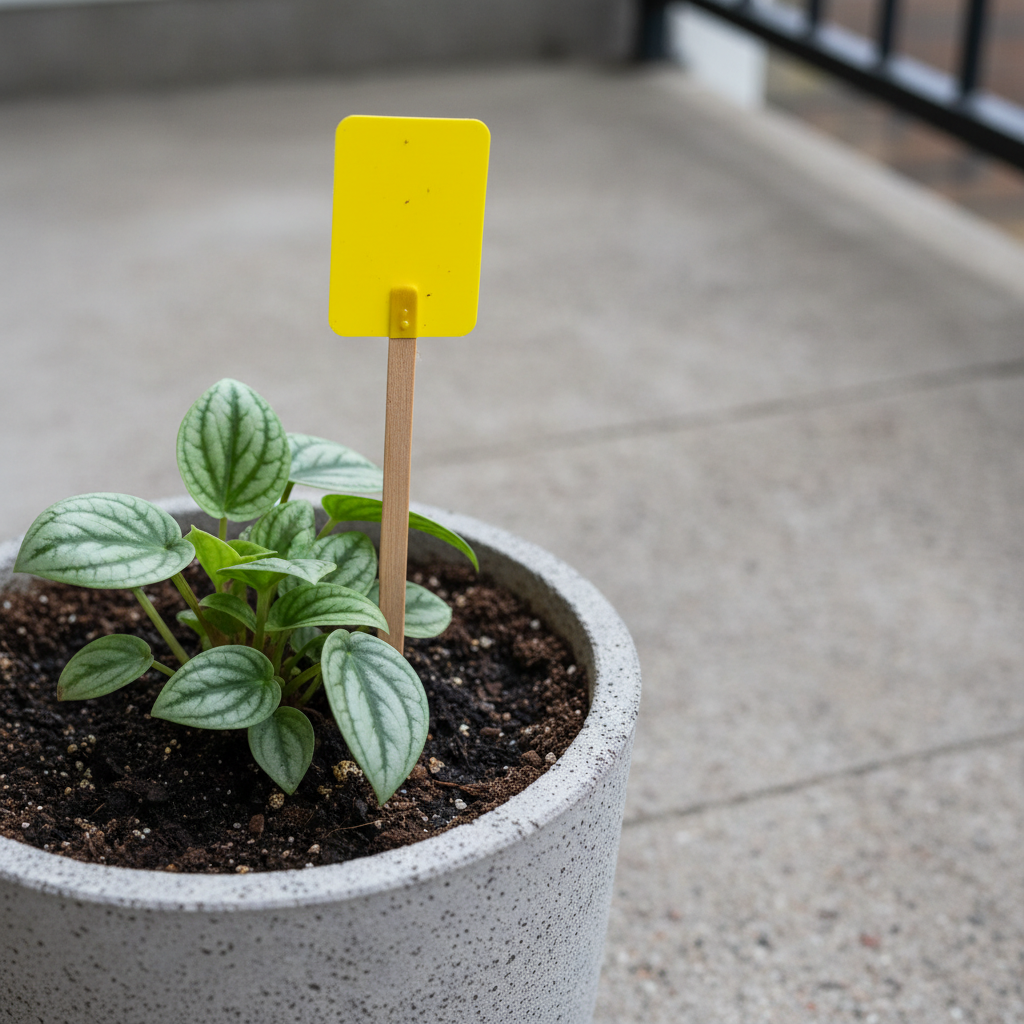
Treatment: Allow the top few centimetres of substrate to dry out completely between waterings, which interrupts the larval life cycle within a week or two. Place yellow sticky traps near the pot to catch the flying adults and monitor population levels. For stubborn cases, drench the soil with a solution of Bacillus thuringiensis israelensis (Bti) or apply beneficial nematodes such as Steinernema feltiae, both of which target the larvae specifically without harming the plant.
Thrips (Frankliniella occidentalis and related species)
Thrips are tiny, slender insects that rasp at leaf surfaces to feed on the cell contents, leaving silvery streaks, small black faecal spots and, eventually, distorted new growth. They are less common on watermelon peperomia than on aroids and orchids, but they do occasionally appear and can spread quickly to other susceptible plants in a collection.
Treatment: Blue sticky traps catch many of the flying adults and serve as a population gauge. Spray the plant thoroughly with insecticidal soap or spinosad-based treatments, with attention to the undersides of leaves and the central crown, repeated every five to seven days for at least three weeks because thrips have multiple overlapping life stages that resist single-application controls.
Common Diseases
Root and crown rot (Pythium and Phytophthora species)
The single most common killer of watermelon peperomias, root and crown rot is caused by water-mould pathogens that flourish in saturated, poorly drained soil. The first signs are usually yellowing and softening of older leaves, often without any obvious external cause, followed by a mushy, blackened section at the base of the stem and easily detachable leaves at the crown. By the time symptoms are visible on the foliage, the damage to the root system is already extensive.
Treatment: Remove the plant from its pot, rinse the roots clean and use sterilised scissors to cut away every soft, brown or black section of root and stem tissue, working back into healthy white or cream-coloured material. Repot into completely fresh, dry mix in a clean pot only marginally larger than what the remaining root system requires. Hold off on watering for several days to let the cut surfaces callus. If the crown itself is rotten, the only viable rescue is usually to take leaf cuttings from any still-healthy outer leaves and start over.
Leaf spot diseases (Cercospora, Phyllosticta and bacterial pathogens)
Leaf spot infections show as small, circular or irregular brown to black spots on leaf surfaces, sometimes with a yellow halo. They usually appear when leaves stay wet for prolonged periods, particularly in poorly ventilated conditions, or when plants are sprayed in the evening so foliage cannot dry before nightfall.
Treatment: Remove affected leaves cleanly at the base of the petiole and dispose of them away from other plants. Improve air circulation around the plant, avoid wetting the foliage when watering, and apply a copper-based fungicide if the problem persists. Most cases resolve once the underlying moisture or ventilation issue is corrected.
Edema (physiological disorder)
Edema is not strictly a disease but a physiological response to taking up water faster than the plant can transpire it away. It shows as small, raised, corky or blistered patches on the undersides of leaves, often misdiagnosed as pest damage. The trigger is usually heavy watering in cool, humid, dim conditions where transpiration is slow.
Treatment: Reduce watering frequency, improve air circulation and brighten the position slightly. Existing damaged tissue does not heal, but new leaves emerge unaffected once the underlying water balance is restored.
Pest and Disease Summary
| Pest / Disease | Identification | Treatment |
|---|---|---|
| Mealybugs | White cotton-wool tufts in leaf axils and on petioles | Isopropyl alcohol dabs, then insecticidal soap or neem every 7 days |
| Spider mites | Fine yellow stippling, bronzed look, faint webbing | Rinse, neem or soap sprays every 5 to 7 days, raise humidity |
| Fungus gnats | Small dark flies around soil, weak larvae in top layer | Let surface dry, sticky traps, Bti drench or beneficial nematodes |
| Thrips | Silver streaks, black flecks, distorted new growth | Sticky traps, spinosad or soap sprays every 5 to 7 days |
| Root and crown rot | Yellowing, mushy black stem base, easily detached leaves | Surgical removal of rotten tissue, fresh dry mix, leaf cuttings as backup |
| Leaf spot | Brown or black spots with yellow halos on leaves | Remove affected leaves, improve airflow, copper fungicide if needed |
| Edema | Corky raised blisters on undersides of leaves | Reduce watering, improve airflow and light |
Prevention Strategies
Prevention is mostly about creating conditions in which pests struggle to establish and diseases never get the foothold of stressed, weakened tissue to exploit. The same care choices that produce a vigorous, well-coloured plant also produce a plant that resists problems: appropriate light, a wet-and-dry watering rhythm, breathable soil, modest fertiliser, and good airflow around the foliage.
Quarantine is the other essential habit. New plants arriving in a collection should sit on their own for at least two weeks, ideally a month, somewhere away from the rest of the houseplants. This isolation period gives time for any hidden pests to reveal themselves before they can spread. Many serious infestations across whole collections trace back to a single new plant that looked clean on the shop bench but carried mealybug eggs, spider mite stages or thrips larvae out of sight.
Pro Tip — Monthly Neem Maintenance: A monthly preventive spray of dilute neem oil across the collection during the active growing season acts as a gentle deterrent for the most common indoor pests without any of the side effects of harsher chemical controls. Apply in the evening or out of direct sun to avoid leaf burn, and rinse the plants the next day if any oily residue remains visible.
Popular Varieties
The watermelon peperomia is a single botanical species, Peperomia argyreia, but several distinct selected forms and cultivars are now available in the houseplant trade. Most of these differ in the intensity or distribution of silver banding, the presence or absence of variegation, and the overall plant size. Demand has grown sharply since the late 2010s, and a handful of named selections now command premium prices among collectors.
It is worth noting that the watermelon peperomia is sometimes confused with other silver-patterned peperomias such as Peperomia caperata ‘Silver Streak’ or various Peperomia griseoargentea forms. These are distinct species with different leaf shapes, growth habits and care requirements, although they share a vague visual family resemblance. When buying a named variety, check the botanical name on the label to be sure you are getting a true selected form of P. argyreia.
| Variety | Leaf Appearance | Light Needs | Growth Rate | Availability |
|---|---|---|---|---|
| Species form | Classic silver bands between dark green veins, oval leaves to 8 cm | Bright indirect | Slow to moderate | Widely available |
| ‘Frost’ | Heavily silvered with subtle striping, near-frosted appearance overall | Bright indirect | Slow | Specialist nurseries |
| ‘Variegata’ | Cream to yellow variegation along leaf margins over the silver-and-green pattern | Bright indirect, slightly more light helps colour | Slow | Specialist and online sellers |
| ‘Mini’ or compact forms | Same pattern but leaves only 3 to 5 cm long, plant rarely exceeds 15 cm tall | Bright indirect | Slow | Increasingly common |
| ‘Red Edge’ | Classic pattern with a noticeably more saturated red blush on petioles and leaf edges | Bright indirect | Slow to moderate | Specialist nurseries |
| Large-leaf forms | Mature leaves to 10 cm or more, more pronounced cupping | Bright indirect | Moderate | Occasional |
Featured Varieties
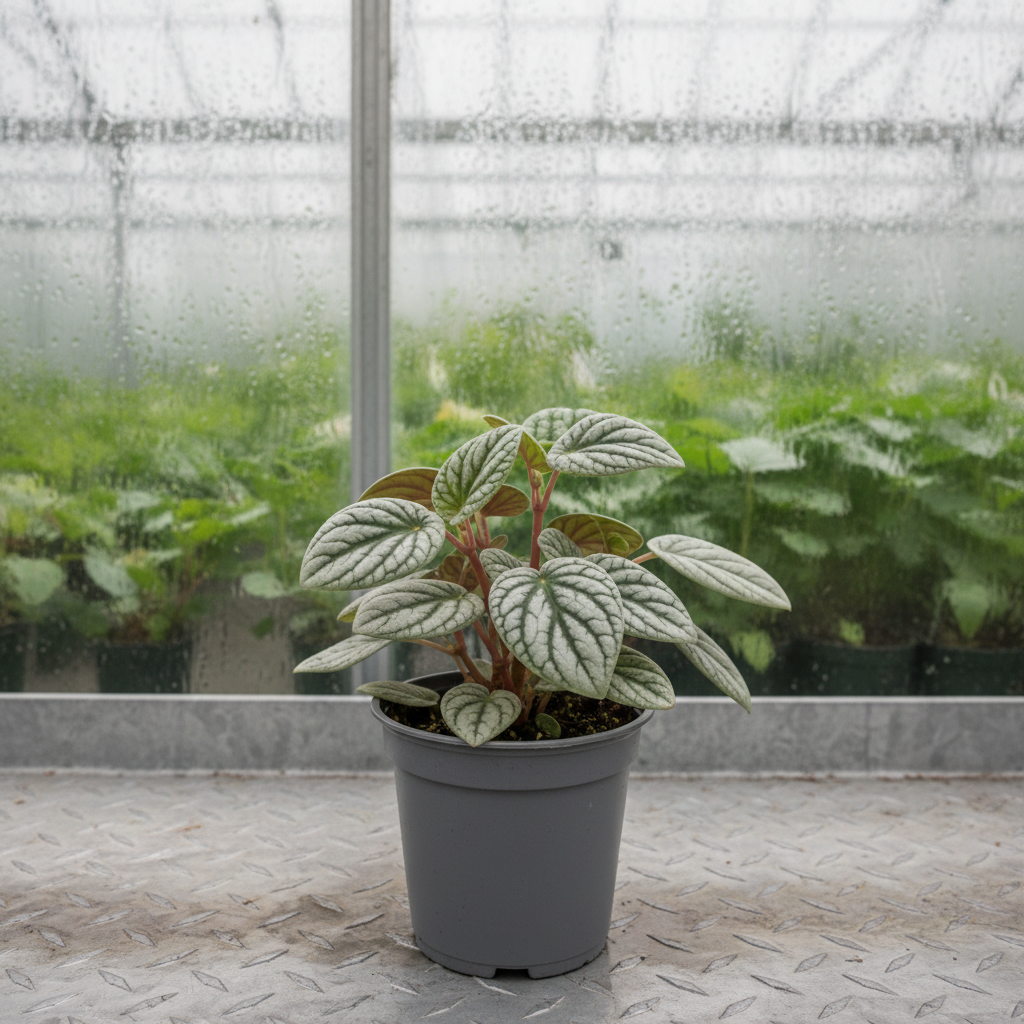
Peperomia argyreia ‘Frost’
A selected form in which the silver banding is so dominant it almost obscures the underlying green, giving the entire leaf a frosted, pewter appearance. The dark green veins remain visible as fine lines but the broad bands between them are silvered from edge to edge. ‘Frost’ is slow even by the standards of the species, but rewards patient growers with the most striking foliage in the group.
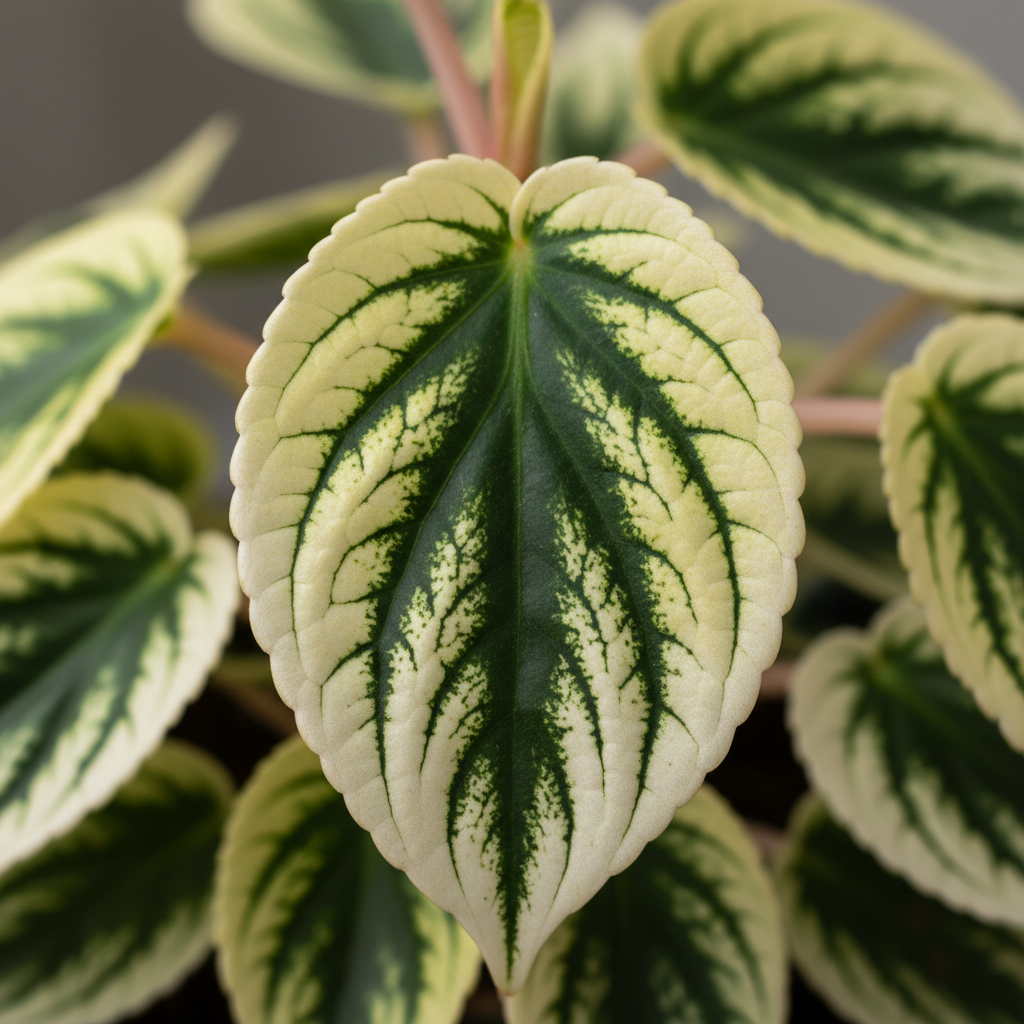
Peperomia argyreia ‘Variegata’
A rarer chimeric form in which sections of leaf tissue lack the green chlorophyll, producing irregular cream to pale yellow margins overlaid on the classic watermelon pattern. The variegation is unstable and individual plants may revert towards the species form over time, so growers should prune out any fully green new leaves to encourage the variegated tissue to dominate. Slightly brighter light than the species tolerates helps maintain the contrast.
Variety Profiles in Detail
Species form (Peperomia argyreia)
The unselected species form is the plant most growers think of first when watermelon peperomia is mentioned. Mature leaves reach 6 to 8 centimetres in length with the classic alternating bands of deep emerald and gleaming silver running from base to tip, held on slender pink to red petioles. Plants grow into a low, rounded rosette typically 20 to 25 centimetres tall and equally wide. This is by far the most widely available form and is generally the easiest to source at high-street garden centres at sensible prices.
‘Mini’ compact forms (Peperomia argyreia, dwarf selections)
Several nursery selections under the umbrella label ‘Mini’ or ‘Compacta’ offer the classic patterning at a markedly smaller scale, with mature leaves between 3 and 5 centimetres long and plants rarely exceeding 15 centimetres in any dimension. These are excellent choices for terrariums, desks and limited spaces where a full-sized specimen would dominate. Care is identical to the standard form, though the smaller root system dries out a touch faster and benefits from slightly more attentive watering.
‘Red Edge’ (Peperomia argyreia, selected form)
A relatively new selection in which the natural pink to red colour of the petioles is amplified and extended onto the leaf margins, producing a subtle wine-red edge that contrasts beautifully with the silver banding. The variety is moderately stable and the red colouration intensifies in slightly brighter light, though it never quite reaches the saturation seen in plants like Begonia rex selections. Best displayed at eye level where the red details are visible.
Choosing the Right Variety for Your Space
For most homes the unselected species form remains the best starting point. It is the most widely available, the most forgiving of inconsistent care, and offers the full visual impact that made the watermelon peperomia famous in the first place. The compact ‘Mini’ selections suit small shelves, desks and closed terrariums where a regular specimen would crowd the space. ‘Frost’ rewards a grower who already has reliable care dialled in and wants to step up to something more striking. The variegated forms are best reserved for collectors who can give them their slightly brighter light and accept the occasional reversion as part of the deal. Whichever you choose, the underlying care recipe is the same: bright indirect light, a wet-and-dry watering rhythm, breathable soil, gentle feeding and patience with the slow pace of growth.
Frequently Asked Questions
Why are my watermelon peperomia leaves falling off?
Sudden leaf drop almost always points to a root problem caused by overwatering, with the plant losing its ability to draw moisture up to the foliage even though the soil is wet. Less commonly, sudden cold drafts, a dramatic move to a darker position, or transplant shock can produce the same symptom. Check the soil first, lift the plant out of the pot if conditions feel persistently wet, and prune away any soft black roots before repotting into fresh dry mix.
Why are the stems of my watermelon peperomia leggy and stretched?
Elongated, pale petioles with widely spaced leaves are the textbook sign of insufficient light. The plant is reaching towards whatever brightness it can find, sacrificing compact form for the chance to capture more photons. Move it to a brighter position within a metre of a bright window, or supplement with a grow-light, and new growth should return to its proper compact rosette shape.
Is watermelon peperomia safe for cats and dogs?
Yes. The ASPCA lists Peperomia argyreia as non-toxic to both cats and dogs, and there are no reports of significant toxicity in humans either. The plant is therefore a sensible choice for households with curious pets, though as with any houseplant it is wise to discourage chewing because of physical irritation and the disruption to the plant itself.
How fast does watermelon peperomia grow?
This is a slow to moderately slow grower by houseplant standards. A small specimen bought in a 9 centimetre pot may take 18 months to two years to reach its mature size in a 12 to 14 centimetre pot, producing a handful of new leaves each month during the growing season and pausing almost entirely in winter. Plants that grow much faster are usually being pushed by overly generous feeding or unusually warm conditions and tend to produce weaker, more pest-prone foliage as a result.
Why are the silver stripes fading on my plant?
Fading silver bands almost always indicate light levels that are below the plant’s preferred range. The silver patterning is an optical effect produced by specialised cells that reduce light penetration, and in dim conditions the plant compensates by reducing those cells in favour of more chlorophyll-rich tissue. Move the plant to a brighter spot and new leaves should emerge with the proper contrast restored. Existing faded leaves will not regain their pattern but stay as a record of past conditions.
Should I mist my watermelon peperomia?
Misting is largely ineffective for this species and not recommended. The semi-succulent leaves already store enough moisture to handle average household humidity, and the brief lift in humidity from misting evaporates within minutes. Worse, repeated misting with hard water can leave mineral residues that dull the silver banding and provide entry points for leaf spot infections. If extra humidity is genuinely needed, a small room humidifier or grouping with other plants is far more effective.
Why is the centre of my watermelon peperomia turning black?
Blackening at the centre of the rosette is crown rot, an extension of the same water-mould pathogens that cause root rot. It usually develops when water has been allowed to pool at the base of the central petioles, either from overhead watering or from prolonged contact with wet substrate. Once crown rot is well established, the plant is generally beyond rescue at its current size. The best response is to take several leaf cuttings from any healthy outer leaves immediately, before the rot can spread further, and start a new generation in fresh dry conditions.
Can watermelon peperomia grow in a terrarium?
Compact and mini selections of Peperomia argyreia can grow well in open or partially open terrariums where humidity is moderate and air circulation is reasonable. Fully sealed terrariums are usually too wet and stagnant for the species, and the constant moisture at the soil surface invites both crown rot and fungal leaf spots. If using a terrarium, choose one with an open top, water sparingly, and place it where it receives bright indirect light.
What is the difference between watermelon peperomia and watermelon begonia?
“Watermelon begonia” is one of the older common names for Peperomia argyreia, dating from a time when the plant was sometimes mistaken for a begonia because of its patterned leaves. The two names refer to the same plant. True begonias are an entirely different family, the Begoniaceae, with quite different growth habits, flowering structures and care needs.
When should I repot a newly bought watermelon peperomia?
In most cases, it is best to leave a newly purchased plant in its nursery pot for at least four to six weeks while it acclimatises to your home. Many commercial growers use a slightly more moisture-retentive substrate than is ideal for long-term care, but a plant in transition does not benefit from being uprooted on top of every other adjustment. Wait until the plant is visibly growing well, then repot in early spring into the chunkier mix described in the soil section above.






