
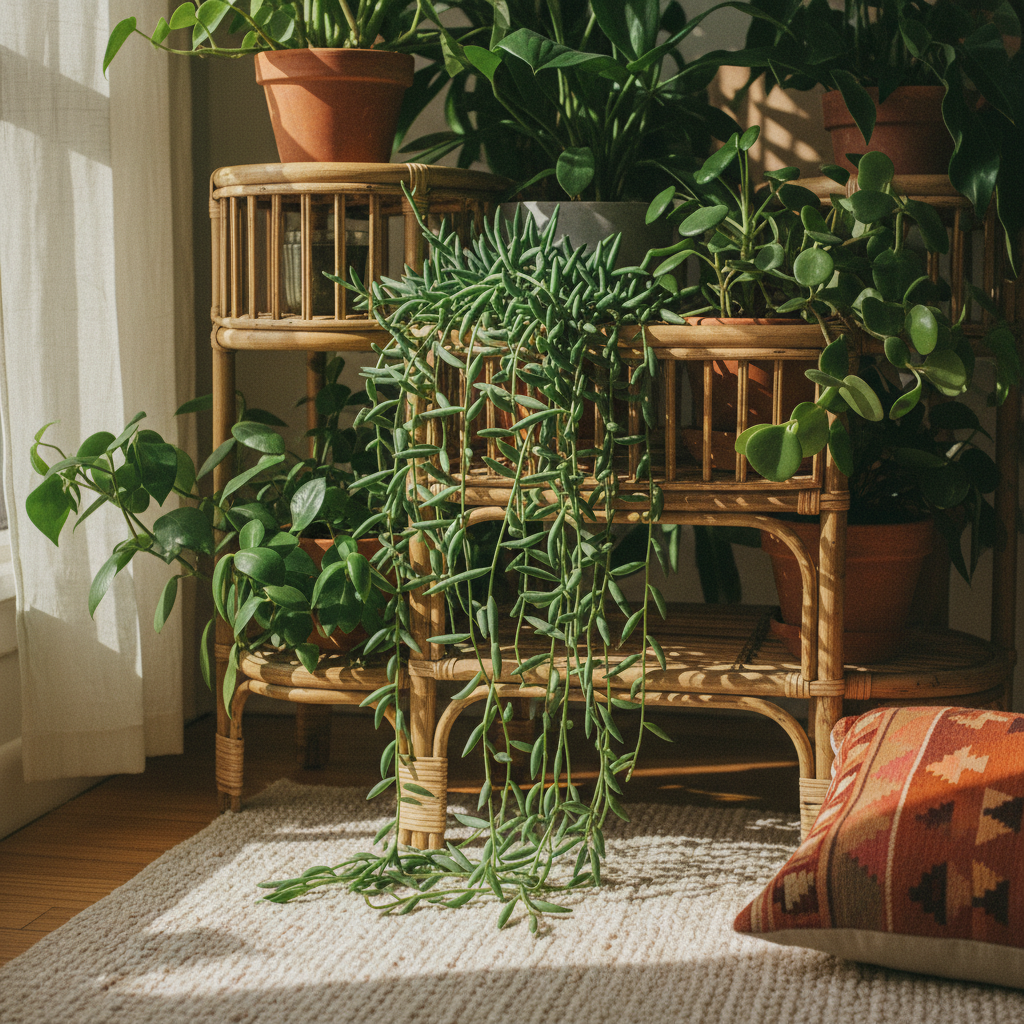
The String of Bananas is one of the most distinctive trailing succulents in cultivation, instantly recognisable by the plump, curved, banana-shaped leaves strung along its slender cascading stems. Botanically known as Curio radicans (formerly classified as Senecio radicans), this South African native belongs to the daisy family Asteraceae and grows wild across the dry, rocky escarpments of the Eastern Cape, where it sprawls over boulders and tumbles down crevices in search of cooler shade. Many growers also know it as Fishhooks Senecio, Banana Vine or String of Fishhooks, the latter two names earned by the gentle hook curl at the tip of each succulent leaf.
Among the so-called “string of” succulents, String of Bananas has built a reputation as the easy entry point — tougher, faster and considerably more forgiving than the famously temperamental Curio rowleyanus, String of Pearls. Mature plants can throw stems well past one metre, making them a popular choice for hanging planters, tall bookshelves and macramé hangers where the trailing growth can shine. This guide covers everything you need to know to keep a String of Bananas alive, but more importantly, to push it past mere survival into the abundant, lush, fast-trailing growth that makes the plant such a satisfying houseplant.
Contents
- Quick Reference
- Why String of Bananas Makes an Excellent Houseplant
- Light Requirements
- Watering and Humidity
- Soil, Potting and Repotting
- Fertilising
- Propagation
- Pests and Diseases
- Popular Varieties
- Frequently Asked Questions
Quick Reference: String of Bananas at a Glance
| Light | Bright indirect light with 2 to 3 hours of gentle direct sun; tolerates some morning or filtered afternoon sun |
| Watering | Water deeply when the substrate is bone dry, roughly every 10 to 14 days in summer and every 3 to 4 weeks in winter |
| Temperature | 18 to 27 degrees Celsius (65 to 80 Fahrenheit); survives down to 5 degrees Celsius (41 Fahrenheit) briefly |
| Humidity | Low to moderate, 30 to 50 per cent; dislikes prolonged high humidity |
| Fertiliser | Diluted balanced cactus and succulent feed once a month from spring to early autumn; none in winter |
| Toxicity | Mildly toxic to cats, dogs and humans if ingested; sap can irritate sensitive skin |
Why String of Bananas Makes an Excellent Houseplant
A common piece of advice in succulent circles is that beginners drawn to the famous String of Pearls should buy a String of Bananas first. The reasoning is straightforward. Both plants share the same elegant trailing habit, both produce small white pom-pom flowers with a faint cinnamon scent, and both belong to the same genus, but Curio radicans is noticeably more vigorous, more forgiving of irregular watering, and far less prone to the sudden collapse that humbles so many pearl growers. The leaves are larger and more deeply curved, the stems are sturdier, and the root system establishes faster after potting on or propagation. For anyone who likes the cascading aesthetic but does not want a high-maintenance prima donna, String of Bananas is the practical answer.

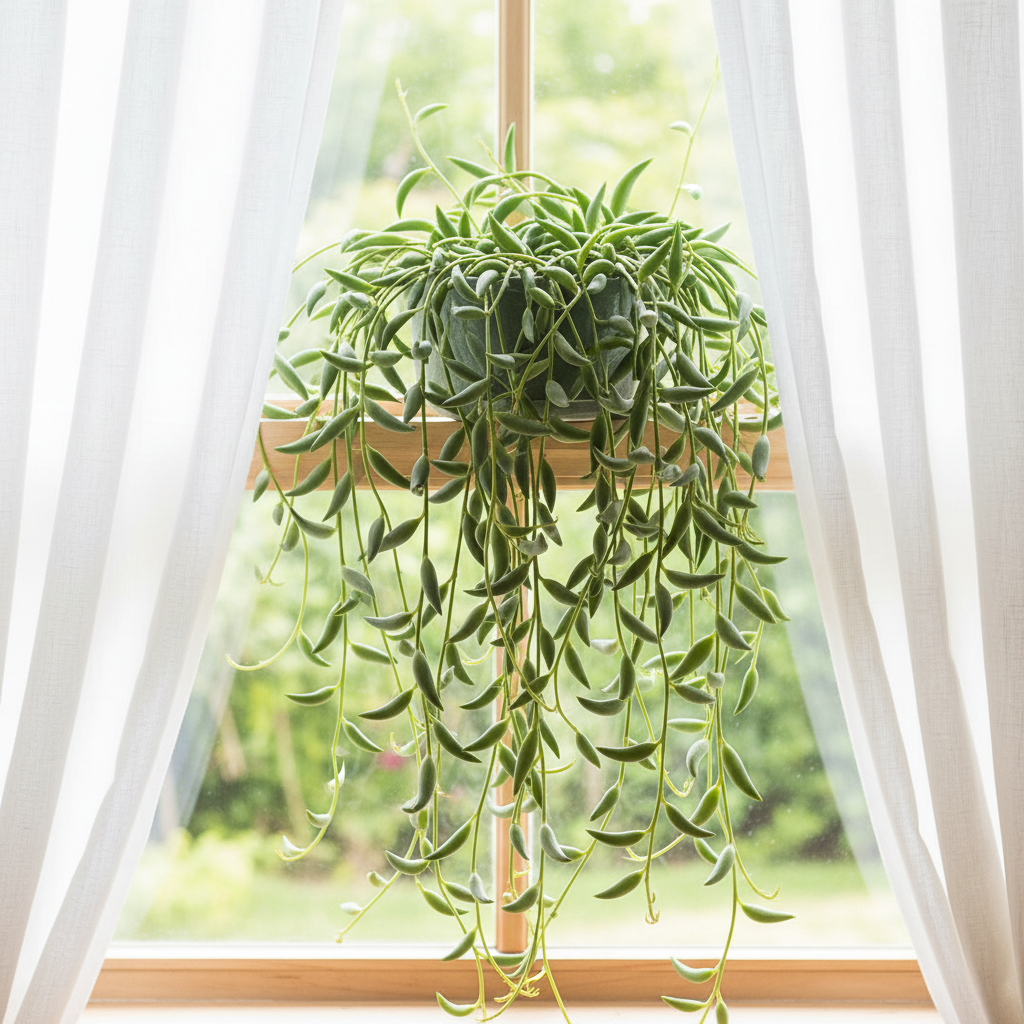
Beyond the practical care advantages, String of Bananas earns its place through pure visual impact. The leaves are translucent at the leaf tips, a feature shared with many other succulents that allows diffuse light to enter the body of the leaf and reach the photosynthetic tissue at the base. This translucency, called a leaf window, gives the foliage a luminous quality when backlit by a window. Mature stems trail 60 to 120 centimetres (24 to 47 inches), creating a dense waterfall of foliage that, once established, requires very little intervention to maintain. The plant also flowers reliably indoors given enough light, producing small white tubular daisy-like blooms in late winter and early spring that fill a small room with a subtle cinnamon-and-vanilla fragrance.
Important — Toxicity: Like other members of the Senecio and Curio genera, String of Bananas contains pyrrolizidine alkaloids that are mildly toxic to cats, dogs and humans if chewed or swallowed. Ingestion typically causes drooling, vomiting and lethargy in pets, and oral irritation in people. The milky sap can also cause contact dermatitis in sensitive individuals. Keep the plant out of reach of curious animals and small children, and wash hands after pruning or repotting.
Light Requirements
Light is the single most important factor in growing a healthy, full-bodied String of Bananas. In its native Eastern Cape habitat the plant grows wedged among rocks and beneath low scrub, receiving filtered overhead sun for much of the day. Indoors, the closest equivalent is a position that captures plentiful bright indirect light supplemented by two or three hours of direct sun, ideally first thing in the morning or filtered through a sheer curtain at midday. Provided enough light is on offer, almost every other care variable becomes easier to manage; stems remain compact and leafy, internodes stay short, and the plant maintains the springy, vigorous habit that makes it so appealing.
Light starvation is the most common slow-motion failure mode. A String of Bananas placed too far from a window will continue to grow for months, but the new stems push out long, weak internodes with widely spaced leaves and a noticeable colour shift toward a flat, dull green. Eventually the older leaves shrivel, the lower stems drop their foliage, and the plant develops the unfortunately common “bald rope” appearance of a stretched succulent. Once this etiolated growth has set in, it cannot be reversed in place; the affected stems must be cut back and the cuttings restarted in better conditions.
Light Levels Explained
Plant care guides love vague phrases like “bright indirect light”, but the underlying numbers help when matching a plant to a real position in a real home. Illuminance is measured in lux, and the table below translates the common indoor light categories into approximate lux ranges and typical placement examples to help you assess your own space.
| Light Category | Approx. Level | Typical Location | Outcome |
|---|---|---|---|
| Direct sun | 30,000 to 100,000 lux | Right inside a south or west window, no curtain | Good in morning, risk of scorch in summer afternoons |
| Bright indirect | 10,000 to 25,000 lux | Within 30 to 60 cm of a sunny window with a sheer curtain | Ideal sweet spot; compact growth and flowering |
| Medium indirect | 2,500 to 10,000 lux | A metre or two back from a bright window, or in a north window | Acceptable; slower growth, paler leaves |
| Low indirect | 500 to 2,500 lux | Mid-room with side window only | Etiolation likely within months; not recommended |
| Very low | Under 500 lux | Interior corners, hallways, basement rooms | Will decline and die; do not place here |
Window Orientation and Placement
South-facing window: In the northern hemisphere, a south window is the gold standard for String of Bananas, providing bright light for most of the day. Set the plant a short distance back from the glass or use a sheer curtain to filter the harshest midday rays, especially in summer. In the southern hemisphere, the same applies to north-facing windows.
East-facing window: Gentle morning sun followed by bright indirect light for the rest of the day is excellent. The plant can sit right against the glass in an east window without scorching, and the cooler light usually preserves the blue-green leaf tone beautifully.
West-facing window: The hot late-afternoon sun in a west window can scorch leaf tips in summer, so a sheer curtain or a small step back from the glass is wise. Light intensity is otherwise very similar to a south window and easily sufficient for healthy growth and flowering.
North-facing window: A bright unobstructed north window can just about support a String of Bananas, but growth will be slower, stems thinner and the chance of flowering low. If north is your only option, consider supplementing with a small LED grow light or moving the plant outdoors for the warmer months.
Pro Tip — Read the Stretch: The single best way to know whether your plant is getting enough light is to look at the distance between leaves on new growth. If the new internodes are roughly the same length as the old ones, the light is right. If new stems suddenly produce long bare gaps between leaves, the plant is reaching toward a brighter spot and you should move it closer to the window.
How Light Affects Leaf Colour and Form
The natural leaf colour of String of Bananas is a cool, faintly waxy blue-green, sometimes with hints of grey or silver when grown in very bright conditions. Under high light, the leaves become noticeably more compact and rounder, develop a slight purple flush at the leaf tips on the most exposed stems, and the waxy farina that protects the surface from sunburn intensifies. Conversely, in lower light the leaves elongate, lose their plumpness and take on a flatter, more uniform mid-green tone. The variegated cultivar in particular needs strong light to maintain its cream and yellow patterning; in dim conditions the variegation fades back toward green as the plant prioritises chlorophyll-rich tissue.
Warning — Direct Sunlight: Although String of Bananas tolerates more direct sun than many succulents, prolonged exposure to harsh summer afternoon rays through unfiltered glass can scorch the leaves, producing brown, crispy patches that never fully recover. Acclimatise gradually to brighter positions over 7 to 10 days, and use a sheer curtain during the hottest summer weeks if your window faces south or west.
Artificial Lighting
String of Bananas responds well to supplementary LED grow lights, making it a viable plant for rooms without strong natural light. A full-spectrum LED panel rated at 20 to 40 watts, positioned 30 to 45 centimetres (12 to 18 inches) above the plant, on a timer for 12 to 14 hours per day, will keep stems compact and leaves plump even in a windowless office or basement. The combination of cooler 6,500 Kelvin lights for vegetative growth with a few warmer 3,000 Kelvin diodes encourages flowering in mature plants. Be aware that grow lights also dry the substrate faster, so check watering schedules accordingly.
Seasonal Adjustments
Light availability shifts dramatically through the year in temperate climates. From late autumn through to early spring, the sun sits lower in the sky and many windows receive only a fraction of their summer intensity. Move the plant closer to the window in winter, even right against the glass if the room is warm and the glass not freezing. In high summer, the opposite applies: a position that was perfect in February can deliver harsh direct sun by mid-July, scorching the leaves. A small repositioning of 50 centimetres back from the window, or the addition of a sheer curtain for the months of June through August, is often all that is needed.
Watering and Humidity
Watering is where most String of Bananas plants are accidentally killed, and the cause is almost always overzealous attention rather than neglect. As a true succulent, Curio radicans stores water inside the swollen banana-shaped leaves, drawing on this reserve through long dry periods. The roots are correspondingly fine and shallow, evolved to absorb water quickly during brief rainfall and then go dormant during drought. Keeping the substrate continuously moist suffocates these fine roots, triggering rot that can travel up the stems and collapse a healthy plant in days. The mantra to memorise is simple: water thoroughly, then leave it alone until the substrate is completely dry from top to bottom.
When to Water
Calendar schedules are unreliable for succulents because actual water demand depends on temperature, light, pot size, substrate composition and time of year. The most accurate method is to physically check the substrate. Push a wooden chopstick or your finger all the way to the bottom of the pot; if it comes out completely clean and dry, it is time to water. If any dampness or dark soil clings to it, wait a few more days. A second, complementary cue is the leaves themselves. Plump, firm leaves with a slight squeak when squeezed gently mean the plant is fully hydrated; leaves that feel slightly softer and look subtly wrinkled along their length signal that the reserves are running low and a watering is due within a day or two.
In practical terms, a String of Bananas in a 13-centimetre (5-inch) terracotta pot, on a bright windowsill at room temperature, typically needs water every 10 to 14 days during the active growing season from April to September, and every 3 to 4 weeks during the cooler, lower-light winter months. Plastic pots retain moisture longer, so extend intervals by a few days; tiny pots and grit-heavy mixes dry faster, so check more frequently. When in doubt, wait another day. Mild underwatering is almost always recoverable; overwatering is often not.
Pro Tip — Squeeze Test: A fully hydrated String of Bananas leaf should feel taut and slightly squeaky between finger and thumb, like a small grape. A leaf that compresses easily with a soft, almost spongy give is asking for water. This tactile check is faster and more reliable than any moisture meter, especially in chunky grit-based mixes that confuse electronic probes.
How to Water Correctly
- Confirm the substrate is bone dry by inserting a chopstick or your finger all the way to the bottom of the pot.
- Move the plant to a sink, bath or large tray to catch run-off, lifting trailing stems aside if needed.
- Water slowly and evenly across the whole surface of the substrate, avoiding splashing the leaves where possible, until water flows freely from the drainage holes.
- Continue watering for another few seconds to ensure the entire root ball is saturated, then stop.
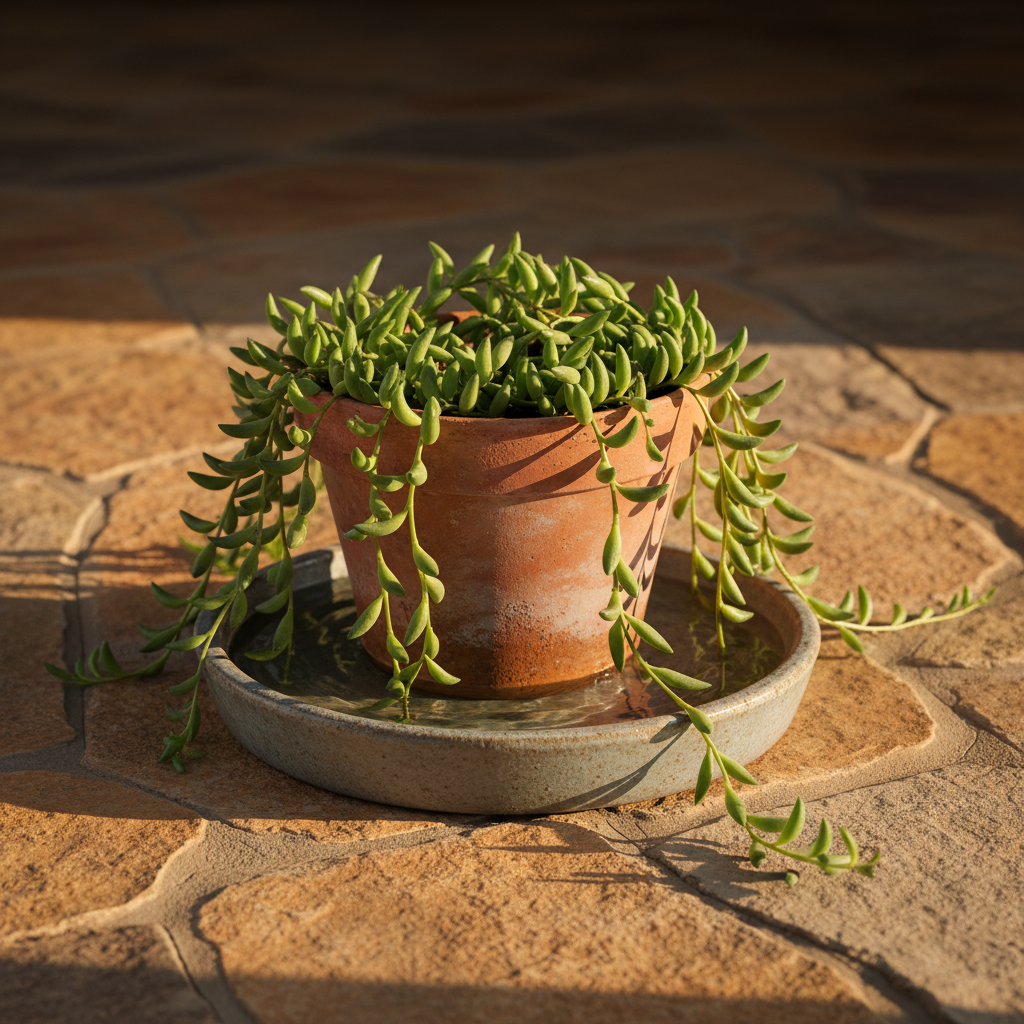
- Allow the pot to drain completely for 10 to 15 minutes before returning it to its display position; never leave the pot standing in a saucer of water.
- Discard any water that has collected in the saucer once draining stops, and only water again when the substrate is fully dry.
Signs of Overwatering vs. Underwatering
| Symptom | Overwatering | Underwatering |
|---|---|---|
| Leaf colour | Yellowing, often translucent and watery-looking | Duller, slightly grey-green or purplish at tips |
| Leaf texture | Soft, mushy, sometimes splitting along the leaf | Wrinkled, slightly deflated but still firm |
| Stem condition | Soft, blackening from the base, easily detached | Wiry and thin but intact, slightly papery |
| Soil surface | Stays damp for days, may grow algae or fungus gnats | Pulls away from the pot edge, dust-dry to touch |
| Roots | Brown or black, mushy, often foul-smelling | Pale, dry but intact, may show fine new white tips on rewatering |
Warning — Root Rot: If you notice yellowing, translucent leaves combined with a sour or earthy smell from the substrate, act quickly. Unpot the plant, gently rinse the roots, trim away any soft brown or black tissue back to firm pale roots with sterilised scissors, allow the rootball to air-dry for 24 to 48 hours, then repot in fresh, dry, well-draining mix. Do not water for at least a week. Root rot is reversible if caught early, but it spreads upward fast through soft succulent tissue.
Humidity Requirements
String of Bananas is one of the rare houseplants that does not benefit from high humidity. Its leaves are adapted to dry, breezy conditions, and prolonged exposure to humidity above 60 per cent encourages fungal problems and surface mould. Normal indoor humidity of 30 to 50 per cent is ideal, which means most homes are perfectly suited without any intervention.
The signs of humidity problems are easy to read. Excessive humidity manifests as soft spots on individual leaves, occasionally with a fluffy white or grey mould on the surface, and stems that feel cool and slightly clammy to the touch. Extremely low humidity, below 25 per cent, can cause leaf tips to develop fine brown points, though this is rare indoors and almost never serious. Misting is unnecessary and often counterproductive: the water sits on the waxy leaf surface, attracts dust, and can foster the very mould problems you are trying to avoid.
If you live in a naturally humid climate, focus instead on improving airflow around the plant. A small clip-on fan running on its lowest setting a few hours a day, particularly in summer, keeps the foliage dry and dramatically reduces the risk of stem rot. Avoid placing the plant in steamy bathrooms or directly above kitchens where cooking moisture lingers in still air.
Water Quality
String of Bananas is reasonably tolerant of average tap water in most regions. In very hard-water areas, however, mineral build-up on the substrate surface and inside the pot can gradually push the substrate pH upward and lock up nutrients. If your tap water is heavily chlorinated, leave it to stand uncovered overnight before use; this allows free chlorine to evaporate. In very hard-water areas, switch to rainwater or filtered water once a month to flush accumulated salts. Use water at room temperature; cold tap water shocks the fine roots and can trigger leaf drop.
Soil, Potting and Repotting
The substrate underneath your String of Bananas is doing more work than any other variable except light. The plant’s fine, shallow roots demand a mix that drains within seconds of watering, holds just enough moisture to rehydrate the leaves, then dries out completely before the next watering. Bag-standard general-purpose compost is a frequent culprit behind sudden plant collapse: it retains too much moisture, compacts within a few months, and leaves the fine root system permanently waterlogged. Building or buying a proper gritty succulent mix is the single most impactful change a new owner can make.

Ideal Soil Composition
The aim is an open, airy substrate with about 50 to 70 per cent inorganic, free-draining ingredients and 30 to 50 per cent organic material. Inorganic components such as pumice, perlite and horticultural grit create permanent air pockets and prevent compaction. Organic ingredients such as cactus compost or coir provide a small reservoir of moisture and the structural fines that anchor the roots. The exact proportions can be flexed depending on your watering tendencies: if you tend to overwater, push the mix toward 70 per cent inorganic; if you have a habit of forgetting, dial it back toward 50 per cent.
| Component | Proportion | Function |
|---|---|---|
| Cactus and succulent compost | 40 per cent | Base organic content; supplies a small moisture buffer and nutrient reservoir |
| Pumice or lava rock (3 to 6 mm) | 30 per cent | Permanent airspace; holds moisture inside its porous structure without becoming waterlogged |
| Perlite | 20 per cent | Lightweight aeration; lifts the mix and improves drainage |
| Coarse horticultural grit or coarse sand | 10 per cent | Adds weight, sharpens drainage and prevents fines from compacting |
Substrate pH should sit between 6.0 and 7.0, very slightly acidic to neutral. Most commercial cactus mixes already fall within this range, so unless you are mixing your own from peat or limestone-heavy ingredients, pH rarely needs active management. Avoid mixes labelled for orchids or carnivorous plants; the ingredients suited to those species are wrong for succulents.
Pro Tip — Quick Mix Recipe: If you do not want to source four ingredients, the simplest effective shortcut is to combine two parts of any decent commercial cactus and succulent compost with one part pumice and one part perlite, then add a generous handful of coarse grit on top after potting. This three-ingredient mix replicates the drainage characteristics of a proper bespoke blend at a fraction of the effort.
Choosing the Right Pot
Pot choice is more consequential for String of Bananas than for most houseplants because the species pairs a fine, shallow root system with a stem mass that can easily outgrow the pot’s apparent capacity. Get this balance wrong and you end up with a top-heavy plant in a tiny waterlogged container, or a sparse young plant adrift in a vast pot of cold, slow-drying substrate.
Drainage holes are non-negotiable. Decorative pots without drainage are death traps for succulents. If you must use a closed-bottom cachepot for aesthetic reasons, keep the plant in a smaller plastic nursery pot inside it, lift it out to water, allow it to drain fully in the sink, and only then return it to the decorative pot. Glass terrariums, sealed ceramics and metal containers without holes should be avoided entirely.
Pot material: Terracotta is the gold standard. The porous walls breathe, allowing moisture to evaporate from the sides as well as the surface, which dramatically reduces the risk of waterlogged roots. Glazed ceramic and plastic pots retain moisture for longer, which means watering intervals must extend and the consequences of overwatering arrive more slowly. Hanging plastic baskets are popular for the trailing display, but be especially conservative with water in them; the enclosed sides hold moisture stubbornly.
Pot size: Choose a pot only 2 to 3 centimetres (about 1 inch) wider in diameter than the root ball. String of Bananas is happy in surprisingly small pots and often flowers more readily when slightly root-bound. An oversized pot holds excess unused substrate that stays wet far too long after watering, breeding rot and fungus gnats.
When to Repot
String of Bananas needs repotting much less frequently than fast-growing tropical houseplants, typically every 2 to 3 years. Signs it is time include roots visibly growing from the drainage holes, water running straight through the pot without soaking in, substrate that has noticeably compacted or become hydrophobic, and a clear slowdown in new growth despite good light. Always repot in spring, ideally just as the plant is breaking its winter dormancy, so it can immediately root into the fresh mix.
How to Repot: Step-by-Step
- Water lightly the day before repotting so the rootball lifts cleanly and the fine roots do not snap.
- Prepare the new pot: place a small piece of mesh or shard over the drainage holes to retain substrate, and add a layer of fresh gritty mix to the bottom.
- Gently squeeze and invert the current pot, supporting the crown of the plant with one hand, and ease the rootball out without yanking the trailing stems.
- Lightly tease away the outer two centimetres of old substrate from the rootball, and trim any soft, brown or dead roots with sterilised scissors.
- Centre the plant in the new pot, ensuring the crown sits 1 to 2 centimetres below the rim, then backfill with fresh mix, tapping the pot to settle the substrate without compacting it.
- Top-dress with a thin layer of coarse grit if desired, which keeps the surface clean and discourages fungus gnats.
- Do not water for 5 to 7 days. Allow any damaged root tissue to callus and seal before exposing it to moisture.
Warning — Transplant Shock: It is normal for a freshly repotted String of Bananas to look slightly limp or for a few older leaves to drop in the days following the move. Resist the urge to “help” by watering immediately or fertilising. The plant is reallocating resources to push new roots; intervening too early simply increases the risk of rot. Wait at least a week before the first watering, and skip fertiliser for the following 6 to 8 weeks.
Fertilising
String of Bananas is a light feeder. In its native rocky habitat it survives, and even thrives, on remarkably lean soils, drawing what little it needs from thin layers of organic material trapped between stones. Indoors, the same principle applies; overfeeding is far more damaging than underfeeding. A modest, well-timed feeding regime supports the spring and summer flush of new stems, fuels flowering, and keeps the foliage that beautiful saturated blue-green, while excess fertiliser leads to soft, etiolated growth and salt build-up that scorches the fine roots.
The right answer for most growers is a diluted balanced cactus and succulent fertiliser, applied roughly once a month from April through September, then completely withheld through the dormant winter months. There is no need for exotic supplements, foliar feeds or specialty flowering boosters. Keep it simple.
Understanding Plant Nutrients
Plant fertilisers are described by their N-P-K ratio, three numbers indicating the relative proportions of nitrogen, phosphorus and potassium. Each macronutrient supports a different aspect of growth, and a generally balanced ratio such as 5-10-10 or 2-7-7 is best for succulents, which require less nitrogen than leafy tropical plants. The table below summarises the role and deficiency symptoms of the main nutrients String of Bananas needs.
| Nutrient | Symbol | Primary Function | Deficiency Symptoms |
|---|---|---|---|
| Nitrogen | N | Drives leaf and stem production through chlorophyll synthesis | Pale, uniformly yellowing older leaves; weak slow growth |
| Phosphorus | P | Supports root development and flowering | Stunted growth; reluctance to flower; purplish leaf tinge |
| Potassium | K | Regulates water balance and disease resistance | Brown leaf margins; weak stems; increased susceptibility to rot |
| Calcium | Ca | Builds cell walls and supports new growth | Distorted, deformed new leaves at the growing tips |
| Magnesium | Mg | Central atom in the chlorophyll molecule | Yellowing between leaf veins on older leaves |
| Iron | Fe | Required for chlorophyll formation | Yellowing between veins on newest leaves while veins stay green |
Types of Fertiliser
Liquid fertilisers: The most practical choice for String of Bananas. A bottle of balanced cactus and succulent feed diluted to half the recommended strength and mixed into the watering can once a month during the growing season delivers nutrients in a form the roots can absorb immediately. The dilution provides a margin of safety against the salt build-up that succulents are particularly sensitive to.
Slow-release granular: Coated prills mixed into the substrate at potting time release nutrients gradually over several months. Convenient and forgiving, they work well for growers who travel or forget to feed regularly. Use at half the recommended rate, as standard doses can be too strong for succulents. Refresh annually in spring.
Organic fertilisers: Worm castings, dilute seaweed extract and diluted compost tea offer a gentler nutrient delivery that is almost impossible to overdose. A thin top-dressing of worm castings once or twice a year, watered in lightly, is an excellent low-effort approach for organic growers. Avoid raw manures and strong fish emulsions, which can smell unpleasant indoors and may burn the roots.
Feeding Schedule
The simplest reliable schedule is monthly half-strength liquid feed from April to September, paused entirely from October through March. In northern climates with shorter growing seasons, start feeding only when you see clear new growth in spring and stop earlier in autumn as growth slows. Newly repotted plants should not be fed for 6 to 8 weeks; the fresh substrate already supplies plentiful nutrients, and adding more risks burning the disturbed root system. Plants that are clearly stressed or recovering from pests or rot should also be left unfed until they have rebuilt firm new growth.
Pro Tip — Half-Strength Rule: Always dilute liquid fertiliser to half the manufacturer’s recommended strength for succulents. The labels are calibrated for thirsty leafy houseplants that consume nutrients quickly; for a slow-growing succulent like String of Bananas, full-strength feed leaves a tidemark of unused salts in the substrate, gradually poisoning the fine root tips.
How to Fertilise
- Wait until the plant needs watering anyway, when the substrate is fully dry.
- Mix liquid fertiliser into your watering can at half the recommended strength using room-temperature water.
- Water as you normally would, letting the diluted solution run through the entire substrate until it drains from the holes.
- Allow the pot to drain fully and discard any saucer water; do not allow the plant to sit in fertiliser solution.
- Mark the date and skip fertiliser entirely on the next watering, alternating fertilised waterings with plain water flushes to prevent salt build-up.
Warning — Salt Build-Up: Mineral salts from fertilisers accumulate gradually in the substrate, especially in pots without regular leaching. The first signs are a fine white crust on the soil surface and the inside of terracotta walls, followed by brown crispy leaf tips and a general loss of vigour. Once a year, flush the pot thoroughly with plain water at three times the pot’s volume to wash accumulated salts out of the system.
Propagation
One of the great pleasures of owning a String of Bananas is how easily it produces new plants from cuttings. A single mature stem can yield half a dozen viable cuttings, and within a few months you can transform one parent into a generous collection of gift-ready trailing succulents. The plant roots almost too willingly: where stems brush soil or another pot, they will often put down roots without any encouragement at all. This generosity has made Curio radicans a perennial favourite at plant swaps and a forgiving first project for anyone learning to propagate succulents.
The right time to take cuttings is during the active growing season, from late spring through early autumn, when the plant has the metabolic energy to push new roots quickly. Cuttings taken in deep winter root much more slowly, if at all, and risk rotting before they establish. Choose healthy, plump stems with several leaves, and avoid taking cuttings from a plant that is clearly stressed or recovering from pest pressure.
Understanding Stem Nodes
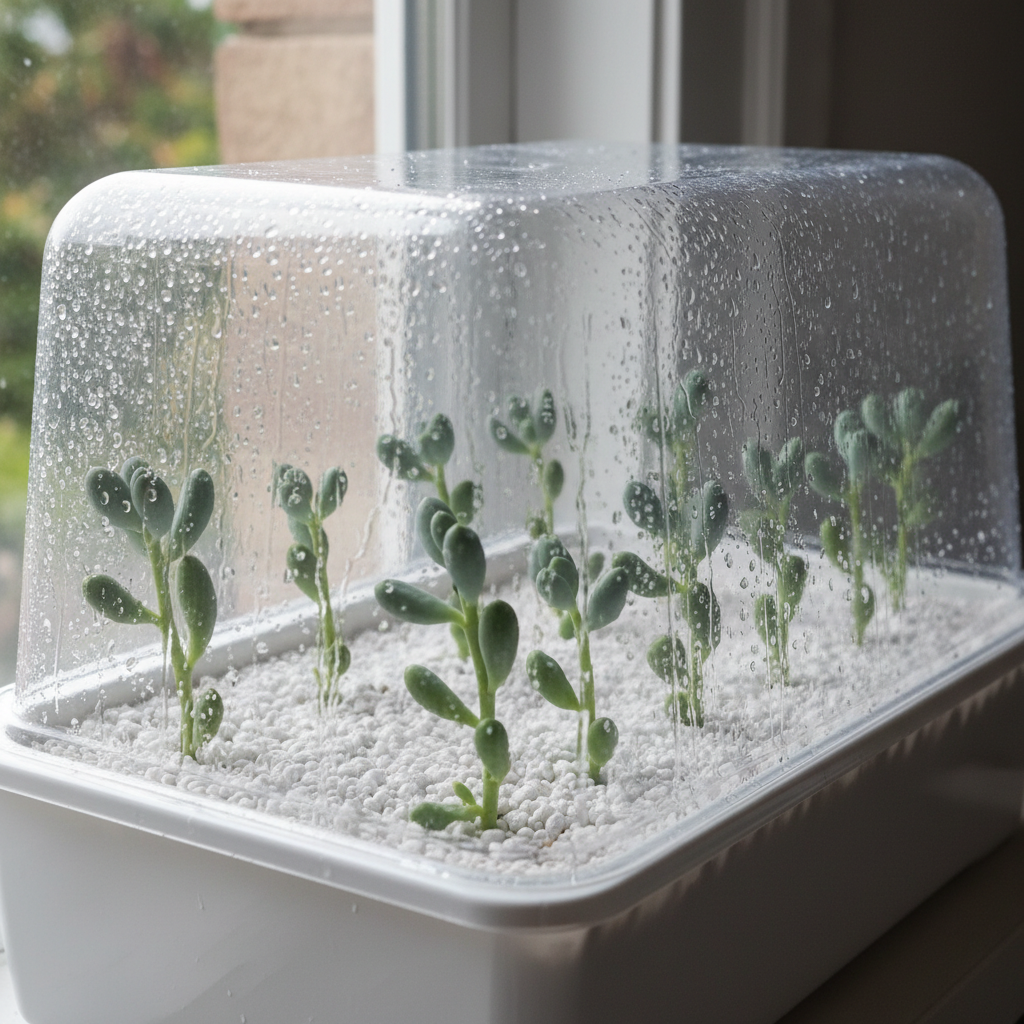
The key structures for propagating String of Bananas are the nodes along each stem. A node is a slight thickening, often marked by a pair of leaves or a small leaf scar, from which new roots and new stems can emerge. When you cut a stem, the cells immediately above and below the cut are stimulated to form roots and shoots respectively. Each successful cutting therefore needs at least two or three nodes: one or two in contact with the rooting medium to produce roots, and at least one above to push out fresh growth. Internodal cuttings, with no nodes at all, simply rot. Always make cuts just below a node, leaving the cutting itself with the node intact at its base.
Soil Propagation: Step-by-Step
Soil propagation is the most reliable method for String of Bananas and produces sturdy new plants that transition seamlessly to their forever pot. This is the method most experienced succulent growers recommend.
- Select healthy stems and cut sections 10 to 15 centimetres (4 to 6 inches) long with sterilised scissors, making the cut just below a node.
- Strip the leaves from the lowest 2 to 3 centimetres of each cutting, leaving at least three or four leaves at the tip; the bare nodes will form the roots.
- Lay the cuttings on a paper towel in a shaded spot for 2 to 3 days to allow the cut ends to callus and seal, which prevents rot.
- Fill a shallow tray or small pot with fresh gritty succulent mix, lightly moistened so it is just damp to the touch, never wet.
- Insert the cuttings vertically into the substrate so the bare nodes are buried 1 to 2 centimetres deep, and gently firm the mix around them.
- Place the tray in bright, indirect light away from harsh sun, and mist the surface lightly only when the top centimetre of substrate dries out.
- Wait 3 to 6 weeks. A gentle tug will tell you when roots have formed; resistance means a successful take. Begin normal watering at that point and pot up after another two to three weeks once growth is visible.
Pro Tip — Pile Them In: For a fast, full-looking trailing plant, root multiple cuttings together in the same final pot rather than rooting each individually and combining later. Aim for 6 to 10 cuttings in a 13-centimetre (5-inch) pot, spaced evenly. Once rooted they will weave together, and within a season you have a single bushy specimen that already trails over the rim of the pot.
Water Propagation: Step-by-Step
Water propagation is technically possible for String of Bananas, though it is generally considered second-best because succulent roots formed in water are thinner and more fragile than those formed in soil, and they sometimes struggle to transition. Used carefully, however, it is a visually rewarding way to watch the rooting process and works fine for small batches of cuttings.
- Take cuttings as for soil propagation, callus them for two days, and prepare a glass jar or small vase of room-temperature water.
- Suspend the cuttings so that one or two bare nodes sit just below the water line, while the leaves stay above the water; a cardboard collar or chopstick rest works well.
- Place the jar in bright, indirect light, never direct sun, which would overheat the water and rot the cuttings.
- Refresh the water completely every 5 to 7 days, or whenever it becomes cloudy.
- Once roots are 2 to 3 centimetres long, transfer the cuttings into gritty succulent mix, keeping the substrate barely damp for the first two weeks to ease the transition.
Troubleshooting Propagation
| Problem | Likely Cause | Solution |
|---|---|---|
| Cuttings rotting at the base | Substrate too wet, or cuttings not callused before planting | Allow cut ends to dry for 2 to 3 days; use barely damp gritty mix; reduce watering |
| Cuttings shrivelling and drying out | Insufficient moisture or too much direct sun | Increase ambient humidity slightly, mist the surface, move out of direct sun |
| No roots after 6 weeks | Cuttings taken in winter, or temperatures too low | Wait for active growing season; keep cuttings at 21 to 24 degrees Celsius (70 to 75 Fahrenheit) |
| Cuttings flop after transplant from water | Water roots struggling to function in soil | Keep new pot in bright shade and barely damp for two weeks; new soil roots will develop |
Pests and Diseases
String of Bananas is generally a robust, pest-resistant houseplant. A well-watered plant in good light is rarely seriously troubled by the common houseplant pests, which tend to single out stressed or weakened specimens. Vigilance and prevention are far more effective than treatment, and a habit of inspecting the undersides of leaves and the leaf axils once a fortnight will catch nearly every problem at a stage where a cotton bud and a bottle of isopropyl alcohol are all you need.
When problems do arise, mealybugs are by far the most common offender, followed by spider mites in dry indoor air and the occasional aphid colony on tender new growth. On the disease side, root rot from overwatering vastly outweighs any other concern, with stem rot following a close second when humidity is too high or air circulation poor. Almost every disease problem traces back to a watering or environmental error.
Common Pests
Mealybugs (Pseudococcus longispinus)
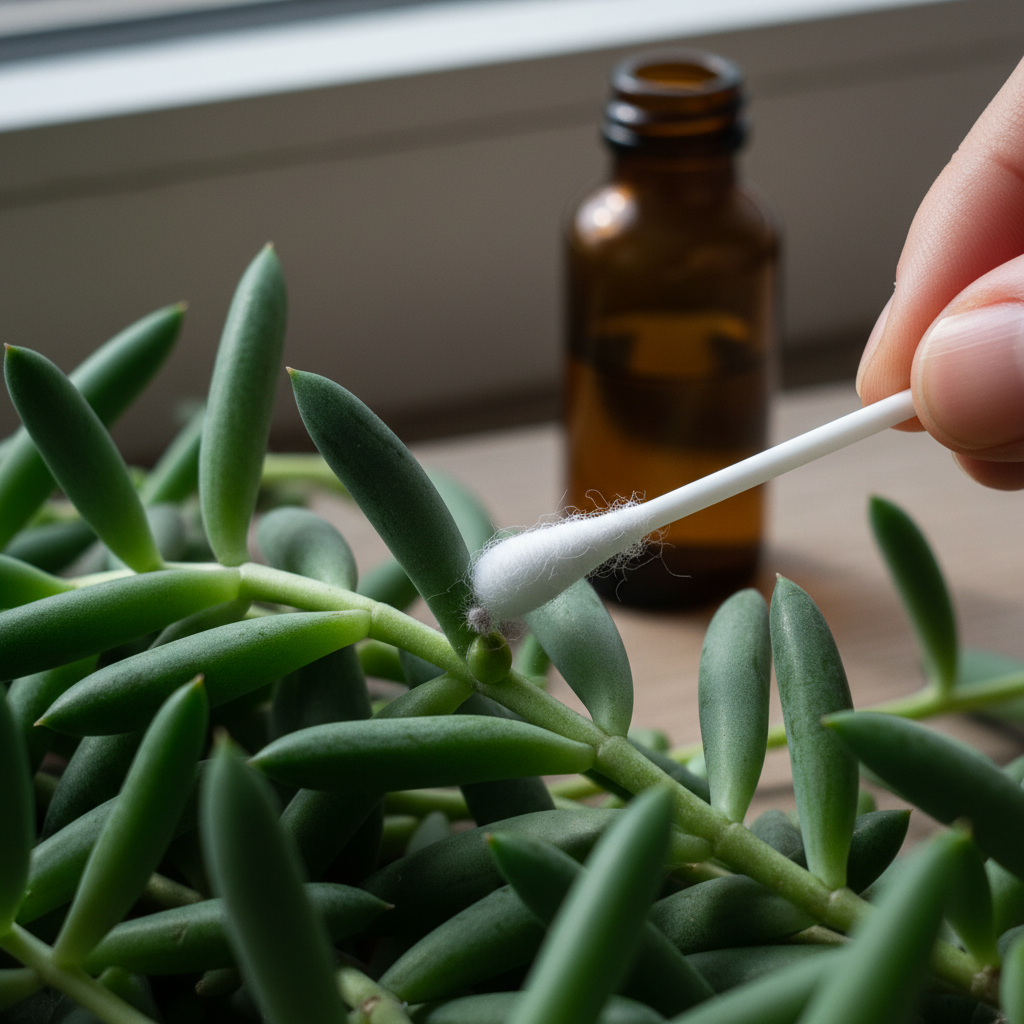
Mealybugs are the most persistent pest of String of Bananas, appearing as small, soft-bodied insects coated in a white waxy fluff. They cluster in leaf axils, at the base of the plant and tucked into the spaces where stems meet, sucking sap and excreting sticky honeydew that attracts sooty mould. Infested plants show wilting leaves, yellowing along stems and a general loss of vigour. The waxy coating makes mealybugs resistant to many sprays, so a direct, persistent approach is needed.
Treatment: Touch each visible mealybug with a cotton bud dipped in 70 per cent isopropyl alcohol; the wax dissolves on contact and the bug dies within seconds. Inspect every leaf axil, the soil surface and under the rim of the pot. Repeat every 4 to 5 days for at least three rounds to catch newly hatched generations. For larger infestations, a systemic insecticide containing imidacloprid drenched into the substrate is highly effective.
Spider Mites (Tetranychus urticae)
Tiny, almost invisible to the naked eye, spider mites thrive in hot, dry indoor air, especially over winter near a radiator. The first sign is a faint pale stippling on the leaves where individual cells have been emptied of sap, followed in heavier infestations by fine silken webbing in the leaf axils and at the growing tips. Leaves take on a dusty, washed-out appearance and may begin to drop.
Treatment: Mites hate moisture and good airflow. Wipe leaves with a damp cloth or rinse gently in a tepid shower, then improve ventilation and slightly raise ambient humidity. Apply a miticidal soap or neem oil solution weekly for three weeks, ensuring you treat the undersides of leaves where mites hide. Predatory mites are an effective biological control for stubborn outbreaks.
Aphids (Aphis fabae and related species)
Aphids occasionally colonise the tender growing tips of String of Bananas, particularly on flower buds in late winter. They are visible to the naked eye as small green, black or pink soft-bodied insects clustered along stems and around buds. Like mealybugs, they secrete sticky honeydew that attracts mould.
Treatment: Aphids are easily dislodged by a strong stream of lukewarm water from a sink tap. For persistent colonies, spray with a dilute solution of insecticidal soap or neem oil, repeating every 5 days for two to three weeks. Ladybirds and lacewing larvae are excellent natural predators if you can source them.
Fungus Gnats (Bradysia species)
Small black flies hovering around the pot are usually fungus gnats, a sign that the substrate is too wet for too long. The adults are merely annoying, but the larvae feed on fine roots and decaying organic matter in the soil and can damage young plants and freshly rooted cuttings.
Treatment: The single most effective intervention is to dry out the substrate completely between waterings; the larvae cannot survive in dry soil. Top-dress with a 1-centimetre layer of coarse grit or horticultural sand to prevent the adults laying eggs in the surface. Yellow sticky traps near the pot catch flying adults, and a BTI (Bacillus thuringiensis israelensis) drench kills larvae without harming the plant.
Common Diseases
Root Rot (Pythium and Phytophthora species)
Root rot is the disease that kills most String of Bananas, almost always triggered by overwatering or poor drainage. The pathogens proliferate in waterlogged substrate, attacking the fine roots, then spreading up through the stem base. Above-ground symptoms include yellowing, translucent or mushy leaves, blackening at the stem bases, and a sour smell from the substrate.
Treatment: Unpot immediately, rinse the rootball, trim all soft brown roots back to firm pale tissue with sterilised scissors, allow the plant to air-dry for 24 to 48 hours, then repot in fresh dry gritty mix. Withhold water for at least a week. If the rot has reached the main stems, take healthy cuttings from the tips, callus them and start again; the parent may not recover.
Stem Rot (Erwinia bacteria)
Stem rot appears as soft, dark, often mushy patches along otherwise healthy stems, sometimes with a slightly translucent watery edge. It is most common in plants kept in humid still air or where overhead watering has left moisture trapped between leaves. Once present, it spreads quickly along the stem.
Treatment: Cut affected stems back to firm, healthy tissue several centimetres above the rot, sterilising your scissors between cuts. Dispose of infected material, do not compost it. Improve airflow around the plant, reduce humidity, and avoid wetting the foliage when watering. Healthy cuttings from above the rot zone can be rooted to preserve the plant.
Powdery Mildew (Erysiphe species)
Occasionally a fine white powdery coating appears on leaves and stems, particularly during cool damp periods or in poorly ventilated rooms. Affected leaves yellow and may drop. Powdery mildew is rarely fatal on String of Bananas but disfigures the foliage and weakens the plant.
Treatment: Improve ventilation, reduce humidity, and remove badly affected leaves. A weekly spray of diluted milk (one part milk to nine parts water) is a surprisingly effective gentle treatment; for stubborn cases use a sulphur-based fungicide labelled for ornamentals, following the manufacturer’s instructions.
Pest and Disease Summary
| Pest / Disease | Identification | Treatment |
|---|---|---|
| Mealybugs | White waxy fluff in leaf axils; sticky honeydew | Cotton bud with 70 per cent isopropyl alcohol; systemic if severe |
| Spider mites | Pale stippling; fine webbing; dusty leaves | Rinse, raise humidity, miticidal soap or neem oil weekly |
| Aphids | Clusters of small soft-bodied insects on new growth | Rinse off; insecticidal soap or neem oil |
| Fungus gnats | Small black flies around the pot; larvae in soil | Dry out substrate; grit top-dress; BTI drench; sticky traps |
| Root rot | Yellow translucent leaves; mushy roots; sour smell | Unpot, trim rot, air-dry, repot in fresh dry mix |
| Stem rot | Soft dark mushy patches on stems | Cut back to healthy tissue; improve airflow; propagate from clean cuttings |
| Powdery mildew | White powdery coating on leaves | Ventilation; remove affected leaves; milk spray or sulphur fungicide |
Prevention Strategies
Prevention is largely a question of environment and habit. Inspect new plants before bringing them into your collection, ideally quarantining them for two weeks in a separate room where any hidden pests can show themselves without spreading. Wipe the leaves of nearby plants regularly to remove dust and disturb any colonising insects before they establish. Avoid placing plants too tightly together; a little space between specimens dramatically reduces the rate at which pests jump between hosts.
Watering habits matter even more. Most disease problems and many pest problems either start with, or are aggravated by, soggy substrate. A free-draining mix, a pot with proper drainage, room-temperature water, and the discipline to wait until the substrate is fully dry between waterings, eliminate the majority of issues before they can begin. Add a small clip-on fan running a few hours a day, especially in winter when heating dries the air but stagnates it, and your String of Bananas will reward you with strong, healthy growth and remarkably little pest trouble.
Pro Tip — Quarantine New Plants: Every new houseplant should spend at least two weeks isolated from your existing collection before joining the family. A surprising proportion of mealybug, spider mite and scale infestations arrive on plants from nurseries or shops where eggs hatch only after a few weeks in your warmer home. Quarantine catches these outbreaks before they spread.
Popular Varieties
String of Bananas is sold most often as the unadorned species, Curio radicans, but a small handful of named cultivars and closely related hybrids have emerged in the houseplant trade. The most prized of these is the variegated form, whose creamy yellow streaks can transform an otherwise green cascade into a striking accent piece. A second category covers naturally occurring variants and hybrids that have made their way into mainstream cultivation, including the heavily glaucous “Glauca” type and the dolphin-leaved Curio hybrids.
Genuine named cultivars are scarce: most String of Bananas variety names you encounter at garden centres are descriptive labels rather than registered cultivars, and plants travel under different names in different countries. The table below gives a practical overview of what is most likely to appear on plant-shop benches and online listings.
| Variety | Leaf Appearance | Light Needs | Growth Rate | Availability |
|---|---|---|---|---|
| Species form (Curio radicans) | Plump, hook-curved, blue-green | Bright indirect with some direct sun | Fast | Very common |
| Variegated String of Bananas | Creamy yellow and white streaks on blue-green base | Bright indirect; needs more light to hold variegation | Moderate | Uncommon, specialist |
| Glauca String of Bananas | Extra-plump, strongly hooked, silvery-blue waxy bloom | Bright indirect to filtered direct | Moderate to fast | Uncommon |
| String of Fishhooks (trade name) | Pronounced hook curl, slightly smaller leaves | Bright indirect | Fast | Common, often sold synonymously |
| String of Dolphins (Curio × peregrinus) | Leaves shaped like leaping dolphins; hybrid with String of Pearls | Bright indirect | Moderate | Increasing |
| String of Tears (Curio citriformis) | Tear-drop shaped leaves; relative, not true cultivar | Bright indirect | Moderate | Specialist nurseries |
Featured Varieties
Variegated String of Bananas
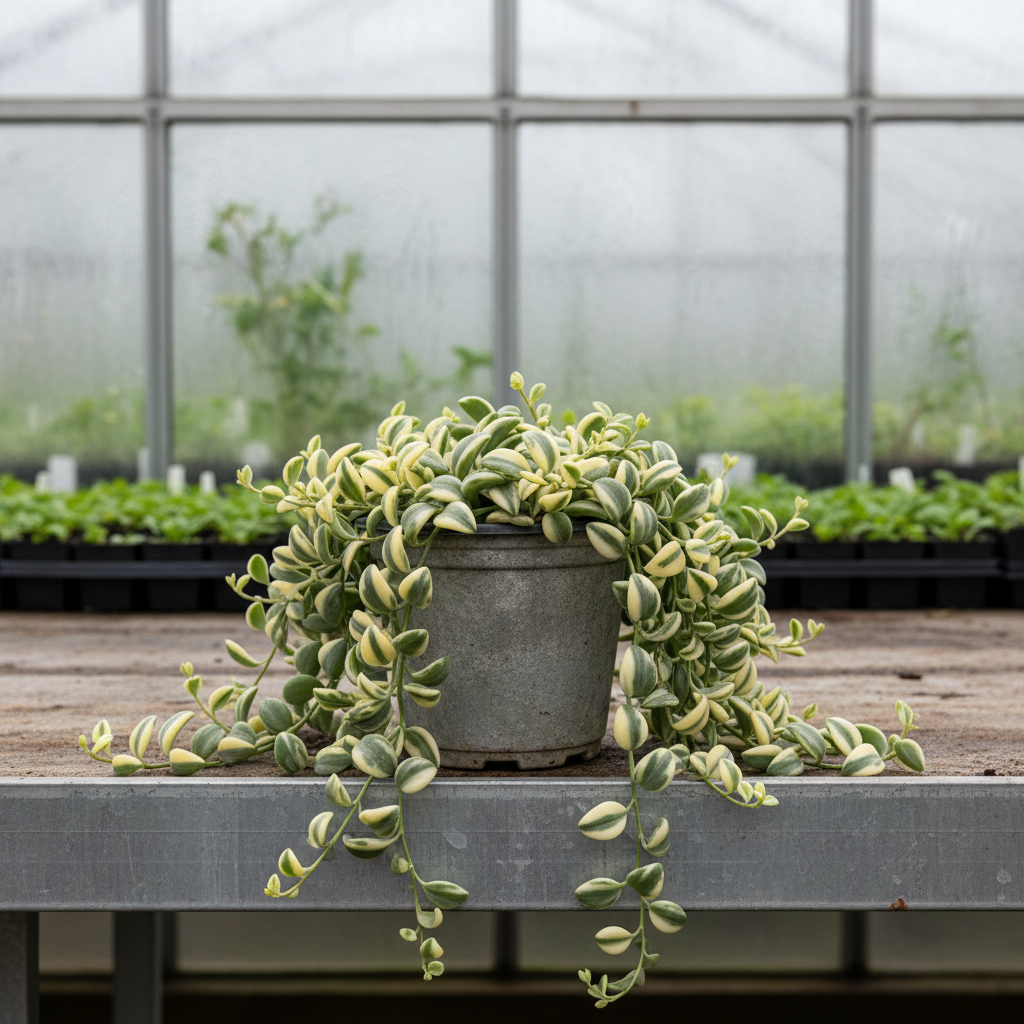
The most coveted form, with each banana-shaped leaf marbled in creamy yellow and pale white against a muted blue-green base. Needs noticeably brighter light than the species to maintain the variegation, and grows somewhat more slowly. Occasional all-green stems should be pinched back to encourage the variegated growth to dominate.
Glauca String of Bananas
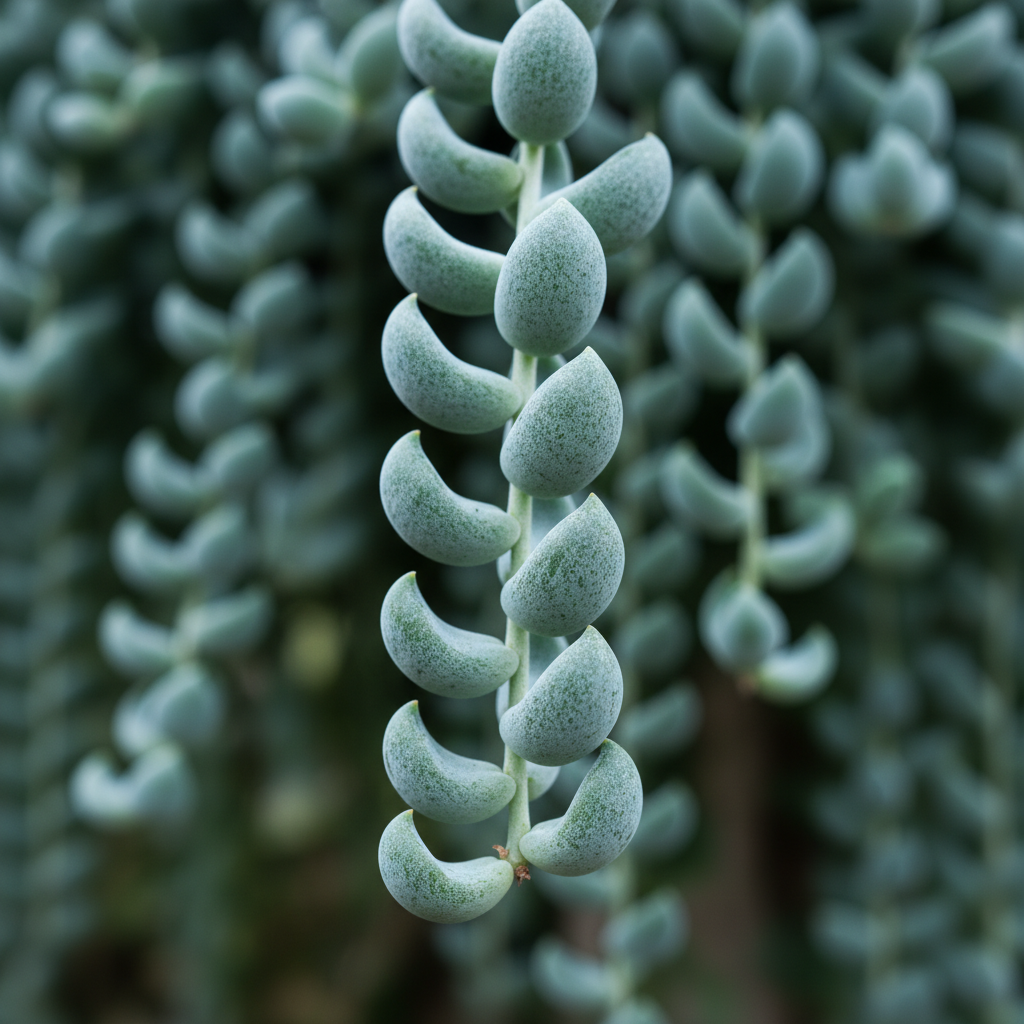
A naturally occurring form selected for an unusually heavy silvery-blue waxy bloom and a more pronounced hook curvature on each leaf. The bloom protects the leaf from sun and gives the plant a frosted, ghostly quality in good light. Care is identical to the species, but the bloom is rubbed off by handling, so site the plant where it can hang undisturbed.
Variety Profiles in Detail
Variegated String of Bananas (Curio radicans ‘Variegata’)
The variegated form is the headline cultivar of the trade. Its leaves are unevenly streaked, with some leaves almost entirely cream, others half-and-half, and a few reverting to the standard blue-green of the species. This irregular distribution is what gives the plant its painterly look, but it also makes the cultivar more demanding. Variegated tissue lacks chlorophyll, so the plant produces less energy from a given amount of light. To compensate, place ‘Variegata’ in the brightest indirect light you can offer, and prune away any fully green stems promptly; left unchecked, green growth quickly outpaces variegated growth and the plant can lose its variegation entirely within a year.
Glauca String of Bananas (Curio radicans ‘Glauca’)
Slightly less common in the trade but readily available from succulent specialists, the ‘Glauca’ form is prized for its heavily glaucous waxy coating. The bloom is both protective and decorative; it scatters bright light and gives the leaves a frosted, almost ethereal appearance against darker backgrounds. The bloom regenerates if rubbed off, but slowly, so handle the plant by the pot rather than the foliage.
String of Dolphins (Curio × peregrinus)
A hybrid between String of Bananas and String of Pearls, String of Dolphins has surged in popularity over the last decade thanks to its uncanny leaf shape, which truly does resemble a row of leaping dolphins. Care sits between its two parents: somewhat more tolerant of variable watering than String of Pearls but a little fussier than String of Bananas. Treat it like a pampered String of Bananas and you will rarely go wrong.
String of Tears (Curio citriformis)
Often grouped with String of Bananas at plant shops, String of Tears is technically a different species in the same genus. Its leaves are smaller and shaped like teardrops rather than bananas, with a delicate translucency at the tips that catches light beautifully. It is somewhat slower-growing and slightly more sensitive to overwatering, but otherwise responds to identical care.
Choosing the Right Variety for Your Space
For most growers, the unadorned species is by far the best starting point: fast, forgiving, easy to source and easy to propagate into a generous trailing display. If you have a brilliantly lit window and want a statement plant, the variegated cultivar repays the extra care with a stunning visual effect, though expect to pay several times the price of the standard form. The Glauca form sits between the two in care and effect, offering the silvery aesthetic without the variegated cultivar’s demand for very bright light. For collectors building a “string of” feature wall, the dolphin and tear-leaved relatives mix harmoniously alongside Curio radicans and create an arresting trio of trailing succulents that share light and watering preferences.
Frequently Asked Questions
Why are my String of Bananas leaves shrivelling?
Shrivelled, slightly wrinkled leaves are almost always a sign of underwatering, often combined with very dry air or too much direct sun. Check the substrate; if it is bone dry, water thoroughly and give the plant a few days to rehydrate. The leaves should plump back up within a week. If the substrate is still moist, the cause is more likely root damage from previous overwatering; in that case, unpot and inspect the roots.
Why is my String of Bananas leggy with bare gaps between leaves?
Long, stretched stems with widely spaced leaves are the classic symptom of insufficient light, called etiolation. The plant is reaching toward a brighter source. Move it to a sunnier window or supplement with a grow light, and trim back the leggy growth; the cuttings can be rooted to fill out the pot.
Is String of Bananas safe around pets?
No. The plant contains mildly toxic pyrrolizidine alkaloids and can cause vomiting, drooling and lethargy in cats and dogs if chewed or swallowed. Keep it well out of reach in a hanging basket or on a high shelf, and contact a veterinarian if you suspect a pet has ingested any part of the plant.
How fast does String of Bananas grow?
Under good conditions, expect 15 to 30 centimetres (6 to 12 inches) of new stem growth per stem per growing season, with new shoots emerging from established nodes throughout spring and summer. Plants in lower light or dormant winter conditions grow much more slowly or pause entirely.
Will my String of Bananas flower indoors?
Yes, given enough light. Mature plants in bright indirect light with some direct sun typically produce small white tubular daisy-like flowers in late winter or early spring, often with a faint cinnamon and vanilla fragrance. A slight cool period in autumn, with reduced watering and temperatures around 13 to 15 degrees Celsius (55 to 59 Fahrenheit), often encourages heavier flowering the following season.
Can I grow String of Bananas outdoors?
Yes, in USDA hardiness zones 10 and 11, where temperatures never drop below about 5 degrees Celsius (41 Fahrenheit). In cooler climates it can spend the summer outdoors on a sheltered, partially shaded patio or balcony but must come inside before the first cold nights of autumn. Outdoor light is far stronger than indoors, so acclimatise gradually over 7 to 10 days to prevent leaf scorch.
Why are some of my leaves turning purple at the tips?
A slight purple flush on the leaf tips is usually a sign that the plant is receiving plenty of bright light. Many succulents accumulate protective anthocyanin pigments in their most exposed leaves, which act as a natural sunscreen. As long as the leaves remain plump and the rest of the plant looks healthy, this is a desirable response and not a sign of stress.
Should I prune String of Bananas?
Pruning is optional but beneficial. Trimming long stems back by one third in spring stimulates branching from the cut node and produces a fuller, denser plant; the trimmings can be propagated immediately to expand the collection. Remove any leggy or bare stems entirely to redirect energy into healthier growth.
My String of Bananas stems are dropping leaves at the base. What is wrong?
Leaf drop concentrated at the base of stems most often indicates either overwatering at the root zone or insufficient light reaching the older parts of the plant. Check the substrate for excessive moisture and inspect the roots; if light is the culprit, rotate the pot weekly so all sides receive even illumination, and consider supplementing with a grow light during darker months.
How long does a String of Bananas live?
With reasonable care, a single String of Bananas plant can live and grow for 5 to 10 years indoors, though most growers refresh the plant through cuttings every 3 to 5 years to keep the display lush. The species itself is effectively perpetually renewable: each propagated cutting is genetically identical to the parent, so a beloved plant can be maintained through generations of cuttings indefinitely.






