
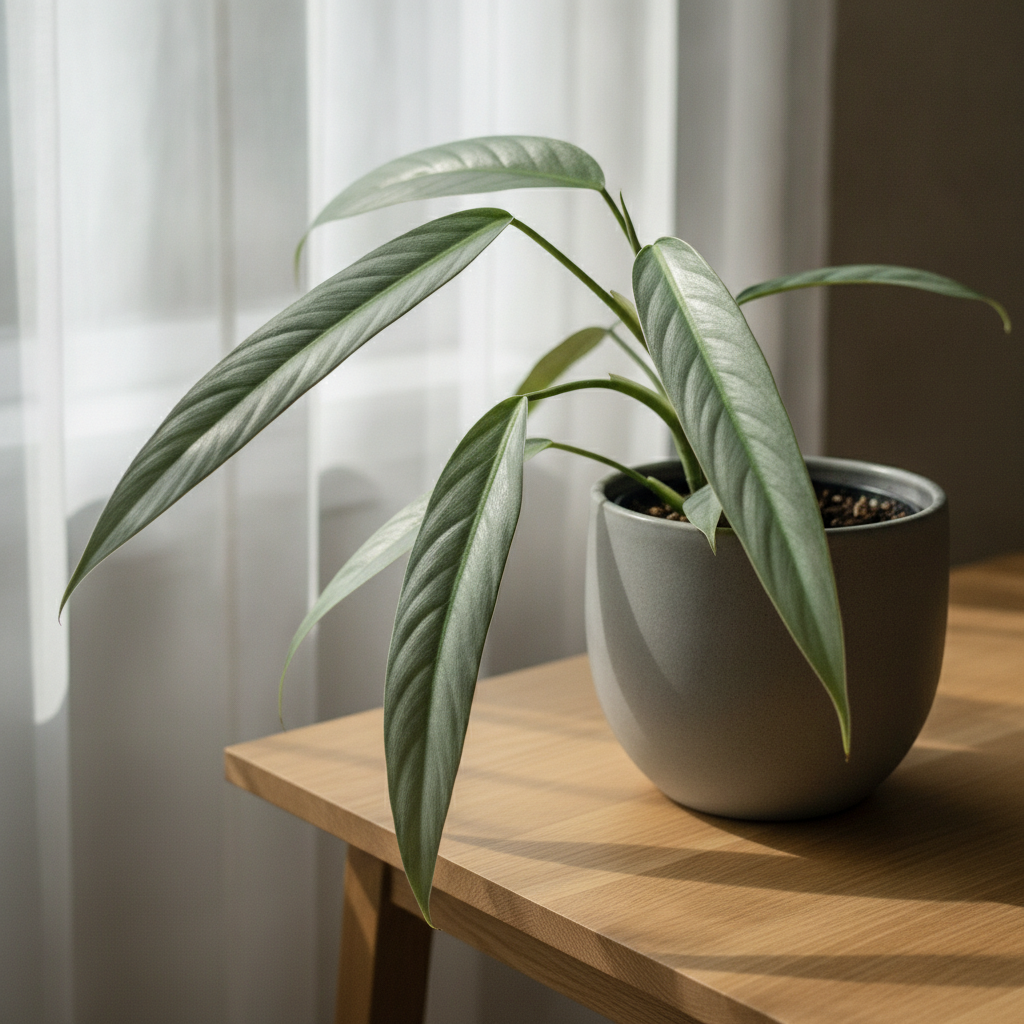
Few houseplants manage to look both armoured and elegant, but the Silver Sword Philodendron (Philodendron hastatum) does exactly that. Its young leaves emerge as narrow, metallic blades washed in a cool pewter-silver sheen, and as the plant matures they broaden into the dramatic halberd shape that gives the species its botanical name. Once a collector’s rarity, it has become far more available in recent years, and it rewards that wider audience by being one of the more forgiving silver-leaved aroids you can grow indoors.
This guide walks through everything needed to take a Silver Sword from a modest nursery pot to a towering, climbing specimen, with the practical detail that separates a plant that merely survives from one that genuinely thrives.
In this guide
- Quick Reference
- Why Grow a Silver Sword Philodendron
- Light
- Watering
- Soil and Potting
- Fertilising
- Propagation
- Pests and Problems
- Varieties and Forms
- Frequently Asked Questions
Quick Reference
| Common names | Silver Sword Philodendron, Sword Philodendron |
| Botanical name | Philodendron hastatum |
| Family | Araceae (the aroids) |
| Origin | Atlantic coastal forest of south-eastern Brazil |
| Mature size indoors | 2 to 3 metres (6 to 10 feet) tall when climbing a support |
| Light | Bright, indirect light; tolerates a little gentle morning sun |
| Water | When the top 2 to 4 cm (1 to 1.5 inches) of mix has dried |
| Soil | Chunky, free-draining aroid mix, slightly acidic |
| Temperature | 18 to 27 degrees Celsius (64 to 81 Fahrenheit) |
| Humidity | Happy at average levels; best above 55 per cent |
| Feeding | Balanced liquid feed monthly in spring and summer |
| Propagation | Stem cuttings at a node, or air layering |
| Toxicity | Toxic to people and pets if chewed or swallowed |
| Difficulty | Easy to moderate |
Why Grow a Silver Sword Philodendron
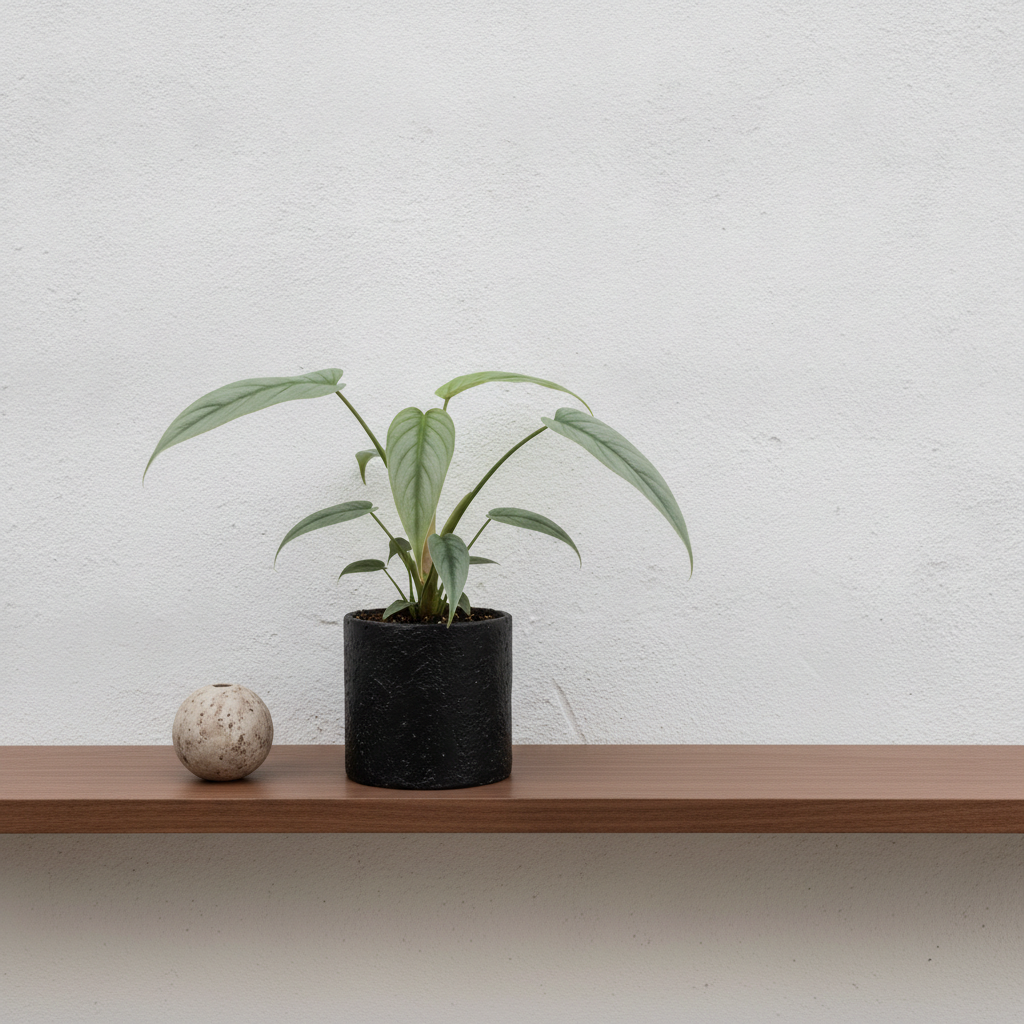
The appeal of Philodendron hastatum begins with its colour. Where most philodendrons offer some variation on glossy green, the Silver Sword carries a genuine metallic finish, a microscopically textured leaf surface that scatters light into a cool silvery sheen. In a collection of greens it stands apart without resorting to variegation, which means there is no slow-growing white tissue to coddle and no reversion to worry about. The whole leaf works for a living.
The plant is also a shape-shifter, and that transformation is part of the fun of growing it. Juvenile leaves are narrow and lance-like, the sword the common name promises. As the vine matures and is given height to climb, the leaves enlarge dramatically and develop the hastate, or halberd, outline of two backward-pointing basal lobes flanking a long central blade. A well-grown mature specimen looks like a different, grander plant than the one that arrived in its nursery pot, and it gets there surprisingly quickly when conditions suit it.
It helps that the species is naturally vigorous. Native to the warm, humid Atlantic forest of south-eastern Brazil, where it climbs tree trunks as a hemiepiphyte, it has the constitution of a plant built to grow fast and reach for the canopy. Indoors that translates into a satisfying rate of new leaves through the warm months and a forgiving tolerance of the occasional missed watering. For a plant that once commanded collector prices, it asks for remarkably little in return.
Pro Tip — Give it something to climb: The single biggest factor in how impressive a Silver Sword becomes is vertical support. Left to trail, it stays in its small-leaved juvenile phase almost indefinitely. Attached to a moss pole or plank, it matures faster and produces the large hastate leaves the species is famous for.
Light
Bright, indirect light is the sweet spot for a Silver Sword. In its native forest the plant climbs upward through dappled shade towards brighter light as it matures, so it is adapted to a range of intensities rather than one narrow band. Indoors, the practical target is a position that receives plenty of ambient brightness without prolonged exposure to hot, direct sun striking the leaves through glass.
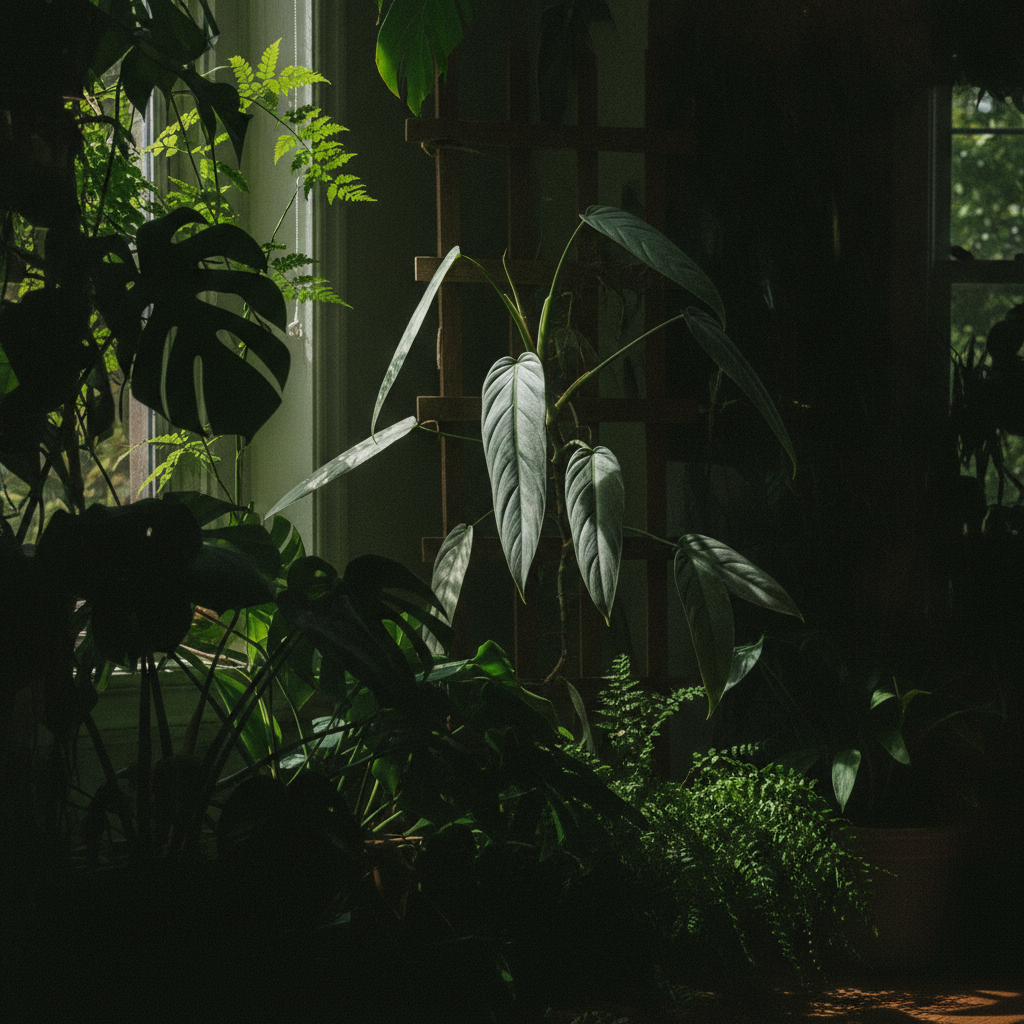
An east-facing window is close to ideal, offering gentle morning sun and bright light for the rest of the day. A north-facing window suits the plant well too, though growth will be a touch slower and the internodes, the gaps between leaves, slightly longer. A west or south aspect can work provided the plant sits a metre or two back from the glass, or behind a sheer curtain that softens the midday intensity. The silver finish actually holds up better in good light: in a dim corner the leaves grow larger and thinner but lose some of their reflective brilliance and the new growth becomes leggy.
The clearest sign that light is too low is stretched, sparse growth with small leaves and long bare stem between them. Reaching towards the window is another. Too much direct sun shows up as pale, bleached patches or crisp dry sections on the most exposed leaves, usually on the side facing the glass. If you are growing under artificial light, a full-spectrum LED running for ten to twelve hours a day keeps the plant compact and the foliage well coloured through the darker months.
Pro Tip — Rotate for even growth: Because the plant leans towards its light source, give the pot a quarter turn each time you water. Over a few weeks this keeps the vine growing straight and the foliage evenly filled rather than crowding to one side.
Watering
Watering a Silver Sword well is mostly a matter of rhythm rather than rules. The plant likes its mix to stay lightly and evenly moist through the growing season, but it resents sitting in saturated soil. The reliable approach is to water thoroughly when the top 2 to 4 cm (1 to 1.5 inches) of the mix has dried, then let excess drain away completely before the pot goes back in its place.
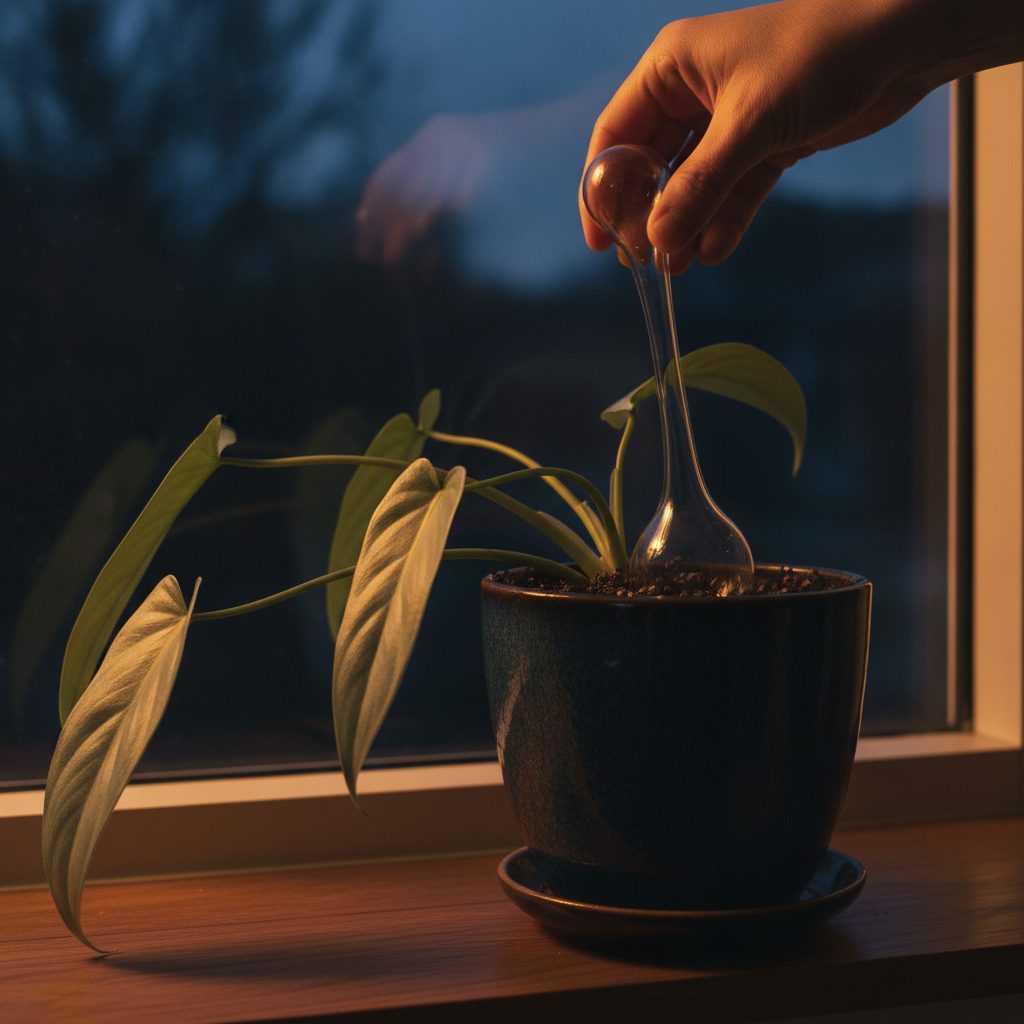
When you do water, do it properly. Pour slowly and evenly across the surface until water runs freely from the drainage holes, which ensures the entire root ball is wetted and flushes out any accumulated mineral salts. A common mistake is to give frequent small splashes that only dampen the top layer while the lower roots stay dry, encouraging shallow rooting and uneven growth. A chunky aroid mix makes this hard to overdo, because it drains so freely that the roots get air as well as moisture.
Frequency depends entirely on conditions, so trust the mix rather than the calendar. In a bright, warm room through spring and summer that might mean watering every five to seven days; in a cooler, dimmer room in winter it could stretch to a fortnight or more. Check by pushing a finger into the mix or lifting the pot to feel its weight, which becomes second nature with a little practice. Rainwater, distilled water or filtered water are kinder than hard tap water over the long term, though the species is not as fussy about this as some of its thinner-leaved relatives.
Overwatering is the most common way to harm this plant. The early warning signs are yellowing lower leaves, a soft or mushy stem base, and a persistent sour smell from the mix. Underwatering shows the opposite picture: drooping, curling leaves and crisp brown edges, with the whole plant perking up within hours of a thorough drink. Of the two, the plant recovers far more readily from a dry spell than from waterlogged roots, so when in doubt, wait a day.
Warning — Empty the saucer: Never leave the pot standing in a saucer or cachepot full of water. Even half an hour is fine, but water left for a day or more deprives the roots of oxygen and is the fastest route to root rot in an otherwise healthy plant.
Soil and Potting
As an epiphytic climber, Philodendron hastatum grows in nature among loose forest litter and along bark rather than in dense ground soil, and the best potting mix reflects that. The goal is a medium that holds moisture but drains and breathes freely, never compacting into an airless block. Standard bagged houseplant compost used on its own is too heavy and stays wet too long, which is a frequent cause of trouble with this plant.
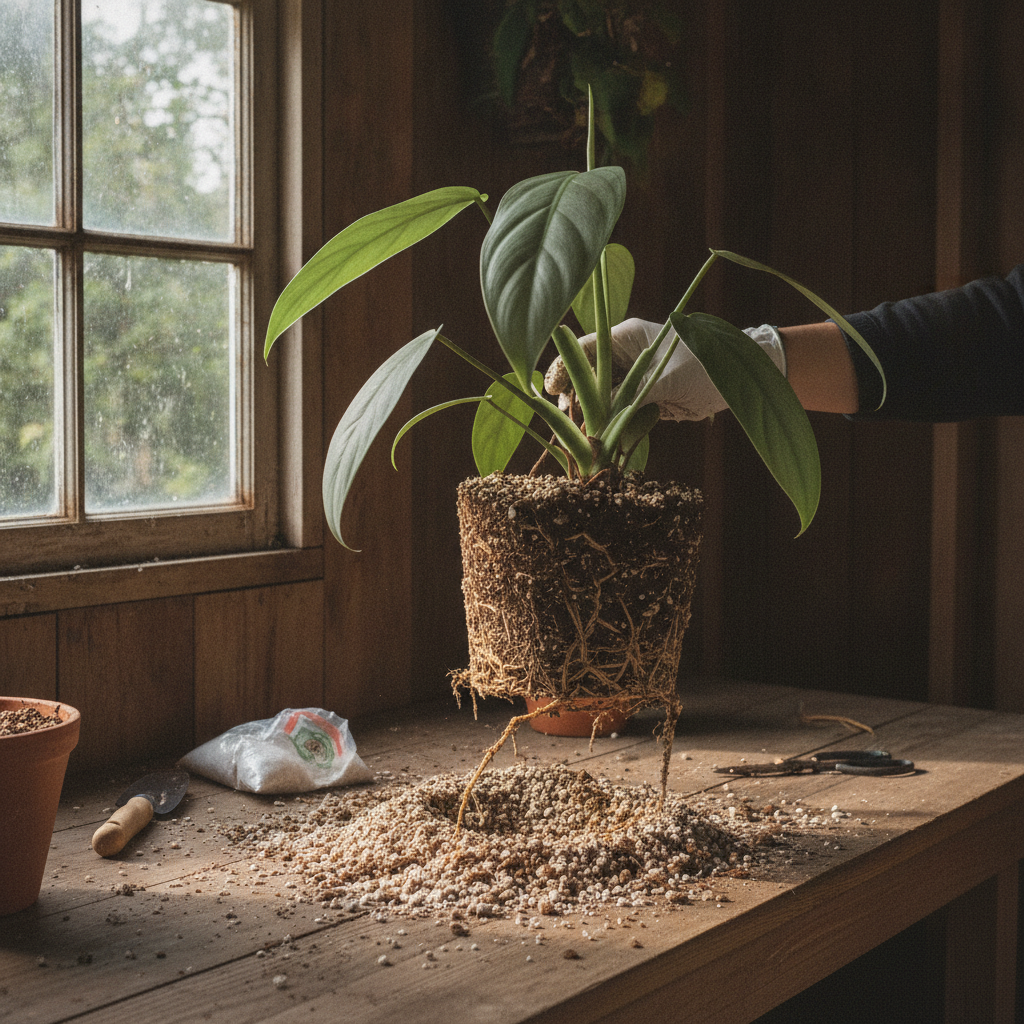
A reliable recipe is roughly equal parts orchid bark, perlite or pumice, and a quality coco coir or peat-based base, with a handful of worm castings or fine compost mixed in for nutrition. The bark and perlite create the open structure the roots crave, while the coir holds enough moisture to keep things from drying too fast. The target pH is slightly acidic, around 5.5 to 6.5, which a coir-and-bark blend tends to provide naturally. Some growers add a little horticultural charcoal to keep the mix sweet, which does no harm and may help.
Always pot into a container with drainage holes, sized just one or two centimetres larger in diameter than the current root ball. An oversized pot holds a reservoir of wet mix that the roots cannot use quickly, which raises the risk of rot. Terracotta is a forgiving choice because its porous walls let excess moisture evaporate, though plastic and glazed ceramic work perfectly well if you adjust your watering to their slower drying.
Repot every one to two years, ideally in spring as growth resumes, or whenever roots begin circling the pot or pushing out of the drainage holes. Refreshing the mix matters as much as increasing the pot size, because old medium breaks down over time and loses its airy structure. When you repot, this is also the natural moment to add or upgrade a climbing support, settling a moss pole into the centre of the pot before the roots fill the new space around it.
Pro Tip — Keep the moss pole damp: If you grow your Silver Sword up a moss pole, mist or trickle water down the pole when you water the pot. The aerial roots will grip and feed from the moist moss, which speeds up the shift to larger mature leaves noticeably.
Fertilising
A growing Silver Sword is a hungry plant, and regular feeding through the warm months is what fuels its fast production of new leaves. Because the recommended chunky mix is comparatively low in nutrients, supplementary feeding matters more here than it would for a plant in rich, soil-based compost. The simplest approach is a balanced liquid houseplant fertiliser, diluted and applied around once a month from spring through to early autumn.
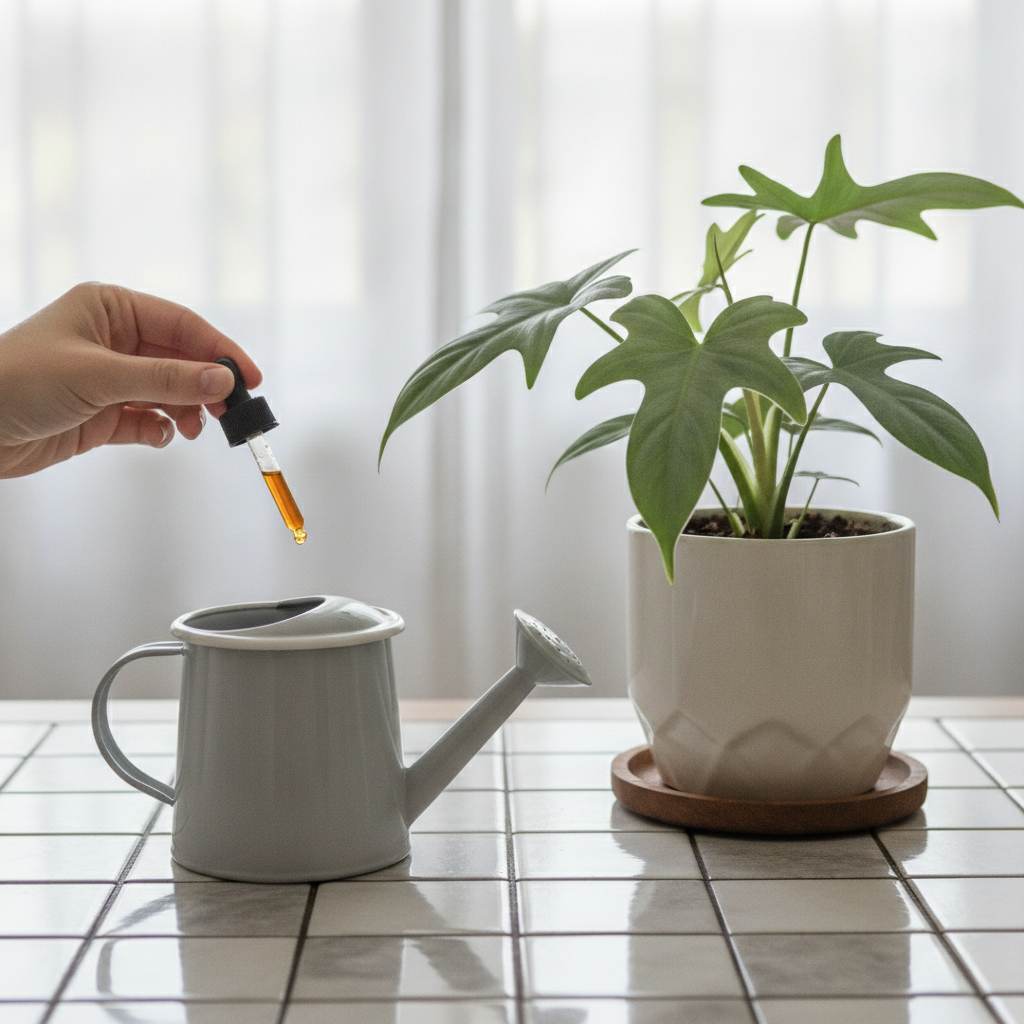
Dilute to roughly half the strength stated on the bottle. Aroids are sensitive to over-feeding, and a steady supply of weak nutrition produces better results than infrequent heavy doses. A fertiliser with a balanced ratio of nitrogen, phosphorus and potassium suits the plant’s general needs, and many growers favour a formula that includes trace elements such as magnesium and calcium, which support the deep colour and firm structure of the foliage. Always feed onto already-moist mix rather than dry roots, which prevents the salts from scorching the fine root tips.
Through late autumn and winter, when light levels fall and growth naturally slows, ease off or stop feeding altogether. Fertilising a plant that is not actively growing simply leaves unused salts to build up in the mix, which can burn the roots and show as brown leaf tips. If you do notice a white crust forming on the soil surface or pot rim, that is accumulated fertiliser salts, and flushing the pot thoroughly with plain water two or three times will clear it.
Warning — Brown tips often mean too much feed: If leaf tips and edges turn brown despite consistent watering, suspect fertiliser build-up before anything else. Cut back the frequency, flush the pot with several volumes of plain water, and the new growth should come through clean.
Propagation
The Silver Sword is straightforward to propagate, which is one reason it has spread from rare collector status to widespread availability. Because it is a vining aroid with clearly visible nodes along its stem, it multiplies readily from stem cuttings, and more cautious growers can use air layering to root a section before ever detaching it from the parent. Leaf cuttings do not work for this plant, since a leaf without a node has no growth point from which roots and new shoots can form.
To take a stem cutting, identify a healthy section of vine with at least one node, the slightly swollen point where a leaf meets the stem and where you will often see a small aerial root or root bud. Using clean, sharp secateurs, cut about a centimetre below a node so the cutting includes the node, a leaf or two, and ideally a nub of aerial root. A cutting with two nodes is more robust than one, giving you a backup growth point if one fails.
- Cut a healthy stem section just below a node, including at least one node and one or two leaves.
- Remove the lowest leaf if it would sit below the water line or in the moss, leaving the node exposed.
- Place the cutting in a jar of clean water, or nestle the node into damp sphagnum moss in a covered container.
- Keep it warm and bright but out of direct sun, and refresh the water every few days to keep it oxygenated.
- Wait for new roots to reach 3 to 5 cm (1 to 2 inches), which usually takes two to four weeks in warm conditions.
- Pot the rooted cutting into the standard chunky aroid mix and keep it slightly more humid than usual for the first fortnight while it settles.
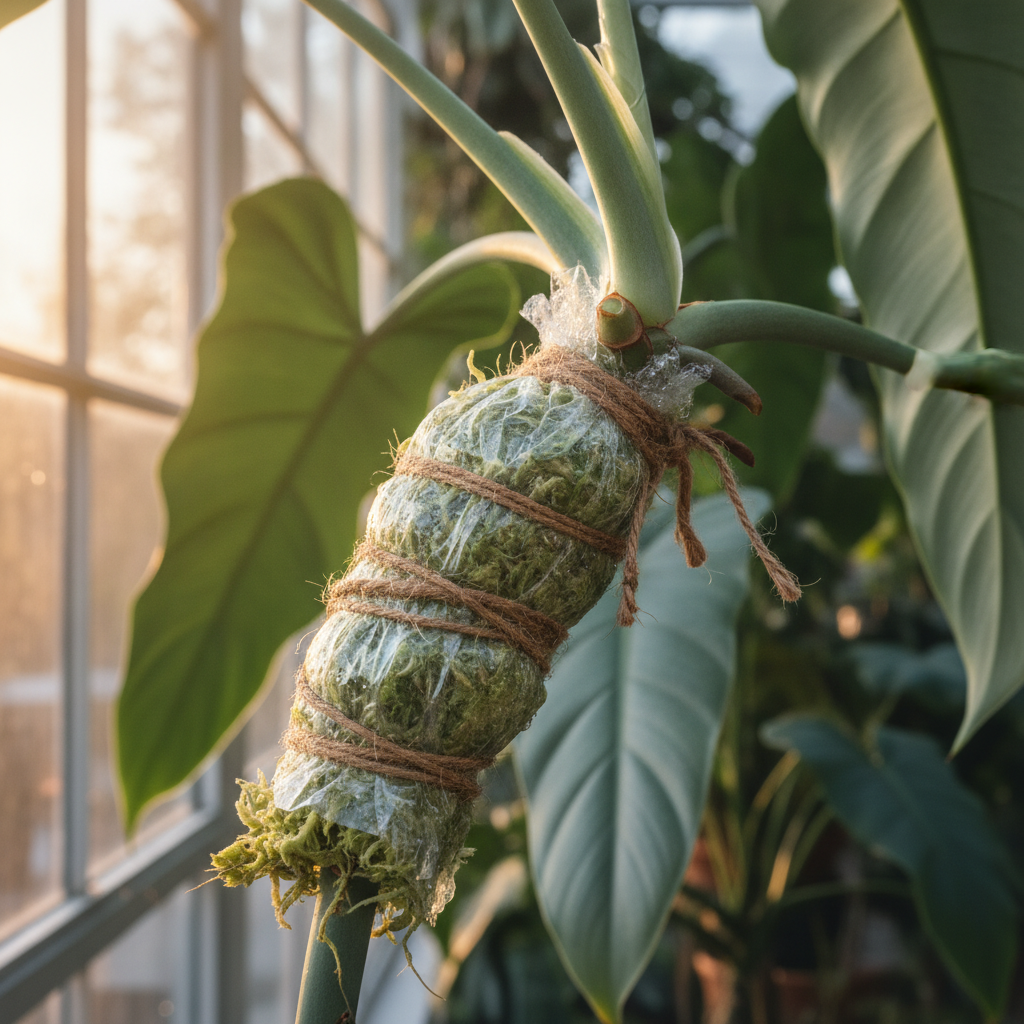
Air layering is the method of choice if you want to minimise risk or grow a larger plant from the start. Rather than cutting first and rooting afterwards, you wrap a node on the intact vine in damp sphagnum moss, enclose it in clear film to hold the moisture, and wait for roots to develop inside the moss over a few weeks. Only once a healthy root mass has formed do you cut below it and pot the rooted section up. Because the new plant is never without a water and nutrient supply, the success rate is very high and the resulting plant establishes quickly.
Spring and early summer are the best times to propagate, when the plant’s natural vigour speeds rooting. Whatever method you use, warmth is the key variable: cuttings root far faster at 22 to 26 degrees Celsius (72 to 79 Fahrenheit) than in a cool room, so a warm, bright spot makes all the difference.
Pests and Problems
A healthy, well-grown Silver Sword is not especially prone to pests, but like any indoor plant it can attract the usual sap-feeding insects, particularly when conditions are dry or when a new plant brings unwanted guests home. Regular inspection is the most powerful tool you have, because almost every infestation is easy to deal with when caught early and far harder once it has spread.
Spider mites are the pest to watch most closely, since they thrive in warm, dry air and can establish before you notice them. The first signs are fine pale stippling across the leaf surface and, in a heavier infestation, delicate webbing in the leaf axils. Mealybugs appear as small white cottony tufts tucked where leaves meet the stem, while scale insects show up as flat brown discs clinging to stems and the undersides of leaves. Thrips, which leave silvery scarring and tiny black specks of frass, and fungus gnats, whose larvae live in overly wet mix, round out the usual suspects.
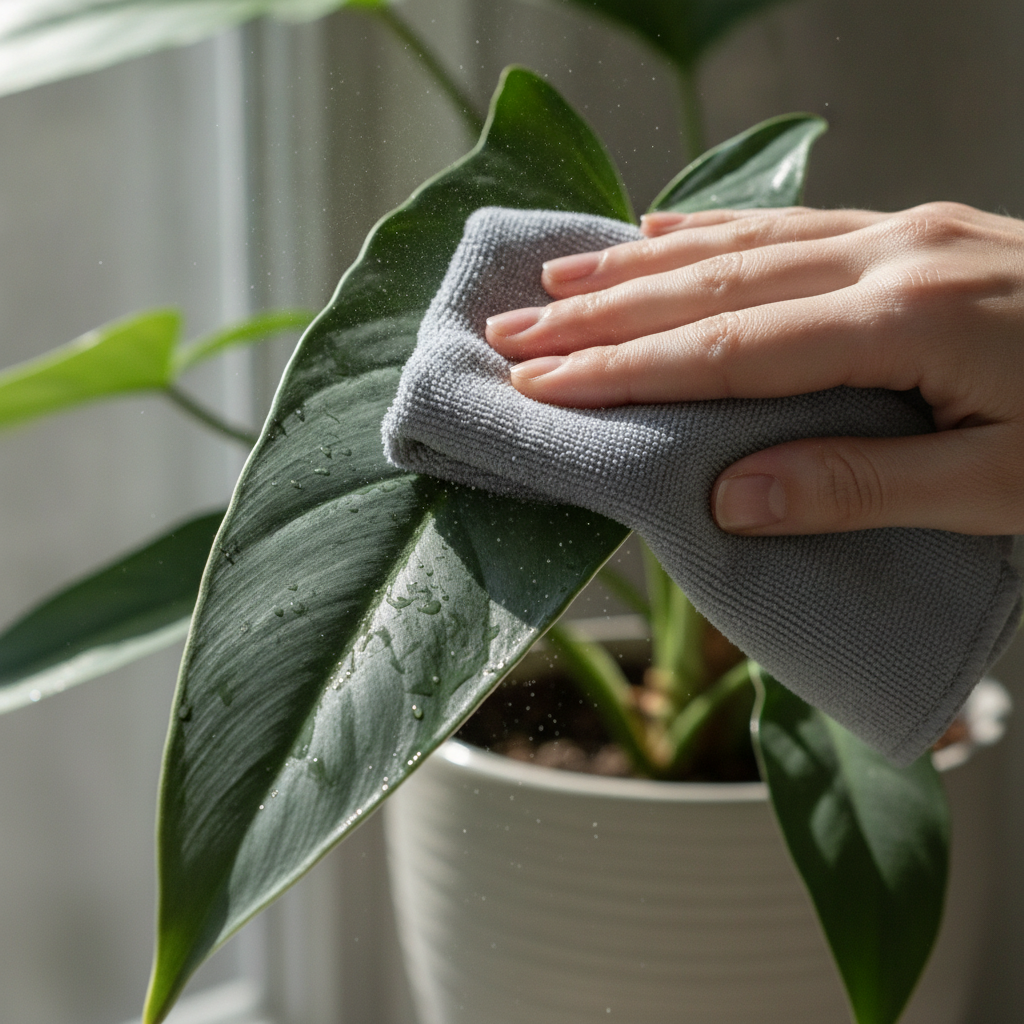
Treatment follows the same pattern for most of these. Isolate the affected plant promptly to protect the rest of your collection. Wipe down the leaves, removing what you can by hand, then treat thoroughly with insecticidal soap or a neem oil solution, making sure to reach the undersides of leaves and the leaf axils where pests hide. Repeat every five to seven days for several weeks to catch newly hatched insects, since a single treatment rarely breaks the life cycle. For fungus gnats specifically, the cure is cultural: let the top of the mix dry out more between waterings and the larvae lose their damp habitat.
Beyond pests, most problems trace back to watering and light. Yellowing lower leaves usually point to overwatering or a pot that drains too slowly; crisp brown edges suggest the air is too dry or the mix has been allowed to go bone dry. Pale, leggy growth with small leaves is a request for more light, and brown leaf tips often signal fertiliser build-up rather than any disease. Reading the plant this way, and adjusting one variable at a time, resolves the great majority of issues without any need for chemicals.
Warning — Keep it away from curious mouths: Like all philodendrons, Philodendron hastatum contains insoluble calcium oxalate crystals and is toxic to cats, dogs and people if chewed or swallowed, causing painful mouth irritation and swelling. Site it out of reach of pets and small children, and wash your hands after taking cuttings.
Varieties and Forms
Unlike many popular houseplants, Philodendron hastatum is grown almost entirely as the true species rather than as a long list of named cultivars. What does change dramatically is the plant’s appearance as it ages, and growers often speak of its juvenile and mature forms as if they were two distinct plants. A rarer stable variegated form also exists and commands high prices, but the two faces of the ordinary green plant are what most owners will encounter.
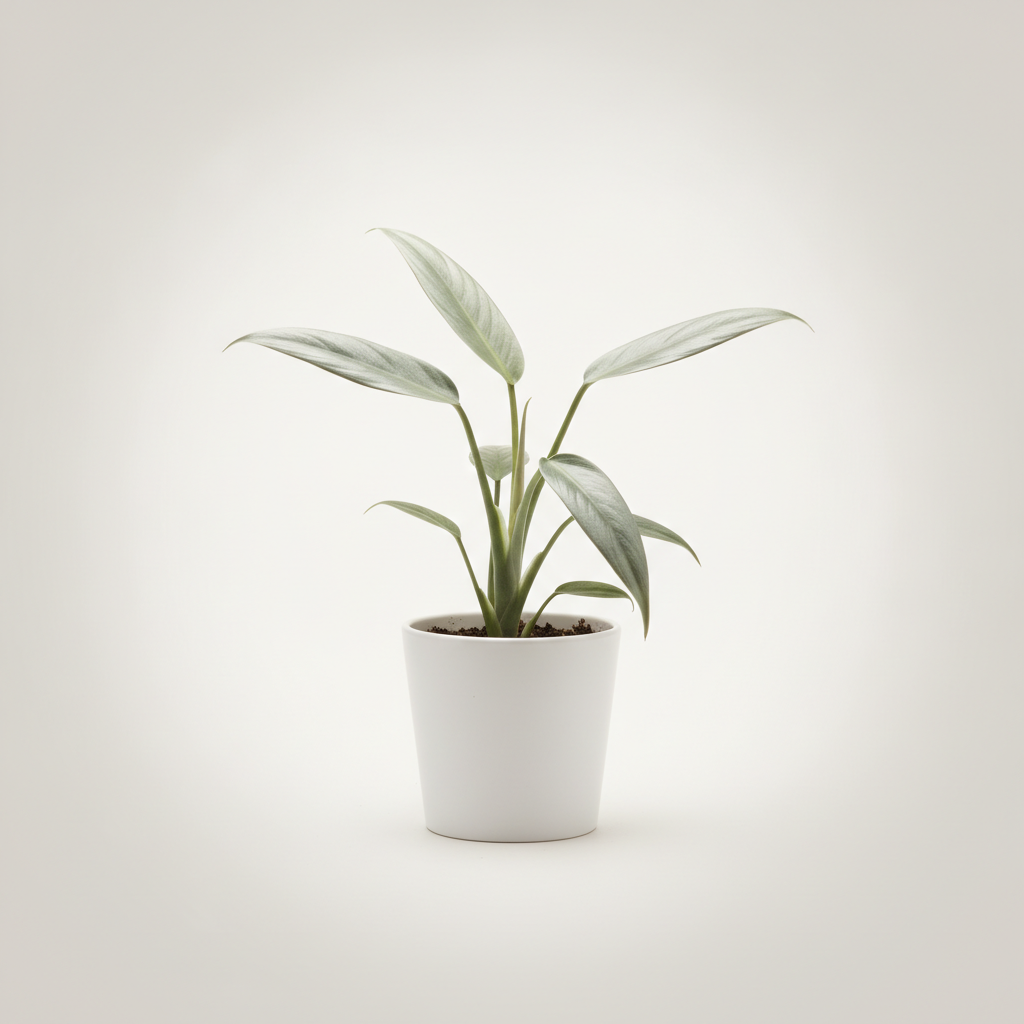
Juvenile Silver Sword. This is the phase the plant is named for and the one most often sold. The leaves are narrow and elongated, held on a compact vine, and carry the most pronounced metallic pewter-silver sheen of the plant’s life. It is at its most reflective and sword-like here, and many growers happily keep plants in this stage by letting them trail rather than climb.
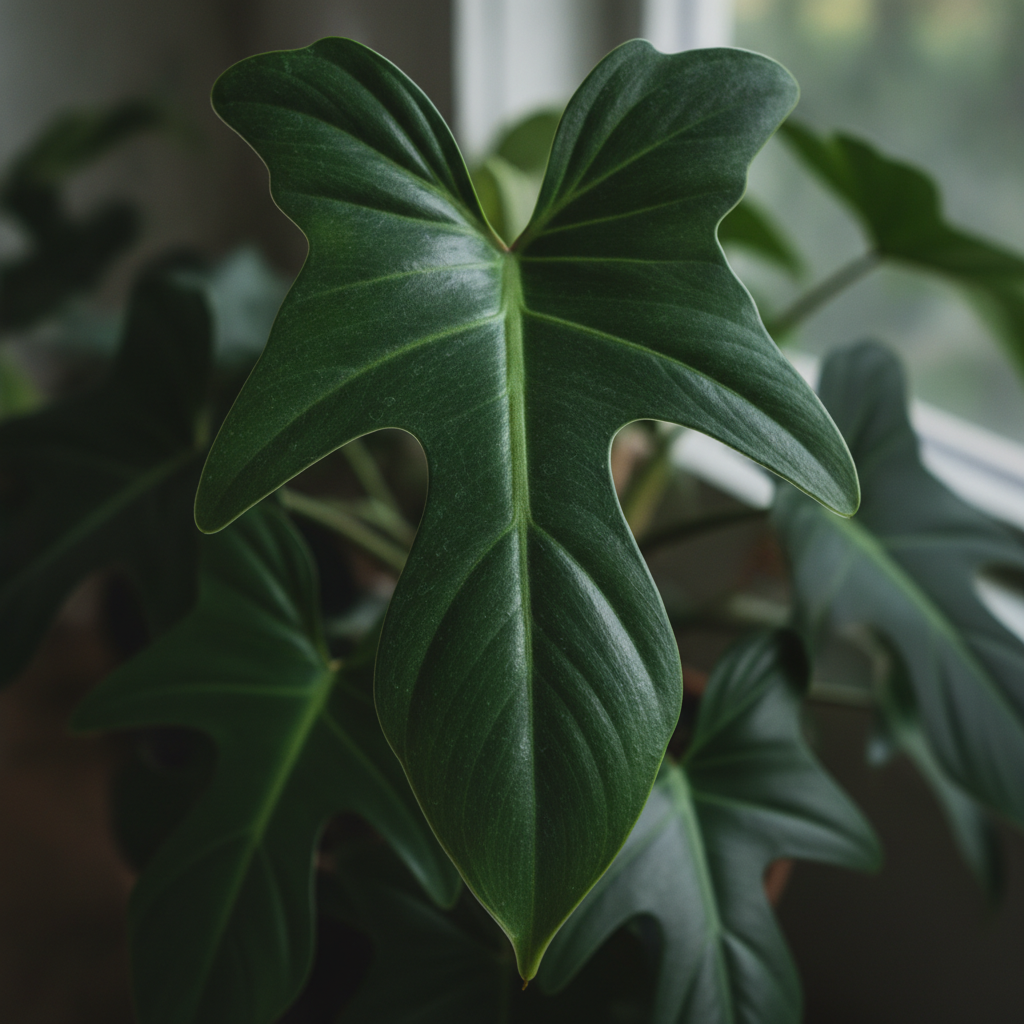
Mature Silver Sword. Given height to climb, the plant transforms. The leaves enlarge substantially and develop the deeply hastate, halberd outline of two backward-pointing basal lobes, while the colour deepens towards a glossier green with the silver retreating to a subtle wash. This is the grand, architectural form that rewards anyone who gives the plant a moss pole and the years to use it.
It is worth knowing that the Silver Sword is sometimes confused at point of sale with other silvery climbing aroids, such as certain Scindapsus and Philodendron species that share a metallic finish. The reliable tell is the leaf shape and the way it changes: the genuine hastatum moves from a slim sword towards a broad halberd as it climbs, a progression that few of its lookalikes share.
Frequently Asked Questions
Why are my Silver Sword’s leaves staying small and silvery instead of getting big?
Small, narrow, intensely silver leaves are the plant’s juvenile form, and a vine left to trail will hold that form more or less indefinitely. To trigger the larger, more hastate mature leaves, give the plant something tall to climb, such as a moss pole, keep that support damp, and provide good light. The shift happens as the plant gains height and its aerial roots grip the support.
How fast does a Silver Sword Philodendron grow?
In warm, bright conditions with regular feeding it is a genuinely fast grower, often pushing a new leaf every couple of weeks through spring and summer. Growth slows markedly in winter as light fades, which is normal. A plant given a moss pole and good care can climb a metre or more in a single growing season.
Is the Silver Sword Philodendron safe around pets?
No. Like all philodendrons it contains insoluble calcium oxalate crystals and is toxic to cats, dogs and humans if chewed or swallowed, causing intense mouth and throat irritation, drooling and swelling. It is rarely fatal but genuinely unpleasant, so keep the plant out of reach of pets and young children.
Why are the lower leaves turning yellow?
The most common cause is overwatering or a mix that drains too slowly, leaving the roots short of oxygen. Check that the pot drains freely, that you are letting the top few centimetres dry between waterings, and that the plant is never left standing in water. An occasional yellow leaf at the very base of an otherwise healthy plant, however, is just normal ageing.
Does it need high humidity to do well?
It tolerates average household humidity better than many silver-leaved aroids, which is part of its appeal, but it is happiest and grows fastest above about 55 per cent. If your air is very dry, grouping it with other plants, using a humidifier, or growing it on a damp moss pole all help. Brown, crispy leaf edges are the usual sign that the air is too dry.
Can I grow it as a hanging or trailing plant instead of climbing?
Yes, and many people do. Trailing keeps the plant in its compact, silvery juvenile form, which is attractive in its own right. The trade-off is that the leaves will stay small and the dramatic mature foliage will not develop, since that transformation depends on the plant climbing upward. It is purely a matter of which look you prefer.






