
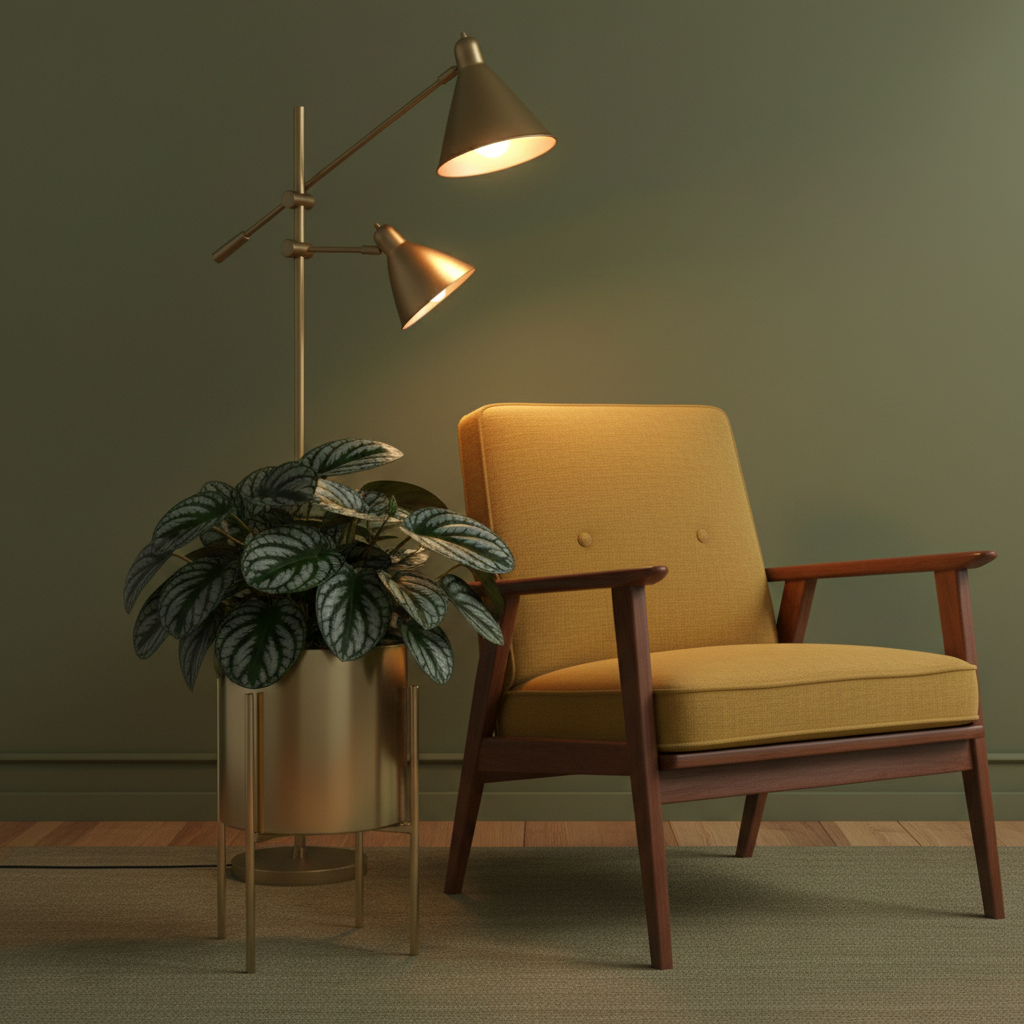
Few houseplants achieve a metallic shimmer through nothing more than their own leaf anatomy, and the aluminum plant (Pilea cadierei) is one of them. Native to the misted limestone valleys of the Annam range in central Vietnam, this small herbaceous perennial belongs to the Urticaceae, the same family that contains stinging nettles and the rather more famous Chinese money plant. The English common name comes from the four prominent raised silvery patches that run between the deeply impressed parallel veins on each ovate leaf, giving the foliage the look of polished aluminum laid into a dark green matrix. The species was introduced to Western horticulture in the late 1930s after the French botanist R. Cadière collected it, and the specific epithet honours him.
The aluminum plant has a reputation as one of the easier patterned foliage houseplants to keep alive, though that reputation slightly oversells how forgiving it is. It will tolerate average indoor conditions long enough to look respectable, but the difference between a stoic survivor and a genuinely thriving specimen comes down to a handful of cultural details that are easy to get wrong by accident. This guide walks through everything that matters for keeping Pilea cadierei compact, well coloured and continuously producing new growth, from the light levels that maximise the silver banding to the pinching routine that prevents the legginess that overtakes neglected plants by their second year.
Contents
- Quick Reference
- Why the Aluminum Plant Makes a Rewarding Houseplant
- Light Requirements
- Watering & Humidity
- Soil, Potting & Repotting
- Fertilising
- Propagation
- Pests & Diseases
- Popular Varieties
- Frequently Asked Questions
Quick Reference: Aluminum Plant at a Glance
| Light | Medium to bright indirect light; tolerates lower light at the cost of leggy growth and dulled silver markings |
| Watering | Keep evenly moist but never soggy; water when the top 2 cm (about 1 inch) of mix feels dry to the touch |
| Temperature | 18 to 27 degrees Celsius (65 to 80 degrees Fahrenheit); avoid prolonged exposure below 13 degrees Celsius (55 degrees Fahrenheit) |
| Humidity | 50 to 70 per cent; visibly happier above 60 per cent, will manage at 40 per cent if airflow is good |
| Fertiliser | Balanced liquid feed at half strength every four weeks during spring and summer; nothing in late autumn or winter |
| Toxicity | Listed as non-toxic to cats and dogs by the ASPCA, making it a useful option for pet households |
Why the Aluminum Plant Makes a Rewarding Houseplant
The appeal of Pilea cadierei starts and ends with the leaves. Each one is a small ellipse roughly 5 to 8 cm long, deeply quilted, with four neat rows of raised silver patches sitting between the impressed parallel veins. Held against a north window the silver looks almost grey, but turn the plant into morning sun and the patches read as bright pewter, even faintly iridescent. The plant never gets large enough to dominate a room: a mature specimen sits at around 25 to 30 cm tall, with stems that bend outward into a low, billowy mound rather than holding themselves stiffly upright. This makes it useful as a finisher plant for small shelves, plant stands and tabletop arrangements, where a tall structural species would overpower the composition.
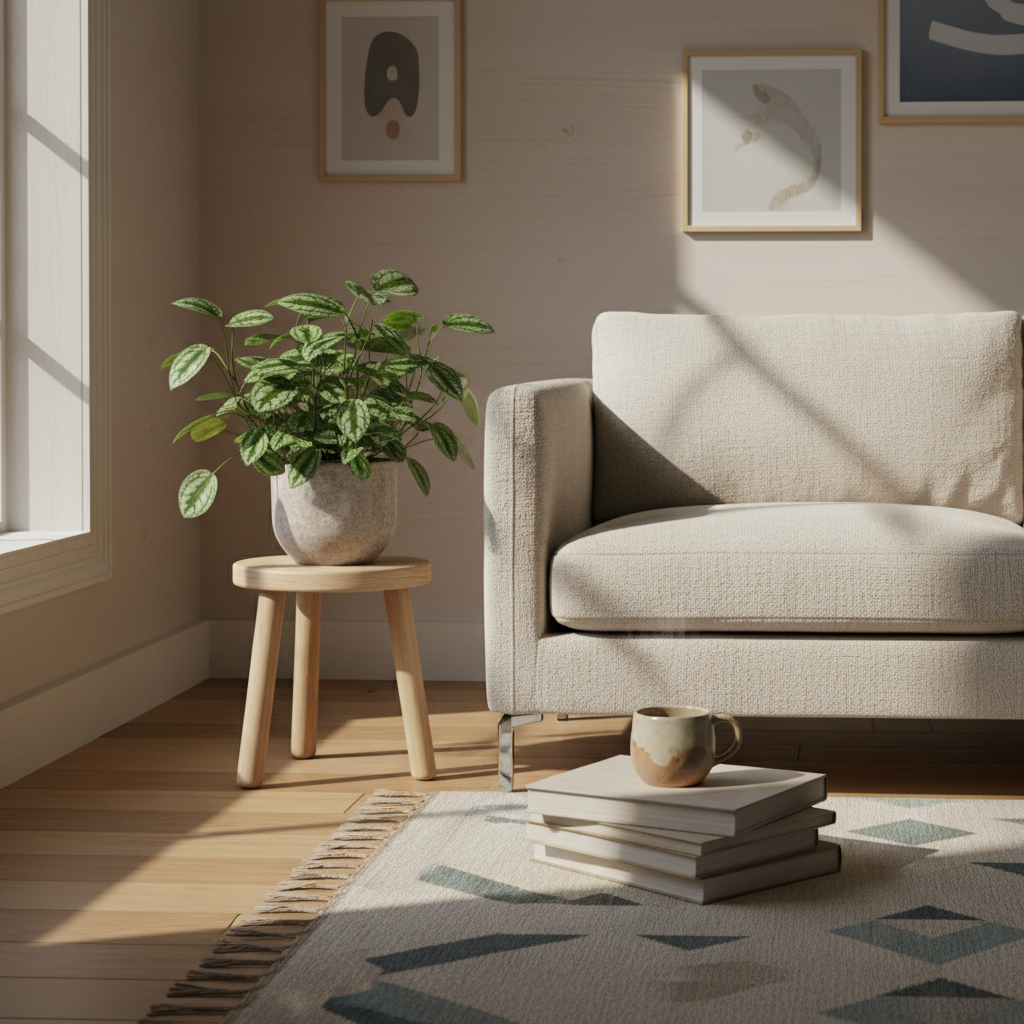
Beyond the foliage, two practical traits drive its enduring popularity. The first is its non-toxic status: the ASPCA lists Pilea cadierei as safe for cats and dogs, which is an unusually clean record for a houseplant with this much visual interest. The second is propagation. Stem cuttings root within two to three weeks in plain water or a moist substrate, so a single plant easily becomes a tray of gift-sized pots within a season. The trade-off is that the species is short-lived by houseplant standards. Even well grown specimens tend to look tired after three to four years, with woody bare stems below a sparse crown of leaves. The standard solution is to keep propagating young plants on a rolling cycle rather than trying to coax the original parent through a graceful old age.
Important — Toxicity: While Pilea cadierei is officially non-toxic to cats, dogs and humans, members of the Urticaceae family can still cause mild stomach upset if eaten in quantity, and the dust from disturbed soil is best kept away from very young children. Treat it as low-risk rather than risk-free.
Light Requirements
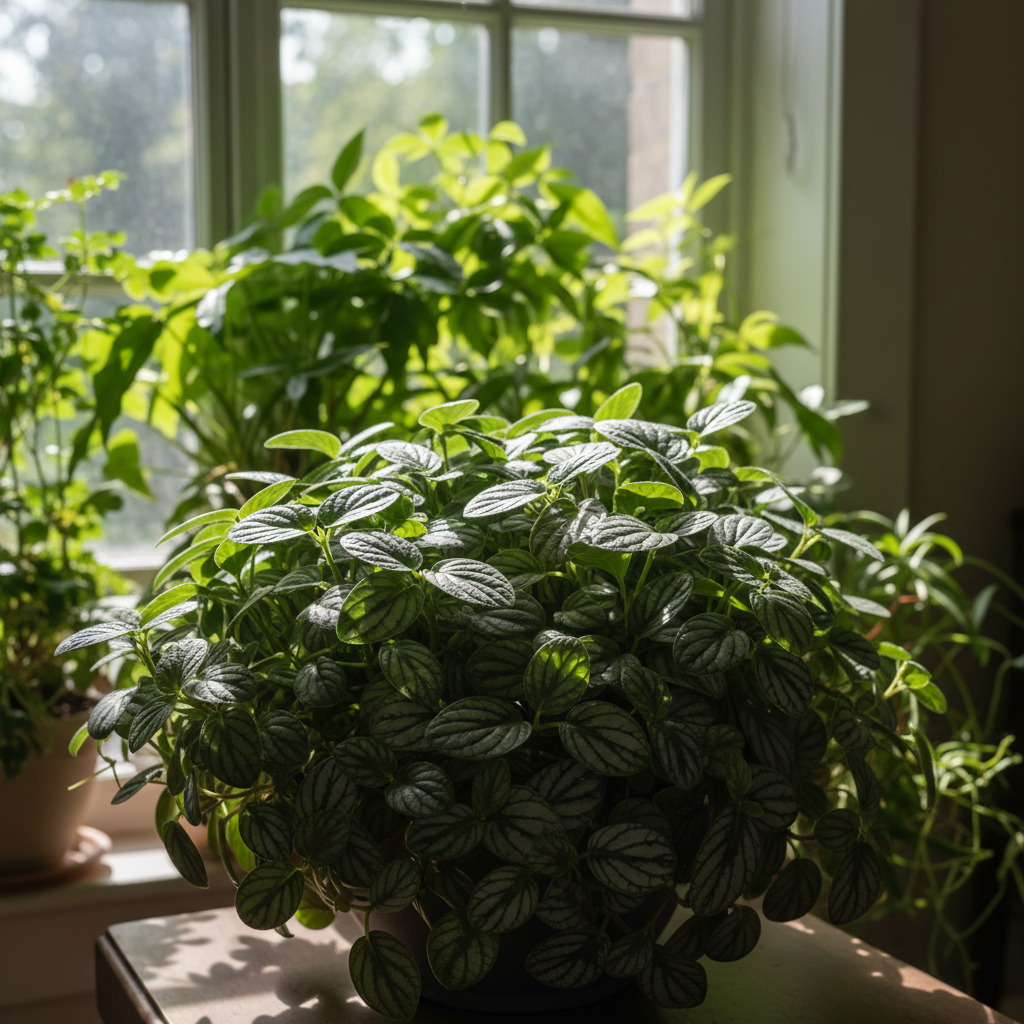
In its native habitat the aluminum plant grows on shaded limestone slopes under a closed canopy, receiving filtered, dappled light rather than direct sun. That ecology translates fairly directly into indoor care: Pilea cadierei thrives on the kind of bright, diffused light that you find a metre or two back from a south or west window, or directly in front of an east or north window. The plant will keep its full silver-and-green contrast in this range, and the stems remain short between leaf pairs, giving the dense mounded habit that the species is grown for.
The aluminum plant tolerates lower light better than most patterned foliage species, but tolerance is not the same as flourishing. Pushed into a dim corner, the plant survives by stretching, doubling the distance between leaf nodes and producing smaller, less heavily silvered leaves. After a few months in inadequate light it stops producing new growth entirely. Move it back into brighter conditions and it resumes growth within a week or two, but the stretched lower stems do not recover their old proportions and usually need to be pruned back to force a denser regrowth.
Light Levels Explained
Indoor light is best thought of in five broad tiers, measured in lux. Each tier has a typical placement and a predictable outcome for the aluminum plant. The table below maps the tiers onto realistic locations and what to expect from a specimen kept there for several months.
| Light Category | Approx. Level | Typical Location | Outcome |
|---|---|---|---|
| Direct sun | over 50,000 lux | Bare south window in summer | Leaf scorch, bleaching of silver bands, dehydration |
| Bright indirect | 10,000 to 25,000 lux | One to two metres from a south or west window | Ideal growth, dense mound, strongest silver contrast |
| Medium indirect | 2,500 to 10,000 lux | Directly in front of an east or north window | Healthy growth, slightly slower, full pattern retained |
| Low light | 500 to 2,500 lux | Three to four metres from any window | Leggy stems, smaller leaves, reduced silver intensity |
| Very low light | under 500 lux | Interior corridor, windowless bathroom | Decline within weeks, leaf drop, eventual death |
Window Orientation and Placement
South-facing window: Excellent light overall, but the plant should not sit directly on a south-facing sill in spring or summer. Set it back by one to two metres, or filter the sun through a sheer curtain. In winter the lower sun angle and weaker intensity make a south-facing position safe even at the glass.
East-facing window: Arguably the best orientation. The plant catches a couple of hours of gentle morning sun and bright diffused light through the rest of the day, with no risk of midday scorch. Silver markings tend to be at their most pronounced in east-window plants.
West-facing window: Workable but requires more vigilance than east. The hot afternoon sun on a west sill can crisp the upper leaves of a plant in summer. Pull the plant a half metre back, or use a sheer curtain to soften the light during peak hours.
North-facing window: Suitable in spring and summer when northern light is reasonably strong, and especially in upper-floor rooms with unobstructed sky. In winter at higher latitudes a north window may dip below the comfort threshold, in which case supplementary lighting is the simplest fix.
Pro Tip — Reading the Stems: The single best indicator that an aluminum plant is in the right light is internode length, the distance between successive pairs of leaves on the stem. In good light internodes stay between 1 and 2 cm; once they push past 3 cm the plant is asking for more light, and the only cure is to relocate or supplement.
How Light Affects Silver Banding
The silver patches on the leaves are not pigment but a structural feature: air pockets in the upper leaf layers scatter light and produce the metallic appearance, much like the white scales on certain butterfly wings. In bright indirect light the leaf invests fully in those silvered air pockets and the contrast is high. In dim conditions the new leaves emerge with a more even green colouration as the plant prioritises chlorophyll-rich cells across the entire upper surface to capture what light is available. The change is reversible: returning the plant to good light produces patterned leaves on subsequent growth, though existing leaves keep whatever colouration they came in with.
Warning — Direct Sunlight: Even an hour of unfiltered midday sun in summer is enough to leave permanent pale patches on the upper leaves of an aluminum plant. The damage looks like papery, bleached blotches and does not fade. If you must place the plant near a sunny window, use a sheer curtain or diffusing film, or pull it back into the room.
Artificial Lighting
The aluminum plant responds well to LED grow lights, which is useful in rooms with poor natural light or for winter supplementation at high latitudes. A full-spectrum bulb in the 4,000 to 6,500 Kelvin range, positioned 30 to 45 cm above the foliage and run for 10 to 12 hours daily, produces growth virtually indistinguishable from a well-placed window. White LED panels are preferred over purple-only horticultural lamps for living spaces, since the colour rendering lets the silver markings show their full contrast.
Seasonal Adjustments
Daylight intensity at temperate latitudes drops sharply from October to February, sometimes by a factor of five or more. A plant that thrives in a particular spot from March to September may struggle in the same place during winter. The two reasonable responses are either to move the plant a metre closer to the window for the dim months, or to add a supplementary LED on a simple timer. Either approach prevents the slow stretching that otherwise creeps in by January.
Watering & Humidity
Watering is where most aluminum plants die, and almost always from too much rather than too little. The species evolved in a habitat with reliable rainfall and reliably draining substrates: lateritic soil on a steep limestone slope rarely stays waterlogged for long. Recreating that pattern indoors means watering thoroughly when needed, then letting the upper layer of mix dry partially before the next pass. Plants kept in soggy mix without that drying interval develop root rot within weeks, and the silver leaves are the last thing to show distress, by which point the roots are usually beyond saving.
When to Water
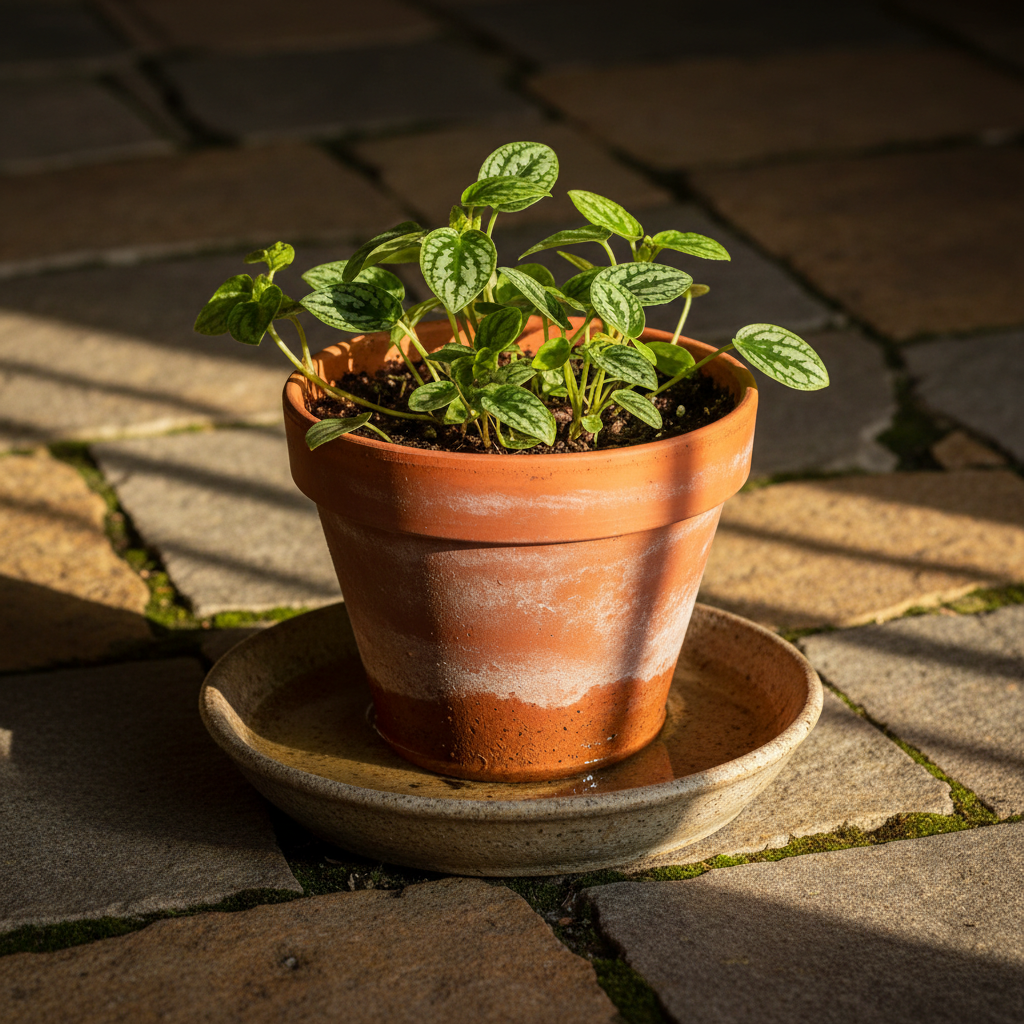
The reliable rule is to water when the top 2 cm (roughly one inch) of mix feels dry to the touch. Push a finger gently into the substrate beside the stem: if it comes out clean and the mix feels light, water; if it comes out with a damp coating, wait two or three days and check again. Frequency varies with conditions, but in spring and summer this usually translates to once every 5 to 7 days; in winter the interval often stretches to 10 to 14 days because slower growth and cooler temperatures reduce uptake.
The aluminum plant is more tolerant of brief underwatering than of sustained overwatering. A plant that has dried out fully will wilt dramatically, with the leaves drooping flat against the pot, and recover within a few hours of a thorough soak, occasionally losing a leaf or two. By contrast, a plant left sitting in a saucer of standing water for even a single week often shows no obvious distress until the rot is already extensive. Err toward dry rather than wet whenever you are uncertain.
Pro Tip — Weighing the Pot: Lift the pot just after watering, and again a few days later when the surface has started to dry. The weight difference is unmistakable, and within a week of this calibration you will be able to assess watering need by feel alone, no probe or moisture meter required.
How to Water Correctly
- Take the plant to the sink or use a basin large enough to catch runoff. Watering in place tempts you to underdose to avoid mess.
- Pour room-temperature water slowly around the base of the stems, working in a spiral so the entire surface is dampened evenly.
- Continue until water runs freely from the drainage holes. Aluminum plants need the whole rootball wetted, not just the top.
- Let the pot drain for 10 to 15 minutes. Tip out any water that collects in the saucer or decorative cachepot.
- Return the plant to its spot. Do not let the pot sit in standing water for more than half an hour at most.
- Alternatively, bottom water: set the pot in a shallow dish of water for 20 to 30 minutes until the surface darkens with absorbed moisture, then lift, drain and return.
Signs of Overwatering vs. Underwatering
| Symptom | Overwatering | Underwatering |
|---|---|---|
| Leaf colour | Lower leaves yellow uniformly, often dropping while still soft | Older leaves go pale, crisp brown at the edges |
| Leaf texture | Soft, limp, sometimes mushy at the base | Curled, papery, dry to the touch |
| Soil | Wet, sour smelling, possibly with surface algae | Pulls away from the pot edges, very light when lifted |
| Roots | Dark brown or black, slip out of their sheaths when pulled gently | Pale, dry, slightly brittle but still firm |
| Stem base | Soft, sometimes blackened, easy to break with light pressure | Firm but shrunken, leaves wilt above an intact stem |
Warning — Root Rot: If you suspect rot, unpot the plant immediately, rinse the rootball gently, snip away any black or mushy roots with sterilised scissors, dust the cut surfaces with cinnamon or sulphur powder and repot into fresh dry mix. Hold off watering for 48 hours afterwards. Severe rot is rarely worth fighting on the parent plant; take healthy stem cuttings instead and start over.
Humidity Requirements
Native to a region with year-round humidity above 70 per cent, Pilea cadierei visibly enjoys a moist atmosphere indoors. The practical comfort range is 50 to 70 per cent relative humidity, and the species will manage at 40 per cent if airflow is good and the mix is kept just right. The cosmetic difference between 45 per cent and 65 per cent is real but subtle: lower humidity tends to produce slightly crisper leaf margins and a more sparse mound, while higher humidity yields broader, more turgid leaves and more enthusiastic side branching.
The early symptoms of humidity stress are leaf-tip browning and a faint roughening of the leaf edge. These can also indicate hard tap water or fluoride sensitivity, so check several variables before responding. If a hygrometer shows the room sitting below 40 per cent for long stretches, take action; if the room reads 55 per cent or above, the browning is probably caused by something else.
The most effective way to raise local humidity is a small ultrasonic humidifier running on a timer during daylight hours, set within a metre of the plant. Grouping the aluminum plant with other species creates a transpiration microclimate that lifts ambient humidity by several percentage points, and a humidity tray (a shallow dish of pebbles topped up with water, with the pot sitting on the pebbles above the waterline) is a passive complement to either approach. Misting briefly raises surface humidity but does very little for the air ten minutes later, and frequent misting on still days encourages fungal leaf spots.
Water Quality
Aluminum plants are mildly sensitive to fluoride and chloramine, which are present in most municipal tap water. The damage is rarely catastrophic but shows up over time as small brown spots along the leaf margins, sometimes mistaken for fertiliser burn. The straightforward fix is to draw a watering can the day before use and let it sit uncovered, allowing volatile chlorine to dissipate (this does not remove fluoride or chloramine, which need filtration or rainwater). Rainwater is the best option where it is available, especially in hard-water regions; collected condenser water from an air conditioner or dehumidifier works too.
Soil, Potting & Repotting
The right mix for an aluminum plant is loose, airy and quick to drain, while still holding enough moisture to keep the fine surface roots from drying out between waterings. Straight peat-based potting compost is too dense and stays wet too long, leading to the slow rot that kills more aluminum plants than any other single cause. Adding bulky inorganic particles to that compost transforms the texture into something the species actually wants to root into.
Ideal Soil Composition
A successful aluminum plant mix has three jobs: drain freely so the roots are never waterlogged, hold a reservoir of moisture between waterings, and provide enough air around individual root segments that gas exchange continues. A 60-30-10 blend of peat-free potting compost, perlite and fine orchid bark hits all three. The compost gives water retention and nutrition, the perlite opens the structure and keeps air pockets between particles, and the bark adds the chunkier texture that resembles forest-floor leaf litter.
| Component | Proportion | Function |
|---|---|---|
| Peat-free potting compost or coir-based mix | 60 per cent | Holds moisture and supplies baseline nutrition |
| Perlite or pumice (medium grade) | 30 per cent | Maintains air pockets, prevents compaction, encourages drainage |
| Fine orchid bark or pine bark fines | 10 per cent | Adds chunky texture, mimics natural leaf-litter substrate, resists collapse |
The ideal pH for Pilea cadierei is mildly acidic to neutral, somewhere between 6.0 and 7.0. Most commercial peat-free mixes already sit in this range, and the addition of bark nudges it slightly toward the acidic side, which the plant prefers. Strongly alkaline tap water (above pH 8) used continuously over a year or two can shift the substrate out of range, at which point repotting into fresh mix resets the chemistry.
Pro Tip — Quick Mix Recipe: Three handfuls of peat-free houseplant compost, one and a half handfuls of perlite, and half a handful of orchid bark fines. Tip into a bowl and stir with a hand until the bark is dispersed evenly. The mix should feel light and fall through your fingers without clumping.
Choosing the Right Pot
The aluminum plant has a shallow, finely branched root system that does not appreciate sitting in a deep reservoir of damp mix. The best pots are slightly wider than they are tall, in proportions that match the spreading habit of the plant above. A pot that is too deep tends to keep the lower portion of the rootball perpetually waterlogged regardless of how carefully the upper layer is watered.
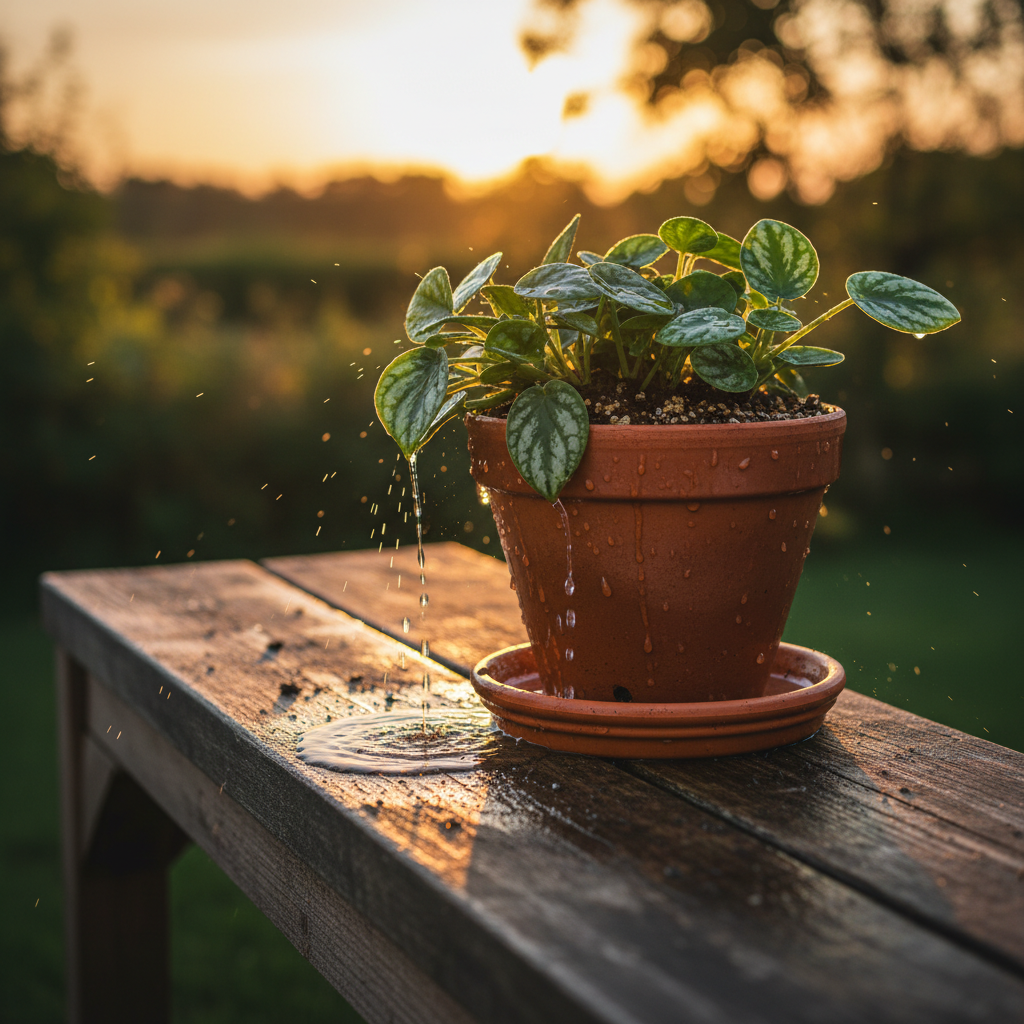
Drainage holes are non-negotiable. A pot without drainage will kill an aluminum plant within weeks. If you have fallen in love with a decorative cachepot that has no drainage, use it as an outer sleeve only: keep the plant in a plain plastic nursery pot inside it, and lift the inner pot out to water at the sink before returning it.
Pot material: Terracotta is the safest choice for inexperienced growers because its porous walls allow excess moisture to evaporate from the sides of the rootball, buffering against overwatering. Glazed ceramic and plastic both work for confident waterers, and have the advantage of holding moisture longer in dry rooms or for owners who travel.
Pot size: The aluminum plant rarely needs a pot wider than 15 cm (about 6 inches), even at full size. Upsize in increments of 2 to 3 cm rather than jumping to a much larger container, since an oversized pot holds far more moisture than the modest root system can absorb.
When to Repot
An aluminum plant typically needs repotting every 18 to 24 months, less because the roots have outgrown the container and more because the mix itself has broken down. Used potting mix collapses into a fine, dense slurry that suffocates the roots, and the visible signs are a slow general decline, water running straight through without absorbing, and leaves yellowing for no obvious cause. Spring is the right season: the plant moves into active growth and recovers from disturbance quickly.
How to Repot: Step-by-Step
- Water the plant lightly the day before. A slightly damp rootball lifts out more cleanly than a bone-dry one.
- Choose a new pot one size larger than the current one, with drainage holes confirmed. Cover the holes with a shard of broken pot or a piece of fine mesh to stop fresh mix washing out.
- Place a 2 cm layer of fresh mix in the bottom of the new pot and tamp lightly.
- Squeeze the sides of the old pot to loosen the rootball, then ease the plant out by grasping the base of the stems gently rather than pulling on the foliage.
- Tease the outer roots free with your fingers, removing as much spent mix as comes away easily. Snip off any dark, mushy roots with sterilised scissors.
- Position the plant in the new pot so the top of the rootball sits about 1 cm below the pot rim. Fill around the sides with fresh mix, tapping the pot gently to settle it.
- Water lightly to settle the mix further, then return the plant to its usual spot and hold off the next watering until the surface has dried.
Warning — Transplant Shock: A repotted aluminum plant may droop visibly for the first two or three days as the disturbed roots re-establish contact with the new mix. Resist the urge to overwater. Keep the plant out of bright direct sun for a week, mist lightly if humidity is low, and let it recover at its own pace. Resuming a normal watering routine should be enough.
Fertilising
Aluminum plants are modest feeders by tropical-foliage standards. They put out a steady supply of new leaves through spring and summer, which carries some nutrient demand, but the species does not produce large structural growth and does not need a heavy feeding programme to look its best. The default mistake among new owners is to feed too often and at too high a concentration, leading to leaf-tip burn, stunted new growth and a slow accumulation of mineral salts in the substrate.
A balanced liquid feed at half the manufacturer’s recommended strength, applied every four weeks during the growing season, covers what a healthy plant actually needs. Long-running houseplants that have been in the same mix for over a year benefit from this kind of light supplementation, while newly repotted specimens can skip feeding for the first eight to ten weeks since the fresh substrate provides ample nutrition on its own.
Understanding Plant Nutrients
Houseplant fertilisers are sold on their NPK ratio, the three primary nutrients in greatest demand, but a healthy foliage plant relies on around a dozen other elements in smaller quantities. The aluminum plant rarely shows secondary nutrient deficiencies in fresh mix, but understanding what each element does makes diagnosis easier when problems do arise.
| Nutrient | Symbol | Primary Function | Deficiency Symptoms |
|---|---|---|---|
| Nitrogen | N | Leaf and stem growth, chlorophyll production | Older leaves yellow first, plant looks pale overall |
| Phosphorus | P | Root development, flowering, energy transfer | Slow growth, dull purplish tint on leaf undersides |
| Potassium | K | Stress resistance, water regulation, leaf strength | Brown crispy leaf margins, weak stems |
| Calcium | Ca | Cell wall construction, new growth integrity | Distorted or stunted new leaves, hooked tips |
| Magnesium | Mg | Central atom of chlorophyll molecules | Interveinal yellowing on older leaves, veins stay green |
| Iron | Fe | Chlorophyll synthesis, electron transport | Interveinal yellowing on newest leaves, veins stay green |
Types of Fertiliser
Liquid fertilisers: The most controllable option for aluminum plants. A balanced 10-10-10 or slightly nitrogen-leaning 7-9-5 product, diluted to half strength, is applied during a regular watering and reaches the roots immediately. Liquid feeding suits the species because intervals and concentrations can be adjusted easily as growth speeds up in summer and slows in autumn.
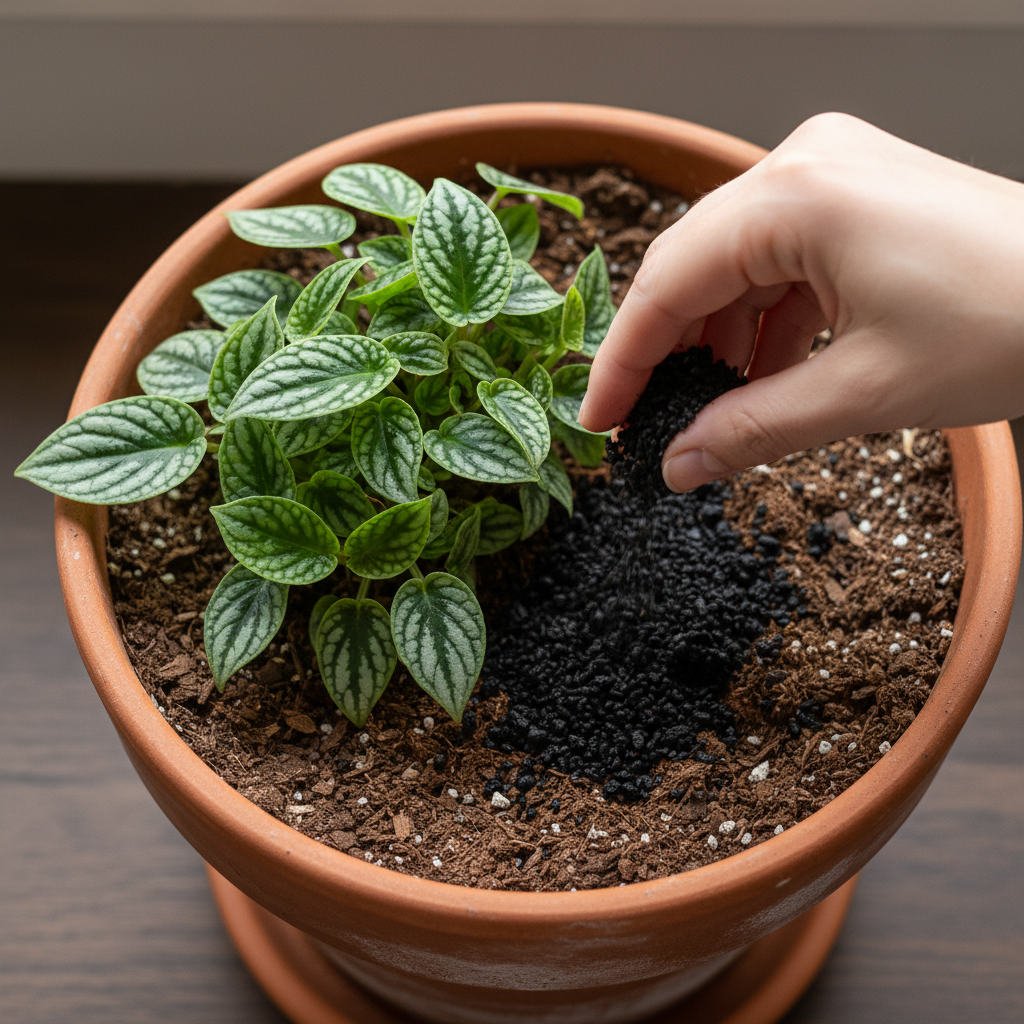
Slow-release granular: Coated prills release a fraction of their nutrient load with each watering over three to six months. Convenient for owners who travel or forget routine feeding, but harder to fine-tune to the plant’s actual demand. If using granular fertiliser, choose a product rated for foliage houseplants, scatter a small spoonful evenly across the surface in spring, and skip liquid feeding entirely while it is active.
Organic fertilisers: Worm castings, fish emulsion and seaweed extract all work well for aluminum plants. Worm castings can be top-dressed at any time and release slowly, fish emulsion provides a quick gentle nitrogen boost (though the smell is real, even from deodorised versions), and seaweed extract supplies trace minerals along with growth-stimulating compounds. Organic options are inherently low-concentration, which makes overdosing harder.
Feeding Schedule
From early spring through late summer, feed a half-strength balanced liquid every four weeks, applied to mix that is already damp from a recent watering to spread nutrients evenly and avoid root contact with concentrated solution. From late September onward, taper to once every six to eight weeks, and stop completely from mid-November through mid-February, when growth has naturally slowed and the plant cannot use the added nutrients. Resume in late February or early March as new leaves appear.
Pro Tip — Half Is Plenty: Aluminum plants respond better to half-strength feed at routine intervals than to full-strength feed less often. The same total nutrient load, spread thinner, produces steadier growth without the spikes of leaf-tip burn that follow a concentrated dose.
How to Fertilise
- Water the plant normally a day before feeding, so the substrate is damp throughout. Feeding into dry mix concentrates fertiliser around shallow roots and risks burn.
- Mix the fertiliser to half the recommended strength in a clean watering can, using room-temperature water.
- Apply slowly around the base of the plant until a small amount drains through the bottom. Avoid splashing the foliage.
- Discard any liquid that collects in the saucer rather than leaving it for the plant to reabsorb.
- Every fourth feeding, water with plain water only to flush accumulated salts through the substrate.
Warning — Salt Build-Up: Even careful fertilising leaves behind mineral residues in the substrate over time, visible as a white crust on the soil surface or pot rim. Once or twice a year, take the plant to the sink and flush it with several times the pot volume of plain water, letting it drain fully between passes. This single act prevents most chronic fertiliser-related problems.
Propagation
Propagating the aluminum plant is unusually rewarding for a houseplant grower: cuttings root quickly, the success rate is high even for beginners, and the resulting plants reach a presentable size within a single growing season. The trade-off, mentioned earlier, is that the species ages out of its best appearance within three or four years, so propagation is less a way to make extra plants and more a way to keep an ongoing supply of fresh, compact specimens replacing tired older ones.
The two reliable methods are stem cuttings rooted in water or moist medium, and division of mature multi-stemmed plants. Both work, both produce strong plants, and the choice between them comes down to whether you want to multiply or simply rejuvenate. Stem cuttings yield many independent plants, while division splits a single overgrown specimen into two or three lower-density ones.
Understanding Stem Nodes
The aluminum plant produces leaves in opposite pairs along the stem, and at every leaf pair there is a node, a thickened point where dormant root and shoot tissue lies just beneath the surface. A cutting that contains at least one node below the substrate or waterline will root reliably, while a cutting without a node will rarely produce roots no matter how long it is left. Recognising nodes is therefore the single most important skill for propagating this species: look for the slight swelling on the stem where each pair of leaves emerges.
Stem Cuttings in Water or Moss: Step-by-Step
Water rooting is the simplest method and lets you watch root development through clear glass. Moss rooting is marginally more reliable for cuttings that go on to be potted up, since moss-grown roots adapt to substrate without the brief shock that water-grown roots can show. Either approach takes two to three weeks to produce viable roots in spring or summer.
- Choose a healthy stem tip 8 to 12 cm long, ideally from spring or early summer growth. Avoid woody lower stems and the very softest new tips.
- Cut just below a node with sterilised scissors or a sharp blade. The cutting should contain at least two pairs of leaves above the lowest node.
- Strip the lowest pair of leaves cleanly with your fingers so the lower node is bare and will sit below water or substrate.
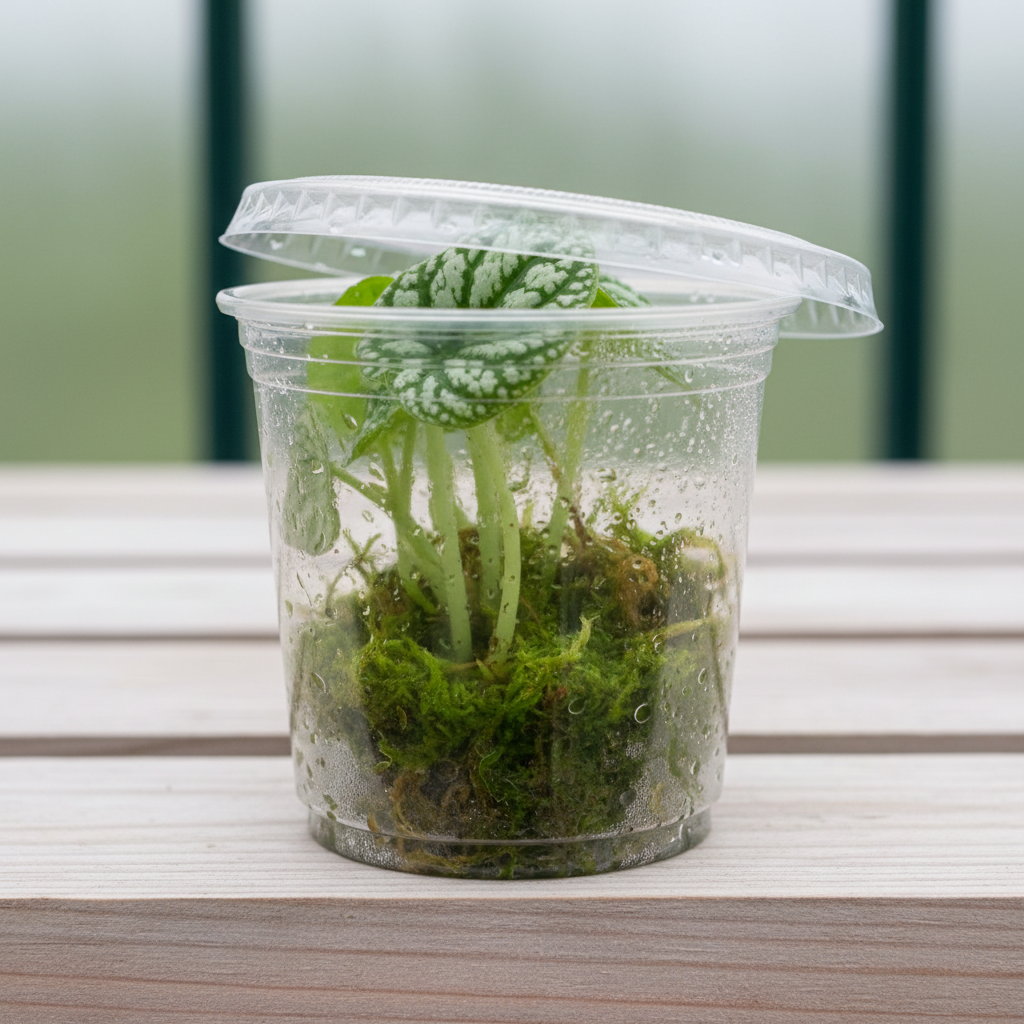
- Place the cutting in a small glass of room-temperature water (with the lower node submerged and the upper leaves above the rim) or push it gently into damp sphagnum moss in a deli cup with a slightly open lid.
- Set the container in bright indirect light, away from direct sun and draughts. Top up water to maintain depth, or mist the moss every few days to keep it just damp.
- Roots typically appear within 10 to 14 days. Once they reach 3 to 4 cm in length, pot the cutting into standard aluminum plant mix and water lightly. Three or four cuttings to a 12 cm pot makes a full, attractive young plant from day one.
Pro Tip — Multi-Cutting Pots: A single rooted cutting in a pot always looks sparse. Take three to five cuttings at once, root them together, and pot them as a cluster. Within six to eight weeks the new pot looks like a mature small plant rather than a propagation experiment.
Division of Mature Plants: Step-by-Step
A multi-stemmed aluminum plant that has been in the same pot for over a year often forms several independent crowns at the substrate surface, each with its own root system. These can be separated cleanly at repotting time to produce two or three smaller plants from one. Division is gentler on the parent than stem cuttings since each new plant retains an established root system, but it is only possible on mature specimens that have actually produced multiple crowns.
- Water the plant the day before so the substrate releases easily. Lift the plant out of its pot and shake off as much loose mix as comes away without force.
- Examine the base of the plant for natural divisions: distinct clusters of stems with their own root masses.
- Tease the divisions apart with your fingers where the roots allow. Where they do not, use sterilised scissors to cut cleanly through the rootball, separating it into two or three pieces.
- Trim any damaged roots with sterilised scissors and check each division has both healthy roots and at least three or four healthy stems.
- Pot each division into its own appropriately sized pot of fresh aluminum plant mix, water lightly, and keep out of direct sun for a week while the divisions settle.
Troubleshooting Propagation
| Problem | Likely Cause | Solution |
|---|---|---|
| Cutting wilts in the first week | Too many leaves transpiring before roots form | Remove the lower leaf pair if not already done; cover with a clear bag or dome for 5 days |
| Stem rots in water | Stagnant water, lower leaves submerged | Change water every two to three days; ensure no leaves sit below the waterline |
| Roots form but stop growing | Cutting taken too late in season; insufficient light | Move to brighter spot; pot up to substrate once visible roots reach 3 cm |
| Roots form but new plant fails after potting | Sudden move from water to dry mix shocks roots | Water generously after potting and keep humidity high for two weeks while roots adapt |
Pests & Diseases
The aluminum plant is not strongly resistant to common houseplant pests, but it is small enough that infestations are usually caught early if you look. The dense mounded habit creates plenty of sheltered leaf axils where pests like to settle, so a quick weekly inspection from above and below is the single most effective preventative measure. Healthy plants in correct light and humidity are far less attractive to pests than stressed specimens, so good cultural conditions do most of the work.
When a problem does appear, early treatment is almost always successful. The species responds well to gentle physical removal of pests, and to mild treatments like neem oil and insecticidal soap. Harsh systemic insecticides are rarely necessary on a plant this size and tend to damage the leaves more than they damage the pests.
Common Pests
Spider Mites (Tetranychus urticae)
Spider mites are the most common pest on aluminum plants, especially in dry indoor air. They feed on the underside of leaves, draining individual cells and producing a stippled, faintly silver-flecked appearance that is easy to mistake for the species’ natural markings. The giveaway is fine webbing in the leaf axils and a dusty rust-coloured residue if the infestation has been ignored for a few weeks.
Treatment: Take the plant to the sink and rinse the foliage thoroughly with a strong spray of room-temperature water, paying particular attention to the undersides. Repeat every five days for three weeks to break the egg-hatch cycle. If the infestation is severe, follow each rinse with a neem oil spray (5 ml per litre of water plus a drop of dish soap to emulsify), applied to all leaf surfaces in the evening to avoid leaf scorch.
Mealybugs (Pseudococcus longispinus)
Mealybugs appear as small white cotton-wool tufts in the leaf axils and along the stems. They sap sugary fluid from the plant and excrete sticky honeydew, which then attracts sooty mould. On the aluminum plant they tend to congregate at the base of leaves and in the centre of the crown where airflow is poorest.
Treatment: Dab each visible mealybug with a cotton bud soaked in 70 per cent isopropyl alcohol; the alcohol breaks down their waxy coating and kills on contact. For larger populations, follow with a weekly insecticidal soap spray for three weeks. Isolate the plant from neighbouring specimens during treatment, since mealybugs spread readily through touching foliage.
Aphids (Aphis gossypii)
Aphids tend to cluster on soft new growth and developing flower spikes (yes, aluminum plants do flower indoors, in small inconspicuous panicles). They are usually green or pale yellow, small and pear-shaped, and reproduce quickly enough to overwhelm a young plant within a fortnight if unchecked.
Treatment: A strong rinse with water dislodges most aphids physically. Follow with insecticidal soap or a 1 per cent neem oil solution sprayed weekly for three weeks. Pinching off the heavily infested soft growth tips is also effective on a plant this small.
Fungus Gnats (Bradysia spp.)
Fungus gnats are small dark flies that emerge from chronically wet potting mix; the adults are an annoyance more than a threat, but their larvae feed on fine root hairs and can stunt young plants. The presence of fungus gnats almost always indicates that the substrate is being kept wetter than it should be.
Treatment: Allow the top 3 cm of mix to dry thoroughly between waterings to interrupt the larval lifecycle. Yellow sticky traps capture adults and visibly reduce the breeding population within ten days. For persistent infestations, treat the substrate with a biological control containing Bacillus thuringiensis israelensis, which kills larvae without harming the plant.
Common Diseases
Root Rot (Pythium spp., Phytophthora spp.)
Root rot is the disease that kills more aluminum plants than every other pest and disease combined. It is caused by water-borne oomycete pathogens that proliferate in waterlogged substrates, attacking fine roots first and progressing upward into the stem base. Once rot reaches the lower stems the plant is usually beyond rescue.
Treatment: Catch it early by responding promptly to any unexplained yellowing of lower leaves or sour smell from the substrate. Unpot, rinse the rootball, snip away black or mushy roots with sterilised scissors, dust the cuts with cinnamon powder, and repot into fresh dry mix. Withhold water for 48 hours. Severe infections rarely recover, so taking healthy stem cuttings to start fresh is the better insurance.
Leaf Spot (Cercospora spp.)
Brown or tan spots with a darker margin appear on the upper leaf surface, usually in plants exposed to persistent overhead moisture or in cramped collections with poor airflow. Spots can coalesce into larger patches if untreated, eventually causing leaf drop.
Treatment: Remove affected leaves and dispose of them in the rubbish rather than compost. Improve airflow around the plant, water from the base rather than overhead, and reduce humidity slightly if it has been chronically very high with still air. A copper-based fungicide applied as a foliar spray is reserved for stubborn cases that fail to clear with cultural changes.
Pest and Disease Summary
| Pest / Disease | Identification | Treatment |
|---|---|---|
| Spider mites | Stippling on undersides, fine webbing in axils | Strong water rinse, neem oil weekly for three weeks |
| Mealybugs | Cottony white tufts in leaf axils | Alcohol on cotton bud, then insecticidal soap weekly |
| Aphids | Small green or yellow soft-bodied clusters on new growth | Water rinse, insecticidal soap, pinch off heavy growth tips |
| Fungus gnats | Small dark flies around the pot, larvae in moist mix | Let surface dry, yellow sticky traps, BTI biological control |
| Root rot | Yellow lower leaves, mushy black roots, sour smell | Unpot, trim roots, fresh dry mix, propagate as insurance |
| Leaf spot | Tan or brown spots with darker margins on leaves | Remove affected leaves, improve airflow, copper fungicide if persistent |
Prevention Strategies
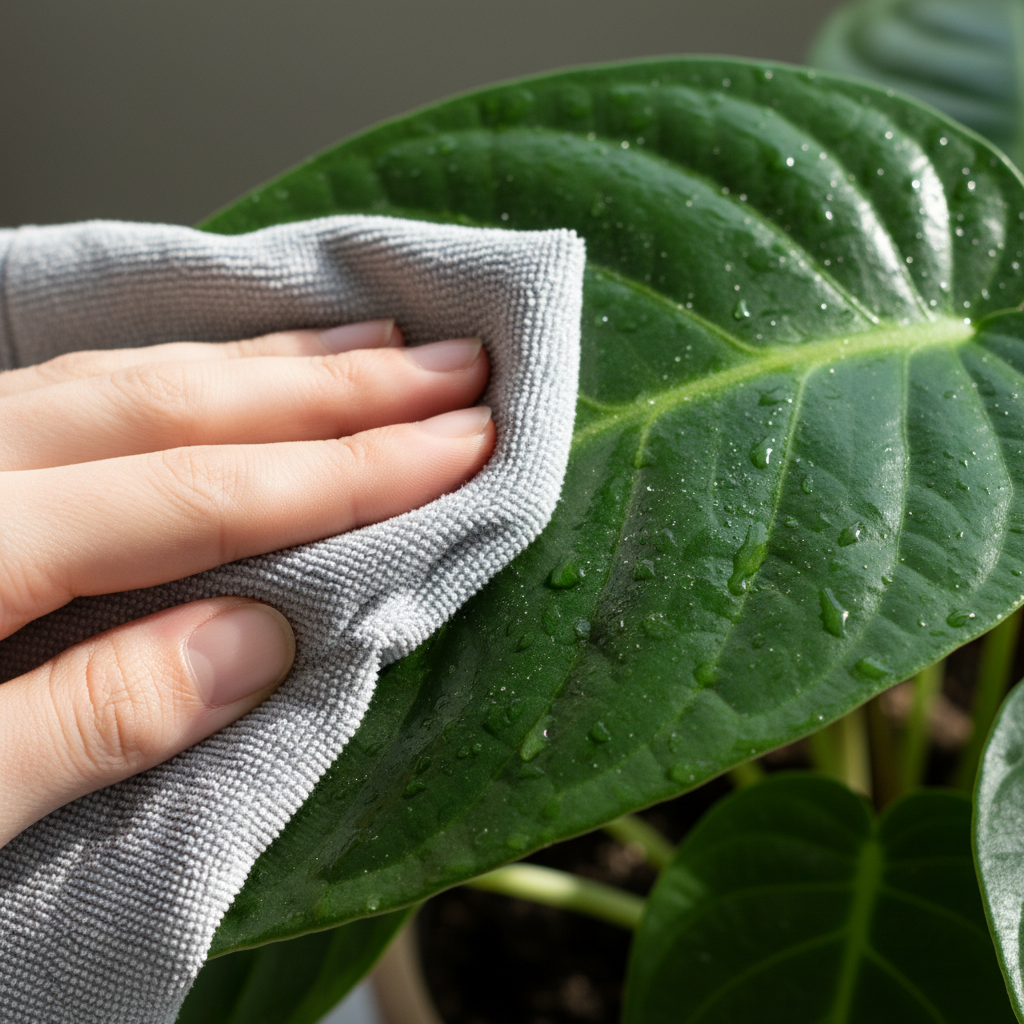
The single most effective preventative measure is weekly inspection: spend two minutes lifting each leaf, checking the undersides, looking at leaf axils and at the substrate surface. Pests caught in their first generation are trivial to remove; pests caught after several generations of population growth are a multi-week treatment problem. Wiping the upper leaf surfaces with a damp cloth at the same time dislodges spider mite eggs before they hatch and keeps the plant looking its best.
Quarantine new plants for two to three weeks before introducing them to an existing collection. Most pest outbreaks in established collections arrive on a single new plant, and a separate room or even a different shelf during the quarantine window prevents the spread. Sterilise tools between plants with isopropyl alcohol, particularly after pruning or repotting, since fungal spores travel readily on blade surfaces.
Pro Tip — Neem Oil Routine: A monthly preventative spray of dilute neem oil (5 ml per litre, with a drop of soap to emulsify) keeps most soft-bodied pests at bay before infestations begin. Apply in the evening on plants out of direct sun, and rinse the foliage the next morning if you notice any residue. Skip during the hottest summer weeks when warm leaves and neem oil can interact unpredictably.
Popular Varieties
Compared to species like the snake plant or pothos, the aluminum plant has a modest portfolio of named cultivars. The wild-type form is what most growers encounter under the bare name Pilea cadierei, and the one named cultivar in any wide circulation is ‘Minima’, a compact dwarf form selected for tighter growth. A handful of closely related Pilea species are sometimes confused for or sold alongside Pilea cadierei at garden centres, and those are worth knowing about both as decorative companions and to avoid misidentification.
Crossing the aluminum plant with other Pileas has historically been difficult and no commercially significant hybrids exist. Variegated forms with cream or white sectoring on the green areas occasionally appear in the trade but they tend to be unstable, reverting to the wild pattern within a generation or two. The varieties below are the ones you can actually find and grow with consistent results.
| Variety | Leaf Appearance | Light Needs | Growth Rate | Availability |
|---|---|---|---|---|
| Pilea cadierei (species) | Ovate leaves 5 to 8 cm, four rows of raised silver patches between impressed veins | Bright indirect | Moderate | Common |
| ‘Minima’ | Same pattern, leaves and stems roughly half size, mound stays under 15 cm | Bright indirect | Slow to moderate | Specialist nurseries |
| Variegated forms (unstable) | Occasional cream or white sectors on silver-green leaves | Bright indirect, slightly more than species | Slow | Rare, often reverts |
| Pilea spruceana ‘Silver Tree’ (relative) | Bronze-green leaves with a single broad silver central stripe | Bright indirect | Moderate | Common |
| Pilea involucrata ‘Norfolk’ (relative) | Deep velvety bronze leaves with a metallic silver overlay | Bright indirect | Moderate | Specialist nurseries |
| Pilea mollis ‘Moon Valley’ (relative) | Heavily textured chartreuse leaves with red-bronze veins, no silver markings | Bright indirect | Moderate to fast | Common |
Featured Varieties
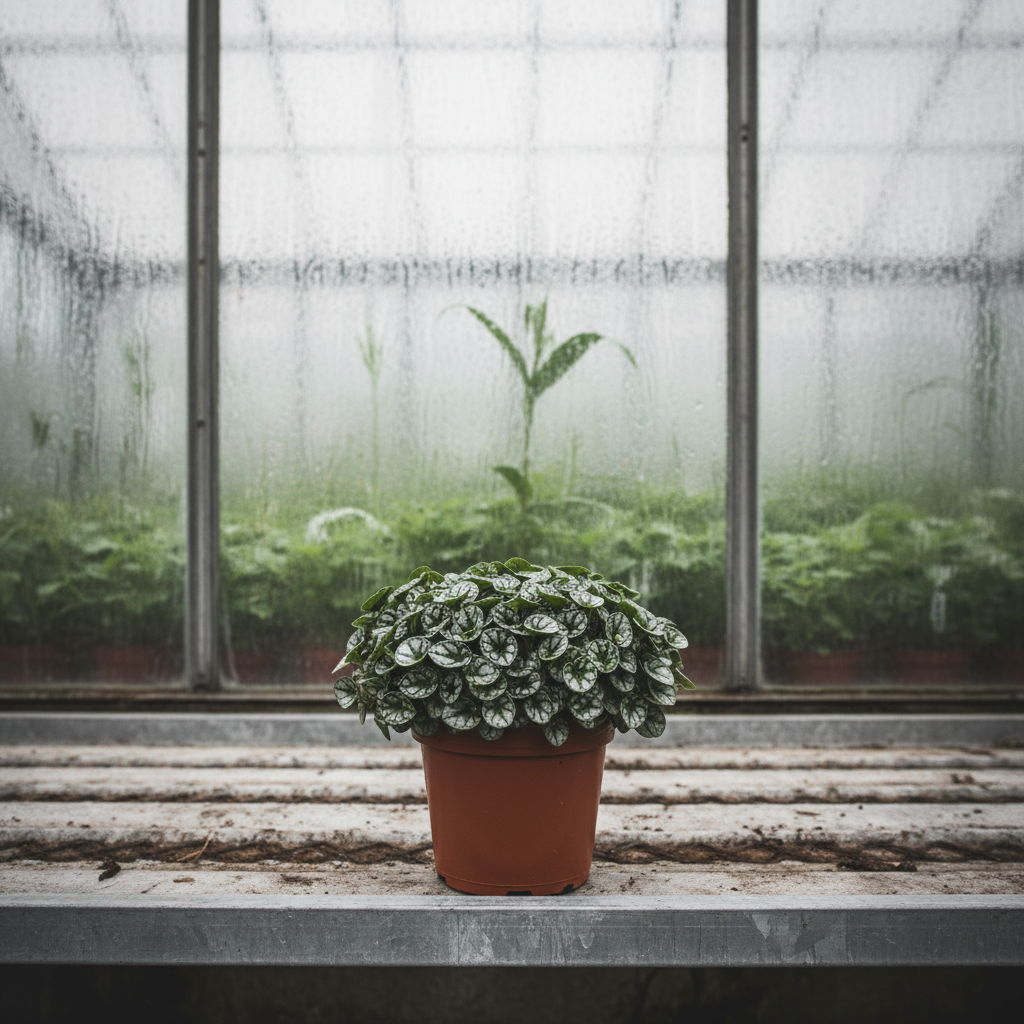
‘Minima’
The single most commonly grown named cultivar of Pilea cadierei, ‘Minima’ is a compact dwarf selection that retains the species’ characteristic silver banding on noticeably smaller leaves and shorter stems. Mature plants top out around 15 cm rather than the species’ 25 to 30 cm, and the internodes stay short even in less than perfect light, which makes ‘Minima’ a useful choice for small terrariums and tabletop displays where the standard plant would quickly outgrow its space.
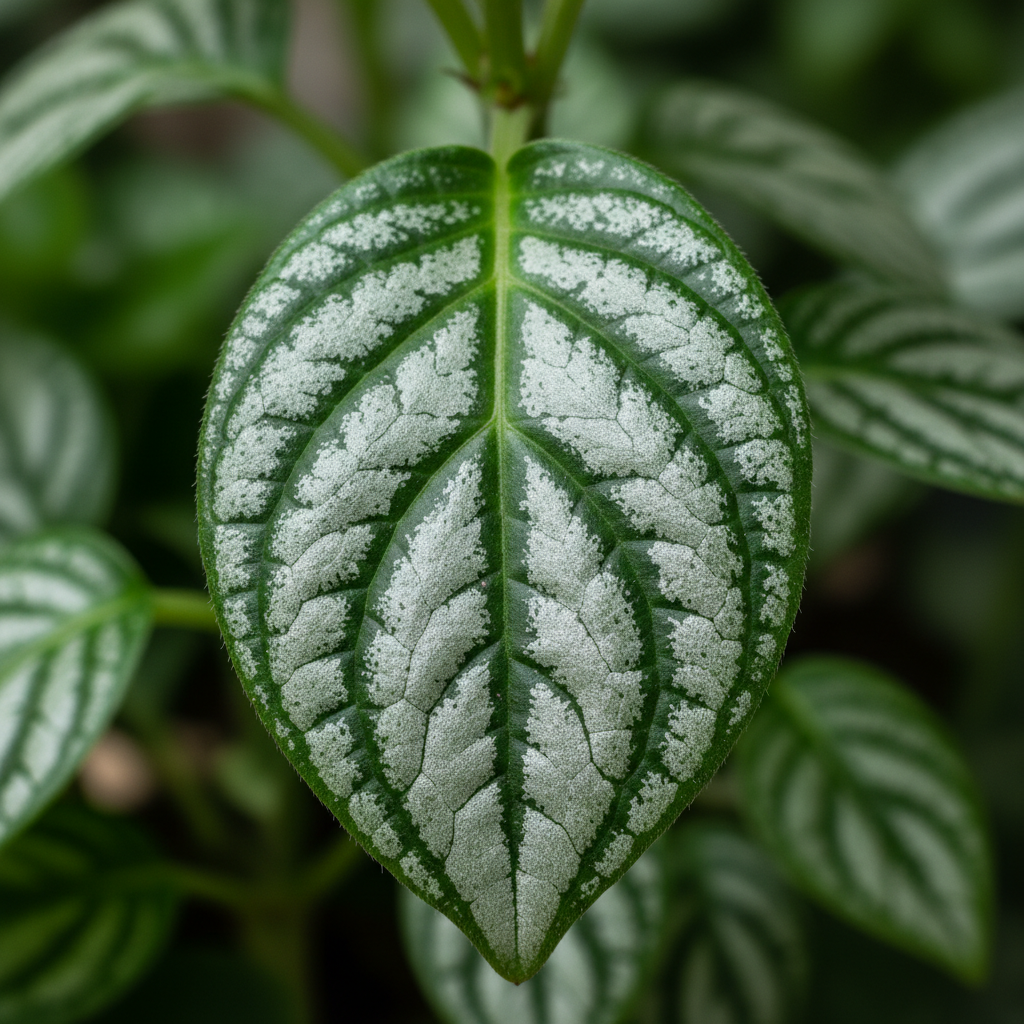
Species Form
The wild-type Pilea cadierei, sold simply as ‘Aluminum Plant’ or ‘Watermelon Pilea’, remains the form most often encountered and the standard against which the cultivars are measured. Leaves are 5 to 8 cm long, with the four characteristic raised silver patches arranged between the deeply impressed parallel veins. Stems hold themselves semi-upright until weight pulls them outward into a low billowing mound, perfect for plant stands, side tables and the front edge of a shelf arrangement.
Variety Profiles in Detail
Aluminum Plant ‘Minima’ (Pilea cadierei ‘Minima’)
The ‘Minima’ cultivar was selected from variation within the species for its consistently compact habit and unusually short internodes. It carries the same four-row silver banding as the wild-type but on leaves that rarely exceed 3 cm in length. Care is identical to the species, although the smaller scale means watering intervals run slightly shorter and pot size stays smaller through the plant’s life. ‘Minima’ is the easiest aluminum plant for a closed terrarium or bottle garden, where its tight habit and tolerance of high humidity both work in its favour.
Silver Tree Pilea (Pilea spruceana ‘Silver Tree’)
A close relative routinely sold alongside the aluminum plant, Pilea spruceana ‘Silver Tree’ has bronze-green leaves with a single broad silver stripe running down the centre, rather than the species’ four discrete bands. The growth habit is similar and care requirements are practically identical, so the two are often grown as companions. They distinguish each other neatly in arrangements where the eye benefits from a contrast between four narrow silver lines and one wide silver one.
Norfolk Friendship Plant (Pilea involucrata ‘Norfolk’)
Another close relative, Pilea involucrata ‘Norfolk’ has deep velvety bronze leaves with an iridescent silver-purple shimmer across the upper surface and an unmistakably hairy texture. It needs slightly higher humidity than the aluminum plant and is more sensitive to dry indoor air, but where conditions suit it the leaves take on an almost metallic quality that no other Pilea matches. Often sold as the ‘friendship plant’ because its easy propagation made it a popular gift exchange among Victorian houseplant enthusiasts.
Moon Valley Pilea (Pilea mollis ‘Moon Valley’)
While not silver-patterned like the others on this list, Pilea mollis ‘Moon Valley’ rounds out the genus’ decorative range with intensely textured chartreuse leaves crossed by deep red-bronze veins, producing a quilted, almost reptilian effect. It is a more vigorous grower than the aluminum plant and reaches 30 to 40 cm, which makes it a useful companion species at a slightly larger scale within the same care regime.
Choosing the Right Variety for Your Space
For most growers the standard species form is the right starting point: widely available, fully representative of what makes the aluminum plant interesting, and forgiving enough to teach the cultural details that any related Pilea will then need. ‘Minima’ is the natural second purchase for anyone with a terrarium habit or a particularly small display space, and the related species above (Silver Tree, Norfolk, Moon Valley) make excellent companion plants once you have the basics of Pilea care down. Avoid chasing variegated forms of Pilea cadierei as a beginner: they exist, but they are inconsistent and the disappointment of reversion is real.
Frequently Asked Questions
Is the aluminum plant toxic to cats and dogs?
No, Pilea cadierei is listed as non-toxic to cats and dogs by the ASPCA, which makes it one of the safer patterned foliage options for pet households. As with any houseplant, large quantities eaten by a curious pet can still cause mild stomach upset, but no serious poisoning has been documented and the species does not contain the calcium oxalate crystals that make many tropical houseplants risky to chew.
Why is my aluminum plant getting leggy?
Legginess in an aluminum plant almost always points to inadequate light. The stems stretch reaching for brighter conditions, the spacing between leaf pairs increases, and the plant develops a sparse, top-heavy appearance. Move it to a brighter spot (in front of an east window, or a metre back from a south-facing one), then pinch out the stretched growing tips. Pinching encourages branching at the nodes below, producing a denser plant within four to six weeks. Save the pinched tips as cuttings to grow new plants alongside.
Should I pinch or prune the aluminum plant?
Yes, regular pinching is one of the most useful habits with this species. Pinching out the growing tip of each stem at every second or third leaf pair forces the plant to branch from the nodes below, producing a fuller, more compact plant. Without periodic pinching most aluminum plants grow into single long stems that eventually bend under their own weight. Light pinching every few weeks during the growing season keeps the plant looking its best.
Why are the silver markings fading on new leaves?
The silver bands are produced by air pockets in the upper leaf layers, and the plant invests more in those pockets when light is good. New leaves emerging without the usual silver contrast are a sign that the plant is in lower light than it would prefer. Move it closer to a window or add supplementary LED lighting, and subsequent new leaves should return to the species’ full pattern. Existing leaves keep whatever colouration they emerged with, so the fix shows up in new growth rather than in current foliage.
How long does an aluminum plant live?
Three to four years is realistic for a well-grown specimen before it starts to look genuinely tired, with woody bare lower stems and a thinning crown. The species is short-lived by houseplant standards, and rather than fighting that natural decline, most experienced growers take cuttings every couple of years to keep a rolling supply of young, dense, vigorous plants replacing the older ones. The original plant is rarely worth saving once it has reached the leggy-and-woody stage.
Does the aluminum plant flower indoors?
Yes, but the flowers are small, pale green, clustered in inconspicuous panicles that emerge from the leaf axils in late spring or early summer. They are not the reason anyone grows the species and they consume energy that the plant would otherwise put into leaf production, so most growers pinch off the flower spikes as they appear. The plant is grown for its leaves; the flowers are a botanical curiosity rather than a feature.
Can the aluminum plant grow in a terrarium?
Yes, and it is one of the better-suited candidates for a closed glass case. The species’ love of high humidity, its small mature size and its slow steady growth all work in a terrarium’s favour, and the ‘Minima’ cultivar in particular is almost custom-made for the role. Use the same well-draining mix as for potted plants, keep the terrarium in bright indirect light, and ventilate briefly every couple of days to discourage fungal growth in still humid air.
Why are the leaf tips turning brown?
Brown leaf tips on an aluminum plant most often indicate low humidity, but several other factors can produce the same symptom: hard tap water with high fluoride or chloramine, fertiliser salt build-up in the substrate, or chronic underwatering. Check humidity first with an inexpensive hygrometer; if it sits below 40 per cent for long stretches, add a small humidifier. If humidity is adequate, switch to filtered or rainwater for a month, flush the substrate with plain water, and watch new leaves for improvement.
Why is my aluminum plant dropping leaves suddenly?
Sudden leaf drop usually follows an environmental shock: a cold draught from an open window, a sharp drop in room temperature, or a move from a warm shop to a cool home. The aluminum plant is not as fragile as some tropical species but it dislikes rapid changes, particularly to cold. Move the plant to a stable spot above 18 degrees Celsius, away from doors and draughty windows, and avoid further repotting or pruning for a few weeks while it recovers.
How do I revive a stretched, leggy aluminum plant?
An already-leggy plant cannot be made compact again by relocation alone; the existing stretched stems will not shorten. The fix is to cut the plant back hard, removing all the longest leggy stems just above the lowest healthy leaf pair, and to root the cuttings as new plants. The cut-back parent will sprout new growth from the remaining nodes within two to three weeks if it has enough light, and the new growth will be tight and compact provided the light is good. Within two months you have a fresh dense original plus several young clones from the cuttings.
What is the difference between Pilea cadierei and Pilea peperomioides?
Both belong to the genus Pilea but the resemblance ends there. Pilea peperomioides, the Chinese money plant, has round coin-shaped leaves on long petioles emerging from a central rosette, no silver markings, and a tidy upright habit. Pilea cadierei, the aluminum plant, has elongated ovate leaves in opposite pairs along sprawling stems, with the distinctive raised silver patches between the veins. They share preferences for bright indirect light and well-draining mix, but visually they have very little in common.
Where does the aluminum plant come from originally?
The species is native to the central Annam range of Vietnam, where it grows on shaded limestone slopes at moderate elevations. The climate of its native habitat features high year-round humidity, reliable monsoon rainfall, mild temperatures and filtered light beneath a closed forest canopy. Replicating those conditions broadly (warm, humid, bright but not direct light, with well-draining substrate) is the foundation of indoor care for the species.






