
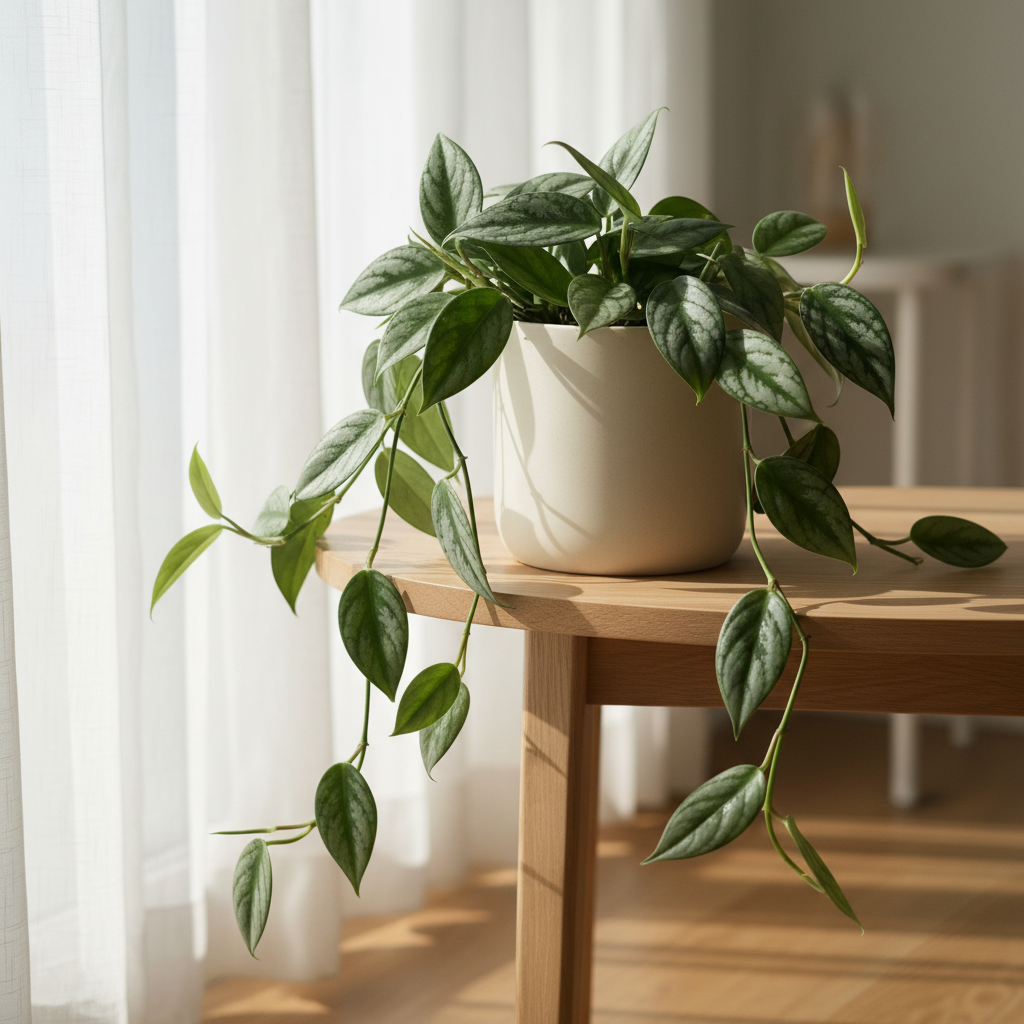
Among the trailing aroids that have crowded onto windowsills in recent years, the silver satin plant stands slightly apart. Where its cousin the pothos is fast and forgiving to a fault, Scindapsus treubii is measured, almost deliberate, unfurling thick leaves that catch the light like brushed metal. It is a plant that rewards patience rather than fuss, and once its few simple preferences are understood it becomes one of the most undemanding foliage plants a home can hold. Native to the forest floors and tree trunks of Southeast Asia, it has evolved to climb through deep shade, and that heritage shapes everything about how it should be grown indoors.
Contents
- Quick reference
- Why grow a silver satin plant
- Light
- Watering
- Soil and potting
- Fertilising
- Propagation
- Pests and problems
- Varieties
- Frequently asked questions
Quick reference
The table below distils what the silver satin plant needs to do more than merely survive in a home. The gap between surviving and thriving is wide with this species, because it tolerates poor conditions quietly for a long time, growing slowly and saying little, before its leaves dull and its stems stretch. Reading the conditions below as targets rather than minimums is the surest route to a plant that genuinely flourishes.
| Common name | Silver satin plant, sterling silver scindapsus |
| Botanical name | Scindapsus treubii |
| Family | Araceae |
| Origin | Southeast Asia |
| Light | Medium to bright indirect light |
| Water | When the top half of the soil is dry |
| Soil | Loose, well-draining aroid mix |
| Temperature | 18 to 29 degrees Celsius (64 to 84 degrees Fahrenheit) |
| Humidity | Average room humidity; appreciates 50 per cent or more |
| Feeding | Monthly in spring and summer, diluted |
| Mature size | Trails to 1 to 1.5 metres (3 to 5 feet) indoors |
| Toxicity | Toxic to pets and humans if ingested |
| Difficulty | Easy |
Why grow a silver satin plant
The first thing anyone notices about Scindapsus treubii is the leaves. They are thicker and stiffer than those of most trailing houseplants, with a slightly succulent quality that lets the plant store water and shrug off the occasional missed watering. Across that deep, matte-green surface lies a wash of metallic silver, dense enough in some forms to nearly obscure the green beneath. The effect shifts with the angle of the light, giving the plant a quiet, shimmering presence that few others can match.
Beyond its looks, this is a plant built for real homes rather than ideal ones. As an understorey climber from the forests of Southeast Asia, it is adapted to low and dappled light, which makes it genuinely happy in the medium-light spots where many plants sulk. Its thick leaves make it markedly more drought-tolerant than a pothos, so it suits people who travel or simply forget. It grows slowly, which means it rarely outgrows its place or demands constant pruning, and it can be left to trail from a shelf or trained up a moss pole to climb, where its leaves grow noticeably larger.
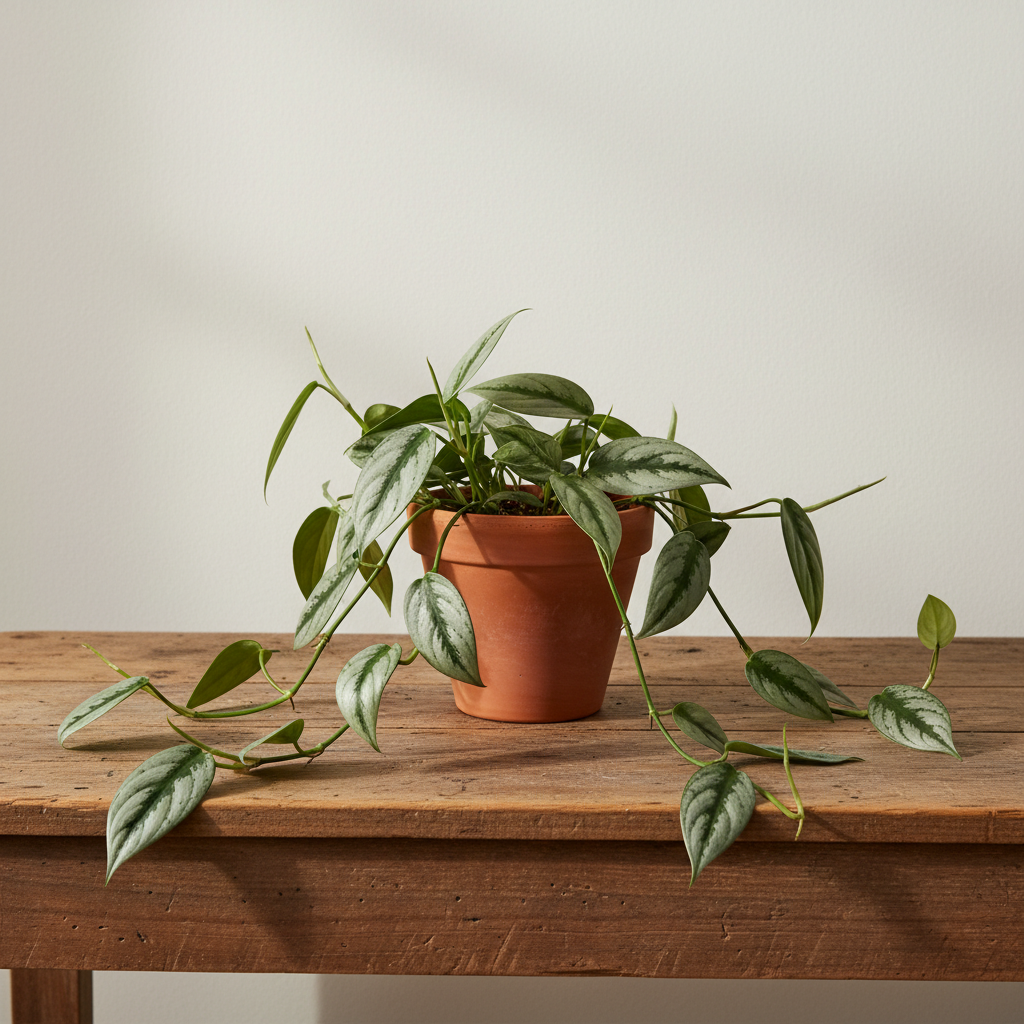
It is worth knowing from the outset that, like all members of the arum family, the silver satin plant is toxic if eaten. Its sap contains insoluble calcium oxalate crystals that cause painful irritation and swelling of the mouth and throat in pets and people alike. The plant poses no danger sitting on a shelf, but households with curious cats, dogs or small children should place it where idle nibbling is not an option.
Light
Medium to bright indirect light is the sweet spot for the silver satin plant. In the wild it grows beneath a forest canopy, threading up tree trunks through filtered, shifting light, and it carries that tolerance for shade indoors. This makes it one of the better choices for a position a metre or two back from a window, or beside a north-facing aspect that would leave a sun-lover starved. In good indirect light the leaves hold their dense silvering and the plant produces compact, well-spaced growth.
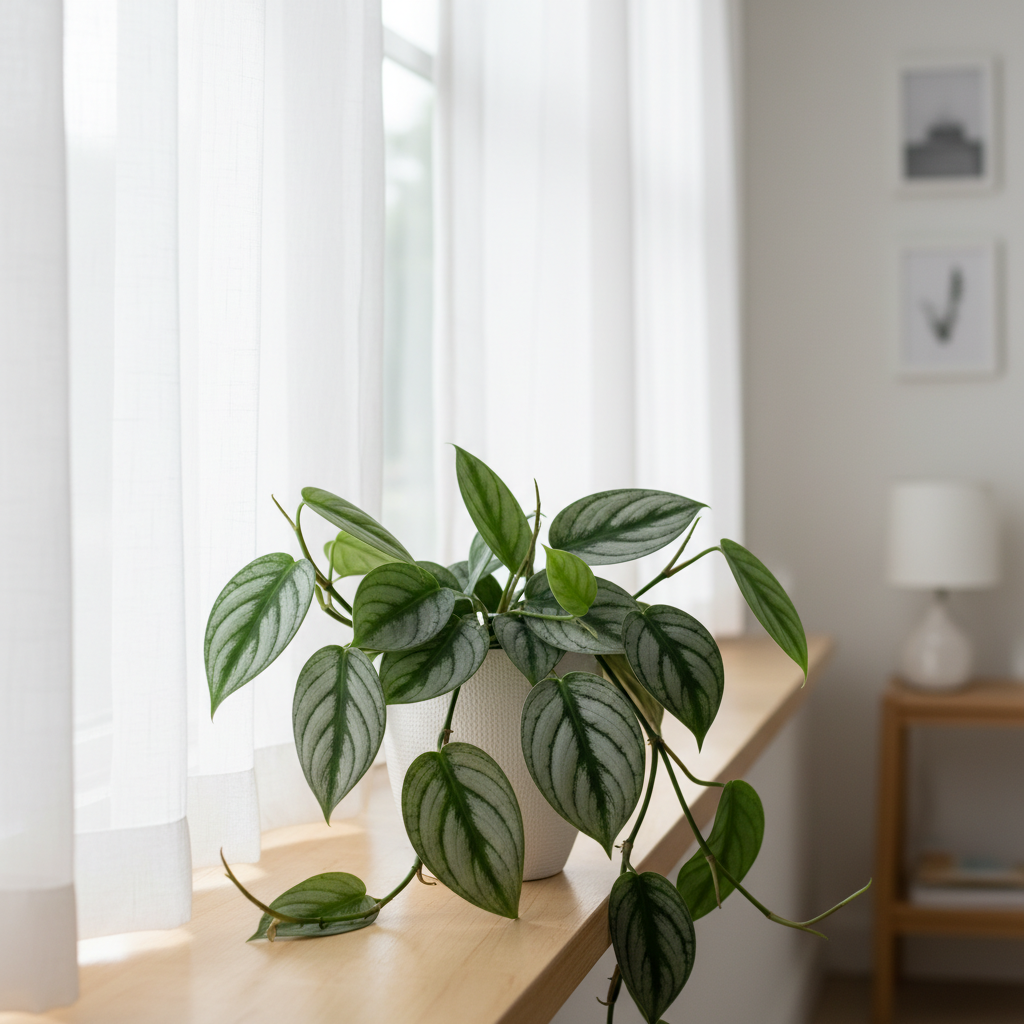
The two extremes to avoid are harsh direct sun and deep gloom. Direct midday sunlight falling on the leaves will scorch them, bleaching the silver to a washed-out beige and leaving dry brown patches that never recover. Too little light, on the other hand, brings its own slow decline: the stems stretch and grow leggy as they reach for brightness, the gaps between leaves widen, and the striking silver variegation fades back towards plain green as the plant tries to maximise its chlorophyll. If your home is genuinely dim, the plant will persist, but a position with more ambient light, or a modest grow light, will transform it.
Pro Tip — Chase the silver: If the new leaves are emerging greener and less silvery than the old ones, the plant is telling you it wants more light. Move it somewhere brighter, though still out of direct sun, and the variegation on fresh growth will return.
Watering
Watering is the one area where the silver satin plant is most often killed with kindness. Those thick, semi-succulent leaves store moisture, so the plant is far happier slightly too dry than slightly too wet. The reliable rule is to water only when the top half of the pot has dried out, then to water thoroughly until it runs from the drainage holes, and to tip away anything that collects in the saucer. In practice this usually means watering every week to ten days in the growing season and considerably less in winter.
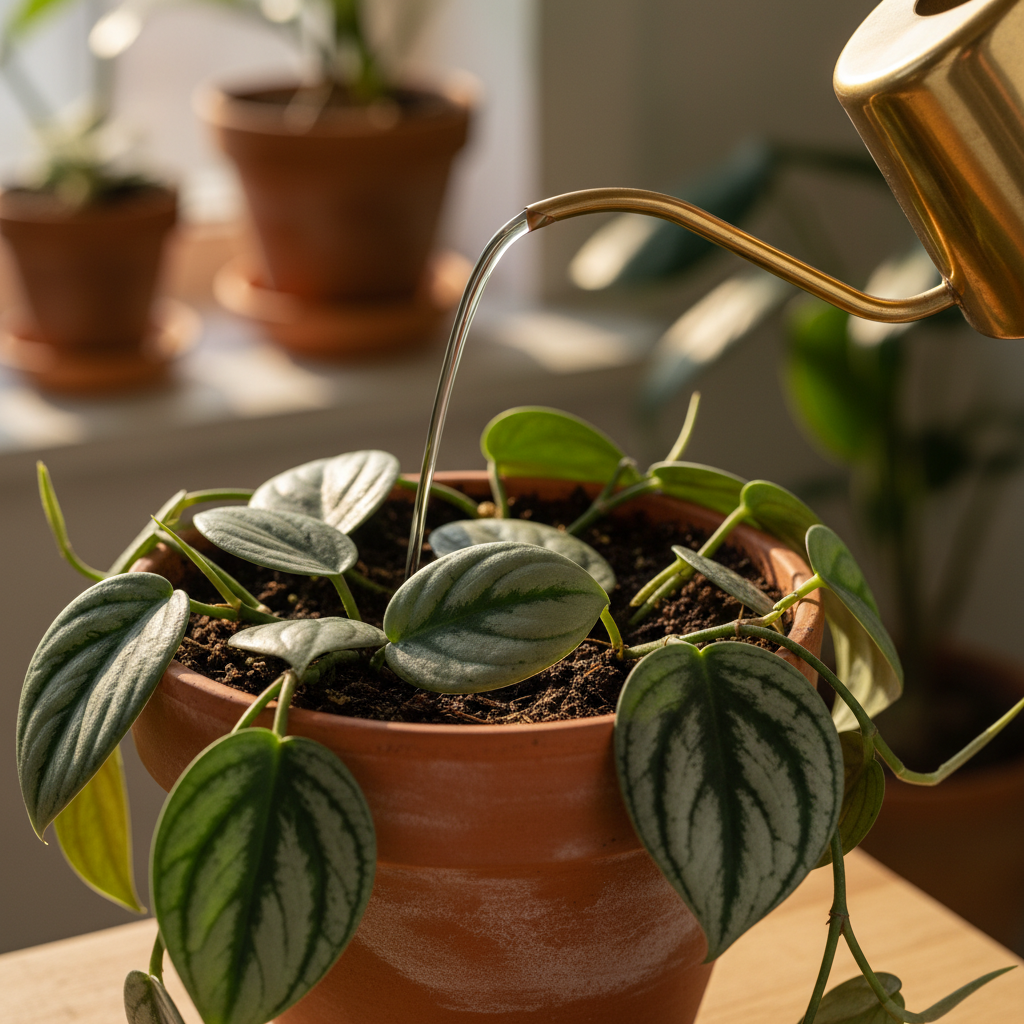
The danger to watch for is overwatering, which leads to root rot. The early warning signs are yellowing leaves, often several at once, and a soft, mushy feel to the lower stems, sometimes accompanied by a sour smell from the soil. If you suspect rot, lift the plant from its pot, trim away any blackened, slimy roots, and repot into fresh, barely moist mix. Underwatering, by contrast, announces itself more gently: the normally firm leaves curl inward and feel limp or slightly wrinkled, recovering quickly once watered. Because the plant tolerates a degree of thirst so well, when in doubt it is always safer to wait a few more days than to water again too soon.
Warning — Let it dry out: More silver satin plants die from sodden soil than from any other cause. Never leave the pot standing in water, and always check that the top half of the soil is dry with your finger before reaching for the watering can.
Soil and potting
The right soil does half the watering work for you. As an epiphytic climber, Scindapsus treubii wants a loose, airy, fast-draining medium that holds a little moisture while letting the rest run straight through, mimicking the bark and leaf litter its roots cling to in the wild. A dense, water-retentive compost used on its own will stay wet too long and invite the very rot the plant is prone to.
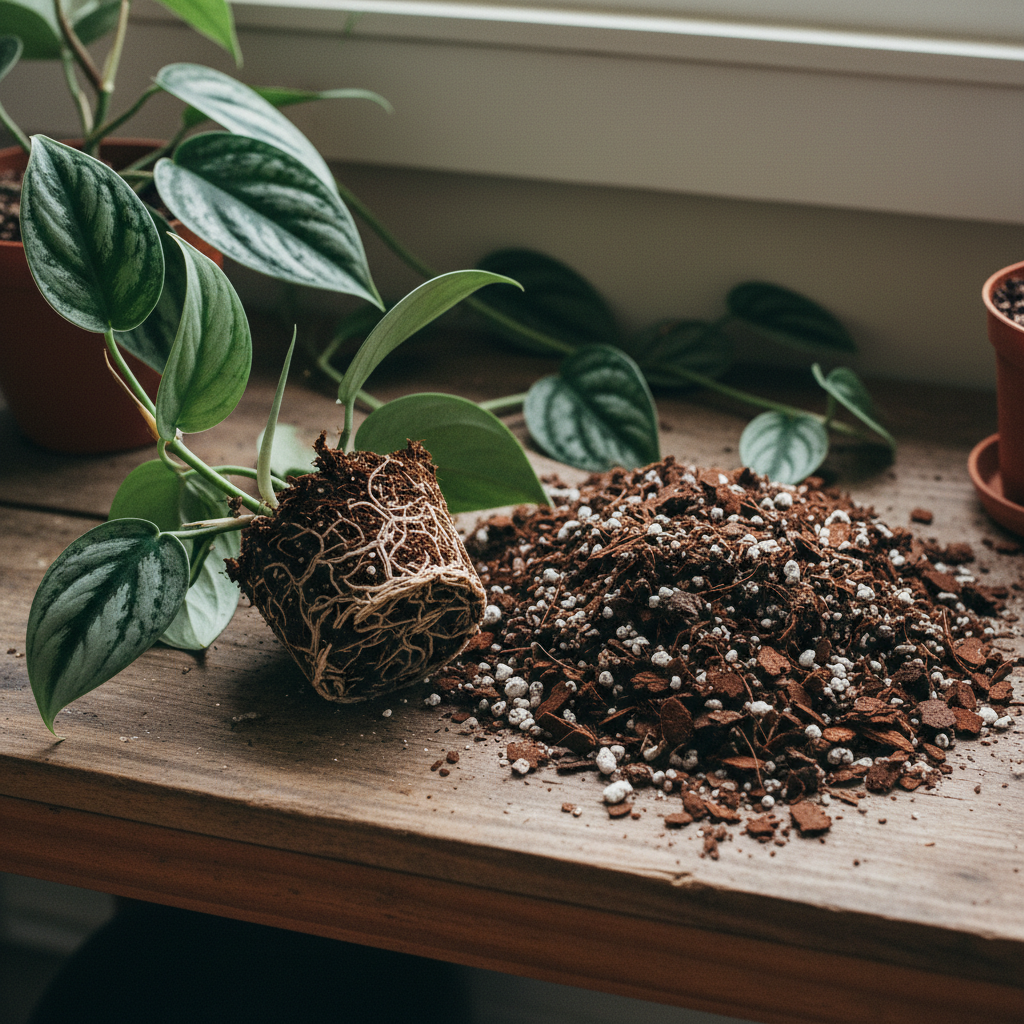
A simple and effective recipe is roughly half general houseplant compost, with the other half made up of orchid bark, perlite and a handful of coco coir or worm castings for a little structure and nutrition. This chunky blend keeps air around the roots and drains readily. Whatever the mix, the pot must have drainage holes; a decorative cover pot is fine provided the plant is never left sitting in collected water. Repotting is needed only every two to three years, since this is a slow grower that is quite content to be a little root-bound. Move it up just one pot size when the roots fill the container, ideally in spring, and refresh the top layer of mix in the intervening years.
Fertilising
The silver satin plant is a light feeder, in keeping with its slow, steady pace. It does not need heavy fertilising to do well, but a modest feed through the growing season supports healthy new leaves and keeps the variegation strong. The simplest approach is a balanced liquid houseplant fertiliser, diluted to half the recommended strength, applied roughly once a month from spring through to early autumn.
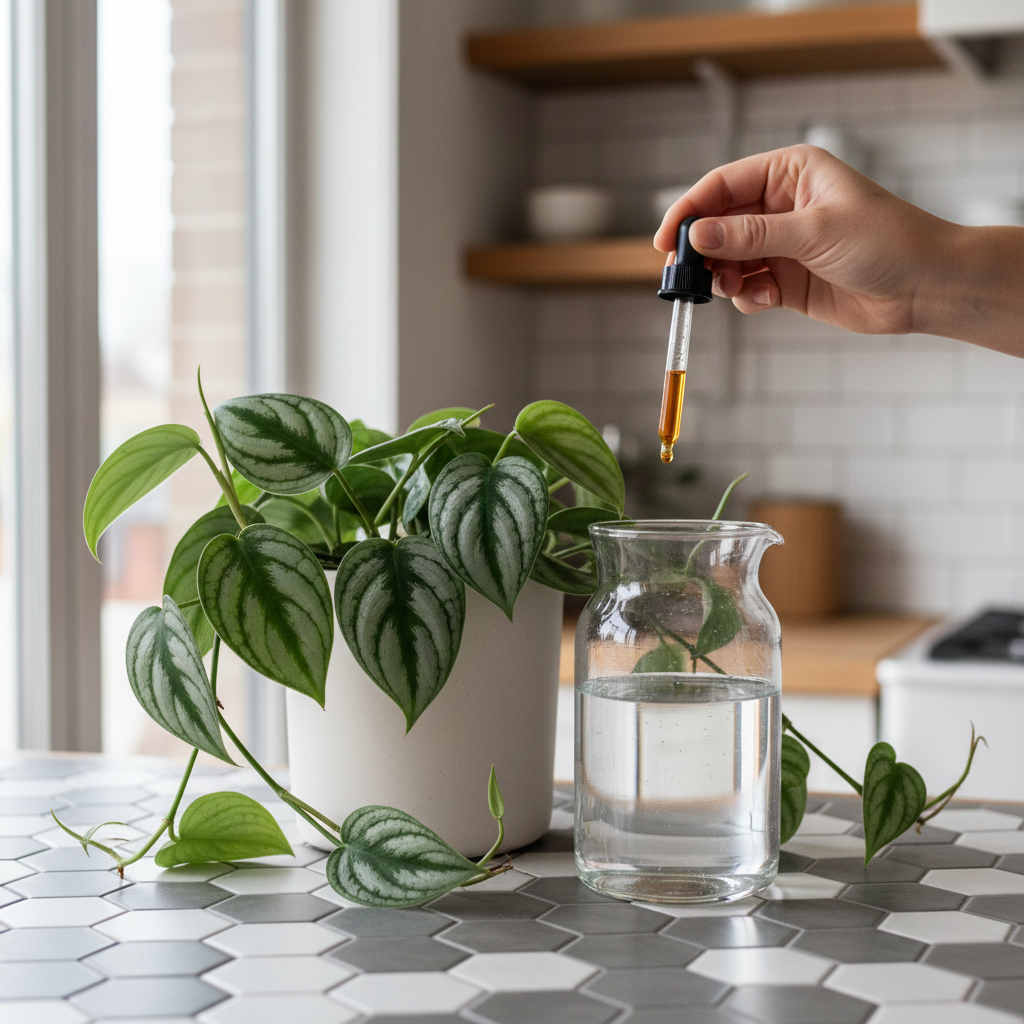
Through autumn and winter, when growth naturally slows or stops, feeding should be paused altogether, as fertilising a resting plant simply allows unused salts to build up in the soil. Those mineral salts are the main risk with any feeding regime: too much fertiliser, or feeding a dry root ball, scorches the roots and shows as brown, crispy leaf edges. To avoid this, always water lightly before feeding so the roots are never exposed to concentrated solution, and flush the pot thoroughly with plain water every few months to wash away any accumulated residue. As with watering, restraint serves this plant better than generosity.
Propagation
Propagating the silver satin plant is straightforward and uses the same stem-cutting method that works for most trailing aroids. The key is the node, the small bump on the stem where a leaf meets it and from which new roots emerge. A cutting must include at least one node to have any chance of rooting, and ideally two or three leaves to sustain it while it does.
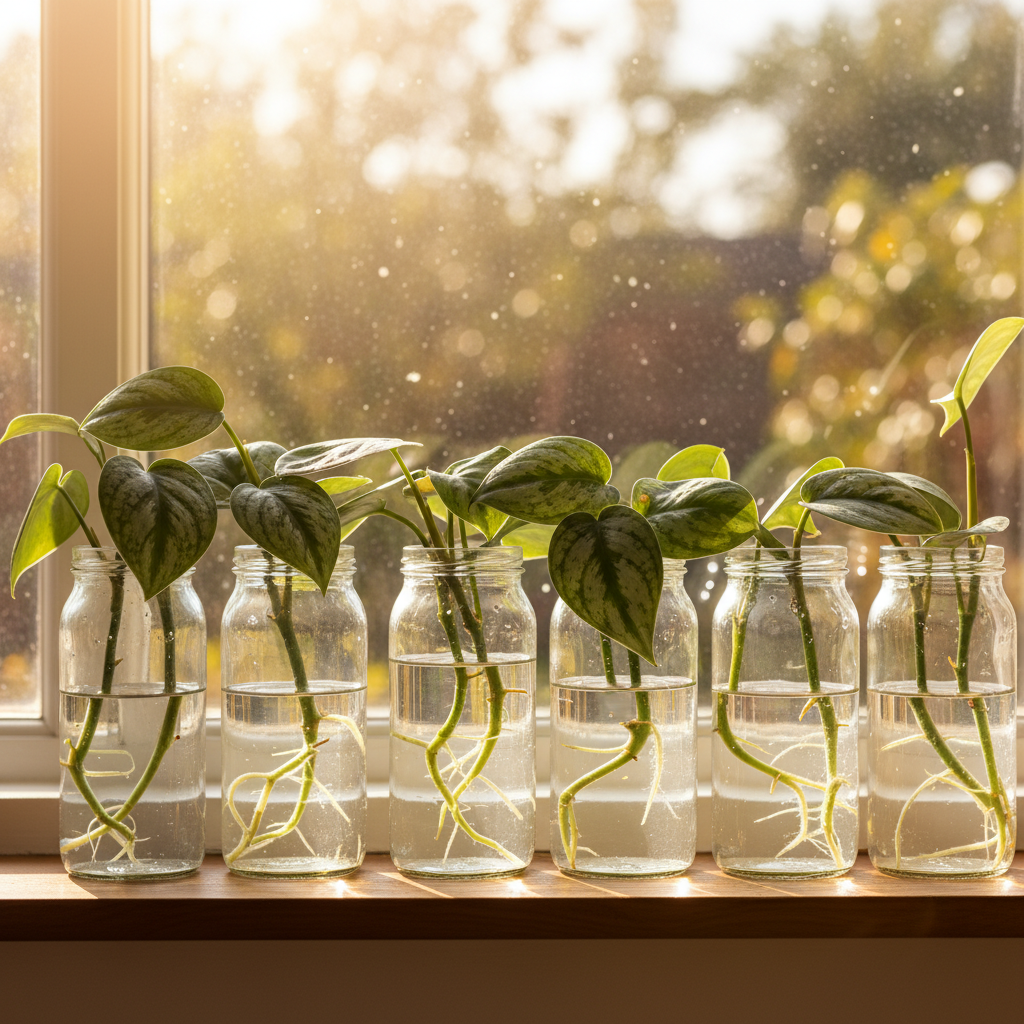
To propagate in water, follow these steps:
- Using clean, sharp scissors, cut a healthy length of stem just below a node, ensuring the cutting carries at least one node and two or three leaves.
- Remove the lowest leaf so that the bare node will sit beneath the water line, as it is the node, not the leaf, that produces roots.
- Place the cutting in a glass of room-temperature water in a warm, bright spot out of direct sun, and refresh the water every few days to keep it clear and oxygenated.
- Wait for roots to appear, which usually takes three to six weeks; this plant roots more slowly than a pothos, so patience is essential.
- Once the roots are 3 to 5 centimetres (1 to 2 inches) long, pot the cutting up into a small container of moist aroid mix and keep it slightly more humid than usual while it settles.
Cuttings can also be started directly in damp sphagnum moss or potting mix, which often produces sturdier roots better adapted to soil, at the cost of being unable to watch their progress. Either way, spring and summer are the best times to propagate, when the warmth and longer days spur the cutting into faster growth.
Pests and problems
The silver satin plant is robust and not especially prone to pests, but no houseplant is immune. The usual offenders indoors are spider mites, mealybugs and scale. Spider mites favour warm, dry air and betray themselves with fine webbing and faint pale stippling on the leaves; raising humidity discourages them. Mealybugs appear as small white cottony tufts tucked into leaf joints, while scale shows as tiny immobile brown bumps along the stems and leaf undersides.
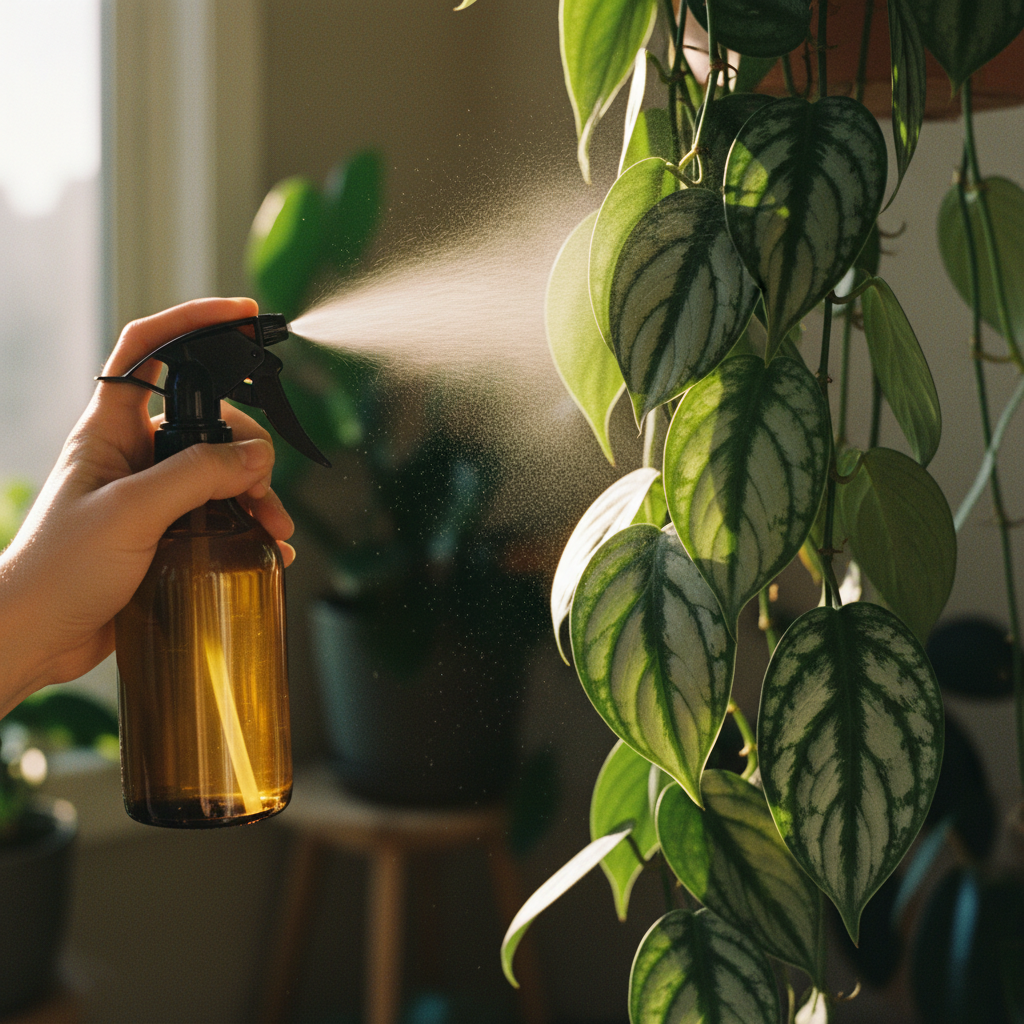
At the first sign of any of these, isolate the plant from its neighbours and wipe the leaves down, dabbing visible mealybugs and scale with a cotton bud dipped in diluted isopropyl alcohol. Follow up with a thorough application of neem oil or insecticidal soap, covering the undersides of the leaves where pests congregate, and repeat weekly until no trace remains. The most common troubles, though, are not pests at all but symptoms of care. Yellowing leaves usually mean overwatering, brown crispy edges point to dry air or fertiliser salt build-up, faded variegation signals insufficient light, and leggy, sparse stems indicate the plant needs to be brighter. Reading these signals and adjusting accordingly will keep the plant in good order far more reliably than any spray.
Varieties
Although Scindapsus treubii is less varied than the closely related Scindapsus pictus, it is grown in two strikingly different forms that sit at opposite ends of the colour spectrum. Both share the same thick leaves and easy temperament, differing only in colouring, so the choice between them is purely a matter of taste.
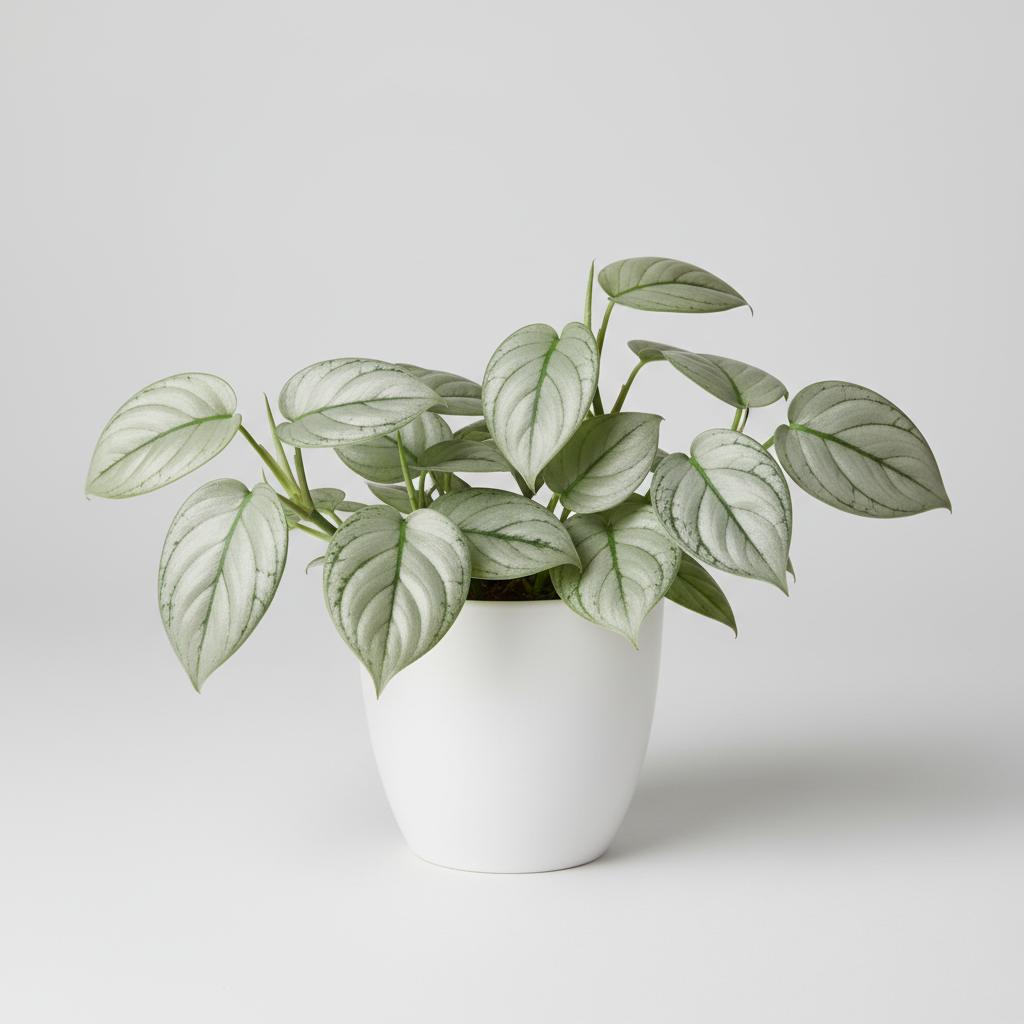
‘Moonlight’ is the pale, luminous form, its ovate leaves washed almost entirely in shimmering silver with only a faint green midrib showing through. It is the most widely available variety and the one most people picture when they think of the silver satin plant, prized for the way it brightens a shaded corner.
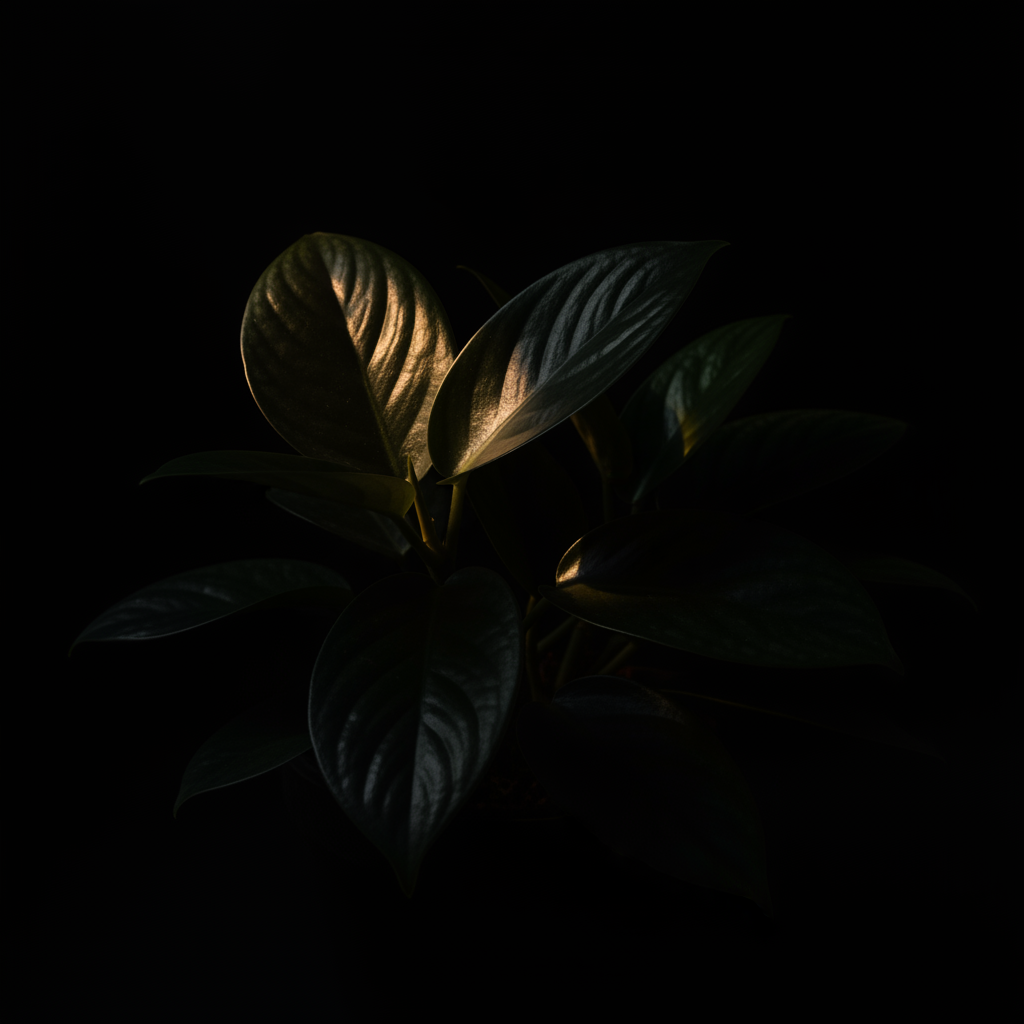
‘Dark Form’ is the dramatic opposite, with deep blackish-green leaves that carry only a subtle satiny sheen rather than overt silver. Sometimes sold as ‘Black’ or ‘Mystique’, it is rarer and more sought after, lending a moody, sculptural quality that contrasts beautifully against pale walls and lighter foliage.
Frequently asked questions
Is the silver satin plant the same as a pothos?
No, though they are often confused and are loosely related. The silver satin plant is Scindapsus treubii, while pothos is Epipremnum aureum. The silver satin has thicker, stiffer, more silvered leaves and grows considerably more slowly, but its care is very similar, which is why the two are frequently mistaken for one another.
Why is my silver satin plant losing its silver colour?
Fading variegation is almost always a sign of too little light. In dim conditions the plant produces more chlorophyll to compensate, so new leaves emerge greener. Move it to a brighter spot with plenty of indirect light, keeping it out of direct sun, and fresh growth will regain its silvering.
How often should I water it?
Water only when the top half of the soil has dried out, which typically falls every week to ten days in spring and summer and less often in winter. The thick leaves store water well, so this plant copes far better with being slightly dry than with sitting in wet soil.
Why are the leaves turning yellow?
Several yellow leaves at once usually point to overwatering. Check that the soil is draining freely and that the pot is not standing in water, and allow the top half of the mix to dry before watering again. An occasional old leaf yellowing and dropping at the base, however, is perfectly normal.
Is it safe for cats and dogs?
No. Like all aroids, Scindapsus treubii contains calcium oxalate crystals that are toxic if chewed or swallowed, causing oral irritation, drooling and vomiting in pets. Keep it out of reach of animals and children, for example on a high shelf or in a hanging pot.
Why is my plant growing so slowly?
Slow growth is normal for this species; it is naturally far more measured than a pothos. You can encourage faster, larger growth by giving it brighter indirect light, training it up a moss pole to climb, and feeding lightly through the growing season, but a degree of patience is simply part of keeping this plant.






