
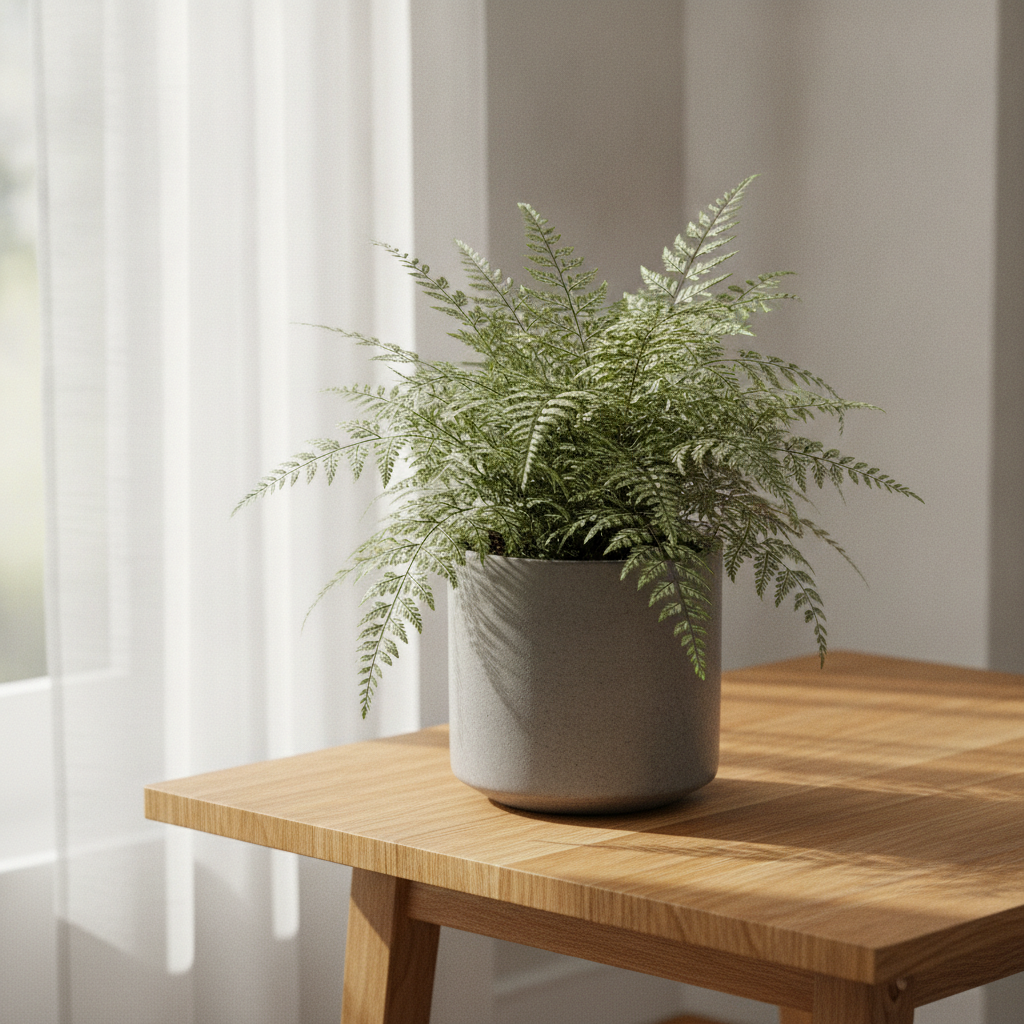
Few small ferns earn a second glance the way the silver lace fern does. Known botanically as Pteris ensiformis, it belongs to the brake or table ferns of the family Pteridaceae and is grown for the cool metallic stripe that runs down the centre of each narrow, finely divided frond. The species is native across a broad sweep of the tropics and subtropics, from southern China and the Himalayan foothills through South East Asia to northern Australia and Polynesia, where it grows on shaded banks, along stream margins and in the dappled understorey of warm forests. In cultivation it stays compact, usually reaching 30 to 45 centimetres (12 to 18 inches), which makes it a natural fit for terrariums, bathroom shelves and tabletop groupings rather than the floor-standing role its larger cousins play.
The silver lace fern carries a reputation for being temperamental, and that reputation is only half deserved. It is not a difficult plant in the sense of needing rare conditions, but it is an honest one: it will tell you immediately, through crisping pinnae and a collapsing centre, when the air is too dry or the soil has swung to either extreme. Keeping it alive is straightforward once you understand that it never wants to be bone dry and never wants to sit in water. Helping it truly thrive, with dense fresh fronds and bright silver markings, asks for a little more attention to humidity, light quality and water. This guide walks through every part of that care in turn, so you can move your fern from merely surviving to genuinely flourishing.
Contents
- Quick Reference
- Why Silver Lace Fern Makes a Rewarding Houseplant
- Light Requirements
- Watering & Humidity
- Soil, Potting & Repotting
- Fertilising
- Propagation
- Pests & Diseases
- Popular Varieties
- Frequently Asked Questions
Quick Reference: Silver Lace Fern at a Glance
| Light | Bright indirect light to light shade; no direct midday sun |
| Watering | Keep evenly moist at all times; never allow the rootball to dry out fully |
| Temperature | 16 to 24 degrees Celsius (61 to 75 degrees Fahrenheit); avoid cold draughts below 13 degrees Celsius (55 degrees Fahrenheit) |
| Humidity | High, ideally 60 percent or above; struggles below 40 percent |
| Fertiliser | Half-strength balanced feed every 4 to 6 weeks in spring and summer |
| Toxicity | Non-toxic to cats, dogs and humans |
Why Silver Lace Fern Makes a Rewarding Houseplant
The first thing that draws people to Pteris ensiformis is the variegation. Unlike the uniform green of most ferns, the silver lace fern produces fronds split into slender pinnae, each one bisected by a band of silvery-white tissue that catches the light and gives the whole plant a frosted, almost luminous appearance. That colouring is genuinely useful indoors, because it brightens the shaded corners where ferns are often placed and reads well against both pale Scandinavian interiors and darker, more layered planting schemes. The plant also has an appealing dimorphism: shorter, broader sterile fronds form the silvered base of the clump, while taller, narrower fertile fronds rise above them carrying the spores, so a healthy specimen has a pleasing two-tier structure.

Beyond looks, the silver lace fern is genuinely safe to live with. It is not listed as toxic to cats, dogs or people, which sets it apart from many popular foliage plants and makes it a sensible choice for households with curious pets or small children. It stays small enough to suit a windowsill, a bathroom shelf or a closed terrarium, and it pairs beautifully with other humidity-loving plants such as nerve plants, mosses and small calatheas. The honest trade-off is its thirst: this is not a plant you can forget for a fortnight. If you travel often or tend to underwater, you will find it more demanding than a pothos or a snake plant. For anyone willing to keep its compost reliably damp and its air reasonably humid, though, it returns the effort with one of the most refined leaf displays available in a plant this size.
Important — Toxicity: The silver lace fern is considered non-toxic to cats, dogs and humans, and true ferns in general are among the safer houseplants for pet owners. Even so, nibbling on any houseplant can cause mild stomach upset in animals, so it is still wise to discourage chewing and to keep fertiliser and pest treatments out of reach.
Light Requirements
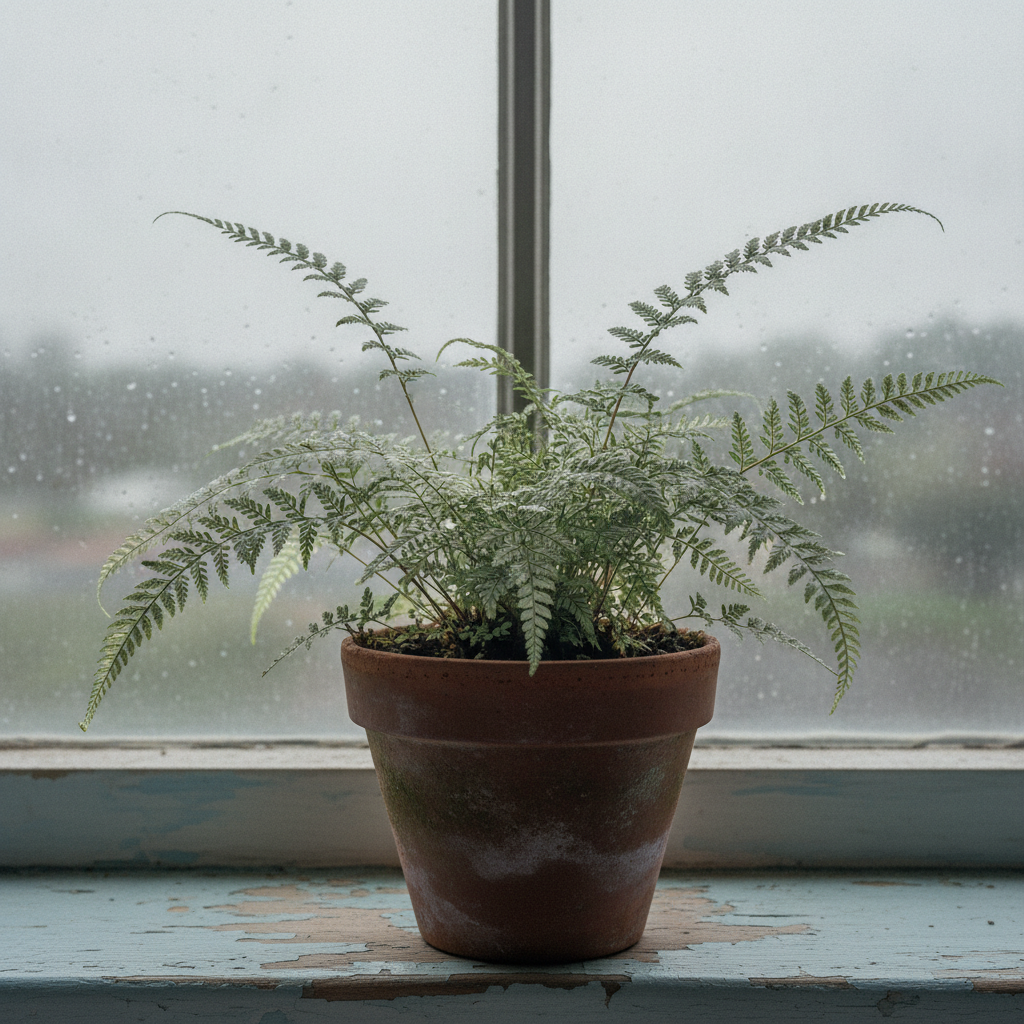
In its native habitat the silver lace fern grows on shaded forest banks and beneath taller vegetation, so the light it receives in the wild is filtered, indirect and rarely harsh. Recreating that indoors means aiming for bright but diffused light, the kind found a little back from a window or directly beside one that does not catch the full midday sun. Under these conditions the fronds stay compact, the silver variegation holds its contrast, and new growth emerges steadily through the warmer months.
The ideal spot delivers several hours of gentle, indirect brightness each day without any scorching beam falling across the leaves. A position two to three metres from a large south or west window, or right on the sill of a north or east window, usually suits it well. Because the plant is small, it is easy to fine-tune: if the fronds look pale and stretched, move it closer to the light, and if the tips brown or the colour bleaches, pull it back into softer shade.
Light Levels Explained
Indoor light is far dimmer than most people assume, and ferns sit firmly in the middle of the brightness scale: they want more than the gloom of an interior wall but far less than the glare a succulent enjoys. The table below translates common descriptions into approximate light levels and the outcome you can expect for a silver lace fern in each.
| Light Category | Approx. Level | Typical Location | Outcome |
|---|---|---|---|
| Direct sun | 20,000 lux and above | On a south sill in full sun | Scorched, bleached and crisping fronds |
| Bright indirect | 10,000 to 20,000 lux | Beside an east or north window | Ideal: dense growth, strong silver contrast |
| Medium | 5,000 to 10,000 lux | A metre or two back from a bright window | Good, slightly slower growth |
| Low | 1,000 to 5,000 lux | Interior corner away from windows | Tolerated briefly; thin, pale fronds over time |
| Very low | Below 1,000 lux | Hallway or windowless room | Decline, leaf loss, eventual death |
Window Orientation and Placement
South-facing window: The brightest and potentially harshest exposure. A silver lace fern can grow near a south window only if it is set well back or shielded by a sheer curtain, because direct southern sun will quickly scorch the delicate pinnae.
East-facing window: Often the sweet spot. Gentle morning sun followed by bright indirect light for the rest of the day gives the fern the brightness it wants without the heat that damages it.
West-facing window: Workable with care. The strong afternoon light can be too intense directly on the sill, so position the plant slightly to one side or a short distance back from the glass.
North-facing window: Reliable and forgiving. The cool, even light of a north window rarely scorches and suits a fern perfectly, provided the room is not so dim that growth stalls.
Pro Tip — Rotate for Even Growth: Ferns lean gently towards their light source over time. Give the pot a quarter turn each week so the clump fills out evenly on all sides rather than thinning on the shaded back.
How Light Affects Variegation
The silver banding that gives this fern its name is at its brightest in good indirect light. In light that is too low, fronds tend to grow longer, thinner and greener as the plant stretches to find brightness, and the silver contrast fades. In light that is too strong, the opposite problem appears: the variegated tissue, which has less protective pigment than the green, bleaches and browns first because it is the most vulnerable part of the leaf. The clearest, most silvery fronds therefore come from a steady, moderately bright position rather than from pushing the plant towards either extreme.
Warning — Direct Sunlight: Even an hour of direct midday sun on the foliage can permanently scorch a silver lace fern, leaving crisp brown patches that will not recover. If you see pale, dry blotches appearing on the upper fronds, move the plant out of the sun immediately and trim the worst-affected leaves.
Artificial Lighting
Because its light needs are moderate, the silver lace fern adapts readily to artificial lighting and does well under a full-spectrum LED grow light in a room with little natural daylight. A modest fixture positioned 30 to 45 centimetres (12 to 18 inches) above the plant and run for ten to twelve hours a day provides ample energy. This makes the fern a strong candidate for closed terrariums and plant cabinets, where controlled lighting and naturally high humidity combine to keep it in near-perfect condition year round.
Seasonal Adjustments
Light intensity indoors drops sharply through autumn and winter, and a position that was ideal in summer can become too dim by December. As the days shorten, move the fern a little closer to its window to compensate, then ease it back again in spring when the sun strengthens. Watch the new fronds as your guide: pale, widely spaced growth signals too little light, while bleaching at the leaf edges signals too much.
Watering & Humidity
Watering is where the silver lace fern is most particular, and where most failures occur. Unlike succulents or many tropical aroids, this fern has fine roots and a low tolerance for drought, so the compost should stay consistently and evenly moist, never drying out completely and never staying waterlogged. Think of the texture of a wrung-out sponge as the target: damp throughout, but with no standing water in the saucer. Get this balance right and the rest of the plant tends to look after itself.
When to Water
Check the compost every couple of days by pressing a finger into the top centimetre or so. When the very surface begins to feel slightly less wet, it is time to water again; you should not wait for the soil to dry out the way you would with a hardier plant. In a warm, bright room this often means watering two or three times a week in summer, easing to perhaps once a week in winter when growth slows and evaporation drops.
The exact frequency depends on your conditions rather than the calendar. Pot size, light, temperature and humidity all change how fast the compost dries, so let the feel of the soil lead you instead of a fixed schedule. A small terracotta pot in a sunny, heated room may need water every other day, while the same fern in a glazed pot in a cool bathroom might be happy with twice a week. The goal in every case is the same: never bone dry, never sitting in water.
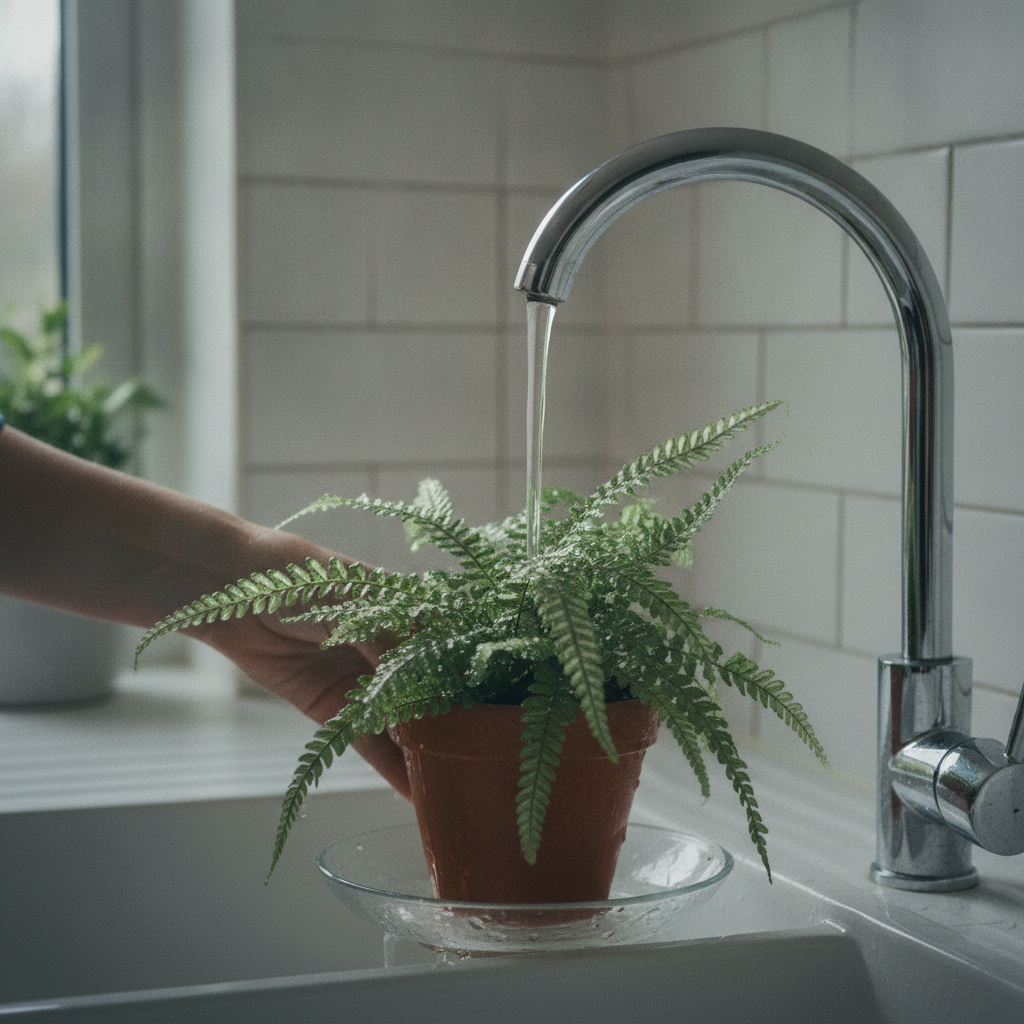
Pro Tip — Bottom Watering: Because the crown of a fern can rot if it stays wet, watering from below is a tidy solution. Stand the pot in 2 to 3 centimetres (1 inch) of water for ten to fifteen minutes, let the compost wick moisture up to the surface, then drain off whatever remains. This keeps the rootball evenly damp without splashing the centre of the clump.
How to Water Correctly
- Check the top centimetre of compost and water as soon as it starts to feel less than fully damp.
- Use room-temperature water, ideally rainwater, filtered or left to stand, to avoid chilling the roots.
- Water gently around the base of the plant, or stand the pot in a shallow tray to draw moisture up from below.
- Continue until water runs freely from the drainage holes, ensuring the whole rootball is wetted.
- Let the pot drain completely and never leave it standing in a full saucer.
- Tip away any water that collects in the saucer or outer cover pot within a few minutes.
Signs of Overwatering vs. Underwatering
| Symptom | Overwatering | Underwatering |
|---|---|---|
| Leaf colour | Yellowing fronds, often from the base | Fronds fade and turn straw-brown |
| Leaf texture | Soft, limp, sometimes blackening | Dry, crisp and brittle to the touch |
| Soil | Constantly wet, sour-smelling | Pulls away from the pot edge, dust-dry |
| Roots | Brown, mushy and foul-smelling | Dry and wiry but generally intact |
| Crown | Rotting and collapsing at the centre | Whole clump wilts and shrivels evenly |
Warning — Root Rot: A waterlogged silver lace fern can rot from the roots up within days, and the damage is often invisible until the fronds suddenly collapse. If the compost smells sour and the base is blackening, unpot the plant at once, cut away any soft brown roots, and repot into fresh, free-draining mix. Persistent sogginess is far more dangerous to this fern than a brief dry spell.
Humidity Requirements
If watering is the silver lace fern’s first demand, humidity is its second. As a tropical forest plant it expects moist air, ideally 60 percent relative humidity or higher, and it struggles in the dry atmosphere of a centrally heated room, where levels can fall below 40 percent. Low humidity is the usual culprit behind the crispy brown frond tips that frustrate so many fern growers.
The earliest sign of air that is too dry is browning along the delicate edges and tips of the pinnae, followed by a general thinning of the clump as fronds give up. Because the leaves are so finely divided, they lose moisture quickly and show stress sooner than thicker-leaved plants, which makes the fern a useful early warning for the overall humidity of a room.
Raising humidity is the single most effective thing you can do for this plant. Grouping it with other plants, standing it on a wide tray of damp pebbles, or running a small room humidifier nearby all help, and a humidifier is by far the most reliable. Bathrooms and kitchens with good light are natural homes for it, and a glass terrarium or cloche creates a near-perfect microclimate. Misting offers only a brief lift and can encourage fungal spotting if the fronds stay wet, so treat it as a minor supplement rather than a real solution.
Water Quality
Silver lace ferns are moderately sensitive to the minerals and chemicals in tap water, and a build-up of fluoride and salts can contribute to browning leaf tips over time. Where your water is hard or heavily treated, switching to rainwater, distilled or filtered water makes a noticeable difference. If only tap water is available, letting it stand uncovered overnight allows some chlorine to dissipate and brings it to room temperature, both of which the fine roots appreciate.
Soil, Potting & Repotting
The right compost for a silver lace fern threads a careful needle: it must hold enough moisture to keep those fine roots permanently damp, yet drain freely enough that water never pools and starves them of air. A dense, water-retentive potting soil on its own will stay too wet and invite rot, while a gritty cactus mix will dry out far too fast. The answer is an open, organic-rich blend that stays moist but breathes.
Ideal Soil Composition
A good starting point is a peat-free houseplant compost lightened with perlite for drainage and enriched with leaf mould or fine bark and a little coir to hold moisture. The aim is a springy, humus-rich medium that feels open in the hand but does not shed water instantly. The table below shows a reliable blend.
| Component | Proportion | Function |
|---|---|---|
| Peat-free houseplant compost | 50 percent | Holds moisture and supplies nutrients |
| Perlite or fine grit | 20 percent | Opens the mix and prevents waterlogging |
| Coco coir | 20 percent | Retains even moisture without compacting |
| Leaf mould or fine bark | 10 percent | Adds structure and organic richness |
The silver lace fern prefers a slightly acidic to neutral root zone, roughly pH 5.5 to 7.0, which most peat-free houseplant composts naturally fall within. There is no need to test or adjust pH in normal conditions; simply avoid adding lime or alkaline materials, and refresh the compost every year or two so it does not become sour or depleted.
Pro Tip — Quick Mix Recipe: For a fast, forgiving blend, combine two handfuls of peat-free houseplant compost, one handful of coco coir and one handful of perlite. This holds moisture for a thirsty fern while still draining well enough to protect the roots.
Choosing the Right Pot
Because this fern likes constant moisture, pot choice has a real effect on how often you will need to water and how safe the roots stay between waterings. The right container balances moisture retention against drainage and gives the compact rootball room without drowning it in excess compost.
Drainage holes are non-negotiable. Whatever pot you choose must have holes in the base so surplus water can escape. A decorative cover pot is fine, but only if you lift the inner pot to drain it and never let water collect unseen at the bottom.
Pot material: Plastic and glazed ceramic hold moisture longer and are generally the easier choice for a plant that must not dry out. Unglazed terracotta breathes and wicks water away quickly, which lowers the risk of rot but means you will need to water more often; it suits growers who tend to overwater.
Pot size: Choose a container only slightly larger than the rootball, around 2 to 3 centimetres (1 inch) of extra width. An oversized pot holds a reservoir of wet compost the small roots cannot use, which stays soggy and invites rot.
When to Repot
Silver lace ferns are slow, modest growers and rarely need frequent repotting. Move the plant up a size when you see roots emerging from the drainage holes, when the clump has clearly filled its pot, or when water starts running straight through a congested rootball. For most plants this means repotting every one to two years, ideally in spring as new growth begins. Even when the pot size does not need to change, refreshing the compost every couple of years keeps the medium open and nourishing.
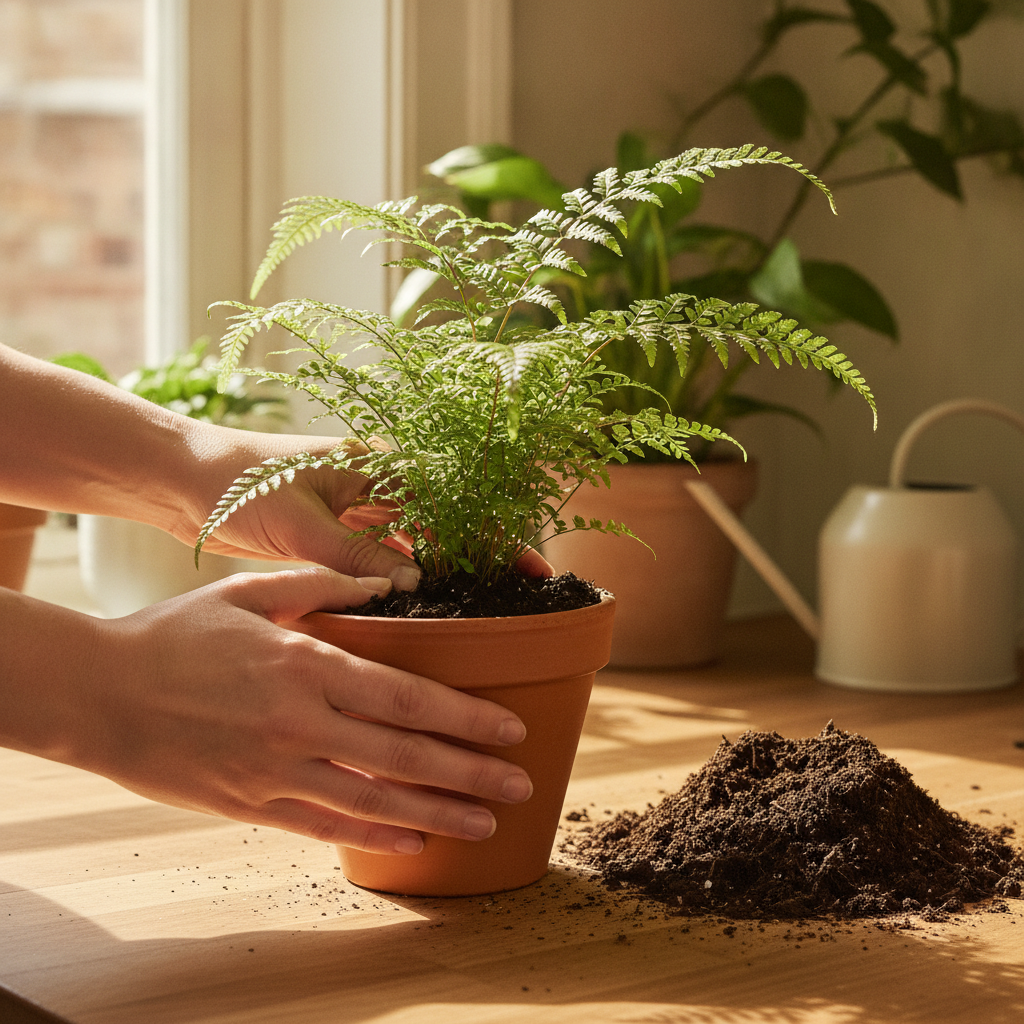
How to Repot: Step-by-Step
- Water the fern a day before repotting so the rootball is hydrated and holds together.
- Ease the plant out of its pot by supporting the crown and gently squeezing the sides; avoid pulling on the fronds.
- Tease away a little of the old compost from the outer roots and check for any soft, brown or rotten sections.
- Part-fill a clean pot, only slightly larger than the last, with fresh moist mix and settle the fern so the crown sits at its original depth.
- Fill in around the rootball with more mix, firming gently so no large air pockets remain, and keep the crown at the surface rather than buried.
- Water thoroughly to settle the compost, then return the plant to bright indirect light and high humidity.
Warning — Transplant Shock: Ferns dislike root disturbance and may droop or drop a few fronds in the week after repotting. Resist the urge to fertilise straight away or to compensate by overwatering; keep the plant warm, humid and evenly moist, and let it settle. Trim only fronds that have fully browned, and new growth should resume within a few weeks.
Fertilising
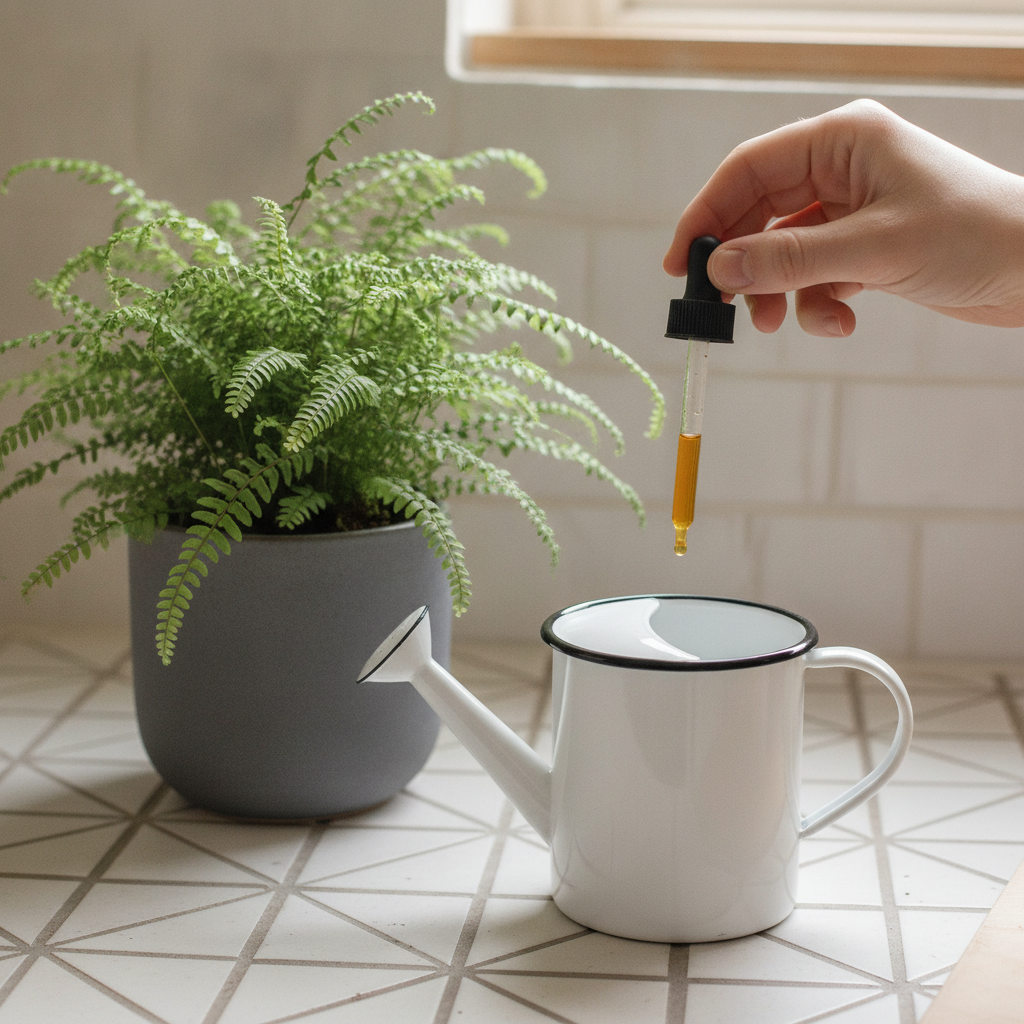
Silver lace ferns are light feeders. In the wild they draw modest nutrition from decaying leaf litter rather than rich soil, so indoors they need only gentle, regular feeding through the growing season and none at all in the depths of winter. Overfeeding does far more harm than underfeeding, because the fine roots are easily burned by concentrated fertiliser salts.
The guiding principle is little and often, always diluted. A balanced liquid houseplant feed applied at half the recommended strength, every four to six weeks from spring through to early autumn, supplies everything the plant needs to push out fresh, well-coloured fronds without risking root damage.
Understanding Plant Nutrients
Fertilisers are labelled with an NPK ratio showing the proportion of nitrogen, phosphorus and potassium they contain, the three nutrients plants use in the largest amounts. For a foliage plant like the silver lace fern a balanced ratio such as 10-10-10, or one slightly higher in nitrogen to support leafy growth, works well. Secondary nutrients and trace elements matter too, and the table below summarises the main ones and the signs of their deficiency.
| Nutrient | Symbol | Primary Function | Deficiency Symptoms |
|---|---|---|---|
| Nitrogen | N | Drives leafy frond growth and green colour | Pale, yellowing, slow-growing fronds |
| Phosphorus | P | Supports root development and energy transfer | Stunted growth, weak roots |
| Potassium | K | Regulates water use and overall vigour | Browning frond edges, general weakness |
| Calcium | Ca | Builds strong cell walls and new growth | Distorted, poorly formed new fronds |
| Magnesium | Mg | Central to chlorophyll and photosynthesis | Yellowing between the veins of older fronds |
| Iron | Fe | Needed for chlorophyll formation | Pale or yellow new growth with green veins |
Types of Fertiliser
Liquid fertilisers: The easiest and safest option for ferns, because they are diluted in water and reach the roots evenly. They give you precise control over strength, which matters for a plant this sensitive, and are simply added to the watering can during the growing season.
Slow-release granular: Coated pellets release nutrients gradually over several months and reduce the risk of forgetting to feed. They are convenient but offer less control, so use them at a reduced rate for ferns to avoid a build-up of salts in the small pot.
Organic fertilisers: Worm castings, diluted seaweed extract and other gentle organic feeds suit ferns well, releasing nutrients slowly and improving the soil as they break down. They are very hard to overdo, which makes them a forgiving choice for cautious growers.
Feeding Schedule
Feed from spring to early autumn, when the plant is actively producing new fronds, and stop entirely through late autumn and winter while growth is dormant. A diluted liquid feed every four to six weeks during the growing season is plenty. A newly repotted fern needs no fertiliser for the first couple of months, as fresh compost already carries enough nutrition to see it through.
Pro Tip — Always Feed Half Strength: The roots of a silver lace fern burn easily, so dilute any liquid feed to half the label rate. With fertiliser for this plant, less truly is more: a weak feed given regularly outperforms a strong one that scorches the roots.
How to Fertilise
- Dilute a balanced liquid houseplant feed to half the recommended strength in room-temperature water.
- Water the plant with plain water first if the compost is dry, so the feed never hits parched roots.
- Apply the diluted feed evenly to the damp compost, avoiding splashing it onto the fronds.
- Let any excess drain away and empty the saucer, then return the plant to its spot.
Warning — Salt Build-Up: Over time fertiliser salts accumulate in the compost and show as a white crust on the soil or pot and as browning frond tips. Flush the pot thoroughly with plain water every few months, letting it run freely through the drainage holes, to wash these salts away and protect the roots.
Propagation
Silver lace ferns cannot be grown from leaf or stem cuttings the way many houseplants can, because ferns do not form the nodes and dormant buds that cuttings rely on. Instead they are propagated either by dividing an established clump or, for the more adventurous, by sowing the dust-fine spores that fertile fronds produce. Division is by far the simpler and more reliable route for the home grower.
The best time to propagate is in spring, just as the plant moves into active growth, which gives the divisions or sporelings the longest possible run of warm, bright conditions to establish before winter. Whichever method you choose, patience and humidity are the keys to success.
Understanding the Rhizome and Crown
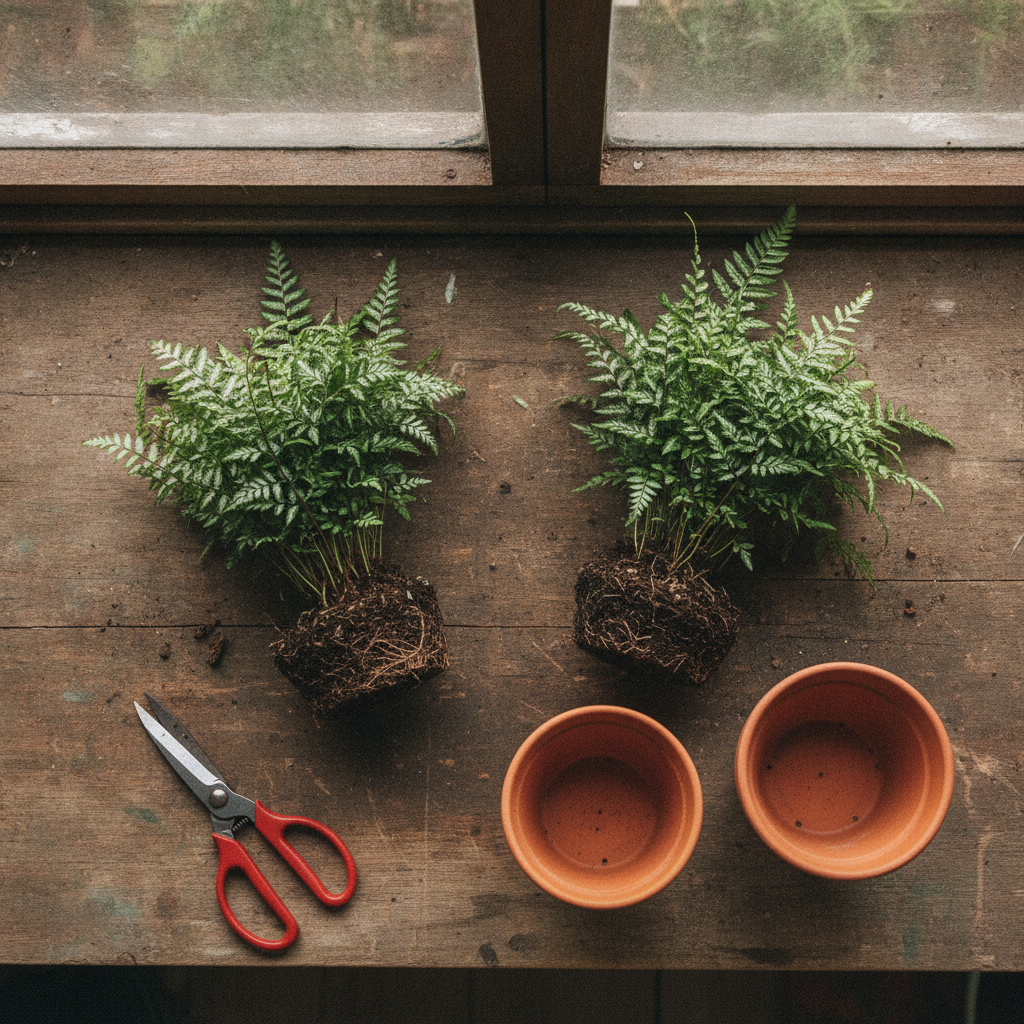
A silver lace fern grows from a short, branching rhizome at soil level, from which both the roots and the fronds emerge. As the plant matures, this rhizome produces several distinct crowns or growing points, each capable of becoming a separate plant. Recognising these natural divisions is the whole secret to propagating by division: rather than tearing the plant apart at random, you are simply separating clumps that have already formed their own roots and shoots.
Division: Step-by-Step
Division is the quickest way to make new plants and gives you instant, established ferns rather than tiny seedlings. Choose a healthy, pot-filling specimen with several visible crowns, and work gently to keep as many roots intact as possible.
- Water the fern the day before so the rootball is hydrated and holds together during the process.
- Slide the plant out of its pot and gently brush away enough compost to see the separate crowns and their roots.
- Tease the clump apart with your fingers into two or three sections, each with its own roots and a good fan of fronds; use a clean, sharp knife only if the rhizome will not separate by hand.
- Pot each division into its own small container of fresh, moist fern mix, setting the crown level with the surface.
- Water well, then place the new plants somewhere warm, bright and humid, out of direct sun.
- Keep the compost evenly moist and expect a little wilting at first while the divisions settle and root in.
Pro Tip — Cover for Humidity: Freshly divided ferns lose water faster than their disturbed roots can replace it, so the first fortnight is the riskiest. Slip a clear plastic bag or propagation dome over each new plant, opening it daily for fresh air, to hold humidity high while the roots recover.
Spore Propagation: Step-by-Step
Growing ferns from spores is slow and demands patience, but it is deeply rewarding and the only way to raise large numbers at once. The fertile fronds carry their spores in brown lines along the leaf margins; when these ripen and begin to shed a fine dust, they are ready to collect and sow.
- Cut a fertile frond showing ripe brown spore cases and lay it spore-side down on a sheet of paper for a day or two to release its dust.
- Fill a shallow container with sterilised, moist seed compost and firm the surface flat.
- Scatter the collected spores thinly across the surface but do not cover them, as they need light to germinate.
- Cover the container with a clear lid or film and stand it in warm, bright indirect light, keeping the compost constantly damp with rainwater from below.
- Wait patiently: a green film of tiny prothalli appears over several weeks, and recognisable little ferns follow over the following months.
- Once the young ferns are large enough to handle, prick them out into individual pots and grow them on in humid conditions.
Troubleshooting Propagation
| Problem | Likely Cause | Solution |
|---|---|---|
| Divisions wilt and collapse | Too much root loss or dry air | Raise humidity with a cover and keep compost evenly moist |
| No spores germinate | Spores were unripe or compost not sterile | Use fully ripe spores and sterilised compost in a covered container |
| Green film but no ferns | Insufficient moisture for fertilisation | Keep the surface constantly damp so sperm can reach the eggs |
| Mould on the surface | Stagnant air under the cover | Ventilate briefly each day and avoid overwatering |
Pests & Diseases
A healthy, well-watered silver lace fern in humid air is reasonably resistant to pests, but the same warm, moist conditions it loves can also suit a number of common houseplant insects. The delicate, finely cut fronds make infestations harder to spot and harder to treat, so regular inspection is your best defence.
Ferns are also notably sensitive to chemical treatments. Many insecticides, and oils applied too heavily, can scorch or disfigure the foliage, so gentle methods and careful dilution matter more here than with tougher plants. Catching problems early, while they are still confined to a frond or two, almost always means a milder and safer cure.

Common Pests
Scale Insects (Coccidae)
Scale appear as small, immobile brown or tan bumps clinging to the stems and the undersides of fronds, where they suck sap and weaken the plant. On a fern they are easy to overlook among the fine foliage until the leaves begin to yellow and a sticky residue appears.
Treatment: Wipe the scales off gently with a soft cloth or a cotton bud lightly dampened with diluted insecticidal soap, taking care on the delicate fronds. Repeat every few days, and isolate the plant until no new scales appear.
Mealybugs (Pseudococcidae)
Mealybugs look like tiny tufts of white cotton wool tucked into the crown and the joints of the fronds. They too feed on sap, causing distorted growth and a sticky honeydew that can lead to sooty mould.
Treatment: Dab each insect with a cotton bud moistened with diluted insecticidal soap, then follow up with a gentle, well-diluted neem oil spray on the undersides of the fronds. Check the crown carefully, as mealybugs hide deep in the centre of the clump.
Fungus Gnats (Sciaridae)
The constantly moist compost a fern requires is the perfect breeding ground for fungus gnats, small dark flies whose larvae live in the top layer of soil. The adults are mostly a nuisance, but heavy larval populations can nibble at fine roots.
Treatment: Let the very surface of the compost dry slightly between waterings, use yellow sticky traps to catch the adults, and top-dress with a thin layer of fine grit to break the breeding cycle. A biological control of beneficial nematodes deals with stubborn infestations.
Common Diseases
Root Rot (Pythium and Phytophthora)
The most serious threat to a silver lace fern, root rot sets in when the compost stays waterlogged and starves the roots of oxygen, allowing fungal pathogens to take hold. The fronds yellow and collapse, the base turns soft, and the roots blacken and smell foul.
Treatment: Unpot the plant, cut away all soft, brown roots with clean scissors, and repot into fresh, free-draining mix in a clean pot. Improve drainage and watering habits afterwards, as prevention through careful moisture control is far more effective than any cure.
Leaf Spot (various fungi and bacteria)
Leaf spot shows as small brown or black blotches, sometimes ringed with yellow, that spread when fronds stay wet for long periods in stagnant air. It is more cosmetic than fatal but can disfigure the plant if left unchecked.
Treatment: Remove and dispose of affected fronds, avoid wetting the foliage when watering, and improve air circulation around the plant. Keeping the leaves dry and the air moving usually halts its spread without the need for fungicides.
Pest and Disease Summary
| Pest / Disease | Identification | Treatment |
|---|---|---|
| Scale insects | Brown bumps on stems, sticky residue | Wipe off, treat with diluted insecticidal soap |
| Mealybugs | White cottony tufts in the crown and joints | Dab with soap, follow with gentle neem spray |
| Fungus gnats | Small flies around moist compost | Dry the surface, sticky traps, grit top-dressing |
| Root rot | Yellow fronds, soft black base, foul smell | Cut away rot, repot in fresh draining mix |
| Leaf spot | Brown or black blotches on fronds | Remove leaves, keep foliage dry, improve airflow |
Prevention Strategies
The best defence is a vigorous plant grown in the conditions it prefers. A silver lace fern kept evenly moist, warm and humid, in good indirect light and an open mix, has the resilience to shrug off minor pest pressure that would overwhelm a stressed specimen. Inspect the fronds and crown every week or two, paying attention to the undersides where pests gather, so you catch trouble while it is still small.
Quarantine is equally important. Keep any newly bought plant apart from your collection for a few weeks and check it carefully before it joins the others, as most infestations arrive on new arrivals. Good hygiene, removing dead fronds and debris from the soil surface, and avoiding the twin extremes of waterlogging and drought together prevent the great majority of fern problems before they start.
Pro Tip — Test Treatments First: Ferns can react badly to insecticidal sprays and oils, so always treat a single frond first and wait a day to check for damage before spraying the whole plant. Apply oils and soaps in the cooler part of the day, never in direct sun, to avoid scorching the delicate foliage.
Popular Varieties
Although Pteris ensiformis is a single species, it has given rise to several named cultivars selected for the brightness and extent of their silver variegation. The wider Pteris genus also includes a number of related brake ferns that are often sold alongside it and grown in much the same way, so it is worth knowing which is which when shopping.
The two cultivars most often found in shops are ‘Victoriae’ and ‘Evergemiensis’, both prized for their silvered fronds. The table below sets out the most widely grown silver lace ferns and their close relatives, and the featured profiles that follow look at the standout forms in more detail.
| Variety | Leaf Appearance | Light Needs | Growth Rate | Availability |
|---|---|---|---|---|
| ‘Victoriae’ | Bold silver-white band on dark green pinnae | Bright indirect | Moderate | Common |
| ‘Evergemiensis’ | Broad, frosted creamy-white variegation | Bright indirect | Moderate | Common |
| Species P. ensiformis | Slender green fronds with a subtle silver centre | Bright indirect to shade | Moderate | Occasional |
| Pteris cretica ‘Albolineata’ | Wider fronds with a central cream stripe | Bright indirect to shade | Moderate | Common |
| Pteris cretica (Cretan brake) | Plain green ribbon-like fronds | Bright indirect to shade | Moderate | Common |
| Pteris tremula (trembling fern) | Large, soft, finely cut all-green fronds | Bright indirect | Fast | Occasional |
Featured Varieties
‘Victoriae’
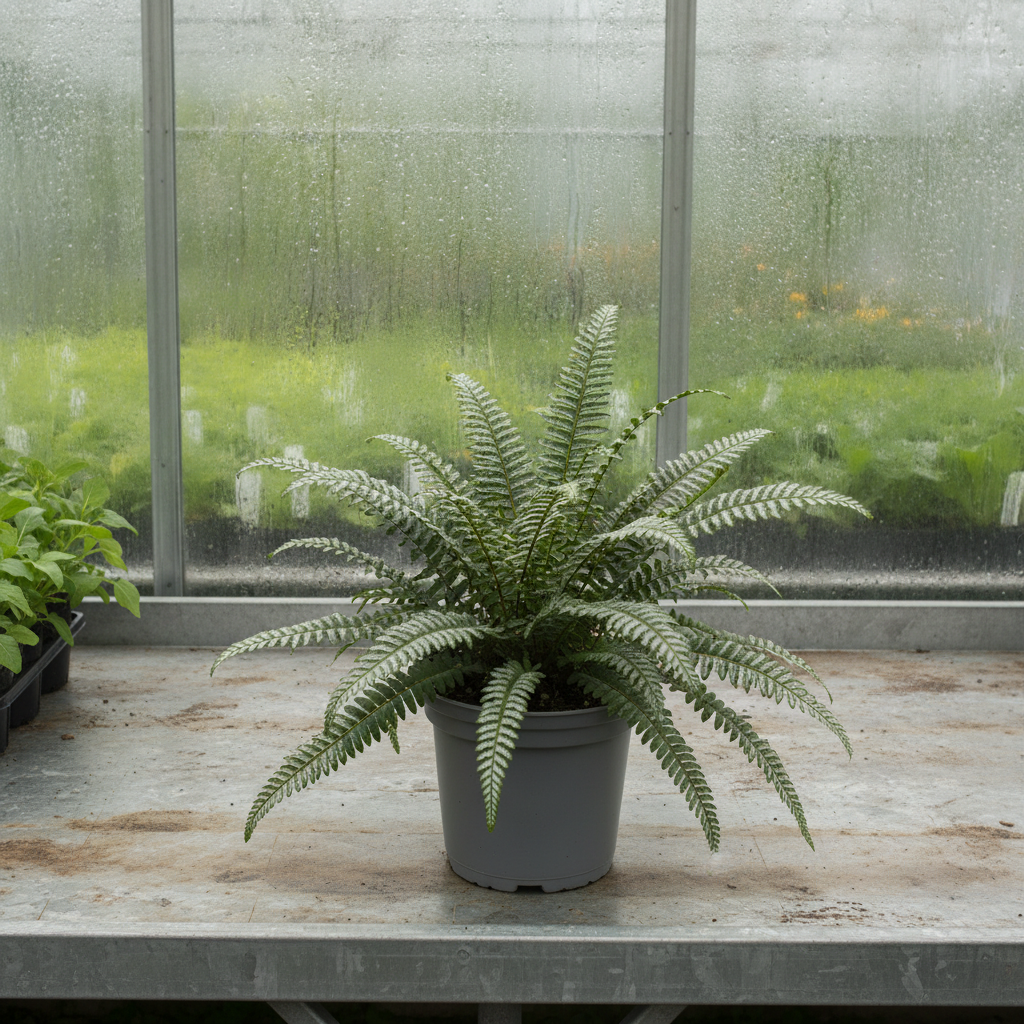
The classic and most widely sold silver lace fern, ‘Victoriae’ carries a bold silvery-white band straight down the centre of each narrow, dark green pinna. The high contrast between silver and green makes it the showiest form and the one most people picture when they think of this plant.
‘Evergemiensis’
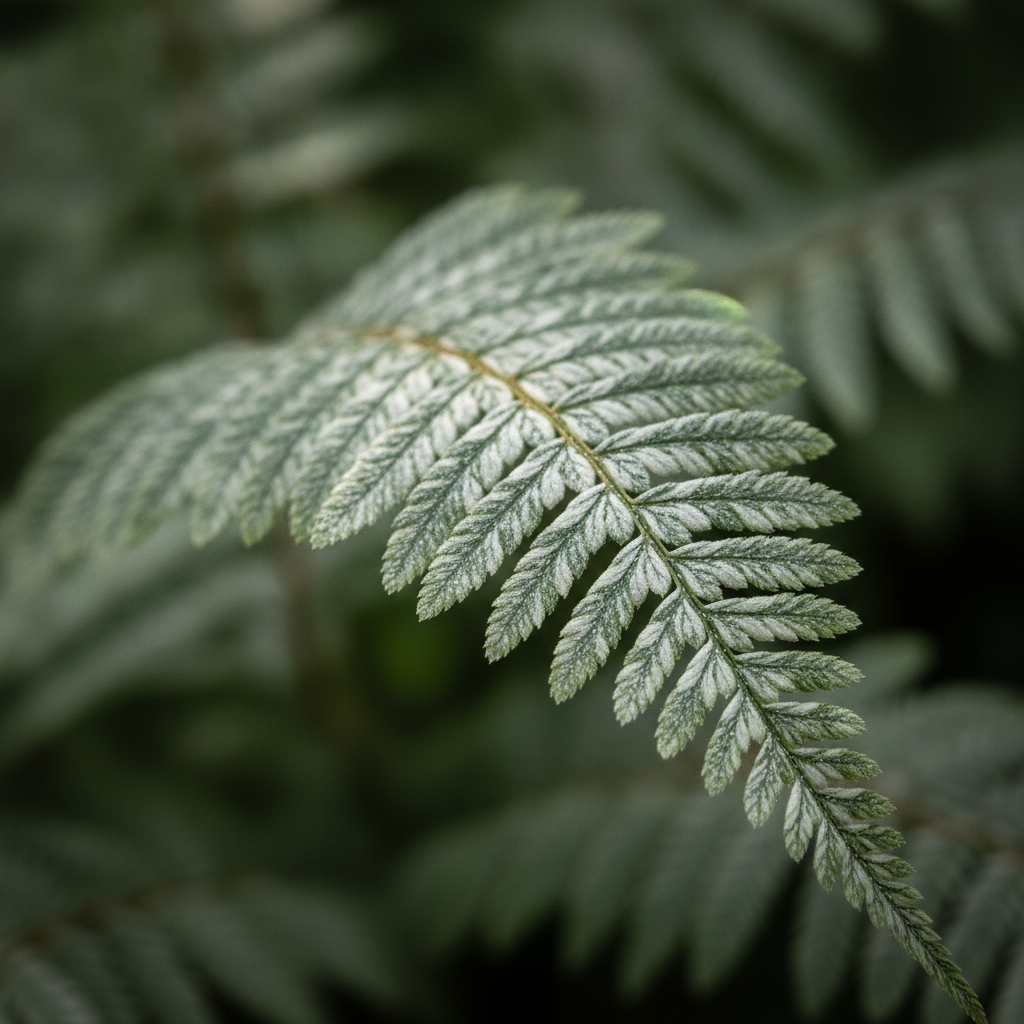
More heavily silvered than ‘Victoriae’, ‘Evergemiensis’ shows broader, frosted creamy-white variegation that can almost overtake the green, giving the fronds a paler, softer look. Its slightly more compact habit makes it a favourite for terrariums and tight groupings.
Variety Profiles in Detail
‘Victoriae’ (Pteris ensiformis ‘Victoriae’)
This is the benchmark cultivar against which the others are measured. Its sterile fronds form a low silvered mound while the taller fertile fronds rise above, and the crisp white midline holds its contrast well in good light. It is widely available, reasonably forgiving for a silver lace fern, and the natural first choice for anyone new to the plant.
‘Evergemiensis’ (Pteris ensiformis ‘Evergemiensis’)
Selected for its more extensive variegation, ‘Evergemiensis’ has a frostier, paler appearance because the silver tissue covers more of each pinna. That heavier variegation makes it marginally more light-sensitive, since the pale areas scorch more readily, so it appreciates a slightly shadier, very humid spot. Its compact growth lends itself well to enclosed cases.
Choosing the Right Variety for Your Space
For a bright bathroom shelf or a humid kitchen windowsill, ‘Victoriae’ offers the strongest visual impact and the easiest care of the silver forms. If you are planting a terrarium or a glass cabinet where humidity is reliably high and light is gentler, the more heavily silvered ‘Evergemiensis’ comes into its own. Gardeners who simply want a tough, shade-tolerant brake fern, with less emphasis on silver, may prefer one of the related Pteris cretica forms, which share the same growing needs but stand up a little better to ordinary room conditions.
Frequently Asked Questions
Why are the tips of my silver lace fern turning brown?
Brown, crispy tips are almost always a sign of air that is too dry, and sometimes of compost that has been allowed to dry out or of mineral build-up from tap water. Raise the humidity around the plant with a humidifier or pebble tray, keep the soil evenly moist, and switch to rainwater or filtered water if your tap water is hard.
How often should I water a silver lace fern?
Often enough that the compost never dries out fully, which usually means two or three times a week in summer and about once a week in winter. Rather than following a fixed schedule, check the top centimetre of soil every couple of days and water as soon as it starts to feel less than fully damp.
Is the silver lace fern safe for cats and dogs?
Yes. The silver lace fern is non-toxic to cats, dogs and humans, and true ferns in general are considered among the safer houseplants for homes with pets. Chewing any plant can still cause mild stomach upset, so it is best to discourage nibbling, but the plant itself poses no poisoning risk.
Why is my fern losing its silver colour?
Fading silver variegation is usually caused by too little light. In dim conditions the plant produces longer, greener fronds and the silver contrast weakens. Move it to a brighter spot with more indirect light, taking care to avoid direct sun, and new fronds should emerge with stronger markings.
Can I grow a silver lace fern in a terrarium?
It is one of the best ferns for the purpose. Its small size and love of constant humidity make it ideally suited to closed terrariums and glass cabinets, where the enclosed air keeps it lush and the controlled environment prevents the dry tips that plague it on an open shelf. Give it bright indirect or artificial light and it will thrive.
My silver lace fern has collapsed. Can I save it?
It depends on the cause. If the compost dried out completely, a thorough soaking and high humidity may revive it, and even if the top fronds die, the rhizome often pushes out fresh growth. If the collapse comes with a soft, smelly base, root rot is likely, in which case unpot the plant, cut away the rotten roots, and repot any firm, healthy sections into fresh draining mix.
Should I cut off the brown or dying fronds?
Yes. Trimming away fully brown or dying fronds at the base with clean scissors tidies the plant and lets it direct energy into new growth. Leave any frond that still has green tissue, as it continues to feed the plant, and never remove more than a third of the foliage at once.
Why has my fern stopped growing?
A pause in growth through autumn and winter is completely normal, as the plant rests when light levels fall. If growth stalls during spring or summer, check that the fern has enough light, that it is not root-bound, and that you have been feeding it lightly through the growing season. Correct any of these and active growth should resume.






