
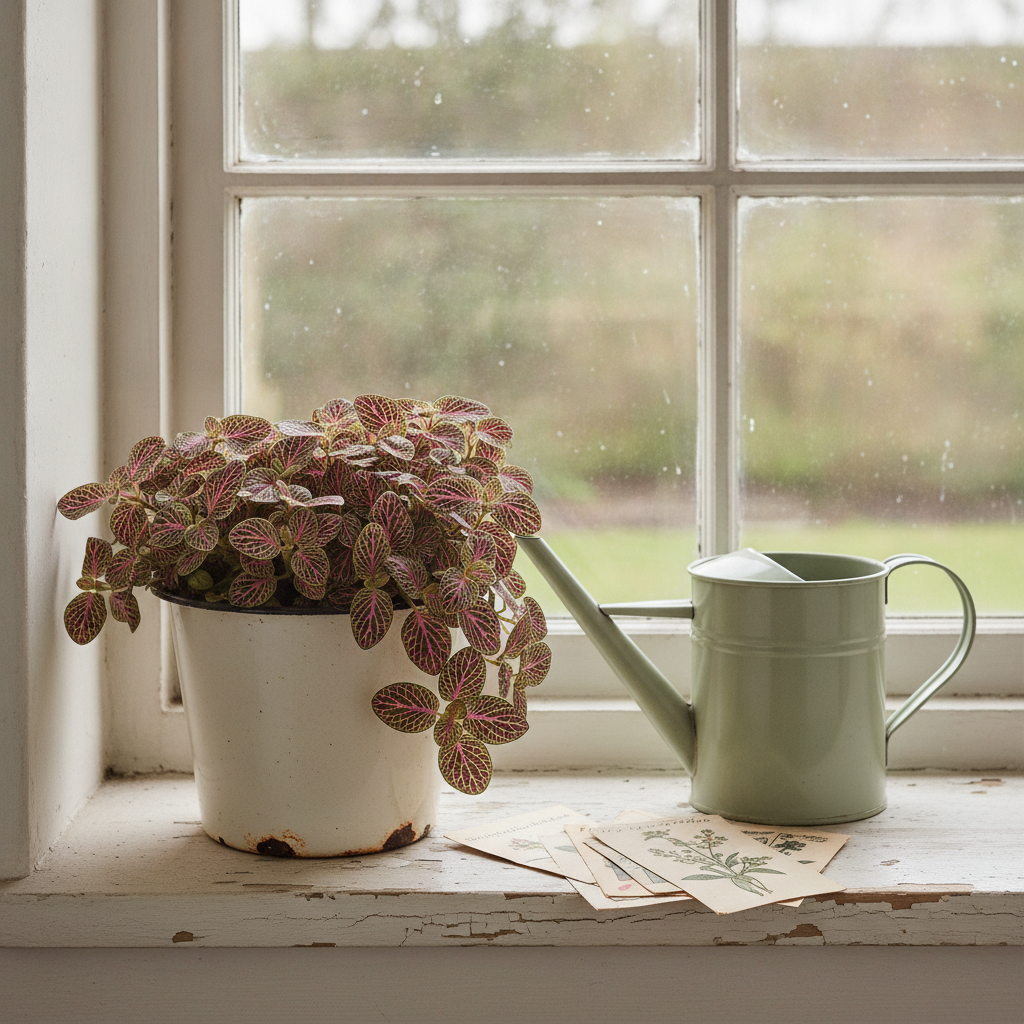
Few houseplants wear their feelings quite as openly as the red vein fittonia. Let the compost dry out for an afternoon too long and the whole plant collapses into a dramatic swoon, every stem draped over the pot rim as though the effort of standing has become too much. Give it a drink and, within a couple of hours, it stiffens back to attention as if nothing happened. This theatrical thirst signalling has earned Fittonia verschaffeltii a reputation as a drama queen, but it also makes the plant unusually easy to read: it tells you exactly what it wants, when it wants it.
Beneath the theatrics sits one of the most beautiful foliage plants you can grow on a windowsill. Each small oval leaf is a piece of living marquetry, an olive to deep green background threaded with a fine net of rose, pink or fiery carmine veins that seem almost too precise to be natural. Grown well, a red vein fittonia forms a low, spreading cushion of colour that thrives in the same warm, humid, low-light corners where most decorative plants sulk. This guide covers everything you need to move a fittonia from merely surviving to genuinely thriving, from the quirks of its rainforest origins to the specifics of watering, light, feeding and propagation.
Quick Reference
| Common names | Red vein fittonia, nerve plant, mosaic plant, painted net leaf |
| Botanical name | Fittonia verschaffeltii (often listed under Fittonia albivenis Verschaffeltii Group) |
| Family | Acanthaceae |
| Origin | Tropical rainforest understorey of Peru and neighbouring South America |
| Mature size | 10 to 15 cm (4 to 6 in) tall, spreading 30 cm (12 in) or more |
| Light | Bright indirect light to moderate shade; no direct sun |
| Water | Keep compost lightly and evenly moist; never bone dry, never waterlogged |
| Humidity | High, ideally 50 to 90 per cent |
| Temperature | 18 to 26 degrees Celsius (64 to 79 degrees Fahrenheit) |
| Soil | Light, moisture-retentive but free-draining peat-free mix |
| Feeding | Weak, balanced feed every 3 to 4 weeks in spring and summer |
| Propagation | Stem tip cuttings in water or moist substrate |
| Toxicity | Non-toxic to cats, dogs and humans |
| Difficulty | Moderate; forgiving once humidity and watering are dialled in |
- Quick Reference
- Why Red Vein Fittonia Makes a Rewarding Houseplant
- Light
- Watering
- Soil and Potting
- Fertilising
- Propagation
- Pests and Problems
- Varieties
- Frequently Asked Questions
Why Red Vein Fittonia Makes a Rewarding Houseplant
To understand what a red vein fittonia needs indoors, it helps to picture where it comes from. Fittonia verschaffeltii is a creeping evergreen perennial from the shaded floor of South American rainforests, where it spreads across the leaf litter beneath a dense canopy. Almost nothing about that habitat resembles a bright, dry living room. The light that reaches the forest floor is soft and filtered, the air is warm and heavy with moisture, and the ground never fully dries between the frequent rains. Every quirk of fittonia care traces back to recreating a slice of that understorey.
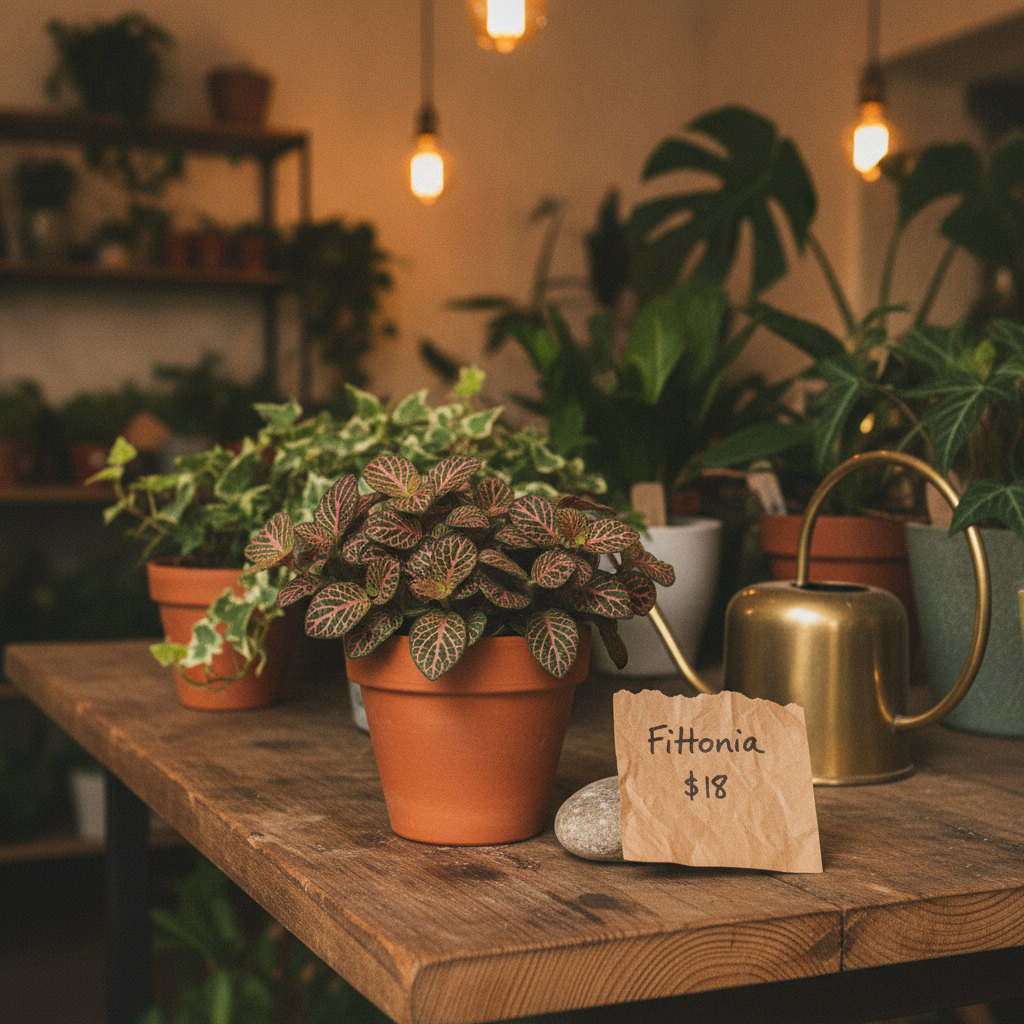
The genus was named after Elizabeth and Sarah Mary Fitton, two nineteenth-century Irish botanical writers, while the species epithet honours the Belgian horticulturist Ambroise Verschaffelt. Belonging to the Acanthaceae family, fittonias are grown almost exclusively for their foliage. They do flower, producing modest spikes of tiny white to cream blooms, but these are so insignificant that many growers pinch them off to keep the plant channelling its energy into leaves. The real spectacle is the venation, a network so crisp and evenly spaced that Victorian collectors compared it to embroidery, mosaic and lacework, giving rise to the plant’s clutch of common names.
What makes fittonia genuinely rewarding rather than merely pretty is the feedback it gives. Most houseplants suffer in silence, and by the time they show visible stress the damage is done. A fittonia, by contrast, wilts theatrically the moment its compost runs too dry, then recovers with equal drama once watered. For a beginner learning to judge moisture, this living moisture meter is a gift. Add the fact that the plant stays compact, tolerates the low light of a north-facing room, and is completely non-toxic to curious cats, dogs and children, and it becomes clear why the nerve plant has remained a windowsill favourite for well over a century.
Light
Light is the requirement most people misjudge with fittonia, usually by giving it too much. Because the plant grows on the rainforest floor beneath a heavy canopy, it is adapted to soft, filtered, indirect light and can scorch badly in direct sun. A few hours of unobstructed midday rays through glass will bleach the leaves, crisp the delicate edges and fade the very veining you bought the plant for. The ideal spot is bright but shielded, the kind of light you would happily read a book in without a lamp, but without a hard beam of sun ever landing on the foliage.
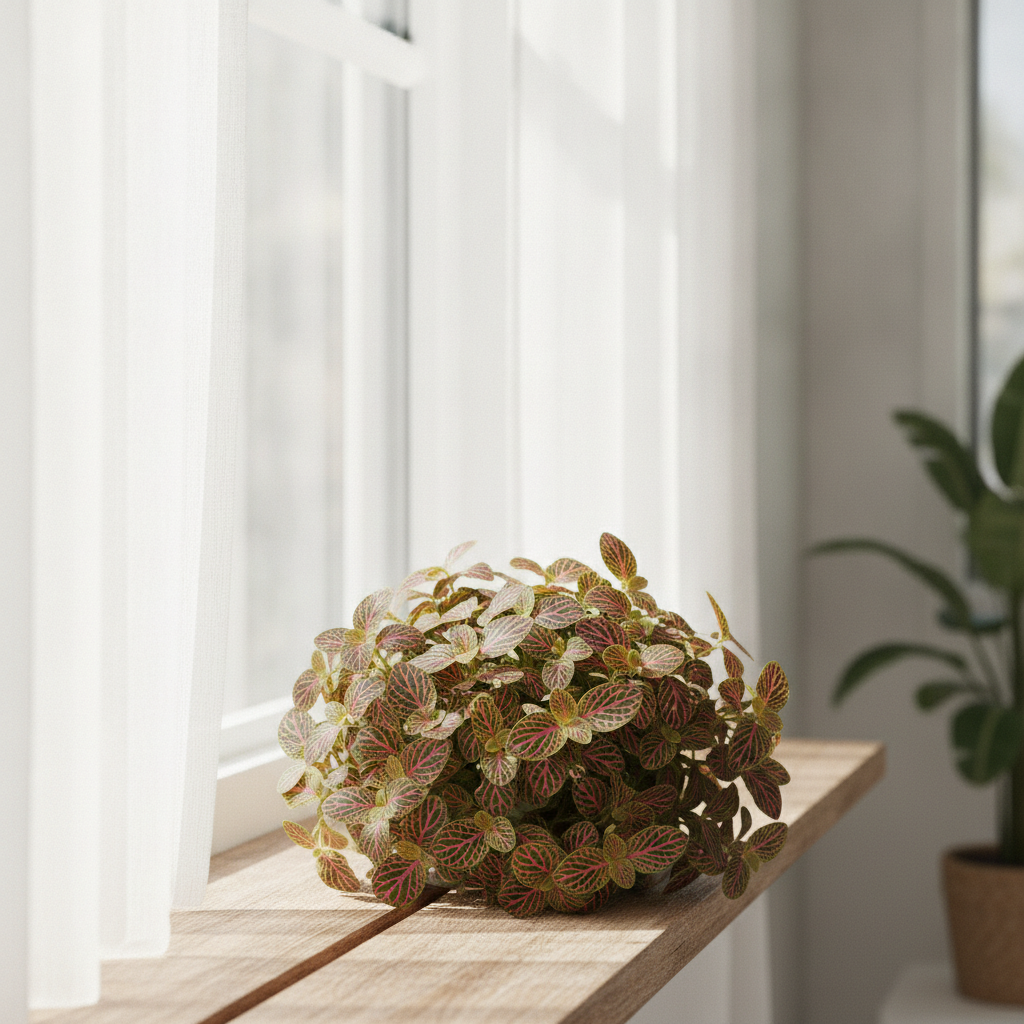
In practice, an east-facing window offering gentle morning light suits fittonia perfectly, as does a north-facing window in the northern hemisphere, which never receives direct sun at all. A south or west aspect can work well too, provided you set the plant a metre or so back from the glass or diffuse the light with a sheer curtain. The plant’s tolerance of low light is one of its great virtues: it will hold its colour in situations where many variegated plants revert to plain green or stretch desperately toward the window. That said, deep gloom is not the same as low light. In a truly dark corner the stems will elongate, the leaves will space out and the compact cushion habit will loosen into something leggy and sparse.
Watch the plant for its own opinion on the matter. Leaves that turn pale, washed out or develop dry brown patches are telling you the light is too strong, so move them further from the window. Stems that stretch and lean, with noticeably wider gaps between leaves, indicate the opposite, and the plant should be shifted somewhere brighter. If your home genuinely lacks a suitable window, fittonia responds well to a modest LED grow light run for ten to twelve hours a day, which is also why it performs so beautifully in enclosed terrariums lit artificially.
Pro Tip — Rotate for even growth: Fittonia grows toward its light source, so a plant left untouched will gradually lean and flatten on one side. Give the pot a quarter turn each time you water to keep the cushion symmetrical and full.
Watering
Watering is where fittonia earns both its reputation and its nickname. The plant likes its compost kept lightly and evenly moist at all times, mimicking the rarely-dry forest floor of its home. It has little tolerance for drought and even less for sitting in a saucer of stagnant water, so the aim is a steady middle ground: damp like a wrung-out sponge, never dust dry and never sodden. When the surface of the compost begins to feel dry to the touch, it is time to water thoroughly until liquid runs from the drainage holes, then let the excess drain away completely.
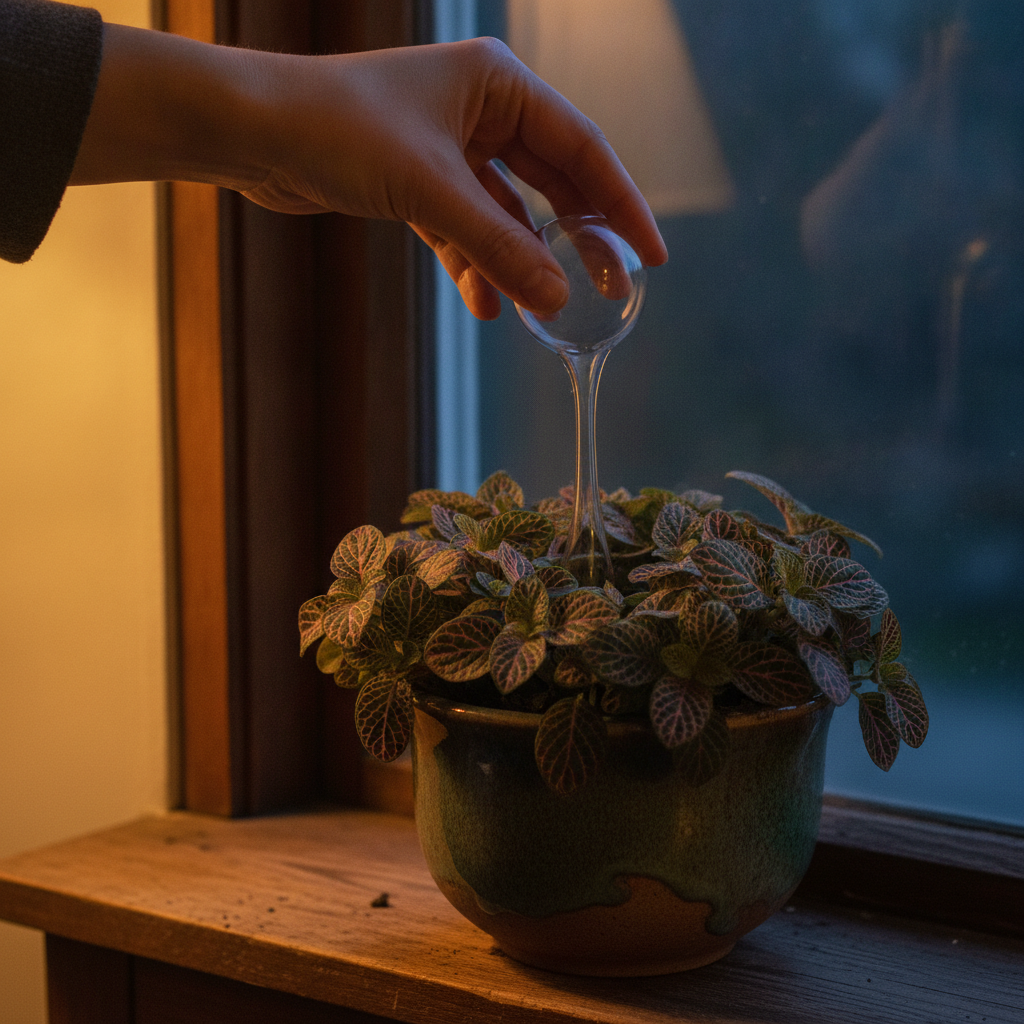
The infamous fainting spell is the plant’s response to going too dry. When the roots can no longer draw enough moisture, the fittonia loses turgor pressure and every stem wilts flat within hours, a genuinely alarming sight the first time you witness it. The reassuring news is that a healthy plant almost always recovers. Water it well, and in most cases the stems will have lifted and re-firmed by the following morning. It is tempting to treat these collapses as a handy watering schedule, but resist that. Each faint is real stress, and repeated fainting eventually shows up as browned leaf edges and lost lower leaves. Use the drama as an early warning system while you learn the plant’s rhythm, not as a routine.
Room-temperature water is kinder than cold water straight from the tap, which can shock the roots. Fittonia is only mildly sensitive to the minerals and chlorine in tap water, so most growers can use it without trouble, but if your water is very hard or you notice a crusty build-up on the compost, switching to filtered or collected rainwater is a sensible upgrade. Frequency will vary with the seasons: expect to water perhaps twice a week through the warmth of spring and summer, tapering to once a week or less in the cooler, darker months when growth slows and the compost dries more slowly. Always judge by the compost rather than the calendar.
Humidity deserves a mention alongside watering, because the two together determine how comfortable a fittonia feels. This is a plant that genuinely craves moist air, ideally above 50 per cent and happiest between 60 and 90 per cent. In the dry air of a centrally heated room the leaf edges brown and crisp no matter how carefully you water the roots. Grouping plants together, standing the pot on a tray of damp pebbles, or running a small humidifier all help. It is no accident that fittonia is one of the classic terrarium and bottle-garden plants, since a closed glass container delivers exactly the warm, saturated microclimate it evolved to love.
Warning — Watch for rot: A fittonia that wilts even though the compost is wet is not thirsty, it is drowning. Constantly soggy compost suffocates the roots and invites rot, which produces the same limp collapse as drought. If in doubt, feel the compost before you reach for the watering can.
Soil and Potting
The right compost solves half of fittonia’s watering puzzle before you ever pick up a can. Because the plant wants consistent moisture without waterlogging, it needs a medium that holds water yet drains freely and stays airy around the roots. A quality peat-free houseplant compost forms a good base, lightened with a generous handful of perlite for drainage and, if you have it, a little fine orchid bark or coco coir to keep the structure open. The goal is a mix that feels moist and spongy after watering rather than dense and claggy, so that air can still reach the fine roots.
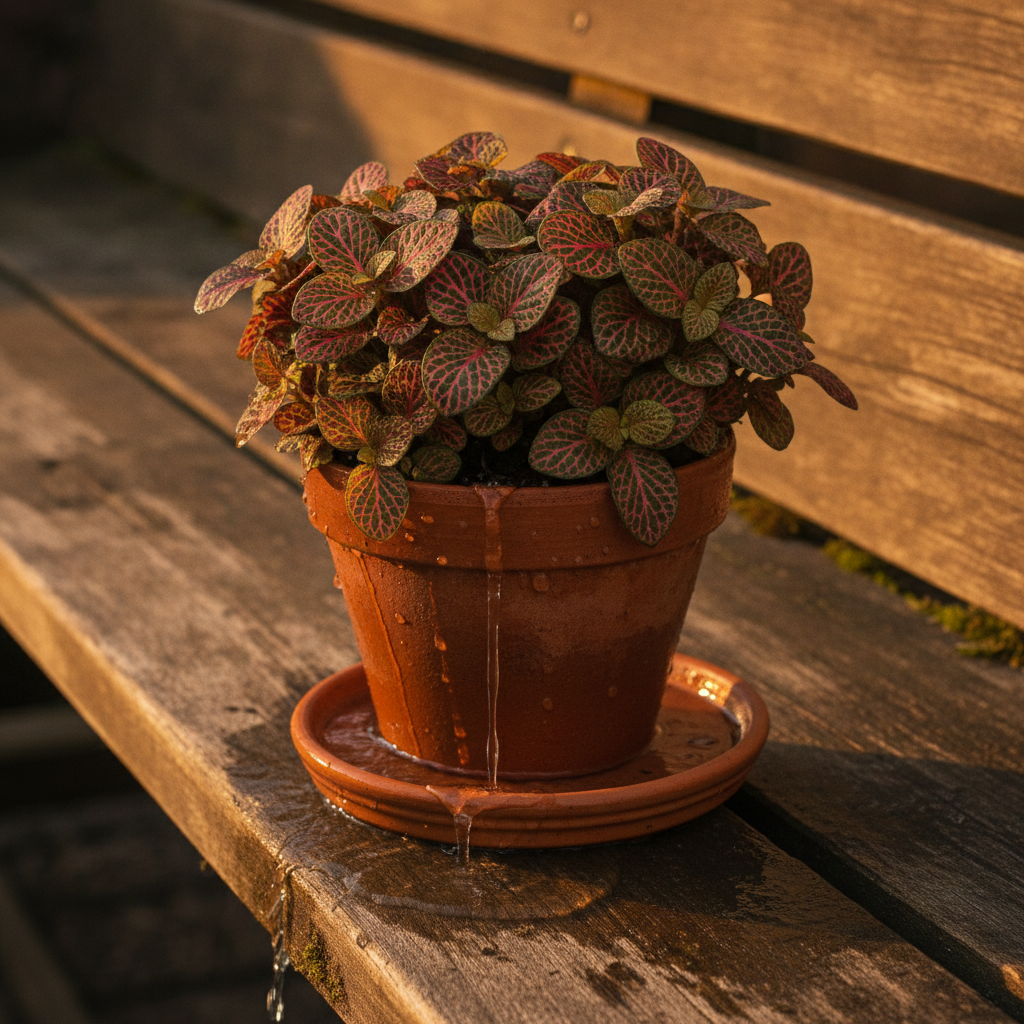
Fittonia has a shallow, fibrous root system and appreciably dislikes being overpotted. A container that is too large holds a reservoir of wet compost the small roots cannot use, and that stagnant moisture is a fast route to root rot. Choose a pot only slightly larger than the current root ball, no more than a couple of centimetres wider, and make absolutely sure it has drainage holes. A shallow pot or half pot suits the plant’s spreading, low-growing habit better than a deep one. Terracotta breathes and dries a little faster, which can help nervous overwaterers, while glazed ceramic and plastic hold moisture longer and suit anyone who tends to forget the watering can.
Repotting is best done in spring, at the start of the growing season, and only when the plant has genuinely outgrown its home or the compost has broken down and gone tired. Signs it is time include roots creeping from the drainage holes, water racing straight through without wetting the compost, or a plant that dries out again almost as soon as you have watered it. Ease the fittonia out gently, tease away the worst of the old compost, settle it into fresh mix at the same depth it sat before, and water it in well. It is normal for a freshly repotted fittonia to sulk and even faint for a day or two while the roots re-establish, so keep it warm, humid and shaded from strong light while it recovers.
Fertilising
Fittonia is not a heavy feeder, and its small size means a little goes a long way. On the forest floor it draws nutrients from a steady trickle of decomposing leaf litter rather than any sudden abundance, so the indoor equivalent is a light, regular feed rather than an occasional strong dose. Through the active growing months of spring and summer, a balanced liquid houseplant fertiliser diluted to roughly half the strength on the label, applied every three to four weeks, keeps the foliage dense and the veining vivid without pushing weak, sappy growth.
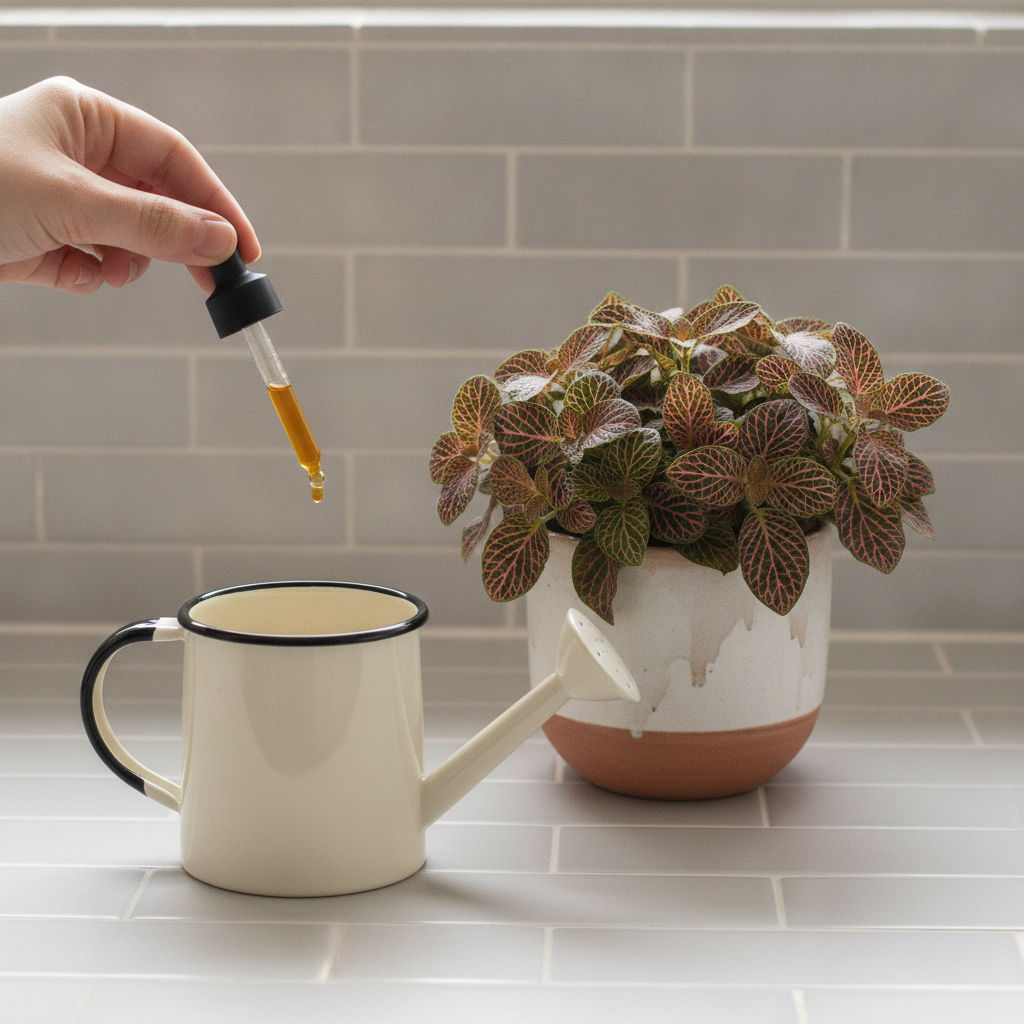
The most common feeding mistake is overdoing it. Because the plant is compact and its roots are fine and shallow, they are easily scorched by concentrated fertiliser salts, which show up as brown, crisped leaf tips and edges, ironically the same symptoms as low humidity. Always dilute more than you think you need to, always feed onto compost that is already damp rather than bone dry, and never feed a plant that is stressed, wilting or newly repotted. Fresh compost already carries a few weeks of nutrients, so hold off feeding for a couple of months after any repot.
As the light fades and temperatures drop in autumn, growth slows to a near halt and the plant’s appetite falls away with it. Stop feeding through late autumn and winter, resuming only when you see fresh growth pushing again in spring. If you ever suspect you have overfed, whether from crusty white deposits on the compost or a sudden rash of brown tips, flush the pot thoroughly with plain water several times to leach out the excess salts, and pause feeding until the plant recovers.
Propagation
One of fittonia’s most endearing qualities is how readily it propagates. As a creeping plant it naturally roots wherever its stems touch damp ground, so persuading a cutting to root in a jar or tray is rarely difficult. Propagation is best undertaken in spring or summer, when the plant is growing actively and cuttings root fastest, and it doubles as a way to rejuvenate an older plant that has grown leggy or bare in the centre.
The most reliable method is the stem tip cutting. Using clean scissors, snip a healthy shoot around 5 to 8 cm (2 to 3 in) long, cutting just below a node, the slightly swollen point where leaves emerge, because this is where new roots form. Strip the lowest pair of leaves so that at least one bare node will sit in your rooting medium. From here you have two easy routes to follow.
- To root in water, stand the cutting in a small glass so the bare node is submerged while the remaining leaves stay dry above the waterline. Place it somewhere warm and bright but out of direct sun, refresh the water every few days, and watch for fine white roots to appear within one to two weeks. Once the roots reach a couple of centimetres, pot the cutting into moist compost.
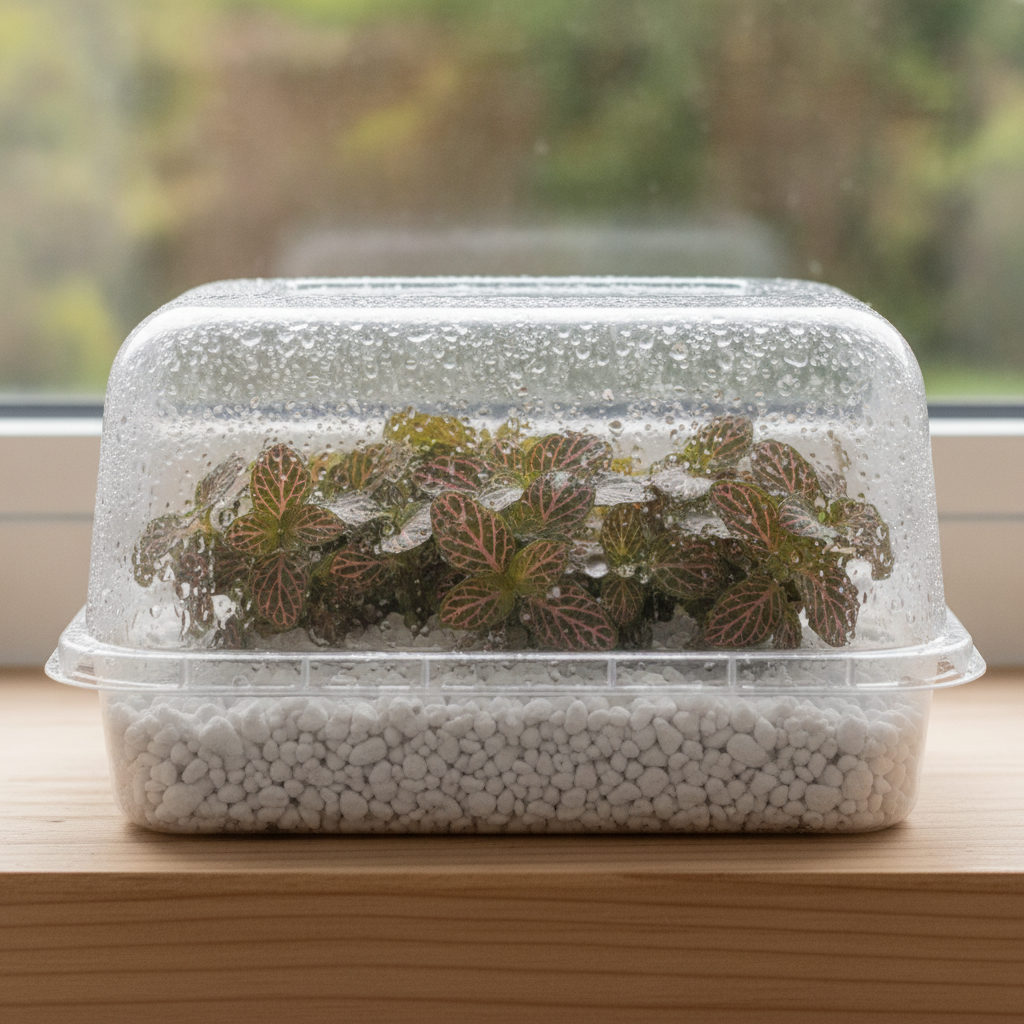
- To root directly in substrate, insert the cutting into a small pot of damp compost or a tray of moist perlite with the bare node buried. Cover the whole thing with a clear plastic bag or humidity dome to lock in moisture, keep it warm and bright, and lift the cover occasionally for fresh air. Roots usually establish within two to three weeks, signalled by new growth at the tip.
Whichever route you take, a few small cuttings potted together make a fuller, more impressive plant far quicker than a single stem. If your fittonia has grown into a large clump, you can also divide it: gently pull the root ball apart into sections, each with its own roots and stems, and pot them up individually. Warmth and high humidity are the two levers that decide how fast any fittonia cutting roots, so a covered propagator on a warm windowsill will always outperform a bare jar in a cool room.
Pests and Problems
Most fittonia troubles are cultural rather than the work of pests, and the plant’s expressive foliage makes them easy to diagnose once you know the language. Crisp brown leaf tips and edges almost always point to air that is too dry or, less often, to overfeeding. Yellowing lower leaves that feel soft and limp usually mean the compost is staying too wet, while a plant that wilts and browns despite regular watering may be suffering root rot from that same excess moisture. Faded, bleached patches indicate too much direct sun, and leggy, stretched stems signal too little light. Read these signs together with a finger pushed into the compost, and the cause is usually obvious.
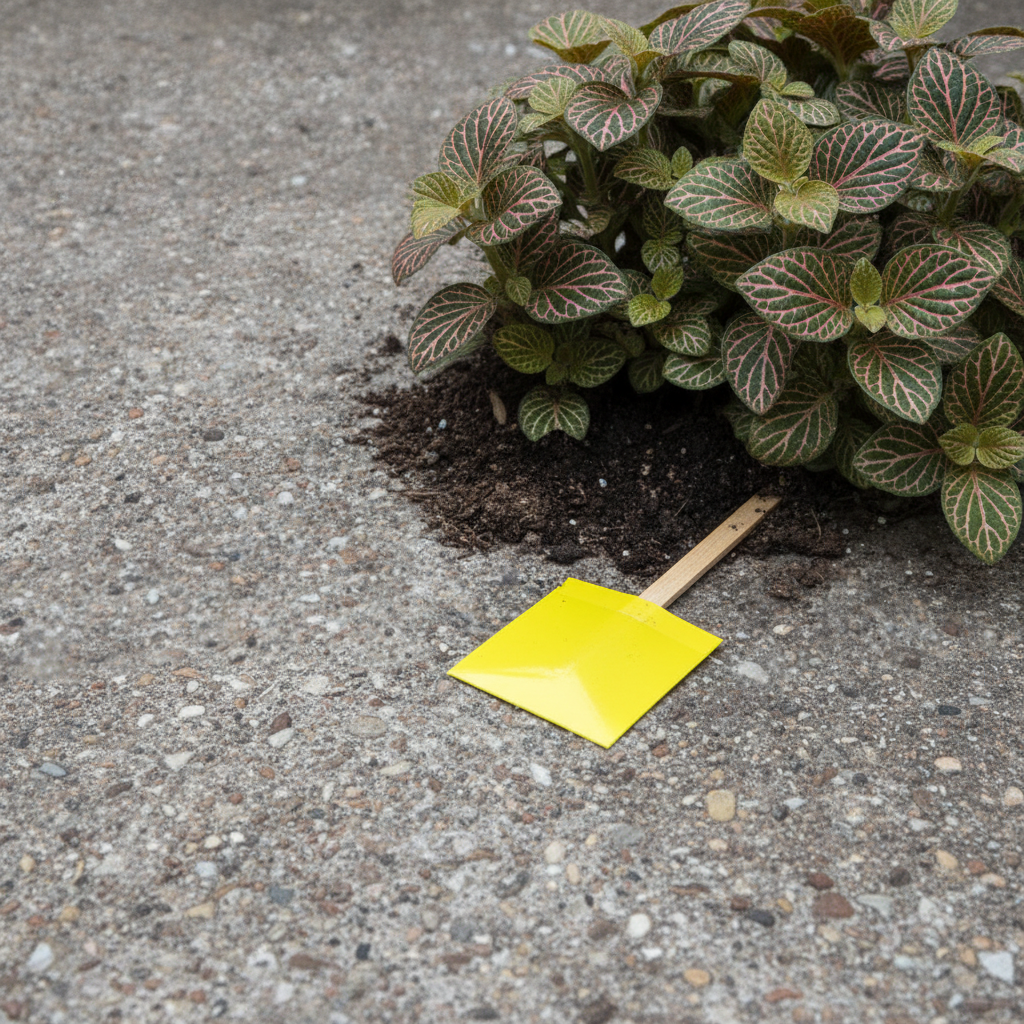
The pest you are most likely to meet is the fungus gnat, a small dark fly whose larvae thrive in the constantly moist compost fittonia demands. The adults are more nuisance than danger, but heavy larval populations can nibble young roots. Letting the very top layer of compost dry slightly between waterings, topping the surface with a thin layer of grit, and hanging a few yellow sticky traps will usually break the cycle. In drier, warmer conditions you may occasionally encounter aphids clustered on soft new growth, mealybugs as white cottony tufts in the leaf axils, or spider mites betrayed by fine webbing and a stippled, dusty look to the leaves, the last of these being far more likely when humidity is allowed to fall too low.
Catching any infestation early makes control simple. Isolate an affected plant from its neighbours, wipe or rinse off what you can, and treat with an insecticidal soap or a diluted neem oil solution, repeating every week or so until the problem clears. Because fittonia has such delicate, thin leaves, test any spray on a single leaf first and keep the treated plant out of direct sun while it is wet to avoid scorching. Good routine care, meaning appropriate light, careful watering and high humidity, prevents the great majority of these problems before they ever start, since a vigorous, unstressed fittonia is far less inviting to pests than a struggling one.
Pro Tip — Refresh a tired plant: If your fittonia grows bare and woody at the centre, do not throw it out. Take a batch of tip cuttings from the healthiest growth, root them together, and you will have a lush, compact plant again within a couple of months.
Varieties
The red-veined fittonias belong to the Verschaffeltii Group, prized for warm pink to fiery crimson venation set against deep green leaves, in contrast to the cooler white-veined Argyroneura types. Within the red-veined camp, breeders have selected a range of cultivars that differ in leaf size, vein colour and intensity. Two of the most widely grown are shown below.
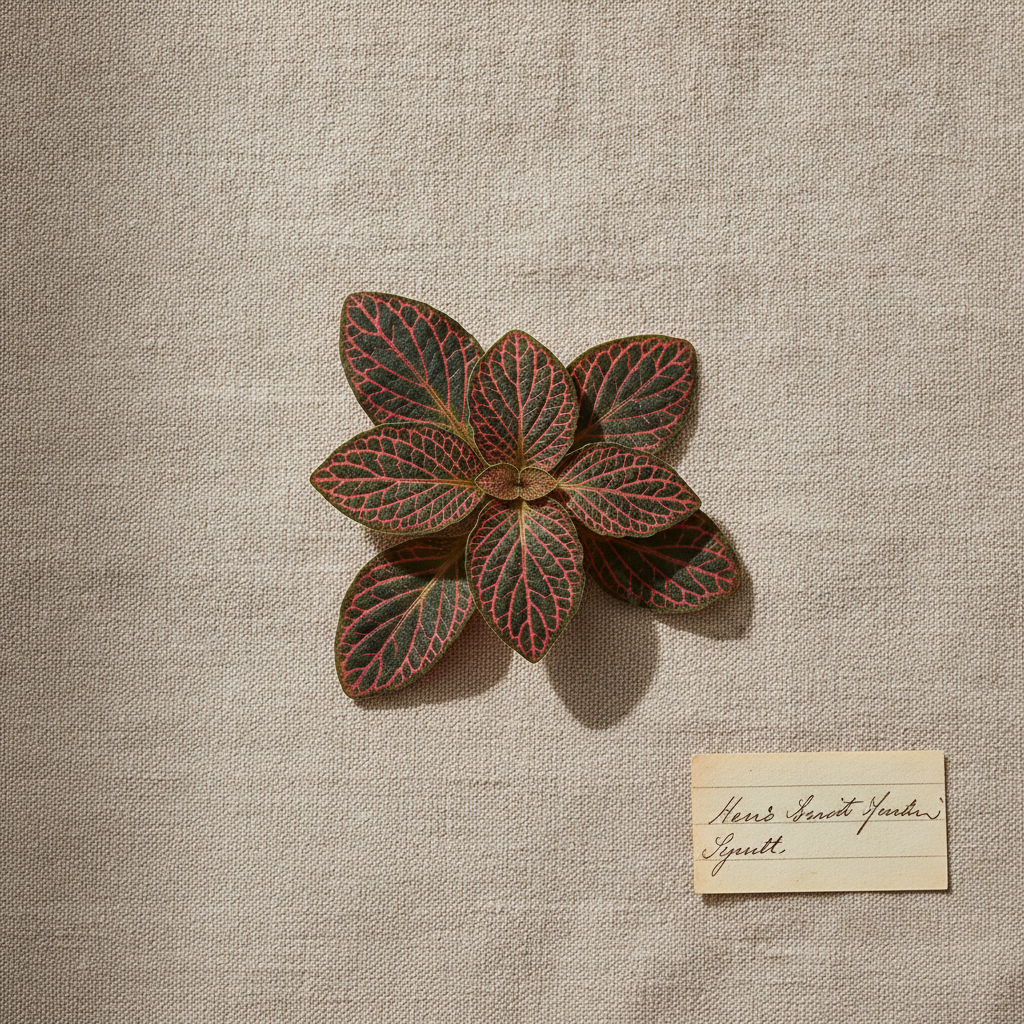
‘Red Anne’ is one of the most striking of the red-veined selections, with compact deep green leaves laced by a fine, tidy network of carmine-red veins. It keeps a dense, cushiony habit that makes it a favourite for terrariums and small feature pots, and its vivid colouring holds well even in the moderate light of an interior room.
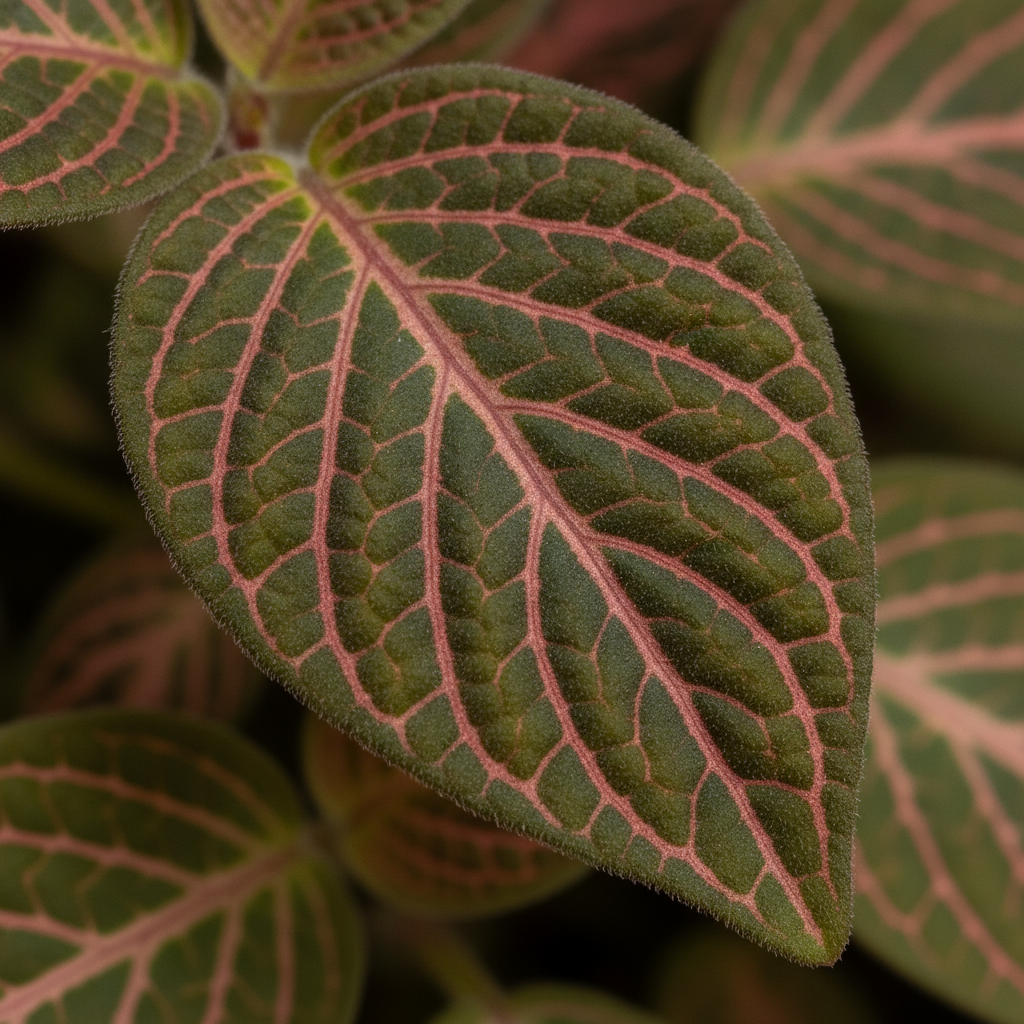
‘Juanita’ is a bolder, larger-leaved cultivar, with olive-green leaves noticeably bigger than the species and broad rosy-red veins that give it a lush, almost quilted appearance. Its greater size makes it a fine standalone plant for a pot rather than a terrarium filler, and the wider veining reads dramatically even from across a room.
Beyond these two you will find named selections such as ‘Ruby Red’, with an especially saturated vein colour, and ‘Fortissimo’, which pairs pink veining with green in a slightly looser pattern. All of the red-veined cultivars share the same care requirements, so once you have mastered one fittonia you can grow the whole group with confidence, mixing several colours in a single wide bowl for a patchwork of contrasting veins.
Frequently Asked Questions
Why does my fittonia keep fainting?
A dramatic, sudden collapse of all the stems is fittonia’s classic response to compost that has dried out too much. Water it thoroughly and it will usually recover within a few hours to a day. If the plant wilts while the compost is still wet, however, the cause is the opposite, meaning waterlogged roots that can no longer function, and you should let the compost dry a little and check for root rot rather than adding more water.
Is red vein fittonia safe around pets?
Yes. Fittonia verschaffeltii is listed as non-toxic to both cats and dogs, and it poses no poisoning risk to children either. It is one of the safer choices for a home with curious animals, though as with any plant it is still best not to let pets make a habit of chewing the leaves.
Why are the leaf tips turning brown and crispy?
Crisp brown edges are almost always a sign that the air is too dry for the plant’s tropical taste. Raise the humidity by grouping plants together, using a pebble tray or running a humidifier. Less commonly, brown tips follow overfeeding or a build-up of mineral salts, in which case flush the compost with plain water and ease off the fertiliser.
Can I grow fittonia in a terrarium?
Fittonia is one of the best terrarium plants there is. The warm, consistently humid, softly lit environment of a closed glass container matches its rainforest origins almost exactly, and it will often grow more happily there than on an open windowsill. Its compact size keeps it in scale with small terrariums for a long time before any trimming is needed.
How do I keep my fittonia bushy instead of leggy?
Pinch out the growing tips regularly to encourage the plant to branch, and provide enough bright, indirect light so the stems do not stretch. Rotating the pot each week keeps growth even on all sides. If a plant has already gone bare and leggy in the middle, the quickest fix is to take tip cuttings and root a fresh, dense clump.
Should I let my fittonia flower?
The flowers are small, spiky and unremarkable, and producing them draws energy away from the colourful foliage that is the whole point of the plant. Many growers pinch off the flower spikes as they appear to keep the plant compact and channel its resources into fuller, more vividly veined leaves. It is entirely a matter of preference, and doing nothing will not harm the plant.






