
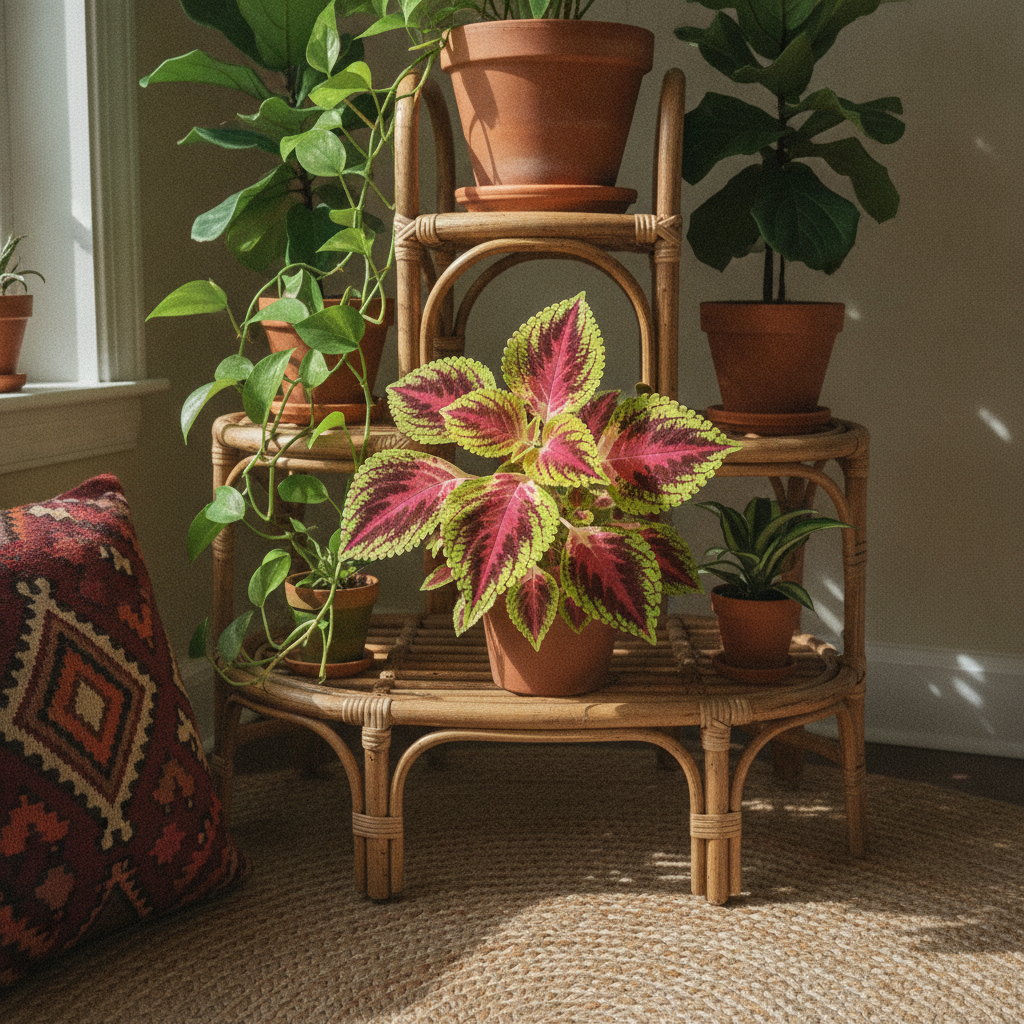
Few houseplants earn their keep on colour alone quite like the rainbow coleus (Coleus blumei), a soft-stemmed member of the mint family whose leaves read less like foliage and more like stained glass. Where most tropical plants ask you to admire a subtle gradient of green, coleus throws down a full patchwork of magenta, lime, burgundy, chartreuse and cream, often layered within a single leaf and edged with a scalloped, toothed margin. Native to the warm, humid understorey of Southeast Asia, from Indonesia to Malaysia, it has been bred and re-bred for well over a century into hundreds of named cultivars. Botanists have shuffled its name repeatedly, and you may also see it listed as Coleus scutellarioides, Plectranthus scutellarioides or Solenostemon scutellarioides, but to gardeners it remains simply coleus, the painted nettle.
The good news is that coleus is genuinely easy to keep alive, and the better news is that the gap between merely surviving and truly thriving is entirely within your control. A neglected coleus stretches into a pale, leggy shadow of itself, its colours washing out and its lower stem going bare. A well-tended one stays dense, richly saturated and generous with cuttings you can root almost carelessly. This guide walks through everything that separates the two: the light that keeps colours electric, the steady moisture this thirsty plant demands, the pinching that keeps it bushy, and the simple propagation that means you need never buy another one.
Contents
- Quick Reference
- Why Rainbow Coleus Makes a Rewarding Houseplant
- Light Requirements
- Watering & Humidity
- Soil, Potting & Repotting
- Fertilising
- Propagation
- Pests & Diseases
- Popular Varieties
- Frequently Asked Questions
Quick Reference: Rainbow Coleus at a Glance
| Light | Bright, indirect light indoors; modern sun-tolerant cultivars accept some direct morning sun. Poor light fades the colours. |
| Watering | Keep the mix evenly moist at all times. Water when the top 1 to 2 cm feels dry; never let it dry out completely. |
| Temperature | 18 to 24 C (64 to 75 F). Frost tender; suffers below 10 C (50 F). |
| Humidity | Moderate to high, ideally 50 percent or above. Tolerates average rooms but colours and leaves look best with more. |
| Fertiliser | Balanced liquid feed at half strength every two to four weeks in the growing season. |
| Toxicity | Mildly toxic to cats, dogs and humans if eaten; sap can irritate skin. Keep away from pets and children. |
Why Rainbow Coleus Makes a Rewarding Houseplant
The first reason to grow coleus is obvious the moment you see one: nothing else delivers this much colour without a single flower. A well-grown plant functions like a living bouquet that never fades, holding its display for months on end rather than for a fleeting bloom. Because the colour lives in the leaves, it is remarkably consistent through the year, and a windowsill of mixed cultivars can range from acid lime through to near-black burgundy. For anyone who finds all-green foliage plants a little restrained, coleus is the antidote.

The second reason is speed. Coleus is one of the fastest houseplants you can grow, putting on visible new growth week by week and rewarding almost any attention with a flush of fresh leaves. That pace makes it forgiving of mistakes, because a plant that has gone leggy or lost its lower leaves can be cut back hard and will rebound within weeks. It also makes propagation absurdly simple: a snipped stem rooted in a glass of water becomes a new plant in days, so a single specimen can furnish an entire shelf. The main caveat is that coleus is a short-lived perennial rather than a decade-long heirloom, but because it renews so easily from cuttings, most growers keep a line going indefinitely without ever buying a replacement.
Important — Toxicity: Coleus contains volatile oils and diterpenes that make it mildly toxic to cats, dogs and horses, and eating it can cause vomiting, diarrhoea and lethargy. The sap can also irritate sensitive skin, so wear gloves if you handle a lot of cuttings. Site the plant out of reach of curious pets and children, and wash your hands after pinching or pruning.
Light Requirements
Light is the single most important factor in how good your coleus looks, because the pigments that create its colours are produced in response to it. Give the plant too little and it does not die quickly, but it stretches toward the nearest window, the gaps between leaves widen, and the vivid reds and pinks mute into flat, tired green. This is the classic difference between a coleus that survives in a dim corner and one that thrives on a bright sill.
Indoors, the sweet spot for most coleus is bright, indirect light: a position within a metre or so of a window that receives plenty of daylight but little scorching midday sun on the leaves. Many modern bedding cultivars have been bred to tolerate direct sun outdoors, and these will happily take a few hours of gentle morning light on an east-facing sill. The older, more delicate types prefer their sun filtered. As a rule, the more intense and richly coloured you want the foliage, the more light you should give, stopping short of the point where leaves bleach or crisp.
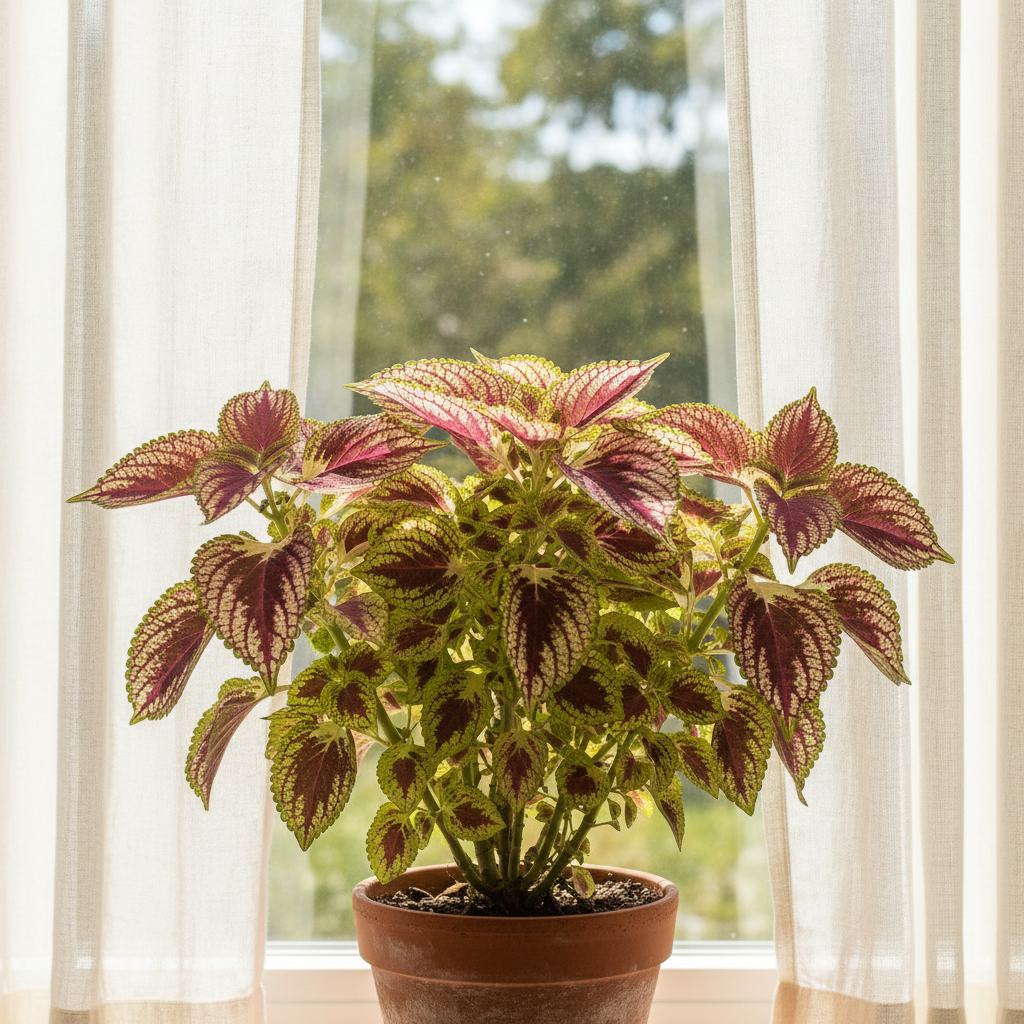
Light Levels Explained
The table below translates the vague language of light into something you can act on, from full sun down to the dim conditions where coleus struggles.
| Light Category | Approx. Level | Typical Location | Outcome |
|---|---|---|---|
| Direct sun | 20,000 lux and above | Unshaded south window, outdoors in summer | Fine for sun-bred cultivars; can scorch older types |
| Bright indirect | 10,000 to 20,000 lux | Near an east or west window, filtered south | Ideal; densest growth and richest colour |
| Medium | 5,000 to 10,000 lux | A metre or two back from a bright window | Acceptable; colours slightly softer, growth slower |
| Low | 1,000 to 5,000 lux | North window, interior wall | Leggy, stretched growth and fading colour |
| Very low | Below 1,000 lux | Dim hallway, far from any window | Decline; leaf drop and loss of pigment |
Window Orientation and Placement
South-facing window: The brightest option and excellent for sun-tolerant cultivars, though delicate types benefit from a sheer curtain to soften the harshest midday hours. Watch for any leaf that starts to bleach or feel papery, which signals too much direct exposure.
East-facing window: Arguably the ideal indoor spot, offering bright, gentle morning sun followed by softer light for the rest of the day. Colours stay vivid here with very little risk of scorch.
West-facing window: Good light overall, with stronger afternoon sun that most modern cultivars handle well. Turn the plant every few days so it does not lean toward the glass.
North-facing window: The most challenging orientation. Coleus will hang on here but tends to stretch and lose intensity, so this position usually needs a supplementary grow light to keep the plant looking its best.
Pro Tip — Read the Internodes: The distance between one set of leaves and the next, the internode, is your quickest light gauge. Short gaps and tightly packed leaves mean the light is right; long, bare stretches of stem mean the plant is reaching for more and needs to move closer to a window.
How Light Affects Leaf Colour
Unlike variegated plants that can lose their pattern entirely in low light, coleus keeps its markings but drains them of vibrancy. The anthocyanin pigments responsible for the reds, purples and pinks are produced more abundantly under strong light, so a plant on a bright sill glows while the same cultivar in a dim room looks muddy and greenish. If your coleus was dazzling in the shop and has since dulled at home, insufficient light is almost always the reason, and moving it brighter will restore the colour over a few weeks of new growth.
Warning — Direct Sunlight: Even sun-tolerant cultivars can scorch if moved abruptly from shade into blazing sun, especially behind glass that magnifies the heat. Acclimatise a plant gradually over a week or two, and if you see pale, dry, bleached patches on the upper leaves, pull it back from the glass or add a sheer curtain.
Artificial Lighting
Coleus responds enthusiastically to artificial light, which makes it a strong candidate for rooms with poor natural daylight. A full-spectrum LED grow light positioned 20 to 40 cm above the canopy, running for 12 to 14 hours a day, keeps growth compact and colours saturated through the darkest months. Because the plant grows so fast, you will see the benefit quickly, and a grow light is often the difference between a north-room coleus that limps along and one that flourishes.
Seasonal Adjustments
Daylight weakens considerably in winter, so a plant that was perfect a metre from the window in July may need to move right onto the sill by December. Growth naturally slows in the short, cool days, and colours can soften a little even with your best efforts. Come spring, ease the plant back from the brightest position if the strengthening sun starts to look too intense, and expect a burst of vigorous new growth as the light returns.
Watering & Humidity
If light governs colour, water governs vigour, and coleus is unapologetically thirsty. Its large, soft leaves lose moisture quickly, and unlike a succulent it has no reserves to fall back on, so a coleus that dries out will flop dramatically within hours. The aim is steady, even moisture: a mix that is damp but never waterlogged, refreshed before it ever dries fully. Get this rhythm right and the plant stays turgid and lush; get it wrong in either direction and coleus is quick to tell you.
When to Water
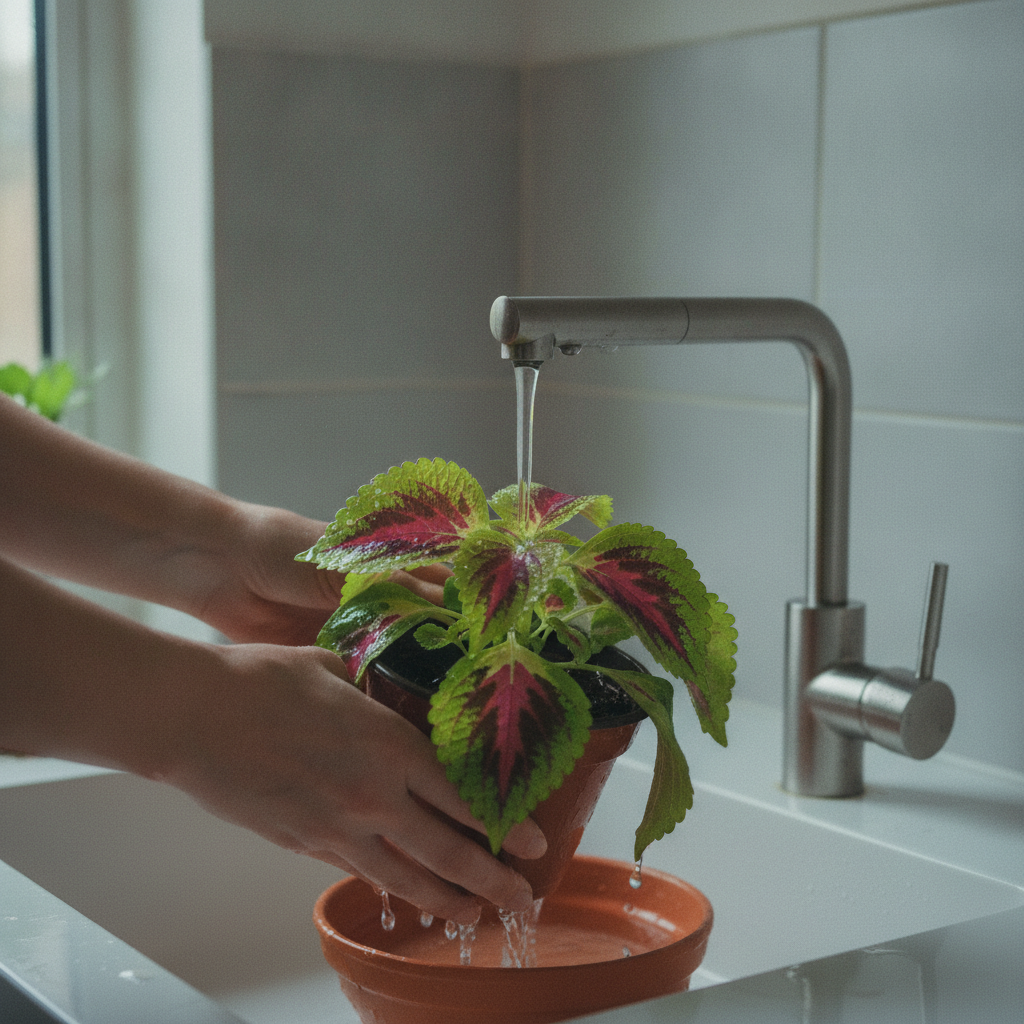
Check the plant every day or two by pressing a finger into the surface of the mix. When the top 1 to 2 cm feels dry to the touch, it is time to water. In warm, bright conditions during active growth, this can mean watering several times a week, and a large plant in a small pot may need attention almost daily in high summer. In cooler, darker winter conditions the plant uses far less, so always let the surface be your guide rather than a fixed schedule.
The one thing to avoid is letting the pot dry out entirely. A coleus that wilts hard will usually recover if you water it promptly, but repeated wilting stresses the plant, causes lower leaves to yellow and drop, and gradually thins its display. Equally, do not confuse steady moisture with standing water: the roots need air as well as moisture, and a pot left sitting in a saucer of water will suffocate and rot.
Pro Tip — The Wilt Test: A slightly wilted coleus in the late afternoon of a hot day is normal and usually perks up overnight. If it is wilting first thing in the morning with damp soil, the problem is likely root rot rather than thirst, so check the roots before you reach for the watering can.
How to Water Correctly
- Check that the top 1 to 2 cm of the mix has begun to dry before watering.
- Water at the base of the plant, directing the stream onto the soil rather than over the foliage.
- Add water slowly and evenly until it flows freely from the drainage holes.
- Let the pot drain fully for several minutes so no excess sits at the bottom.
- Empty the saucer or cover pot; never leave the roots standing in water.
- Use room-temperature water, as very cold water can shock these warmth-loving roots.
Signs of Overwatering vs. Underwatering
| Symptom | Overwatering | Underwatering |
|---|---|---|
| Leaf colour | Yellowing, often starting with lower leaves | Dulling and browning at the leaf edges |
| Leaf texture | Soft, limp and translucent | Thin, papery and crisp |
| Soil | Constantly wet, may smell sour | Bone dry and pulling away from the pot |
| Roots | Brown, mushy and foul-smelling | Dry but firm and pale |
| Recovery | Slow; may not recover once rot sets in | Fast; usually perks up within hours of watering |
Warning — Root Rot: Because coleus likes to stay moist, it is easy to tip over into permanently soggy soil, which is the fastest route to root rot. If the stem base turns soft and blackened and the plant wilts despite wet soil, act quickly: take healthy cuttings from the top growth and root them, because a rotted parent plant rarely recovers.
Humidity Requirements
As a plant of the humid tropics, coleus appreciates moisture in the air and looks its best at around 50 percent relative humidity or higher. It will tolerate the drier air of an average home, but in very dry rooms, particularly near radiators or in winter when heating is on, the leaf edges can turn brown and crisp.
Watch for browning, papery leaf margins on otherwise healthy leaves as the classic sign that the air is too dry. This is easily confused with underwatering, so check the soil moisture first; if the mix is adequately damp but the edges are still crisping, low humidity is the likely culprit.
To raise humidity, group coleus with other plants so they share the moisture they transpire, stand the pot on a tray of damp pebbles kept topped up with water, or run a small humidifier nearby in the driest months. Misting offers only a brief lift and, on soft coleus foliage, can encourage fungal problems, so the other methods are more reliable.
Water Quality
Coleus is not especially fussy about water quality and copes with most tap water. In areas with very hard or heavily chlorinated supplies, mineral build-up can show as pale crusting on the soil surface over time, so if you notice this or your plant seems sensitive, switch to filtered or rainwater, or leave tap water to stand overnight before use. Whatever the source, room-temperature water is always kinder to the roots than water straight from a cold tap.
Soil, Potting & Repotting
Coleus wants a growing medium that reconciles two apparently opposing needs: it must hold moisture reliably, because the plant hates to dry out, yet it must also drain freely enough that the roots never sit in stagnant water. The ideal is a rich, moisture-retentive but well-aerated mix, quite different from the gritty blend you would give a succulent.
Ideal Soil Composition
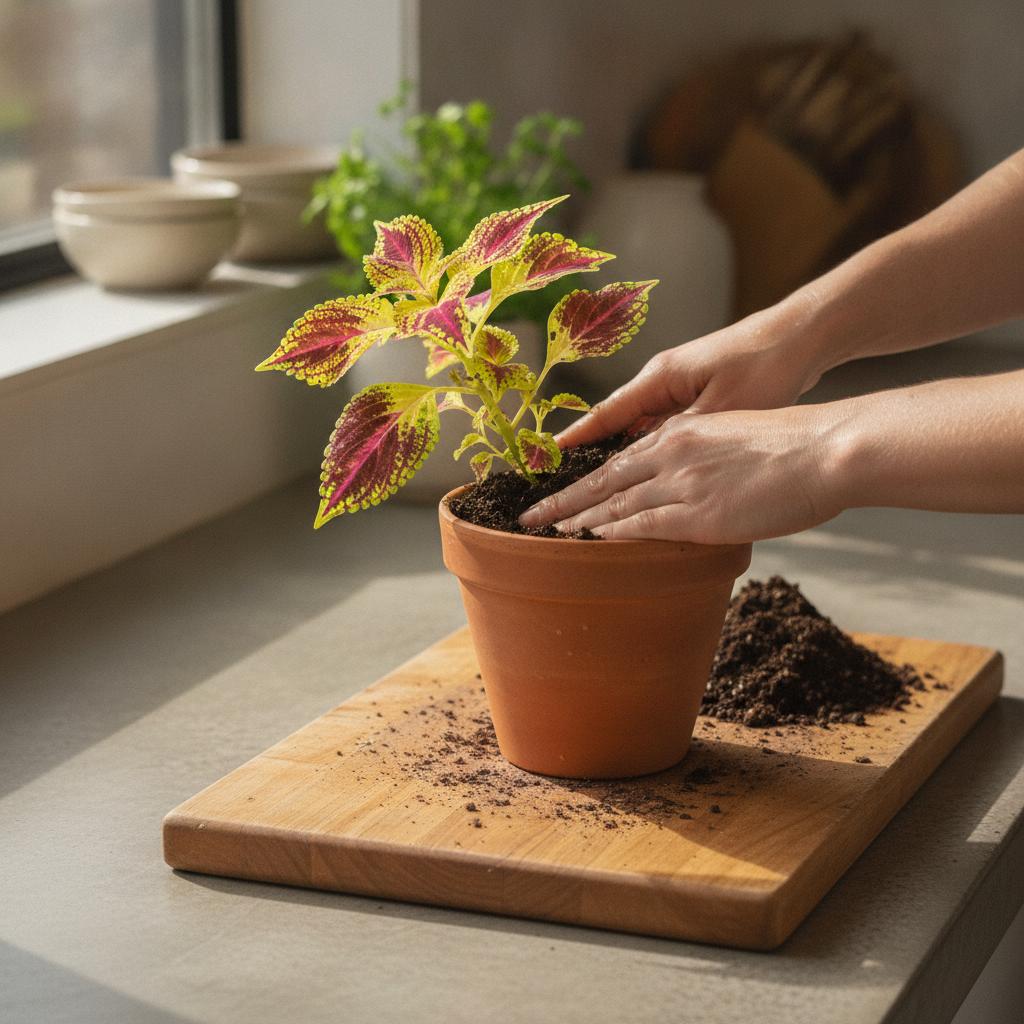
A good general-purpose potting compost forms the backbone of a coleus mix, providing nutrients and moisture retention. To that base, add a portion of perlite or coarse grit to open up the structure and prevent compaction, and a handful of coco coir or fine bark to hold moisture without turning claggy. The result should feel spongy and hold together when squeezed damp, then break apart easily.
| Component | Proportion | Function |
|---|---|---|
| Quality potting compost | 60 percent | Base nutrition and moisture retention |
| Perlite or coarse grit | 20 percent | Aeration and drainage |
| Coco coir or fine bark | 20 percent | Holds moisture evenly without waterlogging |
Coleus prefers a slightly acidic to neutral soil, roughly pH 6.0 to 7.0, which most standard composts already fall within. There is no need to test or adjust the pH for a healthy plant in fresh compost; simply refresh the mix periodically rather than letting the plant sit in old, exhausted soil.
Pro Tip — Quick Mix Recipe: For a fast, reliable blend, combine three handfuls of ordinary houseplant compost with one handful of perlite and one handful of coco coir. It takes a minute to mix and gives coleus exactly the damp-but-airy texture it thrives in.
Choosing the Right Pot
Because coleus grows quickly and drinks heavily, the pot you choose has a real effect on how often you water and how well the roots breathe. The right container balances moisture retention against drainage and gives the fast-growing root system a little room without drowning it in excess soil.
Drainage holes are non-negotiable. Whatever pot you use, it must have holes in the base. Coleus likes moisture but will rot without a route for excess water to escape, and no amount of careful watering fully compensates for a pot that traps water at the bottom.
Pot material: Plastic and glazed ceramic hold moisture longer, which suits this thirsty plant and reduces watering frequency. Unglazed terracotta breathes and dries faster, which lowers rot risk but means you will water more often, a fair trade if you tend to be heavy-handed with the watering can.
Pot size: Choose a pot only 2 to 4 cm wider than the current root ball. Coleus fills a pot fast, but an oversized container holds a large volume of wet soil around a small root system and invites rot, so step up gradually.
When to Repot
Given its pace, coleus may need repotting once or even twice in a single growing season. The signs are familiar: roots emerging from the drainage holes, the plant drying out unusually fast, or growth slowing despite good light and feeding. Spring and early summer are the best times to move up a size, though because coleus is so resilient you can repot almost any time during active growth. Many growers, however, simply take fresh cuttings each year rather than carrying an ageing plant through repeated repottings.
How to Repot: Step-by-Step
- Water the plant a day beforehand so the root ball is moist and holds together.
- Ease the plant out by tipping the pot and supporting the stem base, rather than pulling on the top growth.
- Gently tease apart any tightly circling roots to encourage them to spread into the new soil.
- Add fresh mix to the base of the new pot, then position the plant at the same depth it grew before.
- Fill around the root ball with fresh mix, firming gently to remove large air pockets.
- Water thoroughly and let the pot drain, then return the plant to its bright spot.
Warning — Transplant Shock: A freshly repotted coleus may wilt for a day or two while the roots settle. Keep it out of harsh direct sun and resist the urge to overwater in sympathy, as soggy soil around disturbed roots is far more dangerous than a brief sulk. Normal watering and steady light will see it right.
Fertilising
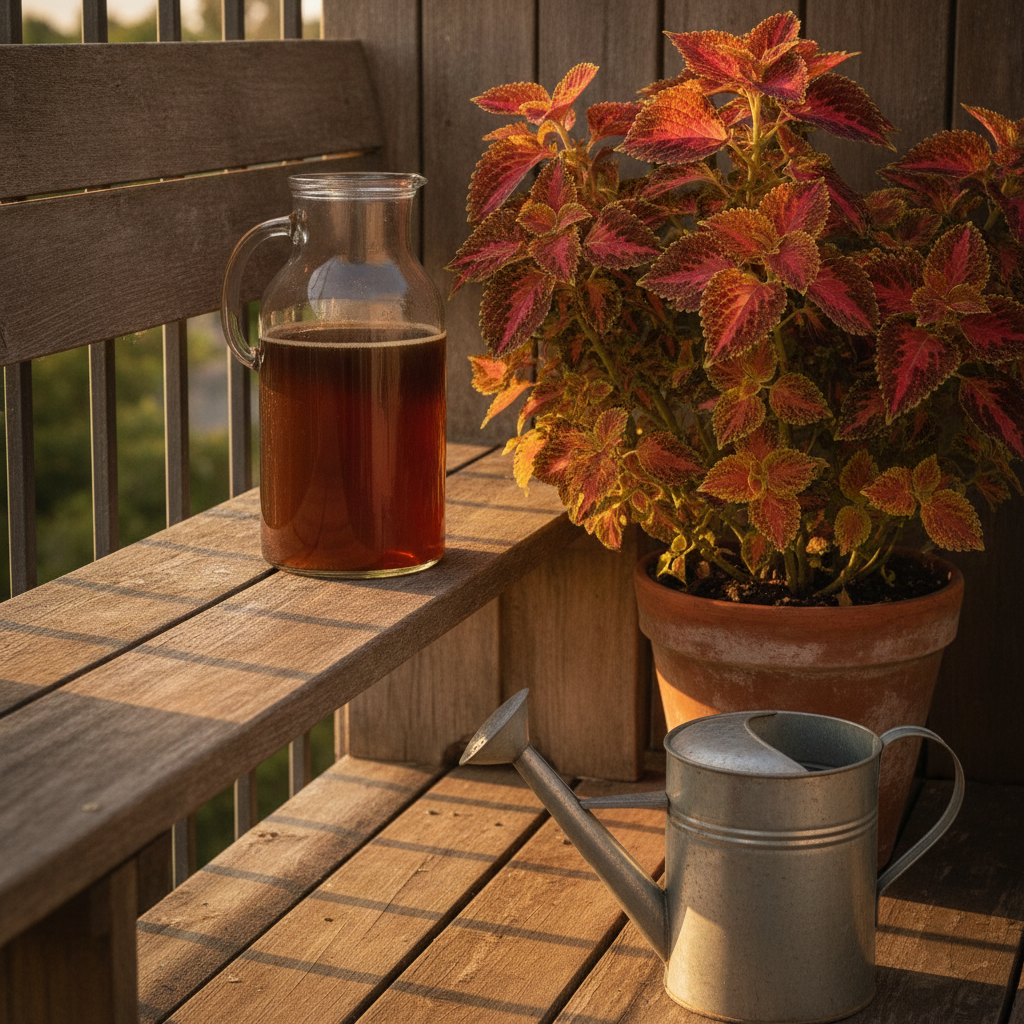
A fast-growing plant is a hungry plant, and coleus rewards regular feeding with the dense, richly coloured growth that makes it worth having. Because you grow it for foliage rather than flowers, the goal is steady, balanced nutrition that fuels leaf production without pushing the plant so hard that quality suffers.
That said, coleus does not need heroic quantities of fertiliser, and there is a subtle trade-off worth knowing: very heavy nitrogen feeding drives lush green growth but can slightly mute the intensity of the coloured pigments. A moderate, balanced approach gives you the best of both, plenty of new leaves and colours that stay vivid.
Understanding Plant Nutrients
Fertilisers are labelled with an NPK ratio, the proportions of nitrogen, phosphorus and potassium, the three nutrients plants need in the largest amounts. For a foliage plant like coleus, a balanced ratio such as 10-10-10, or one only slightly higher in nitrogen, works well. Alongside these, secondary and trace nutrients keep the leaves healthy, and their absence shows up as recognisable symptoms.
| Nutrient | Symbol | Primary Function | Deficiency Symptoms |
|---|---|---|---|
| Nitrogen | N | Leaf and stem growth, green pigment | Overall paling, weak growth, lower leaves yellow first |
| Phosphorus | P | Root development and energy transfer | Stunted growth, dull or purple-tinged leaves |
| Potassium | K | Overall vigour and water regulation | Brown, scorched leaf edges |
| Magnesium | Mg | Core of the chlorophyll molecule | Yellowing between the veins of older leaves |
| Iron | Fe | Chlorophyll production | Yellowing between veins on the newest leaves |
Types of Fertiliser
Liquid fertilisers: The most convenient choice for coleus, dissolved in water and applied during routine watering. They act quickly and let you control the dose precisely, which suits the plant’s steady, moderate appetite.
Slow-release granular: Coated pellets mixed into the soil release nutrients gradually over several months. They are low-effort and useful for a plant you intend to keep through a whole season, though they give you less fine control over the exact feeding rate.
Organic fertilisers: Options such as worm castings, diluted seaweed extract or compost tea feed the plant more gently and improve the soil life. They are forgiving and hard to overdose, making them a safe choice for anyone wary of chemical burn.
Feeding Schedule
During the active growing season of spring and summer, feed with a balanced liquid fertiliser at half the recommended strength every two to four weeks. As growth slows in autumn and light levels fall, taper the feeding right back, and stop altogether in the depths of winter when the plant is barely growing. If you keep a coleus actively growing under grow lights through winter, a light feed roughly once a month is enough.
Pro Tip — Feed Weakly, Weekly: Rather than a full-strength dose now and then, coleus responds beautifully to a very dilute feed, around a quarter strength, applied with most waterings through the growing season. This steady trickle of nutrients supports its rapid growth without ever risking a build-up.
How to Fertilise
- Water the plant lightly first if the soil is very dry, so the feed does not burn dry roots.
- Dilute the fertiliser to half the label rate, or less, in room-temperature water.
- Apply evenly to the soil until it just begins to drain from the base.
- Avoid splashing concentrated feed onto the leaves, which can mark them.
- Flush the pot with plain water every couple of months to clear any accumulated salts.
Warning — Salt Build-Up: Frequent feeding can leave a white, crusty deposit of mineral salts on the soil surface or pot rim, and over time these salts scorch the roots and brown the leaf edges. Flushing the pot thoroughly with plain water every month or two washes them away and keeps the root zone healthy.
Propagation
If coleus has a superpower, it is how effortlessly it propagates. This is a plant that practically wants to be cloned, rooting from stem cuttings so readily that a single specimen can become a dozen within a month. Because the plant is short-lived and tends to grow leggy with age, most growers treat propagation not as an occasional project but as routine maintenance, continually rooting fresh cuttings to replace tired old stems.
The two most reliable methods are rooting cuttings in water, which is almost foolproof and lets you watch the roots develop, and rooting them directly in a moist medium, which produces sturdier young plants with less transplant setback. Both work brilliantly for coleus, and seed sowing is also possible if you want to raise mixed colours from scratch.
Understanding Nodes
The key to coleus propagation is the node, the point on the stem where a pair of leaves attaches. This is where dormant root cells wait, so every successful cutting must include at least one node below the water or soil line. Coleus has square stems, a signature of the mint family, with leaves in opposite pairs, which makes the nodes easy to spot. Strip the leaves from the lowest node and that bare node becomes your rooting zone.
Water Propagation: Step-by-Step
Rooting in water is the classic way to multiply coleus and the most satisfying to watch, with fine white roots appearing within a few days.
- Choose a healthy, non-flowering shoot and cut a 10 to 12 cm length just below a node with clean scissors.
- Remove the leaves from the lower half of the cutting, leaving two or three leaves at the top.
- Place the cutting in a glass of clean, room-temperature water so at least one bare node is submerged.
- Stand the glass in bright, indirect light and refresh the water every two to three days.
- Once roots reach 3 to 5 cm long, usually within one to two weeks, pot the cutting into moist mix.
- Keep the newly potted cutting well watered for its first fortnight while it adjusts to soil.
Pro Tip — Do Not Wait Too Long: Coleus roots grown in water are brittle and adapted to life submerged, so pot cuttings up once the roots are a few centimetres long rather than letting them sprawl. The sooner they meet soil, the more easily they make the transition and the less they sulk.
Soil Propagation: Step-by-Step
Rooting directly in a moist medium skips the water stage entirely and produces tougher, better-adapted young plants, which is why nurseries favour it.
- Take a 10 to 12 cm cutting below a node and strip the lower leaves as for water rooting.
- Optionally dip the cut end in rooting hormone, though coleus rarely needs it.
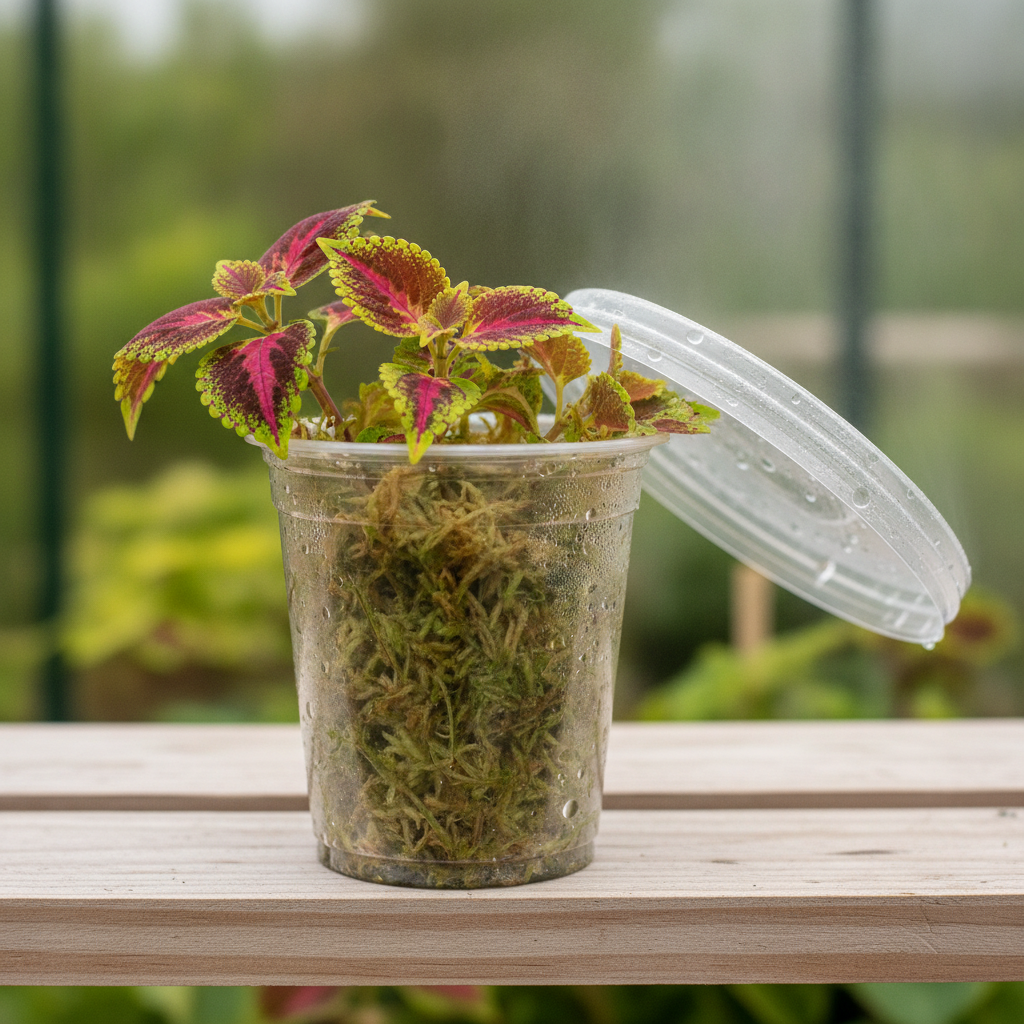
- Insert the cutting into a small pot of damp, free-draining mix or moist sphagnum moss, burying at least one node.
- Firm the medium gently around the stem and water lightly to settle it.
- Cover loosely with a clear bag or propagator lid to hold humidity, keeping it out of direct sun.
- Roots form within one to two weeks; a gentle tug that meets resistance tells you they have taken.
Troubleshooting Propagation
| Problem | Likely Cause | Solution |
|---|---|---|
| Cutting rots in water | Stale water or too little light | Change water more often and move to brighter light |
| No roots after two weeks | No node submerged, or cool conditions | Check a node is below the surface and keep warm |
| Cutting wilts badly | Too many leaves losing moisture | Reduce leaves and raise humidity around the cutting |
| Potted cutting collapses | Shock moving from water to soil | Pot up earlier and keep soil evenly moist at first |
Pests & Diseases
Coleus is reasonably robust, but its soft, sappy leaves are exactly the kind of tender growth that sap-sucking insects love, so it pays to keep an eye out. The good news is that its fast growth means a plant can often outpace minor damage, and its easy propagation gives you an escape route: if an infestation ever gets out of hand, you can simply root clean cuttings and start afresh.
Most trouble is preventable with good basic care and regular inspection. Check the undersides of leaves and the leaf axils every week or two, because catching a problem early is the difference between a quick wipe-down and a full-blown outbreak.

Common Pests
Mealybugs (Pseudococcus species)
These slow-moving insects look like small blobs of white cotton wool tucked into leaf axils and along stems. They suck sap, weaken the plant and leave behind sticky honeydew that encourages sooty mould. On the crowded, sheltered stems of a bushy coleus they can hide easily, so look deep into the growth.
Treatment: Dab each insect with a cotton bud dipped in isopropyl alcohol, then treat the whole plant with insecticidal soap or diluted neem oil, repeating weekly until they are gone.
Spider Mites (Tetranychus urticae)
Tiny and hard to see, spider mites thrive in warm, dry air and reveal themselves through fine pale stippling on the leaves and delicate webbing between stems. They multiply fast, and a heavy infestation can bronze and drop the foliage of a coleus quickly.
Treatment: Rinse the plant thoroughly, including the leaf undersides, raise the humidity to make conditions less favourable, and apply neem oil or a miticide every few days until the mites are cleared.
Whitefly (Trialeurodes vaporariorum)
Whitefly are among the most persistent coleus pests, tiny white moth-like insects that rise in a cloud when the plant is disturbed. Like other sap-suckers they weaken growth and coat the leaves in sticky honeydew, and their fast breeding cycle makes them hard to shift once established.
Treatment: Hang yellow sticky traps to catch the adults, and treat the leaf undersides with insecticidal soap or neem oil every few days to break the breeding cycle over several weeks.
Common Diseases
Root and Stem Rot (Pythium and Rhizoctonia species)
The most common serious problem, caused by keeping the soil too wet for too long. The stem base blackens and softens, the plant wilts despite wet soil, and the roots turn brown and mushy. On a plant that likes to stay moist, the line between damp and soggy is easily crossed.
Treatment: Rot is difficult to reverse, so the best response is to take healthy top cuttings and root them as a fresh start. To prevent it, ensure sharp drainage and never let the pot stand in water.
Downy Mildew (Peronospora species)
A fungal-like disease that has become a notable problem for coleus, showing as leaf drop, distorted growth and a greyish, downy fuzz on the leaf undersides. It spreads in cool, damp, still conditions and can move quickly through a crowded group of plants.
Treatment: Improve air circulation, avoid wetting the foliage, remove affected leaves promptly and dispose of them. Badly affected plants are best replaced with clean cuttings taken from unaffected growth.
Pest and Disease Summary
| Pest / Disease | Identification | Treatment |
|---|---|---|
| Mealybugs | White cottony blobs in leaf axils | Alcohol swab, then insecticidal soap or neem |
| Spider mites | Fine stippling and webbing, dry air | Rinse, raise humidity, apply neem or miticide |
| Whitefly | Tiny white flies rising when disturbed | Yellow sticky traps plus repeated soap sprays |
| Root and stem rot | Blackened soft stem base, wilting in wet soil | Take clean cuttings; improve drainage |
| Downy mildew | Grey downy fuzz on leaf undersides, leaf drop | Improve airflow, remove leaves, replace with cuttings |
Prevention Strategies
The best defence is a healthy, well-lit plant in a mix that drains freely and air that moves gently around the foliage. Avoid overcrowding, keep the leaves dry when you water, and inspect regularly so problems are spotted while they are still small. New arrivals should be kept apart from your other plants for a couple of weeks, since bought-in coleus is a common way that whitefly and mildew enter a collection.
Good hygiene closes the loop: clear away dropped leaves, use clean scissors when taking cuttings, and do not reuse old, contaminated soil. Because coleus renews so readily, keeping a few young cuttings coming along at all times means you always have clean replacements should a mature plant succumb.
Pro Tip — Neem as Routine: A light monthly spray of diluted neem oil on the leaf undersides, applied in the evening out of direct sun, discourages most sap-sucking pests before they establish. Treat it as preventive maintenance rather than waiting for an outbreak.
Popular Varieties
More than perhaps any other houseplant, coleus is defined by its cultivars, and breeders have produced hundreds of them in every conceivable colour and leaf shape. They divide broadly into two camps: seed-raised series that come as mixed colours, and vegetatively propagated named cultivars grown from cuttings to keep their exact colouring true.
Choosing between them comes down to how you intend to grow the plant. Compact, sun-tolerant modern series shine on a bright windowsill, while the larger-leaved and trailing types make bolder statements. The selection below covers the most widely available and reliable choices.
| Variety | Leaf Appearance | Light Needs | Growth Rate | Availability |
|---|---|---|---|---|
| Wizard Mix | Rounded leaves in mixed reds, greens, cream and gold | Bright indirect | Fast, compact | Very common |
| Black Dragon | Ruffled deep burgundy with magenta centres | Bright indirect | Moderate | Common |
| Kong series | Very large leaves, bold colour splashes | Bright, shade-tolerant | Fast, large | Common |
| Wasabi | Frilled, chartreuse-lime foliage | Bright, sun-tolerant | Fast, vigorous | Common |
| Henna | Scalloped copper, rose and green leaves | Bright, sun-tolerant | Moderate | Common |
| Redhead | Uniform deep velvety red | Bright, sun-tolerant | Fast, upright | Common |
Featured Varieties
Wizard Mix
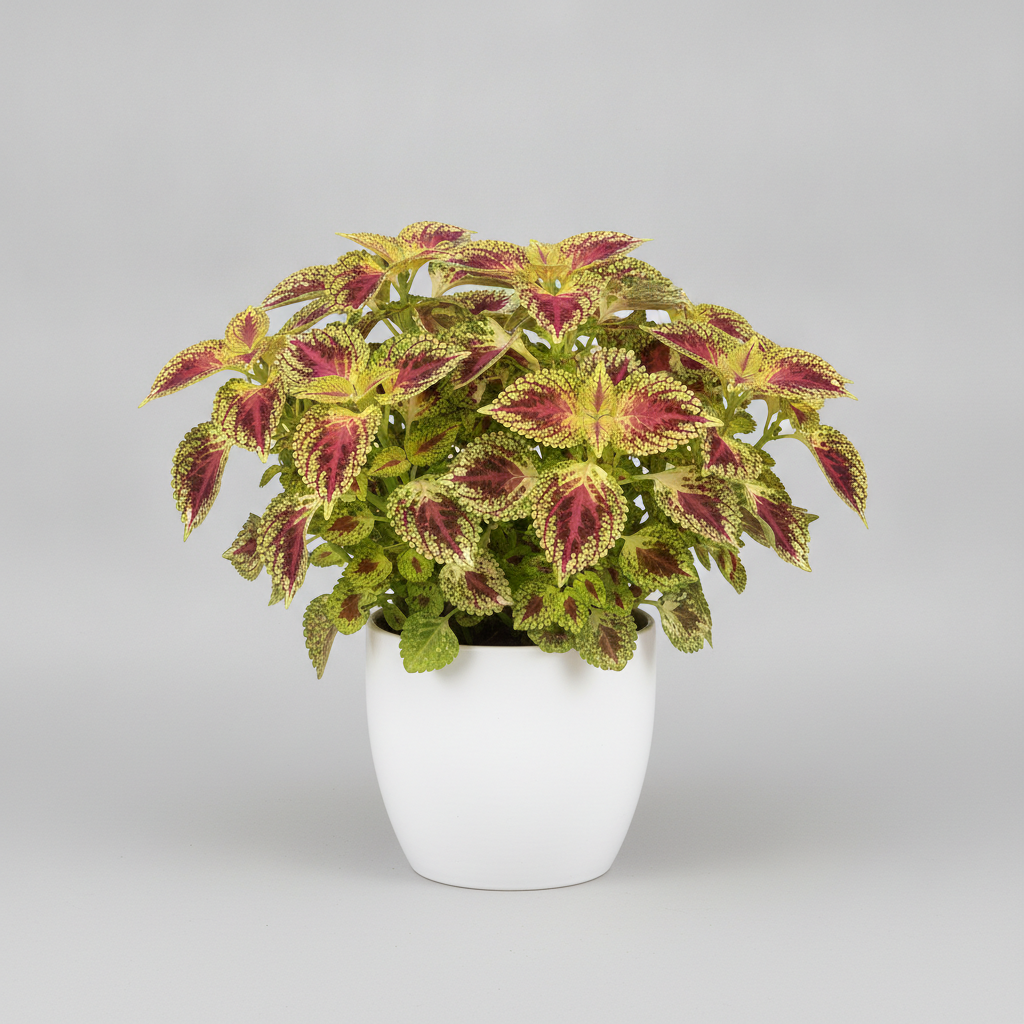
The classic seed-raised series, compact and dependable, with rounded leaves splashed across a rainbow of reds, greens, cream and gold. Its dwarf habit and self-branching growth make it the easiest coleus for a windowsill.

Black Dragon
A dramatic cultivar with deeply ruffled, fringed leaves in the darkest burgundy-purple, lit from within by bright magenta centres. Its moody colouring and unusual texture make it a striking counterpoint to the brighter mixes.
Variety Profiles in Detail
Kong Series (Coleus blumei)
Bred for sheer size, the Kong series produces enormous leaves up to 15 cm across in bold splashes of colour. It prefers a little shade and shelter from strong sun and wind, which can tatter its oversized foliage, making it a fine choice for a bright but not scorching interior spot where its scale can be appreciated.
Wasabi (Coleus blumei)
An acid-green, frilled cultivar whose luminous chartreuse leaves brighten any grouping and contrast beautifully with darker types. It is notably sun-tolerant and vigorous, holding its colour well in strong light where many older coleus would bleach.
Henna (Coleus blumei)
Distinctive for its scalloped, deeply cut leaves in coppery rose and green, with burgundy undersides that show as the foliage moves. Sun-tolerant and elegant, Henna brings a warmer, more autumnal palette than the primary-coloured mixes.
Choosing the Right Variety for Your Space
For a sunny windowsill, lean toward the modern sun-tolerant cultivars such as Wasabi, Henna or Redhead, which keep their colour in strong light. For a bright but less intense spot, the large-leaved Kong types or the reliable Wizard Mix will thrive without scorching. If you want maximum drama, pair a dark cultivar like Black Dragon against a luminous lime such as Wasabi, and remember that because coleus is so easy to propagate, you can build a whole coordinated collection from a handful of cuttings.
Frequently Asked Questions
Why is my coleus losing its bright colours?
The most common cause is too little light. The pigments that create the reds and pinks are produced in response to bright light, so a plant in a dim spot fades to green. Move it to a brighter position and the colour returns on the new growth within a few weeks.
Should I let my coleus flower?
Generally no. Coleus produces small spikes of blue or white flowers, but flowering diverts energy away from foliage and can make the plant leggy and short-lived. Pinch out the flower spikes as they appear to keep the plant bushy and the leaves at their best.
How do I keep my coleus bushy instead of leggy?
Pinch out the growing tips regularly. Removing the tip of a stem forces the plant to branch from the nodes below, and repeated pinching every few weeks builds a dense, full plant. Good light also keeps the internodes short and the growth compact.
Why is my coleus wilting even though the soil is moist?
Wilting in wet soil usually points to root rot from overwatering rather than thirst. Check the stem base and roots: if they are soft, dark and mushy, take healthy cuttings from the top and root them, as a rotted plant rarely recovers.
Can I grow coleus as a houseplant year-round?
Yes. Although often grown as a summer bedding annual, coleus is a tender perennial that lives happily indoors all year given warmth and bright light. Many people bring cuttings inside over winter and keep the line going indefinitely rather than starting over each spring.
How cold can coleus tolerate?
Not very. Coleus is frost tender and begins to suffer below about 10 C (50 F), with cold damage showing as blackened, collapsing leaves. Keep it in warm rooms, away from cold draughts and unheated porches, and never leave it outside once nights turn chilly.
Is coleus safe around pets?
No, it is mildly toxic. Coleus contains volatile oils that can cause vomiting, diarrhoea and lethargy in cats and dogs if eaten, and the sap can irritate skin. Keep it out of reach of pets and children, and wash your hands after handling cuttings.
How long does a coleus plant live?
Individual plants are relatively short-lived, often looking their best for a year or two before becoming woody and leggy. The plant compensates with its extraordinary ease of propagation, so most growers simply root fresh cuttings each year and effectively keep the same plant going forever.






