
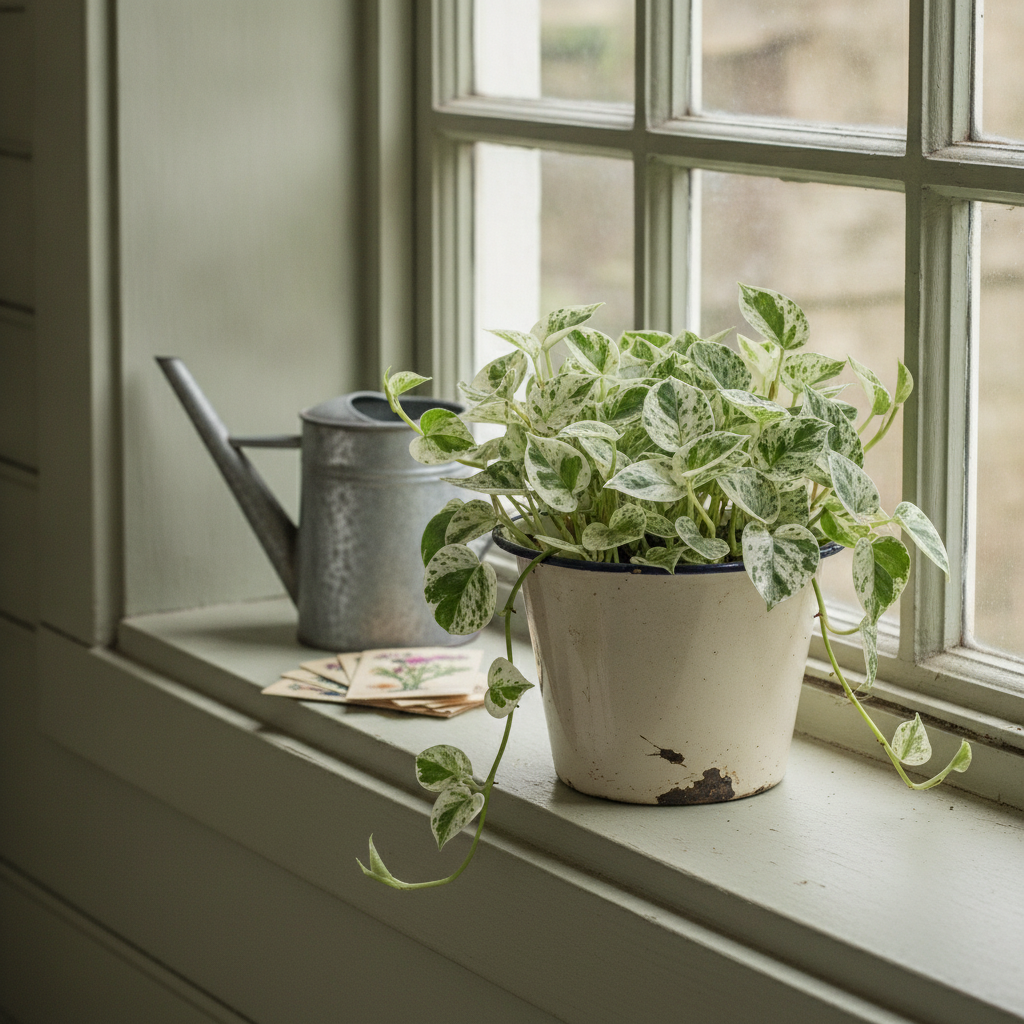
Among the sprawling family of pothos cultivars, the Pearls and Jade Pothos stands out for being deliberately small. Where its cousins race across bookshelves and swallow trellises, this is a slower, daintier plant whose compact leaves are painted with green centres and irregular cream and silvery-white margins, each edge flecked with tiny green and grey speckles that look as if they were stippled on by hand. It is a patented cultivar of Epipremnum aureum, developed at the University of Florida as a mutation of the older ‘Marble Queen’, and it has earned a permanent place on windowsills precisely because it stays in scale with the spaces most of us actually live in.
Pothos in general carry a reputation as the houseplant you cannot kill, and the Pearls and Jade Pothos inherits most of that toughness. It will survive in mediocre light, irregular watering and ordinary room humidity. Thriving, though, is a different matter, and a heavily variegated plant like this one asks for a little more attention than a plain green pothos to keep its colouring crisp and its growth tidy rather than leggy. This guide walks through everything from light and water to soil, feeding, propagation and pests, with the goal of moving your plant from merely alive to genuinely flourishing.
Contents
- Quick Reference
- Why Pearls and Jade Pothos Makes a Rewarding Houseplant
- Light Requirements
- Watering & Humidity
- Soil, Potting & Repotting
- Fertilising
- Propagation
- Pests & Diseases
- Popular Varieties
- Frequently Asked Questions
Quick Reference: Pearls and Jade Pothos at a Glance
| Light | Bright, indirect light. Tolerates medium light but variegation fades and growth slows in anything dim. |
| Watering | When the top 2 to 3 cm (1 inch) of soil is dry, roughly every 7 to 10 days in summer and less in winter. |
| Temperature | 18 to 29 degrees Celsius (65 to 85 degrees Fahrenheit). Keep above 12 degrees Celsius (54 degrees Fahrenheit). |
| Humidity | Average household humidity of 40 to 60 percent is fine. Appreciates a little more. |
| Fertiliser | Balanced liquid feed at half strength every 4 to 6 weeks during spring and summer. |
| Toxicity | Toxic to cats, dogs and humans if chewed or swallowed, due to insoluble calcium oxalate crystals. |
Why Pearls and Jade Pothos Makes a Rewarding Houseplant
The appeal of this cultivar begins with its restraint. A mature Pearls and Jade Pothos rarely overwhelms a shelf the way a golden pothos can, and its smaller leaves, typically 5 to 8 cm (2 to 3 inches) long, give it a delicate, almost lacy presence. The variegation is its signature: rather than the bold creamy streaks running through the centre of a Marble Queen leaf, here the white and silver gather along the leaf margins, where they are dusted with fine green speckling. No two leaves are identical, and that quiet variability is what keeps the plant interesting long after the novelty of a new purchase wears off.

Practically speaking, it is also forgiving. The plant copes with the occasional missed watering, adapts to a range of indoor conditions and signals its needs clearly through its foliage long before any real harm is done. Because it grows more slowly than green pothos, it stays presentable in the same pot for longer and needs repotting less often, which suits anyone who would rather not be constantly potting up. It works equally well trailing from a high shelf, climbing a small moss pole or sitting compactly on a desk, and it tolerates the warm, sometimes dry air of centrally heated homes better than most decorative aroids.
Important — Toxicity: All parts of the Pearls and Jade Pothos contain insoluble calcium oxalate crystals. Chewing or swallowing leaves can cause intense oral irritation, drooling, vomiting and difficulty swallowing in cats, dogs and humans. Keep the plant out of reach of pets and small children, and wash your hands after taking cuttings, as the sap can irritate sensitive skin.
Light Requirements
Light is the single most important factor in keeping a Pearls and Jade Pothos looking its best, far more so than for a plain green pothos. The white and silver sections of each leaf contain little or no chlorophyll, which means they cannot photosynthesise. The plant relies entirely on its green tissue to produce energy, so it needs noticeably brighter conditions than a fully green cultivar simply to power the same amount of growth.
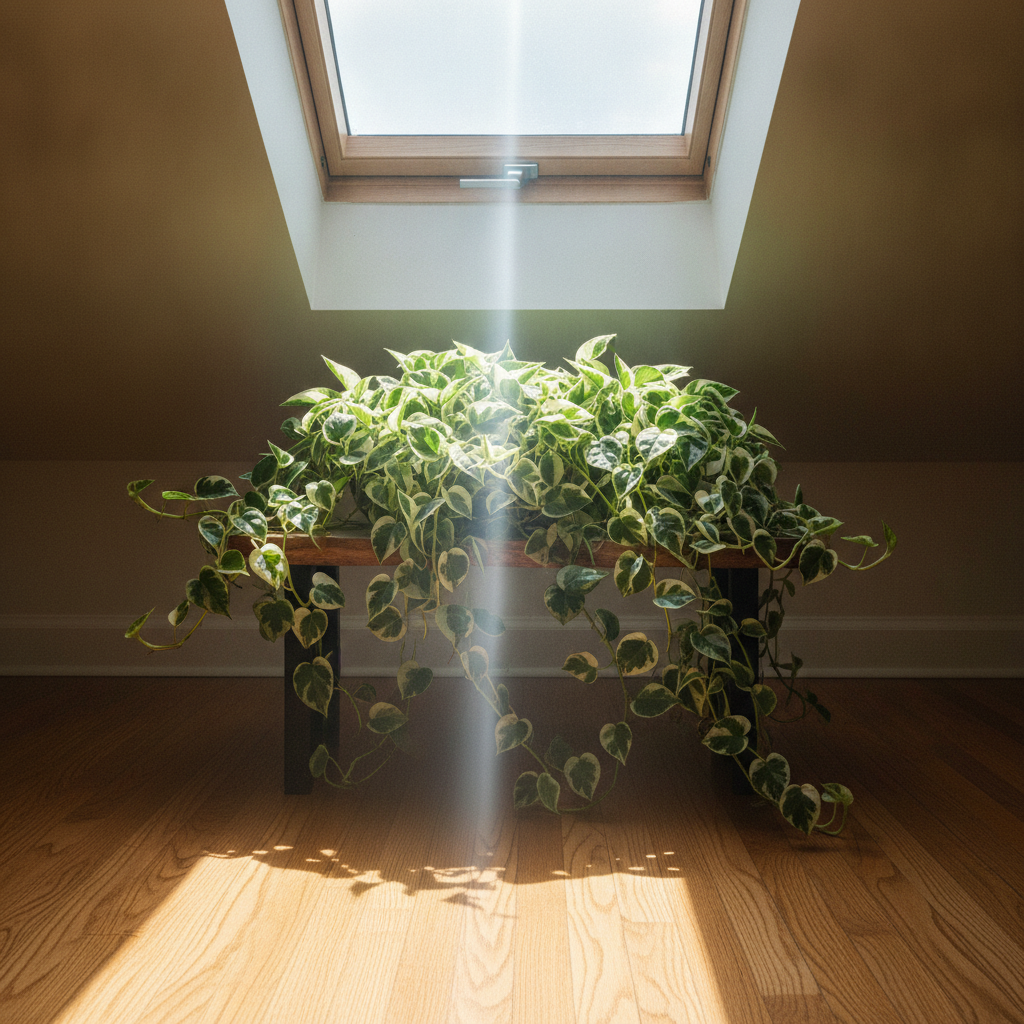
The ideal is bright, indirect light: a position a metre or two back from an east or west window, or close to a south window screened by a sheer curtain. In this kind of light the variegation stays sharp, new leaves emerge well marked and the vines extend at a steady, healthy pace. Too little light and the plant compensates by producing leaves with more green and less white, a survival strategy that dulls the very feature you bought it for.
Light Levels Explained
Indoor light is easy to overestimate, because our eyes adjust constantly and a spot that looks bright to us may be quite dim to a plant. The table below gives a rough guide to where a Pearls and Jade Pothos sits within common indoor light categories and what to expect from each.
| Light Category | Approx. Level | Typical Location | Outcome |
|---|---|---|---|
| Direct sun | Over 50,000 lux | On an unscreened south windowsill | Risk of scorched, bleached patches on the white areas |
| Bright indirect | 10,000 to 25,000 lux | Near an east or west window | Ideal: strong variegation and steady growth |
| Medium | 5,000 to 10,000 lux | A metre or two into a bright room | Acceptable: slower growth, slightly greener leaves |
| Low | 1,000 to 5,000 lux | A north corner or interior wall | Survives but variegation fades and stems stretch |
| Very low | Under 1,000 lux | A hallway or windowless room | Decline over time, leggy and pale growth |
Window Orientation and Placement
South-facing window: Offers the most light, which suits this variegated cultivar, but the plant should be set back from the glass or shielded with a sheer curtain so that the white leaf areas are not exposed to harsh midday sun.
East-facing window: An excellent choice. Gentle morning sun followed by bright indirect light for the rest of the day keeps the variegation crisp without any risk of scorching.
West-facing window: Also very good, providing bright afternoon light. Keep the plant just off the sill so the strongest late rays are filtered rather than falling directly on the foliage.
North-facing window: Usable but the weakest option. The plant will survive, yet you should expect slower growth and a gradual loss of white in the leaves. A grow light makes a meaningful difference here.
Pro Tip — Rotate for Even Growth: Pothos lean noticeably towards their light source. Give the pot a quarter turn each time you water so the plant develops a balanced, full shape instead of sending all its longest vines in one direction.
How Light Affects Variegation
The relationship between light and variegation is the defining quirk of this plant. In strong indirect light the plant can afford to keep large white and silver margins, because its green tissue is producing energy efficiently. Move it somewhere dim and it begins to hedge, pushing out leaves with broader green centres and narrower pale edges so that more of each leaf can photosynthesise. This change is gradual and reversible: return the plant to brighter conditions and subsequent leaves will once again show the speckled cream borders. If a few all-green leaves appear, you can prune them out to encourage the plant to keep producing variegated growth.
Warning — Direct Sunlight: The chlorophyll-free white areas have no protection against intense sun and burn easily, developing crisp brown or translucent patches that never recover. A plant that has been in low light is especially vulnerable, so move it into stronger light gradually over a week or two rather than all at once.
Artificial Lighting
Because variegated pothos are hungry for light, they respond well to supplementary lighting in rooms that lack a good window. A standard full-spectrum LED grow light positioned 30 to 45 cm (12 to 18 inches) above the plant and run for 10 to 12 hours a day is more than enough to maintain growth and colour through the darkest months. An ordinary desk LED helps a little, but a dedicated horticultural bulb gives far better results for the variegation.
Seasonal Adjustments
Light levels indoors can fall by half or more between summer and midwinter, even in the same spot. As the days shorten, move the plant closer to its window to compensate, and clean the glass and the leaves so nothing dims the available light further. In summer, watch that the strengthening sun does not start to strike the foliage directly through a south or west window, and pull the plant back or add a sheer screen if it does.
Watering & Humidity
If there is one thing that kills more pothos than anything else, it is overwatering. The Pearls and Jade Pothos stores a little moisture in its stems and leaves and strongly prefers to dry out partly between drinks. Its roots need air as much as water, and soil that stays permanently wet quickly suffocates them and invites rot. The goal is a rhythm of thorough soaking followed by partial drying, rather than frequent light sips.
When to Water
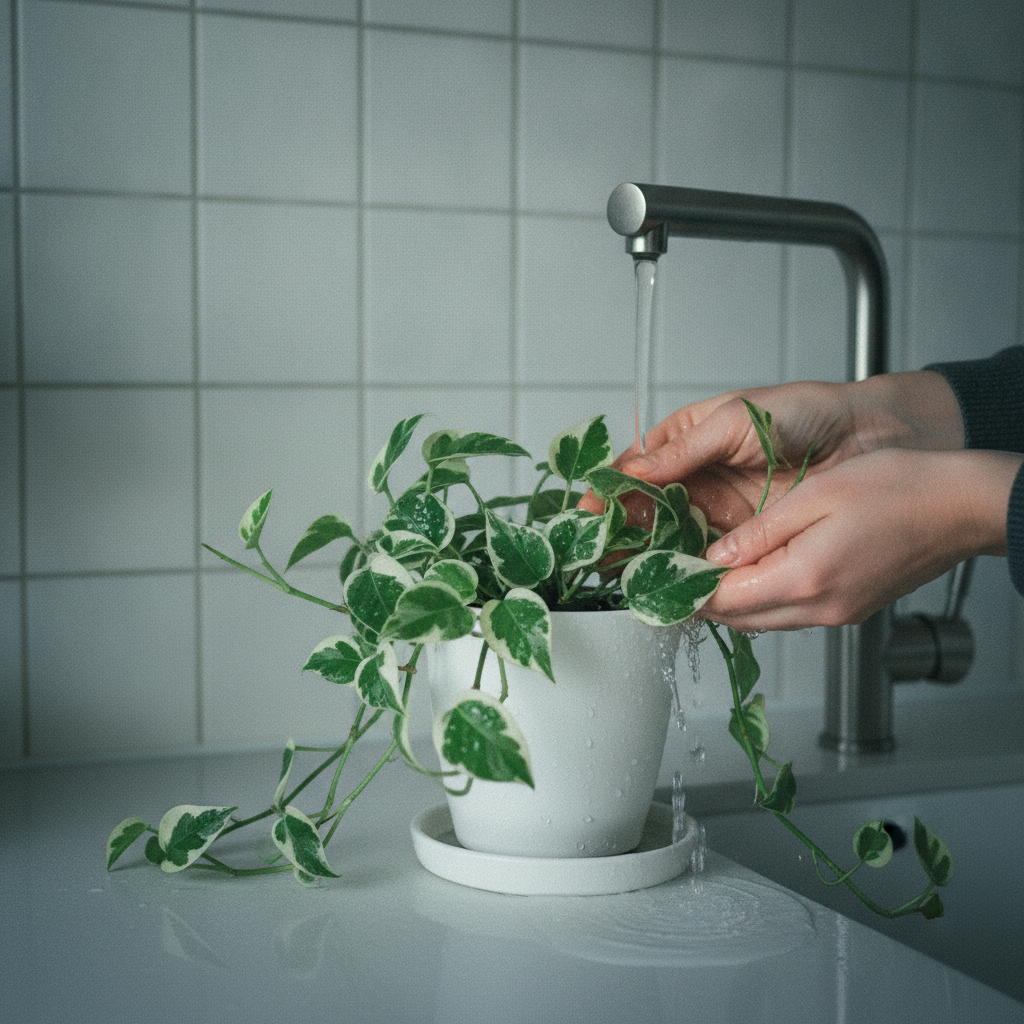
The most reliable method is simply to check the soil. Push a finger into the top of the pot, and when the top 2 to 3 cm (about 1 inch) feels dry, it is time to water. In a bright, warm spot during the growing season this usually works out to roughly once every 7 to 10 days, but treat that as a loose guide rather than a fixed schedule, because pot size, light, temperature and the time of year all shift the timing.
The plant is also good at telling you when it is genuinely thirsty. Leaves that look slightly limp or softly curled, and lift again within hours of watering, are a clear sign you have left it a touch too long. Leaves that stay firm but the soil that has pulled away from the side of the pot tell the same story. Over time you will learn the weight of the pot when wet versus dry, which becomes the quickest check of all.
Pro Tip — Lift the Pot: A freshly watered pot is surprisingly heavy, and a dry one feels light. Lifting the plant becomes a far more accurate gauge of soil moisture than any calendar, especially once you know the difference by feel.
How to Water Correctly
- Take the plant to a sink or use a watering can with a narrow spout, and check that the soil surface is dry to the depth of about one finger joint.
- Pour water evenly across the whole surface of the soil, working slowly so it soaks in rather than running straight down the sides.
- Continue until water flows freely from the drainage holes at the base, which ensures the entire root ball has been moistened.
- Let the pot drain fully for several minutes so no excess sits at the bottom.
- Empty the saucer or cover pot completely, never leaving the plant standing in collected water.
- Return the plant to its spot and wait until the top of the soil dries again before repeating.
Signs of Overwatering vs. Underwatering
| Symptom | Overwatering | Underwatering |
|---|---|---|
| Leaf colour | Yellowing, often several leaves at once | Browning, crisp tips and edges |
| Leaf texture | Soft, limp and translucent | Dry, papery and curling |
| Soil | Stays wet for many days, may smell sour | Bone dry, pulling away from the pot |
| Roots | Brown, mushy and foul smelling | Dry and brittle but still pale |
| Stem base | Soft, blackened and collapsing | Firm but slightly shrivelled |
Warning — Root Rot: Persistent overwatering leads to root rot, the most common cause of death in pothos. If the soil smells sour and the stem base feels soft, unpot the plant at once, trim away any brown mushy roots with clean scissors, and repot into fresh, dry, well-draining mix. Salvaging healthy cuttings is often the surest rescue.
Humidity Requirements
Pearls and Jade Pothos is admirably relaxed about humidity. It grows perfectly well in the 40 to 60 percent range found in most homes and does not demand the steamy conditions that fussier aroids insist on. That tolerance is a large part of why it is such a dependable houseplant, surviving the dry air of centrally heated rooms without much complaint.
That said, very dry air, below about 30 percent, can show up as crisp brown leaf tips, particularly in winter when radiators are running. It is rarely serious, but if you notice it creeping in, a modest lift in humidity will smooth out the new growth and keep the foliage looking clean.
Raising humidity is simple. Grouping plants together creates a slightly moister pocket of air, a pebble tray of water beneath the pot helps locally, and in a particularly dry room a small humidifier solves the problem outright. Misting offers only a fleeting benefit and, if overdone on still foliage, can encourage fungal spots, so it is the least effective of the options.
Water Quality
Ordinary tap water is fine for this plant in most areas. If your supply is heavily chlorinated or you notice brown tips that you cannot attribute to dryness, let tap water stand uncovered overnight before using it, which allows some chlorine to dissipate, or switch to filtered or collected rainwater. Lukewarm water is gentler on the roots than a cold shock straight from the tap.
Soil, Potting & Repotting
The right growing medium does much of the work of keeping a pothos healthy, because it governs how quickly the roots can breathe again after each watering. Pearls and Jade Pothos wants a mix that holds enough moisture to stay lightly damp for a few days yet drains freely and never turns to mud. A dense, water-retentive compost used on its own is the quickest route to the root rot described above.
Ideal Soil Composition
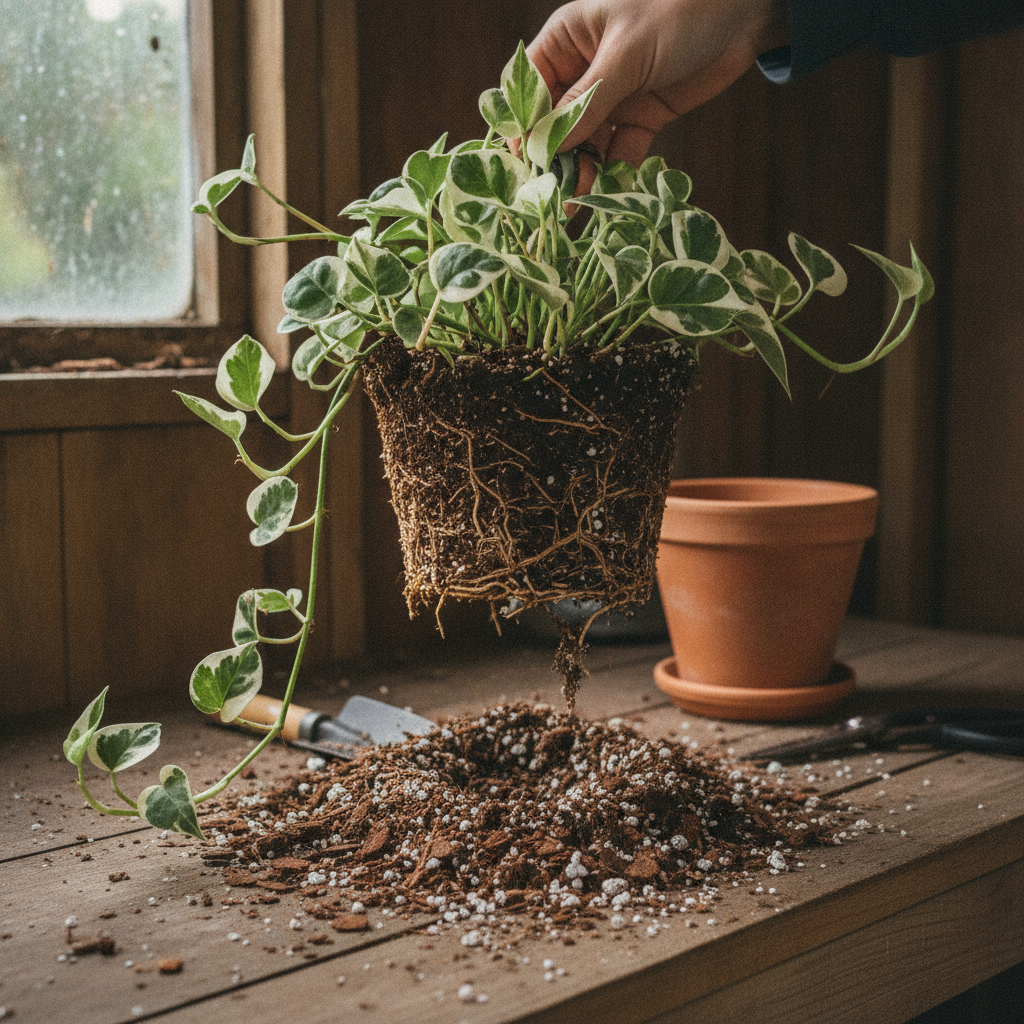
Aim for an airy, chunky blend built around a good houseplant compost but opened up with coarse, free-draining materials. A common and effective recipe combines a base potting mix with perlite for aeration, orchid bark for structure and a little coco coir or worm castings to hold moisture and nutrients. The proportions below make a reliable starting point that you can adjust to your own watering habits.
| Component | Proportion | Function |
|---|---|---|
| Houseplant potting compost | 50 percent | Base structure and nutrient holding |
| Perlite | 25 percent | Aeration and free drainage |
| Orchid bark | 15 percent | Chunky structure and air pockets for roots |
| Coco coir or worm castings | 10 percent | Even moisture retention and gentle feeding |
The plant is not fussy about acidity, but it does best in a slightly acidic to neutral medium, somewhere around pH 6.1 to 6.8. A standard peat-free houseplant compost naturally falls within this range, so for most growers there is no need to test or adjust it.
Pro Tip — Quick Mix Recipe: If you would rather not buy multiple ingredients, take a bag of general houseplant compost and stir in roughly one large handful of perlite for every two handfuls of compost. That single addition transforms drainage and is enough to keep most pothos happy.
Choosing the Right Pot
The container matters as much as what goes in it. Because this is a compact, slower-growing cultivar, it is happy in a relatively snug pot and does not need to be moved up in size often.
Drainage holes are non-negotiable. Whatever the material or style, the pot must have holes at the base so excess water can escape. A decorative cover pot without drainage is fine as an outer shell, provided you lift the inner nursery pot out to water and let it drain fully before returning it.
Pot material: Terracotta is porous and wicks moisture from the soil, which suits anyone prone to overwatering, while glazed ceramic and plastic hold moisture longer and need watering less often. Either works well as long as you adjust your watering rhythm to the pot you have chosen.
Pot size: Choose a pot only 2 to 3 cm (1 inch) wider than the current root ball. An oversized pot holds a large volume of wet soil that the modest root system cannot use, which keeps the medium soggy and raises the risk of rot.
When to Repot
Pearls and Jade Pothos needs repotting only every two to three years, less often than faster pothos. The signs are easy to read: roots emerging from the drainage holes or circling the surface, water running straight through without wetting the soil, or growth that has visibly slowed despite good light and feeding. The best time to repot is spring or early summer, when the plant is actively growing and recovers quickly. Move it up just one pot size, refreshing the surrounding mix at the same time.
How to Repot: Step-by-Step
- Water the plant a day or two beforehand, as a slightly moist root ball slides out more cleanly and suffers less stress.
- Gently ease the plant from its pot, supporting the base of the stems and teasing the roots loose if they have begun to circle.
- Inspect the roots and trim away anything brown, soft or rotten with clean, sharp scissors.
- Add a layer of fresh, airy mix to the base of the new pot so the plant will sit at the same depth as before.
- Position the plant in the centre and fill around the sides with mix, firming gently to remove large air gaps without compacting it.
- Water thoroughly to settle the soil, then let the pot drain completely.
- Return the plant to bright, indirect light and hold off on feeding for four to six weeks while the roots settle in.
Warning — Transplant Shock: A little drooping in the first few days after repotting is normal as the roots re-establish. Resist the urge to water more or move the plant around in response. Keep conditions stable, water only when the soil dries, and the plant will recover on its own within a week or two.
Fertilising
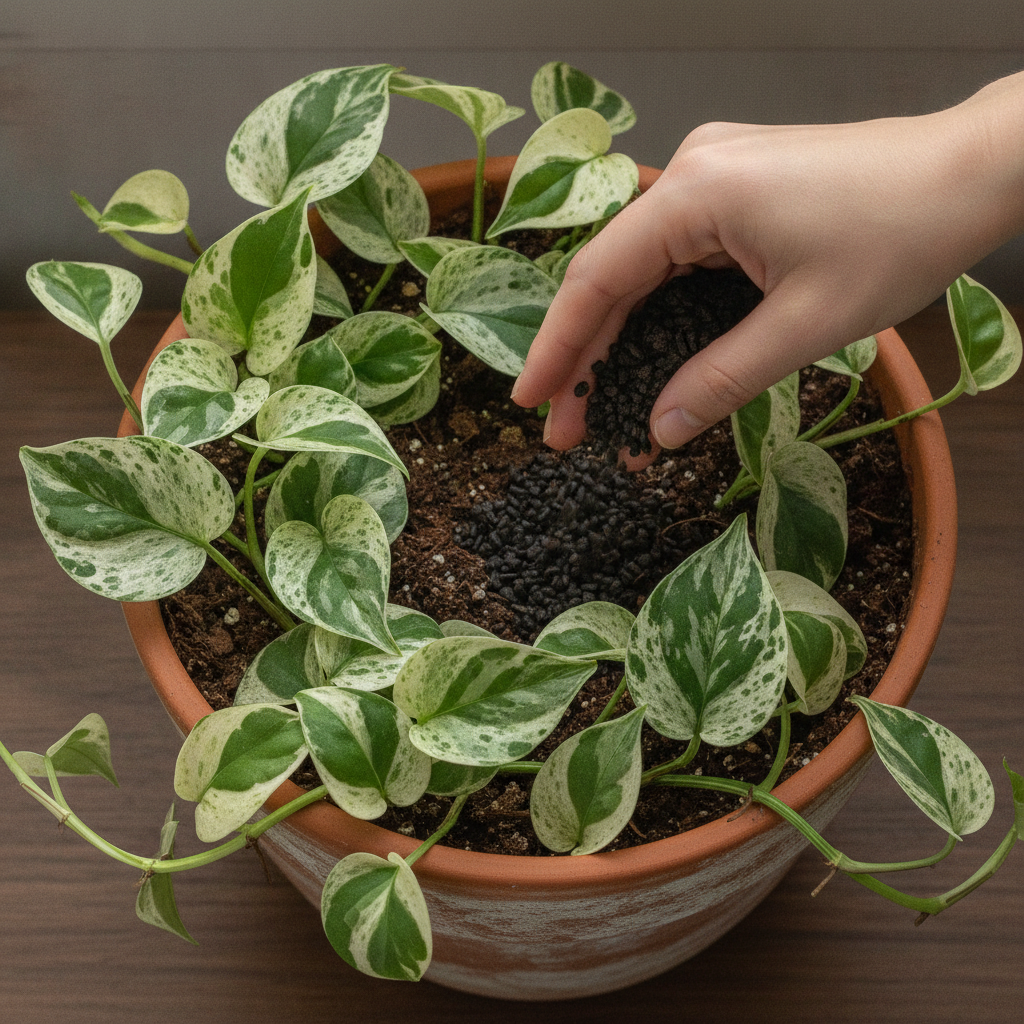
Pothos are light feeders, and the Pearls and Jade Pothos, being a slower grower, needs even less than most. A modest, regular feed through the growing season is all it asks, and the most common fertilising mistake by far is giving too much rather than too little.
Feeding supports new growth and keeps the foliage a healthy colour, but it cannot substitute for good light, and no amount of fertiliser will brighten variegation on a plant kept in a dim corner. Think of feeding as a supplement to the right conditions, not a fix for the wrong ones.
Understanding Plant Nutrients
Most houseplant fertilisers are labelled with three numbers, the N-P-K ratio, showing the proportions of nitrogen, phosphorus and potassium. A balanced feed where these are roughly equal suits a foliage plant like pothos well. Plants also need smaller amounts of secondary nutrients and trace elements, which a good general fertiliser supplies. The table below summarises what each does and how a shortage tends to show.
| Nutrient | Symbol | Primary Function | Deficiency Symptoms |
|---|---|---|---|
| Nitrogen | N | Leaf and stem growth, green colour | Pale, yellowing older leaves and weak growth |
| Phosphorus | P | Root development and energy transfer | Stunted growth and dull foliage |
| Potassium | K | Overall vigour and water regulation | Yellow or browning leaf margins |
| Calcium | Ca | Cell wall structure | Distorted, weak new growth |
| Magnesium | Mg | Core of the chlorophyll molecule | Yellowing between the veins of older leaves |
| Iron | Fe | Chlorophyll production | Yellowing between the veins of new leaves |
Types of Fertiliser
Liquid fertilisers: The easiest option for pothos. Diluted into water and applied during normal watering, they give you precise control over the dose and are simple to dial back or pause. A balanced houseplant feed at half the recommended strength is ideal.
Slow-release granular: Coated pellets that release nutrients gradually over several months. Convenient for those who forget to feed, though they offer less control, and in a slow grower like this it is easy to apply more than the plant can use.
Organic fertilisers: Worm castings, compost-based feeds and diluted seaweed gently nourish the plant and improve the soil over time. They are very forgiving and almost impossible to overdo at sensible rates, which makes them a safe choice for a cautious grower.
Feeding Schedule
Feed only during the active growing season, from spring through to early autumn, applying a balanced liquid fertiliser at half strength roughly every four to six weeks. Through late autumn and winter, when growth naturally slows or stops, stop feeding entirely. Fertiliser applied to a dormant plant simply accumulates in the soil as unused salts.
Pro Tip — Less Is More: When in doubt, underfeed. A pothos given slightly too little fertiliser will grow a touch more slowly but stay healthy, whereas one given too much develops scorched brown leaf tips and a crust of salts on the soil that is far harder to put right.
How to Fertilise
- Water the plant lightly first, or feed onto already moist soil, never onto a bone-dry root ball where concentrated feed can burn the roots.
- Dilute a balanced liquid fertiliser to half the strength stated on the label.
- Apply the solution evenly across the soil surface in place of a normal watering.
- Let any excess drain away fully and empty the saucer so no fertiliser-laden water sits at the base.
- Mark the date so you can space the next feed four to six weeks later through the growing season.
Warning — Salt Build-Up: Over time, fertiliser salts accumulate in the soil and can show as a white crust on the surface or pot rim and as browning leaf tips. Every few months, flush the pot by running plenty of plain water through it until it drains freely from the base, which washes the excess salts away.
Propagation
One of the quiet pleasures of growing pothos is how readily it propagates. A single healthy vine can be turned into several new plants with nothing more than a pair of scissors and a jar of water, and because Pearls and Jade Pothos grows slowly, propagating is also the fastest way to build a fuller, bushier plant by rooting cuttings and replanting them back into the parent pot.
Spring and summer are the best times, when the plant is in active growth and cuttings root quickly. The key to success is understanding where roots come from, and on a pothos that means the nodes.
Understanding Nodes
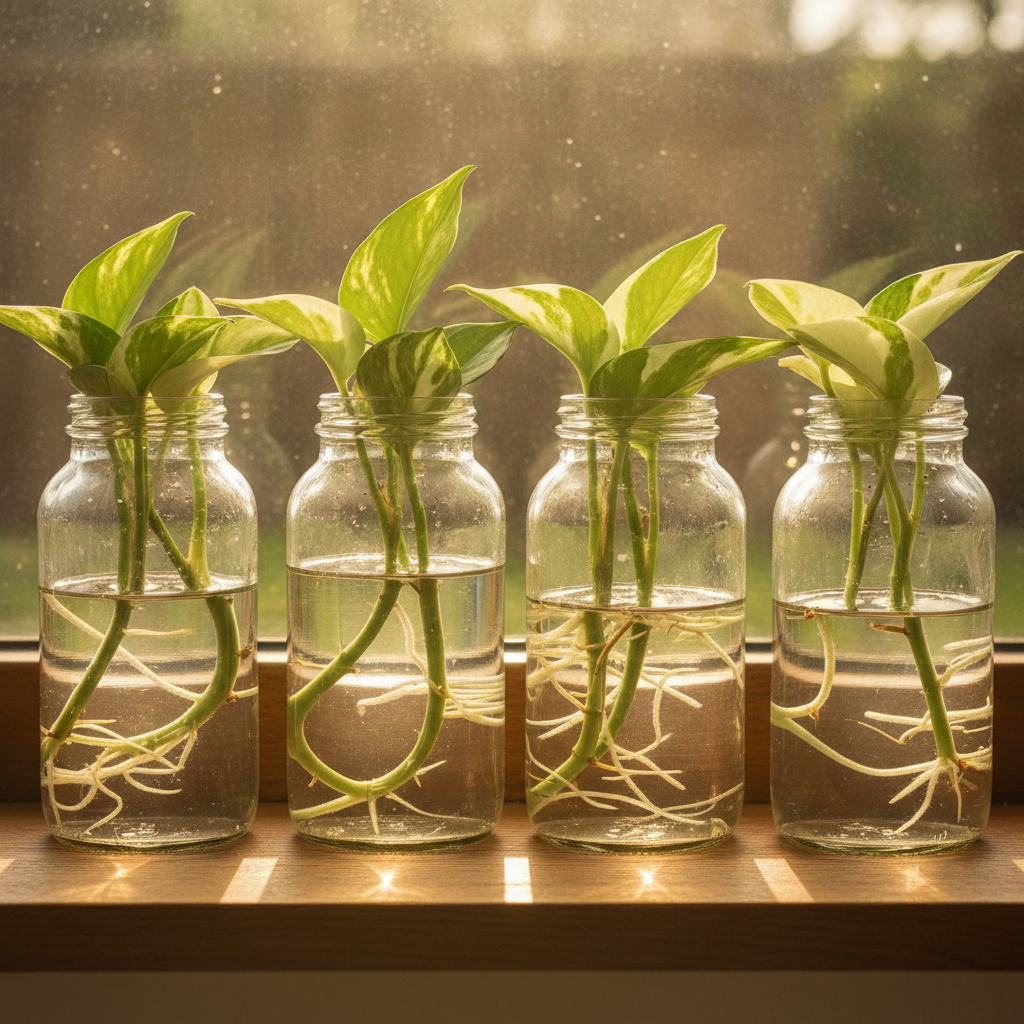
A node is the slightly raised bump on the stem where a leaf joins it, often with a small brown nub, an aerial root, just below. This is the only point from which a cutting will produce new roots. A cutting that includes at least one node will root; a cutting of leaf and stem with no node will not, however healthy the leaf looks. Once you can spot nodes, propagation becomes almost foolproof.
Water Propagation: Step-by-Step
Rooting cuttings in water is the simplest method and has the advantage that you can watch the roots develop, which makes it especially satisfying for newer growers.
- Choose a healthy vine and cut just below a node with clean scissors, taking a section with one or two leaves and at least one node.
- Remove the lowest leaf so that the bare node will sit beneath the water without any foliage submerged.
- Place the cutting in a clear glass of room-temperature water, keeping the leaves above the surface.
- Set the glass in bright, indirect light and refresh the water every three to five days to keep it clean and oxygenated.
- Wait for white roots to grow from the node, which usually takes two to four weeks.
- Once the roots are 3 to 5 cm (1 to 2 inches) long, pot the cutting into moist, airy mix and keep it slightly more humid for the first couple of weeks as it adjusts.
Pro Tip — Pot Up Promptly: Cuttings left in water for many weeks develop fine, brittle water roots that struggle to adapt to soil. Move them into mix once the roots reach a few centimetres long, while they are still able to transition smoothly.
Soil Propagation: Step-by-Step
Rooting straight into soil skips the transition step and often produces sturdier roots from the outset, though you cannot see progress as it happens.
- Take cuttings in the same way, each with one or two leaves and at least one node, and remove the lowest leaf.
- Optionally dip the cut end in rooting hormone to speed things along, though pothos rarely needs it.
- Insert the node and bare stem into a small pot of moist, airy propagation mix, firming gently so the node makes good contact.
- Water lightly and place the pot in bright, indirect light, keeping the mix just damp but never soggy.
- To hold humidity, you can loosely cover the pot with a clear bag, opening it regularly for air.
- After three to four weeks, a gentle tug that meets resistance tells you roots have formed and the cutting is established.
Troubleshooting Propagation
| Problem | Likely Cause | Solution |
|---|---|---|
| Cutting rots in water | A leaf was submerged or the water went stale | Keep foliage above the water and refresh it every few days |
| No roots after a month | No node was included, or light is too low | Check for a node and move to brighter indirect light |
| Roots form but the cutting wilts in soil | Potted up too late, or the air was too dry | Pot earlier and raise humidity during the first two weeks |
| Cutting yellows | Too little light or an exhausted cutting | Take fresh cuttings from a vigorous, well-lit vine |
Pests & Diseases
Pearls and Jade Pothos is not especially prone to pests, and a healthy, well-cared-for plant shrugs off most problems. Trouble, when it comes, usually arrives on a newly bought plant or spreads from an infested neighbour, so a quick inspection of any new arrival before it joins your collection prevents most issues.
The best defence is observation. Glance over the leaves, especially their undersides and the leaf axils, every week or two while watering, and you will catch any infestation while it is small and easy to deal with. The most common culprits and the diseases linked to overwatering are covered below.
Common Pests
Mealybugs (Pseudococcus species)
Mealybugs are the pest most often seen on pothos. They appear as small, soft, white cottony tufts tucked into leaf axils and along the stems, where they suck sap and weaken the plant, leaving sticky honeydew behind. A bad infestation slows growth and yellows the foliage.
Treatment: Dab each insect with a cotton bud dipped in diluted isopropyl alcohol, then wipe the plant over and follow up with insecticidal soap or neem oil. Repeat weekly until no new bugs appear, and isolate the plant meanwhile.
Spider Mites (Tetranychus urticae)
Spider mites thrive in warm, dry air and are tiny enough to be easy to miss until fine webbing appears between leaves and stems. Affected foliage takes on a dull, finely stippled or speckled look as the mites drain the cells.
Treatment: Rinse the plant thoroughly, paying attention to the leaf undersides, then treat with neem oil or insecticidal soap. Raising the humidity makes conditions far less hospitable and helps prevent a return.
Fungus Gnats (Bradysia species)
Fungus gnats are small dark flies that hover around the soil. The adults are merely a nuisance, but their larvae live in persistently wet compost and can nibble at fine roots. Their presence is usually a sign that the soil is being kept too wet.
Treatment: Let the top of the soil dry out more thoroughly between waterings, which breaks their breeding cycle. Yellow sticky traps catch the adults, and a layer of fine grit on the soil surface deters egg-laying.
Common Diseases
Root Rot (Pythium and Phytophthora species)
By far the most serious problem for pothos, root rot is caused by soil-borne pathogens that take hold in waterlogged conditions. It shows as widespread yellowing, soft and blackened stem bases and a sour smell from the soil, with roots that are brown and mushy rather than firm and pale.
Treatment: Unpot the plant, cut away all affected roots with sterile scissors and repot into fresh, dry, free-draining mix. If the rot is advanced, take healthy cuttings from the top growth and start again, as these often root readily.
Bacterial Leaf Spot (Pseudomonas and Erwinia species)
Leaf spot appears as dark, water-soaked patches, sometimes ringed with a yellow halo, that spread when foliage is kept wet and air movement is poor. It is more cosmetic than fatal but can disfigure a plant if left unchecked.
Treatment: Remove affected leaves, avoid wetting the foliage when watering, and improve airflow around the plant. Keeping the leaves dry and the plant uncrowded usually halts the spread.
Pest and Disease Summary
| Pest / Disease | Identification | Treatment |
|---|---|---|
| Mealybugs | White cottony tufts in leaf axils | Alcohol swab, then neem oil or insecticidal soap |
| Spider mites | Fine webbing and stippled, dull leaves | Rinse, treat with neem oil, raise humidity |
| Fungus gnats | Small flies around damp soil | Let soil dry, use sticky traps and a grit topping |
| Root rot | Yellowing, soft black stems, sour soil | Trim rotten roots, repot dry, or take cuttings |
| Bacterial leaf spot | Dark water-soaked patches with halos | Remove leaves, keep foliage dry, improve airflow |
Prevention Strategies
Almost every problem above is easier to prevent than to cure, and prevention comes down to good basic care. A plant grown in suitable light, watered only when it needs it and planted in free-draining mix is naturally resilient, and most pests struggle to gain a foothold on vigorous foliage.
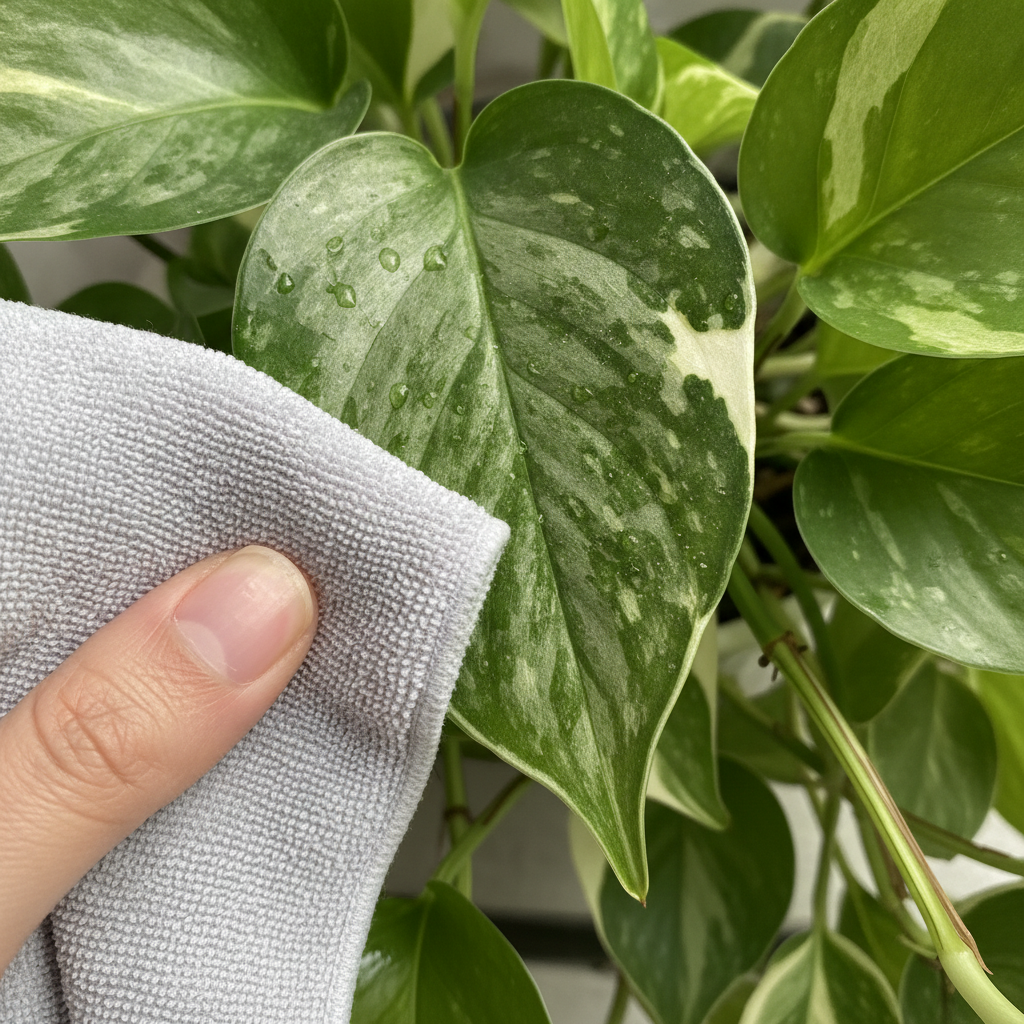
Quarantine every new plant for a couple of weeks before it joins the others, wipe the leaves occasionally to keep them clean and to give yourself a regular look at their condition, and avoid the overwatering that underlies both root rot and fungus gnats. These few habits head off the great majority of trouble.
Pro Tip — Neem as Routine: A monthly preventative spray of diluted neem oil over the leaves, especially their undersides, deters most common pests before they establish. Apply it in the evening or out of direct sun so the wet foliage does not scorch.
Popular Varieties
Pearls and Jade Pothos belongs to a large and much-loved family of Epipremnum aureum cultivars, and part of the fun of growing it is appreciating how it differs from its relatives. It was itself developed as a mutation of ‘Marble Queen’, so its closest kin share its taste for bright light and its tendency towards generous variegation.
The table below sets Pearls and Jade alongside the cultivars it is most often compared with or mistaken for, while the profiles that follow look more closely at the two it most resembles. Knowing these differences makes it easier to choose the right plant for a given spot and to identify exactly what you have.
| Variety | Leaf Appearance | Light Needs | Growth Rate | Availability |
|---|---|---|---|---|
| Pearls and Jade | Small leaves, green centres with speckled cream and silver margins | Bright indirect | Slow | Common |
| Marble Queen | Heavily marbled creamy-white and green, larger leaves | Bright indirect | Slow to moderate | Very common |
| N’Joy | Crisp blocks of green centres and clean white margins | Bright indirect | Slow | Common |
| Golden Pothos | Glossy green splashed with gold and yellow | Low to bright | Fast | Very common |
| Manjula | Wavy leaves with swirled cream, white and green | Bright indirect | Slow | Less common |
| Snow Queen | Predominantly white with light green flecks | Bright indirect | Slow | Common |
Featured Varieties
Marble Queen
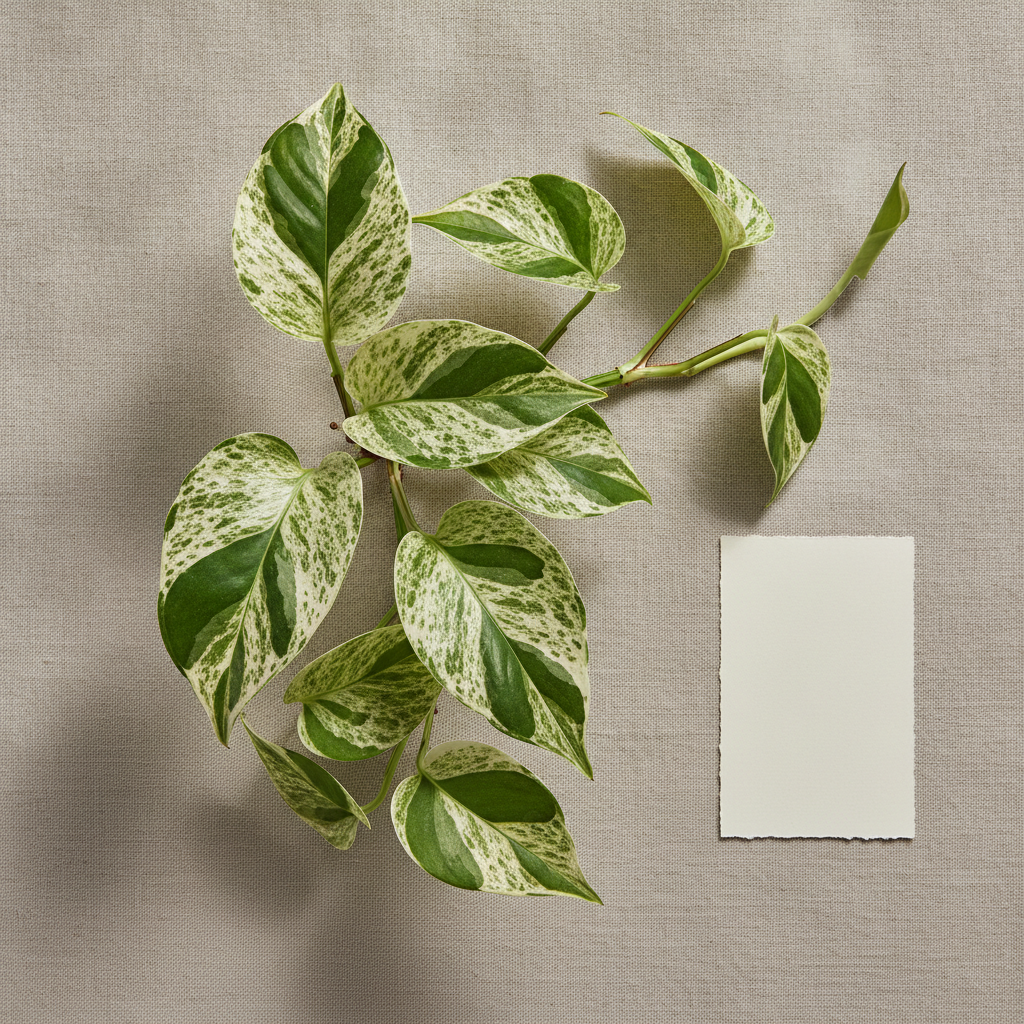
The parent from which Pearls and Jade arose. Its larger leaves carry heavy, almost equal marbling of creamy-white and deep green running right through the leaf, giving it a bolder, brighter look than its more delicate offspring.
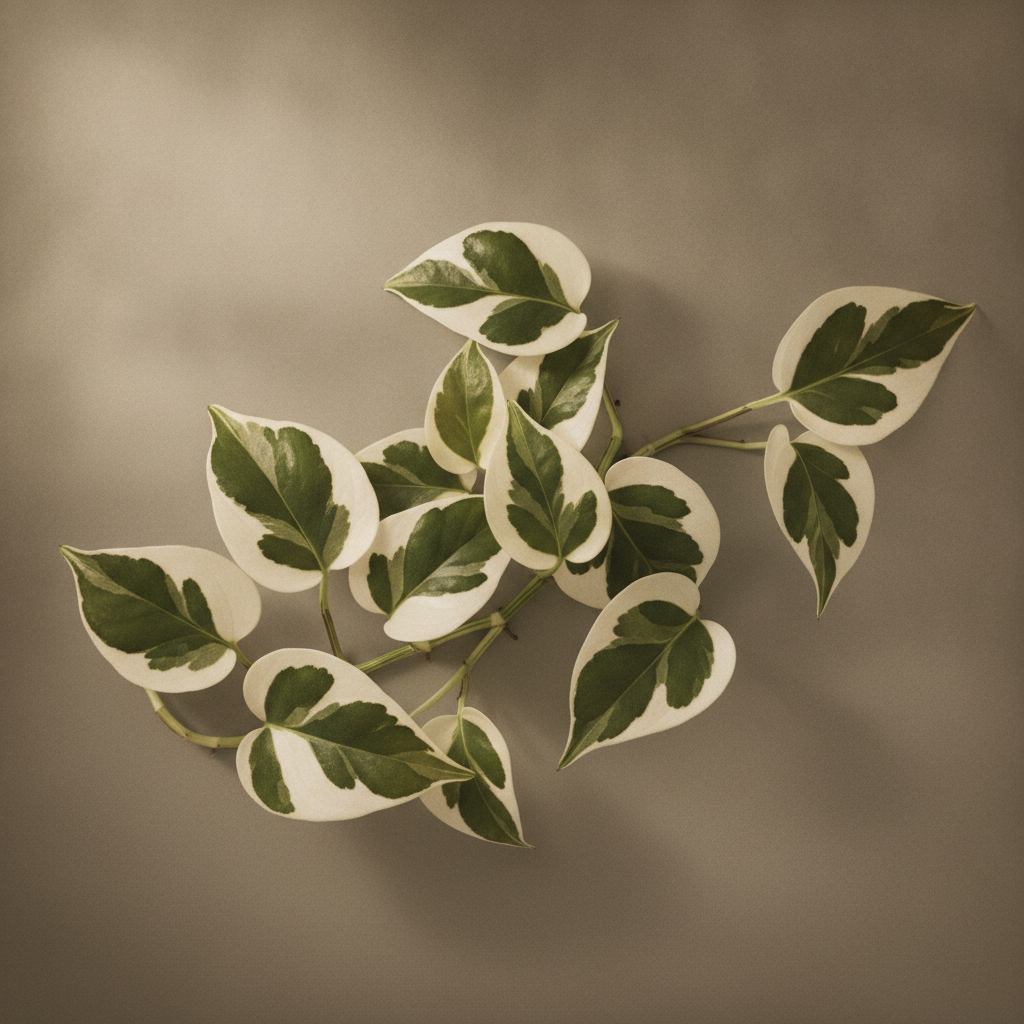
N’Joy
The cultivar most often confused with Pearls and Jade. N’Joy has similarly compact leaves but with crisp, well-defined patches of green and white and far less of the fine green speckling that runs through the pale margins of Pearls and Jade.
Variety Profiles in Detail
Marble Queen (Epipremnum aureum ‘Marble Queen’)
Marble Queen is one of the oldest and most widely grown pothos cultivars, prized for its dense, painterly variegation. Each pointed heart-shaped leaf is streaked through with cream and white over a green base, sometimes so heavily that pale tones dominate. Like all heavily variegated pothos it needs good light to keep its colouring, and it grows a little faster than Pearls and Jade while sharing the same easy temperament. Knowing it is the parent plant helps explain why Pearls and Jade behaves so similarly in cultivation.
N’Joy (Epipremnum aureum ‘N’Joy’)
N’Joy is the cultivar most likely to be mislabelled as Pearls and Jade in shops, and the two are genuinely close. The reliable way to tell them apart is the margins: N’Joy shows clean, sharply divided sections of solid green and solid white, whereas Pearls and Jade scatters tiny green and grey flecks through its pale edges, giving a softer, dustier transition. Both are compact, slow and undemanding, so whichever you end up with, the care is essentially identical.
Choosing the Right Variety for Your Space
If you have a bright spot and want a compact, finely detailed plant, Pearls and Jade is an excellent pick, as is N’Joy. For a bolder splash of variegation in a slightly larger plant, Marble Queen delivers. And if your light is limited, a plain golden pothos will cope far better than any of the heavily white cultivars, which all sulk and lose their colour in the shade. Matching the variety to your conditions is the surest route to a plant that thrives rather than merely survives.
Frequently Asked Questions
Why is my Pearls and Jade Pothos losing its variegation?
The usual cause is insufficient light. With less energy available, the plant produces leaves with more green and less white so that more of each leaf can photosynthesise. Move it to a brighter, indirect spot and new growth should regain its markings. Pruning out any fully green leaves also encourages the plant to keep producing variegated foliage.
Why does my plant grow so slowly?
Slow growth is normal for this cultivar. Because so much of each leaf is white and cannot photosynthesise, the plant simply has less energy to spend on new growth than a plain green pothos. Brighter light and feeding through the growing season help, but it will never match the runaway pace of a golden pothos, and that compactness is part of its charm.
Is Pearls and Jade Pothos safe around pets?
No. Like all pothos, it contains insoluble calcium oxalate crystals that are toxic to cats and dogs if chewed or swallowed, causing oral irritation, drooling and vomiting. Keep it well out of reach of curious pets, ideally trailing from a high shelf or hanging planter where it cannot be nibbled.
Why are the leaf tips turning brown?
Brown, crisp tips usually point to very dry air, inconsistent watering or a build-up of fertiliser salts in the soil. Check that you are letting the plant dry only partway before watering thoroughly, raise the humidity a little if your home is very dry, and flush the pot with plain water every few months to clear accumulated salts.
How do I make my plant bushier?
Regular pruning is the answer. Trimming the vines just above a node encourages the plant to branch from that point, and the cuttings you remove can be rooted and replanted into the same pot to fill it out. Combined with good light, this turns a sparse, trailing plant into a full, lush one over a season or two.
How is Pearls and Jade different from N’Joy?
They are very similar and often confused. The clearest difference is in the variegation: Pearls and Jade has fine green and grey speckling dusted through its white margins, giving a soft, mottled edge, while N’Joy shows cleaner, more sharply divided blocks of green and white. Their care needs are identical, so it makes no practical difference to how you grow them.
Can I grow Pearls and Jade Pothos in water permanently?
You can keep a cutting alive in water for a long time, but it will grow slowly and stay small, because water alone provides little in the way of nutrients. For a thriving plant, root your cuttings in water if you like to watch the process, then pot them into soil once the roots are a few centimetres long. If you do keep it in water, change the water regularly and add a very dilute hydroponic feed.
How often should I repot?
Only every two to three years, as this is a slow grower that is happy in a snug pot. Repot when you see roots emerging from the drainage holes, when water runs straight through without wetting the soil, or when growth slows despite good care. Spring or early summer is the ideal time, moving up just one pot size.






