
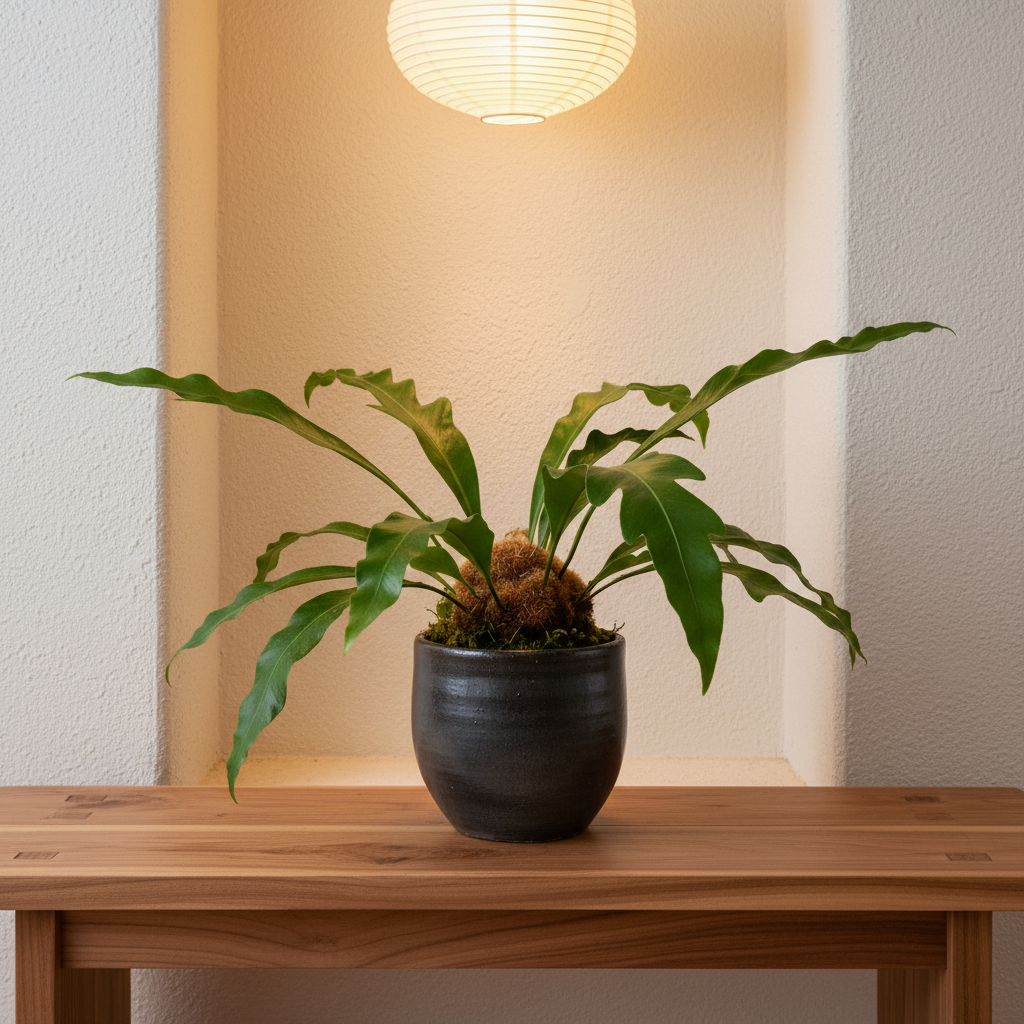
Few ferns wear their toughness as plainly as the panda fern. Known to botanists as Microsorum diversifolium and to most growers as the kangaroo fern or kangaroo paw fern, it trades the delicate, lacy filigree of a maidenhair for something altogether more robust: thick, glossy, leathery fronds that range from simple straps to deeply lobed paws on the same plant. Native to the forests of eastern Australia and New Zealand, it grows as an epiphyte and lithophyte, scrambling across rocks, tree trunks and the forest floor on a creeping rhizome clad in soft brown scales. That wandering, fuzzy rhizome is the reason it earned the “panda” nickname in the houseplant trade.
This is a fern that forgives the kind of treatment that flattens most of its relatives. It shrugs off the dry air of a centrally heated room, tolerates a forgotten watering or two, and keeps its colour in light levels that would leave a calathea sulking. None of that means it is indestructible, and the gap between a panda fern that merely survives and one that genuinely thrives is wider than its reputation suggests. This guide covers everything that closes that gap: how to read its light, how to water a rhizome rather than a root ball, the airy substrate it insists on, when and how to feed it, dividing it into new plants, and dealing with the handful of pests that find it indoors.
Contents
- Quick Reference
- Why the Panda Fern Makes a Forgiving Houseplant
- Light Requirements
- Watering & Humidity
- Soil, Potting & Repotting
- Fertilising
- Propagation
- Pests & Diseases
- Popular Varieties
- Frequently Asked Questions
Quick Reference: Panda Fern at a Glance
| Light | Bright, indirect light; tolerates medium to lower light. No harsh direct sun. |
| Watering | Keep evenly moist; let the top 2 to 3 cm (about 1 in) dry slightly between waterings. Never waterlogged. |
| Temperature | 16 to 24 degrees C (61 to 75 degrees F). Avoid anything below 10 degrees C (50 degrees F). |
| Humidity | Prefers 50 to 70 percent; tolerates average room humidity better than most ferns. |
| Fertiliser | Balanced liquid feed at half strength, monthly during spring and summer. |
| Toxicity | Non-toxic to cats, dogs and humans. Safe around pets and children. |
Why the Panda Fern Makes a Forgiving Houseplant
The single most useful thing to understand about Microsorum diversifolium is that it is built differently from the ferns most people fail with. A maidenhair fern is essentially a sheet of moisture held together by thin tissue, and it browns the moment the air dries out. The panda fern, by contrast, evolved as an epiphyte clinging to bark and rock, exposed to drying breezes and the wet-then-dry rhythm of forest canopies. Its fronds are thick and waxy, holding water and resisting moisture loss, which is precisely why it copes with the conditions of an ordinary living room.
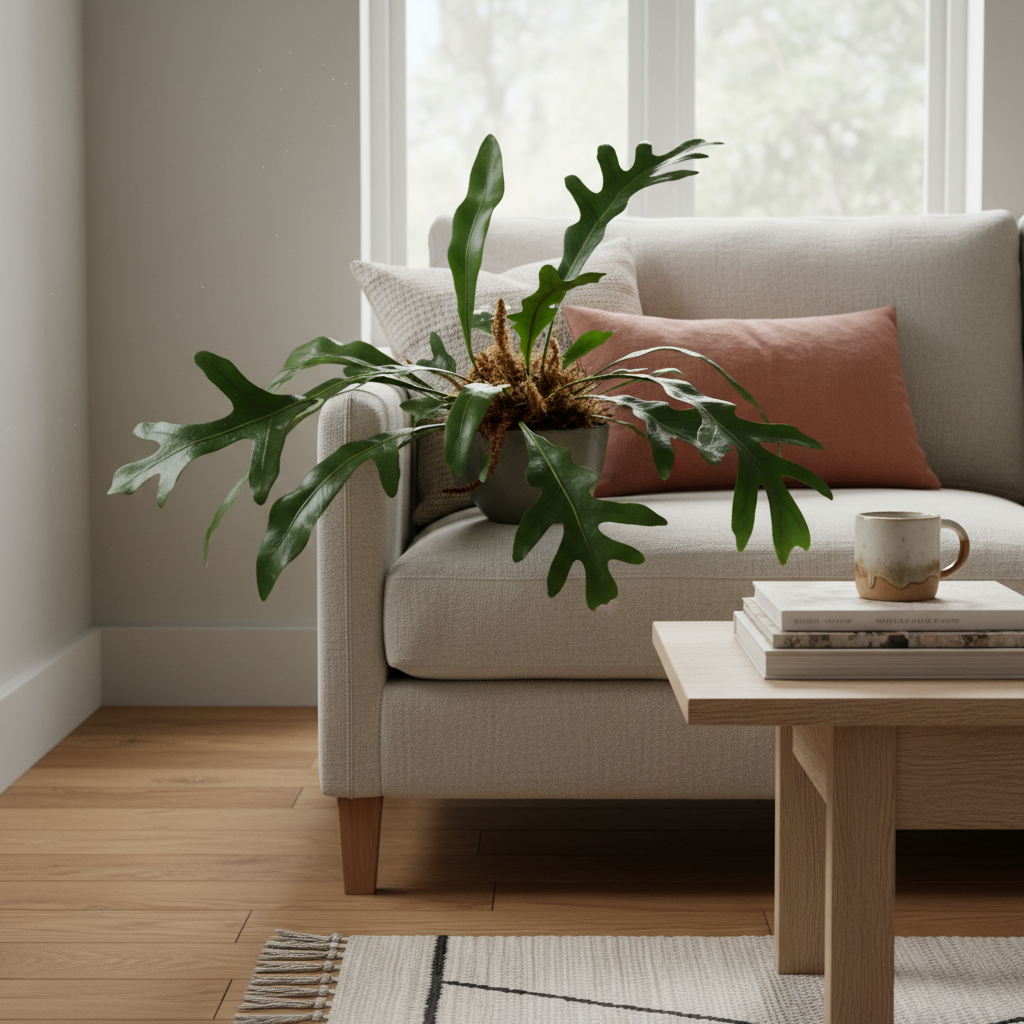
Beyond toughness, it earns its place for the simple novelty of its foliage. The species name diversifolium means “diverse-leaved,” and it is literal: a single mature plant carries simple, undivided straps alongside fronds split into three, five or seven leathery lobes. The effect is sculptural rather than frilly, and the deep glossy green reads as polished rather than fussy. Add the creeping, scaly rhizome that wanders over the pot rim and you have a plant that looks especially good spilling from a shelf, a hanging planter or the edge of a bookcase. Because it stays compact, rarely exceeding 30 to 45 cm (12 to 18 in) in height, it suits small spaces where a larger fern would overwhelm.
Important — Toxicity: The panda fern is considered non-toxic to cats, dogs and humans, in keeping with true ferns generally. It is one of the safer choices for a household with curious pets or small children. As with any plant, nibbling foliage can still cause mild stomach upset simply from the fibre and plant matter, so it is sensible to discourage chewing even when the species itself is harmless.
Light Requirements
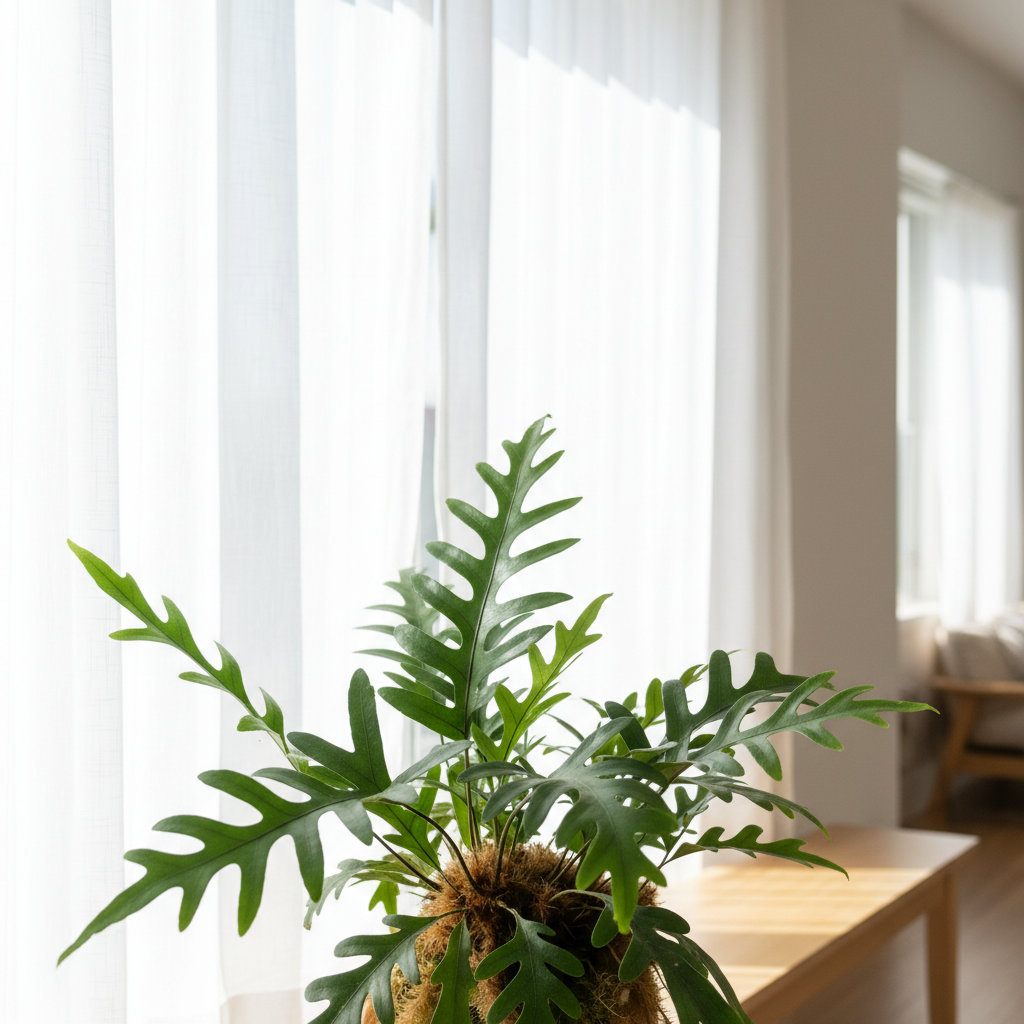
In its native canopy and forest-floor habitat, the panda fern lives in dappled, filtered light, shielded from the full force of the sun by layers of foliage above. Recreating that indoors means aiming for bright but indirect light: a position that feels well lit to the eye but where the sun’s rays do not fall directly on the fronds for any length of time. This is the sweet spot where the plant grows steadily and keeps its glossy, deep colour.
What sets this fern apart is its tolerance of less. It will hold its own in medium and even fairly low light, making it one of the few ferns genuinely suited to an interior wall or a north-facing room. Growth slows in dimmer spots and the plant produces fewer new fronds, but it does not deteriorate the way a sun-loving plant would. That flexibility makes it forgiving for beginners and useful for the awkward corners of a home that other plants reject.
Light Levels Explained
Light indoors is far weaker than most people assume, and the difference between a bright windowsill and the middle of the same room can be enormous. The table below translates common descriptions into rough light levels and shows what to expect from a panda fern in each.
| Light Category | Approx. Level | Typical Location | Outcome |
|---|---|---|---|
| Direct sun | 20,000 lux and above | On an unshaded south or west sill | Fronds scorch, bleach and crisp at the edges. Avoid. |
| Bright indirect | 10,000 to 20,000 lux | Near an east window or behind a sheer curtain | Ideal. Steady growth, glossy deep-green fronds. |
| Medium | 5,000 to 10,000 lux | A metre or two back from a bright window | Good. Slightly slower, still healthy and full. |
| Low | 1,000 to 5,000 lux | North room, interior wall away from windows | Tolerated. Sparse new growth, longer gaps between fronds. |
| Very low | Below 1,000 lux | Hallway, windowless bathroom | Survival only. Decline over months without supplementary light. |
Window Orientation and Placement
South-facing window: The brightest exposure in the northern hemisphere and too intense directly on the glass. Set the plant a metre or more back, or filter the light with a sheer curtain, and a south aspect becomes excellent.
East-facing window: Close to perfect. The gentle morning sun is mild enough to sit on the fronds briefly without harm, and the rest of the day delivers the bright indirect light the fern wants.
West-facing window: Workable, but the afternoon sun carries more heat. Pull the plant back from the glass or diffuse the strongest hours to prevent scorching.
North-facing window: Reliable and safe. The steady, gentle light never scorches, and a panda fern placed right at a north sill will grow slowly but contentedly all year.
Pro Tip — Rotate for Even Growth: Ferns lean towards their light source over time, and a creeping rhizome will wander in the direction it finds brightest. Give the pot a quarter turn each week so fronds develop evenly on all sides and the plant keeps a balanced, symmetrical shape rather than crowding to one edge.
How Light Affects Frond Colour and Form
In good light the panda fern’s fronds are a rich, saturated green with a noticeable shine, and the plant tends to produce more of the deeply lobed, paw-shaped fronds that give it character. In dimmer conditions the colour pales slightly towards a flatter green, fronds emerge further apart along the rhizome, and the plant looks looser and more open. Neither outcome is harmful, but if you want the dense, glossy look the fern is prized for, brighter indirect light is the surest route to it.
Warning — Direct Sunlight: Despite its leathery toughness, the panda fern is not a sun plant. Several hours of direct sun, especially through glass that concentrates the heat, will bleach the fronds to a sickly yellow-green and leave dry, brown, crisp patches that never recover. Damaged fronds do not heal, so move a scorching plant to gentler light at the first sign of bleaching.
Artificial Lighting
The panda fern responds well to artificial light, which makes it a good candidate for offices and rooms with few windows. A standard LED grow light positioned 30 to 45 cm (12 to 18 in) above the plant and run for 10 to 12 hours a day will keep it growing steadily where natural light falls short. Even an ordinary bright desk or ceiling LED, left on for much of the day, contributes meaningfully to a plant in a dim corner.
Seasonal Adjustments
Indoor light drops sharply through autumn and winter as the sun sits lower and days shorten. A panda fern that was thriving a metre back from a window in summer may need moving closer to the glass once the bright months pass. In the same period its growth naturally slows, so expect fewer new fronds and ease back on watering and feeding to match. When spring light returns, shift the plant back to its summer position to avoid the scorch risk of strengthening sun.
Watering & Humidity
Watering is where the panda fern’s epiphytic nature matters most. Unlike a thirsty terrestrial fern that wants its soil constantly damp, this plant grows from a surface rhizome that rots quickly if it sits in waterlogged substrate. The goal is consistent moisture in an airy mix that never stays sodden: damp like a wrung-out sponge, not wet like a bog.
When to Water
Check the substrate with a finger before reaching for the watering can. When the top 2 to 3 cm (about 1 in) feels dry but the layer below is still faintly cool and moist, it is time to water. Letting the surface dry slightly while keeping the deeper mix moist mimics the wet-then-drying cycle of the fern’s natural perch and protects the rhizome from rot.
Frequency varies with the season, the light and the pot. In the warmth and brighter light of spring and summer that may mean watering once or twice a week; in winter, when growth slows and evaporation falls, it can stretch to once every week or ten days. Resist watering on a fixed schedule. Test the mix each time, because the same calendar interval can mean bone-dry in July and soaking in January.
Pro Tip — Weigh the Pot: Lift the pot just after a thorough watering and again when the plant is ready for the next drink. The difference in weight is dramatic and quickly becomes a more reliable gauge than any schedule. A freshly watered panda fern feels heavy; a thirsty one feels conspicuously light.
How to Water Correctly
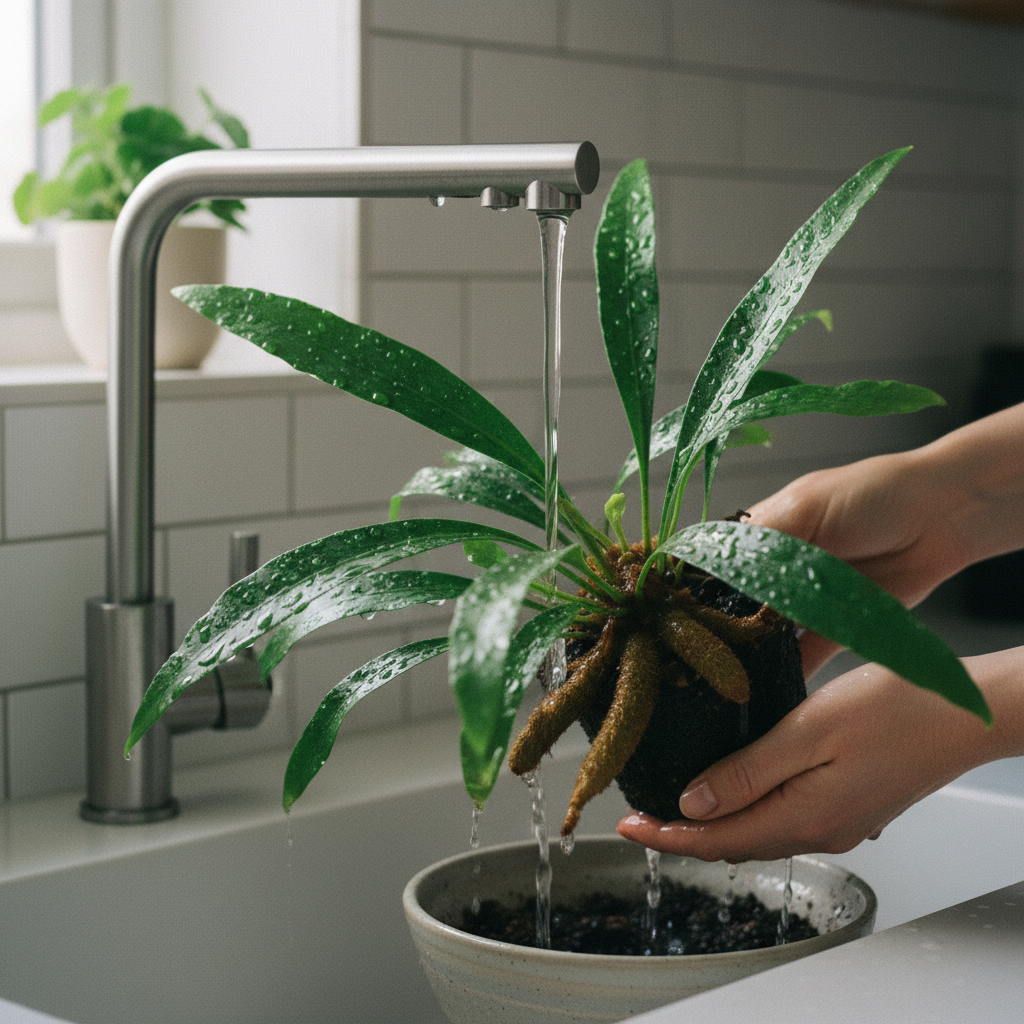
- Take the plant to a sink or use a watering can with a narrow spout, directing water onto the substrate rather than over the rhizome and crown.
- Water slowly and evenly across the surface until it runs freely from the drainage holes, ensuring the whole root zone is wetted rather than just one channel.
- Let the pot drain completely for several minutes. Standing water is the single greatest threat to this fern.
- Tip away any water that collects in the saucer or cachepot. The roots and rhizome must never sit in it.
- Return the plant to its spot only once it has stopped dripping, and feel the surface again in a few days to recalibrate your timing.
Signs of Overwatering vs. Underwatering
| Symptom | Overwatering | Underwatering |
|---|---|---|
| Frond colour | Yellowing, often starting at the base and spreading | Dulling to a greyish green, then browning at the tips |
| Frond texture | Soft, limp, sometimes translucent or mushy | Dry, brittle, crisping along the edges |
| Substrate | Constantly wet, may smell sour or musty | Pulls away from the pot sides, dusty and bone-dry |
| Rhizome | Soft, dark and slimy in patches | Shrivelled and noticeably lighter than usual |
| Overall vigour | New fronds emerge weak or fail to unfurl | Whole plant wilts, perks up partly after watering |
Warning — Root Rot: A creeping rhizome left in soggy mix rots fast, and once the rot reaches the growing points the plant rarely recovers. If you find soft, brown, slimy sections of rhizome, unpot the fern at once, cut away every affected part with a sterilised blade, and repot the healthy remainder into fresh, airy mix. Prevention through good drainage is far easier than rescue.
Humidity Requirements
As ferns go, the panda fern is remarkably relaxed about humidity. It is happiest between 50 and 70 percent, which is comfortably achievable in most homes, but its thick, waxy fronds allow it to cope with the drier air of a heated room far better than the thin-leaved ferns that demand a terrarium. This tolerance is a large part of why it succeeds where a maidenhair or a Boston fern would slowly crisp away.
That said, very dry air still leaves a mark. When humidity drops well below 40 percent, often in mid-winter when heating runs constantly, you may notice the frond tips browning and new growth emerging smaller than usual. These are early signals rather than emergencies, but they are worth heading off before they spread.
Raising humidity is straightforward. Grouping plants together creates a moister microclimate as they transpire, a pebble tray of water beneath the pot lifts the local humidity as it evaporates, and a small room humidifier solves the problem outright in a dry space. Misting offers only a brief, fleeting boost and is not a substitute for any of these, though it does little harm. A naturally humid room such as a bright bathroom or kitchen is an ideal home for this fern.
Water Quality
Ferns are more sensitive than average to the minerals and chemicals in tap water, and the panda fern is no exception. Hard water high in salts, and the chlorine or fluoride added to many municipal supplies, can accumulate in the mix and show up as browning frond tips over time. If your tap water is heavily treated or very hard, water with filtered, distilled or collected rainwater, or leave tap water standing uncovered overnight so some of the chlorine dissipates. Room-temperature water is gentler on the roots than cold water straight from the tap.
Soil, Potting & Repotting
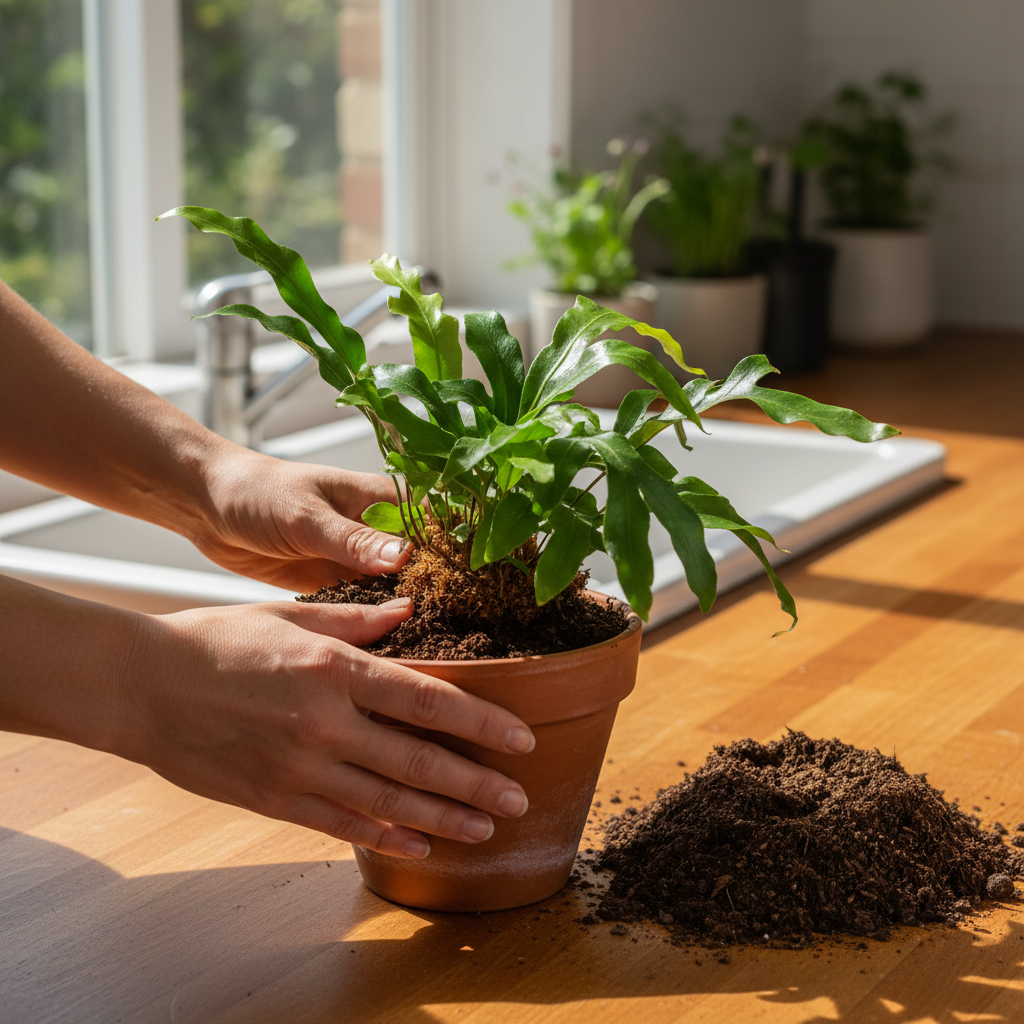
If there is one thing the panda fern is fussy about, it is drainage and aeration. As an epiphyte it is accustomed to having its roots in loose litter, moss and bark where air flows freely and water drains away in seconds. A dense, water-retentive potting soil suffocates it and invites the rhizome rot it is so prone to. The substrate should be light, chunky and fast-draining while still holding enough moisture to keep the plant evenly damp.
Ideal Soil Composition
The best approach is to start with a quality peat-free base such as coco coir or a houseplant compost and open it up generously with chunky materials that create air pockets. Orchid bark, perlite and a little sphagnum moss together build a substrate that drains freely yet stays pleasantly moist, much like the epiphytic litter the fern grows in naturally.
| Component | Proportion | Function |
|---|---|---|
| Coco coir or peat-free houseplant compost | 40 percent | Holds moisture and provides a base for the roots |
| Orchid bark (fine to medium) | 30 percent | Creates large air channels and prevents compaction |
| Perlite | 20 percent | Improves drainage and keeps the mix light |
| Sphagnum moss | 10 percent | Retains gentle moisture around the surface rhizome |
The panda fern prefers a slightly acidic to neutral substrate, roughly pH 5.5 to 6.5, which a coir or peat-free base sits within naturally. There is rarely any need to test or adjust pH for this plant, as a well-built airy mix lands in the right range on its own.
Pro Tip — Quick Mix Recipe: For a fast, reliable blend, combine two handfuls of coco coir, one and a half of orchid bark, one of perlite and half a handful of sphagnum moss. If you would rather not mix your own, a bagged orchid or aroid mix lightened with extra perlite makes a very acceptable shortcut.
Choosing the Right Pot
Because the panda fern grows from a spreading surface rhizome rather than a deep root system, a wide, shallow pot suits it far better than a tall, narrow one. The extra surface area gives the rhizome room to creep, and a shallow profile means less standing substrate to stay wet at the bottom. A half pot or a broad bulb pan is ideal.
Drainage holes are non-negotiable. Given this fern’s susceptibility to rot, never plant it in a pot without drainage. If you love a decorative cachepot with no holes, keep the fern in a plain plastic nursery pot that does drain and slip that inside the ornamental one, removing it to water and drain.
Pot material: Terracotta is excellent here, as its porous walls wick away excess moisture and help guard against overwatering. Glazed ceramic and plastic both work too, but with those you will need to be a touch more disciplined about not overwatering, since they hold moisture longer.
Pot size: Choose a pot only slightly larger than the current root and rhizome spread. An oversized pot holds a large volume of damp substrate the roots cannot use, and that lingering moisture is exactly what causes trouble. Step up gradually, never by more than a few centimetres at a time.
When to Repot
The panda fern is a relatively slow grower and dislikes disturbance, so it needs repotting only every two to three years, or when clear signs appear: roots and rhizome crowding over the pot rim, water running straight through a root-bound mass without wetting it, or the substrate breaking down into a dense, airless sludge. The best time to repot is spring, as the plant moves into active growth and recovers fastest. Often the simplest move is to refresh the top layer of mix annually and only fully repot when the plant has genuinely outgrown its container.
How to Repot: Step-by-Step
- Water the fern a day beforehand so the root ball is hydrated and holds together, easing the transition.
- Ease the plant out by tipping the pot and supporting the base, rather than pulling on the fronds, which detach easily from the rhizome.
- Gently tease away the old, spent substrate from the outer roots, keeping the core root ball intact to limit shock.
- Inspect the rhizome and roots, trimming any soft, dark or rotten sections with a sterilised blade.
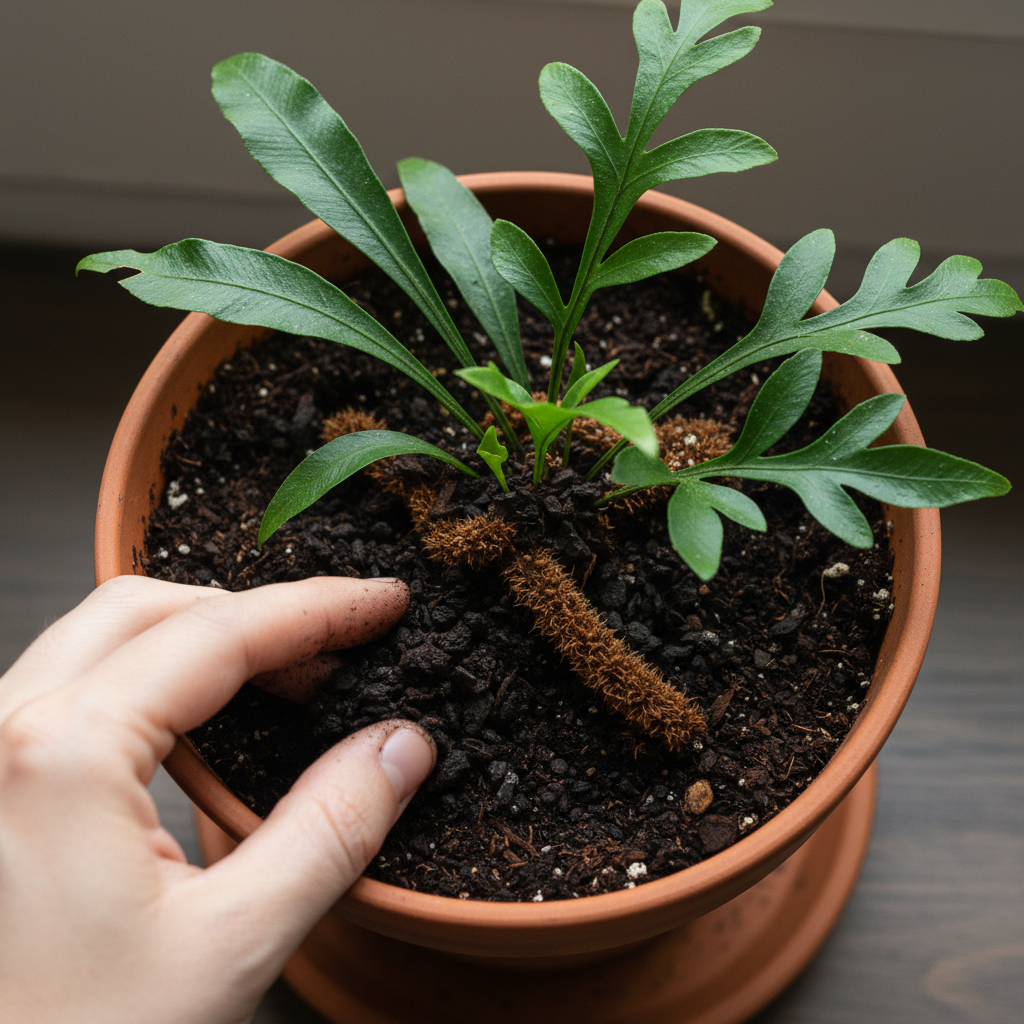
- Position the plant in its new pot at the same depth as before, with the scaly rhizome resting on the surface rather than buried.
- Fill around the roots with fresh airy mix, settling it with light taps of the pot, and leave the rhizome exposed on top.
- Water thoroughly, let it drain completely, and keep the plant out of strong light for a week or two while it settles.
Warning — Transplant Shock: Do not bury the rhizome when repotting. Covering that scaly surface stem with mix is a common mistake that leads straight to rot. The rhizome is meant to sit on top of the substrate, anchored only by the roots that descend from its underside, exactly as it would lie across bark or rock in the wild.
Fertilising
The panda fern is a light feeder. In nature it draws modest nutrition from decaying leaf litter, rain and the thin organic matter that gathers around its perch, so it never expects a rich diet. Indoors, a little balanced feeding through the growing season keeps it producing fresh fronds and holding its deep colour, but the watchword throughout is restraint.
Overfeeding does far more harm than underfeeding with this plant. Ferns are sensitive to the mineral salts in fertiliser, and too strong or too frequent a dose burns the fine roots and scorches the frond tips brown. When in doubt, feed less.
Understanding Plant Nutrients
Houseplant fertilisers are described by their N-P-K ratio, the proportions of nitrogen, phosphorus and potassium they contain, alongside smaller amounts of secondary nutrients and trace elements. For a foliage plant like the panda fern, a balanced or slightly nitrogen-leaning formula supports the leafy growth that is the whole point of the plant.
| Nutrient | Symbol | Primary Function | Deficiency Symptoms |
|---|---|---|---|
| Nitrogen | N | Drives leafy frond growth and green colour | Pale, yellowing older fronds, stunted growth |
| Phosphorus | P | Root development and energy transfer | Weak roots, slow establishment, dull foliage |
| Potassium | K | Overall vigour and water regulation | Browning frond margins, general weakness |
| Calcium | Ca | Cell wall strength and new growth | Distorted or stunted emerging fronds |
| Magnesium | Mg | Central component of chlorophyll | Yellowing between the veins of older fronds |
| Iron | Fe | Chlorophyll production in new growth | Yellowing of young fronds while veins stay green |
Types of Fertiliser
Liquid fertilisers: The easiest and most controllable option for this fern. Diluted into water and applied during normal watering, they let you feed at a precise, gentle strength and stop instantly when growth slows. A balanced houseplant liquid feed at half the recommended dose is the reliable default.
Slow-release granular: Coated prills that release nutrients gradually over months. Convenient, but they offer less control over dose and timing, which matters for a salt-sensitive plant. If you use them, choose a formulation for foliage houseplants and apply at the lower end of the rate.
Organic fertilisers: Worm castings, diluted seaweed extract and gentle organic feeds suit the panda fern particularly well. They release nutrients slowly and mildly, carry far less risk of salt burn, and a thin top-dressing of worm castings in spring feeds the plant quietly over weeks.
Feeding Schedule
Feed only during the active growing season, from spring through to early autumn, roughly once a month with a balanced liquid feed at half strength. Through late autumn and winter, when growth all but stops, withhold fertiliser entirely. A dormant or resting plant cannot use the nutrients, and unused salts simply build up in the mix and risk burning the roots.
Pro Tip — Half Strength, Always: Whatever the bottle recommends for a typical houseplant, halve it for a panda fern. Ferns thrive on a leaner diet than most foliage plants, and a dilute feed given a little more often is always safer than a concentrated dose. You can scale up cautiously if growth looks sluggish, but you can never undo a salt burn.
How to Fertilise
- Water the plant lightly first if the mix is very dry, so the feed does not contact parched roots directly and risk burning them.
- Dilute a balanced liquid fertiliser to half the recommended strength in a watering can.
- Apply evenly across the substrate during a normal watering, letting the solution run through and drain away.
- Avoid splashing concentrated feed onto the fronds or the rhizome, wiping off any that lands on the foliage.
- Every few months, flush the pot with plain water until it runs freely from the base to wash out accumulated salts.
Warning — Salt Build-Up: White or yellowish crusting on the substrate surface or around the pot rim is a sign that fertiliser salts have accumulated to harmful levels. Left unchecked this scorches the roots and browns the fronds. Flush the pot thoroughly with plain water, and if the crusting is heavy, repot into fresh mix and ease off the feeding.
Propagation
Propagating a panda fern is refreshingly simple, because the same creeping rhizome that defines the plant is also its means of multiplying. Where many houseplants root from a snipped stem or a single leaf, ferns do not, and the panda fern is propagated by dividing that rhizome into sections, each carrying its own roots and fronds.
It can also be raised from spores, the dust-fine reproductive bodies that form on the undersides of mature fronds, but this is a slow, exacting process that takes many months and rarely tempts the home grower. For all practical purposes, division is the method, and it is quick, reliable and free.
Understanding the Rhizome
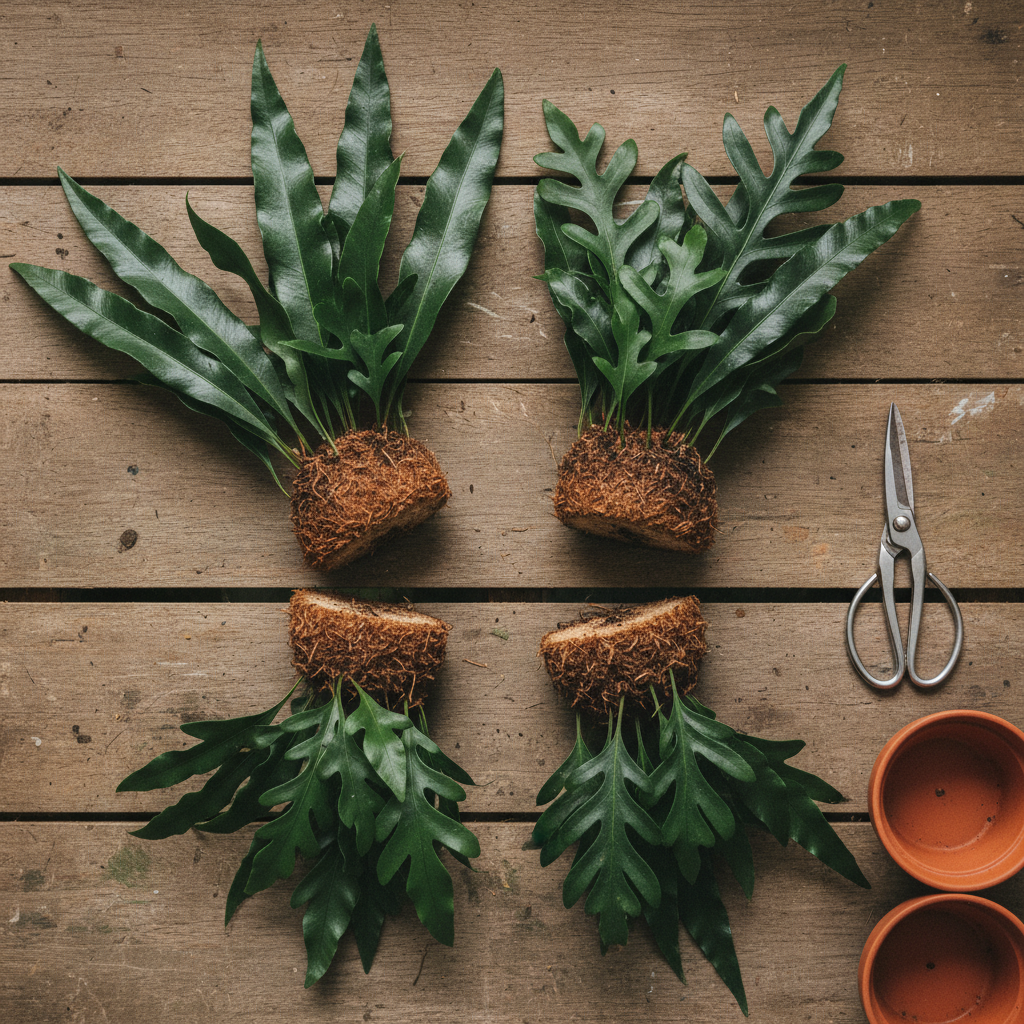
The rhizome is the horizontal, scale-covered stem that creeps across the surface of the substrate. Fronds rise from its upper side and roots descend from beneath, so every section of healthy rhizome that bears both is, in effect, a complete plant waiting to be separated. Understanding this makes division intuitive: you are simply cutting a continuous plant into self-sufficient pieces, each able to grow on independently.
Division: Step-by-Step
Division is best done in spring, ideally at the same time as a planned repotting, so you disturb the plant only once. Choose a healthy, well-established fern with several fronds and a good spread of rhizome before you begin.
- Water the plant a day ahead, then slide it gently from its pot and brush away enough substrate to see the rhizome and roots clearly.
- Identify natural divisions where the rhizome branches, aiming for sections that each carry at least two or three fronds and a healthy clump of roots.
- Cut cleanly through the rhizome with a sterilised knife or scissors, making each division a self-contained piece with its own roots and fronds.
- Pot each section into its own small container of fresh, airy mix, settling the roots in but leaving the rhizome resting on the surface.
- Water lightly, then place the divisions somewhere warm with bright indirect light and slightly raised humidity to help them establish.
Pro Tip — Bigger Divisions Establish Faster: Resist the urge to cut the plant into as many pieces as possible. Each division survives on the reserves in its rhizome and roots, so generous sections with several fronds settle in and resume growth far more readily than tiny fragments. Two strong new plants beat five struggling ones.
Growing from Spores: Step-by-Step
Spore propagation is a project for the patient and the curious rather than a practical way to increase your stock. It is included here for completeness, since it is the panda fern’s natural means of reproduction and a fascinating one to attempt.
- Collect ripe spores by placing a frond with brown, dust-like sori on its underside onto a sheet of paper for a day or two until the spores drop.
- Scatter the fine spores thinly over the surface of moist, sterilised seed compost in a clean, covered container.
- Keep the container warm, in bright indirect light, and consistently humid, never letting the surface dry out.
- Wait patiently as a green, mossy film of prothalli develops over weeks, followed eventually by tiny fronds over several months.
- Prick out and pot on the largest young plantlets only once they are robust enough to handle, then grow them on as normal.
Troubleshooting Propagation
| Problem | Likely Cause | Solution |
|---|---|---|
| Divisions wilt and collapse | Too few roots per section, or air too dry after potting | Make larger divisions and raise humidity while they establish |
| Rhizome rots after division | Mix kept too wet, or rhizome buried instead of surface-set | Use airier mix, water sparingly, keep the rhizome on top |
| No new growth for weeks | Normal slow establishment, or cool temperatures | Be patient, keep warm and bright; new fronds follow root recovery |
| Spores fail to germinate | Spores not ripe, contamination, or surface dried out | Use fully ripe spores, sterilise compost, maintain constant moisture |
Pests & Diseases
The panda fern is not especially prone to pests, and its leathery fronds discourage some of the sap-suckers that plague softer foliage. Even so, the usual indoor culprits do occasionally find it, and the most common problems indoors are tied less to pests than to watering and humidity. Regular inspection, particularly of the frond undersides and the rhizome, catches trouble while it is still easy to deal with.
One important caution applies throughout: ferns are sensitive to many insecticides and even to neem oil, which can damage their fronds. Always test any treatment on a single frond first and wait a few days before treating the whole plant, and favour gentler physical methods where you can.
Common Pests
Scale (Coccoidea)
Scale insects are the most likely pest on a panda fern, appearing as small, immobile brown or tan bumps along the rhizome, frond stalks and the midribs of the fronds. They suck sap and excrete sticky honeydew, weakening the plant and leaving a shiny residue. Their hard shells make them easy to overlook until a colony has built up.
Treatment: Scrape or wipe the scales off with a cotton bud dipped in diluted isopropyl alcohol, or rub them away with a damp cloth. For heavier infestations, treat with a fern-safe insecticidal soap, testing on one frond first, and repeat weekly until no new scales appear.
Mealybugs (Pseudococcidae)
Mealybugs show up as small, soft, white cottony tufts tucked into the joints where fronds meet the rhizome and in other sheltered spots. Like scale they feed on sap and produce honeydew, and they multiply quickly in warm indoor conditions if left alone.
Treatment: Dab each visible mealybug with a cotton bud moistened in diluted isopropyl alcohol to kill it on contact, then wipe the area clean. Isolate the plant from others while you treat it, and check every few days, as mealybugs are persistent and hide well.
Fungus Gnats (Sciaridae)
Small black flies drifting up from the substrate when disturbed are fungus gnats, and their presence is almost always a sign of substrate kept too wet. The adults are merely a nuisance, but their larvae feed on organic matter and fine roots in consistently damp mix, exactly the condition a panda fern should never be in.
Treatment: Let the surface of the mix dry more thoroughly between waterings to break their breeding cycle, and use yellow sticky traps to catch the adults. A layer of fine grit or sand over the surface deters egg-laying, and correcting the overwatering usually solves the problem at its root.
Spider Mites (Tetranychidae)
Spider mites are uncommon on this fern thanks to its tough fronds, but very dry air can occasionally invite them. Look for fine stippling, a faint dulling of the fronds and, in bad cases, delicate webbing between the foliage. They are tiny and easiest to spot by the damage they cause.
Treatment: Raise the humidity, which mites dislike, and rinse the fronds thoroughly under a gentle stream of water to wash them off. Wipe the foliage with a damp cloth, and for stubborn cases use a fern-safe insecticidal soap, again testing on one frond first.
Common Diseases
Root and Rhizome Rot (Pythium and Phytophthora)
By far the most serious threat to a panda fern, rot sets in when the substrate stays waterlogged and fungal pathogens attack the roots and rhizome. Signs include soft, dark, slimy sections of rhizome, yellowing and collapsing fronds, and a sour smell from the mix. Left unchecked it kills the plant.
Treatment: Unpot the fern immediately, cut away all soft and discoloured rhizome and root with a sterilised blade, and repot the healthy remainder into fresh, airy mix in a clean pot. Water sparingly afterwards. Prevention through good drainage and careful watering is far more effective than any cure.
Leaf Spot (various fungi and bacteria)
Leaf spot appears as small brown or black blotches on the fronds, sometimes with a yellow halo, and usually follows wet foliage combined with poor air circulation. It spreads where water sits on the fronds for long periods and the air around the plant is stagnant.
Treatment: Remove affected fronds with sterilised scissors, improve air movement around the plant, and avoid wetting the foliage when watering. Keeping the fronds dry and the air moving usually stops the spread without any chemical treatment.
Pest and Disease Summary
| Pest / Disease | Identification | Treatment |
|---|---|---|
| Scale | Brown or tan bumps on stalks and midribs, sticky residue | Wipe off with alcohol, fern-safe insecticidal soap if heavy |
| Mealybugs | White cottony tufts in frond and rhizome joints | Dab with diluted alcohol, isolate and recheck regularly |
| Fungus gnats | Small black flies rising from wet substrate | Let surface dry, sticky traps, correct overwatering |
| Spider mites | Fine stippling, dull fronds, faint webbing | Raise humidity, rinse fronds, insecticidal soap if needed |
| Root and rhizome rot | Soft slimy rhizome, yellow collapsing fronds, sour smell | Cut away rot, repot in fresh airy mix, water sparingly |
| Leaf spot | Brown or black blotches, sometimes yellow-haloed | Remove affected fronds, improve airflow, keep foliage dry |
Prevention Strategies
Almost every problem a panda fern encounters traces back to two causes: too much water and too little air movement. Get the watering right, keep the substrate airy and free-draining, and ensure a gentle flow of air around the plant, and you eliminate the conditions that pests and rot need to take hold. A healthy, well-grown fern is also far better at resisting trouble than a stressed one.
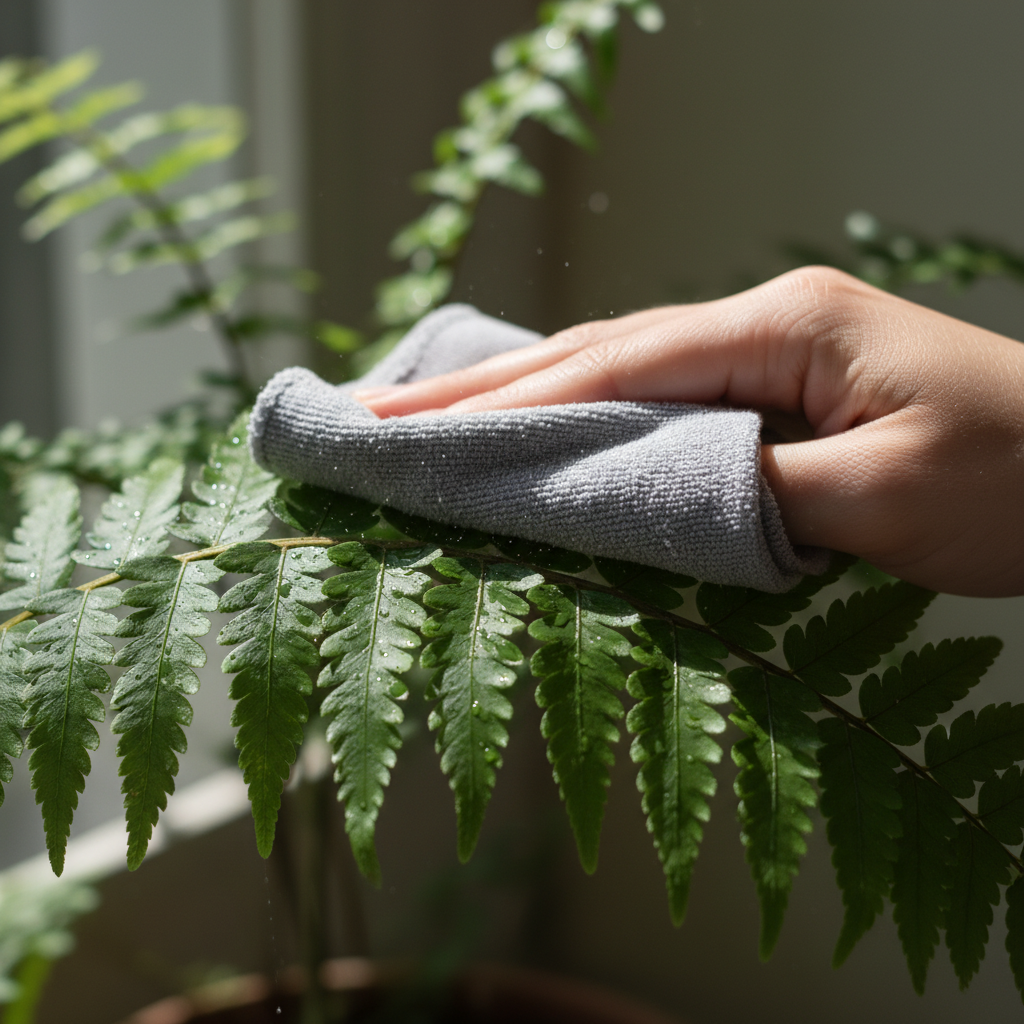
Build a simple routine of inspection. Every week or two, look over the frond undersides, the joints and the rhizome while you check whether the plant needs water. Wipe the fronds with a damp cloth occasionally to remove dust and dislodge any early pests, and quarantine any new plant for a couple of weeks before it joins your collection. Catching a handful of scale or a few mealybugs early is trivial; clearing a full infestation is not.
Pro Tip — Test Before You Treat: Because ferns can be damaged by neem oil and many insecticides, never spray a whole panda fern with an untested product. Apply it to a single frond, wait three to four days, and only treat the entire plant if that frond shows no browning or scorching. Insecticidal soaps formulated as fern-safe are the gentlest chemical option.
Popular Varieties
The panda fern itself shows considerable natural variation, which is exactly what its name diversifolium describes, with frond shapes on a single plant ranging from simple straps to deeply lobed paws. Named cultivars are few, but the fern belongs to the wider Microsorum genus, which offers several handsome and easy relatives often sold and grown alongside it.
The varieties and relatives below are the ones you are most likely to meet in shops and collections. They share the same epiphytic habits and the same airy, evenly moist culture, so anyone comfortable with a panda fern can grow the whole group with confidence.
| Variety | Leaf Appearance | Light Needs | Growth Rate | Availability |
|---|---|---|---|---|
| Kangaroo paw form | Deeply, irregularly lobed glossy fronds | Bright indirect | Moderate | Common |
| Entire-leaved form | Simple, undivided strap fronds | Bright indirect to medium | Moderate | Common |
| Crocodile Fern | Long straps with raised crocodile-skin veining | Bright indirect | Slow to moderate | Common |
| Crested Fishtail Fern | Strap fronds forked into crests at the tips | Bright indirect | Slow | Occasional |
| Wart Fern | Broad, lobed fronds with raised spore patches | Bright indirect to medium | Moderate to fast | Occasional |
Featured Varieties
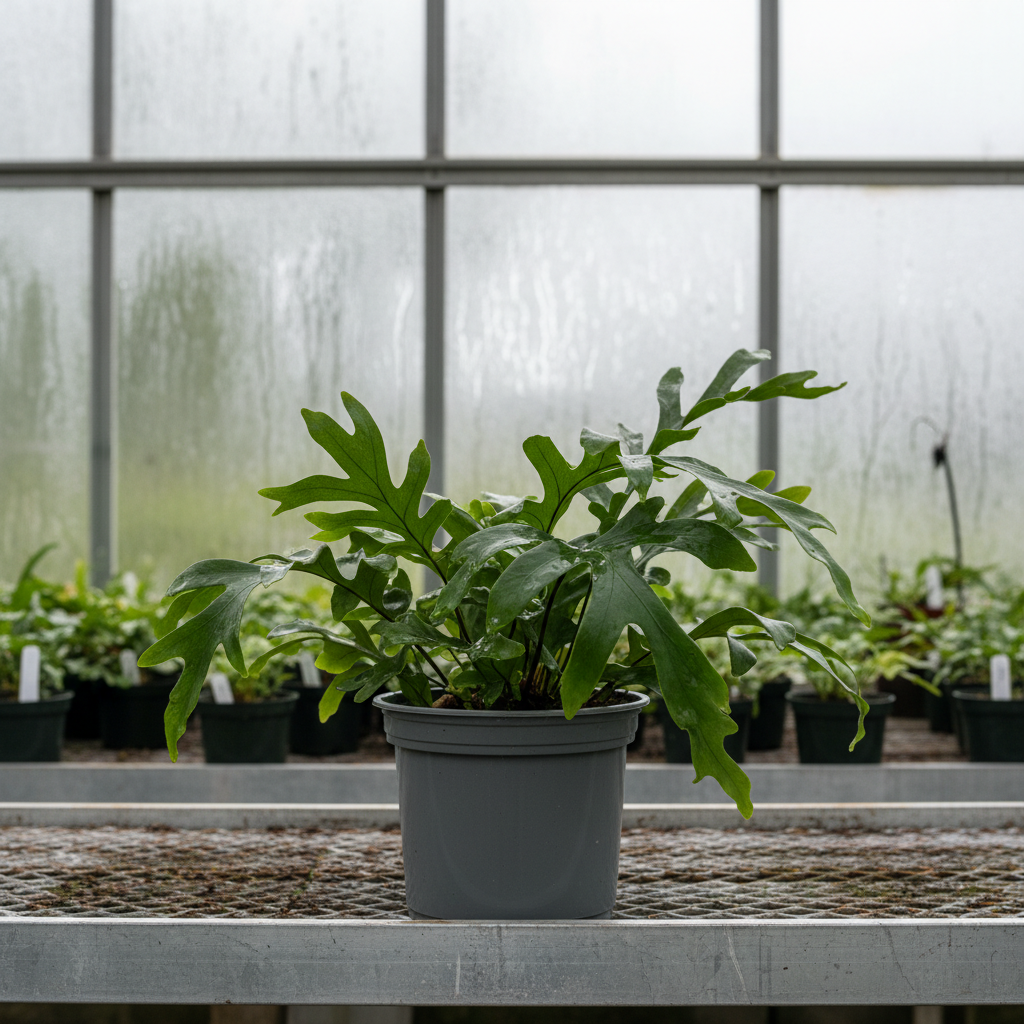
Kangaroo Paw Form
The classic look of the species, with thick, glossy fronds split into rounded lobes that resemble a kangaroo’s paw. It is the form most often sold as a panda or kangaroo fern and the easiest to find.
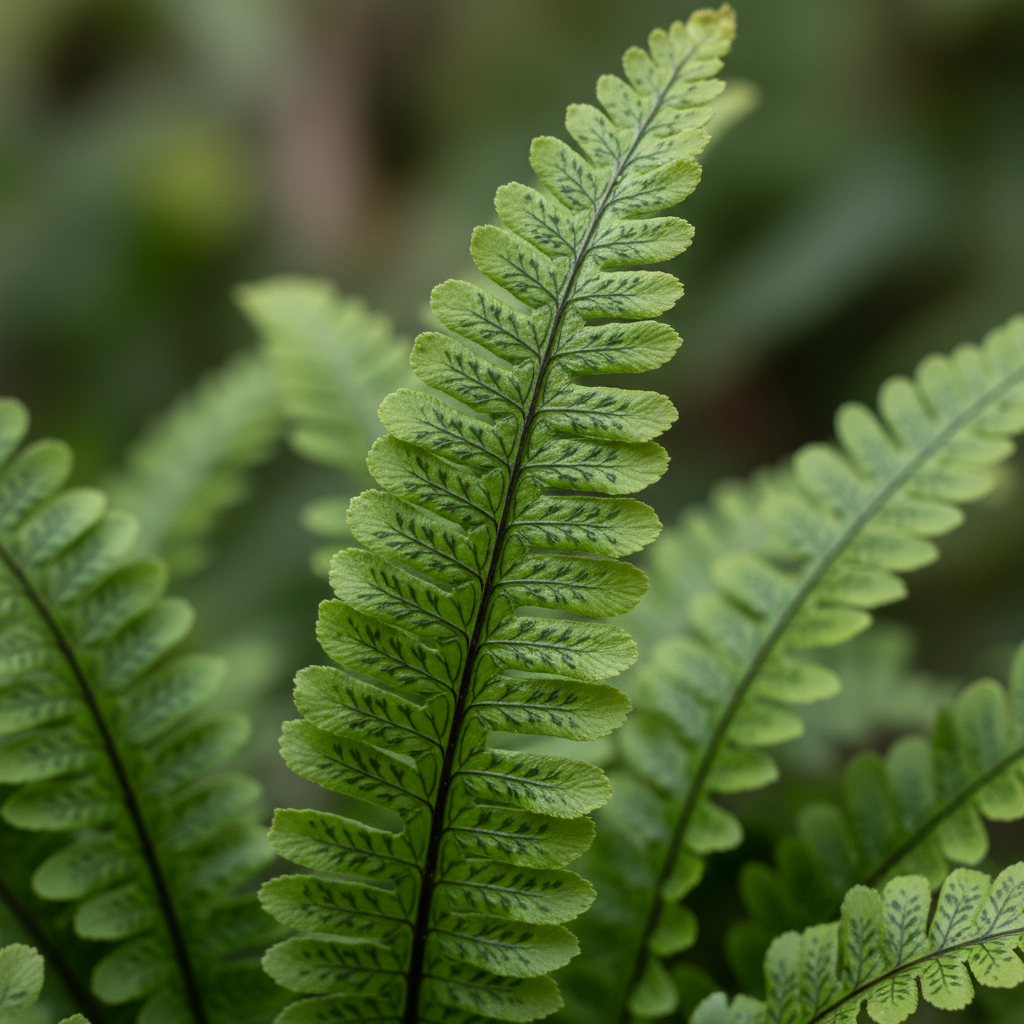
Crocodile Fern
A close relative, Microsorum musifolium, with long upright apple-green straps embossed by a raised dark vein network that mimics crocodile skin. It shares the same easy culture and makes a striking companion to the panda fern.
Variety Profiles in Detail
Kangaroo Paw Form (Microsorum diversifolium)
This is the panda fern as most people picture it. The fronds are thick and leathery with a high gloss, divided into bold, rounded lobes, and they emerge along a creeping, scaly rhizome that spreads across and over the pot. It is tough, compact and forgiving, and its sculptural foliage is what wins the species its many admirers.
Crocodile Fern (Microsorum musifolium)
Where the panda fern is glossy and lobed, the crocodile fern is matte and strap-shaped, its long apple-green fronds patterned with a sunken, dark vein network that genuinely looks like reptile skin. It wants the same bright indirect light, airy mix and steady moisture, though it appreciates a touch more humidity, and it brings a bold textural contrast to a fern grouping.
Wart Fern (Microsorum scolopendria)
A vigorous relative with broad, deeply lobed fronds and a fast-creeping rhizome, the wart fern takes its name from the raised, wart-like spore patches dotting the frond undersides. It is faster-growing than the panda fern and can fill a wide, shallow pot quickly, making it a good choice where you want lush coverage.
Choosing the Right Variety for Your Space
For a compact, sculptural plant that copes with everyday conditions, the kangaroo paw form of the panda fern is the obvious starting point. If you want textural drama and can offer a little more humidity, the crocodile fern is the showpiece of the group, while the wart fern suits anyone after quick, lush growth to fill a shallow bowl. All share the same forgiving temperament, so the choice comes down to the look you want rather than any real difference in difficulty.
Frequently Asked Questions
Is the panda fern safe for cats and dogs?
Yes. The panda fern is considered non-toxic to cats, dogs and humans, in line with true ferns generally, which makes it one of the safer houseplants for a home with pets. Chewing any plant can cause mild stomach upset simply from the fibre, so it is still wise to discourage nibbling, but the species itself poses no poisoning risk.
Why are the tips of my panda fern turning brown?
Brown, crisp frond tips usually point to dry air, inconsistent watering, or a build-up of salts from tap water or fertiliser. Raise the humidity around the plant, keep the substrate evenly moist without letting it dry out completely, and switch to filtered or rainwater if your tap supply is hard or heavily treated. Flushing the pot occasionally clears accumulated salts.
How often should I water a panda fern?
There is no fixed schedule. Water when the top 2 to 3 cm (about 1 in) of mix feels dry, which in practice often means once or twice a week in spring and summer and roughly every week to ten days in winter. Always check the substrate by feel rather than watering by the calendar, as the right interval shifts with the season, the light and the pot.
Can a panda fern grow in low light?
It tolerates low light better than almost any other fern, which is part of its appeal. It will not thrive in deep shade, and growth slows noticeably with fewer new fronds, but it holds its colour and condition in medium and even fairly low light where sun-loving plants would fail. For the fullest, glossiest growth, bright indirect light is still best.
What is that fuzzy brown stem creeping over the pot?
That is the rhizome, the scale-covered creeping stem the fern grows from, and it is completely normal and healthy. It is meant to sit on the surface and wander over the pot rim, with fronds rising from its top and roots descending beneath. Never bury it, as covering the rhizome with substrate causes rot.
How do I make my panda fern bushier?
Bright indirect light is the single biggest factor, as it prompts the plant to produce fronds closer together along the rhizome for a denser look. Steady moisture, a light monthly feed through the growing season and rotating the pot for even growth all help. If a plant has grown loose and sparse, dividing it and replanting the sections together in a wide, shallow pot can quickly restore a fuller appearance.
Why are my panda fern’s fronds going yellow?
Yellowing fronds most often signal overwatering, especially when they feel soft and the yellowing starts at the base. Check that the substrate is not staying soggy and that the pot drains freely, and inspect the rhizome for any soft, dark rot. The occasional older frond yellowing and dying back is natural, but widespread yellowing means it is time to review your watering.
Does the panda fern need a humidifier?
Not usually. Its thick, waxy fronds let it cope with ordinary room humidity far better than most ferns, and it is happy anywhere between 50 and 70 percent. A humidifier helps in a very dry home, particularly in winter when heating strips moisture from the air, but grouping plants together or standing the pot on a pebble tray is often enough to keep it content.






