
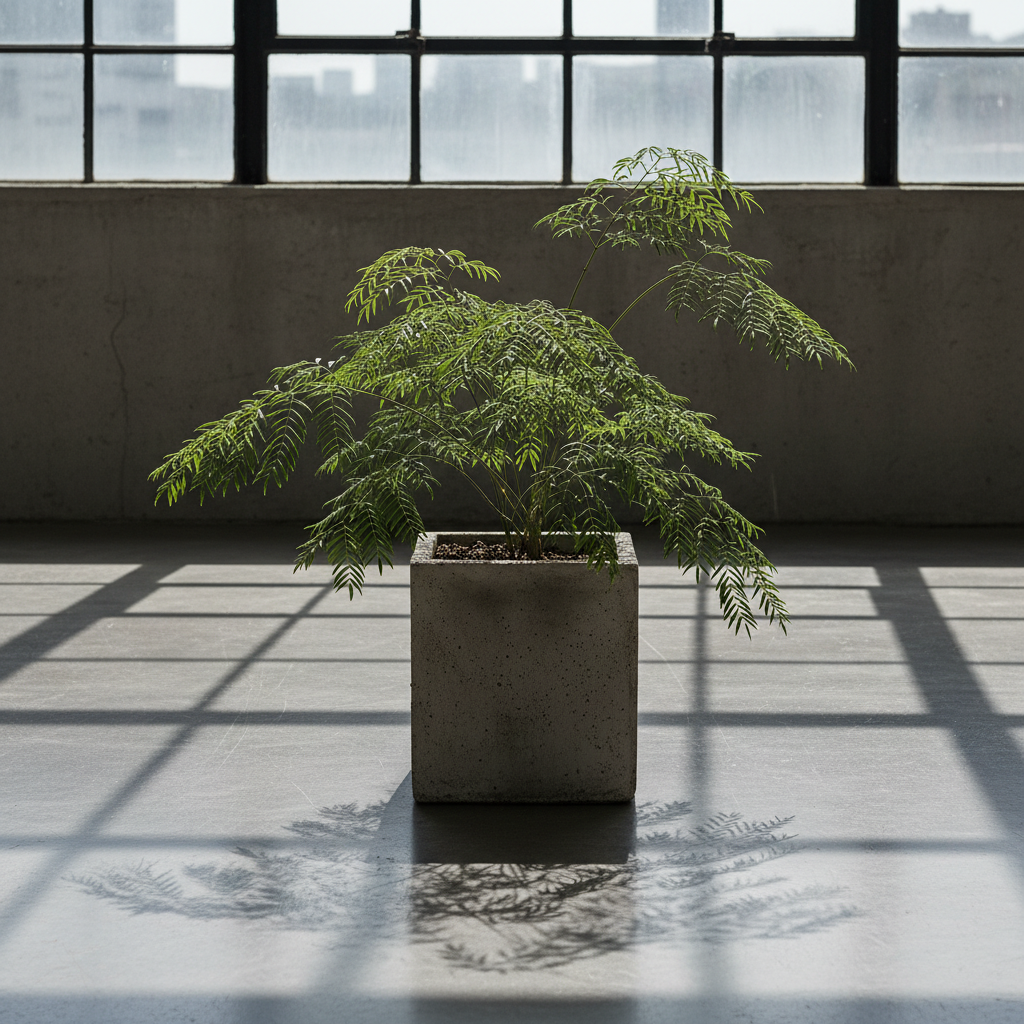
The Ming Aralia (Polyscias fruticosa) is one of those houseplants whose appearance does not quite match its temperament. With its slender woody stems, almost bonsai-fine silhouette and clouds of finely divided, parsley-like foliage, it looks like the kind of plant that has been quietly cultivated in a conservatory for a century. In its native range across India, Sri Lanka, Southeast Asia and the islands of Polynesia, it grows as a tall, upright tropical shrub of the Araliaceae family, the same plant family as English ivy, schefflera and ginseng. Indoors it usually settles into a slow, dignified growth pattern that tops out somewhere between one and two metres, holding its airy crown of lacy leaflets aloft like a piece of living sculpture.
It also has a reputation, and it is worth being upfront about it. Ming Aralia is widely considered one of the more sensitive easy-looking houseplants. It does not collapse dramatically when neglected, but it does sulk: a sudden draught, a missed watering or a cold windowsill in winter can trigger a slow shower of leaflets that takes weeks to stop. The good news is that the plant’s needs are not mysterious. Once a stable position, a consistent watering rhythm and a humid microclimate are in place, the Ming Aralia thrives quietly for decades. This guide covers everything required to move it from merely surviving to genuinely thriving, from the structure of its bipinnate leaves to the specific reasons it drops them, with detailed sections on light, watering, soil, fertilising, propagation, pests and the most attractive cultivars to look for.
Contents
- Quick Reference
- Why Ming Aralia Makes a Sophisticated Houseplant
- Light Requirements
- Watering and Humidity
- Soil, Potting and Repotting
- Fertilising
- Propagation
- Pests and Diseases
- Popular Varieties
- Frequently Asked Questions
Quick Reference: Ming Aralia at a Glance
| Botanical name | Polyscias fruticosa |
| Family | Araliaceae |
| Common names | Ming Aralia, Parsley Aralia, Shrubby Aralia, Chinese Aralia |
| Native range | India, Sri Lanka, Southeast Asia, Polynesia |
| Mature size (indoors) | 1 to 2 m (3 to 6 ft) tall, slow-growing |
| Light | Bright, indirect light; tolerates some gentle morning sun |
| Watering | Keep evenly moist; water when the top 2 to 3 cm (about 1 in) of soil feels dry |
| Temperature | 18 to 27 °C (65 to 80 °F); avoid anything below 15 °C (60 °F) |
| Humidity | 50 to 70 percent; struggles under 40 percent for long |
| Soil | Rich, well-draining, slightly acidic; aroid or houseplant mix with extra perlite and bark |
| Fertiliser | Balanced liquid feed at half strength, monthly during spring and summer |
| Propagation | Semi-hardwood stem cuttings, air layering |
| Toxicity | Mildly toxic to cats and dogs (saponins); not for nibbling pets or children |
| Difficulty | Intermediate; not difficult but stress-sensitive |
Why Ming Aralia Makes a Sophisticated Houseplant
There is a particular visual quality the Ming Aralia brings to a room that is genuinely difficult to replicate with any other commonly available houseplant. The compound leaves are bipinnate or even tripinnate, meaning each leaf is divided, then divided again, into many narrow, deeply lobed leaflets. The effect from across a room is a soft green cloud held on slender, almost reed-like stems, somewhere between a fern and a miniature tree. Up close, the leaflets are crisp, slightly leathery and patterned in such fine detail that the plant has been compared to a piece of cut paper. This is why florists and interior designers reach for it whenever a space needs vertical lightness without the visual weight of a fiddle-leaf fig or a large monstera.
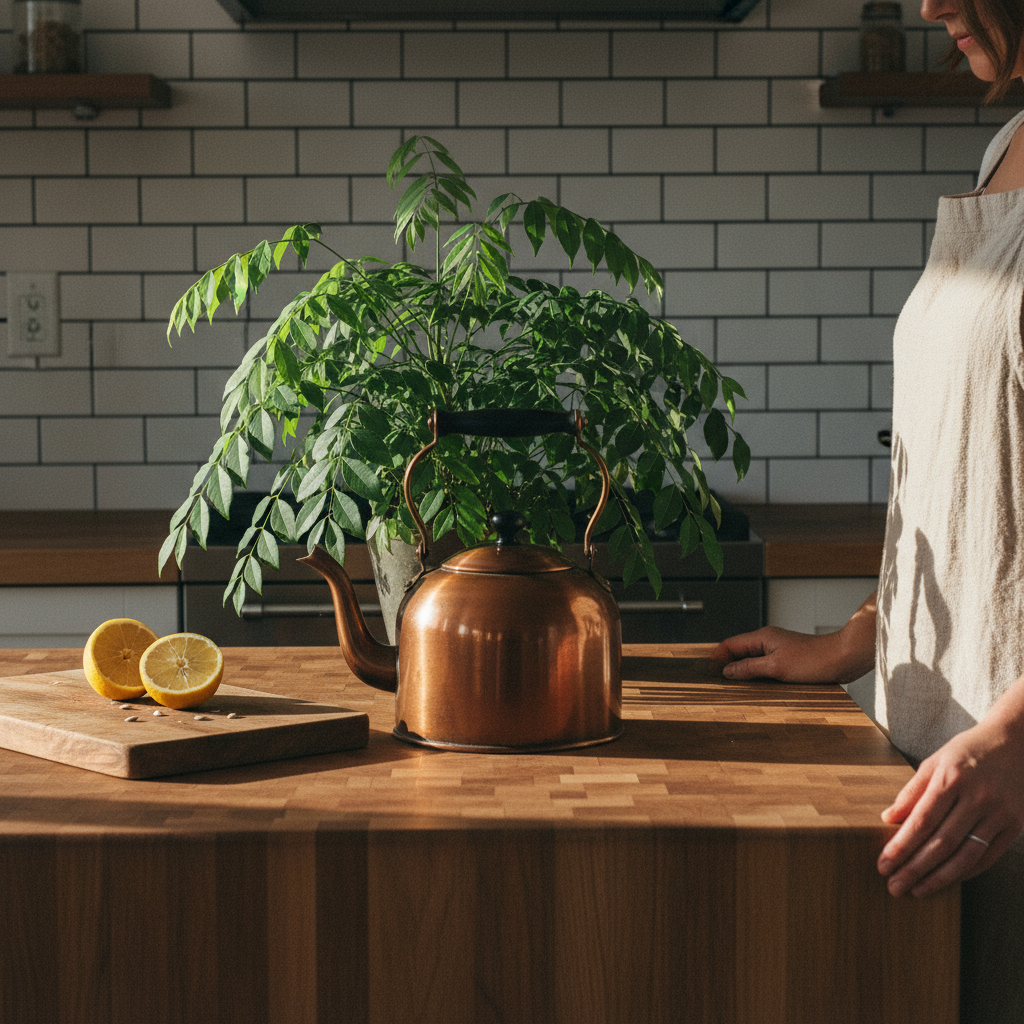
The plant also has a long, quietly useful history beyond decoration. In parts of Southeast Asia the young leaves are eaten as a culinary herb in soups, salads and stews, prized for a faintly carrot-like, anise-flavoured taste. In Polynesia and Vietnam various parts of the plant have been used in traditional medicine, with modern research showing the species contains saponins and triterpenoid compounds with measurable biological activity. For most indoor growers, however, the practical attraction is simpler: a Ming Aralia is a long-lived structural plant that fills a vertical niche in a room without sprawling outwards. It works particularly well in narrow hallways, near reading chairs, beside tall lamps and in any spot where a taller plant is needed but a fast-growing tree would dominate. It also makes a striking subject for indoor bonsai work, where its woody stems and tiny leaflets can be trained over years into miniaturised landscapes.
Important — Toxicity: Ming Aralia contains saponins and is considered mildly toxic to cats and dogs if chewed or ingested. Reactions are usually limited to drooling, vomiting or mild gastrointestinal upset, but the plant is best placed out of reach of pets that nibble foliage. The sap can also be a mild skin irritant for sensitive people, so wear gloves when pruning heavily.
Light Requirements
Light is the single biggest variable that decides whether a Ming Aralia stays full and lush or thins out gradually from the inside. In its native tropical habitat the plant grows as part of the dappled understorey, receiving abundant filtered light through the broken canopy of taller trees. Indoors, the closest match is a position with consistently bright, indirect light: somewhere it would be comfortable to read a book without artificial lighting throughout the day. Direct, unfiltered midday sun is genuinely too harsh and will bleach the fine leaflets within days, while deep shade slowly starves the plant, causing it to thin out and stretch awkwardly toward the nearest window.
The ideal placement is roughly a metre back from a large, unobstructed east, west or south window, with a sheer curtain softening any direct sun that reaches the plant. A north-facing window can work in summer or in genuinely well-lit rooms, but in winter most north windows in the temperate northern hemisphere will be too dim, and the plant will respond by shedding interior leaflets. Watch the plant for a few weeks after moving it; a happy Ming Aralia produces new growth at the tips of its stems, while a light-starved one quietly drops older leaflets without replacing them.
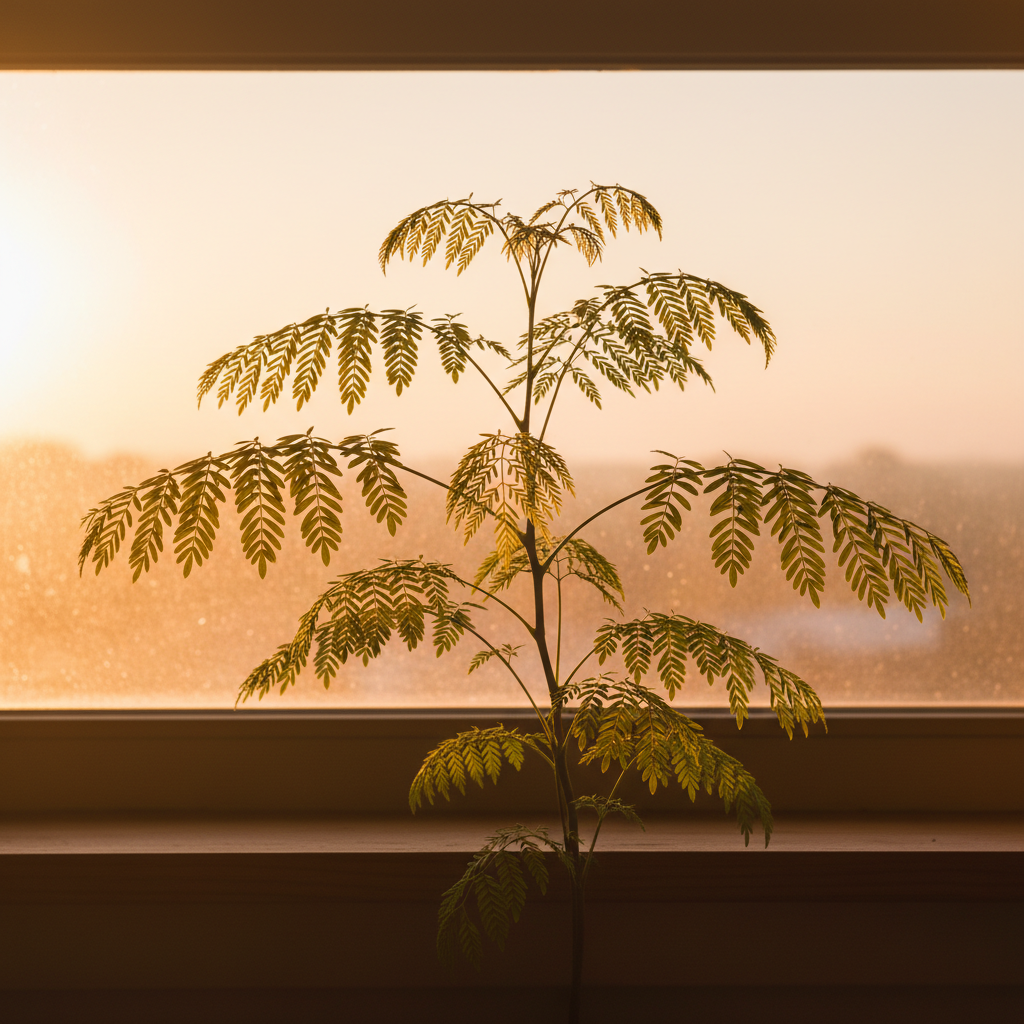
Light Levels Explained
It helps to think about indoor light in five practical tiers rather than the binary of sun and shade. The table below maps the categories most commonly used in houseplant guides onto rough lux measurements and onto the outcome you can expect from a Ming Aralia placed in each.
| Light Category | Approx. Level | Typical Location | Outcome |
|---|---|---|---|
| Direct sun | 30,000 lux or more | Pressed against a south or west window in summer | Leaflets bleach and crisp; not recommended without sheer curtains |
| Bright indirect | 10,000 to 20,000 lux | Within 1 to 2 m of a large east, south or filtered west window | Ideal; steady new growth and dense foliage |
| Medium | 2,500 to 10,000 lux | Mid-room in a well-lit space, 2 to 3 m from windows | Acceptable; growth slows, plant holds its shape |
| Low | 500 to 2,500 lux | Hallway, dim corner, north window in winter | Survives short-term; gradual interior leaf drop |
| Very low | Below 500 lux | Bathrooms with frosted glass, inner rooms | Not suitable; decline within weeks |
Window Orientation and Placement
South-facing window: Excellent year-round, provided a sheer curtain or a second plant filters the most intense midday rays from spring through to early autumn. In a south-window position the Ming Aralia tends to grow faster, hold its leaflets more densely and develop the woodier, more characterful stems associated with mature specimens. In summer keep the foliage at least 60 cm (about 24 in) back from the glass to avoid heat damage.
East-facing window: Possibly the single best long-term position. Morning light is gentle, golden and undemanding, and it tends to be soft enough that the plant can sit directly on the windowsill or close to the glass without scorching. Plants in east windows tend to produce a slightly slower, denser growth pattern, which suits the species’ naturally compact silhouette.
West-facing window: A reasonable second choice, but the strong afternoon sun in summer can be surprisingly fierce on the western side of a building. Either pull the plant 1 to 1.5 m back into the room or filter the light with a sheer curtain or a sturdier neighbouring plant. Watch for crisp brown leaflet tips after a hot afternoon, which usually means the plant is too close to the glass.
North-facing window: Workable in summer or in rooms with high ceilings and pale walls, marginal in winter. If a north window is the only option, place the plant as close to the glass as possible and consider supplementing with a small grow light during the darker months. Otherwise expect noticeable thinning by midwinter.
Pro Tip — Rotate Every Two Weeks: Ming Aralia stems lean toward the brightest light source surprisingly quickly. Quarter-turn the pot every two weeks to keep the canopy symmetrical; otherwise, within a season the plant develops a noticeable lean that is difficult to correct without pruning.
How Light Affects Leaf Density and Colour
In good light the leaflets of a Ming Aralia are a saturated, slightly glossy mid-green and are spaced densely enough that the canopy looks like a single textured mass. As light levels fall, the plant first stops producing new growth at the tips, then quietly drops its oldest, innermost leaflets to redirect resources. The result is a thinning, almost see-through silhouette with bare stem visible between leaf clusters. Variegated cultivars such as ‘Snowflake’ lose their cream-and-white patterning fastest in low light, reverting to mostly green leaflets as the plant prioritises chlorophyll-rich tissue over decorative variegation. Returning the plant to bright indirect light will not restore lost leaflets, but it will encourage new, properly variegated growth at the tips.
Warning — Direct Sunlight: Although mature Ming Aralia can take a small amount of gentle morning sun, prolonged exposure to direct midday or afternoon sun causes irreversible bleaching, crispy brown tips and in severe cases a wave of leaf drop. Plants that have been kept in low light for months should be reintroduced to brighter conditions gradually over two to three weeks, never moved straight to a sunny window.
Artificial Lighting
Ming Aralia responds well to supplemental lighting in rooms that simply do not receive enough natural light. A full-spectrum LED grow light positioned 30 to 60 cm (12 to 24 in) above the plant for 10 to 12 hours a day in winter is enough to keep growth steady and prevent leaf drop. Look for fixtures rated around 20 to 30 watts of actual LED draw for a medium-sized plant, and avoid older, hotter compact-fluorescent fixtures placed too close to the foliage. A simple timer plugged into the lamp removes the daily decision of when to switch it on and off, which matters because Ming Aralia prefers a regular photoperiod.
Seasonal Adjustments
Light intensity in the northern hemisphere drops by roughly half between September and December, and Ming Aralia notices it. Many growers find their plant goes through a period of mild leaf drop in autumn, which is normal as long as it does not become persistent. To soften the transition, move the plant 30 to 60 cm (12 to 24 in) closer to the window once the leaves start falling outside, clean the glass to maximise transmission and consider switching on a grow light for the darker months. In spring, reverse the process gradually so the plant is not exposed to a sudden jump in light intensity that can cause bleaching.
Watering and Humidity
If light decides the long-term shape of a Ming Aralia, water decides its daily mood. The plant prefers a watering rhythm that is neither parched nor permanently saturated; the goal is a soil profile that is consistently moist in the top third but never sodden at the bottom of the pot. Long dry spells cause crisp, brown leaflets and a wave of leaf drop that can take weeks to stop. Constantly wet soil, particularly in winter, suffocates the fine feeder roots and triggers root rot that the plant struggles to recover from. Almost every Ming Aralia problem traceable to watering falls into one of those two scenarios, and the cure is the same: pay attention to the substrate, not to a fixed weekly schedule.
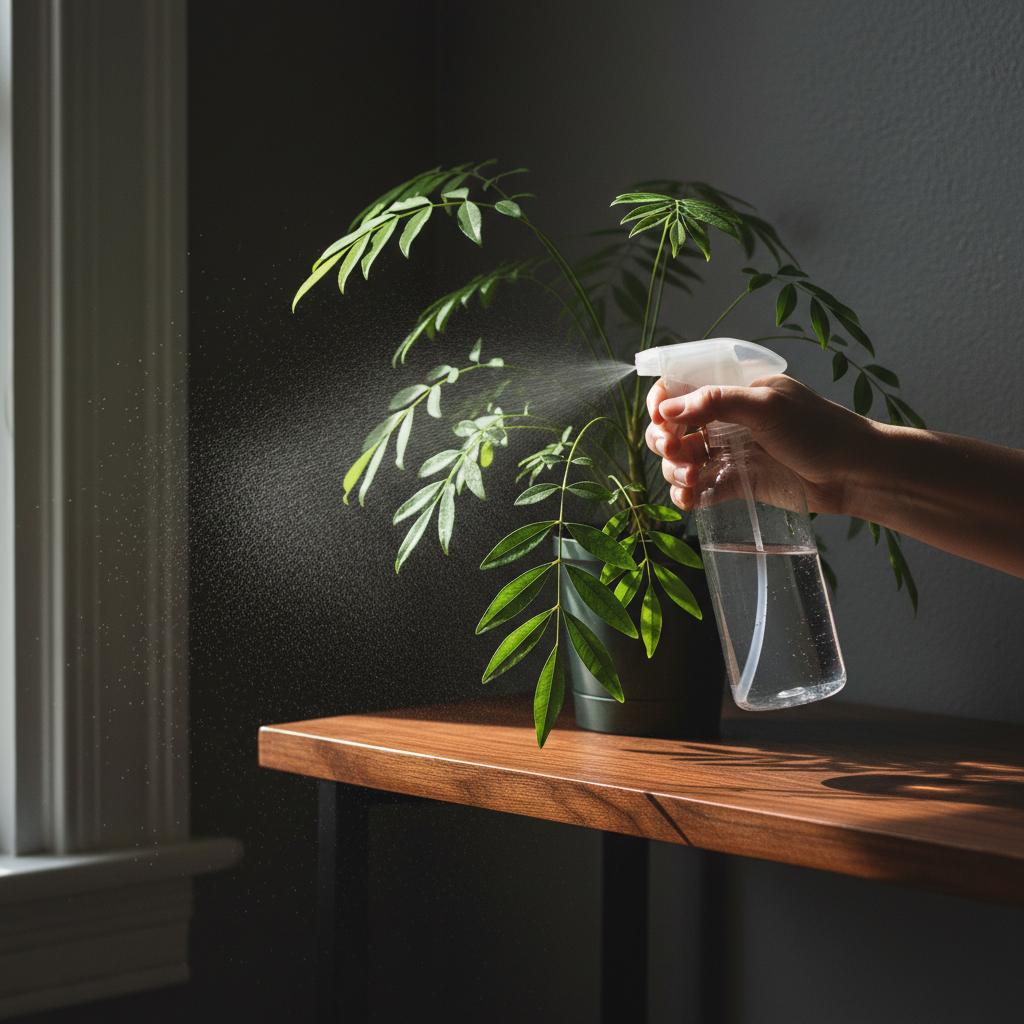
When to Water
The simplest and most reliable test is a finger or a wooden chopstick pushed about 3 cm (just over an inch) into the substrate. If it comes out with moist soil clinging to it, wait. If it comes out almost clean and the soil is cool but no longer obviously damp, it is time to water. Most healthy indoor Ming Aralia plants in a typical 20 to 25 cm (8 to 10 in) pot will need watering roughly every five to ten days in spring and summer, stretching to every ten to fourteen days in winter when growth slows and evaporation drops.
Pot size, substrate composition, room temperature and humidity all push these numbers around significantly, which is why a calendar is a poor substitute for a finger check. Plants in small terracotta pots dry several times faster than the same plant in a large glazed ceramic, and a plant near a radiator may need water every three days while a twin in a cool hallway needs it once a fortnight. Get into the habit of checking every Ming Aralia in the house once a week and watering only the ones that pass the dryness test.
Pro Tip — Lift the Pot: Once you have watered a Ming Aralia thoroughly and allowed it to drain, lift the pot to feel its weight. Lift it again before each watering and compare. A pot that feels noticeably lighter than the freshly watered baseline is ready for water; one that still feels heavy is not. With a little practice this method is more reliable than any moisture meter.
How to Water Correctly
- Take the plant to a sink, bath or large tray that can catch run-off rather than watering in place over a saucer.
- Pour room-temperature water slowly and evenly around the entire surface of the substrate, avoiding the central crown where the woody stems emerge.
- Continue until water flows freely from every drainage hole at the base, then continue for another few seconds to flush accumulated mineral salts out of the root zone.
- Let the pot drain completely for ten to fifteen minutes before returning it to its decorative cover pot or saucer.
- Empty any standing water from the saucer or cover pot afterwards; a Ming Aralia should never sit in water for more than half an hour.
- Note the date on a sticky label or a plant-care app and use the interval as a rough guide for the next check, not a hard schedule.
Signs of Overwatering vs. Underwatering
| Symptom | Overwatering | Underwatering |
|---|---|---|
| Leaf colour | Yellowing of older leaflets from the inside outwards, often uniformly across a stem | Browning starting at the tips and edges of leaflets, sometimes with curling |
| Leaf texture | Soft, limp, sometimes translucent leaflets that drop while still partly green | Crispy, papery leaflets that crumble at the touch |
| Soil surface | Persistently dark and damp, sometimes with a musty smell or surface mould | Pale, cracked, often pulling away from the sides of the pot |
| Roots | Brown, mushy, foul-smelling, sloughing skin when rubbed gently | Brittle, pale, sometimes dusty; intact but desiccated |
| Stem base | Soft, dark, occasionally weeping at the soil line | Firm but slightly wrinkled or shrunken |
Warning — Root Rot: Once a Ming Aralia develops noticeable root rot, recovery is slow and not guaranteed. Unpot the plant, rinse the root ball thoroughly under tepid water, trim away any blackened or mushy roots with sterilised scissors, dust the cuts with cinnamon or sulphur powder, and repot into a slightly smaller container with completely fresh, well-draining substrate. Water sparingly for the next four to six weeks while new roots establish.
Humidity Requirements
Humidity is the second axis of the watering question for this species, and the one most often overlooked. Ming Aralia evolved in humid tropical understoreys where ambient humidity rarely falls below 60 percent, and it shows. Most modern centrally heated homes hover around 30 to 40 percent humidity in winter, which is roughly the same as a desert. In these conditions the plant compensates by transpiring more, drying out faster, and eventually dropping leaflets that it can no longer keep hydrated.
The visible symptoms of low humidity are crispy brown leaflet tips, papery edges that work their way inwards over weeks, and a slow but persistent shower of fine leaflets onto the floor below the plant. These are usually mistaken for underwatering, and the natural response, watering more, only makes things worse by saturating the substrate while the air stays bone-dry. The signal to watch for is whether the brown areas are mostly at the very tips and edges, with the centre of each leaflet still green; that is a humidity problem, not a watering one.
Raising humidity around a Ming Aralia is usually done in several small overlapping ways rather than one dramatic intervention. A pebble tray placed under the pot, with the water level always below the bottom of the pot, adds a small steady amount of evaporation right where the plant needs it. Clustering several humidity-loving plants together creates a humid microclimate through their collective transpiration. A simple cool-mist room humidifier set to 50 to 60 percent in the same room is the most reliable solution and the one most experienced growers eventually settle on. Misting helps briefly, but the effect lasts only an hour or two and is best treated as a supplement, not a strategy.
Water Quality
Ming Aralia is moderately sensitive to mineral build-up in the substrate and to chemical additives in tap water. In hard-water regions, leaflet tips often show fine browning even when humidity and watering are both correct, because soluble salts accumulate in the root zone and burn the most active growing tissue. The simplest mitigation is to flush the pot thoroughly every few months by running plain water through it until at least three pot-volumes have drained out, and to occasionally substitute rainwater, distilled water or cooled boiled water for the regular tap supply. Where chloramine in the local supply is the suspected culprit, letting the water stand uncovered for 24 hours will not remove it; only filtration through a carbon filter, or substitution with rain or distilled water, makes a real difference.
Soil, Potting and Repotting
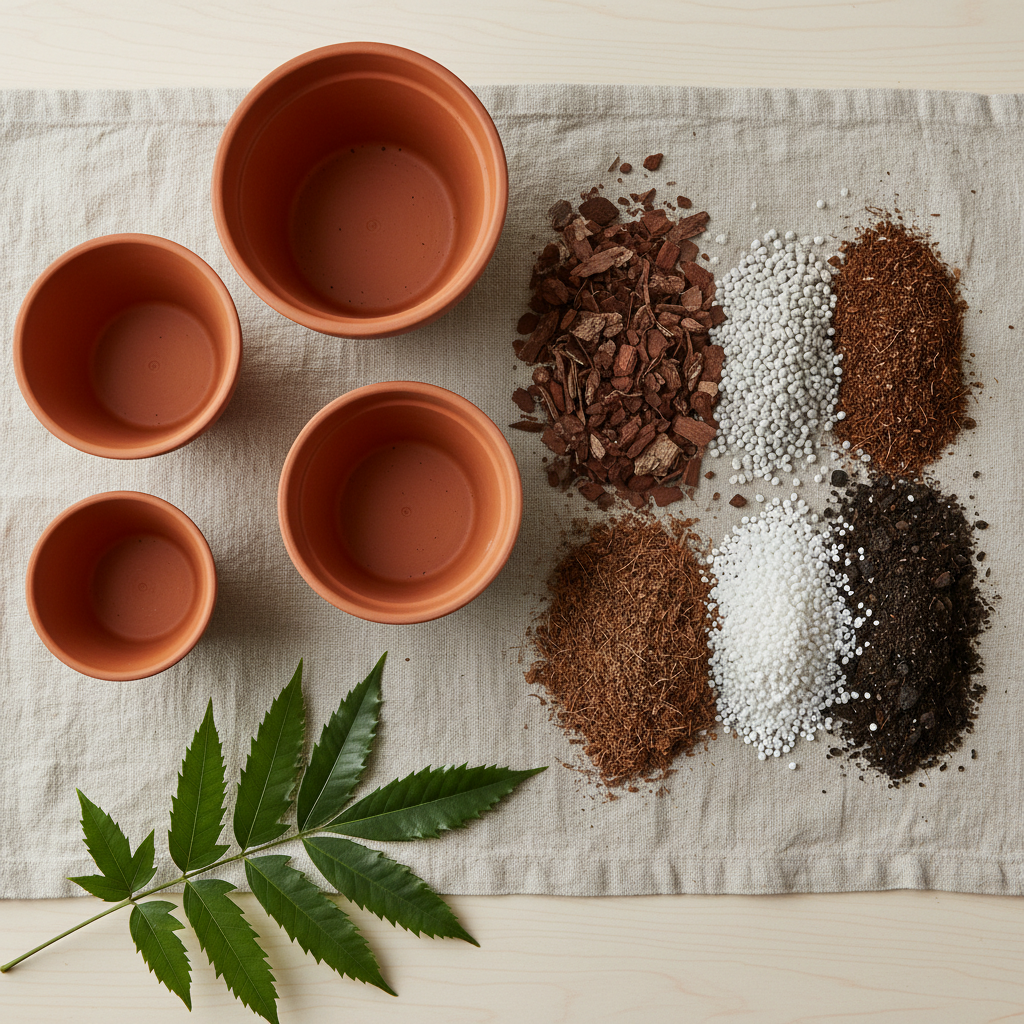
The substrate around a Ming Aralia’s roots performs three jobs simultaneously: it holds enough moisture between waterings to keep the plant comfortable, it lets excess water and stale air escape quickly through the drainage holes, and it delivers a steady supply of nutrients to the slow-growing root system. A dense, peaty all-purpose compost on its own will do the first job too well and the other two badly, which is why an off-the-shelf bag is rarely the right answer. A small amount of mixing produces a substrate that suits this plant far better and lasts longer between repottings.
Ideal Soil Composition
The aim is a chunky, free-draining mix with enough organic matter to hold moisture but plenty of large particles to keep the structure open as roots grow through it. Picture a substrate that you could squeeze gently in a fist, see hold its shape briefly, then fall apart at the slightest poke. That is the texture Ming Aralia roots prefer, because it lets oxygen reach the fine root hairs while still keeping the surrounding particles damp for a few days after each watering.
| Component | Proportion | Function |
|---|---|---|
| Quality peat-free houseplant compost or coco coir base | 50 percent | Holds moisture, supplies a baseline of organic nutrients, anchors roots |
| Perlite or pumice | 20 percent | Creates air pockets, prevents compaction, speeds drainage |
| Fine orchid bark or fir bark | 20 percent | Adds structure, holds a little moisture without becoming soggy |
| Worm castings or well-rotted compost | 5 to 10 percent | Slow-release nutrients, beneficial microbiology |
| A handful of horticultural charcoal | Optional, to taste | Sweetens the mix, absorbs odours and impurities |
Ming Aralia prefers a substrate that is very slightly acidic, in the pH range of about 6.0 to 6.5. Most peat-free houseplant composts and coco-coir-based mixes are already close to this range out of the bag, which is one reason these substrates work well as a base. Lime-rich mixes intended for cacti or alpines push the pH too high and slowly cause yellowing between the veins of new leaflets as iron and other micronutrients become locked up in the substrate.
Pro Tip — Quick Mix Recipe: If a single ready-made bag is the only option, look for a quality aroid mix or an indoor tree mix and add one part perlite for every four parts of mix. This single change addresses the drainage problem most off-the-shelf composts have and dramatically reduces the risk of soggy soil for a Ming Aralia.
Choosing the Right Pot
Ming Aralia roots are surprisingly modest for the plant’s eventual size and prefer a pot that fits them snugly rather than one that gives them a swimming pool of substrate to wander through. The general rule for this species is that the pot diameter should be only 2 to 3 cm (about 1 in) larger than the current root ball, and slightly deeper than wide rather than the other way around. A pot that is too large stays wet for too long between waterings, which is the single most common cause of root rot in this species.
Drainage holes are non-negotiable. Whatever else the pot has going for it, it must allow water to leave the substrate freely within minutes of watering. A decorative cover pot without drainage holes is perfectly acceptable as long as the actual growing pot inside it has them and any run-off is emptied promptly. A Ming Aralia planted directly into a hole-less ceramic container is a candidate for root rot within a season, no matter how careful the watering schedule.
Pot material: Terracotta is the traditional choice and is well suited to Ming Aralia because the porous walls wick moisture out of the substrate and reduce the risk of staying wet for too long. The trade-off is that terracotta pots dry out faster, especially in summer, so plants in this material may need watering noticeably more often than the same plant in a glazed ceramic or plastic pot. Glazed ceramic and plastic both hold moisture longer, which suits gardeners who tend to forget to water; glossy and matt glazes also tend to look more contemporary in interior settings. Whatever the material, a saucer underneath catches drips and protects floors but should never become a permanent reservoir.
Pot size: Step up by no more than one nursery size at a time, typically from a 14 cm pot to a 17 cm, or a 17 cm to a 21 cm. Larger jumps shock the root system and surround the existing roots with too much undisturbed wet substrate. If a Ming Aralia is already in a generous pot but needs refreshing rather than a size up, simply tease out the old substrate, prune any damaged roots and return it to the same pot with fresh mix.
When to Repot
Ming Aralia is a slow-growing plant and does not need repotting often. Most specimens are happy in the same container for two to three years, and many keep producing new growth perfectly well for longer than that as long as the substrate is refreshed annually with a layer of fresh worm castings or compost on top. Repot when roots begin to emerge from the drainage holes, when water now runs straight through the pot in seconds with very little visible absorption, or when the substrate looks compacted and grey rather than dark and crumbly. Spring is the ideal moment, just as new growth begins, because the plant has the longest possible warm season ahead to recover and establish.
How to Repot: Step-by-Step
- Water the plant a day before repotting; hydrated roots handle disturbance much better than dry ones.
- Prepare the new pot with a 2 to 3 cm (about 1 in) layer of fresh substrate at the bottom; resist the urge to add gravel or shards, which actually impede drainage rather than helping it.
- Gently tip the plant out of its current pot, supporting the main stem at the base; if it sticks, squeeze the sides of a plastic pot or run a knife around the inside of a ceramic one rather than pulling on the trunk.
- Tease out a thin outer layer of substrate to expose the active root tips, and trim away any blackened, mushy or obviously dead roots with sterilised scissors.
- Centre the plant in the new pot at the same depth it was growing before; planting it deeper risks rotting the stem base.
- Add fresh substrate around the sides, tapping the pot gently on the bench every couple of centimetres to settle the mix without compressing it.
- Water thoroughly once until run-off appears at the drainage holes, then place the plant out of direct sun for two weeks while the roots re-establish.
Warning — Transplant Shock: It is normal for a Ming Aralia to drop a handful of leaflets in the two to three weeks after repotting, even when everything was done correctly. Do not respond by over-watering or fertilising; treat it as a settling-in period, keep the substrate evenly moist and wait for new growth at the tips before resuming normal care.
Fertilising
Ming Aralia is not a heavy feeder, but its slow, steady growth pattern does benefit from a regular trickle of nutrients through the active growing season. The aim is to supply roughly the same flow of minerals the plant would receive in its native understorey, where falling leaves and decomposing organic matter provide a constant gentle nutrient drip. The single most common feeding mistake is treating Ming Aralia like a tomato or a fast-growing climber and dosing it with full-strength fertiliser every fortnight; this builds up salts in the substrate, burns the fine roots and ultimately causes more leaflet drop than it prevents.
The goal of any fertilising programme for this species is therefore to keep the macronutrients available at low levels rather than maximised. Less is reliably more. A specimen that goes too long without any feeding will show pale, sluggish new growth and slow leaf production; one that is overfed will show crispy brown leaflet tips and edges that look superficially like underwatering. Both extremes are easy to avoid with the schedule described below.
Understanding Plant Nutrients
Every fertiliser label is dominated by the NPK ratio, the three numbers that list the percentages of nitrogen, phosphorus and potassium by weight. For a balanced foliage plant such as Ming Aralia, a roughly even ratio in the 10-10-10 to 20-20-20 range is ideal, or anything similar where no one number is more than about twice another. High-nitrogen formulas designed for lawns or leafy greens push the plant into producing thin, leggy growth that loses its characteristic density, while high-phosphorus bloom boosters are unnecessary because Ming Aralia is not grown for flowers indoors.
| Nutrient | Symbol | Primary Function | Deficiency Symptoms |
|---|---|---|---|
| Nitrogen | N | Leaf growth, chlorophyll production, overall vigour | Pale, uniformly yellowing older leaves; weak new growth |
| Phosphorus | P | Root development, energy transfer, flowering | Stunted growth, dull purplish tinge on undersides of older leaves |
| Potassium | K | Overall hardiness, water balance, disease resistance | Browning at leaf margins, weak stems, vulnerability to stress |
| Calcium | Ca | Cell-wall structure, new-tip integrity | Deformed or crinkled new growth, dead growing points |
| Magnesium | Mg | Central atom of chlorophyll, photosynthesis | Interveinal yellowing on older leaves, green veins remain |
| Iron | Fe | Chlorophyll synthesis, electron transport | Interveinal yellowing on the newest leaves, green veins remain |
Types of Fertiliser
Liquid fertilisers: The easiest option for most indoor growers, liquid feeds are mixed with water and applied during normal watering. Pick a balanced houseplant formula and consistently dilute to half the dose recommended on the bottle. Liquid feeds give the most immediate response, which is useful for fine-tuning, but they also leach out of the pot quickly, so they need re-application on a regular schedule.
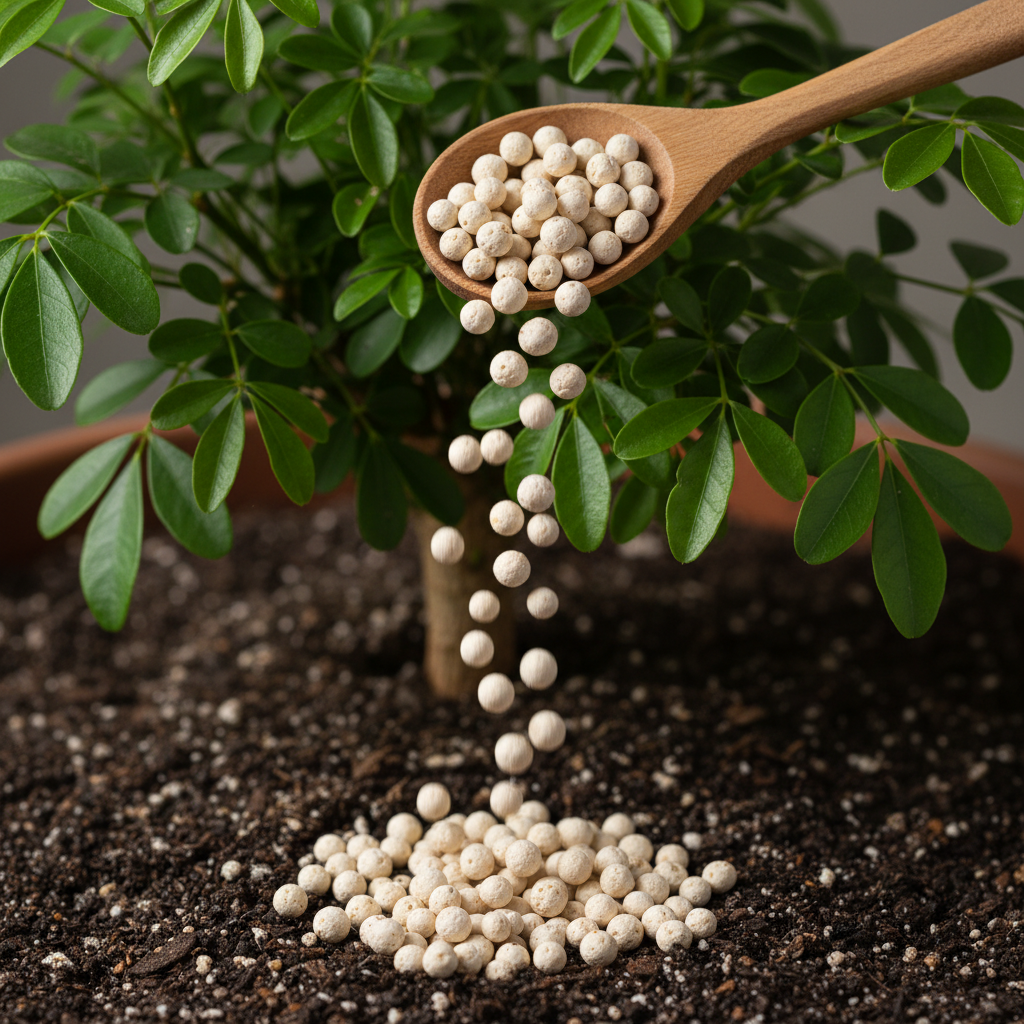
Slow-release granular: Coated prills release nutrients gradually over three to six months in response to soil moisture and warmth, which produces an even, low-level supply that suits Ming Aralia’s pace of growth particularly well. Sprinkle a small dose onto the surface of the substrate in early spring, top up at midsummer if recommended on the label, and stop entirely from late autumn to early spring. Always err on the side of less than the bag suggests, particularly for younger plants.
Organic fertilisers: Worm castings, well-rotted compost, seaweed extract and fish emulsion all work well with Ming Aralia and have the advantage of feeding the soil microbiology as well as the plant. A thin top-dressing of worm castings in spring, refreshed in midsummer, is enough to supply most of the plant’s modest needs. Liquid organic feeds tend to be smelly and are better used sparingly indoors; outdoor balcony specimens can take them more enthusiastically.
Feeding Schedule
From early spring through to early autumn, when daylight, warmth and active new growth all line up, feed once a month with a balanced liquid fertiliser at half the manufacturer’s recommended strength, or apply a single dose of slow-release granules in spring and a second in midsummer. From late autumn to early spring, when the plant is essentially resting, stop fertilising entirely; feeding a dormant plant simply accumulates salts in the substrate and burns the roots without any benefit to growth. A long, well-spaced watering with plain water every six to eight weeks during winter helps flush out any residual minerals.
Pro Tip — Always Feed on Moist Soil: Pouring fertiliser onto bone-dry substrate concentrates the salts on the roots and risks chemical burn, even at half strength. Water the plant lightly with plain water first, wait an hour, then apply the diluted feed. The roots are then surrounded by moist substrate and absorb the nutrients evenly rather than in a damaging spike.
How to Fertilise
- Check that the plant is actively growing; pale, etiolated or freshly repotted specimens should not be fed.
- Mix the chosen fertiliser at half the label dose in a watering can or jug of room-temperature water.
- If the substrate is fully dry, give it a light watering with plain water first and let it absorb for an hour.
- Apply the diluted feed slowly and evenly across the entire substrate surface, avoiding direct contact with the stem base.
- Stop pouring as soon as a small amount of solution shows at the drainage holes, then empty any run-off from the saucer.
Warning — Salt Build-Up: Even with careful half-strength dosing, mineral salts gradually accumulate in the substrate as a fine white crust on the soil surface or at the rim of the pot. Flush the substrate thoroughly with plain water every three to four months by running water through the pot until at least three pot-volumes have drained out. If the crust is severe, scrape off the top centimetre of substrate and replace it with fresh mix.
Propagation
Propagating Ming Aralia is rewarding once the rhythm is understood, but it is genuinely slower and less forgiving than rooting a pothos cutting in a jar of water. The plant produces fine, slow-developing roots that prefer a humid, warm and stable environment, and rushing the process by exposing fresh cuttings to dry household air is the most common reason home propagation attempts fail. The two reliable methods for amateur growers are semi-hardwood stem cuttings rooted in moist substrate under a humidity cover, and air layering of an existing branch on the mother plant.
Both methods take patience. A successful Ming Aralia cutting typically needs four to eight weeks before substantial new roots appear, and another month or two before it can be treated as a normal small plant. The reward, however, is a genetically identical copy of the parent that often grows into a fuller, more compact shape because home-rooted cuttings are pinched and shaped from the start.
Understanding Stem Maturity
The single most useful concept when propagating Ming Aralia is the difference between softwood, semi-hardwood and hardwood stems. Soft, green growth at the very tip of a stem roots quickly in good conditions but is fragile and prone to rotting in the days before roots form. Fully woody, brown lower stems are tough but slow to produce new roots and often refuse altogether. The sweet spot is semi-hardwood: stems that have firmed up and turned a paler green or pale tan, are still flexible but no longer soft, and bear several mature leaves but are not yet fully bark-covered. These cuttings combine the rooting enthusiasm of fresh growth with the structural resilience of mature tissue, and they are by far the most reliable section to work with.
Stem Cuttings: Step-by-Step
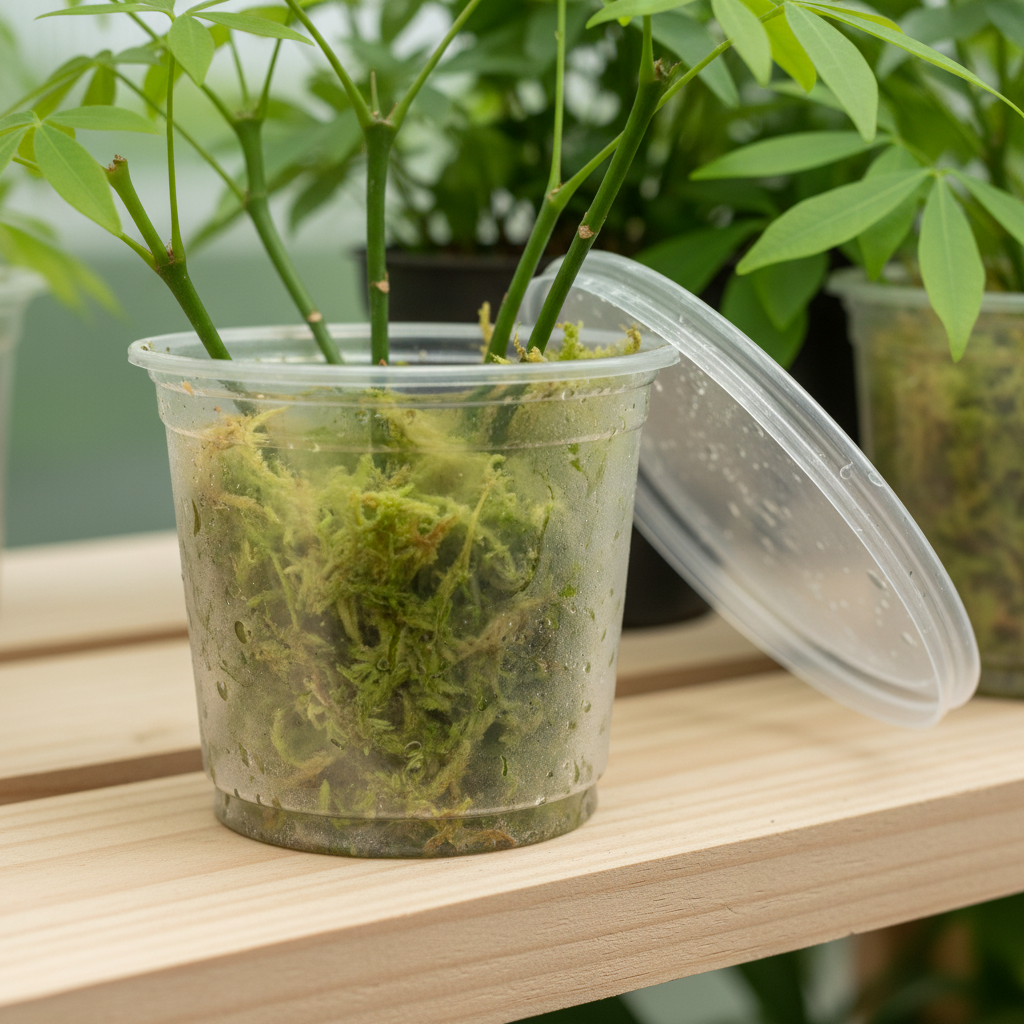
Stem cuttings can be rooted directly in moist substrate, in damp sphagnum moss, or in a deli cup of perlite under a clear cover. Sphagnum and perlite both make it easier to see when roots have developed without disturbing the cutting, which is why most experienced propagators prefer them over soil for this species. Take cuttings in late spring or early summer when the plant is in active growth, ideally on a warm day with the parent plant fully hydrated from a recent watering.
- Choose a healthy semi-hardwood stem section about 10 to 15 cm (4 to 6 in) long, with at least two or three sets of leaves at the top.
- Cut just below a node using sterilised, sharp secateurs; a node is the slight swelling where leaves emerge from the stem, and is where the new roots will form.
- Remove the lower leaves entirely so only the top two or three leaf clusters remain, exposing at least one bare node that will sit in the rooting medium.
- Optionally dip the cut end in rooting hormone powder or gel; this is not essential but does improve success rates noticeably with woody Aralia stems.
- Insert the cutting 3 to 5 cm (1 to 2 in) deep into damp sphagnum moss, fine perlite or a 50/50 perlite-and-coir mix, firming the medium gently around the stem so the cutting stands upright.
- Cover the cutting with a clear plastic bag, a propagator lid or an inverted deli cup to maintain 80 to 95 percent humidity around the foliage.
- Place in bright indirect light at 22 to 27 °C (72 to 80 °F); a heat mat under the container speeds rooting noticeably during cooler months.
- Open the cover briefly every two or three days to refresh the air, and keep the medium just damp; bone-dry kills the cutting, sodden rots it.
- After four to eight weeks, tug very gently on the cutting; resistance means roots have formed and the cover can be vented progressively over a fortnight before transplanting.
Pro Tip — Use Bottom Heat: Ming Aralia cuttings root noticeably faster and more reliably when the rooting medium is held at around 24 to 27 °C (75 to 80 °F). A small horticultural heat mat under the propagator, set on a timer or thermostat, often cuts rooting time roughly in half compared with the same cutting on an unheated windowsill.
Air Layering: Step-by-Step
Air layering is a slightly more advanced method that produces a much larger, already substantial new plant in a single operation. Instead of removing a cutting and asking it to grow roots on its own, the gardener encourages roots to form on a stem while it is still attached to the parent and being fed by it. This is particularly useful for a leggy older Ming Aralia that has lost its lower leaflets and would benefit from being shortened anyway.
- Identify a healthy section of stem about 30 to 45 cm (12 to 18 in) below a leafy top, on a stem that is no thinner than a pencil.
- With a sharp, sterilised blade, make an upward angled cut about a third of the way through the stem, or remove a 2 cm (about 1 in) ring of bark all the way around the stem; either method exposes the inner tissue where roots will form.
- Lightly dust the wound with rooting hormone powder and prop the cut open with a tiny piece of matchstick or toothpick if the angled-cut method was used.
- Wrap the wound in a generous handful of damp, but not dripping, sphagnum moss, large enough to enclose the cut completely.
- Cover the moss with clear plastic film or a clear plastic bag and secure both ends with twist ties or twine, creating a sealed humid bubble around the wound.
- Check the moss every couple of weeks; if it dries out, inject a little water with a syringe rather than unwrapping the bundle.
- After six to twelve weeks, white roots should be visible through the plastic against the moss; once a clear network has formed, cut the stem just below the layered section and pot the new plant up, keeping it slightly more humid and shaded for the first month.
Troubleshooting Propagation
| Problem | Likely Cause | Solution |
|---|---|---|
| Cutting wilts within a few days | Humidity around foliage too low, or too many leaves left on the cutting | Tighten the cover, remove half the remaining leaflets to reduce transpiration, and place out of direct sun |
| Cutting turns black at the base | Rooting medium too wet, or non-sterile tools introduced fungus | Start again with a fresh cutting, sterilise tools, use barely damp medium, and add a thin layer of perlite at the base |
| No roots after eight weeks | Temperature too cool, softwood rather than semi-hardwood used, or cutting taken from a stressed parent | Move to a warmer spot or add bottom heat, take a more mature cutting, and let the parent recover before trying again |
| Roots form but new plant stalls after potting | Transition shock from high humidity to dry household air | Vent the humidity cover gradually over two weeks before removing it entirely, and keep ambient humidity above 50 percent for the first month |
Pests and Diseases
Ming Aralia is not especially attractive to pests on a healthy plant, but its slow growth means damage accumulates noticeably when an infestation does take hold. Most problems begin with an environmental stressor, low humidity, light, irregular watering, that weakens the plant enough for opportunistic pests to gain a foothold. The single most effective pest-control measure for this species is keeping conditions stable; the second is regular close inspection of the undersides of leaflets and the angles where they join the stem.
When an outbreak does occur, early action is far easier than rescue. A weekly habit of holding the canopy up to a window or a torch and looking for movement, webbing or sticky residue takes thirty seconds and catches the vast majority of problems before they become visible across the room. The pests that affect this plant most commonly are all manageable with techniques described below, none of which require restricted-use pesticides.
Common Pests
Spider Mites (Tetranychus urticae)
The most common Ming Aralia pest, particularly in centrally heated homes with low winter humidity. Spider mites are nearly invisible to the naked eye but produce fine webbing in the leaflet axils and a stippled, dusty appearance on the upper leaf surface as cells are sucked dry one by one. Severe infestations cause sweeping leaflet drop and a generally lifeless look to the plant within a few weeks.
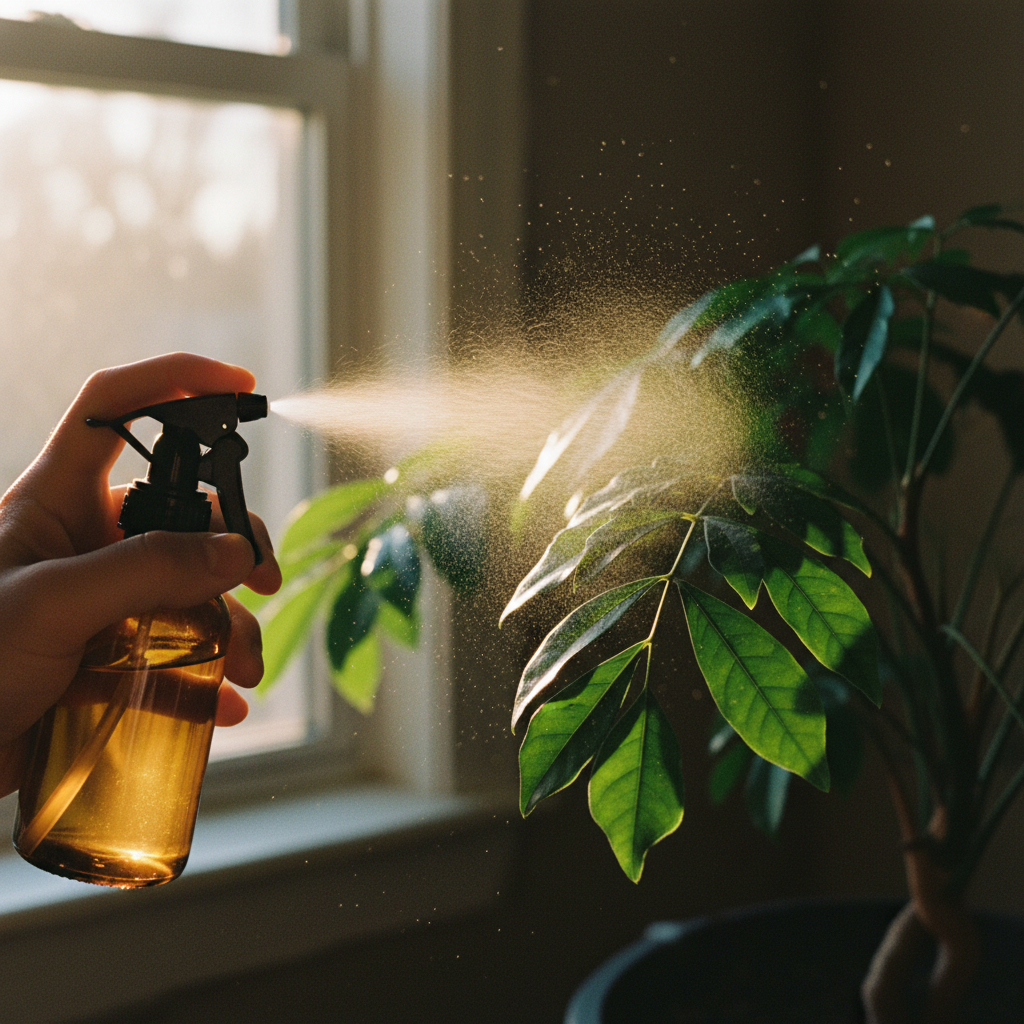
Treatment: Rinse the entire canopy under a tepid shower or a strong spray of water at the sink, focusing on the undersides of the leaflets. Follow up the next day with a neem oil or insecticidal soap spray applied to both upper and lower leaf surfaces, repeated every five to seven days for three cycles. Raising ambient humidity above 50 percent makes the environment much less welcoming to future infestations.
Mealybugs (Pseudococcus longispinus)
Small, soft-bodied sucking insects coated in a white waxy fluff that gives them the appearance of tiny cotton balls. They prefer hidden spots such as the bases of leaflets, the joints of stems and the surface of the substrate near the trunk. Heavy infestations leave behind sticky honeydew that often grows a black sooty mould, and weaken the plant by depleting its sap supply.
Treatment: Spot-treat visible mealybugs by dabbing each one with a cotton bud soaked in 70 percent isopropyl alcohol; the wax coating dissolves and the insect dies almost immediately. Follow up with a thorough neem oil or insecticidal soap spray every seven days for at least three weeks to catch the next hatch of crawlers. Isolate the affected plant from other houseplants while treating.
Scale Insects (Coccus hesperidum)
Brown, oval, almost limpet-like discs that attach themselves firmly to stems and the undersides of mature leaves. Scale insects often go unnoticed for months because they look like part of the bark. They sap the plant slowly and produce honeydew that attracts black sooty mould, and over time cause yellowing and progressive weakness.
Treatment: Scrape off visible scale insects with a fingernail or soft toothbrush dipped in soapy water; the protective shell makes contact sprays less effective unless the insect is dislodged first. Follow up with horticultural oil or neem oil to suffocate eggs and juvenile crawlers, repeating every ten days for three or four cycles. Inspect any neighbouring plants carefully because scale spreads slowly but persistently.
Aphids (Aphis fabae)
Soft green, black or pale yellow insects that cluster on the soft new growth at the tips of stems and around emerging leaves. They suck plant sap, deform new growth and produce honeydew like the other sap-suckers above. Outdoor specimens are far more vulnerable than indoor ones, but balcony or summer-vacationed plants can pick aphids up easily.
Treatment: Knock off the bulk of the colony with a strong jet of water at the sink or hose, then follow with a single dose of insecticidal soap to mop up survivors. Aphid populations crash quickly once their numbers are reduced, and a single thorough wash often clears a small infestation entirely.
Common Diseases
Root Rot (Pythium and Phytophthora spp.)
The most serious and most common Ming Aralia disease, caused by waterborne fungi that thrive in continuously saturated substrate and starve roots of oxygen. Symptoms include soft, blackened or mushy roots, yellowing and dropping of older leaves, a faint musty smell from the pot and a stem base that feels soft to the touch. Once root rot is well established, recovery is uncertain even with prompt action.
Treatment: Unpot the plant, rinse the root ball under tepid water, and trim away every blackened, mushy or foul-smelling root with sterilised scissors back to clean white tissue. Dust the cuts with cinnamon, sulphur or a horticultural fungicide, then repot in completely fresh, fast-draining substrate in a clean container slightly smaller than the original if many roots were removed. Water sparingly for the next six weeks while new roots establish, and address whatever overwatering pattern caused the rot in the first place.
Leaf Spot (Alternaria and Cercospora spp.)
Brown or black spots, sometimes with a yellow halo, that appear on individual leaflets and slowly enlarge until the affected leaflet drops. Fungal leaf spots are encouraged by water sitting on the foliage for long periods, particularly overnight, and by poor air circulation around a crowded plant.
Treatment: Pinch off and bin the worst affected leaflets to reduce the inoculum, improve air movement around the plant with a small fan on its lowest setting, and avoid wetting the foliage when watering. In stubborn cases, a copper-based fungicide applied every seven to ten days for three cycles usually resolves the problem entirely.
Sooty Mould
A black, dusty-looking growth on the upper surface of leaflets and on nearby surfaces, sooty mould is not actually a parasite on the plant; it grows on the honeydew secreted by sap-sucking pests. While sooty mould itself does little direct harm, it blocks light from reaching the leaflet surface and indicates an underlying pest infestation that needs treating.
Treatment: Wipe affected leaflets gently with a damp microfibre cloth or a soft sponge of warm soapy water, then rinse. Treat the underlying pest infestation as described above; once the honeydew supply stops, the sooty mould stops returning.
Pest and Disease Summary
| Pest / Disease | Identification | Treatment |
|---|---|---|
| Spider mites | Fine webbing, stippled leaves, dust-like specks moving on undersides | Shower wash, neem oil weekly for three weeks, raise humidity |
| Mealybugs | White cottony clusters in leaf joints and stem axils | Cotton-bud alcohol spot treatment, neem oil follow-up for three weeks |
| Scale | Brown limpet-like discs on stems and leaf undersides | Scrape off, then horticultural oil every ten days for a month |
| Aphids | Soft insects on new growth tips, sticky honeydew | Strong water spray, insecticidal soap once or twice |
| Root rot | Blackened mushy roots, musty smell, yellowing older leaves | Unpot, trim affected roots, refresh substrate, water sparingly for six weeks |
| Leaf spot | Dark spots with yellow halos, often expanding outwards | Remove affected leaflets, improve airflow, copper fungicide if persistent |
| Sooty mould | Black dusty coating following a sap-sucker infestation | Wipe leaves clean, eliminate the underlying pest |
Prevention Strategies
Most Ming Aralia pest and disease problems are easier to prevent than to treat once they are established. Stable conditions, balanced watering and adequate humidity together remove most of the openings that pests exploit. New plants brought home from a nursery or shop should be isolated from the rest of the collection for two to three weeks while their leaves and stems are inspected, ideally with a magnifier, for any sign of mites, scale or mealybugs. Tools used on suspect plants should be wiped down with isopropyl alcohol before being used on healthy ones.
Air circulation is one of the most underestimated preventive measures. A small clip-on fan running on its lowest setting in the same room, even just for a few hours a day, dries the surface of the substrate and the leaflets more quickly after watering and makes the environment dramatically less hospitable to fungal pathogens and spider mites. Regular gentle dusting of the foliage with a damp cloth, or an occasional warm shower at the sink, removes the dust film that can otherwise smother the surface of the leaflets and reduce gas exchange.
Pro Tip — Neem Oil as Preventive: A light monthly spray of diluted neem oil on the undersides of the leaflets, applied in the early evening when no direct sun will hit the foliage, acts as a gentle preventive against most common houseplant pests. Mix at the label rate, add a drop of mild liquid soap as an emulsifier, and shake the bottle frequently while spraying to keep the oil evenly distributed.
Popular Varieties
Although Polyscias fruticosa is the species most commonly sold as “Ming Aralia”, the wider genus Polyscias contains around 150 species and a number of garden cultivars, several of which are sold under the same trade name or alongside it in the same nursery section. They share the same care requirements but differ noticeably in leaf shape, colour and overall silhouette, which makes it worthwhile knowing what to look for when shopping.
The cultivars below cover the most readily available forms in Europe and North America. A few are scarce enough that they may need to be sourced from specialist Aralia or bonsai nurseries, but most appear at well-stocked indoor-plant retailers from time to time. All thrive under the same indoor regime described in the earlier sections.
| Variety | Leaf Appearance | Light Needs | Growth Rate | Availability |
|---|---|---|---|---|
| ‘Elegans’ (Dwarf Ming Aralia) | Compact, very finely cut, feathery leaflets clustered tightly along stems | Bright indirect | Slow | Common |
| ‘Snowflake’ | Bright cream-white margins and splashes on lacy green leaflets | Bright indirect; revert in low light | Slow | Specialist |
| ‘Plumata’ | Even more finely divided than the species; almost feather-duster texture | Bright indirect | Slow | Specialist |
| ‘Crispa’ (Curly Aralia) | Twisted, curled or wavy edges to the leaflets | Bright indirect | Slow | Uncommon |
| ‘Variegata’ | Pale yellow-green to cream margins, slightly broader leaflets | Bright indirect | Slow | Uncommon |
| ‘Marginata’ | Narrow, well-defined cream margins on otherwise standard green leaves | Bright indirect | Slow | Uncommon |
| ‘Roble’ | Larger, broader leaflets with a flatter overall texture | Bright indirect | Slow to moderate | Specialist |
| Polyscias scutellaria (Balfour Aralia) | Rounded, scalloped leaves; very different look despite shared common names | Bright indirect | Slow | Common |
Featured Varieties
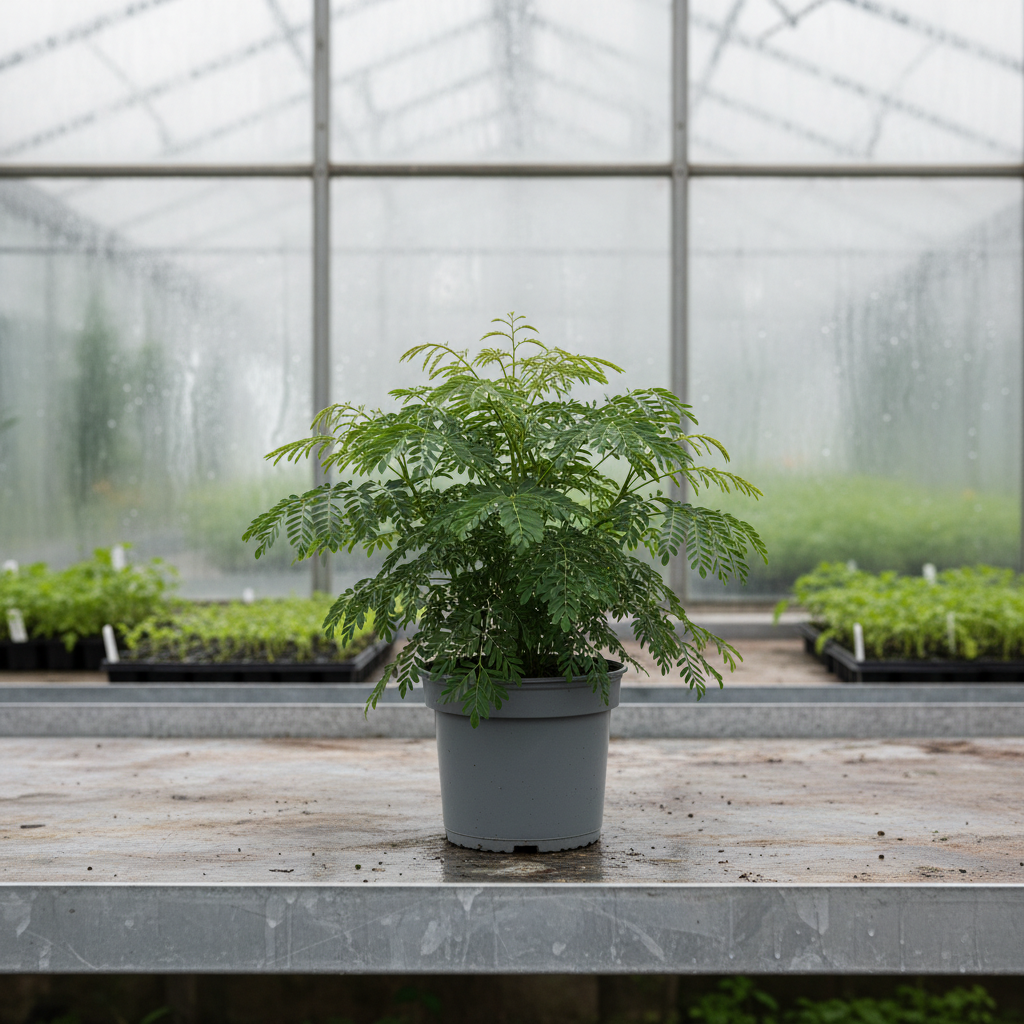
‘Elegans’
The most popular cultivar in interior settings, ‘Elegans’ is a more compact, more finely divided form of the species. The leaflets are smaller and lacier, clustered closely along the stems, producing the dense, almost bonsai-like silhouette that many people associate with the name Ming Aralia. It tops out around 1 to 1.2 m (3 to 4 ft) indoors and accepts gentle pinching very well, which makes it the easiest variety to keep at a chosen size.
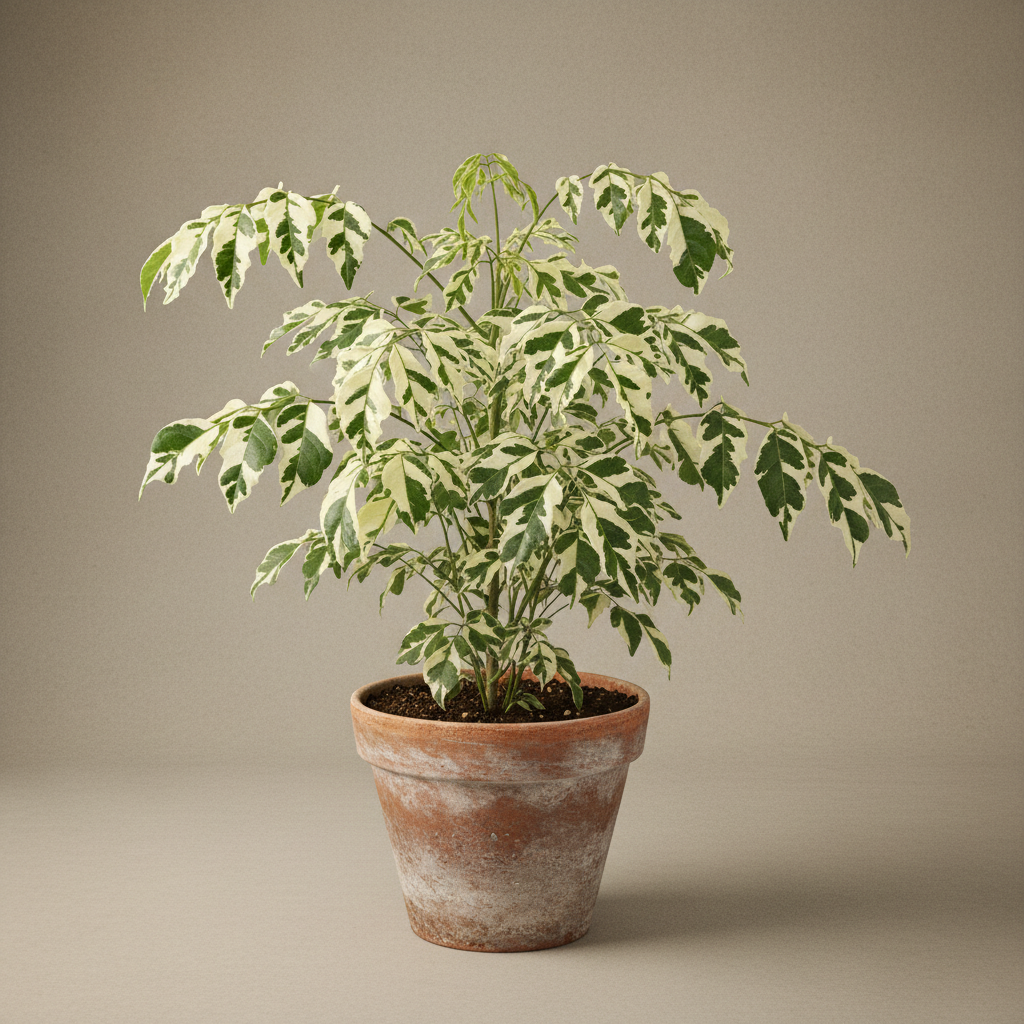
‘Snowflake’
A striking variegated cultivar with bright cream-white margins and irregular splashes painted across the lacy green leaflets. ‘Snowflake’ is slightly slower-growing than the all-green species and needs noticeably more light to keep its variegation; in dimmer rooms it gradually loses the white edges and reverts to a mostly green appearance over a year or two. Worth the small extra fuss for the unique appearance.
Variety Profiles in Detail
‘Plumata’ (Polyscias fruticosa ‘Plumata’)
An exceptionally feathery selection in which the leaflets are divided even further than the species, producing a soft, almost feather-duster effect along each stem. ‘Plumata’ is genuinely delicate-looking from a few metres away and rewards close inspection. It tends to be the slowest-growing of the common cultivars and is generally only stocked by specialist Aralia or bonsai nurseries; expect to pay a small premium when it does appear.
‘Crispa’ / Curly Aralia (Polyscias fruticosa ‘Crispa’)
A curiosity of the genus in which the leaflets are pronouncedly twisted, curled or wavy at the edges, producing a slightly chaotic, almost cabbage-leaf texture compared to the orderly fern-like appearance of the species. ‘Crispa’ is uncommon in mainstream retail but worth seeking out for anyone who wants something visually different on a shelf full of plain green plants.
‘Marginata’ (Polyscias fruticosa ‘Marginata’)
A more restrained variegated form, with narrow, clean cream margins on otherwise standard green leaflets. The overall effect is more subtle than ‘Snowflake’, and the variegation is generally more stable in moderate light, making this a useful choice for rooms that fall just short of the brightness ‘Snowflake’ demands. ‘Marginata’ is uncommon but turns up occasionally in well-stocked specialist nurseries.
Balfour Aralia (Polyscias scutellaria)
Often sold alongside Ming Aralia and sometimes confused with it, the Balfour Aralia is a closely related species with rounded, scalloped, almost dish-shaped leaves rather than fine lacy leaflets. It needs identical care to Polyscias fruticosa and makes an interesting visual counterpoint when grown beside its lacy cousin, but it is genuinely a different species and worth being aware of when shopping by sight alone.
Choosing the Right Variety for Your Space
For a first Ming Aralia, the straightforward all-green species or ‘Elegans’ is the safest choice; both tolerate a slightly broader range of indoor conditions and forgive small mistakes more readily than the variegated cultivars. Choose ‘Snowflake’ or ‘Marginata’ only if the intended spot has reliably bright indirect light all year, including the dimmer winter months, since these variegated forms revert noticeably in lower light. ‘Crispa’ and ‘Plumata’ are best treated as collector pieces and given the most prominent display spot; their unusual textures are wasted in a corner where they will not be seen up close.
Frequently Asked Questions
Why is my Ming Aralia dropping leaves so quickly?
Leaf drop is the Ming Aralia’s signature response to almost any stress, and the cause is usually a recent change in conditions rather than a single fatal mistake. The most common triggers are a sudden move to a darker or draftier spot, a switch from a humid nursery greenhouse to a dry centrally heated home, a missed watering followed by overcompensation, and the natural seasonal light drop in autumn. Identify the most recent change and reverse it gently; do not respond by lavishing water or fertiliser on the plant, which usually makes things worse.
Is Ming Aralia safe around cats and dogs?
Ming Aralia contains saponins and triterpenoid compounds that are mildly toxic to cats and dogs if chewed or eaten. Reactions are typically limited to drooling, vomiting and mild digestive upset, but the plant is best placed out of reach of pets that nibble foliage. For households with enthusiastic plant chewers, consider an entirely pet-safe alternative such as a Boston fern or a Parlor palm instead.
How big does a Ming Aralia get indoors?
Most indoor Ming Aralia plants top out between 1 and 2 m (3 to 6 ft) over many years, with the dwarf ‘Elegans’ rarely exceeding 1.2 m (4 ft). Growth is slow, often only 10 to 15 cm (4 to 6 in) of new stem per year on a happy plant, which means a Ming Aralia bought as a 60 cm specimen will probably take a decade to reach its mature indoor size. The plant can be pruned to maintain a chosen height at any point.
Can I prune a Ming Aralia hard?
Yes, and many older specimens benefit from it. Ming Aralia tolerates hard pruning well, regrowing from old wood within a few months of being cut back to almost any height. The best time is in early spring, just before the new growing season begins. Use sharp, sterilised secateurs, cut just above a node, and seal large wounds with a dab of cinnamon or pruning paste if available. The prunings can often be used as cuttings, doubling the value of the operation.
Does Ming Aralia flower indoors?
Very rarely. In its native tropical habitat the plant produces small, greenish-white flowers in branched umbel-like clusters followed by tiny fruits, but indoor specimens almost never reach the maturity or environmental conditions needed to flower. This is not a problem; the plant is grown entirely for its foliage and the absence of flowers has no bearing on health or longevity.
Why does the underside of my plant look bare?
Mature Ming Aralia naturally sheds older leaflets along the lower stems as it ages, revealing the slender, slightly woody trunk underneath. This is normal and is actually part of the plant’s appeal in bonsai-influenced styling, where the contrast between the bare trunk and the airy crown is desirable. If the bareness is creeping rapidly upwards, however, it usually indicates insufficient light, low humidity or chronic root-zone stress rather than natural aging.
Can I keep a Ming Aralia outdoors in summer?
In temperate climates the plant can spend the warmest summer weeks outdoors in a sheltered, bright but shaded spot such as a covered patio or a north-facing balcony. Wait until night temperatures are reliably above 15 °C (60 °F), acclimatise the plant gradually to outdoor light over two weeks to prevent leaf scorch, and bring it back inside well before the first cool autumn nights. Outdoor time often encourages a noticeable burst of summer growth.
How long does a Ming Aralia live?
Well-cared-for indoor specimens routinely live for several decades, and there are documented Ming Aralia plants in private collections that are 50 years old or more. The species is naturally long-lived, woody and resilient once established. With periodic repotting, occasional rejuvenation pruning and stable conditions, a Ming Aralia is genuinely a multi-generational houseplant rather than a short-term decoration.
Why does my new Ming Aralia look so sparse compared to the one in the shop?
Shop-grown Ming Aralia plants are usually raised in commercial greenhouses with very high humidity, abundant light and warm temperatures, all of which produce the dense, full canopies shown on sale. The first month or two in an ordinary home almost always involves some leaflet drop as the plant adjusts to lower humidity and lower light. Give it a settling-in period of six to eight weeks under stable conditions before drawing any conclusions about its long-term health.
Is Ming Aralia good for beginners?
It is best described as intermediate. A first-time houseplant owner who is willing to follow a consistent routine and pay attention to humidity will get on with a Ming Aralia perfectly well. A complete beginner who tends to forget about plants for weeks at a time is more likely to be discouraged by the species’ leaf-drop reaction to stress; a Snake Plant, ZZ Plant or Pothos would probably be a friendlier first step. Once basic houseplant rhythms are established, however, Ming Aralia is an excellent next plant to grow into.






