
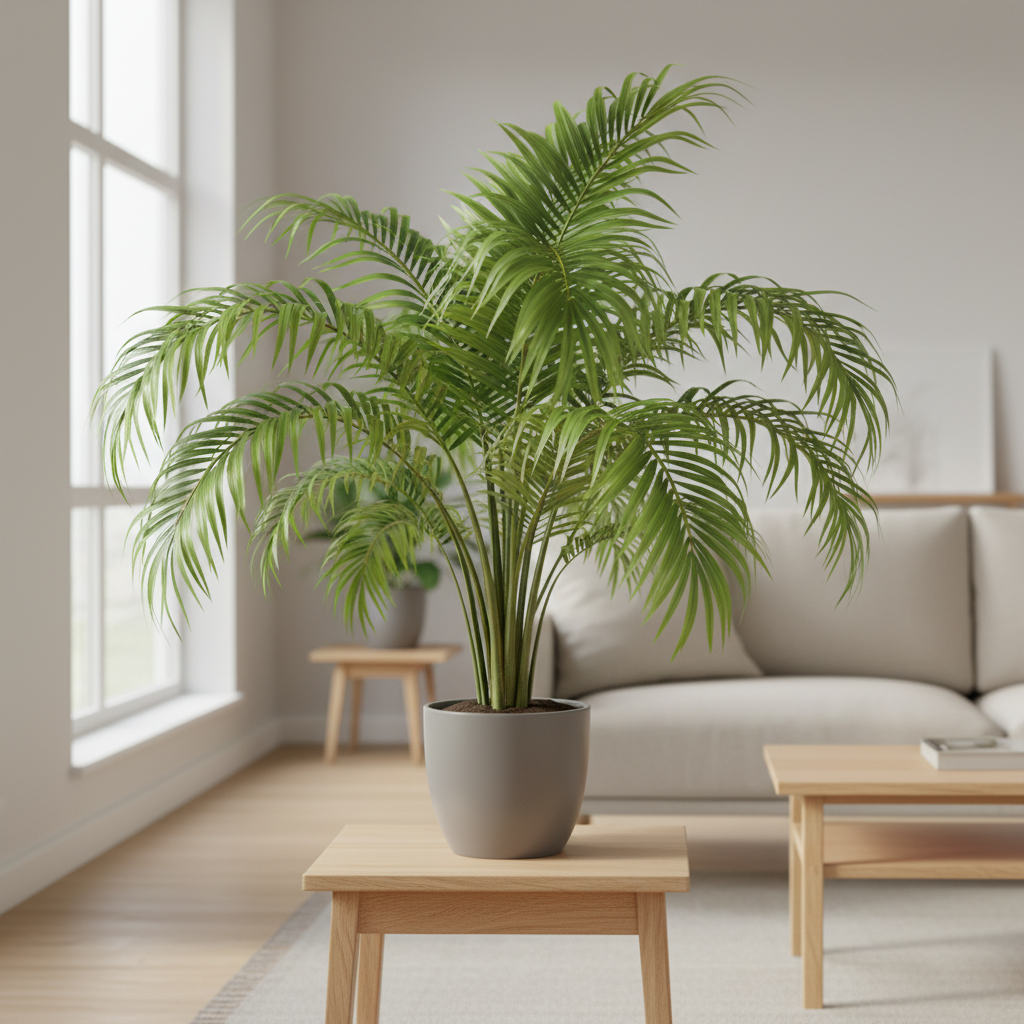
Few houseplants invite as much hope and as much disappointment as the majesty palm. Sold cheaply in clusters of slim ringed trunks topped with cascading feather-shaped fronds, Ravenea rivularis looks every inch the tropical centerpiece it is named after. It is also a riverbank palm from south-western Madagascar, a species that grows naturally with its feet near flowing water under bright tropical skies, and that botanical reality sits uncomfortably with the average living-room corner. Understand where it comes from and the plant becomes legible; ignore that origin and it slowly browns, thins and collapses despite every good intention.
This guide treats the majesty palm as the demanding but rewarding plant it really is. It is not a “low-light” palm, no matter what the garden-centre tag claims, and it is not a plant that tolerates the desert air of a heated winter room. With the right window, a consistent watering routine, generous humidity and an honest feeding schedule, it can become a graceful, three-metre indoor specimen. With anything less, it can also become a slow-motion lesson in why provenance matters. The sections that follow cover what survival looks like, what thriving requires, and the small adjustments that separate the two.
Contents
- Quick Reference
- Why the Majesty Palm Makes a Striking Houseplant
- Light Requirements
- Watering and Humidity
- Soil, Potting and Repotting
- Fertilising
- Propagation
- Pests and Diseases
- Popular Varieties
- Frequently Asked Questions
Quick Reference: Majesty Palm at a Glance
| Light | Bright indirect to several hours of filtered direct sun. East or lightly diffused south window. |
| Watering | Keep evenly moist, never soggy and never bone dry. Typically every 5 to 8 days indoors. |
| Temperature | 18 to 27 degrees Celsius (65 to 80 degrees Fahrenheit). Avoid prolonged exposure below 13 degrees Celsius (55 degrees Fahrenheit). |
| Humidity | 55 to 70 percent ideal, 40 percent tolerable with daily care. Below 30 percent is hostile. |
| Fertiliser | Balanced palm-specific feed at half strength every 4 to 6 weeks in the growing season, with extra magnesium and manganese. |
| Toxicity | Non-toxic to humans, cats and dogs according to the ASPCA. Safe for most homes. |
Why the Majesty Palm Makes a Striking Houseplant
The visual case for the majesty palm is obvious the moment a healthy specimen is in the room. Long, gracefully arching pinnate fronds, each composed of dozens of narrow soft-green leaflets, fan out from slender ringed trunks to create the kind of layered green silhouette that anchors a corner without dominating it. In its native habitat Ravenea rivularis can reach 20 to 30 metres (65 to 100 feet) along the riverbanks of Madagascar, but indoors it typically settles into the role of a 1.5 to 2.5 metre (5 to 8 foot) statement plant with a soft, almost cinematic presence in evening light.
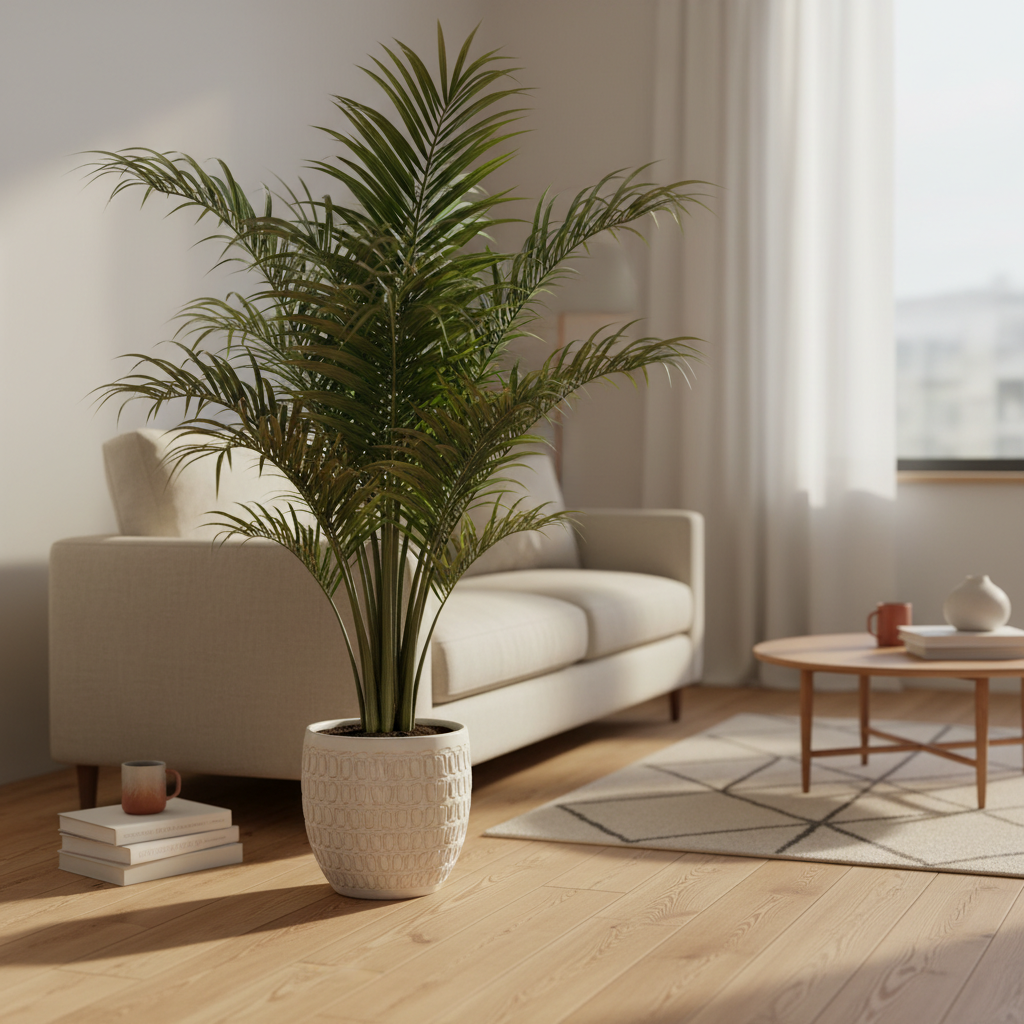
The case against it is equally simple. Compared to a snake plant or a ZZ, the majesty palm asks for real attention. It does not store water like a succulent, it does not adapt to deep shade like a parlour palm, and it punishes dry air with crisp brown leaflet tips that never recover. The reward for getting the conditions right is a plant that grows steadily, looks more elegant each year and, unlike many statement-piece houseplants, refuses to outgrow a normal ceiling for the first half-decade or so. It is also one of the easiest large palms to source affordably, which makes it forgiving to experiment with as long as the basic conditions are honestly assessed before the plant comes home.
Important — Toxicity: The majesty palm is listed as non-toxic to cats and dogs by the ASPCA, and it is not known to cause poisoning in humans either. That makes it a safer choice than most large indoor palms when there are curious pets or small children in the household. As with any plant, ingestion of large amounts of plant material can still cause mild stomach upset, so it remains worth keeping browsing pets discouraged from chewing the fronds.
Light Requirements
Light is the single biggest reason indoor majesty palms decline, and almost always the reason is too little of it rather than too much. In its riverbank habitat the species germinates in open, sun-flooded clearings and grows up through gaps in light forest canopy. Indoors that translates to a need for hours of bright light every day, with at least some direct or lightly filtered sun being a genuine bonus rather than a hazard. A majesty palm placed three metres from the nearest window in an otherwise pleasant room is on a slow timer to thinning fronds, weak new growth and eventual collapse.
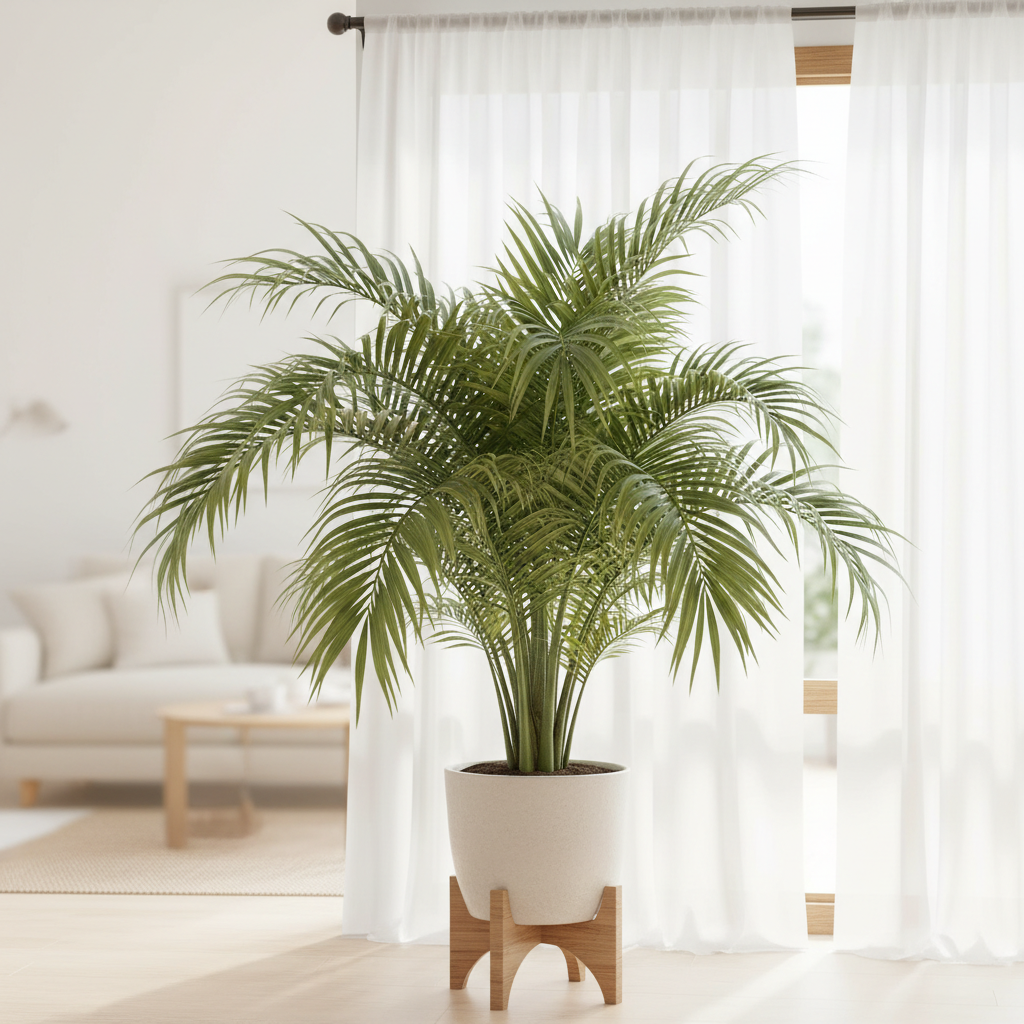
The ideal location indoors is within one metre of a large east-facing window, or set back slightly from a south or west-facing window where it receives several hours of softly filtered direct sun. North windows almost never provide enough light for long-term health, although they can serve as a temporary holding spot during the darkest weeks of winter. A position with an unobstructed sky view is more important than a particular compass orientation, because diffuse skylight from above is what the species evolved to use.
Light Levels Explained
Plant lighting is often discussed in vague terms, but the majesty palm responds clearly to measured light. A simple lux meter or even a smartphone app can be the difference between guessing and growing. The table below describes the practical light tiers and what each one tends to produce in this species over a six-month period.
| Light Category | Approx. Level | Typical Location | Outcome |
|---|---|---|---|
| Direct sun | 40,000 lux and above | Right against a south or west window | Tolerated when humidity is high and the plant is acclimatised, but can scorch fronds on cold glass. |
| Bright indirect | 15,000 to 25,000 lux | Within 1 m of a large east window, set back 1 m from south or west | The sweet spot. Steady growth, deep green fronds, manageable watering schedule. |
| Medium | 5,000 to 10,000 lux | 2 to 3 m from a bright window, beside a north window | Survival is possible for many months but new fronds are smaller, paler and slower. |
| Low | 1,000 to 3,000 lux | Interior wall, far corner of a small-windowed room | Long, slow decline. Lower fronds yellow, the plant becomes leggy and prone to pests. |
| Very low | Below 500 lux | Hallway or windowless room | Not survivable for this species without strong supplementary lighting. |
Window Orientation and Placement
South-facing window: The most generous source of natural light in the northern hemisphere and an excellent home for a majesty palm, provided a sheer curtain or set-back of about half a metre softens midday sun on the hottest summer days. Without that buffer, the leaflets directly against the glass can scorch in a heatwave.
East-facing window: Generally the ideal placement. A few hours of gentle morning sun, then bright sky for the rest of the day. The light is strong enough to keep fronds compact and richly coloured but rarely harsh enough to burn anything.
West-facing window: Works well, but the afternoon sun is hotter and more direct than morning sun. Place the palm slightly back from the glass or filter the light with a sheer curtain, especially in summer.
North-facing window: Only suitable in summer or in tall, unobstructed rooms where the sky fills the window. In winter, a north-window-only majesty palm will steadily thin out. Supplement with a grow light, or move the plant to a brighter window from October to March.
Pro Tip — Read the Newest Fronds: The most reliable sign that a majesty palm has enough light is the size and colour of the most recently opened fronds, not the oldest. New fronds that emerge smaller, paler or noticeably more upright than the older ones are an early warning that the plant is on a slow light budget. New fronds that match or exceed the older ones in spread and saturation are confirmation that the position is genuinely working.
How Light Affects Frond Density and Colour
Unlike variegated houseplants where light controls pigmentation, light in a majesty palm primarily controls density, internodal spacing and overall vigour. Plants grown in their preferred bright indirect light produce fronds with closely spaced leaflets, a saturated mid to deep green colour and a graceful outward arch. Plants grown in too little light produce fronds that are paler, narrower, stand more upright and shed their lowest leaflets faster. The trunks themselves stretch with longer gaps between leaf scars, giving the plant a leggy silhouette over time.
Warning — Direct Sunlight: A majesty palm that has been growing in lower light cannot be moved straight into hot midday sun without scorching. Acclimatise it over two to three weeks by extending the daily exposure gradually, and watch the central spear and youngest fronds for any sign of bleaching. Sun damage on a frond is permanent; bleached or browned sections will not recover and must wait until the frond is naturally shed.
Artificial Lighting
In rooms without strong natural light, a majesty palm responds well to a full-spectrum LED grow light run for 10 to 12 hours a day. The fixture should sit between 30 and 60 centimetres above the crown, with enough output to provide at least 200 to 300 photosynthetic photon flux density (PPFD) at the canopy. White full-spectrum panels are easier to live with aesthetically than pink-purple LEDs, and modern bar-style fixtures hidden along a ceiling beam or shelf can supply almost all of a palm’s needs in an otherwise dim flat. Combine supplementary light with the brightest available window for the best results.
Seasonal Adjustments
Indoor light levels in mid-latitude winters can drop by 80 percent compared to midsummer, even at the same window. Plan for this in autumn by moving the palm closer to the brightest glass, opening curtains fully on grey days, and rotating the pot a quarter turn every couple of weeks to keep growth even on all sides. In spring, reverse the process gradually: bring the plant back from the brightest window before the sun strengthens, or add a sheer curtain to soften the increase. Sudden, large changes in light do more harm to a majesty palm than steady, slightly imperfect conditions.
Watering and Humidity
Watering is where majesty palms diverge most sharply from other popular indoor palms. As a riverbank species, Ravenea rivularis evolved with consistently moist soil and rarely experiences true drought in nature. Yet it also grows in well-aerated alluvial substrates that drain freely after seasonal floods. The practical implication indoors is that the soil should be kept evenly moist at almost all times, but never compacted, waterlogged or anaerobic. Treat it like a perpetually damp sponge wrung out, not like a soaked cloth and not like dry crumbs.
When to Water
The most reliable indicator is the top three to four centimetres of substrate. When that upper layer feels just barely damp to the touch and a finger inserted to the second knuckle comes back faintly cool rather than wet, the palm is ready for another thorough soak. In a bright spot at room temperature this typically falls every five to eight days in summer and every eight to twelve days in winter. The exact frequency varies enormously with pot size, light, humidity and substrate, so build the habit of checking rather than watering on the calendar.
Two states must be avoided. The first is letting the entire rootball dry out, which causes leaflet tips to brown irreversibly within hours and can trigger whole-frond collapse if repeated. The second is leaving the rootball saturated for days, which strangles the fine feeder roots, locks out oxygen and quietly kills the plant from the base up. Both look like “drought” symptoms on the leaves, which is why diagnosing by appearance alone often leads owners in the wrong direction.
Pro Tip — Weigh the Pot: Lift the pot just after a thorough watering and again when the soil is at the right “barely damp” point a week later. The weight difference is dramatic and far easier to feel than to see. Within two or three weeks the heft of a “needs water” pot becomes intuitive, and most under and overwatering mistakes disappear without buying a moisture meter.
How to Water Correctly
- Move the pot to a sink, bath or large saucer where free drainage is welcome.
- Pour room-temperature water slowly and evenly across the surface, avoiding the trunk bases.
- Continue until water flows freely from every drainage hole for several seconds.
- Pause for two to three minutes, then water through a second time to fully rehydrate the rootball.
- Allow the pot to drain completely for at least 15 minutes before returning it to its decorative cachepot or saucer.
- Empty any standing water from the cachepot or saucer; a majesty palm should never sit in a pool.
Signs of Overwatering vs. Underwatering
| Symptom | Overwatering | Underwatering |
|---|---|---|
| Leaf colour | Older fronds yellow uniformly, sometimes with darker watery patches. | Leaflet tips and edges turn crisp tan or brown; older fronds yellow from the tip inward. |
| Leaf texture | Limp, soft, sometimes translucent. | Dry, papery, brittle when bent. |
| Soil | Constantly wet, sour smell, may show fungus gnats or a slick surface. | Pulls away from the pot wall, very light when lifted, dust-dry several centimetres down. |
| Roots | Brown, mushy, peel away from the central strand at the slightest tug. | Pale, dry and shrivelled but still firm. |
| Trunk base | Soft, dark or blackened near the soil line. | Firm but with crisp dry papery sheaths flaking off. |
Warning — Root Rot: Once the trunk base softens and the substrate smells sour, the plant is in advanced rot and the odds of full recovery drop sharply. Unpot immediately, rinse the rootball, trim away every mushy or blackened root with sterilised secateurs, and repot into completely fresh, fast-draining palm mix. Withhold water until the new mix dries to barely damp, and accept that lower fronds may still be lost as the surviving root system rebuilds.
Humidity Requirements
Humidity is the second non-negotiable factor for a thriving majesty palm. Its leaflets are thin, abundant and transpire heavily, and the species evolved in air that rarely dropped below 60 percent relative humidity. Modern centrally heated homes routinely fall to 25 or even 15 percent humidity in winter, which is when most fronds brown at the tips, regardless of how careful the watering routine is. Anything reliably above 50 percent gives the plant a fair chance; anything above 65 percent is approaching its preferred conditions.
Symptoms of low humidity are easy to confuse with underwatering, but they typically begin at the very tips of the youngest leaflets, spread inward as a thin dry band and rarely affect the whole frond at once. If watering has been adequate and brown tips still appear, the air is the culprit. A simple hygrometer near the plant takes the guesswork out of this entirely; cheap digital ones are accurate enough.
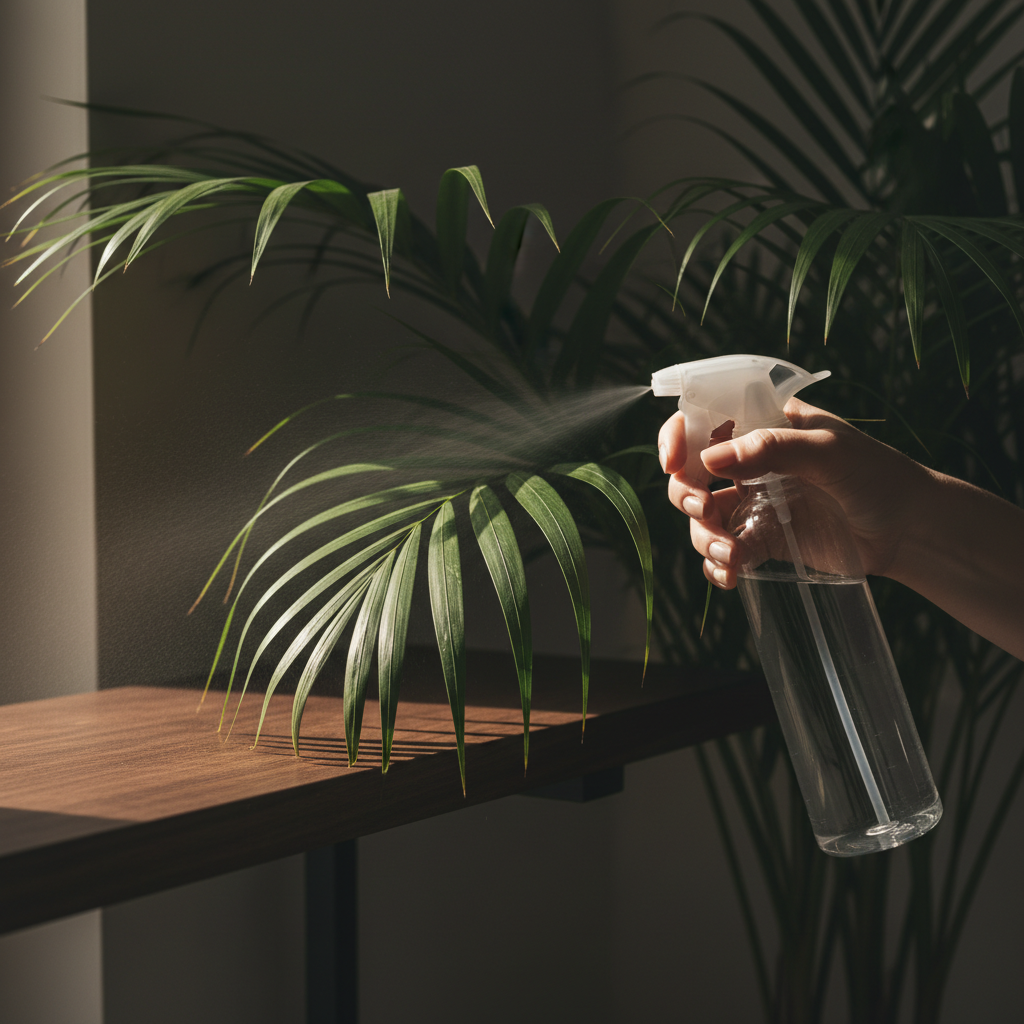
Raising humidity around a majesty palm is best done in layers rather than relying on any single trick. Group the plant with other large foliage plants to create a shared microclimate. Place a humidifier within two metres and run it during the heating season. Stand the pot on a wide pebble tray kept topped up with water just below the level of the stones. Mist the foliage with a fine spray in the morning, never in the evening, to lift local humidity without leaving water sitting on the leaflets overnight. None of these alone is enough in a dry winter living room; together they are usually sufficient.
Water Quality
Majesty palms are moderately sensitive to fluoride, chloramine and accumulated salts. In hard or heavily treated tap-water areas, the symptoms appear as evenly distributed leaflet-tip browning that does not improve with attention to humidity. Where tap water is suspected, switch to filtered, rainwater or distilled water for several weeks and watch the next flush of growth. Standing tap water uncovered for 24 hours allows chlorine to dissipate but does nothing for chloramine or dissolved salts, so it is only a partial fix.
Soil, Potting and Repotting
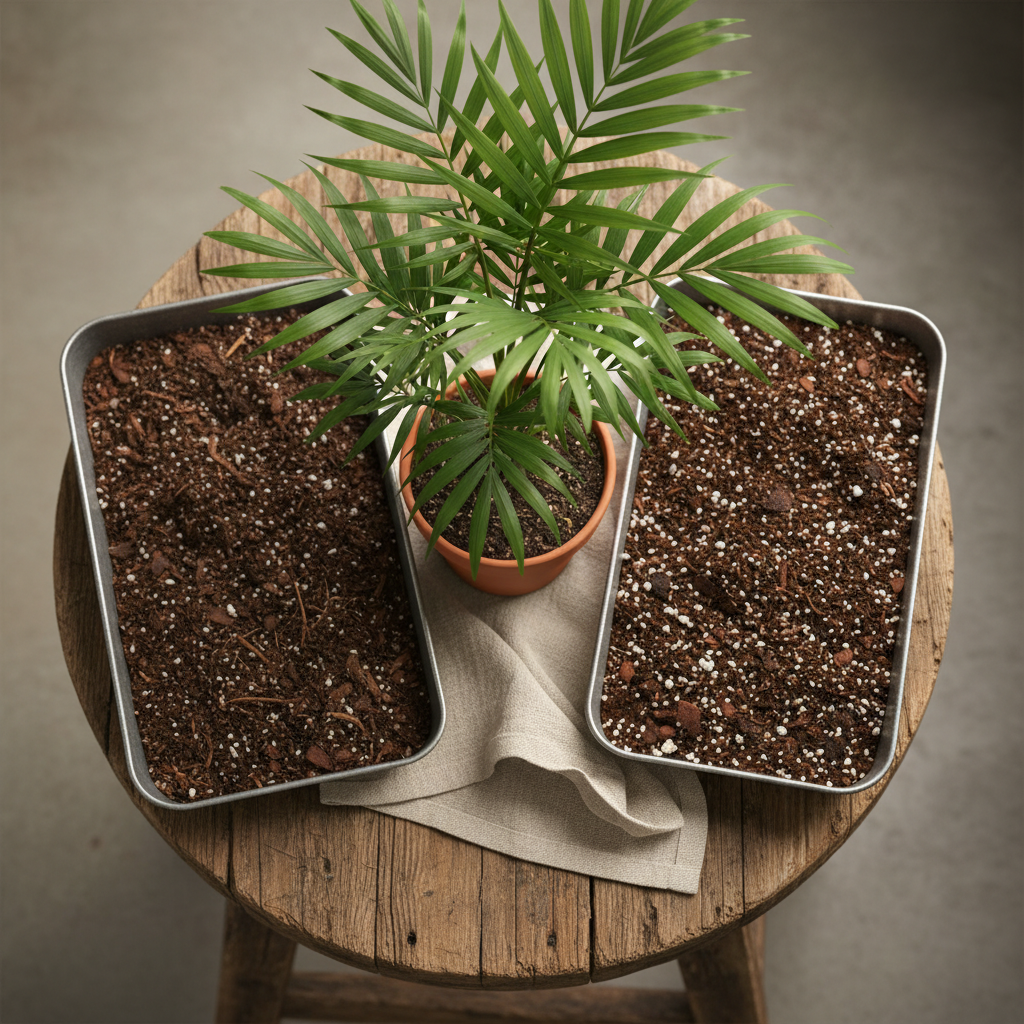
The soil under a majesty palm needs to do two opposing things at once: hold enough moisture to keep the rootball evenly damp between waterings, and drain quickly enough that air can reach the roots within an hour of each soak. Off-the-shelf “houseplant compost” rarely manages this balance because most general-purpose mixes are heavy in fine peat or coir that compacts over time. The result is a pot that looks dry on top but stays sodden three centimetres down, exactly the conditions that kill majesty palms.
Ideal Soil Composition
A good majesty palm mix is open, slightly acidic and rich enough to feed the plant between fertiliser doses. The aim is a chunky structure where each ingredient is visible to the eye and air gaps remain after watering. The table below describes a reliable home recipe that suits most indoor conditions; small adjustments either way will not cause problems as long as drainage stays generous.
| Component | Proportion | Function |
|---|---|---|
| Quality houseplant compost or peat-free coir-based mix | 50 percent | Provides base structure, organic matter and modest nutrient retention. |
| Perlite or pumice | 25 percent | Creates persistent air pockets, keeps the rootball from collapsing. |
| Orchid bark (fine grade) | 15 percent | Adds chunk for long-term aeration and slow breakdown into humus. |
| Coarse horticultural sand | 5 percent | Improves drainage at the base of the pot, mimics alluvial substrates. |
| Worm castings or sieved leaf mould | 5 percent | Slow-release nutrition and a healthy microbial community. |
The preferred soil pH is mildly acidic to neutral, in the range of 6.0 to 7.0. Most peat-free mixes fall comfortably into this band, and the slow breakdown of orchid bark helps keep pH stable over a couple of years. Strongly alkaline soils, often a side effect of hard tap water in soft substrates, can lock out manganese and iron, producing the pale, faintly yellowed new fronds that owners often misread as a light problem.
Pro Tip — Quick Mix Recipe: Two parts peat-free houseplant compost, one part perlite and half a part orchid bark, with a generous handful of worm castings per 10-litre batch, will keep most indoor majesty palms thriving without obsessive measuring. The visible perlite chunks at the surface are a useful tell that the mix is right.
Choosing the Right Pot
Pot choice has more impact on a majesty palm than on almost any other common houseplant, because the species drinks heavily and breathes heavily through its roots. A poorly chosen pot will undo a perfect watering routine, so the small decisions here matter.
Drainage holes are non-negotiable. A pot without generous drainage at the base will collect anaerobic water in its bottom centimetre regardless of how careful the watering technique is, and majesty palm roots are intolerant of standing water. If a decorative cachepot must be used, plant the palm in a plastic nursery pot with multiple drainage holes and slip that inside the cachepot, lifting the inner pot out for every watering.
Pot material: Terracotta wicks moisture from the rootball and dries out more quickly, which suits a plant in a humid summer climate or a less attentive owner who tends to overwater. Glazed ceramic and plastic hold moisture longer and forgive forgetful watering schedules in dry winters. Either works, but pair the choice with the conditions: terracotta in a humid bathroom, plastic in a dry, heated living room.
Pot size: Choose a pot just two to four centimetres wider than the existing rootball. Oversized pots hold large reserves of wet, unrooted soil that the plant cannot dry out, which is one of the most common causes of slow root rot in newly purchased majesty palms that are immediately moved into a “nicer” larger container.
When to Repot
Majesty palms prefer to be moderately rootbound and resent unnecessary disturbance. Plan to repot every two to three years in spring or early summer, when active growth resumes. Clear signs that a repot is overdue include roots circling the surface of the soil, roots emerging from drainage holes in tight white bundles, water running straight through the pot without absorbing, and a noticeable slowing of new frond production in otherwise good conditions. A plant repotted only because the gardener feels guilty is more likely to suffer than one repotted at the right structural moment.
How to Repot: Step-by-Step
- Water the plant thoroughly the day before repotting so the rootball holds together cleanly.
- Lay the pot on its side and gently slide the plant out, supporting the trunks at the base rather than pulling on the fronds.
- Tease the outer 1 to 2 centimetres of root gently with the fingers, removing only obviously dead, mushy or tightly circling roots.
- Place a 2 to 3 centimetre layer of fresh palm mix in the new pot, then position the rootball so the original soil line sits about 2 centimetres below the new rim.
- Backfill around the rootball with fresh mix, tapping the pot to settle the substrate without packing it down hard.
- Water in slowly until water drains freely, then top up any sunken areas with extra mix.
- Place the plant back in bright indirect light and hold off on fertilising for at least six weeks.
Warning — Transplant Shock: Expect some leaflet tip browning and possibly the loss of one or two of the oldest fronds in the weeks after repotting. This is normal as the root system adjusts. To minimise shock, repot during the active growing season, keep the plant in slightly lower light than usual for two weeks, maintain high humidity, and avoid fertilising until new growth resumes.
Fertilising
Majesty palms are moderately heavy feeders during the growing season and notoriously prone to micronutrient deficiencies in pot culture, particularly magnesium, manganese and iron. The classic indoor majesty palm in a department-store living room is not just under-watered or under-lit; it is also slowly starving. A consistent, palm-specific feeding routine is what unlocks the steady production of full-sized fronds and the dark saturated green that healthy specimens show.
That said, more is not better. The fine roots of a majesty palm are sensitive to fertiliser salts, and a heavy hand causes leaf-tip burn, white crust on the soil surface and, in the worst cases, root damage that mimics overwatering. The right approach is little and often during the growing months, nothing in midwinter, and a careful annual flush to clear accumulated salts from the substrate.
Understanding Plant Nutrients
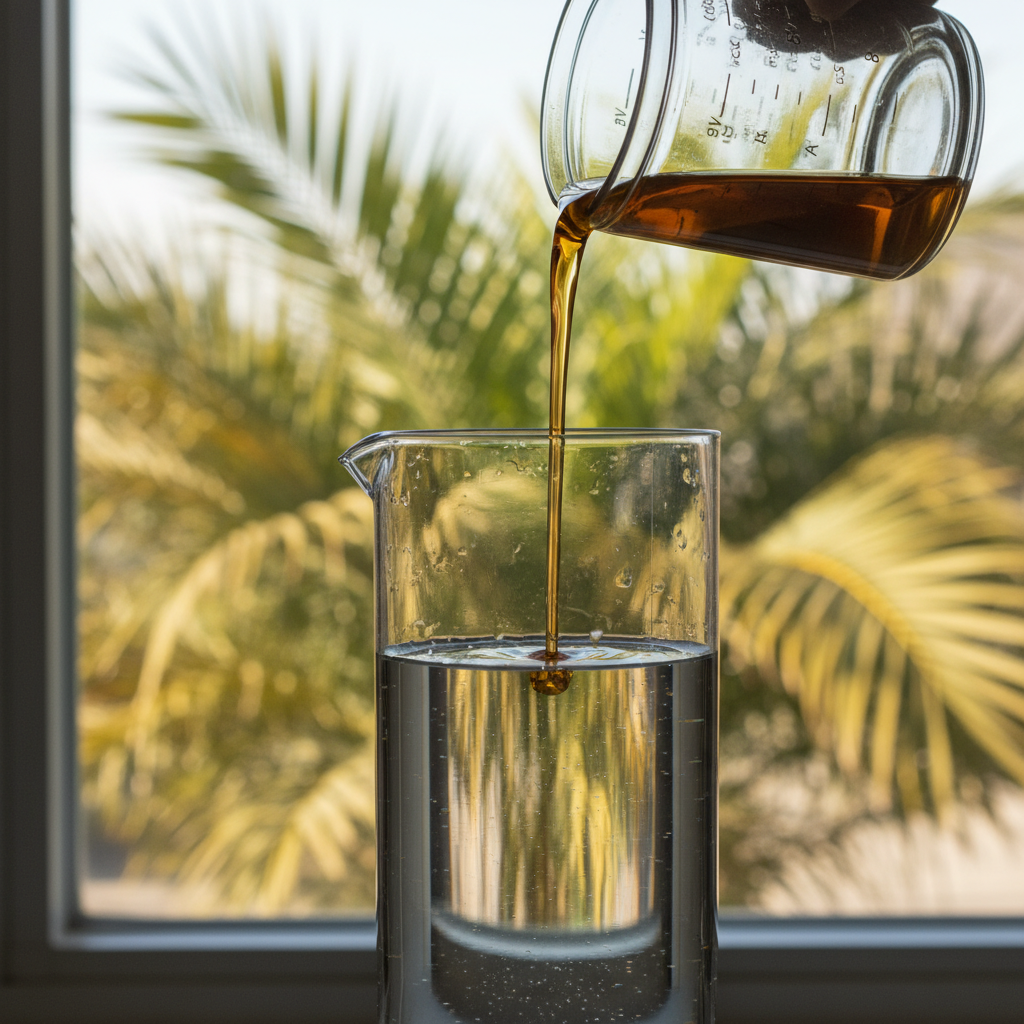
Three macronutrients dominate fertiliser labels: nitrogen, phosphorus and potassium, usually shown as the N-P-K ratio. For a foliage palm like Ravenea rivularis, the N and K numbers matter most, with phosphorus playing a smaller supporting role. Secondary nutrients and trace elements then make the difference between an adequate feeding regime and one that produces show-quality plants. Palm-specific fertilisers exist precisely because the species in this family share a heavy demand for magnesium and several micronutrients that most general houseplant feeds do not supply in adequate amounts.
| Nutrient | Symbol | Primary Function | Deficiency Symptoms |
|---|---|---|---|
| Nitrogen | N | Drives frond size, leaflet count and green colour. | Pale, small new fronds and uniformly yellowing older fronds. |
| Phosphorus | P | Root development and energy transfer. | Slow growth, dull deep green, weak roots; rare indoors. |
| Potassium | K | Water regulation, leaflet structure, stress tolerance. | Translucent yellow-orange flecks on older fronds, frizzled tips. |
| Magnesium | Mg | Central atom of chlorophyll; critical for palms. | Broad yellow bands along the edges of older fronds, green centre. |
| Manganese | Mn | Required for healthy new frond emergence. | “Frizzletop” — weak, distorted, partially necrotic new fronds. |
| Iron | Fe | Chlorophyll synthesis in the youngest growth. | Pale to whitish new fronds with green veins. |
Types of Fertiliser
Liquid fertilisers: The easiest and most controllable option indoors. A balanced 3-1-2 or 8-2-12 palm-specific liquid feed diluted to half the label rate and applied every four to six weeks during spring and summer suits most situations. Liquid feeds reach the roots quickly and allow rapid correction of deficiencies, which makes them ideal for actively growing plants.
Slow-release granular: Coated prills release nutrients over three to six months. They are convenient and forgive missed feeding weeks, but they are harder to flush if dosed too generously and can over-feed in hot summer windows. Choose a palm-specific blend with added magnesium and manganese, and apply at the lower end of the label rate for indoor pots.
Organic fertilisers: Worm castings, well-rotted compost top-dressings and fish or seaweed-based liquid feeds work well for majesty palms and tend to be gentle on the root system. They also support healthy soil biology, which helps in the long run. Their nutrient ratios are lower than synthetic feeds, so use them more frequently or in combination with a moderate base feed.
Feeding Schedule
Fertilise from early spring through late summer, taper off in autumn and stop entirely from late November to mid-February in the northern hemisphere, or whenever growth has clearly paused. A typical schedule is liquid feed at half strength every four to six weeks during the growing season, plus a single application of a slow-release palm-specific granular in early spring to cover the months in between. Always water plain first, then apply the dilute feed to a damp rootball; fertilising bone-dry soil concentrates salts against fine roots and risks burn.
Pro Tip — Annual Flush: Once a year, ideally in late spring, take the plant to a sink or shower and run a volume of fresh water equal to three or four times the pot volume through the soil over several minutes. This dissolves and rinses out accumulated fertiliser salts and helps prevent the slow buildup that produces tip burn even when the feeding regime looks reasonable on paper.
How to Fertilise
- Water the plant lightly with plain water the day before, so the rootball is evenly damp.
- Dilute liquid fertiliser in a jug or watering can to the recommended half-strength rate.
- Apply the diluted feed slowly across the soil surface, avoiding the trunks and fronds, until water just begins to drain.
- Empty any standing fertiliser solution from the saucer or cachepot after 15 minutes.
- Note the date and stick to the chosen interval, rather than topping up because the plant looks tired.
Warning — Salt Build-Up: White or yellowish crust on the soil surface, on the pot rim or around drainage holes signals accumulated fertiliser salts. Persistent leaf-tip burn that does not respond to higher humidity or improved water quality is often the same problem. Flush the pot immediately, skip the next two scheduled feeds and resume at a lower concentration. Repeated salt damage to roots is one of the slow-motion ways indoor palms decline.
Propagation
Propagating a majesty palm at home is harder than propagating most popular houseplants, and the methods that work for pothos, monstera or philodendron simply do not apply here. Ravenea rivularis is a single-stemmed palm by nature: each trunk arises from a single growing point at its apex and cannot be cut, layered or rooted from a stem section. There is no “node” to root from. Once a trunk is removed from its roots, it cannot be regrown.
That leaves two realistic routes. First, the multi-trunk clumps that dominate the houseplant trade are almost always made up of several seedlings grown together in the same pot for fullness, not true offsets, and these can be carefully separated into smaller groups if the plant is large enough. Second, fresh seed germinates reliably under the right conditions, which is how commercial growers produce stock. Both methods are described below, with the practical caveats that matter at home.
Understanding the Single Growing Point
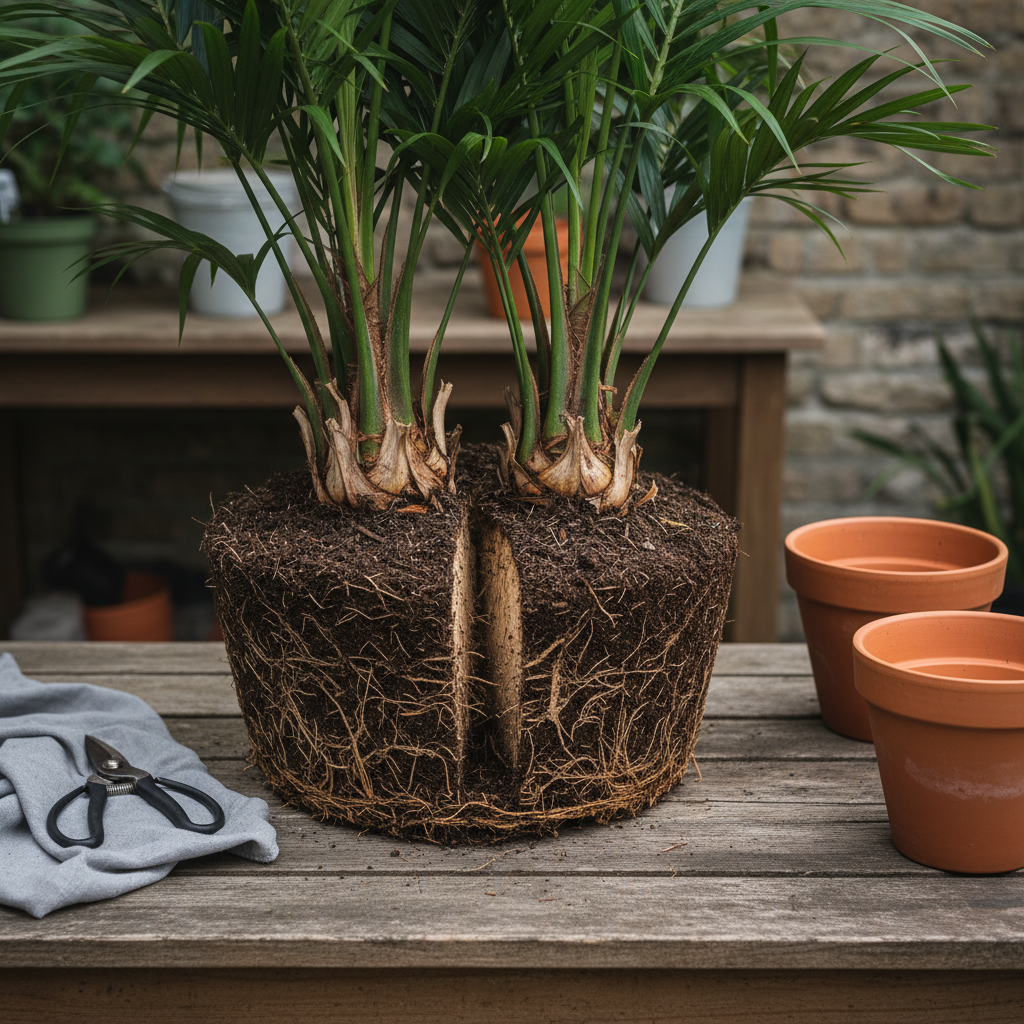
Each majesty palm trunk has one apical meristem at the top from which all new fronds emerge. Cutting the trunk above the soil, or damaging the central spear, will eventually kill that stem because no replacement growing point exists. This single-meristem habit is shared with most palms and is why none of them can be propagated from stem or leaf cuttings the way a tropical aroid can. Every plant or clump traces back to either a divided rootball or a germinated seed, and the propagation methods follow from that biology.
Division of a Multi-Stem Clump: Step-by-Step
This is the most practical method at home and only works on commercial multi-trunk specimens that contain several distinct seedlings in the same pot. The aim is to separate the rootball without tearing each individual seedling’s roots beyond recovery. Plan division for late spring or early summer when growth is most vigorous, and accept that some trunks will sulk for months or be lost.
- Water the plant thoroughly two days before, then ease it out of its pot on division day.
- Rinse the rootball gently to expose the individual trunks and their roots, working over a tray.
- Identify the natural grouping of trunks and roots; do not force separations where roots are fully intertwined.
- Use sterilised secateurs to cut only the connecting tissue between separate plants, preserving as much root mass per division as possible.
- Plant each division into its own pot of fresh palm mix at the same depth it grew before.
- Water in lightly, place in bright indirect light and maintain high humidity for the first four to six weeks.
- Withhold fertiliser for at least two months and watch for new central spears as the sign that recovery is under way.
Pro Tip — Divide Sparingly: Most majesty palm “clumps” look far less impressive once split, and the smaller divisions take a year or more to fill out. Unless a clump genuinely needs splitting because it is overcrowded or because the gardener wants two plants, leaving it alone usually produces a more beautiful long-term specimen. The fuller the clump, the more dramatic the silhouette.
Growing From Seed: Step-by-Step
Fresh majesty palm seed germinates readily but slowly, taking anywhere from one to three months under warm, humid conditions. Seed viability drops sharply once the fruit dries out, so buy from a reputable supplier with a recent harvest date or sow promptly if the seeds are gifted. Indoor sowing avoids the temperature swings that delay germination and improves the strike rate significantly.
- Soak fresh seeds in warm water at around 30 degrees Celsius (86 degrees Fahrenheit) for 48 to 72 hours, changing the water once a day.
- Fill a deep tray with a mix of equal parts coir and perlite, moistened so it clumps lightly when squeezed but releases no water.
- Press the seeds half-buried into the surface, spaced 3 to 5 centimetres apart.
- Cover the tray with a clear humidity dome or place it inside a sealed bag with a small ventilation gap.
- Maintain a substrate temperature of 27 to 32 degrees Celsius (80 to 90 degrees Fahrenheit) using a heated propagation mat.
- Keep the medium evenly moist and check every few days for the emergence of a thin spear-like first leaf.
- Pot up each seedling into its own small container once the first true frond has fully opened.
Troubleshooting Propagation
| Problem | Likely Cause | Solution |
|---|---|---|
| Divisions wilt for weeks after potting up | Excessive root damage and low humidity during recovery | Increase humidity to 70 percent, reduce light slightly and resist watering unless the substrate is genuinely drying. |
| Newly potted division rots at the base | Substrate too wet or trunk planted too deep | Repot into fresh mix at the original soil line, withhold water until the surface dries. |
| Seeds fail to germinate after three months | Old seed, cool substrate or dried out medium | Source fresher seed, use a heat mat to hold 28 to 30 degrees Celsius (82 to 86 degrees Fahrenheit), and keep moisture even. |
| Seedlings damp off after first leaf emerges | Saturated medium and stagnant air around the seedlings | Increase air movement, lift the humidity dome slightly, water from below and avoid wetting the seedling crowns. |
Pests and Diseases
Majesty palms in good conditions are not a particularly pest-prone houseplant, but the combination of dense foliage, high humidity and stressed plants in heated winter rooms tends to invite the usual indoor culprits. Most problems are easier to prevent than to treat, and most of the early-warning signs sit on the undersides of fronds or in the leaflet axils, which is where weekly inspection should focus.
A weakened majesty palm is essentially advertising itself to pests. Plants kept too dry, in dusty air or chronically under-fed produce thinner cuticles and softer tissue that piercing-sucking insects find easy work. Treat any pest outbreak as a two-part problem: the immediate infestation and the underlying conditions that allowed it to take hold. Treating only the first usually leads to a fresh outbreak within a month.
Common Pests
Spider Mites (Tetranychus urticae)
The most common majesty palm pest in dry indoor conditions. Spider mites thrive at 30 to 50 percent humidity and produce fine pale stippling on leaflets, dusty-looking webbing in the axils between leaflets and the rachis, and a general bronze cast across affected fronds. Severe infestations cause whole fronds to look faded and the plant to feel almost gritty when the leaves are rubbed lightly.
Treatment: Move the plant to a sink or shower and rinse both sides of every frond thoroughly with room-temperature water. Repeat weekly for three weeks to break the life cycle. Increase humidity above 55 percent permanently. For stubborn infestations, treat with a neem oil spray or insecticidal soap on every surface, including the trunks and the soil edge, every five to seven days for three cycles.
Scale Insects (Coccidae family)
Soft brown or hard armoured scale appear as small immobile bumps along the rachis, leaflet midribs and the trunk near the soil line. They excrete sticky honeydew that leaves a glossy film on the leaves below and on the floor or furniture nearby, and they can rapidly weaken a plant if left untreated.
Treatment: Wipe individual scale off with a cotton bud dipped in 70 percent isopropyl alcohol, working systematically from the youngest fronds outward. Follow with a thorough horticultural oil spray on all surfaces and repeat after 10 days. Persistent scale on large specimens may require systemic treatment; consult a local garden professional rather than overdosing on contact insecticides.
Mealybugs (Pseudococcidae family)
White, cottony tufts in leaflet axils and at the base of the youngest fronds are the calling card of mealybugs. Like scale, they suck sap and excrete honeydew, and they can spread to neighbouring plants quickly through casual contact or shared tools.
Treatment: Spot-treat each visible cluster with a cotton bud and 70 percent isopropyl alcohol, which kills them on contact. Follow up with insecticidal soap or neem oil sprays at five to seven day intervals for three cycles. Isolate the affected plant from others until two clean inspections in a row confirm the population is gone.
Fungus Gnats (Bradysia spp.)
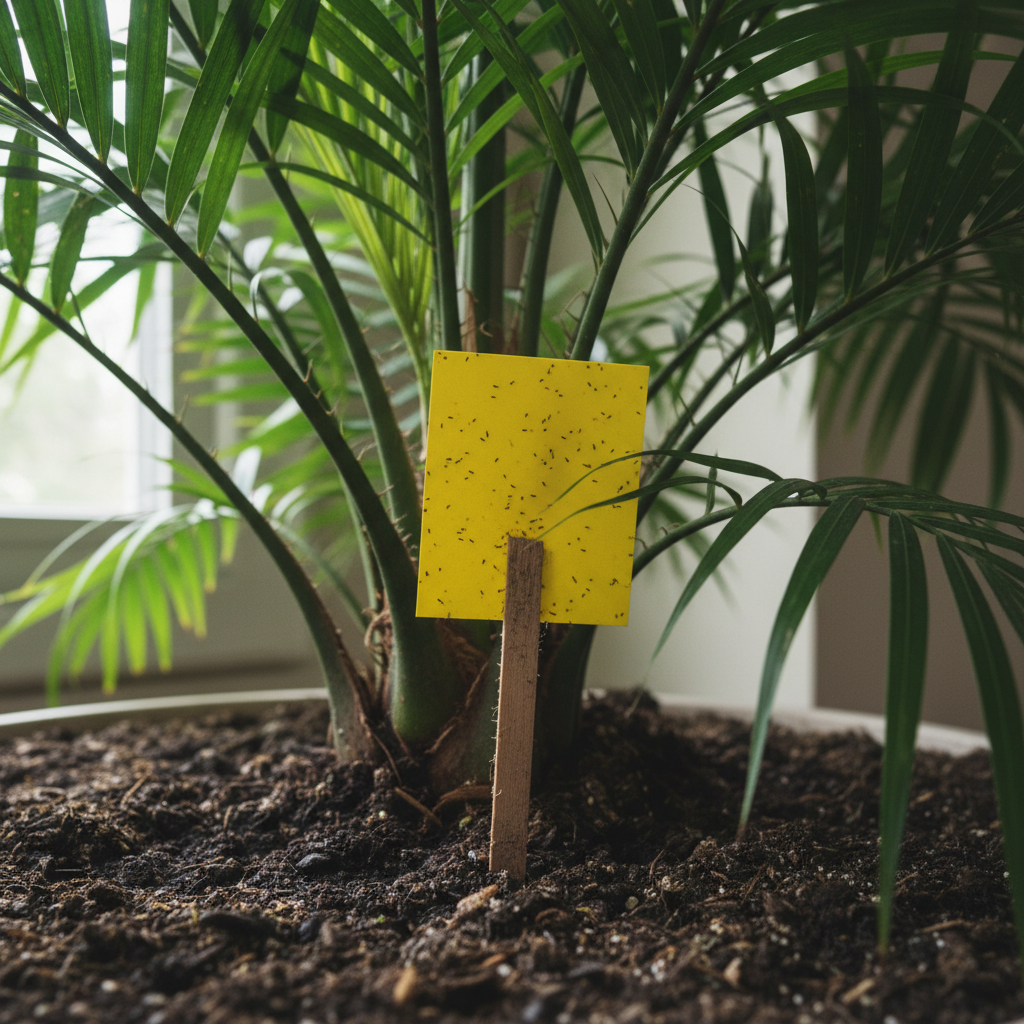
Tiny black flies hovering around the pot, especially after watering, are usually fungus gnats. The adults are mostly a nuisance but their larvae feed on organic matter and very fine roots in consistently wet topsoil, which can weaken a young or recovering majesty palm.
Treatment: Let the top 2 centimetres of soil dry between waterings to break the larval life cycle, top-dress with a centimetre of horticultural sand to deny egg-laying surface, and use yellow sticky traps to catch the adults. For persistent problems, drench the soil with a product based on Bacillus thuringiensis israelensis, which kills larvae specifically without harming the plant or beneficial soil life.
Common Diseases
Root Rot (Pythium and Phytophthora spp.)
The most damaging disease of indoor majesty palms, and the one that quietly accounts for most “mystery deaths” within the first year of ownership. It develops when waterlogged soil starves the roots of oxygen and oomycete pathogens move in on weakened tissue. Symptoms appear above ground as yellowing lower fronds, a sour smell from the pot and softening of the trunk base.
Treatment: Catch it early or not at all. Unpot the plant, rinse the roots, cut away every soft or blackened section with sterilised secateurs, and repot into completely fresh, sharply drained mix. Keep the new substrate barely damp for several weeks and resist the urge to fertilise until clear new growth resumes. Prevention is far more effective: a well-draining substrate, an appropriately sized pot and disciplined watering.
Leaf Spot (Cylindrocladium and Bipolaris spp.)
Small water-soaked spots that enlarge into tan or brown lesions with darker margins, sometimes ringed with a yellow halo. Leaf spot diseases are favoured by overhead watering that leaves foliage wet for long periods, by poor air circulation, and by stressed plants in low light.
Treatment: Remove and discard affected fronds, improve air circulation around the plant, and water at the soil level rather than from above. Avoid misting in the evening. In severe cases, a copper-based fungicide labelled for ornamental palms can break the cycle, but cultural fixes are usually enough on a single houseplant.
Pest and Disease Summary
| Pest / Disease | Identification | Treatment |
|---|---|---|
| Spider mites | Fine stippling, dusty webbing in axils, bronze cast on fronds | Rinse weekly, raise humidity, neem or insecticidal soap on three cycles |
| Scale | Small immobile bumps on rachis and trunks, sticky honeydew below | Alcohol-dipped cotton bud, then horticultural oil spray, repeat at 10 days |
| Mealybugs | White cottony tufts in axils and on new fronds | Spot alcohol treatment, then insecticidal soap or neem in three cycles |
| Fungus gnats | Small black flies around pot, larvae in wet topsoil | Let topsoil dry, sand top-dressing, sticky traps, Bti drench if needed |
| Root rot | Lower frond yellowing, sour soil smell, soft trunk base | Unpot, trim rotten roots, repot in fresh dry mix, correct watering routine |
| Leaf spot | Small water-soaked spots growing into ringed tan-brown lesions | Remove affected fronds, improve airflow, water at soil level only |
Prevention Strategies
Prevention starts with the environment. A majesty palm placed in adequate light, watered consistently, fed correctly and kept above 50 percent humidity will shrug off the kind of pest pressure that overwhelms a stressed plant. Most outbreaks on otherwise well-grown specimens are introduced by a new plant brought into the room without quarantine, by reused tools that have not been sterilised between plants, or by a sudden environmental change that puts the palm on the back foot.
Build a weekly inspection habit. Take 30 seconds to look at the undersides of new fronds, the soil surface and the axils between leaflets. Wipe the upper sides of the fronds with a damp microfibre cloth every couple of weeks to clear dust, which both improves photosynthesis and exposes early signs of mites or scale. Quarantine any new plant for at least three weeks before placing it within touching distance of established plants, and sterilise pruning tools with 70 percent isopropyl alcohol before and after every use.
Pro Tip — Neem Oil Done Right: Most neem oil failures come down to weak dilution and a single half-hearted application. Use cold-pressed neem at 1 to 2 percent in lukewarm water with a drop of mild soap to emulsify, spray every surface including the trunks and soil edge, and repeat every five to seven days for three cycles. Apply in the evening or in low light to avoid leaf burn, and ventilate the room well; neem has a strong smell.
Popular Varieties
Compared to species with long histories of cultivar selection, the majesty palm offers fewer named varieties on the market. Ravenea rivularis is sold almost exclusively as the straight species, in two practical forms that reflect how the plant is grown rather than separate cultivars: dense multi-trunk clumps of several young seedlings potted together, and rarer single-trunk specimens that have been grown on as solo plants. A handful of related Ravenea species, such as the smaller Ravenea hildebrandtii, occasionally appear in specialist nurseries and are worth seeking out for compact spaces.
For most homes, the meaningful choice is between a fuller multi-trunk look and a more architectural single-trunk silhouette, with size at purchase mattering more than naming. Mature specimens command premium prices because palms take years to reach a presentable indoor size, and a healthy multi-trunk clump several years old can be both more impressive and easier to keep alive than a single tiny seedling with no buffer against early mistakes.
| Variety | Leaf Appearance | Light Needs | Growth Rate | Availability |
|---|---|---|---|---|
| Standard Majesty Palm (multi-trunk clump) | Multiple slender trunks, lush arching fronds | Bright indirect to filtered sun | Moderate | Common in garden centres |
| Single-Trunk Majesty Palm | One ringed trunk, full crown of fronds | Bright indirect to filtered sun | Moderate | Specialist nurseries |
| Ravenea hildebrandtii (Dwarf Majesty) | Compact, narrower fronds, slower habit | Bright indirect, tolerates slightly less light | Slow | Rare, specialist collections |
| Ravenea glauca | Bluish-grey fronds, more drought tolerant | Brighter light, prefers some direct sun | Slow to moderate | Rare |
| Field-grown specimen Majesty | Thicker trunks, larger crown from outdoor years | Bright indirect, needs gradual acclimation | Moderate | Occasional in large-plant retailers |
| Nursery seedling (single growing point) | One thin trunk, very few starter fronds | Bright indirect with humidity | Slow at first, then moderate | Common, often inexpensive |
Featured Varieties
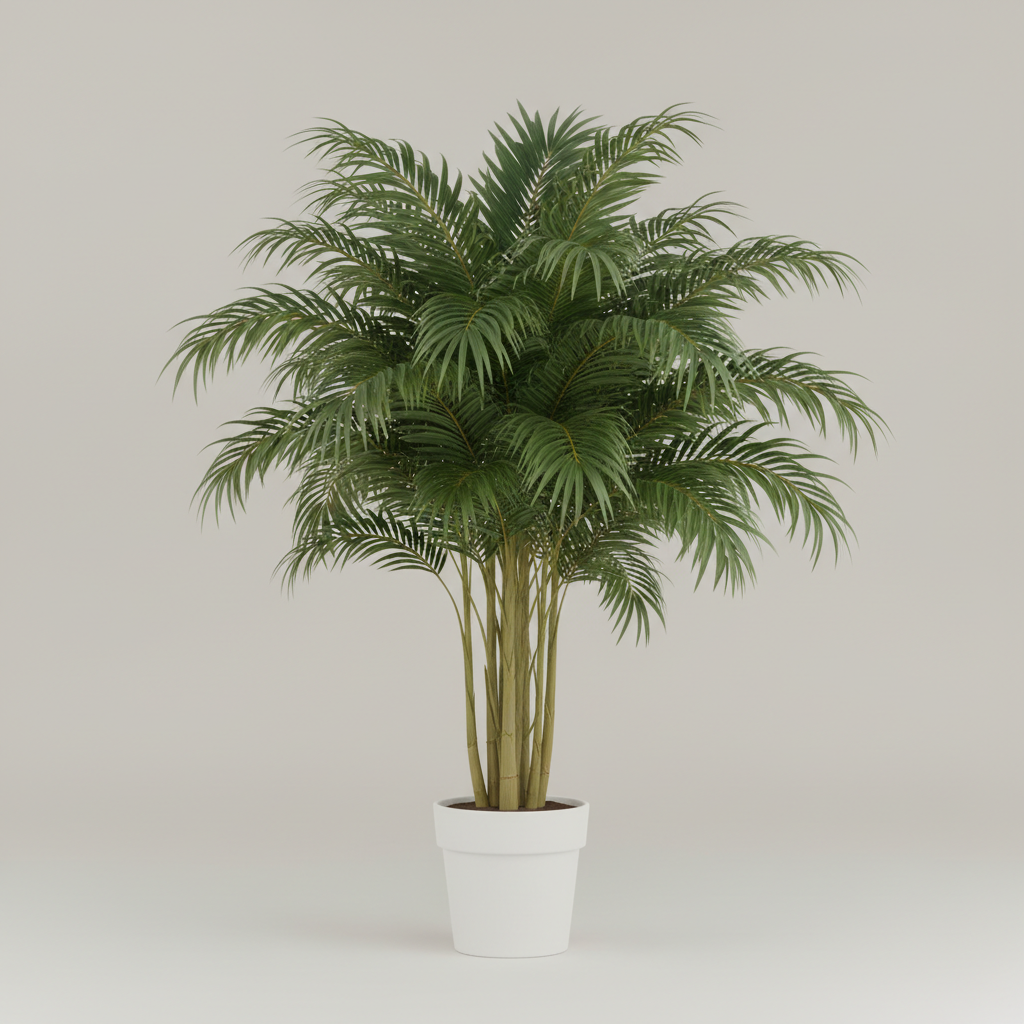
Standard Majesty Palm
The form most people picture: several slim ringed trunks rising together from one pot, each topped with arching feather-shaped fronds that overlap into a dense, fountain-like crown. Inexpensive in small sizes, dramatic at full height, and the easiest to find at general garden centres and home stores.
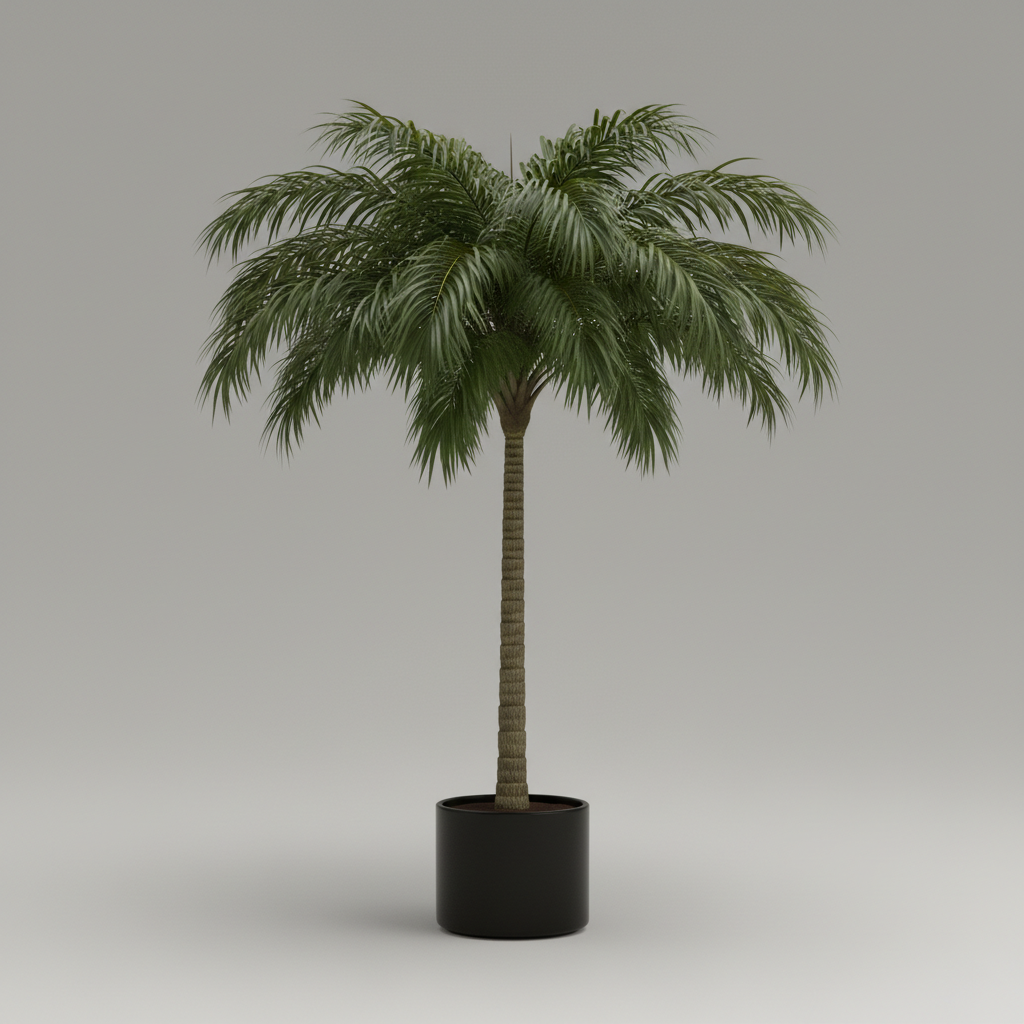
Single-Trunk Majesty Palm
A more architectural, sculptural form, with a single tall ringed trunk and a full crown of long arching fronds. Less common in mainstream retail because growers prefer to pot multiple seedlings together for instant fullness, but a striking choice for modern interiors where a clean silhouette matters more than density.
Variety Profiles in Detail
Standard Majesty Palm (Ravenea rivularis)
The default form of the species in the houseplant trade. A pot typically contains three to seven seedlings grown together from a young age, giving the appearance of a single clump-forming palm even though each trunk is a separate individual. Reaches 1.5 to 2.5 metres (5 to 8 feet) indoors over several years with steady care, and looks particularly striking once the lowest fronds extend almost horizontally outward and the silhouette settles into its mature shape.
Single-Trunk Majesty Palm (Ravenea rivularis)
A solo specimen of the same species, grown without companions in the pot. The single trunk thickens more visibly with age, the leaf-scar rings become a feature in their own right, and the overall shape is closer to a classic palm-tree silhouette than a fountain. Often more expensive at a given height because the grower has invested more years in a single plant rather than spreading the cost across a clump.
Dwarf Majesty Palm (Ravenea hildebrandtii)
A distinct species in the same genus, occasionally marketed under the marketing nickname “dwarf majesty”. Reaches only 1 to 1.5 metres (3 to 5 feet) indoors, with finer fronds and slower growth, making it a sensible choice for smaller flats and tabletop displays. Care is broadly similar, although it tolerates slightly lower light and slightly drier air than Ravenea rivularis.
Ravenea glauca (Ravenea glauca)
Another Madagascan Ravenea, found mainly in specialist palm collections rather than the mainstream houseplant trade. Distinctive bluish-grey fronds and a slightly more drought-tolerant constitution set it apart from the better-known majesty palm, although it still prefers consistent moisture and humidity to truly thrive. Worth seeking out for collectors who want something visually different in the same genus.
Choosing the Right Variety for Your Space
For a generous floor-standing statement in a bright living room, the standard multi-trunk majesty palm is hard to beat. For a more architectural, modern look beside a sofa or window seat, a single-trunk specimen rewards the extra cost with a cleaner silhouette. For smaller flats or tabletop displays, Ravenea hildebrandtii brings the same feather-frond aesthetic at half the size. In every case, the rule of thumb is to buy the biggest healthy plant the budget allows, because the majesty palm rewards patience but does not particularly thrive when miniaturised, and a larger established specimen handles minor care lapses far better than a tiny seedling.
Frequently Asked Questions
Is the majesty palm safe for cats and dogs?
Yes. Ravenea rivularis is listed as non-toxic to cats, dogs and horses by the ASPCA, which makes it one of the safer large palms to keep in a home with curious pets. Cats may still find the long fronds tempting to chew, which can cause mild stomach upset and is also harmful to the plant, so a position out of easy reach is sensible regardless of toxicity.
Why do the tips of my majesty palm’s fronds keep turning brown?
Brown leaflet tips on a majesty palm are most commonly caused by dry air, followed by inconsistent watering and, less often, by accumulated salts from tap water or fertiliser. Check humidity first with a hygrometer and aim to keep it above 50 percent. Then review whether the rootball is allowed to fully dry between waterings, or sit soggy for days, and correct the routine. Finally, flush the pot once or twice with plain water to clear salts.
How fast does a majesty palm grow indoors?
Indoor growth is moderate when conditions are right and slow when they are not. Expect two to four new fronds per trunk per year on a healthy specimen, with a height gain of roughly 15 to 30 centimetres (6 to 12 inches) a year once the plant is established. Plants in dim light or chronic underfertilisation grow far less and may produce only one new frond a year, which is one of the clearest signs that conditions need attention rather than time.
Can I put my majesty palm outside in summer?
Yes, with care. A sheltered patio or balcony in dappled shade can be excellent for a majesty palm in summer, providing higher humidity, more light and better air circulation than most indoor positions. Acclimatise the plant gradually over two weeks, avoid direct midday sun for at least the first month, and bring it back inside well before night temperatures drop below 13 degrees Celsius (55 degrees Fahrenheit). Inspect carefully for hitchhiking pests before bringing it back indoors.
Should I cut off brown leaflet tips?
Trimming brown tips with sharp scissors is a cosmetic choice rather than a horticultural necessity. Cut just inside the brown tissue, following the natural taper of the leaflet to keep the shape looking natural rather than blunt-cut. Removing a whole frond should be reserved for fronds that are more than half brown or yellow, because even partly green fronds continue to photosynthesise and feed the plant.
Why does my majesty palm look thinner each year?
Progressive thinning almost always points to a chronic shortfall in one of the three pillars: light, humidity or nutrition. Fewer new fronds emerge than old ones are shed, and the plant slowly hollows out. Audit each pillar honestly. Move the plant to brighter light, add a humidifier, switch to a palm-specific fertiliser, and watch the next two flushes of growth before changing anything else. Recovery is real but slow; expect months, not weeks.
Can a majesty palm recover from completely drying out?
Sometimes, but rarely without losing fronds. If the rootball has dried completely, soak the pot in a basin of room-temperature water for 20 to 30 minutes so the substrate fully rehydrates, then allow excess water to drain. Expect the most damaged fronds to brown out and need removing over the following weeks. Resume regular care, raise humidity and avoid fertilising for at least a month while the plant rebuilds.
Why does my majesty palm have yellow bands on its older fronds?
Broad yellow bands along the edges of older fronds with a green centre are the classic signature of magnesium deficiency, which is very common in indoor majesty palms fed only with general houseplant fertiliser. Switch to a palm-specific feed that includes magnesium and manganese, or supplement with a dilute Epsom salt solution at 1 gram per litre once a month during the growing season. Expect existing affected fronds to remain marked; new growth should emerge with normal colouring.
How do I clean dust off the fronds without damaging them?
Wipe each frond gently with a damp microfibre cloth, supporting the underside with the other hand to avoid stress on the rachis. For very large or very dusty plants, take the whole palm to a shower and run a gentle stream of lukewarm water over the foliage for a few minutes, allowing the pot to drain fully afterwards. Avoid commercial leaf-shine sprays, which clog the leaflet pores and rarely improve appearance on a feathery palm.
Is the majesty palm a good plant for beginners?
Honestly, no, despite being widely sold to beginners on the strength of its low price and dramatic looks. The combination of bright-light requirements, intolerance of dry air and sensitivity to inconsistent watering makes it a more demanding houseplant than its garden-centre reputation suggests. For a true beginner who wants a similar tropical aesthetic with far more forgiveness, a parlour palm (Chamaedorea elegans) or kentia palm (Howea forsteriana) is a much easier first plant. Once those are doing well, the majesty palm becomes an excellent second-tier project.






