
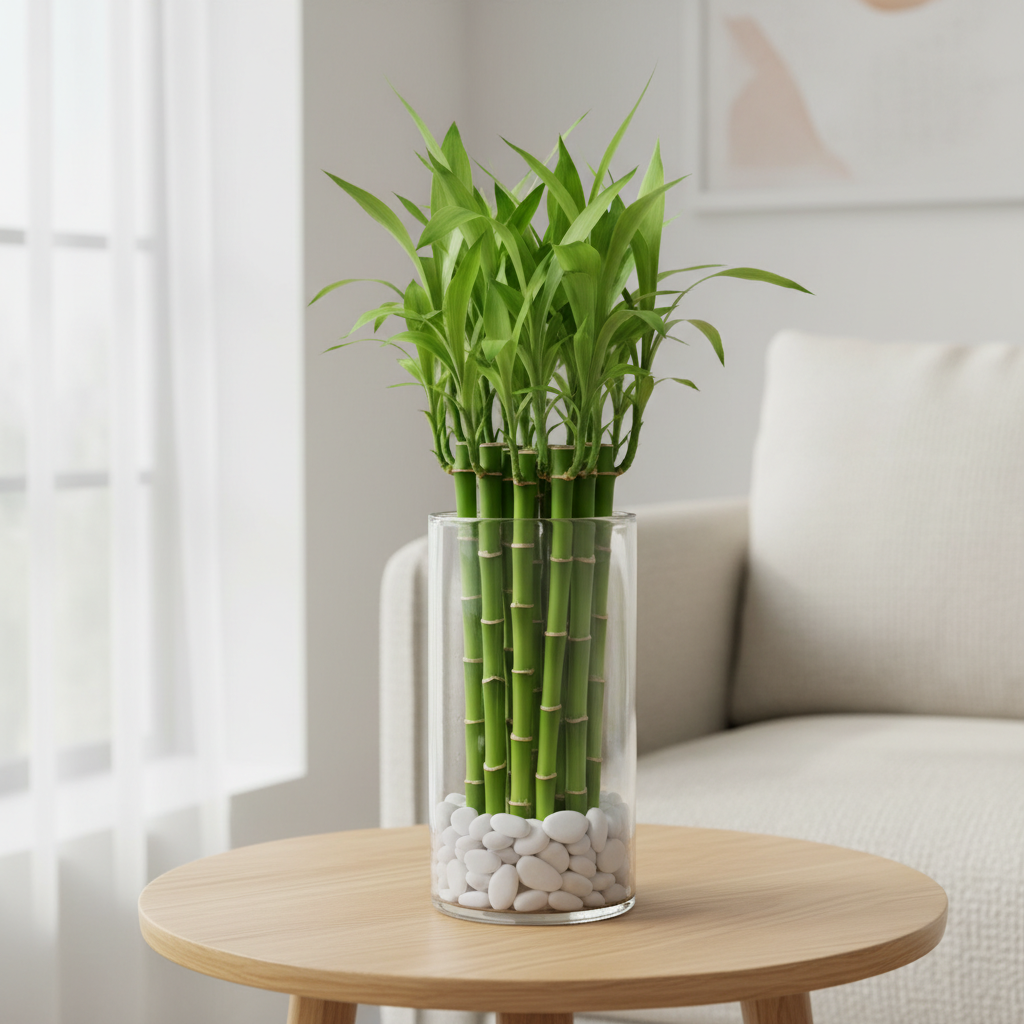
Few houseplants travel as far on a misunderstanding as lucky bamboo. The slim green canes sold in florists, supermarkets and gift shops the world over are not bamboo, not even botanical cousins of true bamboo. The plant is Dracaena sanderiana, a slow-growing tropical shrub from the rainforests of Central and West Africa whose jointed stems happen to look like miniature bamboo canes. It earned its modern name in the 1990s when Taiwanese and Chinese growers began cultivating it as a hydroponic novelty tied to feng shui symbolism, and the association stuck. Today the same plant turns up in offices, kitchens and home altars from Copenhagen to Kuala Lumpur, usually standing in a small glass vessel with a few smooth pebbles and an inch of water.
That reputation as a gift plant masks a more interesting truth. Lucky bamboo is one of the most forgiving Dracaenas, but it is also one of the most easily mistreated, partly because its unusual presentation invites care decisions that no other houseplant requires. Should it live in water forever, or be moved to soil? Why do the leaves keep tipping brown when nothing seems wrong? How often does the water need changing, and does anything go in it? This guide answers those questions and walks through the practical care that turns a short-lived gift into a plant that holds its green colour for many years.
Contents
- Quick Reference
- Why Lucky Bamboo Makes a Forgiving Houseplant
- Light Requirements
- Watering & Humidity
- Soil, Pebbles & Repotting
- Fertilising
- Propagation
- Pests & Common Problems
- Popular Varieties and Arrangements
- Frequently Asked Questions
Quick Reference: Lucky Bamboo at a Glance
| Light | Bright, indirect light; tolerates low light, dislikes direct sun |
| Watering | In water: keep roots submerged, change water every 7 to 14 days. In soil: water when the top 2 cm (3/4 in) dries out |
| Temperature | 18 to 32 °C (65 to 90 °F); avoid below 15 °C (59 °F) and cold draughts |
| Humidity | Average household humidity is fine; tolerates 40 to 70 percent |
| Fertiliser | Very dilute liquid feed every 4 to 8 weeks during active growth; lucky bamboo formulas dosed at one drop per litre work well |
| Toxicity | Toxic to cats and dogs (saponins); keep out of reach of pets |
Why Lucky Bamboo Makes a Forgiving Houseplant
Lucky bamboo earns its place in beginner collections for three reasons. It tolerates low light better than most decorative plants, it grows in plain water if no potting mix is available, and it asks for almost no attention between weekly water changes. Anyone who has watched a fiddle leaf fig drop leaves at the first hint of dry air will appreciate a plant that thrives on what amounts to benign neglect. The jointed canes also lend themselves to design: nurseries train them while young to produce spirals, hearts, towers and braids that hold their shape for the life of the plant.
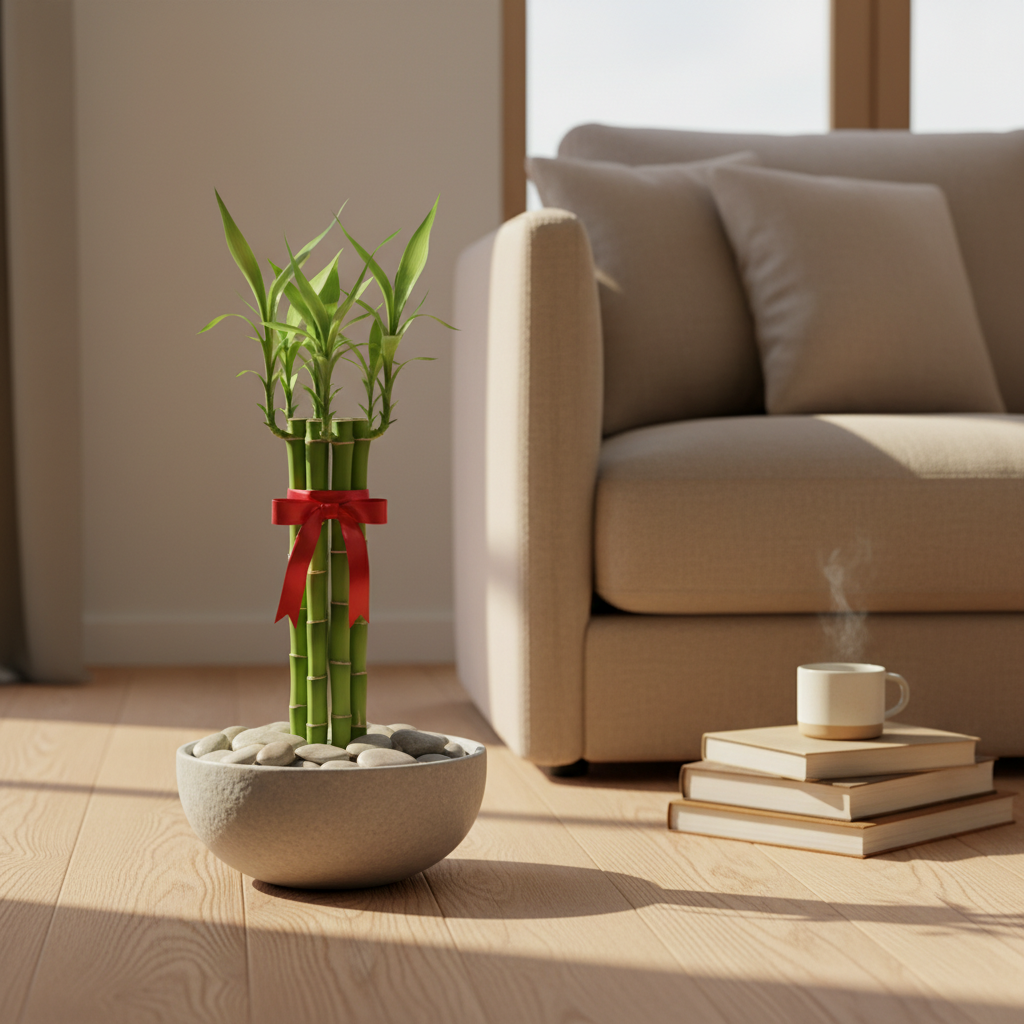
The cultural story matters too. In contemporary Chinese feng shui practice the number of stalks in an arrangement carries specific symbolism, and gifting a particular configuration is a way of wishing someone love, prosperity or long life. Three stalks represent happiness, wealth and longevity; five stalks bring balance across the five areas of life; six stalks invite good fortune; eight stalks represent abundance and growth; nine stalks signify great luck. Four stalks are conspicuously absent from any reputable gift arrangement because the Mandarin word for four sounds close to the word for death. None of this has any horticultural bearing on how the plant grows, but it explains why lucky bamboo arrangements look the way they do and why so many people own one without ever planning to.
Important — Toxicity: Like all Dracaena species, lucky bamboo contains saponins that are toxic to cats and dogs. Ingestion can cause vomiting, drooling, loss of appetite, lethargy and dilated pupils in cats. Keep the plant out of reach of pets, particularly cats who tend to chew slender vertical stems. The plant is not considered toxic to humans, but it is not edible.
Light Requirements
Lucky bamboo evolved as an understorey plant in tropical African rainforests, growing beneath taller trees that filtered the sun before it reached ground level. Indoors that translates to bright, indirect light: a position a metre or two back from an east-facing or north-facing window, or further back from a south or west window with sheer curtains. The plant tolerates lower light than almost any other green-leaved houseplant of its size, which is why it does so well in bathrooms, on office desks beside fluorescent or LED panels, and in interior hallways. It will not, however, thrive there. Tolerance and preference are not the same thing.
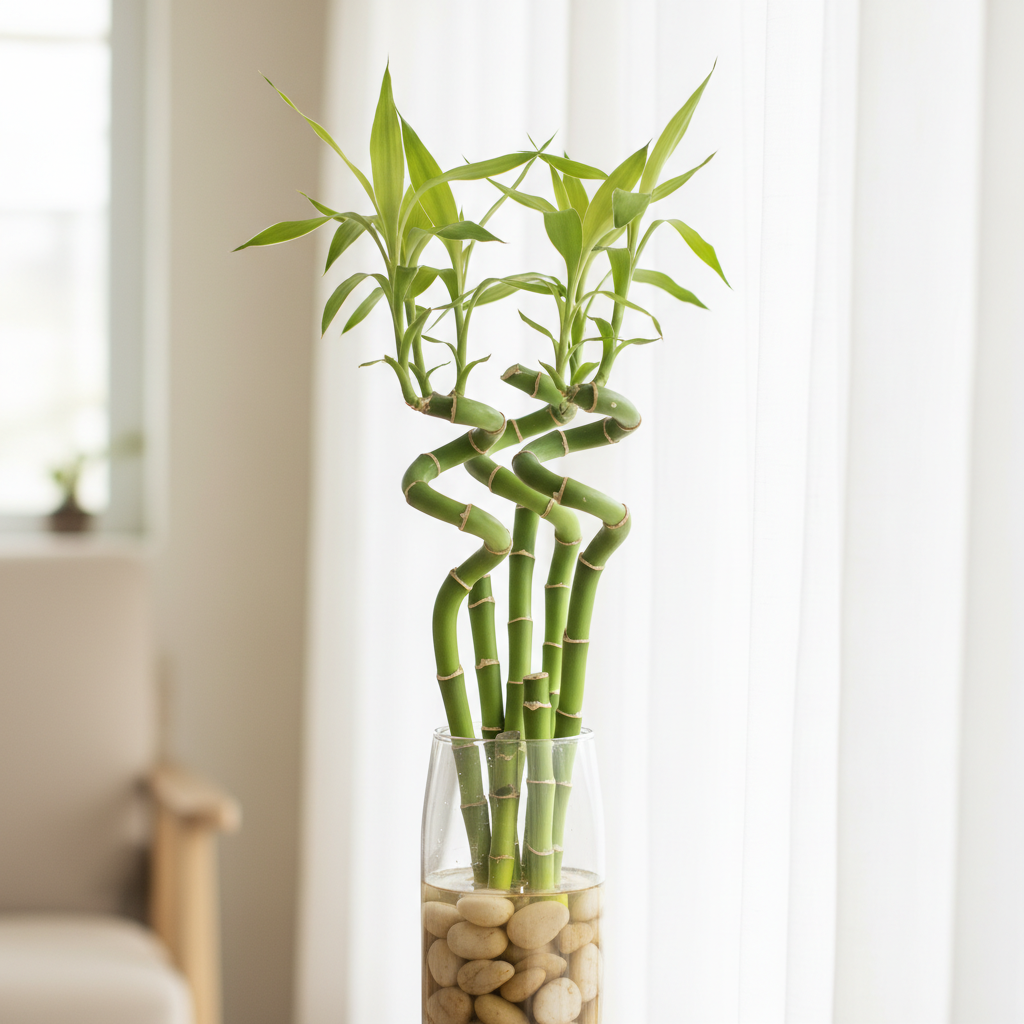
The clearest sign that lucky bamboo is getting too little light is slow new growth combined with progressive yellowing of the lowest leaves. The plant continues to live for a long time in dim conditions but the canes stop adding height and the green colour fades to a pale, washed-out shade. The opposite sign, too much direct sun, shows up as scorched patches on the upper surfaces of the leaves and a yellowing that starts at the tips and edges rather than at the base. Strong midday sun through bare glass can scorch lucky bamboo leaves within a single afternoon, particularly when the canes sit in a clear glass vase that amplifies the light around the roots.
Rotating the arrangement a quarter turn each week keeps the canes growing straight rather than leaning toward the light source. This is especially important for spiral and braided arrangements that are meant to keep their decorative shape; once one side of a spiral starts reaching toward a window, the symmetry never quite returns.
Pro Tip — Reading the colour: Healthy lucky bamboo leaves are a medium, slightly glossy green. A pale, almost lime-green colour usually means light is too low. A yellow that starts at the tips and crisps usually means too much direct sun or, more often, water quality issues. Use this distinction to decide whether to move the plant brighter or change what you put in the vase.
Watering & Humidity
Watering lucky bamboo is unlike watering any other common houseplant because the same plant can be grown in two completely different ways. The arrangement that comes home from the shop almost always sits in a glass vessel of water with smooth pebbles or marbles holding the canes upright. That is hydroponic culture, and it requires its own routine. The same plant can also be transferred to a pot of well-draining soil for a sturdier, longer-lived specimen, and the routine changes accordingly.
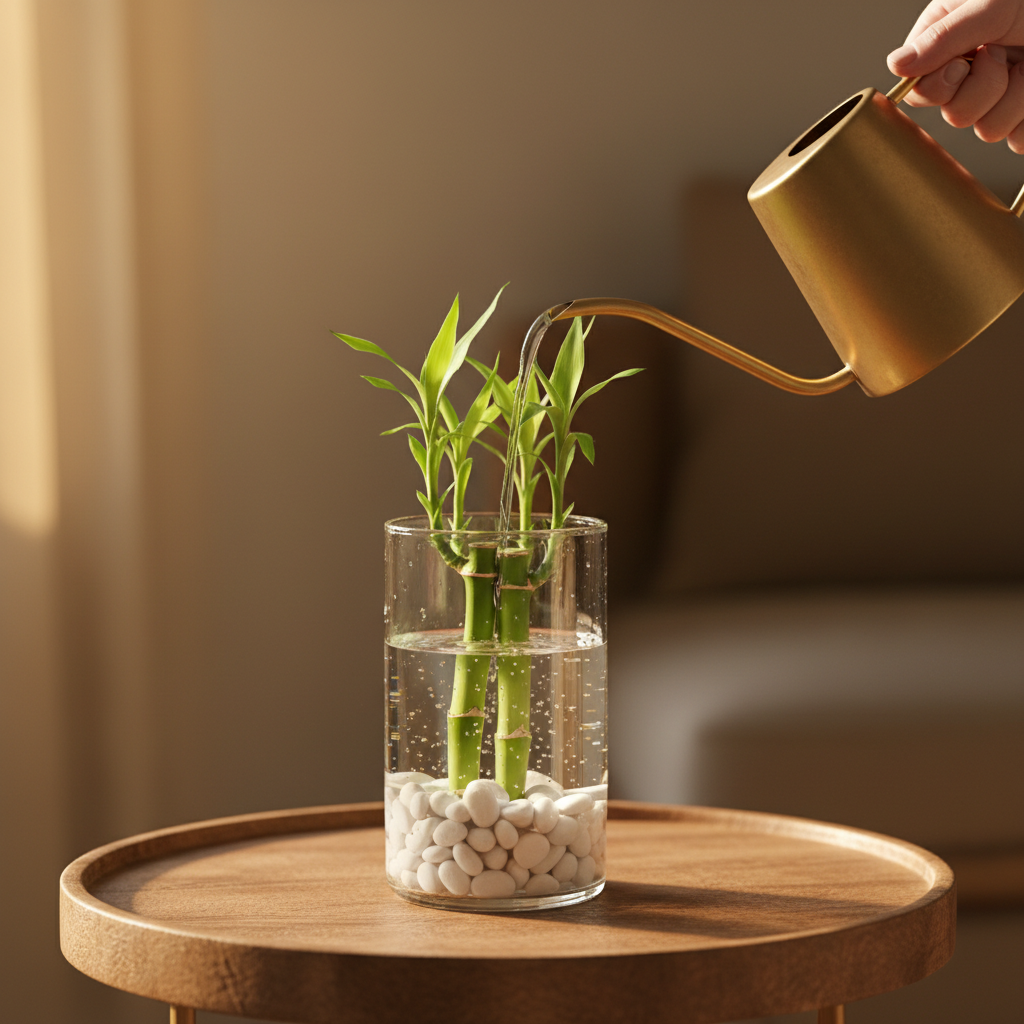
Water culture
For lucky bamboo grown in water, the goal is to keep the lowest 3 to 5 cm (1 to 2 in) of each cane submerged at all times. The roots emerge from the bottom node of the cane and form a small fan of white, sometimes pink-tinged threads that anchor the plant among the pebbles. These roots need oxygen as well as moisture, which is why the water needs refreshing on a regular cycle. A complete change every 7 to 14 days, with a top-up between changes as evaporation occurs, prevents the water from going stale and stops a bacterial film from forming on the inner glass.
Water quality is the single most important variable for lucky bamboo and the reason most plants develop brown leaf tips within months of being brought home. The plant is unusually sensitive to chlorine, chloramine and fluoride, all of which are routine additions to municipal tap water in many countries. The classic sign is a dry, crisp brown band right at the tip of each leaf, sometimes preceded by a yellow halo just behind. The damage is cumulative and cannot be reversed, but it stops progressing once the water source is corrected.
The simplest fix is filtered water from a domestic carbon filter, which removes chlorine and reduces fluoride sufficiently for most plants. Rainwater works well where it is available. Distilled water and reverse osmosis water are the safest options because they contain none of the offending compounds, although they also contain none of the trace minerals the plant needs, so a very dilute feed becomes necessary if these are used exclusively. The cheapest workaround is to fill a jug from the tap and leave it uncovered overnight: most of the chlorine off-gasses within 24 hours, though chloramine and fluoride do not.
Soil culture
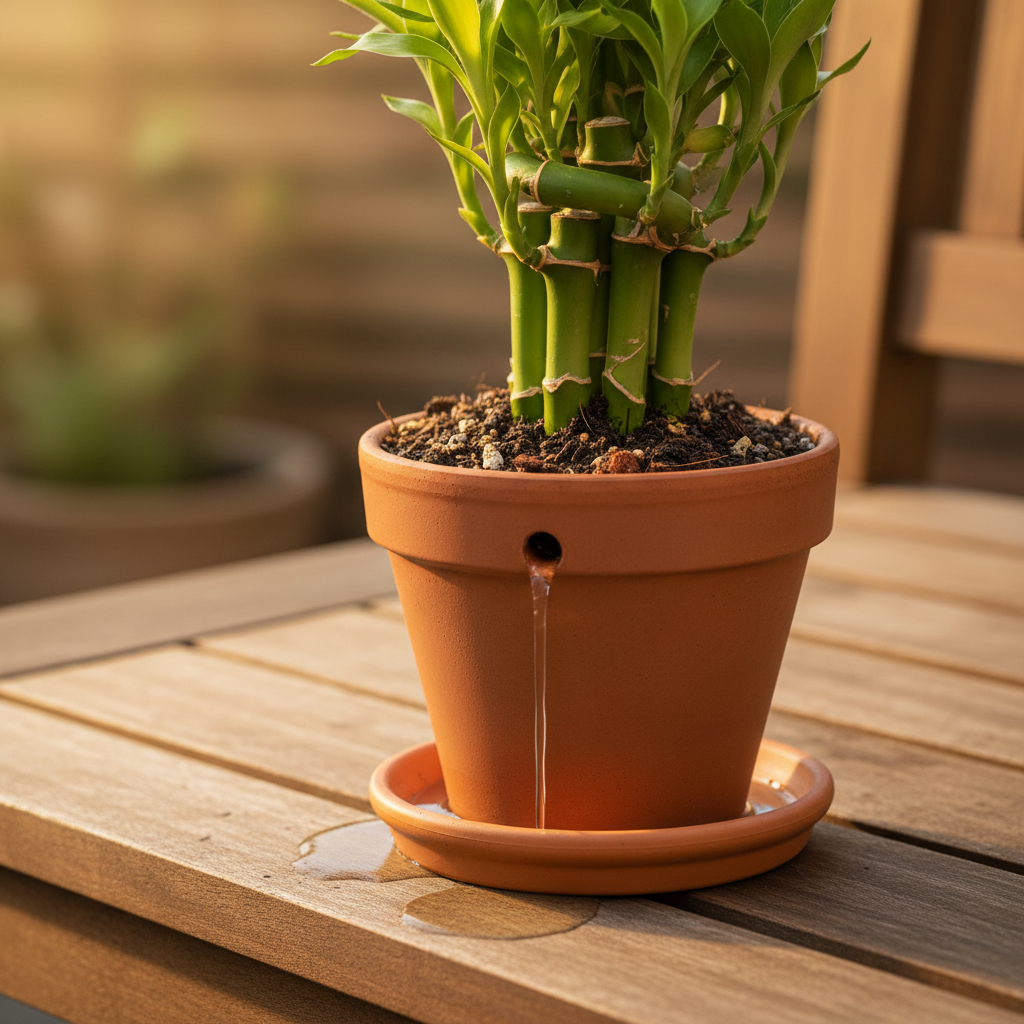
For lucky bamboo grown in soil, the routine is closer to that of a typical houseplant Dracaena. Water thoroughly when the top 2 cm (3/4 in) of the mix has dried, let the excess run from the drainage hole, and empty the saucer afterwards so the roots do not sit in standing water. In a small pot in a bright room this works out to once a week in summer and every 10 to 14 days in winter. The same water quality cautions apply: use filtered, rainwater or rested tap water rather than fresh tap, because the chemicals build up in the potting mix over time and cause the same tip browning seen in water-grown specimens.
Humidity and temperature
Lucky bamboo is far less fussy about humidity than its tropical origin would suggest. Anything between 40 and 70 percent suits it, which covers most home and office environments. Misting is not necessary and can actually accelerate the spread of fungal spots on the leaves if water sits in the leaf axils too long. The plant prefers temperatures between 18 and 32 °C (65 and 90 °F) and dislikes anything below 15 °C (59 °F). Cold draughts from doors and single-glazed windows are a particular problem in winter; the canes themselves rarely show the damage immediately, but the leaves go yellow within a week or two of repeated chilling.
Warning — Tap water and brown tips: If lucky bamboo leaves develop crisp brown tips while the rest of the leaf stays green, the cause is almost always chlorine or fluoride in the water. Switching to filtered, rainwater or rested tap water stops the progression but cannot heal the existing damage. Trim the brown tips at an angle with clean scissors for cosmetic reasons.
Soil, Pebbles & Repotting
The choice between water and soil culture is essentially a choice between aesthetics and longevity. Water-grown lucky bamboo looks elegant in a glass vase and reads instantly as the feng shui plant most people recognise, but it tends to lose vigour after one to three years as the plant exhausts what trace nutrients it had stored when leaving the nursery. Soil-grown lucky bamboo loses some of its decorative simplicity but holds its colour and produces new leaves for many years longer. Both are valid; neither is wrong.
Pebbles for water culture
The pebbles in a water arrangement have one job: holding the canes upright. Smooth river pebbles, glass marbles and polished ceramic stones all work. Sharp gravel can nick the soft roots when they push down into the layer, so smooth, rounded shapes are preferable. Rinse new pebbles thoroughly in plain water before adding them to the vase to remove any dust or coating. There is no advantage to adding sand, clay pellets or any other substrate to a lucky bamboo vase; pebbles do the job cleanly and stay clean themselves.
Potting mix for soil culture
For soil-grown lucky bamboo, a free-draining houseplant mix suits the plant well. A blend of two parts standard houseplant potting compost, one part coarse perlite and one part orchid bark provides the structure and aeration the roots need without compacting over time. A peat-free coir-based mix amended with perlite works equally well. The mix should hold moisture briefly after watering and then drain freely; lucky bamboo roots rot quickly in dense, soggy mixes designed for ferns or seedlings.
Pot choice and size
Choose a pot that is only slightly wider than the diameter of the cane bundle, with at least one drainage hole. Lucky bamboo has a small, fibrous root system and resents being lost in a large pot of damp soil. A 12 to 15 cm (5 to 6 in) pot is usually large enough for a typical bundle of three to seven canes and will not need replacing for two or three years. Terracotta breathes and forgives overwatering, while glazed ceramic holds moisture longer and looks more in keeping with the decorative tradition.
Switching from water to soil
Moving an established water-grown lucky bamboo into soil is straightforward but the roots need a brief adjustment period. The roots that grew in water are thinner and less branched than the roots that develop in soil, and they often die back over the first few weeks as the plant grows replacements adapted to the new environment. Lift the bundle from the vase, rinse the roots gently to remove pebbles and any algal film, and place it in a pot with a layer of fresh mix beneath. Hold the canes at their original depth, fill around the roots with mix, press lightly to settle the substrate and water in with rested or filtered water. Some leaf yellowing during the first month is normal; new leaves emerging from the cane tops confirm that the transition has succeeded.
Repotting
Soil-grown lucky bamboo needs repotting every two to three years, ideally in spring as growth picks up. Lift the plant, shake off most of the old mix, trim any dead or mushy roots with clean scissors and replant in a pot one size larger with fresh mix. Water-grown lucky bamboo does not need repotting in the same sense, but the vase should be scrubbed and refreshed every two to three months to remove the mineral film that builds up around the waterline. Soak the empty vase in a mild solution of white vinegar to dissolve any limescale, rinse thoroughly and refill with rested water before returning the plant.
Fertilising
Lucky bamboo is one of the few houseplants where over-fertilising is a more common problem than under-fertilising. The plant grows slowly by nature, and in water culture it has no soil reserve to buffer excess minerals; whatever goes into the vase reaches the roots directly. A heavy hand with standard liquid fertiliser produces classic salt damage almost immediately: yellow leaves, brown tips and, in severe cases, a slimy film around the roots themselves.
For water culture
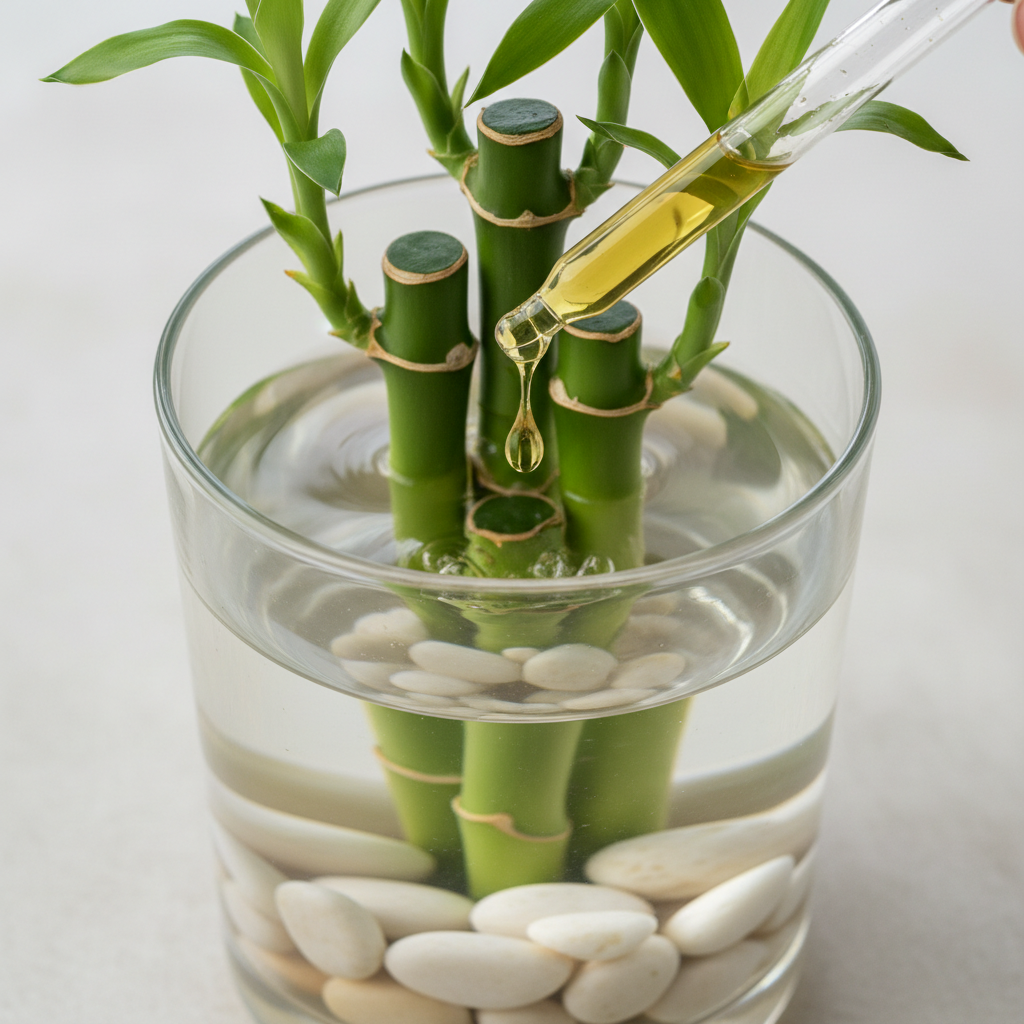
Specialised lucky bamboo fertilisers exist and are formulated at very low concentration for exactly this reason. They are typically dosed at one or two drops per litre of fresh water at each monthly water change. If a specialised product is not available, a standard balanced liquid houseplant fertiliser can be substituted at one tenth of the recommended dilution, applied every 6 to 8 weeks during the active growing season. Skip feeding entirely in autumn and winter when growth slows.
For soil culture
Soil-grown lucky bamboo can take a slightly stronger dose because the substrate buffers and binds excess nutrients. A balanced liquid houseplant fertiliser at half strength applied every 4 to 6 weeks from spring to early autumn is sufficient. Flush the pot with plain rested water every third feed to wash out any accumulated salts. If the lower leaves begin to yellow despite adequate light and watering, suspect salt build-up and flush thoroughly before fertilising again.
Pro Tip — Less is more: If the plant is producing one new leaf at the top of each cane every few months and the existing leaves are holding their colour, the feeding routine is correct. Adding more fertiliser will not produce faster growth; it will produce damaged roots.
Propagation
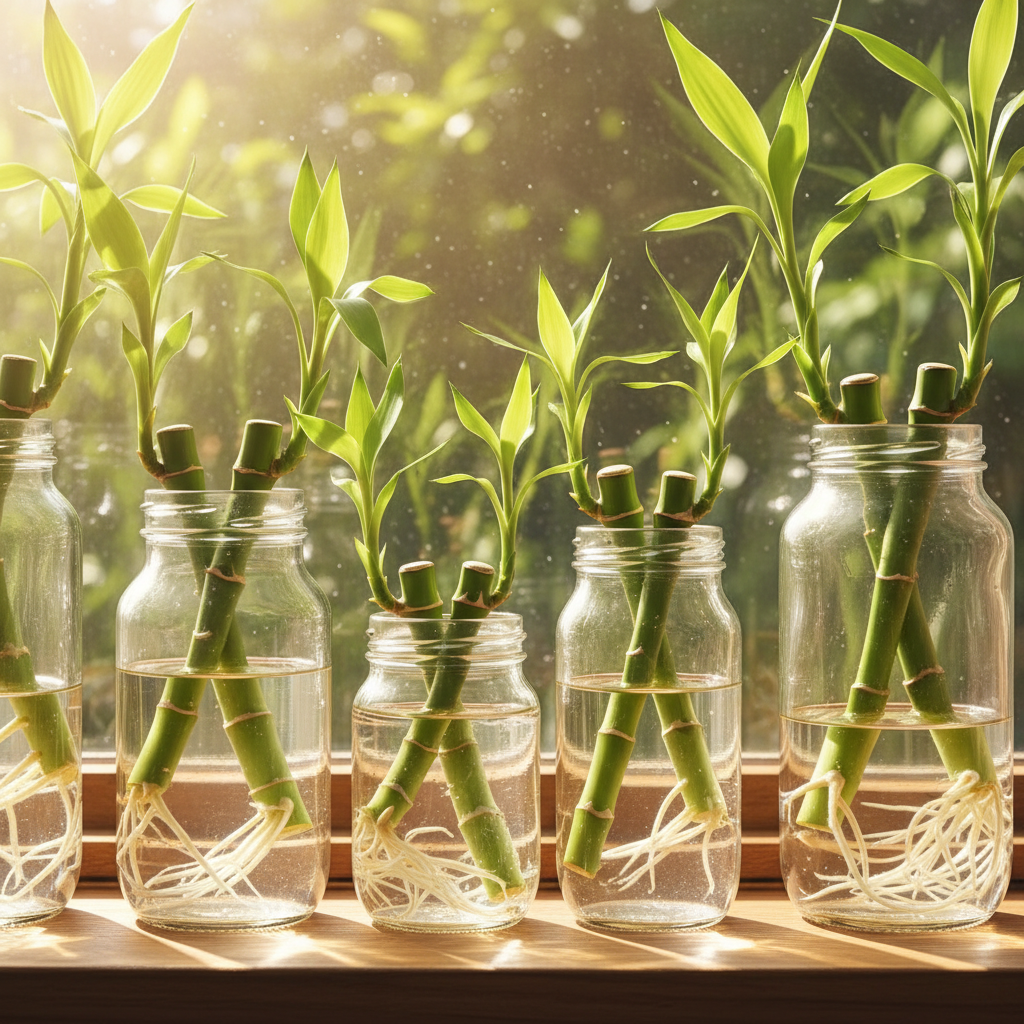
Lucky bamboo propagates from stem cuttings with such reliability that the entire commercial industry depends on it. Mature canes are cut into sections containing two or three nodes, the cut ends are sealed with wax to direct growth out of the upper buds, and the cuttings are rooted in water and sold on. The same method works at home with no special equipment.
Step-by-step water rooting
- Choose a healthy parent cane and identify a section that includes at least one node (the slightly raised ring where leaves emerge) and ideally a leaf cluster at the top.
- Sterilise sharp scissors or secateurs with a wipe of isopropyl alcohol. Cut just below a lower node to take a cutting 10 to 20 cm (4 to 8 in) long.
- Strip any leaves that would sit below the future waterline, leaving the upper leaf cluster intact.
- Place the cutting in a clean glass jar with 3 to 5 cm (1 to 2 in) of filtered or rested tap water. The lower node must be submerged; the leaves must not.
- Stand the jar in bright, indirect light, away from direct sun. Change the water every 7 to 10 days using fresh water at room temperature.
- White roots emerge from the submerged node within three to six weeks. Once the roots reach 4 to 5 cm (1.5 to 2 in), the cutting can be potted into soil or placed in a permanent vase arrangement.
Sealing the parent cane
When taking a cutting from the top of a parent cane, the cut surface on the remaining stub is vulnerable to rot. Sealing it with a thin layer of melted candle wax or a small dab of plant grafting wax mimics what commercial nurseries do and prevents water entering the open tissue. The parent cane usually responds within a few weeks by pushing one or two new shoots from the nodes below the cut, giving the original plant a denser, branched look over time.
Shaping new cuttings
The decorative spirals, hearts and braids that arrive from the nursery are not natural growth habits; they are produced by laying young canes on their sides under controlled directional light, then rotating them as they turn toward the source. Achieving the same effect at home requires patience, a three-sided light box and weekly rotation, and even then the results tend to be irregular. Most home propagators are happier letting cuttings grow straight upward, which is what the plant wants to do on its own.
Pests & Common Problems
Lucky bamboo is comparatively pest-resistant, especially in water culture where there is no soil substrate for fungus gnats or root mealybugs to inhabit. The problems that arise are mostly cultural — the result of water quality, light or temperature — and the small number of insect pests that do appear are easy to spot and treat early.
Insect pests
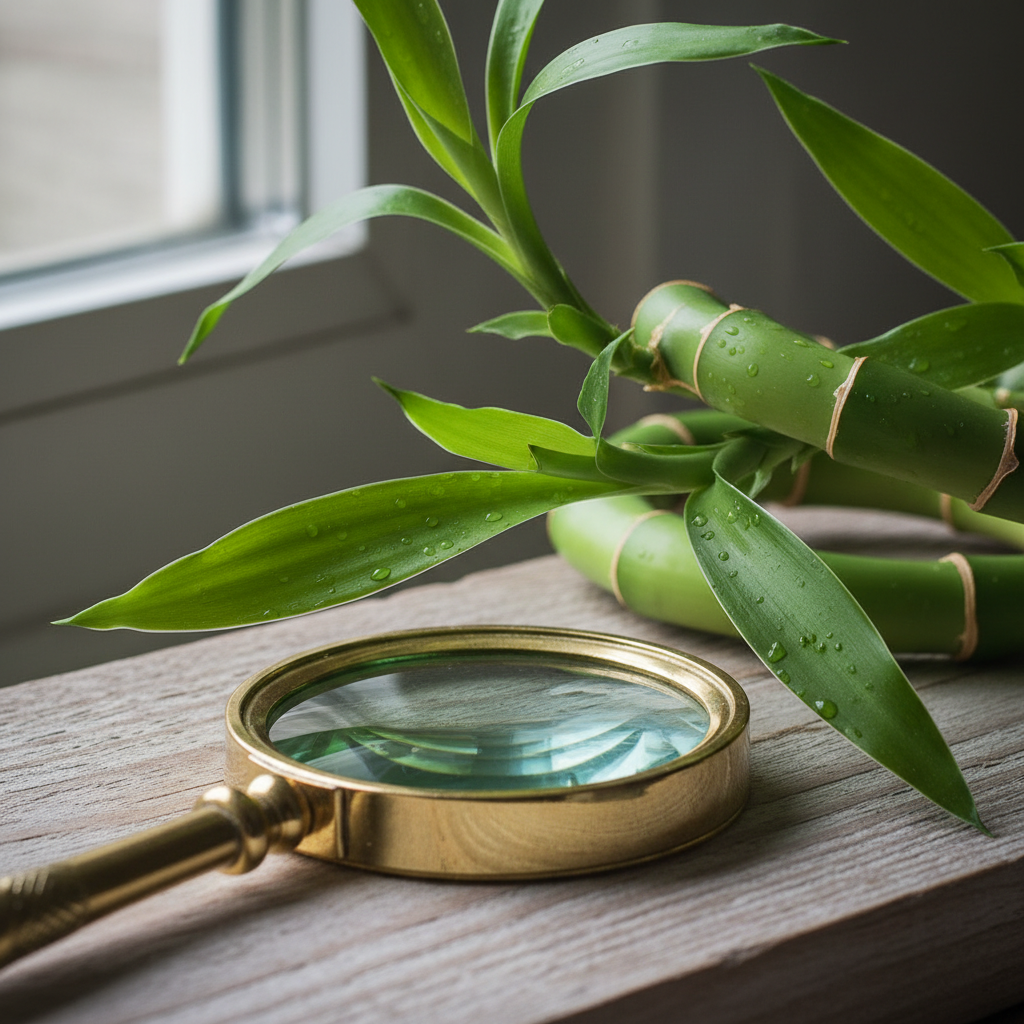
Mealybugs are the most common insect on lucky bamboo and appear as small, cottony white tufts in the joints of the canes and at the bases of the leaves. They feed on sap and weaken the plant slowly. The standard treatment is to dab each visible mealybug with a cotton bud soaked in 70 percent isopropyl alcohol, then wipe the cane and leaf surfaces with a damp cloth. Repeat the inspection weekly for a month to catch any newly hatched insects.
Spider mites are a problem in dry indoor air, particularly in winter when central heating drops the humidity. The first sign is fine speckling on the upper leaf surfaces and faint webbing on the undersides. Rinsing the leaves under a gentle stream of water and increasing humidity around the plant disrupts a light infestation; persistent mites respond to insecticidal soap or neem oil applied to all leaf surfaces, including the undersides where the mites breed.
Scale insects occasionally appear as small brown or tan bumps along the canes. They scrape off with a fingernail or respond to the same alcohol treatment used for mealybugs. Scale rarely takes hold on healthy lucky bamboo and is mostly seen on plants that are also stressed by poor light or water quality.
Cultural problems
| Symptom | Most likely cause | Action |
| Crisp brown leaf tips | Chlorine or fluoride in tap water | Switch to filtered, rain or rested water; trim tips for appearance |
| Yellow lower leaves | Old leaf shed or salt build-up from fertiliser | Trim yellow leaves; flush pot or change vase water; cut fertiliser back |
| Yellow cane (stalk itself) | Root rot, often from stagnant water or cold | Remove the yellow cane entirely; refresh water; warm the position |
| Pale washed-out green | Insufficient light | Move to brighter indirect light over a fortnight |
| Slimy film inside vase | Algal or bacterial growth in stale water | Empty, scrub vase, refresh pebbles, change water schedule to weekly |
| Soft mushy roots | Bacterial rot from old water | Trim affected roots, refresh water, move to brighter spot |
Pro Tip — A yellow cane is final: Unlike a yellow leaf, a yellow stalk on lucky bamboo is essentially dead tissue and the colour will continue to advance up the cane. Remove the affected cane completely rather than waiting for it to recover. The remaining canes in the arrangement are unaffected as long as the water and roots are refreshed.
Popular Varieties and Arrangements
Most of what looks like varietal diversity in the lucky bamboo world is shape rather than genetics. Nurseries train ordinary Dracaena sanderiana canes into spirals, hearts, towers and braids while the stems are young and flexible. There are also a small number of true cultivars selected for leaf colour and variegation, and these tend to be sold individually as soil-grown plants rather than as gift arrangements.
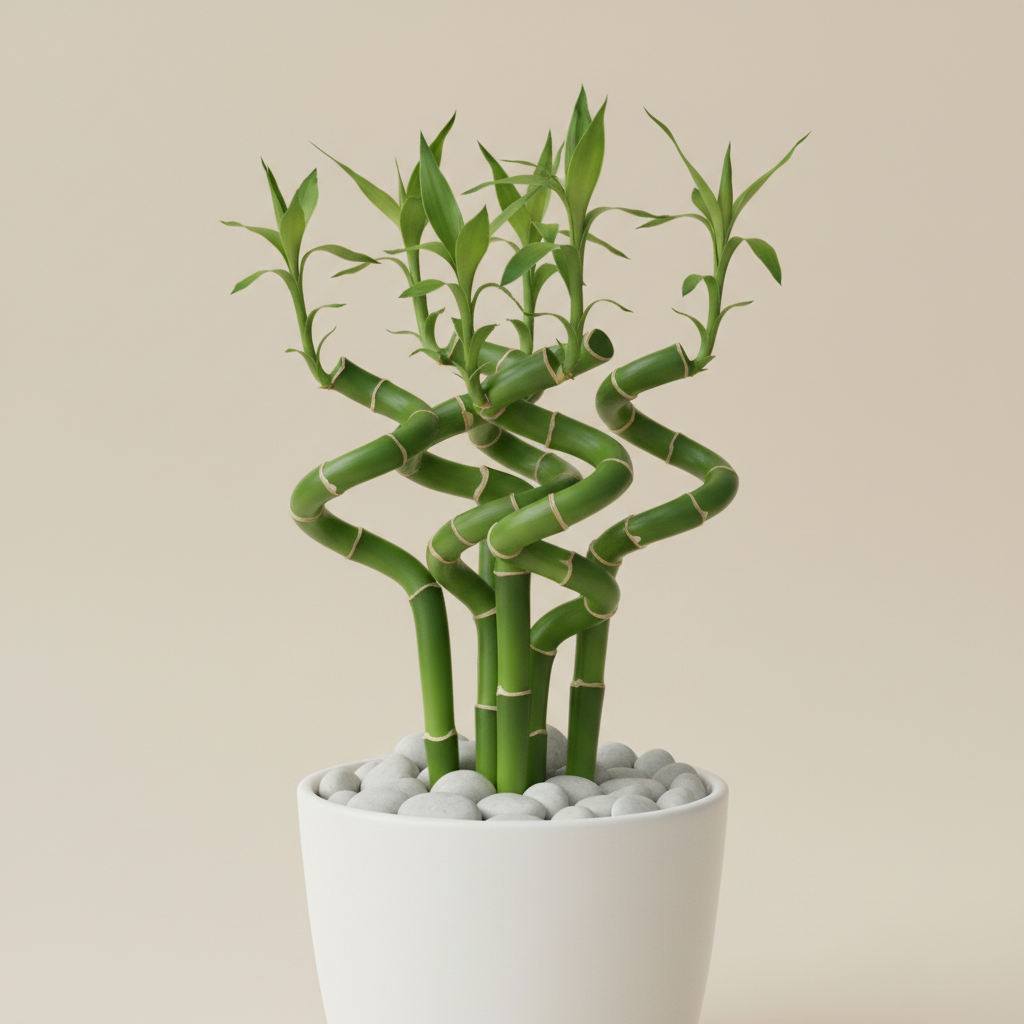
Spiral (Curly)
The signature decorative form. Young canes are laid horizontally beneath a light source and rotated slowly over months so they curve toward the brightening direction. The result is a tight, evenly spaced spiral that holds its shape for the life of the cane. Once trained, the cane keeps the spiral even after new straight growth emerges from the top, so the silhouette can become a vertical column rising from a curled base.
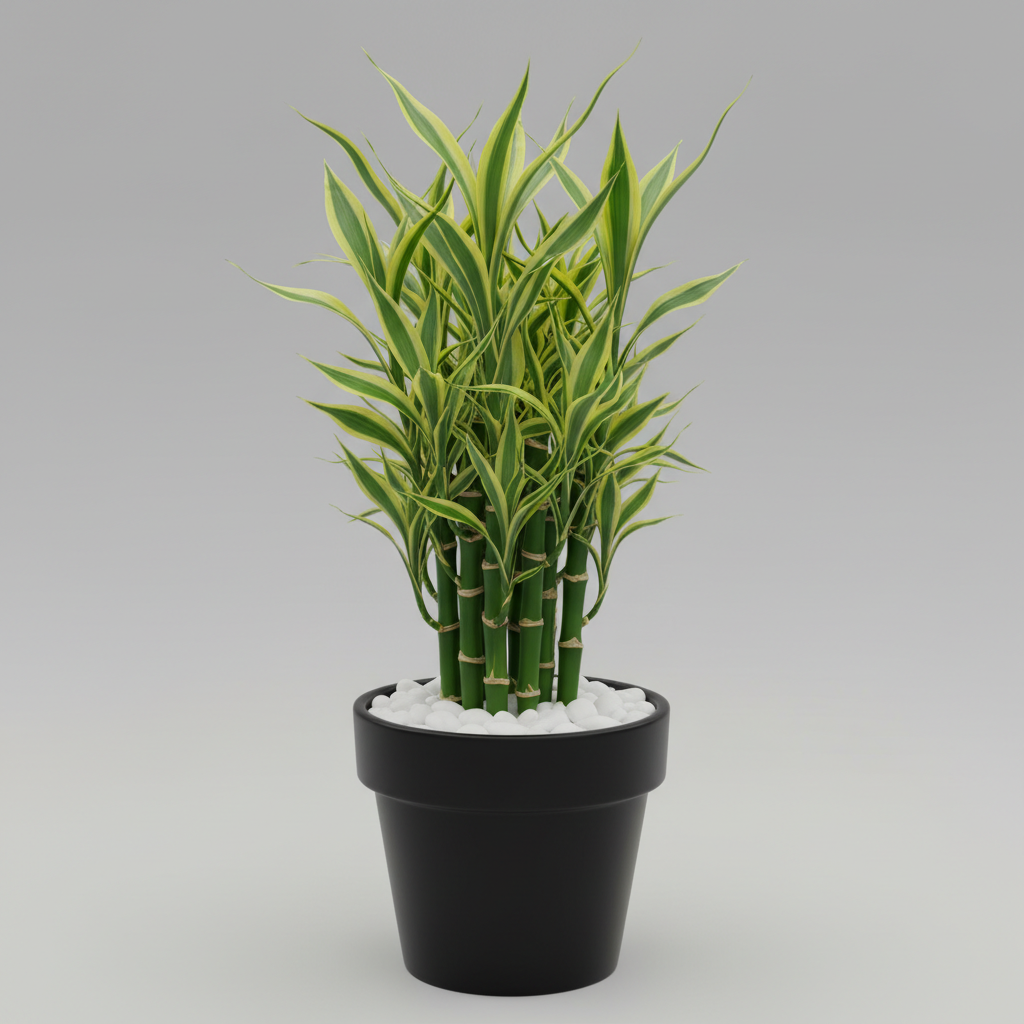
‘Victory’ (Variegated)
One of the few true colour cultivars in commercial cultivation. ‘Victory’ carries broad cream-to-yellow stripes along the margins of each lance-shaped leaf, framing a green central band. The variegation is stable in moderate to bright indirect light; in dim conditions the variegation pales and the plant reverts toward solid green. ‘Victory’ is usually sold as a soil-grown plant in a small nursery pot rather than as a water arrangement.
Other arrangements worth knowing
Braided lucky bamboo twists three or more young canes around each other before they harden. As the canes mature the braid sets and the plant grows as a single thickened column with multiple leaf clusters at the top. Tower arrangements bundle canes of progressively shorter heights in concentric rings, producing a stepped pyramid that can carry seven, twelve or even twenty stalks. Heart and number-shaped frames use thin wire armatures to coax canes into shapes as they grow, then the wire is removed.
Solid green wild-type lucky bamboo, with no training and no variegation, is the form closest to how the plant grows in West African forests. It rarely makes its way into Western shops but is common in tropical nurseries and increasingly in the offerings of specialist collectors. ‘White Stripe Victory’ is a related variegated cultivar with thinner, brighter white margins, sometimes sold under the simpler name ‘White Stripe’.
Frequently Asked Questions
Is lucky bamboo actually a bamboo?
No. Despite the name and the visual resemblance, lucky bamboo is Dracaena sanderiana, a member of the asparagus family. True bamboos are grasses in the family Poaceae and are unrelated. The shared name comes from the jointed appearance of the green canes, which look superficially like miniature bamboo culms.
Why are the leaves turning yellow?
The three most common causes, in order, are: chlorine or fluoride in the water (yellow with brown crisp tips), too much direct sun (yellow on upper surfaces with scorched patches), and over-fertilising (yellow lower leaves with intact green tips). Switch to filtered water, move the plant out of direct sun and skip the next two feeds; the new growth that emerges over the following month should appear normal.
How often should the water be changed?
Every 7 to 14 days for a complete change, with topping up between changes as evaporation drops the level. Stretching to longer than two weeks risks bacterial growth and produces the slimy film that coats the inner glass and the roots. In a hot room or strong light the cycle moves toward weekly; in a cool, dim spot it can extend to every fortnight.
Can lucky bamboo live in water forever?
It can live in water for many years, but most water-grown specimens lose vigour after one to three years as the plant exhausts the trace nutrients it had banked at the nursery. Adding a very dilute fertiliser at each water change slows that decline. For the longest, healthiest life, transferring the plant to a free-draining potting mix after the first year is the most reliable route.
Does the number of stalks really matter?
Horticulturally, no — three healthy canes grow as well as eight. Culturally, the number carries symbolic weight in Chinese feng shui practice, where two, three, five, six, eight, nine and twenty-one stalks each represent a particular wish. Four stalks are conventionally avoided because the Mandarin word for four sounds close to the word for death. Gift arrangements almost always come in one of the auspicious numbers.
My lucky bamboo cane has gone soft and yellow. Can I save it?
Not the cane itself. A yellow, soft cane has lost its internal tissue to rot and the colour will continue moving up the stem. Remove the affected cane from the arrangement entirely, rinse the remaining canes and pebbles, scrub the vase and refill with fresh rested water. The remaining canes should recover; the lost one cannot.
Is lucky bamboo safe for cats and dogs?
No. Like all members of the genus Dracaena, lucky bamboo contains saponins that are toxic to cats and dogs if ingested. Symptoms include vomiting, drooling, loss of appetite and, in cats, dilated pupils. The plant is not considered toxic to humans. Keep the arrangement on a high shelf or in a room your pets cannot reach.
Will lucky bamboo flower indoors?
Almost never. The species does flower in its native habitat with small, pale, fragrant blooms, but the conditions that trigger flowering — extended periods of high light, warmth and root crowding — are very difficult to recreate in a typical home, and water-grown specimens almost never reach the required maturity. Treat lucky bamboo as a foliage plant and any flowers will be a bonus.
How big can lucky bamboo grow?
In commercial cultivation and in its native range the plant reaches 1.5 m (5 ft) over many years, with canes thickening to about 2 cm (3/4 in) in diameter. Indoor specimens, especially in water culture, rarely exceed the height they were sold at, growing only a small amount of new leaf tissue at the top each year. Soil-grown plants in good light can extend by 10 to 20 cm (4 to 8 in) annually.






