
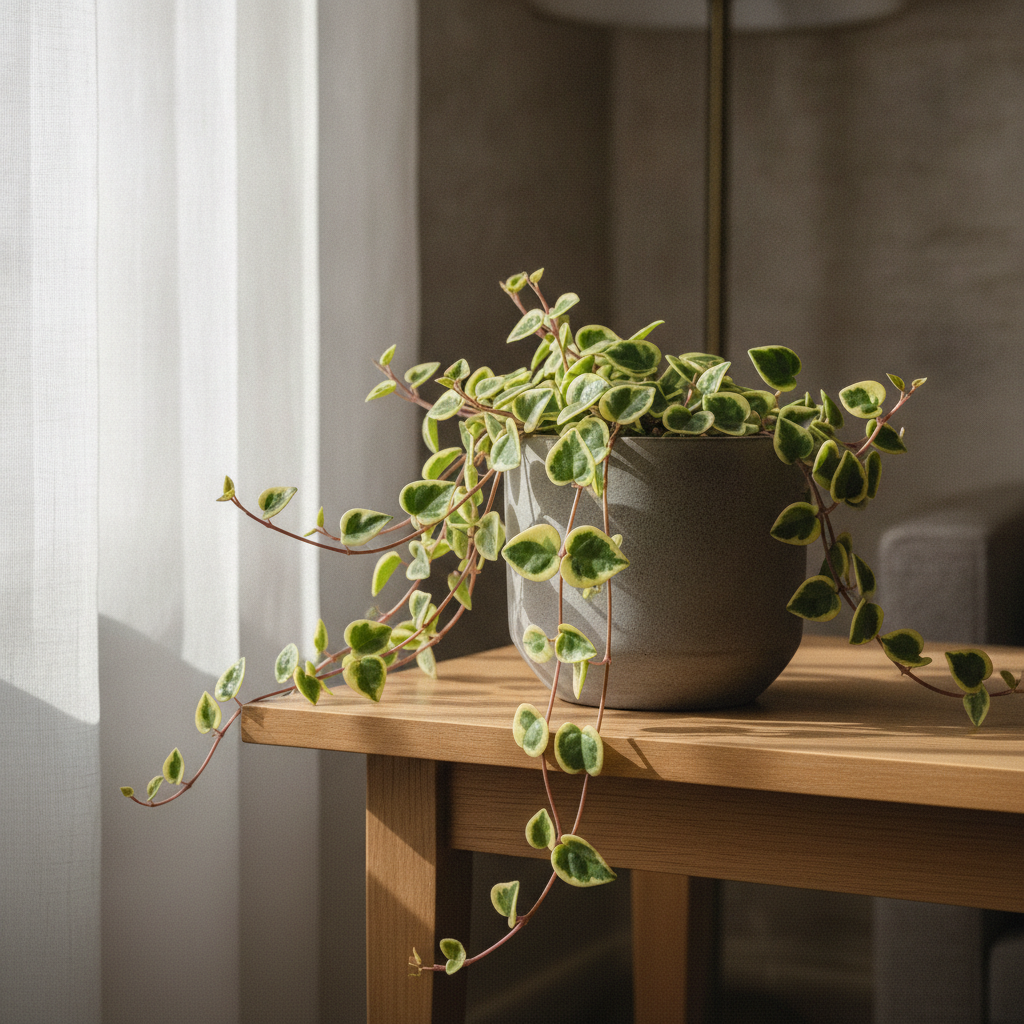
Cupid’s peperomia, botanically Peperomia scandens in its variegated form, is one of those plants that quietly earns its place. It does not demand a bright south window, a humidifier, or a weekly feeding routine, yet it rewards the smallest attention with a steady procession of small, waxy, heart-shaped leaves edged in buttery cream. Left to trail from a shelf or a hanging pot, its slender pink-tinged stems can reach well past half a metre, softening a hard corner or spilling gently over the lip of a bookcase. For anyone who has killed a fern or watched a calathea sulk, this is a plant that restores confidence.
It belongs to the genus Peperomia, an enormous group of well over a thousand species in the pepper family, Piperaceae. That family connection is not just trivia: it explains the plant’s semi-succulent, moisture-storing leaves and its preference for the same warm, humid, dappled conditions found on tropical forest floors and tree trunks across Central and South America. Understanding where a plant comes from is the shortcut to keeping it alive, and Cupid’s peperomia comes from a world of filtered light, quick-draining leaf litter, and rain that arrives often but never lingers. Recreate a hint of that at home and the plant will not merely survive, it will thrive.
Quick Reference
The table below distils the essentials for anyone who wants the headline numbers before reading further. Every point is expanded in the sections that follow, but if you only take away one idea, let it be this: Cupid’s peperomia is far more forgiving of neglect than of kindness. Underwatering costs you a few limp leaves that plump back up within hours; overwatering rots the roots and can end the plant entirely.
| Botanical name | Peperomia scandens ‘Variegata’ |
| Common names | Cupid’s peperomia, Cupid peperomia, variegated cupid peperomia, false philodendron |
| Family | Piperaceae (the pepper family) |
| Origin | Tropical Central and South America, Mexico, the Caribbean |
| Light | Bright, indirect light; a little direct morning sun keeps the variegation crisp |
| Water | Let the top third of the mix dry out; water thoroughly, then drain |
| Humidity | Average room humidity is fine; 50 per cent or more is appreciated |
| Temperature | 18 to 24 degrees Celsius (64 to 75 Fahrenheit); keep above 10 Celsius (50 Fahrenheit) |
| Soil | Light, airy, fast-draining mix with plenty of perlite or bark |
| Feeding | Dilute balanced fertiliser monthly in spring and summer only |
| Growth habit | Trailing to semi-climbing; stems reach 60 to 90 centimetres (24 to 35 inches) |
| Propagation | Stem-tip cuttings in water, moss, or perlite; roots readily |
| Toxicity | Non-toxic to cats and dogs; safe around pets and children |
| Difficulty | Easy; well suited to beginners |
Why Cupid’s Peperomia Makes Such a Good Houseplant
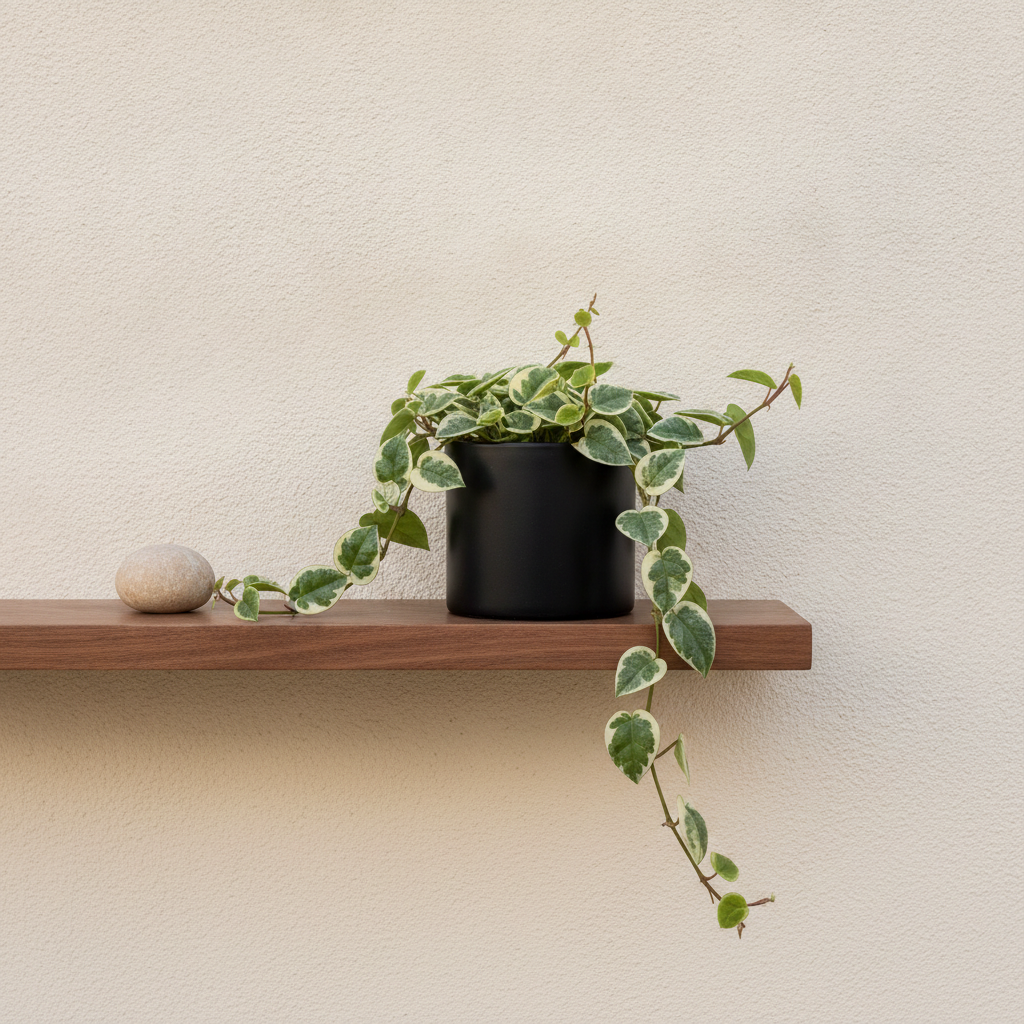
Three qualities set this plant apart. The first is genuine ease of care. The semi-succulent leaves act as small water reservoirs, so the plant tolerates a missed watering or a fortnight of holiday neglect without complaint. The second is its manners: mature stems rarely exceed a metre and the plant never becomes the sprawling monster that a pothos or a philodendron can, which makes it ideal for smaller homes, office desks, and shelves where space is measured in centimetres. The third is safety. Unlike a great many popular trailing plants, including pothos, philodendron, and English ivy, peperomias contain no calcium oxalate crystals and are not toxic to cats or dogs. In a house with a curious cat or a toddler, that single fact can be decisive.
The common name deserves a word, because it causes some confusion. Cupid’s peperomia is grown for its small, symmetrical, heart-shaped leaves, and the “Cupid” refers to those valentine forms rather than any single named cultivar. The variegated form, sometimes sold simply as ‘Variegata’, carries a wide, irregular margin of cream and pale yellow around a green heart, and it is by far the most popular version on sale. You may also see the plant labelled false philodendron, a nod to the heart-leaved, trailing resemblance it shares with Philodendron hederaceum. The two are unrelated, and the peperomia’s thicker, waxier, more succulent leaf is the giveaway.
In the wild, Peperomia scandens scrambles across rocks and up the base of trees as a low epiphyte, rooting where its nodes touch damp bark or moss. That scrambling, rooting habit is the source of everything that makes it a good houseplant: it stores water to survive dry spells, it roots with almost embarrassing ease, and it is happiest in the low, filtered light of a canopy understorey rather than blazing sun. Keep those origins in mind and the care that follows will feel less like a set of arbitrary rules and more like common sense.
Light
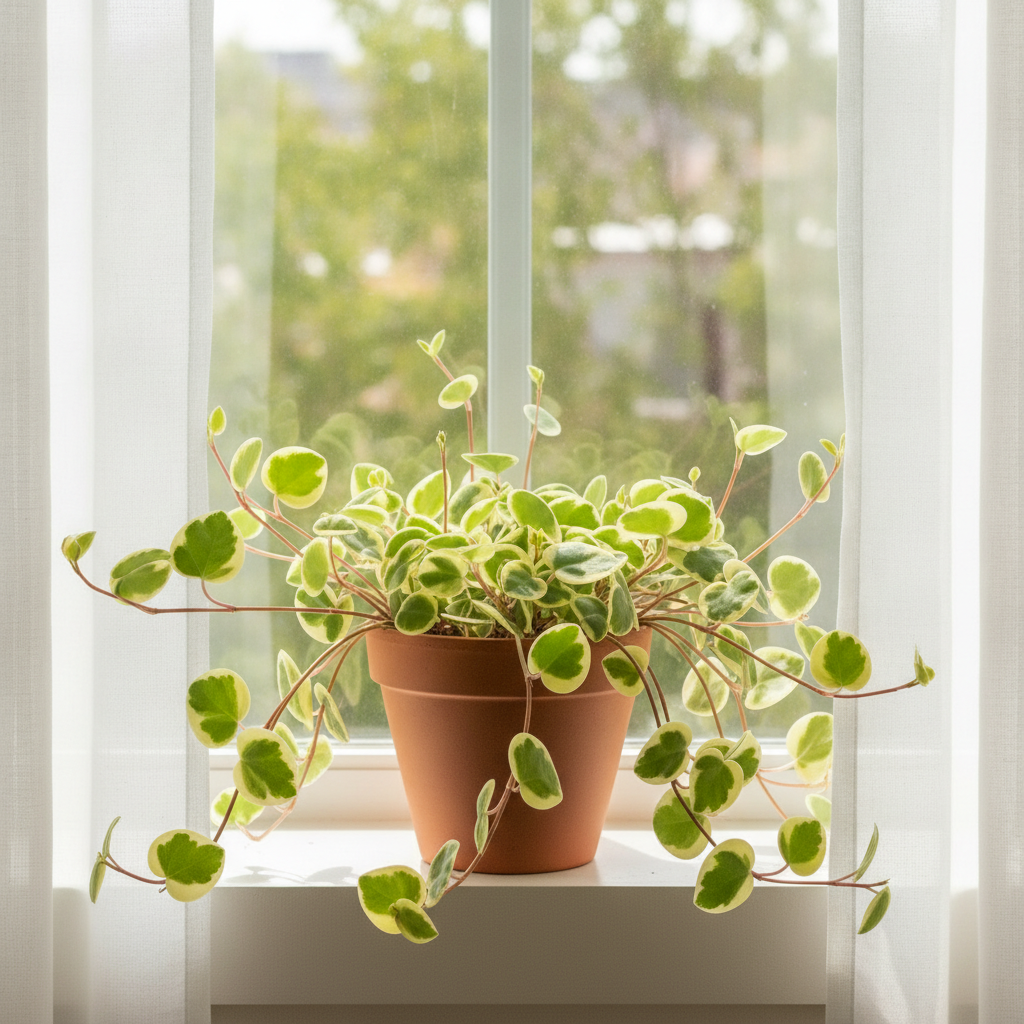
Light is where a variegated peperomia and its all-green cousin part ways. Bright, indirect light is the target for both, but the cream and yellow areas of a variegated leaf contain little or no chlorophyll, so they contribute nothing to feeding the plant. To compensate, a variegated specimen needs noticeably more light than a solid-green one simply to gather enough energy through its remaining green tissue. Give it too little and the plant responds by reverting: new leaves emerge greener and greener as the plant quietly sacrifices decoration for survival. Give it a good amount of bright, filtered light and the variegation stays wide, crisp, and luminous.
An east-facing windowsill that catches gentle morning sun is close to perfect. A spot a metre or so back from a bright south or west window, ideally behind a sheer curtain, works equally well. What you want to avoid is harsh, direct midday sun striking the leaves through unfiltered glass, which scorches the pale margins first and leaves crisp brown patches that never recover. At the other extreme, a dim corner or a north-facing room without supplementary light will slowly drain the plant of both colour and vigour, stretching the stems as they reach for a brighter source.
Pro Tip – Chasing the light: If your Cupid’s peperomia starts producing long stretches of bare stem between leaves, that etiolation is a clear signal it wants more light. Move it closer to a window or add a small full-spectrum grow light for a few hours a day, and the next flush of growth will come back compact and well-coloured.
Because the plant trails, remember that the leaves nearest the pot often sit in better light than the tips dangling below. Rotating the pot a quarter turn each week keeps growth even and stops the plant leaning permanently towards the glass. If you grow it under artificial light entirely, a modest LED grow light positioned 30 to 45 centimetres (12 to 18 inches) above the plant and run for 10 to 12 hours a day is more than enough to maintain strong variegation.
Watering
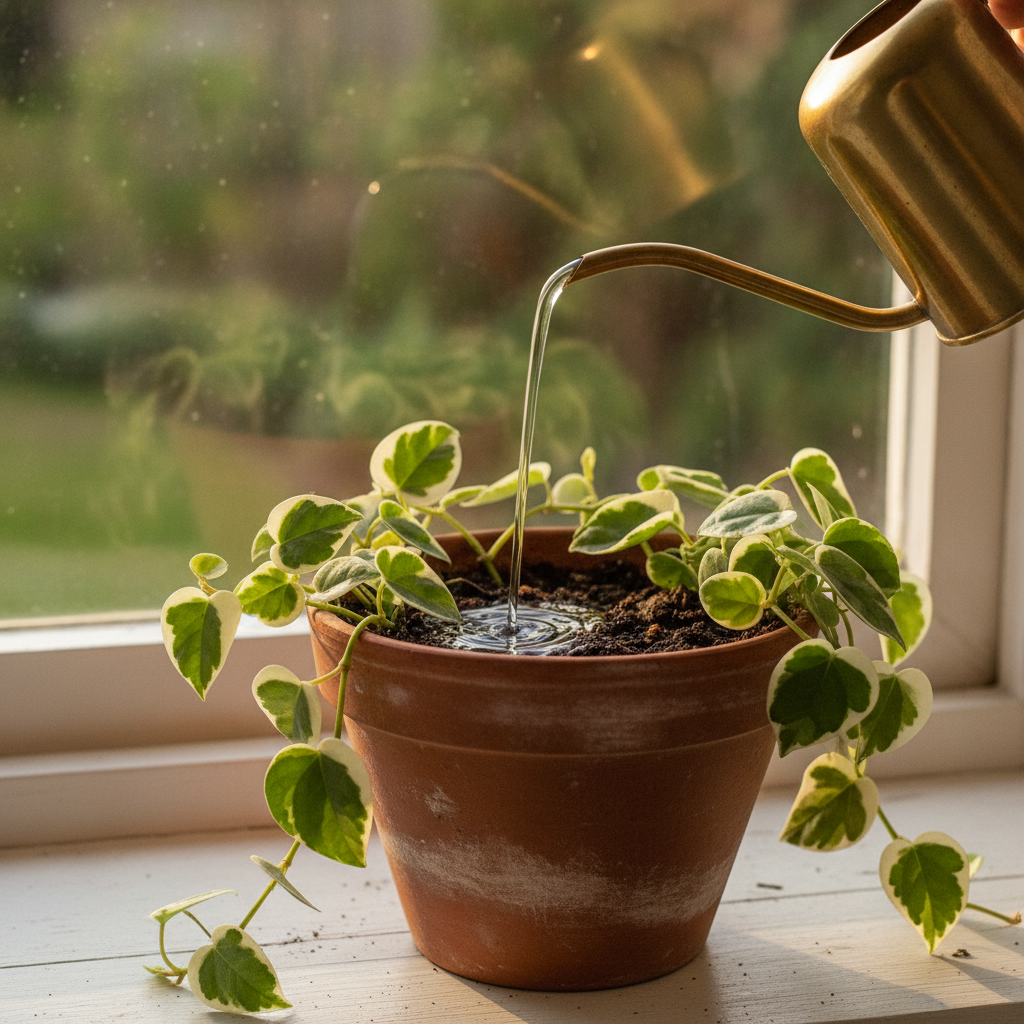
If there is a single skill that separates a flourishing peperomia from a failing one, it is watering, and the good news is that this plant makes the skill easy to learn. Those thick, semi-succulent leaves store water, which means the plant is built to ride out dry periods and is acutely vulnerable to sitting in wet soil. The rule is simple: let the top third of the mix dry out before watering again, then water thoroughly until it runs from the drainage holes, and tip away anything that collects in the saucer. In practice this usually means watering once every seven to ten days in spring and summer, dropping to every two or three weeks in the darker, cooler months.
Resist the urge to water on a fixed schedule. The right interval depends on your light, your warmth, your pot, and the season, all of which shift through the year. Instead, check the soil with a finger. Push it a couple of centimetres into the mix, and if it feels moist, wait. If it feels dry and the leaves have lost a little of their firm tautness, it is time. A slightly thirsty peperomia recovers within hours of a drink; a waterlogged one may already be losing roots by the time the surface looks suspicious.
The classic symptoms are worth memorising because they can look alike. Underwatering shows as soft, slightly wrinkled, drooping leaves that firm up again quickly after watering. Overwatering shows as yellowing lower leaves, a general limpness that does not improve with a drink, and, in the worst cases, a sour smell from the soil and blackened, mushy stems at the base. If you are ever unsure which way you have erred, err on the side of dryness: this plant would far rather be too dry than too wet.
Warning – The root rot trap: A decorative pot with no drainage hole is the most common way people lose a peperomia. Water pools invisibly at the bottom, roots suffocate, and the collapse can happen within days. Always plant in a pot with drainage, or use a plastic nursery pot as a liner inside the pretty one and lift it out to water.
Room-temperature water is kindest, as a shock of cold water can stress the roots. The plant is not especially fussy about water quality, but if your tap water is very hard and you notice pale mineral crusting, switching to rainwater or filtered water occasionally does no harm. As for humidity, Cupid’s peperomia is more tolerant than its tropical origins might suggest and copes happily with average household air. It will look its best when humidity sits around 50 per cent or higher, so a spot in a bright bathroom or kitchen, or a nearby pebble tray, gives it a small lift without any real effort on your part.
Soil
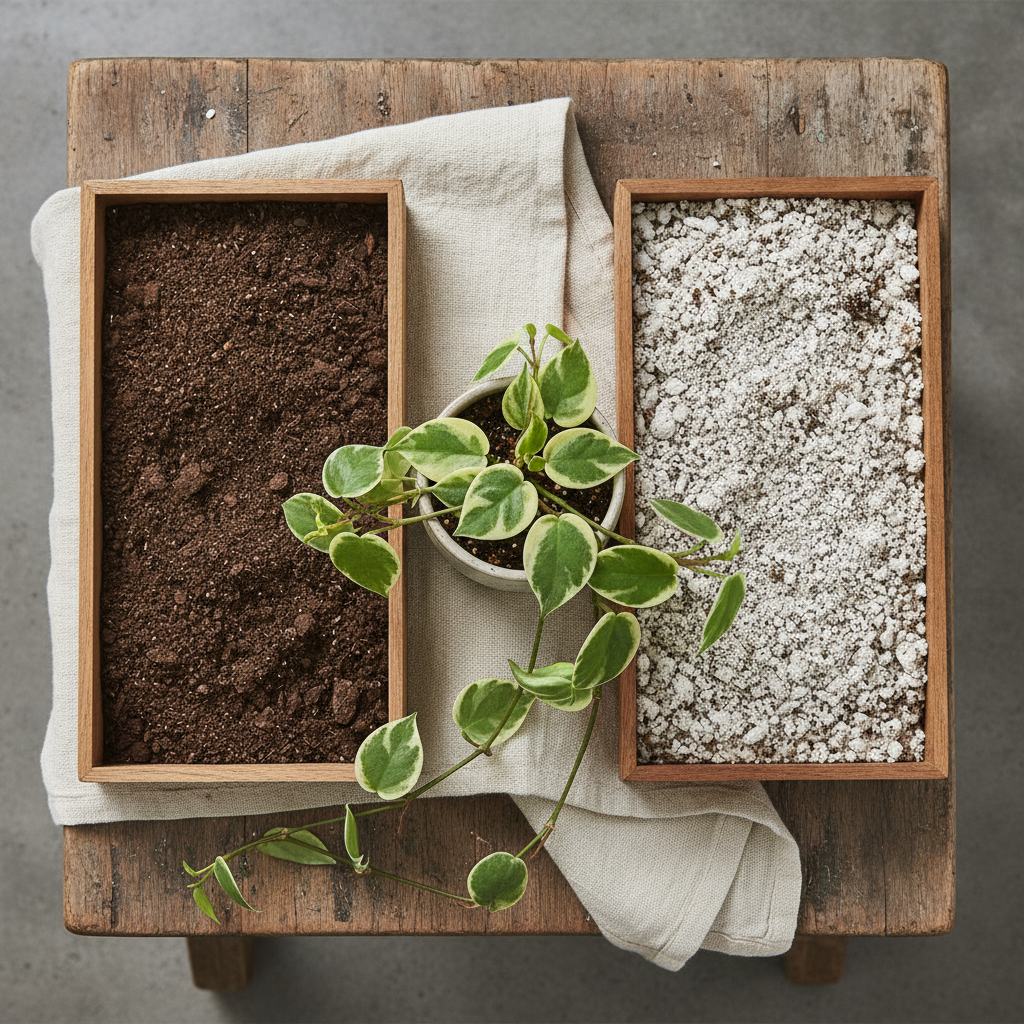
Everything about watering a peperomia depends on the soil it sits in, so getting the mix right is half the battle won before you ever pick up a watering can. As a low epiphyte in the wild, this plant roots into loose, airy leaf litter and moss rather than dense earth, and it wants the same at home: a light, open, fast-draining medium that holds a little moisture but drains freely and never turns to sludge. A heavy, water-retentive compost bought straight off the shelf is the wrong choice, because it stays wet far too long and invites exactly the root rot the plant is prone to.
A reliable mix is roughly half a good-quality houseplant compost or peat-free multipurpose base, with the other half made up of drainage and aeration materials. Perlite is the workhorse here, adding air pockets and letting water run through freely. A handful of fine orchid bark improves structure further and mimics the woody debris the roots would naturally cling to, while a small amount of coco coir helps hold just enough moisture between waterings. Many growers simply reach for a ready-made aroid mix, which is designed for precisely this kind of chunky, free-draining root run and suits peperomias very well.
Peperomias have famously small, shallow root systems, and this changes how you pot them. They are quite happy being a little snug and actively dislike swimming in a large volume of damp soil, so choose a pot only slightly bigger than the root ball, ideally with the width close to the depth. When you do repot, which is usually only necessary every two to three years, do it in spring, be gentle with the delicate roots, and resist the temptation to size up dramatically. A pot that is too large simply holds more wet soil than the modest roots can use, and that surplus moisture is what turns fatal.
Pro Tip – Terracotta helps: Because this plant is so sensitive to overwatering, an unglazed terracotta pot is a quiet ally. It wicks moisture out through its porous walls and lets the soil breathe and dry more evenly, buying you a margin of error that a sealed plastic or ceramic pot cannot.
Fertilising
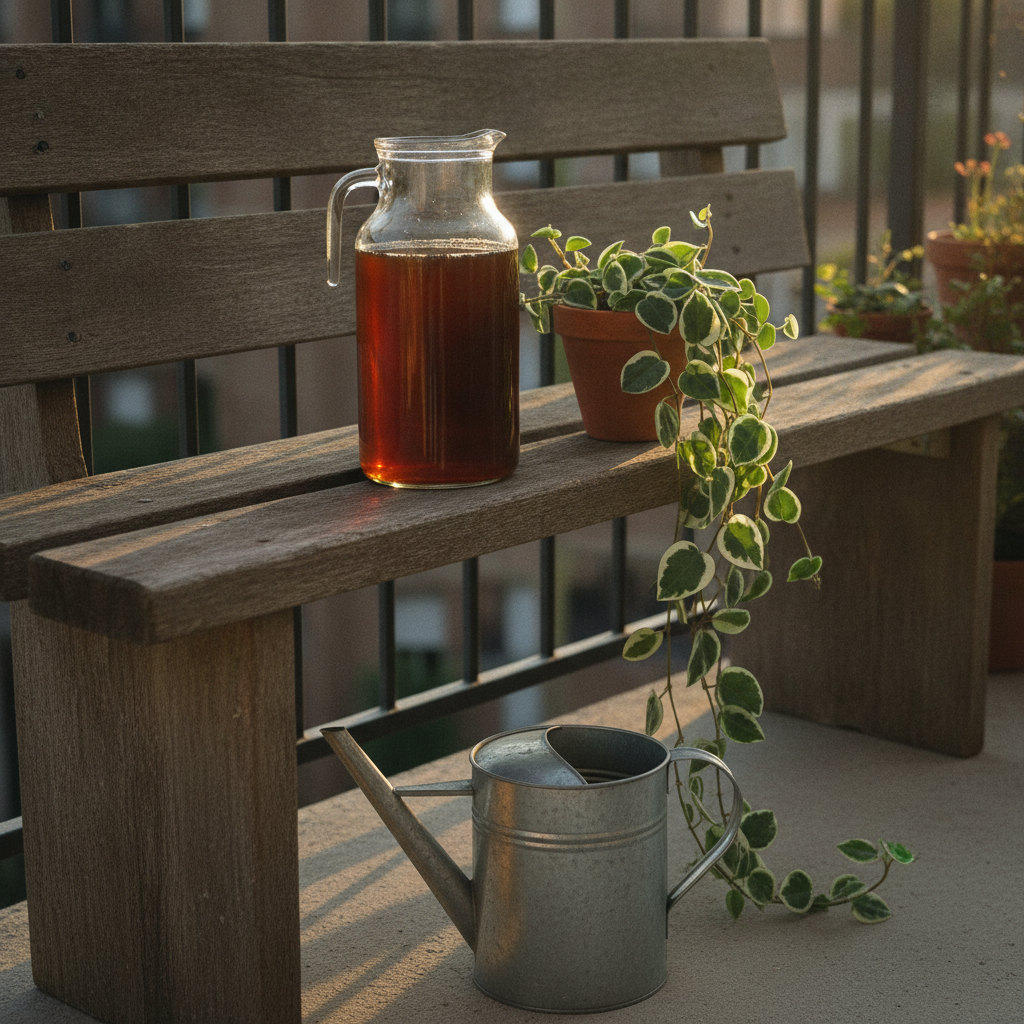
Cupid’s peperomia is a light feeder, and this is one area where doing less is genuinely better. In its native habitat it draws modest nutrition from decomposing leaf matter rather than any rich soil, so its appetite is small and its tolerance for excess is smaller still. A little balanced fertiliser through the growing season keeps the leaves glossy and the growth steady, but heavy feeding does nothing useful and actively risks scorching the roots and browning the leaf tips with a build-up of mineral salts.
Through spring and summer, when the plant is actively growing, feed roughly once a month with a balanced liquid houseplant fertiliser diluted to half, or even a quarter, of the strength printed on the bottle. A gentle, well-rounded feed with even proportions of nitrogen, phosphorus, and potassium is ideal. Always apply fertiliser to already-moist soil rather than bone-dry mix, because feeding a parched root ball concentrates the salts against dry roots and can burn them. In autumn and winter, when growth naturally slows to a crawl, stop feeding altogether and let the plant rest until the light returns.
If you ever suspect you have overfed, the signs are a white crust on the soil surface or around the pot rim and brown, crisping leaf edges despite correct watering. The remedy is simple: flush the pot thoroughly with plain water, letting it run through several times to leach out the accumulated salts, and then hold off on feeding for a couple of months. As a rule of thumb, a peperomia that is slightly underfed looks perfectly healthy, while one that is overfed shows it quickly, so lean towards restraint.
Propagation
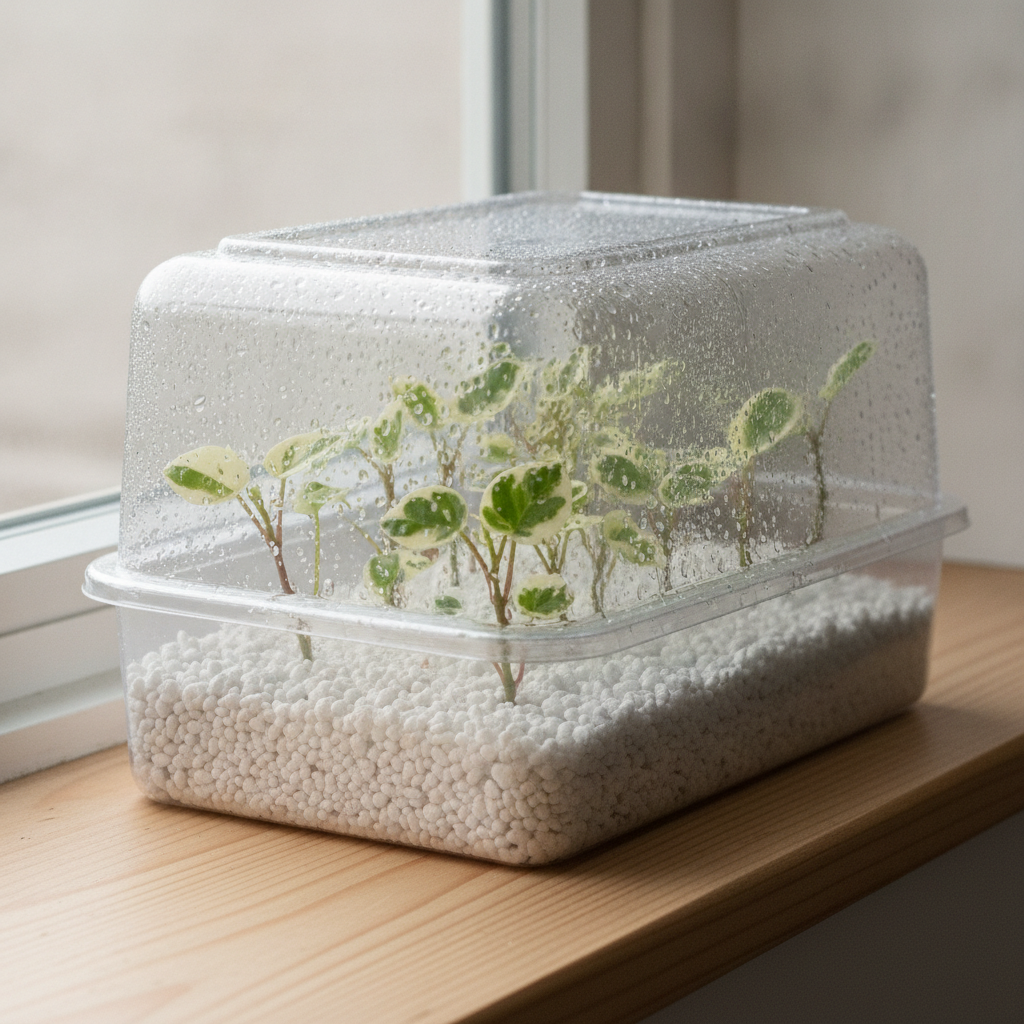
Few houseplants propagate as willingly as Cupid’s peperomia, and its trailing, node-studded stems seem almost designed for the job. Because this is a scrambling plant that roots wherever a node meets moisture in the wild, a cutting placed in water or damp medium roots with very little encouragement. The most reliable method is the stem-tip cutting, which produces a new plant that keeps the trailing habit and, crucially for the variegated form, faithfully carries the cream-and-green colouring of its parent.
One important note on the variegated form: propagate only from stems that carry good, balanced variegation. A cutting taken from an all-green reverted section will produce an all-green plant, since there is no variegated tissue for it to inherit. Choose a healthy tip with two or three well-marked leaves and at least one node below them, and you will pass the colouring on cleanly.
- Using clean, sharp scissors or snips, cut a healthy stem tip about 8 to 10 centimetres (3 to 4 inches) long, making the cut just below a node, the small joint where a leaf meets the stem and where roots will form.
- Remove the lowest one or two leaves so that a bare node is exposed, taking care to leave two or three leaves at the top to power the cutting.
- Root the cutting in your chosen medium. In a glass of water, submerge the bare node while keeping the leaves dry; in damp perlite or sphagnum moss, push the node gently into the surface. Water rooting has the advantage that you can watch progress unfold.
- Place the cutting somewhere warm and bright but out of direct sun. A temperature around 20 to 24 degrees Celsius (68 to 75 Fahrenheit) speeds things along, and a clear cover or humidity dome keeps the air moist and steady.
- Refresh the water every few days if rooting in water, or keep the moss or perlite lightly damp. White roots usually appear within two to four weeks.
- Once the roots reach two or three centimetres (about an inch), pot the cutting into a small container of the airy mix described above. Keep it a little more consistently moist than an established plant for the first couple of weeks while the roots settle, then return to normal care.
A neat trick for a fuller plant is to root several cuttings together in the same small pot rather than growing each one on alone. Peperomias naturally form dense, bushy clumps, and a handful of cuttings started side by side will knit into a lush, well-filled specimen far faster than a single stem ever could. This is also the simplest way to rejuvenate a plant that has grown leggy and bare at the base: take a round of tip cuttings, replant them into the parent pot, and the old plant effectively renews itself.
Pests and Common Problems
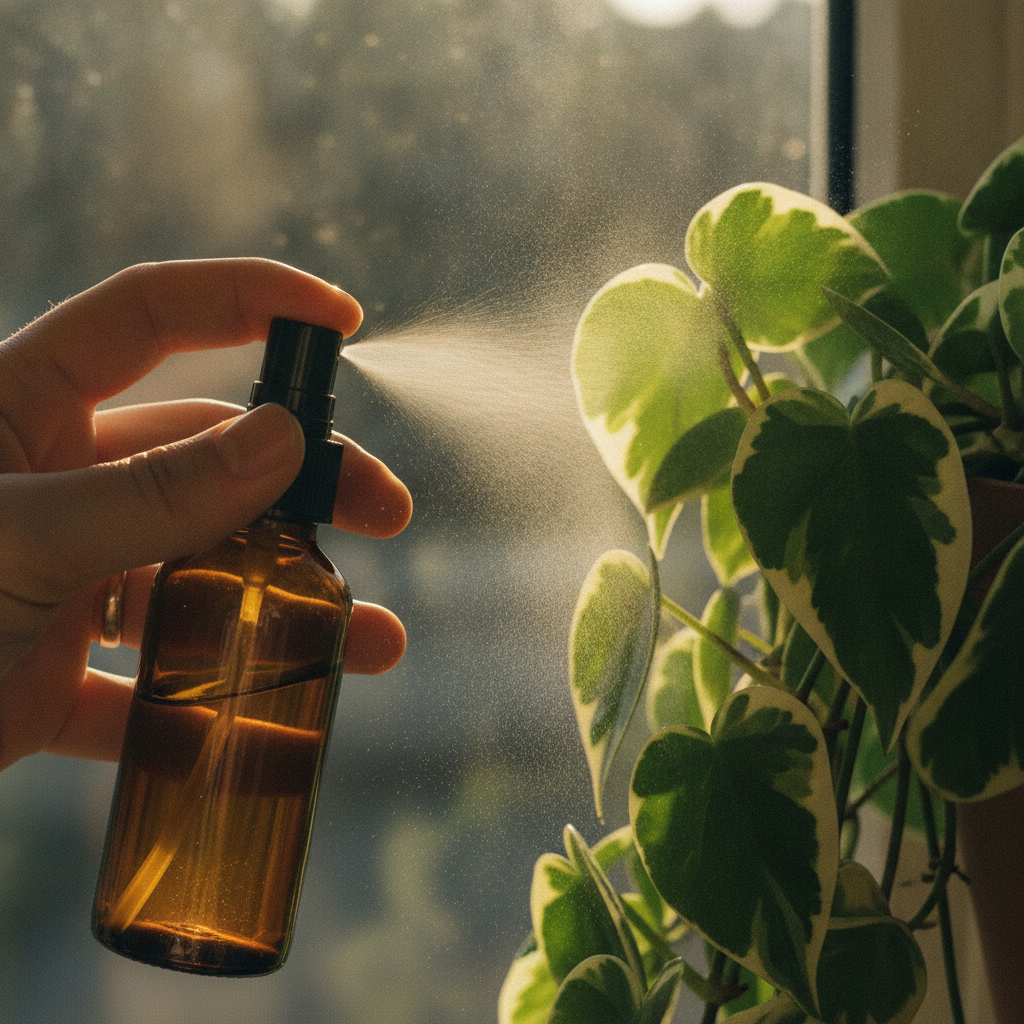
Cupid’s peperomia is refreshingly resistant to pests, and the great majority of problems a grower will ever face are cultural rather than biological, which is to say they trace back to watering, light, or feeding rather than to any invading insect. Even so, a few opportunists occasionally appear, and catching them early makes them easy to deal with. A quick look over the leaves, especially their undersides and the leaf axils where stem meets leaf, whenever you water is the single most effective habit you can build.
Mealybugs are the most likely visitor, showing up as small, white, cottony tufts tucked into the joints and undersides. Dab them off with a cotton bud dipped in rubbing alcohol, and for a wider infestation wipe the foliage with an insecticidal soap or a diluted neem oil solution. Spider mites are less common but can arrive in hot, dry conditions, betraying themselves with fine webbing and a stippled, faintly speckled look to the leaves; raising the humidity and treating with neem oil usually clears them. Fungus gnats, those little black flies that hover around the soil, are almost always a symptom of overwatering, since their larvae live in persistently damp compost. Let the soil dry out more between waterings and they disappear on their own.
The truly serious threat is not an insect at all but root rot, brought on by overwatering or poor drainage. Yellowing lower leaves, a limp plant that will not perk up, mushy blackened stem bases, and a sour smell from the soil all point to it. If you catch it early, the plant can often be saved: unpot it, rinse the roots, cut away anything soft and brown with sterilised scissors, and repot into fresh, dry, airy mix, then water sparingly while it recovers. Beyond rot, most complaints have simple causes. Leaves that lose their variegation and turn greener want more light. Crisp brown leaf tips usually mean the air is too dry, the plant has been overfed, or watering has been erratic. Sudden leaf drop often follows a cold draught or a sharp temperature swing, so keep the plant away from open winter windows and heating vents alike.
Pro Tip – Quarantine new arrivals: Whenever you bring home a new plant, keep it apart from your collection for a fortnight and inspect it closely. Most pest outbreaks arrive on a newly bought plant, and two weeks of separation lets any hidden problem reveal itself before it can spread.
Varieties and Similar Plants
The name Cupid’s peperomia attaches most firmly to Peperomia scandens, and the two forms you are most likely to meet are the variegated cultivar and the plain green species. They are grown in exactly the same way, so the choice comes down purely to which look you prefer, and many collectors end up keeping both for the contrast they make side by side on a shelf.
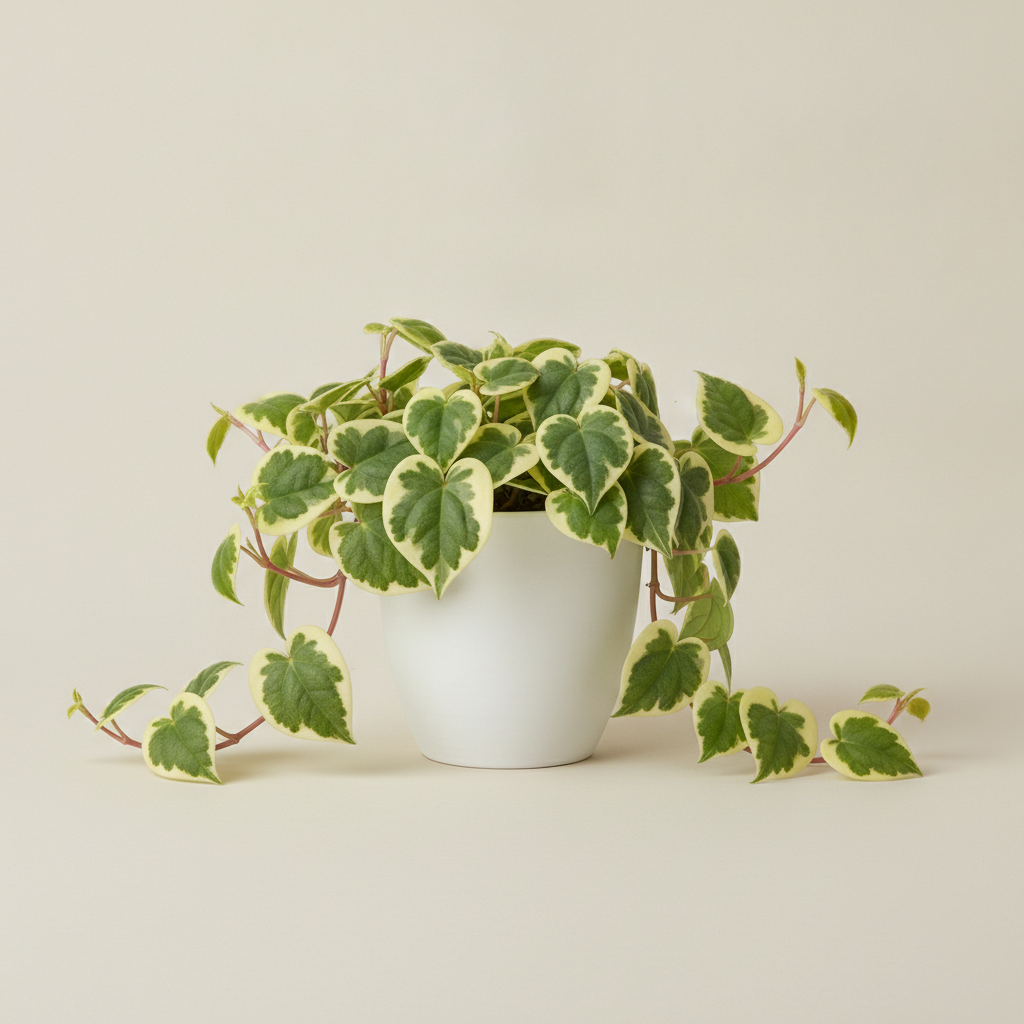
‘Variegata’: The showpiece of the group, this cultivar carries a wide, irregular margin of cream and pale yellow around a green heart, often flushed with pink along the young stems. It is the most sought-after form and the one usually sold as Cupid’s peperomia. It needs a little more light than the green species to keep its bright edges, and it should be propagated only from well-marked stems to preserve the colouring.
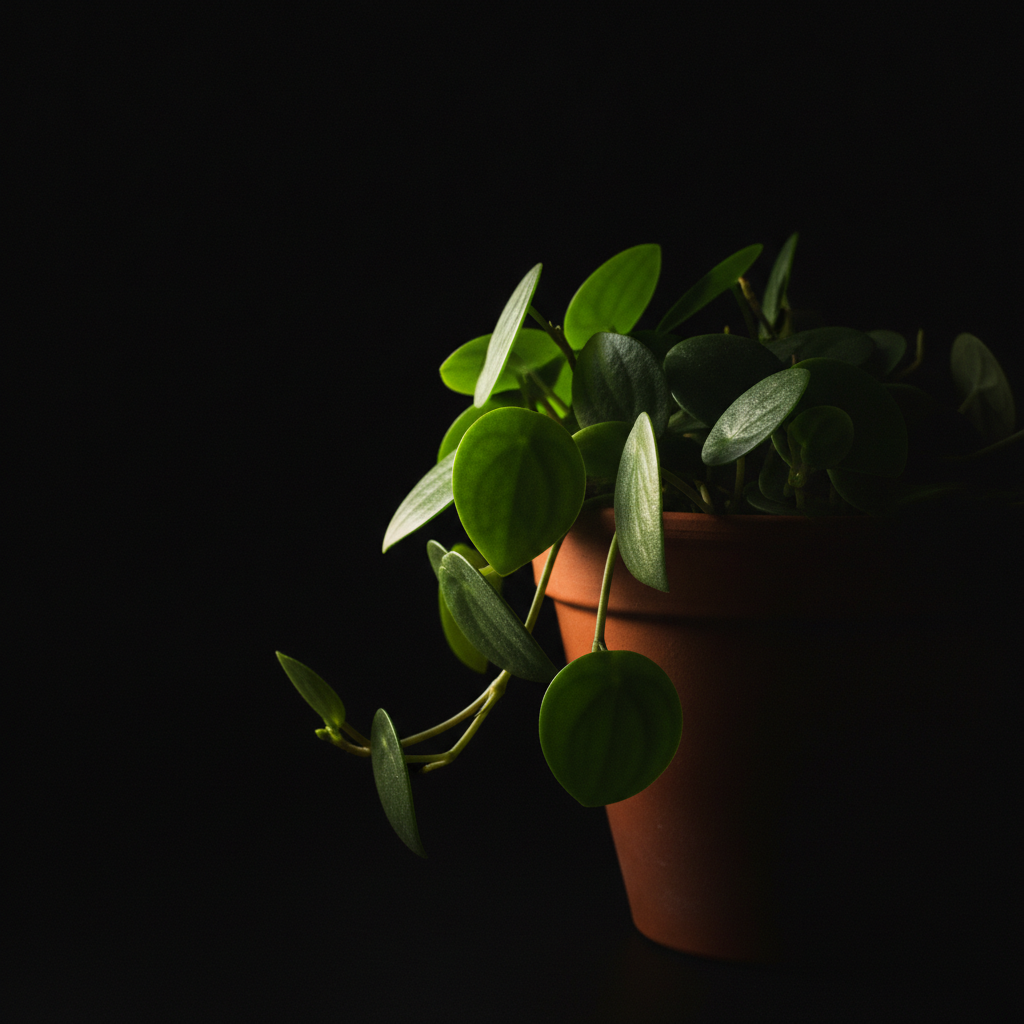
Green species form: The unvariegated Peperomia scandens shows solid, glossy mid-green heart-shaped leaves with a faint waxy sheen. Because every leaf is fully photosynthetic, it is a touch more vigorous and forgiving of lower light than the variegated form, making it the easier of the two for a dim room. Its cleaner, calmer look appeals to anyone who prefers foliage without the fuss of variegation.
If you enjoy this plant, the wider peperomia genus offers plenty of relatives worth collecting, all sharing the same easy, semi-succulent nature. Peperomia prostrata, the string of turtles, trails with tiny patterned button leaves. Peperomia obtusifolia, the baby rubber plant, grows upright with thick, glossy paddles. Peperomia caperata, the ripple peperomia, forms neat rosettes of deeply corrugated leaves. Each asks for the same bright indirect light, careful watering, and airy soil, so once you have mastered Cupid’s peperomia you have effectively mastered the whole family.
Frequently Asked Questions
Is Cupid’s peperomia toxic to cats and dogs?
No. Like other peperomias, Cupid’s peperomia is considered non-toxic to cats, dogs, and humans, and it is listed as pet-safe by animal welfare authorities. It contains none of the calcium oxalate crystals that make many popular trailing plants a hazard, which makes it an excellent choice for homes with curious pets or small children. Even so, it is sensible to discourage nibbling, as any plant material can cause mild stomach upset if eaten in quantity.
Why is my Cupid’s peperomia losing its variegation?
The most common cause is insufficient light. Because the cream and yellow areas of the leaf cannot photosynthesise, a plant in dim conditions produces greener leaves to gather more energy, gradually reverting to plain green. Move it to a brighter spot with plenty of indirect light, prune out any fully green stems as they appear, and new growth should return with better colour.
How often should I water it?
There is no fixed schedule, because the right interval depends on your conditions. Let the top third of the soil dry out, then water thoroughly and drain. In practice this is often every seven to ten days in spring and summer and every two to three weeks in autumn and winter. When in doubt, wait: this semi-succulent plant tolerates dryness far better than sitting in wet soil.
Why are the leaves on my peperomia wrinkled?
Wrinkled, soft leaves are usually a sign of underwatering, and they typically plump back up within a few hours of a thorough drink. If the leaves are wrinkled but also yellowing, limp, and unresponsive to watering, the opposite problem, overwatering and possible root rot, is more likely, and you should check the roots before adding any more water.
Does Cupid’s peperomia flower?
It can. Like all peperomias, it produces slender, greenish, tail-like flower spikes rather than showy blooms, and these appear mainly on healthy, mature plants in good light. The flowers are modest and often go unnoticed, since the plant is grown for its foliage rather than its bloom. There is no harm in leaving them, though some growers snip them off to direct the plant’s energy back into leaves.
How big does it get, and how fast does it grow?
Cupid’s peperomia is a modest, steady grower rather than a rampant one. Trailing stems typically reach 60 to 90 centimetres (24 to 35 inches) over time, though you can keep it far more compact with regular pinching. Growth is fastest in the warm, bright months and pauses in winter. Pinching the stem tips encourages branching and a fuller, bushier shape, and the tips you remove can of course be rooted into new plants.
Cupid’s peperomia asks for very little and gives back a great deal: soft, heart-shaped, cream-edged foliage that trails happily from a shelf, a pet-safe presence in any room, and a plant so willing to root that a single specimen can furnish an entire collection. Give it bright indirect light, an airy pot that drains freely, and the patience to let it dry out between drinks, and it will reward you with years of easy, understated beauty.






