
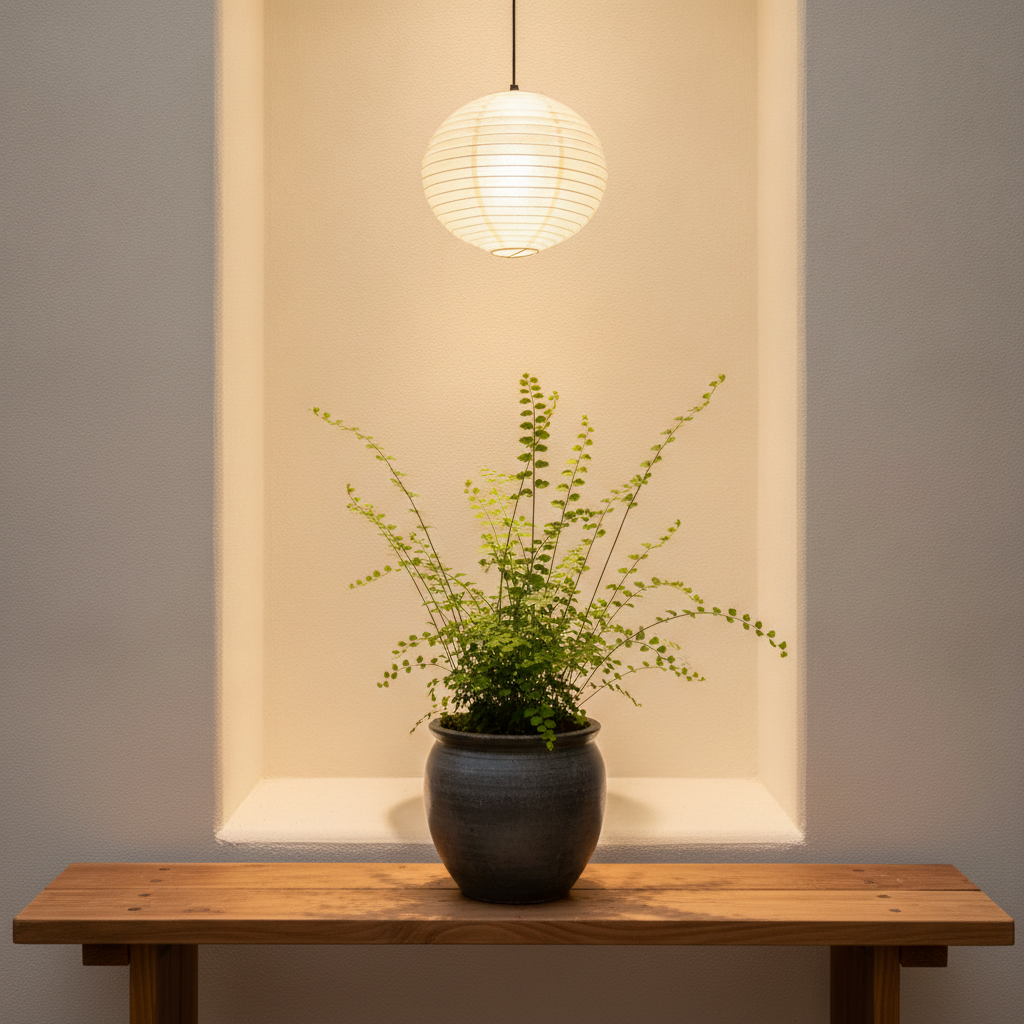
Few ferns forgive a forgetful owner, yet the lemon fern (Nephrolepis cordifolia) is the exception that quietly proves the rule. Beneath its tidy rosette of upright, button-lined fronds sits a hidden reserve of small round tubers, swollen water-storage organs strung along wiry underground runners that let this plant shrug off the odd missed watering that would flatten a Boston fern. The result is a compact, fresh-green fern that looks far more demanding than it actually is, which is a large part of why it has settled so comfortably onto bright bathroom shelves and shaded windowsills alike.
This guide covers everything needed to move a lemon fern from merely surviving to genuinely thriving, from reading its light correctly to dividing an overgrown clump into several new plants. Along the way it untangles the plant’s tangle of common names, since the same species is sold as lemon fern, lemon button fern, fishbone fern, tuber ladder fern and erect sword fern depending on who grew it.

- Quick reference
- Why the lemon fern makes a good houseplant
- Light
- Watering
- Soil and potting
- Fertilising
- Propagation
- Pests and problems
- Varieties
- Frequently asked questions
Quick reference
The table below distils the essentials for anyone who wants the headline numbers before reading further. Each point is expanded in the sections that follow.
| Botanical name | Nephrolepis cordifolia |
| Common names | Lemon fern, lemon button fern, fishbone fern, tuber ladder fern, erect sword fern |
| Plant family | Nephrolepidaceae |
| Native range | Tropical and subtropical Asia, northern Australia and parts of the Pacific |
| Mature size indoors | 30 to 60 cm (12 to 24 in) tall and wide |
| Light | Bright indirect light; tolerates medium light; no harsh direct sun |
| Water | Keep evenly moist, never waterlogged; let the top 2 cm (0.8 in) begin to dry |
| Humidity | Prefers 50 to 60 per cent or above; more forgiving of average rooms than a Boston fern |
| Temperature | 16 to 24 degrees C (61 to 75 degrees F); avoid below 10 degrees C (50 degrees F) |
| Soil | Rich, moisture-retentive yet free-draining, peat-free, slightly acidic |
| Feeding | Balanced liquid feed at half strength, monthly in spring and summer |
| Propagation | Division of the clump; potting up tubers and runners |
| Toxicity | Non-toxic to cats, dogs and humans |
| Difficulty | Easy to moderate; one of the most forgiving ferns to grow indoors |
Why the lemon fern makes a good houseplant
The lemon fern belongs to the genus Nephrolepis, the same group that gives us the ubiquitous Boston fern (Nephrolepis exaltata), but it is a smaller and altogether tougher animal. Its fronds are narrow ladders of small, rounded leaflets, called pinnae, set so closely along the central stem that each frond reads like a string of green buttons. In the popular button forms those leaflets are almost perfectly circular, which is where the name lemon button fern comes from, while the scent, a faint citrus note released when a frond is bruised, accounts for the lemon half.
What sets this species apart from most ferns sold as houseplants is what happens below the soil line. It produces round, fuzzy storage tubers, each roughly the size of a marble, strung along thin runners that snake through the pot. These tubers hold water and starch, a survival strategy for the seasonally dry habitats the plant comes from, and they are the reason a lemon fern can miss a watering or two and still recover where a Boston fern would already be crisp. For anyone who has killed a fern through nothing worse than a busy week, this built-in insurance policy is the plant’s single most appealing trait.
It is also compact, evergreen and dependable. A mature specimen holds a neat fountain of arching fronds rather than sprawling untidily, which suits shelves, plant stands and grouped displays. It is non-toxic to cats, dogs and children, so it can live within reach of curious pets without concern. And because it copes with the medium light of an interior far better than most ferns, it will hold its looks in spots where a calathea or maidenhair would sulk. The one caution worth flagging is outdoors rather than in: in frost-free climates such as Florida and Hawaii the same runners and tubers that make it resilient also make it invasive, so it should never be planted into open ground in warm regions and spent material should go in the bin rather than the compost.
Light
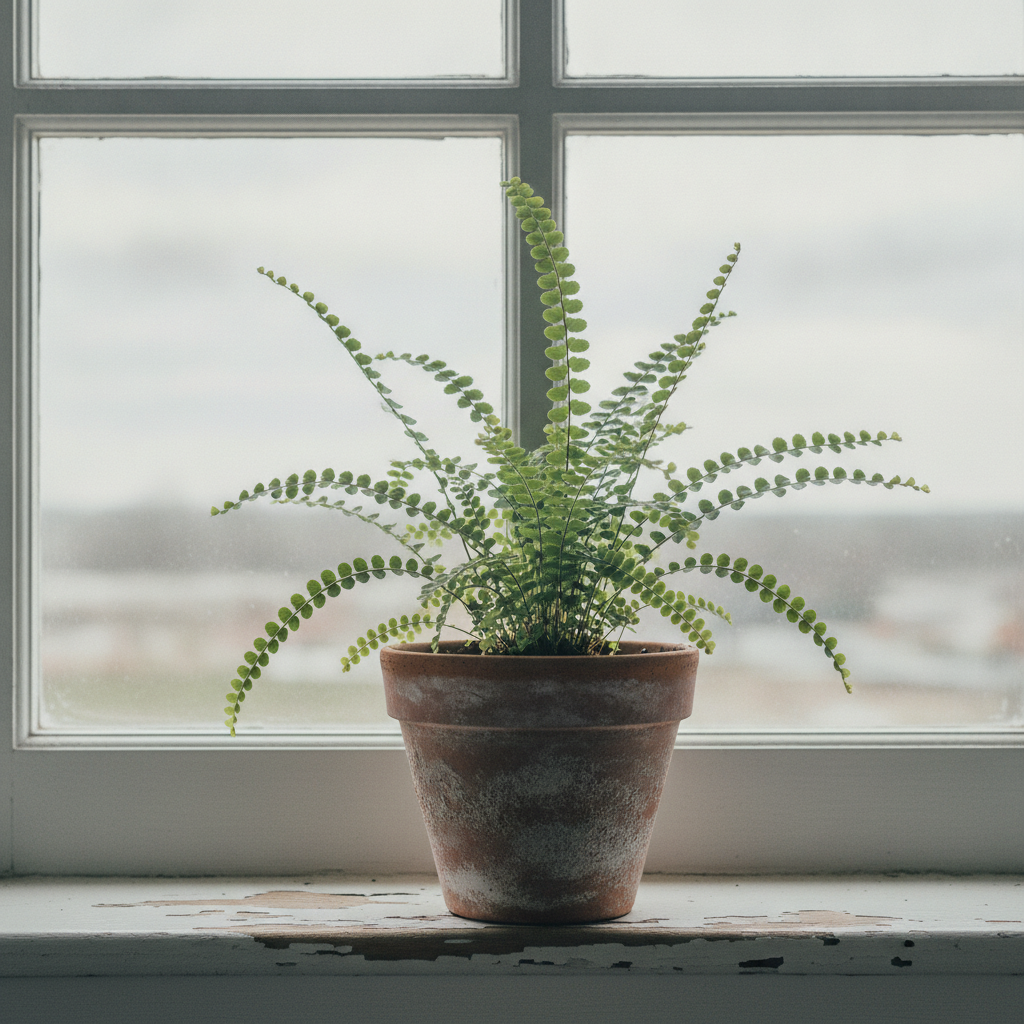
In the wild the lemon fern grows in dappled shade on forest floors, rocky banks and the trunks of larger trees, so it is adapted to filtered rather than full light. Indoors it is happiest in bright but indirect light, the kind found a metre or so back from an east-facing window or beside a north-facing one. In that position the fronds keep their fresh, even green and the plant produces new growth steadily through the warmer months.
The difference between survival and thriving comes down to the quality of that light. A lemon fern will survive in a genuinely shady corner, holding its existing fronds for a long time, but it will grow slowly and sparsely and may look a little thin. Move it somewhere brighter, still out of direct sun, and it fills out noticeably, pushing up denser fronds and knitting into a fuller clump. What it will not tolerate is harsh, unfiltered midday sun striking the leaves directly, which bleaches the delicate pinnae to a pale straw colour and scorches brown patches that never recover. A south or west window is fine provided a sheer curtain diffuses the strongest hours, or the plant sits far enough back that only reflected light reaches it.
Pro Tip — Even growth: Ferns grow towards their light source, so a plant left facing a window will slowly lean and thin on its shaded side. Give the pot a quarter turn each time you water and the clump stays symmetrical and dense all the way round.
Watering
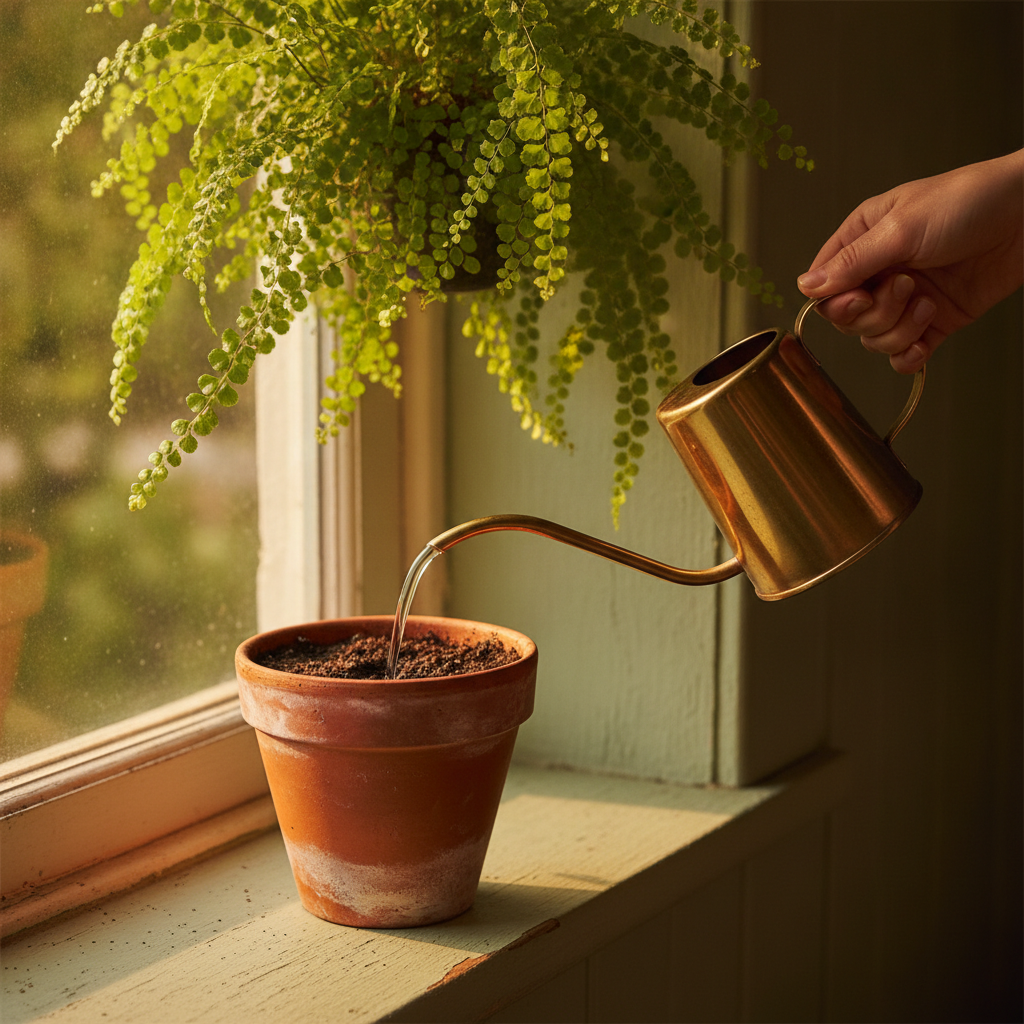
Watering is where the lemon fern rewards a middle path. It likes to stay evenly moist, in the way of most ferns, but its tubers mean it dislikes constant sogginess far more than the occasional dry spell. The reliable method is to feel the surface of the compost and water thoroughly once the top 2 cm (0.8 in) has begun to dry, letting water run freely from the drainage holes and then emptying the saucer so the roots never sit in standing water. In practice this tends to mean watering once or twice a week in spring and summer and rather less in winter, though light, warmth and pot size all shift the timing.
The commonest way to lose this plant is not drought but drowning. Compost that is kept permanently wet starves the roots of air and invites rot at the crown, which shows as a general yellowing, a soft base and fronds that collapse from the centre outwards. If in doubt, err a shade on the dry side and let the tubers do their job. At the other extreme, if the whole rootball dries out completely the tips and outer leaflets turn crisp and brown; a thorough soak, ideally by standing the pot in a basin of water for twenty minutes to rehydrate the rootball from below, usually brings it back.
Water quality matters more for this fern than for a tougher foliage plant. The fine pinnae are sensitive to the salts, chlorine and fluoride in some tap water, which can accumulate and brown the leaf edges over time. Where tap water is very hard or heavily treated, rainwater, filtered water or water left to stand overnight is gentler. Warm, humid air also helps: while the lemon fern copes with average household humidity better than most of its relatives, it looks its best above 50 per cent, so a bathroom, a kitchen or a pebble tray of water beneath the pot all suit it.
Warning — Crown rot: Never pour water into the very centre of the clump and leave it pooling there, and never let the pot stand in a full saucer. A crown that stays wet and airless is the quickest route to a rot that no amount of later care can reverse.
Soil and potting
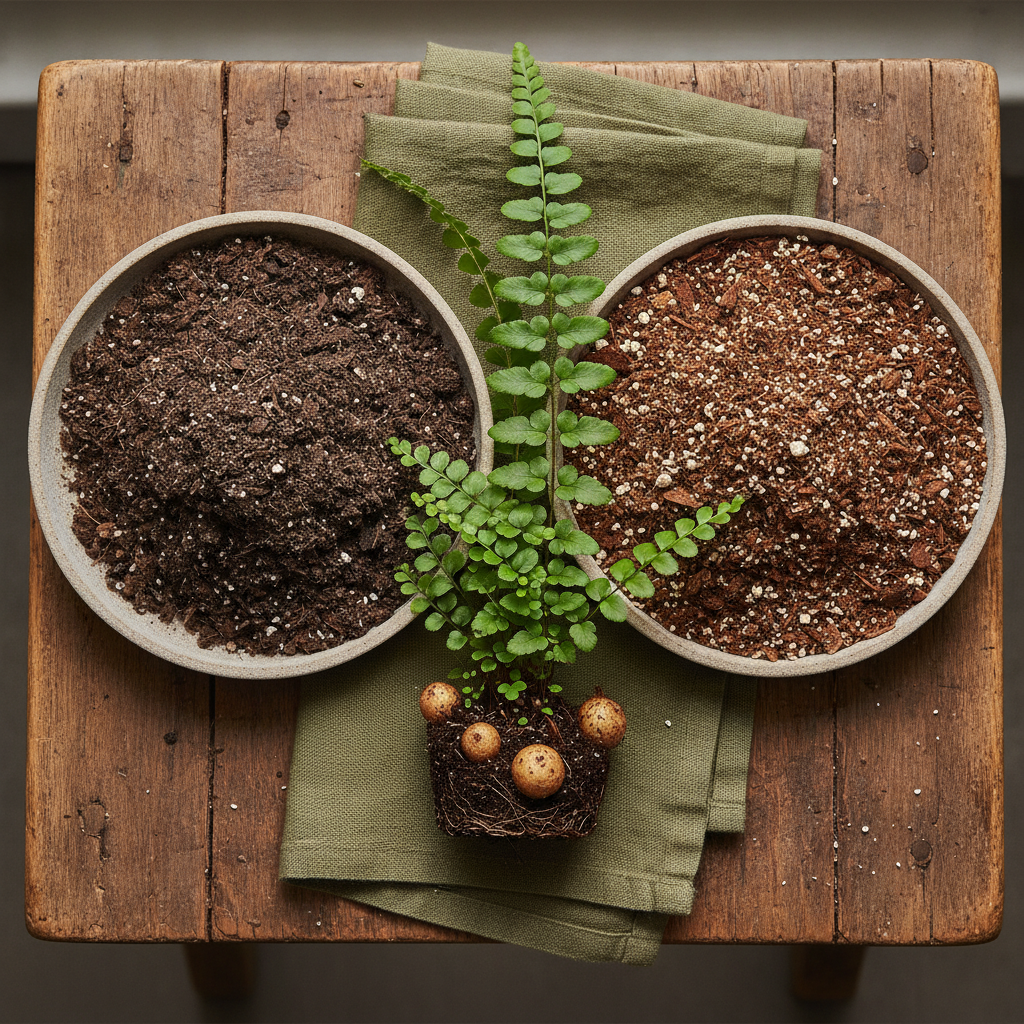
The ideal compost for a lemon fern balances two things that can seem at odds: it holds moisture, so the plant does not dry out between waterings, yet it drains and breathes freely so the roots and tubers never suffocate. A good starting point is a general peat-free houseplant compost lightened with roughly a third extra material for structure. Coconut coir or a quality peat-free base provides the moisture-holding bulk, while perlite, fine bark and a handful of horticultural grit open it up, and a spoonful of worm castings adds gentle, slow nutrition. The plant prefers a slightly acidic mix, in the region of pH 5.5 to 6.5, which most peat-free composts sit close to anyway.
Lemon ferns are relaxed about being a little pot-bound and generally need repotting only every one to two years, when roots and pale tubers begin to crowd the surface or push through the drainage holes. Spring is the best time, at the start of the growing season. Move the plant up by a single pot size only, since an oversized pot holds a reservoir of wet compost around roots that cannot use it, exactly the condition that invites rot. When repotting, tease away the old exhausted compost gently, keep as many tubers attached as possible, and settle the plant at the same depth it grew before, firming the fresh mix around the base without burying the crown.
Pro Tip — Read the tubers: When you slide the plant from its pot, take a moment to look at the tubers. Plump, firm and pale means a well-watered, healthy plant; shrivelled tubers signal that the fern has been running too dry for too long and needs a more consistent watering rhythm.
Fertilising
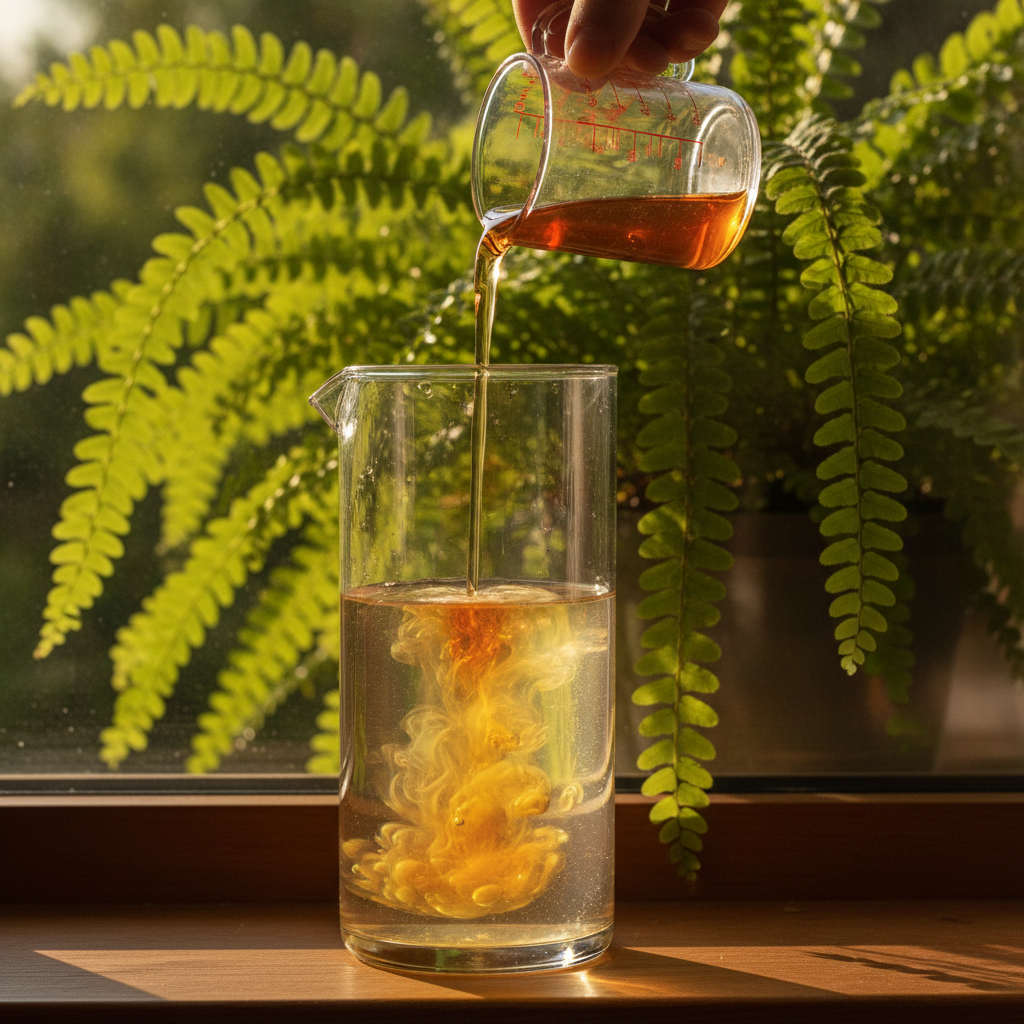
Ferns are light feeders, and the lemon fern is no exception. It needs far less fertiliser than a fast-growing foliage plant, and the surest way to damage it is to feed too generously. Through the active growing season, from spring into early autumn, a balanced liquid houseplant feed diluted to half the recommended strength and applied roughly once a month is ample. That gentle, regular trickle of nutrients keeps the fronds a good colour and supports steady new growth without overwhelming the salt-sensitive roots.
Timing matters as much as quantity. In late autumn and winter, when growth naturally slows, feeding should stop altogether, since nutrients the plant cannot use simply build up in the compost as harmful salts. Those same salts are the usual cause of scorched, brown leaf tips on a fern that is otherwise well watered. If tip burn appears, flush the pot every couple of months by running a generous volume of plain water through the compost until it drains freely, which washes the accumulated residue away. Gardeners who prefer not to measure liquid feed can instead top-dress with a thin layer of worm castings in spring, a mild and forgiving alternative that releases its nutrients slowly.
Warning — Less is more: Always feed a fern onto damp compost, never dry, and never exceed half strength. Concentrated fertiliser drawn across dry roots will burn them, and the browning it causes is far harder to reverse than the slight paleness of a lightly under-fed plant.
Propagation
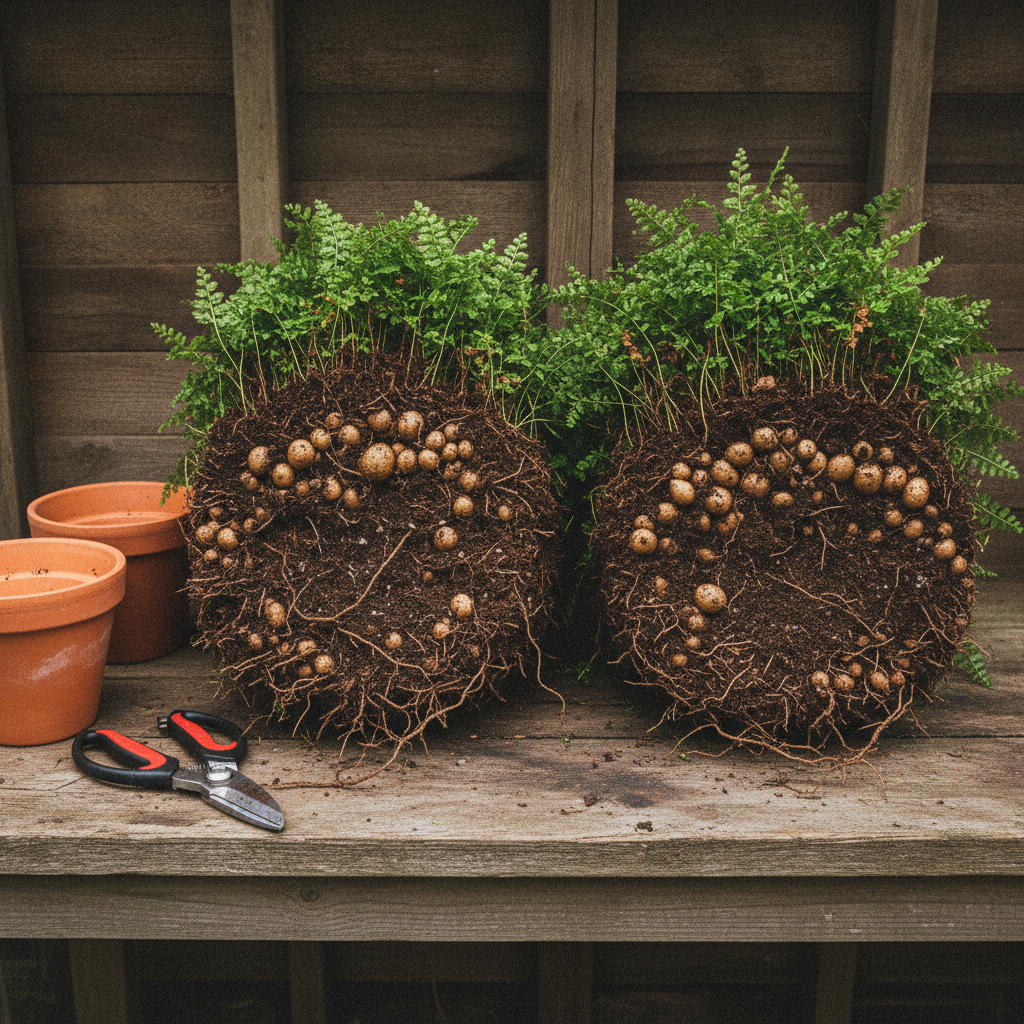
Unlike many trailing houseplants, a fern cannot be grown from a leaf or stem cutting rooted in a jar of water, because it has no nodes to root from. Instead the lemon fern is propagated by division, which is both the simplest method and, conveniently, a natural extension of repotting. A single mature clump can usually be split into two or three healthy new plants, each with its own share of fronds, roots and tubers. Spring, as growth resumes, is the ideal moment.
- Water the plant a day beforehand so the rootball is moist and the roots are supple, then slide the whole plant out of its pot.
- Gently shake and tease away enough compost to see where the crown and the runners naturally separate into distinct clusters of fronds.
- Using clean, sharp scissors or a knife, cut or pull the clump into sections, making sure each piece keeps a good tuft of fronds, a portion of roots and at least one or two tubers.
- Pot each division into its own container of fresh, free-draining mix, at the same depth it grew before, and firm the compost gently around the base.
- Water each new plant in well, then keep them warm, in bright indirect light and slightly more humid than usual for a few weeks while the roots settle.
There are two further routes for the patient. Individual tubers, or the little plantlets that form along the runners, can be detached and potted up on their own; kept warm and humid they slowly develop into full plants. And, like all ferns, the lemon fern can be raised from the dust-fine spores that form in neat rows on the undersides of mature fronds, though this is a slow and fiddly process better suited to enthusiasts than to anyone who simply wants a second plant quickly.
Pests and problems
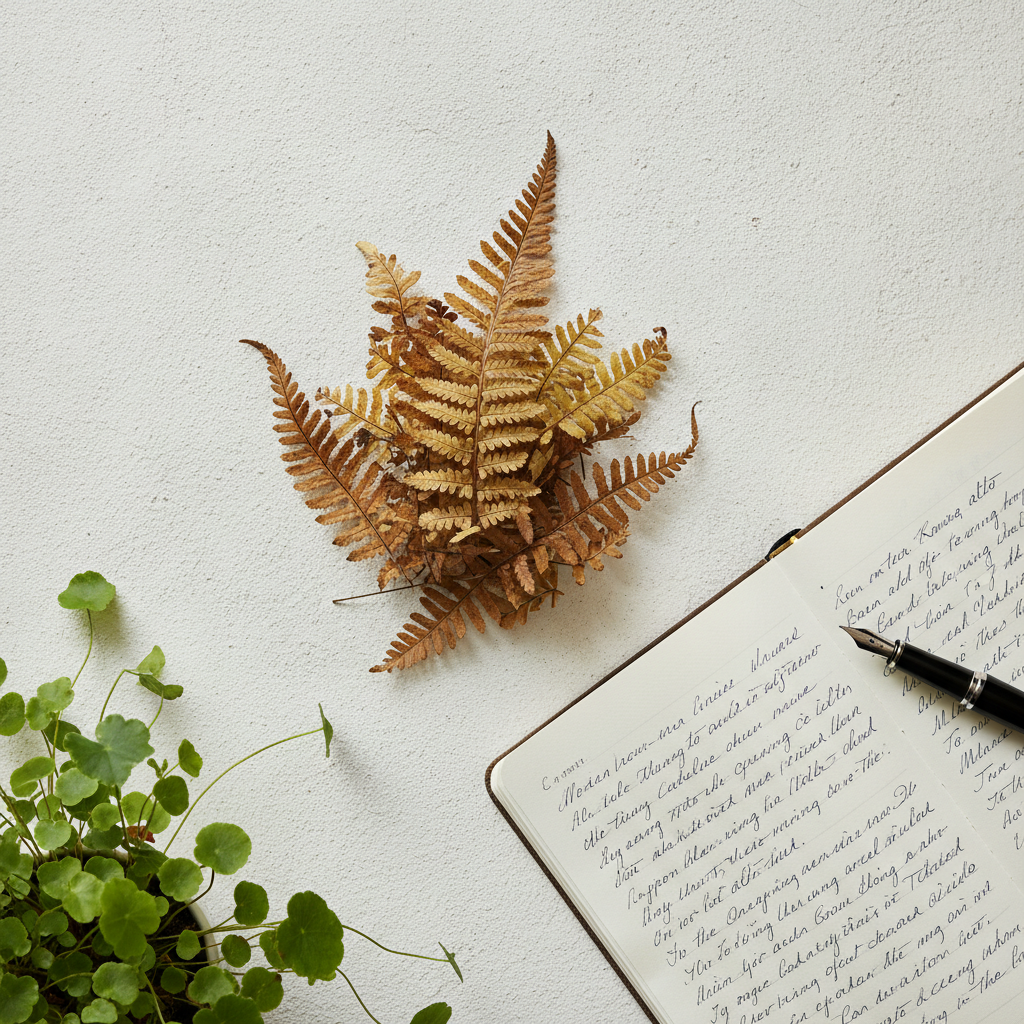
The lemon fern is not especially prone to pests, but three sap-suckers turn up on stressed indoor plants often enough to watch for. Scale insects appear as small brown, limpet-like bumps clinging to the stems and the undersides of fronds; mealybugs show as white, cottony tufts tucked into the leaf axils; and spider mites, encouraged by hot dry air, leave fine stippling and faint webbing between the pinnae. Because the foliage is so finely divided, it pays to inspect a new plant closely before bringing it home and to check established plants whenever you water. Light infestations can be wiped away with a cotton bud dipped in diluted isopropyl alcohol or rinsed off in the shower, while more stubborn cases respond to a horticultural soap or neem oil spray repeated weekly until clear. Fungus gnats, whose larvae thrive in permanently wet compost, are a sign to let the surface dry more between waterings; yellow sticky traps mop up the adults in the meantime.
More often, though, a distressed lemon fern is reacting to its conditions rather than to any insect. Crisp, brown frond tips almost always point to air that is too dry, to a rootball that has dried out, or to a build-up of salts from tap water or over-feeding. A general yellowing accompanied by a soft base usually means the compost has been kept too wet and the roots are suffocating. Sudden shedding of leaflets can follow a sharp change in conditions, such as a move next to a radiator or a cold draught. Reading these signals is straightforward once the pattern is clear: browning and crisping call for more moisture and humidity, while yellowing and softness call for less water and better drainage.
Warning — Skip the leaf shine: Never use commercial leaf-shine products or oily sprays on a fern. The fine pinnae breathe through their surfaces, and a coating of gloss clogs them, damaging the fronds rather than beautifying them. Plain water and a soft cloth are all the cleaning this plant needs.
Varieties
Most plants sold simply as lemon fern are either the straight species or one of a small number of selected forms. The species itself, sometimes labelled fishbone fern or erect sword fern, has the longest and most upright fronds and is the most vigorous grower, spreading enthusiastically by its runners. For indoor growing, two cultivars are far more common, and both are more compact and better behaved than the wild type.
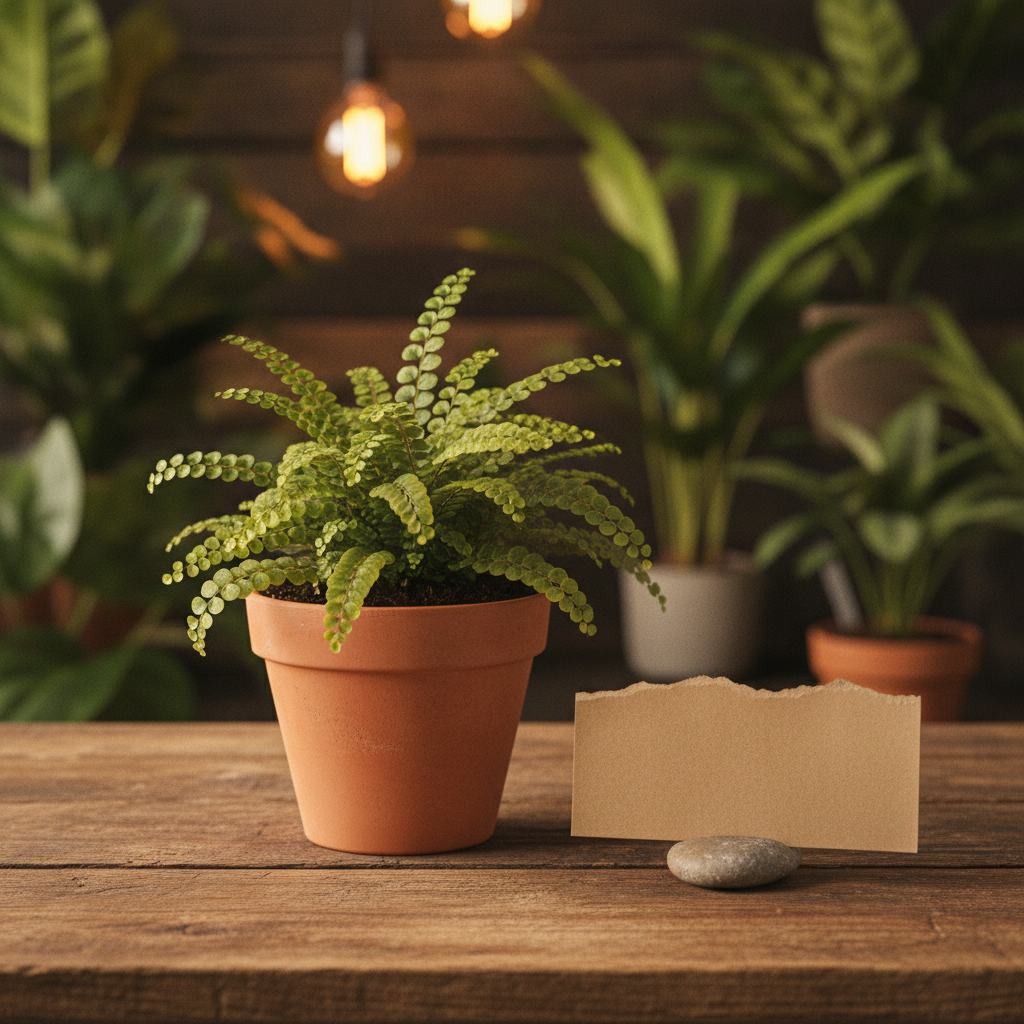
Lemon Button (‘Duffii’)
The form most people mean by lemon button fern, ‘Duffii’ is a compact, dwarf selection whose short arching fronds are lined with small, almost perfectly round leaflets like a row of green coins. It stays neat at around 30 cm (12 in), carries the faintest lemon scent when brushed, and is the tidiest choice for a shelf or a desk. Its slower, denser habit also makes it the least likely of the group to outgrow its pot.
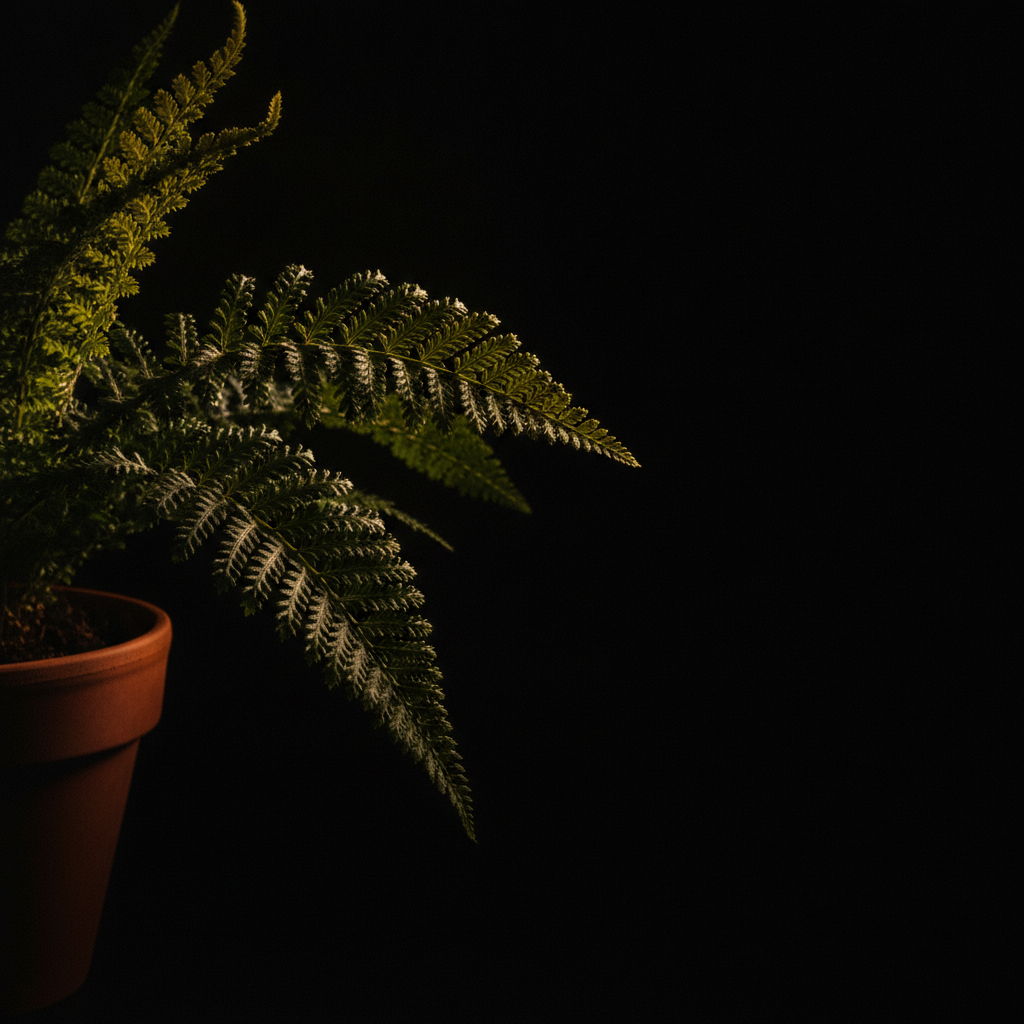
‘Plumosa’
Where ‘Duffii’ is crisp and rounded, ‘Plumosa’ is soft and feathery. Its pinnae are finely divided and gently ruffled, giving each frond a plumed, almost mossy texture that catches the light differently and reads as more delicate. It grows a little more openly than the button form and brings a softer, more romantic note to a grouping, while asking for exactly the same easy care as the rest of the species.
Frequently asked questions
Is the lemon fern toxic to cats and dogs?
No. Nephrolepis cordifolia is listed as non-toxic to cats, dogs and humans, in common with its close relative the Boston fern. It is a sensible choice for a home with pets or young children, though as with any plant it is best not to let animals make a habit of chewing the fronds, since even a harmless plant can cause a mild stomach upset if eaten in quantity.
Why does it smell of lemon?
The lemony scent is released only when a frond is crushed or bruised, and it is most noticeable in the button forms. It is a faint, fresh citrus note rather than a strong perfume, so an undisturbed plant on a shelf will not scent a room; you have to handle it to catch it.
Why are the fronds turning brown and crispy?
Crisp brown tips or leaflets almost always mean the air is too dry, the rootball has dried out, or salts from tap water and fertiliser have built up in the compost. Raise the humidity, keep the watering more consistent, switch to rainwater or filtered water if your tap water is hard, and flush the pot occasionally to clear accumulated salts. Trim off badly browned fronds at the base to keep the plant looking fresh.
What is the difference between a lemon fern and a Boston fern?
They are close cousins in the same genus, but the lemon fern is smaller, more upright, and noticeably tougher. Its leaflets are small and rounded rather than long and tapering, and, crucially, it grows the round underground tubers that store water and give it far better drought tolerance. If you have struggled to keep a Boston fern happy, a lemon fern is likely to be more forgiving in the same spot.
Can I grow a lemon fern outdoors?
In cool and temperate climates it can spend the frost-free months outdoors in a shaded, sheltered spot, then come back inside before temperatures drop below about 10 degrees C (50 degrees F). In warm, frost-free regions it should be kept in containers only and never planted into open ground, because its runners and tubers let it spread aggressively and it is considered invasive in places such as Florida and Hawaii.
How big does a lemon fern get?
Indoors, expect a mature plant to reach roughly 30 to 60 cm (12 to 24 in) in both height and spread, with the compact ‘Duffii’ staying at the smaller end and the straight species reaching the larger. It is an easy plant to keep in scale by dividing it every couple of years, which also gives you new plants to spread around the house or pass on.






