
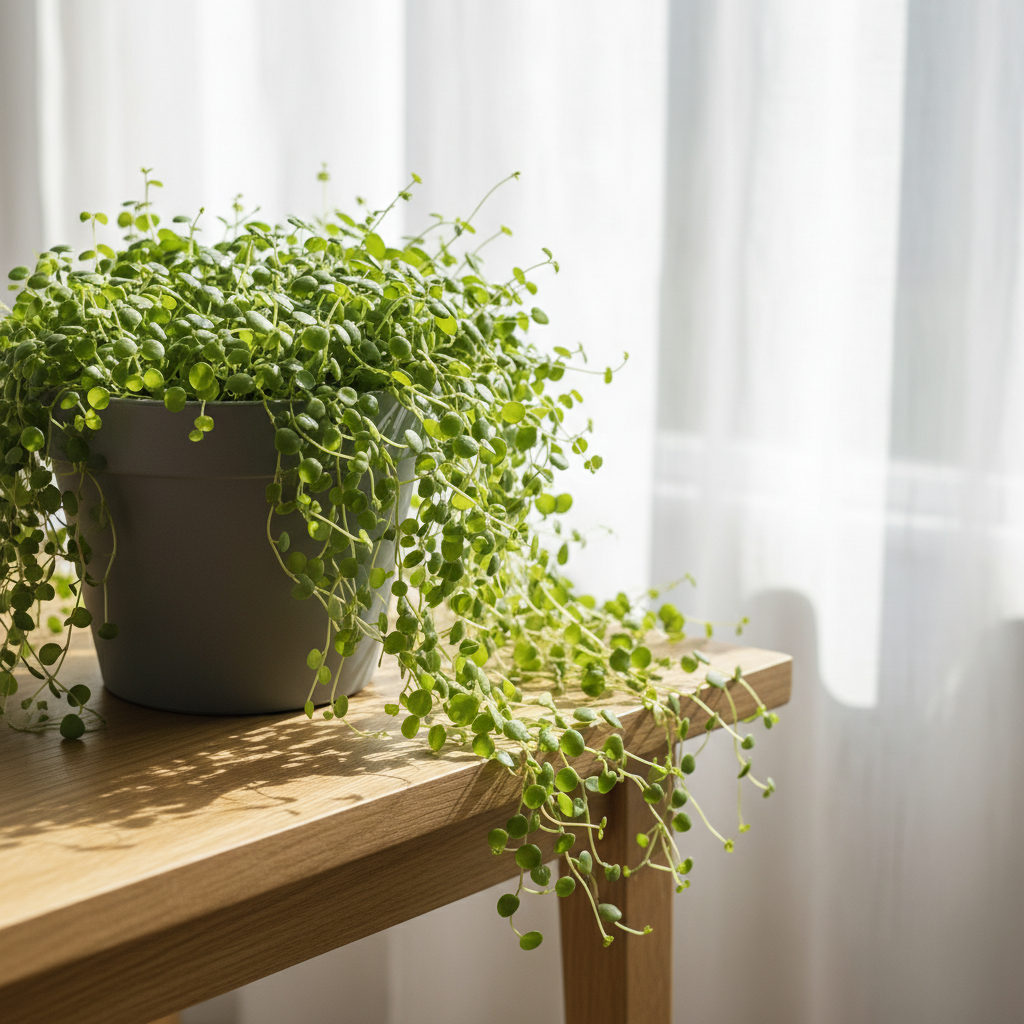
Few houseplants look as soft and improbable as the Baby Tears plant, a thread-stemmed perennial whose thousands of tiny round leaves form a living, mossy carpet that spills over the edge of any pot you put it in. Botanically known as Soleirolia soleirolii, this single-species genus in the nettle family is native to the cool, damp, shady cliff faces of Corsica, Sardinia and the Tyrrhenian islands. It travels through the houseplant trade under a small library of names: Angel’s Tears, Mind-Your-Own-Business, Pollyanna Vine, Irish Moss (a name better reserved for the lawn substitute Sagina subulata), Corsican Curse and the older botanical name Helxine soleirolii. Whatever you call it, the visual signature is unmistakable, a low, dense cushion of bright apple-green leaves so small you have to lean close to see them as individuals at all.
The reputation that follows Baby Tears around plant shops is that it is “easy”, which is partly true and mostly misleading. Easy to find, easy to propagate, easy to fall in love with, yes. But easy to keep looking lush on a kitchen counter for a year? That requires something far closer to attentive than the casual care most beginner-friendly plants tolerate. This guide is written for that distinction, the gap between a plant that survives and one that thrives. We will go through the light it actually needs to produce that dense cushion rather than a thin scraggle, the watering rhythm that keeps it from turning into a brown crisp overnight, the substrate and humidity that make the difference between a pot that fills in within weeks and one that slowly retreats inwards, and the propagation tricks that turn one plant into a steady supply for terrariums, dish gardens and bottle gardens for years to come.
Contents
- Quick Reference
- Why Baby Tears Makes an Unexpected Houseplant
- Light Requirements
- Watering & Humidity
- Soil, Potting & Repotting
- Fertilising
- Propagation
- Pests & Diseases
- Popular Varieties
- Frequently Asked Questions
Quick Reference: Baby Tears at a Glance
| Light | Bright indirect to moderate; tolerates dappled shade; avoid direct midday sun. |
| Watering | Keep evenly moist at all times; never allow the rootball to dry out completely. Typically every 2 to 4 days indoors. |
| Temperature | 16 to 24 degrees Celsius (61 to 75 Fahrenheit) is ideal; minimum 5 degrees Celsius (41 Fahrenheit); avoid hot drafts. |
| Humidity | High, 60 percent and upwards. Terrariums, bathrooms and pebble trays suit it; central-heating dryness causes rapid collapse. |
| Fertiliser | Balanced liquid feed diluted to one quarter strength every 2 to 4 weeks in spring and summer; pause in autumn and winter. |
| Toxicity | Non-toxic to cats, dogs and humans. Considered safe around pets and children, though it is best not eaten. |
Why Baby Tears Makes an Unexpected Houseplant
Most indoor plant lists are dominated by upright structural pieces, the Monstera, the Snake Plant, the Fiddle Leaf Fig, and Baby Tears interrupts that vocabulary with something different entirely. It is horizontal, mossy and textural rather than architectural, more carpet than sculpture. That makes it one of the most useful plants in the indoor design toolkit, because it occupies a niche almost nothing else can. It softens the base of larger plants in mixed plantings, fills the floor of a terrarium where moss would refuse to behave, drapes over the rim of a hanging glass globe, and acts as the green understorey in a bottle garden alongside ferns and miniature Pileas. Where most houseplants ask for vertical space, Baby Tears asks for surface area and humidity, and rewards both with a velvety living texture that genuinely changes how a corner of a room feels.
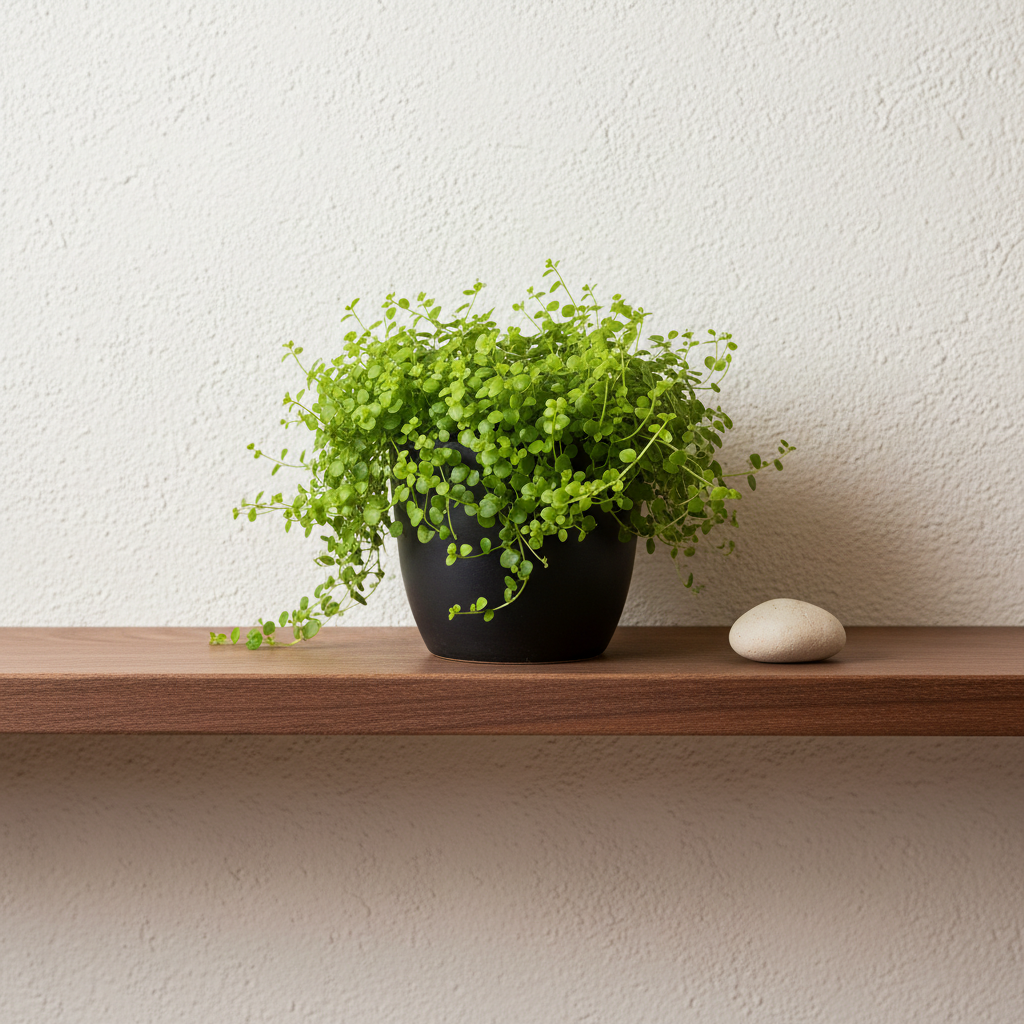
Beyond design, the plant carries a quiet ecological story worth knowing. Soleirolia soleirolii belongs to the Urticaceae, the same family as nettles, although without any of the sting. It evolved on the damp limestone shaded cliffs of the western Mediterranean islands, growing in conditions of constant moisture, dappled light and steady cool temperatures, and that origin explains every quirk of its indoor behaviour. Its tiny leaves are an adaptation to low transpiration in still, humid air. Its creeping, rooting stems let it colonise every available crack of rock. Its preference for shade over sun, for steady moisture over dryness, is not a flaw or a difficulty but a description of the conditions of a Corsican north-facing seep, transplanted into your living room with whatever fidelity you can manage. Read that way, the plant becomes much easier to understand. It is not fussy. It simply remembers where it came from.
Important — Toxicity: Baby Tears (Soleirolia soleirolii) is listed as non-toxic by the ASPCA and is considered safe around cats, dogs, rabbits and small children. It contains no known irritant compounds and is one of the few common houseplants in a pet household where accidental nibbling carries no real risk. That said, no plant is “food” by default, and curious chewing should still be discouraged.
Light Requirements
Light is the variable most people overshoot with Baby Tears. The plant looks delicate, the assumption follows that it wants to live in a dim corner, and within a few weeks the cushion thins, the lower stems brown and the carpet starts to retreat. The reverse error is just as common. Set on a bright south-facing sill in summer, the same plant can crisp from green to straw in a single afternoon. The correct reading is somewhere in between, and the model to keep in mind is the cliff face under tree cover, a place that is shaded from direct sun but still receives the diffuse glare of an open sky.
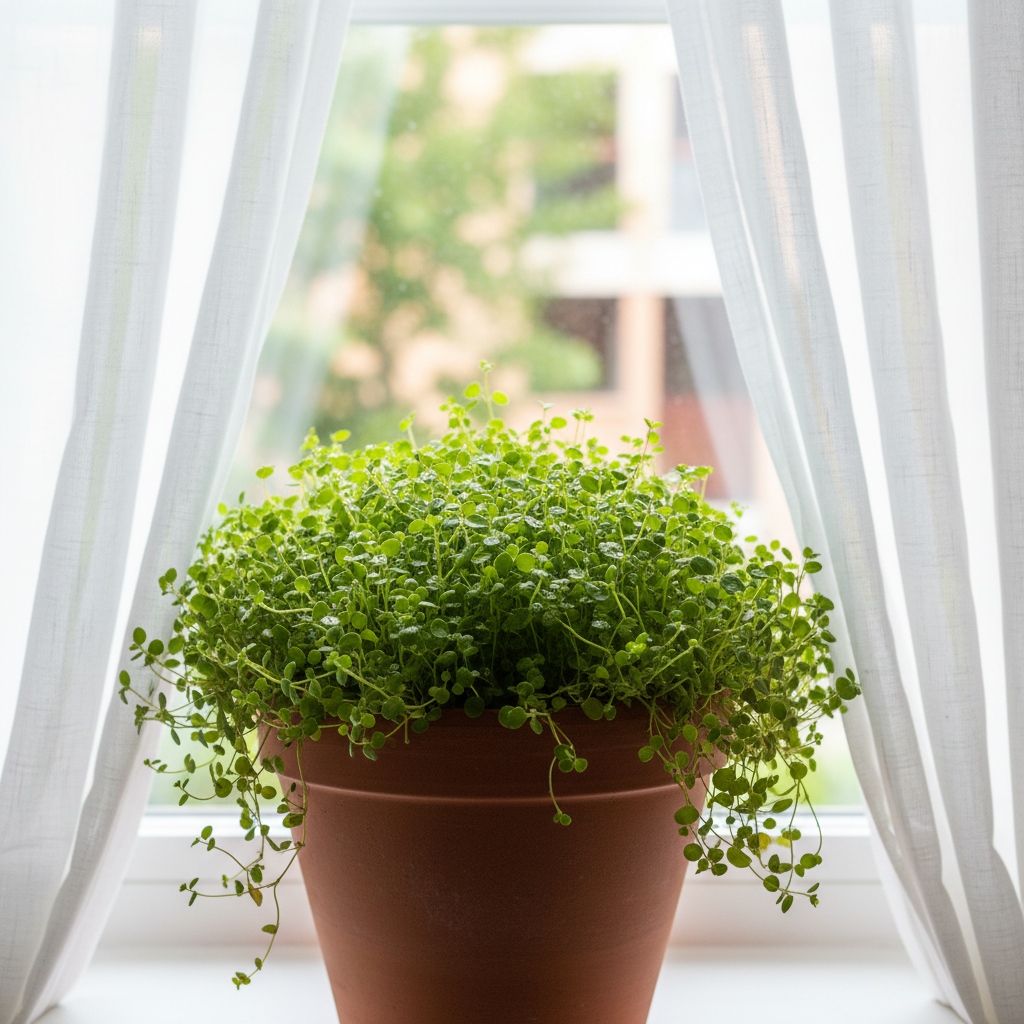
Indoors, that translates to a position with steady, bright but indirect light through most of the day. A spot a metre back from a south-facing window with sheer curtains, the centre of an east-facing room, or the brightest end of a north-facing bathroom all work well. The plant has no objection to a few hours of soft morning sun in winter, when the light is gentle and the air is cool, but in summer that same window is too much. As a quick test, hold your hand a hand’s width above the plant in the middle of the day. If the shadow is sharp and the back of your hand feels warm, the light is too strong. If the shadow is barely visible, it is probably too weak. If the shadow is soft-edged and your hand feels neutral, you are close to right.
Light Levels Explained
For readers who prefer numbers, here is the same guidance expressed in approximate lux ranges measured at the leaf surface. A free smartphone light meter is accurate enough for these tiers, and a quick reading at noon and again at three in the afternoon will give you a workable picture of where any given spot in your home sits on the scale.
| Light Category | Approx. Level | Typical Location | Outcome |
|---|---|---|---|
| Direct sun | 30,000 lux and up | Unobstructed south or west window in summer | Scorched, bleached, crisp brown leaves within hours |
| Bright indirect | 10,000 to 20,000 lux | 1 metre from a south window with sheer curtain | Dense, vigorous cushion with strong green colour |
| Medium | 5,000 to 10,000 lux | Centre of an east-facing room, bright bathroom | Healthy growth, slightly slower fill-in |
| Low | 1,000 to 5,000 lux | Several metres from a north window | Slow thinning, paler colour, longer internodes |
| Very low | Below 1,000 lux | Interior corner with no window line of sight | Gradual collapse over weeks; not survivable long term |
Window Orientation and Placement
South-facing window: The most demanding orientation. Direct unfiltered summer light through a south window will scorch Baby Tears in a matter of hours, and the damage is permanent on the affected stems. Set the plant well back from the glass, behind a sheer curtain or another taller plant that breaks the light. In winter, when the sun sits lower and weaker, the same spot can be ideal.
East-facing window: The easiest orientation to get right. Cool soft morning light, never strong enough to scorch, then bright ambient light for the rest of the day. A Baby Tears placed on or near an east-facing sill in a humid bathroom is close to its native conditions.
West-facing window: Workable but requires care. The afternoon sun is hot and slanting, often the hottest light of the day in summer rooms. Use a sheer curtain or pull the plant back 1.5 metres from the glass. East and west together are a good summer-and-winter rotation, with the plant moving towards the east window as days lengthen and back towards the west as they shorten.
North-facing window: Cool, gentle and rarely too bright. A north-facing bathroom is one of the best positions in a typical home for this species, combining shade-loving light with the humidity it craves. The only failure mode is a north room that is so dim the plant slowly etiolates, sending out longer thinner stems with widely spaced leaves.
Pro Tip — Rotate Weekly: Because Baby Tears grows outwards in every direction at once, the cushion tends to lean towards its light source, leaving the back side thin and the front overgrown. A simple quarter-turn once a week keeps the entire mat even and rounded. Set a recurring reminder for the same time you check the soil moisture and the two checks pair naturally.
How Light Affects Density and Colour
The visual quality you are aiming for is density. A well-lit Baby Tears reads from across the room as a single fuzzy surface, the leaves so closely packed that the stems and soil disappear from view. As light decreases, internode length increases, stems grow longer between each pair of tiny leaves, and the cushion goes from velvety to wispy. The plant is still alive in lower light, but the design effect is lost. Colour follows the same gradient. In bright indirect light the cushion is a clean apple green. In low light it shifts towards a paler, yellower tone that looks like a faded copy of itself. The golden cultivar ‘Aurea’ is more dependent on light than the species, and a dim corner will turn its luminous yellow back to a sad pale lime within weeks.
Warning — Direct Sunlight: A single afternoon of unfiltered summer sun is enough to scorch a Baby Tears beyond recovery. The leaves go from green to translucent straw within hours, the affected stems die back, and the plant has to regrow from the unburned base. If you move the plant outdoors for summer or near an unobstructed window, do so by stages, an hour more diffuse light each day for a week, and never expose it to direct midday rays.
Artificial Lighting
Baby Tears grows well under modest artificial light, and grow lights are a sensible solution in a dark flat or for a closed terrarium. A standard full-spectrum LED panel set 30 to 45 centimetres (12 to 18 inches) above the foliage and run on a timer for 10 to 12 hours a day is more than enough. Because the plant prefers cool conditions, choose a low-wattage LED that does not throw significant heat, and avoid placing the light close enough that the temperature directly above the plant rises noticeably. In a vivarium or terrarium with built-in lighting, the standard reptile-grade plant bulbs work well, and the high humidity inside the enclosure compensates for any slight excess of light intensity.
Seasonal Adjustments
In a northern hemisphere home, expect to shift the plant twice a year. From late autumn through to early spring, when window light drops to a fraction of its summer level, move the pot closer to the glass and consider supplementing with a small grow light if the cushion starts to thin or pale. From late spring through early autumn, move it back from the window, behind a sheer curtain, or to a slightly shadier neighbour. The change should be gradual rather than sudden, because Baby Tears, like most shade-adapted plants, struggles with abrupt light transitions. A week of intermediate positioning between the two seasonal spots is enough to acclimatise the leaves without stress.
Watering & Humidity
Watering is the single biggest reason Baby Tears collapses in domestic care, and the reason is not what most people expect. The classic houseplant advice, “let the top inch of soil dry out before watering again”, is not just wrong for this species, it is actively fatal. Baby Tears has a shallow, fibrous root system designed to operate in soil that is consistently moist from top to bottom. Allow it to dry out once, even just at the surface, and the affected stems wilt, the leaves shrivel, and the cushion turns from green to translucent brown within hours. Unlike a Pothos or a Spider Plant, it does not recover with a heavy drink afterwards. The damaged stems are dead and must be cut back to the base. This is not a forgiving plant, and the watering rhythm needs to match that fact.
When to Water
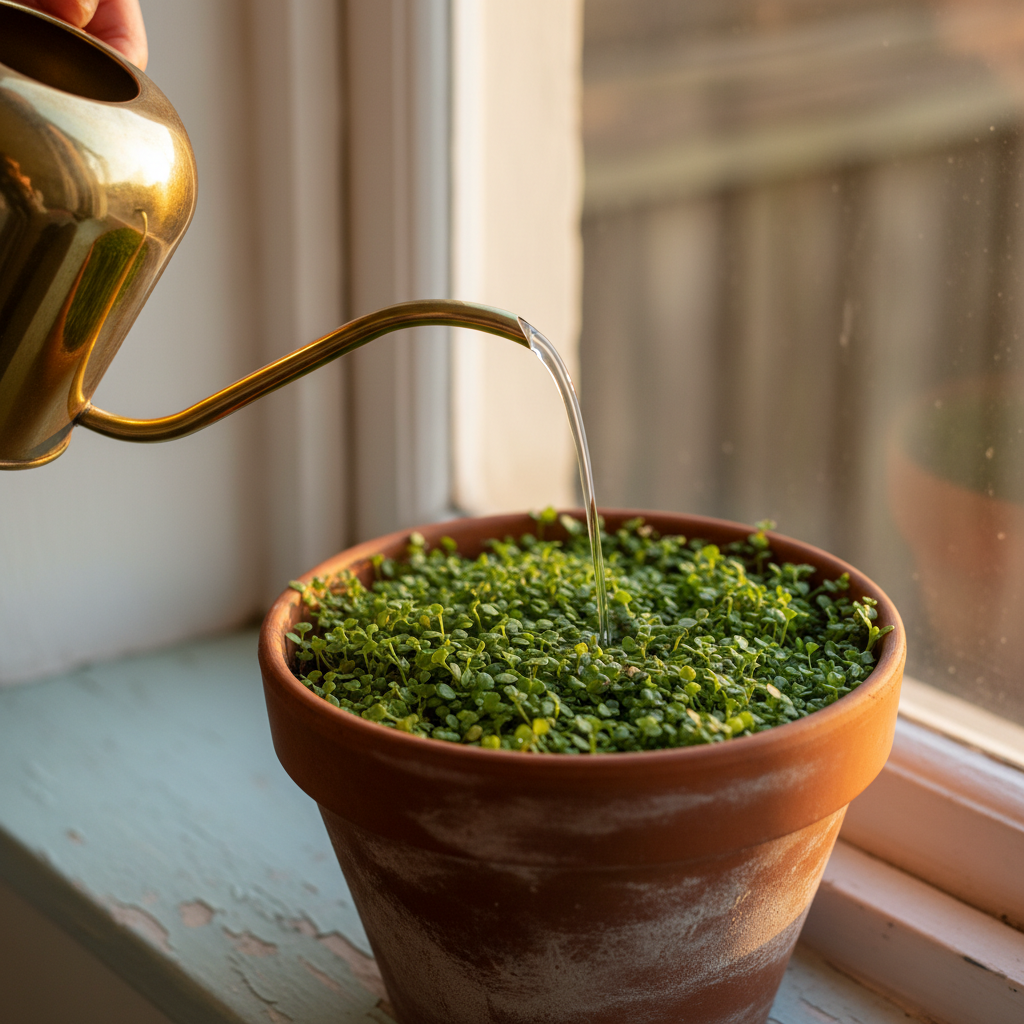
The correct rhythm is to check the surface of the soil every day or every other day, and to water whenever the top half-centimetre of substrate has dried to a slightly paler shade rather than the deep wet brown of fresh moisture. This usually translates to a watering every two to four days indoors in spring and summer, slowing to every three to seven days in winter when growth and evaporation are both reduced. Plants in clay pots, in dry centrally heated rooms or in higher light will need water more often. Plants in glazed ceramic pots, in cool humid bathrooms or in a closed terrarium may go a week or more between drinks.
The best moisture indicator is the cushion itself. A Baby Tears with adequate water sits up turgid, each tiny leaf full and bright, and the cushion springs back when lightly touched. The first warning of dryness is a subtle deflation, the surface losing its puffiness and starting to look slightly slumped, often before any visible colour change. At that point the soil is already too dry and watering should be immediate. By the time leaves are visibly wilting or browning, the damage is done. Watching the cushion’s posture daily is far more reliable than any fixed schedule, and it takes about five seconds.
Pro Tip — Bottom Watering Saves the Cushion: Pouring water on top of a dense Baby Tears mat tends to push the leaves down, leave water sitting in the foliage and encourage rot at the leaf line. Setting the pot in a shallow dish of room-temperature water for 10 to 15 minutes and letting it draw moisture up through the drainage holes keeps the foliage dry and the substrate evenly hydrated. This is the preferred method for any mature plant with a full cushion.
How to Water Correctly
- Lift the pot to feel its weight. A dry pot is noticeably lighter than a freshly watered one, and after a week of handling you will be able to tell at a glance whether watering is needed.
- If watering from above with a long-spout can, aim the stream at the rim of the pot, parting the cushion gently with the spout to reach the soil without flooding the foliage.
- If bottom watering, sit the pot in a shallow tray of room-temperature water that comes up no more than halfway up the pot’s side. Leave for 10 to 15 minutes.
- Remove the pot and let it drain fully on the rim of the sink or in a tray. Never leave Baby Tears standing in water for more than 30 minutes, because the same fine root system that dies of drought will also rot in stagnant water.
- Return the pot to its position and tip out any water that drains into the saucer over the next hour.
- Use water at room temperature. Cold water from the tap shocks the roots and can mark the leaves with pale spots if it splashes the foliage.
Signs of Overwatering vs. Underwatering
Both extremes show themselves quickly in this species, often within 24 hours of the underlying problem starting. Learning to read the symptoms early is the difference between losing a single section and losing the whole pot.
| Symptom | Overwatering | Underwatering |
|---|---|---|
| Leaf colour | Yellowing in patches, often from the centre outward, sometimes with translucent water-logged spots | Crisp browning from the edges of the cushion inward, leaves turning from green to straw |
| Leaf texture | Soft, limp, mushy when touched; whole sections lifting cleanly away from the soil | Brittle and papery, crumbling between fingers; whole stems wilted but still attached |
| Soil surface | Persistently wet, smells sour, sometimes green algae or fungus gnats present | Pulls away from the side of the pot, dust-dry to the touch, very light when lifted |
| Roots | Brown or black, mushy, easily detached from stems | Dry but white or pale; rootball shrunken and easy to lift out cleanly |
| Stem base | Slimy, blackened at the soil line, easy to pull stems free without resistance | Dry, papery, snapping cleanly when bent rather than bending green |
Warning — Root Rot: Once Baby Tears begins to rot at the soil line, the damage spreads quickly through the dense foliage above. Affected sections become slimy and detach in handfuls. The only effective response is to take healthy stem cuttings from the unaffected edge of the cushion, discard the rotted soil and pot, and propagate fresh from the cuttings. Trying to save a rotted plant by reducing water rarely works.
Humidity Requirements
If watering is the first variable that decides whether Baby Tears survives, humidity is the one that decides whether it thrives. The native cliff habitat is constantly moist, often with mist drifting through the leaves. Indoors, the plant tolerates room humidity in the 40 to 50 percent range that most homes settle into, but it does so without much enthusiasm, the cushion thinner, the leaves slightly smaller, the colour less saturated. Push the humidity to 60 percent and above and the plant transforms, the carpet fills in densely, the colour deepens, and the surface takes on the velvety quality that makes the species so visually distinctive.
The classic symptoms of low humidity in Baby Tears are crisping at the very tip of the trailing stems, a generalised paling of the green, and a slow retreat of the cushion inwards from its outer edge as the most exposed leaves give up. In a centrally heated home in winter, when indoor humidity can drop below 30 percent, these symptoms appear within days of the heating coming on, and they catch many keepers by surprise. The plant looked fine in October. By November it is unrecognisable.
Raising humidity for Baby Tears specifically benefits from physical containment more than from misting. A glass cloche, a closed terrarium, a converted goldfish bowl or even a clear plastic dome makes a microclimate that the plant can settle into and that requires almost no intervention. A pebble tray filled with water under the pot, refilled as needed, helps but is a weaker fix on its own. A cool-mist humidifier running near the plant does work but consumes water steadily. Grouping Baby Tears with other moisture-loving plants, ferns, calatheas, prayer plants, in a single shelf or corner creates a small humidity pocket that can be 10 to 15 percent above the rest of the room.
Water Quality
Hard tap water with high mineral content leaves a faint pale crust on the soil surface over time and can mark the tiny leaves with white spots where droplets evaporate. In areas with very hard water it is worth using filtered or rainwater, or letting tap water stand uncovered for 24 hours to allow chlorine to dissipate before use. Distilled water works but is overkill for most homes, and rainwater collected in a clean container is the ideal supply if you have outdoor access. Whatever the source, room temperature is the rule, and a watering can dedicated to indoor plants and refilled the night before makes the right temperature automatic.
Soil, Potting & Repotting
The substrate Baby Tears wants is the same substrate that grows mosses, ferns and other shade understorey plants well, light, water-retentive, free-draining and slightly acidic to neutral. The two failure modes at this stage are a soil so dense and water-holding that it stays sodden and rots the fine roots, and a soil so coarse and free-draining that it cannot hold the steady moisture the plant requires. Most off-the-shelf “houseplant compost” lands in the wrong place by being too dense, especially the cheaper peat-heavy mixes that turn into a saturated brick within weeks. A small amount of amendment fixes this completely.
Ideal Soil Composition
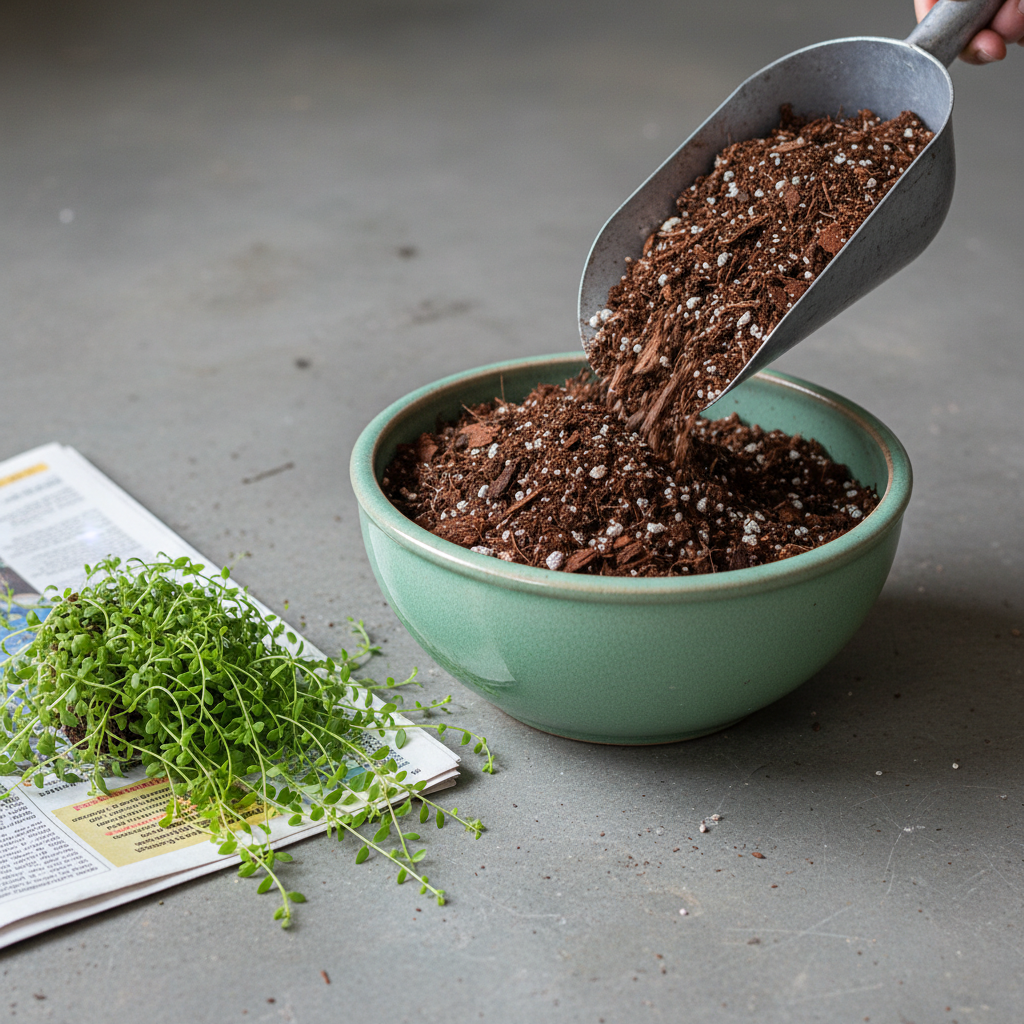
A workable Baby Tears substrate combines a quality peat-free houseplant compost as a base, perlite for air space, fine bark or coir for structure, and a small fraction of worm castings or composted bark fines for slow nutrient release. The aim is a mix that feels light and springy in the hand, holds moisture when squeezed without releasing a stream of water, and falls apart cleanly when released. The table below gives a starting recipe by volume.
| Component | Proportion | Function |
|---|---|---|
| Peat-free houseplant compost | 3 parts | Base structure, moisture retention, fine roots |
| Perlite | 1 part | Air space, prevents compaction, improves drainage |
| Coco coir or fine orchid bark | 1 part | Lightens the mix, holds moisture without compacting |
| Worm castings | Half a part | Slow nutrient release, beneficial microbes |
The plant prefers a slightly acidic to neutral pH in the 5.5 to 7.0 range, which most peat-free houseplant mixes deliver out of the bag. There is no need to test pH for a domestic Baby Tears unless it shows persistent nutrient deficiency symptoms after good care, in which case a cheap soil pH meter and a teaspoon of garden lime or sulphur as appropriate is all the correction needed.
Pro Tip — Quick Mix Recipe: For a single small pot, scoop a handful of peat-free houseplant compost, half a handful of perlite, and a pinch of worm castings into a bowl, mist lightly with water and stir together. The mix is ready when it holds together briefly in the fist and then crumbles when poked. This is enough to repot a 12-centimetre pot with substrate left over for the next round of cuttings.
Choosing the Right Pot
Baby Tears is shallow-rooted and spreading rather than deep-rooted and upright, which means the right pot is wide and low rather than tall. A 12 to 18 centimetre (5 to 7 inch) bowl or shallow dish suits a typical retail division well, and the plant fills the surface area within one growing season. Standard upright pots work too but leave a lot of unused substrate volume at the bottom, which holds excess water and increases rot risk. A pot whose width is at least twice its depth is the right shape.
Drainage holes are non-negotiable. Despite the plant’s love of moisture, a sealed cachepot without drainage is a guaranteed way to rot the roots. Either use a pot with drainage holes and a separate saucer, or use a decorative cachepot but slip a smaller pot with drainage inside it. If you choose the cachepot approach, lift the inner pot out to water, drain it fully, and only then return it to the outer vessel.
Pot material: Terracotta wicks moisture away from the substrate and dries it out faster than glazed ceramic or plastic. For a beginner keeping Baby Tears, plastic or glazed ceramic is the easier choice because it forgives short missed waterings. Terracotta works well in a humid bathroom or a closed terrarium where evaporation through the walls is balanced by ambient humidity, but it punishes a few hot dry days in a centrally heated room.
Pot size: Always pot Baby Tears on by one size at a time, no more than 2 to 3 centimetres wider than the existing rootball. An oversized pot holds excess wet substrate around the roots, which is exactly the condition the plant cannot tolerate. A pot one or two sizes too small, by contrast, simply means you repot a little sooner.
When to Repot
Baby Tears is a fast spreader on the surface but a modest rooter underneath, so the timing of repotting is driven less by root binding and more by exhaustion of the substrate. Most plants benefit from a fresh pot of substrate every 12 to 18 months, regardless of whether the roots have outgrown the pot. The signs that the time is right are a cushion that has flattened or thinned despite good light and water, a substrate that drains noticeably faster than it used to, or a layer of pale mineral crust on the surface. Spring, just as new growth picks up, is the best season for the operation. Avoid repotting in winter when the plant is least able to recover from any minor root disturbance.
How to Repot: Step-by-Step
- Water the plant the day before repotting. A turgid Baby Tears handles the move far better than a thirsty one.
- Prepare the new pot. If reusing the same pot, wash it with mild detergent and rinse thoroughly. Add a 1 to 2 centimetre layer of fresh substrate to the bottom.
- Ease the plant out by inverting the pot and supporting the cushion with one open hand while tapping the rim against the edge of a table. The rootball should slip free intact.
- Tease away the outer half-centimetre of old substrate with your fingers, especially any compacted layer around the base. Do not disturb the inner core of roots unless they are clearly rotted.
- Trim any blackened or mushy roots cleanly with sterilised scissors. Healthy roots are white to pale brown and fibrous.
- Set the plant in the new pot at the same depth as before, with the cushion just above the new substrate level. Fill around the rootball with fresh mix, pressing gently rather than packing.
- Water in lightly from below or with a fine rose, just enough to settle the substrate around the roots. Return to a slightly shaded position for a week before resuming normal light.
Warning — Transplant Shock: Even gentle repotting can trigger a brief period of cushion dieback in the days that follow, especially if the rootball was disturbed more than expected. Resist the urge to overwater or fertilise to compensate. Give the plant a week of slightly shaded, evenly moist recovery, and the new growth that fills in from the centre will be denser than what was lost.
Fertilising
Baby Tears is a modest feeder by houseplant standards, the consequence of a native habitat where the only nutrient supply is whatever leaches out of damp rock and the slow turnover of nearby leaf litter. Push too much fertiliser into the pot and the cushion responds in the opposite of the way most people expect, with longer thinner stems, paler leaves and a general loss of density. The plant does not want feasts. It wants a steady, gentle trickle of nutrients across the growing season, and very little outside it.
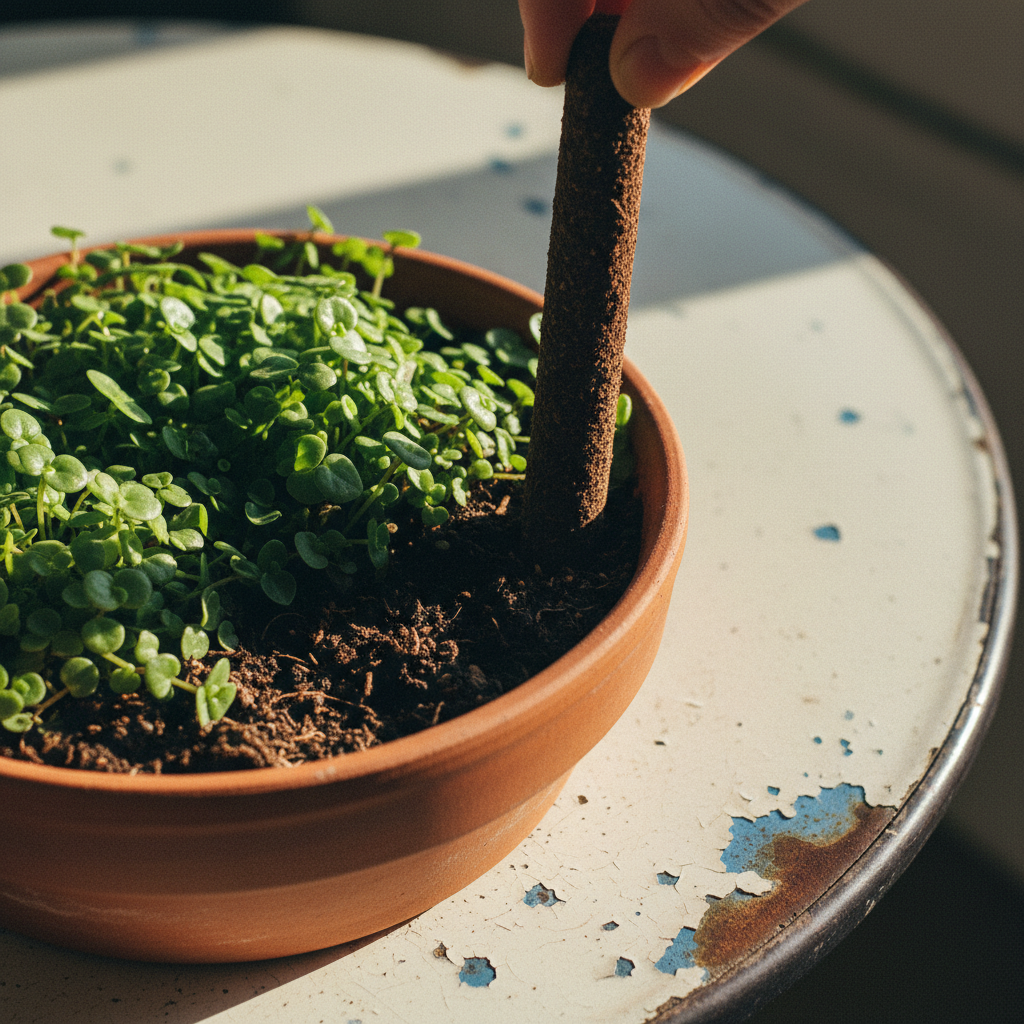
The practical implication is to feed often but very weakly. A balanced liquid houseplant fertiliser diluted to one quarter of the bottle’s recommended strength, applied every two to four weeks from late spring through to early autumn, covers the plant’s needs without risk of burn. In winter the plant stops actively growing under most domestic conditions and feeding should stop with it, resuming as the days lengthen and visible new growth returns to the edges of the cushion.
Understanding Plant Nutrients
Plants need three macronutrients in roughly equal large amounts and a handful of secondary and trace elements in smaller doses. The ratio is given on every fertiliser label as the N-P-K numbers, nitrogen, phosphorus, potassium. For a foliage plant like Baby Tears, a balanced 1-1-1 to 3-1-2 ratio works well across the growing season. There is no need for a flowering or fruiting feed, because the plant’s flowers are so tiny and unscented that almost no one notices them, and the species is grown entirely for foliage.
| Nutrient | Symbol | Primary Function | Deficiency Symptoms |
|---|---|---|---|
| Nitrogen | N | Leaf growth and chlorophyll production | Generalised yellowing of the cushion, slowed growth |
| Phosphorus | P | Root development and energy transfer | Stunted growth, slightly reddish or purplish leaf tones |
| Potassium | K | Cell wall strength and water regulation | Brown leaf edges, weak stems, vulnerability to drying |
| Calcium | Ca | Cell wall integrity and new growth | Distorted or stunted new growth at the cushion edge |
| Magnesium | Mg | Central atom of chlorophyll | Yellowing between leaf veins on older leaves |
| Iron | Fe | Chlorophyll synthesis | Pale yellow new growth with green veining |
Types of Fertiliser
Liquid fertilisers: The easiest format for Baby Tears, because they let you control the dose precisely. A general indoor plant feed at a quarter of the label rate is the working strength. Apply with the watering can on the days you would normally water, replacing the plain water for that watering rather than adding feed on top of plain water.
Slow-release granular: Convenient but harder to dose correctly for such a small substrate volume. If you choose granules, use the lowest sprinkle the label allows for the pot size, and combine it with a slightly more cautious watering rhythm to avoid a flush of soluble salts into the substrate. Most keepers will find liquid feed simpler in practice.
Organic fertilisers: Worm castings as a top-dressing twice a year, a half-centimetre layer scattered around the cushion edge, supply almost all the nutrients a Baby Tears needs through the season with no risk of burn. Compost tea diluted very weakly works similarly. For a low-effort plant in low-effort hands, organic top-dressing is by far the most forgiving option.
Feeding Schedule
The simplest reliable schedule for an indoor Baby Tears in a temperate northern hemisphere home is feeding from April through to September, every two weeks at a quarter strength if using liquid feed, or once with a worm-casting top-dressing in April and again in July. From October through to March, withhold all fertiliser. If a grow light is keeping the plant in active growth through winter, drop to monthly feeds at one-eighth strength rather than skipping entirely.
Pro Tip — Under, Not Over: When in doubt about whether to feed, do not. A Baby Tears that is slightly underfed shows almost no symptoms beyond a marginally slower fill-in rate. A Baby Tears that is overfed develops weak elongated stems, becomes vulnerable to rot and looks worse, not better. Less, with this species, is genuinely more.
How to Fertilise
- Water the plant lightly with plain water the day before feeding. Fertilising into dry soil can scorch fine roots.
- Mix the liquid feed at a quarter of the label-recommended strength in a clean container.
- Apply by bottom watering wherever possible, setting the pot in a shallow dish of the diluted feed for 10 to 15 minutes, then draining fully.
- If applying from above, use a fine-rose can and aim at the soil at the pot rim rather than over the foliage. Wipe any feed that splashes onto leaves with a damp cloth.
- Flush the pot with plain water at least once a quarter to prevent salt build-up. Run several pot-volumes of clean water through the substrate over a sink.
Warning — Salt Build-Up: A pale white crust on the soil surface or around the rim of the pot indicates accumulated mineral salts from tap water and fertiliser. Left unaddressed, these salts pull moisture out of fine roots and cause persistent leaf-edge browning. The fix is a thorough flush, running 3 to 5 pot-volumes of plain water through the substrate over a sink and discarding the run-off, repeated whenever the crust returns.
Propagation
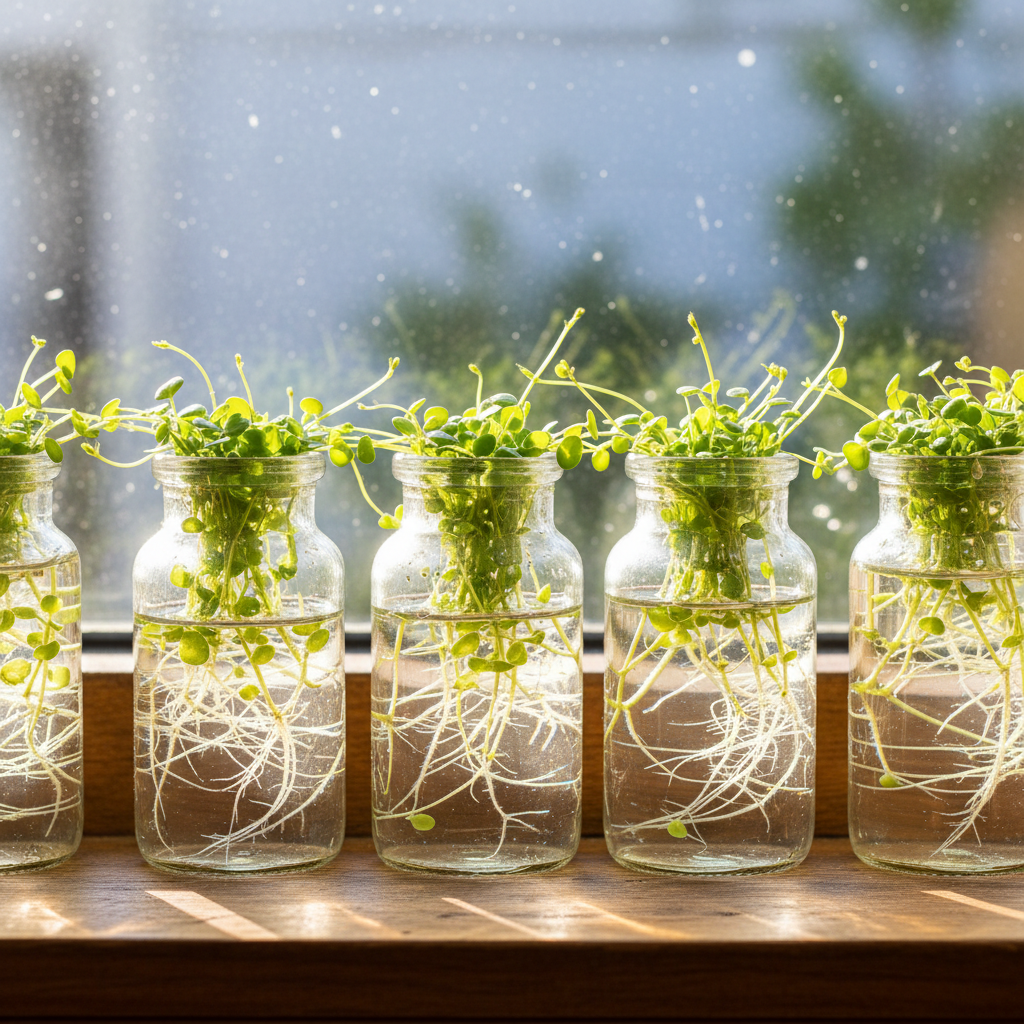
Few houseplants are as casually generous with new plants as Baby Tears. The same trait that makes it considered invasive outdoors in mild climates, every node on every thread-thin stem will root the moment it touches damp substrate, makes it almost embarrassingly easy to propagate indoors. A single retail-sized pot, a few months of growth and a willingness to take cuttings will keep a household supplied with new Baby Tears for friends, terrariums and replacement pots indefinitely. Two methods work reliably: stem cuttings rooted in water or directly in damp substrate, and division of an established mat into smaller cushions.
Both methods are best attempted in late spring or early summer, when the plant is actively growing and the new sections root within days rather than weeks. Autumn and winter propagations are slower and slightly riskier because rot pressure is higher in cooler, damper conditions. That said, the species is forgiving enough that a careful winter propagation under a grow light is perfectly feasible.
Understanding Stem Rooting
The reason Baby Tears propagates so readily is that it does not really have a fixed root system in the way a Pothos or a Monstera does. Every node along every creeping stem is a potential root site, and every time a node makes contact with damp substrate it produces a fresh white hair-root within a day or two. In the native habitat this lets the plant colonise sideways across damp rock indefinitely. In a propagation jar or seed tray, it means a clump of stems pressed gently into moist mix is rooted and ready within a week. Understanding this anatomy makes propagation strategy obvious. You are not creating a new plant from a cutting. You are simply detaching a section of the existing plant and giving it its own pot.
Stem Cuttings in Substrate: Step-by-Step
This is the most reliable method and produces a planted-out result without an intermediate water-rooting step. It works for both a small batch of cuttings into a new pot and for refilling thin spots in an existing one.
- Prepare a small shallow pot or seed tray with a damp peat-free houseplant mix lightened with extra perlite. The surface should be level and moist throughout but not wet.
- From a healthy parent plant, pinch off small sections of stem 3 to 5 centimetres long, ideally with several leaves and at least two visible nodes along the length.
- Press each section gently onto the surface of the damp substrate so that the stem makes good contact along its length. Do not bury the cuttings deeply, the rooting nodes need to be in contact with the substrate, not under it.
- Lightly mist the surface to settle the cuttings and remove any air pockets between stem and substrate.
- Cover the tray with a clear plastic dome, a piece of clear film with a few small holes, or place it in a closed terrarium to maintain very high humidity for the first two weeks.
- Place in bright indirect light, away from any direct sun, at a steady room temperature.
- Within 7 to 14 days the cuttings will have rooted at every node in contact with the substrate. Lift the cover for an hour each day from week two onwards to acclimatise the new plants.
- Pot on into individual pots once the cushion has begun to spread visibly, usually within 4 to 6 weeks of the original cuttings.
Pro Tip — Use Trimmings, Not Cuttings: The neatest way to keep a mature Baby Tears tidy is to trim back any stems that overflow the edge of the pot with scissors. Those trimmings are perfect propagation material. Rather than discarding them, scatter them onto the surface of a damp tray of mix, mist lightly, and cover. The plant is genuinely self-renewing in this respect, the more often you trim, the more new plants you make as a byproduct.
Division: Step-by-Step
Division is the simplest method for an established plant that has filled its current pot and needs splitting. It produces several mature daughter plants in a single operation and works particularly well during a routine spring repotting.
- Water the parent plant well the day before. A turgid cushion separates cleanly. A thirsty cushion crumbles.
- Ease the entire plant out of its pot by inverting and tapping the rim, supporting the cushion with one hand.
- Place the rootball on a clean work surface. Using clean fingers or sterilised scissors, divide the mat into two, three or four roughly equal sections. The thread-thin stems separate easily and each section will carry its own roots.
- Trim away any visible rot, mushy roots or yellowed sections. Each division should look healthy and feel firm.
- Pot each division into its own pot of fresh substrate, sized one to two centimetres wider than the rootball.
- Water in lightly and place in bright indirect light, away from direct sun, for the first week. Resume normal care once new growth is visible at the edge of each cushion, usually within 7 to 10 days.
Troubleshooting Propagation
| Problem | Likely Cause | Solution |
|---|---|---|
| Cuttings shrivelled within 48 hours | Air too dry, no humidity cover used | Cover the tray with a clear dome or film, mist lightly, move out of direct light |
| Cuttings rotted at the base | Substrate too wet or air too still | Use a lighter mix with more perlite, lift the cover for an hour daily, ensure pot has drainage |
| No visible rooting after three weeks | Temperature too cool, or stems not in contact with substrate | Move to a warmer position around 20 degrees Celsius, press cuttings firmly onto damp mix |
| Cuttings rooted but failed to spread | Light too low, or pot too large for the cutting volume | Move to brighter indirect light, pot down to a smaller pot if substrate stays wet |
Pests & Diseases
Baby Tears does not attract a long list of pests, partly because its leaves are too small to interest larger sap-suckers and partly because the high humidity it prefers also suppresses many common houseplant invertebrates. The handful of pests that do find it tend to do so when conditions go slightly wrong, an over-dry phase, a stagnant air pocket, a contaminated cutting brought in from a friend. The bigger threat is fungal, because the same dense damp cushion that makes the plant beautiful is also an ideal microclimate for rot if airflow drops too low.
Prevention sits ahead of treatment. A Baby Tears in steady bright indirect light, on a regular bottom-watering rhythm, in a pot with adequate drainage and in a room with light air circulation rarely sees pest or disease problems through a whole year. Most outbreaks trace back to a single environmental fault that can be corrected once and avoided thereafter.
Common Pests
Fungus Gnats (Bradysia spp.)
Tiny dark flies that hover around the soil surface and lay eggs in damp substrate. The larvae feed on fine roots and organic matter, weakening the plant. Because Baby Tears requires consistently moist soil, it is more vulnerable to fungus gnat populations than drier-loving species.
Treatment: Switch to bottom watering to keep the surface drier between drinks. Apply a top-dressing of fine horticultural sand or fine bark to physically block egg-laying. Place yellow sticky traps near the pot to catch adults. For persistent infestations, water with a diluted biological control containing Bacillus thuringiensis israelensis, which kills larvae without harming the plant.
Aphids (Aphidoidea)
Small soft-bodied insects, usually pale green or black, that cluster on new growth and excrete sticky honeydew. Less common on Baby Tears than on woodier plants but possible, especially in summer when windows are open and outdoor aphids drift in.
Treatment: A firm rinse under a tepid kitchen tap usually clears a light infestation. For heavier populations, a dilute insecticidal soap or neem oil spray applied early in the morning, allowed to sit for an hour and then rinsed off, works well. Repeat weekly for three weeks to break the life cycle.
Spider Mites (Tetranychus urticae)
Microscopic mites that proliferate in hot, dry conditions and produce fine webbing across the leaves. A spider mite infestation on Baby Tears is almost always a sign that humidity has dropped well below the plant’s comfort zone, often during a centrally heated winter.
Treatment: Raise humidity immediately, the mites cannot reproduce above around 60 percent. Rinse the plant under a tepid shower to physically dislodge mites and webbing. For an established infestation, apply diluted neem oil or insecticidal soap, taking care to coat the underside of the foliage where the mites live.
Whitefly (Trialeurodes vaporariorum)
Small white winged insects that lift in a cloud when the plant is disturbed. Whiteflies prefer warm humid conditions, which makes Baby Tears growing in a closed terrarium or warm bathroom an occasional target if eggs arrive on a new plant.
Treatment: Yellow sticky traps catch a useful proportion of the flying adults. For larger infestations, repeated applications of insecticidal soap or neem oil at weekly intervals for three weeks are needed to break the life cycle, which is faster than most pests.
Common Diseases
Root Rot (Pythium and Phytophthora spp.)
The most common cause of total Baby Tears collapse. Soil-borne oomycetes proliferate in cold, waterlogged substrate and attack the fine root system, often spreading upwards into the stem bases within days. The plant suddenly slumps as a section, the stems pull away easily from the soil line, and the substrate smells sour.
Treatment: Recovery from advanced root rot is rare in this species. The reliable response is to harvest healthy stem cuttings from the unaffected edge of the cushion, discard the rotted plant and substrate entirely, and start a new pot from cuttings. Sterilise the pot before reuse.
Botrytis Blight (Botrytis cinerea)
Grey fuzzy mould that appears on dead or dying leaves in conditions of high humidity and low airflow, typically inside a closed terrarium left unopened for too long. It spreads outwards from any decaying material in contact with the cushion.
Treatment: Open the terrarium for several hours a day to improve airflow. Remove all visibly affected leaves and stems, along with any decaying organic matter, using clean tweezers. Spray a fine mist of diluted hydrogen peroxide solution on the affected area as a topical fungicide if the outbreak is large.
Pest and Disease Summary
| Pest / Disease | Identification | Treatment |
|---|---|---|
| Fungus gnats | Tiny dark flies near soil surface | Bottom water, sand top-dressing, Bti drench, sticky traps |
| Aphids | Soft green or black insects on new growth | Rinse, insecticidal soap weekly for three weeks |
| Spider mites | Fine webbing, hot dry conditions, leaf stippling | Raise humidity, rinse, neem oil, soap spray |
| Whitefly | Small white winged insects, cloud when disturbed | Sticky traps, repeat insecticidal soap weekly |
| Root rot | Sudden slump, sour soil smell, mushy stems | Cuttings only, discard rotted plant, start fresh |
| Botrytis blight | Grey fuzzy mould in still humid conditions | Improve airflow, remove affected sections, hydrogen peroxide mist |
Prevention Strategies
The most effective preventive measure is quarantine. Any new plant brought into the home, whether it is a Baby Tears or any other species, should spend two weeks in isolation from the existing collection. Most pest problems on indoor plants arrive on new plants from shops, friends or post, and a fortnight of separate residence in a different room is enough to surface infestations before they spread.
Beyond quarantine, the practical baseline is steady environmental conditions, bright indirect light, consistent moisture without sogginess, humidity in the 50 to 70 percent range and gentle air circulation. A small fan running on its lowest setting nearby for a couple of hours a day discourages fungal pathogens without drying the plant, and the gentle leaf movement strengthens stems slightly. Inspecting the underside of leaves and the soil surface every time you water takes ten seconds and catches almost every infestation in its first generation.
Pro Tip — Neem as a Routine Tonic: A monthly fine mist of diluted neem oil on the foliage, applied in the evening and rinsed off the next morning, deters most common pests before they establish and conditions the leaves. For Baby Tears, which is sensitive to anything that sits on the leaves too long, the rinse-off step matters. A neem residue left to sit on the cushion for days can scorch leaves the same way direct sun does.
Popular Varieties
The species Soleirolia soleirolii is the only member of its genus, but selective propagation has produced a small number of distinct cultivars whose differences are entirely cosmetic. All of them share the species’ care preferences, the same light, the same watering rhythm, the same humidity requirements, so once you have learned to keep one you have learned to keep the rest. The cultivars are mostly distinguished by leaf colour, and the visual difference between them is striking when grown side by side.
Availability varies by region. The plain green species is widely sold in every garden centre and is often the default supermarket houseplant. The golden cultivar ‘Aurea’ is common in specialist plant shops and online but rarer in general retail. The variegated cultivars appear in independent plant shops and are occasionally available from specialist online suppliers. Mixed-cultivar planters, with two or three colour forms grown in a single shallow bowl, are increasingly popular and use the existing care knowledge for the species without any added complication.
| Variety | Leaf Appearance | Light Needs | Growth Rate | Availability |
|---|---|---|---|---|
| Species (plain green) | Tiny round bright apple-green leaves on thread stems | Bright indirect | Fast | Very common |
| ‘Aurea’ (Golden) | Luminous chartreuse to soft golden yellow | Bright indirect, more light brings out colour | Moderate | Common in specialist shops |
| ‘Variegata’ | Tiny green leaves edged in creamy white | Bright indirect, avoid direct sun | Slower than species | Occasional, independent shops |
| ‘Argentea’ (Silver) | Cool silvery-green tones across the cushion | Bright indirect | Moderate | Rare, specialist suppliers |
| ‘Golden Queen’ | Bright gold leaves with slightly larger leaf size | Bright indirect | Moderate | Rare, collector cultivar |
| ‘Variegata Aurea’ | Gold leaves edged with cream | Bright indirect | Slow | Very rare, specialist online only |
Featured Varieties
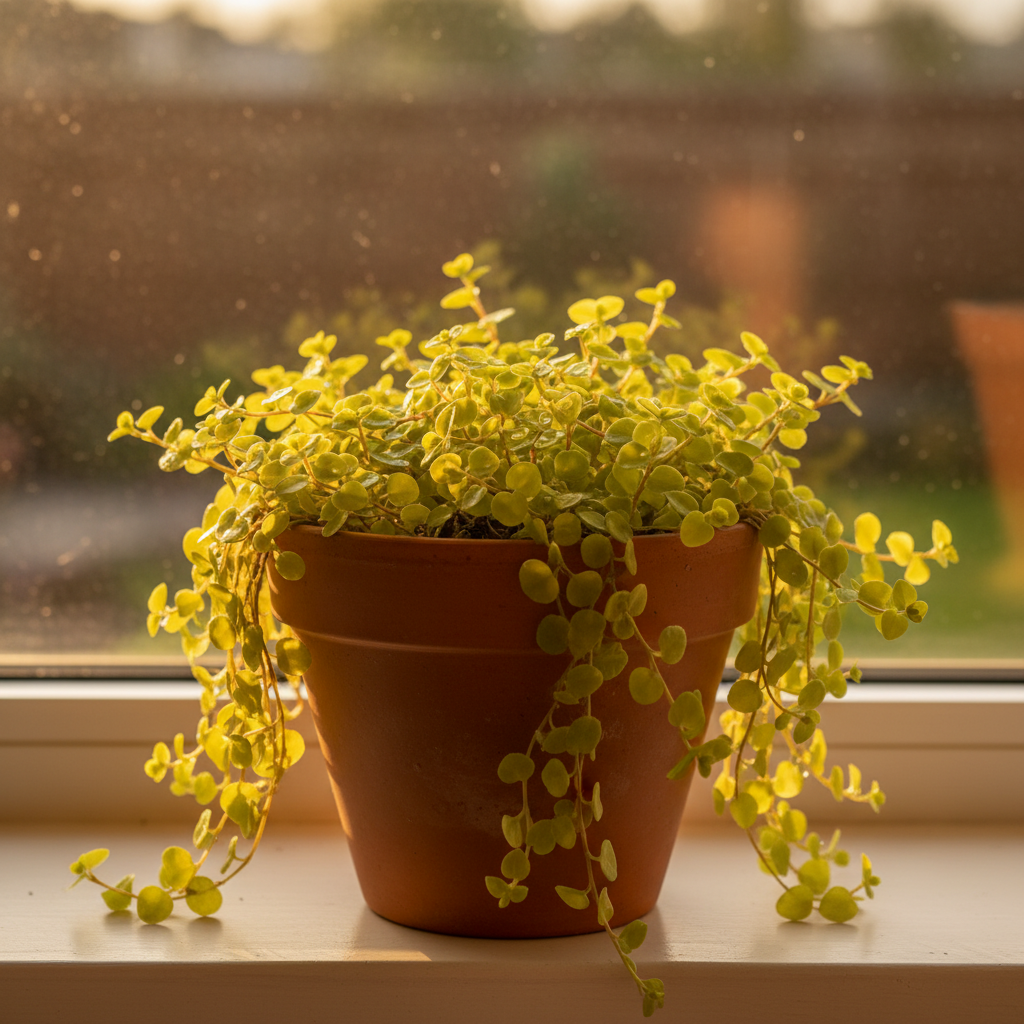
‘Aurea’ (Golden Baby Tears)
The most popular cultivar after the species itself, with luminous chartreuse to soft golden-yellow leaves that glow as if lit from within. The colour depends on light intensity, in bright indirect conditions the cushion takes on a true gold tone, while in lower light it fades to a paler lime. Paired with the plain green species in a mixed planter, the contrast is dramatic.
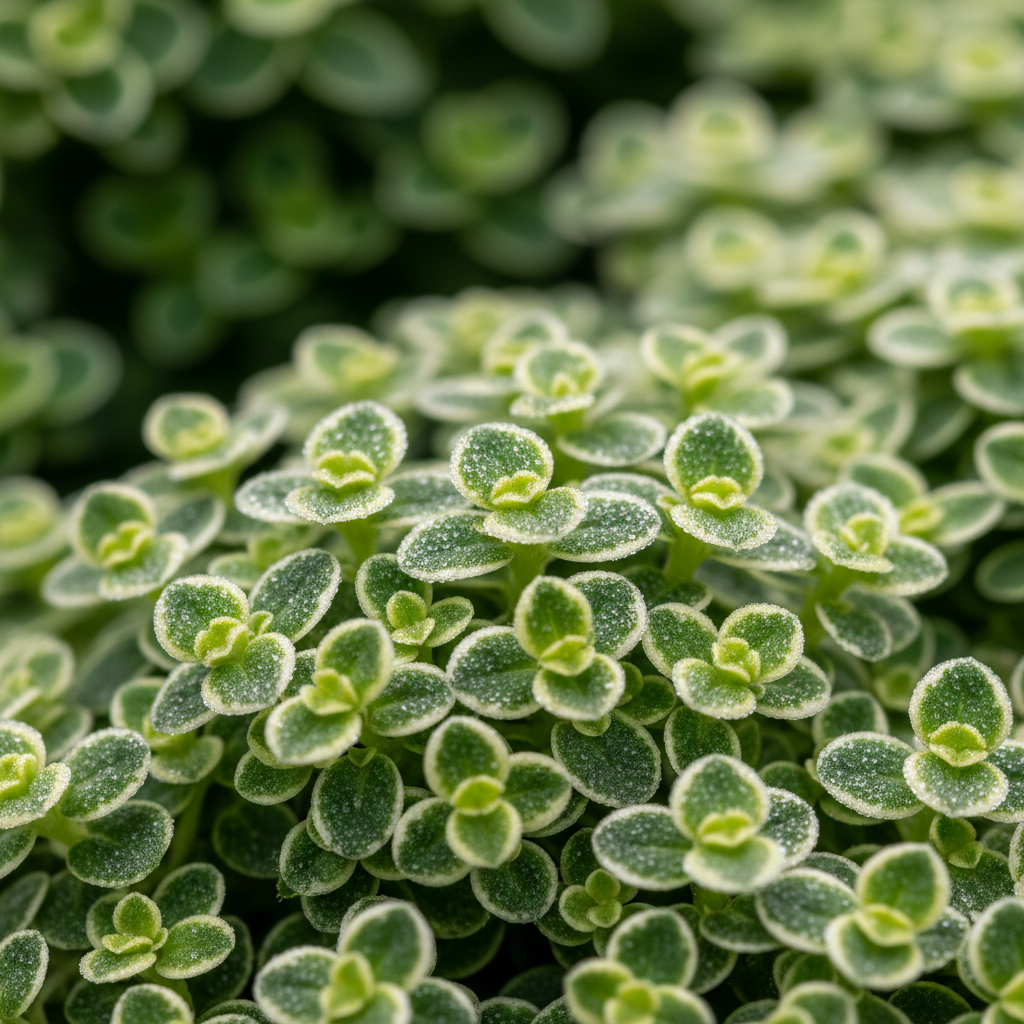
‘Variegata’ (Variegated Baby Tears)
The variegated form carries a soft creamy-white margin around each tiny green leaf, giving the cushion a frosted, twinkling appearance that reads almost as a fine dusting of snow from a short distance. Slower-growing than the plain species and slightly more demanding of bright indirect light to keep the variegation crisp, but rewarding in a closed terrarium where its delicate edges show to advantage.
Variety Profiles in Detail
‘Aurea’ (Soleirolia soleirolii ‘Aurea’)
Selected for the warm chartreuse to soft gold leaf colour, ‘Aurea’ was first widely distributed in European nurseries in the mid 20th century and remains the cultivar most likely to be sold alongside the plain green species. The colour intensity is light-driven, brighter conditions produce a more saturated golden tone, while overly dim positions cause it to revert towards a paler lime green that resembles a stressed version of the species. Growth rate is slightly slower than the species, and the cushion is marginally less robust under stress, which makes it a good barometer for general care.
‘Variegata’ (Soleirolia soleirolii ‘Variegata’)
The classic variegated form, with each minuscule round leaf carrying a thin cream-white margin around a green centre. The visual effect is a soft frosted shimmer at any distance over a few centimetres, with the individual variegation only resolving up close. Variegation is most stable in bright indirect light, and tends to fade towards plain green if the plant is grown in too low a light level for extended periods. Reverts to the green form should be pinched out at the source to prevent the more vigorous plain stems from dominating the cushion.
‘Argentea’ (Soleirolia soleirolii ‘Argentea’)
A rarer cultivar with a cool silvery-green leaf tone across the entire cushion rather than a contrasting margin. Less commercially propagated than ‘Aurea’ or ‘Variegata’, and most often found at specialist online nurseries. The silver tone holds up well in slightly lower light than the variegated form requires, and pairs strikingly with the chartreuse of ‘Aurea’ in a mixed planter.
‘Golden Queen’ (Soleirolia soleirolii ‘Golden Queen’)
A selected form with marginally larger gold leaves than standard ‘Aurea’, sold occasionally by specialist suppliers. Otherwise identical in care needs and habit. Sometimes mislabelled as plain ‘Aurea’ in trade.
Choosing the Right Variety for Your Space
For a plain bathroom shelf or a kitchen windowsill where the plant is going to be admired up close, the variegated forms reward inspection. For a mossy understory in a tall planter where the Baby Tears reads as a textural surface from across the room rather than as individual leaves, the plain green species or ‘Aurea’ work best. In a closed terrarium where humidity is permanently high and the plant fills in faster, mixed cultivars planted together create a layered, painterly effect, with the gold of ‘Aurea’ lifting the depth of the plain species and the silver tones of ‘Argentea’ providing contrast. Whichever cultivar you choose, the care is identical, the difference is purely visual, and the same shallow bowl, peat-free mix and bottom-watering rhythm carry them all.
Frequently Asked Questions
Why is my Baby Tears suddenly going brown in patches?
Sudden patchy browning almost always traces back to a single dry-out event, often missed because the surface looked fine but the substrate had already dried below. Baby Tears does not recover those affected stems, and they should be trimmed away. The remaining green cushion will fill back in within weeks if the watering rhythm is corrected. If the browning starts from the centre and spreads outwards instead of from the edge inwards, the cause is more likely root rot from prolonged sogginess, which requires harvesting cuttings and starting again.
Is Baby Tears safe around cats and dogs?
Yes. The ASPCA lists Soleirolia soleirolii as non-toxic to cats and dogs, and there are no documented poisoning cases in pets or humans. The plant is part of the nettle family but lacks any of the stinging or irritant compounds. Some pets will nibble at the soft cushion out of curiosity, which does no harm beyond temporarily damaging the plant. It remains one of the few common houseplants entirely safe to grow on a low shelf in a pet household.
Will Baby Tears grow in a closed terrarium?
Exceptionally well. A closed glass terrarium provides exactly the conditions the species evolved for, constant high humidity, even moisture, dappled rather than direct light. Inside a sealed jar or bottle, Baby Tears acts almost as a living ground cover and can fill the floor of the container within a few months. The main maintenance task is trimming back stems that climb the inside of the glass, since they will quickly try to colonise every available surface. Open the terrarium for an hour every week or two to let any condensation cycle out and reduce fungal pressure.
Can Baby Tears grow outdoors?
In mild temperate climates with shaded damp positions it can grow outdoors year-round and is hardy down to around minus 5 degrees Celsius (23 Fahrenheit) for short periods. In the UK and parts of the Pacific Northwest and California it is widely naturalised and treated as a weed in damp lawns and rockeries. Outdoor positions in cooler northern climates will lose the plant to the first hard frost. Container-grown Baby Tears can summer outdoors in a shaded sheltered spot and overwinter indoors, but bring it in before temperatures drop below about 5 degrees Celsius (41 Fahrenheit).
How do I stop my Baby Tears from getting leggy?
Legginess, longer stems with wider gaps between leaves, is almost always a light problem. Move the plant closer to a bright indirect source, or supplement with a small LED grow light in winter. Trimming the leggy stems back encourages denser regrowth, and the trimmings can be propagated as cuttings, so no plant material is wasted in the process.
Does Baby Tears flower?
Yes, but the flowers are so small that almost no one notices them. Tiny pinkish-white blooms appear in the leaf axils on mature plants in late spring or early summer, usually fewer than a millimetre across. They are not the reason anyone grows the species, and they have no effect on the plant’s general care. There is no need to deadhead or otherwise manage flowering, the cushion continues growing past it without interruption.
Why does my plant look smaller in winter?
Reduced light and lower indoor humidity in winter both slow Baby Tears growth, and a centrally heated room with dry forced air can pull the cushion noticeably back from its summer extent. This is normal and recovers in spring as conditions improve. Useful winter interventions are running a humidifier, supplementing with a grow light, and reducing fertiliser to zero until growth resumes naturally.
How long does a Baby Tears plant live indoors?
Individual stems live around a year, but the plant as a whole renews itself continuously through rooting nodes, so a well-kept Baby Tears can last indefinitely as a colony of constantly replacing stems. Most indoor specimens benefit from a full propagation refresh every two to three years, trimming back the entire cushion, taking cuttings from the freshest growth, and starting again in clean substrate. This keeps the plant looking dense and youthful far beyond what an untouched mat would achieve.
Why are my golden cultivar’s leaves turning green?
Reversion to plain green is a light problem in ‘Aurea’ and ‘Variegata’. Too dim a position and the plant produces chlorophyll-rich, lower-pigment leaves that look paler or revert toward the species. The fix is brighter indirect light, ideally near an east-facing window with sheer curtains, and patient trimming of any fully reverted plain green stems so they do not outcompete the variegated ones.
Can I grow Baby Tears as a lawn substitute?
In suitable climates, yes, but with significant caveats. The plant tolerates very light foot traffic, the kind of weight a small pet places, but breaks down quickly under normal lawn use. It also spreads aggressively and is classified as an invasive weed in some regions, which makes deliberate planting outdoors a poor choice in those areas. Indoors as a tabletop or terrarium plant, those concerns disappear entirely, and the visual effect of the dense green carpet is exactly the one a lawn-substitute fantasy promises without the regrets.






