
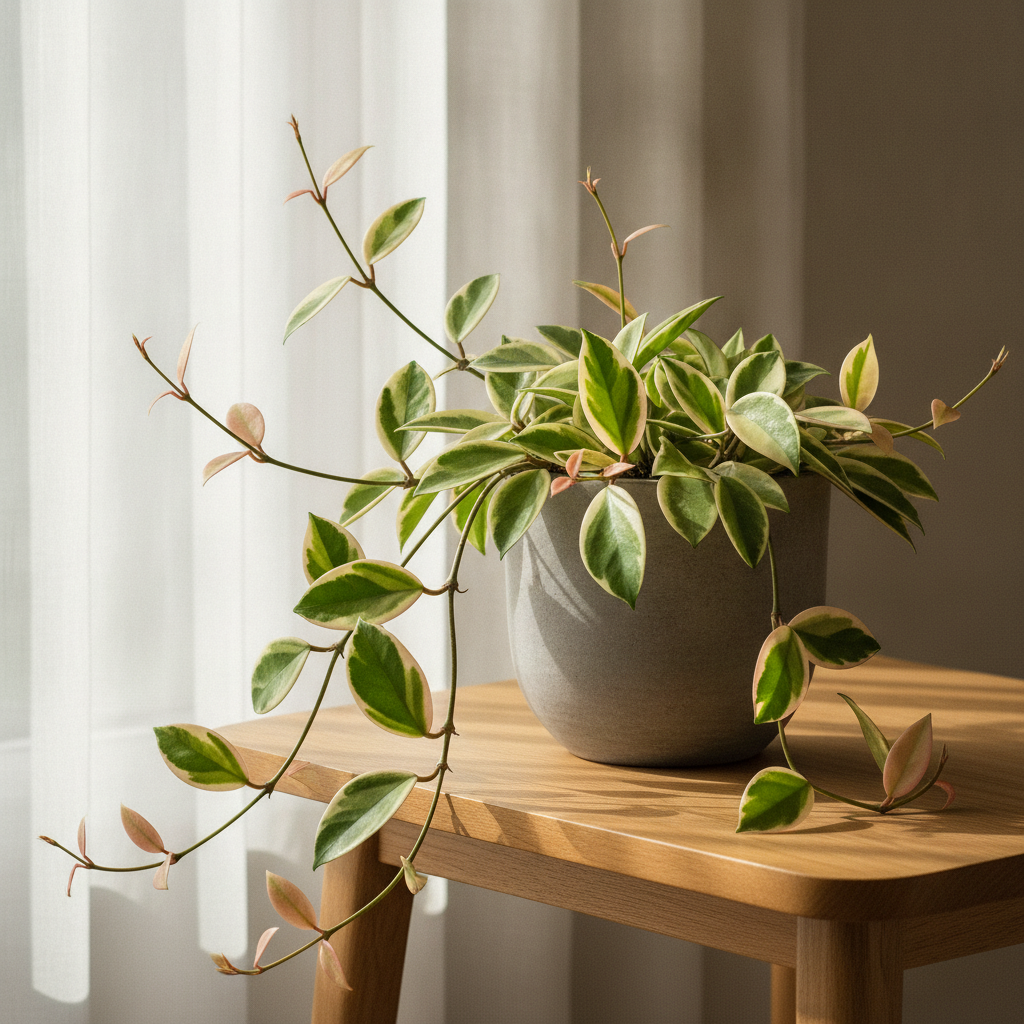
Few houseplants reward a hands-off owner quite like the Krimson Princess Hoya, a centre-variegated form of the classic wax plant whose thick, glossy leaves seem almost too perfect to be real. Known botanically as Hoya carnosa ‘Rubra’, it carries cream, butter-yellow and rose-pink colouring through the middle of each leaf, framed by a clean band of green, and it pushes out new growth in startling shades of coral and red. Native to the warm forests of East Asia and Australia, where the wax plant clambers up tree trunks as an epiphyte, this cultivar has become a collector favourite for combining easy temperament with genuinely unusual foliage.
The Krimson Princess has a reputation as one of the more forgiving variegated plants, and that reputation is largely deserved. Its semi-succulent leaves store water, so it shrugs off the occasional missed watering, and it asks for very little beyond decent light and a pot that drains. The gap between merely keeping one alive and coaxing it into lush, well-coloured growth with clusters of fragrant star-shaped flowers comes down to a handful of details. This guide walks through every one of them, from reading the light in your room to rooting cuttings and dealing with the mealybugs that adore hoyas.
Contents
- Quick Reference
- Why Krimson Princess Hoya Makes a Rewarding Houseplant
- Light Requirements
- Watering & Humidity
- Soil, Potting & Repotting
- Fertilising
- Propagation
- Pests & Diseases
- Popular Varieties
- Frequently Asked Questions
Quick Reference: Krimson Princess Hoya at a Glance
| Light | Bright, indirect light. A little gentle morning sun improves variegation and flowering. |
| Watering | Allow the top half of the mix to dry out, then water thoroughly. Roughly every 7 to 14 days in summer, less in winter. |
| Temperature | 18 to 27 degrees Celsius (64 to 81 degrees Fahrenheit). Keep above 12 degrees Celsius (54 degrees Fahrenheit). |
| Humidity | Tolerates average household humidity but prefers 50 to 70 per cent. |
| Fertiliser | Balanced feed at half strength every 3 to 4 weeks in spring and summer; a high-potassium feed encourages blooms. |
| Toxicity | Non-toxic to cats, dogs and humans. Considered pet safe. |
Why Krimson Princess Hoya Makes a Rewarding Houseplant
The Krimson Princess sits in a sweet spot that few plants manage to occupy. It is striking enough to anchor a shelf or trail dramatically from a hanging pot, yet undemanding enough to suit someone who travels often or simply forgets to water. The variegation is internal, meaning the cream and pink colouring runs through the centre of each leaf while the margins stay green, which is the reverse of its better-known sibling the Krimson Queen. Because the green margins retain plenty of chlorophyll, this cultivar grows more vigorously and tolerates lower light better than many heavily variegated plants, which often sulk and revert.
There is a second payoff that keeps growers loyal: the flowers. A mature, happy wax plant produces rounded clusters, called umbels, of small star-shaped blooms that look as though they have been moulded from porcelain or pink wax. Each cluster carries a sweet, often chocolate or honey scent that intensifies in the evening, and a single flowering spur will rebloom year after year if you leave it intact. Add to this the plant’s longevity, its pet-safe status and the fact that it stays manageable in size indoors, and it is easy to see why Hoya carnosa ‘Rubra’ has remained a staple of windowsills for generations.
Important — Toxicity: The Krimson Princess Hoya is one of the safer choices for homes with curious pets or children, as it is not known to be toxic to cats, dogs or people. The milky sap can still cause mild skin irritation in sensitive individuals, so wash your hands after taking cuttings.
Light Requirements
Light is the single biggest lever you have over a Krimson Princess, because it controls both how fast the plant grows and how much pink and cream shows in the leaves. As a forest epiphyte, the wax plant naturally grows in the dappled canopy where bright light filters through branches above. Indoors, the closest equivalent is a position that receives plenty of brightness without harsh, direct sun beating on the leaves for hours.
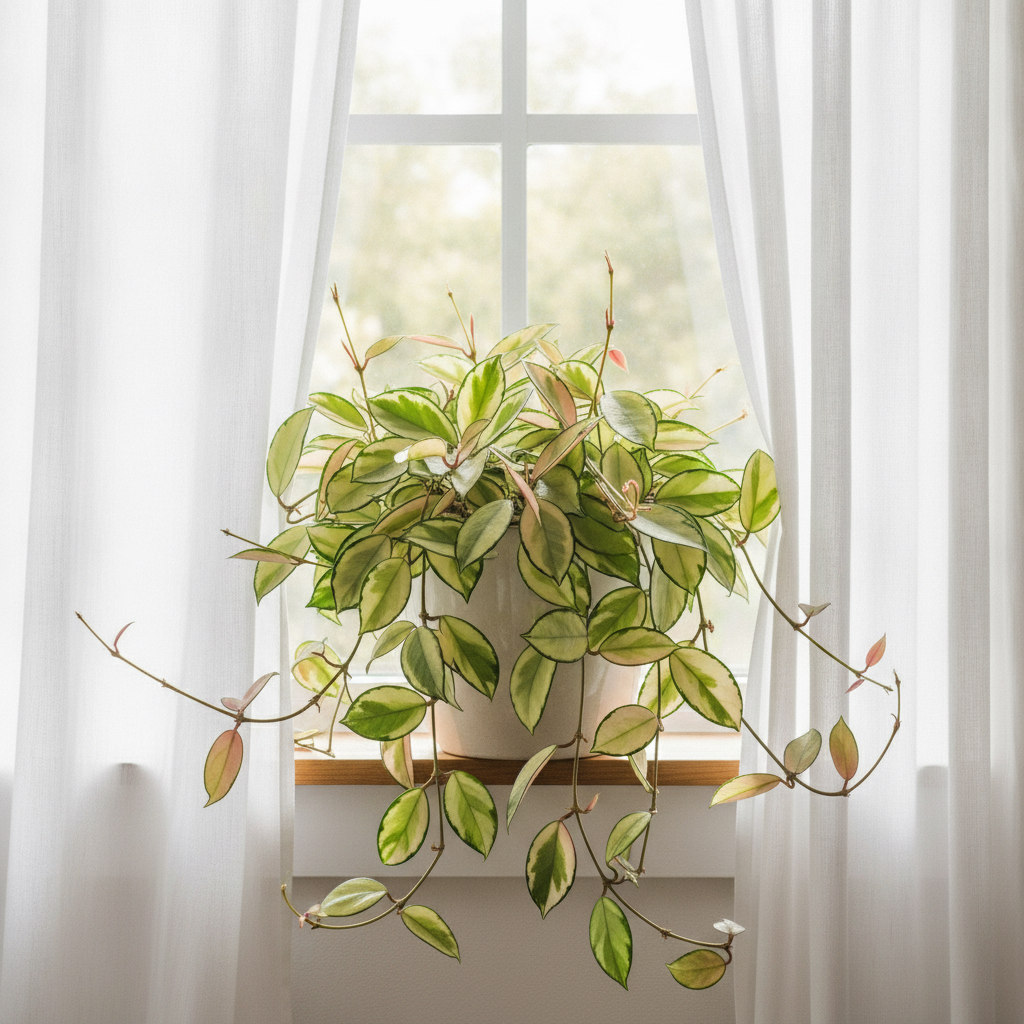
Aim for bright, indirect light for most of the day. A spot within a metre or two of an east or north-east window is often ideal, as is a position just back from a brighter south or west window where sheer curtains soften the midday glare. In good light the plant grows compactly, the variegation stays vivid and the chances of flowering rise sharply. In a dim corner it will survive, but growth slows to a crawl, the pink fades and new leaves emerge smaller and greener.
Light Levels Explained
If you are unsure how much light a given spot provides, the table below translates the usual descriptions into approximate lux values and the kind of result you can expect. A cheap light meter or a phone app will get you close enough for practical decisions.
| Light Category | Approx. Level | Typical Location | Outcome |
|---|---|---|---|
| Direct sun | 50,000 lux and above | On a south windowsill, midday | Risk of bleaching and scorch; tolerable only in early morning |
| Bright indirect | 10,000 to 20,000 lux | Near an east window or behind a sheer curtain | Ideal; strong colour, compact growth, best flowering |
| Medium | 5,000 to 10,000 lux | A metre or two back from a bright window | Good steady growth, slightly less intense variegation |
| Low | 1,000 to 5,000 lux | A north window or interior wall | Survives, slow growth, fading colour, rare flowering |
| Very low | Below 1,000 lux | A dim hallway or back of a room | Decline over time; not recommended |
Window Orientation and Placement
South-facing window: The brightest option in the northern hemisphere and a strong choice, provided you filter the most intense midday and afternoon sun with a sheer curtain or set the plant a short distance back. Unfiltered summer sun here can bleach and scorch the waxy leaves.
East-facing window: Often the perfect home for a Krimson Princess. Gentle morning sun gives the plant the energy it craves, while the cooler afternoon avoids any risk of burn. Variegation and flowering both tend to be excellent in this position.
West-facing window: A good spot that delivers bright afternoon light. Watch for hot afternoon sun in summer, which may need softening, but the extra brightness in winter is welcome.
North-facing window: Workable for keeping the plant ticking over, but light here is usually too weak for strong colour or blooms. Consider supplementing with a grow light if a brighter window is not available.
Pro Tip — Rotate for Even Growth: Hoyas grow towards the light and will lean over time. Give the pot a quarter turn each week so every side receives its share, keeping the plant balanced and the variegation even all the way round.
How Light Affects Variegation
The cream and pink portions of a Krimson Princess leaf contain little or no chlorophyll, so they cannot photosynthesise and depend entirely on the green tissue to feed the plant. In strong light the plant can afford to maintain that variegation, and the new growth often flushes a deep coral or red before settling into its mature colours. In weak light the plant compensates by producing greener, larger leaves with far less cream and pink, because it simply cannot support unproductive tissue. If you want that signature colouring, bright light is not optional, it is the whole game.
Warning — Direct Sunlight: The pale, low-chlorophyll patches on variegated hoyas burn far more easily than green leaves. A few hours of unfiltered summer sun can leave permanent crispy brown or bleached patches, so always introduce a plant to brighter light gradually over a week or two.
Artificial Lighting
The Krimson Princess responds well to grow lights, which makes it a viable plant for rooms with little natural light or for getting good colour through dark winters. A full-spectrum LED positioned 30 to 45 centimetres (12 to 18 inches) above the plant and run for 10 to 12 hours a day mimics the bright indirect light it prefers. Many growers who struggle to flower their hoyas on a windowsill find that the extra, consistent light from a good LED finally tips the plant into bloom.
Seasonal Adjustments
Light intensity indoors can fall by half or more between summer and the depths of winter, so a plant that thrived back from the window in July may need moving right up to the glass by December. As the days shorten, watch for slower growth and slightly stretched stems, and shift the plant to your brightest available window. When the strong light of spring returns, move it back and reintroduce any direct sun gradually to avoid shocking leaves that have acclimatised to lower levels.
Watering & Humidity
Watering is where most Krimson Princess problems begin, and almost always because of too much rather than too little. The thick, waxy leaves are semi-succulent and act as internal reservoirs, which means the plant is built to ride out dry spells and deeply resents sitting in soggy compost. Treat it more like a succulent than a thirsty tropical, and you will avoid the great majority of issues.
When to Water
Wait until the top half of the potting mix has dried out before watering again. The most reliable test is to push a finger several centimetres into the mix, or to lift the pot and feel its weight, as a dry pot is noticeably lighter. In practice this tends to mean watering every 7 to 14 days during the warm growing season and considerably less, perhaps every two to three weeks, through the cooler, darker months.
Rather than watering on a fixed calendar, let the plant and your conditions set the pace. Temperature, light, pot size and the time of year all change how quickly the mix dries. A Krimson Princess in a bright, warm room will drink far faster than the same plant in a cool, dim one, so always check the mix before reaching for the watering can.
Pro Tip — Slight Wrinkling Means Thirsty: If the normally plump leaves start to look a touch soft or wrinkled, the plant has used up its reserves and is ready for a thorough drink. This visible cue is far safer to follow than watering on a schedule, and it is almost impossible to underwater a hoya that you watch this way.
How to Water Correctly
- Check that the top half of the mix is dry before you begin.
- Water thoroughly with room-temperature water, pouring evenly across the surface until it flows freely from the drainage holes.
- Let the pot drain completely for several minutes so no excess remains trapped at the bottom.
- Empty the saucer or cache pot; never leave the plant standing in collected water.
- Return the plant to its spot and wait until the mix dries to the halfway point again before repeating.
Signs of Overwatering vs. Underwatering
| Symptom | Overwatering | Underwatering |
|---|---|---|
| Leaf colour | Yellowing, often several leaves at once | Dulling, with edges browning |
| Leaf texture | Soft, mushy, translucent | Wrinkled, thin, slightly limp |
| Soil | Stays wet for many days, may smell sour | Bone dry, pulling away from the pot sides |
| Roots | Brown, black, soft and foul-smelling | Dry and brittle but otherwise pale and intact |
| Stem base | Blackened and soft, collapsing | Firm but the plant looks generally tired |
Warning — Root Rot: Persistently wet mix starves the roots of oxygen and invites the fungi that cause root rot, the most common killer of hoyas. If you find soft, blackened roots, trim away every affected piece with sterile scissors, repot into fresh dry mix and hold off watering for several days while the plant recovers.
Humidity Requirements
The Krimson Princess is refreshingly relaxed about humidity and copes happily with the average household range of 40 to 50 per cent. That said, as a plant of humid forests it does grow a little faster and looks its best when humidity sits between 50 and 70 per cent, and higher humidity can also help reluctant cuttings root.
You are unlikely to see dramatic humidity-related distress on this plant, but very dry air, such as next to a radiator in winter, can leave leaf edges looking crisp and slow new growth. If the air in your home is especially parched, the plant will simply appreciate a little extra moisture.
To nudge humidity upwards, group the plant with other houseplants so they share the moisture they release, set the pot on a tray of pebbles topped up with water, or run a small humidifier nearby during the driest months. Misting offers only a brief lift and, on a plant prone to fungal issues if foliage stays wet, it is better skipped in favour of the steadier methods.
Water Quality
Average tap water suits the Krimson Princess in most areas. If your supply is very hard or heavily chlorinated, or if you notice a chalky crust building on the soil and pot, switch to filtered or rainwater, or leave tap water to stand overnight before using it. Room-temperature water is always kinder to the roots than a cold blast straight from the tap.
Soil, Potting & Repotting
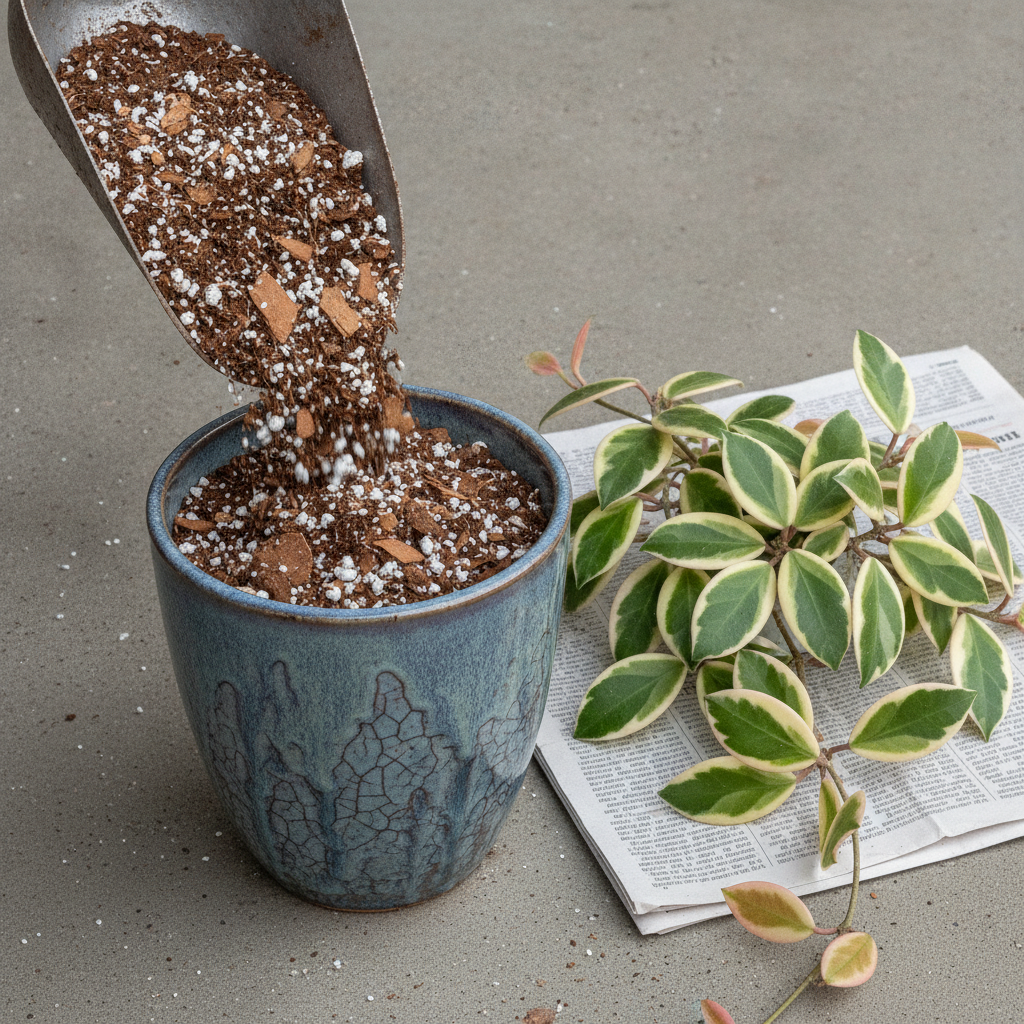
Because the wax plant grows as an epiphyte, clinging to bark with its roots exposed to air, it needs a potting medium that drains fast and never stays soggy. A dense, water-retentive compost is the surest route to root rot. The goal is a loose, chunky, airy mix that holds a little moisture but lets the rest run straight through.
Ideal Soil Composition
A good hoya mix borrows heavily from what you would use for an orchid or an aroid. Start with a quality houseplant compost as the base, then bulk it out generously with chunky materials that create air pockets around the roots. Many growers find a roughly equal blend of potting mix, orchid bark and perlite hits the mark, with a handful of charcoal or coco coir to keep things sweet and lightly moist.
| Component | Proportion | Function |
|---|---|---|
| Houseplant compost | About one third | Holds moisture and nutrients, the base of the mix |
| Orchid bark | About one third | Creates large air pockets and mimics the epiphytic root zone |
| Perlite or pumice | About one quarter | Sharpens drainage and keeps the mix from compacting |
| Horticultural charcoal | A handful | Keeps the mix fresh and helps prevent souring |
| Coco coir | A handful | Adds light, even moisture retention without sogginess |
The Krimson Princess is happiest in a slightly acidic to neutral medium, around pH 6.1 to 7.5, which most peat-free or bark-based mixes provide without any intervention. There is no need to test or adjust pH for ordinary indoor culture.
Pro Tip — Quick Mix Recipe: For a fast, reliable hoya blend, combine two parts orchid bark, two parts coco coir or peat-free compost, and one part perlite, with a scattering of charcoal. It drains in seconds yet stays just damp enough, and it suits almost every Hoya carnosa cultivar.
Choosing the Right Pot
Pot choice matters more than it might seem, because it directly affects how quickly the mix dries and how much air reaches the roots. The wax plant also flowers more freely when slightly underpotted, so resist the urge to give it a roomy home.
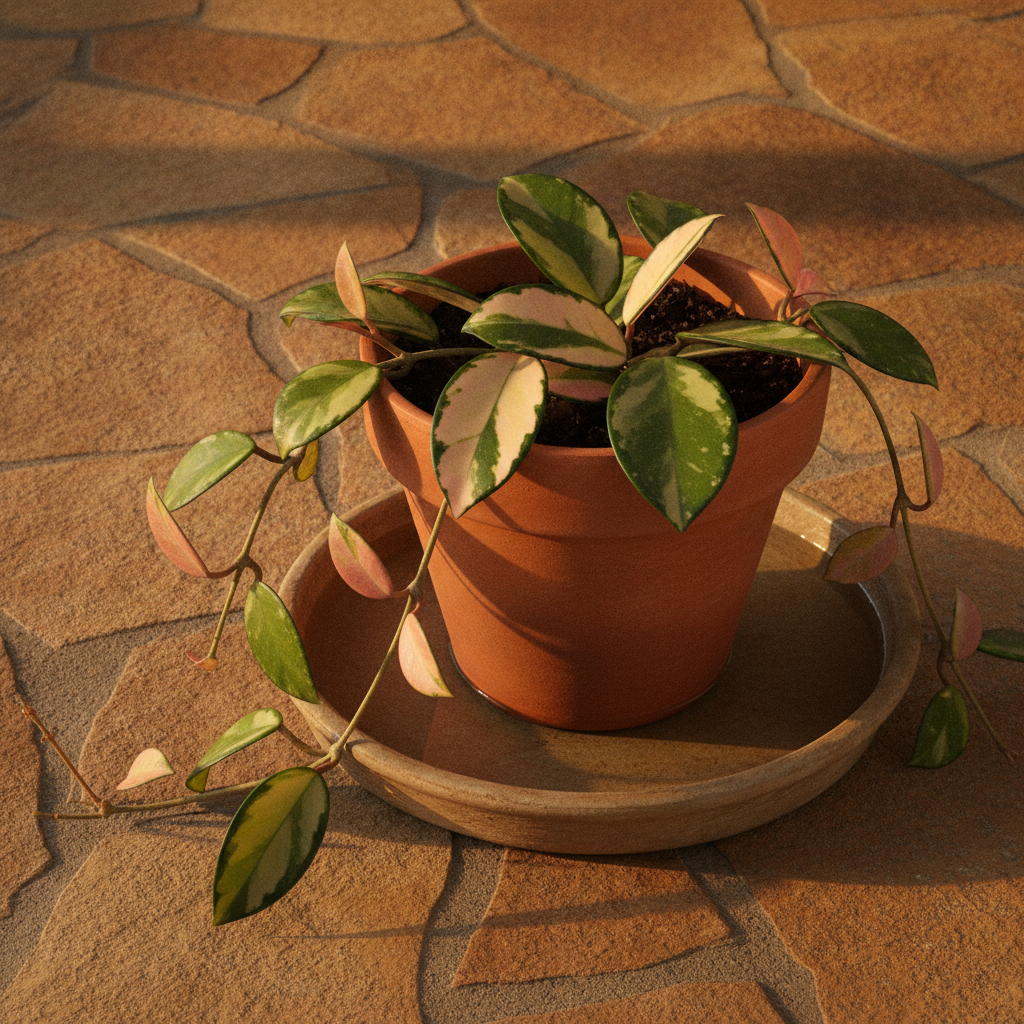
Drainage holes are non-negotiable. Whatever pot you choose, it must have holes in the base. Without them, water collects unseen at the bottom and rots the roots no matter how carefully you water. If you love a decorative pot with no holes, use it as a cover and keep the plant in a plain plastic nursery pot inside.
Pot material: Terracotta is excellent for hoyas because its porous walls wick moisture away and let the mix breathe, which suits a plant that hates wet feet. Plastic and glazed ceramic hold moisture longer, which can work well in very bright, warm rooms or for growers who tend to underwater, but call for a touch more restraint at the watering can.
Pot size: Choose a pot only slightly larger than the root ball, going up by just 2 to 3 centimetres (about an inch) in diameter when you do repot. A snug pot dries out at a healthy rate and encourages the plant to put energy into flowering rather than endless root growth.
When to Repot
Krimson Princess Hoyas are slow growers that genuinely like being root-bound, so they need repotting only every two to three years, or when you see roots creeping from the drainage holes, water running straight through without wetting the mix, or the plant drying out unusually fast. Spring, as growth picks up, is the best time to do it. Often the most useful job is not repotting at all but simply refreshing the top few centimetres of mix with fresh material each year.
How to Repot: Step-by-Step
- Water the plant a day or two beforehand so the root ball holds together and slides out more easily.
- Gently ease the plant from its pot, supporting the base of the stems and teasing the root ball free without yanking.
- Loosen the outer roots with your fingers and brush away the old, spent mix, inspecting for any soft or blackened sections.
- Trim away any rotten or dead roots with sterilised scissors, leaving the healthy pale roots intact.
- Add a layer of fresh chunky mix to a pot only slightly larger, position the plant at the same depth as before, and fill around the roots.
- Firm the mix lightly to remove large air gaps, but do not pack it down hard, as the roots need air.
- Water lightly to settle the mix, then return the plant to bright indirect light and resume normal care.
Warning — Transplant Shock: Avoid fertilising for four to six weeks after repotting, as disturbed roots are easily burned by feed. A little leaf droop or pause in growth is normal in the days afterwards; keep conditions stable and the plant will settle without intervention.
Fertilising
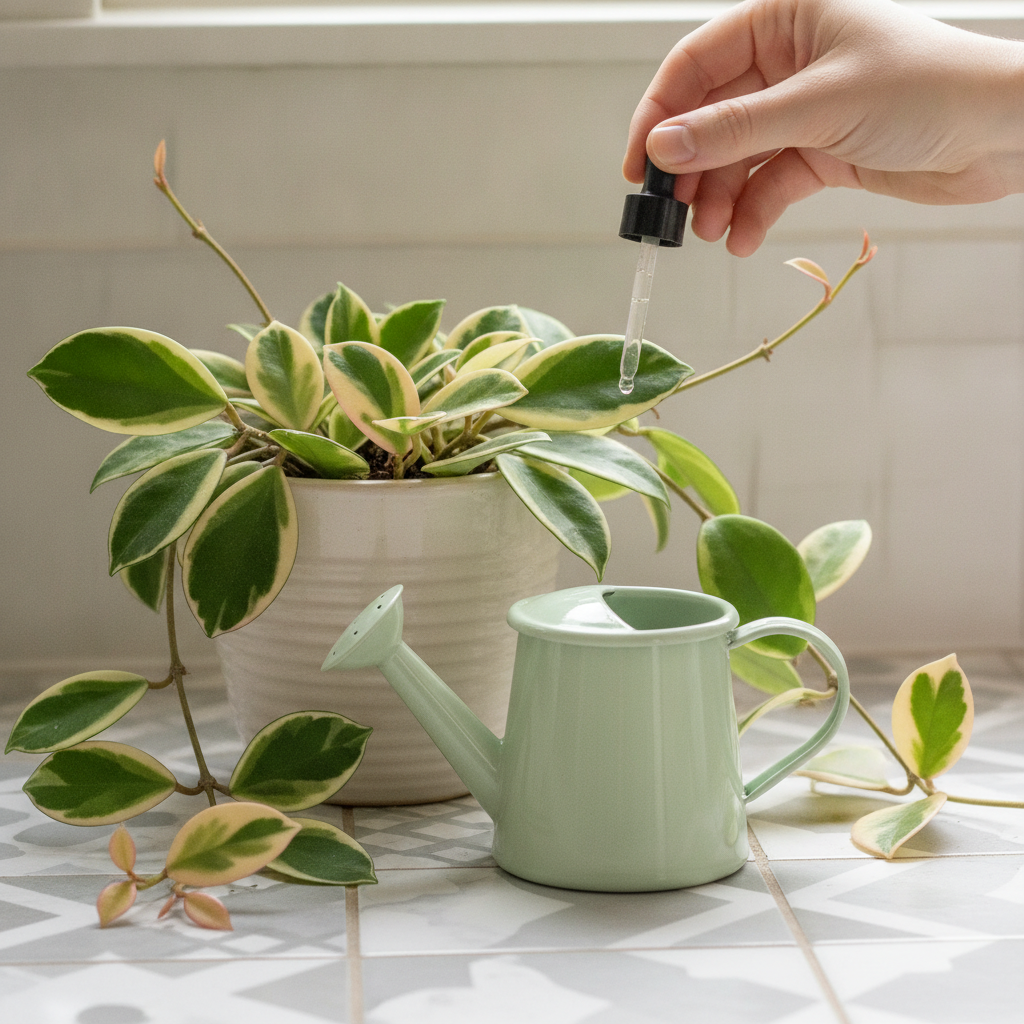
Hoyas are light feeders, and the Krimson Princess is no exception. It draws much of what it needs from a fresh, decent potting mix, so fertiliser is a gentle supplement rather than a heavy requirement. A modest, regular feed through the growing season keeps the leaves well coloured and supports flowering, while overfeeding does far more harm than good.
The aim is to provide a steady, dilute trickle of nutrients while the plant is actively growing in spring and summer, then to ease off almost entirely through the autumn and winter rest. Get the rhythm right and the plant rewards you with vigorous, well-variegated growth and, in time, those coveted clusters of scented flowers.
Understanding Plant Nutrients
Most fertilisers list three numbers, the NPK ratio, standing for nitrogen, phosphorus and potassium. Nitrogen drives leafy growth, phosphorus supports roots and flowering, and potassium underpins overall health and bloom production. For general growth a balanced feed works well, while a formula higher in phosphorus and potassium can encourage a mature plant to flower.
| Nutrient | Symbol | Primary Function | Deficiency Symptoms |
|---|---|---|---|
| Nitrogen | N | Leaf and stem growth, green colour | Pale, yellowing older leaves and stunted growth |
| Phosphorus | P | Root development and flowering | Poor rooting, weak flowering, dull foliage |
| Potassium | K | Overall vigour and bloom production | Browning leaf edges and few flowers |
| Calcium | Ca | Cell wall strength | Distorted or weak new growth |
| Magnesium | Mg | Core of the chlorophyll molecule | Yellowing between the veins of older leaves |
| Iron | Fe | Chlorophyll formation | Yellowing between the veins of new leaves |
Types of Fertiliser
Liquid fertilisers: The easiest choice for hoyas, as they are simple to dilute and apply with watering. They act quickly and give you precise control over strength, which is exactly what a light feeder like the Krimson Princess wants.
Slow-release granular: Pellets mixed into the surface release nutrients gradually over several months. Convenient for the forgetful, but harder to fine-tune, so use sparingly on a plant that prefers a light touch.
Organic fertilisers: Worm castings, diluted seaweed and similar gentle options feed slowly and improve the mix without much risk of burning. They suit hoyas well and are hard to overdo.
Feeding Schedule
Feed every three to four weeks during spring and summer with a balanced liquid fertiliser diluted to half the recommended strength. As autumn arrives and growth slows, taper off, and through winter stop feeding altogether so the plant can rest. If you are chasing flowers on a mature plant, switch to a higher-potassium bloom feed as the growing season begins.
Pro Tip — Less Is More: When in doubt, underfeed. Hoyas suffer far more from fertiliser salt build-up than from a missed feed, and a half-strength dose is plenty. You can always give a little more, but you cannot easily undo a chemical burn to the roots.
How to Fertilise
- Dilute the liquid feed to half the recommended strength in room-temperature water.
- Water the plant with plain water first if the mix is very dry, to protect the roots from concentrated feed.
- Apply the diluted solution evenly until it just begins to drain from the bottom.
- Let the pot drain fully and empty any saucer so no fertiliser sits at the roots.
- Flush the pot with plain water every couple of months to wash out any accumulated salts.
Warning — Salt Build-Up: A white crust on the soil surface or around the pot rim signals fertiliser salts accumulating, which can scorch roots and brown leaf tips. Flush the mix thoroughly with plenty of plain water to dissolve and wash these salts away.
Propagation
The Krimson Princess is wonderfully easy to propagate from stem cuttings, and doing so is the best way to fill out a sparse plant, share with friends or insure against losing a treasured specimen. Because the variegation is carried in the plant’s tissue rather than its genes alone, cuttings reliably keep the same cream and pink patterning as the parent.
The key to success lies in taking a cutting with at least one node, the small bump along the stem where leaves and roots emerge. A length of stem without a node will not root no matter how long you wait, while a healthy node-bearing cutting roots readily in water, moss or a chunky mix.
Understanding Nodes
A node is the point on the stem from which leaves grow and where new roots will form. On a Krimson Princess it appears as a slight thickening, usually paired with a leaf or two. When you take a cutting, count at least one and ideally two nodes along the piece, then strip the lowest leaves so the bare node can sit in your rooting medium. Everything that follows depends on getting this single detail right.
Water Propagation: Step-by-Step
Rooting in water is the most beginner-friendly method because you can watch progress unfold and know exactly when roots are ready for potting.
- Using clean, sharp scissors, cut a healthy length of stem with two or three nodes, just below the lowest node.
- Remove the leaves from the lower node or two, leaving at least one or two leaves at the top.
- Place the cutting in a glass of room-temperature water so the bare nodes are submerged but the remaining leaves stay dry.
- Set the glass in bright, indirect light and refresh the water every few days to keep it clear and oxygenated.
- After three to six weeks, when roots reach 3 to 5 centimetres (1 to 2 inches), pot the cutting into a chunky mix and keep it lightly moist while it settles in.
Pro Tip — Warmth Speeds Rooting: Hoya cuttings root fastest in warmth, ideally around 22 to 25 degrees Celsius (72 to 77 degrees Fahrenheit). A spot on top of a warm appliance or a heat mat can cut rooting time noticeably, and high humidity around the cutting helps even more.
Sphagnum Moss Propagation: Step-by-Step
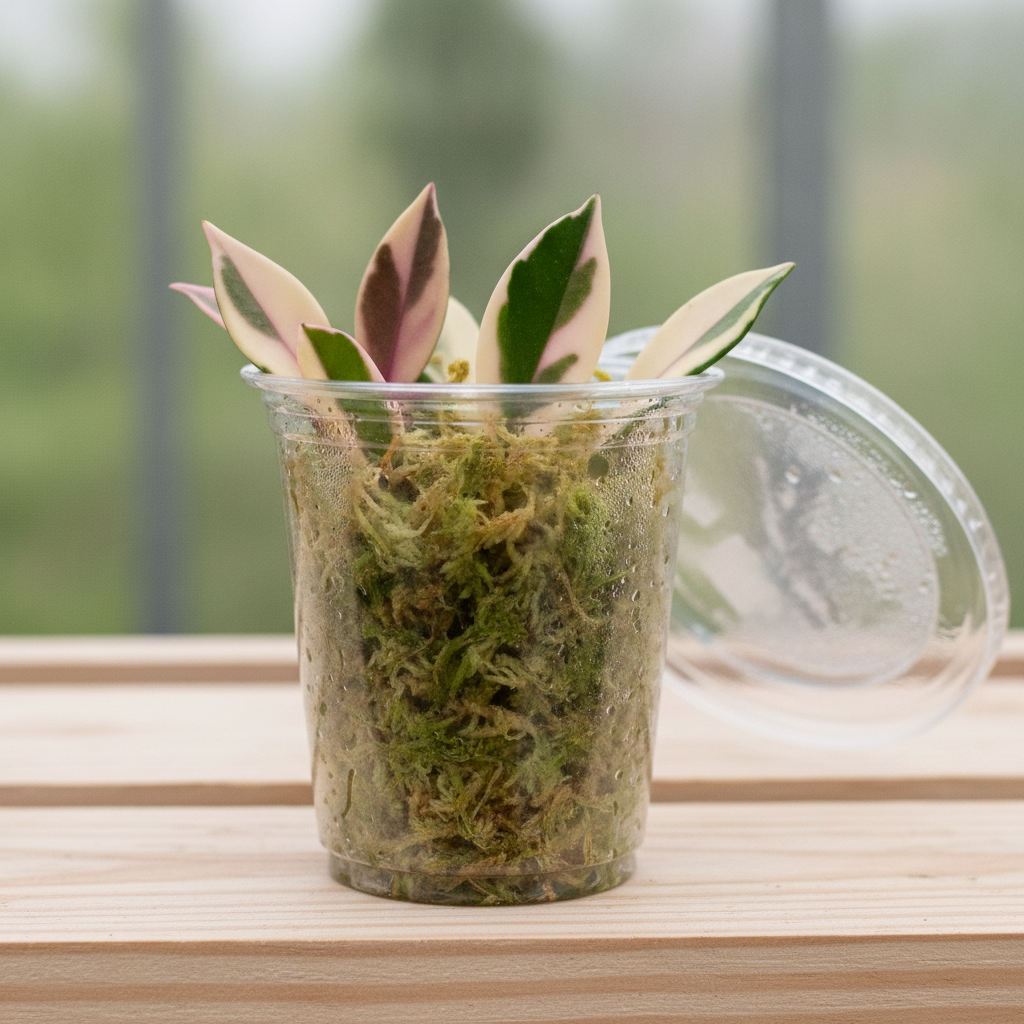
Rooting in damp sphagnum moss often produces sturdier roots that transition to soil with less shock, since the cutting roots directly into an airy, soil-like medium.
- Soak a handful of sphagnum moss, then wring it out until it is just damp and no longer dripping.
- Take a cutting with two or three nodes and strip the lower leaves as before.
- Nestle the bare nodes into the moss inside a clear container or deli cup, leaving the top leaves exposed.
- Cover loosely to trap humidity, leaving a small gap for airflow, and place in bright, indirect light.
- Keep the moss lightly damp; once roots are well established after four to six weeks, pot the cutting into a standard chunky mix.
Troubleshooting Propagation
| Problem | Likely Cause | Solution |
|---|---|---|
| Cutting rots in water | No node submerged, or water left stagnant | Ensure a node is under water and refresh it regularly |
| No roots after many weeks | Too cold, too dark, or no node on the cutting | Add warmth and brighter light, and check for a viable node |
| Leaves shrivel on the cutting | Low humidity drawing moisture from the leaves | Raise humidity with a cover or propagation box |
| Roots form but plant stalls after potting | Transplant shock or overly dense mix | Use a chunky mix, keep warm and humid, and be patient |
Pests & Diseases
The Krimson Princess is generally robust, but its thick, sugary sap and dense growth make it a particular favourite of one pest above all others: the mealybug. Most trouble is preventable with good light, careful watering and the occasional close inspection, and even an established infestation can be cleared with patience.
Catching problems early makes all the difference. Look over your plant whenever you water, paying special attention to the undersides of leaves, the leaf axils where stem meets leaf, and the tight crevices of new growth, which is where pests like to hide.

Common Pests
Mealybugs (Pseudococcus species)
The number one enemy of hoyas, mealybugs appear as small, white, cottony tufts clustered in leaf axils and along stems. They suck sap, weaken the plant and excrete sticky honeydew that attracts sooty mould. Their waxy coating makes them stubborn, and they hide deep in tight growth.
Treatment: Dab each insect with a cotton bud dipped in isopropyl alcohol, which dissolves their protective coat on contact. Follow up with a thorough spray of insecticidal soap or diluted neem oil every week for several weeks, and isolate the plant until no new bugs appear.
Aphids (Aphidoidea)
Small green, black or pink insects that gather on soft new growth and, most tellingly, on flower buds and stalks. They distort tender shoots and, like mealybugs, leave sticky honeydew behind.
Treatment: Rinse them off under a tap or wipe them away, then treat with insecticidal soap or neem oil. Aphids reproduce quickly, so repeat every few days until they are gone, taking care around any developing flower clusters.
Scale (Coccoidea)
Scale insects look like small brown or tan bumps stuck firmly to stems and the undersides of leaves. Under their hard shells they feed on sap, causing yellowing and slow decline, and they are easy to mistake for part of the plant.
Treatment: Scrape them off gently with a fingernail or old toothbrush, then treat with neem oil or a systemic insecticide to reach any juveniles. Check regularly, as scale can be persistent.
Spider mites (Tetranychus urticae)
Tiny sap-sucking mites that thrive in hot, dry air. They cause fine pale stippling on the leaves and spin delicate webbing in severe cases, and their small size means they often go unnoticed until numbers are high.
Treatment: Raise humidity and rinse the foliage, then apply neem oil or a miticide, treating the undersides of the leaves thoroughly. Repeat at weekly intervals to break the breeding cycle.
Common Diseases
Root Rot (Pythium and Phytophthora)
By far the most serious threat to a Krimson Princess, root rot follows from overwatering or poor drainage. The roots turn brown and mushy, the lower leaves yellow and drop, and the stem base may blacken and soften.
Treatment: Unpot the plant, cut away all soft black roots with sterile scissors, and repot into fresh, dry, chunky mix. Water sparingly while it recovers, and if the rot is advanced, take healthy cuttings as insurance.
Botrytis (Botrytis cinerea)
Also called grey mould, this fungus shows as a fuzzy grey coating on leaves or flowers in cool, damp, still conditions, often where foliage stays wet for too long.
Treatment: Remove affected parts promptly, improve air circulation, and avoid wetting the leaves when watering. A fungicide can help if the problem persists.
Sooty Mould (Capnodium species)
A black, soot-like film that grows on the honeydew left by sap-sucking pests. It does not attack the plant directly but blocks light from the leaves and signals an underlying pest problem.
Treatment: Wipe the leaves clean with a damp cloth and, crucially, deal with the pests producing the honeydew, after which the mould will not return.
Pest and Disease Summary
| Pest / Disease | Identification | Treatment |
|---|---|---|
| Mealybugs | White cottony tufts in axils and on stems | Alcohol on a cotton bud, then neem or insecticidal soap |
| Aphids | Clusters on buds and new growth, sticky honeydew | Rinse off, then insecticidal soap or neem oil |
| Scale | Brown bumps fixed to stems and leaf undersides | Scrape off, then neem oil or systemic insecticide |
| Spider mites | Fine stippling and webbing, worse in dry air | Raise humidity, rinse, then neem oil or miticide |
| Root rot | Mushy black roots, yellowing lower leaves | Trim rotten roots, repot into dry mix, water less |
| Sooty mould | Black film over honeydew on leaves | Wipe clean and eliminate the underlying pest |
Prevention Strategies
Prevention is far easier than cure. Quarantine any new plant for a couple of weeks before letting it join your collection, and inspect your Krimson Princess regularly so you catch trouble while it is still small. A healthy plant in good light, watered correctly and not overfed, is naturally more resistant to both pests and disease.
Keep the leaves clean and dust-free, ensure decent air circulation around the plant, and avoid the chronic overwatering that underlies most fungal problems. These simple habits, repeated consistently, prevent the overwhelming majority of issues before they start.
Pro Tip — Treat Early and Often: Mealybugs in particular are far easier to control when you catch the first one or two. A quick weekly glance into the leaf axils, and a dab of alcohol at the first sign, will save you the long battle that follows a full infestation.
Popular Varieties
The Krimson Princess belongs to the wider Hoya carnosa family, one of the most varied and beloved groups in the houseplant world. Understanding where it sits among its relatives helps you appreciate its particular charm and choose companions that complement it.
The defining feature of the Krimson Princess is its internal, or centre, variegation, with cream and pink running through the middle of each leaf. This sets it apart most clearly from the Krimson Queen, which carries its variegation on the leaf margins instead. Both descend from the plain green species, and seeing the three side by side is the best way to read the differences.
| Variety | Leaf Appearance | Light Needs | Growth Rate | Availability |
|---|---|---|---|---|
| Krimson Princess | Cream and pink centre, green margins | Bright indirect | Slow to moderate | Common |
| Krimson Queen | Cream and pink margins, green centre | Bright indirect | Moderate | Common |
| Hoya carnosa (species) | Solid glossy deep green | Bright indirect to medium | Moderate to fast | Very common |
| Hoya carnosa ‘Compacta’ | Curled, twisted green leaves on rope-like stems | Bright indirect | Slow | Common |
| Hoya carnosa ‘Tricolor’ | Green, cream and strong pink combined | Bright indirect | Slow to moderate | Common |
| Hoya carnosa ‘Variegata’ | Green leaves edged in creamy white | Bright indirect | Moderate | Common |
Featured Varieties
Krimson Queen
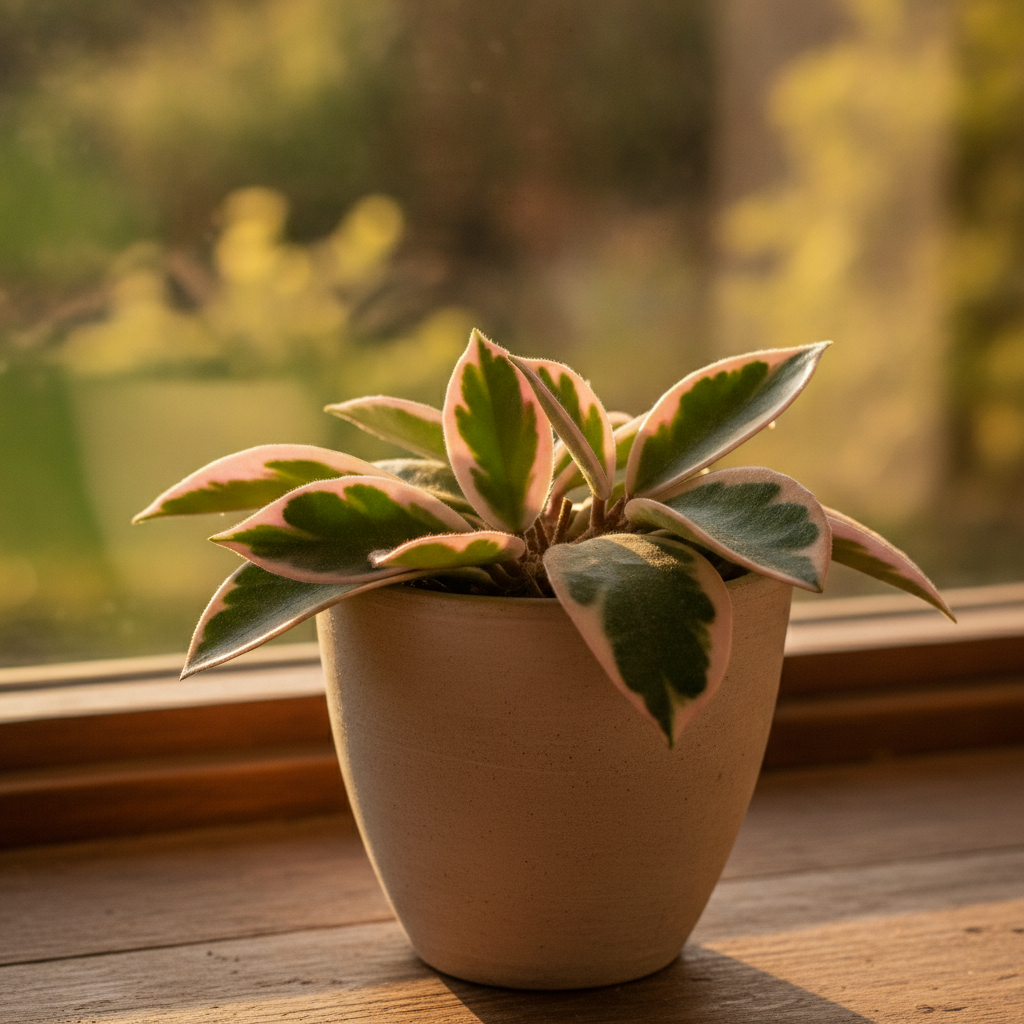
The Princess’s close sibling and constant point of comparison. The Krimson Queen carries its cream, white and pink variegation along the leaf margins, leaving a green centre, the exact reverse of the Princess. New growth often emerges a soft pink before greening.
Hoya carnosa (Species)
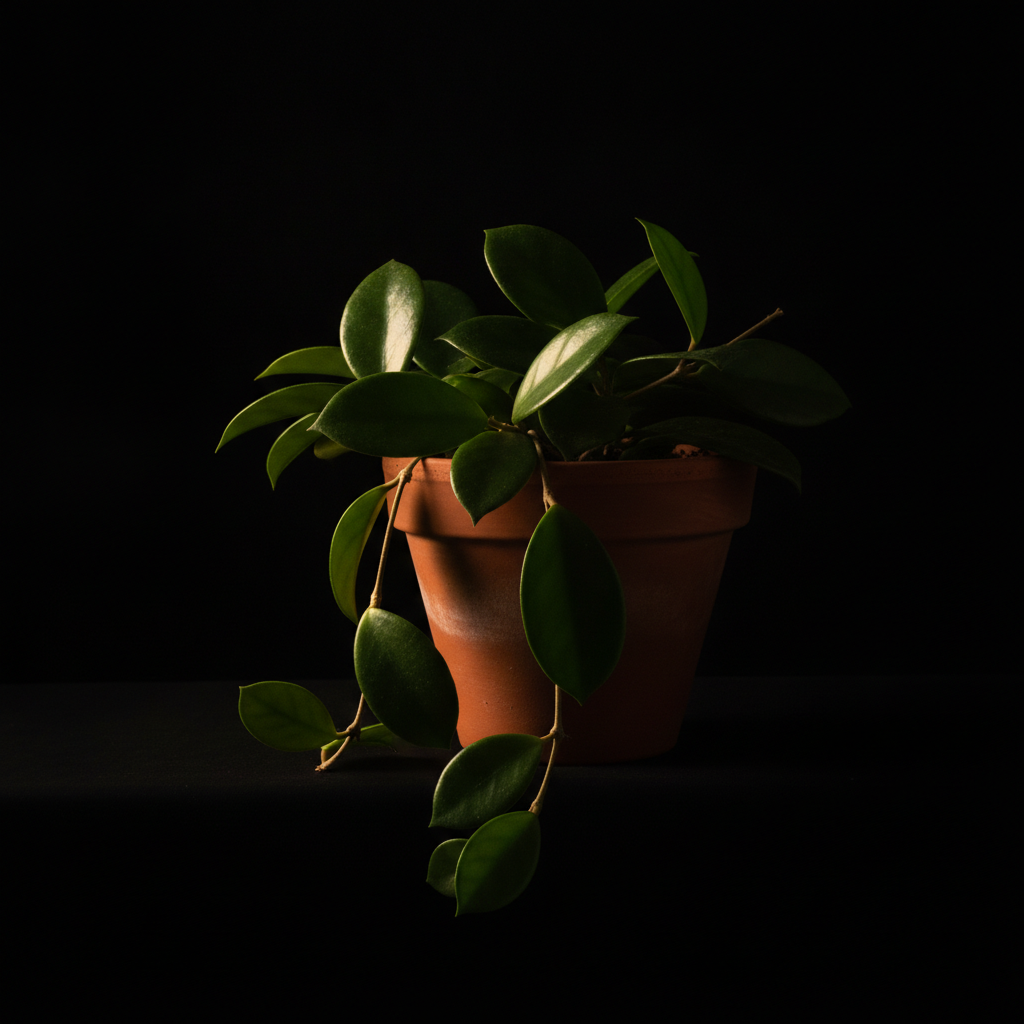
The original wax plant from which all these cultivars arose. Its solid, glossy deep-green leaves photosynthesise at full capacity, so it grows faster and flowers more freely than its variegated offspring, making it the toughest and most forgiving of the group.
Variety Profiles in Detail
Krimson Queen (Hoya carnosa ‘Krimson Queen’)
Often sold under the name Tricolor, the Krimson Queen is the marginally variegated counterpart to the Princess. Because the green sits in the centre where the leaf is most active, it tends to grow a touch more vigorously than the Princess while offering the same easy temperament and lovely pink new growth.
Hoya carnosa ‘Compacta’ (Hoya carnosa ‘Compacta’)
The curious Hindu rope plant, with leaves so tightly curled and folded that the stems resemble twisted rope. It is slow-growing and a little more demanding about drainage, but its sculptural form makes it one of the most distinctive members of the family.
Hoya carnosa ‘Tricolor’ (Hoya carnosa ‘Tricolor’)
A name applied to the most strongly pink-flushed forms, where green, cream and vivid pink mingle across the foliage. The intensity of the pink depends heavily on light, so a bright position brings out its best colour.
Choosing the Right Variety for Your Space
If you have a genuinely bright spot and want maximum colour, the Krimson Princess and its variegated relatives will reward you handsomely. If your light is more modest, or you simply want the easiest, fastest-growing option, the plain green species or the green-centred Krimson Queen are more tolerant choices. Whichever you pick, the underlying care is identical, so collecting several is an easy way to enjoy the full range of this endlessly charming group.
Frequently Asked Questions
Why is my Krimson Princess losing its pink and cream variegation?
Almost always insufficient light. The pale, low-chlorophyll tissue is expensive for the plant to maintain, so in dim conditions it produces greener, plainer leaves instead. Move the plant to a brighter spot with plenty of indirect light and the new growth should regain its colour.
How do I get my wax plant to flower?
Flowering needs a mature plant, bright light and a little patience. Keep it slightly root-bound, feed with a higher-potassium fertiliser as the growing season begins, and ensure it gets as much bright indirect light as possible. Crucially, never remove the flowering spurs, as blooms form from the same spur year after year.
Should I cut off the flower stalks after blooming?
No. The leafless stalk left behind, called a peduncle or spur, will produce next season’s flowers from the very same point. Cutting it off removes the structure the plant relies on to rebloom, so always leave spent spurs in place.
Is the Krimson Princess Hoya safe for cats and dogs?
Yes. The wax plant is considered non-toxic to cats, dogs and humans, which makes it one of the safer choices for a pet-friendly home. The milky sap may cause minor skin irritation, so wash your hands after pruning, but it poses no serious risk if nibbled.
Why are the leaves wrinkled or soft?
Wrinkled leaves usually mean the plant is thirsty and has drawn on its stored water, in which case a thorough watering plumps them up within a day or two. If the leaves are soft and the soil is wet, however, suspect root rot from overwatering, and check the roots without delay.
How fast does a Krimson Princess Hoya grow?
Slowly to moderately, especially compared with the plain green species. Its variegation means less photosynthetic tissue and therefore slower growth, so be patient. Bright light, warmth and consistent care through the growing season will give you the fastest, healthiest progress.
Why does my hoya keep getting mealybugs?
Hoyas have sugary sap and dense, crevice-filled growth that mealybugs love. Recurring outbreaks usually mean a few survivors are hiding deep in the leaf axils. Treat thoroughly and repeatedly over several weeks, isolate the plant, and inspect new arrivals carefully before introducing them to your collection.
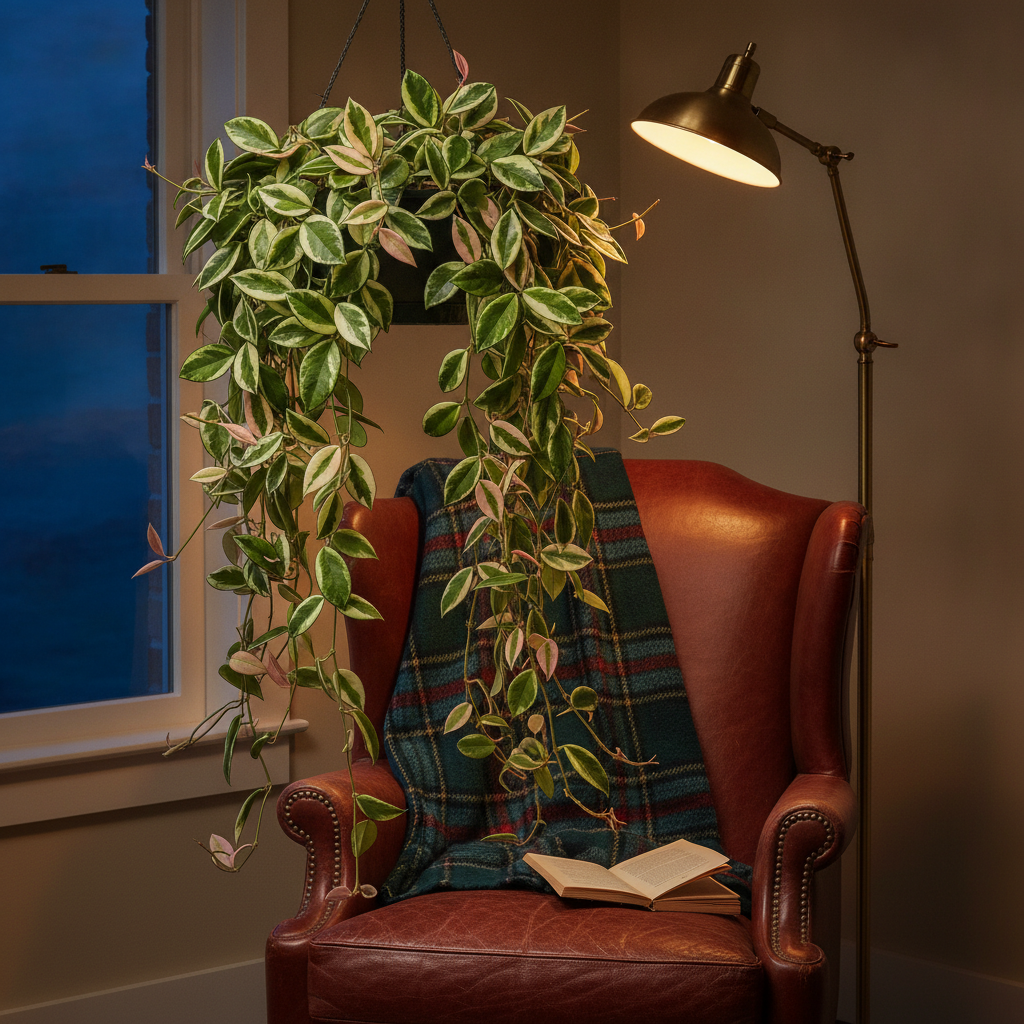
Can I grow a Krimson Princess in a hanging basket?
Absolutely. Its trailing stems look beautiful cascading from a hanging pot, and the raised position often improves air circulation. Just make sure the basket has drainage and that you can still reach it easily to check the soil and water when needed.






