
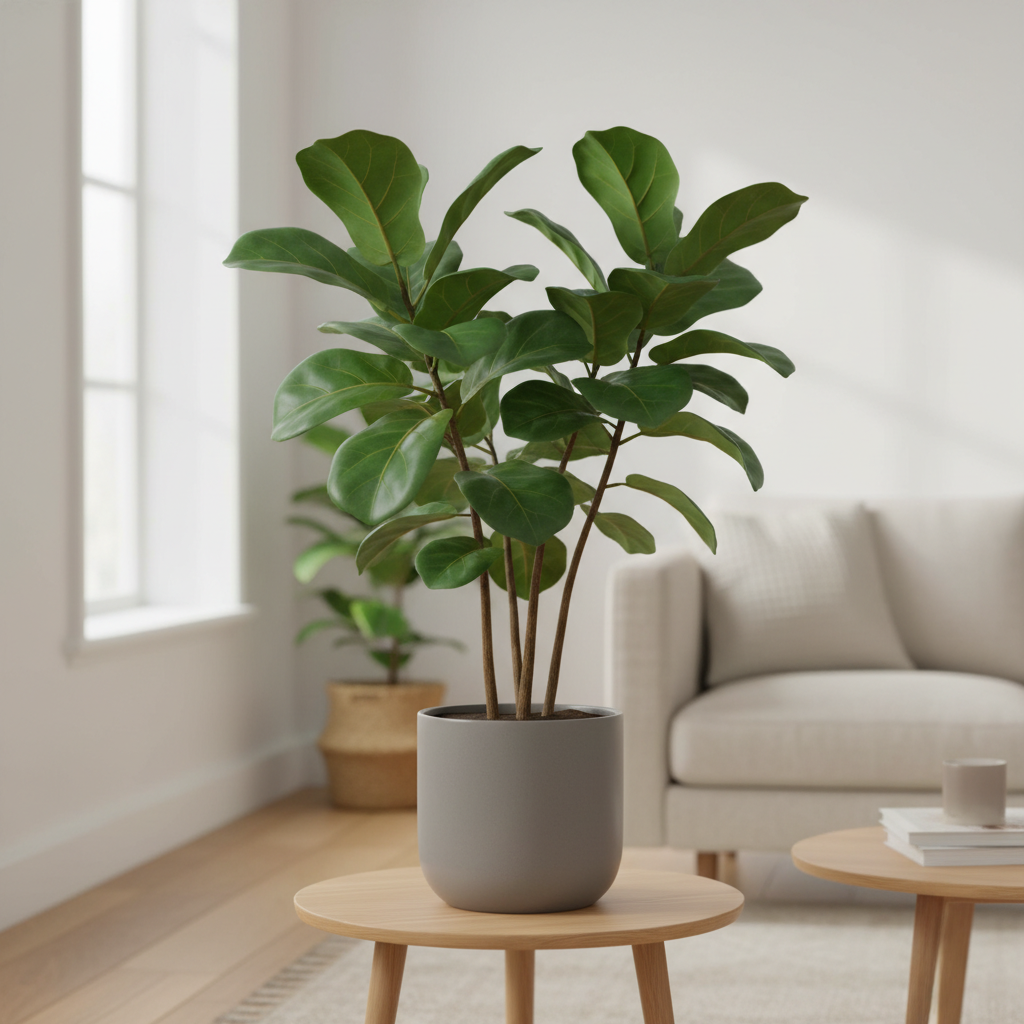
Few houseplants have shaped the look of contemporary interiors as decisively as the fiddle leaf fig. With its outsized, violin-shaped leaves and tall, sculptural silhouette, Ficus lyrata has appeared on the cover of more design magazines, in more boutique hotel lobbies and beside more linen sofas than perhaps any other plant of the last two decades. It is native to the lowland tropical rainforests of western and central Africa, where it begins life as an epiphyte high in the canopy before sending down strangling roots and eventually establishing itself as a towering tree of up to fifteen metres (around fifty feet). The species name lyrata refers to the shape of those leaves, which echo the curved body of a Greek lyre.
For all its glamour, the fiddle leaf fig has a reputation for being temperamental, and a quick search will turn up countless stories of dropped leaves, brown spots and sudden, unexplained declines. The truth is more reassuring: this plant has very specific preferences, and once those preferences are met, it is a steady and rewarding grower. The aim of this guide is to move past the survival mindset and explore what it takes for a fiddle leaf fig to truly thrive in a home, producing new leaves consistently, holding its dramatic posture for years and developing the woody trunk that defines a mature specimen.
Contents
- Quick Reference
- Why the Fiddle Leaf Fig Makes a Striking Houseplant
- Light Requirements
- Watering and Humidity
- Soil, Potting and Repotting
- Fertilising
- Propagation
- Pests and Diseases
- Popular Varieties
- Frequently Asked Questions
Quick Reference: Fiddle Leaf Fig at a Glance
| Light | Very bright indirect light, with up to several hours of gentle direct sun tolerated |
| Watering | Thorough soak when the top 3 to 5 cm (about 1 to 2 in) of soil are dry, then full drainage |
| Temperature | 18 to 27 degrees Celsius (65 to 80 degrees Fahrenheit); avoid drops below 13 degrees Celsius (55 degrees Fahrenheit) |
| Humidity | 40 to 60 percent; tolerates average household air but resents extremes |
| Fertiliser | Balanced liquid feed every 4 weeks in spring and summer, paused in winter |
| Toxicity | Mildly toxic to cats, dogs and humans; the milky latex sap can irritate skin and the mouth |
Why the Fiddle Leaf Fig Makes a Striking Houseplant
The appeal of the fiddle leaf fig is largely architectural. Where many houseplants offer texture or trailing softness, Ficus lyrata brings vertical presence. A well-grown specimen can comfortably reach two to three metres (about six to ten feet) indoors, with a single bare trunk topped by a dense crown of glossy, paddle-shaped leaves that can each measure thirty centimetres (around twelve inches) or more across. That scale lets a single plant define a corner the way a piece of furniture or sculpture would, which is why it has become a fixture of magazine spreads and high-end retail displays.
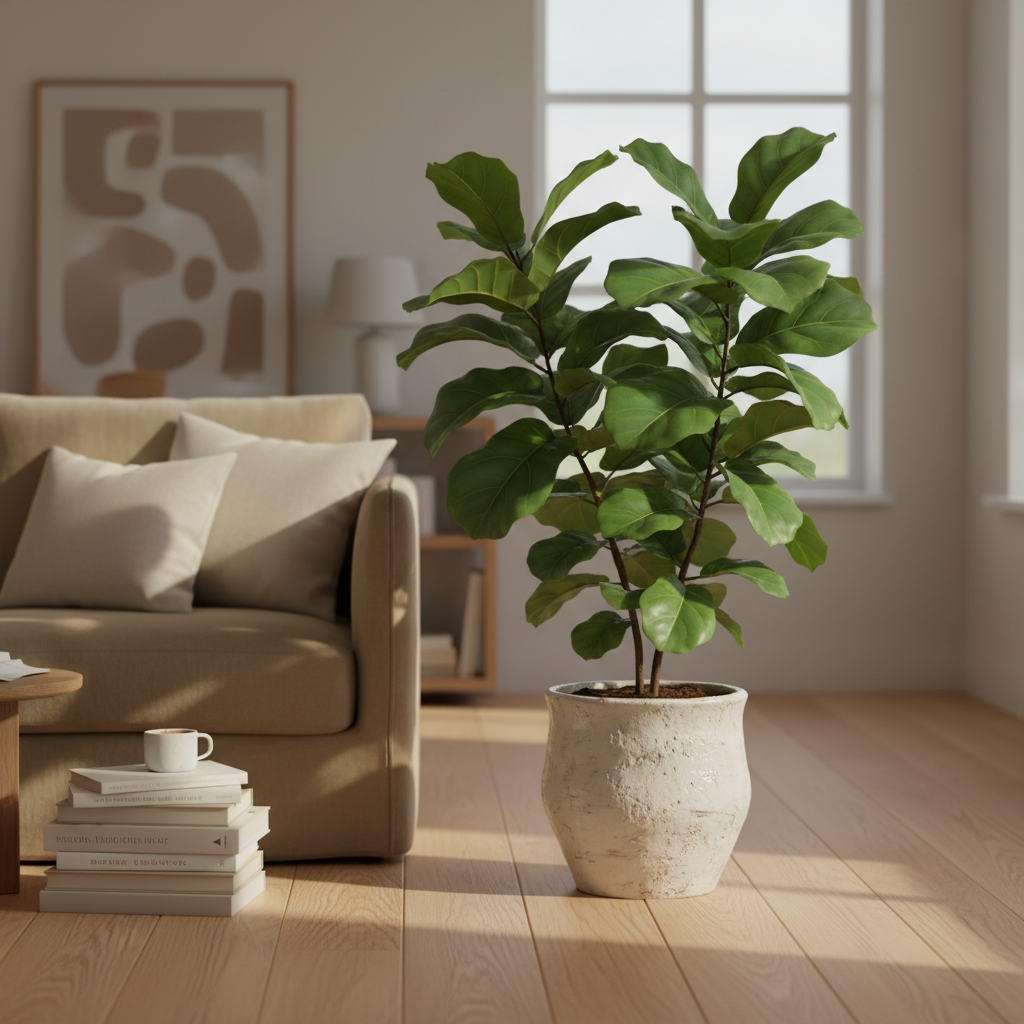
Beyond looks, there are practical reasons the plant has endured as a design favourite. Its leaves are large enough to read clearly from across a room, so it photographs and films well, and the canopy continues to evolve as the plant matures, with older specimens developing a tree-like silhouette and a textured grey trunk. Indoors, where it cannot reach its wild dimensions, the fiddle leaf fig is essentially a slow-growing tropical tree being kept in a pot, and treating it as such, rather than as a small ornamental, is the mental shift that unlocks better care.
Important — Toxicity: All parts of Ficus lyrata contain a milky white latex sap that can cause skin irritation in sensitive people and mild gastrointestinal upset if leaves are chewed by pets or children. Wear gloves when pruning and wash any sap off skin promptly. Keep the plant out of reach of cats, dogs and small children if any of them are prone to nibbling.
Light Requirements
If any single factor determines the success of a fiddle leaf fig indoors, it is light. In its native canopy this plant evolved to receive strong, dappled sunlight for many hours each day, and the leaves are large precisely so they can capture as much of that energy as possible. Bring it into a typical living room and the available light drops by an order of magnitude, which is why so many specimens languish in corners that look bright to the eye but are simply not bright enough for sustained growth.
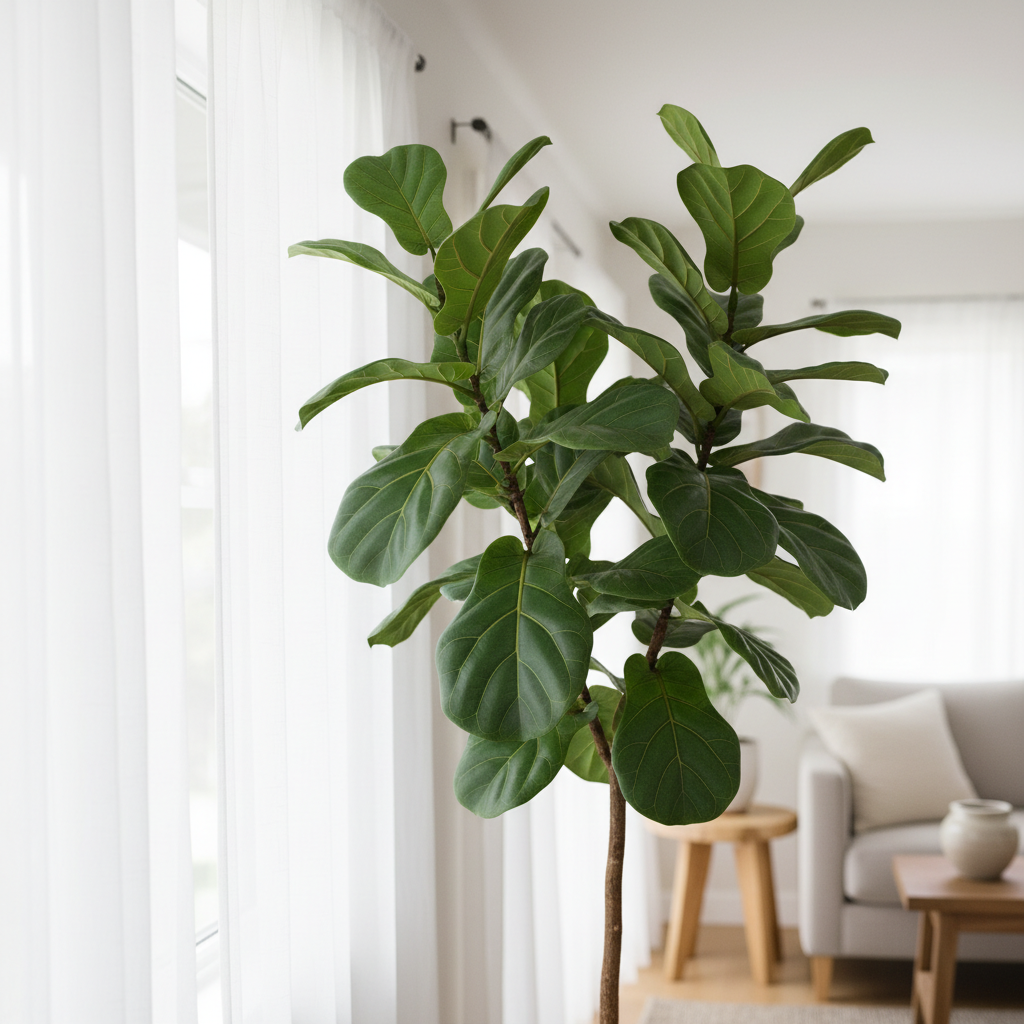
The ideal position is in front of a large, unobstructed window where the plant receives several hours of bright indirect light each day, supplemented by a little gentle direct sun in the morning or late afternoon. A spot one to two metres (about three to six feet) inside a south or west-facing window, or directly in front of an east-facing one, will usually deliver this. A fiddle leaf fig that is growing well will produce a new leaf every four to six weeks during the warm months and hold its existing foliage taut and upright.
Light Levels Explained
To translate vague terms like “bright” into something measurable, it helps to think in terms of lux, the unit of illuminance. A fiddle leaf fig is happiest in conditions roughly equivalent to the dappled understory of a tropical forest, and once light levels drop substantially below that figure, growth slows and the lower leaves are gradually shed.
| Light Category | Approx. Level | Typical Location | Outcome |
|---|---|---|---|
| Direct sun | 40,000 lux and above | Right against a south-facing window in summer | Risk of scorched leaves unless acclimated; midday sun should be filtered |
| Bright indirect | 10,000 to 25,000 lux | Within a metre of a large east, south or west window | Ideal; steady new growth and upright posture |
| Medium indirect | 2,500 to 10,000 lux | Two to three metres into a bright room | Survives but grows slowly; lower leaves may drop |
| Low | 500 to 2,500 lux | Interior wall, hallway, north-facing window | Decline within weeks to months; not suitable |
| Very low | Below 500 lux | Windowless room, deep corner | Steady leaf drop, eventual death |
Window Orientation and Placement
South-facing window: Often the brightest position in northern hemisphere homes and well suited to a fiddle leaf fig, provided the midday sun in high summer is softened by a sheer curtain or by setting the plant a short distance back from the glass. Direct sun on cold winter glass is rarely a problem and can in fact be welcome.
East-facing window: Almost the perfect compromise. Morning sun is gentle, the rest of the day delivers strong indirect light, and there is little risk of scorching. Many of the best-grown indoor fiddle leaf figs sit directly in front of an east window.
West-facing window: Works well, though the afternoon sun in summer can be intense. A pale curtain or a position just to one side of the window will diffuse the harshest hours.
North-facing window: Generally too dim for sustained growth on its own, particularly at higher latitudes or during winter. If a north window is the only option, the plant should be placed as close to the glass as possible and supplemented with a grow light.
Pro Tip — Mark the Pot: Fiddle leaf figs grow towards their light source, and the leaves stiffen in whatever orientation they hardened. To keep the canopy even, mark one side of the pot with a small piece of tape and rotate the plant a quarter turn each time you water, returning to the marked position over a full cycle.
How Light Affects Leaf Production and Posture
Unlike variegated plants, the fiddle leaf fig does not signal poor light through colour change so much as through behaviour. In strong light, new leaves emerge frequently, stand fully expanded and hold a deep, even green. In weaker light, new growth slows or stops, the petioles (the stalks attaching each leaf to the stem) elongate, and the spacing between leaves on the trunk increases. Over time, low-light specimens take on a sparse, leggy character that no amount of fertiliser can correct: the plant is simply telling you it does not have enough energy to support a fuller canopy.
Warning — Direct Sunlight: A plant that has been grown in lower light for some time can be scorched by sudden exposure to direct sun. Acclimate it gradually over two to three weeks, starting with an hour of morning sun and building up from there, or you may see pale tan patches that later turn brown and dry on the most exposed leaves.
Artificial Lighting
If natural light is inadequate, a fiddle leaf fig will respond very well to supplemental lighting. A full-spectrum LED grow light delivering around 200 to 400 µmol/m²/s (micromoles per square metre per second) of photosynthetically active radiation at canopy height, on for ten to twelve hours a day, is enough to replace or significantly boost weak window light. Position the light directly above the crown so the upper leaves are not shaded by the lower ones, and ideally pair it with whatever natural daylight the room offers rather than relying on artificial light alone.
Seasonal Adjustments
Light levels indoors can fall by half or more between summer and the depths of winter, particularly at higher latitudes. A plant that sat happily two metres inside an east window in July may be light-starved in the same position in January. Move the plant closer to the glass for the cooler months, clean both sides of the leaves so they can use every available photon, and accept that growth will slow until day length returns. Resist the urge to compensate with extra water or fertiliser; the limitation in winter is light, not nutrients.
Watering and Humidity
Watering is the second pillar of fiddle leaf fig care, and the area where most problems begin. The species is neither a desert plant nor a bog plant; it is a tropical tree that experiences a steady cycle of heavy rain followed by quick drainage and a brief drying period. Replicating that rhythm in a pot, rather than keeping the soil constantly damp or letting it dry to dust, is what produces glossy, taut leaves and a healthy root system.
When to Water
The right time to water a fiddle leaf fig is when the top 3 to 5 centimetres (about 1 to 2 inches) of soil are dry to the touch and the pot feels noticeably lighter than it did fresh from a watering. A wooden chopstick or moisture meter pushed into the rootball will confirm what your fingers tell you: deeper down, the mix should still be barely moist when you next water. The deeper roots should never be allowed to sit in a dry mix for days on end, and the surface should never be permanently wet.
In a bright, warm room during the growing season, this cycle typically lands every seven to ten days. In a cooler or dimmer location, or in mid-winter, it may stretch to once every two or three weeks. Resist the temptation to water on a fixed schedule; the plant’s actual demand varies enormously with temperature, light and pot size, and a calendar habit is the single most common cause of root rot.
Pro Tip — The Lift Test: Lift the pot immediately after a thorough watering and again the next morning. The difference in weight is your reference point. Over time you will be able to tell from a single lift whether the plant is genuinely ready for another drink, no probe needed.
How to Water Correctly
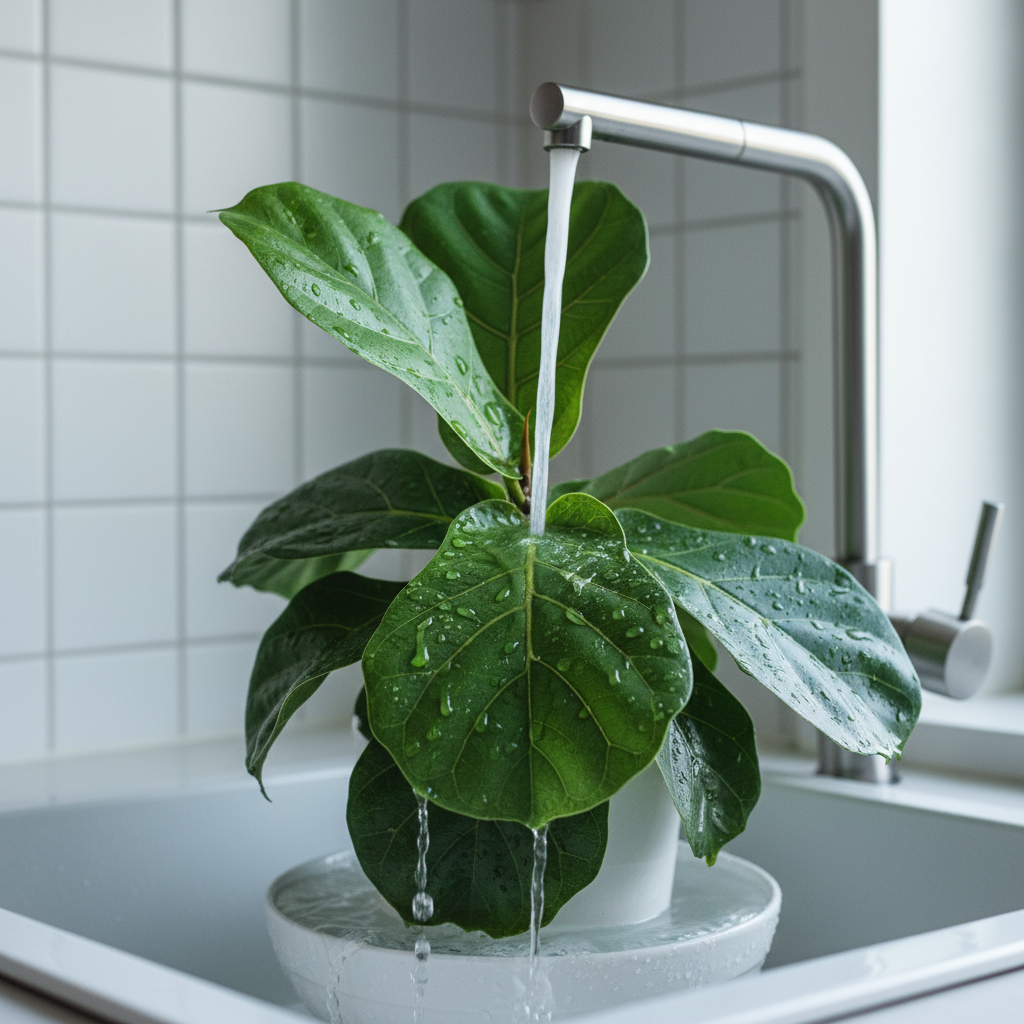
- Move the plant to a sink, shower or large saucer where excess water can escape freely.
- Use room-temperature water and pour slowly around the entire surface of the soil, not just one spot.
- Continue until water flows steadily from every drainage hole and the rootball is fully saturated.
- Let the pot drain for at least fifteen to twenty minutes; tip out any standing water in the saucer.
- Return the plant to its usual position, ideally before the soil has fully cooled again.
- Do not water again until the top centimetres of soil are dry, repeating the cycle as needed.
Signs of Overwatering vs. Underwatering
| Symptom | Overwatering | Underwatering |
|---|---|---|
| Leaf colour | Dark brown spots starting in the centre or along the midrib of older leaves | Crispy light brown edges and tips, often on the newest leaves first |
| Leaf texture | Soft, limp, sometimes leathery; spots feel damp at the edges | Dry, papery, brittle; whole leaves may curl inwards |
| Soil | Stays dark and heavy for many days, may smell sour | Pulls away from the sides of the pot, takes time to absorb water again |
| Roots | Brown, mushy, easily detached from healthy tissue | Pale, dry, but still firm under gentle pressure |
| Stem base | Soft or blackened where it meets the soil | Firm but the lower trunk may show shallow vertical wrinkling |
Warning — Root Rot: Once leaves develop dark, spreading brown spots and the soil refuses to dry out, root rot is well underway. Unpot the plant, rinse the rootball clean, trim every soft or blackened root back to firm white tissue with sterilised secateurs, and repot into a fresh, free-draining mix in a slightly smaller container. Withhold fertiliser entirely until clear new growth resumes.
Humidity Requirements
Although Ficus lyrata evolved in humid tropical air, it is more forgiving of household conditions than many other rainforest species. Anything in the range of 40 to 60 percent relative humidity is comfortable, which covers the conditions in most ordinary homes for much of the year.
Trouble usually appears at the dry end of the scale. In rooms heated to over 20 degrees Celsius (68 degrees Fahrenheit) through winter without any humidification, relative humidity can drop below 25 percent for weeks at a time, and the symptoms appear as crispy edges and tips on newer leaves, slow expansion of unfurling leaves, and brown patches that often outline what would otherwise be perfectly healthy tissue.
The most effective remedies are environmental rather than cosmetic. A small ultrasonic humidifier running near the plant during the heating season makes a clear difference, as does grouping the fig with other large-leaved plants so that their combined transpiration creates a more humid microclimate. Pebble trays and occasional misting are not harmful but contribute little to the relative humidity that the plant actually experiences over hours and days.
Water Quality
Fiddle leaf figs are not as sensitive to water quality as some calatheas or carnivorous plants, but they do react over time to very hard or heavily chlorinated water. White crusts on the soil surface or pale margins on older leaves can signal a build-up of dissolved salts. Where tap water is very hard, switching to rainwater, filtered or distilled water for routine watering and flushing the rootball with plain water every few months will keep the substrate sweet. Lukewarm water is preferable to cold straight from the tap, particularly in winter, since a sudden chill at the roots can shock the plant.
Soil, Potting and Repotting
If light and water are the engine of fiddle leaf fig care, soil is the chassis. A well-built substrate makes correct watering almost automatic, because excess water drains away before the roots can drown, while still leaving enough moisture for steady uptake. A poor substrate, by contrast, will undo even the most attentive watering routine, since the roots simply have no chance of staying oxygenated.
Ideal Soil Composition
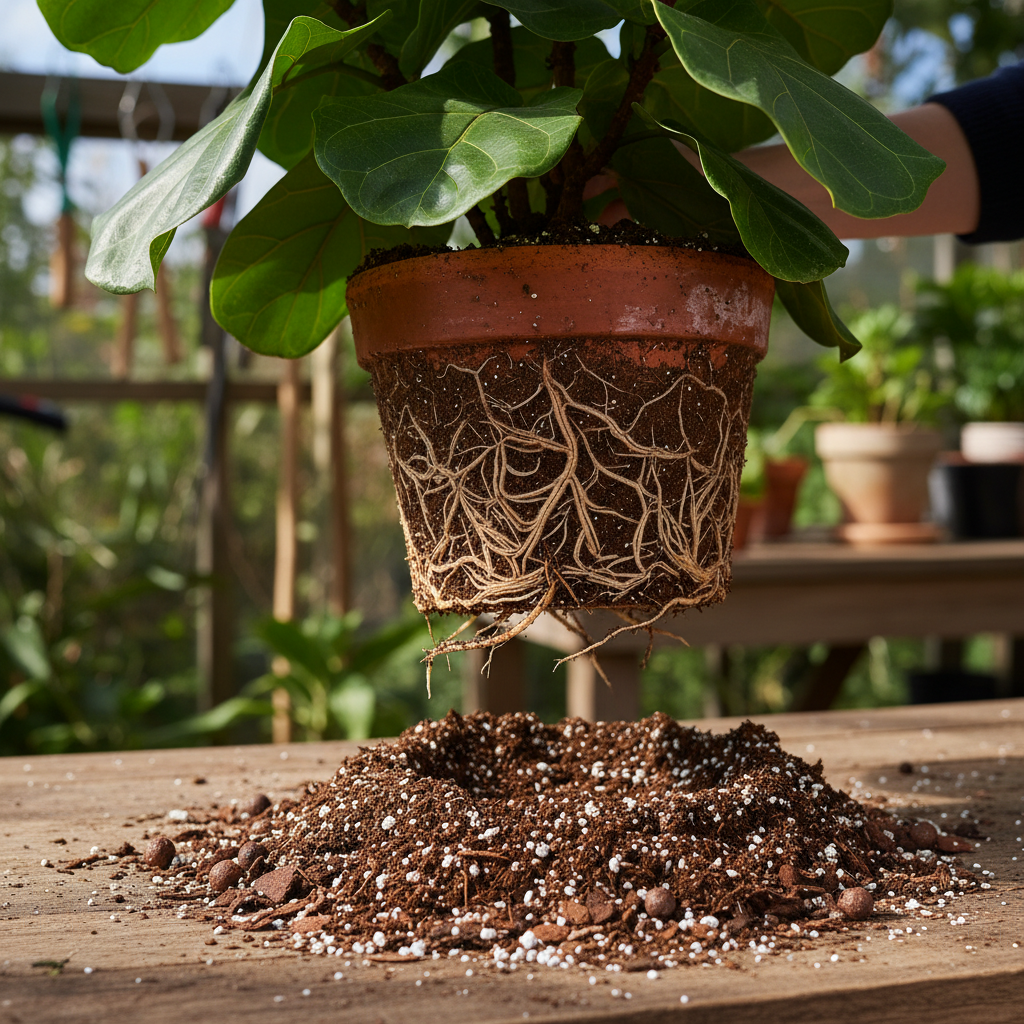
A fiddle leaf fig wants a substrate that is moisture-retentive but quick-draining, with a structure chunky enough that air can move freely through the rootball even when freshly watered. Pure peat-based potting compost on its own is too dense and stays wet for too long. The reliable approach is to start with a quality general-purpose potting mix as a base and lighten it with bark and drainage amendments until the texture loosens noticeably in the hand.
| Component | Proportion | Function |
|---|---|---|
| Quality indoor potting mix | About 50 percent | Provides body, mild nutrition and moisture retention |
| Orchid bark or fine pine bark | About 25 percent | Creates air pockets, prevents compaction |
| Perlite or pumice | About 15 percent | Improves drainage and root oxygenation |
| Coco coir | About 10 percent | Holds moisture without going anaerobic, balances structure |
| Worm castings (optional) | A small handful per pot | Slow, gentle nutrient boost and microbial life |
The target pH is slightly acidic to neutral, in the range of 6.0 to 7.0. Most commercial mixes fall in this window naturally; an occasional dilute feed with a houseplant fertiliser intended for foliage plants will keep nutrition appropriate without pushing the pH significantly in either direction.
Pro Tip — Quick Mix Recipe: When in doubt, combine three parts good indoor potting mix, two parts orchid bark and one part perlite by volume. The result is suitable for almost every fiddle leaf fig in a typical home, and easy to keep on hand for emergency repotting.
Choosing the Right Pot
The container plays at least as great a role in watering success as the mix inside it. A pot that is too large, too small, lacking drainage or made of an unsympathetic material can sabotage an otherwise well-cared-for plant within a season.
Drainage holes are non-negotiable. Every pot that holds a fiddle leaf fig must have at least one generous drainage hole at the base, with a saucer beneath it. A decorative cachepot can hide an inner nursery pot, but the inner pot must drain freely and any water collecting in the cachepot must be poured away after each watering.
Pot material: Terracotta breathes and wicks moisture out of the rootball, which suits gardeners who tend to overwater and rooms with poor air circulation. Glazed ceramic and plastic hold moisture longer, which can be an advantage in warm, dry homes. Whichever material you choose, the principle is the same: match the pot’s drying speed to your watering habits.
Pot size: Move up only one or at most two centimetres in diameter (roughly half an inch to an inch) at each repotting. Oversized pots hold large volumes of damp soil that the existing roots cannot use, which encourages rot and stalls growth. A fiddle leaf fig will happily sit slightly snug in its pot, and the very largest specimens often perform best when their growth is gently constrained at the roots.
When to Repot
A young, actively growing fiddle leaf fig usually benefits from repotting every two to three years. Larger floor specimens settle into a longer cycle, and once a plant is in a pot too heavy to lift comfortably, the goal shifts from full repotting to top-dressing: lifting out the top few centimetres of old soil each spring and replacing it with fresh mix. The signs that a full repot is overdue include roots circling the bottom of the pot, water that runs straight through without wetting the rootball, and a plant that dries out within two or three days of being watered.
How to Repot: Step-by-Step
- Water the plant thoroughly the day before, so the rootball is moist and pliable.
- Choose a pot one or two centimetres larger in diameter than the current one, with drainage.
- Tip the plant out gently, supporting the trunk; tease away the outermost roots and old mix.
- Trim any blackened or mushy roots back to clean tissue with sterilised secateurs.
- Add a layer of fresh mix to the base of the new pot, position the plant so the soil level matches the previous one, and fill around the rootball without compacting it.
- Water in lightly to settle the mix, top up any sunken areas and let the pot drain fully.
- Return the plant to its usual spot and hold off on fertiliser for at least four weeks while the roots recover.
Warning — Transplant Shock: A fiddle leaf fig may drop one or two of its oldest leaves after repotting, especially if the rootball was disturbed significantly. This is normal recovery behaviour, not a disaster. Keep light, temperature and watering steady for several weeks; do not feed, prune or move the plant repeatedly during this period.
Fertilising
Because a fiddle leaf fig produces large, energy-hungry leaves and a steadily thickening trunk, it has a real appetite for nutrients during the growing months. At the same time, the same plant in a low-light corner cannot use the fertiliser you give it, and excess feed accumulates as salts in the soil. Matching feeding to actual growth, rather than to the calendar, is the central idea behind getting fertilising right.
A healthy fiddle leaf fig in good light will respond to consistent, moderate feeding with larger new leaves, shorter intervals between them and a deeper green colour. A plant that is feeling the limits of light or water will not benefit from extra fertiliser; the underlying constraint has to be addressed first.
Understanding Plant Nutrients
Plant fertilisers are usually described by their NPK ratio, the relative proportions of nitrogen, phosphorus and potassium. For a foliage tree such as Ficus lyrata, a balanced ratio with a slight emphasis on nitrogen is suitable; something close to 3-1-2 or a generic balanced 10-10-10 diluted appropriately works well. Trace minerals also matter, since deficiencies can produce subtle leaf symptoms long before the major nutrients are exhausted.
| Nutrient | Symbol | Primary Function | Deficiency Symptoms |
|---|---|---|---|
| Nitrogen | N | Leaf growth, chlorophyll, overall vigour | Older leaves uniformly pale or yellowing |
| Phosphorus | P | Root development, flowering, energy transfer | Dull green leaves, slow rooting after repotting |
| Potassium | K | Water regulation, leaf strength, disease resistance | Brown leaf margins, weak stems |
| Calcium | Ca | Cell wall structure, new leaf integrity | Distorted, hooked or crinkled new leaves |
| Magnesium | Mg | Core of the chlorophyll molecule | Yellowing between veins on older leaves |
| Iron | Fe | Chlorophyll synthesis | Yellowing between veins on the newest leaves |
Types of Fertiliser
Liquid fertilisers: The most controllable option. Dissolved in water and applied with regular watering, they reach the roots quickly and can be adjusted in concentration to match the season. A balanced liquid houseplant feed at half the manufacturer’s recommended strength, applied every three to four weeks during spring and summer, suits most fiddle leaf figs.
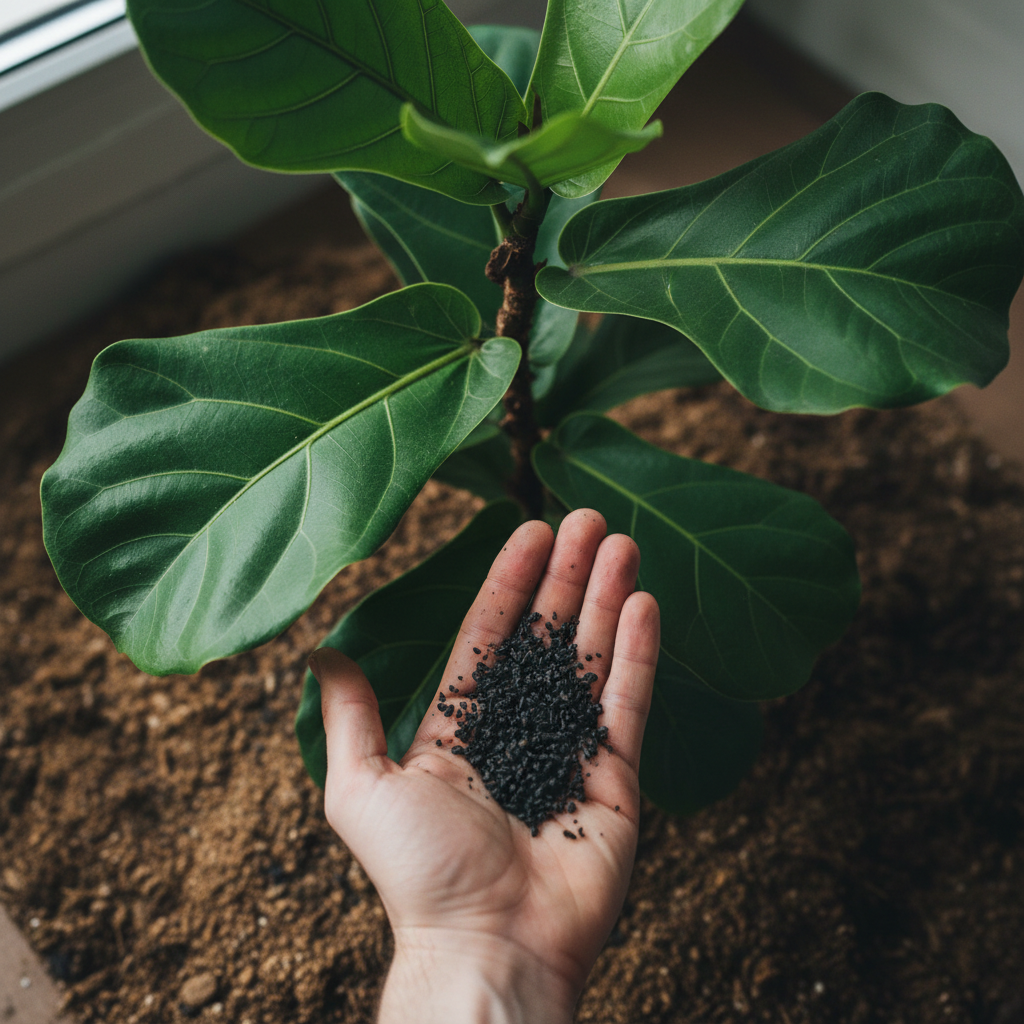
Slow-release granular: Resin-coated prills release nutrients gradually over three to six months as the soil warms and moistens. A measured top-dressing in spring can replace several months of liquid feeding and is convenient for very large floor specimens. The trade-off is less control, so apply conservatively and avoid combining with frequent liquid feeds.
Organic fertilisers: Worm castings, compost teas and seaweed extracts feed both the plant and the microbial community in the soil. They are gentler, harder to overdose with and improve substrate health over time. The trade-off is that nutrient release is slower and harder to measure, so they work best as a steady supplement rather than as a rescue treatment.
Feeding Schedule
From mid-spring to early autumn, a typical indoor fiddle leaf fig benefits from a balanced liquid feed at half strength every three to four weeks. In late autumn, taper the frequency, and through the coldest, darkest months of the year withhold fertiliser entirely. Pick up again only when daylight noticeably lengthens and you can see a new leaf in motion at the top of the trunk; feeding before active growth resumes pushes nutrients into a system that cannot use them.
Pro Tip — Less Is More: If you forget how much to dilute a liquid feed, err on the side of weaker. A fiddle leaf fig recovers quickly from mild underfeeding and very slowly from fertiliser burn. The plant cannot consume extra nutrients faster just because they are available.
How to Fertilise
- Water the plant with plain water first if the soil is dry, to avoid burning roots with concentrated fertiliser.
- Mix the liquid feed in a clean watering can at the chosen strength, using room-temperature water.
- Apply slowly across the whole soil surface, allowing it to soak in evenly rather than running down the sides of the rootball.
- Once a year, flush the rootball with several pot volumes of plain water to wash out accumulated salts.
- Record the date so you can keep the interval roughly even through the growing season.
Warning — Salt Build-Up: White crusts on the soil surface, a powdery rim around the pot or brown-edged older leaves can all point to accumulated fertiliser salts. Skip the next feed, take the plant to a sink and run plain lukewarm water through the rootball for several minutes, then let it drain thoroughly before resuming normal care.
Propagation
One of the quiet pleasures of growing a fiddle leaf fig is that it propagates reliably from cuttings, which makes it possible to turn an overgrown specimen into a row of new young plants. Unlike many indoor trees, this is a species that genuinely roots well at home, given a healthy parent and enough patience to let the process take its course over several weeks.
Two methods give the best results indoors: rooting stem cuttings in water and air layering directly on the parent plant. Single-leaf cuttings can produce roots in water but rarely develop into independent plants because they lack a node from which a new shoot can emerge, so they are best treated as a curiosity rather than a serious propagation route.
Understanding Nodes and Latex
Every successful fiddle leaf fig propagation depends on a node, the slightly thickened point on the stem where a leaf joins the trunk. The node contains the dormant tissue from which new roots and new shoots can emerge, so a cutting without at least one node will never grow into an independent plant. When you cut a stem, the wound releases a milky white latex that protects the plant in the wild but can clog pores and irritate skin. Wear gloves, work over a paper towel and let the cut surfaces dry to a sticky film for fifteen to twenty minutes before placing them in water or moss; this reduces sap loss and gives a cleaner rooting interface.
Water Propagation: Step-by-Step
Water propagation is the easiest method to monitor, since the roots are visible through the glass at every stage. It is best done in spring or early summer, when the parent plant is actively growing and able to recover from the cut.
- Choose a healthy stem section with at least two nodes and one or two leaves at the top.
- Cut just below the lowest node with clean, sharp secateurs at a slight angle.
- Strip the lower leaves so that the bottom node will sit submerged in water without leaves rotting below the waterline.
- Let the cut surface air-dry for fifteen to twenty minutes to seal off the latex.
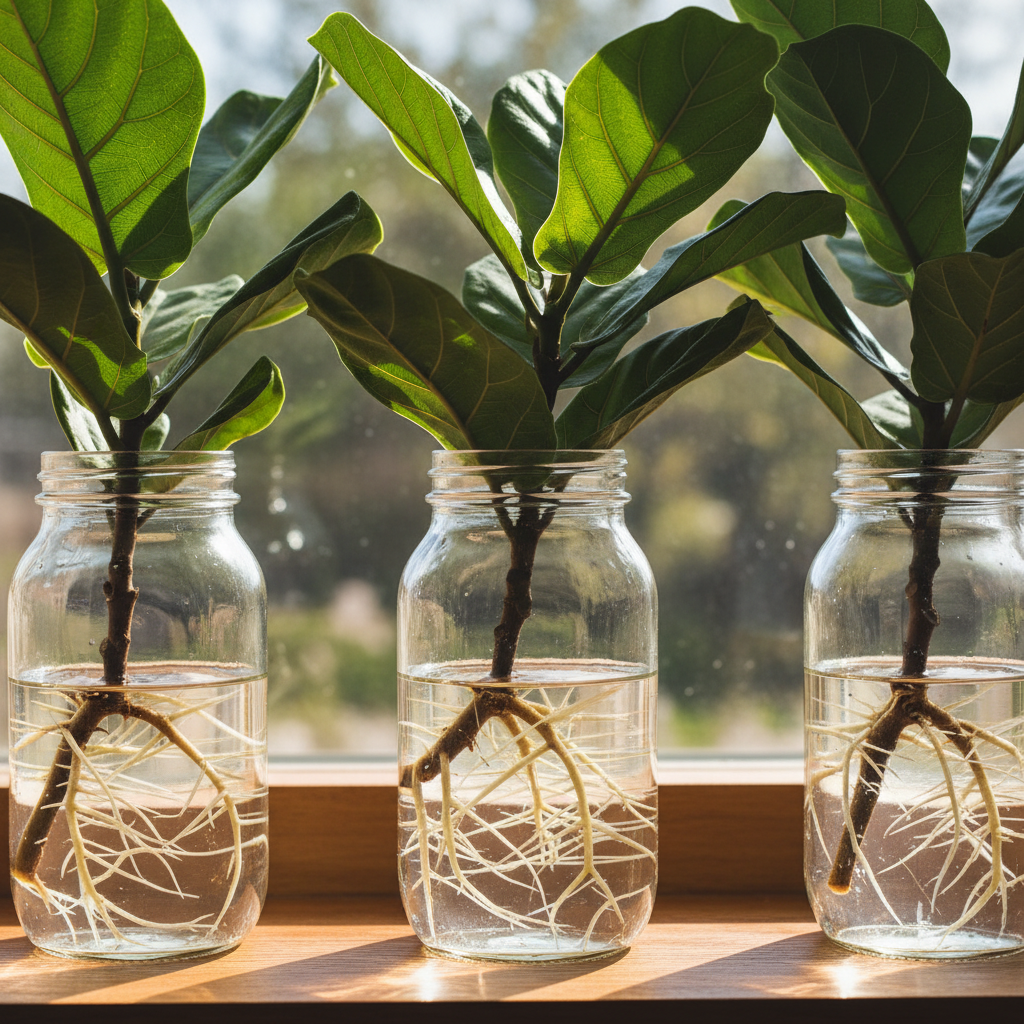
- Place the cutting in a clean glass jar of room-temperature water on a bright, indirectly lit windowsill.
- Change the water every five to seven days to keep it fresh and oxygenated.
- Once new roots reach about five to seven centimetres (two to three inches) long, pot the cutting up into a small container of free-draining mix.
Pro Tip — Bottom Heat: A simple seedling heat mat under the jar, set to around 22 to 24 degrees Celsius (72 to 75 degrees Fahrenheit), shortens rooting time noticeably and increases the proportion of cuttings that strike. Just keep the jar away from direct, intense sun, which can heat the water too far.
Air Layering: Step-by-Step
Air layering is the gold standard for propagating a tall, leggy fiddle leaf fig, because it produces a new plant with several established leaves and a robust root system in one operation, without weakening the parent for as long. The technique uses the parent’s own resources to push roots out of an intact stem before the cutting is removed.
- Choose a healthy section of trunk with several leaves above the chosen spot and a clear node at the working point.
- With a sterile blade, make a shallow upward cut about a third of the way through the stem just below the node, or remove a thin ring of bark.
- Dust the wound lightly with rooting hormone if available.
- Wrap the wound in a handful of damp sphagnum moss, then cover it tightly with clear plastic film secured at both ends with twine or ties so it holds the moisture in.
- Check the moss weekly through the plastic; remoisten with a syringe of water if it begins to dry out.
- After four to eight weeks, when a network of white roots is clearly visible through the plastic, cut the stem below the new roots, unwrap and pot into free-draining mix.
- Keep the young plant warm and out of direct sun for the first few weeks while it adjusts to soil.
Troubleshooting Propagation
| Problem | Likely Cause | Solution |
|---|---|---|
| Cutting rots in water before rooting | Water too warm, leaves submerged, or stem damaged | Use cooler fresh water, remove submerged leaves, take a new cutting with a clean cut |
| No roots after eight weeks | Insufficient light, low temperature, or no node in the water | Move to a brighter, warmer spot and ensure at least one node is below the waterline |
| Roots form but new shoots never emerge | Cutting lacks a viable axillary bud | Pot the rooted cutting up anyway; new growth often appears once it has soil |
| Air layer dries out | Plastic film not sealed or moss too sparse | Rewrap with fresh damp moss and a wider piece of film secured tightly at both ends |
Pests and Diseases
A well-grown fiddle leaf fig is not especially attractive to pests, but its large, smooth leaves give any visitor a generous landing pad, and a weakened plant can become a magnet for several common houseplant insects. Most issues are easier to manage when caught early, so a brief inspection during each watering is the single most useful habit in pest control.
Diseases on indoor specimens are almost always rooted in environmental issues such as overwatering, poor airflow or stagnant humidity, rather than in pathogens arriving from outside. Correct the underlying conditions and most fungal or bacterial problems resolve themselves within weeks.
Common Pests
Spider Mites (Tetranychus urticae)
Spider mites thrive in dry indoor air and feed on the undersides of leaves, leaving fine pale stippling on the upper surface that can be mistaken for dust. Severe infestations produce fine webbing in the leaf axils and along the midribs, and a magnifying glass will reveal moving specks the size of a pinhead.
Treatment: Shower the plant under a gentle stream of lukewarm water to physically dislodge mites, then treat with insecticidal soap or a neem oil spray on all leaf surfaces every five to seven days for three to four cycles. Raising humidity around the plant after treatment makes recurrence much less likely.
Mealybugs (Pseudococcus longispinus)
Mealybugs look like small tufts of white cotton wool tucked into leaf axils, along the midrib or on the trunk. They suck sap and excrete a sticky honeydew that often supports a layer of black sooty mould. Left unchecked, they multiply rapidly and weaken the plant noticeably.
Treatment: Dab visible insects with a cotton bud dipped in 70 percent isopropyl alcohol, then follow up with weekly applications of insecticidal soap or neem oil for at least three weeks to catch hatchlings. Inspect nearby plants, since mealybugs spread easily.
Scale Insects (Coccus hesperidum)
Scale insects appear as small flat or domed brown bumps along stems and the undersides of leaves. Their hard shells protect them from many sprays, and a heavy infestation is often signalled first by sticky droplets of honeydew on the floor or table around the plant.
Treatment: Scrape adults off with a soft brush or fingernail and treat the plant with horticultural oil, ensuring full coverage of stems and leaf undersides. Systemic insecticides labelled for houseplants are useful for heavy infestations on large specimens.
Fungus Gnats (Bradysia spp.)
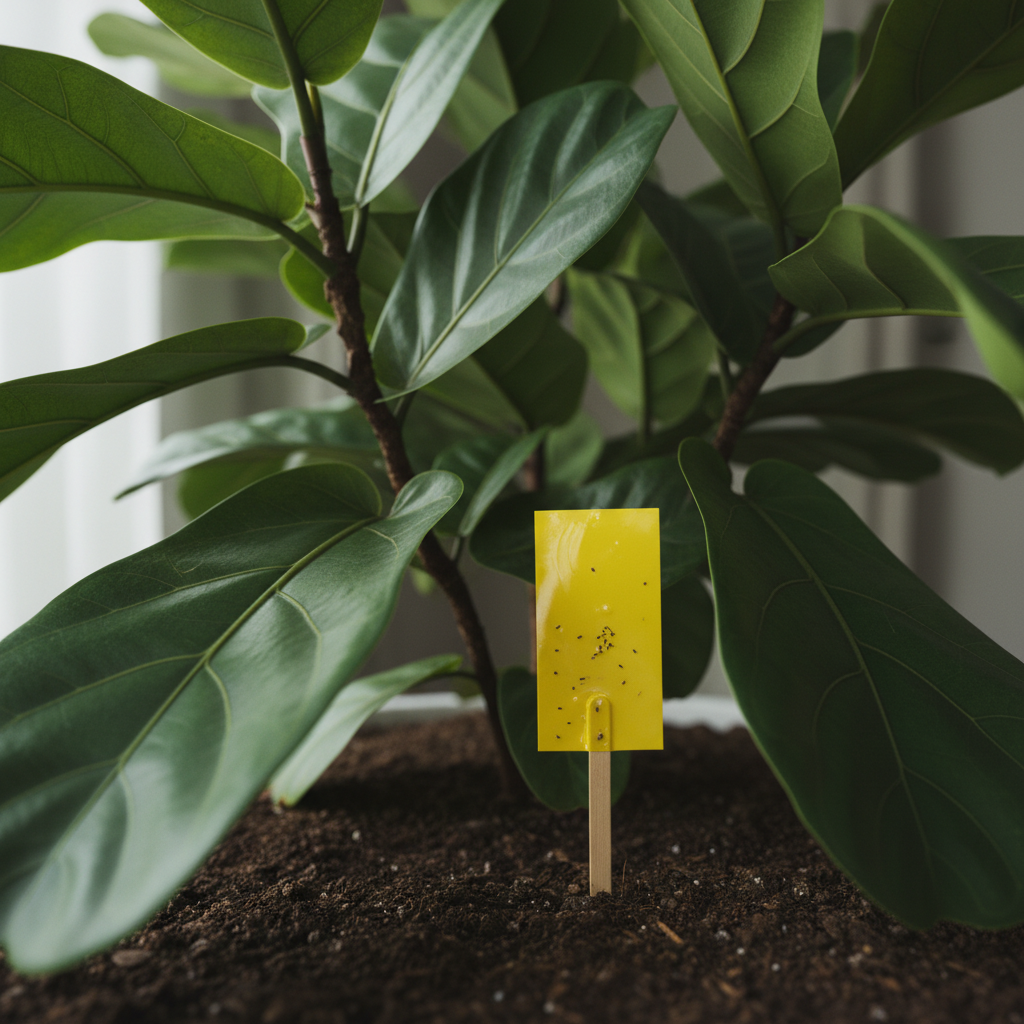
Tiny black flies hovering around the pot and rising in clouds when the leaves are brushed are fungus gnats. The adults are harmless cosmetics, but their larvae feed on roots and on the fungi associated with permanently damp soil, so their presence is also a sign that the substrate is staying too wet.
Treatment: Allow the top few centimetres of soil to dry between waterings, add yellow sticky traps to catch the adults, and water in a Bacillus thuringiensis israelensis (Bti) drench to kill larvae over several weeks. A thin layer of horticultural sand or fine grit on the surface also disrupts the egg-laying cycle.
Common Diseases
Root Rot (Pythium and Phytophthora spp.)
Root rot is the most serious problem a fiddle leaf fig is likely to face indoors and follows directly from chronically wet soil and poor drainage. Above ground it shows as dark brown spots starting in the centre of older leaves and soft, blackened lower stems; below ground the roots turn mushy and detach easily.
Treatment: Unpot the plant, rinse the rootball, cut away all soft and discoloured roots, repot into fresh free-draining mix in a slightly smaller container and water sparingly until clear new growth resumes. Address the underlying cause, almost always overwatering combined with a dense substrate or pots without drainage.
Bacterial Leaf Spot (Pseudomonas spp.)
Bacterial leaf spot shows as small dark, water-soaked spots that quickly enlarge and develop yellow halos, often spreading along veins. Unlike fungal spots, these tend to look damp and slimy rather than dry and crisp, and they can move rapidly through the canopy in warm, humid conditions.
Treatment: Remove affected leaves with sterilised secateurs, improve airflow around the plant, reduce overhead misting, and allow the soil surface to dry more thoroughly between waterings. Copper-based sprays can help in severe cases but environmental correction is the real fix.
Anthracnose (Colletotrichum spp.)
Anthracnose produces dry, sunken brown patches along leaf edges and tips, often with tiny darker dots inside the affected tissue. It usually appears on weakened plants in damp, poorly ventilated rooms and follows existing leaf damage from cold or dryness.
Treatment: Trim affected leaves, improve airflow, avoid wetting the foliage during watering, and treat with a copper-based or systemic fungicide if symptoms continue to spread. Keep the plant on the dry side of its normal watering schedule while it recovers.
Pest and Disease Summary
| Pest / Disease | Identification | Treatment |
|---|---|---|
| Spider mites | Fine stippling, webbing in axils, dry air | Rinse plant, repeat sprays of insecticidal soap or neem oil |
| Mealybugs | White cottony tufts in axils and along stems | Alcohol-dipped cotton bud, follow-up neem oil or soap sprays |
| Scale | Brown bumps on stems and leaf undersides, sticky honeydew | Manual removal, horticultural oil, systemic treatment if heavy |
| Fungus gnats | Small black flies around pot, larvae in damp soil | Let soil surface dry, sticky traps, Bti soil drench |
| Root rot | Dark spreading spots, soft stem base, mushy roots | Unpot, trim affected roots, repot in fresh mix, reduce watering |
| Bacterial leaf spot | Water-soaked dark spots with yellow halos | Remove affected leaves, improve airflow, dry soil between waterings |
| Anthracnose | Dry sunken patches at leaf edges with tiny dark dots | Trim, improve ventilation, treat with fungicide if persistent |
Prevention Strategies
Almost every pest and disease problem on a fiddle leaf fig is easier to prevent than to cure. The single most powerful preventative measure is steady, appropriate watering, since chronically wet soil underlies most root and stem problems, while chronic dryness invites spider mites. Beyond that, regular inspection during routine watering catches small infestations before they spread, and a quarantine period of two to three weeks for any new plant entering the home stops most pests from arriving in the first place.
Clean foliage is also under-rated as a defence. Dust accumulates rapidly on the large flat surfaces of fiddle leaf fig leaves, blocking light and providing cover for small insects. Wiping each leaf gently with a damp cloth every two to three weeks improves photosynthesis and lets you spot incoming trouble while it is still confined to a single leaf or two.
Pro Tip — Neem on a Schedule: If pests have appeared before, a light foliar spray of diluted neem oil once a month during the growing season acts as a gentle preventative. Apply in the evening, after watering and out of direct sun, so the oil has time to spread evenly without scorching the leaves.
Popular Varieties
The standard fiddle leaf fig sold in nurseries is the wild-type Ficus lyrata, but a handful of cultivars and forms have emerged that suit different spaces and growing conditions. Most are selections for compact growth, smaller leaves or denser branching, which makes them easier to fit into typical homes than the imposing parent species.
True genetic variegation in Ficus lyrata is rare, expensive and notoriously slow-growing, but the variegated form is increasingly available in specialist collections. For most growers the choice is between the classic tall species, the compact Bambino and the upright Compacta, with a handful of regional names and bushy hybrids filling out the rest of the catalogue.
| Variety | Leaf Appearance | Light Needs | Growth Rate | Availability |
|---|---|---|---|---|
| Ficus lyrata (standard) | Large, glossy, classic violin shape | Bright indirect to gentle direct | Moderate, eventually very tall | Widely available |
| Ficus lyrata ‘Bambino’ | Smaller, rounder fiddle shape | Bright indirect | Slow, naturally compact | Common in independent nurseries |
| Ficus lyrata ‘Compacta’ | Tightly packed, slightly wavy leaves | Bright indirect | Moderate, dense and upright | Common |
| Ficus lyrata ‘Variegata’ | Cream and green marbling on classic shape | Bright indirect, no harsh sun | Slow | Rare, specialist |
| Ficus lyrata ‘Suncoast’ | Slightly thicker leaves, robust constitution | Bright indirect | Moderate | Occasional |
| Bush-form standard | Multi-stemmed from base, full canopy | Bright indirect | Moderate | Widely available |
| Standard-trained tree | Single bare trunk topped with a rounded crown | Bright indirect to gentle direct | Moderate | Common in floor-plant sizes |
Featured Varieties
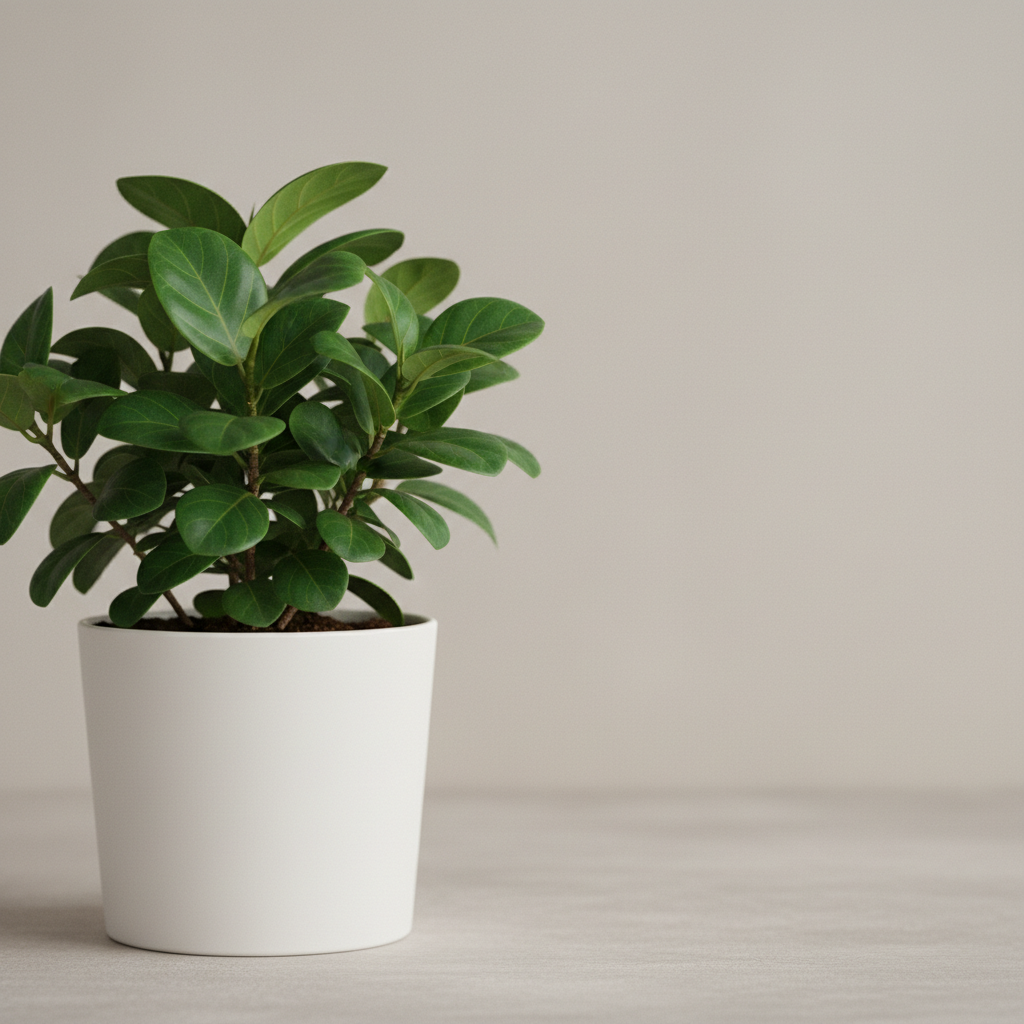
‘Bambino’
A naturally dwarf cultivar with leaves a fraction the size of the standard species and a denser, bushier habit. Ideal for tabletops, smaller rooms and anyone who loves the look of Ficus lyrata but cannot accommodate a three-metre tree.
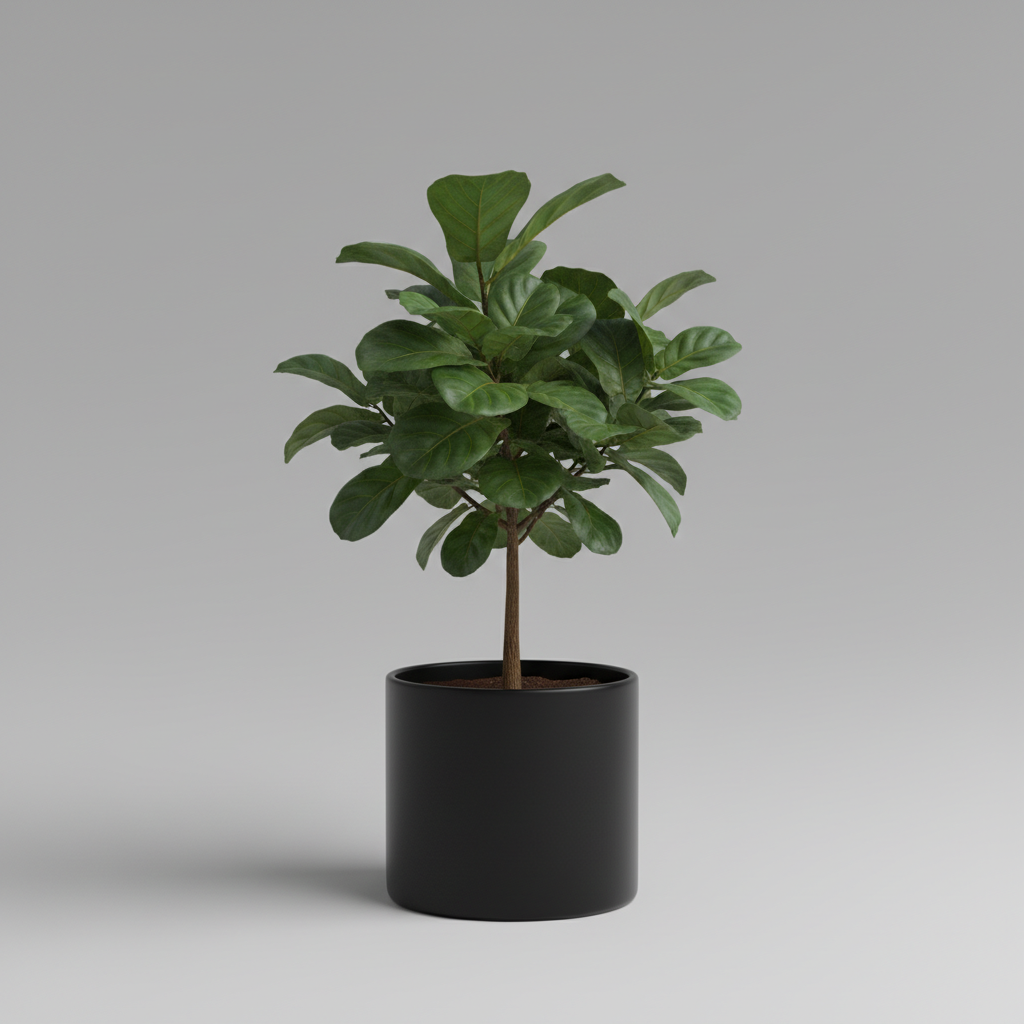
‘Compacta’
Shorter than the standard form and far denser, with leaves stacked closely along the trunk and a slightly wavier edge. Compacta keeps a fuller silhouette without aggressive pruning and suits rooms where a column of foliage rather than a tree is wanted.
Variety Profiles in Detail
Standard Ficus lyrata (Ficus lyrata)
The wild-type species, sold in everything from small nursery pots to two-metre floor specimens. Leaves can reach thirty centimetres or more across in time, and a well-grown plant develops a single straight trunk and a tidy crown. Care matches the rest of this guide exactly; most generic “fiddle leaf fig” instructions in books and online refer to this form.
Bambino (Ficus lyrata ‘Bambino’)
Bambino is the cultivar of choice for compact spaces, with leaves typically ten to fifteen centimetres (four to six inches) long and a naturally branched habit. It still benefits from bright indirect light, but its smaller leaves transpire less, so the watering rhythm tends to be more forgiving than with the standard species.
Compacta (Ficus lyrata ‘Compacta’)
Compacta sits between the standard form and Bambino. Its leaves are smaller than the species but stacked very closely together, giving the trunk a dense, columnar look. The variety is popular as a floor plant in design-led interiors because it reads as a “fiddle leaf fig” instantly without the same demand for ceiling height.
Variegata (Ficus lyrata ‘Variegata’)
True variegated Ficus lyrata is the rarest and most expensive form, with cream and green marbling running across each leaf. It grows noticeably slower than the standard species because the white tissue cannot photosynthesise, and it demands consistently bright indirect light to maintain stable variegation without scorching. Reverted all-green shoots should be pruned out promptly to keep the variegation expressed.
Choosing the Right Variety for Your Space
Choice begins with ceiling height and available light. The standard Ficus lyrata rewards rooms with at least two and a half metres (about eight feet) of headroom and a generous window; in smaller spaces it will quickly outgrow its setting or be forced into hard pruning that compromises its natural shape. Bambino is the right answer for tabletops, dressers and bright corners under low ceilings, while Compacta sits naturally on the floor in average-height rooms and delivers a full fiddle leaf look without sprawling outwards. Variegata is a collector’s plant best reserved for growers who are confident in their light, watering and routine, since its scarcity, slower growth and sensitivity to environmental stress reward steady, considered care.
Frequently Asked Questions
Why is my fiddle leaf fig dropping leaves?
Sudden leaf drop is the plant’s response to a change in conditions, most often a move, a sharp shift in watering frequency, a draft from a heater or air conditioner, or a drop in light. A small number of older lower leaves dropping after a move or repot is normal recovery; widespread loss of green, healthy-looking leaves is a sign of environmental shock that needs investigation. Identify the most recent change and reverse it where possible.
What do brown spots on the leaves mean?
Pattern, location and texture all matter. Dark, spreading spots that begin in the centre or along the midrib of older leaves usually point to overwatering and root distress. Light brown crispy spots and edges on newer leaves usually indicate underwatering or low humidity. Pale tan patches on the most exposed leaves, often confined to one side of the plant, are usually sunscald.
How often should I water in winter?
There is no fixed answer, only a principle: water when the top centimetres of the rootball are dry and the pot feels light. In a typical heated home this often falls every two to three weeks in winter, half the frequency of summer. Stick to the soak-and-dry pattern; do not switch to small, frequent sips just because the days are short.
Can I prune my fiddle leaf fig to make it bushier?
Yes. Cutting the main growing tip removes the apical dominance that suppresses lower buds and almost always triggers one or more side branches to form. Make the cut just above a node in spring or early summer, keep the plant in good light afterwards and expect new branches to emerge within four to eight weeks. The tip itself can be rooted as a cutting.
Is the fiddle leaf fig safe for pets?
No. All parts of Ficus lyrata contain a milky latex sap that is mildly toxic to cats, dogs and humans, and chewing the leaves can cause oral irritation, drooling and gastrointestinal upset. The plant is not lethally toxic to most healthy pets, but it should be placed out of reach of any animal or small child known to chew on houseplants.
My plant has stopped growing — is it dying?
Not necessarily. A fiddle leaf fig in low light or cool temperatures will idle for months without producing new leaves and still be perfectly healthy. Check that the existing leaves remain firm and well coloured, that the roots feel firm under gentle pressure and that the stem base is solid. Slow does not mean dying; declining usually shows up as deteriorating older foliage, not as an absence of new growth.
Should I mist my fiddle leaf fig?
Misting feels reassuring but has almost no effect on the ambient humidity the plant experiences. If a room is dry enough to cause symptoms, an ultrasonic humidifier or grouping with other plants will help much more than a daily mist. Frequent misting can in fact encourage bacterial leaf spot if water sits in axils overnight, so it is best used sparingly and only in the morning.
When and how should I clean the leaves?
Every two to three weeks, wipe each leaf gently with a soft cloth dampened in plain water, supporting the leaf from below with your other hand so the petiole is not stressed. Avoid commercial leaf shine products, which can clog stomata and attract dust over time. Clean leaves photosynthesise more efficiently and let you spot incoming pests before they spread.
Can a fiddle leaf fig live outdoors?
In climates that stay above 13 degrees Celsius (55 degrees Fahrenheit) year-round, with bright filtered light and shelter from strong wind, yes. In cooler temperate climates the plant can be moved outdoors for the warmest months but must come back inside well before night-time temperatures fall below that threshold. Acclimate it gradually in both directions to avoid sun scorch or chill shock.
How long does a fiddle leaf fig live?
With consistent care, a healthy fiddle leaf fig can live for decades indoors and continues to develop a more tree-like form over time. Older specimens often outlast the rooms they began in and need to be moved to taller spaces, given a hard pruning, or air-layered into a new generation of plants when ceiling height becomes a real constraint.






