
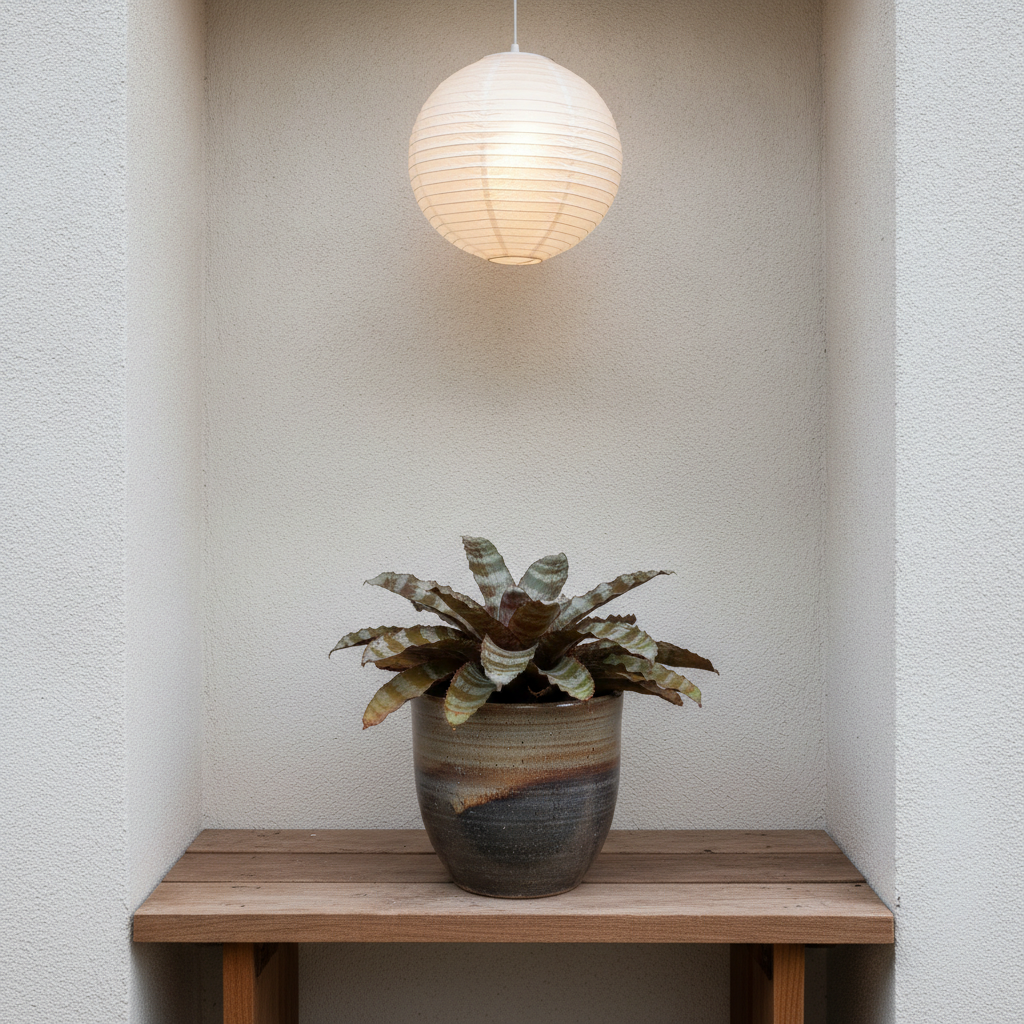
Few houseplants wear their name as plainly as the jewel bromeliad. Look straight down onto the flattened rosette of Cryptanthus zonatus and you see exactly that: a living star pressed close to the soil, its stiff leaves crossed with irregular bands of bronze, copper and silvery grey that catch the light like cloisonné enamel. It belongs to a small group of terrestrial bromeliads known as earth stars, plants that evolved not in the branches of rainforest trees but among the leaf litter of the forest floor in eastern Brazil. That single fact, roots in the ground rather than up in the canopy, shapes almost everything about how you should care for it.
The difference between a jewel bromeliad that merely survives and one that truly thrives comes down to reading it correctly. A neglected plant will hang on for a surprisingly long time as a flat, dull green rosette with faded banding, tolerating dim corners and erratic watering without dying outright. A plant that thrives, by contrast, glows: the cross-banding deepens to metallic copper and pewter, the wavy leaf margins crisp up, and the mother rosette begins to throw offsets around its base. This guide walks through how to move your plant from the first state to the second, section by section.
- Quick Reference
- Why the Jewel Bromeliad Makes a Great Houseplant
- Light
- Watering
- Soil
- Fertilising
- Propagation
- Pests and Problems
- Varieties
- Frequently Asked Questions
Quick Reference
The jewel bromeliad is a small, slow-growing plant, rarely exceeding 30 to 40 centimetres (12 to 16 inches) across and only 15 centimetres (6 inches) tall. It is an excellent candidate for terrariums, shallow bowls and bright bathroom shelves where its love of humidity is easily met. The table below summarises its core needs at a glance.
| Botanical name | Cryptanthus zonatus |
| Common names | Jewel bromeliad, earth star, zebra plant, zebra earth star |
| Family | Bromeliaceae |
| Origin | Tropical forest floors of eastern Brazil (Pernambuco region) |
| Light | Bright indirect light; tolerates medium light, no harsh direct sun |
| Water | Keep soil evenly moist, never waterlogged; water the soil, not the centre |
| Humidity | High, ideally 60 to 80 per cent |
| Temperature | 18 to 26 degrees Celsius (65 to 79 degrees Fahrenheit) |
| Soil | Light, well-draining, organic-rich mix; slightly acidic |
| Feeding | Weak, dilute feed every four to eight weeks in the growing season |
| Propagation | Offsets (pups) around the base of the mother rosette |
| Mature size | Around 30 to 40 cm (12 to 16 in) wide, 15 cm (6 in) tall |
| Toxicity | Non-toxic and safe around cats, dogs and children |
Why the Jewel Bromeliad Makes a Great Houseplant
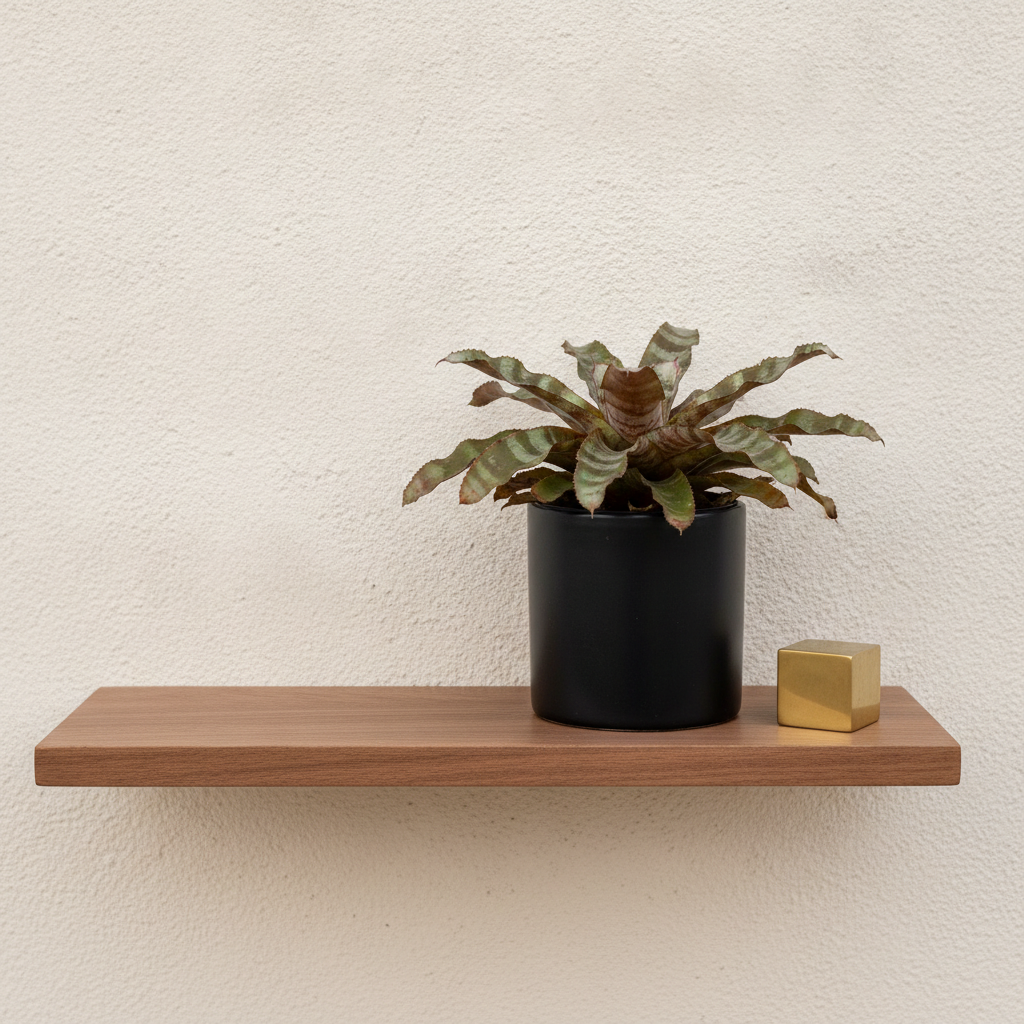
The genus name Cryptanthus comes from the Greek for hidden flower, a reference to the small white blooms that appear tucked deep in the centre of the rosette rather than on a tall showy spike. The plant is grown almost entirely for its foliage, and for good reason. Where most flowering houseplants offer a brief seasonal display, the jewel bromeliad holds its patterned leaves year round, and those leaves are genuinely unusual: flat, stiff and slightly succulent, with strongly wavy margins and the horizontal zebra banding that gives it its alternative common name.
Its small stature is a large part of the appeal. In a hobby dominated by ever-larger monstera and philodendron collections, a plant that stays comfortably under 40 centimetres and grows slowly is a gift to anyone short on windowsill space. It sits happily in a shallow bowl, a decorative saucer or a closed terrarium, and its preference for warmth and humidity means it flourishes in exactly the bathroom and kitchen spots where many other plants sulk. It is also entirely non-toxic, a genuine reassurance in a home with pets or small children who might investigate a low, ground-hugging plant.
There is one quirk worth understanding from the outset. Like many bromeliads, an individual jewel bromeliad rosette flowers only once. After blooming, the mother plant gradually slows and, over many months, declines. This is not a failure of care; it is the plant’s natural life cycle. Long before the mother fades she produces a cluster of offsets around her base, so a well-kept plant effectively renews itself indefinitely. Understanding this rhythm turns what looks like a dying plant into a straightforward propagation opportunity, covered in detail below.
Light
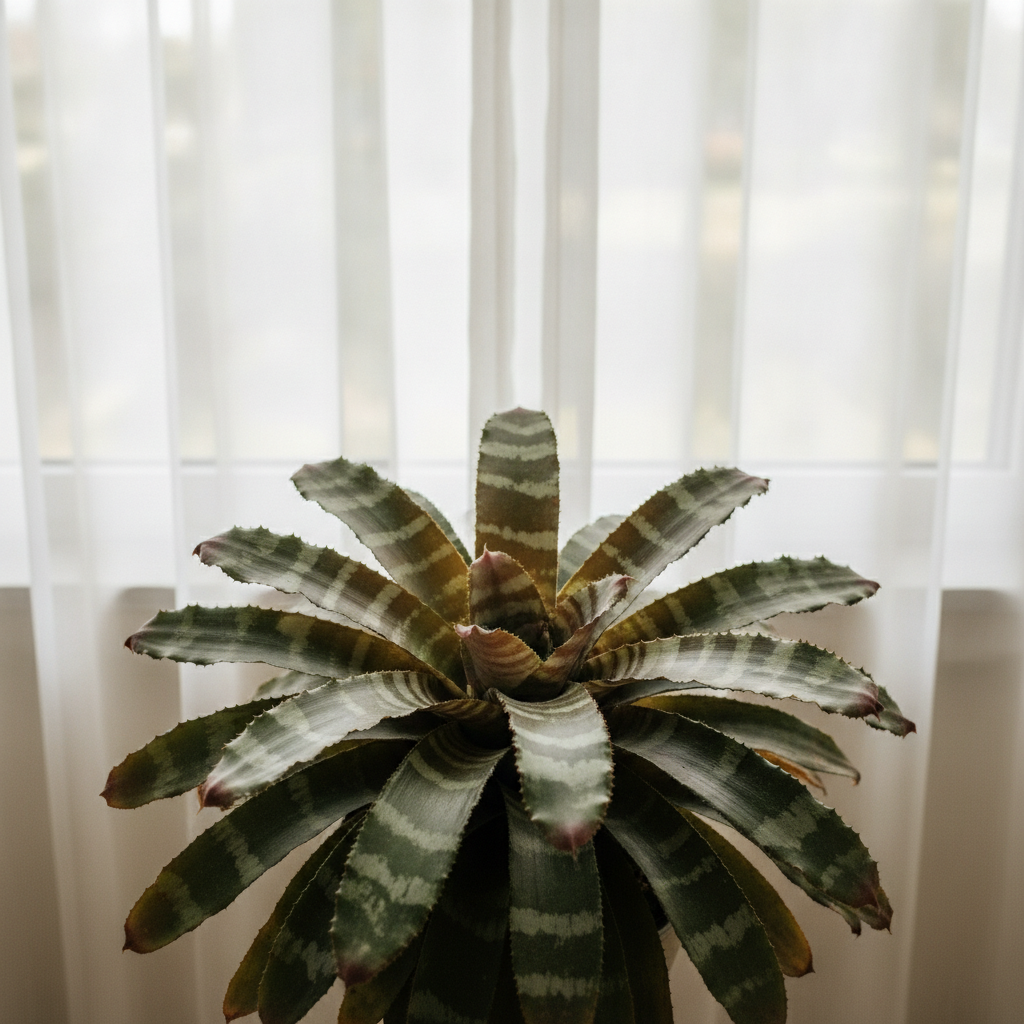
On the forest floor of its native Brazil, the jewel bromeliad receives light that has already been filtered and softened by the canopy above. Replicating that at home means bright but indirect light. An east-facing windowsill that catches gentle morning sun is close to ideal, as is a spot a metre or two back from a brighter south or west window where the harshest rays never land directly on the leaves. The plant will also tolerate medium light, which is what makes it so useful for interior shelves, but there is a visible cost to keeping it too dim.
Light is what powers the plant’s most attractive feature. In good, bright conditions the cross-banding intensifies and the leaves take on rich coppery and bronze tones, sometimes flushing pink or red at the margins. Moved into a dim corner, the same plant slowly loses that drama: the bands fade, the overall colour shifts to a flat, uniform green, and the rosette may stretch slightly as it reaches for light. If your plant looks duller than the one you bought, insufficient light is the most common cause. The remedy is simply a brighter position, introduced gradually over a week or two.
The opposite extreme is just as damaging. Direct midday sun through glass will scorch the leaves, leaving dry, bleached or brown patches that do not recover. If you are using a south or west window, diffuse the light with a sheer curtain, or set the plant off to the side rather than dead centre. A useful rule of thumb is that the light should feel bright enough to read by comfortably, but you should not be able to feel the sun’s warmth on the leaves themselves.
Pro Tip — Read the colour: Treat leaf colour as a living light meter. Deep, high-contrast banding with warm bronze tones means the light is right. Flat, uniform green means move it brighter; bleached or brown patches mean move it back from direct sun.
Watering
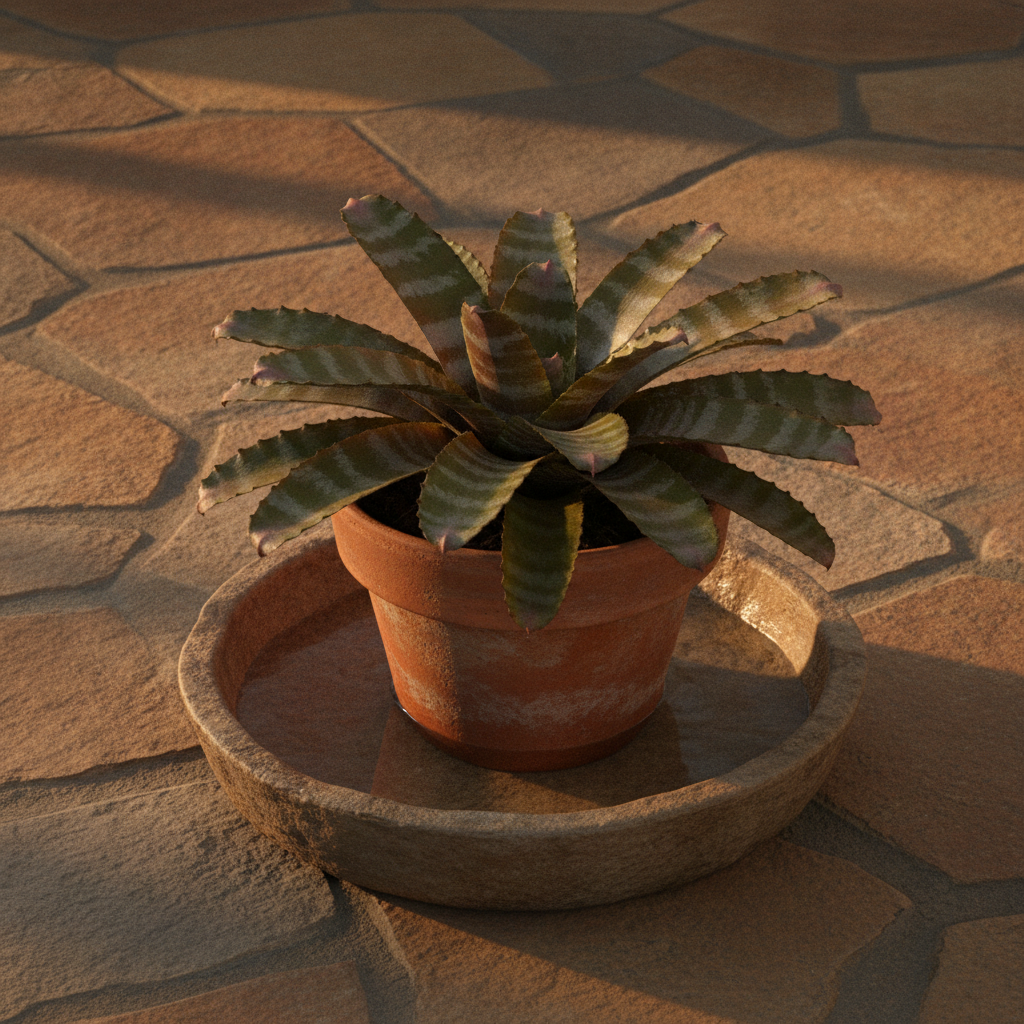
Watering is where the jewel bromeliad differs most sharply from the tank bromeliads that many people know. Epiphytic bromeliads like guzmania and vriesea hold a reservoir of water in a central cup and are watered into that cup. The jewel bromeliad is terrestrial and takes up almost all of its water through a genuine root system, so it should be watered into the soil, not the centre. Pouring water into the tight rosette of an earth star simply lets moisture sit against the growing point, and that trapped water is one of the quickest ways to rot the crown.
The goal is soil that stays evenly moist but never waterlogged. In practice, water thoroughly when the top one to two centimetres of the mix feel dry to the touch, letting excess drain freely from the bottom of the pot. Depending on warmth and light, that usually works out to roughly once or twice a week in the growing season and less often in winter. Because the plant is shallow-rooted and small, it is easy to overwater, and soggy soil is far more dangerous to it than a brief dry spell. When in doubt, wait a day.
Bottom-watering suits this plant particularly well. Standing the pot in a shallow dish of water for fifteen to twenty minutes lets the mix draw moisture up through the drainage holes, keeps water out of the crown entirely, and encourages roots to grow downward. Whichever method you use, water quality matters: bromeliads can be sensitive to the salts and minerals in hard tap water, so rainwater, filtered water or water left to stand overnight is gentler on the leaf tips. Humidity is the other half of the equation. Aim for 60 per cent or more, grouping the plant with others, standing it on a pebble tray, or growing it in a terrarium to keep the air around it moist.
Warning — Keep the crown dry: Never leave standing water pooled in the centre of the rosette. Unlike tank bromeliads, the earth star rots easily at the growing point if water sits there. Always direct water to the soil.
Soil
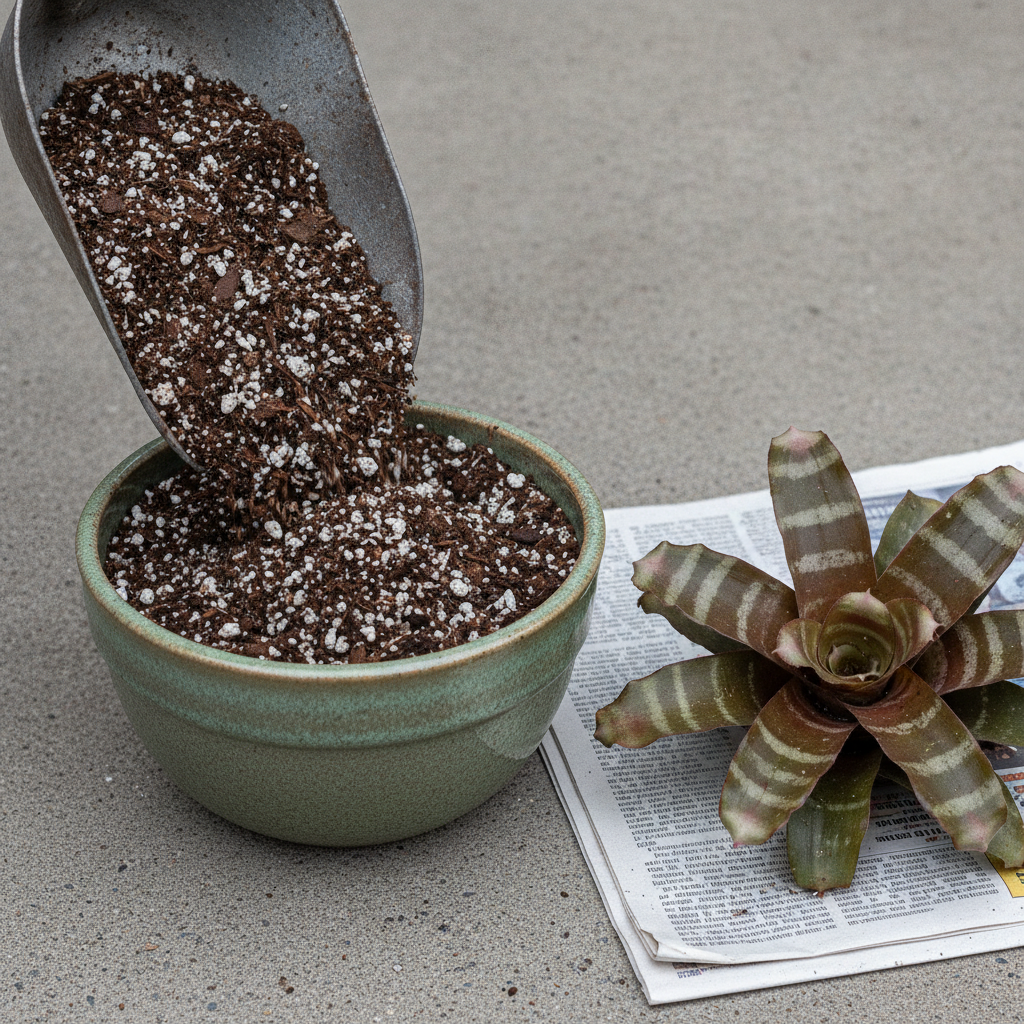
Because it is terrestrial, the jewel bromeliad needs an actual potting medium rather than the pure bark that suits epiphytic bromeliads. What it wants is a light, organic-rich mix that holds a little moisture while still draining fast, mimicking the loose, humus-laden leaf litter of the forest floor. A slightly acidic mix suits it best. A reliable recipe is roughly two parts good-quality peat-free coco coir or a general houseplant compost, one part perlite or pumice for drainage, and one part fine orchid bark to keep the whole thing open and airy.
If mixing your own feels fiddly, several ready-made options work well. A commercial bromeliad mix is the obvious choice, but an African violet mix or a general houseplant compost lightened with a generous handful of perlite will do the job just as well. The single most important quality is drainage. The one thing to avoid is a heavy, dense soil that stays wet for days, which combined with the plant’s rot-prone crown is a recipe for trouble.
Choose the pot to match the plant. The jewel bromeliad has a modest but genuine root system, larger than an epiphytic bromeliad’s, yet it still prefers to be a little snug rather than swimming in a large volume of damp soil. A shallow pot suits its low, spreading habit and dries out more evenly than a deep one. Drainage holes are non-negotiable. Repotting is rarely needed more than once every two or three years, and often the plant is simply refreshed when you divide off its offsets rather than potted up into anything larger.
Fertilising
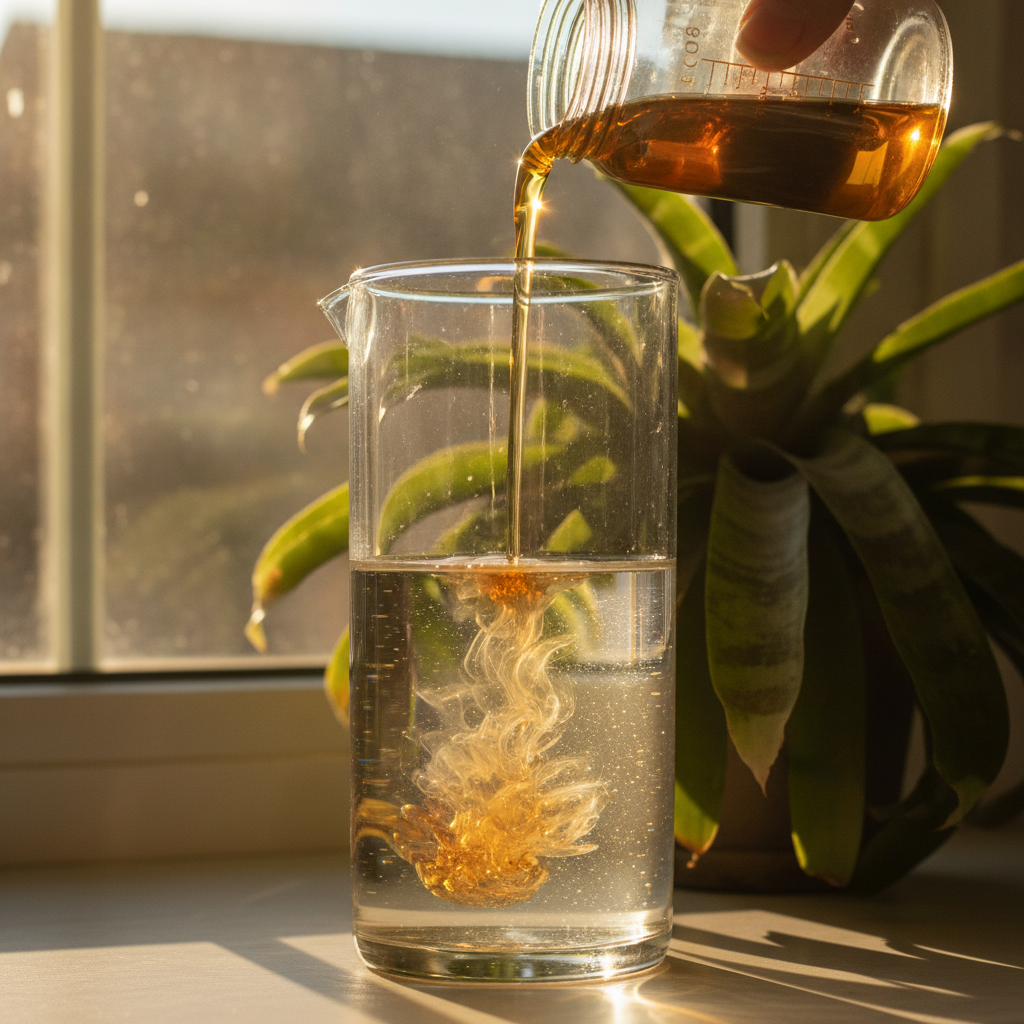
The jewel bromeliad is a genuinely light feeder, and the most common fertilising mistake is doing too much of it. In the wild it draws modest nutrition from decomposing leaf litter, so it has no need for the rich feeding schedule some fast-growing foliage plants appreciate. During the active growing months of spring and summer, a balanced liquid houseplant fertiliser diluted to a quarter or half the recommended strength, applied every four to eight weeks, is ample. In autumn and winter, when growth naturally slows, feeding can be paused altogether.
Apply feed to moist soil rather than dry, which protects the roots from being burned by concentrated salts, and keep the diluted solution out of the central rosette for the same reason you keep plain water out of it. Bromeliads are known to be sensitive to certain metals, copper in particular, so avoid fertilisers or treatments that contain it, and lean towards gentle, balanced formulas over anything strong or specialised.
Over-fertilising shows itself in scorched brown leaf tips and, ironically, in weaker rather than stronger colour, as lush forced growth tends to be paler and softer. If you suspect you have overdone it, flush the pot thoroughly with plain water to leach out accumulated salts and hold off feeding for a couple of months. With this plant, restraint consistently produces better results than generosity.
Propagation
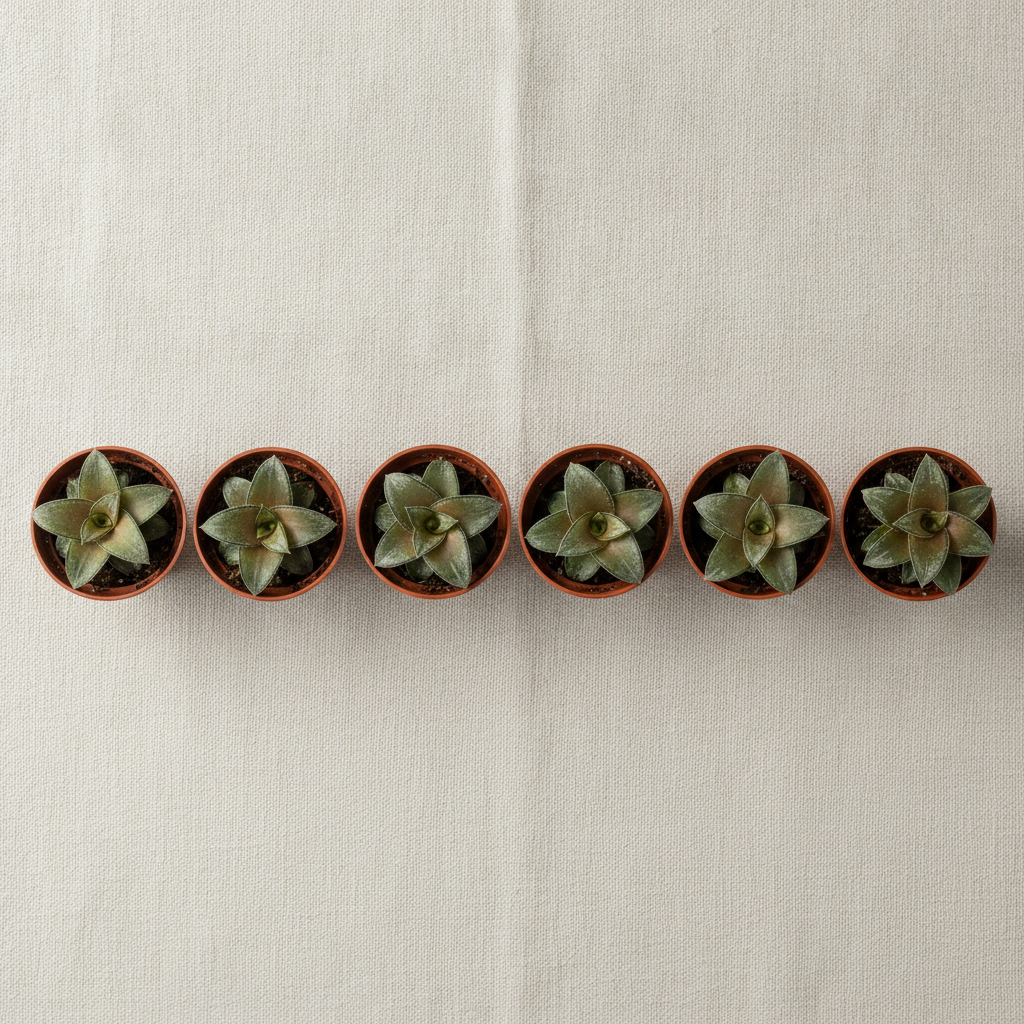
Propagation is where the jewel bromeliad’s life cycle becomes an advantage. The plant does not grow from leaf or stem cuttings; instead it reproduces through offsets, commonly called pups, that emerge around the base of the mother rosette. These typically appear as the mother approaches or passes flowering, and a healthy plant may produce several. Each pup is a complete miniature of the parent and, once large enough, can be separated to become an independent plant, giving you a steady supply of new bromeliads at no cost.
Patience is the key. It is tempting to remove a pup as soon as it appears, but a pup taken too early has too few roots of its own to establish well. Wait until it has reached roughly one-third to one-half the size of the mother and, ideally, has started to form its own small roots at the base. At that point separation is quick and reliable.
- Gently remove the whole plant from its pot, or ease the soil away from the base, so you can see where each pup joins the mother.
- Using a clean, sharp knife or a pair of sterilised secateurs, cut the pup away from the mother, keeping any roots that have formed on the pup intact.
- Let the cut surfaces dry for a few hours to callus over, which reduces the risk of rot at the wound.
- Pot each pup into a small container of the same light, well-draining mix you use for the adult plant, setting it just deep enough to stand upright.
- Water lightly, then place the new plant somewhere warm, bright and humid, and keep the mix barely moist until fresh growth signals that roots have taken hold.
New pups establish fastest in warm, humid conditions, so a spot above 20 degrees Celsius (68 degrees Fahrenheit) with high humidity, or a propagation case or terrarium, speeds things along considerably. The mother plant can be kept as she is; even a post-flowering rosette that is slowly declining will often continue to support and produce pups for a long time before she finally gives out.
Pests and Problems
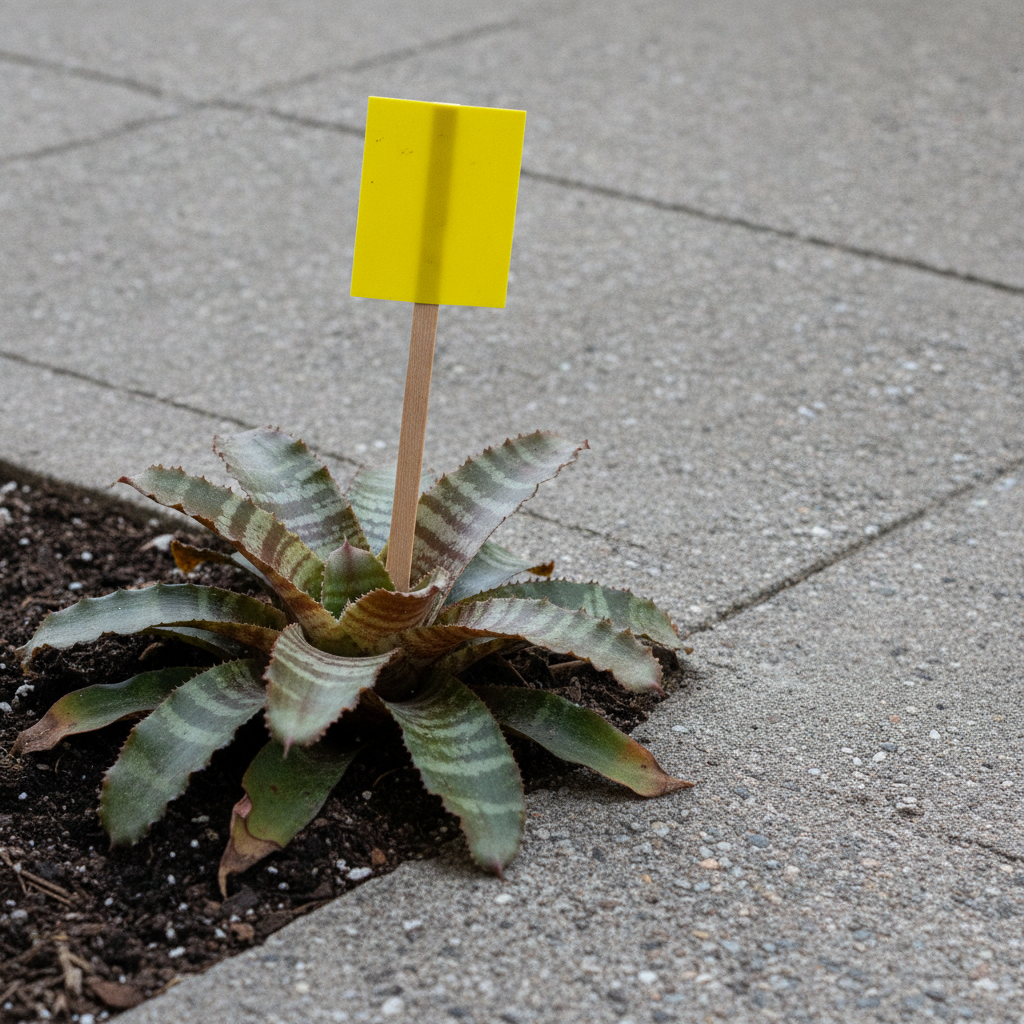
The jewel bromeliad is not especially prone to pests, and the majority of the problems people encounter are cultural rather than the work of insects. Chief among them is overwatering, which shows up as a soft, browning or blackening crown and mushy roots. Because the rosette rots so readily, wet soil and water trapped in the centre are the two conditions to guard against most carefully. Caught early, a rotting plant can sometimes be saved by removing it from the wet soil, cutting away affected tissue and repotting into fresh dry mix, but prevention through careful watering is far more reliable.
When insects do appear, mealybugs are the most likely culprits, hiding as small cottony white tufts down in the leaf axils where the stiff leaves meet the centre. Scale insects and, in dry air, spider mites can also occur. The table below sets out how to recognise and deal with each. A word of caution on treatment: bromeliads can be sensitive to certain insecticides and to oily sprays that clog the leaf surface, so test any product on a single leaf first, and remember the earlier warning about copper-containing products.
| Problem | Signs | What to do |
| Mealybugs | Cottony white tufts in leaf axils and the crown | Dab with a cotton bud lightly moistened with diluted isopropyl alcohol; repeat weekly until clear |
| Scale | Small brown limpet-like bumps on leaves | Scrape off gently and wipe leaves; treat persistent infestations with a mild insecticidal soap, tested first |
| Spider mites | Fine webbing and stippled, dull leaves in dry air | Raise humidity, rinse the foliage, and wipe leaves regularly until controlled |
| Crown rot | Soft, dark, collapsing centre; mushy base | Reduce watering, keep the crown dry, remove rotted tissue and repot into fresh dry mix |
| Brown leaf tips | Dry, crisp tips on the leaves | Increase humidity, use gentler water, and reduce fertiliser strength |
| Faded banding | Flat green leaves with weak pattern | Move to brighter indirect light, increasing exposure gradually |
Varieties
Cryptanthus zonatus is a variable species, and growers have selected several distinct forms over the years, differing mainly in the intensity of their banding and their base colour. The genus as a whole is even more diverse, encompassing brilliantly coloured hybrids in pinks, reds and creams, but the two forms below are the ones most closely associated with the true zebra-banded zonatus itself.
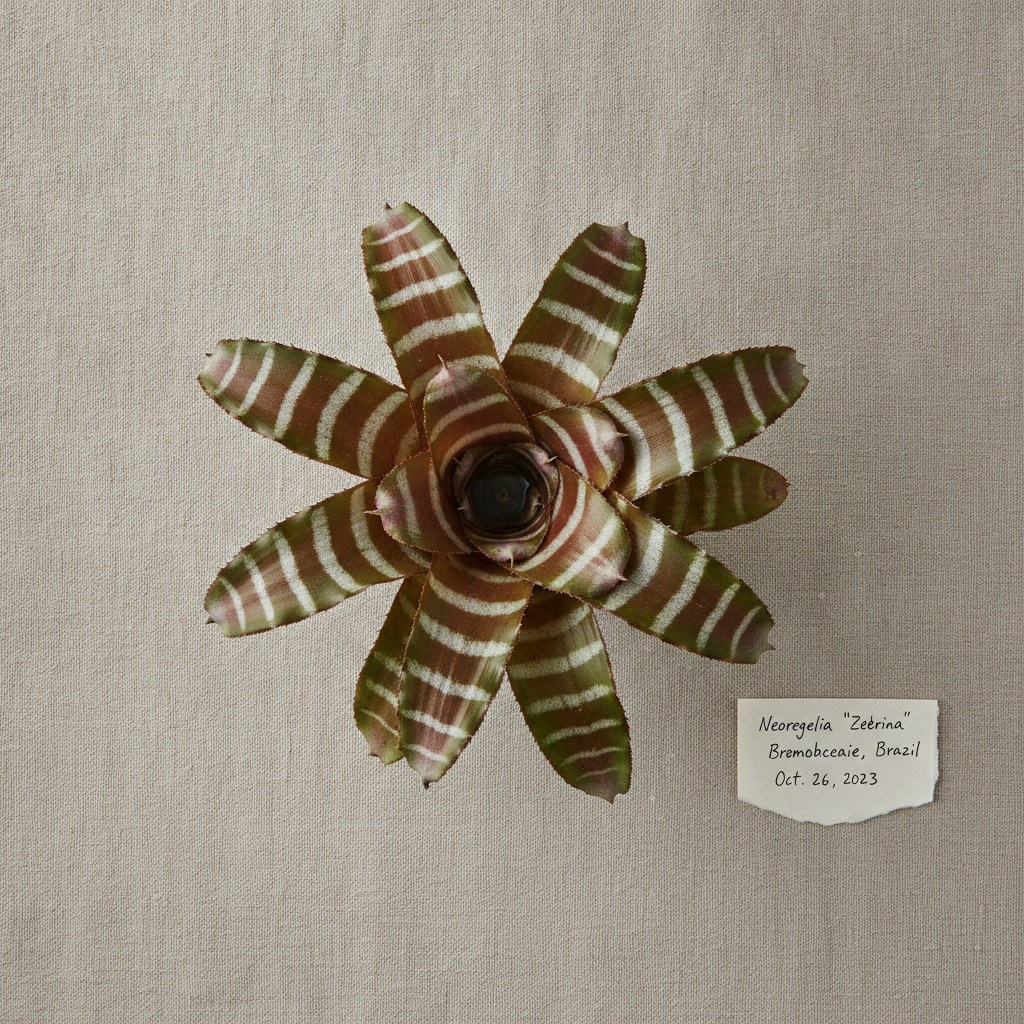
‘Zebrinus’ is the best known form and the one most people picture when they think of the zebra plant. It carries bold, high-contrast silvery-white banding running horizontally across deep coppery-bronze leaves, with strongly crimped, wavy margins that emphasise the flattened star shape. In bright light the contrast becomes striking, and this is the form to seek out if the banding is what drew you to the plant.
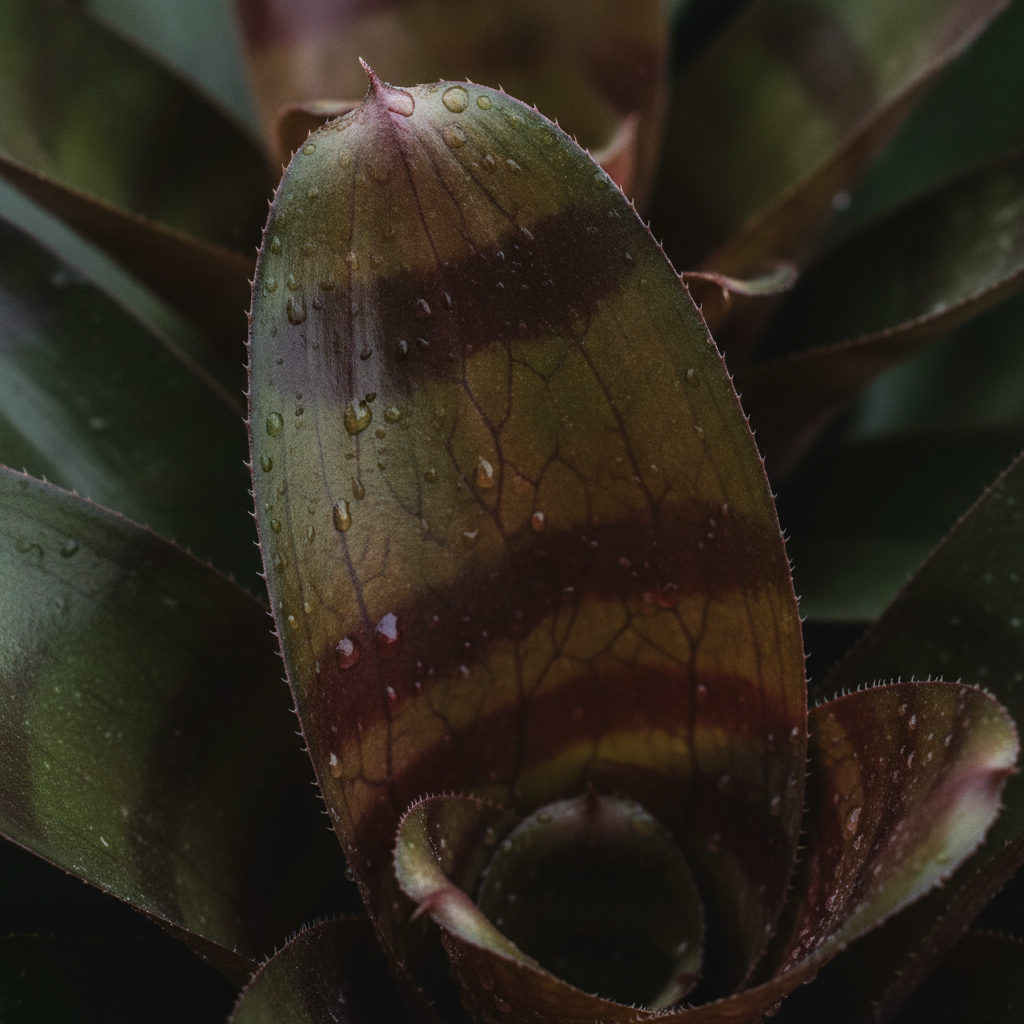
‘Fuscus’ takes the species in a moodier direction, with deeper reddish-brown to chocolate-toned leaves and more subdued, muted banding. Grown in bright light it flushes a rich burgundy, giving it a darker, more dramatic presence than ‘Zebrinus’. It pairs beautifully with pale pots and light backgrounds that let its warm tones stand out, and its care is identical to the species.
Frequently Asked Questions
Why is my jewel bromeliad losing its stripes?
Faded, uniformly green leaves almost always mean too little light. The banding and warm colours are driven by bright, indirect light, so moving the plant to a brighter position, introduced gradually over a week or two, will usually restore the pattern in new growth. Avoid direct sun, which scorches rather than colours the leaves.
Should I water into the centre of the rosette?
No. Unlike the tank bromeliads that hold water in a central cup, the jewel bromeliad is terrestrial and drinks through its roots. Water the soil and keep the crown dry, as standing water in the centre readily causes rot at the growing point.
My plant flowered and now looks like it is dying. What is happening?
This is normal. Each rosette flowers only once and then slowly declines over many months. Before it fades, the mother produces offsets around her base. Leave those pups in place until they reach a third to a half of the mother’s size, then separate and pot them to continue the plant.
Is the jewel bromeliad safe for pets?
Yes. Cryptanthus zonatus is non-toxic and considered safe around cats, dogs and children, so it can be placed within reach without concern. Its low, ground-hugging habit makes this reassurance particularly welcome.
Can I grow it in a terrarium?
It is one of the best bromeliads for the purpose. Its small size and love of high humidity suit a terrarium well, provided the setup drains freely and the crown is not left sitting in trapped moisture. Bright, indirect light and good airflow keep it healthy in an enclosed environment.
Why are the leaf tips turning brown?
Brown, crisp tips usually point to low humidity, mineral build-up from hard tap water, or fertiliser that is too strong. Raise the humidity, switch to rainwater or filtered water, and feed more sparingly with a well-diluted solution to keep the tips clean and green.






