
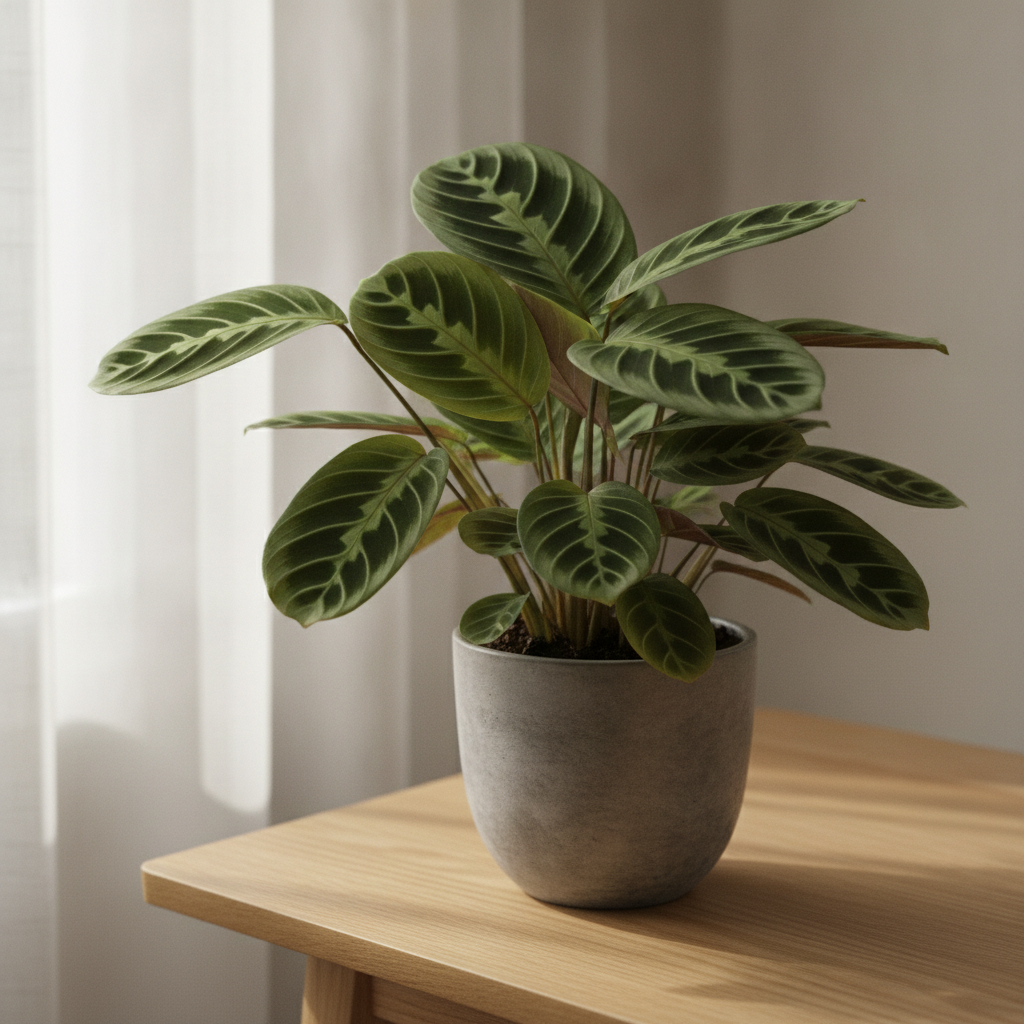
Few houseplants perform quite as literally as the green prayer plant. Each evening its broad, patterned leaves rise and fold together like a pair of hands closing in prayer, a nightly ritual that gives Maranta leuconeura both its common name and much of its charm. Native to the humid, shaded floor of Brazil’s tropical rainforests, this low, spreading plant is prized for foliage that looks hand-painted: oval blades of deep and light green traced with a feathery herringbone of veins, which is why it also answers to the name herringbone plant. It has been a windowsill favourite since the Victorian era and remains one of the most recognisable decorative foliage plants in cultivation.
The green prayer plant has a reputation for being a little temperamental, and that reputation is only half deserved. It will survive a surprising range of neglect, but the gap between a plant that merely survives and one that truly thrives is wider here than with most houseplants. Crisp brown leaf edges, faded markings and a sulking, flattened habit are all signs of a plant that is getting by rather than flourishing. This guide walks through everything that separates the two: the light it wants, the particular way it likes to be watered, the humidity it craves, and how to feed, repot, propagate and protect it so that the nightly leaf-folding show carries on for years.
Contents
- Quick Reference
- Why the Green Prayer Plant Makes a Rewarding Houseplant
- Light Requirements
- Watering & Humidity
- Soil, Potting & Repotting
- Fertilising
- Propagation
- Pests & Diseases
- Popular Varieties
- Frequently Asked Questions
Quick Reference: Green Prayer Plant at a Glance
| Light | Bright, indirect light; tolerates medium light. No direct sun. |
| Watering | Keep soil evenly moist, never soggy or bone dry. Use filtered, distilled or rainwater. |
| Temperature | 18 to 24 °C (65 to 75 °F). Avoid anything below 15 °C (59 °F). |
| Humidity | High, ideally 50 to 60 % or more. |
| Fertiliser | Balanced feed at half strength, every four weeks in spring and summer. |
| Toxicity | Non-toxic to cats, dogs and humans. Pet and child safe. |
Why the Green Prayer Plant Makes a Rewarding Houseplant
The strongest argument for the green prayer plant is its foliage, which delivers pattern and movement in a way few other plants manage. The leaves emerge a soft apple green and mature to a deeper shade, marked with a symmetrical herringbone of paler veins and, in many forms, dark blotches arranged in pairs along the midrib. Because the plant stays low and spreads outward rather than climbing, it suits shelves, tabletops, mantelpieces and the front edge of a grouped plant display, where the leaf detail can be seen up close.

Then there is the nightly performance. The prayer plant belongs to a group of plants that exhibit nyctinasty, a rhythmic movement of the leaves driven by changes in light. During the day the leaves lie open and flat to catch what light reaches the forest floor; as darkness falls they lift and press together along the stem, reopening at dawn. This is powered by small swellings at the base of each leaf called pulvini, which shift water pressure to raise and lower the blade. The effect is genuinely mesmerising and makes the plant feel more like a companion than a fixture. On top of that, the green prayer plant is one of the safest houseplants you can own, which broadens where and with whom it can live.
Important — Toxicity: The green prayer plant is listed as non-toxic to cats and dogs by the ASPCA, and it poses no risk to humans either. It is one of the few statement foliage plants you can keep in a home with curious pets or small children without worry. That said, no plant is meant to be eaten, and nibbled leaves may still cause mild stomach upset.
Light Requirements
Understanding light is the single most useful thing you can do for a green prayer plant, because its natural home explains everything about its preferences. On the rainforest floor it lives beneath a dense canopy, receiving light that has already been filtered and softened by the leaves above. It never sees the full force of the tropical sun, and it has evolved leaves that are efficient at capturing gentle, diffuse light rather than tolerating harsh, direct rays.
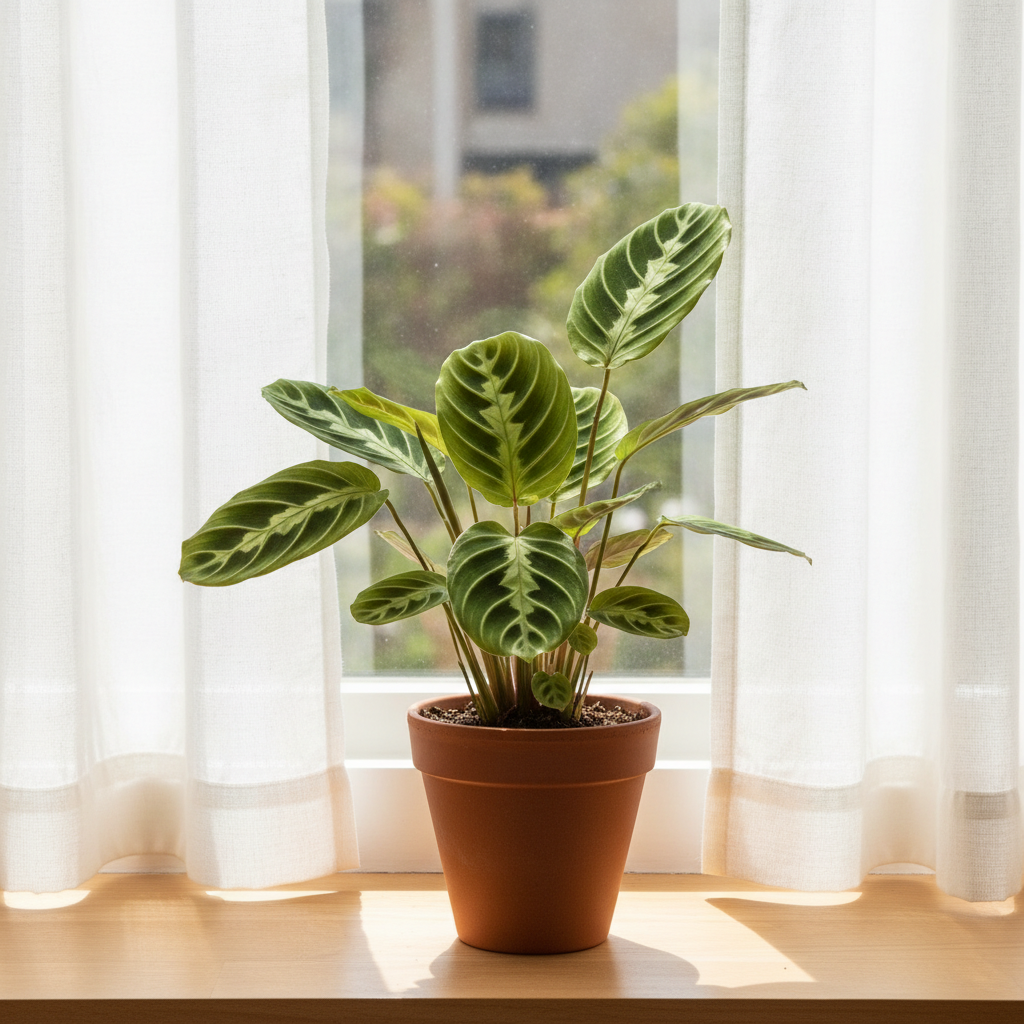
Translated to the home, that means bright but indirect light is ideal. A position a metre or two back from a bright window, or beside a window screened by a sheer curtain, mimics the dappled conditions the plant expects. In this light the leaf markings stay bold, the colours stay saturated, and growth is steady and compact. The green prayer plant will also tolerate genuinely medium light better than many patterned foliage plants, which is part of why it succeeds in rooms that are too dim for a fiddle leaf fig or a calathea to look their best.
Light Levels Explained
Gardeners describe indoor light in broad categories, and knowing where your plant sits helps you predict how it will respond. The table below outlines the common tiers and what each means for a green prayer plant specifically.
| Light Category | Approx. Level | Typical Location | Outcome |
|---|---|---|---|
| Direct sun | 20,000+ lux | On an unshaded south or west sill | Harmful; leaves scorch and fade |
| Bright indirect | 10,000 to 20,000 lux | Near an east window or set back from a bright one | Ideal; strong colour, steady growth |
| Medium | 5,000 to 10,000 lux | A metre or two into a bright room | Good; slightly slower, still healthy |
| Low | 1,000 to 5,000 lux | North-facing room, interior wall | Tolerated; leggy, muted markings |
| Very low | Under 1,000 lux | Windowless or deeply shaded corner | Poor; decline over time |
Window Orientation and Placement
South-facing window: The brightest exposure in the northern hemisphere and too intense for direct placement. Set the plant well back from the glass, or filter the light with a sheer curtain or blind. Never let midday sun fall directly on the leaves.
East-facing window: Often the sweet spot. Gentle morning sun followed by bright, indirect light for the rest of the day suits the plant perfectly, and a spot right on or just beside an east sill usually works without any shading.
West-facing window: Workable, but the strong afternoon sun can be too much up close. Keep the plant back from the glass or diffuse the light, much as you would at a south window.
North-facing window: The dimmest exposure, yet the green prayer plant tolerates it better than most patterned plants. Growth will be slower and the markings a little softer, but the plant can hold its own directly on a north sill.
Pro Tip — Read the Leaves: Let the plant tell you if the light is right. Leaves that curl tightly, fade or develop crisp bleached patches are getting too much light. Leaves that stretch toward the window on long, sparse stems and lose their contrast are getting too little. Adjust the position a little at a time and watch the new growth.
How Light Affects Leaf Colour and Movement
Light does more than fuel growth in this plant; it shapes the very features people buy it for. In good bright indirect light the contrast between the dark and light zones of each leaf is at its most dramatic, and the red-veined varieties show their strongest colour. In dim conditions the markings blur toward a uniform green and the plant loses much of its decorative punch. Light also governs the nightly folding: because the movement is a response to changing light, a plant kept in a stable, well-lit position will keep a reliable rhythm, opening each morning and closing each night.
Warning — Direct Sunlight: Direct sun is the fastest way to ruin a green prayer plant. Even an hour of harsh midday light through unshaded glass can bleach the leaves, brown their edges and permanently scar the markings. Scorch damage does not heal; affected leaves must grow out and be replaced. When in doubt, err toward less light rather than more.
Artificial Lighting
Because it evolved in low, filtered light, the green prayer plant adapts readily to artificial lighting and makes an excellent candidate for offices and windowless rooms. A full-spectrum LED grow light positioned 30 to 45 cm above the plant, running for 10 to 12 hours a day, will keep it healthy and colourful. Ordinary bright room lighting is rarely enough on its own, but a dedicated grow light bridges the gap easily and can even improve a plant that has been struggling in a genuinely dark corner.
Seasonal Adjustments
Indoor light shifts noticeably through the year, and the plant appreciates being moved to follow it. In the short, weak days of winter, shift the plant closer to its window to make up for the reduced intensity, and consider supplementing with a grow light if growth stalls. As spring returns and the sun climbs higher and stronger, ease the plant back from the glass again to avoid scorching the new season’s soft growth. A plant that looked perfectly placed in December may be sitting in too much light by June.
Watering & Humidity
Watering is where the green prayer plant earns its fussy reputation, and it is worth getting right because more of these plants are lost to watering mistakes than to anything else. The goal is consistency: soil that stays evenly and lightly moist, never waterlogged and never allowed to dry out completely. Unlike a succulent, which wants to dry between drinks, the prayer plant sulks the moment its roots parch, and unlike a fern it will rot if left standing in water. The narrow middle ground is exactly where it wants to live.
When to Water
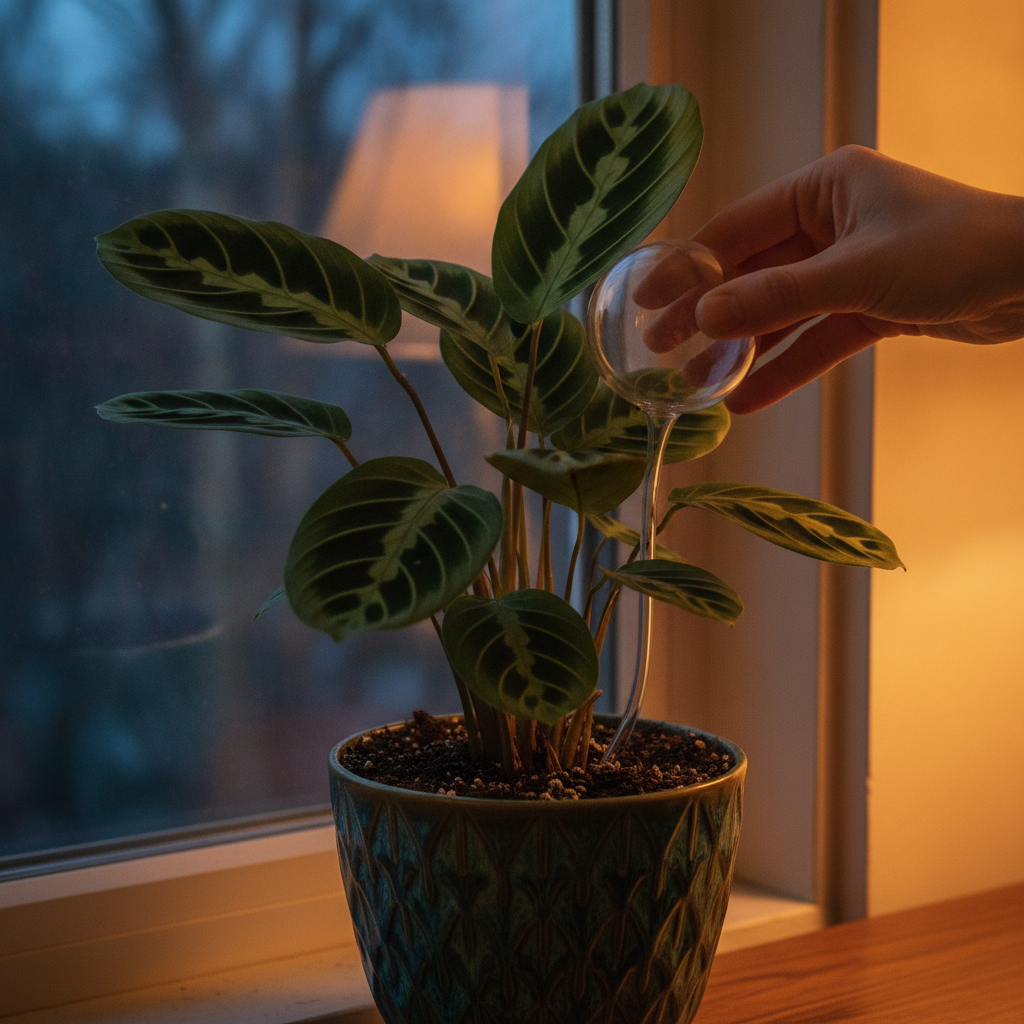
Rather than watering on a fixed calendar, check the soil with your finger. When the top centimetre or two feels just barely dry to the touch, it is time to water. In practice this usually works out to roughly once a week in the warm growing months, tapering to every ten days or two weeks in winter, but light levels, pot size and household warmth all shift the timing, so the finger test always beats a schedule.
The plant will also signal its thirst through its leaves and its movement. Slightly limp, downturned leaves that perk up after watering point to a plant that was allowed to get a touch too dry, while leaves that stay folded and dull through the day can indicate stress from erratic moisture. Learning to read these cues alongside the soil check turns watering from guesswork into routine.
Pro Tip — Skip the Tap: The green prayer plant is unusually sensitive to the fluoride, chlorine and dissolved salts in ordinary tap water, which build up and show as brown, crispy leaf tips and edges. Water with filtered water, distilled water or collected rainwater, and let it come to room temperature first. This one change resolves the majority of brown-tip complaints.
How to Water Correctly
- Check that the top centimetre or two of soil feels barely dry before you begin.
- Use room-temperature filtered, distilled or rainwater rather than cold water straight from the tap.
- Pour slowly and evenly across the whole surface until water runs freely from the drainage holes.
- Let the pot drain completely for several minutes so no water is trapped at the base.
- Empty the saucer or cache pot; never leave the plant standing in collected water.
- Return the plant to its spot and note roughly how long the soil took to reach barely-dry again to guide the next watering.
Signs of Overwatering vs. Underwatering
| Symptom | Overwatering | Underwatering |
|---|---|---|
| Leaf colour | Yellowing, often lower leaves first | Browning, crisp edges and tips |
| Leaf texture | Soft, limp, sometimes translucent | Dry, papery, curling inward |
| Soil | Constantly wet, may smell sour | Pulls away from the pot sides, dusty |
| Roots | Brown, mushy, foul-smelling | Dry, brittle, pale |
| Stem base | Soft or blackened at the soil line | Firm but the plant looks deflated |
Warning — Root Rot: Persistently soggy soil starves the roots of oxygen and invites the fungal and bacterial rots that kill prayer plants quickly. If you notice yellowing lower leaves, a sour smell or a soft stem base, unpot the plant at once, trim away any brown mushy roots with clean scissors, and repot into fresh, barely-moist mix. Catching rot early is often the difference between saving and losing the plant.
Humidity Requirements
If watering is the first pillar of prayer plant care, humidity is the second, and the two are closely linked. As a rainforest-floor species, the green prayer plant expects the air around it to be moist, ideally 50 to 60 % relative humidity or higher. The dry air of a centrally heated or air-conditioned home, which can drop below 30 %, is one of the most common reasons for the brown, crispy leaf edges that so often frustrate new owners.
The clearest symptoms of low humidity are browning leaf margins, edges that feel dry and brittle rather than supple, and new leaves that unfurl already marked or misshapen. Because these overlap with the effects of tap water, it is worth addressing both at once: filtered water plus better humidity usually clears the problem entirely.
To raise humidity, group the plant with other houseplants so they share the moisture they release, stand the pot on a shallow tray of pebbles topped up with water so evaporation moistens the air around the leaves, or run a small room humidifier nearby, which is by far the most effective and consistent method. A steamy bathroom or kitchen with adequate light also makes an excellent home. Misting is often suggested but offers only a brief, minor lift and can encourage fungal spots if leaves stay wet, so it is not a reliable substitute for the other methods.
Water Quality
It is worth restating because it matters so much for this particular plant: water quality is not a detail here but a core part of care. The mineral content of hard tap water and the additives in municipal supplies accumulate in the soil and the leaf tissue, producing the tell-tale brown tips. Rainwater is ideal and free where you can collect it, distilled water is reliably pure, and a simple filter jug removes enough chlorine to help. Whatever the source, let the water reach room temperature before use, as a shock of cold water can stress the roots.
Soil, Potting & Repotting
The right soil for a green prayer plant resolves the central tension of its watering needs: it must hold enough moisture to keep the roots evenly damp, yet drain freely enough that they never sit in water. A dense, water-retentive mix rots the roots, while a fast-draining cactus mix dries out far too quickly and leaves the plant perpetually thirsty. The ideal is an open, moisture-retentive blend built around a peat or coir base.
Ideal Soil Composition
You can use a good-quality peat-based houseplant compost as a starting point and improve its structure with a few amendments. The aim is a mix that feels light and springy, holds moisture without turning to mud, and lets excess water pass through. The components below combine to strike that balance.
| Component | Proportion | Function |
|---|---|---|
| Peat or coco coir | 50 % | Holds moisture evenly and provides an acidic base |
| Perlite | 20 % | Opens the mix and improves drainage and aeration |
| Fine orchid bark or coir chips | 20 % | Creates air pockets and prevents compaction |
| Worm castings or compost | 10 % | Adds gentle, slow-release nutrition |
The green prayer plant prefers a slightly acidic soil, roughly pH 5.5 to 6.5, which the peat or coir base naturally provides. There is no need to test or adjust the pH in most cases; using a peat-based mix rather than a neutral general-purpose compost keeps it comfortably in range.
Pro Tip — Quick Mix Recipe: For a fast, reliable blend, stir together two parts peat-based houseplant compost, one part perlite and one part fine orchid bark, with a handful of worm castings mixed through. It holds moisture like the plant wants while staying airy enough to protect the roots.
Choosing the Right Pot
The green prayer plant has a shallow, spreading root system rather than a deep one, so a wide, relatively shallow pot suits it better than a tall, narrow one. This matches its growth habit and reduces the volume of wet soil sitting below the roots, which lowers the risk of rot.
Drainage holes are non-negotiable. Whatever pot you choose, it must have drainage holes. Without them water collects at the base out of sight and rots the roots. If you love a decorative cache pot with no holes, use it as an outer sleeve and keep the plant in a plain nursery pot that you can lift out to water and drain.
Pot material: Plastic and glazed ceramic both hold moisture well and suit this plant’s love of consistent dampness. Unglazed terracotta wicks moisture out of the soil and dries it faster, which can work against you here unless you are prone to overwatering, in which case its forgiving nature may help.
Pot size: Move up only one size at a time, choosing a pot two to three centimetres wider than the current one. An oversized pot holds a large reservoir of soil that stays wet long after the roots have taken their fill, which is a recipe for root rot.
When to Repot
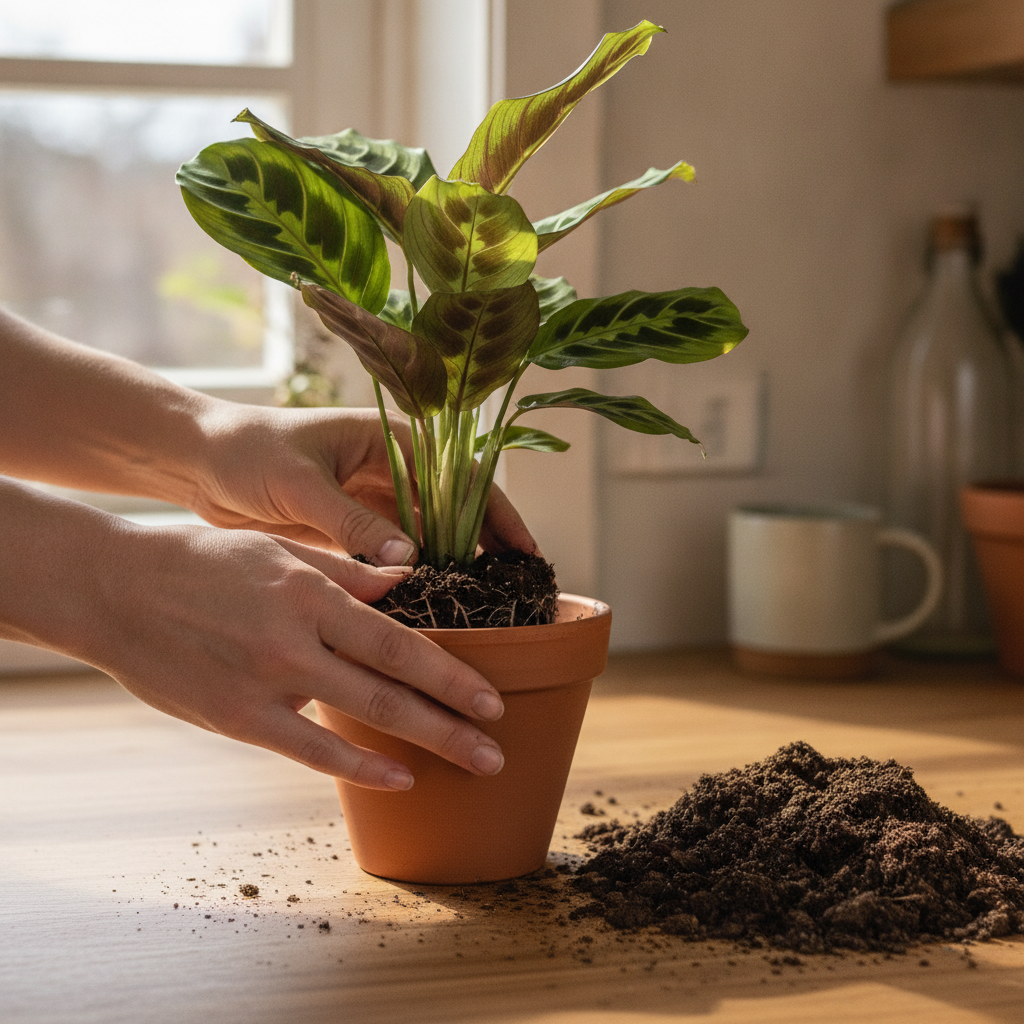
The green prayer plant is not a fast grower and only needs repotting every one to two years, usually in spring as it enters active growth. Signs that it is ready include roots emerging from the drainage holes or circling the surface, water that runs straight through without wetting the soil, and a plant that seems to dry out much faster than it used to. If none of these apply, the plant is content and can be left alone; refreshing the top few centimetres of soil each spring is enough to keep it fed between repottings.
How to Repot: Step-by-Step
- Water the plant a day beforehand so the root ball is hydrated and holds together.
- Ease the plant out by tipping the pot and supporting the base of the stems, rather than pulling on the foliage.
- Gently tease apart the outer roots and remove any that are brown, soft or mushy with clean scissors.
- Add a layer of fresh mix to the base of a pot only one size larger, and set the plant so its crown sits at the same depth as before.
- Fill around the root ball with fresh mix, firming lightly to remove large air pockets without compacting the soil.
- Water thoroughly with room-temperature filtered water and let the pot drain completely.
- Return the plant to a spot with bright, indirect light and hold off on feeding for four to six weeks while it settles.
Warning — Transplant Shock: Expect a short sulk after repotting, with drooping or folded leaves for a few days as the roots recover. Keep conditions stable, warm, humid and out of direct sun, and resist the urge to overwater a plant that looks limp. Shock passes on its own within a week or two; fussing over it tends to do more harm than good.
Fertilising
The green prayer plant is a light feeder, and its nutritional needs are modest compared with fast-growing foliage plants. A little, applied regularly during the growing season, keeps the leaves large and richly coloured; too much scorches the sensitive roots and leaf edges. As with watering, restraint pays off.
Feeding matters most from spring through late summer, when the plant is actively pushing out new leaves. In autumn and winter growth slows or stops, and feeding during this rest period simply leaves unused fertiliser salts to accumulate in the soil, so it is best to pause until the days lengthen again.
Understanding Plant Nutrients
Most houseplant fertilisers are labelled with three numbers, the N-P-K ratio, which give the proportions of nitrogen, phosphorus and potassium. For a foliage plant like the prayer plant, a balanced formula in which those three are roughly equal serves well, supporting leaf growth without pushing the plant toward flowering at the expense of foliage. The table below explains what each of the key nutrients does.
| Nutrient | Symbol | Primary Function | Deficiency Symptoms |
|---|---|---|---|
| Nitrogen | N | Drives leafy green growth | Pale, yellowing older leaves; stunted growth |
| Phosphorus | P | Supports roots and energy transfer | Weak roots, dull leaves, slow development |
| Potassium | K | Regulates water and overall vigour | Brown leaf edges, weak stems |
| Calcium | Ca | Builds cell walls and new tissue | Distorted or hooked new leaves |
| Magnesium | Mg | Central to chlorophyll production | Yellowing between the veins of older leaves |
| Iron | Fe | Aids chlorophyll and enzyme function | Yellowing between the veins of new leaves |
Types of Fertiliser
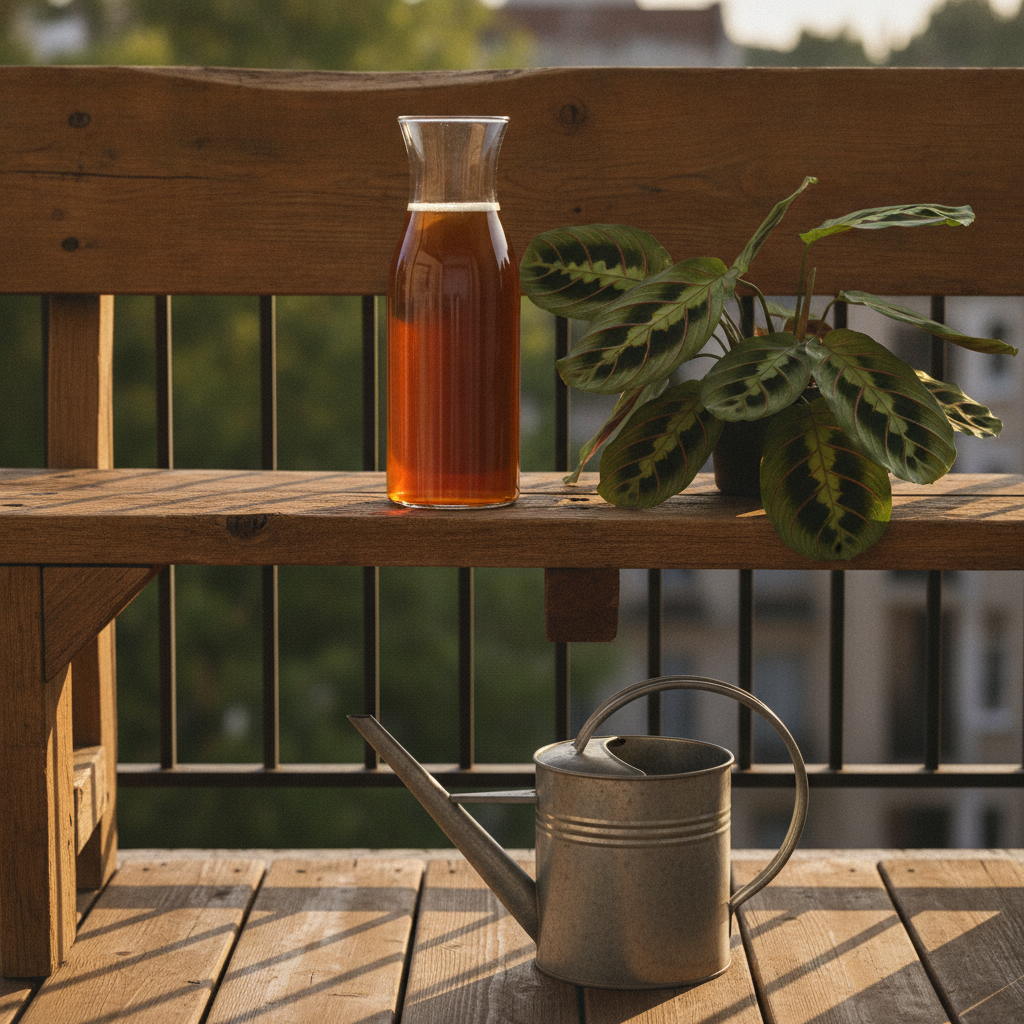
Liquid fertilisers: The easiest choice for prayer plants because you control the dose precisely. Diluted into the watering can, a balanced liquid feed can be applied at half the label strength during the growing season and adjusted or skipped at the first sign of trouble.
Slow-release granular: Convenient in that it feeds gradually over months, but it offers less control, and its steady release can build up salts in a plant this sensitive. If you use it, apply at the lower end of the recommended rate and flush the soil occasionally.
Organic fertilisers: Worm castings, diluted compost tea and gentle organic liquids feed softly and improve the soil, making them well suited to a plant that dislikes strong chemical feeds. They are more forgiving of slight over-application, though still best used in moderation.
Feeding Schedule
A simple, reliable rhythm is to feed once every four weeks from spring through late summer with a balanced liquid fertiliser at half strength, then stop entirely from autumn until the following spring. This mirrors the plant’s natural cycle of active growth and rest, and it keeps the leaves lush without overwhelming the roots.
Pro Tip — Half Strength Always: When it comes to feeding a prayer plant, less really is more. Mixing fertiliser at half the recommended concentration protects the sensitive roots and greatly reduces the risk of salt burn, while still supplying everything the plant needs. It is far easier to feed a little more next time than to undo the brown edges caused by feeding too much.
How to Fertilise
- Water the plant lightly first if the soil is quite dry, so the feed never hits parched roots.
- Mix a balanced liquid fertiliser into filtered water at half the label strength.
- Apply evenly across the soil until it is moistened, avoiding splashing the leaves.
- Let any excess drain away and empty the saucer so no fertiliser-rich water pools at the base.
- Every couple of months, flush the pot with plain water to wash out accumulated salts.
Warning — Salt Build-Up: A white crust on the soil surface or around the pot rim, along with worsening brown leaf tips, signals a build-up of fertiliser and mineral salts. Flush the soil thoroughly by running filtered water through it several times until it drains freely, and scale back feeding. Left unchecked, salt accumulation damages the roots and steadily disfigures the foliage.
Propagation
Propagating a green prayer plant is straightforward and one of the quiet pleasures of owning one, letting you multiply your collection or share cuttings with friends. The plant lends itself to two reliable methods: division of an established clump and stem cuttings rooted in water or moss. Both work best in spring or early summer, when the plant is growing actively and recovers quickly.
The key to success with either method is understanding the plant’s structure. Growth arises from nodes along the trailing stems, and it is at these nodes that new roots and shoots form. Getting a node into the right conditions is the whole game.
Understanding Nodes and Pulvini
A node is the slightly thickened point on a stem where a leaf joins and where dormant root and shoot cells wait. Just above each node sits the pulvinus, the swollen joint that powers the nightly leaf movement. For propagation, what matters is that a cutting must include at least one node below the leaf, because that is where roots will emerge. A leaf on its own, with no node, will not grow into a new plant, which is why prayer plants cannot be propagated from single leaves the way some succulents can.
Division: Step-by-Step
Division is the fastest way to make new plants and works beautifully because a mature prayer plant naturally forms several clumps that can be separated with their roots already intact. It is best done at repotting time so the plant is only disturbed once.
- Water the plant the day before, then slide the whole root ball out of its pot.
- Gently brush away loose soil so you can see the natural clumps and where the roots divide.
- Tease the plant into two or more sections by hand, each with a healthy share of both stems and roots, using clean scissors only where roots must be cut.
- Pot each division into its own container of fresh, barely-moist mix at the same depth it grew before.
- Water in with room-temperature filtered water, then keep the divisions warm, humid and out of direct sun while they establish.
Pro Tip — Halve the Stress: Newly divided plants root fastest in high humidity. Slip a clear plastic bag or propagator lid loosely over each division for the first week or two, opening it daily for fresh air, to hold moisture around the leaves while the disturbed roots recover and take hold.
Stem Cuttings: Step-by-Step
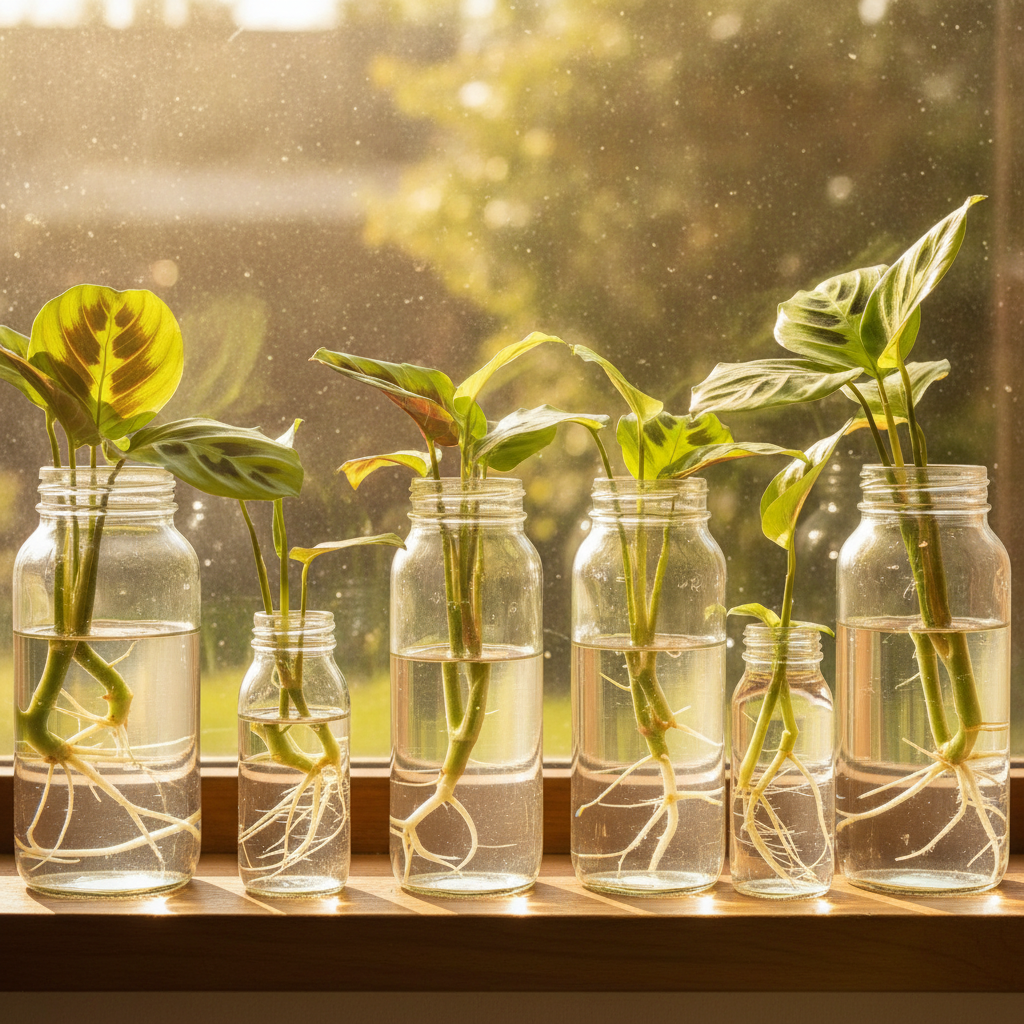
Stem cuttings are the method to reach for when you want to multiply a plant without unpotting it, or to make use of a stem that has grown long and leggy. Cuttings root readily in water, where you can watch the process unfold.
- Choose a healthy stem and cut just below a node with clean, sharp scissors, keeping one or two leaves and removing any lower ones that would sit in water.
- Place the cutting in a glass of room-temperature filtered water with the node fully submerged and the remaining leaves above the surface.
- Set the glass in bright, indirect light and refresh the water every few days to keep it clean and oxygenated.
- Wait for white roots to emerge from the node, which usually takes two to four weeks.
- Once the roots reach three to five centimetres, pot the cutting into moist mix and keep it humid while it adjusts to soil.
Troubleshooting Propagation
| Problem | Likely Cause | Solution |
|---|---|---|
| Cutting rots in water | Leaves submerged, or water left stale | Keep only the node under water and change it every few days |
| No roots after weeks | No node included, or light too low | Re-cut below a clear node and move to brighter indirect light |
| Divisions wilt badly | Too little humidity or too much sun | Cover loosely and move out of direct light while they root |
| Roots form but plant stalls in soil | Abrupt move from water to dry air | Pot into moist mix and raise humidity for the first weeks |
Pests & Diseases
A healthy, well-cared-for green prayer plant shrugs off most problems, but the same conditions it dislikes, dry air and inconsistent watering, are exactly the ones that leave it vulnerable to pests and disease. Prevention, in other words, is mostly a matter of good routine care, and a plant kept humid, evenly watered and out of harsh sun rarely suffers seriously.
When trouble does appear, catching it early makes all the difference. Get into the habit of turning a few leaves over when you water to check their undersides, where most pests gather first, so an infestation is spotted while it is still small and easy to treat.
Common Pests
Spider Mites (Tetranychus urticae)
The prayer plant’s number one enemy, spider mites thrive in exactly the dry air the plant hates. They are tiny, almost invisible to the naked eye, and betray themselves through fine webbing between leaves and stems and a pale stippling or speckling across the leaf surface. Left unchecked they can weaken a plant quickly.
Treatment: Rinse the plant under a gentle shower to knock the mites back, then treat with insecticidal soap or neem oil, coating the leaf undersides and repeating weekly until they are gone. Raising the humidity makes the environment far less welcoming to them.
Mealybugs (Pseudococcidae)
Mealybugs appear as small, soft, white cottony tufts tucked into leaf axils and along stems. They feed on sap and excrete a sticky honeydew that can lead to sooty mould, and they spread slowly but persistently if ignored.
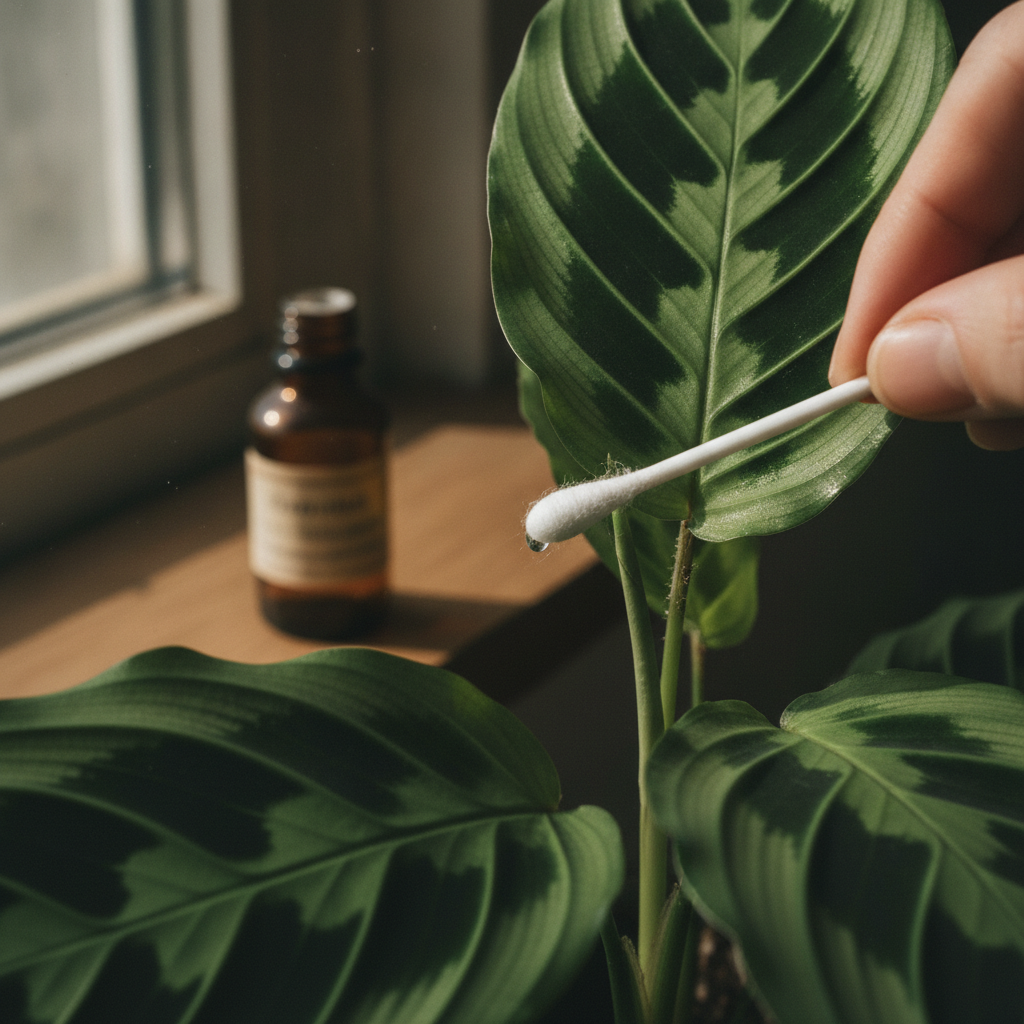
Treatment: Dab each insect directly with a cotton bud dipped in isopropyl alcohol, which kills them on contact, then follow up with neem oil or insecticidal soap. Check weekly, as their waxy egg sacs can hide in crevices and hatch later.
Aphids (Aphidoidea)
Aphids are small green, black or brown insects that cluster on soft new growth and the undersides of young leaves, sucking sap and causing distortion and yellowing. They reproduce rapidly, so a few can become many within days.
Treatment: Spray them off with a firm jet of water, then treat with insecticidal soap or neem oil, paying attention to the growing tips where they congregate. Repeat every few days until no new aphids appear.
Common Diseases
Root Rot (Pythium and Phytophthora)
The most serious disease of prayer plants, root rot follows from soil that stays waterlogged. The roots suffocate and are colonised by fungi, turning brown and mushy, while above ground the plant yellows, wilts and collapses despite the wet soil.
Treatment: Unpot the plant, cut away all soft, dark roots with sterilised scissors, and repot into fresh, airy mix in a clean pot with good drainage. Water more sparingly afterwards and correct the underlying overwatering or poor drainage that caused it.
Leaf Spot (Helminthosporium)
Fungal leaf spot shows as small water-soaked spots that enlarge into brown or tan lesions, sometimes ringed with yellow. It is encouraged by water sitting on the leaves for long periods, particularly in still, humid air.
Treatment: Remove affected leaves, improve air circulation and avoid wetting the foliage when watering. In stubborn cases a copper-based or general houseplant fungicide can help bring it under control.
Pest and Disease Summary
| Pest / Disease | Identification | Treatment |
|---|---|---|
| Spider mites | Fine webbing, pale stippled leaves | Rinse, raise humidity, neem or insecticidal soap |
| Mealybugs | White cottony tufts in axils | Alcohol on a cotton bud, then neem oil |
| Aphids | Clusters on new growth | Water jet, then insecticidal soap |
| Root rot | Yellowing, wilting, mushy roots | Trim roots, repot, water less |
| Leaf spot | Brown lesions ringed with yellow | Remove leaves, improve airflow, fungicide |
Prevention Strategies
The best defence is a plant kept in the conditions it wants. Consistent moisture, high humidity, bright indirect light and good airflow together create an environment in which pests struggle to gain a foothold and fungal diseases rarely take hold. Most infestations begin on a stressed plant, so the same care that keeps the foliage beautiful also keeps it healthy.
Beyond good care, a few simple habits go a long way: inspect new leaves and undersides regularly, quarantine any newly bought plant for a couple of weeks before introducing it to your collection, wipe the leaves occasionally to remove dust and expose hidden pests, and remove dead or yellowing foliage promptly so it cannot harbour problems. Catching issues early is always easier than curing an outbreak.
Pro Tip — Neem as Routine: A monthly preventive spray of diluted neem oil on the leaf undersides, applied in the evening out of direct light, deters spider mites and other common pests before they establish. It is gentler and more effective as prevention than as a last-minute cure once an infestation is well underway.
Popular Varieties
Although this guide centres on the plain green prayer plant, Maranta leuconeura is a variable species with several named forms, and knowing them helps you choose the look you want and identify what you already own. All share the same care needs, so you can mix them freely in a collection.
The forms differ chiefly in leaf colour and marking. Some keep to soft greens with dark blotches, while others add dramatic red veining or lime tones. The table gives an at-a-glance comparison before the detailed profiles that follow.
| Variety | Leaf Appearance | Light Needs | Growth Rate | Availability |
|---|---|---|---|---|
| Kerchoveana | Light green with paired dark blotches | Bright indirect | Moderate | Very common |
| Erythroneura | Dark leaves with bright red veins | Bright indirect | Moderate | Common |
| Leuconeura (Black) | Deep olive with silver central band | Bright indirect | Slow to moderate | Occasional |
| Lemon Lime | Green with vivid lime-yellow veins | Bright indirect | Moderate | Common |
| Marisela | Green with pale feathered midrib | Bright indirect | Moderate | Occasional |
| Fascinator Tricolor | Red veins plus cream-green blotches | Bright indirect | Moderate | Common |
Featured Varieties
Kerchoveana (Rabbit’s Foot)
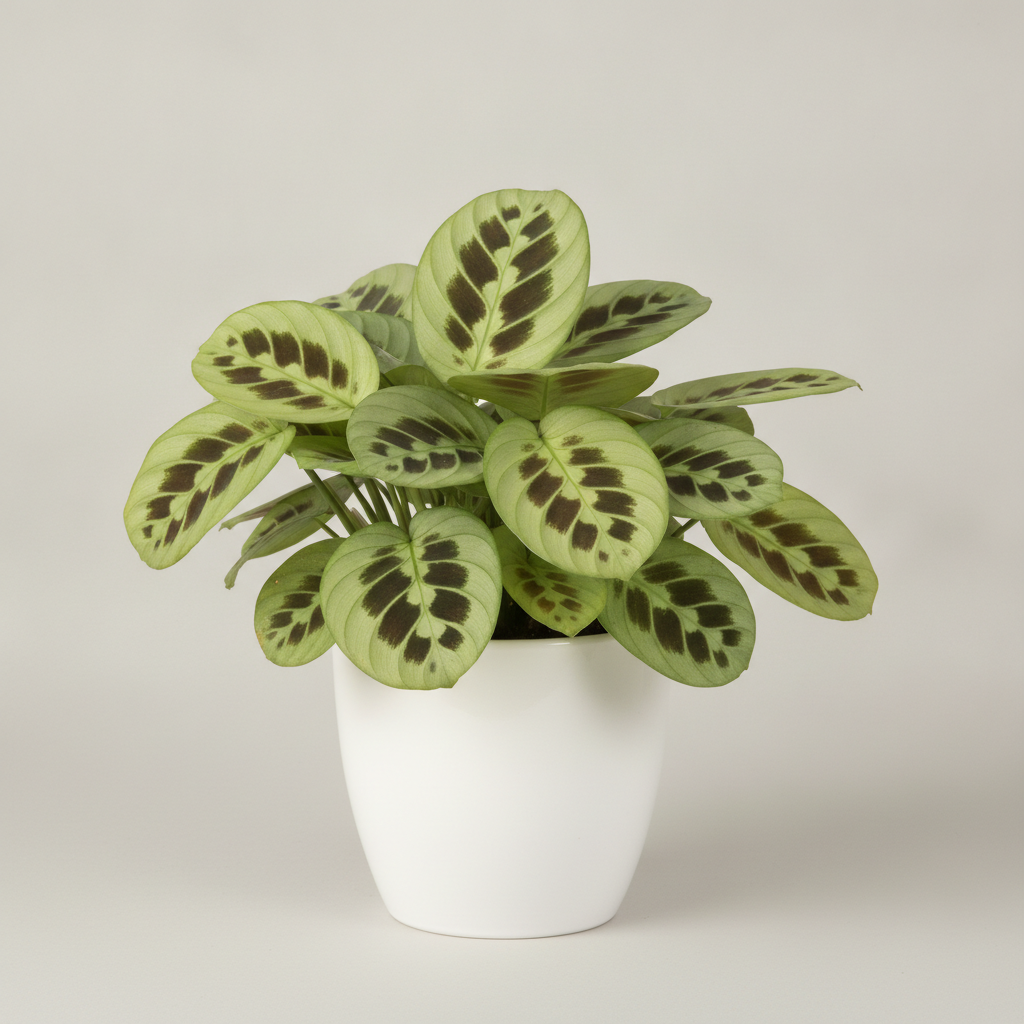
The classic green prayer plant, with soft apple-green leaves marked by paired dark chocolate blotches either side of the midrib that mellow to green as they age. It is the most widely sold form and the most forgiving.
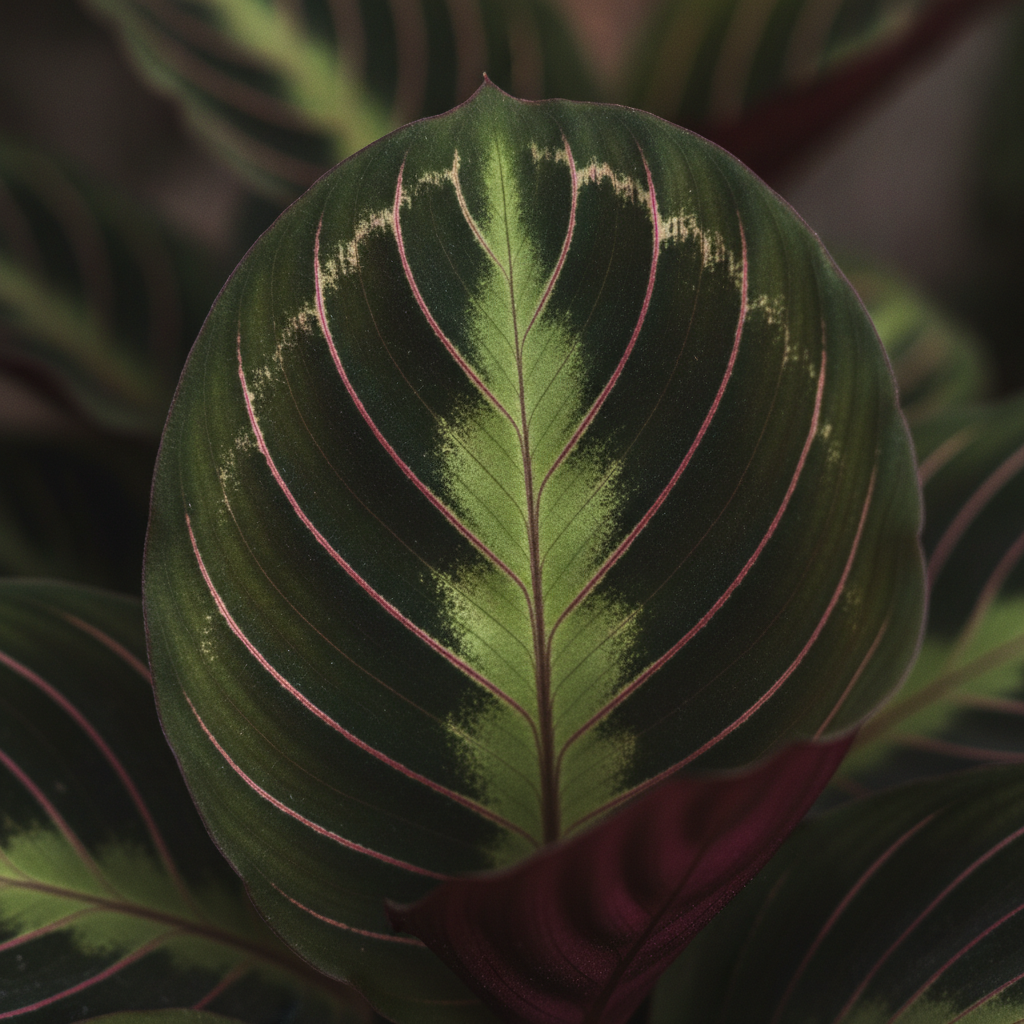
Erythroneura (Red Herringbone)
The showstopper of the group, with deep olive leaves crossed by a vivid pink-red herringbone of veins and a light green feathered central zone, and purple-red undersides. It is the form most people picture as the herringbone plant.
Variety Profiles in Detail
Kerchoveana (Maranta leuconeura var. kerchoveana)
Sometimes called rabbit’s tracks for the way its dark blotches resemble animal footprints, kerchoveana is the archetypal green prayer plant. Its pale green leaves and bold nightly folding make it a reliable, sculptural choice, and its ready availability and easy temperament make it the ideal first prayer plant.
Erythroneura (Maranta leuconeura var. erythroneura)
The red-veined herringbone form is the most ornamental of the species, its bright veins glowing against dark foliage. It wants the same care as the green form but rewards good bright indirect light with especially intense colour, which fades if the plant is kept too dim.
Lemon Lime (Maranta leuconeura ‘Lemon Lime’)
A modern favourite in which the herringbone veining glows a fresh lime-yellow against mid-green leaves. It brings a brighter, more contemporary note than the traditional forms and has become widely available in recent years.
Choosing the Right Variety for Your Space
Because every form of Maranta leuconeura shares the same needs, the choice comes down to looks and, a little, to how much light you can offer. If your spot is on the dimmer side, the plain green kerchoveana holds up best and keeps its character with the least fuss. If you have bright, well-filtered light to spare and want maximum drama, the red-veined erythroneura or the zesty Lemon Lime will reward you with vivid colour. Grouping two or three forms together makes a striking, low display that plays their different patterns against one another while asking for just one care routine.
Frequently Asked Questions
Why does my green prayer plant have brown, crispy leaf tips?
Brown tips almost always come down to two things: minerals in tap water and dry air. Switch to filtered, distilled or rainwater and raise the humidity around the plant to 50 % or more, and new growth should come in clean. Existing brown tips will not turn green again, but you can trim them for appearance if you wish.
Why won’t my prayer plant’s leaves fold up at night?
The nightly folding is a response to light, so a plant that has stopped moving is often getting too little light during the day or, occasionally, too much artificial light at night. Move it to a brighter indirect spot and ensure it experiences genuine darkness in the evening. Stress from over- or underwatering can also mute the movement temporarily.
Is the green prayer plant safe for cats and dogs?
Yes. Maranta leuconeura is listed as non-toxic to both cats and dogs by the ASPCA, making it one of the safest decorative foliage plants for a home with pets. As with any plant, discourage nibbling, since large amounts of any foliage can cause mild stomach upset, but there is no toxic risk.
How often should I water a green prayer plant?
Roughly once a week in spring and summer and every ten days to two weeks in winter, but always check first. Water when the top centimetre or two of soil feels barely dry, aiming to keep the soil evenly moist without ever letting it get soggy or dry out completely.
Why are the leaves curling on my prayer plant?
Curling leaves usually mean the plant is too dry, either at the roots or in the air. Check whether the soil has dried out too far and whether the humidity has dropped, and correct both. Tightly curled leaves in strong light can also signal too much sun, so make sure the plant is not catching direct rays.
Does the green prayer plant flower indoors?
It can. Mature, happy plants sometimes send up slender spikes of small white or pale purple flowers, though the blooms are modest and the plant is grown for its foliage rather than its flowers. Flowering is a good sign that the plant is content, and there is no need to remove the spikes.
Why is my prayer plant getting leggy?
Long, sparse stems with widely spaced leaves point to insufficient light; the plant is stretching toward the window. Move it somewhere brighter but still indirect, and pinch back the leggy stems to encourage bushier growth. The trimmings can be rooted as cuttings to fill out the pot.
Can I grow a green prayer plant in a bathroom?
A bathroom is often an excellent home, provided it has enough light. The naturally higher humidity from showers and baths suits the plant perfectly and can solve the dry-air problem outright. Just make sure a window or a grow light supplies the bright, indirect light it still needs.






