
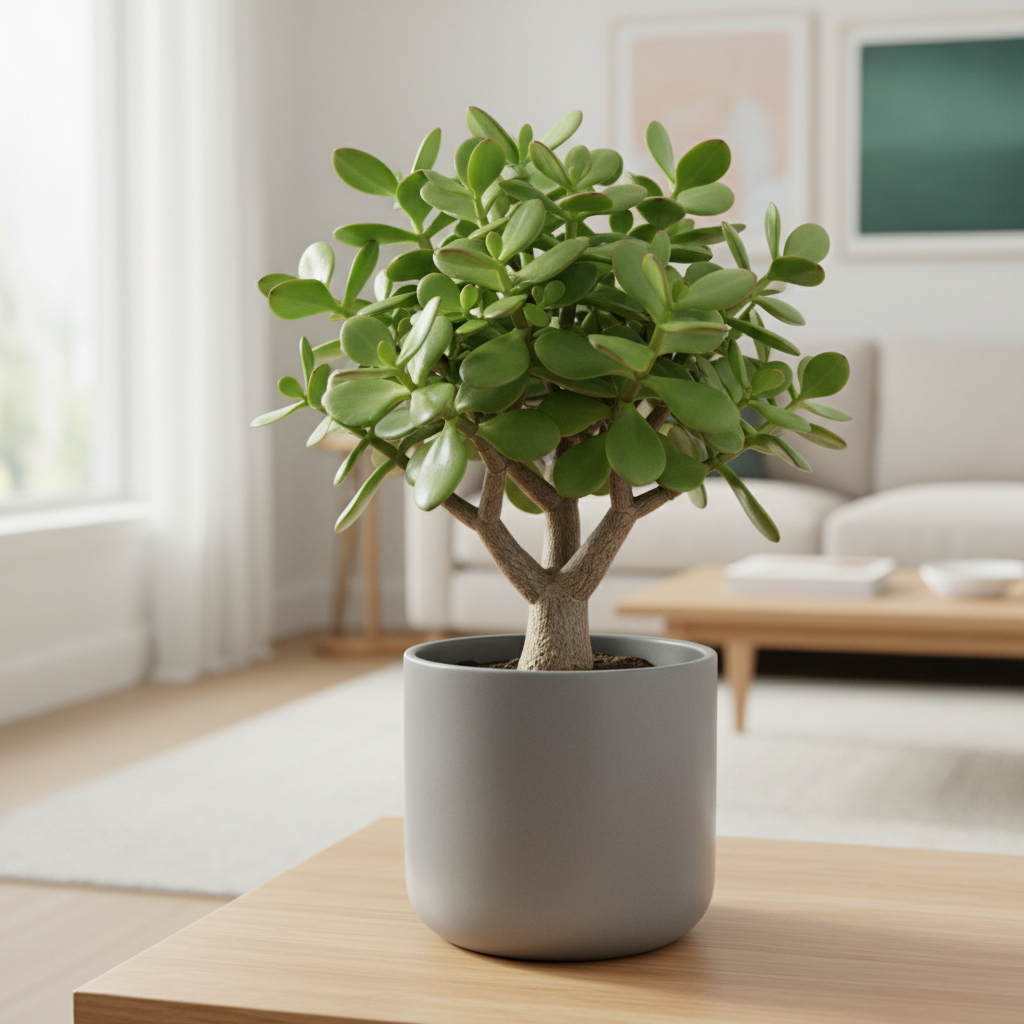
The jade plant is the houseplant that quietly outlives its owners. A slow-growing, evergreen succulent from the dry hillsides of South Africa and Mozambique, Crassula ovata has been carried indoors for well over a century and is still one of the most widely grown succulents in the world. It is also known as the money plant, lucky plant, friendship tree and dollar plant, names that hint at its long folk association with prosperity and good fortune. The reasons for that popularity are partly practical, partly aesthetic: it asks for very little, it forgives almost any mistake except chronic wet feet, and it slowly shapes itself into a miniature tree with a thickening woody trunk, stout branches and rounded canopies of plump, glossy leaves.
Jade plants are also among the easiest houseplants to keep alive and one of the hardest to grow well, and the gap between those two outcomes is where this guide lives. A neglected specimen on a dim shelf will hang on for years, slowly stretching and dropping leaves, while a thriving one on a sunny windowsill will swell into a sculptural, miniature bonsai with leaves blushing red at the margins and, eventually, clouds of pale star-shaped flowers in late winter. Everything that follows is aimed at moving your plant from the first state to the second: the right light, the right watering rhythm, the right gritty soil, plus the small interventions that matter most when something goes wrong.
Contents
- Quick Reference
- Why Jade Plant Makes a Rewarding Houseplant
- Light Requirements
- Watering and Humidity
- Soil, Potting and Repotting
- Fertilising
- Propagation
- Pests and Diseases
- Popular Varieties
- Frequently Asked Questions
Quick Reference: Jade Plant at a Glance
| Botanical name | Crassula ovata (family Crassulaceae) |
| Origin | Eastern Cape and KwaZulu-Natal, South Africa; southern Mozambique |
| Light | Very bright; at least 4 to 6 hours of direct sun a day. A south or west window indoors |
| Watering | Soak then dry completely. Roughly every 10 to 21 days in summer, every 4 to 6 weeks in winter |
| Temperature | 18 to 24 °C (65 to 75 °F) in growth; tolerates 7 °C (45 °F) in winter rest. Not frost hardy |
| Humidity | 30 to 50 percent. Prefers dry air; humidity is rarely the limiting factor |
| Soil | Gritty, fast-draining cactus and succulent mix with extra pumice or coarse sand |
| Fertiliser | Balanced liquid succulent feed at quarter to half strength, once a month in spring and summer only |
| Growth rate | Slow; 5 to 10 cm (2 to 4 in) of new growth a year. Eventual indoor height 60 to 90 cm (24 to 36 in) |
| Propagation | Very easy from stem cuttings or individual leaves |
| Toxicity | Toxic to cats and dogs; mildly toxic to humans if ingested. Sap may irritate skin |
| Lifespan | Routinely 50 to 70 years indoors; documented specimens have passed 100 years |
Why Jade Plant Makes a Rewarding Houseplant
Few houseplants reward patience as visibly as Crassula ovata. In its natural habitat on the rocky koppies and dry scrubland of the Eastern Cape, it grows as a stout, much-branched shrub up to about 2.5 metres tall, often hanging onto rock crevices where almost nothing else will. That heritage shapes everything about its behaviour as a houseplant: it expects long, bright, dry stretches punctuated by occasional drenching rain, it stores water in its leaves and stem against shortages, and it grows slowly enough that even a small specimen on a windowsill represents real time and care. A 30 cm jade plant in a clay pot is rarely younger than five years.
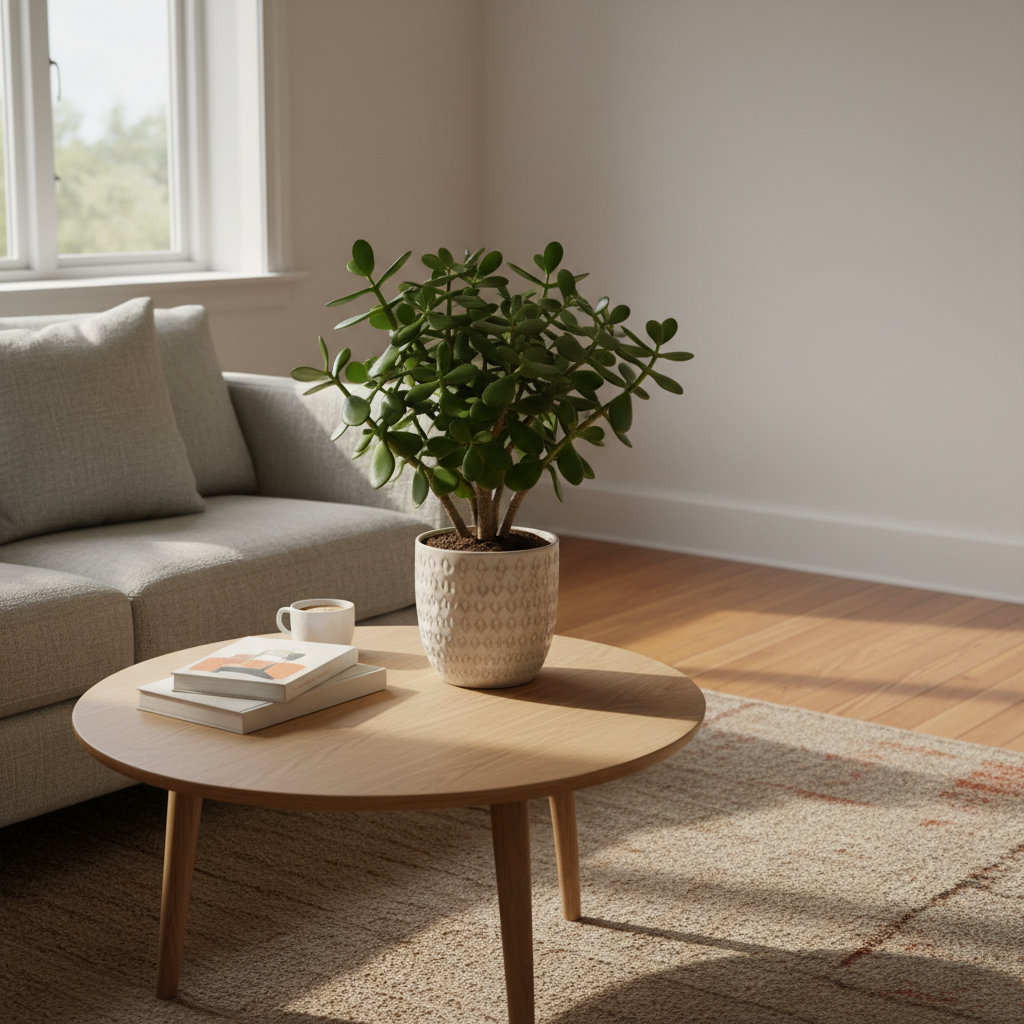
That slow pace is one of the plant’s quiet pleasures. Each pair of opposite, fleshy leaves forms a small green ellipse, glossy on the upper surface and faintly waxy below, with a margin that flushes coral or burgundy when the plant is grown in strong light. New growth pushes out at the tips of each branch in tidy pairs that rotate ninety degrees from the pair below, gradually forming a rounded canopy. As the trunk thickens and the bark turns from green to papery brown, the silhouette starts to resemble a miniature tree. Older indoor specimens, given winter cool and bright light, may also produce small clusters of white or pale pink star-shaped flowers, sweetly scented and lasting for weeks.
For households that travel, work long hours or simply want a low-maintenance focal point, jade plants are unusually forgiving. They prefer to be underwatered and a little pot-bound, they shrug off dry indoor air, and they recover well from being knocked over, broken, or chewed on by a cat (though the latter is unsafe for the cat, not the plant). Their cultural reputation as bringers of prosperity, particularly in feng shui where they are placed near entrances and in offices, ensures they are still given as housewarming gifts a hundred years after they first travelled north from the Cape. None of that mythology is necessary to enjoy them, but it does mean a healthy jade plant carries a small layer of history along with its waxy leaves.
Pro Tip — Read the leaves: A jade plant’s leaves are an honest dashboard. Plump and firm with a faint red margin in bright light means happy. Soft, wrinkled and slightly translucent means thirsty. Yellowing, mushy and easily detached means overwatered. Check the leaves before reaching for the watering can.
Light Requirements
Light is the single most important variable in jade plant care, and the one most often misjudged. In its native habitat, Crassula ovata grows in full sun for most of the day, often on south-facing rocky slopes with little shade. Indoors, no window matches that intensity, and a jade plant placed in a dim corner will not die quickly, but it will fail to thrive. It will stretch towards the light, its internodes lengthening into pale leggy stems, its leaves spacing further apart and losing their characteristic red margins. Over time it becomes top-heavy, prone to flopping, and far more vulnerable to overwatering because slow-growing tissue uses very little water.
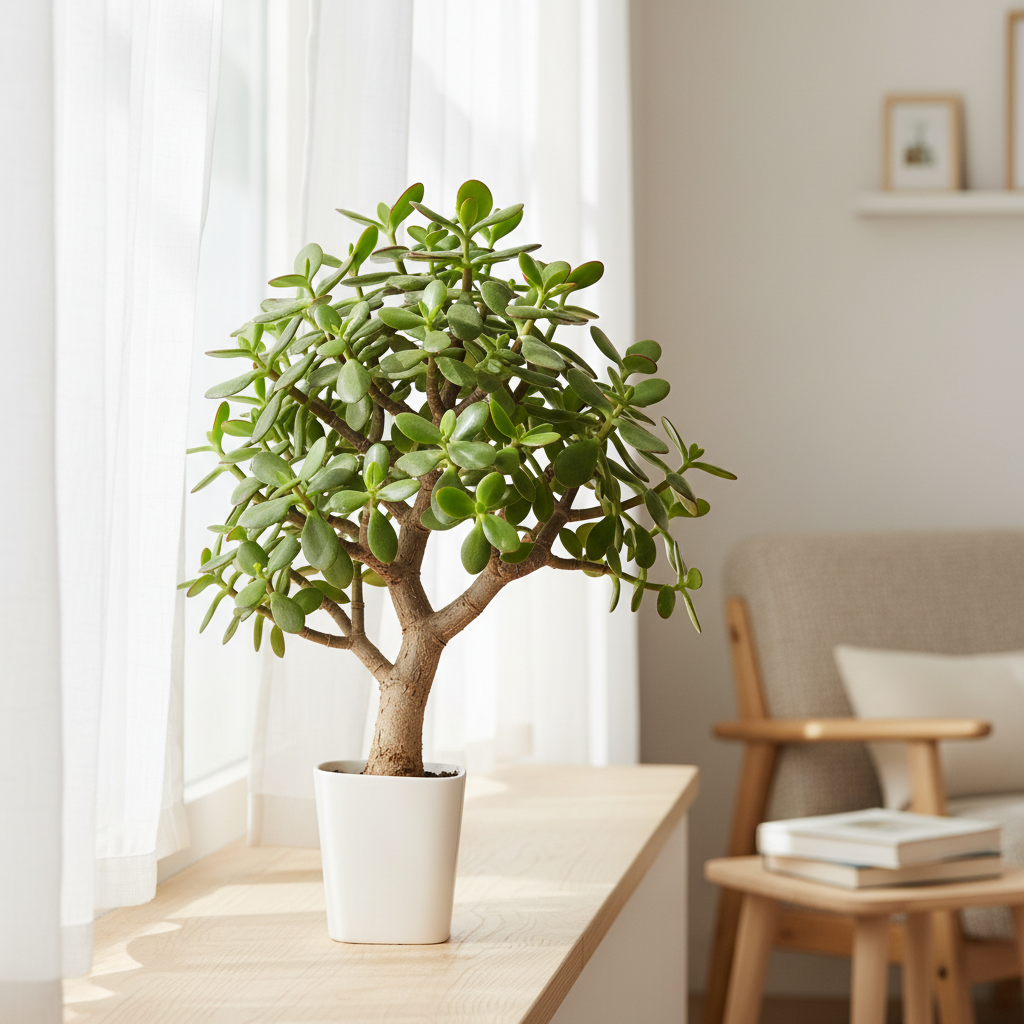
The reliable rule of thumb is four to six hours of direct sun per day, ideally in the morning or late afternoon during high summer, and as much as you can give it during the short days of winter. A south-facing window in the northern hemisphere, or a north-facing window in the southern hemisphere, is the gold standard. East and west windows work well if they are unobstructed. Pure north-facing rooms in temperate climates are usually too dim for long-term health unless supplemented by a grow light. If the only available spot is bright but indirect, the plant will live, but expect slow growth, pale green colour, and a tendency to lean noticeably towards the brightest pane.
Move a jade plant outside for the summer if you can. A sheltered balcony or patio with morning sun and afternoon shade hardens the leaves, deepens the red margins and triggers a noticeable growth spurt. The transition needs to be gradual, however. A plant taken straight from a windowsill to full midday sun in July will scorch within an hour, producing pale bleached patches that turn papery and never recover. Acclimatise it over seven to ten days, starting in deep shade and adding an hour of direct sun a day until it is in its final position. The same logic applies in reverse when moving it back indoors in autumn, before the first cold nights arrive.
Reading the plant’s response to its light is more useful than measuring lux. A happy jade plant has tightly spaced leaves, a compact branching habit and at least a hint of red or bronze on the leaf margins; an unhappy one stretches between leaf pairs, drops lower leaves and produces only soft, pale new growth. Rotating the pot a quarter turn every couple of weeks keeps the canopy even and prevents the trunk from setting permanently in one direction.
Pro Tip — Watch for the red blush: In a jade plant grown in adequate light, the leaf margins develop a coral or maroon edge, sometimes spreading across the whole leaf in winter. Lose that blush and the leaves return to flat green, your light has dropped below the plant’s preferred range.
Watering and Humidity
Almost every jade plant that fails does so because of water rather than light. The plant evolved in a climate of long dry spells broken by short bursts of rain, and its leaves and stems are essentially a built-in reservoir. Indoors, in a pot with limited drainage and no breeze, that reservoir is easy to overwhelm. The watering rule is short and surprisingly forgiving: soak the soil thoroughly, then let it dry out completely before watering again. There is no schedule that beats checking the pot, because how fast it dries depends on the season, the pot material, the light level and the size of the plant.
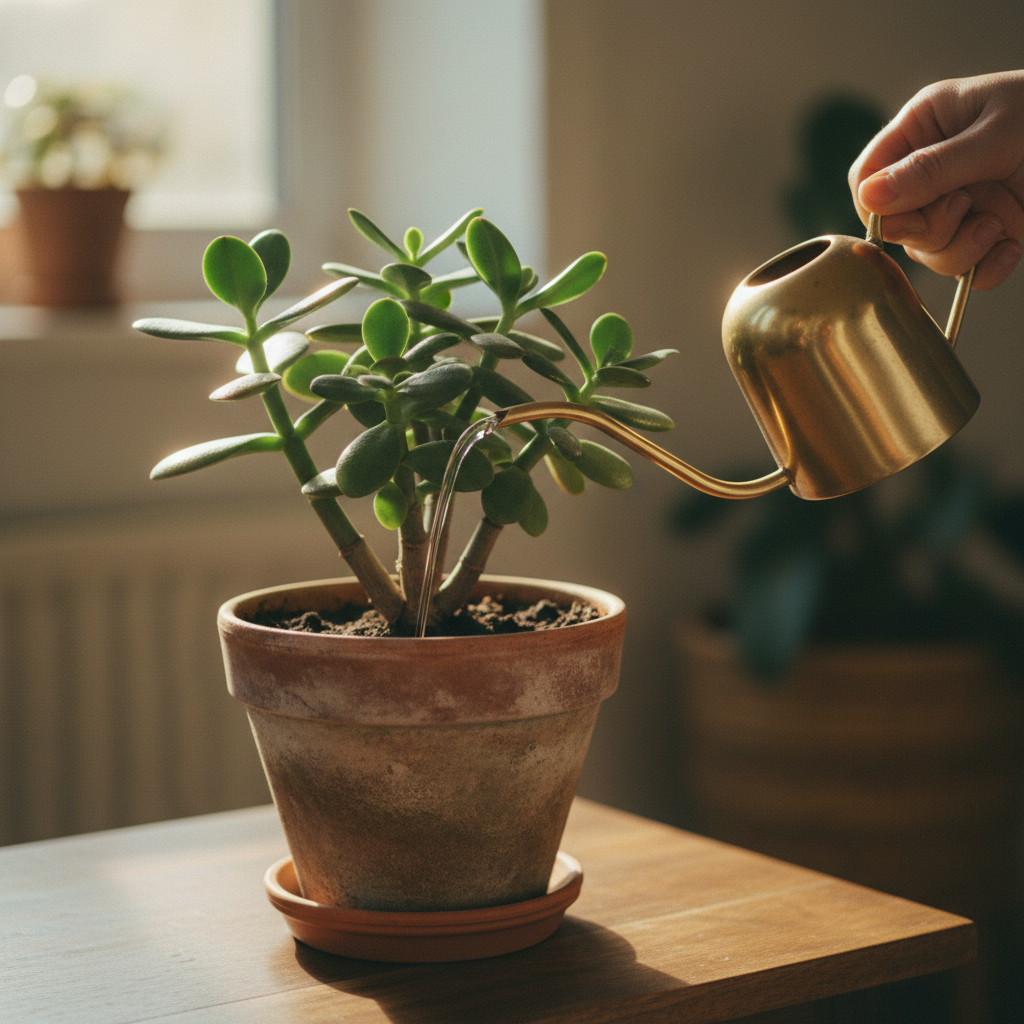
In practice this means watering every 10 to 21 days during spring and summer, and every 4 to 6 weeks in autumn and winter, with the caveat that those numbers are starting points, not commandments. The reliable test is to push a finger 3 to 5 cm (1 to 2 in) into the soil, or to lift the pot. Soil that feels bone dry and a pot that feels suspiciously light tell you it is time. If the soil still feels cool and slightly damp, wait. When you do water, water generously. Take the plant to a sink and pour water through the mix until it runs freely from the drainage holes, then let the pot drain completely before returning it to its saucer. The aim is to flush salts and rehydrate every root, then deny the plant any standing water for the next few weeks.
Winter watering is the area where most jade plants are killed. Combined with low light, cool temperatures and slow growth, even moderate watering becomes too much. From late autumn until the days start lengthening again in early spring, treat your plant as semi-dormant. A small indoor specimen might genuinely need water only once every six to eight weeks. If in doubt, do not water; a slightly thirsty jade plant recovers within a day of a drink, while a waterlogged one can be lost within a week.
Humidity is, refreshingly, almost a non-issue. Jade plants are comfortable across the typical range of indoor humidity, anywhere from 30 to 60 percent, and actively prefer drier air to the muggy conditions tropicals like. They do not need misting, and in fact misting can promote fungal spotting on the leaves and increase the risk of mealybug colonies establishing in the leaf axils. The only humidity-related concern is sudden cold draughts in winter, which can cause leaves to drop. Keep the plant well away from open windows during frosts and from direct contact with cold panes of glass.
Water quality matters less for jade plants than for many tropicals. They tolerate hard tap water reasonably well, although a long-term build-up of mineral salts can show as a white crust on the soil surface and the rim of the pot. If you live in a very hard water area, an occasional flush with rainwater or filtered water, particularly during repotting, helps reset the soil chemistry.
Warning — The soft, mushy stem: If the base of the main trunk feels soft, smells sour or shows a translucent, water-soaked look, root rot is already advanced. Stop watering immediately, unpot the plant, cut away all soft tissue back to firm green, dust the cuts with cinnamon or sulphur, and repot in fresh dry mix. Do not water for at least two weeks while the cuts heal.
Soil, Potting and Repotting
Soil for a jade plant should drain faster than you think it needs to. In the wild, Crassula ovata roots in shallow pockets of grit between rocks, never in a dense bed of organic matter, and its fine roots are easily suffocated by a soggy mix. A bagged cactus and succulent compost is a perfectly good starting point, but most commercial mixes are still slightly too peaty for a jade plant grown indoors. Stretching them with extra mineral grit produces a far better long-term result. A reliable recipe is roughly two parts cactus mix to one part coarse horticultural sand or pumice and one part perlite. The finished mix should feel gritty and loose, with visible chunks of mineral matter, and water should run straight through it rather than puddling on top.
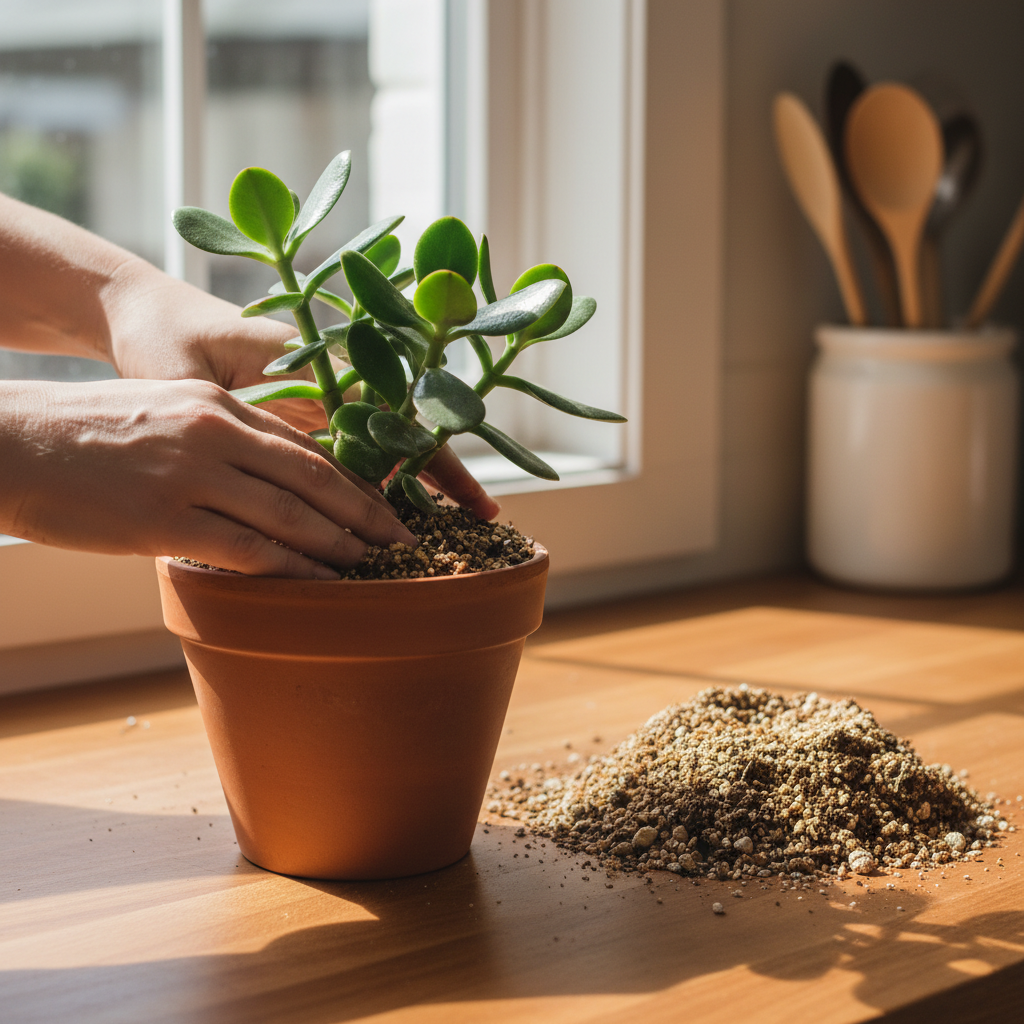
Pot choice is just as important as the mix. Unglazed terracotta is the traditional choice for jade plants for good reason: it breathes, wicks moisture out of the soil and helps the medium dry between waterings. Glazed ceramic and plastic pots work too, but they hold water longer and demand more attention to watering rhythm. Whatever the material, the pot must have a drainage hole. A jade plant in a sealed decorative cachepot is on a slow path to rot; if you want to use a pretty outer pot, slip the plant inside in its own functional inner pot and tip out any water that collects in the bottom.
Jade plants prefer to be slightly root-bound. They grow more slowly than the pot suggests, and oversized containers hold a reservoir of damp soil around the rootball that nothing can reach. The right pot is one that allows roughly 2 to 4 cm (1 to 1.5 in) of soil around the rootball, with a depth that just accommodates the existing roots. As a rule, a healthy plant only needs repotting every two to three years, and many older specimens go four or five years before they truly need refreshing.
The best time to repot is late spring, when active growth is starting and any damaged roots can quickly regenerate. Water the plant a few days beforehand so the rootball is slightly hydrated but not wet. Tip the plant out, gently tease away the old soil from the outer roots, and inspect for any black, mushy or hollow sections, which should be cut away with clean snips. Set the plant in fresh mix in a slightly larger pot, firming the soil gently around the roots but leaving a 1 cm gap to the rim for watering. Then comes the most important step: do not water for a week to ten days. The dry rest lets any damaged root tissue callus over instead of rotting, and it triggers the plant to push new feeder roots into the fresh substrate.
A traditional clay pot, modest in size and shallow rather than deep, also has the advantage of stability. A mature jade plant develops a heavy, top-weighted canopy, and a tall plastic pot is much easier to knock over. If your plant ever does topple and snaps a branch, do not panic; the broken section is simply a free cutting, and the remaining trunk will branch from below the break within a few weeks.
Pro Tip — Top-dress with grit: A 1 to 2 cm layer of decorative grit, gravel or pumice on the soil surface keeps the crown of the plant dry, discourages fungus gnats and prevents soil splashing onto the lower leaves. It also looks elegant against the rounded jade-green canopy.
Fertilising
Jade plants are not heavy feeders. In the wild they grow in lean, mineral-rich soil with very little organic matter, and they have evolved to make slow, deliberate use of whatever nutrition they find. Indoors, that translates to a light hand with fertiliser. Most jade plant problems associated with feeding are caused by giving too much, too often, or feeding during the wrong season; underfeeding produces a perfectly serviceable plant that simply grows a little slower than its full potential.
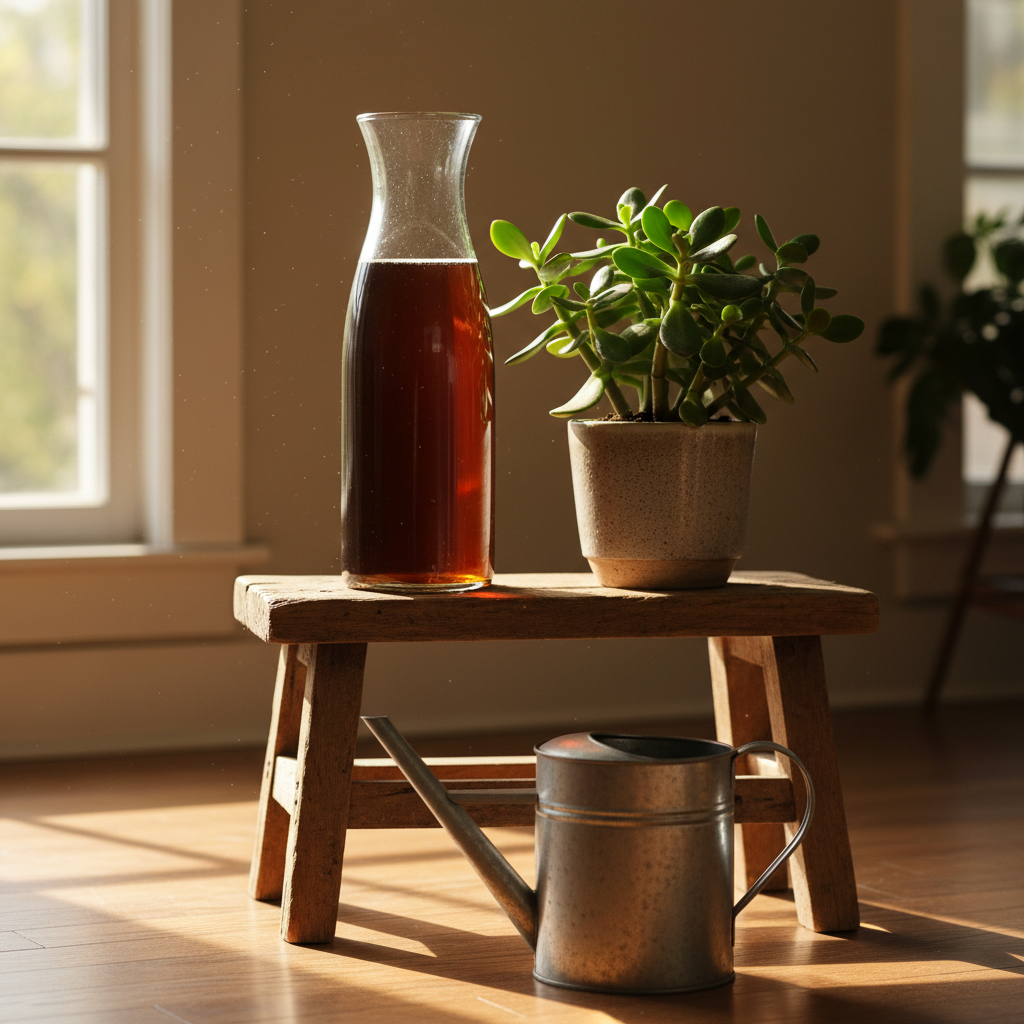
A balanced liquid fertiliser formulated for cacti and succulents is the safest choice, applied at quarter to half the rate printed on the bottle. A typical NPK ratio of 2-7-7 or 5-10-10 works well, with low nitrogen relative to phosphorus and potassium; high-nitrogen feeds intended for leafy houseplants encourage soft, watery growth that flops and rots. If you do not have a dedicated succulent fertiliser, a general houseplant feed diluted to about a quarter strength is an acceptable substitute. Compost tea is another gentle option for those who prefer organic methods, again diluted to roughly the colour of weak black tea.
Feeding rhythm is straightforward. Fertilise once a month from early spring, when daylight lengths are visibly increasing, through to the end of summer, then stop entirely from autumn until the following spring. Winter feeding is a common mistake. With light levels low and the plant in semi-dormancy, fertiliser salts accumulate in the soil and slowly burn the roots, manifesting weeks or months later as brown leaf tips, leaf drop and weak growth. Always apply fertiliser to soil that has already been moistened with plain water; pouring concentrated feed onto bone-dry roots causes chemical burns at exactly the points where the plant can least afford them.
Recently repotted plants do not need fertiliser. Fresh succulent mix contains enough background nutrition for at least three to four months, and the plant’s first job after repotting is to grow new feeder roots, not to push leaf growth. Wait at least six to eight weeks after repotting before resuming any feeding, and only feed if active new growth is visible.
Warning — Salt build-up: A white or yellow crust on the soil surface or pot rim signals accumulated fertiliser salts. Flush the pot with three or four pot-volumes of plain water, draining completely each time, and skip the next feed. Long-term salt accumulation is one of the few ways a well-watered jade plant can decline.
Propagation
Few plants are easier to propagate than a jade plant. Almost any piece that falls off or is intentionally cut, whether a leaf or a section of branch, will root given a few weeks of patience and dry conditions. This is partly why jade plants travelled so far so quickly in the first place: a single leaf wrapped in a damp cloth survives a long journey, and within months produces a tiny new plant. Indoors, propagation is a reliable winter activity, an easy way to share plants with friends, and a useful backup whenever you prune a mature specimen for shape.
Stem cuttings
Stem cuttings are the fastest route to a sizeable plant. Choose a healthy, non-flowering stem 8 to 15 cm (3 to 6 in) long and cut just below a leaf node with clean, sharp snips. Strip off the lower two or three pairs of leaves, then leave the cutting exposed to the air, out of direct sun, for five to ten days. This is the most important step in jade plant propagation. The cut surface needs to develop a dry, papery callus before it touches any moisture; an uncallused cutting placed straight into damp soil will almost always rot at the base instead of rooting.
- Take a clean cutting, 8 to 15 cm long, from a healthy branch tip.
- Remove the lower pairs of leaves, leaving 2 to 3 cm of bare stem at the base.
- Set the cutting aside on a paper towel in a warm, dry spot out of direct sun for 5 to 10 days, until the cut end is dry and corky.
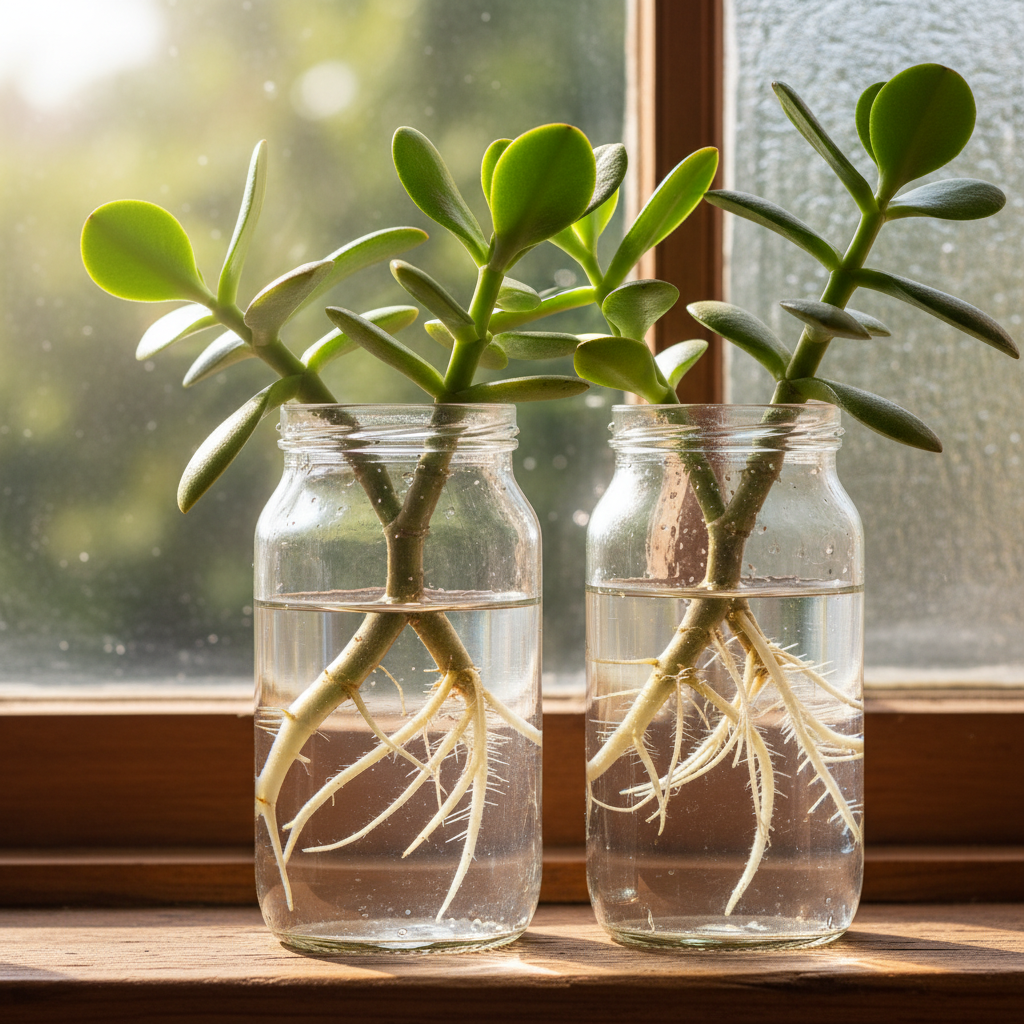
- Insert the callused base into a small pot of barely moist succulent mix, or stand it in a clean glass of water with the base just touching the surface.
- Place in bright, indirect light. Do not water soil cuttings for the first week; thereafter, water lightly only when the surface is dry.
- Roots appear in 2 to 6 weeks. New leaf growth follows soon after, signalling that the cutting is established.
Leaf cuttings
Leaf propagation is slower but almost magical. Twist a healthy, plump leaf gently from a stem, taking care to keep the entire base intact; a leaf that snaps in the middle will not root. Let the detached leaf rest on a saucer in a warm, bright spot for several days until the wound calluses. Place the leaf, base just touching the surface, on top of a tray of slightly damp gritty succulent mix. Mist the tray lightly every five to seven days, never soak it. Within four to six weeks, tiny pink roots emerge from the base, and a miniature rosette of new leaves follows. The original leaf eventually shrivels and is absorbed as the new plantlet matures, which takes anywhere from six months to a year.
Water propagation
Although jade plants are succulents, they also propagate cheerfully in water, which is useful when you want to watch the roots develop. After callusing, stand a stem cutting in a small jar so the base just touches the surface of clean room-temperature water. Replace the water every five to seven days to keep it fresh. Roots typically appear in two to four weeks. Transplant carefully into a gritty mix once the longest roots are about 3 cm long, taking care not to bend them. Water roots are noticeably more brittle than soil roots and will need a week or two to adapt.
Pro Tip — Patience over fuss: Jade plant propagation rewards doing less. Resist the urge to water freshly inserted cuttings, lift them to check for roots or move them from spot to spot. A callused cutting in a warm, bright corner will root on its own schedule. Cuttings taken in late spring and early summer establish fastest.
Pests and Diseases
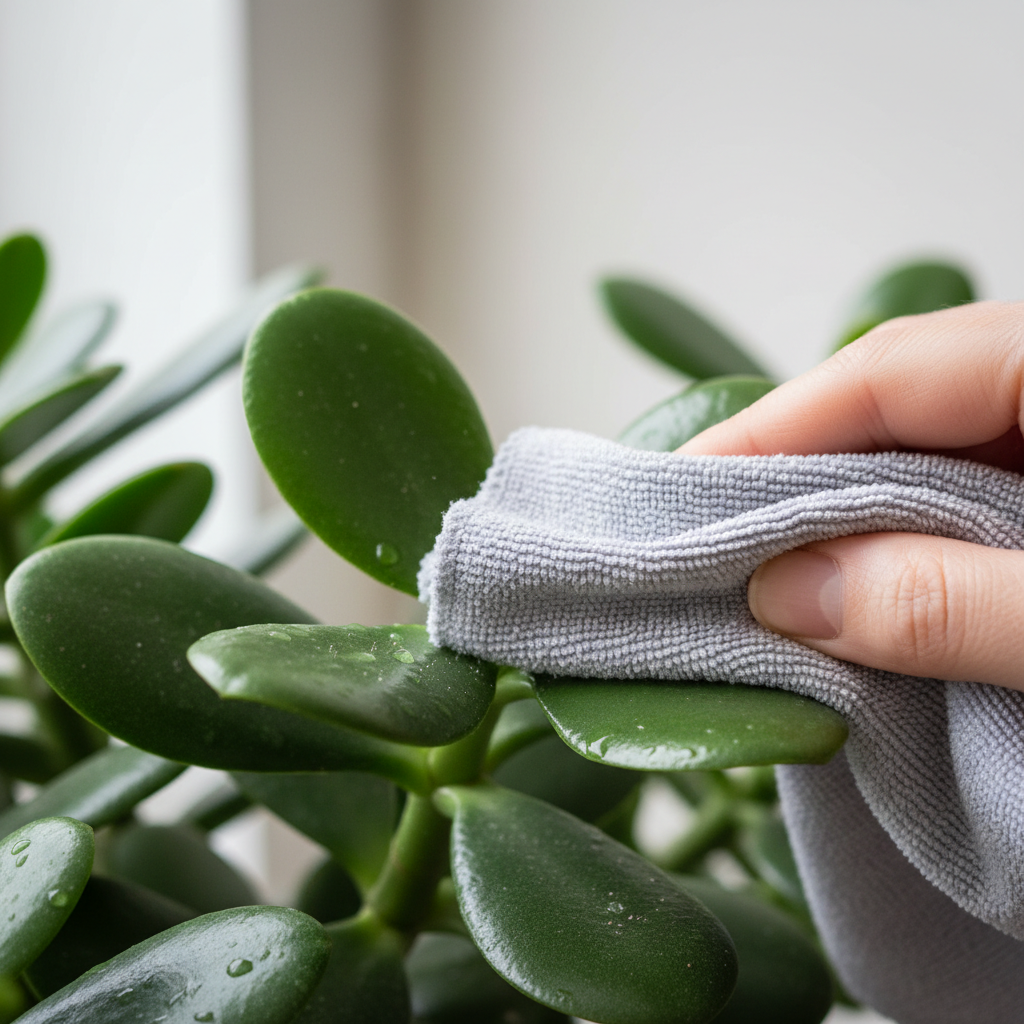
Healthy jade plants are remarkably resistant to pests. Their thick, waxy leaves are unappealing to most chewing insects, and the dry conditions they prefer discourage many of the soft-bodied pests that plague tropicals. Most problems arrive either with a new plant from a garden centre or with a sibling houseplant that has been quietly hosting an infestation for weeks. A monthly leaf-by-leaf inspection, particularly the leaf axils where new growth emerges, catches almost every issue early.
Mealybugs
Mealybugs are by far the most common jade plant pest. They appear as small, soft, oval insects covered in a white, cotton-wool-like wax, tucked into leaf axils, along stems and around the soil line. Heavy infestations leave a sticky honeydew on leaves and a sooty mould that follows. Mealybugs reproduce quickly in warm indoor conditions and can take down a small plant in a matter of weeks if left alone. Treat at the first sign: dip a cotton bud in 70 percent isopropyl alcohol and dab every visible insect directly. Repeat every five to seven days for three to four weeks to catch newly hatched generations. For larger infestations, spray the whole plant with a soap-based insecticide or neem oil emulsion, again repeating the treatment every week for a month.
Scale insects
Scale appears as small, brown, limpet-like bumps stuck firmly to stems and leaf surfaces. The bumps are protective shields covering the actual insect, which sucks sap underneath. They are easy to overlook because they sit still and can resemble part of the plant. Scrape adults off gently with a fingernail or the dull side of a knife, then wipe the area with alcohol or neem oil. Persistent infestations may require horticultural oil or systemic insecticide, but starting with manual removal and oil sprays usually handles a normal indoor outbreak.
Spider mites and fungus gnats
Spider mites are uncommon on jade plants but appear during dry winter spells, showing as fine stippling on the upper leaf surface and very fine webbing under the leaves. A monthly shower under tepid water knocks them back, and neem or insecticidal soap finishes the job. Fungus gnats are a symptom rather than a pest in their own right: they breed in chronically damp soil, which means a jade plant with fungus gnats is almost certainly being overwatered. Let the soil dry completely, top-dress with a layer of grit, and the gnats vanish within a few weeks.
Root rot and stem rot
Fungal and bacterial rots are the most serious threat to a jade plant, and overwatering is the cause in almost every case. Early signs are subtle: a lower leaf becoming pale and translucent, then yellow, and detaching at a touch. By the time the trunk feels soft, several roots are already gone. Treat by unpotting immediately, washing away the old soil and inspecting the roots and base of the stem. Cut away every soft, brown or smelly section back to firm green tissue, dust the cuts with cinnamon, sulphur or charcoal powder, and let the plant air-dry on a tray for two or three days before repotting into fresh dry mix. Do not water for at least a week to ten days afterwards. If the rot has reached high into the trunk, your best chance of saving the plant is to take healthy stem cuttings from the top and start the plant over.
Leaf spots and edema
Small brown or black spots on the leaves are usually one of two things. Sunken brown patches with a slightly papery look are sunburn, often from a sudden move to a much brighter location. Soft, blister-like raised bumps that later go corky are edema, the result of the plant taking up more water than it can transpire; cut back on watering and improve airflow, and new leaves will be normal. Neither is contagious and neither requires a chemical response.
Warning — Quarantine new plants: Pests almost always arrive on a newly bought plant. Keep any new jade plant or new succulent at least a metre from your existing collection for three to four weeks and inspect it weekly. Treat at the first sign of trouble before introducing it to the rest of your plants.
Popular Varieties
The standard Crassula ovata is only the starting point of a large and unusually playful family of cultivars. Breeders and collectors have selected for unusual leaf shapes, dramatic colour, dwarf forms and variegation, and most are no harder to grow than the species. Two cultivars in particular have become so widely shared that they almost count as separate houseplants in their own right.
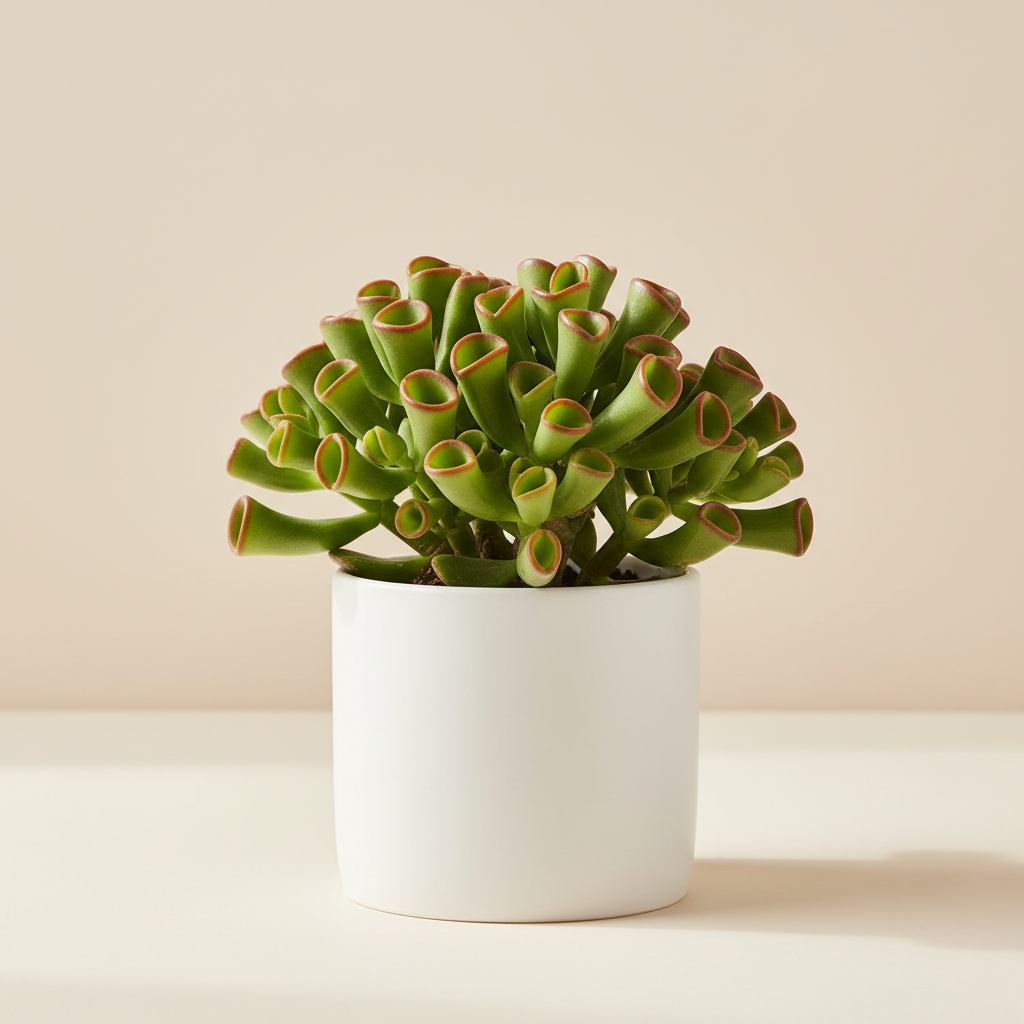
Crassula ovata ‘Hobbit’
‘Hobbit’ replaces the standard oval leaves with short, tubular, finger-like leaves that curl inward and flare slightly at the tips, almost like miniature trumpets. The colour is a glossy mid-green that flushes coral-red on the leaf edges in bright light, and the plant has a tendency to branch densely, building up a compact, sculptural bush rather than the open tree shape of the species. Care is identical to standard jade plant.
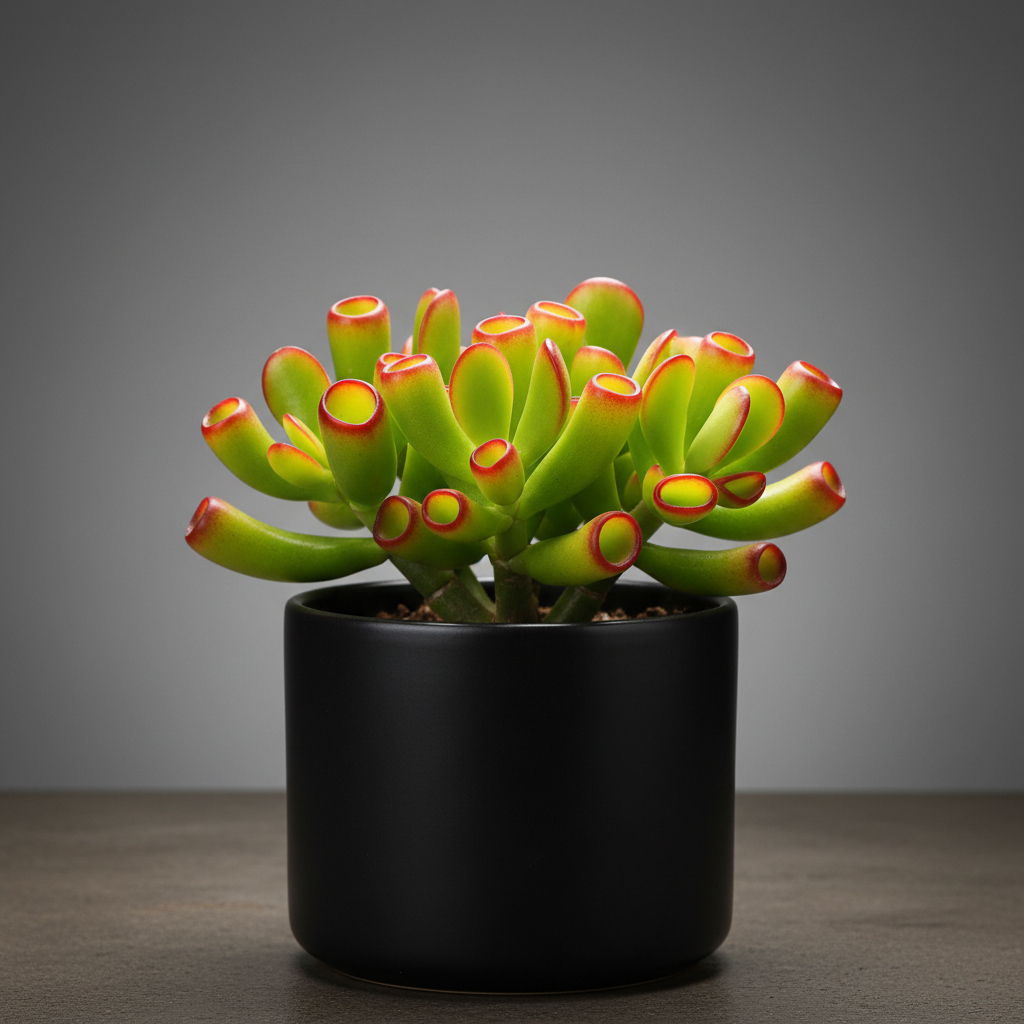
Crassula ovata ‘Gollum’
‘Gollum’ takes the tubular idea further, producing long, narrow, fully cylindrical leaves with a concave, suction-cup-shaped tip; the result is often nicknamed finger jade or shrek ears. The tips of the leaves blush a vivid crimson in good light, contrasting sharply with the apple-green body of each leaf. ‘Gollum’ grows a little more slowly than the species but eventually forms a beautifully gnarled, branching trunk that takes well to light pruning into bonsai form.
Other cultivars worth seeking out
‘Hummel’s Sunset’ is a slow-growing variegated cultivar with leaves that turn from green to gold to crimson in bright light, with all three colours often visible on the same branch. It is one of the most sought-after jade plants and was awarded the Royal Horticultural Society’s Award of Garden Merit. ‘Tricolor’ is variegated with creamy white and pink streaks along the leaves, but is markedly less vigorous than green forms and needs careful light management to keep the variegation. ‘Crosby’s Compact’ is a true dwarf, with shorter internodes and smaller, redder leaves that make it well suited to small pots and beginner bonsai work. ‘Pink Beauty’ is a flowering selection bred for unusually heavy crops of pale pink flower clusters in late winter, useful if you want to coax your jade plant into bloom. All of these are grown like the standard species, with no special treatment required.
Frequently Asked Questions
How often should I water a jade plant?
There is no fixed schedule, only a rhythm: soak the soil thoroughly, then let it dry out completely before watering again. In practice that is roughly every 10 to 21 days from spring to autumn, and every 4 to 6 weeks in winter, but check by pushing a finger into the soil or by feeling the weight of the pot. If the soil still feels cool and damp, wait. Underwatering is far easier to correct than overwatering.
Why are my jade plant’s leaves dropping?
The single most common cause is overwatering, often combined with low light. Wet soil for extended periods damages the roots, and the plant sheds lower leaves it can no longer support. Check the trunk for softness, let the soil dry out completely and ease back on the watering frequency. Sudden temperature drops, draughts and a recent move to much lower light can also trigger leaf drop, but in those cases the plant generally stabilises within a few weeks.
Why are my jade plant’s leaves wrinkly and shrivelled?
Wrinkled, soft leaves usually signal thirst rather than illness. The plant has drawn on its internal water reserve to keep going and the leaves have collapsed slightly. Water thoroughly until the soil is fully wet, then let it drain. The leaves should plump up within 24 to 48 hours. If a thirsty drink does not fix the wrinkling within a few days, suspect root damage, in which case unpotting and inspecting the roots is the next step.
Is my jade plant toxic to my cat or dog?
Yes. Crassula ovata is listed as toxic to cats and dogs by veterinary poison resources, including the ASPCA. Ingestion can cause vomiting, depression, slowed heart rate and incoordination. The exact toxic principle is still uncharacterised, but the effect is well documented. Place jade plants where pets cannot reach the leaves, and contact a vet immediately if you suspect ingestion. The plant is mildly toxic to humans if eaten in quantity, and the sap can irritate sensitive skin.
Can a jade plant survive outdoors?
It can spend the warmer half of the year outside in most climates, and it strongly benefits from doing so. It is not, however, frost hardy. Sustained temperatures below about 5 °C (41 °F) damage the leaves, and a hard frost will kill the plant outright. In USDA zones 10 and warmer it can be grown outdoors year round, but anywhere colder it should come indoors well before the first autumn frost. Acclimatise gradually in both directions to avoid sunburn or sudden leaf drop.
Why won’t my jade plant flower?
Most indoor jade plants never flower because they never experience the conditions that trigger bloom: a mature plant of at least four or five years, several hours of direct sun a day, a cool winter rest at around 10 to 13 °C (50 to 55 °F), and short days. Providing a cool, bright, dry winter on a sheltered porch or cool windowsill, with very little water, is the standard trick. Flowers, when they come, appear as clusters of small white or pale pink stars at the branch tips in late winter or early spring.
How big will a jade plant get?
Indoors, a typical jade plant reaches 60 to 90 cm (24 to 36 in) tall over many years, with a similar spread. Outdoor specimens in mild climates can build into shrubs 2 metres or more across, with a thick gnarled trunk. Growth is slow at every life stage, often only a few centimetres of new shoot a year, so even small plants represent meaningful time investment.
Should I prune my jade plant?
Pruning is optional but rewarding. Tip-pinching a branch removes the growing point and triggers two or three new shoots to form just below, producing a fuller canopy. Heavier pruning back to a leaf node forces the plant to rebuild, often improving its shape considerably. The best time is early spring before active growth resumes. All prunings, even the smallest tip, can be set aside to callus and rooted as cuttings, so nothing is wasted.
My jade plant is leaning to one side. What do I do?
Leaning indicates uneven light. The plant is steering its canopy towards the brightest pane. Rotate the pot a quarter turn every one to two weeks to even out the silhouette. If the lean is severe and the trunk is bending, move the plant to a brighter spot with more even light, and consider staking the main stem temporarily while the trunk strengthens. Over many years a strongly leaning jade plant can still recover into a beautifully sculptural specimen, but it is easier to prevent than to correct.
How long do jade plants live?
A long time. Well-cared-for indoor jade plants routinely pass 50 to 70 years, and there are well-documented specimens that have crossed 100 years and changed hands across several generations. With reasonable light, restrained watering and an occasional repot, your jade plant is likely to be a multi-decade companion rather than a passing acquaintance.






