
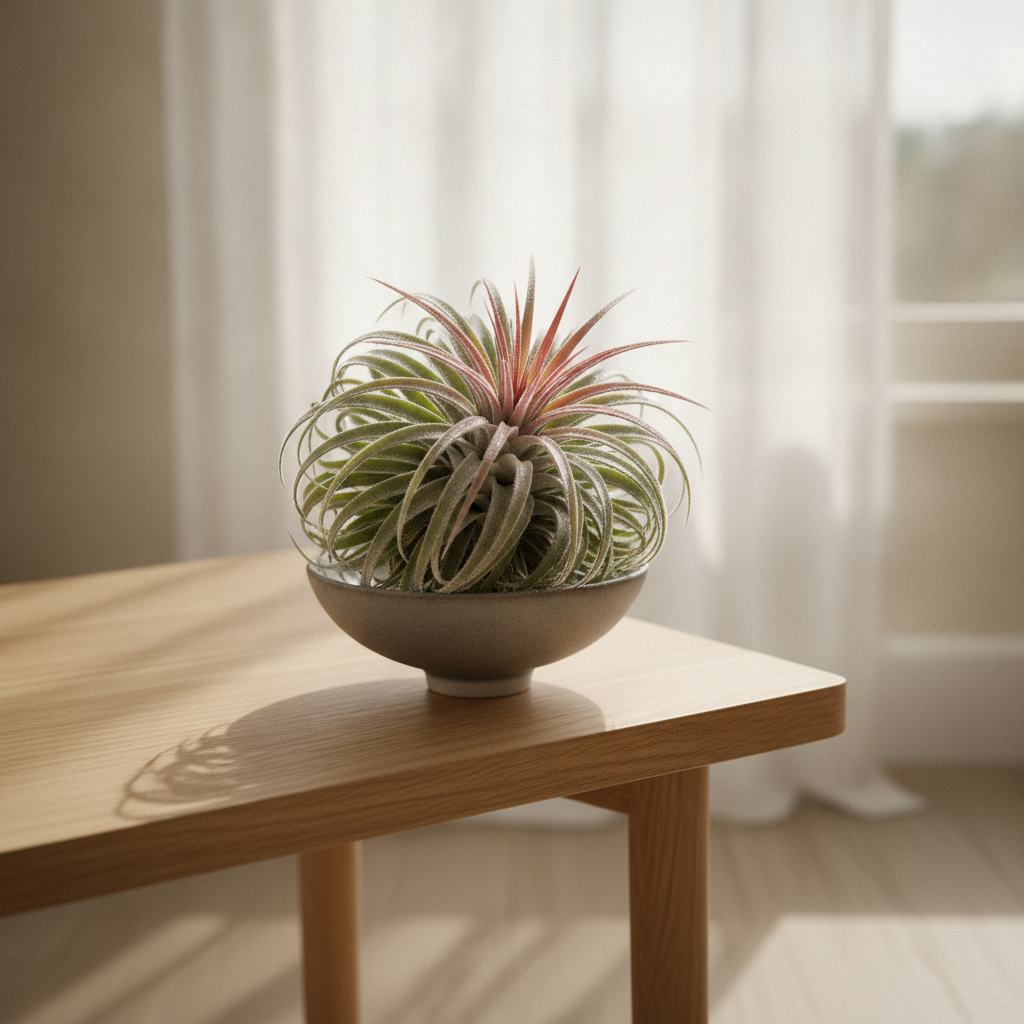
Few houseplants overturn expectations as completely as the ionantha air plant (Tillandsia ionantha), a diminutive epiphytic bromeliad that grows with no soil at all, clinging instead to tree bark and rock across its native range from Mexico south through Guatemala, Nicaragua and Costa Rica. Commonly sold simply as the sky plant or ionantha, it forms a dense rosette of narrow, tapering leaves cloaked in silvery scales called trichomes, the tiny structures through which it drinks moisture and captures nutrients straight from the air. It is among the most widely grown of the roughly 650 species in the genus Tillandsia, and for good reason.
The plant has earned a reputation as nearly indestructible, and while that is close to the truth, there is a meaningful gap between an ionantha that merely survives on a shelf and one that thrives, blushes fiery red and rewards you with tubular violet flowers. This guide walks through everything that closes that gap: how to read its light, how to soak and mist it without inviting rot, how to display it now that a pot is irrelevant, how to feed a plant that has no roots to feed through, and how to raise the offsets that turn a single rosette into a thriving clump.
Contents
- Quick Reference
- Why the Ionantha Air Plant Makes a Rewarding Houseplant
- Light Requirements
- Watering & Humidity
- Mounting, Display & the No-Soil Question
- Fertilising
- Propagation
- Pests & Diseases
- Popular Varieties
- Frequently Asked Questions
Quick Reference: Ionantha Air Plant at a Glance
| Light | Bright, indirect light; tolerates gentle morning sun but scorches in harsh midday rays |
| Watering | Soak 20 to 30 minutes every 7 to 14 days, or mist several times weekly; must dry fully within 4 hours |
| Temperature | 10 to 32°C (50 to 90°F); protect from anything below about 5°C (41°F) |
| Humidity | Prefers 50 to 70 per cent; drier air simply means more frequent soaking |
| Fertiliser | Bromeliad or air-plant feed at quarter strength, once or twice a month in the growing season |
| Toxicity | Non-toxic to cats, dogs and humans |
Why the Ionantha Air Plant Makes a Rewarding Houseplant
The appeal of the ionantha begins with its sheer freedom from the usual apparatus of houseplant keeping. Because it is an epiphyte that gathers everything it needs from the atmosphere, it needs no pot, no compost and no repotting schedule, which means it can live in a glass globe, perch on a shelf of driftwood, sit in a decorative bowl or hang from a length of fishing line. This makes it one of the most flexible plants you can own, equally at home in a minimalist apartment as in a crowded plant shelf, and it takes up almost no space while doing it.
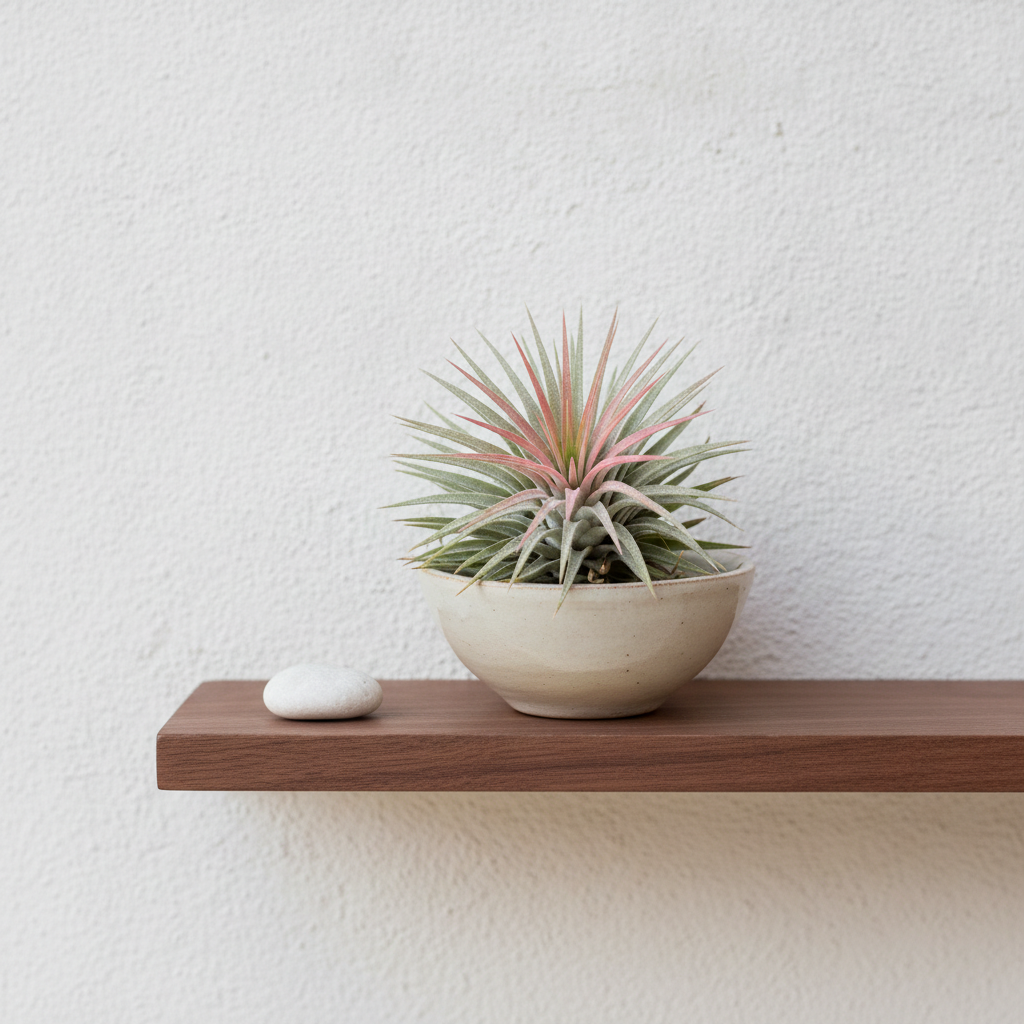
Beyond convenience, the ionantha earns its keep with a genuinely spectacular life cycle. For most of the year it is a modest silver-green rosette rarely taller than 8 centimetres (about 3 inches), but as it approaches flowering the inner leaves flush an intense red, pink or orange, a colour change known as blushing that signals a tubular violet bloom is on the way. That combination of low demands and a dramatic annual display is rare, and it is why the ionantha remains a gateway plant for anyone curious about the wider world of tillandsias. The difference between a plant that limps along and one that blushes reliably comes down to light, watering rhythm and airflow, each of which this guide covers in turn.
Important — Toxicity: The ionantha air plant is not toxic to cats, dogs or people, which makes it a safe choice for homes with curious pets and children. That said, it is not food, and the wiry leaves can cause mild stomach upset if chewed, so it is still worth placing out of reach of determined nibblers.
Light Requirements
In the wild the ionantha grows lashed to branches in the dappled canopy of dry forests, catching filtered sun through gaps in the leaves overhead. That origin tells you almost everything about its indoor needs: it wants bright light, but light that is broken up or indirect rather than the full, unfiltered blast of a summer window. Give it enough and the plant stays compact, silvery and primed to blush; give it too little and it stretches, greens up as it produces more chlorophyll to compensate, and quietly refuses to flower.
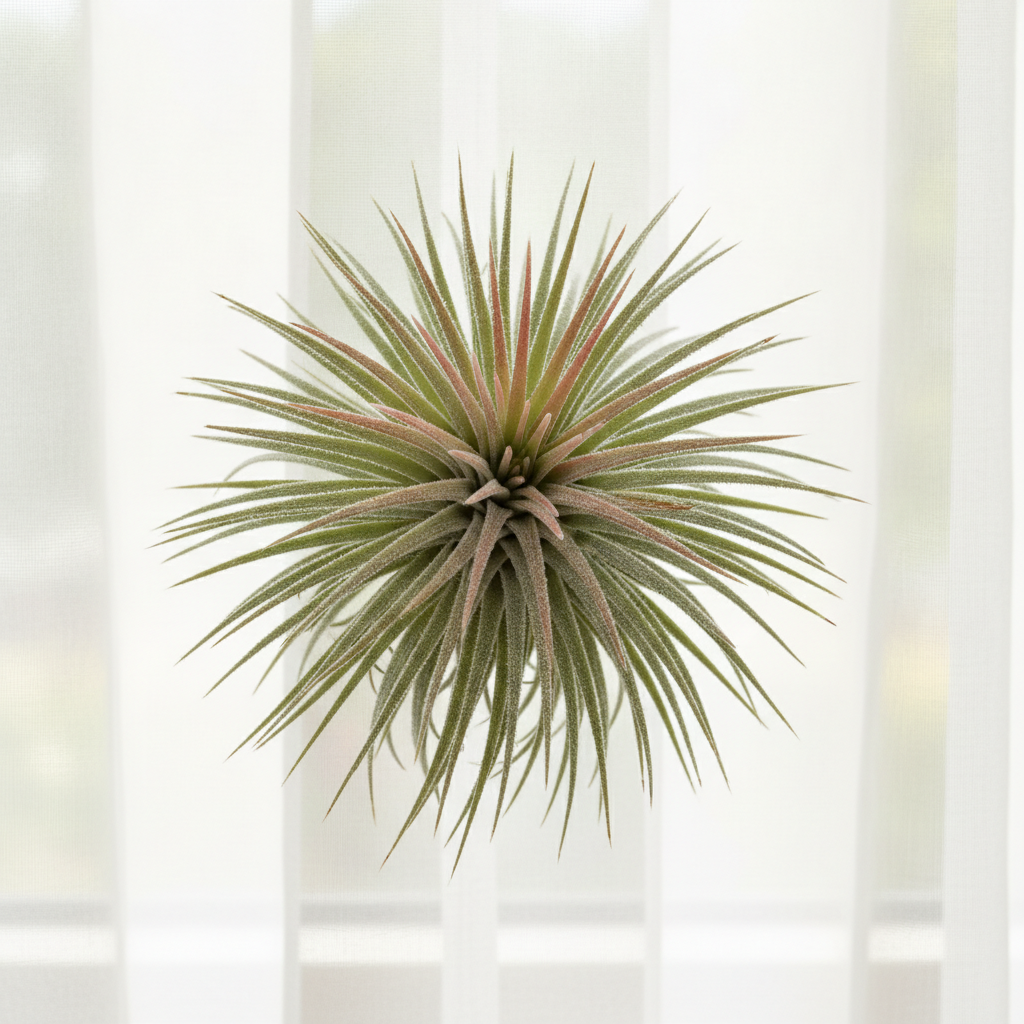
The ideal is a position within a metre or two of a bright window where daylight is strong but diffused, whether by a sheer curtain, a nearby larger plant or the angle of the sun. A few hours of gentle early morning sun is beneficial and often deepens the leaf colour, but the fierce midday and afternoon sun of a south or west window, magnified through glass, will bleach and crisp the delicate leaf tips within days.
Light Levels Explained
Air plants read light differently from potted foliage plants because their silvery trichomes both harvest moisture and reflect excess radiation, so a healthy ionantha can handle a slightly brighter position than its size might suggest. The table below translates the usual light categories into what each means for this species.
| Light Category | Approx. Level | Typical Location | Outcome |
|---|---|---|---|
| Direct sun | Over 50,000 lux | Unshaded south or west windowsill | Leaf tips scorch and dry; rapid moisture loss |
| Bright indirect | 15,000 to 40,000 lux | Near an east window or a curtained bright window | Ideal; compact silvery growth and reliable blushing |
| Medium | 5,000 to 15,000 lux | A metre or two back from a bright window | Good, though blushing may be paler |
| Low | 1,000 to 5,000 lux | North window or a dim interior corner | Stretched, greener growth and little to no flowering |
| Very low | Under 1,000 lux | Windowless room or deep interior | Slow decline; the plant cannot photosynthesise enough to sustain itself |
Window Orientation and Placement
South-facing window: The brightest exposure, and workable only if the plant sits back from the glass or behind a sheer curtain. Placed directly on a south sill in summer, an ionantha can scorch and dehydrate faster than you can keep it watered.
East-facing window: Often the sweet spot. Cool morning sun followed by bright indirect light for the rest of the day suits the ionantha perfectly and tends to bring out the strongest red blush.
West-facing window: Usable with a little shade, but the intense late-afternoon sun can be harsh in summer, so filter it or set the plant back a short distance from the pane.
North-facing window: Gentle and safe from scorching, but frequently too dim on its own to trigger blushing or flowering. A north window works best supplemented with a grow light through the darker months.
Pro Tip — Colour as a Light Meter: Let the plant tell you whether the light is right. A silvery, tightly held rosette with a hint of blush is receiving ideal light, while a soft, deep-green rosette with elongated leaves is reaching for more and should be moved brighter.
How Light Affects Colour and Blushing
The red, pink and orange blush that makes the ionantha famous is directly tied to light intensity working in concert with the plant’s flowering hormones. Under bright, indirect light the pigments that produce the blush develop richly and evenly, whereas in low light the plant stays stubbornly green and often skips the display altogether. Increasing light in the weeks before an expected bloom, without tipping into scorching direct sun, is the single most effective way to intensify the colour.
Warning — Direct Sunlight: The trichomes that give the ionantha its silvery sheen are its sunscreen, but they have limits. Prolonged direct summer sun through glass will dry the leaf tips to brown, crisp paper and can kill the plant through dehydration far faster than underwatering alone, so introduce any brighter position gradually over a week or two.
Artificial Lighting
Because the ionantha is small and undemanding, it responds very well to a modest full-spectrum LED grow light, which makes it a practical plant for offices, bathrooms and rooms with poor natural light. A standard LED positioned 15 to 30 centimetres (6 to 12 inches) above the plant and run for 10 to 12 hours a day is ample, and it can also be used to top up a dim north window during winter so the plant keeps its colour and its momentum toward flowering.
Seasonal Adjustments
As the sun’s angle drops and days shorten through autumn and winter, move the ionantha closer to its light source or nearer the window to maintain the intensity it enjoyed in summer. The flip side is that the same position which is perfect in December may become too bright and hot by July, so it is worth shifting the plant slightly further from the glass, or adding a sheer layer, as spring arrives. Watching for tip browning in summer and elongation in winter tells you when an adjustment is due.
Watering & Humidity
Watering is where most ionantha owners either succeed or come unstuck, because the plant drinks in a way that has nothing to do with the pot-and-compost routine familiar from other houseplants. It absorbs water through the trichomes on its leaves, so watering means wetting the whole plant thoroughly and then, crucially, allowing it to dry out completely afterwards. Get that rhythm right and the ionantha is almost impossible to kill; get the drying part wrong and it rots from the centre out.
When to Water
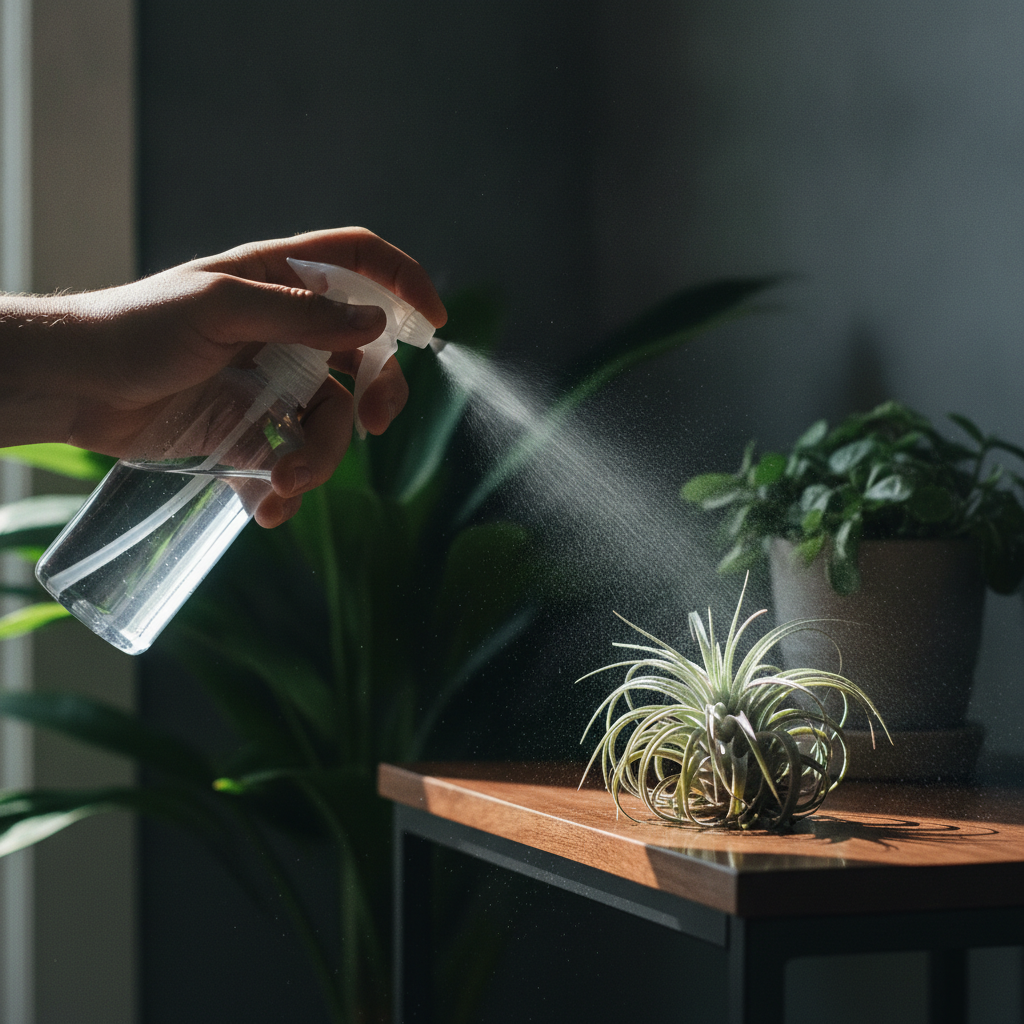
As a general rhythm, a full soak once every 7 to 14 days suits most homes, with misting in between during dry spells. The exact interval depends entirely on your air: a warm, dry, centrally heated room may call for a soak every five to seven days plus regular misting, whereas a cool, humid bathroom might need only a fortnightly dunk. Rather than counting days rigidly, learn to read the plant, because it signals its thirst clearly once you know the sign.
A well-hydrated ionantha has leaves that feel firm and look relatively flat and open, while a thirsty one develops leaves that curl inward, roll at the edges and take on an exaggerated, wrinkled silver cast. When the leaves begin to curl and feel soft, it is time to soak; after a good drink they plump up and flatten again within a few hours. This visual feedback loop is far more reliable than any calendar.
Pro Tip — The Post-Soak Shake: The most important second of the entire watering process is turning the plant upside down and giving it a firm shake after soaking. Water that pools in the tight central cup between the leaves is the number one cause of ionantha rot, so flick it out and let the plant dry inverted for the first hour.
How to Water Correctly
- Fill a bowl with room-temperature rainwater, filtered water or tap water that has stood overnight, deep enough to submerge the whole plant.
- Lower the ionantha in so it is fully immersed, and leave it to soak for 20 to 30 minutes so the trichomes can rehydrate fully.
- Lift it out, turn it upside down and shake gently but firmly to expel any water trapped in the central rosette and leaf bases.
- Set the plant on its side or upside down on a towel or rack in a bright, airy spot so that air circulates freely around it.
- Confirm it is completely dry to the touch within about 4 hours; if your room is still and humid, add a fan or move it somewhere with more airflow.
- Return it to its display only once fully dry, never while any moisture remains in the crown.
Signs of Overwatering vs. Underwatering
| Symptom | Overwatering (or poor drying) | Underwatering |
|---|---|---|
| Leaf colour | Base of leaves browning or blackening | Overall pale, exaggerated silvery cast |
| Leaf texture | Soft, mushy leaves that pull away easily | Curled, rolled, wrinkled but still firm leaves |
| Centre of rosette | Dark, wet, foul-smelling core; leaves fall from the middle | Dry and intact, simply tightly closed |
| Overall form | Rosette collapses or splits apart from the base | Whole plant contracts inward, opens again after a soak |
| Recovery | Rarely recoverable once the core rots | Bounces back fully within hours of soaking |
Warning — Rot: Rot in an air plant is the equivalent of root rot in a potted plant, and it is almost always fatal once the central core turns dark and soft. It comes not from watering too often but from water sitting in the crown or the plant never drying fully, so airflow and the post-soak shake matter more than frequency.
Humidity Requirements
The ionantha is more tolerant of dry air than many tropical houseplants, but it is happiest in moderate humidity of around 50 to 70 per cent, which reflects the misty forests it comes from. Humidity and watering are two sides of the same coin for this plant: the drier your home, the more often you will need to soak and mist, while a naturally humid room lets you stretch the interval between soaks considerably.
Signs that the air is too dry show up as leaf tips that brown and crisp despite regular soaking, and a rosette that curls tight again unusually quickly after watering. A bright bathroom or kitchen, where showers and cooking raise the ambient moisture, is often an ideal home for an ionantha and can dramatically cut how often you need to intervene.
To raise humidity around the plant you can mist it two or three times a week with a fine sprayer, group it with other plants, or run a small humidifier nearby during the driest winter weeks. Misting is a useful supplement but it is not a substitute for a proper soak, because a quick spray rarely rehydrates the inner leaves as fully as full immersion does.
Water Quality
Water quality matters more for air plants than for most houseplants because everything the ionantha absorbs passes directly across its leaf surface. Rainwater is the gold standard, followed by pond or aquarium water, which carries a little natural fertiliser, and then filtered or bottled spring water. Ordinary tap water is generally fine if left to stand overnight so chlorine can dissipate, but you should avoid artificially softened water, which is high in sodium and will slowly damage the plant, and steer clear of distilled water, which lacks the trace minerals the ionantha needs.
Mounting, Display & the No-Soil Question
Here the ionantha departs entirely from conventional houseplant care, because it must never be planted in soil. As an epiphyte it has no functional feeding roots, and burying its base in compost traps moisture against the crown and kills it through rot within weeks. Whatever roots the plant produces exist solely to grip a surface, so instead of potting and repotting you are choosing how to mount and display it, which is one of the great pleasures of growing air plants.
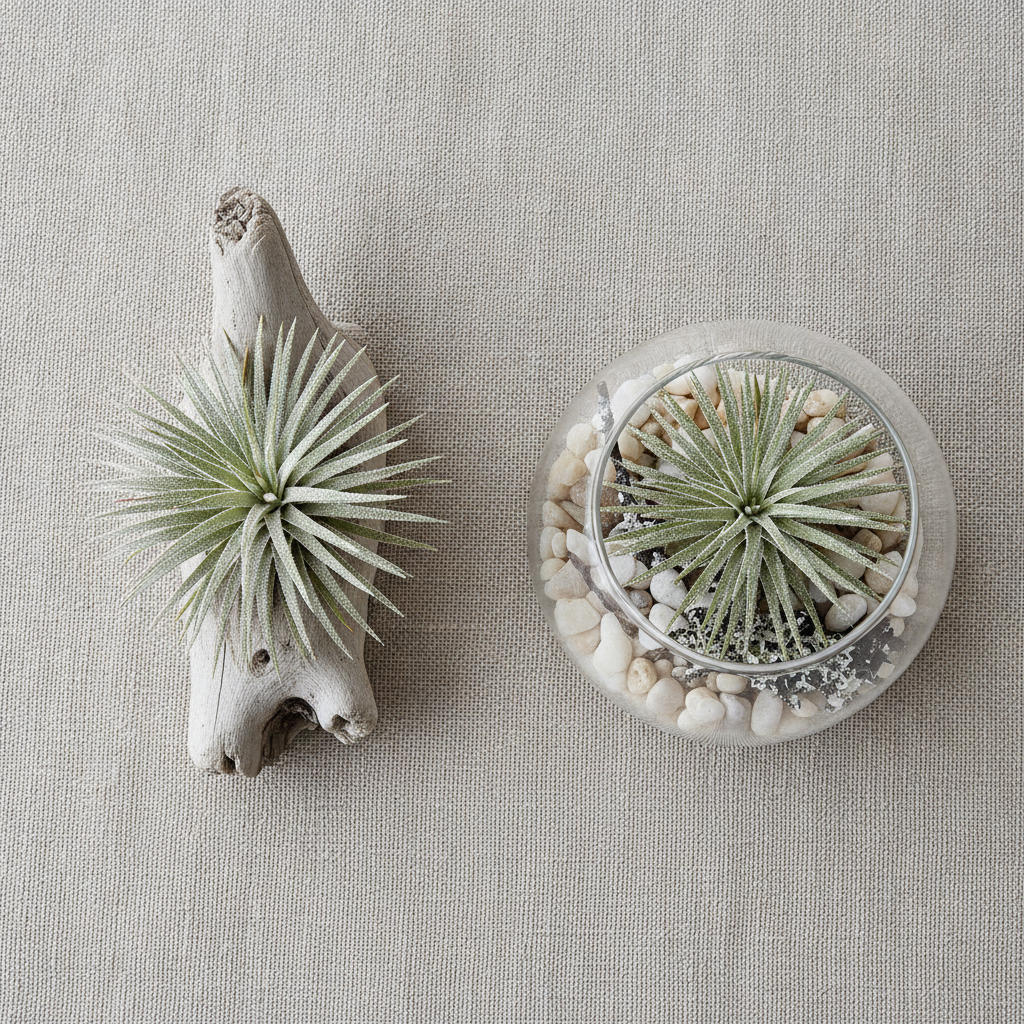
What It Grows On Instead of Soil
The ionantha will happily sit loose in a bowl, nestle in a glass globe, or be fixed to a natural mount such as driftwood, cork bark, a piece of grapevine or a decorative stone. The one rule that governs every display choice is airflow and drainage: whatever you use must let the plant dry quickly and completely after watering, which rules out closed containers, moss that stays wet, and any nook that holds standing water.
| Mounting Material | Suitability | Notes |
|---|---|---|
| Driftwood or cork bark | Excellent | Natural look, dries fast, mimics the plant’s wild host |
| Open glass globe or dish | Very good | Attractive and airy, provided it is left uncovered |
| Decorative stone or shell | Good | Fine for a loose, movable display; no adhesive needed |
| Sphagnum moss bed | Poor | Holds moisture against the base and invites rot |
| Soil or compost | Never | Traps water at the crown and kills the plant |
If you want to fix the plant permanently to a mount, you can tie it on with fishing line, cotton thread or a dab of waterproof, solvent-free adhesive such as E6000, positioning the base against the wood so its anchoring roots can eventually grip. In time the ionantha grasps the surface on its own and the tie can be removed.
Pro Tip — Quick Mounting Recipe: For a fuss-free mount, hold the plant against a piece of cork bark and wrap a loop of clear fishing line snugly around its base, avoiding the leaves. Leave it for a few months until you see roots gripping the surface, then snip the line away and the ionantha will hold itself in place.
Choosing a Display Spot
Airflow is non-negotiable. Because the plant relies on drying out between waterings, the perfect display marries good light with steady air movement. A stuffy, enclosed terrarium is the one setting to avoid, since trapped humidity keeps the plant permanently damp and rot follows.
Material of the holder: Natural materials such as wood, cork, ceramic and glass all work well, and metal is fine too with one important exception. Copper is toxic to air plants, so avoid copper wire, copper mounts and copper-based fixings entirely, as prolonged contact will poison the ionantha.
Ease of removal: Whatever display you settle on, remember you will need to lift the plant off regularly to soak it, so a holder that lets you pick the ionantha up easily, or a mount light enough to submerge whole, will make routine care far simpler.
When to Re-mount
Unlike a potted plant, the ionantha never outgrows its home in the pot-bound sense, so there is no repotting cycle to keep. You will only need to re-mount it if the original tie loosens, if the mount itself begins to rot or degrade, or when the plant produces offsets and you decide to separate a growing clump. Otherwise it can stay put indefinitely, gripping its perch for years.
Warning — Handling Stress: The leaves are more brittle than they look, and rough handling snaps them at the base or bruises the crown. When moving or re-mounting an ionantha, support it from underneath and avoid pulling on individual leaves, since damage to the central growing point cannot be repaired.
Fertilising
An ionantha can live for a long time on nothing but water, gathering trace nutrients from dust and minerals in the air, but a plant that is fed lightly and regularly grows faster, blushes more strongly and is far more likely to flower and produce offsets. Feeding is therefore optional in the strict sense but well worth the small effort if you want the plant at its best.
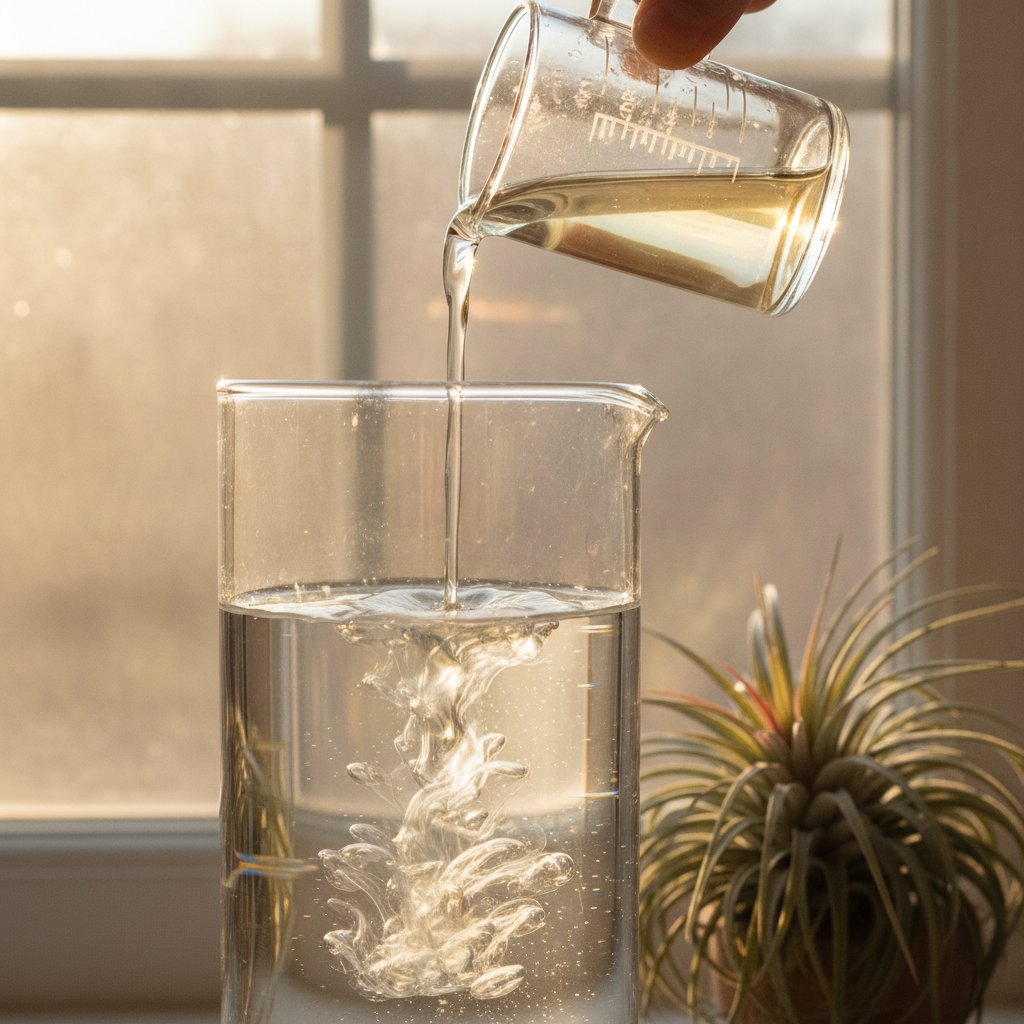
Because there is no soil to hold and release nutrients, fertilising an air plant means adding a very dilute feed to its soaking or misting water, so that the trichomes take it up along with the moisture. The key discipline is restraint: air plants are adapted to a lean diet, and too much fertiliser will burn the leaves rather than boost them.
Understanding Plant Nutrients
Fertilisers are described by their ratio of nitrogen, phosphorus and potassium, the three macronutrients plants need in the largest amounts, alongside smaller quantities of secondary nutrients and trace elements. For air plants the composition matters more than usual, because certain forms of nitrogen and certain trace metals are actively harmful to them.
| Nutrient | Symbol | Primary Function | Deficiency Symptoms |
|---|---|---|---|
| Nitrogen | N | Leaf growth and green colour | Slow growth, pale leaves |
| Phosphorus | P | Root anchoring and flowering | Poor blooming, weak offsets |
| Potassium | K | Overall vigour and stress resistance | Weak, easily damaged leaves |
| Magnesium | Mg | Core of the chlorophyll molecule | Yellowing between leaf tissue |
| Copper | Cu | Not needed and actively toxic to tillandsias | N/A; avoid entirely |
Types of Fertiliser
Dedicated air-plant feed: The safest option is a fertiliser formulated specifically for tillandsias or bromeliads, which uses nitrogen in a form the leaves can absorb and leaves out the copper and boron that harm them. These are designed to be diluted into water and are almost foolproof.
General houseplant liquid feed: A balanced liquid houseplant fertiliser can be used at a quarter of its recommended strength, provided it does not rely heavily on urea nitrogen and contains no copper. This is a reasonable stand-in when a specialist product is not to hand.
Orchid fertiliser: A dilute orchid feed is another workable choice, since orchids are also often epiphytic, but again it must be used at roughly a quarter strength and checked for the absence of copper.
Feeding Schedule
Feed the ionantha once or twice a month during the active growing season of spring and summer, and pause almost entirely through the darker, cooler months when growth naturally slows. A simple, safe approach is to add the dilute feed to one soaking session every two to four weeks, and use plain water for the soaks in between so nutrients never accumulate to a harmful level.
Pro Tip — Feed to Trigger a Bloom: A light phosphorus-rich feed in spring can nudge a mature, well-lit ionantha into blushing and flowering. Combine a monthly dilute feed with a slight increase in light and you give the plant the strongest possible cue that conditions are right to bloom.
How to Fertilise
- Mix an air-plant or bromeliad fertiliser into room-temperature rainwater or dechlorinated water at a quarter of the strength stated on the label.
- Soak the plant in the fertiliser solution for 20 to 30 minutes, exactly as you would for a normal watering.
- Remove the ionantha, turn it upside down and shake out any solution trapped in the crown.
- Dry it fully within four hours in a bright, airy spot, just as after plain watering.
- Use only plain water for the following one or two soaks before feeding again.
Warning — Over-Feeding Burn: Applying fertiliser at full strength, or feeding at every watering, will scorch the trichomes and leave the leaves patchy, brown and damaged. With air plants far less is genuinely more, and a missed feed does no harm while an excess one does.
Propagation
Propagating the ionantha is a slow but almost effortless process, and it is bound up with the plant’s dramatic life cycle. After a rosette flowers it will not bloom again, but before and after that final flourish it produces offsets, known as pups, around its base. Left in place these pups grow into a clustered colony; separated, they become new individual plants, and either way a single ionantha can give you many more over the years.
Unlike many houseplants, the ionantha cannot be propagated from leaf or stem cuttings, because a severed leaf has no way to form a new growing point. Division of pups is the reliable home method, while growing from seed is possible but so slow, often taking several years to reach a decent size, that it is really the preserve of dedicated collectors.
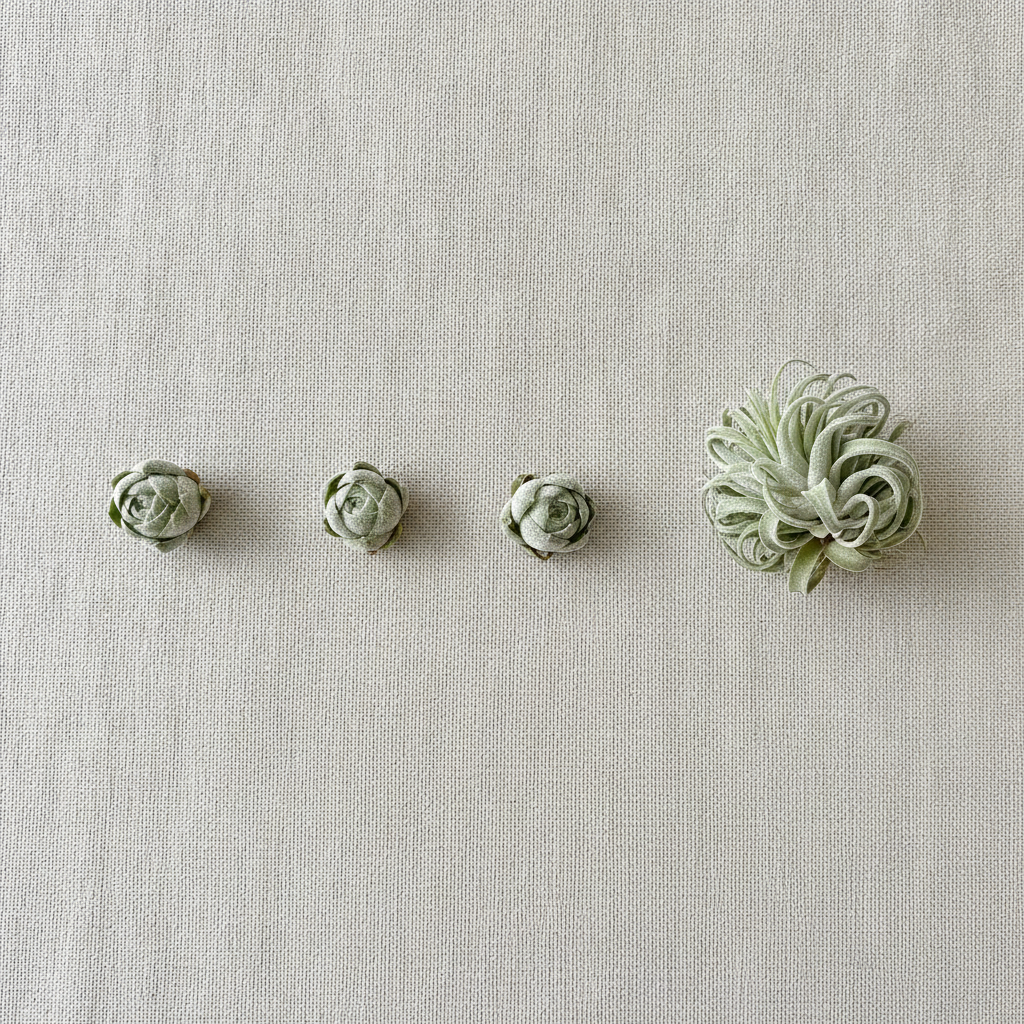
Understanding Pups and the Blooming Cycle
A pup is a genetically identical offset that emerges from between the leaves near the base of a mature rosette, usually triggered by or following flowering. Each mother plant typically produces two to eight pups over its life, and although the original rosette gradually declines after blooming, it feeds and supports its pups for a long time as it does so. This is why a healthy, well-cared-for ionantha does not simply die after flowering but instead hands on to a whole new generation.
Dividing Pups: Step-by-Step
The moment to separate a pup is when it has reached at least one third, and ideally about half, the size of the mother plant, by which point it has developed enough of its own structure to live independently. Removing pups too early greatly reduces their chance of survival.
- Hold both the mother rosette and the chosen pup firmly but gently, one in each hand, close to the point where they join.
- Gently twist and rock the pup sideways while pulling it down and away from the mother, so it detaches cleanly at the base.
- If it resists, use a clean, sharp blade to slice through the connecting tissue rather than forcing and tearing it.
- Set the separated pup aside for a few hours so the wound can dry and callus over slightly.
- Place the new pup in its own bright, airy spot and begin the normal soak-and-dry watering routine.
Pro Tip — Grow a Clump Instead: You do not have to separate pups at all. Leaving them attached lets the ionantha develop into a lush, multi-headed clump that flowers in waves and is far more striking than a single rosette, so divide only if you specifically want more individual plants to share or display separately.
Growing from Seed: Step-by-Step
Seed propagation is a long-term project rewarding chiefly for its novelty, requiring pollinated flowers, patience and consistent humidity, but it is the only way to raise genuinely new plants rather than clones.
- Hand-pollinate open flowers with a small brush and wait several months for the seed capsules to ripen and split.
- Scatter the fluffy, parachute-like seeds onto a rough, permanently humid surface such as a slab of tree-fern fibre or a mesh screen.
- Keep them under bright indirect light with high humidity and gentle air movement, misting regularly.
- Be patient, as germination takes weeks and the seedlings grow at a glacial pace for the first year or two.
- Once the tiny rosettes are a centimetre or so across, begin very dilute feeding to speed them along.
Troubleshooting Propagation
| Problem | Likely Cause | Solution |
|---|---|---|
| Pup rots after separation | Removed too early or left wet at the base | Wait until larger, dry thoroughly after each soak |
| Mother declines with no pups | Low light or poor overall vigour | Improve light and feeding before and after flowering |
| Pup pulls apart and tears | Forced off rather than twisted cleanly | Use a sterile blade at the join instead of yanking |
| Seeds fail to germinate | Insufficient humidity or unviable seed | Maintain constant humidity and use fresh, ripe seed |
Pests & Diseases
The ionantha is remarkably resistant to pests, partly because its trichome-coated leaves offer little foothold and partly because it carries no soil to harbour the fungus gnats and root pests that plague potted plants. When trouble does arise it is nearly always either a sap-sucking insect brought in on a new plant, or the plant’s own nemesis, rot, caused by staying wet.
The best defence is simple observation. Because an ionantha is small and handled every time you water it, you are naturally well placed to spot the first sign of an insect or a soft, darkening base long before it becomes serious, and early action almost always resolves the problem.
Common Pests
Mealybugs (Pseudococcus species)
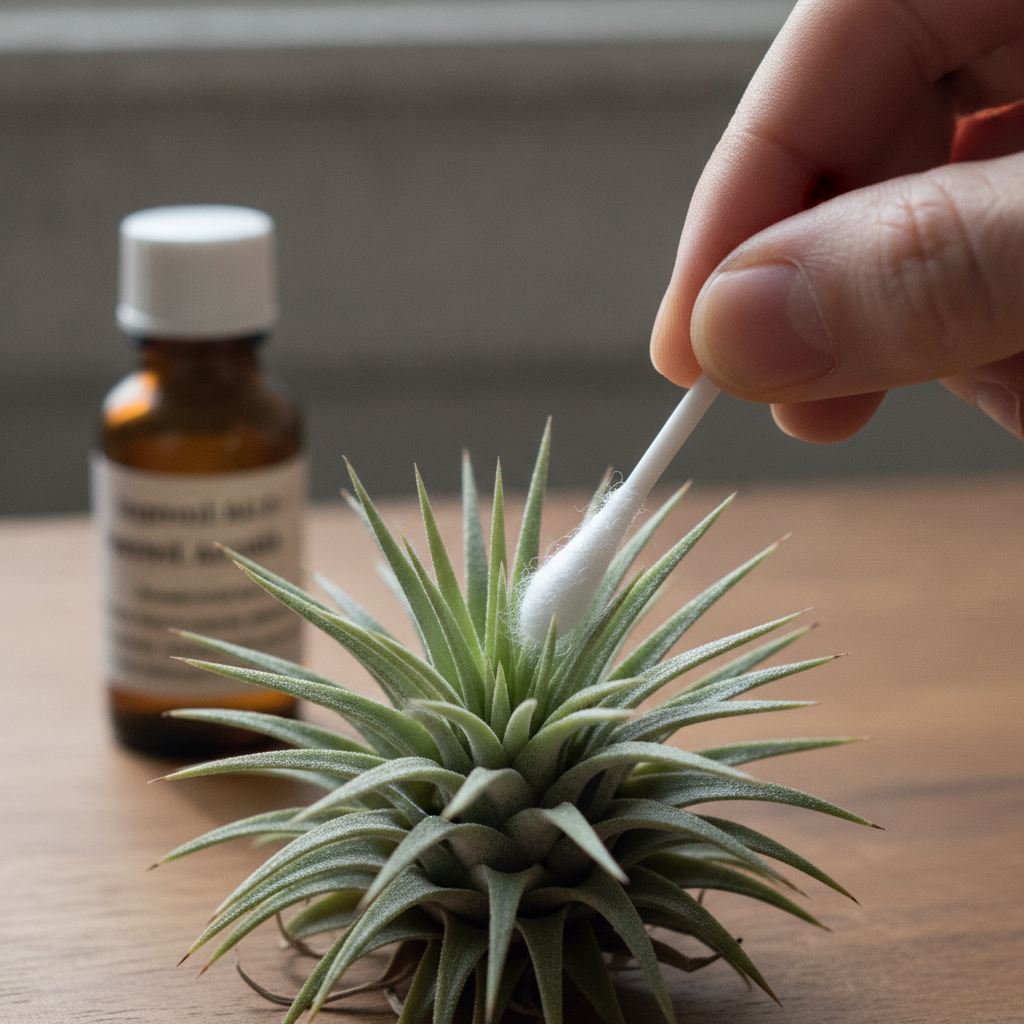
Mealybugs are the most likely pest to trouble an ionantha, appearing as small, white, cottony tufts tucked between the leaves near the base, where they suck sap and weaken the plant. They are easy to miss until a small colony has formed, so check the leaf axils whenever you water.
Treatment: Dab each insect with a cotton bud dipped in diluted isopropyl alcohol, then give the whole plant a soak and a thorough rinse. Repeat every few days until no new bugs appear, and isolate the plant from others in the meantime.
Scale (Diaspididae family)
Scale insects show up as small, hard, brown or tan bumps clinging to the leaves, and like mealybugs they feed on sap and can be brought in on a newly acquired plant. Their waxy shells make them slightly more stubborn to shift.
Treatment: Scrape or wipe the scales off gently with a cloth or a fingernail, follow up with a diluted alcohol dab, and rinse well. Persistent infestations may need a horticultural soap spray, applied late in the day and rinsed off before the plant dries.
Aphids (Aphidoidea superfamily)
Aphids are an occasional visitor, most often drawn to the tender flower spike when the plant blooms, where they cluster and feed on the soft new growth. They are less common on the tougher mature leaves.
Treatment: Rinse them off under a stream of water, which dislodges most of the colony, and repeat as needed. A very dilute insecticidal soap can be used for heavier numbers, always followed by a rinse and a full dry.
Common Diseases
Crown and Base Rot (fungal and bacterial)
Rot is by far the most serious problem an ionantha faces, and it is a disease of husbandry rather than infection from outside. It sets in when water sits in the central rosette or the plant fails to dry, turning the core dark, soft and foul-smelling, at which point the leaves loosen and pull away from the middle.
Treatment: Rot is usually terminal once it reaches the core, so prevention through the post-soak shake and good airflow is everything. If caught extremely early at a single leaf base, you can sometimes cut away the affected tissue and keep the plant bone dry for a week, but recovery is far from guaranteed.
Leaf Tip Browning (environmental)
Brown, crisp leaf tips are not a true disease but a common environmental complaint, caused by air that is too dry, water that is too harsh, or a spell of scorching direct sun. It is unsightly rather than dangerous.
Treatment: Trim the browned tips at an angle with clean scissors for appearance, then address the cause by raising humidity, switching to rainwater or filtered water, and moving the plant out of direct sun.
Pest and Disease Summary
| Pest / Disease | Identification | Treatment |
|---|---|---|
| Mealybugs | White cottony tufts in leaf axils | Diluted alcohol dab, soak and rinse, isolate |
| Scale | Hard brown bumps on leaves | Scrape off, alcohol, horticultural soap if needed |
| Aphids | Small green insects on the flower spike | Rinse off, dilute insecticidal soap for heavy numbers |
| Crown rot | Dark, soft, smelly core; leaves fall out | Prevent with drying and airflow; usually fatal once set in |
| Tip browning | Crisp brown leaf tips | Trim, raise humidity, use rainwater, reduce direct sun |
Prevention Strategies
Prevention for an air plant rests on two habits above all: never let it stay wet, and quarantine anything new. The drying discipline that keeps rot at bay is the same routine that keeps the plant healthy in every other respect, so a good watering habit is most of the battle. Any new air plant should be kept apart from your existing collection for a couple of weeks and inspected closely, since sap-sucking pests almost always arrive as hitchhikers rather than appearing spontaneously.
Good airflow does double duty here, discouraging both fungal rot and insect colonies, so a spot with gentle air movement is worth seeking out. Regular handling at watering time is itself a form of prevention, because it turns pest and rot detection into an automatic part of care rather than something you have to remember to do.
Pro Tip — Quarantine New Arrivals: Keep any newly bought air plant separate for two to three weeks and give it a good soak and a close inspection before it joins the others. Almost every pest problem on air plants is imported this way, so this single habit prevents the majority of infestations.
Popular Varieties
Although sold generically as the ionantha, Tillandsia ionantha is a variable species with a number of named forms and regional varieties that differ in size, shape and the intensity of their blush. Collectors prize these variants precisely because they let you assemble a whole shelf of plants that share the easy ionantha temperament while looking quite distinct from one another.
All of the forms below want the same core care of bright indirect light, a soak-and-dry watering rhythm and good airflow, so choosing between them is really a matter of appearance and availability rather than difficulty. The two featured varieties are among the most sought after for their colour.
| Variety | Leaf Appearance | Light Needs | Growth Rate | Availability |
|---|---|---|---|---|
| Ionantha Fuego | Small rosette blushing vivid scarlet-red | Bright indirect | Moderate | Common |
| Ionantha Guatemala | Taller silver-green, blushing pink to red | Bright indirect | Moderate | Common |
| Ionantha Mexican | Compact, dense silver rosette, red blush | Bright indirect | Moderate | Very common |
| Ionantha Rubra | Reddish-toned leaves even out of bloom | Bright indirect | Moderate | Common |
| Ionantha Druid | Blushes soft yellow with a white flower | Bright indirect | Slow | Uncommon |
| Ionantha Peach (Maxima) | Larger form flushing peach to apricot | Bright indirect | Moderate | Uncommon |
Featured Varieties
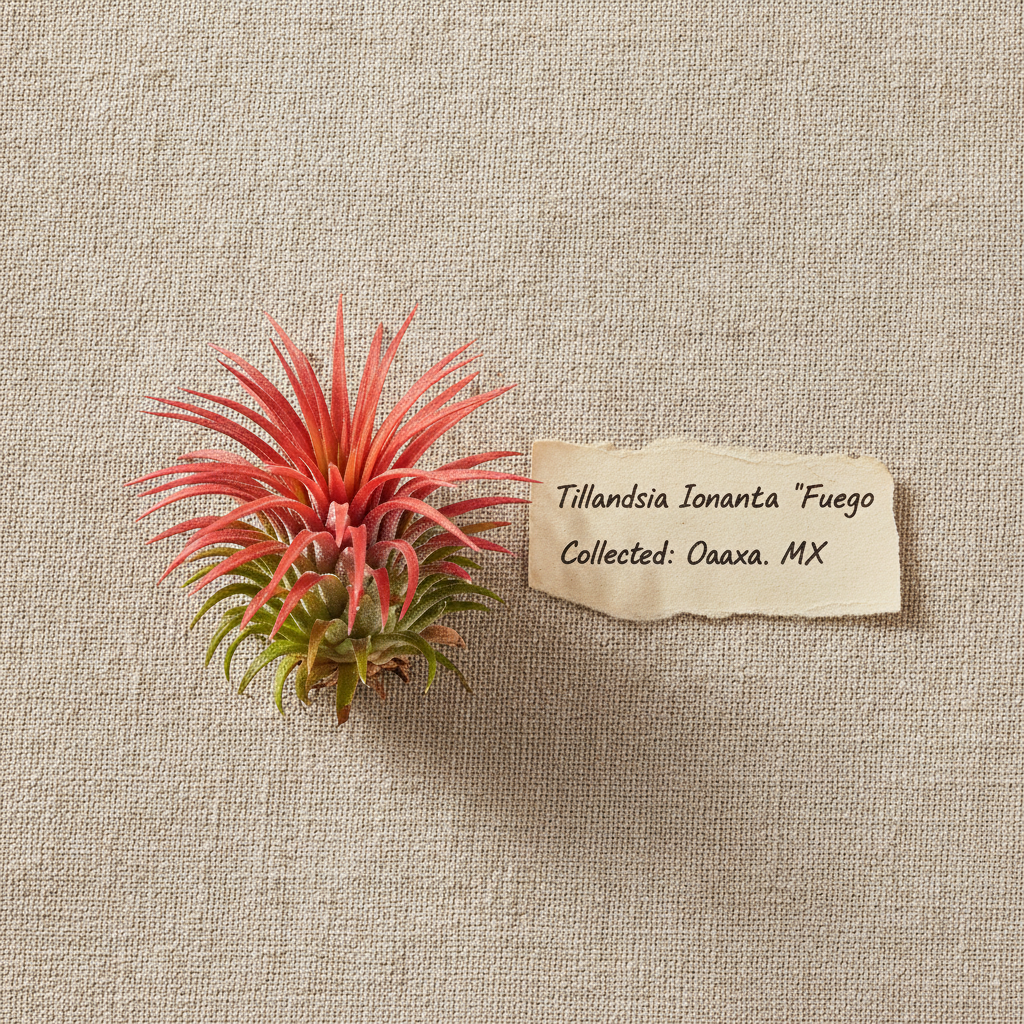
Ionantha Fuego
Named for the Spanish word for fire, Fuego is the most intensely coloured common ionantha, flushing almost its entire compact rosette a vivid scarlet-red as it approaches bloom. It is small, dramatic and widely available, making it a favourite starter variety.
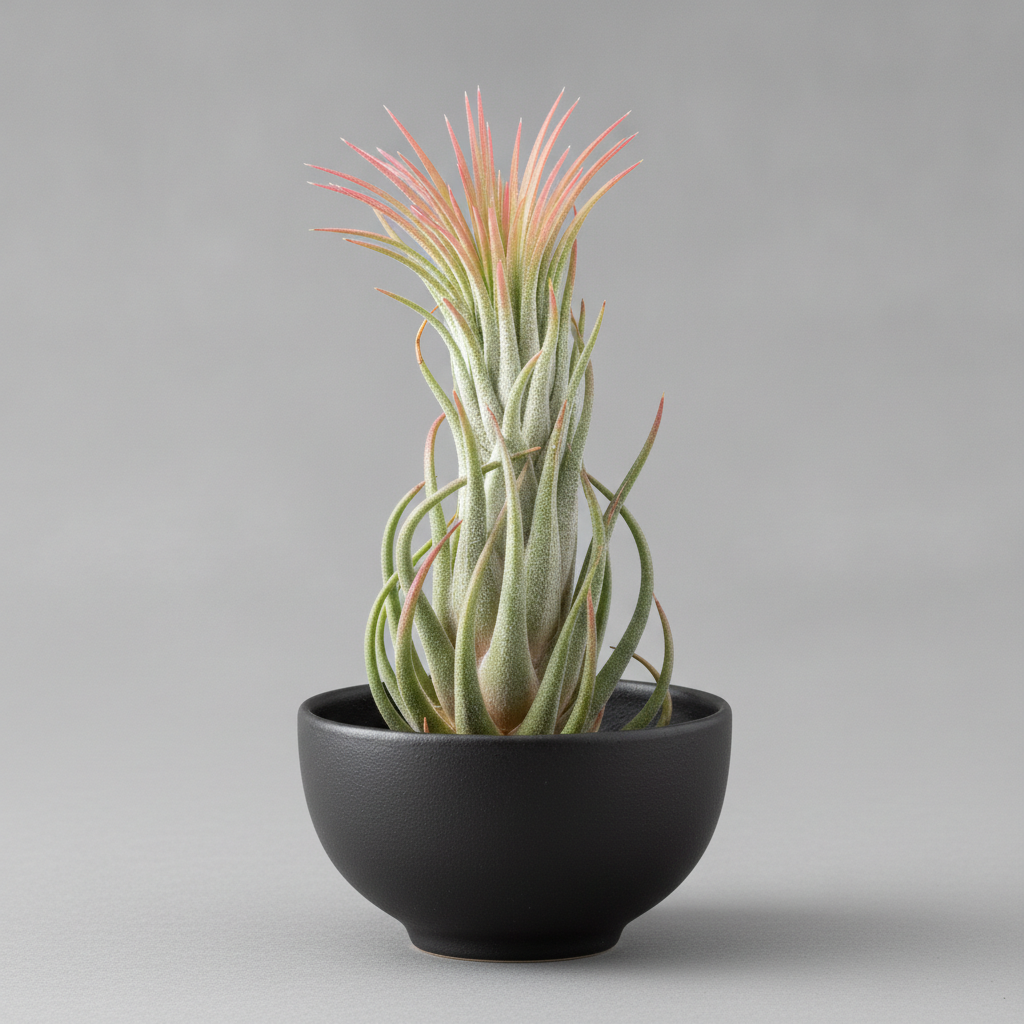
Ionantha Guatemala
The Guatemala form is a taller, more elongated rosette of bright silver-green leaves that blush soft pink to red at the tips before flowering. It clumps readily and is one of the most reliable and vigorous ionanthas for a beginner.
Variety Profiles in Detail
Ionantha Mexican (Tillandsia ionantha var. ionantha)
The Mexican form is the classic ionantha of the houseplant trade, a small, dense rosette of silvery leaves that blushes a warm red from the centre outward at flowering. Its ubiquity and toughness make it the plant most people picture when they hear the name, and it is an excellent, inexpensive introduction to the species.
Ionantha Druid (Tillandsia ionantha f. druid)
Druid is a striking colour mutation that blushes a soft golden yellow rather than red and opens white rather than violet flowers, giving it a ghostly, luminous look quite unlike the standard form. It is slower and a little less common, but hugely prized by collectors for its unusual palette.
Choosing the Right Variety for Your Space
Because every ionantha form shares the same easy care, your choice comes down to look and setting rather than skill level. If you want the boldest splash of colour choose Fuego or the Mexican form, if you prefer a larger plant that clumps into a display go for Guatemala, and if you are after something unusual to anchor a collection seek out Druid or one of the peach-toned forms. For a first air plant, any of the common varieties will forgive the odd mistake while you learn the soak-and-dry rhythm.
Frequently Asked Questions
How often should I water my ionantha air plant?
As a starting point, soak it for 20 to 30 minutes once every 7 to 14 days, then adjust to your home. In warm, dry rooms you may need to soak weekly and mist in between, while in cool, humid spaces a fortnightly soak is plenty. Let the leaves guide you, as they curl inward when the plant is thirsty and flatten out again after a good drink.
Why is my air plant turning red?
Turning red is a good sign, not a problem. Known as blushing, it is the plant’s natural signal that it is about to flower, and the inner leaves flush red, pink or orange as the violet bloom develops. Bright indirect light encourages the strongest colour, so a blushing ionantha is usually a well-lit, happy one.
Does my ionantha die after it flowers?
The individual rosette will not flower again and slowly declines after blooming, but it does not simply vanish. Before and after flowering it produces pups around its base, and these grow on to replace it, so with decent care a single plant perpetuates itself into a long-lived clump rather than dying out.
Can I keep my air plant in a closed terrarium?
It is best avoided. The ionantha depends on drying out fully between waterings, and a closed terrarium traps humidity that keeps it permanently damp, which leads to rot. An open globe or dish with good airflow is fine, but seal the container and you create the one condition most likely to kill the plant.
Why are the tips of my air plant turning brown?
Brown, crisp tips usually mean the air is too dry, the water too harsh, or the plant has caught too much direct sun. Try misting more often or moving it somewhere more humid, switch to rainwater or filtered water, and keep it out of scorching midday rays. You can trim the browned tips at an angle for appearance.
Do air plants really need no soil at all?
Correct, and you must never plant one in soil. The ionantha is an epiphyte that absorbs water and nutrients through its leaves, and its roots serve only to grip a surface. Burying the base in compost traps moisture against the crown and causes fatal rot, so display it loose, in a holder or mounted on wood instead.
Is the ionantha air plant safe for cats and dogs?
Yes, Tillandsia ionantha is considered non-toxic to cats, dogs and people, which makes it a reassuring choice for pet-owning households. It is not meant to be eaten, though, and its wiry leaves could cause mild stomach upset if chewed, so it is still sensible to keep it out of a determined pet’s reach.
How do I know if my air plant is dead or just dormant?
A living ionantha holds its leaves firmly, even if curled from thirst, and its base is pale and solid. A dead or rotting plant has a soft, dark centre, leaves that pull away from the middle with no resistance, and often a sour smell. If leaves simply fall out from the core when handled, the plant has rotted and cannot be saved.






