
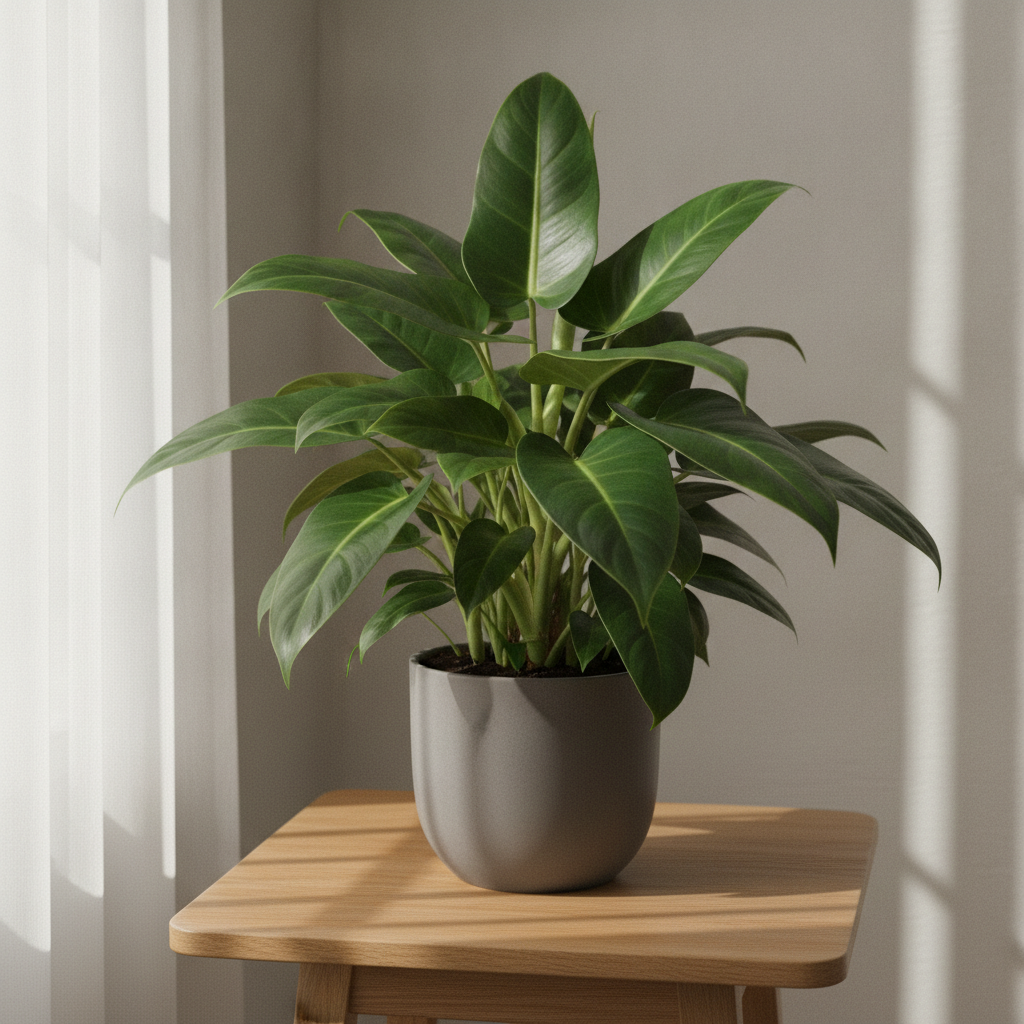
Few houseplants reward indifference quite as graciously as the Imperial Green Philodendron. Where a fiddle leaf fig sulks at the first draught and a calathea curls its leaves at tap water, this glossy self-heading hybrid simply keeps unfurling broad, lacquered leaves from the centre of its rosette, asking for little beyond a bright corner and the occasional drink. It is a cultivated selection within the sprawling Philodendron erubescens complex, bred for compact good looks rather than the rambling vines most people picture when they hear the word philodendron, and it has become one of the most dependable green furnishings in modern interiors for exactly that reason.
This guide covers everything needed to take an Imperial Green from a supermarket impulse buy to a glossy, full specimen that anchors a room for years. The distinction throughout is between merely keeping the plant alive and genuinely letting it thrive, because the gap between those two states is where most of the interesting decisions live.
- Quick reference
- Why grow the Imperial Green Philodendron
- Light
- Watering
- Soil and potting
- Fertilising
- Propagation
- Pests and problems
- Varieties and relatives
- Frequently asked questions
Quick reference
| Botanical name | Philodendron erubescens (Imperial Green, a self-heading hybrid) |
| Common names | Imperial Green Philodendron, Green Imperial |
| Family | Araceae (the aroids) |
| Origin | Garden hybrid; parent species native to tropical South America |
| Light | Bright, indirect light; tolerates medium light |
| Water | When the top 3 to 5 cm (1 to 2 in) of soil is dry |
| Soil | Chunky, well-draining aroid mix, slightly acidic |
| Temperature | 18 to 29°C (65 to 85°F) |
| Humidity | Average household fine; prefers 50% and above |
| Mature size | 60 to 90 cm (24 to 36 in) tall and wide indoors |
| Growth habit | Self-heading rosette, non-climbing |
| Toxicity | Toxic to pets and people if chewed (calcium oxalate) |
| Difficulty | Easy |
Why grow the Imperial Green Philodendron
The genus Philodendron divides loosely into two camps. There are the climbers, the trailing heartleaf and Brasil types that send out long stems hunting for something to scramble up, and there are the self-headers, which grow as a tight central crown of leaves on short stems and stay where they are put. The Imperial Green belongs firmly to the second camp. It was selected from the variable Philodendron erubescens lineage, the same breeding pool that produced Imperial Red, Rojo Congo and Prince of Orange, and like its siblings it forms a dense rosette of large, paddle-shaped leaves that radiate outward from a stubby central stem rather than vining across a shelf.
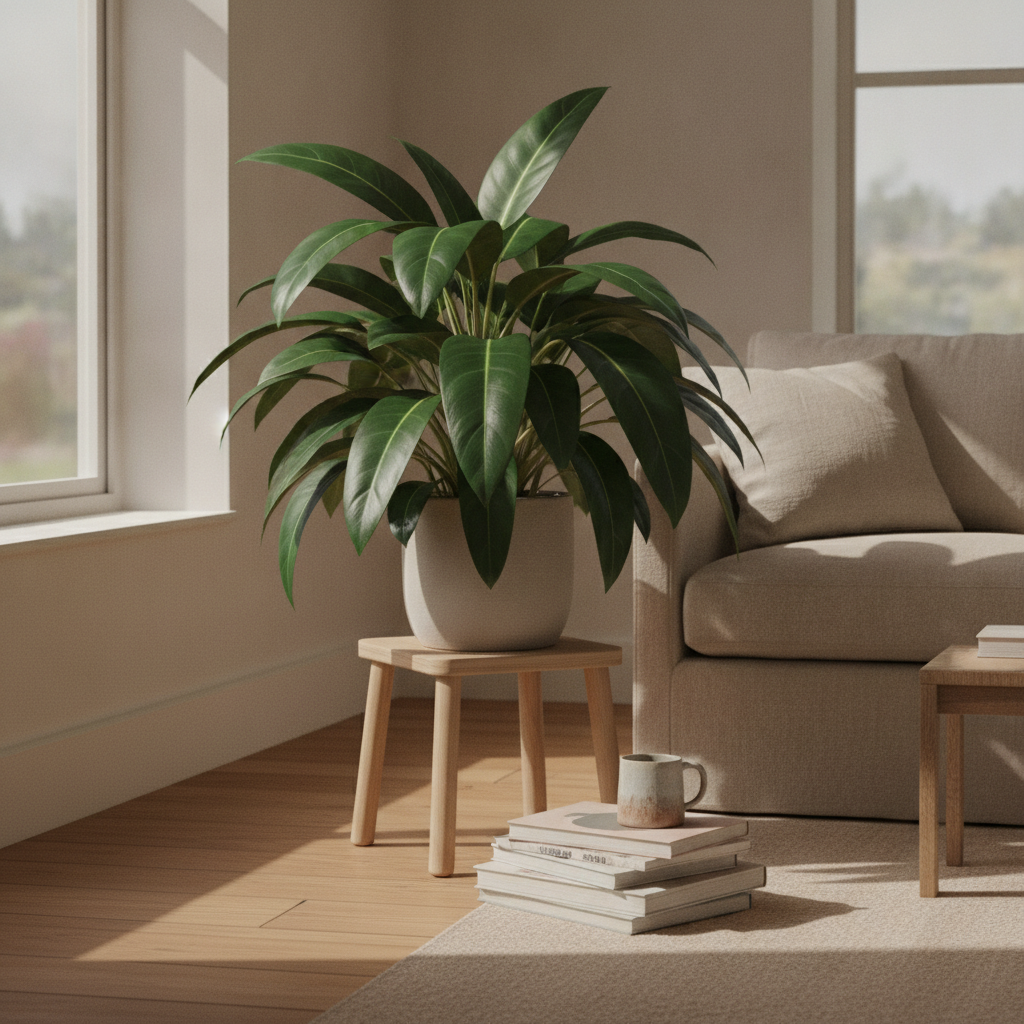
The leaves are the main event. They emerge a soft, almost translucent lime from the centre of the crown, then deepen over a week or two into a rich, glossy emerald with a leathery, light-catching surface that reads as expensive across a room. A healthy mature plant carries a dozen or more of these leaves at once, each on a sturdy, pale-green petiole, and the overall silhouette is rounded and full rather than leggy. Because the plant heads rather than climbs, it never needs a moss pole and never outgrows its corner in the unruly way a monstera can.
The other reason it earns a place is sheer resilience. As an aroid bred for interior use, it copes with the dry air of centrally heated rooms, tolerates light levels that would starve most variegated plants, and shrugs off the irregular watering that ordinary life imposes. It is genuinely difficult to kill through neglect, and the most common way people harm it is by caring too much rather than too little. For a first foray into the larger statement houseplants, it is hard to do better.
Pro Tip — Give it room to spread: The Imperial Green grows wider than it does tall. Leave 20 to 30 cm of clear space around the pot so the outer leaves can extend fully without scraping a wall or a neighbouring plant, which causes them to bend and lose their symmetry.
Light
Bright, indirect light is the sweet spot. In its parent species’ native understorey, Philodendron erubescens grows beneath a canopy that filters the tropical sun into a bright, dappled glow, and the Imperial Green wants the indoor equivalent: a position a metre or two back from an east or west window, or a few steps inside a bright south-facing room where the direct beam never quite lands on the leaves. In that kind of light it produces large leaves on short petioles and keeps its compact, full shape.
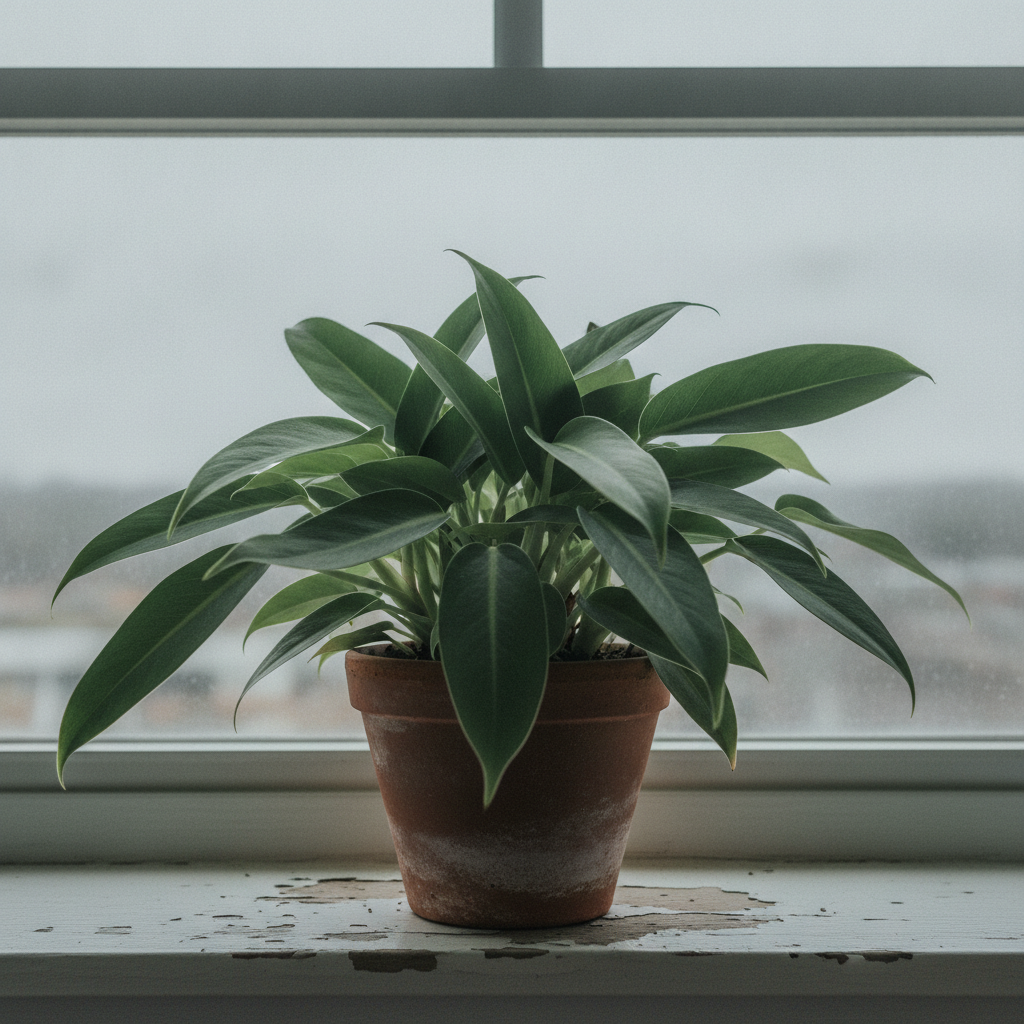
The plant’s tolerance is what makes it so forgiving. Those dark, chlorophyll-rich leaves are efficient light-gatherers, so the Imperial Green will survive in medium light, the sort found several metres from a window or in a north-facing room, where it simply grows more slowly and spaces its leaves a little further apart. This is the difference between surviving and thriving in practice: a plant in medium light stays alive and presentable for years, while a plant in bright indirect light pushes out noticeably larger, glossier leaves at a faster clip.
What it will not tolerate is harsh, direct sun through glass. A few hours of unfiltered midday light scorches the leaf surface, leaving bleached, papery patches that never recover and have to be pruned away. If the only available spot is a bright south or west window, set the plant back from the glass or hang a sheer curtain to break the intensity. At the other extreme, a plant in genuinely dim light, a windowless hallway or a dark interior corner, will gradually stretch toward the nearest light source, producing long, weak petioles and small leaves. Rotating the pot a quarter turn each week keeps growth even and stops the rosette leaning.
Pro Tip — Read the petioles: The length of the leaf stems is the clearest light gauge. Short, sturdy petioles holding leaves close to the crown mean the light is good. Long, reaching petioles with widely spaced leaves mean the plant wants to be moved closer to a window.
Watering
Watering is where most Imperial Greens are loved to death, so it is worth getting the rhythm right. The plant likes its soil to dry out partially between drinks. The reliable test is to push a finger into the mix: when the top 3 to 5 cm (1 to 2 in) feels dry, it is time to water; while it still feels cool and damp, wait. In a bright room during spring and summer this usually works out to roughly once a week, and in the low light and cool temperatures of winter it can stretch to every ten days or fortnight. Trust the soil rather than the calendar.
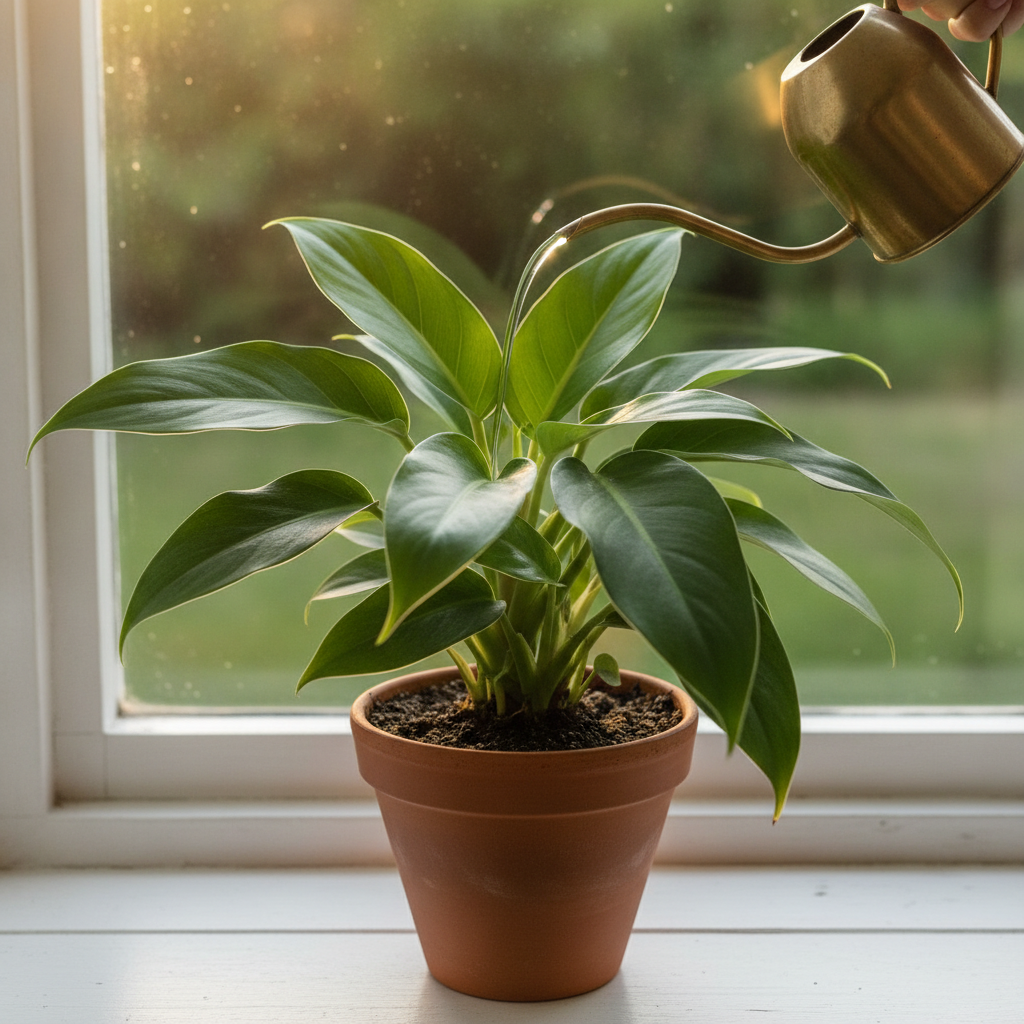
When you do water, water properly. Take the pot to a sink and pour slowly and evenly across the soil surface until water runs freely from the drainage holes, which wets the entire root ball and flushes out the salts that fertilisers and hard tap water leave behind. Let the pot drain completely before it goes back on its saucer, and never leave it standing in a tray of water. The single most common killer of this plant, and of almost every philodendron, is root rot caused by a pot that sits permanently wet. Roots deprived of air suffocate and decay, the lower leaves yellow and the whole crown wilts in a way that looks like thirst but is the opposite problem.
The Imperial Green is reasonably tolerant of tap water, but if your supply is heavily chlorinated or very hard, leaving the watering can to stand overnight or using filtered or rainwater will keep the leaf tips from browning over time. Aim for tepid water rather than cold straight from the tap, as a shock of cold water on warm roots can cause temporary stress. Yellowing lower leaves almost always point to overwatering, while crispy brown leaf edges and a pot that feels light point to the soil having gone too dry too often.
Warning — When in doubt, wait: An Imperial Green recovers from a missed watering within hours of being given a drink. It recovers from root rot slowly, if at all. If you are unsure whether it needs water, the safe answer is almost always to leave it another day or two.
Soil and potting
As an aroid, the Imperial Green has thick, fleshy roots that need air as much as moisture, and the worst thing you can do is plant it in dense, water-retentive compost straight from the bag. What it wants is a chunky, free-draining mix that holds some moisture but lets the rest drain away quickly, leaving plenty of air pockets around the roots. A standard houseplant or peat-free compost on its own packs down too tightly and stays soggy, which is the express route to rot.
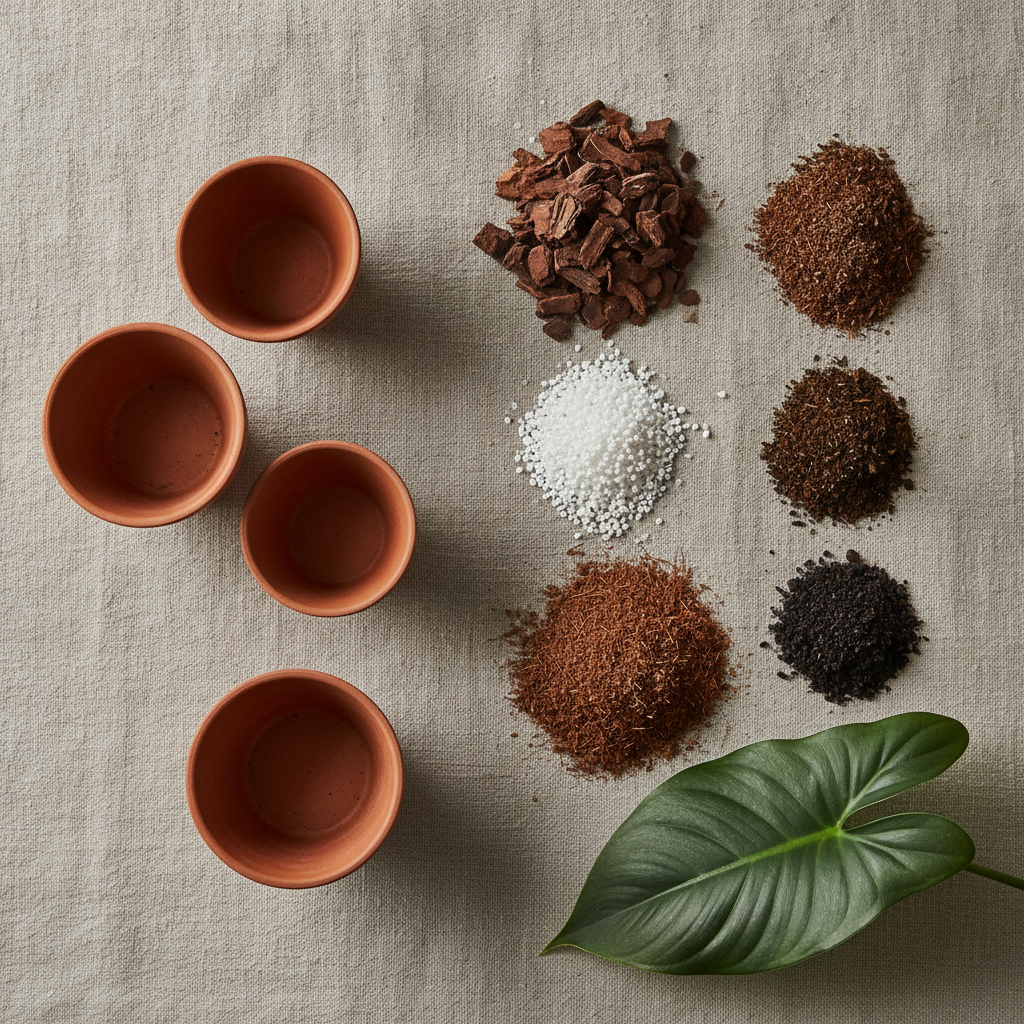
A reliable recipe is roughly equal parts good-quality houseplant compost, orchid bark and perlite, with a handful of coco coir for moisture retention and, if you have it, a small amount of worm castings for slow background nutrition. The bark creates structure and air channels, the perlite guarantees drainage, and the coir holds just enough water between drinks. The target is a slightly acidic mix, around pH 5.5 to 6.5, which most aroid blends naturally provide. If mixing your own feels fiddly, a bagged aroid or monstera mix gives the same result.
Whatever pot you choose, it must have drainage holes. A beautiful cachepot with no holes is fine as an outer cover, but the plant itself should sit in an inner pot that can drain freely. Repotting is needed only every two to three years, when roots begin to circle the base or poke out of the drainage holes. Move up just one pot size, around 3 to 5 cm wider in diameter, because an oversized pot holds a reservoir of wet soil the roots cannot reach and invites rot. The best time to repot is spring or early summer, when the plant is actively growing and recovers quickly from the disturbance.
Pro Tip — Refresh, do not always upsize: A mature Imperial Green that has reached the size you want does not need a bigger pot every time. Simply replace the top few centimetres of old soil with fresh mix each spring, or repot back into the same container with new substrate, to renew nutrients without forcing more growth.
Fertilising
The Imperial Green is not a heavy feeder, but it is a steady one, and a little regular nutrition during the growing season is the difference between a plant that merely holds its size and one that keeps pushing out new, larger leaves. From spring through early autumn, feed roughly once a month with a balanced liquid houseplant fertiliser diluted to half the strength stated on the label. Half strength is deliberate: aroids are sensitive to salt build-up, and a weaker feed given more carefully does far less harm than a strong one given enthusiastically.
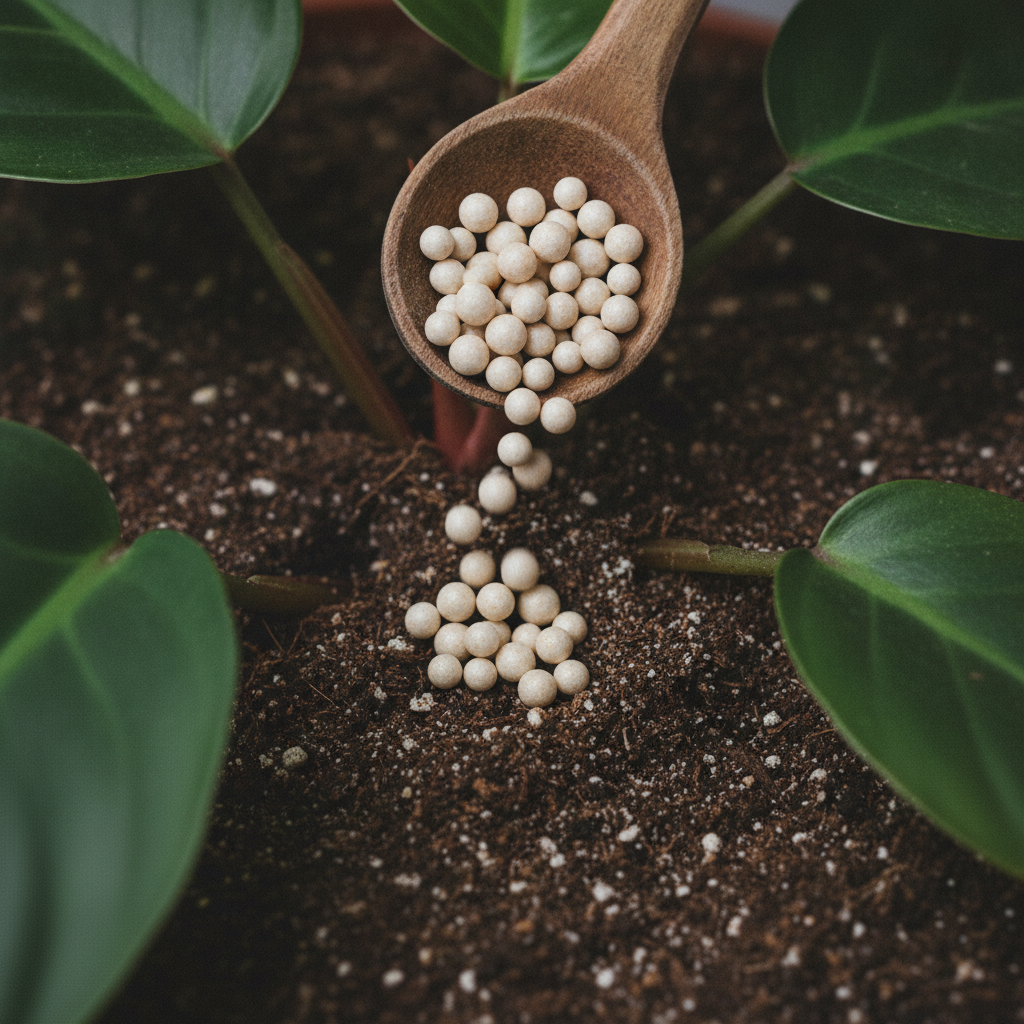
If monthly liquid feeding sounds like one more thing to remember, a slow-release granular fertiliser scattered onto the soil in spring is an excellent low-effort alternative, releasing a steady trickle of nutrients over several months as you water. Whichever route you take, always feed onto already-damp soil rather than bone-dry mix, because applying fertiliser to dry roots can scorch them. In late autumn and winter, when growth naturally slows in the lower light, stop feeding entirely and let the plant rest until the days lengthen again.
Over-fertilising shows itself as a white, crusty crust on the soil surface or pot rim, browning leaf tips, and in severe cases sudden leaf drop. If you see these signs, flush the pot thoroughly with plain water several times to leach out the excess salts, then hold off feeding for a couple of months. As with watering, restraint serves this plant better than generosity.
Propagation
Here the self-heading habit that makes the Imperial Green so tidy also makes it harder to propagate than its vining cousins. A heartleaf philodendron roots from any node you snip off and drop in water, but the Imperial Green grows from a single central crown with very short internodes, so there are no long, easily cut stems to work with. Propagation is still possible, just slower and more deliberate, and it is genuinely a project for a mature, well-established plant rather than a casual snip.
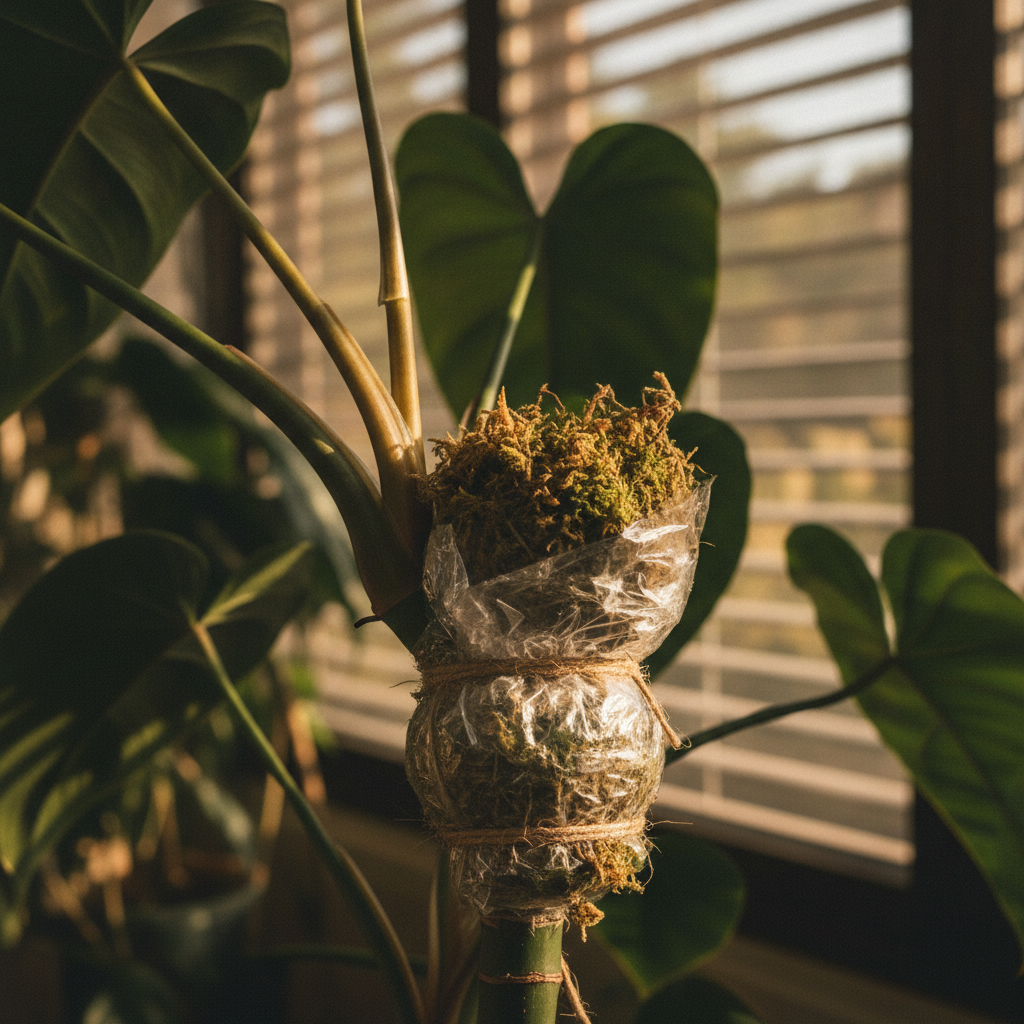
The most reliable home method, and the one shown above, is air layering. It works because the plant roots a new section while it is still drawing support from the parent, so there is no risky period of a detached cutting trying to survive on its own. The technique:
- On an older plant that has developed a visible woody stem below the crown, find a point on that stem where you can see small aerial roots or root nubs beginning to form.
- Wrap a generous handful of damp sphagnum moss around the stem at that point, covering the nubs completely.
- Enclose the moss in a sheet of clear plastic film and tie it loosely at both ends with natural twine, leaving it snug but not airtight, so you can re-moisten the moss as it dries.
- Keep the moss consistently damp and wait. Over several weeks to a couple of months, roots will grow out into the moss.
- Once a healthy network of roots fills the moss, cut the stem just below the rooted section, remove the film, and pot the new crown into a small container of aroid mix.
The other natural route is division. Mature Imperial Greens occasionally produce offsets, small pups, from the base of the crown. When one of these has a few leaves and some roots of its own, the whole plant can be unpotted in spring, the offset gently teased away with its roots intact using a clean, sharp knife, and potted up separately. Whichever method you use, work with sterilised tools, keep the new plant warm and humid while it establishes, and be patient: the Imperial Green is in no hurry, and neither should you be.
Warning — Wear gloves and protect surfaces: Cut philodendron stems release a sap that contains calcium oxalate and can irritate skin and eyes. Wear gloves when taking cuttings or dividing, keep the sap away from your face, and wash your hands afterwards.
Pests and problems
A healthy, well-positioned Imperial Green is largely untroubled by pests, but the dry indoor air of heated rooms can occasionally invite the usual suspects. Spider mites are the most likely visitors, betraying themselves by fine webbing in the leaf joints and a faint stippling or speckling across the leaf surface. Mealybugs appear as small white cottony tufts tucked into the crown and along the petioles, while scale shows up as flat brown discs clinging stubbornly to stems and leaf undersides. All three are easier to control the earlier they are caught, which is the strongest argument for giving the plant a proper look every week or two.
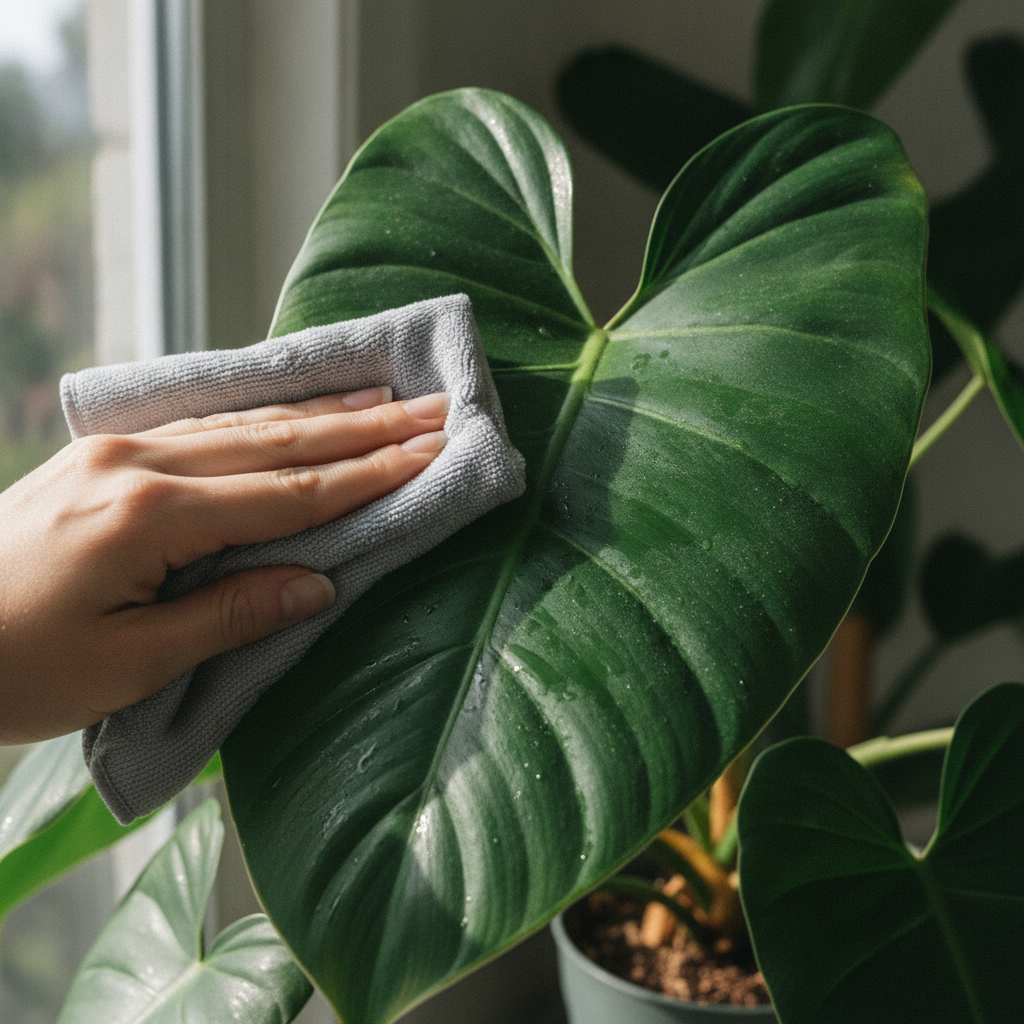
The large, glossy leaves are an asset here. Wiping them down with a damp microfibre cloth every couple of weeks removes the dust that would otherwise dull their shine and block light, and it doubles as a pest inspection, since you have the leaf in your hand and can check its underside while you work. If you do find an infestation, isolate the plant from its neighbours, wipe off what you can, and treat with an insecticidal soap or a diluted neem oil spray, repeating every week or so until the population is gone. A heavy mealybug colony can be spot-treated by dabbing each insect with a cotton bud dipped in isopropyl alcohol.
Most of the troubles people bring to this plant, though, are cultural rather than biological. Yellowing lower leaves almost always signal overwatering or a pot that drains poorly; let the soil dry further and check the roots are firm and pale rather than mushy and brown. Brown, crispy leaf edges usually mean the air is too dry or the plant has been allowed to dry out too hard between waterings. Pale, washed-out new growth suggests too much direct sun, while small leaves on long, stretching petioles point to too little light. The plant is, in effect, constantly reporting its conditions through its leaves, and learning to read those signals is most of what good care amounts to.
Warning — Keep away from pets and children: Like all philodendrons, the Imperial Green contains insoluble calcium oxalate crystals. Chewing the leaves causes intense burning and swelling of the mouth and throat in cats, dogs and humans. Place it where curious pets and small children cannot reach it, and contact a vet or doctor if any part is eaten.
Varieties and relatives
The Imperial Green sits within a family of self-heading Philodendron erubescens hybrids that share its compact rosette habit but differ in leaf colour, and collecting two or three of them makes for a striking grouping that needs identical care. The two most popular relatives are below.
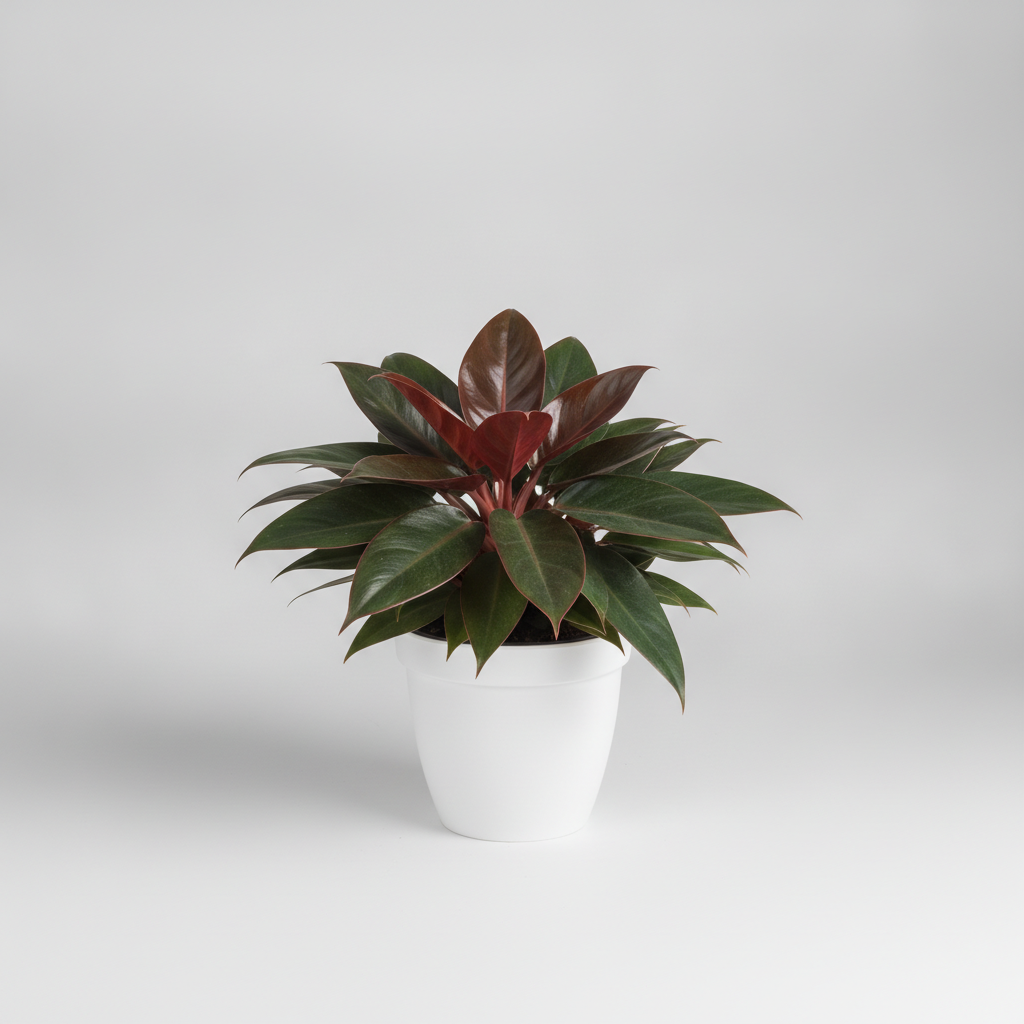
Imperial Red. The closest sibling, identical in habit and care but with new leaves that unfurl a glossy burgundy-red before maturing to a deep, wine-tinged green. Grown alongside the Imperial Green, it offers a warm counterpoint to the cooler emerald, and the colour is most vivid in bright indirect light.
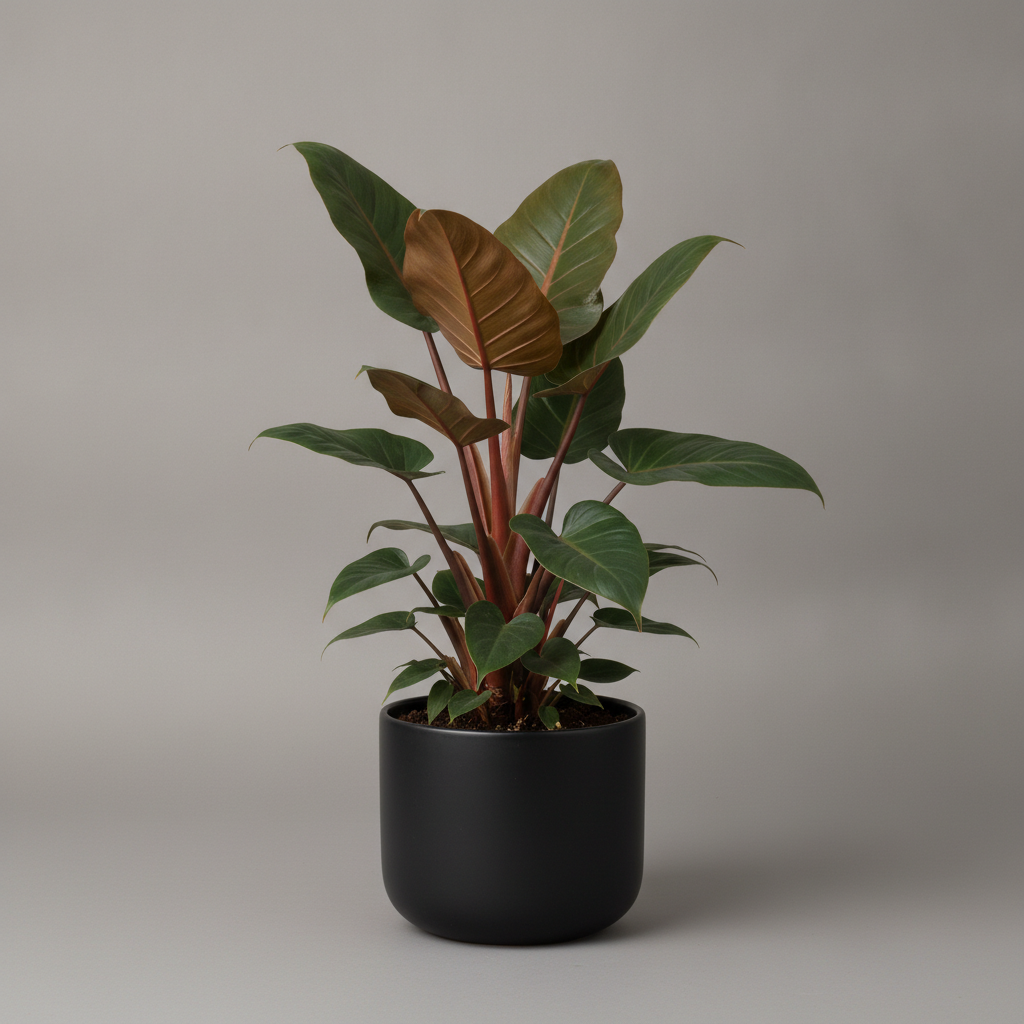
Rojo Congo. A robust, slightly larger hybrid with thick reddish petioles and coppery-red new growth that matures to glossy dark green. It is the most vigorous of the group and the most forgiving of imperfect conditions, making it an excellent companion plant for anyone who likes the Imperial Green’s look at a bigger scale.
Beyond these two, the wider erubescens group includes Prince of Orange, whose new leaves emerge bright apricot-orange and fade through copper to green, and Pink Princess, the variegated collector’s favourite splashed with bubblegum pink. All share the same self-heading habit and the same straightforward care described in this guide, so anything you learn growing an Imperial Green transfers directly to its more colourful cousins.
Frequently asked questions
Why are the lower leaves on my Imperial Green turning yellow?
The occasional yellowing of an old, lowest leaf is natural as the plant ages and sheds it. Several yellowing leaves at once, especially if the soil is wet and the pot heavy, point to overwatering. Let the mix dry further between drinks, make sure the pot drains freely and is not standing in water, and check that the roots are firm and pale rather than soft and brown.
Does the Imperial Green Philodendron climb or need a moss pole?
No. Unlike vining philodendrons, it is a self-heading type that grows as an upright rosette from a central crown and never produces long climbing stems, so it does not need a moss pole or any support. It simply gets fuller and slightly taller over time.
How big does an Imperial Green Philodendron get?
Indoors, expect a mature plant to reach around 60 to 90 cm (24 to 36 in) both tall and wide, growing as broad as it is high. Growth is slow to moderate, so it takes a few years to reach full size, and it stays a manageable floor or large-table plant rather than turning into a ceiling-scraper.
Is the Imperial Green Philodendron safe around cats and dogs?
No. All philodendrons contain insoluble calcium oxalate crystals that cause painful burning and swelling of the mouth and throat if chewed, in pets and people alike. It is not usually fatal but is genuinely unpleasant, so keep the plant out of reach of cats, dogs and small children and seek veterinary or medical advice if any is eaten.
How often should I water an Imperial Green Philodendron?
Water when the top 3 to 5 cm (1 to 2 in) of soil has dried out, which typically works out to about once a week in spring and summer and every ten days to a fortnight in winter. Rather than fixing a schedule, check the soil with a finger each time, since light, temperature and the season all change how fast the pot dries.
My Imperial Green has leggy growth with small leaves. What is wrong?
Long, stretching petioles carrying small, widely spaced leaves are the classic sign of insufficient light. Move the plant closer to a bright window, though still out of direct sun, and rotate it a quarter turn each week so it grows evenly. New growth should come back larger and more compact within a few months.






