
- Quick Reference: Humidity Solutions
- Relative Humidity in Plain English
- Misting: Pleasant, Brief and Overrated
- Pebble Trays: Better in Theory Than Practice
- What Actually Works
- Which Plants Care Most?
- Humidity Is Not a Substitute for Watering
- The Bathroom Question
- Frequently Asked Questions
Humidity is one of the most misunderstood parts of indoor plant care. It is blamed for crispy leaves, praised for lush growth, and chased with misting bottles that make the grower feel useful for roughly twelve seconds. The truth is more practical. Humidity matters, especially for thin-leaved tropical plants, ferns, calatheas and many orchids. But not every popular humidity trick actually changes the air in a meaningful way.
Winter is the hard season. Penn State Extension notes that heated indoor air can easily fall below 30 percent relative humidity, while many indoor plants benefit from humidity higher than that typical winter level.[4] The challenge is to raise humidity where it matters without creating mould, soggy soil or a bathroom full of plants slowly starving in poor light.
Quick Reference: Humidity Solutions
| Method | How useful is it? | Best use |
|---|---|---|
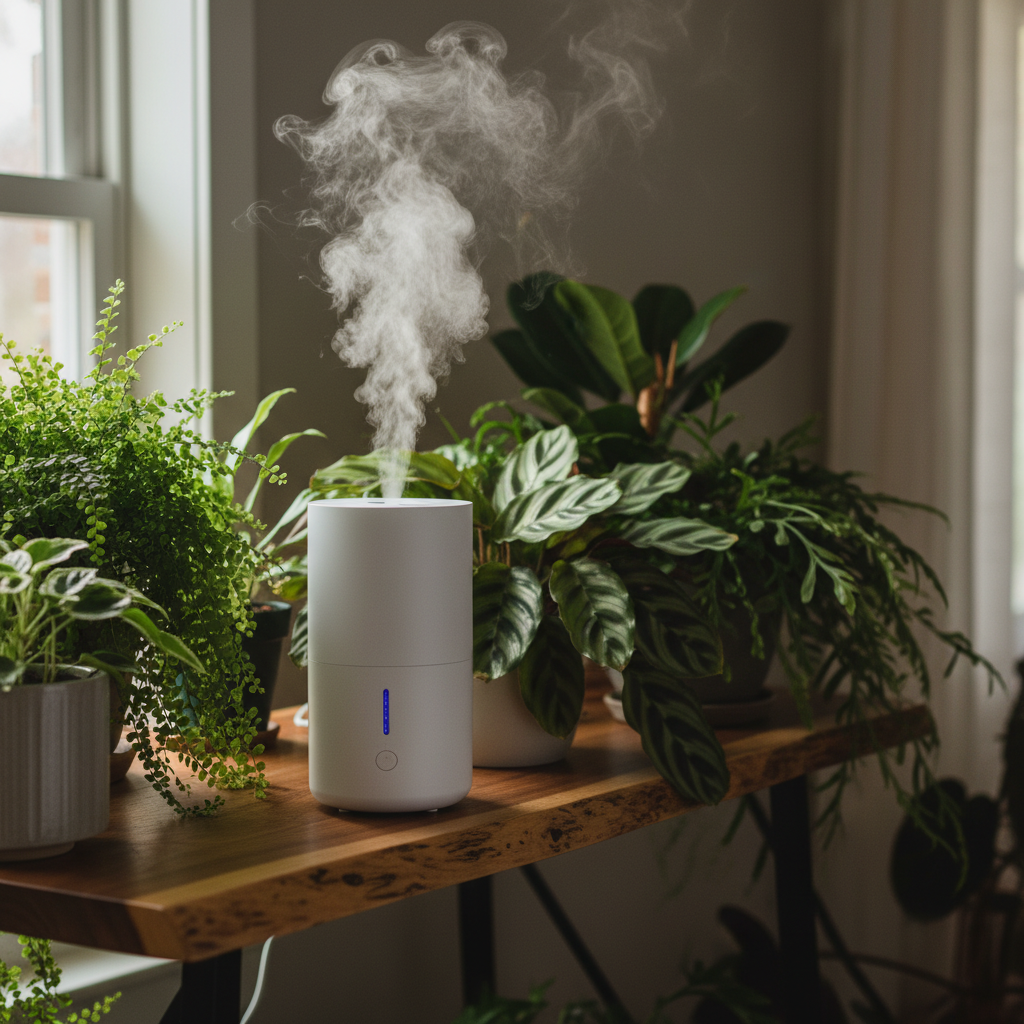
| Humidifier | Very useful | Plant shelves, fern corners, calathea collections, winter rooms. |
| Grouping plants | Moderately useful | Creates a slightly kinder microclimate around foliage. |
| Terrarium or cloche | Very useful for small plants | Jewel orchids, small ferns, cuttings, humidity-sensitive miniatures. |
| Pebble tray | Limited | Decorative, but usually minor effect on room humidity. |
| Misting | Very limited | Cleaning leaves or watering air plants; not reliable humidity control. |
| Bathroom placement | Depends | Useful only if the room also has enough light. |
Relative Humidity in Plain English
Relative humidity is the amount of water vapour in the air compared with the amount that air could hold at that temperature. Warm air can hold more moisture than cold air. That is why winter creates trouble: cold outdoor air starts dry, then heating it indoors lowers relative humidity further.
Plants lose water through their leaves. In very dry air, that loss speeds up. If roots cannot replace the water quickly enough, leaf edges crisp, new leaves emerge distorted, and moisture-loving plants look perpetually tired even when the soil is not dry.
Misting: Pleasant, Brief and Overrated
Misting raises humidity only until the droplets evaporate, which may be a matter of minutes. Penn State Extension makes this point clearly: daily misting does not meaningfully raise humidity around a plant over time.[4] It can be useful for cleaning dust, discouraging spider mites temporarily by making leaves less dusty, or watering air plants. It is not a serious humidity strategy for a maidenhair fern in a heated room.
Misting can also backfire if leaves stay wet in cool, still air. Spots, fungal issues and crown rot are more likely when water sits overnight on plants that dislike wet foliage.
Warning — Wet Leaves Are Not Humid Air: A leaf can be damp while the surrounding air remains dry. Humidity is an air condition, not a spray pattern.
Pebble Trays: Better in Theory Than Practice
A pebble tray looks convincing: water evaporates from the tray, the plant sits above it, and humidity rises. In practice, the moisture diffuses into the room rather than forming a stable little cloud around the plant. Penn State Extension describes pebble trays as having almost no overall impact on relative humidity in a room.[4]
They are not harmful if used correctly. The pot must sit above the water, not in it. Treat pebble trays as decorative saucers with a small local effect, not as a replacement for a humidifier.
What Actually Works
A portable humidifier is the most reliable solution for a dry winter room. Place it near, not directly against, the plant group, and use a hygrometer to measure results. Many foliage plants are comfortable around 40 to 60 percent relative humidity, while some ferns, calatheas and orchids prefer the upper end or beyond.
Grouping plants helps because leaves transpire water vapour and create a slightly more buffered microclimate together than alone. The effect depends on how many plants there are and how large the room is, but it is simple and useful.
Growing under glass is excellent for small humidity lovers. A terrarium, cabinet or clear cloche traps moisture close to the plant and can turn difficult miniatures into easy plants. The trade-off is airflow. Closed environments need monitoring so stagnant moisture does not become mould.
Which Plants Care Most?
| Plant type | Humidity sensitivity | Notes |
|---|---|---|
| Ferns | High | Thin fronds crisp quickly in dry rooms. |
| Calatheas and marantas | High | Leaf edges brown in dry, inconsistent conditions. |
| Many orchids | Medium to high | Especially epiphytic types with exposed roots. |
| Aroids | Medium | Many tolerate average homes but size up better with humidity. |
| Hoyas and peperomias | Low to medium | Usually fine in average homes if watering and light are right. |
| Cacti and succulents | Low | Often prefer drier air and strong light. |
Humidity Is Not a Substitute for Watering
Dry air and dry soil are different problems. A fern in bone-dry soil does not need humidity first; it needs water. A calathea in soggy soil with crispy tips does not need more water; it may need better roots, cleaner water, steadier warmth and higher humidity. Diagnosis matters.
Humidity also interacts with watering. In high humidity, pots dry more slowly. If you add a humidifier to a plant shelf, check the soil rather than continuing the old watering rhythm. More humid air often means less frequent watering.
The Bathroom Question
Bathrooms can be good plant rooms if they have bright natural light. They are often more humid after showers, but many bathrooms are dim, cold at night, or ventilated so strongly that humidity spikes disappear quickly. A bright bathroom suits ferns, orchids and peace lilies beautifully. A windowless bathroom is a plant waiting room unless you add a grow light.
Pro Tip — Buy a Hygrometer: A small digital hygrometer is cheap and clarifies everything. Guessing humidity is surprisingly difficult; measuring it turns a vague worry into a number you can act on.
Frequently Asked Questions
| Question | Answer |
|---|---|
| What humidity is best for most houseplants? | Many common houseplants manage around 40 to 60 percent, though needs vary widely.[1] |
| Can too much humidity be bad? | Yes. High humidity with poor airflow can encourage fungal disease and mould. |
| Should a humidifier run all day? | Use a hygrometer. Run it enough to reach the target range, not blindly. |
| Why are only the leaf tips brown? | Low humidity is one possibility, but salts, inconsistent watering, root stress and hard water can also cause brown tips.[3] |



