
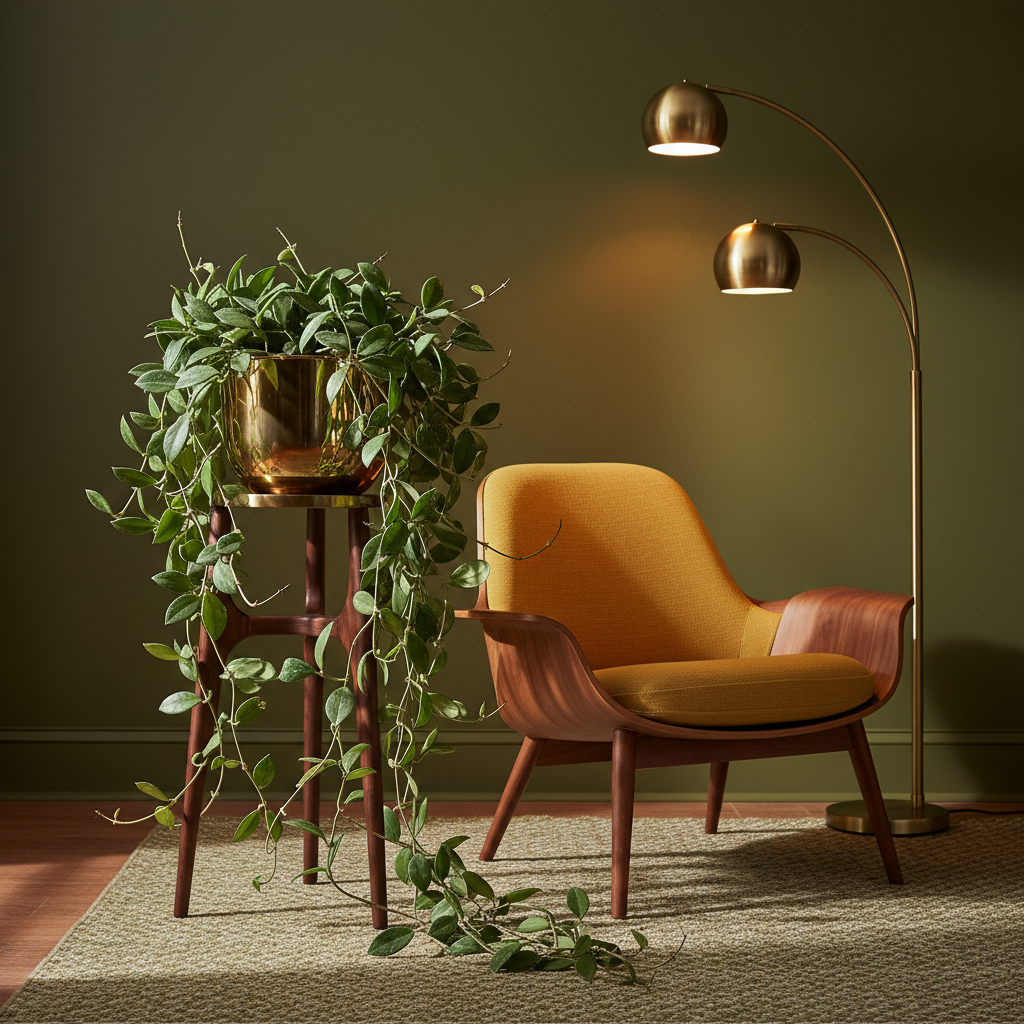
Few houseplants reward patience quite like the wax plant. Hoya carnosa is a slow-growing tropical epiphyte from the warm forests of eastern Asia and northern Australia, where it twines through the canopy on woody stems and produces tight, spherical clusters of star-shaped flowers that look as if they were carved out of porcelain. Indoors, the same plant becomes a long-lived vine with thick waxy leaves that store water in their tissues, climbing a trellis or trailing happily from a shelf. Grown well, it can flower year after year, releasing a deep honey-and-chocolate scent in the evening that drifts across an entire room.
The wax plant has a reputation for being either trouble-free or maddeningly stubborn, and both impressions are partly correct. The plant itself is almost indestructible: it tolerates dry air, inconsistent watering and a wide range of light, and it lives for decades on very little fuss. What it is fussy about is flowering. A hoya can sit happily on a shelf for years producing only leaves, and then one summer, when conditions finally line up, throw out a sudden flush of blooms from a tiny knobbly spur that looked like nothing at all. This guide walks through the small handful of adjustments that move a hoya from quietly surviving to actively thriving, and explains why a few common impulses, like cutting off bare stems or repotting too generously, are the very things that hold it back.
Contents
- Quick Reference
- Why Hoya Carnosa Makes an Excellent Houseplant
- Light Requirements
- Watering and Humidity
- Soil, Potting and Repotting
- Fertilising
- Propagation
- Pests and Diseases
- Popular Varieties
- Frequently Asked Questions
Quick Reference: Hoya Carnosa at a Glance
| Botanical name | Hoya carnosa (family Apocynaceae) |
| Common names | Wax plant, wax flower, porcelain flower, honey plant |
| Native range | Eastern Asia, southern China, India, Indonesia, eastern Australia |
| Light | Bright indirect light, with one to three hours of gentle direct sun ideal for flowering |
| Watering | Allow the top half of the pot to dry out, then water thoroughly; semi-succulent, tolerates short droughts |
| Temperature | 18 to 27 degrees Celsius (65 to 80 Fahrenheit); tolerates short dips to 10 degrees Celsius (50 Fahrenheit) |
| Humidity | 40 to 60 per cent is comfortable; higher encourages flowering but is not essential |
| Fertiliser | Balanced liquid feed at quarter to half strength every three to four weeks in spring and summer; switch to a higher-phosphorus bloom feed in late spring |
| Soil | Loose, chunky, very free-draining mix with orchid bark, perlite and coco coir |
| Toxicity | Non-toxic to cats, dogs and humans; the sap is mildly milky and best kept off skin |
| Growth rate | Slow in low light, moderate in bright light; mature vines can reach 3 metres (10 feet) over many years |
| Lifespan | Decades when established; specimens of 30 years or more are not unusual |
Why Hoya Carnosa Makes an Excellent Houseplant
The wax plant earns its place in living rooms for a combination of qualities that rarely appear together in a single species. The leaves are thick and semi-succulent, which means the plant carries its own moisture reserve and forgives a forgotten watering far more readily than the thin-leaved aroids and ferns it is often grouped with. It is happy in the dry indoor air of a centrally heated home in winter, and it actively prefers being a little rootbound, which suits the kind of person who hates repotting. It is non-toxic to cats, dogs and small children, which removes one of the most common reasons to pass on a houseplant in a busy household.

The bloom is the real draw, though, and it is worth understanding before you commit. Hoya carnosa flowers in tight, almost geometrical clusters called umbels, each one made up of 15 to 40 individual five-pointed stars in shades of pale pink, cream or pure white, with a darker red or pink crown at the centre. The texture is genuinely waxy, almost as if the petals had been moulded from candle wax, and a cluster will often last two weeks before dropping. Most striking is the scent, which intensifies after dark and carries notes of honey, vanilla and warm chocolate; one flowering cluster can perfume a whole bedroom at night. The flowers also produce a sweet sticky nectar that can drip onto the leaves below or the surface beneath the pot, which is worth noting if you place the plant above an upholstered chair or a polished wood floor.
What distinguishes a hoya that merely survives from one that thrives is, more than anything else, restraint on the part of the gardener. Hoyas form their flower clusters on small woody nubs called peduncles or spurs, and the same spur will rebloom in the same place year after year, sometimes for a decade. Pruning off what looks like a dead bare stub is the single most common reason a wax plant never flowers a second time. The pages that follow lean heavily on understanding the plant’s small idiosyncrasies, because once those are out of the way, the rest of care really is as easy as the plant’s reputation suggests.
Light Requirements
Light is the single most important variable in hoya care, and it is also the one most often misjudged. In the wild, Hoya carnosa grows as a semi-epiphytic climber in the dappled understorey of warm forests, where it scrambles up trunks until it finds gaps in the canopy that give it long, bright spells of filtered sun. The indoor equivalent is bright indirect light for most of the day, with one to three hours of gentle direct sun in the morning or late afternoon. This is the level at which a hoya not only grows but also begins to lay down the woody spurs that will eventually flower.
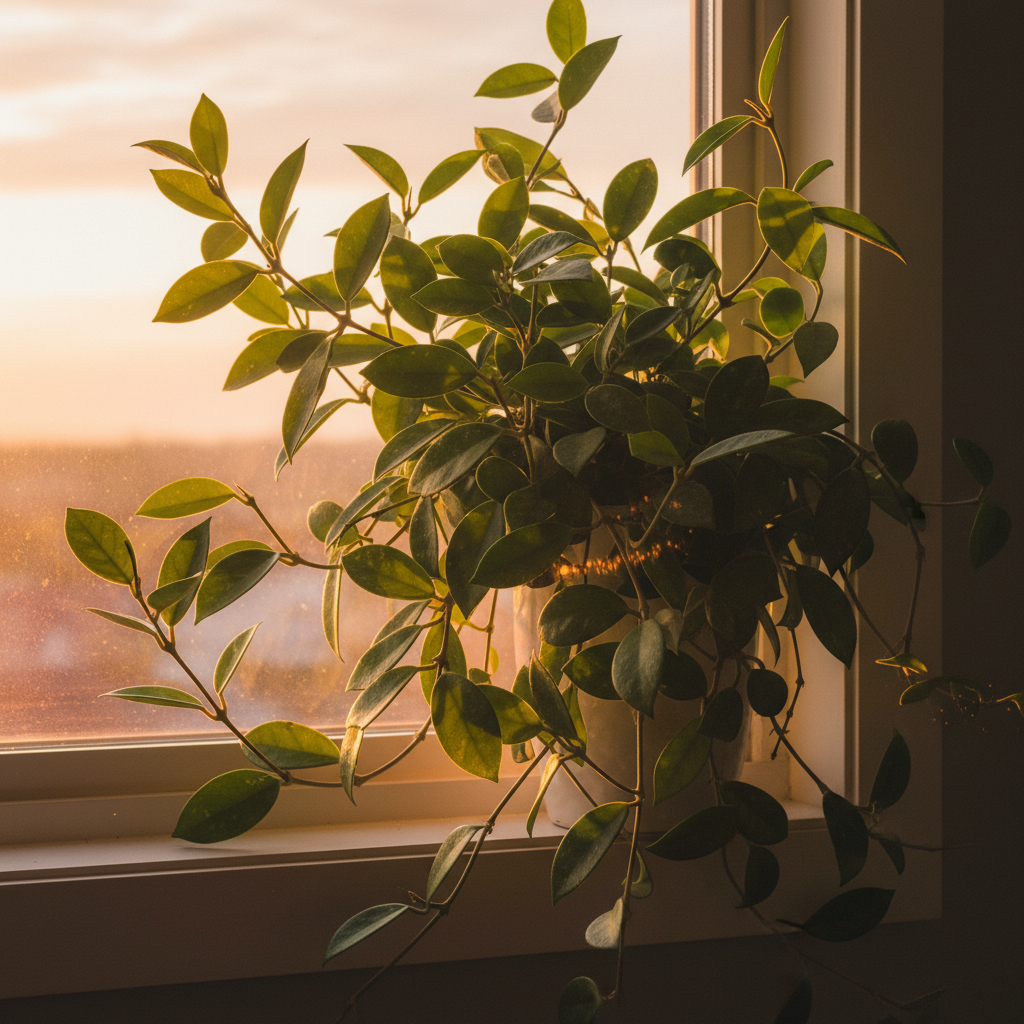
An east-facing window is close to ideal in most homes, offering gentle morning sun followed by bright open shade for the rest of the day. A west-facing window works well too, although the afternoon sun in midsummer can be intense enough to scorch the waxy leaves and bleach the variegated forms to a pale lemon. In that case, a light sheer curtain or a position set back half a metre (a couple of feet) from the glass usually solves the problem. South-facing windows are excellent in winter and require diffusion in summer. North-facing windows are tolerable for a plain green wax plant, but variegated cultivars often refuse to flower in such weak light and may revert to all-green growth over time.
The leaves give clear feedback about whether the light level is right. Healthy growth on a well-lit wax plant has firm, dark green leaves with a faint silver fleck, held on tight internodes. New growth that emerges large but pale, with long stretched gaps between each pair of leaves, almost always signals not enough light. Leaves that look pinched, yellow or sunburnt-bronze on the upper surface, especially on a stem pressed right against a south- or west-facing pane in summer, mean the plant has had too much direct sun and should be moved slightly back. Variegated forms in particular should be watched in midsummer, because the cream and pink areas of the leaf have less chlorophyll and burn more readily than the green sections.
Pro Tip — Stop moving the plant once it sets buds: Once a hoya forms a flower bud, do not rotate the pot or shift the plant to a different window. Even a small change in light angle can cause developing buds to be aborted before they open. Wait until the cluster has bloomed and dropped before reaching for the pot.
If your home simply lacks a bright enough window, a full-spectrum LED grow light placed 30 to 45 centimetres (12 to 18 inches) above the plant and run for 10 to 12 hours a day is a reliable substitute. Hoyas respond well to supplementary lighting and will flower under grow lights provided the daily light total is high enough, which is rarely the case under a single low-wattage bulb.
Watering and Humidity
The wax plant treats its leaves as small water tanks. Each leaf is a thick semi-succulent slab packed with moisture, and the plant will draw on those reserves before it ever shows visible distress at the root. This means that the most common cause of decline in Hoya carnosa is not, as new owners often assume, drought, but the opposite: roots sitting in soggy mix for days after each watering, suffocating quietly until the lower stems collapse. The whole watering routine for a hoya can be summed up in one rule: wait until at least the top half of the pot is dry, then water thoroughly until water runs from the drainage holes, and never leave the pot standing in a saucer of water.
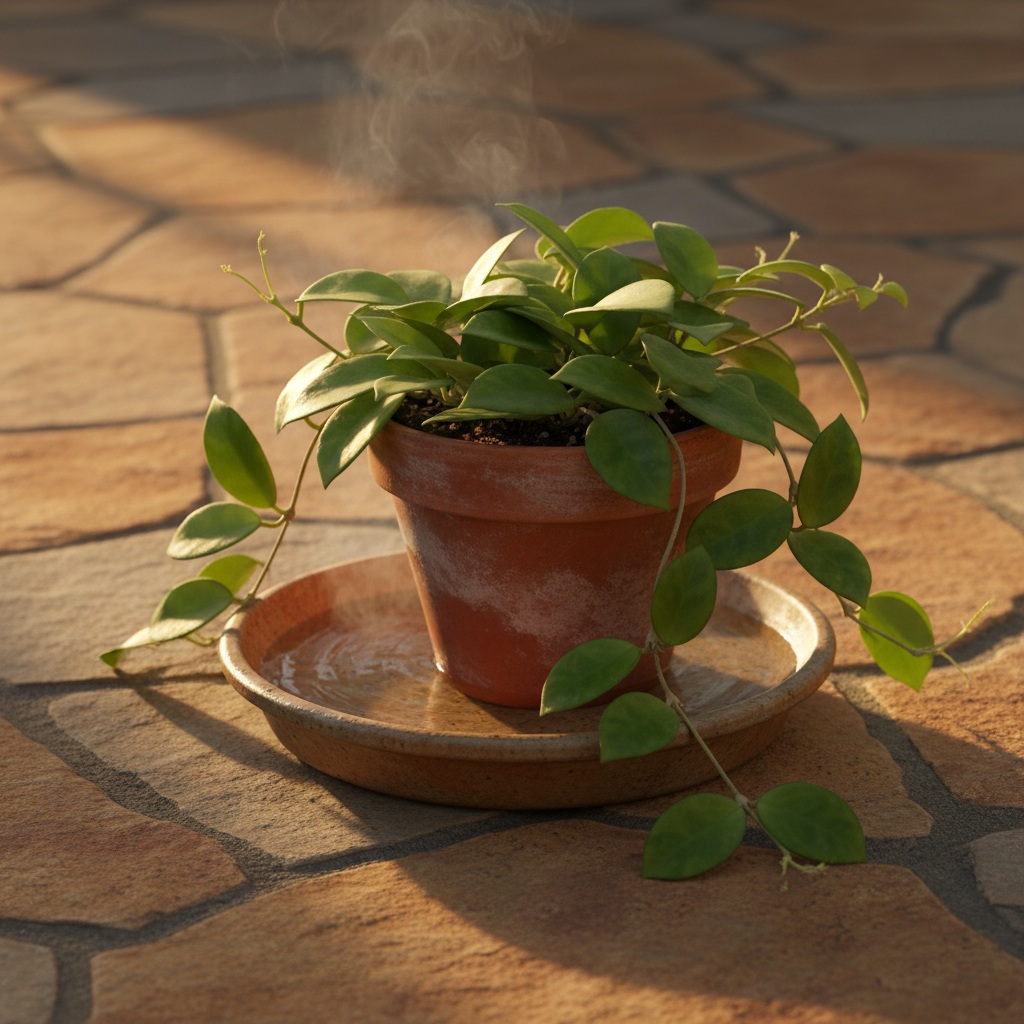
In practice, for a hoya in a 13-centimetre (5 inch) pot of chunky mix on a bright windowsill, this usually means watering once every 10 to 14 days in spring and summer, stretching to every three or four weeks through autumn and winter when growth slows. A wooden chopstick or a moisture meter pushed two thirds of the way into the pot is a more reliable test than guessing by the look of the surface, which dries out much faster than the core. If the probe comes out with a clean coating of dust, water; if it comes out with damp soil clinging to it, wait. Once a plant is established and the rhythm is familiar, most people can dispense with the probe and judge by the weight of the pot when lifted.
The signs of overwatering are unfortunately delayed. A hoya that has been watered too often will look fine for weeks, then suddenly drop several lower leaves at once, often still plump and waxy, with blackened stem at the point of attachment. By the time the symptoms appear, the root system is already compromised. The signs of underwatering are gentler and easier to reverse: the leaves wrinkle slightly, lose a touch of their firmness, and droop. A thorough soak restores them within a day or two.
Warning — Tap water and the wax cuticle: Hard tap water in regions with heavy mineral content can leave white deposits on the waxy leaves over time, and chlorinated water can stress sensitive hoyas. Letting tap water stand uncovered for 24 hours allows chlorine to dissipate, and an occasional wipe of the leaves with a damp soft cloth removes mineral build-up.
Humidity matters less to a hoya than to most tropical houseplants, because the same waxy cuticle that protects the leaves from drying also reduces their need for ambient moisture. A wax plant is comfortable at the 40 to 50 per cent humidity typical of a centrally heated home in winter, and it does not need to be misted, grouped with a humidifier or placed on a pebble tray to stay healthy. That said, raising humidity to 60 per cent or above, particularly during late spring and early summer when flower buds are forming, does encourage more reliable blooming and slightly larger clusters. In a dry climate, a small humidifier running for a few hours a day in the same room is usually enough; constant misting tends to mark the leaves and is not recommended.
Temperature requirements are straightforward. The plant is happiest between 18 and 27 degrees Celsius (65 to 80 Fahrenheit) and will grow slowly but steadily at the cooler end of that range. It tolerates short dips to about 10 degrees Celsius (50 Fahrenheit) without damage, but anything below that risks chilling injury, which shows up later as soft black patches on the leaves. A short cool spell in autumn, with night-time temperatures around 13 to 15 degrees Celsius (55 to 60 Fahrenheit) and slightly reduced watering, often acts as a flowering trigger the following spring.
Soil, Potting and Repotting
A hoya’s roots are fine and shallow and used to clinging to the bark of trees, which means that any soil thick enough to hold its shape in your hand after a squeeze is already too dense. The right substrate behaves more like a coarse mulch than a soil: water should rush through it within seconds, leaving the roots damp but not saturated, and air should still reach the deepest part of the pot. A standard bag of houseplant compost on its own will not do, and is the most common cause of slow decline in otherwise healthy specimens.
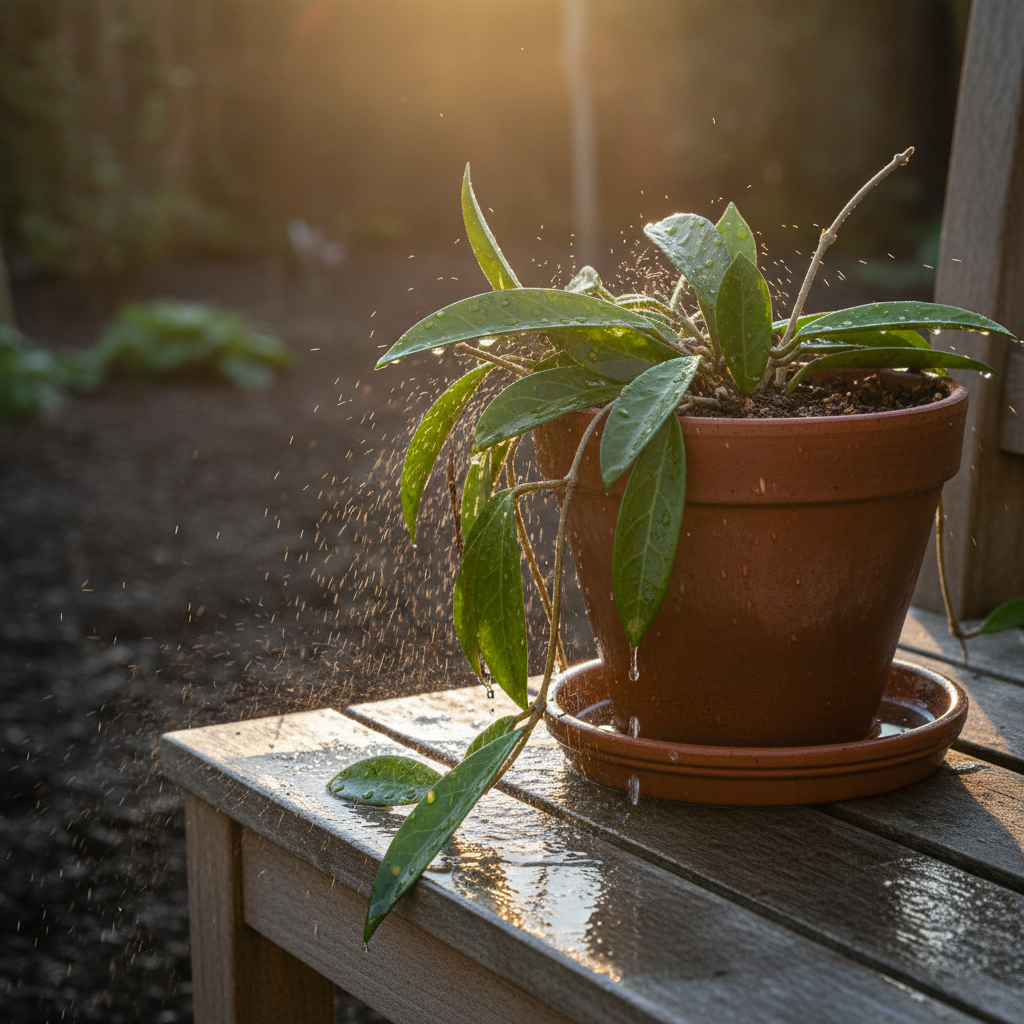
A reliable mix is roughly 40 per cent fine orchid bark, 30 per cent perlite or pumice, 20 per cent coco coir or peat-free houseplant compost, and 10 per cent worm castings or composted bark fines. The exact proportions are forgiving; what matters is that perlite or pumice and chunky bark together make up about two thirds of the volume, so that air pockets remain even when the mix is wet. Some growers add a handful of activated charcoal to help keep the mix sweet between waterings, which is worth doing in a humid bathroom or a sunroom where airflow is limited.
Container choice is just as important as the mix. Terracotta is the traditional and arguably the best option because its porous walls allow moisture to evaporate from the sides of the rootball, which lowers the risk of rot and pulls the plant closer to the natural wet-and-dry cycle it prefers. Plastic and glazed ceramic are perfectly serviceable provided the watering schedule is adjusted to account for slower drying. Whatever the material, the pot must have drainage holes. Decorative cachepots without holes can be used as outer sleeves only, and any water that collects in them after a soak should be tipped out within 30 minutes.
Pro Tip — Keep the pot small: Wax plants flower best when slightly rootbound. Resist the temptation to step up two pot sizes at once. Move only to the next size up, about 2 to 3 centimetres (1 inch) wider in diameter, and only when roots are visibly circling the inside of the pot or growing out of the drainage holes. Many mature flowering specimens stay in the same 15-centimetre (6 inch) pot for five years or longer.
Repotting itself is best done in late spring, just as the plant is waking up but before any flower buds have formed. Slide the rootball out, tease away the loose old mix from the outer surface but do not strip the roots, settle it into the new pot with fresh chunky mix tucked around the sides, and water in well. Newly repotted hoyas often pause growth for a few weeks while they re-establish; this is normal and not a sign of trouble.
Fertilising
Hoya carnosa is not a heavy feeder, and overfeeding is more dangerous than underfeeding. The fine epiphytic roots are sensitive to salt build-up, and a routine of strong monthly fertiliser typically ends with crispy leaf tips and a refusal to flower. A gentler programme of weak, regular feeding produces noticeably better growth and far more reliable blooming.
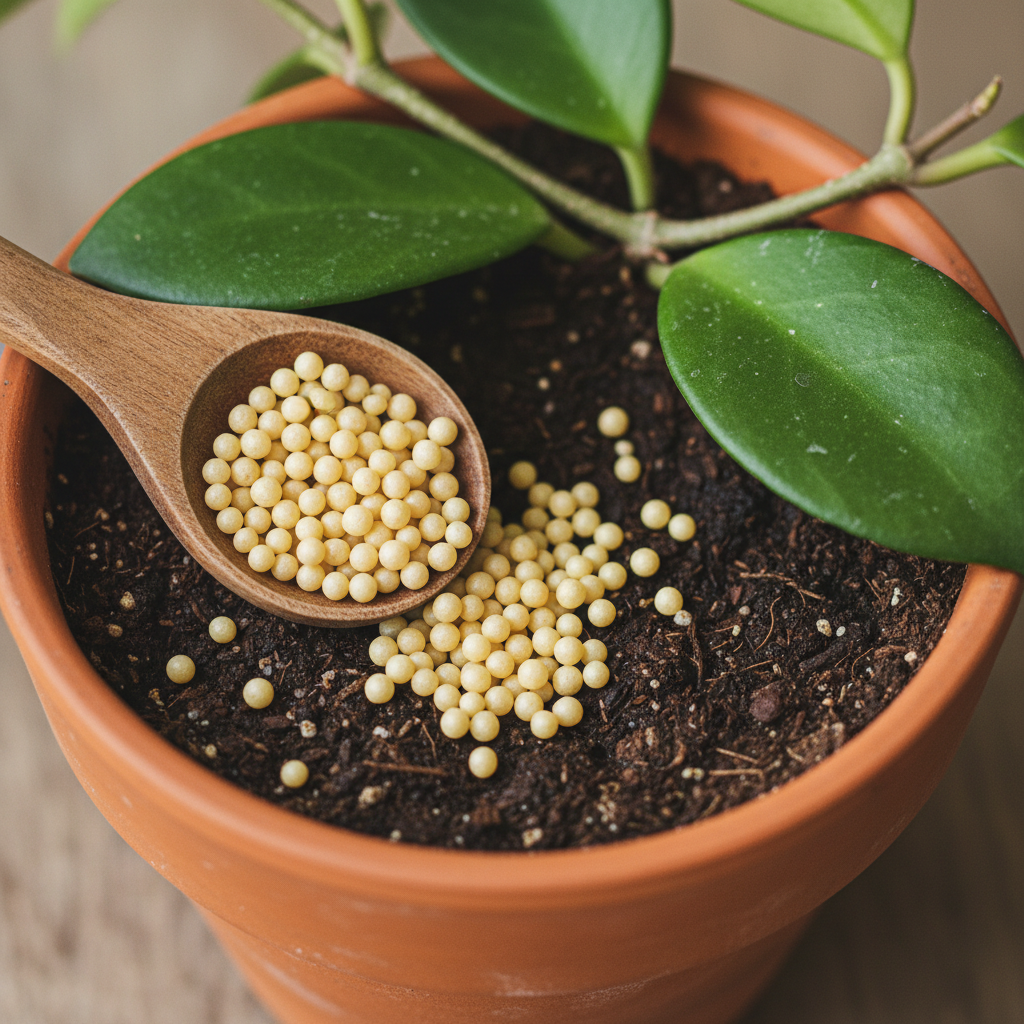
Through the active growing season, from early spring to the end of summer, a balanced liquid feed diluted to one quarter or one half of the dose recommended on the bottle and applied every three to four weeks is sufficient. Through autumn and winter, when growth slows, fertilising should stop entirely. A formulation with an NPK ratio around 3-1-2 or 7-3-7 works well for leafy growth in spring; for plants that are large enough to flower, switching to a higher-phosphorus bloom booster around 5-10-5 from late spring onwards encourages bud formation. Slow-release prills are a workable alternative for growers who prefer not to remember a feeding schedule, but they should be used at a lower rate than the packet suggests because the rest of the year has no rinsing rainfall to flush them through.
Flushing the pot with plain water every two to three months prevents salt build-up. To flush, run water through the mix slowly for about five minutes, letting it drain freely, then allow the plant to dry out as normal before the next watering. Plants that have been on fertiliser for many seasons without a flush often show the symptom most associated with overfeeding: a sudden refusal to bloom despite otherwise perfect conditions.
Organic top dressings, such as a thin scatter of worm castings worked into the surface of the mix once a year, are a good gentler alternative to bottled fertiliser. They release nutrients slowly, support beneficial microbes in the substrate and pose almost no risk of overfeeding. A teaspoon for a small pot and a tablespoon for a larger one, refreshed every spring, covers the plant’s needs for the season.
Propagation
Few houseplants are as obliging to propagate as Hoya carnosa. Almost any healthy section of stem with at least one node will root, given moisture and warmth, and a successful cutting carries the same genetic stock as its parent, so a variegated mother yields a variegated baby. The most common methods are stem cuttings rooted in water or sphagnum moss, and, for long mature vines, air layering on the parent plant itself.
Stem Cuttings, Step by Step
- Choose a healthy length of vine with two or three pairs of mature leaves and at least two visible nodes. Avoid the very tip of the plant, which is too soft, and avoid old woody stem without leaves.
- Cut about 1 centimetre (half an inch) below a node using sterilised secateurs or a sharp craft knife. Strip the lower one or two leaves so that at least one bare node is exposed; this is where the new roots will emerge.
- Allow the cut end to dry and form a callus for two to four hours on a paper towel. This step reduces the risk of stem rot.
- Insert the cutting into a small jar of room-temperature water with the bare node submerged but the remaining leaves clear of the water, or into a small clear cup of damp sphagnum moss with the node tucked just below the surface.
- Place the jar or cup in bright indirect light at room temperature, ideally between 21 and 24 degrees Celsius (70 to 75 Fahrenheit). Change the water once a week to keep it fresh, or mist the moss when it begins to feel dry to the touch.
- White roots usually appear within three to six weeks. Once the longest root is around 3 centimetres (1 inch) long, pot the cutting into the standard chunky hoya mix and water in gently. Keep the new plant in slightly higher humidity for two to three weeks while it transitions from water roots to soil roots.
Air Layering
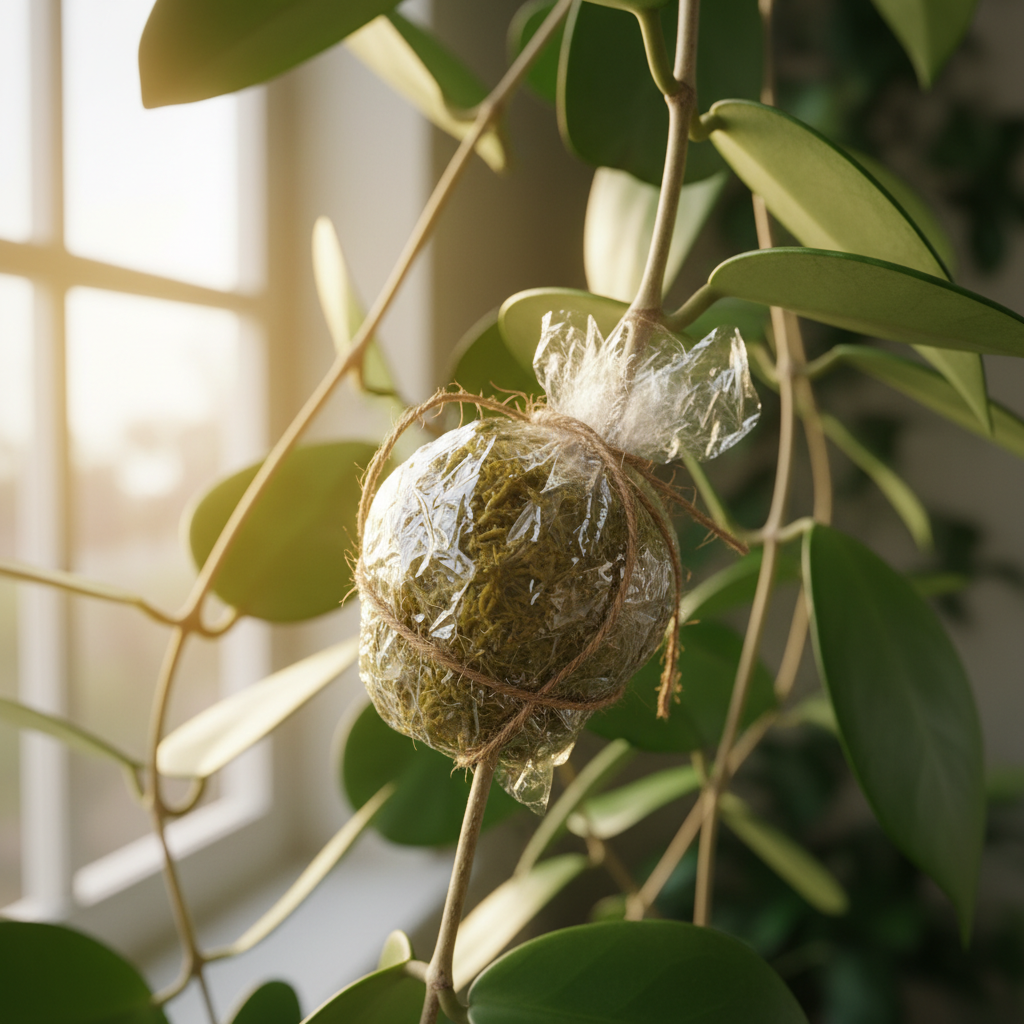
For a mature plant with long woody vines, air layering produces an established new plant without putting any single cutting at risk. Choose a stem with a clear visible node, scratch a very shallow wound across the bark just below the node with a clean blade, wrap a generous handful of damp sphagnum moss around the area, and seal it inside a small parcel of clear plastic film tied at both ends with natural twine. Keep the moss damp by misting through a small slit every few days. Within four to eight weeks, new roots will fill the moss, at which point the stem can be cut just below the parcel and potted up as a fully formed new plant.
Pro Tip — Cuttings without nodes will not root: Hoya leaves alone, no matter how lovingly nestled in soil, will not produce a new plant. The often-seen single leaf of a Hoya kerrii “in a heart-shaped pot” never grows beyond that leaf because it was taken without a node. Always include at least one node on a wax plant cutting.
Pests and Diseases
Hoyas are not particularly attractive to pests, but a handful of regulars do appear when conditions allow. The most common by some margin is mealybug, which loves the warm, sheltered crannies where leaves meet stem and where peduncles join the vine. The first sign is usually a small cluster of white cottony fluff in a leaf axil or under the lip of a flower spur, soon followed by sticky honeydew on the leaves below and occasionally a thin layer of black sooty mould on top of it.
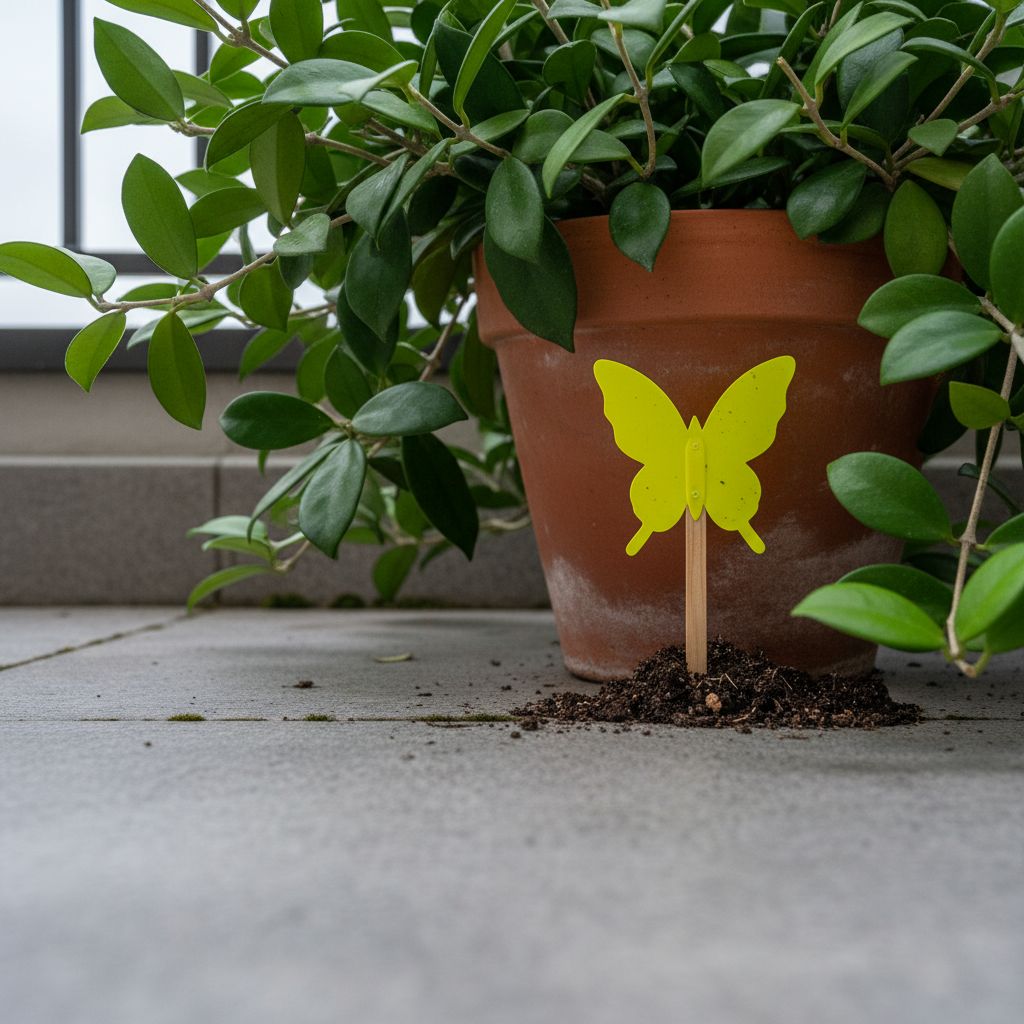
Mealybug is controlled by dabbing each visible insect with a cotton bud dipped in 70 per cent isopropyl alcohol, which breaks down the waxy coating and kills the bug on contact. For a heavier infestation, a thorough spray with a neem oil solution applied late in the day, when direct sun is off the plant, smothers the population and disrupts the next generation. The treatment usually needs to be repeated every seven to ten days for three to four cycles, because newly hatched crawlers are invisible to the eye. A yellow sticky trap pushed into the soil catches winged adults and also signals the arrival of fungus gnats, the only other common nuisance.
Aphids occasionally appear on developing flower buds in spring; they are easily knocked off with a strong jet of water at the kitchen sink and rarely persist indoors. Scale insects, which look like flat brown bumps on stems and leaf undersides, respond to the same alcohol-and-cotton-bud treatment as mealybug. Spider mites are uncommon on hoyas because the thick waxy cuticle is harder for them to pierce than the thin leaves of more vulnerable hosts, but they can appear in very hot, dry conditions; raising humidity and a thorough wash usually resolves the problem before it spreads.
Diseases are rarer still and almost always traceable to overwatering. Root rot, signalled by sudden leaf drop from the base of the plant, by soft blackened stem at soil level or by a sour smell from the pot, is treated by tipping the plant out, trimming away all soft black roots and tissue with sterile scissors, allowing the cut surfaces to dry for a day, and repotting into fresh dry chunky mix in a slightly smaller pot. Hold off watering for a week to let new roots form, then resume a sparing schedule. A fungal leaf spot can occur in poorly ventilated bathrooms; improving airflow and avoiding misting usually clears it.
Warning — Quarantine new arrivals: Most hoya pest problems hitch a ride into the home on a newly bought plant. Keep any new wax plant isolated for two to three weeks, inspect the leaf undersides and axils with a magnifying glass twice in that period, and only group it with your other plants once you are confident it is clean.
Popular Varieties
Hoya carnosa has been in cultivation for more than 200 years and is now sold in dozens of named cultivars that vary mostly in leaf colour and variegation pattern. The two most widely available, and most often confused, are Hoya carnosa ‘Krimson Queen’ and ‘Krimson Princess’, which are essentially mirror images of one another. Both grow at the same rate as the plain green species, both produce identical flower clusters, and both ask for exactly the same care.
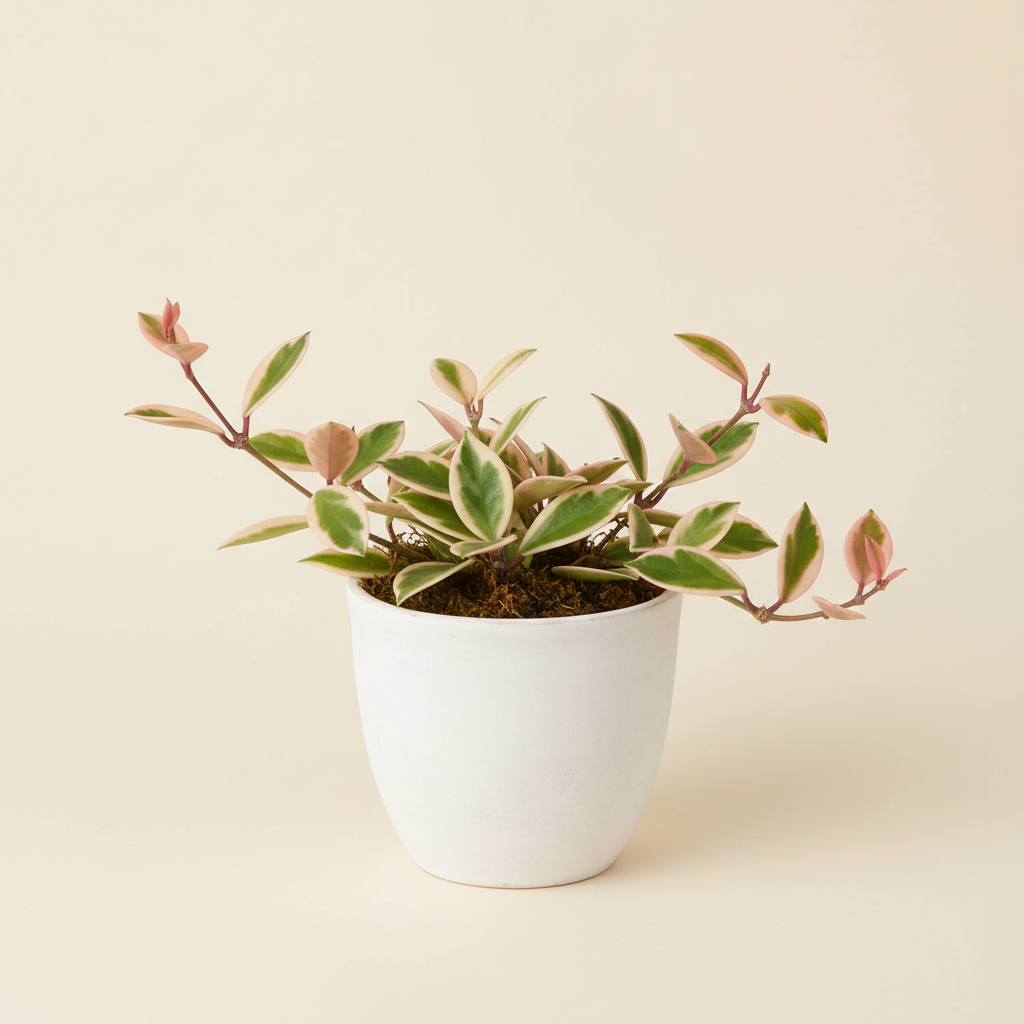
‘Krimson Queen’ (sometimes sold as ‘Tricolor’) has dark green leaf centres surrounded by broad cream and pink margins. New growth emerges flushed bright pink, fading to cream as it matures. It is one of the more reliable variegated hoyas and tolerates a slightly wider light range than other variegated forms, although it still asks for brighter conditions than the plain green species. Expect roughly 20 per cent slower growth in exchange for the leaf colour.
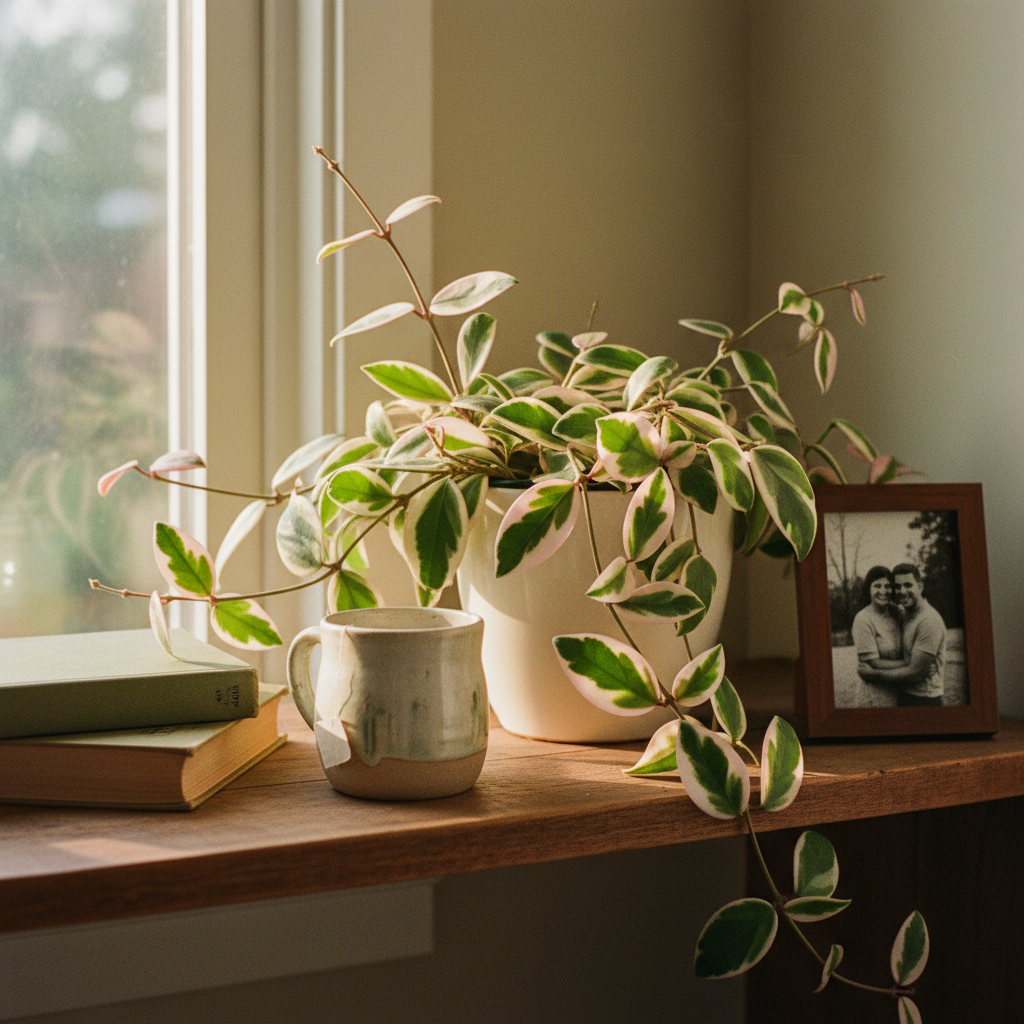
‘Krimson Princess’ (sometimes sold as ‘Rubra’) is the inverse: green margins frame a creamy pink centre, and individual leaves can be almost entirely cream when the variegation is strong. Because the variegation sits in the middle of the leaf rather than on the outside, ‘Krimson Princess’ is a touch more sensitive to scorch in direct afternoon sun and slightly slower to flower than ‘Krimson Queen’. Position it where it gets bright indirect light most of the day with only a short window of gentle direct sun.
Beyond these two, the plain species itself is sometimes called Hoya carnosa ‘Green’ to distinguish it on a label. The cultivar ‘Variegata’ (sometimes ‘Albomarginata’) sits between Queen and Princess in pattern, with creamy white margins and no pink flush. ‘Chelsea’ has slightly larger leaves with a deep dimpled surface, while ‘Compacta’, better known as the Hindu rope plant, twists its leaves into a tight cluster along the stem and is treated as a separate plant in many collections because of how distinctive it looks. Recent cultivars such as ‘Grey Ghost’, ‘Stardust’ and ‘Argentea Picta’ add silvery splash patterns to the basic green leaf and are increasingly easy to find. All of them flower in essentially the same way and respond to the same care.
Frequently Asked Questions
Why won’t my Hoya carnosa flower?
Three causes account for almost all cases. The most common is insufficient light: a wax plant in a north-facing room or set back from a bright window will keep producing leaves but never accumulate the energy to bloom. The second is age and maturity: a young plant under three years old is usually not yet ready. The third is well-meant interference: cutting off the old bare peduncles from previous years, which look like dry stubs, removes the very spurs that would have reflowered. Move the plant to a brighter spot, leave every peduncle untouched, and accept that the first bloom on a young plant may still be a year or two away.
Is Hoya carnosa toxic to cats and dogs?
No. Hoya carnosa is listed as non-toxic to cats, dogs and humans by major reference databases, which makes it one of the better choices for a household with curious pets. The sap is mildly milky and may cause minor skin irritation in sensitive people if handled in quantity, and ingestion of large amounts of any plant matter can cause stomach upset, but the wax plant carries no specific toxic compounds of concern.
What is the sticky substance on the leaves and floor?
Almost certainly nectar from open flowers, not pest honeydew. Hoya flowers produce generous amounts of sweet sticky nectar that drips from the umbel onto whatever is beneath. The drops are harmless and wipe up with a damp cloth, but they will stain absorbent surfaces if left, so it is worth placing a tray or repositioning the plant while it is in bloom if it hangs above textiles or wood. If sticky residue appears when no flowers are present, check carefully for mealybug or scale.
How fast does Hoya carnosa grow?
Slowly, by the standards of most houseplants. A well-grown plant in bright light will add 30 to 60 centimetres (1 to 2 feet) of vine in a year, with variegated forms growing somewhat slower than the plain green species. Plants in low light may add only a handful of new leaves in a season. The reward for patience is longevity: a healthy hoya can live and bloom for decades, with mature specimens reaching 3 metres (10 feet) or more in length when trained up a trellis or moss pole.
Should I cut off long bare vines without leaves?
Resist the urge. Long bare runners are normal in a hoya and are how the plant explores for new light and new places to climb in the wild. Many of them eventually grow leaves along their length once they touch something solid, and many produce peduncles that go on to flower. Cutting bare vines back tends to encourage the plant to put out yet more bare runners rather than fill in. If the tangle becomes unmanageable, gently train the runners around a small trellis, hoop or moss pole instead of pruning them away.
My Hoya carnosa has yellow leaves at the bottom. What’s wrong?
Occasional yellowing and shedding of the oldest leaves at the base of the plant is normal as the vine matures and is no cause for concern. Yellowing that affects several leaves at once, particularly if the leaves remain plump and waxy, is almost always a sign of overwatering and waterlogged roots. Allow the plant to dry out completely, check that the pot is draining freely, and consider whether the mix has become compacted and needs replacing. Yellowing accompanied by crispy brown tips and dry soil is the simpler opposite problem and resolves with a thorough soak.
Can I grow Hoya carnosa outdoors?
In climates that stay above 10 degrees Celsius (50 Fahrenheit) year-round, broadly USDA zones 10 and 11, a wax plant can grow happily outside in a shaded position on a porch or under a tree canopy. In cooler climates, it can be moved outdoors for the summer once nights are reliably above 13 degrees Celsius (55 Fahrenheit), provided it is placed in deep shade for the first week to acclimatise, then in bright dappled light. Bring it back indoors well before the first cold autumn night, and inspect carefully for hitchhiking insects before it rejoins the houseplant collection.






