
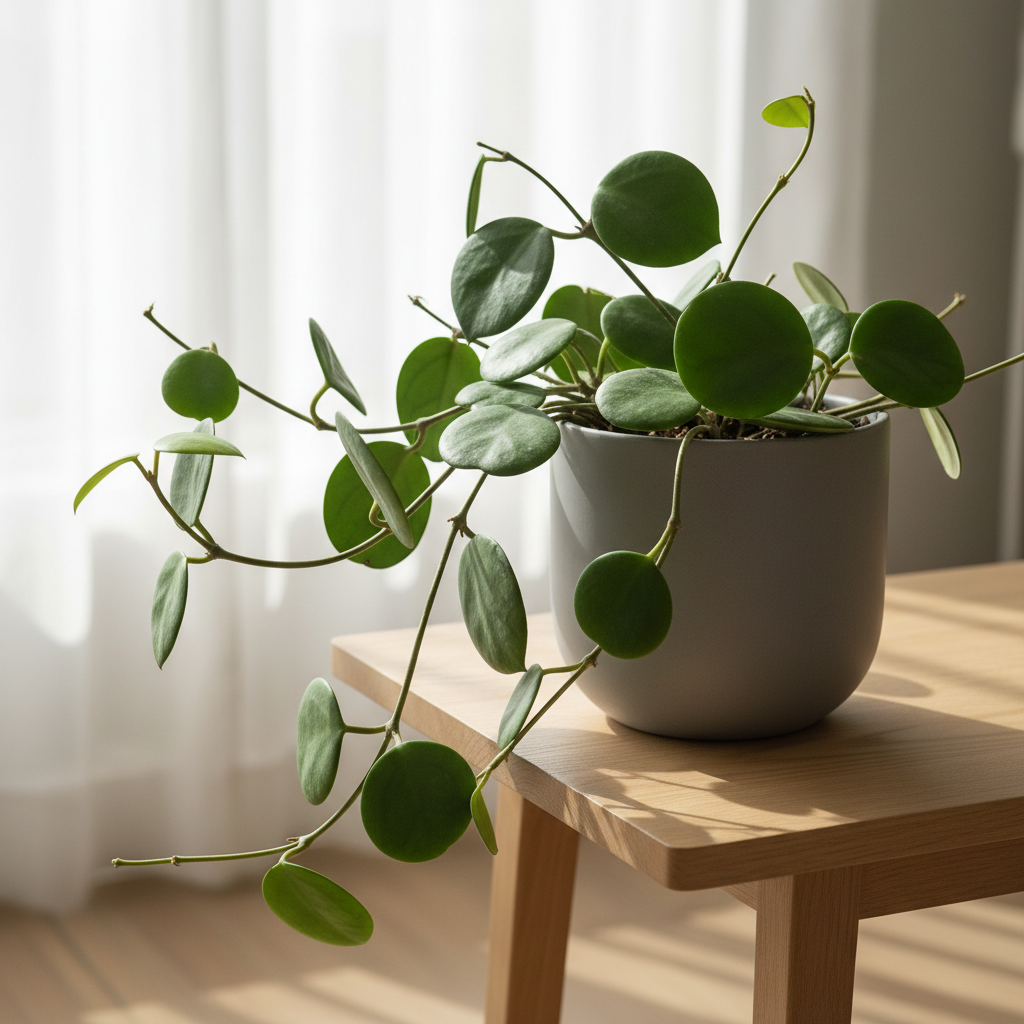
Few houseplants arrive with as much sentiment attached as the heartleaf hoya, a thick-leaved climbing succulent whose foliage is shaped, almost improbably, like a perfect heart. Sold in florists every February as a single potted leaf, Hoya kerrii belongs to the milkweed subfamily within the dogbane family, Apocynaceae, and grows wild across the warm forests of Thailand, Laos, Cambodia, Vietnam, southern China and parts of Indonesia. There it behaves as an epiphytic and semi-climbing vine, hauling itself up tree trunks and scrambling over rock, its waxy leaves storing water against the dry season. The common names follow the shape: sweetheart hoya, sweetheart plant, Valentine hoya and lucky-heart plant.
It has a reputation as one of the most forgiving plants you can own, and that reputation is mostly deserved, with one important caveat that this guide returns to more than once. A heartleaf hoya will survive a great deal of neglect because its succulent leaves carry their own water reserves, but surviving and thriving are two different things. A plant left as a lonely leaf on a windowsill may sit unchanged for years, while a rooted, well-positioned vine will slowly lengthen, thicken and, given enough time and light, produce clusters of intricate star-shaped flowers. This guide covers everything from light and watering to soil, feeding, propagation, pests and the varieties worth seeking out, so you can move your plant from merely alive to genuinely flourishing.
Contents
- Quick Reference
- Why Heartleaf Hoya Makes a Rewarding Houseplant
- Light Requirements
- Watering & Humidity
- Soil, Potting & Repotting
- Fertilising
- Propagation
- Pests & Diseases
- Popular Varieties
- Frequently Asked Questions
Quick Reference: Heartleaf Hoya at a Glance
| Light | Bright, indirect light; tolerates a little gentle morning sun. Variegated forms need more. |
| Watering | Let the soil dry out almost completely, then water thoroughly. Roughly every 2 to 3 weeks in growth, less in winter. |
| Temperature | 18 to 27 degrees Celsius (64 to 81 degrees Fahrenheit). Keep above 10 degrees Celsius (50 degrees Fahrenheit). |
| Humidity | Average household humidity of 40 to 60 per cent is fine; tolerant of dry air. |
| Fertiliser | Dilute balanced feed once a month during spring and summer; none in winter. |
| Toxicity | Considered non-toxic to cats and dogs. The milky sap can irritate sensitive skin. |
Why Heartleaf Hoya Makes a Rewarding Houseplant
The appeal of Hoya kerrii starts with the leaves and only deepens from there. Each one is a thick, firm heart roughly five to six centimetres (two to two and a half inches) across, deep matte green and pleasingly symmetrical, holding enough stored moisture that the plant can shrug off a missed watering or a forgotten fortnight away. That succulence is what makes it so undemanding: it is built for the dry spells of a monsoon climate, so the dry spells of a busy household barely register.
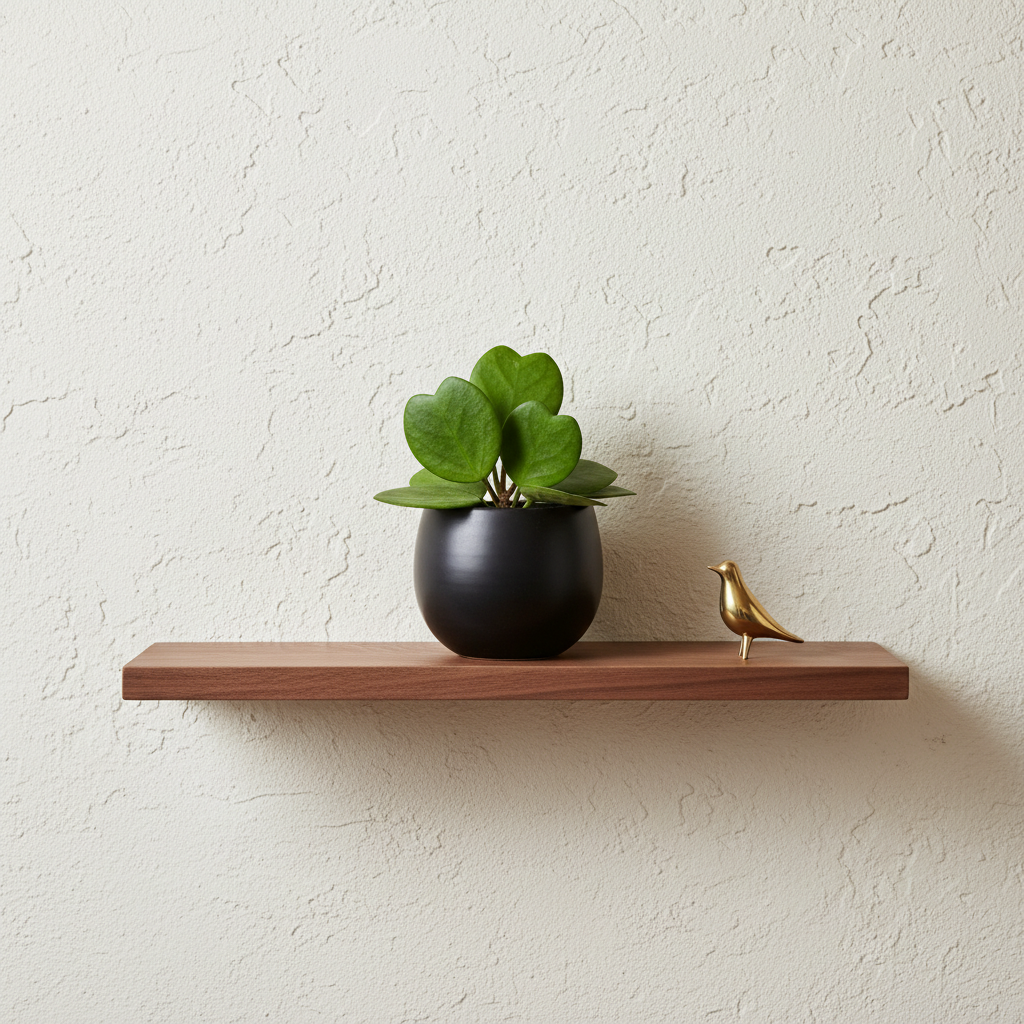
There is also the matter of what the plant becomes. Most people meet the heartleaf hoya as a single leaf wedged upright in a tiny pot, and many never learn that this is only a fragment of the real thing. Given a stem, a node and time, the plant grows into a vining hoya several metres long, clad in those same hearts and eventually crowned with umbels of waxy, star-shaped flowers in pale pink and white with deep red centres, lightly scented and dripping a sweet nectar. Reaching that stage takes patience, because Hoya kerrii is a famously slow grower, but the journey is part of the charm for collectors who measure progress in new leaves rather than new shoots every week.
Important — Toxicity: The heartleaf hoya is widely listed as non-toxic to cats and dogs, which makes it a sensible choice for pet households. The plant does exude a milky latex sap when cut or bruised, and this can irritate sensitive skin or eyes, so wash your hands after taking cuttings and keep the sap away from your face.
Light Requirements
Light is the single biggest lever you have over a heartleaf hoya, because it governs not only growth but whether the plant will ever flower. In the wild it grows in dappled forest light, clinging to trunks where it receives bright but largely filtered sun. Indoors, the goal is to recreate that: plenty of brightness, little or no harsh direct sun on the leaves for most of the day.
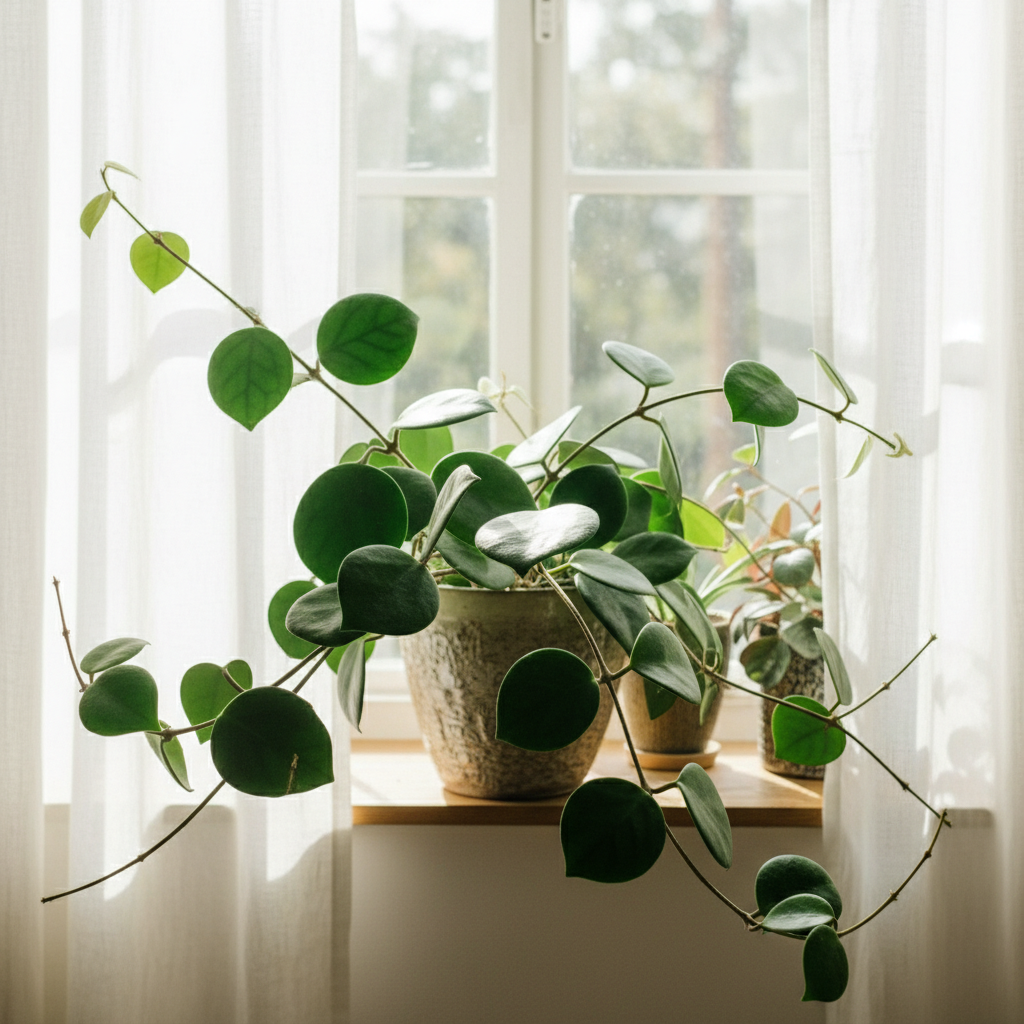
A spot that receives bright indirect light for most of the day is ideal, and a couple of hours of gentle early-morning sun is a bonus rather than a risk. The more light the plant receives, within reason, the more readily it will grow and the better its chances of blooming once mature. Variegated forms in particular need brighter conditions than the plain green plant, because their pale tissue contains less chlorophyll and must work harder to feed the plant.
Light Levels Explained
Indoor light is easy to overestimate, because the human eye adjusts to dim rooms in a way that plants cannot. The table below translates the categories used throughout this guide into rough lux values and the places they tend to occur in a typical home.
| Light Category | Approx. Level | Typical Location | Outcome for Hoya kerrii |
|---|---|---|---|
| Direct sun | Over 50,000 lux | On a south-facing sill, glass uncovered | Risk of scorch in summer; tolerable only in winter or early morning |
| Bright indirect | 10,000 to 20,000 lux | Near an east or south window, slightly back or behind a sheer | Ideal; steady growth and the best chance of flowering |
| Medium | 5,000 to 10,000 lux | A metre or two from a bright window | Survives and grows slowly; flowering unlikely |
| Low | 1,000 to 5,000 lux | North window, or deep in a room | Hangs on but stalls; leggy, pale growth over time |
| Very low | Under 1,000 lux | Interior wall, windowless corner | Slow decline; not suitable long term |
Window Orientation and Placement
South-facing window: The brightest option in the northern hemisphere and a good home for a heartleaf hoya, provided you set it slightly back from the glass or filter the midday sun with a sheer curtain in high summer. Variegated plants are happiest here.
East-facing window: Often the sweet spot. Gentle morning sun followed by bright indirect light for the rest of the day suits the plant perfectly and carries little risk of scorch.
West-facing window: Workable, though the strong afternoon sun can be fierce in summer. Pull the plant back a little or diffuse the light during the hottest months.
North-facing window: Usually too dim for vigorous growth or flowering. The plant will persist but expect it to do little, and consider a grow light if this is your only option.
Pro Tip — Read the Leaves: A heartleaf hoya getting the right light keeps its leaves compact and richly coloured. If new leaves emerge small, widely spaced and pale, and the vine reaches across the room towards the window, it is asking for a brighter position.
How Light Affects Variegation and Flowering
Two things depend almost entirely on light. The first is variegation: the creamy centres and margins of variegated cultivars hold their contrast only in bright conditions, fading towards plain green when light is short. The second is flowering, which a heartleaf hoya will attempt only when it is mature, well established and receiving generous light over a sustained period. A plant in medium or low light may live happily for years and simply never bloom, which is not a fault so much as a missing ingredient.
Warning — Direct Sunlight: Although the leaves are tough, prolonged direct summer sun through glass can bleach or scorch them, leaving permanent pale or brown patches. Introduce a plant to brighter light gradually over a week or two rather than moving it from shade into full sun overnight.
Artificial Lighting
The heartleaf hoya responds well to supplementary lighting, which makes it a candidate for rooms that lack a good window. A full-spectrum LED grow light positioned 30 to 45 centimetres (12 to 18 inches) above the plant and run for 10 to 12 hours a day will sustain healthy growth and can even coax flowering from a mature specimen. This is especially useful for variegated plants through the short days of winter, when natural light alone often cannot hold their colour.
Seasonal Adjustments
Light changes through the year, and the plant’s needs change with it. In summer, pull the plant back from a hot south or west window or add a sheer to soften the midday peak. In winter, do the opposite: move it closer to the glass and clean both the window and the leaves so it captures every available photon. A plant that grew comfortably in a bright spot in July may be quietly starving in the same spot in January.
Watering & Humidity
If light is the lever for growth, watering is the lever for survival, and with a heartleaf hoya the danger lies almost entirely in doing too much. Those plump leaves are water-storage organs, and the roots are adapted to the brief, intense soakings of a monsoon followed by long dry periods. Treat the plant as a succulent rather than a thirsty tropical and you will rarely go wrong.
When to Water
Wait until the soil has dried out almost completely before watering again. In practice that often means watering roughly every two to three weeks during the warm growing months, stretching to once a month or less in winter, but you should always check rather than count days. Push a finger into the soil to the second knuckle, lift the pot to feel its weight, or use a wooden skewer that comes out clean and dry. Only when the substrate is dry well below the surface should you water.
A second, more reliable signal lives in the leaves themselves. A well-watered heartleaf hoya has firm, taut foliage. When the leaves begin to feel slightly soft or look faintly puckered, the plant has drawn down its reserves and is genuinely ready for a drink. This leaf cue is far more trustworthy than any schedule, and it is one of the reasons the plant is so hard to kill through under-watering.
Pro Tip — When in Doubt, Wait: A thirsty heartleaf hoya recovers within hours of watering, but a waterlogged one may be quietly rotting at the roots before you see any sign above the soil. If you cannot decide whether to water, leave it another few days.
How to Water Correctly
- Confirm the soil is dry well below the surface and the leaves feel ready, not still firm and full.
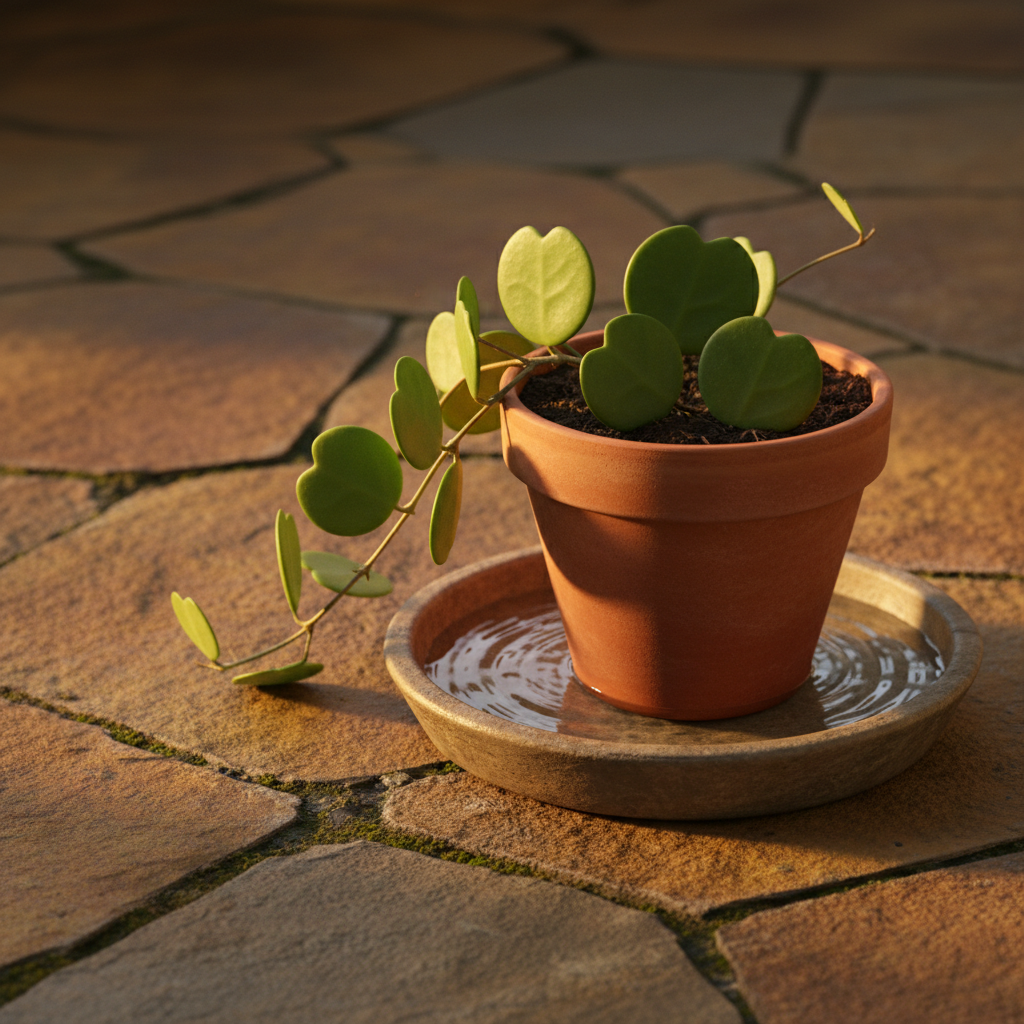
- Water thoroughly with room-temperature water, either over the soil until it runs freely from the drainage holes, or by standing the pot in a tray of water for 15 to 20 minutes.
- Let every drop drain away completely. Never leave the pot sitting in collected water.
- Empty the saucer or cachepot once draining has finished.
- Return the plant to its spot and do not water again until the soil has dried out once more.
Signs of Overwatering vs. Underwatering
| Symptom | Overwatering | Underwatering |
|---|---|---|
| Leaf colour | Yellowing, often several leaves at once | Slight dulling, occasional yellowing of the oldest leaf |
| Leaf texture | Soft, mushy, sometimes translucent | Wrinkled, puckered but still firm |
| Soil | Stays wet for a long time, may smell sour | Bone dry, pulling away from the pot edge |
| Roots | Brown, soft, foul smelling | Pale and intact, perhaps a little dry |
| Stem base | Blackened or collapsing | Firm |
Warning — Root Rot: Root rot is the leading cause of death in heartleaf hoyas. If you find soft, blackened roots, unpot the plant immediately, cut away all the affected tissue with clean scissors, let the cuts callous for a day, and repot into fresh, very free-draining mix. Hold off watering until new growth shows the plant has recovered.
Humidity Requirements
Unlike many trendy tropicals, the heartleaf hoya is relaxed about humidity. Ordinary household levels of 40 to 60 per cent suit it well, and its waxy, succulent leaves lose moisture slowly, so it copes with the dry air of a centrally heated room far better than a fern or a calathea ever could.
That said, the plant will not object to a little extra moisture in the air, and slightly higher humidity can encourage faster growth and help mature plants set flowers. There is rarely any need to chase humidity for this species, and you should be wary of doing so in ways that wet the foliage, which brings risks of its own.
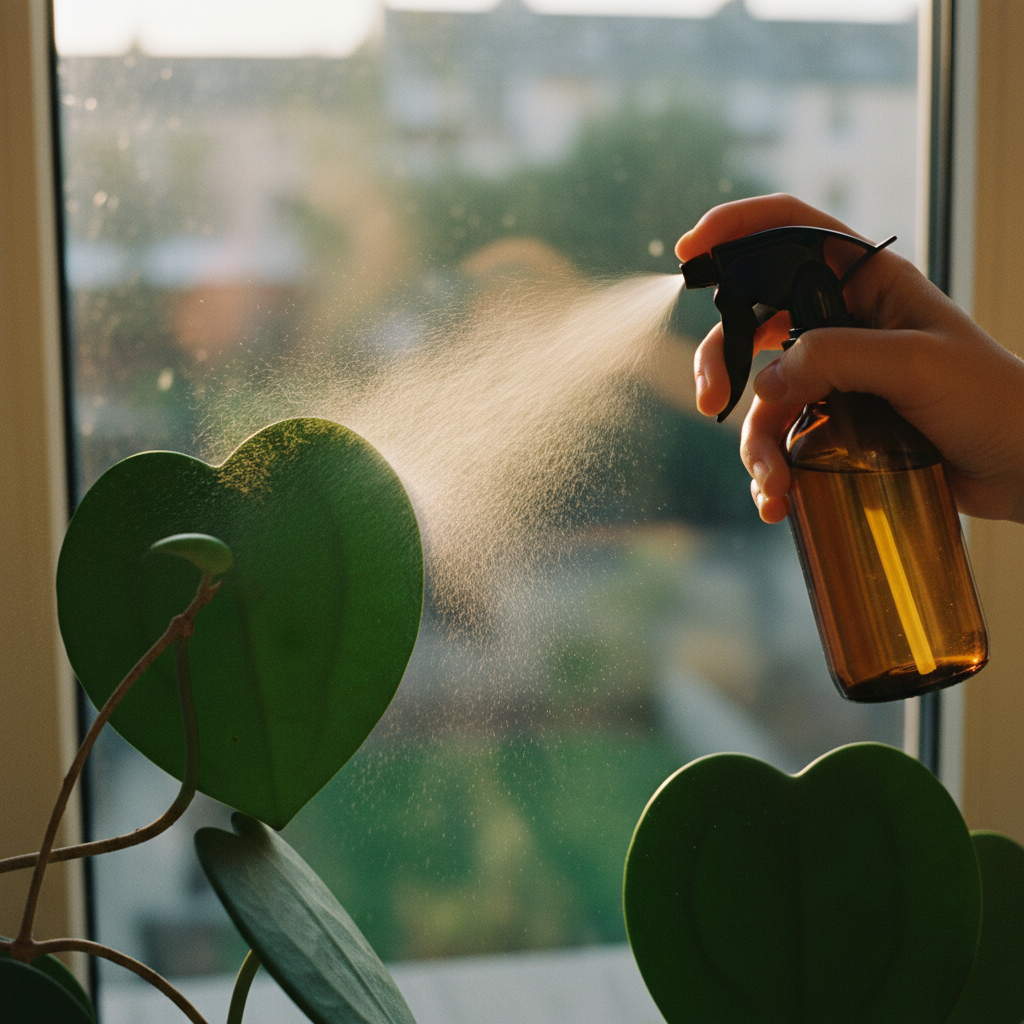
If your home is exceptionally dry, grouping plants together or standing the pot on a tray of damp pebbles raises local humidity gently and safely. Misting is best avoided: water pooling in the leaf axils and on the dense foliage can encourage rot and fungal spotting without delivering much lasting benefit.
Water Quality
The heartleaf hoya is not especially fussy about water, but because it is watered infrequently, any minerals in tap water concentrate slowly in the soil over time. If your water is very hard or heavily chlorinated, rainwater or filtered water is a kind choice. At minimum, let tap water stand for a few hours before using it so the chlorine dissipates and the temperature settles to room level, since cold water straight from the tap can shock the roots.
Soil, Potting & Repotting
Because the heartleaf hoya is part epiphyte and part succulent, its roots want air as much as water. The single most useful thing you can do for the plant is to give it a loose, chunky, fast-draining medium that never stays soggy. Ordinary bagged houseplant compost, used alone, holds far too much water for this species and is a common first step towards root rot.
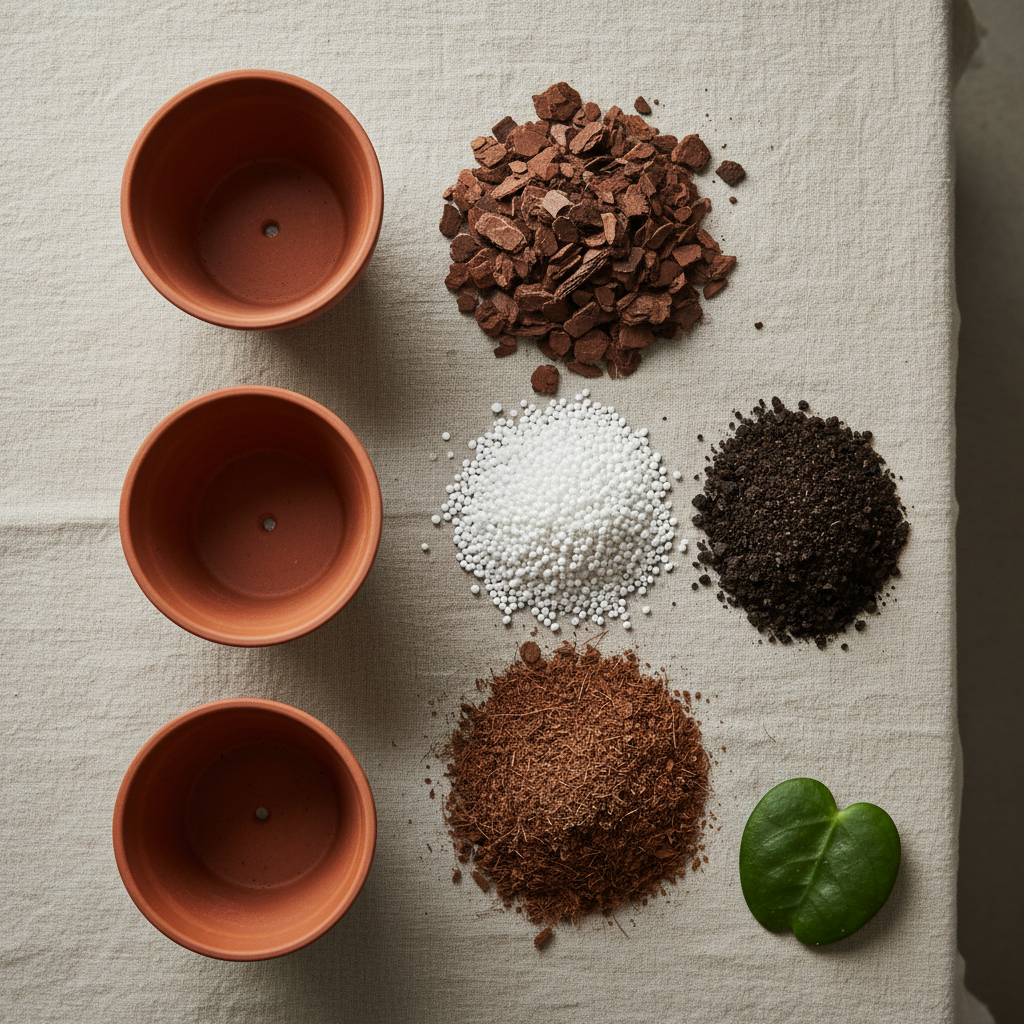
Ideal Soil Composition
Aim for a mix that drains within seconds of watering and still holds a little moisture in its finer particles. A blend built around bark and perlite, loosely bound with coir and a small amount of compost or worm castings for nutrition, gives the open structure these roots crave. The proportions below are a reliable starting point that you can lean drier still if your home runs cool or humid.
| Component | Proportion | Function |
|---|---|---|
| Orchid bark (fine to medium) | One third | Creates air pockets and mimics the epiphytic perch |
| Perlite or pumice | One third | Sharpens drainage and stops compaction |
| Coco coir or peat-free compost | One quarter | Holds light moisture and a little structure |
| Worm castings or compost | A small handful | Provides gentle, slow nutrition |
The plant prefers a slightly acidic to neutral substrate, broadly in the range of pH 6.1 to 7.5, which most bark-based mixes fall into naturally. There is no need to test or adjust pH for a healthy heartleaf hoya; getting the drainage right matters far more.
Pro Tip — Quick Mix Recipe: No bark to hand? Combine two parts of a good cactus and succulent compost with one part perlite for a serviceable heartleaf hoya mix. It is not as airy as a true epiphyte blend, but it drains far better than houseplant compost on its own.
Choosing the Right Pot
Pot choice works hand in hand with soil to control how wet the roots stay, and with a plant this prone to rot it deserves real thought rather than whatever cachepot looks nicest.
Drainage holes are non-negotiable. The heartleaf hoya must never sit in standing water, so the growing pot needs one or more drainage holes. If you love a decorative pot without holes, use it as a cover and keep the plant in a plain plastic nursery pot that you lift out to water.
Pot material: Terracotta is an excellent match because its porous walls wick moisture out of the soil and let it dry more evenly, which suits a plant that hates wet feet. Plastic and glazed ceramic hold moisture longer, which can work well in a very bright, warm room but raises the risk of overwatering elsewhere.
Pot size: Choose a snug pot rather than a generous one. A large volume of soil around a small root system stays wet for too long, so the heartleaf hoya is happiest slightly pot-bound and is one of the few plants that genuinely seems to flower more readily when its roots are a little restricted.
When to Repot
This is a slow grower that resents disturbance, so repot only every two to three years, or when roots are clearly circling the pot and emerging from the drainage holes. Spring, at the start of the growing season, is the best time. Because the plant likes tight quarters, move it up only one pot size when you do, and resist the urge to give it room to grow into.
How to Repot: Step-by-Step
- Water lightly a day or two beforehand so the root ball holds together, then ease the plant out by tipping the pot rather than pulling the stems.
- Gently tease away loose old soil and inspect the roots, trimming any that are brown, soft or smell sour.
- Add a layer of fresh, chunky mix to the base of a pot only one size larger.
- Position the plant at the same depth it grew before and fill around the roots with mix, firming lightly to remove large air gaps without compacting.
- Wait a few days before watering, which lets any nicked roots callous over and reduces the chance of rot.
- Return the plant to its usual spot and resume normal care once it has settled.
Warning — Transplant Shock: Expect a freshly repotted heartleaf hoya to pause, sometimes for weeks. This is normal. Do not respond by watering or feeding more, which only stresses recovering roots. Steady light and patience are all it needs.
Fertilising
Fertiliser is not plant food in the way the label often implies; it is a supplement of mineral nutrients that supports the food a plant makes for itself through photosynthesis. For a slow, frugal grower like the heartleaf hoya, this means feeding is helpful but easily overdone, and a light hand always beats a heavy one.
A plant in a fresh, compost-enriched mix needs little feeding in its first few months. As the season progresses and those initial nutrients are used up, a regular weak feed during active growth keeps the leaves firm and well coloured and gives a mature plant the resources to flower.
Understanding Plant Nutrients
Fertiliser labels carry three numbers, the N-P-K ratio, showing the proportion of nitrogen, phosphorus and potassium. Nitrogen drives leafy growth, phosphorus supports roots and flowers, and potassium underpins general health and blooming. A balanced feed serves the heartleaf hoya well most of the time, though some growers switch to a higher-potassium formula to encourage a mature plant into flower.
| Nutrient | Symbol | Primary Function | Deficiency Symptoms |
|---|---|---|---|
| Nitrogen | N | Leaf and stem growth | Pale, slow, undersized new leaves |
| Phosphorus | P | Roots and flower formation | Weak rooting, reluctance to bloom |
| Potassium | K | Overall vigour and flowering | Yellowing or browning leaf edges |
| Magnesium | Mg | Chlorophyll production | Yellowing between the veins of older leaves |
| Iron | Fe | Chlorophyll in new growth | Yellowing of the youngest leaves while veins stay green |
Types of Fertiliser
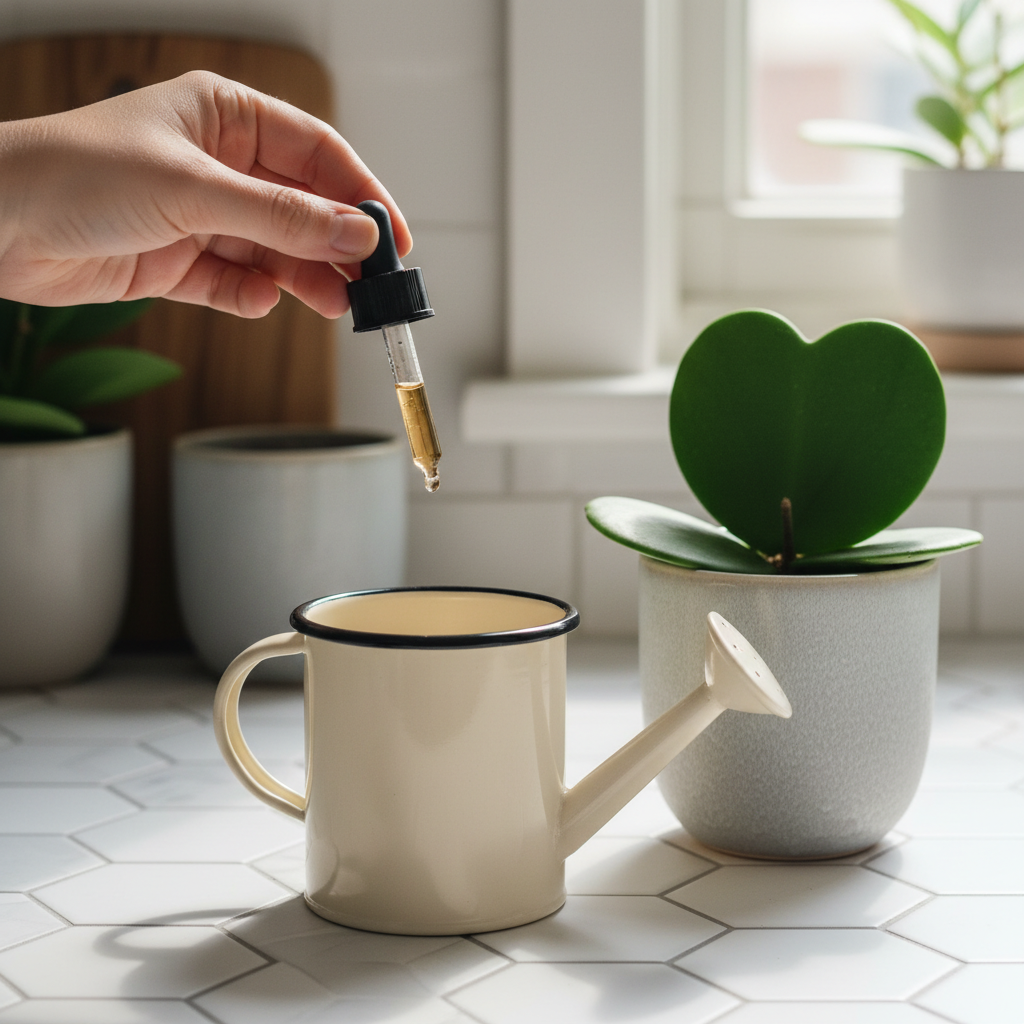
Liquid fertilisers: The easiest to control and the best fit for this plant. Diluted into the watering can, they let you feed at half strength and skip a feed whenever the plant seems to want it. They act quickly and leave little residue when used sparingly.
Slow-release granular: Convenient for those who forget to feed, releasing nutrients gradually over months. The drawback is the loss of control, since you cannot easily dial the feed back if the plant slows, so use them at a conservative rate.
Organic fertilisers: Worm castings, diluted seaweed and similar gentle inputs feed the plant slowly and improve the soil biology. They are forgiving and very hard to overdo, which makes them a good choice for a plant that dislikes strong feeding.
Feeding Schedule
Feed roughly once a month from spring through to the end of summer, always with a diluted solution and always onto already-moist soil. Stop entirely in autumn and winter, when the plant is barely growing and cannot use the nutrients; feeding a dormant heartleaf hoya simply leaves unused salts to build up in the soil.
Pro Tip — Half Strength, Always: Mix any fertiliser at half the dose on the label for this plant. Hoyas are sensitive to over-feeding, and a weak, regular feed produces far better results than an occasional strong one that risks burning the roots.
How to Fertilise
- Water the plant normally first, or feed onto soil that is already damp, never bone dry.
- Dilute a balanced liquid fertiliser to half the recommended strength.
- Apply evenly over the soil until the mix is moistened, avoiding splashing the leaves.
- Every few months, flush the pot with plain water to wash out any accumulated mineral salts.
Warning — Salt Build-Up: A white crust on the soil surface or pot rim, or browning leaf tips, signals a build-up of fertiliser salts. Flush the pot thoroughly with plenty of plain water, let it drain completely, and ease off feeding until the plant recovers.
Propagation
Propagation is where the heartleaf hoya hides its most famous secret, and understanding it will save you years of disappointment. The plant is propagated from stem cuttings, and the cutting must include at least one node, the small joint where a leaf meets the stem, because the node is the only place from which new roots and new shoots can emerge.
This single fact explains the curious fate of the Valentine’s single-leaf plant. A lone heart-shaped leaf, with no piece of stem and no node, can root and live for years, plump and green, yet it will almost never grow into a vine because it has no meristem from which to produce new growth. It is not dead and it is not faulty; it simply lacks the part of the plant that grows. If you want a heartleaf hoya that lengthens and eventually flowers, start from a stem cutting, not a leaf.
Understanding Nodes
A node is the slightly thickened point on the stem where a leaf and its dormant growth buds sit. Roots form readily from this zone, while internodes, the bare lengths of stem between nodes, will not root. Before you take any cutting, find the nodes and make sure each piece you remove carries at least one, ideally with one or two healthy leaves attached to fuel its recovery.
Water Propagation: Step-by-Step
Rooting in water is the simplest method to monitor, since you can watch the roots develop, and it works well for heartleaf hoya cuttings taken in the warmth of spring or summer.
- Using clean, sharp scissors, cut a length of healthy stem with at least one node and one or two leaves.
- Remove any leaf that would sit below the water line, leaving the node exposed.
- Place the cutting in a jar of room-temperature water so the node is submerged but the remaining leaves stay dry.
- Set the jar in bright, indirect light and refresh the water every few days to keep it clear.
- Once roots reach three to five centimetres (one to two inches), pot the cutting into a small container of chunky hoya mix and keep it lightly moist while it establishes.
Pro Tip — Patience Pays: Hoya cuttings root slowly, sometimes taking a month or more before the first roots appear. Resist the temptation to disturb them; a cutting that looks idle is often busy below the surface.
Sphagnum Moss Propagation: Step-by-Step
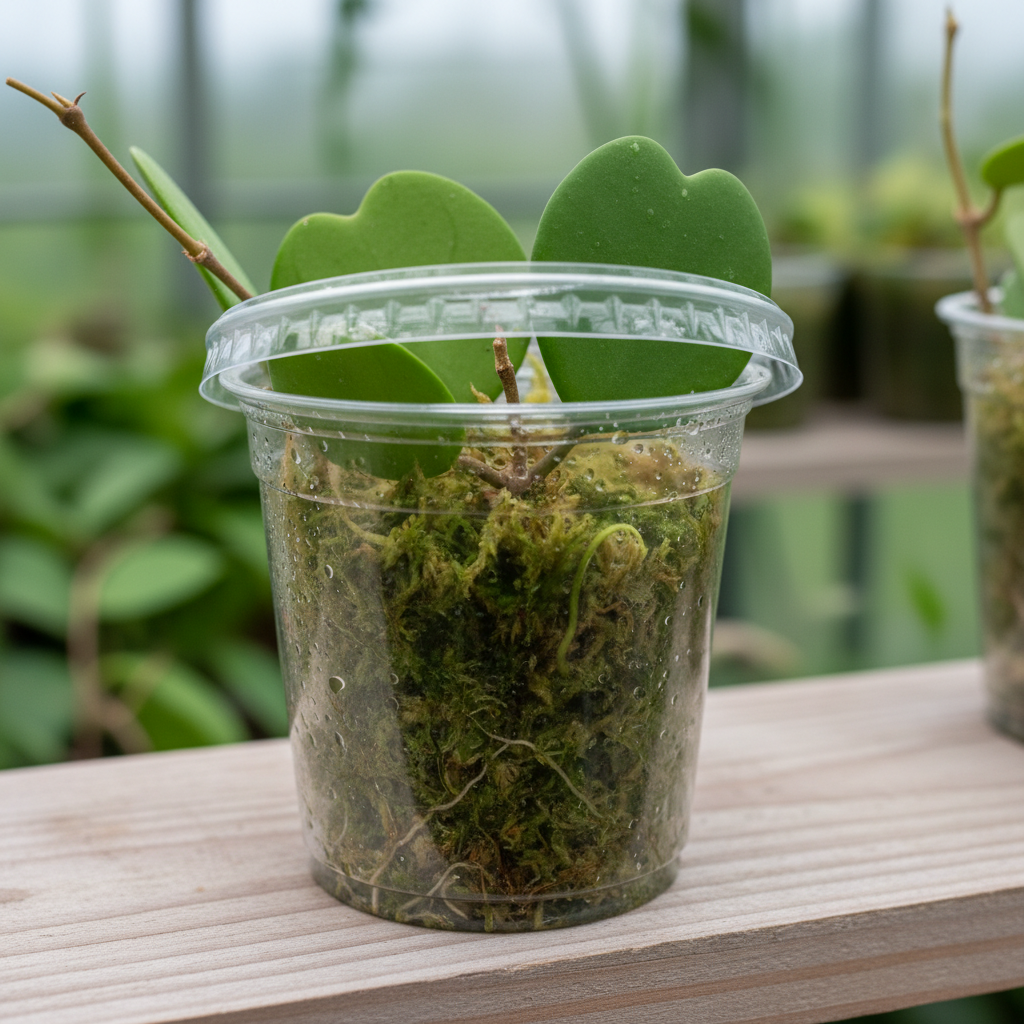
Rooting in damp sphagnum moss often produces sturdier roots that adapt to soil more easily than water roots, and it suits the hoya’s love of airy, humid conditions.
- Soak sphagnum moss, then wring it out so it is damp but not dripping.
- Nestle the nodal section of the cutting into the moss inside a clear pot or deli cup, leaving the leaves above the surface.
- Cover loosely or set the lid ajar to hold humidity while allowing some air exchange.
- Keep the moss lightly moist and the container in bright, indirect light.
- When roots have run well through the moss, pot the whole cutting on into a chunky mix, moss and all, to avoid disturbing the new roots.
Troubleshooting Propagation
| Problem | Likely Cause | Solution |
|---|---|---|
| Cutting rots before rooting | Too much moisture, or no node included | Use a fresh cutting with a clear node; keep moss only just damp |
| No roots after many weeks | Low temperature or light | Move somewhere warmer and brighter; hoyas root best in warmth |
| Single leaf never grows | No node or stem present | None; a lone leaf cannot form a vine, so start again with a stem cutting |
| Leaves shrivel on the cutting | Moisture loss before roots form | Raise humidity around the cutting and keep it out of direct sun |
Pests & Diseases
A healthy heartleaf hoya is fairly resistant to trouble, but its dense, sap-rich foliage and tight leaf axils give a few familiar pests places to hide. Most problems are easier to prevent than to cure, and the earliest line of defence is simply looking at the plant regularly, undersides and crevices included.
When pests do appear, they are almost always sap-sucking insects drawn to the plant’s stored moisture and sugars. Catch them early and they are easy to clear; let an infestation build and the waxy leaves and hidden axils make them stubborn.
Common Pests
Mealybugs (Pseudococcus species)
The classic hoya pest, mealybugs look like tiny tufts of white cotton wool tucked into leaf axils and along the stems, where they suck sap and weaken the plant. They thrive in exactly the sheltered crevices a heartleaf hoya provides.
Treatment: Dab each insect with a cotton bud dipped in surgical spirit, then treat the whole plant with neem oil or an insecticidal soap. Repeat weekly until no new bugs appear, checking the axils carefully each time.
Aphids (Aphidoidea)
Small green, black or yellow insects that cluster on soft new growth and flower stalks, aphids multiply quickly and leave sticky honeydew behind. They are especially drawn to the tender buds of a flowering hoya.
Treatment: Rinse them off under a tap or wipe them away, then follow up with insecticidal soap or neem oil to catch any survivors and the eggs they leave.
Scale (Coccoidea)
Scale insects appear as small, hard brown bumps along the stems and the backs of leaves, often mistaken for part of the plant until they are scraped off. They too feed on sap and excrete honeydew that can turn to sooty mould.
Treatment: Scrape off what you can with a fingernail or soft brush, then apply neem oil or a horticultural oil to smother the rest, repeating until the plant stays clear.
Spider Mites (Tetranychus urticae)
Most likely in hot, dry conditions, spider mites are nearly invisible but betray themselves with fine webbing and a faint stippling or bronzing on the leaves. Their populations can explode quickly on a stressed plant.
Treatment: Wipe the leaves, raise humidity around the plant, and treat with neem oil or a miticide, paying attention to the leaf undersides where they gather.
Common Diseases
Root Rot (Pythium and Phytophthora species)
By far the most serious threat to a heartleaf hoya, root rot follows persistent overwatering or a soggy, airless mix. Soft yellowing leaves, a sour smell and blackened roots are the tell-tale signs, and an advanced case can collapse a plant within days.
Treatment: Unpot the plant, cut away every soft or blackened root, and repot into fresh, very free-draining mix. Salvage healthy stem cuttings as insurance and water far more sparingly afterwards.
Botrytis and Fungal Leaf Spot (Botrytis cinerea)
Grey mould or dark, spreading leaf spots can appear when foliage stays wet in cool, still, humid air. The dense leaves of a heartleaf hoya trap moisture readily, so misting and overhead watering both raise the risk.
Treatment: Remove affected leaves, improve air circulation, and keep water off the foliage. A fungicide can help in stubborn cases, but better airflow usually solves the underlying problem.
Pest and Disease Summary
| Pest / Disease | Identification | Treatment |
|---|---|---|
| Mealybugs | White cottony tufts in axils and on stems | Surgical spirit then neem oil, repeated weekly |
| Aphids | Clusters on new growth and buds, sticky residue | Rinse off, then insecticidal soap or neem |
| Scale | Hard brown bumps on stems and leaf backs | Scrape off, then horticultural oil |
| Spider mites | Fine webbing and stippled, bronzed leaves | Wipe, raise humidity, treat with neem or miticide |
| Root rot | Soft yellow leaves, black roots, sour smell | Cut away rot, repot dry, water sparingly |
| Botrytis / leaf spot | Grey mould or dark spreading spots | Remove leaves, improve airflow, keep foliage dry |
Prevention Strategies
Prevention rests on a few steady habits. Quarantine every new plant for a couple of weeks before it joins the rest of your collection, since most infestations arrive on a new arrival. Inspect your heartleaf hoya whenever you water, parting the foliage to check the axils where mealybugs hide, and keep the leaves clean and dust-free so pests have nowhere to settle unnoticed.
Just as important is keeping the plant itself robust. A heartleaf hoya in good light, in a free-draining mix, watered only when it is genuinely dry, is far less attractive to pests and far better able to shrug off the diseases that prey on stressed, waterlogged roots. Most disease problems on this plant trace back to too much water, so getting the watering right is the most powerful prevention of all.
Pro Tip — Treat the Axils: Whatever pest you are tackling, pay particular attention to the leaf axils and stem joints when you spray or wipe. These hidden crevices are where mealybugs and scale survive a half-hearted treatment and rebuild their numbers.
Popular Varieties
Although the plain green heartleaf hoya is lovely in its own right, much of the collector interest centres on its variegated forms, where the familiar heart is split between green and cream or yellow. These cultivars carry the same easy temperament, with the one proviso that the paler the leaf, the more light it needs to stay healthy and hold its pattern.
The varieties below are the ones you are most likely to find, and the differences between them come down to where the variegation sits and how much green leaf remains to power the plant. None is difficult, but the heavily variegated forms grow more slowly still and reward a brighter position.
| Variety | Leaf Appearance | Light Needs | Growth Rate | Availability |
|---|---|---|---|---|
| Plain green | Solid deep-green hearts | Bright indirect | Slow | Common |
| ‘Variegata’ | Green hearts with buttery yellow centres | Bright | Slow | Common |
| ‘Albomarginata’ | Green centres edged with cream margins | Bright | Slow | Frequent |
| ‘Reverse Variegata’ | Cream centres with green margins | Very bright | Very slow | Uncommon |
| ‘Splash’ | Green hearts flecked with silvery speckling | Bright indirect | Slow | Uncommon |
Featured Varieties
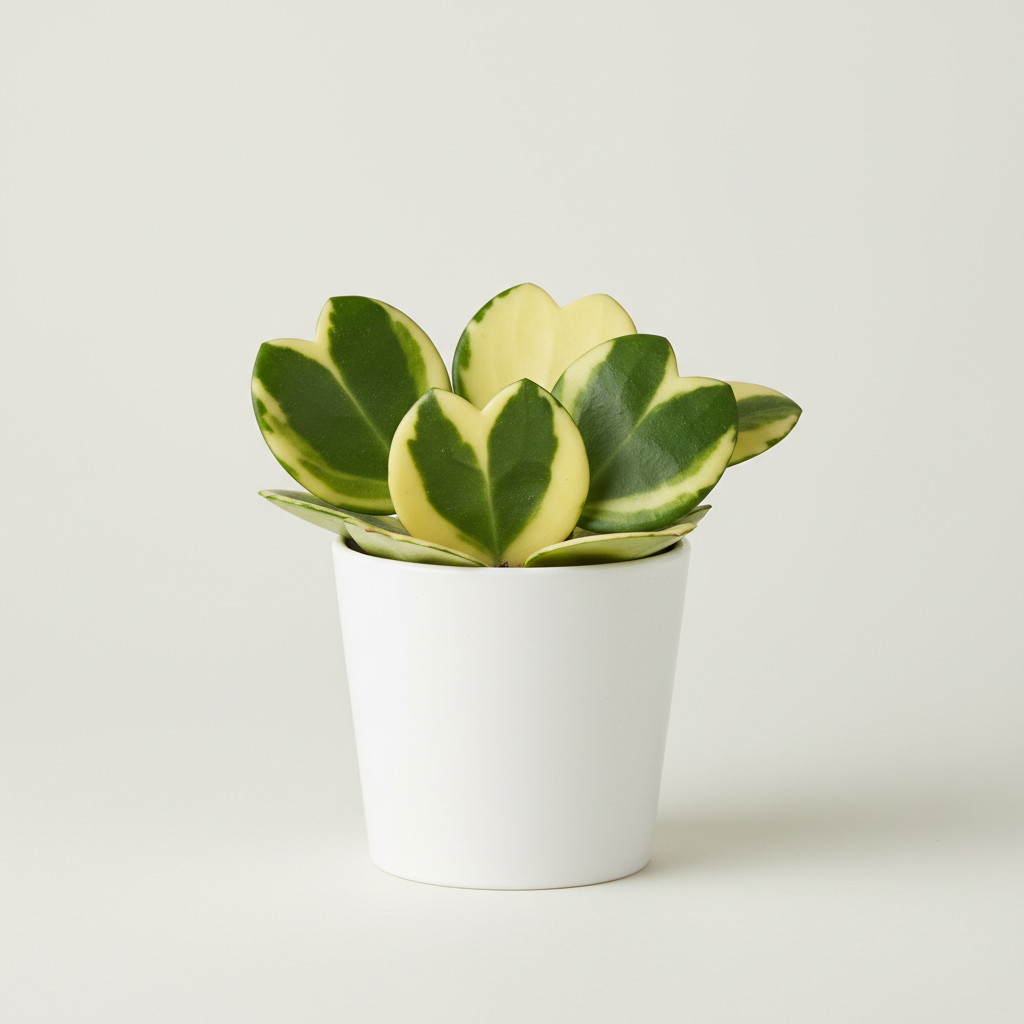
‘Variegata’
The best-loved variegated form, with a soft yellow flush through the centre of each heart framed by a green border. It needs noticeably more light than the plain plant to keep that buttery colour from fading.
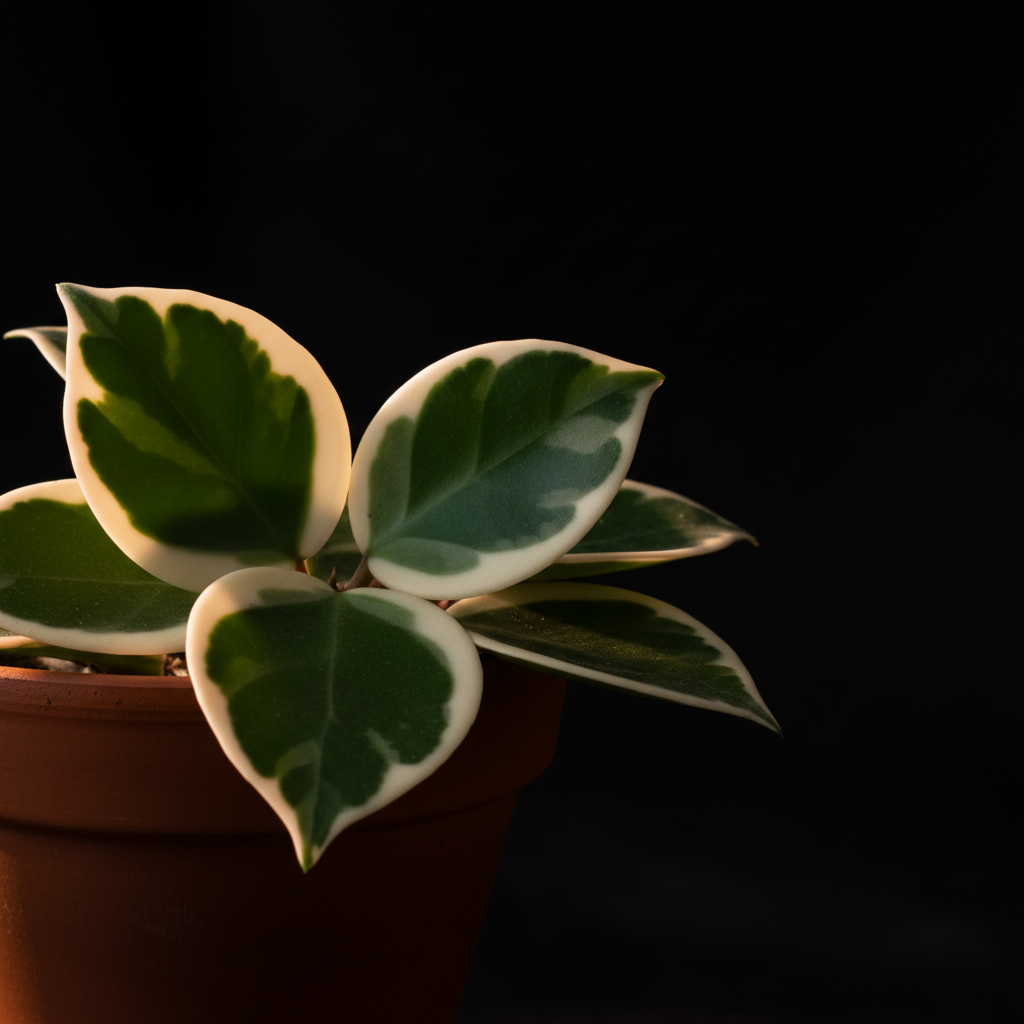
‘Albomarginata’
Here the variegation runs around the edge of the leaf as a cream margin enclosing a green heart. With more green tissue than the reverse form, it grows a little more readily while still bringing pale contrast to the plant.
Variety Profiles in Detail
Plain Green (Hoya kerrii)
The original species plant, with thick, uniformly deep-green hearts. With full chlorophyll across every leaf, it is the most vigorous and forgiving of the lot, growing fastest and tolerating slightly lower light than its variegated cousins. It is also the form most often sold as the single-leaf Valentine plant.
‘Reverse Variegata’ (Hoya kerrii ‘Reverse Variegata’)
A striking inversion of the standard variegated plant, with cream or pale-yellow centres and green only around the edges. Because so little of each leaf is green, it is the slowest grower and the hungriest for light, and it rewards a bright, stable position with some of the most beautiful foliage in the genus.
Choosing the Right Variety for Your Space
Let your light decide. If you have a bright, reliable window, any of the variegated forms will reward you, with the reverse-variegated plant making the most dramatic centrepiece for the brightest spots. If your light is merely good rather than excellent, the plain green plant or the cream-margined ‘Albomarginata’ will be happier and grow more willingly. Whichever you choose, remember that every heartleaf hoya is a slow plant by nature, so buy the size you want to live with rather than expecting rapid growth.
Frequently Asked Questions
Will my single heart-shaped leaf ever grow into a full plant?
Almost certainly not. A single leaf sold without a piece of stem has no node, and the node is the only part of a hoya that can produce new stems and leaves. The leaf can root and live for years, staying plump and green, but it will not become a vine. For a plant that grows, start with a stem cutting that includes at least one node.
Why is my heartleaf hoya growing so slowly?
Slow growth is normal for this species, which puts on far less length each year than most trailing houseplants. You can encourage what growth it has by giving it brighter light, feeding lightly through the growing season and keeping it comfortably warm, but no amount of care will turn it into a fast grower. Patience is part of the deal.
How do I get my heartleaf hoya to flower?
Flowering requires a mature, well-established plant in bright light, so the first step is simply time and patience. Keep the plant slightly pot-bound, give it as much bright indirect light as you can, and feed during the growing season with a balanced or slightly higher-potassium feed. Once flower spurs form, leave them in place, because hoyas rebloom from the same spurs year after year.
Why are the leaves on my heartleaf hoya wrinkling?
Wrinkled, puckered leaves usually mean one of two opposite things. Most often the plant is simply thirsty and has drawn down its stored water, in which case a thorough watering plumps the leaves back up within a day. If watering does not help, suspect root rot from overwatering, which prevents damaged roots from taking up water at all; check the roots if the wrinkling persists after a drink.
Is the heartleaf hoya safe around pets?
Yes. Hoyas, including Hoya kerrii, are widely listed as non-toxic to cats and dogs, which makes this a sensible choice for homes with curious animals. The milky sap can still irritate skin, and no plant material is good for a pet to chew in quantity, but it carries none of the toxicity of plants such as dieffenbachia or lilies.
Why are the leaves turning yellow?
The most common cause is overwatering. When several leaves yellow and turn soft at once, and the soil has stayed wet, the roots are likely suffering and you should let the mix dry out and check for rot. A single old leaf yellowing slowly near the base is usually just natural ageing and nothing to worry about.
My variegated hoya is turning all green. What happened?
Variegation fades when light is short, because the plant produces more chlorophyll-rich green tissue to compensate for the energy its pale areas cannot supply. Move the plant to a brighter position and new growth should return to its variegated pattern, though leaves that have already greened will not change back.
How often should I repot a heartleaf hoya?
Rarely. This is a slow grower that flowers better when slightly pot-bound, so repot only every two to three years or when roots are escaping the drainage holes. When you do, move up just one pot size, use a fresh chunky mix, and choose spring so the plant can recover during its active season.






