
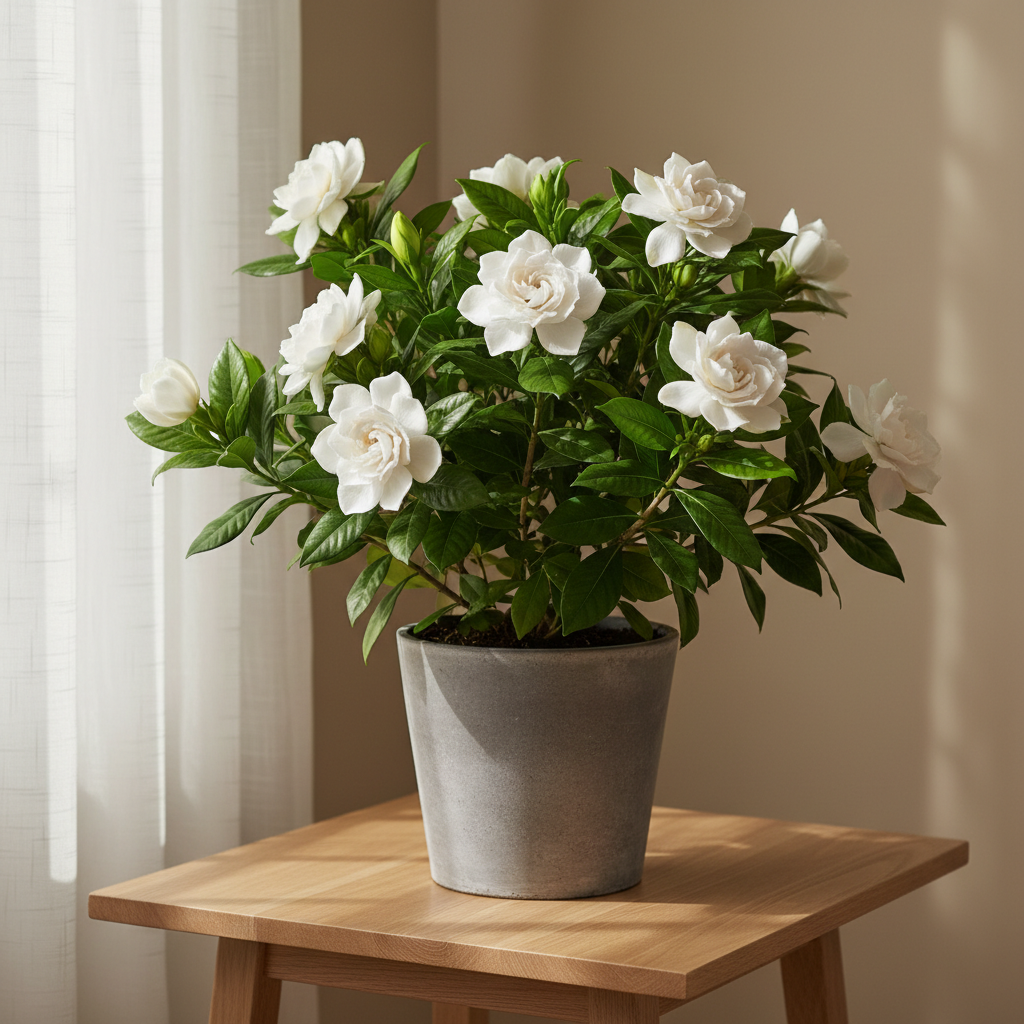
Few houseplants command attention quite like the gardenia (Gardenia jasminoides), also widely known as cape jasmine. A native of southern China, Taiwan, Japan and parts of southeast Asia, this evergreen shrub belongs to the coffee family (Rubiaceae) and was named in honour of the eighteenth-century Scottish-American botanist Alexander Garden. Its waxy ivory blooms, set against a glossy mantle of dark green leaves, release a sweet, almost narcotic fragrance that has perfumed parlours, conservatories and bridal bouquets for more than two centuries.
Reputation precedes the gardenia. It is the houseplant that gardening writers reach for whenever they want an example of beautiful but demanding, and the warnings are not unearned. Surviving a gardenia is possible in a wide range of homes, but coaxing one to thrive and flower indoors requires understanding a handful of non-negotiables: bright filtered light, distinctly acidic soil, scrupulously consistent moisture, generous humidity and a careful temperature spread between day and night. This guide walks through every one of those variables in detail, separating the genuinely critical from the merely fashionable, so that you can give your gardenia a real shot at the long, fragrant career it is capable of.
Contents
- Quick Reference
- Why Gardenia Makes a Rewarding Houseplant
- Light Requirements
- Watering and Humidity
- Soil, Potting and Repotting
- Fertilising
- Propagation
- Pests and Diseases
- Popular Varieties
- Frequently Asked Questions
Quick Reference: Gardenia at a Glance
| Light | Bright indirect to gently filtered direct sun, ideally 4 to 6 hours of morning light |
| Watering | Keep the top 2 to 3 cm (1 inch) of mix evenly moist, never soggy and never bone dry |
| Temperature | Days 21 to 24 °C (70 to 75 °F), nights 15 to 18 °C (60 to 65 °F); a clear day-to-night drop is essential for bud set |
| Humidity | 50 to 70 percent ambient humidity; below 40 percent buds will drop |
| Fertiliser | Acid-loving plant feed (azalea or camellia formula) every 2 to 3 weeks from spring to early autumn, paused in winter |
| Toxicity | Mildly toxic to dogs, cats and horses; ingestion can cause vomiting, diarrhoea and mild lethargy |
Why Gardenia Makes a Rewarding Houseplant
The case for growing a gardenia indoors rests almost entirely on the flowers. A single mature plant in full bloom can perfume a whole room in a way no candle or diffuser ever quite manages, and that fragrance has a depth and warmth to it that perfumers have spent decades trying to copy synthetically. The blooms themselves are exquisite: cream-white at first, ageing to a buttery ivory, with the layered swirl of a tea rose and a thickness to the petals that almost reads as porcelain. Cut a single flower and float it in a shallow bowl of water, and you have an instant centrepiece worthy of a dinner party.
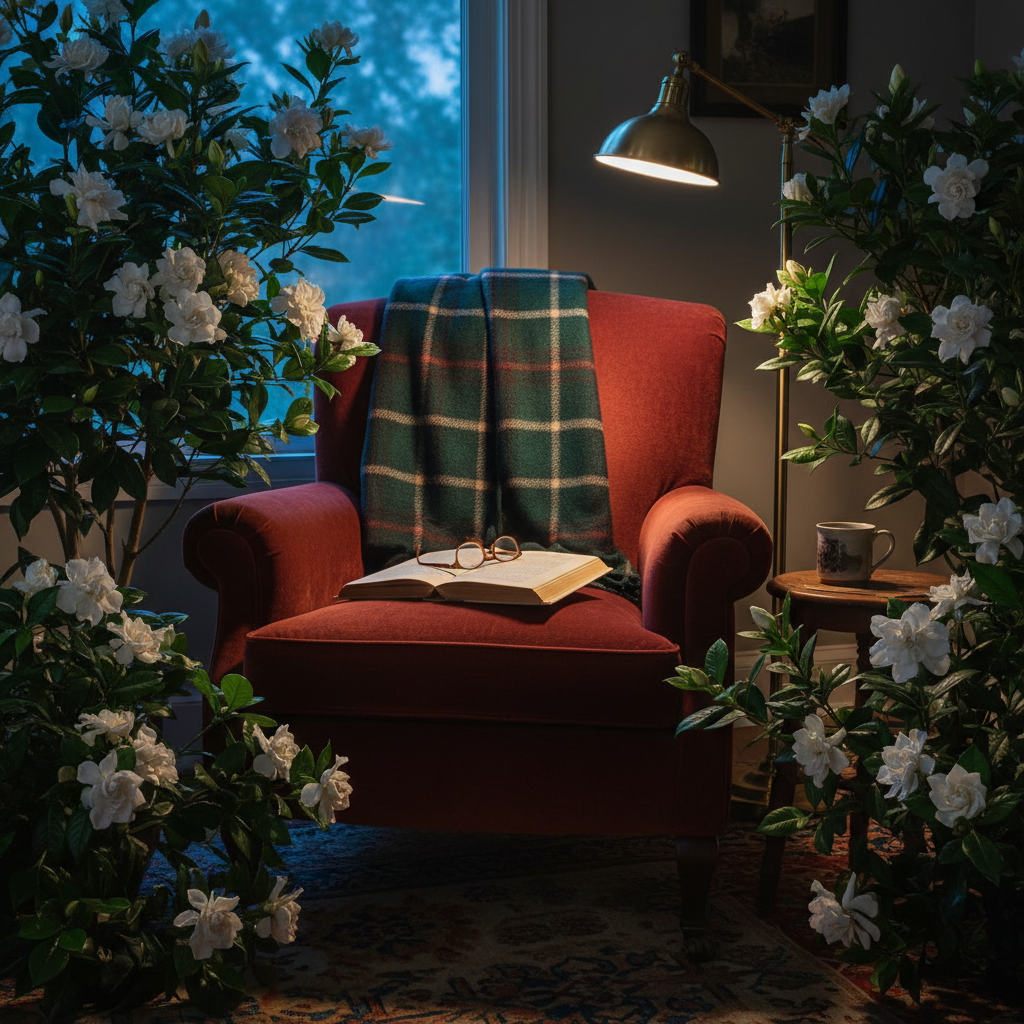
Beyond the flowers, the foliage carries its own quiet appeal. Gardenia leaves are deeply glossy, oval and arranged in opposite pairs along stiff woody stems, giving the plant the architectural presence of a small camellia or a citrus tree. Even out of bloom it reads as a serious, considered houseplant rather than a filler. Most indoor specimens stay at a manageable 60 to 120 cm (2 to 4 feet) when grown in containers, though in optimum conditions they can reach 180 cm (6 feet) and produce dozens of buds in a single flush. They flower most heavily in late spring and early summer, with sporadic reflushes through autumn when conditions are right, and a well-tended plant can stay productive for fifteen years or more.
Important — Toxicity: Gardenia is classified as mildly toxic to dogs, cats and horses by the ASPCA. Ingestion of leaves or flowers can cause vomiting, diarrhoea, hives or mild lethargy, and the iridoid glycosides responsible (gardenoside and geniposide) are concentrated in the foliage. Keep plants out of reach of grazing pets and curious toddlers, and pick up any fallen petals or leaves promptly.
Light Requirements
Light is the first variable to get right, because a gardenia in the wrong spot will sulk regardless of how perfectly you manage its watering and feeding. In its native subtropical habitat the plant grows at woodland edges and along stream banks, sheltered by the canopy of larger trees but flooded with bright, dappled sun for most of the day. That is the light environment you are trying to recreate indoors, and it is fortunately a forgiving one in homes with at least one well-lit window.
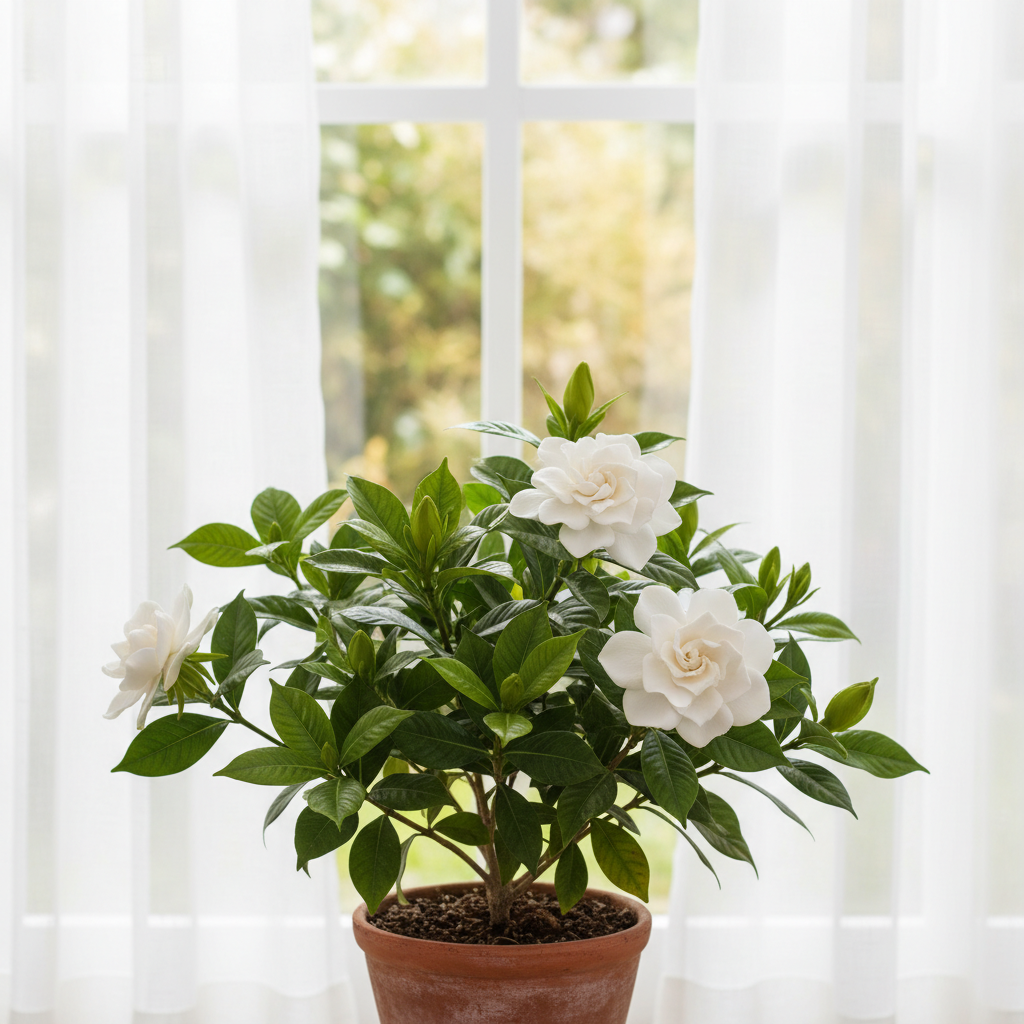
The ideal placement is within a metre of an east-facing window where the plant catches a few hours of gentle morning sun, or a couple of metres back from a south or west window where the harshest midday rays are filtered by a sheer curtain. Gardenias need a noticeable amount of light to set buds, which is the make-or-break difference between a glossy green shrub and one that actually flowers. Light starvation is by far the most common reason an otherwise healthy gardenia refuses to bloom indoors, and growers in low-light apartments often need to supplement with artificial lighting through winter.
Light Levels Explained
Plant care literature talks about light in fairly loose terms, but actual measurements help when you are diagnosing a non-flowering gardenia. The table below gives the approximate lux range for each category and where in a typical home you might find it. A simple smartphone light-meter app is enough to put numbers on the spot you are considering.
| Light Category | Approx. Level | Typical Location | Outcome |
|---|---|---|---|
| Direct sun | 50,000 to 100,000 lux | Pressed against a south or west window, no curtain | Risk of scorched young leaves and dried flower buds; only acceptable in cooler months |
| Bright filtered | 10,000 to 25,000 lux | Within 1 m of a south window with sheer curtain | Optimal; promotes vigorous growth and abundant bud set |
| Bright indirect | 5,000 to 10,000 lux | 1 to 2 m back from a sunny window, or directly at a north window | Healthy foliage and modest flowering |
| Medium | 1,000 to 5,000 lux | Interior of a well-lit room, away from windows | Survival but few or no flowers, leggy growth |
| Low | Under 1,000 lux | Hallways, bathrooms with small windows | Decline and eventual loss; gardenias cannot tolerate prolonged low light |
Window Orientation and Placement
South-facing window: In the northern hemisphere a south window offers the brightest and longest light of the day. Gardenias can sit happily within a metre of glass if a sheer curtain or partial blind softens the midday hours from late spring through early autumn. Without that diffusion the leaves nearest the glass may bleach to a pale yellow-green and developing buds can dry out before opening.
East-facing window: This is arguably the most reliable orientation for an indoor gardenia. The plant receives several hours of gentle morning sun, which is bright enough to drive flowering but rarely hot enough to scorch new growth. By afternoon the window receives only ambient indirect light, allowing the room to cool slightly, which supports bud development.
West-facing window: A west window provides strong afternoon light that can be excellent in cooler months but punishingly hot in summer, particularly when combined with radiant heat from window glass. Pull the plant back by 60 to 90 cm (2 to 3 feet) or use a sheer curtain to take the edge off the rays between 14:00 and 18:00.
North-facing window: In the northern hemisphere, north windows produce cool, even light without any direct sun. This is generally too dim to support flowering in a gardenia year-round, though it can serve as a temporary placement during heatwaves. A north-facing room with a large skylight is another matter, and can work well.
Pro Tip — The Quarter-Turn Rule: Rotate your gardenia a quarter turn every week or two. Stems lean towards the brightest light, and an unrotated plant will develop a noticeably one-sided habit and uneven flowering. The rotation also encourages a more compact, symmetrical canopy that holds buds better.
How Light Affects Flowering and Foliage Colour
A gardenia in optimum light produces deeply saturated, almost lacquered foliage with a hint of bronze on new growth. In dim conditions the leaves stay green but lose that depth, the internodal spacing stretches, and the entire plant takes on a slightly tired appearance. More importantly, flower bud initiation requires a threshold of daily light integral that low-light positions simply cannot deliver. If your gardenia is robustly leafy but has not bloomed in two seasons, light is the first variable to investigate, well before fertiliser or repotting.
Warning — Direct Sunlight: Glossy gardenia leaves are surprisingly vulnerable to summer scorch, which appears as bleached patches that turn papery brown over several days. Once a leaf has been burned the damage cannot be reversed, and badly burned leaves will drop. Always introduce a plant to direct sun gradually over a week, especially after winter or after a move from a shadier nursery.
Artificial Lighting
Gardenias respond very well to supplemental LED grow lighting, which is often the deciding factor in flat or basement settings where natural light is marginal. A full-spectrum LED panel rated at 30 to 40 watts of actual draw, positioned 30 to 45 cm (12 to 18 inches) above the canopy and run on a 12 to 14 hour timer, will reliably support both growth and flowering. Look for lights with a colour temperature around 4000 to 5000 K, or a bloom-spectrum panel that includes meaningful red wavelengths. Cheap blue-heavy lights from generic vendors will keep the plant alive but rarely trigger consistent bud set.
Seasonal Adjustments
Seasonal light shifts matter more for gardenias than for many houseplants. In summer, you may need to pull the plant back from the window or add a sheer curtain to prevent leaf scorch. In winter, when the sun is lower and weaker, move the plant as close to the brightest available glass as possible, and consider supplementing with a grow light from late October through February. Plants kept in a winter rest period at 13 to 16 °C (55 to 60 °F) with reduced watering and slightly lower light often flower more abundantly the following spring, a trick borrowed from the conservatory tradition.
Watering and Humidity
If light dictates whether your gardenia will flower at all, watering and humidity dictate whether the buds will actually open. The plant is intolerant of both extremes: a single bone-dry week can drop a flush of forming buds, and a few days of waterlogged roots can trigger fungal collapse from which it never recovers. The aim is consistent, even moisture in a free-draining acidic mix, paired with humidity well above what most centrally heated homes provide by default.
When to Water
Check the top 2 to 3 cm (1 inch) of soil with a finger every couple of days. When it feels just barely dry to the touch but still cool, it is time to water. A gardenia should never be allowed to dry to the point that the leaves wilt, and equally should never sit with soaked, glossy soil for days on end. The frequency varies wildly with conditions: a plant in a warm sunroom in July may need watering every two days, while the same plant in a cooler room in January may only need it every seven to ten days.
The weight of the pot is the most reliable single indicator once you have grown a plant for a few months. Lift it just after watering and again when the surface feels dry, and you will quickly calibrate a sense for when it needs more. Moisture meters can supplement this, but cheap probe meters often give erratic readings in chunky bark-based mixes, so trust your finger and the pot weight first.
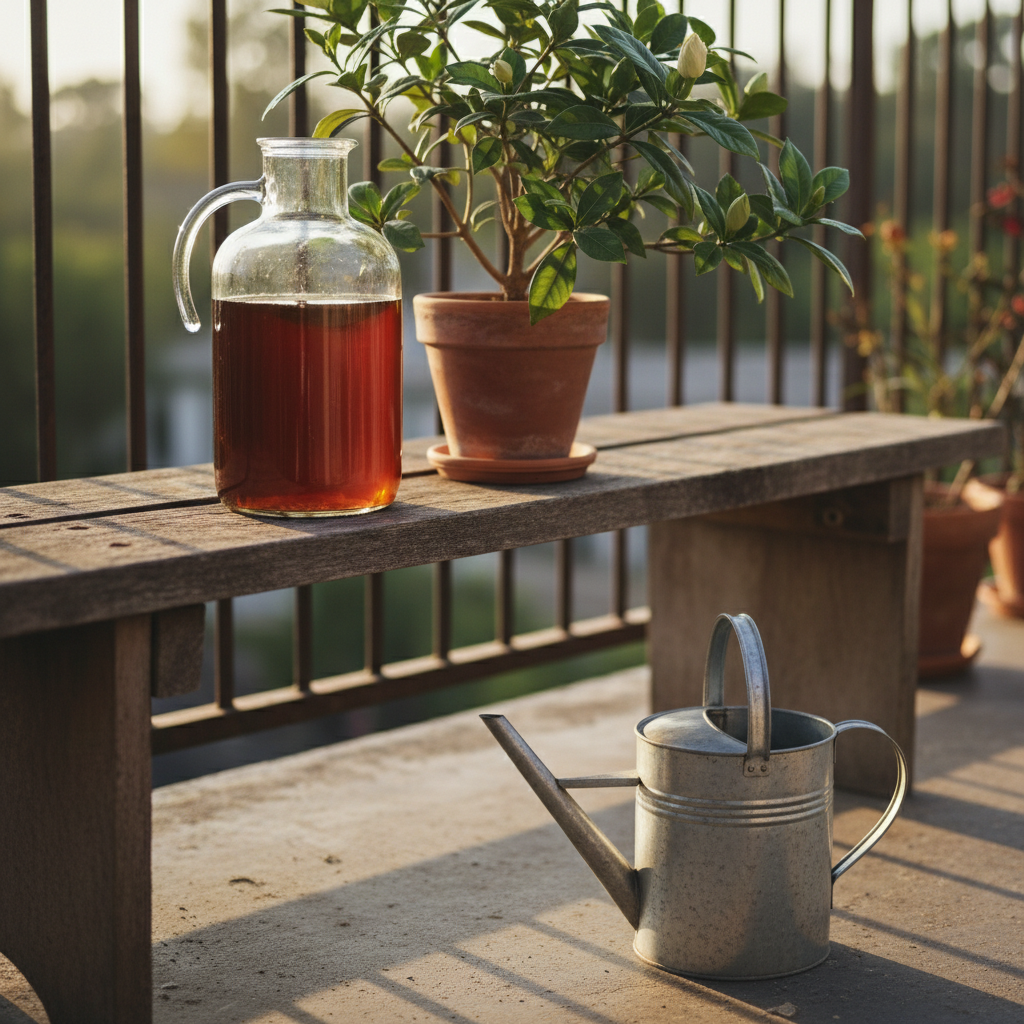
Pro Tip — Lukewarm Only: Gardenia roots are unusually sensitive to cold-water shock. Always water with tepid water at room temperature, never directly from the cold tap, especially in winter. A jug filled and left to stand overnight beside the plant is the simplest fix, and it also lets a portion of any chlorine evaporate off.
How to Water Correctly
- Check moisture with a finger or the pot-weight test before reaching for the watering can.
- Use room-temperature rainwater, distilled water or filtered tap water rested overnight.
- Water slowly around the base of the plant, avoiding the foliage and any open flowers, until water begins to drain from the bottom of the pot.
- Let the plant sit for 10 to 15 minutes, then tip away any water that has collected in the saucer or cachepot.
- Wipe the saucer dry; standing water at the base will quickly cause root rot in a gardenia.
- Avoid watering late in the evening, as cool wet foliage overnight increases the risk of fungal leaf spots.
Signs of Overwatering vs. Underwatering
| Symptom | Overwatering | Underwatering |
|---|---|---|
| Leaf colour | Lower leaves yellow uniformly, then drop | Leaves yellow at the tips and edges, often with brown crisp margins |
| Leaf texture | Soft, limp, almost translucent at the worst | Dry, curled inward, papery in patches |
| Soil | Stays wet for more than 5 days, surface may grow algae or moss | Pulls away from the pot edge, hard and dusty when dry |
| Roots | Soft brown or black, foul smell, slip off in your fingers | Wiry, pale and brittle, sometimes shrunken |
| Stem base | Mushy, may show dark soaked patches | Firm but increasingly woody and stiff |
| Flower buds | Yellow and drop while still green | Shrivel and drop dry; opening flowers brown rapidly |
Warning — Root Rot: Gardenia is a notorious sufferer of Phytophthora and Pythium root rots, both encouraged by waterlogged, poorly aerated soil. Once root rot is established the plant rarely recovers, even with a fungicide drench. Prevention is the only reliable strategy: a free-draining acidic mix, a pot with generous drainage holes, and a strict no-standing-water rule for the saucer.
Humidity Requirements
Ambient humidity above 50 percent is essential for gardenia, and 60 to 70 percent is closer to ideal. The plant evolved under the dripping canopy of subtropical woodland, where moisture in the air helped buffer it through dry spells and supported the slow, even bud development the species depends on. In a typical centrally heated room, winter humidity can dip to 25 percent or lower, which is enough on its own to cause mass bud drop and crisp leaf tips even in a plant doing everything else right.
The classic gardenia signs of low humidity are buds that yellow and fall before opening, brown leaf tips that creep slowly down the margins, and a general loss of the glossy lacquer-like surface to mature foliage. By the time you are seeing these symptoms the underlying problem has been running for weeks, so it is better to manage humidity preemptively through the heating season rather than respond to its absence.
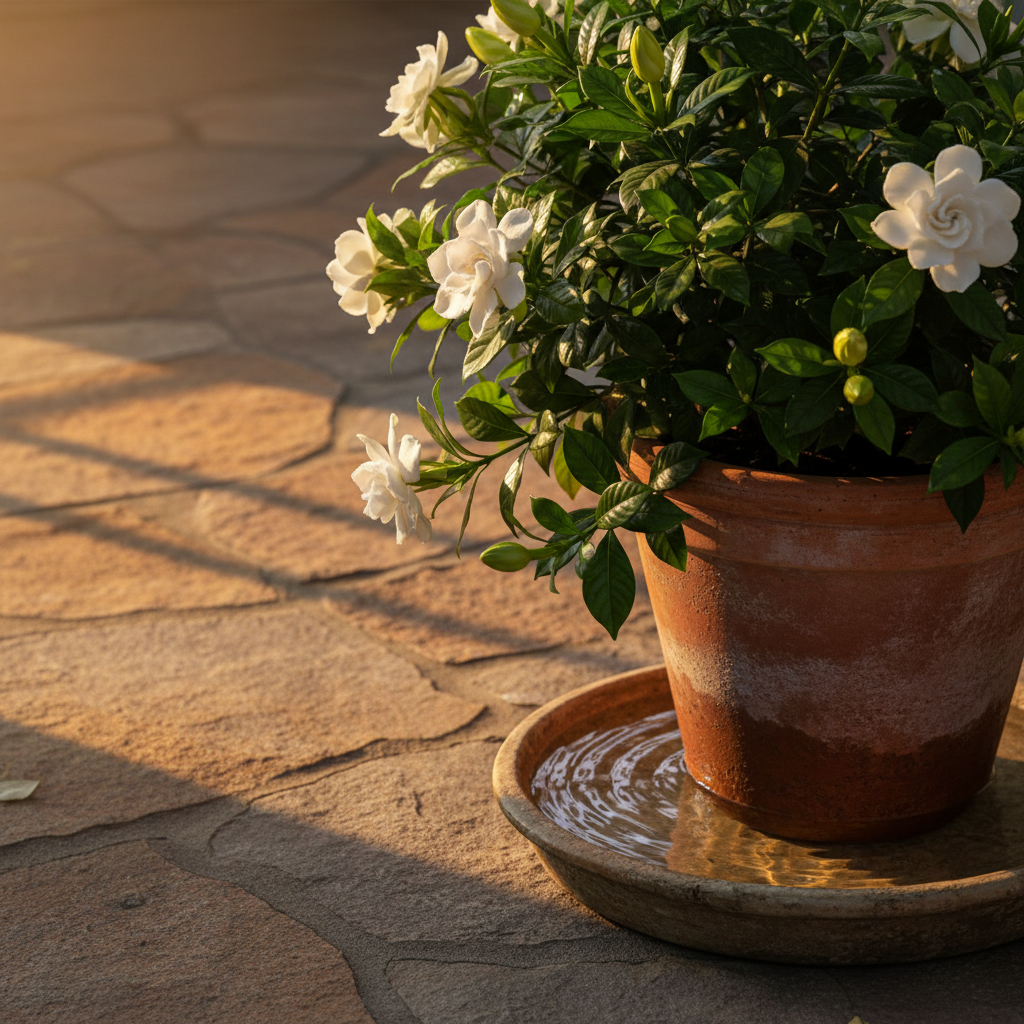
The most reliable way to raise humidity around a gardenia is a small ultrasonic cool-mist humidifier running on a timer for several hours a day, positioned a metre or two from the plant. A pebble tray (a saucer of pebbles topped up with water beneath the pot, with the pot itself sitting on the pebbles rather than in the water) helps but is rarely enough on its own. Misting the foliage gives short-lived relief and can spread fungal leaf spots if done late in the day; if you mist, do so in the morning so that surfaces dry by nightfall.
Water Quality
Gardenias are markedly sensitive to alkaline tap water and to dissolved salts. Hard water raises the soil pH over time, which in turn locks up iron and triggers the classic interveinal yellowing known as iron chlorosis. Rainwater is the gold standard, followed by distilled water, then filtered tap water, with straight hard tap water as a last resort. If you must use hard tap water, periodically flush the pot with rainwater or distilled water to leach accumulated salts, and consider top-dressing with a sprinkle of elemental sulphur to nudge the pH back down.
Soil, Potting and Repotting
If there is one variable that distinguishes a healthy long-term gardenia from a sad declining one, it is soil acidity. Gardenia is an obligate acid-lover, sitting in the same broad category as azaleas, camellias, blueberries and rhododendrons. In a mix at the wrong pH the plant cannot take up iron and magnesium even when those nutrients are present, and the result is the chronically pale, yellow-veined look that drives many owners to discard plants long before they need to.
Ideal Soil Composition
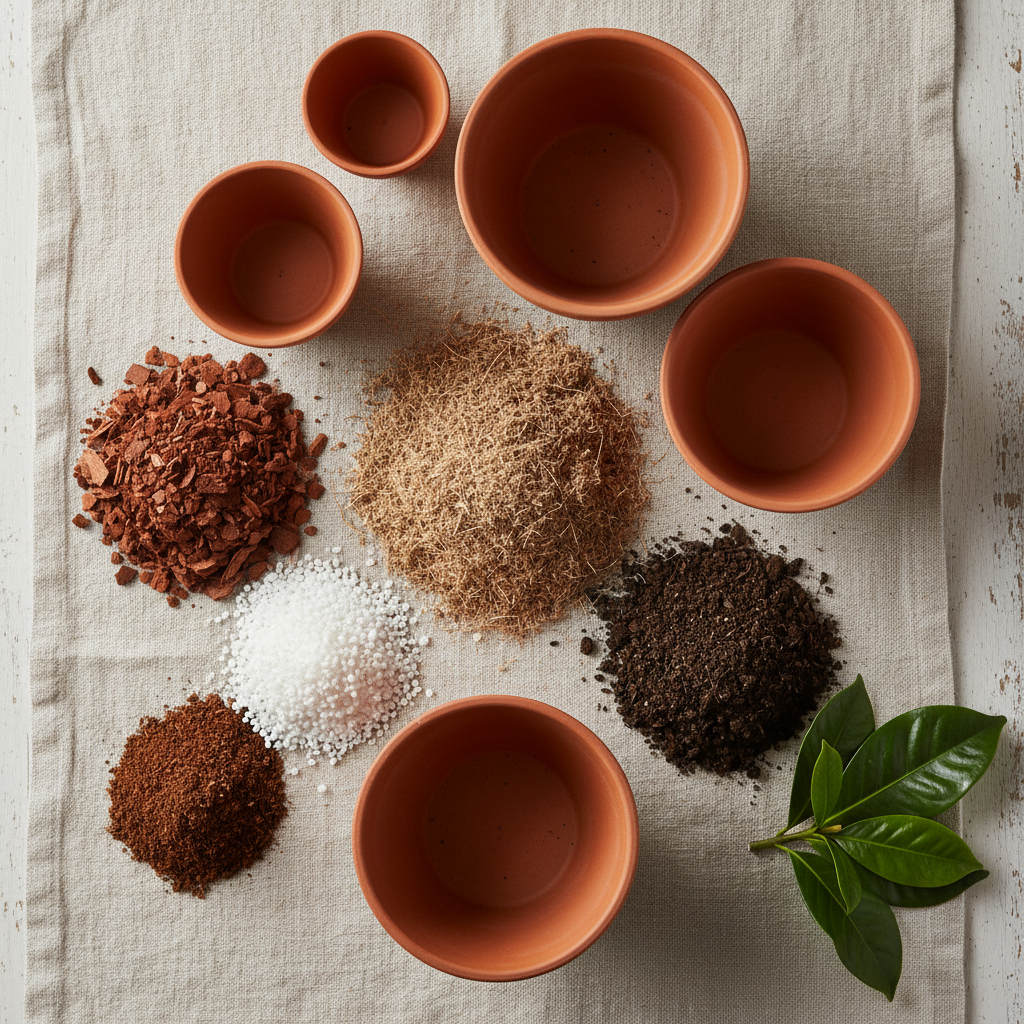
The target is a moisture-retentive but well-aerated acidic mix with a pH between 5.0 and 6.0. Off-the-shelf azalea, camellia or ericaceous compost is a perfectly good starting point for most growers, often used straight from the bag with a handful of perlite added for extra drainage. Builders of their own mix typically combine a peat or coco coir base for moisture and acidity, fine orchid bark for structure and air pockets, and perlite for free drainage.
| Component | Proportion | Function |
|---|---|---|
| Sphagnum peat or coco coir | 50% | Acidic base, holds moisture evenly, provides organic matter |
| Fine orchid bark | 20% | Adds structure, creates air pockets around roots, slowly breaks down to mild humus |
| Perlite | 20% | Improves drainage and prevents compaction |
| Composted pine fines or leaf mould | 10% | Mildly acidifying organic matter that supports beneficial fungi |
The pH of the resulting mix should be tested with a basic soil pH probe or paper kit, which is sold inexpensively at any garden centre. A reading above 6.5 is too alkaline and should be corrected before potting, either by switching to a more peat-heavy base or by adding a small quantity of elemental sulphur and waiting two to three weeks for it to work into the mix. Avoid garden lime, dolomite, bone meal or wood ash entirely; all of these will push the pH in the wrong direction.
Pro Tip — Quick Mix Recipe: For a small batch, combine 5 parts ericaceous compost, 2 parts fine orchid bark and 2 parts perlite by volume in a tub. Moisten lightly, mix thoroughly, and check the pH with a probe; if it reads above 6, work in a tablespoon of elemental sulphur per 10 litres of mix and let it sit for a fortnight before use.
Choosing the Right Pot
Gardenias resent both pots that are too small (and dry out within a day) and pots that are too large (and hold a damp anaerobic core the roots never reach). The sweet spot is a container roughly 2 to 4 cm (1 to 2 inches) wider in diameter than the existing root ball, with proportional depth.
Drainage holes are non-negotiable. A gardenia in a pot with no drainage will fail within a season, regardless of how careful your watering is. If you have a beautiful decorative pot without holes, use it as a cachepot and plant the gardenia in a plain plastic or terracotta nursery pot that drops inside.
Pot material: Terracotta is excellent for gardenias because the porous walls allow excess moisture to evaporate and air to reach the root zone, both of which guard against rot. The downside is that terracotta dries out faster, which in a warm room can mean watering every other day in summer. Glazed ceramic and plastic pots hold moisture for longer and need watering less often, but demand a stricter eye on overwatering. Pick the material that matches your habits.
Pot size: When in doubt, err on the smaller side. A gardenia in a slightly snug pot will flower more reliably than the same plant in a generous one, because constrained roots concentrate energy into bud production. Overpotting is one of the easiest ways to delay flowering by a year.
When to Repot
Repot every two to three years, or whenever you see roots circling tightly inside the pot or pushing out of the drainage holes. The best time is early spring, just as new growth begins but before flower buds start forming; repotting a plant in bud almost always causes those buds to drop. Avoid repotting in autumn or winter when the plant is settling into its slower season and rooting recovery is slow.
How to Repot: Step-by-Step
- Water the plant the day before repotting so the rootball comes out cleanly and the plant is well hydrated for the move.
- Prepare the new pot: a single pot size up, with a thin layer of fresh acidic mix in the bottom, just enough so that the rootball will sit with the top of the root crown about 1 cm below the rim.
- Ease the gardenia out of its current pot by tipping it and supporting the base of the plant; tap the rim if needed rather than pulling on the stem.
- Examine the rootball. Tease apart any circling roots gently with your fingers, and trim away any soft black or mushy patches with sterilised scissors.
- Position the plant in the new pot, holding it at the correct height, then fill around the sides with fresh mix, firming gently as you go to remove large air pockets.
- Water in slowly with tepid rainwater until water drains freely from the base, then let the pot drain fully before returning it to its saucer.
- Return the plant to its previous spot and avoid feeding for four to six weeks, while the roots recover and establish in the new mix.
Warning — Transplant Shock: Gardenias respond poorly to root disturbance, and even a well-executed repot can cause leaf yellowing or bud drop for several weeks. Resist the temptation to overcompensate with extra water, light or fertiliser; the plant simply needs time, stable warmth and ordinary care. Recovery typically takes four to eight weeks before new growth resumes.
Fertilising
Indoor gardenias are hungry plants when they are actively growing and flowering. Their dense glossy foliage and prolific blooms draw heavily on nitrogen, potassium and a constellation of micronutrients, particularly iron and magnesium. Underfed gardenias slowly drift towards anaemic yellow-green leaves and stingy flowering, while overfed plants accumulate salts in the soil that can scorch root tips and burn leaf margins.
The trick is to feed regularly but lightly, and to use a fertiliser formulated for acid-loving plants. Generic houseplant feed at full label rates is poorly matched to gardenia chemistry: the calcium content tends to nudge the soil pH upwards and the iron is often in a form the plant cannot absorb at higher pH. An azalea, camellia or rhododendron feed avoids these problems by design.
Understanding Plant Nutrients
Fertiliser labels almost always begin with three numbers, the NPK ratio, which describe the percentages of nitrogen, phosphorus and potassium in the product. Gardenias do best with a balanced formula leaning slightly toward nitrogen during vegetative growth and slightly toward potassium as buds form. Beyond NPK, the plant relies on a handful of secondary and micronutrients that are easily overlooked but cause dramatic symptoms when missing.
| Nutrient | Symbol | Primary Function | Deficiency Symptoms |
|---|---|---|---|
| Nitrogen | N | Drives vegetative growth and chlorophyll production | Uniform pale yellowing of older leaves first, slow growth |
| Phosphorus | P | Supports root growth, flowering and energy transfer | Dull purple tinge on older leaves, poor bud set |
| Potassium | K | Regulates water balance and improves flower quality | Brown leaf margins, weak stems, premature flower drop |
| Magnesium | Mg | Central atom of chlorophyll, vital for photosynthesis | Yellowing between leaf veins on older leaves while veins stay green |
| Iron | Fe | Required for chlorophyll synthesis and enzyme function | Yellowing between leaf veins on younger leaves while veins stay green (classic chlorosis) |
| Sulphur | S | Component of proteins, also helps acidify soil | Uniform pale yellowing of newest leaves first |
Types of Fertiliser
Liquid fertilisers: A diluted liquid feed mixed into the watering can is the most controllable option for gardenia. Most ericaceous liquids are designed to be applied at half label strength every two weeks during active growth, which suits the gardenia well. Brands marketed as azalea, camellia, rhododendron or simply ericaceous feed all work; the key is the acid-loving formulation rather than the brand name.
Slow-release granular: Coated prills designed for acid-loving plants can be top-dressed onto the soil surface in early spring, releasing nutrients gradually over three to six months. This is convenient but offers less precise control, and the granules can burn delicate surface roots if applied too generously or pushed too close to the stem.
Organic fertilisers: Liquid seaweed, fish emulsion and well-strained compost tea suit gardenias particularly well because they deliver a gentle, balanced cocktail of nutrients with built-in micronutrient diversity, and the organic acids they introduce help maintain low soil pH. The downside is the smell, which can linger for a day or two; a covered watering can and a quick wipe of the pot rim help.
Feeding Schedule
A typical schedule runs from early spring through to early autumn at a fortnightly cadence, with feeds paused entirely from late October through February while the plant rests. Begin feeding when you see the first new growth in spring and taper off as days shorten and growth slows. A plant in heavy bud benefits from a single midsummer dose of a higher-potassium tomato feed at half strength, which can perceptibly improve flower size and substance.
Pro Tip — Iron Top-Up: If the youngest leaves show the classic interveinal yellowing of iron chlorosis, apply a chelated iron foliar spray (iron EDDHA is the most pH-stable form) every two weeks for a month. The greening can be dramatic, with affected leaves recovering within ten to fourteen days. Address the root cause by checking and correcting soil pH at the same time.
How to Fertilise
- Water the plant lightly with plain water first if the soil is bone dry, to protect the roots from fertiliser burn.
- Dilute liquid feed to half the label rate in tepid rainwater or filtered water.
- Pour the dilute feed slowly around the base of the plant, avoiding contact with leaves and any open flowers.
- Allow excess to drain through the pot and discard whatever collects in the saucer.
- Every fourth or fifth feed, flush the pot with plain water in place of feeding to leach accumulated salts.
Warning — Salt Build-Up: A white crust on the soil surface or around the pot rim is a sign of accumulated fertiliser salts. Left unchecked, these salts pull moisture out of root tissue, cause leaf-tip burn and stunt growth. Flush the pot thoroughly with three times its volume of plain rainwater every couple of months to reset the salt load, particularly if you are using a synthetic liquid feed.
Propagation
Gardenia is propagated almost exclusively from stem cuttings, taken from the soft new growth in late spring or from semi-hardwood growth in mid to late summer. Seed propagation is possible but rarely worth the effort: seedlings take years to flower and cultivar traits do not come true from seed, so a beautiful ‘Veitchii’ will produce mostly unremarkable offspring. Cuttings reproduce the parent plant exactly and reach flowering size within two to three years.
Success rates with gardenia cuttings range widely depending on conditions and timing. Beginners often see strike rates around 30 to 50 percent, while experienced growers using bottom heat and a stable humidity dome can routinely exceed 80 percent. The biggest variables are humidity, temperature and the cleanliness of the cutting material; pathogens introduced through a dirty blade or contaminated medium are the most common cause of failure.
Understanding Stem Cuttings
A gardenia cutting is a short length of stem with several leaves attached, removed from the parent plant and induced to grow new roots from the base. The cutting relies on its existing leaves for photosynthesis during the rooting window, and on stored reserves in the woody stem for energy. The two preferred types are softwood cuttings, taken from this season’s flexible new growth in late spring, and semi-hardwood cuttings, taken from partly matured stems with a firmer base in mid to late summer. Semi-hardwood cuttings root more slowly but are more robust and less prone to damping off.
Stem Cuttings in Sphagnum Moss: Step-by-Step
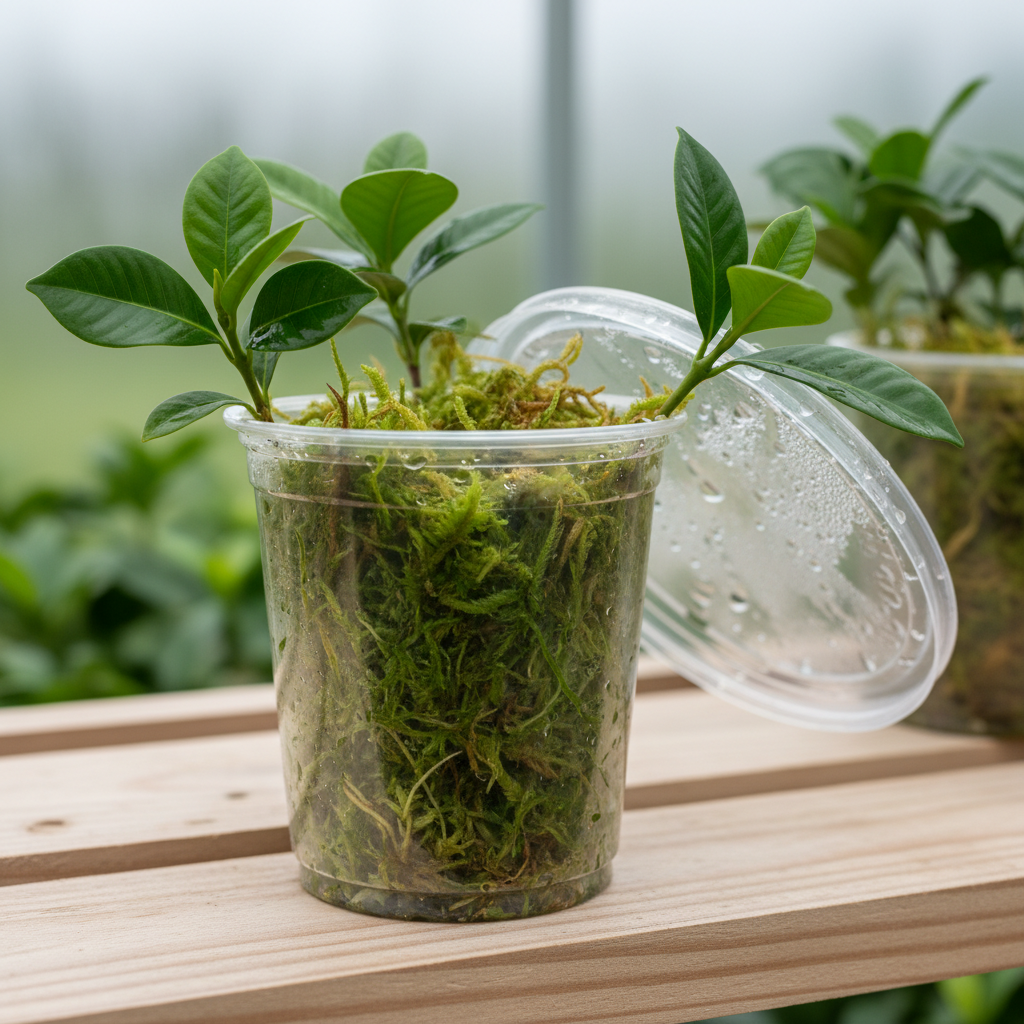
This is the method illustrated above, and the one most home growers will find easiest. The damp sphagnum holds even moisture without becoming soggy, and a clear lid creates the high humidity gardenias need to root.
- Sterilise a sharp knife or secateurs with isopropyl alcohol before each cut to prevent disease transfer.
- Select a healthy non-flowering stem from the current year’s growth, ideally 10 to 15 cm (4 to 6 inches) long with at least three nodes.
- Cut the stem just below a node with a clean angled slice, then strip off the lower two thirds of leaves, leaving two or three at the tip.
- Dip the cut end in rooting hormone powder or gel, tapping off any excess; gardenia is among the species that benefits noticeably from a rooting hormone.
- Soak a small handful of long-fibre sphagnum moss in tepid water, then squeeze out so that it is damp but not dripping.
- Place the moss in a clear plastic deli cup or zip-bag, nestle the cuttings into the moss so the bottom node is buried, and close the lid loosely to retain humidity.
- Keep the container in bright indirect light at 22 to 26 °C (72 to 78 °F); a heat mat under the cup speeds rooting considerably.
- Vent the lid for a few minutes every couple of days to refresh air and prevent mould; mist the moss lightly if it shows signs of drying.
- Roots typically appear within 4 to 8 weeks; once they are 2 to 3 cm long, pot up each cutting individually in a small pot of acidic mix and continue to keep humid for another month while it establishes.
Pro Tip — Bottom Heat Makes the Difference: A simple seedling heat mat set to 24 °C (75 °F) under your propagation cup can lift gardenia rooting rates from “occasional success” to “reliable”, particularly for cuttings taken in cooler months. Without bottom heat, room temperatures often dip too low at night for the cutting to maintain active root initiation.
Air Layering: Step-by-Step
Air layering is a higher-success alternative for growers who want to propagate a treasured specimen and have a stem long enough to commit. The cutting remains attached to the parent during rooting, drawing on its full resources, which dramatically improves the strike rate.
- Select a healthy semi-hardwood stem 30 cm (12 inches) or more in length, with a section of clean bare wood between two leafy zones.
- Using a sterilised blade, make a shallow angled upward cut 30 to 40 percent of the way through the stem, just below a node, and prop the wound open with a matchstick or small piece of toothpick.
- Dust the wound and the cut surfaces with rooting hormone powder.
- Wrap a generous handful of pre-soaked sphagnum moss around the wound, packing it so that it surrounds the stem evenly, then enclose the moss in a square of clear plastic film.
- Tie the film tightly above and below the moss with twine or wire ties, creating a sealed sleeve that traps humidity around the wound.
- Wait 8 to 12 weeks, checking through the plastic for the appearance of white roots in the moss; mist the moss occasionally if it starts to dry.
- Once a healthy root system is visible, sever the stem just below the new roots, remove the plastic, and pot the new plant in acidic mix with the moss intact around the root ball.
- Keep the newly potted layer humid and out of direct sun for several weeks while it adjusts to drawing all its moisture through its new roots.
Troubleshooting Propagation
| Problem | Likely Cause | Solution |
|---|---|---|
| Cutting goes soft and black at the base | Damping-off fungus from contaminated medium or too-wet moss | Discard, sterilise tools, restart with fresh sphagnum squeezed drier |
| Leaves drop within days of taking the cutting | Dehydration stress, often from low humidity or too much air movement | Tighten the lid, mist inside the cup, move out of any draughts |
| No roots after 10 weeks | Temperature too low, or cutting taken from a flowering stem | Add bottom heat, take fresh cuttings from non-flowering shoots |
| White fluffy mould on moss | Insufficient ventilation, possibly contaminated moss | Vent the cup daily for a week, scrape away mould; if it persists, repot in fresh moss |
Pests and Diseases
Stressed gardenias are pest magnets, and the indoor environment in which most are grown (warm, often dry, with limited air movement) is hospitable to most of the common houseplant pests. The good news is that early intervention is highly effective; the bad news is that a gardenia weakened by low humidity or wrong pH is unable to mount the chemical defences that healthier plants use to deter insects, so pests appear faster than they would on a thriving specimen.
Inspect your plant every time you water, paying particular attention to the undersides of leaves, the leaf axils where new growth emerges and the developing flower buds. A 10x hand lens is invaluable for identifying mites and tiny scale before populations explode.
Common Pests
Mealybugs (Pseudococcus longispinus)
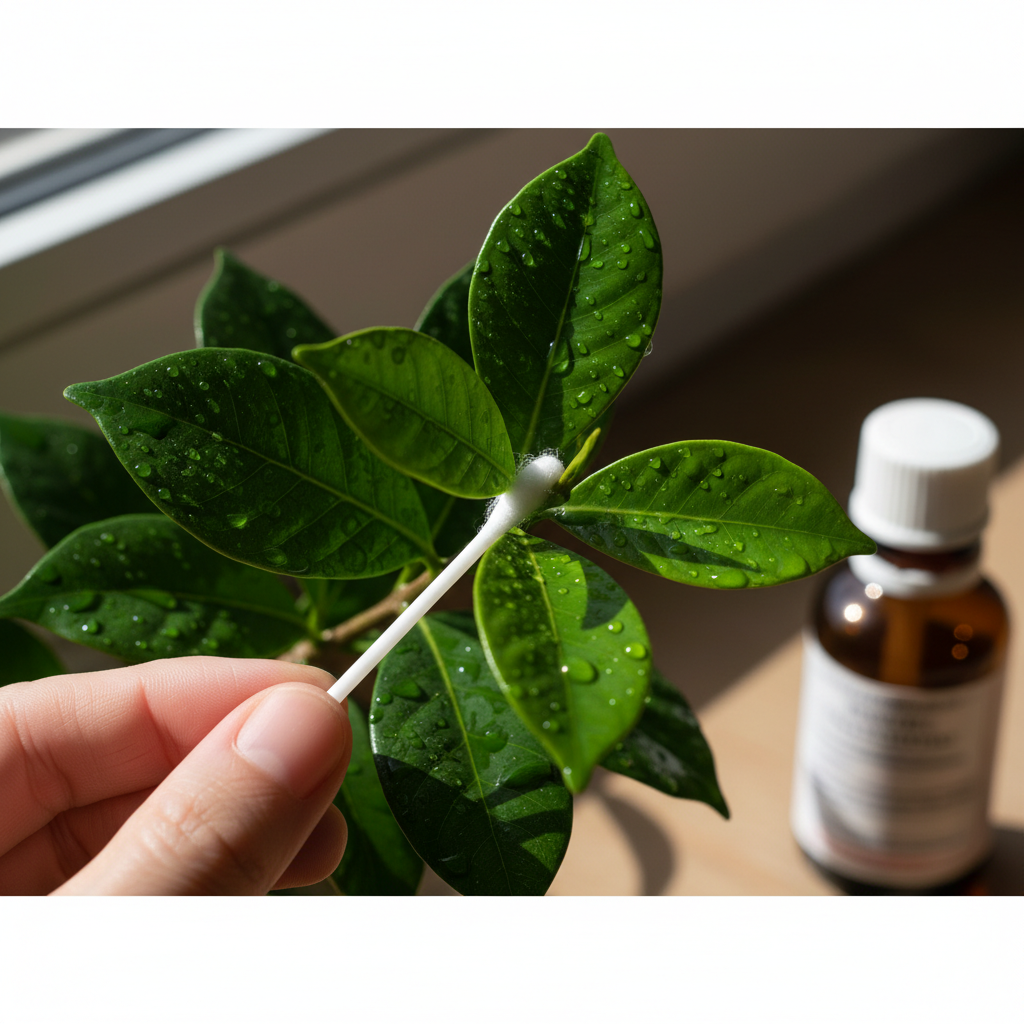
Mealybugs are slow-moving sap-sucking insects that look like tiny tufts of cotton wool tucked into leaf axils and along stems. They are particularly fond of gardenias and seem to congregate around the woody base and in the protected creases where leaves meet stems. Heavy infestations excrete sticky honeydew that supports sooty mould and gives the foliage a glossy sticky feel.
Treatment: For small populations, dab each individual bug with a cotton bud dipped in 70 percent isopropyl alcohol; the waxy coating dissolves on contact and the bug dies within minutes. For larger infestations, follow with a thorough spray of insecticidal soap or horticultural neem oil applied at dawn or dusk, repeated every five to seven days for three cycles to break the life cycle.
Spider Mites (Tetranychus urticae)
Spider mites thrive in the dry, warm conditions that gardenias actively suffer in, so an infestation is often the first sign that ambient humidity has slipped too low for too long. They are nearly invisible to the naked eye but produce telltale fine webbing in leaf axils and at branch tips, and the leaves take on a stippled silvery-grey discolouration where the mites have pierced individual cells.
Treatment: Begin with a thorough lukewarm shower of the plant, paying particular attention to leaf undersides, which knocks down adult populations physically. Follow with a miticide formulated for spider mites; insecticidal soaps and horticultural oils both work but need to be repeated every four to seven days for two to three cycles to catch newly hatched mites. Raising humidity above 60 percent ends the infestation faster than any product can on its own.
Soft Scale (Coccus hesperidum)
Scale insects appear as small flat brown or amber discs glued to leaf undersides, stems and along leaf midribs. They are easy to mistake for natural plant bumps, particularly on the woody main stem of an older gardenia. Like mealybugs, they secrete honeydew, and a sticky leaf or sticky surface beneath the plant is often the first clue.
Treatment: Scrape off as many adult scale as possible with a fingernail or the edge of an old credit card, then treat the entire plant with horticultural oil to smother the immature crawlers that escape physical removal. Three applications spaced a fortnight apart will normally clear a population entirely.
Whitefly (Trialeurodes vaporariorum)
Whitefly are tiny white-winged sap-suckers that cluster on the undersides of leaves and fly up in a small cloud when the plant is disturbed. They reproduce extremely quickly in warm indoor conditions, and a small population can become a major one within a fortnight. Leaves turn pale and the plant loses vigour as nutrients are sucked out.
Treatment: Yellow sticky traps catch the flying adults and provide an early-warning system. Combine with sprays of insecticidal soap or neem oil at five to seven day intervals to suppress nymphs on the leaf undersides. Heavy infestations may need a systemic insecticide such as imidacloprid as a soil drench, though this is best reserved for serious problems given the broader concerns about systemic neonicotinoids.
Common Diseases
Root Rot (Phytophthora and Pythium spp.)
Root rot is the most serious gardenia disease and the leading cause of unexpected collapse in otherwise healthy looking plants. Pathogenic water moulds thrive in waterlogged anaerobic soil and attack the fine feeding roots first. By the time foliage starts wilting and yellowing the plant has often already lost more roots than it can recover. A foul, slightly sweet smell from the pot is a giveaway.
Treatment: Unpot the plant immediately, wash the rootball gently with tepid water, and trim away every dark or mushy root with sterilised scissors. Repot in completely fresh acidic mix in a clean pot, water sparingly, and consider a phosphite-based fungicide drench (sold in horticulture as a root-rot preventative) to support recovery. Prevention through correct watering and free-draining mix is far more reliable than any treatment after the fact.
Sooty Mould (Capnodium spp.)
Sooty mould is not a true disease of the plant; it is a black surface fungus that grows on the sugary honeydew secreted by sap-sucking insects. The mould itself does no direct harm but blocks light from reaching the leaf surface, reducing photosynthesis and making the plant look unsightly. Its presence is a reliable indicator of an active insect infestation, most commonly scale, mealybugs or whitefly.
Treatment: Eliminate the underlying pest first, otherwise the mould will return within weeks. Once the pest is controlled, wipe the sticky residue and sooty deposit off each leaf with a damp microfibre cloth and a drop of mild dish soap, rinsing the cloth frequently. New growth will emerge clean.
Bud Drop (physiological disorder, not a pathogen)
Bud drop is the single most common complaint among new gardenia growers: the plant produces dozens of plump green buds, only to drop them one by one over a fortnight before any flower opens. It is not a disease but a physiological stress response, typically triggered by sudden changes in temperature, humidity, light or watering during the critical window when buds are sizing up.
Treatment: There is no fix once buds have dropped, but the next round can be protected. Once buds form, avoid moving the plant, adjusting its watering rhythm or transferring it between rooms. Hold ambient humidity above 50 percent, keep night temperatures between 15 and 18 °C (60 and 65 °F), and avoid placing the plant near radiators, draughty doors or air-conditioning vents. Patience is the main remedy.
Pest and Disease Summary
| Pest / Disease | Identification | Treatment |
|---|---|---|
| Mealybugs | White cottony tufts in leaf axils, sticky residue | Alcohol-dipped cotton bud, then insecticidal soap or neem oil |
| Spider mites | Fine webbing, stippled silvery leaves, very dry conditions | Lukewarm shower, miticide spray, raise humidity above 60 percent |
| Soft scale | Brown or amber discs on stems and leaf undersides, sticky leaves | Scrape off manually, follow with horticultural oil |
| Whitefly | Tiny white flies rising from disturbed plant, pale weakening leaves | Yellow sticky traps plus insecticidal soap or neem oil |
| Root rot | Wilting despite moist soil, foul-smelling roots, brown mushy root tips | Unpot, trim affected roots, repot in fresh mix, fungicide drench |
| Sooty mould | Black powdery deposit on leaves, always with honeydew underneath | Eliminate underlying sap-sucking pest, wipe leaves clean |
| Bud drop | Green buds yellow and fall before opening | Stabilise temperature, humidity and watering; do not move the plant in bud |
Prevention Strategies
The most effective preventative measure for an indoor gardenia is environmental: stable temperatures, generous humidity, the right light and a free-draining acidic mix together produce a plant strong enough to resist most problems before they take hold. Quarantining new plants for two to three weeks before introducing them to an existing collection catches the majority of pest introductions, since most issues arrive on a plant brought back from a nursery.
A weekly wipe of mature leaves with a damp microfibre cloth keeps dust off the foliage and gives you a regular close look at the plant from all angles. Yellow sticky traps placed unobtrusively beside the pot provide an early-warning system for flying insects, and a small inspection routine with a 10x hand lens every fortnight catches infestations while they are still on a few leaves rather than across the whole plant.
Pro Tip — Quarantine New Plants: Any new plant joining your collection, gardenia or otherwise, should be kept apart from your other plants for at least 14 days, ideally 21. Inspect it under a hand lens twice a week. This single habit prevents the great majority of collection-wide pest outbreaks and is far less work than treating an established infestation.
Popular Varieties
Gardenia jasminoides has been in cultivation in China for at least a thousand years and arrived in Europe in the eighteenth century, where Victorian glasshouse breeders set to work selecting for larger blooms, longer flowering periods and tighter growth habits. The result is a confusingly long list of cultivars, most of which differ only in subtle ways. The varieties below cover the spectrum from compact dwarfs suited to a small windowsill to vigorous growers worth a dedicated corner.
Almost every cultivar grown today is a selection of Gardenia jasminoides; the related Gardenia thunbergia and Gardenia taitensis (Tahitian gardenia or tiare) are seen occasionally but are markedly more demanding as houseplants. For indoor growing, the cultivars below are the ones worth seeking out.
| Variety | Leaf Appearance | Light Needs | Growth Rate | Availability |
|---|---|---|---|---|
| ‘Veitchii’ | Glossy mid-green oval leaves, dense habit | Bright filtered to bright indirect | Moderate | Very common |
| ‘August Beauty’ | Dark glossy green, slightly larger leaves | Bright filtered | Moderate to fast | Common |
| ‘Mystery’ | Large dark green leaves, open habit | Bright filtered to direct morning sun | Fast | Common |
| ‘Radicans’ | Small narrow lance-shaped glossy green leaves | Bright filtered | Slow | Common |
| ‘Frostproof’ | Glossy green narrower leaves, upright habit | Bright indirect | Moderate | Increasingly common |
| ‘Kleim’s Hardy’ | Smaller mid-green leaves | Bright filtered | Slow to moderate | Common |
| ‘Crown Jewel’ | Dense small dark green leaves | Bright filtered | Slow | Specialist |
| ‘Chuck Hayes’ | Glossy dark green, medium-sized leaves | Bright indirect | Moderate | Specialist |
Featured Varieties
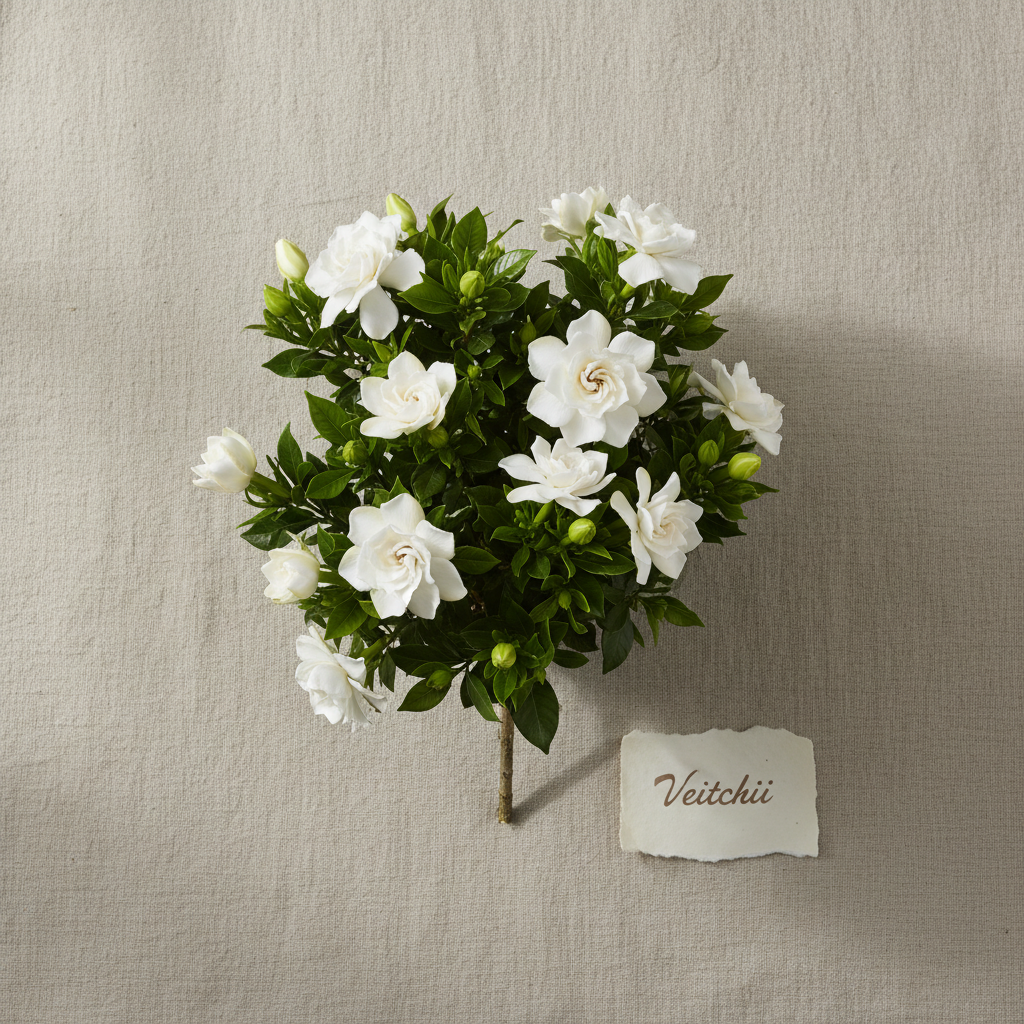
‘Veitchii’ (Everblooming Gardenia)
The most widely grown indoor gardenia, ‘Veitchii’ was introduced by the Veitch nursery of London in the late nineteenth century and quickly became the standard florist gardenia. It earns the everblooming name by producing repeat flushes from spring well into autumn under good conditions, with abundant fully double white blooms 5 to 7 cm across. Compact and naturally tidy, it tops out around 90 to 120 cm (3 to 4 feet) indoors and is the safest choice for a first gardenia.
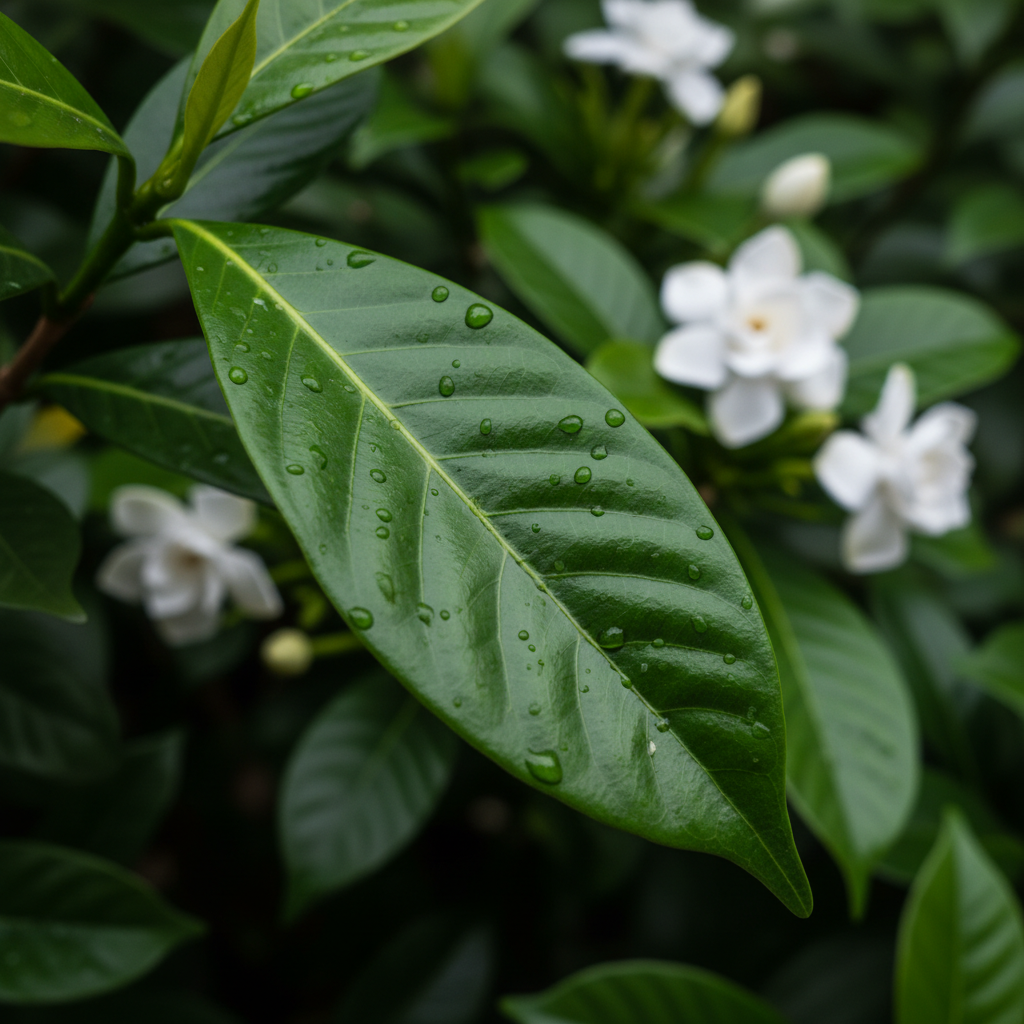
‘Radicans’ (Creeping Gardenia)
A low-spreading dwarf form rarely exceeding 30 cm (12 inches) in height but trailing 60 to 90 cm (2 to 3 feet) wide, ‘Radicans’ carries narrower lance-shaped glossy leaves and produces a profusion of small fully double white flowers 3 to 4 cm across. Its compact size suits small homes, hanging containers and shallow bonsai-style pots, and the trailing habit looks particularly elegant cascading over the edge of a shelf or windowsill.
Variety Profiles in Detail
‘August Beauty’ (Gardenia jasminoides ‘August Beauty’)
An American selection developed in the mid twentieth century, ‘August Beauty’ is prized for its unusually long flowering season, often beginning in late spring and continuing in waves through to the first frosts in cool climates. The blooms are large and fully double, with the classic creamy white colour, and the plant has a vigorous upright habit reaching 120 to 180 cm (4 to 6 feet) when given enough root run. Indoors it is a good choice for a sunroom or large window where it has space to spread.
‘Mystery’ (Gardenia jasminoides ‘Mystery’)
One of the largest-flowered cultivars, ‘Mystery’ produces double white blooms up to 10 cm across, with a strong gardenia fragrance. The plant has an open growth habit and can reach 150 to 200 cm (5 to 6.5 feet) outdoors in mild climates, somewhat smaller in containers. Its size and slightly less dense habit make it better suited to floor placement in a bright sunroom than to a windowsill, and it benefits from periodic light pruning to keep the canopy balanced.
‘Frostproof’ (Gardenia jasminoides ‘Frostproof’)
As the name suggests, ‘Frostproof’ was selected for unusually high cold tolerance, surviving temperatures down to about minus 9 °C (15 °F) outdoors. Indoors that cold tolerance translates to a forgiving plant happy on a cooler windowsill or in a less heated room. The narrow glossy foliage and tidy upright habit reach 120 to 150 cm (4 to 5 feet), and the medium-sized double white blooms are produced reliably even in cooler positions where other cultivars struggle.
‘Kleim’s Hardy’ (Gardenia jasminoides ‘Kleim’s Hardy’)
An unusual selection in that the flowers are single rather than double, with five waxy white petals around a yellow centre that gives the bloom a daisy-like silhouette quite different from the standard cultivars. The plant is compact at 60 to 90 cm (2 to 3 feet) and notably more cold-tolerant than ‘Veitchii’, making it well suited to slightly cooler indoor settings and to growers who prefer the simpler single-flower look.
‘Crown Jewel’ (Gardenia jasminoides ‘Crown Jewel’)
A compact and densely branched dwarf cultivar reaching only 60 to 90 cm (2 to 3 feet), ‘Crown Jewel’ produces medium-sized double white blooms over an extended season and is unusually disease-resistant for a gardenia. Its slow steady growth and good cold tolerance make it a strong indoor choice where space is limited but a full-sized plant is wanted in time.
‘Chuck Hayes’ (Gardenia jasminoides ‘Chuck Hayes’)
Bred for cold tolerance and reliable late-season flowering, ‘Chuck Hayes’ produces double semi-double creamy white blooms across a long flowering window, including a second flush in autumn that few other cultivars match. The plant reaches 120 to 150 cm (4 to 5 feet) with a rounded habit and glossy mid-green foliage. Its tolerance of slightly cooler conditions suits a bright but unheated conservatory or a cool bedroom window.
Choosing the Right Variety for Your Space
For a first gardenia in a typical centrally heated home, ‘Veitchii’ is the safest and most rewarding choice, with the broadest tolerance and the longest flowering season. If your space is small or you want a trailing habit, ‘Radicans’ is the obvious option. Growers in cooler rooms or with draughty older homes will get better results from ‘Frostproof’ or ‘Chuck Hayes’, both of which tolerate cooler nights without dropping buds. For a statement floor plant in a sunny corner, ‘August Beauty’ or ‘Mystery’ will reward the extra space with the largest and most fragrant blooms in the genus.
Frequently Asked Questions
Why are my gardenia buds turning yellow and dropping before they open?
Bud drop is almost always a stress response to changes in temperature, humidity, light or watering during the few critical weeks when buds are sizing up. The most common culprits are a swing in night temperature, dry air below 40 percent humidity, a sudden move to a new spot or an inconsistent watering rhythm. Once buds have dropped there is no recovery, but the next flush can be protected by stabilising every variable while buds are present and resisting any urge to move or repot the plant.
Why are my gardenia leaves yellowing with green veins?
Yellowing between the veins on younger leaves while the veins stay green is the textbook symptom of iron chlorosis, caused by soil pH that has drifted too high for the plant to absorb iron. Test the soil pH with an inexpensive probe; readings above 6.5 lock out iron almost entirely. Switch to rainwater or filtered water, apply a chelated iron foliar spray every fortnight for a month, and consider top-dressing with elemental sulphur or repotting in a fresh ericaceous mix to bring the pH back to the 5.0 to 6.0 range.
Can I grow a gardenia in a north-facing room?
A north window alone in the northern hemisphere is generally too dim to support consistent flowering, though the plant will survive there for a season or two. If a north room is your only option, supplement with a full-spectrum LED grow light for 12 to 14 hours a day, particularly through autumn and winter. A north room with a generous skylight is a different proposition and can work well, since overhead light is much stronger than the sideways light from a north window.
How often should I water my gardenia?
There is no single schedule that works year-round, because watering frequency depends on light, temperature, pot material and soil composition. Check the top 2 to 3 cm of the soil with a finger every couple of days and water when it feels just barely dry but still cool. In a warm sunroom in summer this can mean every two days; in a cool living room in winter it may be every week to ten days. The pot-weight test is the most reliable single indicator once you have grown the plant for a few months.
Are gardenia flowers really fragrant indoors, or just outdoors?
Indoor gardenias are intensely fragrant, often even more noticeably so than outdoor plants because the perfume is concentrated in the enclosed space of a room. A single mature plant in full bloom can perfume an entire living room, and even a few open flowers will fill a small bedroom with their distinctive scent. The fragrance is strongest in the morning and evening, and can occasionally be overwhelming in a small windowless space; if that is a concern, place the plant in a larger or more ventilated room when in bloom.
Do I need to prune my gardenia?
Light pruning encourages a denser, more compact habit and more flowers, since gardenia blooms primarily on new growth. Prune in late summer immediately after the main flowering flush ends, removing leggy branches and shortening the longest stems by a third. Avoid hard pruning in autumn or winter, as the plant will not put on new wood to replace what is removed until spring, and you will sacrifice a year of flowering. Always sterilise pruning tools with isopropyl alcohol between cuts.
Why does my gardenia keep losing leaves from the bottom up?
Lower leaf yellowing and drop is one of the most common gardenia complaints and can have several causes. The two most likely are overwatering (yellowing leaves are soft, the soil stays wet for days, the lower stem may feel mushy) and natural seasonal leaf turnover (the plant simply sheds its oldest leaves as new growth takes over). Inspect the roots for any sign of softness or smell; if these are present, treat for root rot promptly. If the roots are healthy, focus on watering rhythm and humidity.
Can I take my gardenia outside in summer?
Yes, and many gardenias actively benefit from a summer holiday outdoors in a sheltered shaded spot. The increased light, air movement and humidity often triggers a strong flowering flush. Acclimatise the plant gradually over a week or two, starting in deep shade and moving slowly to dappled morning sun. Bring it back indoors before night temperatures drop below 15 °C (60 °F) in autumn, and inspect carefully for pests before returning it to the rest of your collection.
My gardenia has not flowered for two years. What am I doing wrong?
Repeat non-flowering almost always points to either insufficient light or an absence of the cool night drop the plant relies on to set buds. Begin by measuring the daily light at the plant’s position with a smartphone lux meter; if the brightest reading is below 5,000 lux, light is the bottleneck and you should move the plant closer to a window or add a grow light. If light is adequate, check night temperatures with a min-max thermometer at the plant’s position; consistent night readings above 21 °C (70 °F) inhibit bud initiation, and many homes simply run too warm in the evenings to suit a gardenia.
Is gardenia safe to keep around pets?
Gardenia is listed as mildly toxic to dogs, cats and horses by the ASPCA. The iridoid glycosides in the foliage can cause vomiting, diarrhoea, hives and mild lethargy if ingested in any quantity. Cats are particularly likely to chew at glossy houseplant leaves, so place gardenias out of reach on shelves, hanging stands or high tables, and clear up any dropped petals or leaves promptly. Most ingestion events are mild and resolve without veterinary intervention, but contact a vet immediately if symptoms are severe or persistent.






